Thursday, September 11, 2014

Xi Jinping’s new Silk Road – India needs to be wary

My article Xi Jinping’s new Silk Road – India needs to be wary appeared in NitiCentral. 

Here is the link...

For India, ‘The Maritime Silk Route’ is a rather vague proposal, which can’t make Delhi forget China’s assertive moves, particularly the network of military bases and commercial facilities along important sea lines of communication, from the Chinese mainland to Africa.

President Xi Jinping will soon be arriving for his maiden visit to India. While in Delhi, he is bound to raise one of his pet projects — the New Silk Road.
During a visit to Kazakhstan in September 2013, the Chinese President for the first time spoke of the New Silk Road. He called it an ‘economic belt’. A month later, during an ASEAN meet, he unveiled a 21st century ‘Maritime Silk Road’ plan. For Beijing, there are various ideological and economic reasons for reopening these terrestrial and maritime routes.
According to Xinhua news agency, President Xi’s proposal of ‘one belt and one road’ brought “a new connotation for the old Silk Road, and new vibrancy for the cooperation among pan-Asia, Asia and Europe.”
Beijing believes that their new strategy will help in reproducing the spirit of the old route while promoting economic cooperation, cultural exchanges and friendly relationships.
What was the Silk Road? Wikipedia explains:
“It is a series of trade and cultural transmission routes that were central to cultural interaction through regions of the Asian continent connecting the West and East by linking traders, merchants, pilgrims, monks, soldiers, nomads, and urban dwellers from China to the Mediterranean Sea during various periods of time.”
The 6,437 km route got its name from the business in Chinese silk carried out by intrepid traders as earlier as the Han Dynasty (206 BC – 220 AD).
The most renowned part of the ‘route’ was the Central Asian section; the Chinese emperors always took great interest in the safety of this portion.
For centuries, the mythic Silk Road had witnessed, with no hindrance, a flow of goods, technologies, philosophies and religions. The civilisations of China, India, Persia, Europe, and Arabia greatly benefited from the safety of the Central Asian roads.
Buddhism and other Indian cultural and spiritual achievements transited through this route. In June 2014, the corridor of the Silk Road between Xian and Tianshan, the mountain range in Central Asia was even acknowledged by UNESCO as a World Heritage Site.
The new project is so dear to President Xi that The People’s Daily (PD), the mouthpiece of the Communist Party of China recently celebrated the ‘renaissance’ of the route by holding grand functions in Beijing, Xi’an, and Quanzhou. The daily announced:
“Two reporting teams consisting of more than 60 journalists, celebrities, opinion leaders will work along the Silk Road economic belt starting from Xi’an, and the Maritime Silk Road from Quanzhou respectively for about two months.”
The Chinese Government used three keywords to define the new project.
The first word is ‘Connection’: For Beijing, the concept of revitalising the ‘Silk Road’ is not only for economic development or due to globalisation, it is also is an important component of the ‘Chinese Dream’.
The second keyword is ‘inheritance’. China feels that compared with the old Silk Road, the New Silk Road’ extends both in space and time:
“Ways of transportation have changed …while the warmth and amity of wayfarers have been inherited from generation to generation.”
The third key word is ‘Record’, Beijing wants the world to ‘record’ that Xi’an is a big city with blooming scientific research, education and industries; and Quanzhou, the ancient ‘City of Light’ of Marco Polo, an important centre of development in modern China.
China also wants to build a ‘Maritime Silk Road’ (MSR).
Beijing asserts its need to boost ties with port cities in Asia through a ‘Maritime Silk Road’ starting from Fujian province and linking all the littoral countries of the region.
When Chinese Special Representative Yang Jiechi met his Indian counterpart, National Security Adviser Shivshankar Menon for ‘border talks’ in New Delhi in February 2014, Yang conveyed an invitation for India to join the MSR.
According to the spokesperson of the Ministry of Foreign Affairs, Hua Chunying:
“The purpose is to integrate all kinds of ongoing cooperation especially cooperation on connectivity in the spirit of (ancient) silk road so that they can connect with each other and promote each other and accelerate regional countries’ common development.”
For India, it is a rather vague proposal, which can’t make Delhi forget China’s assertive moves, particularly the network of military bases and commercial facilities along important sea lines of communication, from the Chinese mainland to Africa.
India is seriously concerned by the strategic Chinese bases in Pakistan, Sri Lanka, Myanmar, Bangladesh and the Maldives. The concept of a ‘String of Pearls’ (a term long ago coined by the US Department of Defence) is no longer in the realm of ‘ideas’, it has become a worrying reality for Delhi.
Another question that Narendra Modi will have to take up with Xi: while China is wooing India to join the Silk Road journey, is Beijing really serious to open trade and cultural exchanges across the Himalayan barrier?
One of the objectives of the new railway line linking Lhasa to Shigatse is to connect South Asia to the Silk Road.
Yang Yulin, deputy director of the railway office of the Tibet Autonomous Region (TAR) government announced that during the 13th Five-Year Plan (2016-2020) period, the construction of a railway connecting Shigatse with Kyirong in northern Nepal and with Yatung, in the Chumbi Valley between India and Bhutan, will start.
But while Beijing speaks of a link between the New Silk Road and South Asia, the Chinese leadership has systematically refused to open up the old Himalayan routes, particularly for the Kailash/Manasarovar yatra.
When Prime Minister Narendra Modi raised the issue of opening an alternate route for the pilgrimage during his meeting with Xi Jinping during the last BRICS summit, the Chinese president remained silent.
During his recent visit to J&K, the Ladakh Autonomous Hill Development Council (LAHDC) presented the PM a memorandum requesting the reopening of the Demchok road as an alternative route to Kailash/Mansarovar:
“Demchok in Ladakh provides the easiest and the safest access to Kailash Mansarovar. From here pilgrims can approach the holy mountain and the sacred lake in two days. This would also give the much needed fillip to the local economy.”
It appears that Beijing has again vetoed the project.
Why then try to entice India into a New Silk Road project when all the passes to Tibet and Xinjiang (the main traditional pass was the Karakoram pass, near the disputed Depsang Plains) remain closed?
The next logical step would be to progressively reopen Himalayan passes to trade and human exchanges (and why not to tourism), and once the Himalayan belt has recovered its vitality, India could think of participating in projects such as the New Silk Road.

Wednesday, September 10, 2014

Xi Jinping's spouse praising Tibet


I am reposting here an old piece on Xi Jinping (then Vice-President), his wife Peng Liyuan ...and Tibet.
The video shows Peng Liyuan praising Tibet, something she may not do while in India.
Today, The Hindustan Times consecrates an article to Mrs. Peng,explaining:
"Peng became a household name after she performed on China Central Television, China’s national broadcaster, during the Spring Festival, or Chinese New Year, gala programme in the early 1980s. The yearly programme which is still popular is viewed by millions every year. Earlier this year, Forbes magazine named her the 57th most powerful woman in the world, comparing her to Michelle Obama." 
Of course, since her husband has become China's strong man, her rating has considerably improved.
The Hindustan Times quotes Forbes describing her:
"Parallels between China's First Lady Peng Liyuan and her U.S. counterpart, Michelle Obama, include their sharp sense of style, prominence on the global stage, and commitment to their nation's health and education.” 
The daily adds: "She is also known to use China-made accessories like clutch bags rather than opt for MNC brands Her sense of dressing has also caught the eye of both the media and common Chinese citizens, with many commenting favourably on her style."

The South China Morning Post describes her thus:
"Peng appears to like structured clothing. Tailored jackets, nipped in at the waist, seem to have become a favourite of hers. She also likes modernised Chinese qipao dresses, Chinese floral motifs and mandarin collars - a stylistic statement and a strong visual theme for her brand of ‘soft power." 
As India has no First Lady, who will take her around, when Modi and her husband discuss the future of the Sino-Indian relations?
Wait next week for the answer.

Monday, September 8, 2014

Could Tibet be defended?

Harishwar Dayal, PO in Sikkim (here with Lowell Thomas)
I am posting here an interesting note from Harishwar Dayal, the Political Officer in Sikkim between 1948 and 1952.
The note dates from the early months of 1950.
Dayal answers some points made by K.M. Panikkar, the Indian Ambassador to China.


TIBET
SECRET

I have had the advantage of seeing Sardar Panikkar’s note on our attitude to Tibet.
The main points in the note are these.
i.    China will invade Tibet. Invasion is not difficult. Tibet has no chance of successful resistance and will be overrun.
ii.     We have no legal right to intervene. We have never regarded Tibet as independent. The contention that Chinese suzerainty should be dependent on Chinese recognition of Tibetan autonomy was never accepted by China. If China decides to make her sovereignty effective we cannot interfere as long as our treaty interests, trade rights and boundary are respected. Any intervention on our part would be regarded as aggression.
iii.    Political intervention would also be futile. To incite the Tibetans to resist would serve no useful purpose.
iv.    The Peking Government has not repudiated pre-1946 treaties. When China overruns Tibet, our political interests will go, but our trading rights may be preserved as China will not be able to develop trade with outlying provinces for some time.
v.    The wisest course for us to take is to be vigilant, to give such help to Tibet as we can now, to be strictly neutral when the war comes and to resume diplomatic relations with China as soon as possible so that we may be able to guard our interests as far as we can.
I think most of these arguments and conclusions are incontrovertible. But I should like to draw attention to certain matters which perhaps are not made very clear in Sardar Panikkar’s note.

THE LEGAL POSITION:-
Apart from the trade regulations of 1908, framed under the treaty of 1904, there is – as far as I know – no agreement signed by China, India and Tibet together. All other treaties and conventions have been either between India and China (the Chegoo Ceonvention of 1876, the convention of 1890, the Anglo-Chinese Convention of 1906) or between India and Tibet (the Treaty of 1904, the Simla Convention of 1914). At Simla in 1914 the Chinese representative initialed the agreement, but the Chinese Government repudiated it. On the other hand, Tibet has repudiated our agreements with China (Convention of 1890, Trade Regulations of 1893, the Convention of 1906).
The Chinese have always claimed at least suzerainty with no qualifications or conditions, the Tibetans have always claimed independence but have been prepared at times. To recognize Chinese suzerainty if China would recognize Tibetan autonomy and agree on a boundary (e.g. in 1914 and again in 1934) and India has generally recognized Chinese suzerainty but in 1943 declared that this was meant to be conditioned on Chinese recognition of Tibetan autonomy.
Generally, India has acted as if Tibet were a sovereign State to the extent of being capable of making treaties and entering into relations with other powers.
If, therefore, China is the unconditional suzerain of Tibet, then it follows that Tibet had no right to make treaties with India, at least without Chinese participation or consent and accordingly all our agreements with Tibet, including the Simla convention of 1914 which defined the boundary (the Mac Mahon line) are invalid, with the solitary exception of the trade agreement of 1908. China, from her own point of view, might refuse to be bound by any of these treaties. An indication of this attitude is that in 1928 the Nanking Government ignored the 1914 Convention and referred back to the Convention of 1906 in proposing a new treaty between China and India about Tibet. If, as is suggested, our recognition of communist China is unconditional and merely assumes that existing relations will continue, China may well refuse to be bound by the treaties with Tibet to which she was no party.

THE MORAL POSITION:-
There is no legal obligation on the part of India to defend Tibet, if attacked, for there is no treaty of mutual defence. There is not even a moral obligation, for in 1935 Williamson was instructed to make it clear that Tibet, in the event of trouble with China, would have only our diplomatic support so far as was justified by the merits of the case. But the Tibetan Government were given three specific assurances:-
(1)    That Tibet would be treated as an autonomous country in practice, although the theoretical suzerainty of China might be admitted;
(2)    That we should deal with Tibet direct;
(3)    That Tibet would have diplomatic support in case of trouble with China on merits.
In 1940, when the Chinese Foreign Minister told the British Ambassador that China would not interfere in the development of Tibet along her own lines, this was communicated to the Tibetans with the assurance that if the Chinese went back on the promise Tibet would have support.
There is, thus, a clear moral obligation on our part to use diplomatic means to preserve Tibetan autonomy.

THE POLITICAL POSITION:-
Sardar Panikkar thinks we should cease to regard Tibet as a buffer State.
One of the great advantages of India in the past has been not only that its land frontier is protected by almost continuous ranges of high mountains, but also that beyond lay a chain of comparatively small States, none of which was likely to be a serious danger to the peace or integrity of the country and which cushioned India from the impact of the great Powers which are beyond. It was our policy, accordingly to keep on friendly terms with these States, to help them and to preserve their internal peace and independence and to ex clued form them as far as possible rival Powers. The revival of China is now likely to bring us into immediate contact with her on the Sinkiang and Tibetan frontiers; and if Communism establishes itself in the small States of South-East Asia- (which is by no means unlikely) we shall find ourselves surrounded on land by a solid ring of Communist countries which will follow a concerted policy in foreign affairs.
A country is most secure when no other country can easily invade it. That was the position of Great Britain to a certain extent and of the United States. But the advantages of insularity have been largely neutralized by the development of air power. The next most effective guarantee of safety is to have a belt of friendly small States between a country and its most powerful neighbours. That was the position of India and of Turkey as regards Austria, Germany and Russia. The next is to have two powerful neighbours who are suspicious of each other, so that in the event of war it can have an ally and the enemy may have to fight a war on two fronts. France in the 18th century and Germany in the 20th when they became aggressive had to fight on several fronts.
If we lose our armour of friendly small States, of which Tibet is one, we shall find ourselves everywhere on land in direct contact with the two great States of Russia and China and, as a common ideology connects these two, we shall have in effect one enormously powerful State on all or nearly all our land frontiers. It is possible that it may not wish to attack us, but there is little doubt that it will wish India also to become Communist and will use all methods short of war to achieve that object.
The absorption of Tibet into Communist China is not, therefore, a matter which we can contemplate with indifference or even equanimity. If a war should break out, the enemy will be at our very doors and our friends, if any, will be far away.

OUR COURSE OF ACTION:-
At the same time it is not easy to see what effective action we can take. It would perhaps be better to discuss separately what we should do (1) immediately, (2) if and when the Chinese invades Tibet.

IMMEDIATE ACTION:-
Tibet is asking for a fresh treaty and an open recognition of her independence. Neither of these seems wise. She is also asking for arms and training for her troops. In the past, we have given arms and also training, but the arms have been small in quantity and the training largely ineffective. Even with these, it is not likely that Tibet will be able to offer successful resistance. On the other hand, if the Tibetan army has some fighting strength, it is possible that the Chinese may be content with Tibetan adhesion to the Republic and may refrain from invasion and subversion of the Tibetan Government and political system. This, of course, assumes that Tibet will be prepared to agree to these terms. Nor should it be forgotten that we have always encouraged Tibet to regard us as friends; and, if we quietly abandon her without an effort in her hour of need, it will be difficult for any of any small State to have confidence in our promises or professions of friendship. We should, therefore, give such help in arms as we can give, within reason, and use our diplomatic influence with China to get her the best terms possible.
Assuming that Tibet becomes a part of China, we have to look to our own frontiers. The independence, security and defence of Nepal become immediately a matter of primary importance to us. I find that a new treaty with Nepal is being negotiated. I haven’t seen its terms, but I think it is vital that there should be some provision for mutual defence, which does not exist in the 1923 Treaty. Next, we should effectively occupy the country south of the Mac Mahon Line. I do not know to what extent this has been done.
It should be remembered that China at least once invaded Nepal and by the peace of 1792 Nepal acknowledged Chinese suzerainty and undertook to pay tribute and not long ago China again showed a good deal of interest in Nepal. If Tibet goes the door will be wide open.

ACTION IF THERE IS INVASION:-
Active defence of or help to Tibet in the event of an invasion would be both futile and dangerous. It would develop into a war between India and China with unpredictable consequences. But we should protect diplomatically and keep a watch on the frontier.
In case Tibet proclaims her independence and China refuses to recognize it, there may be a reference to the U.N. It is difficult to see what effective action U.N. can take; and condemnation without enforcement would only discredit it. The Korea and Abyssinia cases in the old League are a warining.

GENERAL CONSIDERATIONS:-
The defence of India is now a much more difficult matter than it was fifteen or twenty years ago. Then India included Pakistan and Burma; Ceylon and Malay were also parts of the same Empire; Afghanistan and Tibet were friendly; our long and exposed sea coast was protected by the British Navy; China, our nearest large neighbor, was weak and disunited and Russia, the other, was still reorganizing herself. All this has changed. Pakistan is independent and unfriendly. Ceylon and Burma are independent. China and Russia are strong and will follow a common policy. Apart from Malay and Hong Kong, both threatened, Britain has no possessions in the Indian Ocean. Western Powers have lost control of their colonies, but the result has been civil war – in Burma, Indo-China and Indonesia – which is a fertile breeding ground for Communism - and Communism means alignment with Russia and China.
Even under the old order, the rapid progress of Japan showed how feeble were the defences against a well organized and determined foe. The present situation calls for a well-considered (not, of course, inelastic or inflexible, but not merely opportunist) policy and well planned execution.

Friday, September 5, 2014

Mingling and Marrying

In June, I reported on this blog the new Chinese policy of 'Ethnic Mingling in Xinjiang and Tibet'.
Now, Beijing has decided to take the next step.
According to The South China Morning Post (SCMP),  a county in Xinjiang offers 10,000-yuan reward for Uygurs to marry Han Chinese.
The Hong Kong daily reports: "No takers so far for largely Uygur area's cash rewards for inter-ethnic weddings to promote integration; academic doubts they will work".
Perks and other cash incentives have been introduced to encourage people from 'ethnic minorities' (i.e. local Uygurs)  to marry members of the Han 'majority'.
After registering their marriages, 'inter-ethnic couples' in Cherchen county (under the the Bayin'gholin Mongol Autonomous Prefecture of the Xinjiang Uyghur Autonomous Region), can apply for a 10,000 yuan (US $1,600) annual allocation.
The local administration will also contribute 90 per cent of each 'mixed' family's medical expenses, not covered by existing government insurances.
According to the new rules, payments will be made each year, up to five years, ... if the marriage remains 'harmonious'.
A county official told SCMP: "Our major consideration was to stabilise Xinjiang and promote cultural integration among different ethnic groups."
Cherchen county, bordering the Tibet Autonomous Region, is apparently the first county in Xinjiang to try the new scheme. The average annual rural income of farmers is 7,400 yuan.
On top of the cash incentives, the local administration has promised education and health care subsidies to the couples and their children.
Today Cherchen county has a population of 100,000, out of which 72 per cent are Uyghur and 26 per cent Han.
An official however admitted that no new union had been registered since the scheme is in place.
In the June post mentioned above, I mentioned that Chen Quanguo, the Party Secretary in Tibet had also started promoting inter-marriage between Tibetans and Hans.
But no cash as yet for the Tibetans.
In the meantime, China Tibet Online reported a group wedding held in Lhasa on September 2.
Believe it or not, the 2014 Tibet Holy Wedding was sponsored by the Tourism Bureau of Tibet Autonomous Region.
The package tour (honeymoon included) will last 12 days from August 31 to September 11.
Apparently 15 Chinese couples from the mainland, have registered.
China Tibet Online says: "The wedding kicked off when the guests presented Hada [khata] to the new couples. Then, the bridegroom inserted a color arrow into the back of bride's clothes, with the meaning that the bride will belong to the bridegroom in all their lives. Next, the couples offered respectful chemar(a box containing Tsampa), drunk highland barley wine [chang] and accepted blessing of the living Buddha [rinpoche]".
A couple told the reporter: "We come to Tibet together, hoping to express the pure love to each other in this sacred place and leave the most beautiful memory in the life."
Amazing!
At the same time in Xinjiang, the police experimented a new type of 'anti-terrorism' electric patrol car, which could be seen in the streets of Urumqi.
The electric-powered car is fitted with advanced equipment such as police searchlight and real-time monitoring device.
The carrot and the stick, in other words.
What about if a Chinese girl marry a 'terrorist' local boy?
No answer as yet to this question.

Thursday, September 4, 2014

The new Route for Kailash: a boon for Indians?

As New Delhi prepares to receive President Xi Jinping for his maiden visit to India, PTI reported that, as a ‘political gesture’, the Chinese President will announce the opening of a new route for Indian pilgrims wanting to go on the Kailash/Mansarovar yatra.
The question which needs to be asked: is it a ‘great gesture’ from Beijing or only a self-serving one?
According to the Indian news agency, the proposal has been under serious consideration: “All announcements including the quantum of investments China plans to make in India are expected to be announced during Xi's visit.”
At their first meeting in Fortaleza in Brazil in July, Prime Minister Narendra Modi had requested Xi to offer an alternative to the Lipulekh pass in Pittoragarh district of Uttarakhand for the Kailash yatra.
Either Demchok in Ladakh, or Shipki-la in Himachal Pradesh was expected to be the new port. It made sense in terms of access and 'comfort'.
The present Lipulekh-Purang route, also one of the traditional trade routes to Tibet, is often damaged by floods and the yatra has subsequently to be canceled.
Depending on the weather, the MEA yatra can take, every year, a  maximum of 1,000 pilgrims in 18 batches (selected through a lottery system). The pilgrimage involves a 22-day arduous journey.
It appears that the Chinese have now decided to open Nathu-la border point in Sikkim. PTI says: “The new route, though longer, takes pilgrims from Nathu La to Shigatse … [and] from there the pilgrims could comfortably travel to Mansarovar and Kailash using well laid out highway.”
It is obviously the Chinese argument.
The news agency adds: “It would be part of the big gesture of friendship not only to strike chord with Modi but also the people at large, specially the Hindus and Buddhists considering its religious importance.”
But is it a gesture of friendship or a decision driven by self-interest?
The Chinese foreign ministry told PTI that “lodging and boarding facilities for pilgrims have been improved with new hotels and additional beds with additional investments. Pilgrims also can have access to over 2300 vehicles.”
The Chinese foreign ministry asserted: “Indians pilgrimage to Tibet is an important content of bilateral relations. China's willingness is in accordance with the spirit of the agreement which has been signed by both parties...”
In article published in Rediff.com last month, I mentioned China’s interest in Sikkim (and Nathu-la).
I wrote: “More surprisingly, Yang [Yulin, deputy director of Tibet's railway office] announced that during the 13th Five-Year Plan (2016 to 2020) period, the construction of a railway connecting Shigatse with Kyirong in northern Nepal and with Yatung, in the Chumbi Valley -- located between Sikkim and Bhutan - will start.
I then questioned: “Kyirong is a logical extension of the line as China has extensively invested in this landport to make it the main link between Tibet and Kathmandu, (and economically invade Nepal), but why Yatung, at the bottom of Nathu-la? The border trade between India and Tibet is minimal.”
It is clearer now why Beijing is ready to offer to open Nathu-la for the yatris.
A few months ago, Wang Chunhuan, a professor at the Tibetan Academy of Social Sciences in Lhasa told The Global Times that the railway network in Tibet will play the role of a continental bridge in South Asia and promote economic and cultural exchanges with the subcontinent.
For China, the Yatung-Nathu-la-Gangtok route could become a trade gate to South Asia. But why should pilgrims take this extremely long route (see map) to visit the holy pilgrimages of Western Tibet?
For China, if they want to open the trade route with South Asia, it is undoubtedly a win-win proposition. But for India, opening Shipki-la (already opened for petty trade) or Demchok would be far better.
But does Delhi have a choice in this matter?
The government can however refuse the dumping of cheap Chinese goods via Yatung and Nathu-la. 

Here is my rediff.com article.

Why do the Chinese want a train to Sikkim?

China is spending billions of dollars to improve infrastructure in Tibet and other parts of its border with India. Claude Arpi explains why New Delhi can't afford to ignore Beijing's plans.

India dreams to catch up with China in infrastructure.
Whether it is highways, bullet trains or airports in remote corners of the Middle Kingdom, China is way ahead compared to India which struggles to develop a decent infrastructure, particularly in the Himalayas.
But the Communist leadership in Beijing is apparently not satisfied. It wants to increase the pace of its own development, especially on its borders with India.
Xinhua announced that Beijing was soon to upgrade the road network in Tibet 'to make travels on The Roof of the World much easier.'
For whom, is the question!
The Chinese transport ministry affirmed that China will expand its road network to 110,000 km by 2020 in the Tibetan Autonomous Region alone.
That is not all, according to Xinhua, China plans to complete a network of railways of 1,300 km by the same year (the end of the 13th Five-Year Plan).
China will also build several new airports in Tibet.
In all, over $13 billion (Rs 79,495 crore) have been invested in transportation in the last 20 years in Tibet.
So, why should India be worried?
The ministry itself acknowledged that the development of transport in Tibet was 'crucial to China's national security... and the lasting prosperity in the autonomous region.'
'National security' in Tibet means the strengthening of the borders with India.
The Global Times recently published a report 'Sky rail to run from Lhasa to south Tibet; further railway expansion to connect Nepal, Bhutan, India by 2020'.
It announced that the railway linking Lhasa and Shigatse (poetically called by China as the 'closest stretch of railway to the sky') will be opened to traffic in August.
The construction of the extension of the Qinghai-Tibet Railway, which started in September 2010, will be 254 km long and have 13 stations. Trains will be able to run at a speed of 120 km per hour and will take only two hours from Lhasa to Shigatse, the seat of the Panchen Lama's and Tibet's second largest city.
According to Yang Yulin, deputy director of Tibet's railway office, it is the largest infrastructure project in the region during the 12th Five-Year Plan (2011 to 2015), with an investment of more than $1.7 billion.
Zhu Bin, a manager at a mineral company based in Lhasa, told The People's Daily that 'it will accelerate transportation of the mineral products, which could only be transmitted through highways that often risk being cut off during rainy seasons or see vehicle turnovers.' That is certainly one of the train's objectives
A Tibetan writer based in Lhasa, told the Communist newspaper that the railway will help local Tibetans to 'exchange with the outside world and tourists will be attracted to the area.'
It is obvious that China is not investing billions of dollars for the Tibetans to 'see the outside world.'
The train to Shigatse has three purposes: One, to bring more tourists, Tibet's main source of revenue (15 million will visit Tibet in 2014); two, to take minerals to the mainland to feed the economic machine and three, to 'strengthen' the borders with India by allowing quick movement of troops and armament.
More surprisingly, Yang announced that during the 13th Five-Year Plan (2016 to 2020) period, the construction of a railway connecting Shigatse with Kyirong in northern Nepal and with Yatung, in the Chumbi Valley -- located between Sikkim and Bhutan -- will start.
Kyirong is a logical extension of the line as China has extensively invested in this landport to make it the main link between Tibet and Kathmandu, (and economically invade Nepal), but why Yatung?
The border trade between India and Tibet is minimal.
Despite the great hopes generated in 2006, when Nathu-la was trade opened between Yatung and Gangtok, the border trade has been stagnating (partly due to the restricted list of items allowed to be traded).
Wang Chunhuan, professor at the Tibetan Academy of Social Sciences in Lhasa told The Global Times that the railway network in Tibet will play the role of a continental bridge in South Asia and promote economic and cultural exchanges.
Does it mean that China would like to open the Yatung-Nathu-la-Gangtok route in a big way?
Has Beijing consulted Delhi on this or is it a unilateral decision?
The Global Times quotes Liu Zongyi, a Chinese expert on India at the Shanghai Institute for International Studies, saying that 'Indians have lately been working on adding infrastructure in the South Tibet region, in order to strengthen control.'
Southern Tibet is the Chinese name for Arunachal Pradesh!
Liu explains it is a bargaining chip.
If people on the Chinese side of the South Tibet region (Arunachal Pradesh) see better economic development in south-western Tibet (Shigatse and Ngari) they will be tempted to join the People's Republic.
This is, of course, a Chinese dream; it will never happen. But the move towards Yatung is indeed a bargaining chip at another level.
'The growing railway network will increase Chinese activities in this area,' Liu admits, 'balancing Indian moves.'
China is nervous about India raising a 'Mountain Strike Corps', the XVII Corps, with its headquarters at Panagarh in West Bengal, not too far from Sikkim (and Yatung).
When fully operational (by 2018-2019), the Corps, costing some Rs 64,678 crore to Indian tax-payers, will have 90,274 troops.
The Corps will be spread on the 4,057-km Line of Actual Control from Ladakh to Arunachal Pradesh; it will have two high-altitude infantry divisions (59 Div at Panagarh and 72 Div at Pathankot) with their integral units, two independent infantry brigades, two armoured brigades.
It will also include 30 new infantry battalions and two Para-Special Forces battalions.
Incidentally, the projected railway line to Yatung perhaps explains the inflated size of the Chumbi Valley in newly-published Chinese maps. Huge chunks of Bhutanese territory have been engulfed in the Chumbi Valley.
Also important to India is the railway linking Lhasa to Nyingchi Prefecture, located north of the McMahon Line, which is expected to start in a few months. It is also part of the 13th Five-Year Plan.
The recent heavy traffic of Communist VIPs/VVIPs from Beijing visiting Ngari (Western Tibet) is probably due to Beijing's decision to consolidate its borders; namely the frontiers opposite Ladakh.
Last month, China Military Online reported that General Xu Qiliang, a member of the Politburo and one of the two powerful vice chairmen of the Central Military Commission, inspected the area.
According to an official military Web site, 'Xu Qiliang recently (it is not disclosed when) inspected the troops of the People's Liberation Army and the People's Armed Police Force garrisoning Xinjiang and Tibet.'
'During the inspection, General Xu Qiliang visited the officers and men in frontier areas, and held talks with the leaders of the troop units garrisoning in Hotan (Xinjiang, near the Aksai Chin), Ali (Ngari or Gar) and Lhasa (in the Tibetan Autonomous Region) areas to discuss the development and reform of frontier troop units.'
Xu also met sentries of a frontier defence company at Shenxianwan (just north of the Karakoram Pass and the Depsang Plains): 'The troops were performing their duties at the altitude of 5,380 metres.'
The general went to the barracks of the Khurnak Fort frontier (opposite the Indian troops in Ladakh, north of the Pangong lake) defence company and Banmozhang (near Sirijp on the Pangong lake where many incursions have taken place) 'to inspect a water (speed-boats) squadron and inquire about the soldiers' work, study and life.'
There is no doubt that Xi Jinping will make sure that China is ready in case of a conflict with India. He will also be in a strong bargaining position if Prime Minister Narendra Modi decides one day to discuss the border issue.

Wednesday, September 3, 2014

Tibet: training with live ammunitions

In March, The Times of India reported that the Indian Army is “fast running out of ammunition”.
The daily affirmed: “Tanks and air defence units, artillery batteries and infantry soldiers are all facing the crunch. The Army is, obviously, tight-lipped on the ammunition shortage. But a simple calculation reveals that at present, it may not have enough ammunition reserves to sustain a full-fledged war for even 20 days.”
War wastage reserves (WWR) should be enough for 40 days of intense fighting, with 21 days earmarked for ammunition with shorter shelf-life.
The then Chief of Army Staff, General Bikram Singh had stated that “if there is proper budgetary support for the new ammunition roadmap, the Army should have 50 per cent WWR and three years of training ammunition by 2015.”
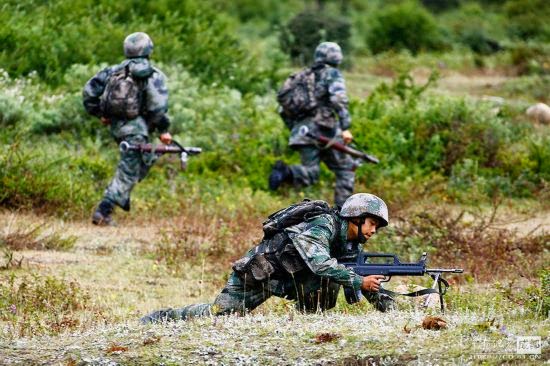
It does not seem the case in China where the PLA is conducting frequent trainings with live ammunitions.
China’s Ministry of Defence published photos of “a scene of the heavy artillery in the joint drill. The tank battalion of an armored regiment under the Xinjiang Military Area Command (MAC) of the Chinese People's Liberation Army (PLA) conducted a joint drill on a snow-covered plateau on August 31, 2014.”
The caption under a picture is “a tank group is about to set out. The tank battalion of an armored regiment under the Xinjiang Military Area Command (MAC)”. Another picture is described as “a tank group is firing at the target.”
The photos seem to have been taken in the Aksai Chin region, opposite Ladakh.


Obviously there is no lack of ammunitions in China.
Another example: between August 24 to 29, China hosted a ‘Peace Mission 2014’ with other States of the Shanghai Cooperation Organization (SCO). Held at Zhurihe training base in Inner Mongolia, it is the largest joint military drill ever organized by China, according to Yang Yujun, a Chinese Defense Ministry spokesperson.
Officially, the drill aims at countering ‘terrorist forces’, particularly the East Turkistan Islamic Movement, based in Xinjiang (and trained in Pakistan).
Yang stated that the exercise played an important role in deterring the ‘three evil forces’ of terrorism, separatism and extremism, safeguarding regional peace and stability and improving the military's ability to coordinate the fight against terrorism.
Here again training with live ammunitions was displayed.
On the Eastern 'Indian' front, north of the McMahon line, regular trainings are also being held.
The People's Daily shows some new all-terrain vehicles recently introduced in the  PLA, and used for the first time for military exercises in the Tibet Military District of Chengdu Military Area Command.


 Here too, live ammunitions are used for the training.
Though in the same series, the last picture may have been taken from another location.

Tuesday, September 2, 2014

India, Japan, China and the National Interest Triangle

My article India, Japan, China and the National Interest Triangle has appeared on NitiCentral.

Here is the link...

In the past, Delhi would have prevaricated and made sure that both Beijing and Tokyo were kept happy. Modi makes clear advances.

The Chinese edition of The People’s Daily recently published an Op-Ed by Shen Dingli, Deputy Director of the International Affairs Institute of Fudan University, who recommended that Beijing should define its enemies, allies, and friends on the basis of China’s national interests. This seems a logical proposition.
After Independence, many foreign observers thought that when it came to strategic thinking, there was something wrong with India’s DNA. Nehru’s India lived in nebulous ideals, incapable to define and implement the country’s national interests, while preaching about the ‘largest interest of world peace’.
There is nothing wrong with world peace, but the Indian approach has often created more mess (take the stoppage of the military operation in Kashmir in 1947-1948 or the non-intervention in Tibet in 1950-1951) and ultimately, more chaos, war and suffering followed.
Hopefully, under the Narendra Modi Government, a genetic mutation is taking place and India will slowly be able to ‘egoistically’ think about her own interests; a position which will eventually command much greater respect from the country’s friends and foes …and bring peace.
China had never had existentialist problems like India.
As Shen Dingli explains in the above–mentioned Op-Ed, the most practical way to define one’s own interests, is to distinguish between enemies and friends in international relations. Using the US as an example, Shen asks: Should America be classified among friends, allies, or foes? Then, he defines China’s most important core interests such as “national sovereignty, national security, territorial integrity, and national unity”.
Each country must define its own ‘core interests’; obviously, India’s interests are different from China’s.
The fact that the US dares to sell weapons to Taiwan and threatens to use force to interfere in China’s internal affairs [i.e. China’s claims in the South China and East China Seas], makes the US go straight into the ‘enemy’ category.
However, according to Shen, because ‘sustainable social economic development’ is also one of Beijing’s core interests and due to the close economic cooperation with the US during the past 30 years, Washington could also come under the ‘friend’ category. As a result, the US will be treated by China as a friend in certain domains and as an ‘enemy’ in others.
Shen believes that Japan’s relationship with China fits in the same categories as the US. He does not however mention India.
Now, take Narendra Modi’s visit to Japan. In one way, it is simpler: Japan is a ‘friend’. The ‘genetic’ novelty of India’s position is that Modi is not shy to say it, it is even heard (and not appreciated) by Japan’s powerful neighbour.
On the eve of his departure for Tokyo, the PM wrote:
“I am keenly looking forward to my three-day visit to Japan at the invitation of my good friend, Prime Minister Shinzo Abe, for the Annual Summit between India and Japan.”
‘My good friend’ is clearly a message to Beijing. In the past, Delhi would have prevaricated and made sure that both Beijing and Tokyo were kept happy.
Now Modi clearly says:
“Japan is one of our closest partners in political, economic, security and cultural realms. It is a key regional and global partner for us. Between our countries, there is only goodwill and mutual admiration. Buddhism from India has inspired Japan for over a millennium. We in India similarly draw inspiration from Japan’s vanguard role as the fountainhead of Asia’s modernization, resurgence and rejuvenation.”
The relation with Tokyo is important to Delhi, and today it is clearly enunciated:
“We will explore how Japan can associate itself productively with my vision of inclusive development in India, including the transformation of India’s manufacturing, infrastructure sectors, energy and social sectors. We will discuss how to boost our defence and security cooperation, including in defence technology, equipment and industry.”
In the past, Delhi would have been shy to preeminently display the importance of this relation, so as not to ‘upset’ China. That is not the case anymore.
China does the same. On August 29, the website China Military Online reported that General Fan Changlong, the vice chairman of the Central Military Commission and China’s senior most Army General participated in a symposium on the occasion of the 120th anniversary of the Sino-Japanese War of 1894-1895. He stressed the importance:
“to deeply summarize and rethink the historical lessons of the Sino-Japanese War of 1894-1895 and undertake the historical responsibility of building a powerful Chinese military.”
He added that the Sino-Japanese War of 1894-1895 left a profound trauma in China. It brought pain and sorrow to the Chinese nation and shame on the Chinese military:
“It is necessary to analyze the historical lessons of this war in an objective and dialectical way.”
China has always chosen its friends (and foes) according to its own economic or strategic interests. India too should ‘deeply summarise and rethink the historical lessons of the 1962 Sino-Indian War’.
China continues to select its ‘friends’ according to its interests. Between August 24 to 29, China hosted a ‘Peace Mission 2014’ with other States of the Shanghai Cooperation Organisation (SCO). Held at Zhurihe training base in Inner Mongolia, it is the largest joint military drill ever organised by China, according to Yang Yujun, a Chinese Defense Ministry spokesperson.
China is clearly looking for new friends in the region. It believes that it will help revive the ‘spirit’ of the New Silk Road, initiated by President Xi Jinping for “promoting economic cooperation, culture exchanges and friendly relationships” …and securing energy for China.
According to Xinhua, the proposal of ‘one belt and one road’ has brought new vibrancy to the cooperation among pan-Asia, Asia and Europe. But behind the rhetoric, the economic relations with Kazakhstan, Kyrgyzstan, Russia and Tajikistan are crucial to the Middle Kingdom’s energy policy.
Though Wang Ning, deputy chief of the PLA general staff and responsible for the drill, clarified that exercises are the sign of a new military alliance, it remains that Beijing needs the Central Asian States’ friendship to run its economic machine.
Officially, the drill only aims at countering ‘terrorist forces’, particularly the East Turkistan Islamic Movement, based in Xinjiang (and trained in Pakistan).
Yang stated that the exercise played an important role in deterring the ‘three evil forces’ of terrorism, separatism and extremism, safeguarding regional peace and stability and improving the military’s ability to coordinate the fight against terrorism.
The visit of Narendra Modi to Japan must be seen in this perspective: India, instead of the usual goody-goody attitude has for the first time decided to assert its national interests. It is crucial before President Xi’s visit to Delhi later this month.
In the meantime, President Xi Jinping has asked China’s military to think of technical and strategic ‘innovations’; he told his Politburo’s colleagues that the PLA must:
“strive to establish a new military doctrine, institutions, equipment systems, strategies and tactics and management modes for information warfare that had become central to modern combat.”
China will always be ready, similarly India should be.
By the way, is Islamabad a ‘friend’ or a ‘foe’ for Beijing? Difficult question, Mr Xi may be scratching his head!

Saturday, August 30, 2014

One more new airport in Tibet

A year ago, I mentioned on this blog, the construction of some new airports in Tibet.
One more now!

Xinhua just reported, "Southwest China's Sichuan Province opened its fourth high-altitude airfield, which local officials hope will boost tourism in the heavily Tibetan-populated region."
It shows that Beijing's policy of 'opening up' restive areas to tourism continues.
It must pay rich dividends.
According to the official news agency, the new Hongyuan Airport is located in Aba [Ngaba] Tibetan and Qiang Autonomous Prefecture at an elevation of 3,535 meters.
The Prefecture is situated in northwestern Sichuan, at the border of Gansu and Qinghai provinces.
Ngaba, also known as Ngawa (or Aba in Chinese) was the epicenter of the 2008 Sichuan earthquake, in which over 20,000 of its local residents died.
The area has also been the epicenter of the wave of Tibetan self-immolations in 2011 and 2012.
While half of the 'Tibetan' self-immolations happened in Ngaba Prefecture, very few of them happened in Tibet Autonomous Region.
Can the number of self-immolations be inversely proportional to the number of tourists visiting an area on the plateau?
It is what Chinese officials believe.
According to a local official, the new flights will be "cutting travel time to the local plateau prairie and Jiuzhaigou Valley, a World Heritage site famous for its colorful pools and snowy mountains."
But the main purpose is clearly to bring 'stability' in the restive prefecture.
Xinhua admits: "Lack of transportation facilities has long troubled the province's out-of-reach Tibetan region, which includes the two prefectures of Aba [Ngaba] and Garze [Kartse] and the county of Muli. Prior to Hongyuan, the province opened three high-altitude airports to link the region with the outside world"
Luo Erwu, head of the tourism bureau of Ngaba told the Chinese news agency: "The new airport will not only help travelers but also benefit locals by bringing more tourists to the region."
This is part of Beijing's policy to make the Tibetan plateau a giant Disneyland.
Beijing's rationale is that by bringing more tourists, the level of employment (and the revenue) of the local population will automatically increase, so will the 'stability' of the area.

Friday, August 29, 2014

Intrusions, trangressions and a line of perception

Local herders are always the sufferers
My article Intrusions, trangressions and a line of perception appeared yesterday in the Edit Page of The Pioneer

Here is the link...

No matter how you define it, the fact is that China has become aggressive along the Line of Actual Control. Indian troops and citizens on the border have to be equipped to deal with the challenge

‘There is nothing like that’, said the new Chief of Army Staff, General Dalbir Singh Suhag, when asked if it was true that Chinese troops had entered deep into Indian territory in Burtse sector, near Daulat Beg Oldi in north Ladakh. The media had earlier reported an intrusion by the People’s Liberation Army. Members of Parliament were explained that there was no Chinese ‘intrusion’ in Ladakh. On August 13, in a written reply to a question, Union Minister of State for Home Kiren Rijiju stated: “No intrusion has been reported or taken place on India-China border, including Sikkim, during the last five years, However, there are cases of transgression due to difference of perception of the Line of Actual Control.”
A couple of years ago, the terminology was different; ‘intrusions’ were called ‘perceptional’, now Mr Rijiju describes the Chinese walking around with banners that read ‘this is our territory’, as simple ‘transgressions’. Even if only attributed to a “mere difference in perception of the LAC between the two sides”, the Government of India admits that there has been a total 1,612 such ‘transgressions’ between January 1, 2010 and August 4, 2014. The young Minister also gave the MPs a crash course on the subtleties of both armies’ reckoning: “While ‘intrusion’ would mean that the Chinese troops crossed over to Indian side of the LAC and stayed put, ‘transgression’ implied that they had entered Indian territory only to eventually retreat to the Chinese side.”
Fine, we can adopt the new terminology, though according to Mr Rijiju, 334 cases of ‘transgression’ had taken place this year alone up until August 4, as compared to 411 in the whole of 2013, 426 in 2012, 213 in 2011 and 228 in 2010. It is clear that the number has increased over the years, though the Government has remained silent on Uttarakhand, where the phenomenon regularly occurred (in Barahoti area particularly). Does this practically means that when the Chinese cross the Indian LAC, they just ‘transgress’ it, because according to their own perceptions, they are in China? As a result, do we have two ‘perceptional’ LACs?
This raises another question: Have maps of the different ‘perceptions’ been exchanged? Apparently, the Chinese are reluctant. The question will hopefully be asked by Prime Minister Narendra Modi, when Chinese President Xi Jinping visits New Delhi next month. Mr Modi should insist: “At least, give us maps of ‘your’ LAC”.
1959 Line, today forgotten

This situation is relatively new. In the past, Chinese Premier Zhou Enlai provided India a map of Chinese claims. On December 17, 1959, after Jawaharlal Nehru asked that the Ladakh sector be treated separately, Zhou argued: “The Chinese Government is very much perplexed by the fact that Your Excellency [Nehru] put forward a separate proposal for the prevention of clashes in the sector of the border between China and India’s Ladakh.” The Premier added: “There is no reason to treat this sector of the border as a special case. The line up to which each side exercises actual control in this sector is very clear, just as it is in the other sectors of the Sino-Indian border. As a matter of fact, the Chinese map published in 1956, to which Your Excellency referred, correctly shows the traditional boundary between the two countries in this sector.”
Three years before the 1962 border war, Beijing’s positions were clear, while today it refuses to provide a map of its claims (which over the years, have obviously expanded in China’s favour). By keeping the situation unstable on the ground, the PLA can continue to prick the Indian Army as well as the local population in Ladakh.
Gen Suhag’s ‘nothing like that’ remark is certainly not good for the morale of the Ladakhis who have to face Chinese ‘transgressor’ on a daily basis; the best proof of is comes from the Chinese Foreign Ministry spokesperson herself. Ms Hua Chunying delightedly stated: “China today appreciated the Indian Army’s response on recent reports of incursions by the PLA in Ladakh... China has noted relevant reports and the Indian position. The Indian position reflects the objective understanding and rational attitude towards the special situation.” She added that for a long time, the Indian and Chinese “have exercised restraint and have maintained peaceful coexistence.” Well, everything is relative.
But there are other issues which, though not directly related to the position of the LAC, are worrying. The Times of India recently reported: “Forces guarding the Sino-Indian border have for years been suffering lack of optimum technological, infrastructural and logistical support — something available aplenty across the border to Chinese troops.”
The article lists several aberrations such Indian GPS sets showing the Indian soldiers in Chinese territory even when the Indian troops are well within their border. Why? Because the Indo-Tibetan Border Police uses US satellite data which does not reflect Indian ‘perceptions’. On the Arunachal border, the situation is often worse as Indian troops have to walk for days without proper all-weather shoes and suitable tents, to reach the LAC. Can the Modi sarkar change this?
Another issue is the recurrent harassment of local herders and villagers by ITBT personnel who regularly stop them on one pretext or another. It is said to be one of the main reasons for migration towards Leh, Itanagar and Delhi.  In an interview to Rediff.com, Mr Rijiju had rightly pointed out: “If we manage to strengthen our forces along the border, I’m sure that it can take care of the local fear. But if we are unable to provide basic necessities to the people living the border areas, then definitely people will run away. [Today], people need basic amenities; if these basic facilities such education, health, roads, communication services, drinking water supply are not made available, people will migrate. These basic facilities should be available to those areas; if we don’t do it, someday the whole border area will be without any civilian population.”
An extreme case occurred in the Pin valley of Spiti in Himachal Pradesh where residents stated that they were not adverse to seeking help from China, if the State and Union Governments did not do something for the area. Apparently, a flood in June 2012 had damaged a bridge which connects several villages of Pin valley. Even after two years, nothing has been done by the Governments to fix it. The president of Sagnam panchayat, Mr Lobsang Tandup, (who since then has been arrested for sedition) had raised the slogan ‘Chalo China’. He told the Press: “If our Government has nothing to do with the pain and problems of its citizens, then we will not be averse in seeking help from China.”
This may be an aberration, but it reflects the unease of the local population against what they perceive as neglect by India. This should be changed on a war-footing. Let us hope that Delhi will go beyond rhetoric and start acting.

Wednesday, August 27, 2014

India-Japan cultural ties through history

Rabindranath Tagore with The Mother (right) in Japan in 1916
My article India-Japan cultural ties through history appeared in NitiCentral.

Here is the link...

Prime Minister Narendra Modi is soon leaving for Japan. For several reasons, his visit will not be an ordinary one. In a statement issued by the PMO, Modi explains: “I will visit Tokyo and Kyoto, and will interact with all sections of Japanese society from students, political leaders to captains of industry.”
Though Modi could not make it in early July (due to the ongoing Parliament session), the visit will undoubtedly be special as it will be the Prime Minister’s first bilateral meet outside the subcontinent, further Japan is an important strategic partner for India.
But there is more. Apart from the first ever defence cooperation agreement between Japan and India which is expected to be signed, there is a cultural and spiritual dimension to the visit as well.
Whether it is Swami Vivekananda, Rabindranath Tagore or Netaji Subhas Chandra Bose, many great Indians have been associated with Japan and have become admirers of the Land of the Rising Sun. There is a reciprocity too and it is not a coincidence that the Japan-India Association was set up 111 years ago in 1903. It is today the oldest international friendship body in Japan.
A Ministry of External Affairs’ backgrounder points out:
Throughout the various phases of history, since civilisational contacts between India and Japan began some 1400 years ago, the two countries have never been adversaries. Bilateral ties have been singularly free of any kind of dispute – ideological, cultural or territorial.
Soon after Independence, Prime Minister Jawaharlal Nehru gifted an Indian elephant to the Ueno Zoo in Tokyo. This special gift brought light into the lives of thousands of Japanese children who had suffered the trauma of the War. The elephant, named Indira after Nehru’s daughter, lived till 1983.
Officially, the first cultural agreement between India and Japan was signed in October 1956, establishing a scholarship system for young Japanese scholars to study in India. A year later, Japanese Prime Minister Nobusuke Kishi travelled to India, and Jawaharlal Nehru visited Tokyo later in the year.
But the relations between India and Japan are much older and deeper.
India’s earliest documented direct contact with Japan dates from 752 CE when the Todaiji Temple in Nara was consecrated by an Indian monk, Bodhisena, who performed the eye-opening of a statue the Buddha Sakyamuni.
Buddhism had been introduced to Japan in 538 CE. The king of Baekje, a Korean principality, gifted a shiny image of the Buddha along with some scripture-scrolls and ornaments to the Japanese Emperor Kimmei.
Though some traditionalist clans opposed the new faith, considering their Shinto indigenous tradition as far more adapted to Japan, the influential Soga clan adopted Buddhism as a State religion.
In 604 CE, a Japanese prince, Shotoku issued a 17–Article Constitution quoting Buddhist and Confucian principles. Article II enjoined his subjects to:
Fervently respect the Three Treasures (the Buddha, Dharma, and Sangha).
Prince Shotoku ordered the Government to start building Buddhist temples. The most famous of them, the Horyu-ji temple, the world’s oldest wooden structure, still stands near the former capital of Nara.
It was because of this prince’s patronage and devotion to the Three Jewels that Buddhism was firmly established on Japanese soil.
During a lecture in Tokyo in 1916, the Great Poet Rabindranath told a Japanese audience:
While travelling in a railway train I met, at a wayside station, some Buddhist priests and devotees. They brought their basket of fruits to me and held their lighted incense before my face, wishing to pay homage to a man who had come from the land of Buddha. The dignified serenity of their bearing, the simplicity of their devoutness, seemed to fill the atmosphere of the busy railway station with a golden light of peace. Their language of silence drowned the noisy effusion of the newspapers. I felt that I saw something which was at the root of Japan’s greatness.
Tagore said he reached the conclusion that the welcome…
...which flowed towards me, with such outburst of sincerity, was owing to the fact that Japan felt the nearness of India to herself, and realised that her own heart has room to expand beyond her boundaries and the boundaries of the modern time.
The Nobel Laureate was a great admirer of traditional Japanese martial arts, particularly of jujutsu, the original form of judo.
Gurudev was determined to bring this art to India. In 1902 in Kolkata, during a meeting with Tenshin Okakura, the Japanese eminent writer and art critic, Tagore requested him to send judo instructors to Shantiniketan. Jinnutsuke Sano, a student of Keio University, eventually came to Tagore’s school, where he stayed from 1905 to 1908. It is how judo was first introduced to India. An interesting aspect of the training was that girls took part along with boys. Quite a revolution!
Rathindranath, Tagore’s elder son, later recalled:
Father had brought a jujutsu expert from Japan. We took lessons from him in order to prepare ourselves to fight the British! Had not the spirit and training of judo helped the Japanese to win the war?
Remembering the deep connection between Tagore and Japan, Visva-Bharati established a Japanese department in 1954 under the guidance of Probodh Chanda Bagchi. This made Visva-Bharati the first Indian university to introduce Japanese language courses.
Another eminent person who served as a bridge between India and Japan is the Mother, Sri Aurobindo’s French-born collaborator. She spent 5 years in Japan between 1915 and 1920. She beautifully described the Japanese genius, she wrote:
If you have — as we have had — the privilege of coming in contact with the true Japanese, those who kept untouched the righteousness and bravery of the ancient Samurai, then you can understand what in truth is Japan, you can seize the secret of her force. They know how to remain silent; and though they are possessed of the most acute sensitiveness, they are, among the people I have met, those who express it the least.
The Mother, who settled in Pondicherry and worked with Sri Aurobindo to create the Ashram, later recalled:
A friend here can give his life with the greatest simplicity to save yours, though he never told you before he loved you in such a profound and unselfish way. Indeed he had not even told you that he had loved you at all.
She spoke of the Japanese unselfishness which…
is not the privilege of the well-educated, the learned or the religious people; in all social ranks you may find it.  …The Japanese are taught from their infancy that life is duty and not pleasure.
This sense of unselfishness, of beauty, of love for nature, along the martial aspect of the Mahayana Buddhism touched many Indian souls.
Narendra Modi rightly noted, “The scale of innovation and level of precision among the people of Japan is admirable. Both our nations can learn a lot from each other.”
India has certainly a lot to learn from Japan, though cricket fans cleaning the stadium after a test may not happen just yet.

Tuesday, August 26, 2014

Why the Dharamsala-Beijing talks failed

Wu Yingjie
According to the pro-Beijing daily The Hindu, Wu Yingjie, the Deputy Secretary of the Tibetan Autonomous Region's Communist Party told a group of visiting Indian journalists that talks with the Dalai Lama were “ongoing and always smooth, but we are discussing only his future, not Tibet’s”.

Wu who, last year, spent several months fire-fighting in Nagchu prefecture, would have added: "All Tibetans, including the Dalai Lama and the people around him, can return if they accept Tibet and Taiwan as part of China, and give up ‘splittist’ efforts.”
When asked about the now-broken talks with Dharamsala, Wu affirmed that the Tibetan demands were unacceptable. “How can the Dalai Lama demand that China withdraw its army from Tibet?”
Wu is probably not aware that in the Dalai Lama's Middle Path approach, Foreign Affairs and Defense remains with the Central Government (Beijing).
Or perhaps, he just bluffed the gullible Indian journalists.
Regarding the Dalai Lama's return to Tibet, as early as 1981, the Dalai Lama had rejected the proposal as his fight was for 6 million Tibetans, not for his personal sake or future.
I quote from my book, The Negotiations that never were:
The answer of the Chinese government to the Dalai Lama’s letter to Deng came in July 1981 when Gyalo Thondup visited Beijing. He had a meeting with the CCP General Secretary Hu Yaobang on July 28, 1981 during which the parameters of the future negotiations were given.
From the Chinese side, this policy statement would guide all further talks; it only mentioned the status of the Dalai Lama and his future role in case he returned to the ‘motherland’.
Here is the text of the Five-Point Communiqué from Beijing:

1. The Dalai Lama should be confident that China has entered a new stage of long term political stability, steady economic growth and mutual help among all nationalities.

2. The Dalai Lama and his representatives should be frank and sincere with the Central Government, not beat around the bush. There should be no more quibbling over the events in 1959.

3. The central authorities sincerely welcome the Dalai Lama and his followers to come back to live. This is based on the hope that they will contribute to upholding China's unity and promoting solidarity between the Han and Tibetan nationalities, and among all nationalities, and the modernization programme.

4. The Dalai Lama will enjoy the same political status and living conditions as he had before 1959. It is suggested that he not go to live in Tibet or hold local posts there. Of course, he may go back to Tibet from time to time. His followers need not worry about their jobs and living conditions. These will only be better than before.

5. When the Dalai Lama wishes to come back, he can issue a brief statement to the press. It is up to him to decide what he would like to say in the statement.

This was not acceptable to the Dalai Lama and his exiled administration. The Tibetan leader wanted to talk about the happiness and the fate of his 6 million countrymen, not about his own status. This issue would be a recurring obstacle during the years to come.
Thirty-three years later, Beijing has not changed its stance.
It is the reason why the 'negotiations that never were' failed.

Monday, August 25, 2014

Let us build roads to the borders: sixty-four years later

Border Road Organisation ...in 2011
Everyday, one reads in the Indian press about the poor infrastructure in the border regions, particularly in areas facing China in the Himalayas.
Last week, I already wrote on this blog about the 'Neglected Borders of India'.
Today, I am posting a note by the Indian Prime Minister addressed to V.K. Krishna Menon, the  Defence Minister on January 20, 1960.
Please read it carefully, you will see that nothing much has changed during the last sixty-four years! 
Nehru suggested the creation of the Border Road Organisation, which has, for different reasons, become the stumbling block in road development in border areas.
It is rather strange that the Prime Minister is thinking of using 'old machinery' for building roads in most difficult terrains. He should have suggested the use of the latest technologies.
Will the Modi Sarkar be able to change this trend?
Certainly not with the present structure.

Note from Jawaharlal Nehru to Krishna Menon
January 20, 1960
[From the Selected Work of Jawaharlal Nehru, Series II, Volume 56, page 378-79, published by Jawaharlal Nehru Memorial Fund]

You will remember that the question of our border areas came up before the Cabinet sometime ago. There were two aspects of it: One was the building of
roads and the other was the development of those areas in other ways. So far as the development is concerned, certain tentative proposals have been made for a reorganisation of the administrative apparatus there so that some good and experienced officers may be put in charge of smaller areas than at present and should be given a good deal of authority and latitude to proceed with the development. Naturally, funds for this development will largely come from the Centre. This matter will come up before the Cabinet soon.

2. The Cabinet Secretary was put in charge of a committee to deal with these border areas and report to the Cabinet. He is reporting soon about the development of the border areas. When I asked him about the roads and communications, he said that the paper had been sent to the Defence Ministry about two weeks ago and it was still there. Will you please look into this matter and have it expedited so that Cabinet might consider any proposals that are being made?

3. To name the roads required in some order of priority can of course be done without much difficulty. The question, however, is how we can expedite the building of these roads. The normal PWD methods are very slow and we cannot afford to wait for several years before these roads are completed. I had a talk with you about this matter sometime ago. You had then suggested that it would be desirable, in order to expedite the building of these roads, to divide them up into three categories: (1) the Central PWD; (2) State PWD; and (3) some other agency [The Border Roads Organisation was started in July 1960] to be created for the purpose. I am not taking into consideration here those roads which might be called operational and which inevitably will be under the charge of the army engineers.

4. About the third category, i.e. some other agency, to build these roads, it is for us to consider what kind of an agency we can create. Probably it will not be wholly desirable to put them regularly under the army engineers, although army engineers may well be used for the purpose. Possibly, a separate labour corps might be recruited, and some army engineers attached to it. This method would probably be cheaper. Also, some of our old machinery for building or levelling etc. which we have with us at present might be used after some reconditioning.

5. This will have to be considered by the Cabinet. I should like your Ministry to give thought to this and prepare a paper on the subject as soon as possible.

Sunday, August 24, 2014

Is China becoming Buddhist?

Communist China is fast becoming expert in Tibetan Buddhism. Unfortunately (for them), though Beijing shows a great interest in the Tibetan Tradition, it is not enamoured with the Dalai Lama as yet.
Beijing was very pleased when, on August 20, Japanese daily Mainichi Shimbun reported that the Tibetan religious leader’s visit to Mongolia, scheduled for later this month, was canceled.
Of course, this was done under Beijing’s own pressure.
How could the Dalai Lama visit Ulan Bator the same month than the new Emperor? Xi Jinping paid a two-day state visit on August 20 and 21 to Ulan Bator.
The Chinese media reported that the cancellation was ‘believed’ to result from China's effective use of economic leverage on the neighbour, whose 80 percent of the population follow Tibetan Buddhist tradition.
Suppose that the Dalai Lama had got a better reception than Xi Jinping, it would have not looked nice for the strong man in Beijing. Isn’t it?
Mongolia, being China's largest trading partner, had no choice, but to bow to Beijing's will and cancel the visit.
More interestingly China Tibet Online asserts: “Tibetan Buddhism has been a remarkable tie and witness of the bilateral relationship between the two countries.”
Outer Mongolia and Communist China now share their passion for Buddhism.
Beijing’s new love is apparent in another article of China Tibet Online which, quoting Trinley Dorje, director of the Tibet Committee of Ethnic and Religious Affairs, affirms: “At present, China's Tibet Autonomous Region has 358 Rinpoches [reincarnated lamas] who were enthroned in accordance with the reincarnation system of Rinpoches.”
The official publication adds: “The reincarnation system of Rinpoches, or living Buddha, is a unique practice for the continuation of the Rinpoche of Tibetan Buddhism, which is respected by the Chinese government. In recent years, some 40 Rinpoches in Tibet were enthroned according to the historical custom and religious ritual. The searching, decision and enthronement of 5th Dezhu Jiangbai Gesang and the 8th Rongbu Chokyi Lozang Dondrup which were carried out in the recent five years both strictly followed the reincarnation system.”
Of course, very few have heard of these ‘rinpoches’ before, but it is another issue; the point is Xi Jinping’s regime pretends to be not atheist anymore.
We are told that Tibet’s Department of Ethnic and Religious Affairs also helped 20 Islamic clergies to get the approval from the China Islam Association (under the Communist Party). In 2013, the Tibetan government even sent 16 Tibetan Muslim for a pilgrimage in the Saudi Arabia.
Is China transformed?
In the meantime, Gyaltsen Norbu, the Panchen Lama selected by Beijing visited with fanfare Western Tibet (Ngari prefecture).
Xinhua reported: “The 11th Panchen Lama, Bainqen Qoigyijabu [Panchen Gyaltsen Norbu], has come to Nagri [Ngari] Prefecture of Tibet for the first time to hold Buddhist activities. Since he arrived on August 13, the Panchen Lama had worshiped Kangrinboqe, [Kang Rinpoche or Mount Kailash] a holy mountain about 6,656 meters above sea level in Burang [Purang] County. In the eyes of the followers of Hinduism, Buddhism and Bonism, it is the center of the world.”
It is undoubtedly true.
The details of the busy schedule of the Panchen Gyaltsen Norbu are given: “Before the worshiping ceremony started in the morning of the August 14, he visited a temple at the foot of the mountain to pray for all living creatures.”
We are told that Gyaltsen Norbu was received by some 20 monks [who] welcomed him ‘by holding prayer flags, accompanied by the sound of horns’. The report continues: “Before the worshiping ceremony [puja], he visited the Chokyi Temple at the foot of the mountain and chanted sutras to pray for all living creatures”, says Xinhua, adding that hearing the news that the Panchen Lama had arrived, 'Buddhism followers' [i.e. Tibetans] nearby got together in a zigzagging queue in hope of worshipping the Panchen Lama for blessings.
Nothing, of course, like the late 10th Panchen Lama, during his last visit to Tashilhunpo. Watch this video!
Gyaltsen Norbu had the ritual photo op in two local village house in Montser [Minsar?] in Gar County. A Tibetan, Yeshe with his family, “with all in brand new clothes, welcomed the Panchen Lama by holding hada [khata] in their hands and bringing out the chema, a wooden container used by Tibetans to pray for a bumper harvest.”
Yeshe had to give details about his daily life, "how many members are there in your family, where is the source of your income, how much do you earn one year”, etc. Gyaltsen Norbu was told the 8-member family, lived on transportation and tourism travel; they have an annual income of about 8,000 US $: “the Panchen Lama was pleased and wished Yeshe could also help other local residents prosper”.
Gyaltsen Norbu then went to “the holy lake Mapham Yutso [Mansarovar] and nearby temples, chanted sutras for all living beings, visited two local farm households, named a 13-day-old baby at the request of his parents and touched the heads of several hundreds of people to give them blessings.”
The report asserts: “It enjoys a reputation equal to the holy mountain in the eyes of local Tibetans.”
On the morning of August 16, the Panchen Lama went to the Khorchak Monastery, built in 996 CE, near Purang. the monastery belongs to the Sakya school; according to the Chinese news agency: “He successively worshiped the main shrine, Great Chanting Hall, Tara Hall, Champa Hall, Dharmapala Hall, and Seven-Buddhas Hall. Then in the main shrine, he chanted sutras with monks of the monastery and gave head-touching blessing to those followers”.
But Karl Marx was not forgotten during the visit, on the last day, Gyaltsen Norbu honoured a Communist ‘model worker’ by visiting the tomb of one Kong Fansen, a Chinese ‘model’ official who dedicated his life to the building of Tibet; Gyaltsen Norbu presented “a hada [khata], a strip of raw silk and linen for good blessing.”
All these choreographed visits would be fine, if they were not aimed at showing off to the world that Communist China is today a very tolerant  nation.
But China is so intolerant that Gedhun Choekyi Nyima born on April 25, 1989 and recognized as the 11th Panchen Lama by the Dalai Lama is still under house arrest in China; the authorities in Beijing have systematically refused to let the world know about his whereabouts.
He has not been seen in public since May 17 1995, nearly twenty years ago.
This proves that Communist China is not truly Buddhist as yet.
Here are some pictures of the Chinese Panchen Lama near Mt. Kailash and Manasarowar.