Showing posts with label Border Issue. Show all posts

Wednesday, May 10, 2023

Chinese social media abuzz with 'tank dens' in Tibet chatter: Why India needs to heed seriously

My article Chinese social media abuzz with 'tank dens' in Tibet chatter: Why India needs to heed seriously appeared in Firstpost.

Here is the link...

Whether all details are confirmed in their entirety or not about the presence of 'tank dens' is an altogether different matter, but it should be a serious warning for India 

In the recent times, the Chinese social media has been agog with ‘tank dens’ being built by the People’s Liberation Army (PLA) in Tibet; one article speaks of “fully underground design, to prevent Indian troops from starting artillery sneak attack.”
In December 2022, the site ximalaya.com mentioned: “India always wants to act tougher with China in order to please the United States; it is the root cause of disputes on the Sino-Indian border and in the border areas.”
This is forgetting that the ‘dispute’ started at the end of the 1950s, at a time India was close to the Soviet Union.
The article affirmed: “The PLA is far better prepared for war than the Indians could imagine, and recently, India has even discovered an unexpected situation. This will not only effectively protect against Indian bombardment, but also provide a fairly good environment for the equipment.”
Of course, this can be seen as part of the Information Warfare (IW) waged against India, but it can’t be fully ignored.
The article mentioned some Chinese PLA 96A tanks hidden in 'tank dens' near the Indian border (probably in the Chumbi Valley between Sikkim and Bhutan).

Old Habits Die Hard

There is nothing new in the Chinese mania to ‘dig’, except that the PLA’s technology is today far ahead of what it was decades ago.
Nearly 30 years ago, I had the opportunity to interview several senior Tibetan officials who accompanied the Dalai Lama in exile in 1959.
One of them was Rinchen Sadutshang, who as a young translator accompanied the Tibetan delegation who signed a 17-Point Agreement with China in Beijing in 1951; later he served as the Dalai Lama’s representative in Delhi.
When asked whether the Chinese had massive deployment of troops in Southern Tibet at the end of 1950s (for example in places like Tsona, north of Tawang), Sadutshang replied: “Oh yes, all over the place. Wherever the PLA went, they were very secretive. …They were always stationed in mountains and they dug tunnels and tunnels and tunnels.”
This surprised me greatly.
Later, I asked him again about the tunnels; for example, was the local population involved? Sadutshang recounted: “They did not allow the local population [to come nearby]. All aspects of military operations were top secret. Very few civilians were involved, maybe one or two who were indispensable. It was people that either were completely trusted or some after being used, were eliminated. It was so secret, and all the [PLA] movements were happening at night, never during the day. [Tibetan] people could only report: ‘we heard a lot of vehicles moving, a lot trucks moving, it must be the army’; they had not seen them.”
The Tibetan official continued: “…Even in Yatung, they used to be a lot of Chinese military forces there, all inside tunnels, they dug the mountains, huge tunnels, [they were] like mice living under the ground. Exactly the same as mice, you do not see them from outside and they are so well guarded, they do not allow anybody to go 10 km from the entrance as all roads were blocked.”
I had forgotten about this interview until I recently came across the ‘tank dens’.

The Underground City
Some other historical cases are well-known; during the Cold War, a bomb shelter consisting of a network of tunnels existed beneath Beijing, the Chinese capital. Some observers spoke of the ‘Underground Great Wall’, it was built for military purposes.
The complex was constructed from 1969 to 1979 in anticipation of a nuclear war with the Soviet Union as the Sino-Soviet relations had worsened.
It is Mao Zedong who ordered the construction of the Underground City.
The complex was designed to withstand nuclear, biochemical and conventional attacks. The averred purpose was to protect Beijing's population, and allow government officials to leave in the event of an attack on the capital.
Lying some 18 metres underground, the ‘dark, damp, and genuinely eerie’ tunnels covered an area of 85 square kilometers: “At one time there were about 90 entrances to the complex, all of which were hidden in shops along the main streets of Qianmen,” says the online encyclopedia Wikipedia.
The complex had facilities such as restaurants, clinics, schools, theaters, factories, a roller skating rink, grain and oil warehouses, and a mushroom cultivation farm. It was built by more than 300,000 local workers, including ‘volunteer’ school students.
There were also almost 70 potential sites where water wells could easily be dug if required. To this add elaborate ventilation systems with 2,300 shafts that could be sealed off to protect the tunnels' inhabitants from poison gases. All contingencies had been taken into consideration.
Many believe that the tunnels linked important governmental buildings such as Zhongnanhai, the Great Hall of the People, and even PLA bases in the outskirts of the city; the rumour was that every senior official’s residence had a secret trapdoor leading to the tunnels.

Project 131
Another grandiose scheme was Project 131, located in the town of Gaoqiao of the Xian'an District of the Xianning prefecture-level city in Hubei Province. It was located some 80 km south of Wuhan.
The origin of the Project is also the split with the Soviet Union. On January 31, 1969, the decision was taken to build an underground command headquarters for the PLA (the name derives the date of the decision or 1-31). The Chief of Staff of the PLA’s General Staff Department, Gen Huang Yongsheng was responsible for the construction.
In 1955, Huang had risen through the 1950s and 1960s, and during the Cultural Revolution he became close to Lin Biao, the Defence Minister.
The tunnels, which had meeting rooms, offices for the top commanders, were constructed under the nearby hills; luxurious villas for Mao Zedong and his heir apparent Lin Biao were also built but over the ground.
After the latter’s dramatic escape and his subsequent death, Huang was purged due to his close association with the defence minister; the project was stopped and Mao and his cronies never used the facilities.

The ‘Tank Dens’

Now, it appears that the PLA has built semi-underground as well as fully underground fortifications and military bases along the Tibet-India border.
The article quoted above said: “In recent reports, the PLA's plateau underground fortifications have been revealed and although not many specific [details about the] plateau underground fortifications have become public, there are enough to show the existence of a number of them, including a rare Chinese ‘tank fortress’; it can also be called a staging area for tanks and troops. A hundred tanks as well as other armoured vehicles and a large number of PLA troops are already stationed directly in this semi-underground fortification.”
The site ximalaya.com added: “the PLA plateau bases are now fully underground facilities, and though the amount of work is very important, it has the advantage of good protection for the equipment and it greatly improves the living conditions of the [army] personnel. More importantly, it can provide good protection against sneak attacks by Indian troops using artillery. Due to the very large range of modern weaponry, the problem of facing a surprise attack must be considered even at a distance of several dozen of kilometres from the front line.”
The article further rationales: “It is not possible to rule out the possibility of a surprise attack by the Indians, [for example] a sudden and massive artillery attack. The PLA should then be prepared with a large number of armoured vehicles [tanks] to ensure that our forces are not destroyed by the Indian army, after all, we can't afford to have a defensive [position] only.”
Whether all these details are confirmed in their entirety or not, it should be a serious warning for India.

The Border Situation
In this context, it was interesting to see that Defence Minister Rajnath Singh recently stood firm on India’s position when he met his Chinese counterpart General Li Shangfu. Held on the sidelines of the Shanghai Cooperation Organisation (SCO) defence ministers’ meeting in Delhi, the Indian Minister is said to have used plain words to characterize the recent developments in the India-China border. A statement said: “Rajnath Singh categorically conveyed that development of relations between India and China is premised on the prevalence of peace and tranquility at the borders …. He reiterated that violation of existing agreements has eroded the entire basis of bilateral relations and disengagement at the border will logically be followed with de-escalation.”
Undoubtedly, China is getting ready for a long haul; the ‘tank dens’ should be seen in this perspective.

Where the Dalai Lama reincarnates is critical to Indian security


Where the Dalai Lama reincarnates is critical to Indian security

In this interview, Ishan Dhar speaks to Claude Arpi on the political importance of Tibetan Buddhist reincarnates, how Chinese interference in this sacred tradition can have ramifications for the entire Himalayan belt, and the steps India can take to ensure its security in this context.

Monday, July 4, 2022

Forced Relocation: for what?

Three years ago, we mentioned a large scale relocation program on this blog.
It looks as if the Chinese government has decided for another round.
On June 30, The China Daily published an article announcing “Thousands to be relocated from high altitudes.” 
 Two days earlier, Xinhua had published another article on the same topic with different figures.
The second article reported that some 26,300 rural residents (from 6,306 households) would be relocated to a site named Sinpori in Lhoka prefecture (City) before August 11, 2022.

Sinburi is located in Gongkar (Konggar) county in Lhoka at 29°18′57″N 90°46′55″E; it is also known as Senburi Cun (森布日村) or Shengbore (省波热).

When one looks at the location, it is strikingly close to the Gongkar airport, the main airport  for civil and military use on the plateau.
Why to bring a new town in this strategic area is a mystery.

The China Daily says that thanks to the Tibet Autonomous Region's (TAR's) relocation policy, “started in 2016, many rural residents living at altitudes above 4,800 meters have been moved to lower valleys more suitable for human habitation.”
The rationale for the scheme is that the nomads living in high altitude in Ngachu City can’t breath at altitude above 4,000 or 4,500 meters. But they survived quite well for centuries.
The mouthpiece of the Communist Party further explains: “The latest relocation plan will help residents from 58 villages in 12 townships in the counties of Tsonyi, Amdo and Nyima in Nagchu. With an average altitude above 4,500 meters, Nagchu is one of the region's highest cities. Residents are mainly herders and nomads, most of whom change their dwelling and herding pastures a few times in a year.”
Why to move nomads to sedentary ghettos?

One of the reasons is that it is easier to control  and monitor the nomadic population when they are brought in these new townships, often located at the border with India (and equipped with facial recognition cameras, etc). 

perhaps because nomads are born-free, they are an issue for the totalitarian regime in Tibet.

Scheme Over in August
The China Daily says that the relocation is planned to be over on August 11, 2022: “The first group of families is expected to arrive in their new community by July 15.”
The article adds that being the busiest time for the nomads: “some residents will remain in their original places.”
What is the big hurry in any case …except if the TAR government is planning to immediately re-employ the nomads on some large infrastructure projects near the airport or at the airport.
Finally, the article says that to ensure the safety, smooth traffic, control of the pandemic as well as proper medical rescues and emergencies, “more than 200 government workers from all walks of life have been dispatched to relocation sites to provide support.”
The government of Lhoka was asked to accelerate infrastructure construction, including housing, water and electricity supplies, traffic, schools and clinics.

A First Article
A few earlier, Xinhua had announced that a total of 17,555 people were to be relocated away from Nagchu City, ”thanks to a local program to improve people's living and protect the plateau region's fragile ecosystem.”
Quoting Wu Wei, director of the regional forestry and grassland administration, Xinhua asserted: “The people had lived in places with harsh weather and relatively backward production and living conditions, where the grassland degraded. The relocation scheme reflects a people-centered development thought, taking into consideration both the ecological protection and people's demand for a better life," Wu said.
The fact is that for centuries, it is the nomads and herders who looked after the conservation of the natural environment; it is of course not mentioned (or even taken into account).
The objectives of the relocation scheme is somewhere else, as Xinhua admits: “The region's overall relocation plan will cover more than 130,000 people in Tibet's nearly 100 townships in eight years.”
This is big, and for India, it is a worry, as many of these new township may come near the border.

The Three Counties

It is worth looking at the three counties from where the relocated herders will come from.
The chart below shows the area and the population of the three counties of Nyima, Amdo and Tsonyi of Nagchu City.

What is striking is that ONE-THIRD of the population is being relocated.
Why such large percentage?
What will happen to these already sparsely inhabited areas?
It looks a certain death for these counties?

Tsonyi (Shuanghu) County


Location of Tsonyi Special County

Total Area  =  116,700 km2 (45,100 sq mi)
Elevation = 4,960 m (16,270 ft)
Total Population (2014) =  13,470
Density  =  0.12/km2 (0.3/sq mi)

Simplified Chinese  =  双湖县
Tibetan =   མཚོ་གཉིས་རྫོང

 Amdo County


Location of Amdo County within Tibet Autonomous Region

Total Area  =  43,410.85 km2 (16,761.02 sq mi)
Total Population (2000) =  32,843
Chinese name =安多县
Tibetan name = ཨ་མདོ་རྫོང་།


Nyima County


Location of Nyima County within Tibet 

Tibetan: ཉི་མ་རྫོང་།, Wylie: nyi ma rdzong,
Simplified Chinese: 尼玛县; traditional Chinese: 尼瑪縣; pinyin: Nímǎ Xiàn)
The northern part of the county is within the Changtang area.
With an area of 72,499 km2 (27,992 sq mi) and a population of 29,000 (2012), it has an average population density of less than 0.4 people per square kilometre.

The scheme raises some important questions:

  • Why one third of the population of these three counties are forcibly relocated south of Lhasa.
  • What will the life of the pastoral populations who for generations have lived in the Changthang? 
  • Can they survive in the new ‘urban’ conditions?
  • Why to relocate such a large number of people near the airport?
  • Which type of employment will they be given? 
  • Is there a mega infrastructure in the pipeline? The area is already served by the Expressway to Lhasa, by the railway line (Lhasa-Nyingchi), by different haighways (G318, G4218), etc. 
  • Which type of new infrastructure is China planning?
  • A new airstrip for the dual use airport?
The developments in the area need to be watch carefully.

Wednesday, October 20, 2021

Dragon flaunts ‘firepower’ across LAC to ward off growing internal challenges

Bunkers near the LAC in Arunachal Pradesh
My article Dragon flaunts ‘firepower’ across LAC to ward off growing internal challenges published in Firstpost

Here is the link...

President Xi Jinping has not left China for almost two years; it is not difficult to understand why if one looks at the domestic problems he has on his plate

What is going on in China? One thing is sure that the Middle Kingdom is going through turbulent times, to say the least. One just needs to look at the 13th round of the India-China Corps Commander level meeting, held at Chushul-Moldo post in Ladakh on 10 October. We are now told that the process of disengagement failed to move forward.

India said that it was necessary for the Chinese “to take appropriate steps in the remaining areas so as to restore peace and tranquility along the LAC in the Western Sector”. The Indian side, therefore, “made constructive suggestions for resolving the remaining areas, but the Chinese side was not agreeable and also could not provide any forward-looking proposals. The meeting thus did not result in resolution of the remaining areas”.

While the Indian negotiators regretted that “the atmosphere has changed suddenly”, China had been quicker to move… and blame India. Most commentators could not explain why the negotiations failed.

A quick look at the two press releases (the Indian one quoted above and the one provided by Col Long Shaohua, the spokesperson of the Western Theatre Command based in Chengdu-Sichuan), helps us to understand. Nowhere are mentioned the names of the commanders who met for nearly nine hours. Why?

From the Indian side, like for the previous rounds, the talks were led by the General-Officer-Commanding (GOC) of the 14 Corps based in Leh, a post presently held by Lt Gen P G K Menon (earlier, Menon’s predecessor, Lt Gen Harinder Singh conducted the first rounds).

What is strange is that nobody seems to know who led the Chinese side. It is usually the commander of the South Xinjiang Military District (SXMD), a post held till recently by Maj Gen Liu Lin. A few weeks ago, Liu Lin was promoted to the rank of Lieutenant General and transferred to Urumqi (Xinjiang) as commander of the Xinjiang Military District (XMD) overlooking the SXMD (and the Ladakh front).

Liu Lin’s promotion meant that the Central Military Commission or CMC (read Xi Jinping, its Chairman) was happy about the way that he dealt with India. Since then, the SXMD, China’s most strategic and ‘hot’ front, has had no commander.

Can you believe it?

This is why both sides agreed to leave a blank on the names of those who conducted the talks (it is rumoured that an officer posted in Urumqi, without a real mandate, was nominated as a stop-gap to replace Gen Liu Lin). What does this mean?

It shows that in India, a democracy, the passing over between commanders at all levels is a smooth affair, announced well in advance in the media; it is not the case in totalitarian China, unable to ‘replace’ its commanders in time, resulting in confusion and an inability to “provide forward-looking proposals”. Some Chinese social media have suggested that it was due to the high rate of “mountain sickness” among the officers and soldiers.

It probably means that President Xi Jinping, also CMC Chairman, is unable to find adequate officers who can fit the bill of professionalism, knowledge of the terrain and, critically, are faithful to the Party, i e the Emperor; the latter being the most important criteria.

As a result, the two armies will probably face each other during the forthcoming harsh winter. India will have no choice but to be prepared; this was stated by Gen M M Naravane, the Chief of Army Staff.

Knowing that the talks were bound to fail in the absence of someone mandated to discuss with India, China was quick to move. The Western Theatre Command headquarters immediately released a communiqué: “Instead of misjudging the situation, the Indian side should cherish the hard-won situation in China-India border areas,” commented Senior Colonel Long Shaohua, the spokesperson, who said that the Chinese side had made great efforts “to promote the easing and cooling of the border situation and fully demonstrated China’s sincerity of maintaining overall interests of bilateral military relations. However, the Indian side still persisted in its unreasonable and unrealistic demands, which added difficulties to the negotiations”.

It pointed out that China was firm in its resolve to safeguard national sovereignty: “The Indian side should avoid misjudging the situation and cherish the hard-won situation in the China-India border areas. The Indian side should abide by the relevant agreements and consensus reached between the two countries and two militaries, show sincerity and take concrete actions to jointly safeguard peace and stability in the border areas with China.”

China, it is well known, has great expertise to point a finger at others for mischiefs that it has itself committed.

A few hours later, The Global Times followed the same track and accused India, warning: “PLA border troops maintain high alert, prepared for upcoming confrontations… The harshly worded statement issued by the Chinese government on China and India failing to reach an agreement during their latest round of corps commander-level talks, showed China's subtle change of attitude toward India, and the country's staunch determination to protect its territorial and sovereign integrity.”

In other words, China was now fed-up with India (for the PLA having entered India’s territory); to prove its points, the Communist mouthpiece quoted different ‘analysts’.

These ‘experts’ brought up in the process a couple of incidents created by the PLA in Barahoti in Chamoli district of Uttarakhand, where over 100 soldiers and 55 horses transgressed over five km into the Indian territory by walking south of the watershed — the Tunjun-la pass. A few days later, a large number of Chinese soldiers entered into India at Yangtze in the Tawang sector of Arunachal Pradesh; the Indian Army and Intelligence Bureau later confirmed the reports of border transgression which lasted for three hours on 9 October.

The Chinese scholars conveniently said: “India has been triggering new incidents along the eastern section of the border recently.” They argued that China should not only refuse “to give in to India's arrogant demands at the negotiating table, but also be prepared to defend against new Indian military aggression.”

But there is more than the local situation. The Sixth Plenum of the Communist Party of China is soon coming up (probably mid-November) and Xi Jinping is under great pressure from many quarters and in these circumstances, he could not afford to ‘give away’ anything in Ladakh.

The forthcoming Plenum explains the PLA’s latest aggression on India’s northern borders, but also near Taiwan where hundreds of Chinese planes have recently trespassed into Taipei’s airspace.

The same Global Times published an editorial stating that mainland China will have a showdown with Taiwan if the Taiwanese authorities continue to make trouble colluding with the United States and Japan. It suggested that the PLA fighter planes could fly over the island of ‘rebel’ Taiwan: “This is a step we must take… It will be a clear and unmistakable declaration of China’s sovereignty over Taiwan, and will create unprecedented conditions for us to further implement this sovereignty.”

Xi has several other problems on his plate, whether it is in Xinjiang, with the continuous unrest of the Uyghur population; in Hong Kong, which is slowly being assimilated to the mainland; with the endless power-cuts affecting the industries and individuals; the quick collapse of Evergrande Group and the real estate market; the purge of more and more senior Party officials (on October 2, the Central Commission for Discipline Inspection said that Fu Zhenghua, the former minister of justice, was being investigated), and many more issues.

In the circumstances, one understands that Xi does not have the time to find a replacement for Gen Liu Lin and can’t afford to withdraw from more disputed areas of Ladakh. The media onslaught on India has simply been to divert the attention of the Chinese public, from far more serious issues. Incidentally, President Xi has not left China for almost two years; it is not difficult to understand why

Sunday, July 7, 2019

How many Tibetans in the Liberation Army? A difficult guess!

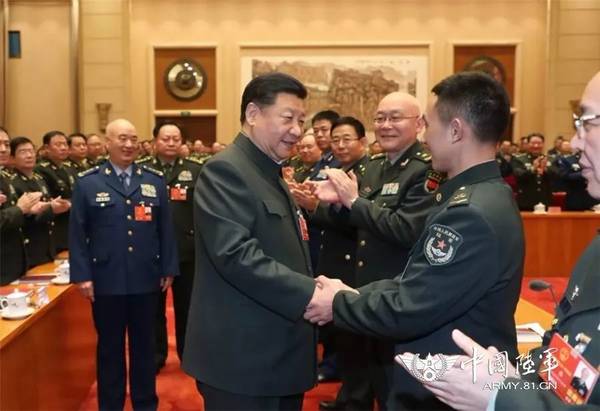
Chairman Xi meeting a young Tibetan Officer at a NPC meet
In an interview to The Week, the Dalai Lama recently said that “the Tibetan issue is no longer a struggle for political independence”. He asserted that there is a need to focus on preservation of Tibet's cultural, religious and linguistic identity.
The Tibetan leader added that “Political independence is mainly meant for the happiness of the people, but does it alone guarantee happiness.”
This can’t be argued that Independence alone does not provide happiness.
The Dalai Lama also stated that “There is a growing feeling among the top leaders in China that their policies have not been able to solve the Tibet issue in the last 70 years. So they should follow a more realistic approach. Even though Tibet was an independent country, politically China occupies Tibet today.”
It is not certain that the top leadership in China believe that Beijing’s Tibet policies have not solved the Tibetan issue for good.
Looking at some current development, it seems the opposite.
The Dalai Lama concluded: “Under the given circumstances, I have been saying for some time now that there is a need to focus on preservation of Tibetan culture, religion and identity. It is no longer a struggle for political independence."
That is an aspect of the problem.

Tibetans in the Communist Party
Another issue should be worrying for India (if not the Tibetans): if the Tibetans become ‘Chinese nationals’ what will happen to the ‘Sino-Tibet’ border? Can we envisage Tibetans fighting Indians soldiers in the Himalaya one day?
A few days ago, The Tibet Daily in Lhasa published a Statistical Communiqué issued by the Tibet Autonomous Region’s (TAR) branch of the Communist Party of China.
On December 31, 2018, the total number of party members in the Autonomous Region was 382,000, a net increase of 18,000 from the previous year.
Further the Party has 21,000 grassroots organizations, an increase of 6.2% compared to 2017. Among them, there are 2,200 grassroots Communist Party’s Committees.

About Party members
•    Out of 382,000, there are 111,000 female party members, accounting for 28.8% of the total number of party members.
•    There are 312,000 minority party members, meaning Tibetans, which make 81.7% of the Communist card holders are local Tibetans. This represents more than 10% of the entire population of the TAR. It is consequent amount of the population who, for whatever reasons, are ‘Communists’ and working for China’s present ethos.
Some 113,000 party members aged 30 and below
71,000 party members aged 31 to 35
51,000 party members aged 36 to 40
39,000 party members aged 41 to 45
34,000 party members aged 46 to 50
24,000 members are between 51 to 55
18,000 party members aged 56 to 60,
and 32,000 party members aged 61 and over.
It shows that a lot of young Tibetans have joined the Communist Party.

•    Job Repartition
There are 13,000 workers (and technicians)
189,000 farmers and herdsmen
47,000 professional and technical personnel in enterprises, institutions and social organizations,
15,000 enterprises and institutions, social organization management personnel,
and 77,000 working in government organs.
Few others are students, professional staff and retired people.
A lot more statistics are given which is not useful to repeat here.

By the end of 2018, there were 77,000 applicants for party membership.
• There are 81 local Communist Party Committees at all levels of the party. Among them, there are 1 Party Committee for the TAR, 6 Municipal Committees (prefecture/city level) and 74 County (dzong) Committees.
• Cities, townships, neighborhood committees and villages have also Party Committees.
• 12 cities, 685 townships, 217 neighborhoods and 5261 recognized villages are covered by Party’s Committees.
• All the 44,000 government agencies in the region have established a Party organization.
• Some 2 million of institutions in the TAR are covered at 99.3% by Party organs; so are the public enterprises at 99.7%.
All this, of course, does not automatically bring happiness.
How the Dalai Lama’s scheme of ‘genuine autonomy’ fits into this scenario is not clear.

More worrying
But the most worrying aspect is the large presence of ethnic Tibetans in the People’s Liberation Army (PLA) and the People’s Armed Police (PAP).
There are no reliable figures, as the Party obviously does not want the people to know how successful the integration of the Tibetan population into the PLA/PAP has been.
This should however cause genuine concerns in India.


How to find out?
For the PLA/PAP, one way to guess is to look at the composition of the local institutions which is in China often based on representative percentages.
If one takes as an example the composition of the 11th TAR People's Congress and the size of the PLA & PAP delegation in it; The Congress has 53 defense delegates (mostly middle level officers with a few senior officers). There are 31 are Han Chinese, 20 Tibetans, one Manchu and one Hui.
Of course, the Tibetan representation in the PLA/PAP is very far from this percentage, but it could indicate, future projections for the Party.
Today, the ‘ethnic’ representation in the PLA/PAP could be at the most 10% of troops serving on the plateau. But the above figures of the Regional Congress’ representation could suggest that in the future the Chinese aim to have a have a pool of junior officers in the TAR reaching 25-30% of the total PLA/PAP personnel posted in Tibet.
It will of course take a long time, as trust of the ‘ethnic minority’ is still lacking today.
This is a serious matter, which needs to be looked into by the Tibetans and India as it has serious implications for the future of the borders.
Incidentally, it is worth looking at the PLA delegation at the National People’s Congress (NPC). There are 269 members in the PLA/PAP delegation, out of 2980 members (75% are new faces).
In the PLA/PAP delegation are represented:
•    The Commanders of the Five Services
•    The Directors of the 15 Departments and Commissions
•    The Commanders of the Five Theater Commands (including Gen Zhao Zongqi for the Western Theater Command)
•    The Commandants of Military academies like the PLA National Defence University
•    and ‘Unknown’ soldiers/officers
Before the NPC gathering in March, it was announced that the current structure of the PLA delegation “has been optimized and fully demonstrated the Universality, Advancement and Representation. All the deputies are outstanding members drawn from all fronts.”
There are three relatively junior Tibetan officers in the Delegation:
Name: Yuk Bak Chu (?)
Delegation: PLA & PAP (1st Lt)
Ethnicity: Tibetan from Kangding, Sichuan
Date of birth: March 1989
Current position: deputy to the NPC
Name:  Tsering Tashi (?)
Delegation: PLA & PAP (Lt)
Ethnicity: Tibetan from Shannan
Date of birth: June 1990
Current position: deputy to the NPC
Name: Yang Chu Geshe (?)
Delegation: PLA & PAP (Sergeant)
Ethnicity: Tibetan from Aba, Sichuan
Date of birth: July  1990
Current position: deputy to the NPC
It is a fact that the leadership in Beijing does not fully trust the Tibetans, but there is nevertheless a clear will to bring more junior and middle-level Tibetans on board. Once again, it will become a challenge for India in the future, especially in the context of a post-Dalai Lama scenario.
Happiness is still a far away dream for the Tibetans; the Indian population bordering Tibet/China too, may suffer about the 'ethnic' changes in China's defense forces.

Friday, January 11, 2019

China Prepares for War

On January 8, the Chinese State-owned Global Times reported that some units of the People's Liberation Army Ground Force (PLAGF) stationed in Tibet have been equipped with a new vehicle-mounted howitzer to boost China's combat capability and improve border security.
The mouthpiece of the Communist Party referred to the new system as ‘PLC-181’, claiming that it had already been deployed by an artillery brigade in Tibet during a 73-day-long stand-off in 2017 between the PLAGF and the Indian Army at the Doklam tri-junction between Sikkim, Tibet, and Bhutan.
Though this information was not confirmed, The Global Times posted a PLAGF photograph (see above) with units of the new howitzer system in a mountainous area. According to Jane's Intelligence Review, “the platforms are similar in appearance to the Norinco SH-15 155 mm self-propelled artillery system.”

What does it mean for India?
It has to be seen in the larger context of the PLA’s preparedness for War.
On January 4, President Xi Jinping ordered the Chinese armed forces to enhance their combat readiness “from a new starting point and open new ground for developing a strong military.”
He gave this instruction during a meeting of the Central Military Commission (CMC); Xi added that the armed forces had resolutely safeguarded national sovereignty, security and development interests and withstood complex situations and severe struggles: “The world is facing a period of major changes never seen in a century, and China is still in an important period of strategic opportunity for development," he asserted while speaking of the various risks and challenges facing China.
The Chinese Armed Forces are expected to speed up their preparation in view of a series of landmark anniversaries in 2019, particularly the 70th anniversary of the founding of the People’s Republic.
Xinhua recently ported that some 2 million personnel had been involved in more than 18,000, mostly small-scale exercises in 2018. The report did not offer a comparison for 2017, but state media reported earlier that the PLA conducted roughly 100 larger-scale exercises in 2016.
Apart from that China has been active for months in boosting its border defence with India; one can cite a few examples:
  • Construction of Xiaogang (‘moderately well-off) model villages in Tibet on the Indian border
  • Rapid development of infrastructure on the plateau (in particular three new airports in Lhuntse, Purang and Tingri)
  • New drones to boost border control.
  • In November, The Global Times quoted a professor at the National Defense University who revealed details of China's new armed reconnaissance drone, which had been seen at the Airshow China 2018 in Zhuhai: “The GJ-2 is believed to enhance China's border patrol and counter-terrorism efforts,” said the professor. The military-industrial conglomerate Aviation Industry Corporation of China had unveiled a new reconnaissance drone series. Reportedly, the GJ-2 prototype flew over the 8,848-meter Mount Everest during one trial flight. The drone has six weapon bays under its wings, capable of carrying more ordnance than its predecessors, including up to 12 air-to-surface missiles.
  • The new-generation Type 15 lightweight battle tank, which is much swifter and has better mobility than other armoured vehicles, could easily be deployed in Tibet in the event of a conflict with India. It was also recently handed over to the PLA; last month, the Chinese Defence Ministry’s spokesman confirmed that the tank has been put into service. According to The South China Morning Post, the tank will enhance PLA’S combat readiness and it could be quickly deployed in sensitive regions such as Tibet and the plateau border area …if a dispute broke out.
  • Already in August 2018, The Global Times, published photos of China's in-development Z-20 utility helicopter trend on Chinese online military forums. It is meant to replace the imported UH-60 Blackhawk to be deployed in Tibet. The Z-20 is a newly developed 10-ton medium-lift utility helicopter, which will fill the gap between light and heavy helicopters.
Many more such examples could be cited.
All this shows that China is working hard to be ready to any contingency.
The deployment of vehicle-mounted howitzer should be seen in this perspective.
India needs not to be worried, but should closely follow the developments on the plateau and take necessary counter-measures to boost the preparedness of the Indian Army and the Air Force on the Line of Actual Control (LAC).

On the Indian side
It is however true that the pace of development on the Indian side of the border is painfully slow.
The Minister of State for Home Affairs, Kiren Rijiju stated in written reply to a question in the Lok Sabha that 73 roads had been identified as strategic Indo-China Border roads (ICBRs) with a total length 3812 km, out of which 61 ICBRs have been entrusted to Border Roads Organisation (BRO) with a length of 3417.50 km. Out of the 61 ICBRs, 28 roads of length 981.17 km have been completed.
The quasi monopoly of the BRO is a serious problem.
Can the government bold enough to tackle it? Doubtful.
In Arunachal Pradesh alone 11 roads for a length of 1110 km has been identified. Though it is said that connectivity has been achieved in 27 roads out of these 33 roads, in practical terms many are not motorable as yet.
The main reasons given by the Minister are: “delay in obtaining Forest/Wildlife clearances, hard rock stretches, limited working season, difficulties in availability of construction materials, delay in land acquisition, natural calamities i.e. earthquakes, flashfloods etc. and strategic security consideration.”
China does not seem to be facing so many problems on the other side of the line.
One explanation is probably that the Middle Kingdom is ruled by a totalitarian regime.
Though Rijiju assured the Parliament that “all measures are being taken to ensure timely and smooth supply of essential commodities and ammunition to the troops in remote locations by appropriate means of transport,” the progress are agonizingly slow.
Developing the border infrastructure (roads, advanced landing grounds, communications) is one of the actions India should take immediately on fast track to counter China, at least far more vigorously than presently.
The acquisition of the Rafale aircrafts will also be a game changer …if the Opposition let it happened.
China does not have these problems ...and Beijing greatly enjoy watching some debates in the Parliament.


Friday, September 21, 2018

After Doklam, how China is opening a new front on the Himalayan border India needs to act fast

My article After Doklam, how China is opening a new front on the Himalayan border
India needs to act fast
, appeared in Mail Today/DailyO.

Here is the link...

In recent months, the Sino-Indian relations have seemingly witnessed a thaw, especially after the visit of General Wei Fenghe, the Chinese defence minister, to Delhi and a few days earlier, the Eastern Army Commander Lt Gen Abhay Krishna’s trip to China.
One can only be glad about the newly cordial atmosphere which follows the tense moments during the Doklam episode in June-August 2017. However, this does not mean that China is not preparing to open new fronts on the 4057km-long Himalayan border.
In fact, Western Tibet (known as Ngari by the Tibetans) has lately seen rapid development, particularly of its infrastructure. As often on the Tibetan plateau, it starts with tourism.

New ‘model’ villages
Last week, China Tibet Online reported that during the first eight months of 2018, nearly six lakh tourists visited Ngari and the revenue generated reached $106 million; a 30 per cent increase compared to last year.
The website noted: “With the completion of the paved National Highway 219, the building of Ngari Kunsha Airport, as well as improvements to tourist services in Ngari Prefecture, more and more tourists have chosen to visit Ngari in recent years.”
Incidentally, Highway 219 is the Aksai Chin Road. The Himalayan range, the source of the Yarlung Tsangpo, the Indus and the Ganges, without forgetting Mt Kailash and Lake Manasarovar, are promoted as “the ancestor of ten thousand mountains and the source of a hundred rivers”.
During the last few years, Beijing concentrated on the development of the southeastern prefectures of Nyingchi and Lhoka, north of Arunachal Pradesh.
This translated in the mushrooming of new ‘model’ villages on the Tibetan side of the Indian border. This development was officially linked to ‘poverty alleviation’ and the ‘defence of the borders’. The local populations are supposed to be the ‘Guardians of the Sacred Land and Builders of Happy Homes’.
Several senior Communist leaders visited these new villages, either north of Kibithu (where a Memorial for the 1962 War has been built as a bonus); in Metok, north of Upper Siang district; in Yume, north of Takshing in Upper Subansari or in Lepo, Marmang and Tsona, north of Tawang. On July 25, even Li Keqian, the Chinese Premier, visited a village in Mainling County, north of West Siang district.
A telling sign of the new move is the amount of archaeological excavations undertaken; as a colonial power, China needs to establish its bona fide in the region.
The idea is to prove that Tibet was always part of the Belt & Road Initiative. Quoting Huo Wei, head of the School of History and Culture of the Sichuan University, Xinhua wrote: “The discoveries showed that there was a long stage of civilisation in the Peyang Tunggar region, and the civilisation had close ties with the surrounding areas. Before Buddhism was introduced to Tibet in the seventh century, there was a period called Shangshung culture according to historical recordings.”
In July, The Global Times affirmed that the excavation in Western Tibet “will help archaeologists understand Tibetan cultural development.”

Banking on history

Though hardly mentioned in these articles, a similar civilisation flourished in the Indian side of the Himalayas, in areas such as Spiti, Kinnaur or Ladakh which have been deeply connected (religiously, economically and also politically) with Western Tibet. But today the border with India is sealed!
For Beijing today, the first step to develop the area into a tourist spot is to provide a solid historical (meaning ideological) background.
The 4th Annual China Tibet Cultural Tourism International Expo is taking place from September 7 to 11 in Lhasa: “the investment-attraction platform at the expo will not only improve Tibet’s cultural soft power, it will… (help promoting) business collaborations in Tibet and boost the local economy.”

Importance for India
The official news agency added: “The Ngari area, located in western Tibet, has an average altitude of 4,500 metres,” the Chinese propaganda usually centres on the Kailash: “a huge pyramid of strange black rock sticks up, head and shoulders above the other mountains surrounding it. Shaped like a 6,000-metre pyramid, this unique mountain is Mount Kailash, known around the world as the most sacred mountain in history. Dominating the region, both physically and spiritually, this surreal mountain holds sway over more than one billion people around the world,” says the Atheist State.
Beijing has started duplicating in Ngari what has been done in Nyingchi and Lhoka areas; first and foremost, improving the infrastructure of the border villages. Among the three new airports to be constructed in Tibet, Purang is located in Ngari prefecture. The construction should begin in 2019 and it will be functional in 2021.
The objective of these airports is to strengthen the border's communications with surrounding areas. Let us not forget that airports and highways on the plateau legally have dual-use (civilian and military).
Several roads branching from the Highway 219 are being constructed to the border with India. The project ‘Guardians of the Sacred Land and Builders of Happy Homes’ is therefore not innocent.
India needs to act accordingly and develop its borders.

Wednesday, September 19, 2018

The new panacea for the Middle Kingdom’s problems?

Premier Li Keqiang inspecting the Lhasa-Nyingtri railway route
Railways have recently been in the news in the Chinese press, particularly new railway lines on the Tibetan plateau and its periphery.
Yesterday, an article dealt at great length about the ‘LaLin’ section of the Sichuan-Tibet Railway.
‘Lalin’ is a short form for Lhasa-Linzhi railway (‘La’ for Lhasa and ‘Lin’ for Linzhi, called Nyingtri by the Tibetans).
On September 18, Xinhua reported that the China Railway’s 11th Bureau had successfully laid the first group of ballasts for the Gonggao [Gonkar?] station, the first new station in the railway line: “thus created the traffic conditions for the passage of the Lalin Railway.”
Liu Jun, the Secretary of the Lhasa-Nyingtri Project told the agency that the Sichuan-Tibet Railway was a key project of the National 13th Five-Year Plan: “Upon completion, it will become another railway artery connecting the plateau with the mainland.”
In 2006, the Qinghai-Tibet Railway was opened to service.

Details of the Lhasa-Nyingtri Project
The Lhasa-Nyingtri Project section is an important section of the Sichuan-Tibet Railway; it is certainly relatively easier to build than the eastern part.
It will have a total length of 435 kilometers and 34 new stations, including 17 which which are already existing. It will start in Lhasa and end at Nyingtri City and follow the Yarlung Tsangbo River (Siang/Brahmaputra in India).
The construction of this section started at the end of 2014; it should take 7 years to complete the entire project and the speed of the train will be 160 kilometers; it will be the first electrified railway in Tibet.
The Railway line will cross the Yarlung Tsangpo 16 times. The railway bridges use large-span bridge structures: “The mountains are high in water depth, the rivers are rushing, the technology is special, and the construction is extremely difficult. There are 14 high-risk tunnels out of 47 tunnels, of which 7 are extremely high-risk tunnels,” explained China Railway's 11th Bureau.

Not being afraid of difficulties
On September 6, another article which appeared in China Tibet Online reported that Lhasa-Nyingtri Railway was making smooth progress; a total of 2.72 billion yuan has been invested between January and August 2018: “Relying on advanced technology and the spirit of not being afraid of difficulties, now the Lhasa-Nyingchi Railway project is progressing well,” said a release.
The annual planned investment is 4.38 billion yuan.
According to the authorities, the project should promote town development, resource exploitation [mining?], industrial upgrading, emergency rescue and relief, emergency situation ...and perhaps more importantly national defense.
Beside this, it will play an important role in implementing the scientific development concept, building a harmonious society, implementing the Western Development strategy; it will promote the coordinated development of eastern and western economies, improve the layout of the regional rail network, connect Yangtze River Economic Zone and Sichuan-Chongqing Economic Circle, promote the development of Shangri-La Ecological Tourist Area and improve the investment environment.
Quite a long list of benefits!
And as importantly, the construction of new towns along the line will improve people's living standard, and speed up the pace of poverty alleviation in Tibet.
In one word, the panacea for all problems on the plateau.
But national defence is certainly one of the major objectives of the project.

A map of future railway lines
Interesting is a map found on a Pakistani website accompanied one of these articles.
The ‘Lalin’ railway line is in green, but several new lines are shown reaching the plateau. They are worth noting:
  • The Lhasa-Shigatse-Kyirong section which should be completed in a couple of years (it was delayed due to the 2015 Nepal Earthquake)
  • The Lhasa-Yatung section reaching the Chumbi Valley and the Indian border in Sikkim. It has serious strategic implications for India, especially after the Doklam episode. Though it is rarely mentioned in the Chinese press, it is clearly on the cards (it is not in dotted lines)
  • The projected Yunnan-Tibet railway line which has special strategic implications to India too, particularly for the border in Arunachal Pradesh (in a dotted line). It will join the Sichuan-Nyingtri line somewhere near Chamdo.
  • Korla-Golmud is already under construction. It will be the second major railway line linking Qinghai province to Western Xinjiang.
  • The Shigatse-Rutok-Kashgar line (in dotted line). It is a novelty. It may follow the G219 Highway (known as the Aksai Chin road). Will India protest if China starts building a railway on its territory?
  • A new Qiemo-Korla line across the Taklamatan desert. An extension of G216 Highway is under construction. It should be following the highway.
  • The Khotan-Quiemo line in Xinjiang. It will link up with the Khotan-Kashar line. It is probably important for the totally unstable Muslim province, in order to ‘stabilize’ southern Xinjiang and build new model villages/town along the line.
  • The Khotan-Tashkurgan line, leading to the border with Afghanistan.
    Tashkurgan has historically been part of the Silk Road. “Major caravan routes converged leading to Kashgar in the north, Yecheng to the east, Badakhshan and Wakhan to the west, and Chitral and Hunza to the southwest” says Wikipedia.
  • A never seen-before project to link Chengdu in Sichuan to Golmud in Qinghai. It will close the loop linking the two provinces on the West and North of the Tibetan plateau and link up Xinjiang through the above-mentioned Golmud-Korla line.
Incidentally at the end of July, Li Keqiang, the Chinese Premier visited a construction site of the Lhasa-Nyingchi railway.
Li stressed the importance of the project for the development of Tibet and  for the ecological protection [how is not clear]: "The railway project is beneficial for Tibet to cultivate new growth drivers, and it is the right thing that must be done. Full construction work should be accelerated," Li said.
He added that "at present, infrastructure development in the country's central and western regions is relatively weak, and promoting effective investments to improve weak links will not only narrow the gap in regional development but also helpful for the country to cope with economic downturn."
He further observed: "China should avoid strong stimulus and take targeted measures that are beneficial in both short and long terms."
Implications for India
All this should be quite worrisome for India.
However the main problem for Beijing seems to be: can China afford all these new projects?
Who will finance these mega-developments, especially if the US President turns the screw on the Chinese economy and if Xi continues to ‘invest’ in Africa, Pakistan or elsewhere, outside the Walls of the Middle Kingdom?
It is a serious question, though difficult to answer.
Further, it is bound to create ‘differences’ within the Communist leadership on the investment ‘priorities’ and ultimately jeopardize the ‘stability’ of the Kingdom …when the Emperor and his courtiers start fighting among themselves.


Tuesday, August 21, 2018

China is opening a new front in Ngari

New roads to the Indian border
During the last few years, Beijing concentrated on the development of Southern Tibet (Nyingchi and Lhoka prefectures), not far from the Indian border of Arunachal Pradesh (the McMahon Line).
I have often mentioned the mushrooming of new ‘model’ villages on the Tibetan side of the Indian border. This development was officially linked to ‘poverty alleviation’ and the ‘defense the borders’.
Several senior Communist leaders have visited these new villages, either north of Kibithu (there is War Memorial as a bonus); in Metok, north of Upper Siang district; in Yume (also written Yumai), north of Takshing in Upper Subansari or in Lepo, Marmang and Tsona, north of Khenzimani and Tawang.
In China, one should always recall the words of the boss; Xi Jinping said:
Govern the nation by governing the borders, Govern the borders by first stabilizing Tibet, Ensure social harmony and stability in Tibet and strengthen the development of border regions.
But the Indo-China border is long and not only located in the Southeast.
In the West, Tibet (today China) shares a disputed frontier , with the Indian States of Uttarakhand, Himachal Pradesh and Jammu & Kashmir (Ladakh).
Whatever happens north of this border should be of some interest/worry for Delhi.

Shifting the Front
It looks as in the coming months, the development front will shift from Nyingchi/Lhoka to Western Tibet (Ngari Prefecture).
One telling sign: the amount of archeological excavations undertaken.
China, as a colonial power, has to establish its bonafide in the region.
Last week, Xinhua reported “Chinese archaeologists have excavated more than 20 tombs thought to be around 2,000 years old in southwest China's Tibet Autonomous Region,” and then to conclude: “ancient tombs provide clues to mysterious civilization in Tibet.”
The idea is to prove that Tibet has not always been Buddhist (which is true).
One of the projects was launched by the Sichuan University in early July.
Quoted by Xinhua, Huo Wei, head of the School of History and Culture of this university announced that “more than 70 artifacts have been found in these tombs in Peyang Tunggar [Dungkar] ruins [near Tholing, the capital of the former Guge Kingdom], including bronze mirrors, fabric, pottery, and accessories. We found millet in a pottery cup and tea in a wooden box, which are believed to date back between the Han Dynasty (206 BC-220 AD) and Jin Dynasty (265-420). We also discovered a central Asian bronze mirror with handles in one of the tombs."
Huo further explained: “The discoveries showed that there was a long stage of civilization in the Peyang Tunggar region, and the civilization had close ties with the surrounding areas. Before Buddhism was introduced to Tibet in the seventh century, there was a period called Shangshung culture according to historical recordings. The location and historical dates of the tombs coincide with existing knowledge about Shangshung.”

A new tourist spot
The first stage to develop the area into a tourist spot, is to provide a solid historical background.
Since 1994, Chinese archaeologists have launched several investigations and excavations in Tsada (Zanda) County and have uncovered numerous Buddhist grottoes and ancient tombs.
Archeology is important in the Communist scheme to show that there were ‘older civilizations’ on the plateau, long before its inhabitants became Buddhist and of course, that it used to be part of the Chinese ‘Silk Road’ to Central Asia.
India is hardly mentioned in these articles, though areas like Spiti, Kinnaur or Ladakh have always been deeply connected with Western Tibet (religiously, economically and also politically).
In July, The Global Times affirmed that the excavation in Western Tibet “will help archaeologists understand Tibetan cultural development."
Five institutes and universities, including the Tibet Institute of Cultural Relics Protection, and the School of History and Culture of Sichuan University are on the job: “relics were discovered in recent years during infrastructure construction and archeological investigations,” Xinhua reported.
Lü Hongliang, a professor at the School of History and Culture of Sichuan University, told The Global Times that Ngari “is at the intersection of South Asia and Central Asia on the Qinghai-Tibet Plateau, giving it an important cultural status.”
With a solid historical basis, the Chinese government can develop ‘cultural tourism’.


Cultural Tourism
The 4th Annual China Tibet Cultural Tourism International Expo is to take place from September 7 to 11 in Lhasa and Nyingchi: “the investment-attraction platform at the expo will not only improve Tibet’s cultural soft power, it will serve to promote tourism and boutique tourism across the region, as well as help more businesses build collaborations in Tibet and boost the local economy,” asserted Xinhua.
The official news agency added: “The Ngari area, located in western Tibet, has an average altitude of 4500 meters, and is known as ‘Roof of the Roof of the World’.”
On July 16, an event was launched in Lhasa, it was called: ‘Go West: Ngari Photo Tour’.
But that is not all, the 7th annual Zhangzhung Cultural Tourism Festival, with events such as traditional horseback racing, exhibitions of archaeological artifacts and the Zhangzhung Cultural Show is being held from July 28.
A full program for the lakhs of tourists coming from the Mainland.
Xinhua admits: “In recent years, the Ngari region has built various boutique tourism events, such as stargazing, the Zhangzhung Cultural Tourism Festival, and other cultural tourism programs, etc., to better enrich the offerings of cultural tourism.”
Enrich the region too.
In August, the Shoton (Yoghourt) Festival was organized in Lhasa. The Tourism and Development Commission revealed that the capital received 2.89 million visitors, an increase of 20.48% compared to the previous year, "achieving an tourism income of 981 million yuan, an increase of 25.28%."
One Zhang, from Hubei Province, who visited Lhasa for the first time, said: “Before, I've only seen the Shoton Festival on TV and online and I thought it was so culturally unique. I feel very lucky to enjoy a perfect Shoton Festival on this visit.”
During the Festival, Lhasa has many events such as Thangka exhibition, hiking tours to Namtso lake, Tibetan opera performances, trade fairs.
Similar events are now planned in Western Tibet.


A New Role Model

In March, China Tibet Online had announced that the Ngari prefecture was to invest 20 million yuan “to improve public cultural services and promote its folk culture.”
It stated that training services will be provided for farmers and herdsmen and role models of ethical and moral standards will be rewarded: “People in border villages will be given easier access to the internet. Educational and red tourism sites will also be set up.”
To ‘promote’ cultural exchanges among local art troupes, the government offered 130 TV to highway maintenance groups and 5,280 movies were screened in rural areas; moreover, a new media center featuring multimedia programs in both Tibetan and Chinese was established.
Does it mean that Ngari has been neglected all these decades, despite the fact that the first Chinese troops entered Western Tibet in Summer of 1950?
It is unfortunately a fact, China would like to change this now.

Poverty alleviation
A few weeks ago, China Tibet News affirmed that the Tsada County “actively promoted the trademark strategy along with paying more attention to the work ideas of developing agriculture. The county develops specialty product trademark so as to achieve a higher living standard for local farmers.”
The County Administration ‘vigorously’ developed specialty products through various exhibition. Online sales platforms have been set-up, while tapping distribution chains: “Actually a three-dimensional marketing strategy has been initially constructed to give new impetus into the development of some characteristic industries.”
All this show the renewed interest of the authorities in Lhasa (and in Beijing) for Ngari.

Looking after the border populations

China Tibet Online described the life of one Tsering Namgyal from Tsada: “he lived for many years in a relatively old wooden house.”
He has now been given a new house: it was a dream for him: “when he was a child, he worked as a serf, and he begged on the street to be given alms by the monks of the monastery; he didn't have enough to eat or wear, and he lived in a wooden house stained black by smoke,” said the website explaining that in 2016, Tsada County was selected as a pilot county of building well-off villages on the border.
According to Dawa Wangdul, the mayor of the border village: “In October 2017, Tsering Namgyal and his daughter, grandson, and granddaughter moved into their 180-square-meter, two-story house new house."
Once again, if Communist China is such a great welfare State, why was the poor not looked after earlier?

Why is it important for India?
It looks like the Chinese government is going to duplicate in Ngari what was done in Nyingchi and Lhoka.
First and foremost by improving the infrastructure to the border villages.
Among the three new airports to be constructed in Tibet – Lhuntse (Lhoka), Tingri (Shigatse) and Purang. The last one is located in Ngari prefecture.
The objective of these airports is to strengthen the border region's communication with surrounding areas. The construction will begin in 2019 and the airports will be functional in 2021.
As often mentioned on this blog, the airports as well as the highways have dual use (civilian and military).
Several roads branching from the Highway 219 are being constructed to the border with India. I have mentioned a few in earlier posts.
The project ‘Guardians of the Sacred Land and Builders of Happy Homes’ is not an innocent scheme.
India needs to watch carefully.


Tunggar Grottoes