Showing posts with label Qinghai. Show all posts

Wednesday, September 19, 2018

The new panacea for the Middle Kingdom’s problems?

Premier Li Keqiang inspecting the Lhasa-Nyingtri railway route
Railways have recently been in the news in the Chinese press, particularly new railway lines on the Tibetan plateau and its periphery.
Yesterday, an article dealt at great length about the ‘LaLin’ section of the Sichuan-Tibet Railway.
‘Lalin’ is a short form for Lhasa-Linzhi railway (‘La’ for Lhasa and ‘Lin’ for Linzhi, called Nyingtri by the Tibetans).
On September 18, Xinhua reported that the China Railway’s 11th Bureau had successfully laid the first group of ballasts for the Gonggao [Gonkar?] station, the first new station in the railway line: “thus created the traffic conditions for the passage of the Lalin Railway.”
Liu Jun, the Secretary of the Lhasa-Nyingtri Project told the agency that the Sichuan-Tibet Railway was a key project of the National 13th Five-Year Plan: “Upon completion, it will become another railway artery connecting the plateau with the mainland.”
In 2006, the Qinghai-Tibet Railway was opened to service.

Details of the Lhasa-Nyingtri Project
The Lhasa-Nyingtri Project section is an important section of the Sichuan-Tibet Railway; it is certainly relatively easier to build than the eastern part.
It will have a total length of 435 kilometers and 34 new stations, including 17 which which are already existing. It will start in Lhasa and end at Nyingtri City and follow the Yarlung Tsangbo River (Siang/Brahmaputra in India).
The construction of this section started at the end of 2014; it should take 7 years to complete the entire project and the speed of the train will be 160 kilometers; it will be the first electrified railway in Tibet.
The Railway line will cross the Yarlung Tsangpo 16 times. The railway bridges use large-span bridge structures: “The mountains are high in water depth, the rivers are rushing, the technology is special, and the construction is extremely difficult. There are 14 high-risk tunnels out of 47 tunnels, of which 7 are extremely high-risk tunnels,” explained China Railway's 11th Bureau.

Not being afraid of difficulties
On September 6, another article which appeared in China Tibet Online reported that Lhasa-Nyingtri Railway was making smooth progress; a total of 2.72 billion yuan has been invested between January and August 2018: “Relying on advanced technology and the spirit of not being afraid of difficulties, now the Lhasa-Nyingchi Railway project is progressing well,” said a release.
The annual planned investment is 4.38 billion yuan.
According to the authorities, the project should promote town development, resource exploitation [mining?], industrial upgrading, emergency rescue and relief, emergency situation ...and perhaps more importantly national defense.
Beside this, it will play an important role in implementing the scientific development concept, building a harmonious society, implementing the Western Development strategy; it will promote the coordinated development of eastern and western economies, improve the layout of the regional rail network, connect Yangtze River Economic Zone and Sichuan-Chongqing Economic Circle, promote the development of Shangri-La Ecological Tourist Area and improve the investment environment.
Quite a long list of benefits!
And as importantly, the construction of new towns along the line will improve people's living standard, and speed up the pace of poverty alleviation in Tibet.
In one word, the panacea for all problems on the plateau.
But national defence is certainly one of the major objectives of the project.

A map of future railway lines
Interesting is a map found on a Pakistani website accompanied one of these articles.
The ‘Lalin’ railway line is in green, but several new lines are shown reaching the plateau. They are worth noting:
  • The Lhasa-Shigatse-Kyirong section which should be completed in a couple of years (it was delayed due to the 2015 Nepal Earthquake)
  • The Lhasa-Yatung section reaching the Chumbi Valley and the Indian border in Sikkim. It has serious strategic implications for India, especially after the Doklam episode. Though it is rarely mentioned in the Chinese press, it is clearly on the cards (it is not in dotted lines)
  • The projected Yunnan-Tibet railway line which has special strategic implications to India too, particularly for the border in Arunachal Pradesh (in a dotted line). It will join the Sichuan-Nyingtri line somewhere near Chamdo.
  • Korla-Golmud is already under construction. It will be the second major railway line linking Qinghai province to Western Xinjiang.
  • The Shigatse-Rutok-Kashgar line (in dotted line). It is a novelty. It may follow the G219 Highway (known as the Aksai Chin road). Will India protest if China starts building a railway on its territory?
  • A new Qiemo-Korla line across the Taklamatan desert. An extension of G216 Highway is under construction. It should be following the highway.
  • The Khotan-Quiemo line in Xinjiang. It will link up with the Khotan-Kashar line. It is probably important for the totally unstable Muslim province, in order to ‘stabilize’ southern Xinjiang and build new model villages/town along the line.
  • The Khotan-Tashkurgan line, leading to the border with Afghanistan.
    Tashkurgan has historically been part of the Silk Road. “Major caravan routes converged leading to Kashgar in the north, Yecheng to the east, Badakhshan and Wakhan to the west, and Chitral and Hunza to the southwest” says Wikipedia.
  • A never seen-before project to link Chengdu in Sichuan to Golmud in Qinghai. It will close the loop linking the two provinces on the West and North of the Tibetan plateau and link up Xinjiang through the above-mentioned Golmud-Korla line.
Incidentally at the end of July, Li Keqiang, the Chinese Premier visited a construction site of the Lhasa-Nyingchi railway.
Li stressed the importance of the project for the development of Tibet and  for the ecological protection [how is not clear]: "The railway project is beneficial for Tibet to cultivate new growth drivers, and it is the right thing that must be done. Full construction work should be accelerated," Li said.
He added that "at present, infrastructure development in the country's central and western regions is relatively weak, and promoting effective investments to improve weak links will not only narrow the gap in regional development but also helpful for the country to cope with economic downturn."
He further observed: "China should avoid strong stimulus and take targeted measures that are beneficial in both short and long terms."
Implications for India
All this should be quite worrisome for India.
However the main problem for Beijing seems to be: can China afford all these new projects?
Who will finance these mega-developments, especially if the US President turns the screw on the Chinese economy and if Xi continues to ‘invest’ in Africa, Pakistan or elsewhere, outside the Walls of the Middle Kingdom?
It is a serious question, though difficult to answer.
Further, it is bound to create ‘differences’ within the Communist leadership on the investment ‘priorities’ and ultimately jeopardize the ‘stability’ of the Kingdom …when the Emperor and his courtiers start fighting among themselves.


Sunday, November 27, 2016

Connecting Heavenly Tibet


The Tibetan plateau is witnessing a great deal of infrastructure development. This is not new, but the Chinese investments have taken much larger proportions in the recent weeks.
According to the website en.tibetol.cn, the Government of the Tibet Autonomous Region (TAR) has vowed to invest 543.1 billion yuan (88 billion US dollar) “to improve transportation conditions and promote the economic and social development during the 13th five-year period (2016-2020).”
What does it means?
Undoubtedly, it will bring tens of millions Chinese tourists on the plateau.
One hundred million soon?

The 12th Five-Year Plan
During the previous five-year period (2011-2015), 300 kilometers of high-level roads were built in the TAR while the Lhasa-Shigatse Railway started its operations in 2014; further 63 new airlines have been opened, linking 40 cities in China.
By the end of the current Plan (13th), the total mileage of highways in Tibet will reach 110,000 kilometers.

New Developments
On November 25, China Daily announced that “more than 20 new highways will be built in the TAR next year, with a total investment of more than 33 billion yuan (5 billion US dollar)”.
According to Ge Yutao, head of the TAR’s regional transportation authority, the new routes will include Lhasa to Nagchu; Derge to Chamdo; Chamdo to Jaka; Lhasa to Shigatse Airport; and Gongkar Airport to Tsethang, as well as the Nyima-Aso section of National Highway 317.
Ge added that 54 billion yuan (8.8 billon US dollar) from the TAR’s coffers will be spent on Tibet's transport infrastructure during the current year: “The total length of roads has reached 82,000 kilometers, and it's expected to reach 89,000 km next year. Next year, we will finish constructing 864 km of highways and 5,500 km of rural roads, and reconstruct 4,310 km of national and provincial trunk highways."
Ge spoke during the recent TAR Congress in Lhasa.
The TAR plans to spend 15 billion yuan (2.4 billion US dollar) from the State resources and 40 billion yuan (6.5 billion US dollar) from bank loans to further improve Tibet's transportation network next year.
It is not said who is guarantying the loans. Probably the Central Government as these investments will also be useful to ‘defend the borders’.
On November 15, while presenting the TAR’s ‘Work Report’ to the regional Congress, Wu Yingjie, the new TAR Party boss mentioned the improvements in road, rail and aviation networks planned for the next five years.

The second ‘Sky Road’
During the current Five-Year Plan, Tibet will particularly speed up the construction of its second ‘Sky Road’, the Sichuan-Tibet Railway.
The 1,838 km railway will run from Chengdu, capital of Sichuan province to Lhasa. The first ‘Sky Road’ on the plateau was the Qinghai-Tibet Railway opened in July 2006, linking Golmund to Lhasa.
‘While the first section of the second ‘Sky Road, between Chengdu and Ya'an, began in 2014, the second part, from Lhasa to Nyingchi, started in 2014. 
Wu affirmed that “The section inside Tibet is expected to be finished by 2020.”
He told the delegates to the Congress that the preliminary work on the Yunnan-Tibet Railway and flights between Ngari and Purang, in Ngari prefecture, will start in the next five years.
Incidentally, Purang is located near Mt Kailash, just north of Pithoragarh district of Uttarakhand.
Wu added that “Tibet has plans to build airports in densely populated and developed cities and prefectures. The progress of an elaborate transportation system of highways, railways and air routes in the coming years will lay a foundation for Tibet to blend in with the Belt and Road Initiative. [One Road One Belt scheme]"
According to the TAR’s Work Report: “Tibet has witnessed rapid development in transportation construction in the past five years, with the total length of the highways increasing by 33 percent. In that time, the 300-km Lhasa-Nyingchi Highway was completed, the Qinghai-Tibet Railway was expanded and the Lhasa-Shigatse Railway went fully operational.”
All this has brought millions of tourists from the Mainland to the plateau, with the consequences often mentioned on this blog.
Xu Ance, an engineer with Qinghai-Tibet Railway Co, told The China Daily: “Over the past 10 years, the number of tourists visiting Tibet has increased every year, while our passenger and cargo flow has grown annually, too,"
The railway line is being used for transporting basic goods, coal, cement and construction materials …and troops and military equipment.

The world’s highest tunnel
The Chinese press reported that China completed the work on the world's highest road tunnel, costing about US dollars 170 million on the Sichuan-Tibet highway.
The seven-km long tunnel, situated 6,168 metre above sea level (the tunnel or the mountain?), passes through the main peak of Chola Mountain. It shortens the time from Chengdu, capital of Sichuan province, to Nagchu in Tibet by two hours, and avoiding the most dangerous section on the highway.
The four-way lanes tunnel has been under construction since 2012. It will open to traffic next year.
The seven-km long tunnel has been built at a cost of 1.15 billion yuan (US dollar 170 million). It takes only takes 10 minutes to drive through. The highway will accommodate 4,000 to 5,000 vehicles a day, as compared with around 1,500 now.

Feasibility of Kangding to Nyingchi railway
According to China Tibet Online, the pre-feasibility study report of the Kangding to Nyingchi segment of the Sichuan-Tibet railway was ready by the end of October this year.
The China Railway Eryuan Engineering Co. Ltd asserted that it is the longest and toughest segment of the Sichuan-Tibet railway line. National Development and Reform Commission is planning to start the construction of this section in 2017. The expected construction time should be seven or eight years
The Sichuan-Tibet railway starting from Chengdu will serve Ya'an, Kangding, Chamdo, Nyingchi, Lhoka and Lhasa. The total length of the operation route will be 1,838 kilometers, out of which 1,738 kilometers of new track will be built. The total investment will reach be 216.6 billion yuan (35 billon US dollars). 
It should shorten the traveling time from 43 hours and 7 minutes now to 13 hours while providing for ‘bidirectional rapid trains’ and inject “double momentum for Tibet's economic development. Over five million people will benefit from this railway project,” according to one report.

Preliminary work of Yunnan-Tibet

The new Yunnan-Tibet Railway to Shangri-La and Dechen County of Yunnan province crossing to the TAR’s Markam and Zogang counties will connect with the Sichuan-Tibet Railway in Bamda Town. The line will be 415 kilometers long; 265-kilometer being in TAR. The total investment has been evaluated to 43.6 billion yuan (7 billion US dollar); the Tibet section alone will cost about 27.8 billion yuan (5 billion US dollar). The preliminary work for the alignment of the line has started. The main work will begin during the 14th Five-Year Plan period.
China Tibet Online says that the railway in Tibet “is gradually approaching perfection with the operation of Qinghai-Tibet Railway and Lhasa-Shigatse Railway as well as the construction of Lhasa-Nyingchi Railway. Since the Qinghai-Tibet Railway is put into operation, [in 2006] Tibet's freight transportation has increased rapidly and it has become the main freight channel."
And let us not forget, it also takes care of the PLA’s requirements.
The Chinese site added: “The construction of Yunnan-Tibet Railway will bring more convenient transportation conditions for the passenger and cargo circulation between TAR and Yunnan Province;” it concludes: “The Yunnan-Tibet Railway is a critical part of China Western Development, which is meaningful for the leapfrog development and long-term peace and order of Tibet.”
In other words it will be useful to control the restive Tibetans.

On October 31, Kangba TV announced, the opening ceremony of Baima (Pema?) Snow Mountain tunnel on the G214 national highway from Shangri-la to Dechen in Yunnan province.
Kangba TV said that the Shangri-la-Dechen secondary highway is extremely difficult to build “with the high altitude, the worst environment and the most complicated geological landscape in Yunnan Province.”
The project consists of three tunnels, all above 4,000m altitude. The length of the three tunnels totals 19,5 kms. The project started its construction in March 10, 2010 (incidentally, the Tibetan Uprising Day).
The Baima (Pema?) Snow Mountain tunnel should boost the local economy and help the transportation network in Dechen Tibetan Autonomous Prefecture.
In Amdo/Qinghai
In the north, in the Amdo province of Tibet, the construction of the Delingha-Xiangride Highway has been completed; the road is 176.48 km long. The 72.75 km-long Ebao-Qilian Highway is also in operation.
The Delingha-Xiangride Highway is a special one.
Historically, Delingha has been the launching sites for many Chinese ballistic missiles. Located in the Haixi Mongol and Tibetan Autonomous Prefecture in Qinghai Province, the project’s ending point will be connected with the planned Beijing-Tibet Highway (G6), and to the beginning of the Xiangride-Huashixia Highway.
It has a complex geographical environment, crossing the Gobi Desert, salt-marsh, and water meadows.
According to the Chinese media: “It will create a combined transportation network featuring the Beijing-Tibet Highway (G6), National Road 214, the Qinghai-Tibet Railway, and the Qinghai-Xinjiang Railway.”
This expansion is part of the national highway project linking Delingha to Maerkang in Sichuan (G0615). The entire highway will be built to the latest standards and will be designed for vehicles to run at a speed at 100 km/hr.
In the Qilian County, the Ebao-Qilian Highway starts from Ebao Town. It connects to National Highway 227 as well as the Zhangye-Henan Highway, ending up in Qilian County. The road further connects to Provincial Road 204 and the planned Qilian-Chamdo Highway.

Other developments
China Tibet News reported that at the beginning of 2016, all cities in China's have access to the fiber-optic broadband. During the current Five-Year period, China Telecom will promote the development of basic information resources, making the fiber-optic broadband faster: “Internet will integrate with more traditional industries, accelerating the construction of broadband Tibet, intelligent city, intelligent industry and intelligent family. It also makes the poverty alleviation work more efficient.”
The website says that there are 82 mobile phones and 11 fixed phones for every 100 people in China's Tibet. The Internet penetration rate reaches 60 percent: “Internet not only improves Tibetan people's livelihood but also shortens the distance between Tibet and the outside world. As Internet integrates with traditional industries such as tourism and agriculture, work efficiency gets great improvement.”
It cites the Qionglin Village in Nanyi Township of Menling County, Nyingchi (north of Aurunachal Pradesh). It has been provide fiber-optic broadband connection by China Mobile. Out of 47 households in the village, 40 have access to broadband and Wifi access is available in the village.
The same website says that “during  the 12th Five-Year Plan period, China's Tibet built 3,000 rural comprehensive information service stations, covering 57 percent of administrative villages and 62 percent of farmers and herdsmen.”
Tibet branch of China Mobile has invested 14.29 billion yuan (about 2.14 billion U.S. dollar) and built 12,600 base stations: “long distance optical cable reached 51,900 sheet km. In Tibet, there are already 4,440 administrative villages that have access to mobile Internet, with the coverage rate of 84 percent. 693 towns and more than 4,000 administrative villages are connected to optical fiber cable, lying a solid foundation for the proliferation of optical fiber cable in all farming and pastoral areas.”
It speaks of ‘Heavenly Tibet’: “an intelligent tourist product, providing tourists with one-stop information service encompassing eating, accommodation, traffic, traveling, shopping and entertainment. It is the same as the newfangled online tourism service.”
The Nyingchi Prefecture has invested 1.33 million yuan (about 199,445 U.S. dollars), to develop the ‘transparent kitchen’ which is a food safety monitoring project integrated with the Internet: “Currently, 25 school cafeterias and hotels have been monitored by this system. Besides, more than 400 restaurants will be put into this item.”
The Disneyland of Snows will become a cool connected place, but it may lose its soul in the process.
Lamas in their mountain caves were also ‘connected’, but in a different way.

Thursday, January 1, 2015

A New Year Wish

A New Year Wish!
Why can't India have a high-speed train, if even the Tibetan plateau has one?

These photos appeared in the Chinese press with the following caption:
The Lanzhou-Xinjiang high-speed railway is the world’s longest railway constructed at one time, and the first high-speed line on China’s high-altitude areas including the Qinghai-Tibet Plateau. It links Lanzhou, capital of Gansu Province and Urumqi, capital of Xinjiang Uygur Autonomous Region, with a total of 31 stations and an investment of 14.35 billion yuan (2.32 billion US dollars). Travel time between Urumqi and Lanzhou is reduced from the previous 20 hours to eight. Top speed could achieve 250 km/h. The Qinghai section of the railway stretches 267 kilometers.


Wednesday, September 17, 2014

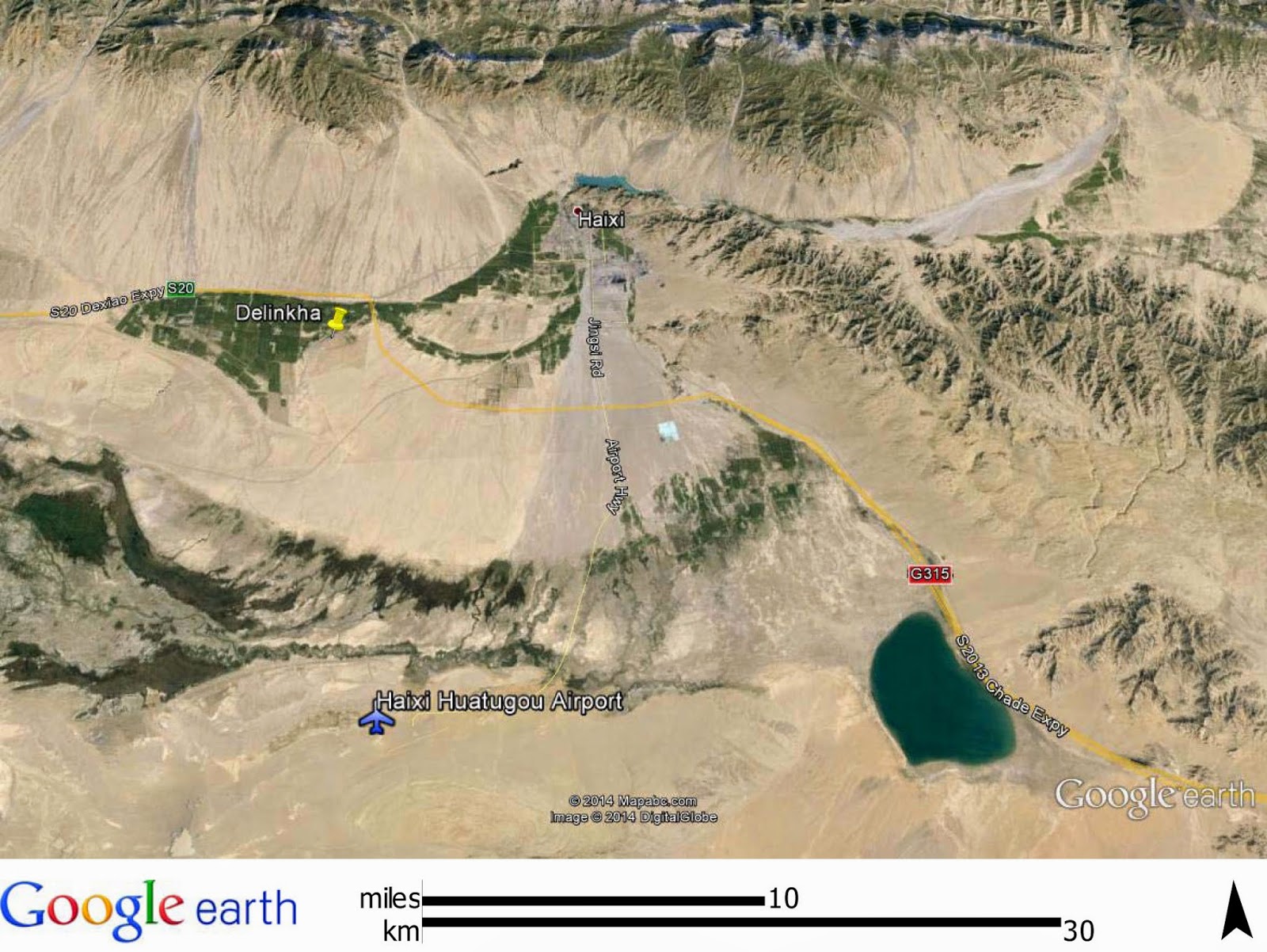
A New Airport In Lhasa ...and one in Amdo

Haixi Huatugou Airport in Amdo (Qinghai)
On August 30, I quoted Xinhua, announcing that Sichuan Province will soon have its fourth high-altitude airfield, “which local officials hope will boost tourism in the heavily Tibetan-populated region.”
The new Hongyuan Airport is located in Ngaba Tibetan and Qiang Autonomous Prefecture at an altitude of 3,535 meters. The Prefecture is situated in northwestern Sichuan, at the border of Gansu and Qinghai provinces.
Less than two weeks later, Xinhua now reports that Qinghai Province 'located on the Qinghai-Tibet plateau' will be home to another airport.
The Huatugou aviation airport, presently under-construction, is being built in the Mongolian-Tibetan Autonomous Prefecture of Haixi.
The Qinghai Airport Company said the airport will cover an area of 180 hectares and it will cost 114 million U.S. dollars.
It is a big investment for a Prefecture which, according the 2010 census, has 489,338 inhabitants only.
The airport will have a 3,600 meters runway and a terminal covering an area of some 3,000 square meters, which is relatively small.
The airport is expected to be completed within a year.
Why an airport in this area?
Xinhua gives one of rationales: "the airport is located in China's major production base for petroleum and potash fertilizer. It is expected to support local development."
Probably, the ‘local development’ with Chinese characteristics, in other words, 'Chinese economy at large'!
In 2011, a Chinese article gave a hint of the Chinese intentions: "The region is an important base for the production of crude oil; the surrounding is rich in oil, asbestos, potash and other scarce resources. The asbestos reserves rank first in the country; reserves of petroleum prospects are estimated at 1.1 billion tons. Though Qinghai is an important base for the production of crude oil, due to the remoteness, the limited transport conditions, the growth of the local economic and social development is restricted."
With connections to Xining, Delinkha, Golmud, Dunhuang, Gansu and Xinjiang, the new airport is expected to have an annual turn-over of 90,000 passengers and 100 tons of goods by 2020.
One understands better why it is a worthwhile investment.
Hongyuan Airport under construction

Further, the new airport is located close to the Xining-Golmund-Lhasa railway line and the China National Highway 315 (G315) which runs from Xining, the capital of Qinghai to Kashgar in Xinjiang. The 3,063 kilometres long highway passed in Delinkha. The new infrastructure will be used to link the restive province of Xinjiang with the Tibetan plateau. It can be useful in case of ‘disturbances’.
But there is more.
In 2010, I mentioned on this blog that DF-21C missiles were deployed in the same area. After The Times of India had ‘broken the news’ that Chinese missiles were deployed near the Indian border, Hans M. Kristensen of the FAS Strategic Security Blog had clarified: “The latest Pentagon report on Chinese military forces recently triggered sensational headlines in the Indian news media that China had deployed new nuclear missiles close to the Indian border. The news reports got it wrong, but new commercial satellite images reveal that launch units for the new DF-21C missile have deployed to central-western China.”
The area mentioned by the US report is not far from the new Hongyuan ‘civil’ airport.
In the meantime, in the Tibetan Autonomous Region, the authorities are actively planning to open a second airport for Lhasa.
On September 7, it was reported that the Lhasa Party’s Secretary Qizha La (or Choedrak in Tibetan) went for an inspection tour on the site of the new airport.
The Tibet Daily said that preliminary planning and design work were carried out. Choedrak asked the people to fully understand the practical significance of the construction of this new airport.
The Township of Lhasa attaches “great importance to further strengthening the organization by building a first-class international airport,” he said.
The objective of his visit was to accelerate the planning, design and other preparatory work for the project which should be implemented as soon as possible, according to the mouthpiece of the Party.

Choedrak, mayor of Lhasa on the site
Choedrak gave the usual speech: “the construction of the new airport in Lhasa will promote leapfrog development and long-term stability; it will strengthen national defense modernization; and will give full play to the role of Lhasa, the capital city [of Tibet]”.
It will also accelerate the overall well-being of the society: “All relevant departments should fully understand the important practical significance and far-reaching historical significance of the construction of a new airport in Lhasa; they should unify their thinking, attention, and effectively do all the pre-planning study for the new airport.”
On the long-term, the authorities want to "build a first-class international airport". For the purpose, “it is necessary to scientifically research, to keep high standards in the construction for this first-class airport in Tibet”, said Choedrak, a Tibetan cadre who added that builders should focus on all aspects of the construction of the new airport, i.e. water, electricity, road networks and other works in order to promote economic and social development.
Though Choedrak used the usual Communist jargon, the fact remains that Lhasa will have soon a second ‘first-class international’.
What does it mean for the Tibetan culture?
Probably something like the Reservations in the West of the United States!

Wednesday, April 16, 2014

New Infrastructure Links on the Tibetan Plateau

New Tunnel on the Golmund-Xining railway line
While India is busy with the legislative elections, China continues to frantically develop its infrastructure on the Tibetan plateau and at its periphery.
A couple of days ago, Xinhua announced, 'world's longest plateau rail tunnel completed'.
The Chinese news agency reported that the Xinguanjiao Tunnel, the world's longest plateau rail tunnel on the Qinghai-Tibet Railway, had been completed last week.
According to Zhi Changying, an official with the China Railway Tunnel Co. Ltd. (CRTC), a partner in the project, the 33 km tunnel is the longest rail tunnel in China.
It is a part of the Qinghai-Tibet Railway. It is located between Golmud in northwestern Qinghai province and the capital, Xining.
Except for the tunnel, the 763-km-long line was opened to traffic in November 2010.
It took some 7 years to the CRTC and the China Railway 16th Bureau Group Co., Ltd. (CRBGC) to built the tunnel which was the main 'bottleneck' on the Golmund-Xining railway line.
Liu Hairong, a CRBGC official admitted that the project posed several challenges for engineers due to high altitude, complicated geological conditions and tight budgets [sic].
Zhi Changying said that the tunnel will be opened to traffic at the end of 2014: "It will give a much-needed boost to the transportation capabilities of the high-profile Qinghai-Tibet Railway, which connects the northwestern Qinghai Province and Lhasa, capital of southwest China's Tibet Autonomous Region", stated the official who added that it will allow to better connect Qinghai and Tibet.
But that is not all.
The China Daily announced that the construction of a new road between Xichang (in Sichuan province) – Shangrila (in Yunnan province).
Te highway is expected to be started soon, 'with a planned construction period of five years'.
And when the Chinese say 5 years, it is usually 5 years.
The new highway will connect the Xichang-Panzhihua Highway with the Shangrila-Lijiang segment of the Xining-Chamdo–Dali highway.
It will start from the city of Xichang.
Let us not forget that the Xichang Satellite Launch Center (XSLC) is one of the main Chinese space vehicle launch facilities The launching pads are located some 64 kilometres, northwest of Xichang, Liangshan Yi Autonomous Prefecture in Sichuan.
Xichang Satellite Launch Center
According to Wikipedia: "The facility became operational in 1984 and is primarily used to launch powerful thrust rockets and geostationary communications and weather satellites. It is notable as the site of Sino-European space cooperation, with the launch of the first of two Double Star scientific satellites in December 2003. Chinese officials have indicated interest in conducting additional international satellite launches from XSLC. In 1996, a fatal accident occurred when the rocket carrying the Intelsat 708 satellite failed on launch from the Xichang Satellite Launch Center. Also, a 2007 test of an anti-satellite missile occurred from the center."
Is the new road linked with the satellite launch? Difficult to say!

China National Highway 318
The new highway will be 320 kilometers long. It will run through Yanyuan county in Sichuan province and the touristic Lugu Lake. More than half of the highway is located in Sichuan province.
The highway will have 97 super large, large and medium bridges and 24 tunnels; it will have four lanes all along; it is designed for a speed of 80 kilometers per hour.
This will be a new route linking Chengdu to Yunnan and Central Tibet (via Highway 318).
Once opened to traffic, it will only take two hours from Xichang to Lugu Lake. Chengdu, Sichuan's capital is 7 hours away from the picturesque lake.
The highway will connect National Highway 108 to National Highways 214 and 318.

China's National Highway 318 (G318) runs from Shanghai to Zhangmu on the China-Nepal border. It is the longest of China's National Highway with 5,476 kilometres. From Shanghai it crosses Zhejiang, Anhui, Hubei, Chongqing, Sichuan, and ends in Tibet.

China National Highway 214 (G214) runs from Xining in Qinghai province to Yunnan. It is 3,256 kilometres long. From Xining it goes southwards to southeastern Tibet (Yunnan province).

China National Highway 108 (G108) connects Beijing to Kunming via Chengdu. In Beijing it is known as Jingyuan Road. It is 3,338 km long. Xichang is located approximatively half way between Chengdu and Kunming.

Tuesday, July 30, 2013

No policy shift in Tibet as yet

The Jamyang Shepa receives Yu Zhengsheng in Labrang
The article of the China Brief of the Jamestown Foundation posted below speaks of a possible policy shift in Xinjiang.
The author's conclusions are based on two visits to Xinjiang by Yu Zhengsheng, the new Chairman of the Xinjiang Work Coordination Small Group.
Interestingly, Yu, No 4 in the Party and Chairman of the Chinese People's Political Consultative Conference (CPPCC) is also Chairman of Central Tibet Work Coordination Working Group (Small Group on Tibet).
Could the China Brief's conclusions for Xinjiang also apply to Tibet?
For the China Brief, the appointment of Yu as head of the Xinjiang Small Group "indicates a willingness to explore alternative solutions to the problem in Xinjiang. The fact that both of the party’s new initiatives in Xinjiang—the mass line and accelerated economic development— are drawn from existing Party orthodoxy raises doubts over how the far the center ultimately is willing to go. ...The extent of the shift from a top-down focus on security to one rooted in the mass line will be become clearer as Yu’s tenure progresses." 
Beginning of July, Yu Zhengsheng visited Amdo region (Qinghai Province) and called "for lasting prosperity and stability in China's Tibetan regions by improving local livelihoods and fighting the 14th Dalai Lama clique."
That is not really new.
He said that: "The Dalai Lama has long been engaged in secessionist activity that runs against both the common interests of people of various ethnic groups and the traditions of Tibetan Buddhism", adding that the Dalai Lama's  'Middle Way', directly conflicts with China's Constitution and the country's system of regional ethnic autonomy."
Though the official Chinese position is often repeated, nobody in Beijing has ever explained why it conflicts with the Chinese Constitution or even answered points by points the Memorandum sent by the Dalai Lama to the leadership in Beijing in 2008.
While in Eastern Tibet, Yu said that the policies of the Central Committee toward the Dalai Lama are 'consistent and clear'. He asserted; "Only when the Dalai Lama publicly announces that Tibet is an inalienable part of China, gives up the idea of 'Tibet independence' and stops his secessionist activity can his relations with the CPC Central Committee be improved."
For the past 25 years, the Dalai Lama has often repeated that he does not seek 'Independence' any more, but Beijing remains deaf to his message.
On the positive side, while visiting a local primary school that promotes bilingual education (Chinese and Tibetan), Yu said that this will help Tibetan students to find employment in the future.
Perhaps more interesting, Yu visited the famous Labrang Monastery, 'one of the six great temples of the Geluk school of Tibetan Buddhism' according to Xinhua. Yu was received by the traditional head of the monastery, the Jamyang Shepa.  
Lobsang Jigme Thubten Chökyi Nyima, the present incarnation (the 6th) is born in 1948 and currently lives in Lanzhou, the capital of Gansu province. During the Cultural Revolution, Jamyang Shepa became a layman but retained a high degree of prestige in the area. The Jamyang Shepas have traditionally been the most prestigious teachers at Labrang Tashikhyil monastery.
It is clear that the Chinese are keen to use the traditional hierarchy to  put across their message.
In conclusion, like for Xinjiang, the visit of Yu Zhengsheng is a mixed bag of old policies and seemingly fresher moves to release the tensions on the Tibetan plateau. 
One will have to wait the autumn (or the winter) to see if the new leadership is serious to find solutions to the Tibet's (and Xinjiang's) issues.
 
New Faces in Xinjiang Signaling a Policy Shift?China Brief 
Edward Schwarck
Volume: 13 Issue: 15
July 26, 2013

As fresh violence erupted across Xinjiang in June, the outlines of a new ethnic policy—one rooted in Xi Jinping’s “mass line” approach— slowly may be coming into focus (Xinhua, July 3). One aspect of this shift may be the appointment of a new Chairman of the Xinjiang Work Coordination Small Group, Yu Zhengsheng, which was revealed during his tour of the region in late May. A Standing Committee member and Chairman of Chinese People's Political Consultative Conference (CPPCC), Yu’s appointment breaks from a past tradition of handing control over Xinjiang affairs to hardliners within the political-legal affairs (zhengfa) system. This change in direction also may signal that, despite a resurgence of ethnic violence in the region, the party wishes to redouble efforts at fast-paced economic development, and that Yu, as former party secretary of Shanghai, may be the man to do so. 
Yu’s appointment was hinted at following his meeting with the delegation from Xinjiang during the National People’s Congress session in March and revealed formally during his five-day visit to Xinjiang in late May (Caixin, May 29). According to a Xinjiang Daily report, Yu undertook an expansive tour that included visits to Hotan, Kashgar, Yili and Urumqi, and he was accompanied by Xinjiang Party Secretary Zhang Chunxian and CPPCC chief of staff and new vice chair of the leading group Wang Wei (Xinjiang Daily, May 29). In an unusual move, Yu also visited Bachu County, which had witnessed a brief bout of sectarian bloodletting the month before. It was here that Yu pledged a “resolute strike” against terrorism, while paying condolences to the government “martyrs” and “heroes” that died in the incident (Xinhua, May 28). 
Despite Yu’s boilerplate rhetoric on stability, evidence suggests an ongoing yet discreet debate within the Party on how violence in Xinjiang should be handled. Following the Urumqi riots in 2009, the removal of the hardline local Party Secretary, Wang Lequan after inordinately long fifteen-year tenure marked the first step in a different direction. While Wang continues to attend policy meetings on Xinjiang through his new role as vice chair of the Central Political-Legal Committee (CPLC), his replacement, Zhang Chunxian, has emphasized “liberated thinking” and development-based solutions to Xinjiang’s ethnic tensions (Xinhua, May 28; Xinjiang Daily, March 4). Zhang’s policy of “flexible iron-fisted rule” has become the party’s new mantra for the region. The multi-billion dollar state-led development drive unleashed at the 2010 Xinjiang Work Forum also marked a watershed in Beijing’s policy toward its troubled western frontier [1].
The retirement of Zhou Yongkang, China’s politics and law chief from 2007 to 2012, and the subsequent downgrading of his portfolio from the Standing Committee to the Politburo level may yield further policy implications for Xinjiang. While acting as China’s security chief, Zhou wore a separate hat as head of the Work Coordination Small Group and also was the region’s delegate to the 2012 National People’s Congress (Tianshan Net [Urumqi], May 19). In this regard, Zhou followed his predecessor, CPLC chief Luo Gan, who also headed the Work Coordination Small Group, and marked the first link in a line of security officials spearheading policy in China’s far west.
Rumors now abound in the overseas Chinese press that the removal of the CPLC from power in Xinjiang marks another step in the targeted relegation of that organization after the 18th Party Congress (People’s Daily, February 5). Indeed, the year preceding the leadership transition witnessed a broad public debate on social management and the party’s stability maintenance apparatus. The CPLC in particular came under fire in party publications for overstepping its authority, interfering in the work of other government bodies and exacerbating social tensions through its heavy-handed reaction to social unrest (“Central Party School’s Critiques Suggest New Leadership Dynamics,” China Brief, June 22, 2012). While the downgrading of the political-legal portfolio after the 18th Party Congress is unlikely to have been driven by minority-related concerns, Xinjiang may now be subject to a broader move within the party away from top-down, coercive methods of stability maintenance. This has been reflected in a recent wave of rticles in the People’s Daily and party journals calling for a shift away from a government-centered approach to social management toward an embrace of the “mass line” (Wen Wei Pao [Shanghai], July 4; People’s Daily, May 19; Study Times, December 10, 2012).
“Following the mass line” (zou qunzhong luxian) was first revived toward the end of the Hu administration (“Resolving Contradictions in Social Management,” China Brief, September 21, 2012). Under the banner of fighting “formalism, bureaucratism, hedonism and extravagance,” Xi Jinping also has called repeatedly for reinvigorating the party’s grass roots work, warning that “winning or losing public support is an issue that concerns the CPC's survival or extinction.” China’s internal security organs have since fallen in step, and are now embarking on an education drive amongst grass roots officials about what the mass line entails. On 2 July, China’s Minister of Public Security, Guo Shengkun, called for “all work units to fully understand the significance of the party’s mass line”, and to ensure that “the masses can see, believe and are satisfied with its results” (Legal Daily, July 3). As violence erupted again in Xinjiang in late June, Yu Zhengsheng himself announced in a visit to the region that, in fighting violence and terrorism, the party should “greatly strengthen grass roots work” and “extensively mobilize and closely rely on broad based party members, cadres and the masses.” In a widely reported remark, Yu also singled out “religious figures and the masses of believers to make a greater contribution to building stability in Xinjiang” (sina.com.cn, June 29).
The mass line may also explain a raft of what Xinjiang news outlet Tianshan.net terms “new stability measures” by the local public security bureau (PSB). In the first two days of July, Xinjiang’s PSB announced three notices calling the public to come forward with information on terrorist threats and urging individuals to hand in knives and explosive weapons. An official responsible for the new initiative described its “core objective” as to “mobilize the masses, rely on the masses and garner the support of the masses” (Boxun, July 4). Xinhua later reported that the PSB is offering 50,000–100,000 yuan (roughly $8,000–16,000) for valuable information (Xinhua, July 3). On July 1, Beijing also dispatched 50 senior officials to “hostile communities” (di sheqing) in Xinjiang to lead local officials in a grassroots campaign to “widely propagate the party’s ethnic and religious policies,” “ensure that the masses of every minority deeply feels the party center’s concern” and that these ideas are “propagated down to every village committee and every household” (sina.com.cn, July 2).
The possibility that the mass line may bring improvement to the Xinjiang problem should be treated with caution. It should be noted, for example, that a string of incidents this year­—including the April violence in Selibuya and fatal stabbings of Han Chinese policemen in Atush city in early July—reportedly have been driven by house-to-house inspections by “community workers” and local police (Radio Free Asia, July 5; Phoenix News, April 25). Grass roots work aimed at achieving stability is also not a new innovation. The “People’s War” launched during the Beijing Olympics by former CPLC chief, Zhou Yongkang, sought to create an extensive network of informants and closed circuit television surveillance systems in cities nationwide (“Beijing Intensifies ‘People’s War’ Against ‘Splittism’ as Nationalism Rears its Head,” China Brief, April 28, 2008).
The mass line, however, is indicative of willingness by Beijing to explore solutions that are—in the Maoist sense—socially transformative as opposed to suppressive in nature. Official statements describe the mass line as a symbiosis between the party and the people in which local cadres ostensibly are better attuned to public needs and expectations. In this respect, the decision to consolidate China’s ethnic portfolio under the CPPCC—and its subordinate body, the United Front Work Department—may be an effort to build an ethnic policy that is more responsive to grassroots opinion and also more capable of influencing that opinion. The need for a new approach may even have been formally reached before the advent of the Xi administration. In Hu Jintao’s Work Report at the 18th Party Congress, China’s former leader singled out the united front as “a powerful instrument…for harmonizing relations between political parties, ethnic groups, religions, social groups and compatriots and home and overseas” (Xinhua, November 17). In an August 2012 article in the Study Times, CPPCC member and new Deputy Party Secretary of Xinjiang Han Yong also argued “mass line work under new conditions is the fundamental guarantee of social stability and of realizing long-term peaceful governance” in Xinjiang, later adding that “the masses are the main force in the struggle against splittism and building stability” (Study Times, August 20).

Economic Reformer
As Chairman of the CPPCC, Yu’s appointment may prove to be a modest step away from the previous government hard-line approach to Xinjiang. His past as a prodigious economic performer provides a further reason for his appointment. Since the Xinjiang Work Forum in 2010, the government has embarked on an ambitious development program that has seen a marked increase in foreign investment; a pledge for $10 billion to be allocated to the region on an annual basis; and a twinning policy called “duikou” that pairs Xinjiang localities with more prosperous eastern/coastal counterparts (“Xinjiang’s April 23 Clash the Worst in Province since July 2009,” China Brief, May 23).
Having successfully steered Shanghai through the global recession, Yu Zhengsheng is well placed to spearhead Xinjiang’s development. During his tenure as Shanghai party secretary, Yu pushed through a new initiative to turn Shanghai into “dual center” (shuang zhongxin) of international finance and shipping center by 2020 and achieved considerable success in rebalancing Shanghai’s economy away from fixed capital investment to consumer spending and FDI (China Economic Watch, November 19, 2012) [2]. This experience will prove useful in the government’s ongoing attempts to open Xinjiang further to regional trade and investment—an effort currently underway through the transformation of Kashgar and the northern city of Khorgos into Special Economic Zones, which have both been recently highlighted by Party Secretary Zhang Chunxian as a regional priority (Qiushi, May 16). Indeed, Yu presided over Shanghai’s support for Kashgar under the duikou policy. This partnership involved the opening of direct flights between the two cities and a multi-billion dollar boost in investment by over 50 Shanghai-based companies, including the creation of a major new Shanghai-Volkswagen plant in Urumqi (China Daily, April 26, 2012; Tian Shan Net, February 14, 2011).
While in Shanghai, Yu also proved himself an able public relations operator with the Chinese press lauding his deft handling of a high-rise fire in 2010. In the face of widespread public protest over the Maglev project, he showed an ostensible ability to compromise, promising to postpone the project until further discussions (South China Morning Post, October 1, 2012). Given that Xinjiang continues to suffer low levels of investment—largely due to fears over security—Yu’s appointment makes sense. Indeed, during his May visit to Xinjiang, Yu opened a new series of talks with local officials on how to building stability for industry and commerce (gongshang wending daji). This was followed by Yu’s publicized assurances that tourism, which is a major source of regional revenue, was safe for the public (Duowei, May 28).

Conclusion
The appointment of Yu Zhengsheng as head of China’s Xinjiang Leading Small Group indicates a willingness to explore alternative solutions to the problem in Xinjiang. The fact that both of the party’s new initiatives in Xinjiang—the mass line and accelerated economic development— are drawn from existing Party orthodoxy raises doubts over how the far the center ultimately is willing to go. One Uyghur dissident recently dismissed Yu’s appointment in Xinjiang as “old wine in a new bottle” (huan tang bu huan yao) (Voice of America, May 31). The extent of the shift from a top-down focus on security to one rooted in the mass line will be become clearer as Yu’s tenure progresses.