Showing posts with label Li Keqiang. Show all posts

Sunday, April 7, 2019

Tibetans in Metok: 'good' guys, 'bad' guys?

Offering khatas to the Premier
China Global Television Network (CGTN) recently gave some insights on China's borders: “China has the longest land border in the world totaling more than 22,000 kilometers. Many of the border towns are diverse and share both Chinese and foreign characteristics.”


Chinese Characteristics in Tibet
The State TV mentioned Metok, “a border county of the Nyingchi City in southeast Tibet, sitting close to India. Due to its complex geographic and weather condition, Metok County is a paradise for adventure seekers.”
Metok is located a few kilometers, north of the Indian border (Tuting Circle of Siang District of Arunachal Pradesh); it is where the Yarlung Tsangpo enters India to become the Siang; it will be known as the Brahmaputra in Assam.
The Chinese TV continues: “Tourists would be amazed by the ecological environment in Metok County as it ranks first among all counties in China in terms of forest coverage, with a forest coverage rate of over 79.2 percent. Metok also boasts as many as 500 waterfalls with the famous ones include the U-shaped Waterfall, the Hanmi Waterfall and the Tiger`s Mouth Waterfall.”
Chinese tourists are strongly recommended to trek to the Yarlung Tsangpo Grand Canyon and Mount Namjagbarwa, ‘the father of glaciers’

China's Last County without Highway
Terming Metok as China's last county without a highway, the TV channel explains: “Local people used to deliver supplies only by manpower. The terrible weather conditions like snow and rainstorm have made the construction of mountain roads extremely difficult.”
The following description makes this border area sounds paradisiacal.

The New Tunnel bringing Prosperity
Three days after the first news item (on March 3),  Metok, the ‘hidden lotus’ (Metok simply means 'flower' in Tibetan), China Tibet News reminds its readers that on October 31, 2013, Metok Highway was opened: “The highway has not only promoted the communication between Metok and the outside, but also enhanced local economic growth.”
The official website argues: “With the access to highway, the local economy developed rapidly and villagers experienced tremendous improvement. Most Metok's farmers and herdsmen living outside wanted to move back to hometown and take part in promoting their hometown's economic development.”
That sounds good.

Relocated villagers
Relocation Scheme
The government of the Tibetan Autonomous Region (TAR) implemented “a moving back project involving 68 households, of which 65 were registered impoverished. People who planned to move back could work for the construction of relocation sites, which also expanded their employment channel. Besides, covering an area of 360 mu (24 hectares), tea plantation in relocation site would benefit 99 households, with an increase of 16,000 yuan RMB (US $ 250) in per capita income,” said the official website.
In other words, a new Xiaogang village, a scheme often mentioned on this blog.
Since April 2018, some 329 farmers and herdsmen had alreday moved into new houses: "With the improvement of economy and society, agriculture and animal husbandry industry have been developing rapidly in Metok County. Life has been getting better and better," said China Tibet News.
That’s good!
But…

Li Keqian on The Roof of the World
Remember, Premier Li Keqiang made an ‘inspection tour’ in Tibet, at the end of July last year. China Tibet Online reported that Chinese Premier Li Keqiang visited Southern Tibet on July 25.
Li went directly to Nyingchi (Nyingtri) Prefecture/City, bordering Arunachal Pradesh. He visited a village (Shiga village) in Mailing County of Nyingchi City; it is a new village inhabited by Monpas. According to the press release, the inhabitants of this ‘Monpa’ village have been recently relocated from 'impoverished areas'. The ‘impoverished’ region is Metok.
You must be lost by now.
One scheme to relocate poor Monpas to another Prefecture/City and another to bring ‘Monpas’ to a 'booming' Metok County!!
It does not sound logic.
In the 'relocated' village, the Premier went to the new house of a Tibetan named Kunsang.
The new house obviously look good.
Li Keqiang sat with the ‘migrant’ family and talked to the six members of the household about their daily life.
He asked: What is the main source of income? How much could you make in a year? What about your health care and children’s education? What kind of difficulties do you still have now?
The Premier Li listened patiently to the answers of the villagers.
One Kunsang said that his family moved from Metok County, where “road travel is fairly difficult”.
Is it not surprising, considering that the TAR government is relocating people there to alleviate their poverty?
Where is the logic?
'Relocation' with Chinese characteristics?
Why to move people to a nearby County, if the situation has improved so much there that this particular place promotes 'return' of the villagers?
Why are some villagers taking away from Metok?
According to the official media, Kunsang told the Premier that his family has now an income of 150,000 yuan a year (US $ 2,400), thanks to farming and tourism. Further, the State “ensured health care service and children’s education program.” A total of 72 households is said to have shifted to the new village and 90% of families have similar income.
Li was said to have been really pleased “to see that the villagers have cast off poverty, through the relocation program and lived a prosperous life.”
The Premier wished the family an even more prosperous life in the future.

Another reason behind the relocation?
‘Poverty alleviation’ might not be the only reason; in a autocratic State, there is always the possibility of sieving the ‘bad’ guys and the ‘good’ guys.
The ‘bad’ ones are sent in safer places, further away from the border, while the ‘good’ ones are made the ‘The guardians of the sacred land and the builders of happy homes’.

Monday, October 29, 2018

The Party carries the people in its heart …when they are away from the border

'Happy' relocated Tibetans in their new home
The Chinese Communist Party’s (CCP) policy on the Indian borders is two-fold: one, to build ‘model’ villages (the villagers are said the ‘Guardians of the sacred land and the builders of happy homes’); two, to relocate recalcitrant Tibetans to place further away from the sensitive Indian borders.

Li Keqiang’s visit

Remember Chinese Premier Li Keqiang’s visit to Southern Tibet on July 25. The Premier went directly to Nyingchi (Nyingtri in Tibetan) Prefecture (now City) bordering Arunachal Pradesh.
He visited a village (Shiga village?) in Mainling County; it is a new village inhabited by Monpas.
Why Monpas in this area?
According to a press release, the inhabitants of this ‘Monpa’ village have been relocated from 'impoverished areas'.
The ‘impoverished’ region is the wealthy Metok County.
The Chinese Premier asked a ‘relocated’ villager: “What is the main source of income? How much could you make in a year? What about your health care and children’s education? What kind of difficulties do you still have now?”
Kunsang, one of the villagers, told Li that his family moved from Metok County, where ‘road travel is fairly difficult’.
This is rather surprising considering that after a tunnel was opened in 2013, the area is doing rather well, thanks to the tea plantation and large income brought by tourism; at the same time, the Chinese propaganda kept insisting that Metok, after the arrival of the all-weather road (via the tunnel), is doing well.
Better communications, are the positive ‘changes’ often mentioned for Metok.
Kunsang explained to the Premier that his family has now an income of 150,000 yuan a year (US $ 2,400), thanks to farming and tourism. Further, the State “ensured health care service and children’s education program.” There are a total of 72 households in the new ‘relocated’ village and 90% of families have similar income. Li affirmed that he was really pleased “to see that the villagers have cast off poverty, though the relocation program and lived a prosperous life.”
It is difficult to understand why this family was shifted from Metok to Mainling County. The only reason can be: the Party wants only ‘safe’ Tibetans on the borders with India.

Received by the border forces
Strengthening the border north of Bhutan
A few days ago, another article appeared in the French edition of China Tibet Online, it was titled: “Relocation of the villagers of Lhodrak: mission over”
It affirmed “After a first wave of successful relocation on October 15, a second wave is now over.”
Lhodrak, the legendary birthplace of Marpa the Translator is located north of the Bhutanese border.
An explanation is given with several telling pictures: “The villagers' relocation project represents the completion of scheme which is part of the strategy of the CPP’s Central Committee's for strengthening of the border. It is also a good example to illustrate that ‘the Party carries the people in its heart’, it provides a housing solution to families in need, and a strengthening of the masses on the borders and a strengthening of the border defence.”
Tibetan ‘uniforms’ are clearly provided for the photo op.

Relocation started long ago
On October 19, The China Daily published another article on “Relocation raises living standards for Lhopas”.
Lhopa or Lhobas, according to Wikipedia is “any of a diverse amalgamation of Sino-Tibetan-speaking tribes living in and around Pemako, a region in southeastern Tibet.” It included Metok and Zayul counties in Nyingchi Prefecture and Lhuntse County in Lhoka (also known as Shannan). The Chinese government officially recognizes Lhoba as one of the 56 ethnic minorities in China.
The article affirmed: “The lives of members of the Lhoba ethnic group in the Tibet Autonomous Region have improved markedly in recent decades, thanks to the reform and opening-up policy that was launched 40 years ago.”
What were these reforms?
It is explained that until about 50 years ago, the Lhobas were savage, they lived in the forest as hunters: “Now, about 3,000 Lhobas live in Tibet, in sparse communities such as the group in Mainling county.”
A Lhoba named Dawa was interviewed by the newspaper: "As hunters on the mountain, we lived in simple wooden sheds and our diet mainly consisted of meat from animals we hunted, corn we grew, and a few edible wild herbs. People often suffered from hunger, and they were forced to exchange bears' gallbladders and the skins of the animals they hunted for daily necessities such as grain, salt, tea leaves and clothes.”
But in 1985, a first group of 18 households, totaling 80 people including Dawa, were relocated from remote mountain and forest areas to Tsedro, a village where they were given houses, fields and livestock. Since then, the number of households has risen to 41, with more than 190 people.
This was probably one of the first cases of ‘relocation’.
But today’s relocation is done more systematically way and on a much larger scale.

The Modern Villages
On October 19, China Tibet News reported that since the beginning of 2018, Tsona County, near of Tawang District of Arunachal Pradesh has been “vigorously promoting the construction of border well-off villages.”
We are told that Tsona County has invested 519 million yuan in the construction projects of 9 border well-off villages which can benefit 1961 people of 617 households. Some 42.3% of the total project quantity has been completed, and an investment of 2.2 billion yuan has been spent.
In May, China Tibet News said that Lepo Valley, the first village in Tibet, north of the Tawang district, boasted of a rich vegetation and clear waters: “With impressive natural scenery and unique ethnic customs, Magmang ecological civilization village is also situated in Lepo Valley, Tsona County. …The construction of Magmang ecological civilization demonstration village began on March of 2014 and was completed on December. On January of 2015, this village was put into operation. In 2016, Magmang village was awarded the name "China's beautiful leisure village’ by China's Ministry of Agriculture.”
China has 26 national key tourist attractions; Lepo Valley is on the list.
A new scheme is now implemented, "Slowing down the speed of tour, enjoying the sea of azaleas in Lepo Valley", it prolonged the peak season said the authorities.
Dekyi Tsomo, a 27-year-old villager of Magmang, told the journalist: "Previously, houses in the village looked fairly rundown, and all roads leading to the village are muddy. Nowadays, the houses we live in are comfortable and big, with underfloor heating and hot water supply. This kind of house costs more than 400,000 yuan. We only pay 120,000 yuan, the other is paid by the government. Facilities in family inns are provided by the government, for which we all feel grateful.”
The Chinese website concludes: “Magmang village persists in following the notion that lucid waters and lush mountains are invaluable assets, focusing on the ecological conservation and promoting ecotourism.”
Incidentally on March 30, 1959, the Dalai Lama spent his last night in Tibet in Magmang; he was on his way to India. The next day, he crossed the border in Khenzimane/Chuthangmu.
Since then, he never returned to Tibet. He would certainly not recognize the ‘model’ villages.

Friday, October 19, 2018

Chairman Xi’s new mega project and China's internal politics

Landslide on the Yarlung Tsangpo
More on the environmental havoc in Tibet
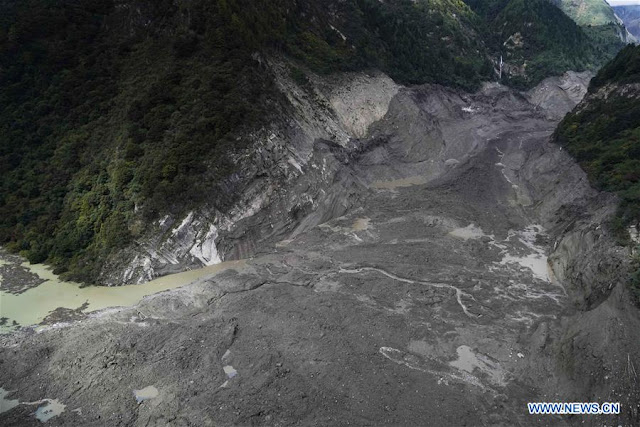
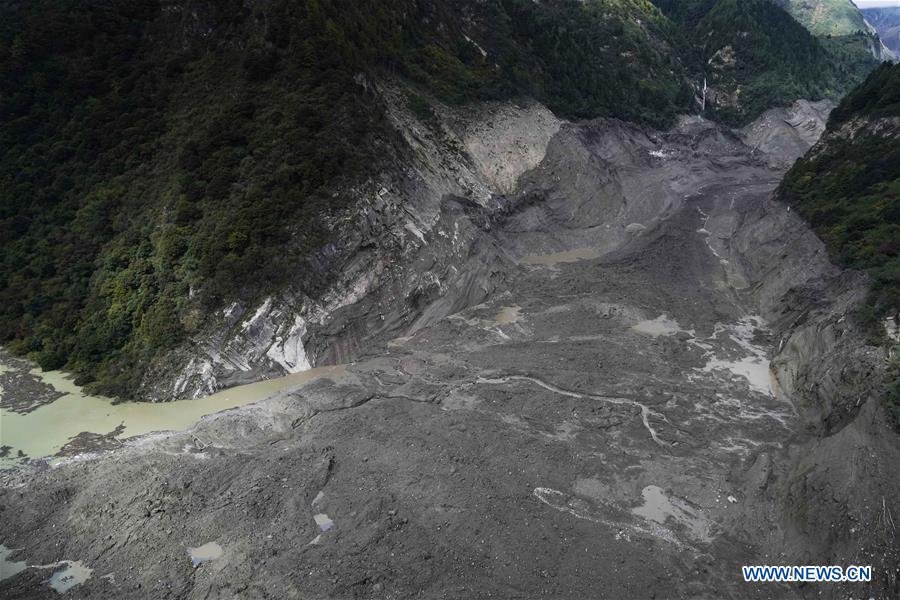
Three days after posting the story below on the landslide on the Upper Yangtze, VTIBET.com reported a "Barrier lake forms following landslide in Nyingchi."
This time it is on the Yarlung Tsangpo/Brahmaputra
The article says: "A barrier lake has formed after a landslide struck a section of the Brahmaputra Valley near Pe Village of Mainling County of Tibet Autonomous Region. As of 3 p.m., the amount of water in the barrier lake had reached about 150 million cubic meters."
Some photos show the landslide-hit road in Mainling County, north of Arunachal Pradesh.
According to The Telegraph, China’s water resources ministry has informed the Centre of a landslide in Mainling "which might have an adverse impact downstream, particularly in the East Siang district of Arunachal Pradesh."
The official order issued by the district administration said, “As per information received from the central water commission, Government of India, ...landslides blocked the Mainling section of the mainstream of Brahmaputra/Yarlung Tsangpo ...on October 16,which will have an impact on the water situation of the lower reaches of the Yarlung Tsangpo river.”
Development has a cost.

The Landslide on the Upper Yangtze
On October 11, Xinhua reported a ‘barrier lake’ which had formed due a landslide in a section of the Upper Yangtze (Jinsha River in Chinese) at the border between Sichuan Province and Tibet Autonomous Region.
The landslide struck in Bolo Township, in Jomda County of Chamdo prefecture.
Though no casualties were reported, the amount of water in the barrier lake had in a short time reached about 100 million cubic meters.
Some reports said 24,000 residents had been evacuated: “The Ministry of Emergency Management has initiated an emergency response.”
The PLA and PAP had been called to rescue the affected populations.
According to the same Ministry, some 7,000 tents, 30,000 cotton-padded coats, 50,000 quilts and 5,000 folding beds were sent to the landslide-affected area to help residents.
The local authorities in Chamdo stated that “the scale of the landslide is vast, clogging the main waterway of the Jinsha River, with several bridges, fields and villages affected.”
Bolo is located in the south of Jomda county; the Upper Yangtze separates this Tibetan area from the Sichuan province at an altitude of 2,860 meters. The county counts 8,325 residents in eight villages.
This 'natural' disaster raises seriously questions, not only environmental, but political too.

A coincidence?
Was it a coincidence that around the same time, Xi Jinping spoke at an ‘important’ meeting about the improvement of the disaster prevention while building the mega Sichuan-Tibet railway?
There is no doubt the project is so big, that it will resulted in serious ecological damage.
On October 10, Xi Jinping “called for efforts to improve the country's ability to safeguard against natural disasters, and fully launch the planning and construction of the Sichuan-Tibet railway.”
The Party's General Secretary made these remarks during the third meeting of the Central Committee for Financial and Economic Affairs: “As a stronger capability of safeguarding against natural disasters concerns the economy and people's livelihood, China will set up an efficient and scientific system and improve the capability of the whole society in a bid to protect people's lives and property and national security," said Xi.

The Sichuan-Tibet Railway
The meeting was called to discuss the Sichuan-Tibet railway, which will have “profound significance for the country's long-term stability and the development of Tibet.”
It had been rumoured earlier that there was a rift between the Chinese President and his Premier, Li Keqiang, who had visited Tibet in rather strange circumstances, probably to inspect a section of the projected mega railway line.
At the recent meeting, two more members of the all-powerful Politburo’s Standing Committee were in attendance: Wang Huning and Vice Premier Han Zheng.
Xinhua commented: “As one of the most disaster-prone countries in the world, China has attached great importance to the matter and made remarkable progress. But its overall capability to respond to such extreme conditions is still relatively weak, and more should be done.”
It was said that China would work to build a coordinated disaster-responding system, adopt a people-centered approach, give priority to the environment, try its best to minimize the aftermath, propel reforms and innovation to modernize its capability, and continue international cooperation: “A raft of major projects will be advanced, including ecological restoration of forest, grassland and rivers, coastal protection such as building ecological seawalls, housing reinforcement projects in earthquake-prone areas, flood control and drought relief, relocation of residents in disaster-hit places, construction of emergency centers, natural disaster monitoring and early warning, and the modernization of rescue technology and equipment.”

Who will pay?
All this will cost money and may increase the cost of the project many folds.
One of the questions never mentioned in the Chinese press is: can Beijing afford this mega project?
What would be the main objectives of the railway line between Sichuan and Lhasa?
Is it really necessary at this point in time?
The meeting just said that “it will promote ethnic solidarity, safeguard national unity and consolidate the stability of the frontier, as well as bolster Tibet's economic and social development.”
There is no doubt that in Xi’s mind, the ‘consolidation of the frontiers’ is crucial; let us not forget that he occupies the seat of Chairman of the Central Military Commission.
Observers have asked, why was this meeting called by Xi; after all such project should come under the State Council, in other words Premier Li, who himself held a similar meeting in August.

Another 'important' meeting
Just after the Summer holidays at Beidaihe, Li had chaired a meeting of the Leading Group on the Development of Western Regions on August 21.
It was held in Beijing; Vice Premier Han Zheng, deputy head of Leading Group was also present.
Li Keqiang stated that the Western areas should continue with reform and opening-up and vigorously innovate to achieve high-quality development.
While acknowledging the economic and social achievements in the regions, Li described the development in Western Regions (i.e. Tibet and Xinjiang) as 'a crucial and difficult point' for China to become a moderately prosperous society in all respects and achieve modernization.
Western areas should channel more energy into industrial upgrades, and make more contributions to a stable national economy, Li said.
The railway was mentioned; but a more holistic approach was stressed: “Entrepreneurship and innovation should be promoted in a practical manner, Li said, urging measures to raise industrial competitiveness in western regions and greater steps to cultivate new growth drivers and restructure traditional sectors,” said Li who adding that “The central government will pump more capital into the areas and encourage local governments to attract private investment.”
Li cited projects such as the Sichuan-Tibet railway, power grids, oil and natural gas pipelines, internet infrastructure, and water diversion projects (hopefully not the Brahmaputra!!).
Li highlighted the people-centered development, which not might be the case of the Sichuan-Tibet railway: “China will take solid, precise actions to win the tough battle against poverty and work for equality in public services. Internet technologies will be used to let remote poor regions enjoy better education and medical services, and the employment and old-age care in western regions will also be enhanced.”
It is here that there is a difference of approach between the two leaders; Li being softer.


The Pharaonic project with the longest tunnels
A month earlier, The China Daily had given some details about the project: “A preliminary study on the Kangding-Nyingchi section of the Sichuan-Tibet Railway shows the section will include at least 10 rail tunnels each longer than 10 kilometers."
He Huawu, a member of the Chinese Academy of Engineering, told the newspaper that the total length of the rail tunnels in the Kangding-Nyingchi section would be 843 kilometers - which is longer than the Beijing-Zhengzhou high-speed railway: “The longest rail tunnel, extending 42.5 km, would be the longest in China, eclipsing one 32-km-long on the Qinghai-Tibet Railway.”
There will be six rail tunnels in the Kangding-Nyingchi section longer than 30 km.
He Huawu spoke during an academic seminar on key technologies for building high-speed railways in complicated mountainous areas held in Chengdu.
China Railway had announced that design of the line was ‘not final’, but just part of preliminary research on the construction of the Kangding-Nyingchi section, and it has not been approved by the authorities.
The Sichuan-Tibet line will be the second railway line connecting the Tibet Autonomous Region with the mainland; the first one was the 1,956-km Qinghai-Tibet Railway, which opened in 2006.
The China Daily commented: “Since the new line will have to go through intricate and difficult geological conditions, and its construction will have to overcome frozen earth, landslides and rock slides, experts have dubbed the Sichuan-Tibet Railway China's most challenging rail project.”
Then recent landslide is an example of what could (will) happen to the railway line.
In fact, the construction in such difficult terrain is bound to create havoc for the environment on the marches of the Tibetan plateau. It probably explains the warning of Xi Jinping.
But a more cautious approach will also drastically increase the cost of the project; it is where Li may not fully agree with the Emperor.

Landslide on the Upper Yangtze
Can China afford it?
At the end the question is: can Beijing afford this in the midst of a trade war with the US?
It is one of the many dilemmas that the Chinese leadership will be facing in the years to come.
It could easily create a schism between the different factions in the Communist Party; between the ones promoting a more human approach and the ones vouching for gigantic schemes.
The discreet visit of the Chinese Premier to Tibet should be seen in this perspective.
The article of The China Daily concluded: “Some easier parts of the line have been built in the past few years, but construction of the Kangding-Nyingchi section has yet to start due to the difficulties involved.”
It refers to the Nyingchi-Lhasa railway line which will soon be open to traffic.
The Chinese paper added: “Previous reports have said trains on the Sichuan-Tibet line will travel at between 160 and 200 kilometers per hour. When the line is completed, the travel time by rail between Chengdu and Lhasa will be cut from 48 hours to about 13 hours.”

It is if the line is completed…
In the meantime, development projects in this ecologically fragile area are creating havoc.

To restore the traffic, a new road is being built. All this has a cost.

Jiala Village is close to the Great Band of the Yarlung Tsangpo
Landslide on the Yarlung Tsangpo near Jiala village

Landslide on the Yarlung Tsangpo near Jiala village

Landslide on the Yarlung Tsangpo near Jiala village

Landslide on the Yarlung Tsangpo near Jiala village

Wednesday, September 19, 2018

The new panacea for the Middle Kingdom’s problems?

Premier Li Keqiang inspecting the Lhasa-Nyingtri railway route
Railways have recently been in the news in the Chinese press, particularly new railway lines on the Tibetan plateau and its periphery.
Yesterday, an article dealt at great length about the ‘LaLin’ section of the Sichuan-Tibet Railway.
‘Lalin’ is a short form for Lhasa-Linzhi railway (‘La’ for Lhasa and ‘Lin’ for Linzhi, called Nyingtri by the Tibetans).
On September 18, Xinhua reported that the China Railway’s 11th Bureau had successfully laid the first group of ballasts for the Gonggao [Gonkar?] station, the first new station in the railway line: “thus created the traffic conditions for the passage of the Lalin Railway.”
Liu Jun, the Secretary of the Lhasa-Nyingtri Project told the agency that the Sichuan-Tibet Railway was a key project of the National 13th Five-Year Plan: “Upon completion, it will become another railway artery connecting the plateau with the mainland.”
In 2006, the Qinghai-Tibet Railway was opened to service.

Details of the Lhasa-Nyingtri Project
The Lhasa-Nyingtri Project section is an important section of the Sichuan-Tibet Railway; it is certainly relatively easier to build than the eastern part.
It will have a total length of 435 kilometers and 34 new stations, including 17 which which are already existing. It will start in Lhasa and end at Nyingtri City and follow the Yarlung Tsangbo River (Siang/Brahmaputra in India).
The construction of this section started at the end of 2014; it should take 7 years to complete the entire project and the speed of the train will be 160 kilometers; it will be the first electrified railway in Tibet.
The Railway line will cross the Yarlung Tsangpo 16 times. The railway bridges use large-span bridge structures: “The mountains are high in water depth, the rivers are rushing, the technology is special, and the construction is extremely difficult. There are 14 high-risk tunnels out of 47 tunnels, of which 7 are extremely high-risk tunnels,” explained China Railway's 11th Bureau.

Not being afraid of difficulties
On September 6, another article which appeared in China Tibet Online reported that Lhasa-Nyingtri Railway was making smooth progress; a total of 2.72 billion yuan has been invested between January and August 2018: “Relying on advanced technology and the spirit of not being afraid of difficulties, now the Lhasa-Nyingchi Railway project is progressing well,” said a release.
The annual planned investment is 4.38 billion yuan.
According to the authorities, the project should promote town development, resource exploitation [mining?], industrial upgrading, emergency rescue and relief, emergency situation ...and perhaps more importantly national defense.
Beside this, it will play an important role in implementing the scientific development concept, building a harmonious society, implementing the Western Development strategy; it will promote the coordinated development of eastern and western economies, improve the layout of the regional rail network, connect Yangtze River Economic Zone and Sichuan-Chongqing Economic Circle, promote the development of Shangri-La Ecological Tourist Area and improve the investment environment.
Quite a long list of benefits!
And as importantly, the construction of new towns along the line will improve people's living standard, and speed up the pace of poverty alleviation in Tibet.
In one word, the panacea for all problems on the plateau.
But national defence is certainly one of the major objectives of the project.

A map of future railway lines
Interesting is a map found on a Pakistani website accompanied one of these articles.
The ‘Lalin’ railway line is in green, but several new lines are shown reaching the plateau. They are worth noting:
  • The Lhasa-Shigatse-Kyirong section which should be completed in a couple of years (it was delayed due to the 2015 Nepal Earthquake)
  • The Lhasa-Yatung section reaching the Chumbi Valley and the Indian border in Sikkim. It has serious strategic implications for India, especially after the Doklam episode. Though it is rarely mentioned in the Chinese press, it is clearly on the cards (it is not in dotted lines)
  • The projected Yunnan-Tibet railway line which has special strategic implications to India too, particularly for the border in Arunachal Pradesh (in a dotted line). It will join the Sichuan-Nyingtri line somewhere near Chamdo.
  • Korla-Golmud is already under construction. It will be the second major railway line linking Qinghai province to Western Xinjiang.
  • The Shigatse-Rutok-Kashgar line (in dotted line). It is a novelty. It may follow the G219 Highway (known as the Aksai Chin road). Will India protest if China starts building a railway on its territory?
  • A new Qiemo-Korla line across the Taklamatan desert. An extension of G216 Highway is under construction. It should be following the highway.
  • The Khotan-Quiemo line in Xinjiang. It will link up with the Khotan-Kashar line. It is probably important for the totally unstable Muslim province, in order to ‘stabilize’ southern Xinjiang and build new model villages/town along the line.
  • The Khotan-Tashkurgan line, leading to the border with Afghanistan.
    Tashkurgan has historically been part of the Silk Road. “Major caravan routes converged leading to Kashgar in the north, Yecheng to the east, Badakhshan and Wakhan to the west, and Chitral and Hunza to the southwest” says Wikipedia.
  • A never seen-before project to link Chengdu in Sichuan to Golmud in Qinghai. It will close the loop linking the two provinces on the West and North of the Tibetan plateau and link up Xinjiang through the above-mentioned Golmud-Korla line.
Incidentally at the end of July, Li Keqiang, the Chinese Premier visited a construction site of the Lhasa-Nyingchi railway.
Li stressed the importance of the project for the development of Tibet and  for the ecological protection [how is not clear]: "The railway project is beneficial for Tibet to cultivate new growth drivers, and it is the right thing that must be done. Full construction work should be accelerated," Li said.
He added that "at present, infrastructure development in the country's central and western regions is relatively weak, and promoting effective investments to improve weak links will not only narrow the gap in regional development but also helpful for the country to cope with economic downturn."
He further observed: "China should avoid strong stimulus and take targeted measures that are beneficial in both short and long terms."
Implications for India
All this should be quite worrisome for India.
However the main problem for Beijing seems to be: can China afford all these new projects?
Who will finance these mega-developments, especially if the US President turns the screw on the Chinese economy and if Xi continues to ‘invest’ in Africa, Pakistan or elsewhere, outside the Walls of the Middle Kingdom?
It is a serious question, though difficult to answer.
Further, it is bound to create ‘differences’ within the Communist leadership on the investment ‘priorities’ and ultimately jeopardize the ‘stability’ of the Kingdom …when the Emperor and his courtiers start fighting among themselves.


Friday, July 27, 2018

Li Keqiang on The Roof of the World

Two big news today.
First, Premier Li Keqiang made an ‘inspection tour’ in Tibet.
And then Lt Gen Lui Xiaowu, a Deputy Commander of the Western Theater Command, who was recently in India, would have been put under ‘investigation’.
If confirmed, it is a serious news.

Li Keqian on The Roof of the World
China Tibet Online reported that Chinese Premier Li Keqiang visited Southern Tibet on July 25. Apparently Li went directly to Nyingchi (Nyingtri) prefecture (City) bordering Arunachal Pradesh. He visited a village (Shiga village) in Mailing County in Nyingchi City; it is a new village inhabited by Monpas. According to the press release, the inhabitants of this ‘Monpa’ village have been relocated from 'impoverished areas'.
The ‘impoverished’ region is located next door is Metok Dzong (County).

Poverty alleviation
The Premier went to the new house of a Tibetan named Kunsang.
He sat with the ‘migrant’ family and talked to the six members of the household about their daily life.
He would have asked:
What is the main source of income?
How much could you make in a year?
What about your health care and children’s education?
What kind of difficulties do you still have now?
It is said that the Premier Li listened patiently.
Kunsang told Li that his family moved from Metok County, where “road travel is fairly difficult”.
This is rather surprising considering that since 2013, when a tunnel was opened, the Chinese propaganda has been insisting on the ‘changes’ in Metok, principally mentioning better communications. Read my post, Metok and the Tourist Boom
The question is why to move people to a nearby County, if the situation had improved so much in the first place?
Kunsang explained to the Premier that his family has now an income of 150,000 yuan a year (US $ 2,400), thanks to farming and tourism. Further, the State “ensured health care service and children’s education program.”
We are told that there are a total of 72 households in the new village and 90% of families have similar income.
Li was said to have been really pleased “to see that the villagers have cast off poverty, though the relocation program and lived a prosperous life.”
The Premier wished the family an even more prosperous life in the future.
It is difficult to understand why this family was shifted from Metok to Mainling County.
Were they creating problems for the Chinese government in Metok, near the Indian border?
It is possible.
Metok, like several other places on the border (Yumed, Tsona, Lepo, Marmang, Rima, etc) has been the focus of very generous investments from the Central Government, the local government as well as different Provincial Governments.
So, it is doubtful if ‘poverty alleviation’ is the only reason.

Education
Li Keqiang spoke to Kunsang’s daughter, the six-year-old Yeshe Drolma, and asked her if she was going to going to school.
The answer was obvious as the Party would have not selected an 'illiterate' family to receive the Premier.
The little Yeshe Drolma, dressed in Monpa costume, said that she was in the senior class of the kindergarten.
Li asked her to write a few words (all this must have been scripted in detail before).
Yeshe wrote her name both in Chinese and Tibetan on a paper and showed it to Li who said, “Wish you could learn hard and grow to be as intelligent and beautiful as your name says”.
According to the Chinese website Yeshe Drolma means ‘Intelligent Fairy’.
In fact, Drolma is Tara, the Mother of the Tibetans.

Reallocation of restive populations
This ‘reallocation’ of population reminded me an article published on July 6 in The People's Daily.
It speaks of the situation in Xinjiang and said that Beijing has relocated “461,000 poverty-ridden residents to work in other parts of the region during the first quarter of the year.”
An ‘expert’ explained to the mouthpiece of the Party that it is a bid to ‘improve social stability and alleviate poverty’. The report asserted that the Xinjiang government planned to further transfer 100,000 residents from southern Hotan and Kashgar prefectures by 2019, to get employed somewhere else.
Yu Shaoxiang, another ‘expert’ at the Chinese Academy of Social Sciences, admitted to The Global Times: “poverty alleviation in Xinjiang is more difficult compared to other places because, aside from poverty, Xinjiang also faces ethnic issues.”
Yu further commented: “Organizing people to work away from home would help them better integrate with the rest of China, and take their advanced skills back to Xinjiang later. The relocation also helps maintain regional security.”
Xinhua News Agency said that in 2017, ‘occupational education programs’ covered 1.26 million people in Kashgar and Hotan, where 47,000 poor people found jobs while 317,400 individuals and 331 villages were lifted out of poverty. It is obviously a pretext in an area which is the hub the Belt and Road Initiative (BRI).
It is clear that reallocation is linked with ‘ethnic issue’.
It is rather worrying knowing that the visit of the Premier to Tibet takes place just before the yearly summer retreat of the Party’s top bosses in Beidaihe, which is always the occasion to discuss ‘new’ policies.
Will reallocation of Tibetans withing Tibet from border areas be discussed?
A new Chen's Policy adapted to Tibet?
There is no doubt that the Mainling Country is less strategic than the Metok area, though Bayi, the PLA garrison is not located far away (it is the neighbouring County in Nyingchi).

A remark
It is usually the Chairman of the Chinese People's Political Consultative Conference (Yu Zhengsheng and now Wang Yang) who is responsible for 'looking after' Tibet. 
The head of the United Front Work Department (Sun Chunlan for example) also regularly 'inspects' the Roof of the World.
It is usually not the job/responsibility of the Chinese Premier to look into Tibet affairs.
One more reason why this visit is very special. 

First visit of a Premier
Another consideration, Li Keqiang, No 2 in the all-powerful in the Standing Committee of the Politburo, is the seventh Premier of China.
Before him, Zhou Enlai (1949–1976), Hua Guofeng (1976–1980), Zhao Ziyang (1980–1988), Li Peng (1988–1998), Zhu Rongji (1998–2003) and Wen Jiabao (2003–2013), served as Premiers.
None of them visited Tibet.
Why to send the Premier if there was not something big cooking?
We will have to wait a few days (or months) to know more.
The other 'important' visit to Tibet were:
But relocations of recalcitrant Tibetans would be dreadful scheme and not a good signed for the health of the People’s Republic, which appears more and more nervous.

A few questions
  • Since when is the Chinese Premier looking after Tibetan affairs?
  • Will Li meet the Chinese Panchen Lama Gyatsen Norbu while in Tibet?
  • Will he visit Bayi, the Chinese garrison in Nyingchi City and meet the border troops?
  • Will he visits other Prefectures/Cities in the Autonomous Region?
(Gen Liu with the Vice-Chief of the Indian Army)
Gen Lui Xiaowu
The second news is that according to The Epoch Times, Lt Gen Lui Xiaowu, who headed a PLA delegation in India earlier this month, would be under investigation.
To be followed…


Sunday, August 30, 2015

China visit and after – Undoing Nehru’s folly

In May, I wrote an article China visit and after – Undoing Nehru’s folly which appeared in NitiCentral.
It was about Nehru's rejection of a seat for India in the UN Security Council.
It occurred twice.
The first time in 1950, when the State Department made the offer and a few years later, when the Soviets were ready to sponsor India for a seat.
Both times, Nehru refused.

Since then, I got a copy of a letter from Nehru addressed to his sister, Vijaya Lakshi Pandit, then the Indian Ambassador in the United States, in which he justifies his refusal.
Here is Nehru's letter.

To Shrimati Vijaya Lakshmi Pandit,
Embassy of India,
Washington, D.C., USA.
SECRET 
PERSONAL
New Delhi,
August 30, 1950.
I have your letter of August 24th. Also Einstein’s new letter.
As far as I can see at present, I shall not be going to Lake Success, But of course there is always a possibility of some new development which might induce me to go there. I am quite sure that my going there casually will do no good to anyone. Einstein and people like him, with their simplicity and good-heartedness, think that some magic might result by a personal intervention. We can hardly plan for magic. Frankly, I do not want to make myself cheap and to get entangled in the internal controversies and debates of Lake Success.
Living in the United States, you are naturally oppressed by the atmosphere there at the present moment. You dislike it and you criticize it. Nevertheless, your view of the world situation is necessarily influenced by your environment. That environment and what happens there is of very great importance because, as you put it, the issue of war and peace may depend upon it.
It is clear that the world outlook today of the British people is markably different from that of America, even though they might be functioning more or less as allies. Western Europe again is also different in its own way. If you travel further to Russia, you are of course in a new world entirely. With new fears, new apprehensions, new ambitions. Here in India though there may not be much intelligent thinking on international affairs, there is nevertheless an instinctive reaction to them which is not at all favourable to the US.
It is no easy matter to deal with this complicated situation where each group thinks differently and where perhaps the only common feature is some kind of fear. Only today I received a letter from Panikkar from Peking together with a report on the present-day China. Both the letter and the report are very interesting and I am therefore enclosing a copy of them for you. Here also you will see an entirely different world with its own way of thinking on problems. What a vast difference there is between this and the US view of China as a stooge of Moscow!
Panikkar is a man of extraordinarily acute intelligence and powers of observation. In fact, his mind is so keen that it over-shoots the mark and goes much further ahead than facts warrant. But his analyzing the situation, apart from the time factor, is usually good. What will happen to China during the next few years is anybody’s guess. But it is a complete misunderstanding of the China situation to imagine that they function like a satellite State of Russia. Only one thing will push them in that direction to some extent. And even then this cannot go far. That one thing is isolation from the rest of the world. The US policy is the one policy which will make China do what the US least want. That is the tragedy or comedy of the situation. We grow blindly to achieve something and get something entirely different.
There can be little doubt that the Chinese Government is trying its best to be friendly to us. Apart from present day conflicts and in the long run, I am sure that it is of great importance to Asia and to the world that India and China should be friendly. How far we shall succeed in this endeavour, I cannot say.
In your letter you mention that the State Department is trying to unseat China as a Permanent Member of the Security Council and to put India in her place. So far as we are concerned, we are not going to countenance it. That would be bad from every point of view. It would be a clear affront to China and it would mean some kind of a break between us and China. I suppose the State Department would not like that, but we have no intention of following that course. We shall go on pressing for China’s admission in the UN and the Security Council. I suppose that a crisis will come during the next sessions of the General Assembly of the UN on this issue. The Peoples’ Government of China is sending a full Delegation there. If they fail to get in there will be trouble which might even result in the USSR and some other countries finally quitting the UN. That may please the State Department, but it would mean the end of the UN as we have known it. That would also mean a further drift towards war.
India, because of many factors, is certainly entitled to a permanent seat in the Security Council. But we are not going in at the cost of China.
Meanwhile, the continuance of the Kuomintang representative in the Security Council becomes more and more Gilbertian. Here is a Permanent Member of the Security Council with power of veto supposed to be a great power. In fact what we have is a Representative of the Government of Formosa having this authority and power at Lake Success. That Government of Formosa too is practically protected by a foreign power, the US.
Pakistan is busy building up a big case against us. There is of course Kashmir. They are now demanding from us a reference to the International Court at The Hague of the canal water dispute. Obviously they are going to raise this matter in the UN and are likely to do so directly on the ground that this might involve a breach of peace between the two countries. They have also written to me after many months about my proposal for a “No War” declaration in the simple and general form which I have originally proposed and which Pakistan had not accepted them.
As regards canal waters, I have not answered them yet, but I shall do so in the course of the next week. I do not propose to agree to The Hague tribunal. But we are prepared for arbitration, that is each party to nominate an arbitrator and a third to be chosen by them.
I am thinking of going to Assam for two or three days soon to confer with people there and to fly over the earthquake areas. We do not yet know the full extent of the earthquake and the damage it has caused. Many areas are completely isolated and people are marooned. It is said that the landscape of upper Assam has changed considerably. Some hills have disappeared and rivers are following new courses. Fortunately that area is not a heaily populated one, or else the damage would have been colossal.

Sd/- Jawaharlal Nehru.

China visit and after – Undoing Nehru’s folly
Here is the link of my May article....

A few months ago, a European diplomat confidentially told me, ‘in fact, the job of Modi is just to undo the knots in which the UPA tied up India in the past’. He was probably thinking of the complex Defence Procurement Policy (DPP) put in place by A.K. Antony, the UPA’s Defence Minister, who made the DPP so complicated that it became impossible for India to arm itself or even ‘make arms in India.’ This is the sad story of the Rafale deal; finally, during his recent visit to France, Prime Minister Modi had cut the MMRCA ‘bind’ and buy a few airplanes ‘off-the-shelf’.
Unfortunately, it is not only in defence issues that the previous governments have entangled India into insolvable predicaments.
The case of a seat in the United Nations’ Security Council is a stark one.
After Modi’s meetings with President Xi Jinping and Premier Li Keqiang, I was curious to see what the Joint Statement would say on this issue and if China’s position had moved. I thought that if Beijing is truly keen to enhance the trust between India and China, it should make a gesture and sponsor India’s candidature to the Security Council. Unfortunately, it did not happen.
The Joint Statement says: “The two sides support a comprehensive reform of the United Nations, including recognizing the imperative of increased participation of developing countries in UN’s affairs and governance structures, so as to bring more effectiveness to the UN. China attaches great importance to India’s status in international affairs as a large developing country, and understands and supports India’s aspiration to play a greater role in the United Nations including in the Security Council.”
It does not say that India should have a permanent seat with veto power, like China has. This is really ingratitude from China’s side.
One remembers the 1955 Soviet offer to sponsor India’s case for a permanent seat.
Sarvepalli Gopal wrote in his 3-volume biography of Nehru: “He [Jawaharlal Nehru] rejected the Soviet offer to propose India as the sixth permanent member of the Security Council and insisted that priority be given to China’s admission to the United Nations.”
Now some ‘experts’, like A.G. Noorani have argued that Nehru did the right thing as ‘the offer was unlikely to materialize’.
Soviet Premier Nikolai Bulganin had told the Indian Prime Minister: “We propose suggesting at a later stage India’s inclusion as the sixth member of the Security Council”; Nehru had replied: “This is to create trouble between us and China. We are, of course, wholly opposed to it. Further, we are opposed to pushing ourselves forward to occupy certain positions because that may itself create difficulties and India might itself become a subject to controversy.”
In another letter, Nehru elaborated about India’s position and the reasons to reject the ‘proposals’: “We have, therefore, made it clear to those who suggested this that we cannot agree to this suggestion. We have even gone a little further and said that India is not anxious to enter the Security Council at this stage, even though as a great country she ought to be there. The first step to be taken is for China to take her rightful place and then the question of India might be considered separately.”
But there is more. Recently, a young scholar, Anton Harder, working on his PhD at the London School of Economics, went through the Vijayalakshmi Pandit Papers kept at the Nehru Memorial Museum & Library in Delhi.
Harder found that in August 1950, Mrs. Pandit, then posted as Ambassador to the US, wrote to her brother: “One matter that is being cooked up in the State Department should be known to you. This is the unseating of [Nationalist] China as a Permanent Member in the Security Council and of India being put in her place. …Last week I had interviews with [John Foster] Dulles and [Philip] Jessup, reports of which I have sent to Bajpai. Both brought up this question and Dulles seemed particularly anxious that a move in this direction should be started.”
Five years before the Soviet offer, Washington was ready to sponsor India for a seat in the Security. A few days later, Nehru answered to Pandit: “You mention that the State Department is trying to unseat China as a Permanent Member of the Security Council and to put India in her place. So far as we are concerned, we are not going to countenance it. That would be bad from every point of view. It would be a clear affront to China and it would mean some kind of a break between us and China.”
The Indian Prime Minister added: “We shall go on pressing for [Communist] China’s admission in the UN and the Security Council. …The people’s government of China is sending a full delegation there. If they fail to get in there will be trouble which might even result in the USSR and some other countries finally quitting the UN.”
Thus whole background is all the more shocking as at that particular time, China was preparing to invade Tibet; a position in the UN would have helped India’s prestige and influence. K.M. Panikkar, India’s Ambassador to China knew about the communists’ intention: on August 15, 1950, it had been reported from Hong Kong that Chinese troops had begun advancing towards Tibet’s borders. Nehru too was aware of the impending ‘liberation’: “This invasion of Tibet might well upset the present unstable equilibrium and let loose dangerous forces. Some of our border States will be affected. But I am more concerned with the larger issues which this involves,” he wrote.
What were the larger issues? One of them was the Chinese admission to the UN!
On October 25, when the news of the Chinese invasion became known, Nehru was unhappy, he frankly told Panikkar: “Our views regarding [the] threatening invasion of Tibet and its probable repercussion should have been communicated to them clearly and unequivocally. This has evidently not been done.”
One can still regret India’s inaction even today and though Modi can’t officially admit it, India has been suffering due to this ‘lapse’ for the past 65 years. But in October 1950, for the then Prime Minister: “The Chinese Government's action has jeopardised our persistent efforts to secure the recognition of China in the interests of world peace have suffered a serious setback.”
What to say? The rest is history, sad history.
As Prime Minister Modi arrived in Xi'an, the first leg of his high profile visit to China, I was wondering if he would speak with the Chinese leadership about Tibet. Apparently, he has not!
The ‘T’ word appears only once in the Joint Statement, when the Kailash yatra is mentioned: “The Indian side appreciated the support and cooperation by the Ministry of Foreign Affairs and the local government of Tibet Autonomous Region of the People’s Republic of China to Indian pilgrims for the Kailash Manasarover Yatra …the Chinese side would launch the route for the Yatra through Nathu La Pass in 2015.”
Note that Beijing always speaks of ‘Tibet Autonomous Region of the People’s Republic of China’! Delhi never speaks of ‘Tamil Nadu of the Republic of India’ or ‘West Bengal of India’. Perhaps it shows that Beijing is still unsure about the legal ground of its ‘presence’ in Tibet.
Apart from this reference, nothing on 'T'.
The fact remains that in the years to come. Narendra Modi will have a lot of work to untie the many knots left by Jawaharlal Nehru and his advisors like K.M. Panikar and V.K. Krishna Menon.
As for the Chinese, the least that one can say is that they have shown little gratitude towards India; Indian leaders should know that till today, Beijing has been unable to appreciate kindness and generosity.

Sunday, June 29, 2014

China lacks human infrastructure, is weakest state in the world

Deng Xiaogang visited Rutok County
My article China lacks human infrastructure, is weakest state in the world appears in NitiCentral.

Here is the link...

Tsering Woeser, a Tibetan blogger living in Beijing, says on her blog that she knew a Chinese traveller who had been told by a travel agency that Tibetans were no longer able to obtain permission to travel in border areas of Tibet such as Purang.


China often says one thing and does another.
In Athens, the visiting Chinese Premier Li Keqiang declared that China is committed to settling maritime disputes through dialogue and negotiation on the basis of respecting historical facts and international law.
Of course, ‘historical facts’ for Beijing mean its own interpretation of history; ditto for international law.
Li also spoke about Beijing’s views on a ‘sea of peace’ with other countries.
After China installed an oil rig in the South China Sea in what Vietnam considers its territorial waters in May, Chinese State Councilor Yang Jiechi met with the Vietnamese Deputy Prime Minister and Foreign Minister Pham Binh Minh in Hanoi on June 18, 2014. Though China and Vietnam pledged ‘to rein in maritime tensions’, little has changed after the high level discussions, on the contrary another Chinese oil rig is being set up.
Beijing wants to make clear that China is the most powerful State around and it can send diktats according to its interpretation of ‘history’ to every ‘smaller’ nation, whether it is Japan, Vietnam, the Philippines or India.
It is called the Law of the Bully; and often, it works.
When Li was in London last week, he told David Cameron that if London wanted to do business with China, it should keep quiet on Tibet and human rights issues; the British Prime Minister obeyed.

But is The Bully truly that powerful?
There is no doubt that an aging Europe often has to listen to orders from a still economically strong Middle Kingdom, which however suffers from acute problems — it has miserably failed to pacify its own ‘masses’.
In 1950, Mao sent its First and Second Field Armies to ‘liberate’ Tibet. Nehru’s India acquiesced, Tibet needed to be liberated (though Nehru had doubts, he asked in the Lok Sabha, ‘liberated from what?’).
More than 60 years later, whether it is in Xinjiang or Tibet, the masses are revolting against the ‘liberators’.
While President Xi Jinping speaks to the ‘masses’ about his Chinese Dream, anyone questioning his dream is immediately imprisoned, often without trial.
A recent two-day Xinjiang Work Forum attended by all the members of the Politburo devised new schemes to bring the Party closer to the masses:
  • Boosting employment and income levels.
  • Encouraging urbanisation and interregional migration aimed at expanding the contact and cooperation between different ethnic groups.
  • Strengthening Party organs at the grassroots level in order to eliminate the ‘three evil forces’ —  splittism, extremism and terrorism.
  • Bilingual instruction to make all minority youth conversant in the national language and culture.
This type of policy has not worked in the past and will not work in the future, for the simple reason that the Party says something and does something else, like for foreign affairs issues.
Just for Xinjiang, authorities last week claimed that they had broken up 32 terrorist groups and arrested more than 380 suspects. In the first month of a ‘security campaign’ … and 13 had been executed.
The outspoken Uygur economist and respected university professor, Ilham Tohti, has been detained since January. He would have been charged with spreading separatist ideas, i.e. promoting the Uyghur language. Is that a crime?
When one closely looks at the situation in China, one realises that the leadership lives in fear.
Take Tibet again. A few days ago, it was reported that Deng Xiaogang, Deputy Party Secretary of the Tibetan Autonomous Region (TAR) has been in Purang County, located near Mount Kailash at the tri-junction of India-Tibet-Nepal. He was said to be inspecting security issues faced by the border guards on India’s border.
The International Campaign for Tibet, based in Washington, deduced: “Deng’s visit was likely to be intended to send a signal of vigilance by the Party authorities in the build-up to the Kalachakra in Ladakh. Deng … was cited by the state media as saying that border security checkpoints are key to maintaining social stability in the TAR.”
Is China trembling just because the Dalai Lama is going to give the Kalachakra initiation to tens of thousands of devotees in Leh?

Is it the sign of a great power?
Tsering Woeser, a Tibetan blogger living in Beijing, says on her blog that she knew a Chinese traveller who had been told by a travel agency that Tibetans were no longer able to obtain permission to travel in border areas of Tibet such as Purang.
It is rather surprising, considering the promotion (not to say propaganda), made by Beijing a few months ago about the Mount Kailash.
In February, The China Daily wrote: “2014, the ‘Year of the Wooden Horse’ is the ‘recurrent birth year’ of Kang Rinpoche (Mount Kailash), a holy mountain in west Tibet. Since circling Kang Rinpoche in the Year of the Horse is a sacred tradition among Tibetan Buddhists, this year has seen an endless stream of people flocking to the region to perform pilgrimage.”
What has happened between the Tibetan New Year in February and today?
Just the Kalachakra? The arrival of the Modi government in Delhi?
The powerful Deng Xiaogang has been roaming around the Ngari (Western Tibet) region for the last few weeks. Why?
On June 20, an article in The Tibet Daily asserted: “The TAR Deputy Chairman, Deng Xiaogang inspected the border county of Rutok in Ngari Prefecture and conveyed to the rank and file of the border policemen, the Party’s cordial greetings”. Rudok is a border town close to Ladakh.
Apparently Deng Xiaogang told the local people that the party has “a great trust in those who are stationed at borders, facing cold and lack of oxygen; facing harsh environmental conditions, fulfilling conscientiously their duties, sacrificing without fear or fatigue, in order to defend the national sovereignty and the territorial integrity of the southwest border of the motherland.”
Does China fear some Indian infiltrations or local Tibetans taking refuge in India?
Deng Xiaogang ordered the border guards to “crack down on all criminal activities that endanger national security and social stability, and never let separatism, terrorism and other violent criminals undermine the excellent situation of stability and unity in our region.”
Why should such a senior officer spend weeks on the border?
China is probably nervous about possible infiltrations of Uyghur militants through the Aksai Chin road which enters Tibet via Rutok.
The point is that while China has built a tremendous infrastructure — roads, telecommunications, airports, etc, in border areas in Tibet — the ‘human infrastructure’, so important in case of conflict, is entirely lacking. This is the condition 60 years after the ‘liberation’.
In this field, China is one of the weakest States of the world.