Showing posts with label Tibet Railway. Show all posts

Saturday, February 22, 2020

No Losar in Tibet, but...

On February 11, Xinhua announced that the Tibetan New Year activities had been called off ‘amid virus outbreak’.
The news agency said: “Large-scale traditional religious activities during the Tibetan New Year, which falls on February 24 this year, will be suspended this year in Lhasa, capital of southwest China's Tibet Autonomous Region (TAR).”
The ‘Communist’ Buddhist Association of Lhasa explained that the decision had been proposed “by monasteries in the city and aimed to protect people's health and avoid the risk of cross-infection caused by gatherings.”
A small mercy: “Other religious activities such as praying for the Tibetan New Year will be held inside monasteries in Lhasa, but the time should be shortened and the scale downsized.”
Xinhua quoted Tsering, a resident in Lhasa: “We all know the novel coronavirus is highly infectious, and we understand the anti-virus measures.”
Who is this Tsering, nobody will ever know.
Incidentally, there was one confirmed case of novel coronavirus pneumonia in TAR and the patient has now been discharged with fanfare from a hospital in Lhasa; his face was blurred in the images published.

Dagu Dam in Lhoka

Double Standards
The decision to cancel Losar seems to be more a political choice, probably to avoid possible disturbances from the restive Tibetan population; it is worth noting that at the same time, China Tibet News, a website run by the Chinese Government announced that the construction of the Dagu Hydropower Station have started again.
Why double standards?
Located in Sangri County, Shanan (Lhoka) City, the Dagu Hydropower Station has an installed capacity of 660 Mw. The total investment is said to be 12.22 billion yuan (2 billion US $): “It is a major project supported by the central government for Tibet's economic and social development. At present, 5.6 billion yuan has been invested and 51% of the main body has been completed.”
China Tibet News said that “During the Spring Festival [Chinese New Year], 300 workers on duty on [near?] the site, have successfully returned to construction recently. …The construction site in the valley is busy; a large hydropower station begins to take shape.”
Dagu will be the third large hydropower station on the Yarlung Tsangpo (Brahmaputra in India) after Zangmu (510 Mws) and Gyatsa (360 Mws) in Lhoka area.
This obviously can’t wait for the stabilization of the virus epidemic.
But it is not all, the construction Lhasa-Nyingchi Railway continued in an orderly manner, said a Chinese website.
A photo of the “front-line workers speeding up the construction process in the deepest part of Mainling Tunnel,” appeared yesterday in Chinese media: “With a total length of 11,560m, Mainling tunnel of Lhasa-Nyingchi (nyintri in Tibetan) Railway is one of the key and difficult parts of the railway, and one of the tunnels with the most complicated geological conditions. According to a responsible person of the project, Mainling Tunnel is scheduled to be completed by the end of March, 2020. In order to ensure constructing process, currently, the construction workers are digging the last 60m of the tunnel.”
Mainling is located a few kilometers north of Arunachal Pradesh.
It appears that this project too can’t wait.
Xinhua also indicated that work will continue on other infrastructure projects in Tibet: “In the county of Sakya, a water project is in progress. With the biggest investment ever in Tibet's water project history, the project will help with irrigation, supply water, generate power and prevent flooding.”
The news agency continues: “Meanwhile, 1,881 workers in Tibet are doing their best to construct the Lhasa-Nyingchi railway. With a designed speed of 160 km/h, it will be the first electrified railway in Tibet.”
While there will be no New Year Celebration for the Tibetans for the Mouse-Year, work has resumed for the most important of the 179 projects (with an expected investment of 187.2 billion yuan – 30 billlon US $) planned in the Five-Year Plan.

Friday, October 19, 2018

Chairman Xi’s new mega project and China's internal politics

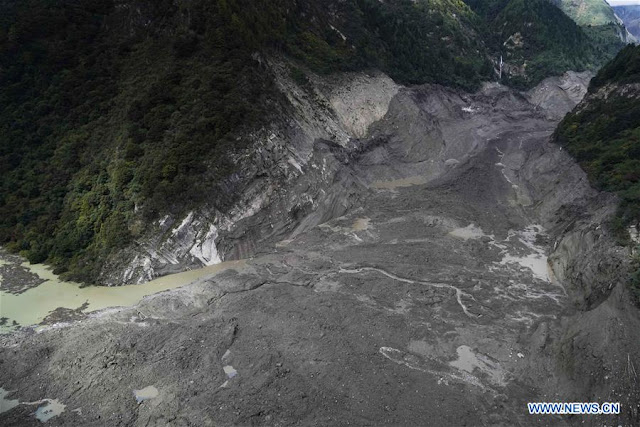
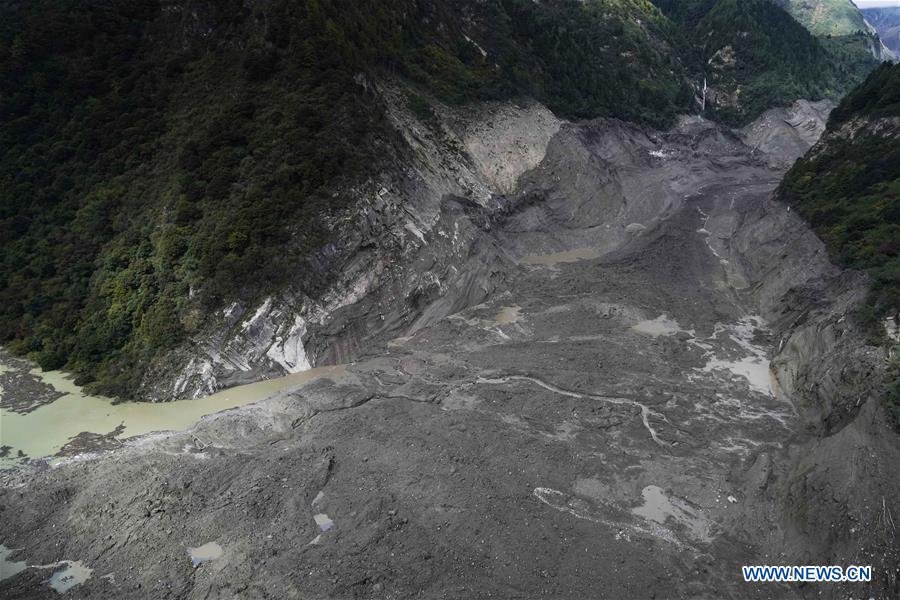
Landslide on the Yarlung Tsangpo
More on the environmental havoc in Tibet
Three days after posting the story below on the landslide on the Upper Yangtze, VTIBET.com reported a "Barrier lake forms following landslide in Nyingchi."
This time it is on the Yarlung Tsangpo/Brahmaputra
The article says: "A barrier lake has formed after a landslide struck a section of the Brahmaputra Valley near Pe Village of Mainling County of Tibet Autonomous Region. As of 3 p.m., the amount of water in the barrier lake had reached about 150 million cubic meters."
Some photos show the landslide-hit road in Mainling County, north of Arunachal Pradesh.
According to The Telegraph, China’s water resources ministry has informed the Centre of a landslide in Mainling "which might have an adverse impact downstream, particularly in the East Siang district of Arunachal Pradesh."
The official order issued by the district administration said, “As per information received from the central water commission, Government of India, ...landslides blocked the Mainling section of the mainstream of Brahmaputra/Yarlung Tsangpo ...on October 16,which will have an impact on the water situation of the lower reaches of the Yarlung Tsangpo river.”
Development has a cost.

The Landslide on the Upper Yangtze
On October 11, Xinhua reported a ‘barrier lake’ which had formed due a landslide in a section of the Upper Yangtze (Jinsha River in Chinese) at the border between Sichuan Province and Tibet Autonomous Region.
The landslide struck in Bolo Township, in Jomda County of Chamdo prefecture.
Though no casualties were reported, the amount of water in the barrier lake had in a short time reached about 100 million cubic meters.
Some reports said 24,000 residents had been evacuated: “The Ministry of Emergency Management has initiated an emergency response.”
The PLA and PAP had been called to rescue the affected populations.
According to the same Ministry, some 7,000 tents, 30,000 cotton-padded coats, 50,000 quilts and 5,000 folding beds were sent to the landslide-affected area to help residents.
The local authorities in Chamdo stated that “the scale of the landslide is vast, clogging the main waterway of the Jinsha River, with several bridges, fields and villages affected.”
Bolo is located in the south of Jomda county; the Upper Yangtze separates this Tibetan area from the Sichuan province at an altitude of 2,860 meters. The county counts 8,325 residents in eight villages.
This 'natural' disaster raises seriously questions, not only environmental, but political too.

A coincidence?
Was it a coincidence that around the same time, Xi Jinping spoke at an ‘important’ meeting about the improvement of the disaster prevention while building the mega Sichuan-Tibet railway?
There is no doubt the project is so big, that it will resulted in serious ecological damage.
On October 10, Xi Jinping “called for efforts to improve the country's ability to safeguard against natural disasters, and fully launch the planning and construction of the Sichuan-Tibet railway.”
The Party's General Secretary made these remarks during the third meeting of the Central Committee for Financial and Economic Affairs: “As a stronger capability of safeguarding against natural disasters concerns the economy and people's livelihood, China will set up an efficient and scientific system and improve the capability of the whole society in a bid to protect people's lives and property and national security," said Xi.

The Sichuan-Tibet Railway
The meeting was called to discuss the Sichuan-Tibet railway, which will have “profound significance for the country's long-term stability and the development of Tibet.”
It had been rumoured earlier that there was a rift between the Chinese President and his Premier, Li Keqiang, who had visited Tibet in rather strange circumstances, probably to inspect a section of the projected mega railway line.
At the recent meeting, two more members of the all-powerful Politburo’s Standing Committee were in attendance: Wang Huning and Vice Premier Han Zheng.
Xinhua commented: “As one of the most disaster-prone countries in the world, China has attached great importance to the matter and made remarkable progress. But its overall capability to respond to such extreme conditions is still relatively weak, and more should be done.”
It was said that China would work to build a coordinated disaster-responding system, adopt a people-centered approach, give priority to the environment, try its best to minimize the aftermath, propel reforms and innovation to modernize its capability, and continue international cooperation: “A raft of major projects will be advanced, including ecological restoration of forest, grassland and rivers, coastal protection such as building ecological seawalls, housing reinforcement projects in earthquake-prone areas, flood control and drought relief, relocation of residents in disaster-hit places, construction of emergency centers, natural disaster monitoring and early warning, and the modernization of rescue technology and equipment.”

Who will pay?
All this will cost money and may increase the cost of the project many folds.
One of the questions never mentioned in the Chinese press is: can Beijing afford this mega project?
What would be the main objectives of the railway line between Sichuan and Lhasa?
Is it really necessary at this point in time?
The meeting just said that “it will promote ethnic solidarity, safeguard national unity and consolidate the stability of the frontier, as well as bolster Tibet's economic and social development.”
There is no doubt that in Xi’s mind, the ‘consolidation of the frontiers’ is crucial; let us not forget that he occupies the seat of Chairman of the Central Military Commission.
Observers have asked, why was this meeting called by Xi; after all such project should come under the State Council, in other words Premier Li, who himself held a similar meeting in August.

Another 'important' meeting
Just after the Summer holidays at Beidaihe, Li had chaired a meeting of the Leading Group on the Development of Western Regions on August 21.
It was held in Beijing; Vice Premier Han Zheng, deputy head of Leading Group was also present.
Li Keqiang stated that the Western areas should continue with reform and opening-up and vigorously innovate to achieve high-quality development.
While acknowledging the economic and social achievements in the regions, Li described the development in Western Regions (i.e. Tibet and Xinjiang) as 'a crucial and difficult point' for China to become a moderately prosperous society in all respects and achieve modernization.
Western areas should channel more energy into industrial upgrades, and make more contributions to a stable national economy, Li said.
The railway was mentioned; but a more holistic approach was stressed: “Entrepreneurship and innovation should be promoted in a practical manner, Li said, urging measures to raise industrial competitiveness in western regions and greater steps to cultivate new growth drivers and restructure traditional sectors,” said Li who adding that “The central government will pump more capital into the areas and encourage local governments to attract private investment.”
Li cited projects such as the Sichuan-Tibet railway, power grids, oil and natural gas pipelines, internet infrastructure, and water diversion projects (hopefully not the Brahmaputra!!).
Li highlighted the people-centered development, which not might be the case of the Sichuan-Tibet railway: “China will take solid, precise actions to win the tough battle against poverty and work for equality in public services. Internet technologies will be used to let remote poor regions enjoy better education and medical services, and the employment and old-age care in western regions will also be enhanced.”
It is here that there is a difference of approach between the two leaders; Li being softer.


The Pharaonic project with the longest tunnels
A month earlier, The China Daily had given some details about the project: “A preliminary study on the Kangding-Nyingchi section of the Sichuan-Tibet Railway shows the section will include at least 10 rail tunnels each longer than 10 kilometers."
He Huawu, a member of the Chinese Academy of Engineering, told the newspaper that the total length of the rail tunnels in the Kangding-Nyingchi section would be 843 kilometers - which is longer than the Beijing-Zhengzhou high-speed railway: “The longest rail tunnel, extending 42.5 km, would be the longest in China, eclipsing one 32-km-long on the Qinghai-Tibet Railway.”
There will be six rail tunnels in the Kangding-Nyingchi section longer than 30 km.
He Huawu spoke during an academic seminar on key technologies for building high-speed railways in complicated mountainous areas held in Chengdu.
China Railway had announced that design of the line was ‘not final’, but just part of preliminary research on the construction of the Kangding-Nyingchi section, and it has not been approved by the authorities.
The Sichuan-Tibet line will be the second railway line connecting the Tibet Autonomous Region with the mainland; the first one was the 1,956-km Qinghai-Tibet Railway, which opened in 2006.
The China Daily commented: “Since the new line will have to go through intricate and difficult geological conditions, and its construction will have to overcome frozen earth, landslides and rock slides, experts have dubbed the Sichuan-Tibet Railway China's most challenging rail project.”
Then recent landslide is an example of what could (will) happen to the railway line.
In fact, the construction in such difficult terrain is bound to create havoc for the environment on the marches of the Tibetan plateau. It probably explains the warning of Xi Jinping.
But a more cautious approach will also drastically increase the cost of the project; it is where Li may not fully agree with the Emperor.

Landslide on the Upper Yangtze
Can China afford it?
At the end the question is: can Beijing afford this in the midst of a trade war with the US?
It is one of the many dilemmas that the Chinese leadership will be facing in the years to come.
It could easily create a schism between the different factions in the Communist Party; between the ones promoting a more human approach and the ones vouching for gigantic schemes.
The discreet visit of the Chinese Premier to Tibet should be seen in this perspective.
The article of The China Daily concluded: “Some easier parts of the line have been built in the past few years, but construction of the Kangding-Nyingchi section has yet to start due to the difficulties involved.”
It refers to the Nyingchi-Lhasa railway line which will soon be open to traffic.
The Chinese paper added: “Previous reports have said trains on the Sichuan-Tibet line will travel at between 160 and 200 kilometers per hour. When the line is completed, the travel time by rail between Chengdu and Lhasa will be cut from 48 hours to about 13 hours.”

It is if the line is completed…
In the meantime, development projects in this ecologically fragile area are creating havoc.

To restore the traffic, a new road is being built. All this has a cost.

Jiala Village is close to the Great Band of the Yarlung Tsangpo
Landslide on the Yarlung Tsangpo near Jiala village

Landslide on the Yarlung Tsangpo near Jiala village

Landslide on the Yarlung Tsangpo near Jiala village

Landslide on the Yarlung Tsangpo near Jiala village

Wednesday, September 19, 2018

The new panacea for the Middle Kingdom’s problems?

Premier Li Keqiang inspecting the Lhasa-Nyingtri railway route
Railways have recently been in the news in the Chinese press, particularly new railway lines on the Tibetan plateau and its periphery.
Yesterday, an article dealt at great length about the ‘LaLin’ section of the Sichuan-Tibet Railway.
‘Lalin’ is a short form for Lhasa-Linzhi railway (‘La’ for Lhasa and ‘Lin’ for Linzhi, called Nyingtri by the Tibetans).
On September 18, Xinhua reported that the China Railway’s 11th Bureau had successfully laid the first group of ballasts for the Gonggao [Gonkar?] station, the first new station in the railway line: “thus created the traffic conditions for the passage of the Lalin Railway.”
Liu Jun, the Secretary of the Lhasa-Nyingtri Project told the agency that the Sichuan-Tibet Railway was a key project of the National 13th Five-Year Plan: “Upon completion, it will become another railway artery connecting the plateau with the mainland.”
In 2006, the Qinghai-Tibet Railway was opened to service.

Details of the Lhasa-Nyingtri Project
The Lhasa-Nyingtri Project section is an important section of the Sichuan-Tibet Railway; it is certainly relatively easier to build than the eastern part.
It will have a total length of 435 kilometers and 34 new stations, including 17 which which are already existing. It will start in Lhasa and end at Nyingtri City and follow the Yarlung Tsangbo River (Siang/Brahmaputra in India).
The construction of this section started at the end of 2014; it should take 7 years to complete the entire project and the speed of the train will be 160 kilometers; it will be the first electrified railway in Tibet.
The Railway line will cross the Yarlung Tsangpo 16 times. The railway bridges use large-span bridge structures: “The mountains are high in water depth, the rivers are rushing, the technology is special, and the construction is extremely difficult. There are 14 high-risk tunnels out of 47 tunnels, of which 7 are extremely high-risk tunnels,” explained China Railway's 11th Bureau.

Not being afraid of difficulties
On September 6, another article which appeared in China Tibet Online reported that Lhasa-Nyingtri Railway was making smooth progress; a total of 2.72 billion yuan has been invested between January and August 2018: “Relying on advanced technology and the spirit of not being afraid of difficulties, now the Lhasa-Nyingchi Railway project is progressing well,” said a release.
The annual planned investment is 4.38 billion yuan.
According to the authorities, the project should promote town development, resource exploitation [mining?], industrial upgrading, emergency rescue and relief, emergency situation ...and perhaps more importantly national defense.
Beside this, it will play an important role in implementing the scientific development concept, building a harmonious society, implementing the Western Development strategy; it will promote the coordinated development of eastern and western economies, improve the layout of the regional rail network, connect Yangtze River Economic Zone and Sichuan-Chongqing Economic Circle, promote the development of Shangri-La Ecological Tourist Area and improve the investment environment.
Quite a long list of benefits!
And as importantly, the construction of new towns along the line will improve people's living standard, and speed up the pace of poverty alleviation in Tibet.
In one word, the panacea for all problems on the plateau.
But national defence is certainly one of the major objectives of the project.

A map of future railway lines
Interesting is a map found on a Pakistani website accompanied one of these articles.
The ‘Lalin’ railway line is in green, but several new lines are shown reaching the plateau. They are worth noting:
  • The Lhasa-Shigatse-Kyirong section which should be completed in a couple of years (it was delayed due to the 2015 Nepal Earthquake)
  • The Lhasa-Yatung section reaching the Chumbi Valley and the Indian border in Sikkim. It has serious strategic implications for India, especially after the Doklam episode. Though it is rarely mentioned in the Chinese press, it is clearly on the cards (it is not in dotted lines)
  • The projected Yunnan-Tibet railway line which has special strategic implications to India too, particularly for the border in Arunachal Pradesh (in a dotted line). It will join the Sichuan-Nyingtri line somewhere near Chamdo.
  • Korla-Golmud is already under construction. It will be the second major railway line linking Qinghai province to Western Xinjiang.
  • The Shigatse-Rutok-Kashgar line (in dotted line). It is a novelty. It may follow the G219 Highway (known as the Aksai Chin road). Will India protest if China starts building a railway on its territory?
  • A new Qiemo-Korla line across the Taklamatan desert. An extension of G216 Highway is under construction. It should be following the highway.
  • The Khotan-Quiemo line in Xinjiang. It will link up with the Khotan-Kashar line. It is probably important for the totally unstable Muslim province, in order to ‘stabilize’ southern Xinjiang and build new model villages/town along the line.
  • The Khotan-Tashkurgan line, leading to the border with Afghanistan.
    Tashkurgan has historically been part of the Silk Road. “Major caravan routes converged leading to Kashgar in the north, Yecheng to the east, Badakhshan and Wakhan to the west, and Chitral and Hunza to the southwest” says Wikipedia.
  • A never seen-before project to link Chengdu in Sichuan to Golmud in Qinghai. It will close the loop linking the two provinces on the West and North of the Tibetan plateau and link up Xinjiang through the above-mentioned Golmud-Korla line.
Incidentally at the end of July, Li Keqiang, the Chinese Premier visited a construction site of the Lhasa-Nyingchi railway.
Li stressed the importance of the project for the development of Tibet and  for the ecological protection [how is not clear]: "The railway project is beneficial for Tibet to cultivate new growth drivers, and it is the right thing that must be done. Full construction work should be accelerated," Li said.
He added that "at present, infrastructure development in the country's central and western regions is relatively weak, and promoting effective investments to improve weak links will not only narrow the gap in regional development but also helpful for the country to cope with economic downturn."
He further observed: "China should avoid strong stimulus and take targeted measures that are beneficial in both short and long terms."
Implications for India
All this should be quite worrisome for India.
However the main problem for Beijing seems to be: can China afford all these new projects?
Who will finance these mega-developments, especially if the US President turns the screw on the Chinese economy and if Xi continues to ‘invest’ in Africa, Pakistan or elsewhere, outside the Walls of the Middle Kingdom?
It is a serious question, though difficult to answer.
Further, it is bound to create ‘differences’ within the Communist leadership on the investment ‘priorities’ and ultimately jeopardize the ‘stability’ of the Kingdom …when the Emperor and his courtiers start fighting among themselves.


Wednesday, September 27, 2017

Tibet: China moving the West ...and the South

In the recent months, rapid developments have taken place in Western Tibet.
This will be the object of several posts.


Banning Foreign Tourists 
As the 19th Congress approaches, China is nervous.
The Chinese authorities have banned foreigners to travel to Tibet from October 18 to 28.
During this period, the crucial Congress will be held in Beijing.
On September 22, Radio Free Asia (RFA) asserted: “The ban was announced by telephone about ten days ago”.
A Tibetan working in a travel agency in Xining (in Qinghai province) told the radio’s Tibetan Service: “During this period, it is not just foreigners but also Tibetans living in the Amdo region of Qinghai who are not allowed to travel in the Tibet Autonomous Region (TAR).”
Agence France Presse confirmed: “During the sensitive, high-level talks, Tibet will close its borders to foreigners, while visitors traveling the country during that period will likewise be required to leave by October 17.”
Usually, foreign visitors and Tibetans living in the Chinese western provinces are not allowed to visit Tibet in March, at the time of the Two Meetings and the anniversary of the Tibetan uprising on March 10.

Demonstration of Force
Incidentally, on September 26, the TAR held the Ninth Regional Congress in Lhasa.
According to the Chinese media: "Police officers and civilians, armed police and soldiers and other involved in the keeping the stability of the region participated. There was a parade ‘to inspire the people’, during which the police vowed to keep a fearless fighting spirit and dare ‘to win the powerful momentum’".
The slogans were: “Loyal to the party, keep in mind the mission, fight terrorist violence, governance for stability, strong base solid, cohesion, advocate honor, dare to win.”
The participants pledged to the Party to maintain the security during the Congress. “Raise right fist, take collective oath.”

A New Highway in Shigatse
In the meantime, a new 40-km highway was opened which should shorten the journey from an hour to 30 minutes between Shigatse airport and the city centre.
According to The Global Times: “Experts believe the development will enable China to forge a route into South Asia in both economic and defence terms.”
It is not clear how 40-km of road could 'link' the plateau to South Asia; it looks more as a propaganda exercise to ‘scare’ India.
The Chinese tabloid says: “The road runs parallel with the Shigatse-Lhasa railway line linking the 5,476 kilometre G318 highway from Shanghai to Zhangmu on the Nepal border.”
Zhao Gancheng, a so-called expert and director of the Centre for Asia-Pacific Studies at the Shanghai Institute for International Studies, who was one of the Chinese hardliners during the Doklam incident, told The Global Times: “It can link with the future cross-border Sino-Nepali railway. …The Sino-Nepali railway, which passes through the Chinese border town of Zhangmu and connects with routes in Nepal, will be the first railway by which China enters South Asia.”
Zhao has it probably wrong: the only railway ever mentioned is crossing to Nepal near the landport of Kyirong.
The new railway is apparently part a deal signed when Nepal Deputy Prime Minister Krishna Bahadur Mahara visited China in early September.
The People’s Daily wrote: “The railway includes two lines: one connecting three of Nepal’s most important cities and two crossing the border.”

A New Road?
RFA also mentioned the project of a new road affirming that Chinese soldiers and civilians who are building a road linking Southern Tibet to Nepal, set up a banner at the border, inviting Nepalese citizens on the other side to help them extend the road farther into Nepal.
Apparently the troops arrived at Nepal’s border near Kyirong on September 1: “they distributed food and clothing to the Nepalese, promising to help them with the roadwork and other construction projects in Nepal if permission can be obtained from government authorities in Kathmandu.”
It is rather strange that Chinese soldiers have started pressurizing Nepali local villagers to get the permission to continue the railway to Kathmandu.
RFA’s source said: “The Chinese began building a road from the Tibetan side of the border up to the Nepalese side about two years ago, and they have now finally finished that work. …Now, a group of Chinese military and civilian officials have appeared at the border, raising a banner and the Chinese national flag to win the hearts and minds of the people on the border.”
The fact is the road was greatly delayed due to the earthquake epicentered in Kyirong.
The railway line will probably follow the same route as the highway.
I have often mentioned on this blog, the new road (as well as the railway) which will link Nepal and Tibet.
The PLA soldiers carried a banner urging ‘loyalty to the Chinese motherland’ and calling for ‘harmonious living’: “This is a new development, and the local Nepali residents are concerned and have mixed feelings about China’s distribution to them of free goods,” said RFA.
The entire episode is strange but it denotes the Chinese authorities’ will to develop Western Tibet (Ngari Khorsum for the Tibetans) on a grand scale and open up on Nepal. It could be the beginning of a flood of goods and people onto the erstwhile kingdom.

Thre railway lines in Nepal?
Last year The Kathmandu Post had reported that four Chinese companies had shown interest to conduct feasibility study for Kathmandu-Rasuwagadhi railway line.
Kathmandu had asked China to conduct a survey and a detailed project report (DPR).
The Nepali newspaper noted: “Once the proposed railway is constructed, it will establish direct railway connectivity with Chinese railway which is expected to arrive in Kyirong, a bordering town of China across Rasuwagadhi, within a few years.” It was said that Sinohydro, China Railway Fist Survey and Design Institute Group, China Engineering Oversees Group (COVEC) and China Railway Construction Corporation Limited (CRCC) applied for conducting the survey.
The Post added: “The Chinese proposals follow Nepal’s request to China to provide financial and technical support for the feasibility study and the preparation of the DPR of the proposed Rasuwagadhi-Kathmandu and Kathmandu-Pokhara-Lumbini Railway Project. The request was made during former prime minister KP Sharma Oli’s visit to China in March. During the visit, it was agreed that the relevant authorities of both sides would exchange ideas and proposals on constructing cross-border railways and rail network in Nepal, and support enterprises to start related preparatory work as soon as possible.”
This was during Oli’s times; it is clear that Beijing is putting pressure on the new government in Kathmandu to continue with the project.


Photo taken in 2012
The Strategic Importance of Shigatse
During the Doklam episode, Chris Biggers mentions in Bellingcat the strategic importance of Shigatse: “Commercial imagery acquired during July and August has shown up to eight PLAAF J-10 multi-role fighters parked on the apron [of Shigatse]. They likely arrived between March and April after at least five Shenyang J-11, a modified and locally produced variant of the Russian Su-27SK, departed the airfield.”
There is usually a rotation of the war planes between Shigatse ‘Peace’ and Lhasa Gongkar airports.
The article continues: “Similar to Gongkar, the fourth generation aircraft were also joined in late June by a rotation of MI-17 or MI-171 HIP, the latter an improved variant. At least two of the four HIP [NATO code name] had weapons racks or winglets attached suggesting they could perform combat or transport roles. The People’s Liberation Army (PLA) Air Force and the PLA Aviation Corp operate the platform.”
Further on August 6 says “we saw the first known deployment of a drone to the airbase. A single CH-4 medium altitude long endurance UAV, joined the HIP on the western parking apron. A primary satellite link was also located at a leveled support area north of the runway. The presence of the satellite link suggests the UAV is piloted from the airbase. This is the first drone deployment at a forward airbase observed since the Doka La crisis was triggered.”
The author concludes: “Bottom Line – Despite SAM [Surface-Air Missile] assets on alert throughout July, fighters deployed to Shigatse remained within baseline for the airbase. However, additional platforms deploying to this location should be watched closely as the PLA operationalizes its new theater commands and tensions remain with India.”

A crucial hub
There is no doubt that in the future the Shigatse airport will become a crucial hub.
This seen with the rapid development of the infrastructure (highway, railway line, ‘oil’ road) in Western Tibet, it is something that India should take into consideration.
I shall come back to this in forthcoming posts.

Photos of the Parade in Lhasa on September 26


Friday, February 24, 2017

A Train to Chumbi Valley?

A Tibetan website has just announced that the Mila (spelt ‘Mira' by the Chinese media) tunnel will be opened on June 30.
According to Tibetonline.cn, at an average altitude of 4,740 meters, this will become the world's highest highway tunnel. It will eventually cut the journey between Lhasa and Nyingchi (or Nyingtri) by some four hours.
The website says: “The tunnel has a longer-than-average length with 5,727 meters on the left and 5,720 meters on the right.”
The Mila Mountain lies at the border between the Lhasa Municipality (Meldro Gungkar County or Mozhugongka Xian in Chinese) and the Nyingchi Prefecture (Kongpo Gyamda County).
Located at an elevation of 5013 meters above the sea level, it is the highest point on the Nyingchi–Lhasa highway, a section of National Highway 318 (the 5400-km road between Shanghai and Zhangmu at the Tibet-Nepal border).
The plan to build a tunnel on this section of the road was announced in January 2015. Construction started just after.
Tibetonline.cn adds: “Affected by the high altitude, the tunnel project encountered many difficulties during the construction process. Rocks surrounding the tunnel's exit are very loose, and it is very cold in the tunnel with considerably thin oxygen. The minimum temperature in winter reaches minus 30 degrees Celsius.”
Wang Liang, chief engineer of the project affirmed that the travel time between Lhasa and Nyingchi will be reduced from eight hours to three or four hours, after completion of the project.
Can you believe it? Quite a feat.
Wikipedia described the area thus: “The west of the mountain is dry and cool, while the east side is warmer and has more moisture, and therefore has richer vegetation. The foothills have natural pastures and farmland. Trees include Yunnan pine birch and fir. Wildlife includes roe deer, antelope and bear.”

More and more tourists on the plateau
A few days back, Kangba TV reported that “over 23 million domestic and foreign tourists visited Tibet Autonomous Region (TAR) in 2016, up by 14.8%, creating a tourism revenue of 33.075 billion yuan, up by 17.3%.”
Whether the figures are accurate or not, it is certain that Tibet is very popular with the Chinese holiday-goers.
The government in Lhasa also announced that in 2017, it will give “priority to building 4 national region-based tourism demonstration areas, including Lhasa City, Nyingchi City, Shigatse City and Purang County in Ngari area as well as 4 TAR-level region-based tourism demonstration areas, including Chengguan and Tohlung Dechen districts in Lhasa, Kongpo Gyamda County in Nyingchi and Pome County.”
It has to be noted that Purang is near the trijunction between India, Tibet and Nepal. The Kailash Yatra via Lipulekh-la passes via Purang (also known as Taklakot).
There is no doubt that Ngari will be the next area to be developed on a grand scale for tourism.
Lhasa also said that in 2017 the TAR plans to receive at least 25 million tourists, providing 380,000 people with jobs in the tourism sector.
But jobs for whom?
For Han migrants or local Tibetans?
It is obviously not mentioned by the authorities in Lhasa.

Tibetan Culture and Infrastructure
Interestingly, Communist China has recently discovered Tibetan culture.
The Chinese embassy in Kathmandu even hosted a special function for celebrating Losar, the ‘Chinese Tibetan Losar’ (sic).
Chinese Ambassador Yu Hong said that Losar is the most ‘ceremonious’ traditional festival of Tibetan people; she extended her “sincere wishes and greetings to all the Tibetan compatriots living in Nepal, and pay tribute to all the friends for your care and support for the development of Tibet."
Interestingly Madam Yu spoke of the railway connectivity between Nepal and China and noted that a train recently operated between Guangdong province, Tibet and Middle-South Asia; it started from Guangzhou, went to Lhasa, Kerung [Kyirong] to Kathmandu, covering a total length of 6,070 km and becoming the first highway-railway combined transport channel linking Guangdong, Tibet and Nepal.
She told the Tibetan 'community' in Kathmandu: "Our fellow Tibetan compatriots, despite living in a foreign land, always concerned about the progress and development of the motherland, and have made contribution to national unity and ethnic solidarity.”.
Another website VTIBET.com quoted figures from the TAR’s Development and Reform Commission: “Data show that Tibet speeds up and strengthens quality of traffic construction.”
It says that the TAR has spared “no efforts to solve the bottleneck problems restricting the development of traffic infrastructure.”
In 2016, the total distance of road opened to traffic in Tibet reached the staggering figure of 82,500 kilometers; the website also mentions the work on the Sichuan-Tibet Railway and the Yunnan-Tibet Railway undertaken during the 13th Five-Year Plan: “the Civil Aviation opened 71 air routes of domestic and international with 41 navigable cities, significantly increasing comprehensive transport capacity. The fixed-asset investment of Tibet's communication and transportation accumulatively achieved 40.21 billion yuan."
In 2016, China started to build 44 key highway projects.
It also asserts: “Tibet's railway construction projects invested about 8.5 billion yuan in 2016, of which the work of Nyingchi-Kangting section of Sichuan-Tibet Railway [in fact probably the Chengdu-Ya’an section of the line], Lhasa-Meldro Gungkar Railway [part of the Lhasa-Nyingchi line], Shigatse-Gillon [Kyirong at the Nepal border] Railway, Bomda [Pome]-Shangri-la section of Yunnan-Tibet Railway, and the earlier stage of Shigatse-Yadong [Yatung] Railway is proceeding orderly.”
It means that the project to take the train to the Indian border near Sikkim (in the Chumbi Valley) is still on, though at its ‘early stages’.
The website continues: “For Civil Aviation's part, Tibet has 5 navigable airports, 9 aviation companies operating in Tibet. It safeguarded 39,000 sorties of take-off and landing flight last year, received 4.05 million of the annual passenger and 30,000 tons of cargos and parcels.”
The shortening to the journey between Lhasa and Nyingchi, the new railway lines to Yatung and Kyirong have serious strategic implications for India.
Why is the Indian press keeping silent about this?
The answer is that many in India believe that if China dares to cross the McMahon line and walk down in Arunachal, it will 'break its teeth' in the Indian roads.
It is not 100% sure.
 
Chegdu-Ya'an railway line
 

Friday, December 16, 2016

New railway lines in Tibet

I have already mentioned in this blog that during the coming year, the Tibetan Autonomous Region's government is planning to construct more than 20 new highways (included new routes from Lhasa to Nagchu; Dege to Chamdo; Chamdo to Jaka; Lhasa to Shigatse Airport; and Gongkar Airport to Tsethang) with a total investment of more than US$ 5 billion.
More information has now come out.


Loop-line around Lhasa City
A 73-kilometers 'loop-line' around Lhasa is under construction. Some 4.9 billion yuan has been spent so far on the project and the basic work is completed.
According to China Tibet News, the loop-line is expected to be finished by the end of this year. The website says that the project “is meaningful to perfect city traffic network, drive the exploitation and utilization of land around, and reserve space for the urban development in the future.”
It is probably necessary to receive 25 million tourists.

Lhasa Nyingchi (Nyingtri) railway line
The Lhasa Railway Office has announced that the main engineering work for the Lhasa section of the Lhasa-Nyingchi Railway has been completed. Next year, the beam-laying  will start on this section.
The total length of Lhasa-Nyingchi Railway will be 430 kilometers; it is designed for a speed of 160 kilometers an hour. It will have 9 stations including Gongkar, Chanang, Tsetang, Sangri, Gyaca (Drumpa), Nang County, Minling, Chaoyang and Nyingchi.
Started in 2014 it should be completed in 2021.
One difficult section is the tunnel under the Galai mountain; it will opened in 2017. With a total length of 4,373 meters, the tunnel is “one of the controlling projects of Lhasa-Nyingchi Railway. At present, most half of the project has been excavated and it is expected to be completed in the next year. Adopting ballastless track laying skill, passengers can feel more stable and comfortable in the process of driving,” says the website.
Some 700 workers are employed on the line. Part of the work is sub-contracted to transportation, labour service and equipment leasing companies.
The Chinese website explains: “This project plays an important role in promoting economic coordinated development of eastern and western areas, perfecting regional railway network layout, connecting Yangtze River Economic Zone and Sichuan-Chongqing Economic Circle, promoting the opening up of Sichuan Province and Tibet Autonomous Region, accelerating the development of Shangri-La ecotourism area [in Yunnan], improving investment environment, promoting economic development and new township construction, improving people's living standard, and speeding up the poverty alleviation work.”
Clearly, the intention of the Chinese government is to link their different ‘corridors’, till one day they reach the most important one, the China Pakistan Economic Corridor (CPEC). In the meantime, the work is progressing fast in the TAR, Sichuan and Yunnan Provinces.
Regarding the Lhasa-Nyingchi railway line, defense is not mentioned but is certainly one of the most important factors as the terminus will be near the Indian border of Arunachal Pradesh.


The Train to Nepal
No mention is made of the present stage of construction of the Shigatse-Kyirong railway line, though on December 5, Chinese news agencies reported that the first Guangzhou-Tibet-Nepal 'block train' reached the freight terminal of Lhasa Railway Station …on his way to Nepal.
One site, VTIBET.com wrote: “It was said that it is the first time that road-rail intermodal transport is used in the Tibet Autonomous Region. The modern transportation mode has effectively reduced transportation cost and enhanced and guaranteed the timeless of logistics. The opening of this transportation line will boost the trade of Tibet Autonomous Region and Guangdong Province and also play on distinctive role in coordinate regional economic, social development nationwide, which marks the successful operation of the line.”
And more importantly, it could one day link the Mainland to Nepal.
The block train started from Dalang in Guangzhou province; it used the Chengdu-Chongqing Railway, Qinghai-Tibet Railway, Lhasa–Shigatse Railway, Shigatse-Gyirong Highway before crossing into Nepal at Kyirong and finally arrived in Katmandu. The 6,070 km long journey included 4,200km by rail and 870 km on highways.
The cargo was worth of 19 million yuan; it included garment, furniture, electric appliances, electronic products, etc.
All what India does not want to be dumped on her territory.
However take a look at the map above, it seems to indicate that China would not mind continuing the line to southern Nepal and India.
To dump what?

The Tibet-India Border trade
Incidentally, during the current year, the Indian trade with Tibet via the Nathula pass in Sikkim has surpassed all previous records. According to The Times of India, during the May-November trading season, the export of Indian goods to the TAR amounted to Rs 63.68 crore as against imports worth Rs.1.8 crore: "Bilateral trade saw an increase of around Rs 16 crore this year as far as exports were concerned. Imports plummeted by around Rs 5 crore as against that in 2015, according to official data."
The report says that initially, Indian traders were reluctant to trade with Tibet due to lack of tradeable items: "After six seasons of low-profile trading, the directorate general of foreign trade in 2012 revised the list of tradeable items and allowed traders from both sides of the border to export and import more commodities."
Interesting development.  By the way, what has happened to the project of having a railway line to Chumbi?

Tuesday, October 4, 2016

China: Perfecting Tibet railway network

New line in blue. Note that China appropriates Arunachal in its maps
Grim news for India: according to Xinhua, the preliminary work on the Yunnan-Tibet Railway is being carried out.
On September 20, the Chinese news agency announced the beginning of the work on the Yunnan-Tibet Railway which will run through Shangri-La and Dechen County of Yunnan Province and Markam and Dzogang Counties in the Chamdo Prefecture of the Tibet Autonomous Region (TAR).
In Bamda, a small township of Nyingchi Prefecture, the line will connect with the Sichuan-Tibet railway presently under construction.
The railway line will have a total length of 415 kilometers, with 265-kilometer railway in Tibet Autonomous Region, the rest in Yunnan.
The total investment is evaluated to be 43.6 billion yuan (some 7 billion US dollars), out of which the Tibet section's comes to 27.8 billion yuan.
The preliminary work which includes surveys and line alignment, has started.
Xinhua says that the Tibet's railway department “will accelerate relative work and strive to start its construction work during the 14th Five-Year Plan period [2020-2025].”
According to China Tibet Online: “The Tibet's railway network is gradually approaching perfect [sic] along with the operation of Qinghai-Tibet Railway and Lhasa-Shigatse Railway as well as the construction of Lhasa-Nyingchi Railway.”
The website adds: “Since the Qinghai-Tibet Railway is put into operation, Tibet's freight transportation has increased rapidly and it has become the main freight channel.”

Though it is not mentioned, China probably plans to extend the Lhasa-Shigatse-Kyirong line towards Western Tibet and one day (not too far) to Xinjiang (by following the route of the Highway 219 through the Aksai Chin).
About the Yunnan-Tibet railway, China Tibet Online notes: “Compared to highway's season limit and airplane's climate limit, the construction of Yunnan-Tibet Railway will bring more convenient transportation conditions for the passenger and cargo circulation between Tibet Autonomous Region and Yunnan Province. The rapid development of traffic can reduce transportation cost and then promote the economic development of manufacturing industry.”
As mentioned earlier on this blog, all infrastructure development in China needs to follow a dual use (civilian and military) norms. It is probably at what the website hints when it says: “In addition, Yunnan-Tibet Railway is a critical part of China Western Development, which is meaningful for the leapfrog development and long-term peace and order of Tibet.”
‘Peace on the border’ means reinforcement of the infrastructure opposite Eastern Arunachal Pradesh.
In the meantime, India is not fully asleep.
According to The Business Standard:  “The Indian Air Force is ready to fully operationalise seven Advanced Landing Grounds (ALGs) in Arunachal Pradesh. After over two years of repair and reconstruction work, the ALGs will be brought into use and are intended to give a major boost to the country's operational capability. The rupees 700-crore project got an impetus in 2009.”
The Tawang ALG, far from being completed, will allow one day the landing of C-130J Super Hercules, the latest IAF’s transport aircraft.

Friday, August 5, 2016

Two new Chinese railway lines to the Indian border

The China Daily reported today that a new ‘Himalayan rail route’ has been ‘endorsed’ by Beijing.
According to the Chinese official publication: “A Himalayan train ride at more than 100 kilometers per hour at the foot of the world's highest snow-capped mountains and oldest glaciers is no longer just a dream.”
Nothing seems new in this!
But the map accompanying the article (see above) shows the rail line reaching two places near the Indian border, namely Purang (Burang for the Chinese and Taklakot for the Nepalis,) north of Pithoraghar district of Uttarakhand and Yatung (Yadong) in the Chumbi valley, adjacent to Sikkim.

Train to Nepal
I have often mentioned on this blog the Lhasa-Shigatse-Kyirong railway as well as the ‘colossal’ project of a railway line between Lhasa and Chengdu, via Nyingchi and Southern Tibet.
The China Daily quotes that ‘Chinese railway experts’ as saying: “With more than 19,000 km of high-speed — up to 350 km per hour — railways, China has accumulated the technology and experience to build a rail link between the Tibet Autonomous Region and the South Asian subcontinent.”
Now, the question is why and how ‘South Asian subcontinent’ comes in the picture?
Ma Jiali, a well-known Chinese ‘India expert’ and a researcher at the China Institutes of Contemporary International Relations explains that “a trans-Himalayan railway would be of great economic value as it could later connect China, the largest economy in Asia, with India, the continent's third-largest economy.”
Has India been consulted?
Probably not; however Beijing goes ahead with the project of connecting India …and Nepal which: “is willing to have a more convenient link to China because it believes that China's development will offer great opportunities for Nepal,” comments Jia.
The China Daily gives some details: the Himalayan railway would start from Shigatse, Tibet’s second city and move towards Kyirong, at the border with Nepal “and extend into Nepal, although it would not be a high-speed railway.”
This announcement came during a forum organized by the China Tibetology Research Center in Beijing.

The railway on the plateau ... and Kathmandu
The China Daily reminds its reader that “In 2006, China built a railway running for more than 1,100 km to connect the highland region of Tibet with the rest of the country” and in 2014, Beijing built a 250-km rail link between Lhasa and Shigatse.
According to the current Five-Year plan (2016-2020), running at 100 km per hour, a train from Shigatse should reach Kyirong in 2020.
The line will then continue to Kathmandu, “as part of the China-Nepal international railway.”
This has serious strategic implications for India, as Beijing would like the land-locked country to be part of the Belt and Road Initiative, while  “boosting economic, cultural and religious communication with Nepal”at the same time.
Zong Gang, deputy director of the Science and Technology Department at Beijing University of Technology told The China Daily: "The construction of a railway crossing the Himalayan mountains is now economically and technologically feasible.”
On July 1, Lobsang Gyaltsen, the head of the Tibet Autonomous Region’s government in Lhasa announced that the rail link “is the most powerful way to help Tibet open up to South Asian countries.”


A link to India's border?
In March, when Premier Li Keqiang had met the then Nepalese Prime Minister K. P. Sharma Oli; the two leaders decided that China and Nepal should further discuss the continuation railway line to Kathmandu and “support companies conducting preliminary research.”
Two Chinese companies have already shown some interest in the project: China CAMC Engineering Co has proposed building a 121-km railway linking Kathmandu and Rasuwagadhi, near Kyirong and the China Railway Construction Corp has applied to Kathmandu for conducting a Kathmandu-Rasuwagadhi railway feasibility study.
The China Daily quotes Zhou Yuhui, a professor at Beijing Jiaotong University who had been on a field visit to the China-Nepal border: "There are rich tourism resources, including virgin forest, canyons and historical relics in Gyirong, which has hardly been developed. …While bringing tourists and businesses to Gyirong, which will help local people to escape poverty, the China-Nepal railway will also help ... to make people more willing to integrate into modern life."
But Beijing would not only link Tibet with Nepal, but India too would be included in Beijing’s new plans (without India being informed).
Ma Jia speaks of connectivity between China and India.
When China celebrated 50 years of the arrival of Qinghai-Tibet and Sichuan-Tibet roads to Lhasa in 2014, Ma Jiali had said the two highways were crucial for the national unity: "I think it's safe to liken the two highways to blood as they hold Tibet and the inland cities together. So, the running of the two highways, in a sense, has held the central government and Tibet together."
There is no doubt that in the 1950s, the 2 highways (plus  the Tibet-Xinjiang Highway cutting across the Aksai Chin, a few years later), helped China consolidate its military position on the Tibetan plateau. By the end of the 1950s, Beijing could take on India which had dared to give asylum to the Dalai Lama.
Today, more worrying than the content of the article, is the map attached to it. It shows the train continuing its journey to Purang (Burang), near the tri-junction Nepal-Tibet-India and Yatung (Yadong) in the Chumbi Valley.
The Purang leg will be a further step to connect Tibet and Xinjiang, through a railway line parallel to the Aksai Chin road (via the Indian territory).
The process and work will be made easier with the recent reforms of the People’s Liberation Army and the creation of Western Theater Command.
It is a worrying issue for India: is China really planning to open two branches of its Belt (leading to India)?
Has India been watched carefully and ask questions to Beijing.

Wednesday, February 3, 2016

The Sichuan-Tibet rail-line on the way

Chengdu-Kangding-Nyingchi-Lhasa railway line
(Note that Arunachal is shown as Southern Tibet on this Chinese map)
The China Daily reported that the construction of a 1,629-kilometer Sichuan-Tibet railway will start in 2016.
Lobsang Gyaltsen, the Chairman of the Tibet Autonomous Region (TAR) government announced it in Lhasa during the fourth session of the TAR’s 10th People's Congress: “The government will start a preliminary survey and research of the Kangding-Nyingchi railway project this year, and accelerate the construction of Sichuan-Tibet railway in the 13th Five-Year Plan (2016-20) period," he said.
Kangding is known as Dardo or Dartsedo in Tibet. It is today the capital city of Gartse Tibetan Autonomous Prefecture.
Yin Li, the acting governor of Sichuan confirmed the news in Chengdu during the 12th People's Congress of Sichuan.
The railway will be connecting Lhasa to Chengdu. It will be divided into three sections from west to east: Lhasa-Nyingch, Nyingchi-Kangding, and Kangding-Chengdu.
The railway line will run for some 1,000 km on the Tibetan plateau.
The construction of the western and the eastern sections already started last year. The entire project is expected to be completed in the early 2030s.
The China Daily quoted Lin Shijin, a senior civil engineer at China Railway Corp, saying: “Perched at over 3,000 meters above sea level, and with more than 74 percent of its length running on bridges or in tunnels, the railway will meander through the mountains, the highest of which is over 7,000 meters.”
It will cross the major rivers Min river (a tributary of the Yangtze), the upper stretches of the Yangtze and the Yarlung Tsangpo (later Siang and Brahmaputra).
Lin added: “The accumulated height it will climb reaches more than 14,000 meters, and it will cross many fault zones. It's like the largest rollercoaster in the world. With a designed service life of 100 years, it is believed to be one of the most difficult railway projects to build on Earth."
According to Zhao Jinxue, a rail construction ‘risk appraiser’: “It will cost at least 100 million yuan ($15.87 million) per kilometer, similar to the cost of high-speed railways on plains.”
Lin explained the difficulty of the Sichuan-Tibet railway project: “it presents difficulties to overcome, such as avalanches, landslides, earthquakes, terrestrial heat, karst caves and underground streams, yet, it is still a worthwhile project."
Why? Because it takes today 42 hours by train and three days by road to travel from Chengdu to Lhasa; the new rail line will shorten the travel time to less than 15 hours.
It will have incalculable strategic implications for India as the train will pass near the Indian border, north of the McMahon Line in Nyingchi Prefecture (Nyingtri in Tibetan, sometimes Lyingchi in Chinese).
He Ping, a tourism agency manager in Chengdu told the Chinese publication: "The railway will effectively boost tourism, and bring a new Shangri-La to the world and tangible revenue to local people," but it will also allow People’s Armed Police’s and PLA’s reinforcements to reach the Indian border in a much shorter time, accentuating further the military strategic balance between India and China.
And one should not forget that with the new military reforms put in place by President Xi Jinping,, the entire plateau now comes under one Combat Zone (or Theater Command) only.

Tuesday, April 21, 2015

No tunnel under the Everest ...but a road to Xinjiang?

A railway line through the Aksai Chin?
When one watches China, it is gratifying to be right once in a while.
It does not happen every day.
Last week, I wrote on this blog that I doubted if China would dig a tunnel under the Everest, when it had easy access to Nepal via Kyirong and Zhangmu.
Xinhua has now issued a clarification: "Will China really dig a tunnel through Himalayas?"
I quote from the 'clarification':
Recently a news story titled "China intends to build a railway through the Himalayas to link to its border with Nepal" has been abuzz on western media.
Glancing at publications from AFP to Reuters and from the UK's 'The Guardian' to 'The Independent', one sees the headline: "Qinghai-Tibet Railway on the roof of the world is already a marvel of human engineering, but could it be that China Railway will now 'defy heaven'"? Will they really dig a turnnel through the Himalayas?
Perusing the various media reports, one finds the same source being quoted: Wang Mengshu, a scholar at the China Academy of Engineering and an expert on China's railway tunnels.
What Xinhua does not say is that the agency was the original source of the incorrect news. It now blames Western media and justifies itself:
Aside from quoting secondary sources, western media outlets imply a kind of bitter tone, exaggerating China's wish to build this rail line behind a so-called 'economic and geopolitical scheme'.
As a saying goes that 'no investigation, no right to a statement', and actually the facts and the reports themselves are very different. But the foreign media misinterprets the real intentions, and a nice vision of the future is instead turned into a deceitful story.
Right, but why was it reported in the Chinese media in the first place?
It is however true that the Western (and Indian) media should have done some basic investigations. It was not done.
Now, Xinhua and China Tibet News back out of their own responsibility and question: 'Is the news reliable?'
They explain in detail why the news published by them and distributed by the Western press was not correct.
Firstly, to which rail line are they referring? According to the western media, this rail line is an extension of the Qinghai-Tibet Railway, linking Tibet's second largest city Shigatse with Gyirong near the border between China and Nepal, a distance of 540 kilometers, with completion of the line expected by the year 2020.
However, Wang Mengshu told reporters from Xinhua News Agency that the feasibility of this rail line is still being deliberated, and its construction is most definitely not on the current agenda. Nor has it obtained governmental approval. Therefore, for the line to be "completed by 2020" is highly unlikely.
An investigation by Xinhua reporters found that "China's wish to build an extension line of the Qinghai-Tibet Railway from Shigatse to Gyirong" is in fact old news. Chinese media reported on this tentative plan as early as last August, at the opening of the Lhasa-Shigatse rail line, the first extension of the Qinghai-Tibet Railway. It was reported that there is a hope that more extension lines of the Qinghai-Tibet Railway such as a line from Shigatse to Gyirong will begin to be constructed during the period of the '13th Five-year Plan', from the year 2016 to 2020.
Therefore, that the construction 'hopefully will begin' turned out to be that it 'will be opened by 2020'. Perhaps in order to attract attention, western media outlets could not manage to check the facts.
Xinhua further questions: 'Is the construction feasible?' And it answers:
So then, can a tunnel really be drilled through the Himalayan mountains? Is it technically feasible? Chinese tunnel and underground engineering expert, Wang Mengshu has the final say. He says that theoretically, it is technically feasible to build a tunnel through the Himalayas, but there would be a number of practical difficulties.
In order to construct a tunnel in the high mountains, first, the location and elevation must be determined. Should it 'cut through' or 'climb over' the mountain?
Wang Mengshu says that the length of the tunnels can be shortened if they are constructed at an elevation of more than 7,000 meters, but considering the thinness of the air, the low temperatures, and the ground freezing over, it is not possible for passenger cars to pass through. So it is the best if the height of the tunnel is below 5,000 meters. Tunnels built at a height of around 4,000 meters would be more appropriate.
Wang Mengshu said that in order to shorten the tunnel length, they still need to try to find a place in the Himalayas with the thinnest mountain body so that a possible tunnel, similar to a mountain pass, could enter from one 'ditch', then come out through another 'ditch' from the other. Previous surveys conducted by various parties initially selected several potential sites, but all remain in the research phase for the feasibility study. No real action has been taken yet.
Wang, the 'expert' has obviously some explanation to do.
The Chinese news agency asked him: is it expensive?
and again he provides an answer:
Now the world's longest railway tunnel is the Gotthard tunnel in the Alps located in central Swiss. With a total length of 57 kilometers, it took 11 years to be finished. So then, how long would the tunnel under the Himalayas be? How long would it take to build it, and how much would it cost?
Wang Mengshu said that at the current stage everything is hypothetical, which definitely has not reached the policy level yet. So it is difficult to make an exact estimation at this point. As for the Himalaya tunnel, it is estimated to cost 10 billion yuan for the lead engineering and the tunnel itself. 'This is the least amount', he said. As for a schedule, subject to external conditions, it would probably take around 10 years to finish the project.
However, Wang Mengshu held that this plan was unlikely to be approved in the short term because many railway construction projects in China are lacking enough funds, not to mention the vast sum that would be required for this large project.
What was the purpose of this tunnel?
The non sense continues:
Just to promote increased trade between Nepal and Tibet says Wang, who adds:"The scenery at the southern foot of the Himalayas is very beautiful, and the people there are unadorned. It is really worth a visit."
The gentleman, who has visited Nepal on several occasions, confides: "Nepal's cashmere products are really inexpensive, and their lamb is also very delicious."
A tunnel for a piece of lamb? Who is to believe this one?
And Wang Mengshu to conclude about the allegation that China's 'geopolitical schemes' was behind the rail project, he predicts: 'acts speak louder than words. The Nepalese will have the final say on whether China is sincere or insincere'.
Wang says: "A lot of Nepalese told me that they believe the Chinese people speak the truth, do practical things, and are sincere and friendly."
What is the connection with digging under the Everest, when the Zhangmu and Kyirong landports are of easy access.

Another possibility
But it is more plausible that it was just a diversion from far more serious plans to link by rail, Tibet to the new Pakistan Economic Corridor.
Once the train reaches Kyirong, the line can follow the National Highway G219 and continue towards Rutok and Kashgar (via the Aksai Chin).
It will then link up with the Karakoram Highway coming from Pakistan.
The loop will be complete.
How India will react to such a project is another issue.