My article Post-Doklam, Chinese aggression not yet over appeared in the Edit Page of The Pioneer.
Here is the link...
The renewed Chinese aggressiveness, including against India's Army Chief, is probably triggered by a great sense of insecurity, not to say instability. The battle for Chairman Xi is far from over
The Doklam incident is over and one could say, ‘All’s well that ends well’, to paraphrase the title of Shakespeare’s play. Lessons should, however, be drawn from the nearly three-month long confrontation near the tri-junction Tibet-Sikkim-Bhutan. Even once a bilateral agreement has been found, China has remained belligerent. Aggressiveness is still over-present in the Chinese official media. Can it be due to the fact that China lost face and had to withdraw from the disputed area without building a road?
Chief of Army Staff General Bipin Rawat had just to say that India needed to be prepared for a two-front war and The Global Times went ballistic. The communist party’s tabloid asserted, “While many people believe it is time to leave the episode of the border stand-off behind, Rawat has sent the completely opposite message.”
Verging on vulgarity, The Global Times wrote, “Rawat has such a big mouth that he could ignite the hostile atmosphere between Beijing and New Delhi. He not only turns a blind eye to international rules, but also made us see the arrogance probably prevailing in the Indian Army.”
Incidentally, who broke ‘international rules’ in the first place? There was nothing wrong in the Army Chief’s remarks, but the tabloid added: “Generals in India need to form some basic knowledge about the current situation. …It seems that there are two India(s), one that is thriving and …the other that keeps provoking and tangling with China. Should we embrace the first India or teach the second India a lesson? Let the first India discipline the second one and the Indians with dignity should take care of the mouths of senior officials like Rawat.”
The party mouthpiece then invites India to reflect.
Why such aggressiveness?
One answer is that all is not well for Chinese President Xi Jinping, especially within the People’s Liberation Army (PLA). His in-depth reforms are not appreciated by all. Just a few weeks before the party’s 19th Congress (scheduled to start on October 18), an important reshuffle of the PLA’s generals has taken place, not only at the Group Army (Corps) level, but at the top of the hierarchy too.
US-based publication, Quartz, wrote: “As the big day nears, lots of the behind-the-scene political struggles are gearing up,” adding that Xi has promoted favorites to top posts in the PLA. In the process, two top generals got the sack hardly a month before retiring.
Bloomberg explained the move: “Two generals who sit on China’s top military body have been excluded from a twice-a-decade leadership reshuffle next month, setting the stage for President Xi Jinping to carry out a further shake-up of the world’s largest Army.”
General Fang Fenghui, the equivalent of the US Chief of Defence Staff, was one of China’s most visible officers — he accompanied Xi to Florida to meet US President Donald Trump in April and received his US counterpart last month. Soon after, he was replaced as Chief of the PLA’s Joint Staff Department by General Li Zuocheng, a Xi favorite. His name and General Zhang Yang’s, another member of the all-powerful Central Military Commission (CMC), were not on the list of the delegates to the Congress.
The rumour mill said that they were being ‘investigated’, a term not usually auguring well for the targeted person. This may indicate disciplinary probes and bad days ahead for the generals.
Bloomberg asserted: “As many as five members of the top military body were already expected to step down under an unwritten rule marking senior officials for retirement after 68. Fang and Zhang are [were] among five members below the threshold, which would put them in contention for a powerful vice chairman post.”
Hong Kong’s publication, Sing Tao Daily, usually well informed, quoted sources in Beijing, to say both were investigated for suspected breaches of party discipline.
Indian analyst, Brahma Chellaney suggested that the reshuffle was linked to the Doklam issue: “pullbacks suggest that the removed chief, General Fang Fenghui, was an obstacle to clinching a deal with India and probably was responsible for precipitating the stand-off in the first place.”
To support his argument, he quoted the Chumar incident in Ladakh which happened as President Xi landed in India on a state visit in September 2014; a theory difficult to confirm. It is, however, clear that a younger generation is taking over. This reflects the deep changes in the PLA…and this may have triggered resentment amongst the ‘retiring’ officers.
On September 1, General Han Weiguo, only 61, was appointed commander of the PLA Army and 60-year old General Ding Laihang, commander of the PLA Air Force (PLAAF). General Han served in Fujian in the 1980s at the time Xi was Deputy Mayor of Xiamen, while Gen Ding’s career also overlapped with Xi’s term in Fujian. He was Chief of Staff of the eighth corps based in Fuzhou in 2001 and later head of the PLAAF in Fuzhou; Xi was then Governor of Fujian Province.
The list of PLA’s delegates to the 19th Congress has some surprises. The 303 ‘elected’ members belong to 31 different units, compared with 19 in 2012; one example, the new PLA rocket force is now represented. While the PLA itself has 253 delegates, the People’s Armed Police has 50.
According to The Global Times: “The number of units increased due to the ongoing military overhaul launched in 2015, which split the former four military headquarters — staff, politics, logistics and armaments — into 15 new agencies.”
Interesting are the general statistics. More than 90 per cent of those ‘elected’ will be first time attendees, representing a new generation of officers who will owe their rise to Chairman Xi, who heads the CMC.
According to The Asia Times, the ethnicity factor plays an important role in promotions: “while sweeping military change is on the cards at China’s upcoming communist party Congress, few expect ethnic minority officers from unstable regions to make top brass.”
Though there is a slight rise in the number of ‘ethnic’ delegates (six per cent of PLA delegates are ethnic minority officers, from 4.6 per cent at the 18th Congress), their number is relatively small and they don’t occupy important post.
Asia Times noted: “The Manchus and Tibetans will each send three delegates, while the Uyghur, Hui and Tujia will each put forward two. The Zhuang, Xibe, Korean, Qiang, Bai and Naxi ethnicities will each send one delegate to the Congress.” Incidentally, two of the three Tibetan delegates are lady officers.
‘Ethnic representation’ has always been limited to junior ranks “but thins out considerably at higher levels. There are comparatively few generals of ethnic minority backgrounds,” writes The Asia Times. It is telling that the PLA has never seen Uyghur or Tibetan commanders posted in their own military districts.
The renewed Chinese aggressiveness, including against India’s Army Chief, is probably triggered by a great sense of insecurity, not to say instability. The battle of Chairman Xi is far from over.
Showing posts with label Doklam plateau. Show all posts
Thursday, September 14, 2017
Friday, September 1, 2017
The Middle Kingdom’s strategic miscalculation
My article The Middle Kingdom’s strategic miscalculation appeared yesterday in the Edit page of The Pioneer.
Here is the link...
Though one can only rejoice about the disengagement in Doklam, one should not forget issues that are extremely disturbing: It is China's non-respect of agreements and international rules
On August 28, the Ministry of External Affairs (MEA) issued a statement: The Doklam confrontation was over, both the Indian and Chinese troops had agreed to withdraw. Later in the afternoon, the MEA clarified further: “India has always maintained that it is only through diplomatic channels that differences on such matters can be addressed. Our principled position is that agreements and understandings reached on boundary issues must be scrupulously respected.”
This was a reference to the 2012 agreement between India and China to not change the status quo. Delhi explained once more its position: “India’s policy remains guided by the belief that peace and tranquility in the border areas is an essential pre-requisite for further development of our bilateral relationship.”
Despite the agreement, Beijing’s propaganda continued. Answering a question fromPTI, on whether the disengagement is mutual, Hua Chunying, the Chinese spokesperson of the Ministry of Foreign Affairs, affirmed: “China will make adjustments based on actual situation.”
On whether the issue had amicably been settled, she answered: “The settlement of issue shows sincerity and attitude of China as major country; will continue develop friendly relations with India.” She, however, urged “India to earnestly abide by historical conventions and international law. … China will continue to uphold sovereignty and territorial integrity in accordance with historical conventions.”
Soviet leader, Nikita Khrushchev, had told off Mao Zedong in 1959, “China can’t ever be wrong.” Nearly 60 years later, this has not changed. Many observers, however, feel that the important outcome is that the tension has been diffused. Though the shadow of a war has receded, there is no doubt that Bhutan is at the heart of China’s strategic miscalculation.
Beijing has never admitted (or accepted) that Thimphu could have a special relation with Delhi. This is not new. Soon after the People’s Liberation Army (PLA) entered Lhasa in September 1951, Beijing started threatening the Land of the Dragon. A recently declassified Central Intelligence Agency (CIA) report dating from February 1953 describes in detail how the Chinese tried to frighten the peaceful Buddhist kingdom. The CIA noted: “(during) the latter part of November 1952, the Chinese communists stationed some two thousand Sino-Tibetan troops along the northern border of Bhutan.”
The CIA continued: “These troops were stationed in groups, numbering approximately 200 each, in the various passes between Bhutan and Tibet, from the pass lying between the Haa Valley and Yatung as far east as the pass between Punakha and Tibet.”
A footnote explained the geographical position of the Chinese troops: “According to available maps, a route extends from Haa Dzong to Chumbi. (It) shows two routes from Punakha to Tibet, the more direct via Gasa Dzong, and a longer routevia Wangdu Phodrang and Byakar Dzong.”
Hardly a year after the PLA’s entry in Lhasa, the Chinese troops were already positioned to bully Bhutan; communist China could not accept the special relation India had with the Kingdom. The information received by the CIA is usually quite accurate; the latitude and longitude of the passes are even given: “Detachments were stationed in the passes between the Paro Valley (and Chumbi)” It speaks of roads from Paro Dzong extending west to Haa Dzong and thence to Chumbi, and east to Tashi Chho Dzong and Phari Dzong, and between Tashi Chho Dzong and the Dochen Plateau (north of Phari), as well as at intermediate passes.”
Note that Beijing was not as yet aware of the tri-junction where the present confrontation took place. The CIA noted that in the opinion of Bhutanese circles, “the disposition of these troops on the border was for the purpose of intimidating Bhutan, and not a preparation for the invasion of that country.”
The Royal Government reacted by sending a letter of protest to the Chinese while accelerating the training of Bhutanese soldiers.
As a result of the Chinese bullying, Bhutan became “actively engaged in training Bhutanese citizens in the art of modern warfare. Recruits are taught to handle and fire the British Lee-Enfield caliber .303 rifle and the British .45-caliber Sten gun. …By so trainings large percentage of the population, the Bhutanese hope eventually to have an Army modeled after the one in Switzerland.”
Another aspect of the Chinese ‘calculation’ in 1952/53, is provided by the CIA analysts: “It may also be anticipated by the Communists in Tibet that the presence of these troops along the border may influence the Bhutanese to export to Tibet more rice, butter, meat and other foodstuffs.” During the first months of Tibet’s occupation, the PLA was starving and Beijing badly needed India …and Bhutan to supply foodstuff (mainly rice) to the occupying forces.
One could say that it is a miracle that despite the tremendous pressure from the north, Bhutan has remained an independent nation, still striving for ‘happiness’. Sixty five years later, seeing that intimidation did not work, China stepped onto Bhutan’s territory while trying to make the world believe that it is India which ‘miscalculated’. Hopefully today, the Bhutanese are grateful to India to have come to their rescue.
Another issue remains extremely disturbing, it is China’s non-respect of agreements, international rules and normal behaviour, whether it is for the supply of data for the Sutlej or the Yarlung Tsangpo, the Kailash Yatra, the implementations of border agreements or in the South China Sea (SCS): For years, China vociferously screamed that from time immemorial the sea belonged to the Middle Kingdom. When the issue was examined by the Permanent Court of Arbitration (PCA) in The Hague, it ruled differently.
The court said that China had no legal basis to claim any historic right to the natural resources in most of the areas of the SCS. It also ruled that such rights must not exceed what’s permitted by the UN Convention on the Law of the Sea (UNCLOS). Further, there was no evidence China had historically controlled the waters or its resources exclusively. The court maintained it had jurisdiction to consider historic rights and maritime entitlements.
The ruling was a terrible blow for the land (and sea) grabbing Middle Kingdom. Of course, this did not stop Beijing to continue with its claims and the reclamation of several islands.
An Indian scholar, Namrata Goswami, pointed out in The Diplomat: “China has strategically preferred to act in ways that go contrary to its signed commitments in the framework agreements. …why does China sign ‘guiding principles’ and ‘framework agreements’ with countries with which it has territorial disputes and then violates the commitment to the status quo enshrined therein? …the pattern in these three cases reflects China’s inability to meet its ‘framework agreement’ commitments, thereby throwing in doubt its seriousness as a reliable negotiator.”
Though one can only rejoice about the disengagement in Doklham, one should not forget these issues which remain alive. More than ever, India should be on its guard.
Here is the link...
Though one can only rejoice about the disengagement in Doklam, one should not forget issues that are extremely disturbing: It is China's non-respect of agreements and international rules
On August 28, the Ministry of External Affairs (MEA) issued a statement: The Doklam confrontation was over, both the Indian and Chinese troops had agreed to withdraw. Later in the afternoon, the MEA clarified further: “India has always maintained that it is only through diplomatic channels that differences on such matters can be addressed. Our principled position is that agreements and understandings reached on boundary issues must be scrupulously respected.”
This was a reference to the 2012 agreement between India and China to not change the status quo. Delhi explained once more its position: “India’s policy remains guided by the belief that peace and tranquility in the border areas is an essential pre-requisite for further development of our bilateral relationship.”
Despite the agreement, Beijing’s propaganda continued. Answering a question fromPTI, on whether the disengagement is mutual, Hua Chunying, the Chinese spokesperson of the Ministry of Foreign Affairs, affirmed: “China will make adjustments based on actual situation.”
On whether the issue had amicably been settled, she answered: “The settlement of issue shows sincerity and attitude of China as major country; will continue develop friendly relations with India.” She, however, urged “India to earnestly abide by historical conventions and international law. … China will continue to uphold sovereignty and territorial integrity in accordance with historical conventions.”
Soviet leader, Nikita Khrushchev, had told off Mao Zedong in 1959, “China can’t ever be wrong.” Nearly 60 years later, this has not changed. Many observers, however, feel that the important outcome is that the tension has been diffused. Though the shadow of a war has receded, there is no doubt that Bhutan is at the heart of China’s strategic miscalculation.
Beijing has never admitted (or accepted) that Thimphu could have a special relation with Delhi. This is not new. Soon after the People’s Liberation Army (PLA) entered Lhasa in September 1951, Beijing started threatening the Land of the Dragon. A recently declassified Central Intelligence Agency (CIA) report dating from February 1953 describes in detail how the Chinese tried to frighten the peaceful Buddhist kingdom. The CIA noted: “(during) the latter part of November 1952, the Chinese communists stationed some two thousand Sino-Tibetan troops along the northern border of Bhutan.”
The CIA continued: “These troops were stationed in groups, numbering approximately 200 each, in the various passes between Bhutan and Tibet, from the pass lying between the Haa Valley and Yatung as far east as the pass between Punakha and Tibet.”
A footnote explained the geographical position of the Chinese troops: “According to available maps, a route extends from Haa Dzong to Chumbi. (It) shows two routes from Punakha to Tibet, the more direct via Gasa Dzong, and a longer routevia Wangdu Phodrang and Byakar Dzong.”
Hardly a year after the PLA’s entry in Lhasa, the Chinese troops were already positioned to bully Bhutan; communist China could not accept the special relation India had with the Kingdom. The information received by the CIA is usually quite accurate; the latitude and longitude of the passes are even given: “Detachments were stationed in the passes between the Paro Valley (and Chumbi)” It speaks of roads from Paro Dzong extending west to Haa Dzong and thence to Chumbi, and east to Tashi Chho Dzong and Phari Dzong, and between Tashi Chho Dzong and the Dochen Plateau (north of Phari), as well as at intermediate passes.”
Note that Beijing was not as yet aware of the tri-junction where the present confrontation took place. The CIA noted that in the opinion of Bhutanese circles, “the disposition of these troops on the border was for the purpose of intimidating Bhutan, and not a preparation for the invasion of that country.”
The Royal Government reacted by sending a letter of protest to the Chinese while accelerating the training of Bhutanese soldiers.
As a result of the Chinese bullying, Bhutan became “actively engaged in training Bhutanese citizens in the art of modern warfare. Recruits are taught to handle and fire the British Lee-Enfield caliber .303 rifle and the British .45-caliber Sten gun. …By so trainings large percentage of the population, the Bhutanese hope eventually to have an Army modeled after the one in Switzerland.”
Another aspect of the Chinese ‘calculation’ in 1952/53, is provided by the CIA analysts: “It may also be anticipated by the Communists in Tibet that the presence of these troops along the border may influence the Bhutanese to export to Tibet more rice, butter, meat and other foodstuffs.” During the first months of Tibet’s occupation, the PLA was starving and Beijing badly needed India …and Bhutan to supply foodstuff (mainly rice) to the occupying forces.
One could say that it is a miracle that despite the tremendous pressure from the north, Bhutan has remained an independent nation, still striving for ‘happiness’. Sixty five years later, seeing that intimidation did not work, China stepped onto Bhutan’s territory while trying to make the world believe that it is India which ‘miscalculated’. Hopefully today, the Bhutanese are grateful to India to have come to their rescue.
Another issue remains extremely disturbing, it is China’s non-respect of agreements, international rules and normal behaviour, whether it is for the supply of data for the Sutlej or the Yarlung Tsangpo, the Kailash Yatra, the implementations of border agreements or in the South China Sea (SCS): For years, China vociferously screamed that from time immemorial the sea belonged to the Middle Kingdom. When the issue was examined by the Permanent Court of Arbitration (PCA) in The Hague, it ruled differently.
The court said that China had no legal basis to claim any historic right to the natural resources in most of the areas of the SCS. It also ruled that such rights must not exceed what’s permitted by the UN Convention on the Law of the Sea (UNCLOS). Further, there was no evidence China had historically controlled the waters or its resources exclusively. The court maintained it had jurisdiction to consider historic rights and maritime entitlements.
The ruling was a terrible blow for the land (and sea) grabbing Middle Kingdom. Of course, this did not stop Beijing to continue with its claims and the reclamation of several islands.
An Indian scholar, Namrata Goswami, pointed out in The Diplomat: “China has strategically preferred to act in ways that go contrary to its signed commitments in the framework agreements. …why does China sign ‘guiding principles’ and ‘framework agreements’ with countries with which it has territorial disputes and then violates the commitment to the status quo enshrined therein? …the pattern in these three cases reflects China’s inability to meet its ‘framework agreement’ commitments, thereby throwing in doubt its seriousness as a reliable negotiator.”
Though one can only rejoice about the disengagement in Doklham, one should not forget these issues which remain alive. More than ever, India should be on its guard.
Saturday, August 26, 2017
Why China needs a history lesson on the 1890 Convention
![]() |
| No Historical Division in South Block |
Here is the link...
India has won a battle on the ridge in western Bhutan by not allowing China to change the status quo and build a strategic road near the trijunction between Sikkim, Tibet and Bhutan.
But Delhi has lost other battles.
In 2003, China's Central Military Commission approved the concept of 'Three Warfares': one, the coordinated use of strategic psychological operations; two, overt and covert media manipulation; and three, legal warfare designed to manipulate strategies, defence policies, and perceptions of target audiences abroad.
Standoff
While some in India are satisfied with preventing the construction of the road, the other aspects of the standoff should be looked into (and indeed India does have strong legal and historical arguments).
For example, Delhi has been unable to explain to the Indian public the background about the Chinese 'trick' regarding the 1890 Convention repeatedly quoted by the Chinese authorities.
The spokesperson of the Chinese ministry of foreign affairs in Beijing vociferously managed to convince many that it was a valid treaty.
However, the fact that the main stakeholders, Tibet and Sikkim (and Bhutan for the trijunction), were not even consulted, made it an 'Imperial Treaty' with no validity (in any case, the survey of the trijunction was done several decades after the agreement was signed; so China can't justify 'fixing' the trijunction by quoting this treaty).
In Tibet: a Political History, Tibetan politician and historian Tsepon WD Shakabpa explained: 'In 1890 a convention was drawn up in Calcutta… without consulting the government of Tibet.
'The first article of the convention agreement defined the (northern) boundary between Tibet and Sikkim, and the second article recognised a British protectorate over Sikkim.'
Three years later, the trade regulations about increasing the trade facilities across the Sikkim-Tibet frontier were discussed: 'Again, the provisions of that agreement could not be enforced because Tibet had not been a party to the negotiations,' says Shakabpa.
The Convention of 1890 and the Trade Regulations of 1893 proved to be of no use to the British as Tibet never recognised them; this eventually led London to directly 'deal' with Lhasa and send the Younghusband expedition to Lhasa in 1904 and open the doors to organise the Tripartite Simla Convention in 1914, with British India, Tibet and China sitting on equal footing.
Today, Beijing speaks of 'renegotiating' the 1890 Convention; it would imply that the treaties signed with the Tibetans, particularly the Simla Convention and the border agreement (defining the McMahon Line) in 1914, would be scrapped and India would have no defined border with Tibet in the Northeast.
The Chinese have tried similar tricks earlier. One factor which has led to losing the battle of information is the lack of a Historical Division in the Ministry of External Affairs (MEA).
In the early years after Independence, the Nehru government established a historical division with S Gopal (President Radhakrishan's son) as its first head.
Essays
Shivshankar Menon, the former foreign secretary and national security advisor, in a book review of Gopal's Collected Essays recollects: 'For reasons I find incredible and incomprehensible the Historical Division was wound up by MEA in the nineties… Some of our present difficulties may indeed be due to a lack of memory.'
Menon mentions the decision of the government of the doubling of MEA posts approved by the Cabinet in 2008 and says that he hopes that '(it) will be used to revive the ministry's memory and Historical Division.'
The former top Indian diplomat adds: 'As head of MEA's historical division from 1954 to 1966, Gopal led the Division's work not just on diplomatic history but on the intersection of policy and history, making significant contributions to both.' An interesting case in point is the 1960 negotiation of the 'officials'.
In April 1960, Nehru and Zhou Enlai, the Chinese Premier, had several meetings: 'The talks, however, did not resolve the differences that had arisen and the two Prime Ministers decided that officials of the two governments should examine the factual materials in the possession of the two governments in support of their stands,' said a joint communiqué.
Meetings
Subsequently five rounds of talks were held between officials of India and China; the Indian side was headed by JS Mehta, director, China Division, and Gopal, the then Director of MEA's Historical Division.
The historian was assisted by knowledgeable colleagues such as TS Murty, G Narayana Rao and K Gopalachari.
The first two meetings were held in Peking, in late June and late July 1960; the next two in New Delhi, in late August and late September 1960, and the last in Rangoon in early December 1960.
The outcome is the Report of the Officials, still today a reference for any study on the Tibet-Indian border. The border issue could probably have been sorted out at that time.
Ironically, the Indian point of view was so well documented (by the historical division) that the MPs were in no mood to agree to a compromise solution; India and China probably lost a chance to solve the dispute.
Many examples of the usefulness of the Historical Division could be cited. Incidentally in 1960, the Chinese refused to discuss Tibet's border with Sikkim and Bhutan; Beijing had probably no clue where the trijunction was.
The point remains that a strong Historical Division in the MEA is a crying need today, like it was in the past.
When the time comes to draw lessons from the present confrontation, let us hope that the ministry realises that it is a worthwhile investment, even if it has to be 'outsourced' outside the service.
Wednesday, August 23, 2017
For the CIA Batang La is the Trijunction
![]() |
| Enlargement of the CIA map below (1965) |
She was speaking of an area which is Bhutanese territory.
But this did not stop Hua to reiterate that India should withdraw its troops: “the prerequisite and basis for resolving the incident is that India immediately and unconditionally withdraws its trespassing border troops and equipment to the Indian side of the boundary.”
She accused the Indian troops of having “illegally crossed the delimited boundary which has been recognized and abided by for nearly 130 years by both China and India. …The Dong Lang (Doklam) area is undisputed Chinese territory, noting that India's intrusion into Chinese territory under the pretext of China's road building lacks legal grounds and India's arguments are simply untenable,” said Hua who concluded: “if China feels that India's infrastructure construction in border areas threatens Chinese security, China can openly send troops to Indian territory to stop it.”
She further warned that if India's absurd logic is tolerated, international norms will be undermined.
High-pitched rhetoric is only to hide the fact that Beijing blundered in trying to unilaterally change the status quo and put Bhutan and India in front of a fait-accompli.
The area is not Chinese and has never been Chinese territory.
For decades Bhutan and India have patrolled this area (see my article The Truth from the Dragon's Mouth).
Interestingly, a map published by the CIA in 1965 shows clearly the reality the situation on the ground: Batang La is the trijunction.
The report which contained the map was released by the US agency in 2003. China never protested.
Monday, August 21, 2017
China plays the Water Card
The Communist tabloid, The Global Times yesterday published an article about China's delay in sharing with India the data of some Himalayan rivers, the Sutlej and the Yarlung Tsangpo (Brahmaputra).
It says: “An Indian official's accusation that China halted sharing hydrological data of a river that flows from China to India has met with demands from Chinese observers that India should withdraw its troops from Chinese territory before pointing fingers at China on secondary issues.”
It then quotes Raveesh Kumar, spokesperson of the Ministry of External Affairs: “For this year, as far as I know, we have not received hydrological data from the Chinese side.”
The Global Times admits that “the two countries signed a memorandum of understanding on trans-border rivers in 2013 and India has since been briefed on data on the river's upper reaches,” and points out that though there is no official explanation for “the alleged halt to the data sharing, but Chinese observers have pointed to the escalating tensions in Doklam.”
The two issues are clearly linked.
Quoting 'experts'
The mouthpiece of the Communist Party quotes Hu Zhiyong, a research fellow at the Institute of International Relations of the Shanghai Academy of Social Sciences: “Although China is a responsible country, we can't fulfill our obligations to India when it shows no respect to our sovereignty.”
Hu said that China will not agree to carry out normal cooperation on hydrological data with India, unless it agrees to withdraw troops from Doklam.
Another so-called expert, Zhao Gancheng, director of the Center for Asia-Pacific Studies at the Shanghai Institute for International Studies, told the tabloid: “China agreed to share hydrological data with India to help it prevent hydrological disasters such as flooding and drought, and carry out cooperation on the development and utilization of hydrological resources.”
Zhao put squarely on India the fact that China has not provided the data: “India's move of bringing up the sharing of hydrological data will exacerbate the already existing conflict between China and India,” and he adds: “By infringing on China's sovereignty in Doklam, India has damaged the mutual trust the two neighbors used to enjoy, and China will be hard pressed to cooperate with India on other issues without the mutual trust.”
A division with Bangladesh
The Global Times is trying to create a division between India and Bangladesh writes; “Experts also suggested that India should take other country's interests into consideration when it comes to the exploitation of the Brahmaputra.”
It means that today, China can come back on any agreement/treaty signed after months and years of negotiations, just because it is ‘upset’.
It is not a way of functioning for a ‘normal’ State.
In August 2004, I wrote an article for Rediff.com about the "The Mysterious Tibetan Lake" on the Pareechu (river).
The danger of not sharing the data are clear.
The Mysterious Tibetan Lake
Less than two months ago, there was euphoria in the corridors of South Block as India 'celebrated' 50 years of the Panchsheel Agreement.
'It is not often that you find a former President, five Cabinet ministers, a chief minister, a lieutenant governor and over 20 ambassadors/high commissioners in one place. It happened at a function organised by External Affairs Minister Natwar Singh to release a special cover to commemorate the 50th anniversary of Panchsheel (five principles) at the banquet hall of the Ashoka Hotel,' said jubilant media reports.
The fact that the MEA officials had not checked that the given date did not correspond to the actual signing of the Panchsheel Agreement was a mere detail.
Who cares about such small things between eternal friends?
But surprisingly, it seems last month's friends cannot even help each other in time of distress.
The facts: an artificial lake at Pareechu in Tibet was created, according to the Chinese authorities, by seasonal landslides. Reports suggest that the water level in the lake has been increasing daily. Experts agree that if it bursts, there would be devastating effects in the Kinnaur district of Himachal Pradesh.
According to the Survey of India Institute at Dehra Dun, the lake has 114 million cubic metres of water. It is 60 metres deep and has a total area of 230 hectares. The depth was measured by the Institute with data supplied by the National Remote Sensing Agency in Hyderabad which had sent the latest satellite images of the water body to the Institute.
With thousands of human and animal lives under threat, a red alert was issued by the Himachal government, and armed and paramilitary forces were put on a war footing. The Rs 8,500 crore (Rs 8.5 billion) Nathpa Jhakri project which employs more than 1,000 people has been closed due to the alert.
But the matter is even more serious for national security . This area is one of the most strategic on the Indo-China border.
In August 2000, I visited Spiti Valley to attend a conference on Tibetan medicine. I was witness to the devastation caused by the bursting of another 'natural lake created by landslides.' The Kinnaur road, one the most sensitive roads, follows the Sutlej and the Tibetan border.
That year, not a single bridge was intact. To reach Kaza, the headquarters of Spiti Valley, we had to go the long way through Manali and Rothang Pass. Along the way, we kept crossing army vehicles ferrying portable bridges. Apart from the loss of human lives, the Border Roads Organisation had to completely rebuild the road and bridges.
The Tribune in Chandigarh questioned the cause of the floods: 'Even three days after the disaster, the mystery of the flash floods in the Sutlej, which wreaked havoc along its 200 km length in the state, remains unresolved Experts are at a loss to understand where the huge mass of water came from.'
Imagine a 50 feet high wall of water descending into the gorges of Kinnaur in Himachal Pradesh! In a few hours, more than 100 peeople died, 120 km of a strategic highway (Chini sector) was washed away and 98 bridges destroyed.
A few months later, a detailed study carried out by ISRO scientists confirmed that the release of excess water accumulated in the Sutlej basin in Tibet had led to the flash floods.
Nearly a year later, India Today commented: 'While the satellite images remain classified, officials of the ministry of water resources indicate that these pictures show the presence of huge water bodies or lakes upstream in Sutlej and Siang river basins before the flash floods took place.'
'However, these lakes disappeared soon after the disaster struck Indian territory. This probably means that the Chinese had breached these water bodies as a result of which lakhs of cusecs of water were released into the Sutlej and Siang river basins,' India Today wrote.
When I mentioned this to Indian 'experts' I was told that 'natural' landslides were happening everywhere and there was no big deal.
Four years later, the 'natural' process has again occurred. This time the Chinese government has informed the Government of India about the impeding mishap, Beijing has remained silent on New Delhi's request to send a fact-finding team to Tibet.
Delhi announced that 'the visit of a four-member technical team -- comprising a mining expert, two members from the Central Water Commission and an expert from the Nathpa hydel project -- to the site has been put off.'
The experts were supposed to have inspected the site and worked with their Chinese counterparts to blast some portions of the lake in order to release the pressure and control the release of the water.
Asked about the steps Beijing has taking to address New Delhi's concerns, Chinese Foreign Ministry spokesman Kong Quan said: 'According to information available from the Tibet Autonomous Region, we know that landslides in surrounding hills caused clogging of the course of a river and China has promptly informed the Indian side of the situation.'
Kong refused to answer when asked if China has given its clearance for the trip to Tibet of the four Indian experts.
Where is the so-called friendship when such a huge area is facing an impeding catastrophe and hundred of human lives and thousands of crores of rupees of damage are at stake?
All the Indian external affairs ministry spokesman could say was: 'We are awaiting clearance from the Chinese side.'
This can only lend to suspicion that the 'natural' lake might not in fact be so 'natural', as ISRO discovered in 2000. At that time, the Chinese had purposely blasted the lake without informing the Indian authorities. But, of course, this was before the reiterating of the Great Principles.
One cannot help thinking that in 1960, when tensions between India and Pakistan were high, the two nations found the wisdom and the courage to sign the Indus Water Treaty. Some may say it was not an ideal document, but at least it had the merit of simply being in existence.
Why can't India and China sign a similar comprehensive treaty today?
Today Beijing swears by a new friendship with India.
'Of course, behind India's initiative of conciliation is its assertive national aspirations,' China Daily said in an August 10 editorial titled 'Sino-Indian ties warming up.' But it also acknowledged that 'India has put forward a multi-faceted diplomacy, of which repairing relations with China is an important part.'
'In the past, India has considered China as its potential threat and main strategic rival. As the gap between China and India in comprehensive national strength widens, India has come to realise that it was a smart move to conciliate with rather than alienate China,' the editorial said.
India does not want to alienate China, but Beijing should also adopt conciliation with Delhi at least on the Himalayan river issue, if not on the border question.
The only thing which is lacking is goodwill.
One can recall the floods two years ago in the southern province of Hunan in China. A swollen Dongting Lake threatened to engulf millions of people. Newspaper reports mentioned 8.4 million people being affected by the floods. At that time the Chinese authorities evacuated 600,000 people in immediate danger.
'More than a million people were piling sandbags and checking for breaches in hundreds of miles of embankments around Dongting that protect 10 million people living in a region of flat, fertile farmland,' said the official news agency, Xinhua.
Why can't the same thing be done in Tibet? I am sure the Government of India would be ready to send manpower and engineers to help.
The Sutlej, like the Indus or the Brahmaputra does not belong to China alone, there are hundreds of millions of stake-holders in South Asia, who also have (through their respective governments) a stake.
One of the problems is that Indian officials never dare to speak up for fear of 'jeopardising' the warming up or the border talks.
Nothing will happen to the border for the next few years, but today the lives of thousands are in danger.
The MEA owes it to the nation to speak up strongly.
It says: “An Indian official's accusation that China halted sharing hydrological data of a river that flows from China to India has met with demands from Chinese observers that India should withdraw its troops from Chinese territory before pointing fingers at China on secondary issues.”
It then quotes Raveesh Kumar, spokesperson of the Ministry of External Affairs: “For this year, as far as I know, we have not received hydrological data from the Chinese side.”
The Global Times admits that “the two countries signed a memorandum of understanding on trans-border rivers in 2013 and India has since been briefed on data on the river's upper reaches,” and points out that though there is no official explanation for “the alleged halt to the data sharing, but Chinese observers have pointed to the escalating tensions in Doklam.”
The two issues are clearly linked.
Quoting 'experts'
The mouthpiece of the Communist Party quotes Hu Zhiyong, a research fellow at the Institute of International Relations of the Shanghai Academy of Social Sciences: “Although China is a responsible country, we can't fulfill our obligations to India when it shows no respect to our sovereignty.”
Hu said that China will not agree to carry out normal cooperation on hydrological data with India, unless it agrees to withdraw troops from Doklam.
Another so-called expert, Zhao Gancheng, director of the Center for Asia-Pacific Studies at the Shanghai Institute for International Studies, told the tabloid: “China agreed to share hydrological data with India to help it prevent hydrological disasters such as flooding and drought, and carry out cooperation on the development and utilization of hydrological resources.”
Zhao put squarely on India the fact that China has not provided the data: “India's move of bringing up the sharing of hydrological data will exacerbate the already existing conflict between China and India,” and he adds: “By infringing on China's sovereignty in Doklam, India has damaged the mutual trust the two neighbors used to enjoy, and China will be hard pressed to cooperate with India on other issues without the mutual trust.”
A division with Bangladesh
The Global Times is trying to create a division between India and Bangladesh writes; “Experts also suggested that India should take other country's interests into consideration when it comes to the exploitation of the Brahmaputra.”
It means that today, China can come back on any agreement/treaty signed after months and years of negotiations, just because it is ‘upset’.
It is not a way of functioning for a ‘normal’ State.
In August 2004, I wrote an article for Rediff.com about the "The Mysterious Tibetan Lake" on the Pareechu (river).
The danger of not sharing the data are clear.
The Mysterious Tibetan Lake
Less than two months ago, there was euphoria in the corridors of South Block as India 'celebrated' 50 years of the Panchsheel Agreement.
'It is not often that you find a former President, five Cabinet ministers, a chief minister, a lieutenant governor and over 20 ambassadors/high commissioners in one place. It happened at a function organised by External Affairs Minister Natwar Singh to release a special cover to commemorate the 50th anniversary of Panchsheel (five principles) at the banquet hall of the Ashoka Hotel,' said jubilant media reports.
The fact that the MEA officials had not checked that the given date did not correspond to the actual signing of the Panchsheel Agreement was a mere detail.
Who cares about such small things between eternal friends?
But surprisingly, it seems last month's friends cannot even help each other in time of distress.
The facts: an artificial lake at Pareechu in Tibet was created, according to the Chinese authorities, by seasonal landslides. Reports suggest that the water level in the lake has been increasing daily. Experts agree that if it bursts, there would be devastating effects in the Kinnaur district of Himachal Pradesh.
According to the Survey of India Institute at Dehra Dun, the lake has 114 million cubic metres of water. It is 60 metres deep and has a total area of 230 hectares. The depth was measured by the Institute with data supplied by the National Remote Sensing Agency in Hyderabad which had sent the latest satellite images of the water body to the Institute.
With thousands of human and animal lives under threat, a red alert was issued by the Himachal government, and armed and paramilitary forces were put on a war footing. The Rs 8,500 crore (Rs 8.5 billion) Nathpa Jhakri project which employs more than 1,000 people has been closed due to the alert.
But the matter is even more serious for national security . This area is one of the most strategic on the Indo-China border.
In August 2000, I visited Spiti Valley to attend a conference on Tibetan medicine. I was witness to the devastation caused by the bursting of another 'natural lake created by landslides.' The Kinnaur road, one the most sensitive roads, follows the Sutlej and the Tibetan border.
That year, not a single bridge was intact. To reach Kaza, the headquarters of Spiti Valley, we had to go the long way through Manali and Rothang Pass. Along the way, we kept crossing army vehicles ferrying portable bridges. Apart from the loss of human lives, the Border Roads Organisation had to completely rebuild the road and bridges.
The Tribune in Chandigarh questioned the cause of the floods: 'Even three days after the disaster, the mystery of the flash floods in the Sutlej, which wreaked havoc along its 200 km length in the state, remains unresolved Experts are at a loss to understand where the huge mass of water came from.'
Imagine a 50 feet high wall of water descending into the gorges of Kinnaur in Himachal Pradesh! In a few hours, more than 100 peeople died, 120 km of a strategic highway (Chini sector) was washed away and 98 bridges destroyed.
A few months later, a detailed study carried out by ISRO scientists confirmed that the release of excess water accumulated in the Sutlej basin in Tibet had led to the flash floods.
Nearly a year later, India Today commented: 'While the satellite images remain classified, officials of the ministry of water resources indicate that these pictures show the presence of huge water bodies or lakes upstream in Sutlej and Siang river basins before the flash floods took place.'
'However, these lakes disappeared soon after the disaster struck Indian territory. This probably means that the Chinese had breached these water bodies as a result of which lakhs of cusecs of water were released into the Sutlej and Siang river basins,' India Today wrote.
When I mentioned this to Indian 'experts' I was told that 'natural' landslides were happening everywhere and there was no big deal.
Four years later, the 'natural' process has again occurred. This time the Chinese government has informed the Government of India about the impeding mishap, Beijing has remained silent on New Delhi's request to send a fact-finding team to Tibet.
Delhi announced that 'the visit of a four-member technical team -- comprising a mining expert, two members from the Central Water Commission and an expert from the Nathpa hydel project -- to the site has been put off.'
The experts were supposed to have inspected the site and worked with their Chinese counterparts to blast some portions of the lake in order to release the pressure and control the release of the water.
Asked about the steps Beijing has taking to address New Delhi's concerns, Chinese Foreign Ministry spokesman Kong Quan said: 'According to information available from the Tibet Autonomous Region, we know that landslides in surrounding hills caused clogging of the course of a river and China has promptly informed the Indian side of the situation.'
Kong refused to answer when asked if China has given its clearance for the trip to Tibet of the four Indian experts.
Where is the so-called friendship when such a huge area is facing an impeding catastrophe and hundred of human lives and thousands of crores of rupees of damage are at stake?
All the Indian external affairs ministry spokesman could say was: 'We are awaiting clearance from the Chinese side.'
This can only lend to suspicion that the 'natural' lake might not in fact be so 'natural', as ISRO discovered in 2000. At that time, the Chinese had purposely blasted the lake without informing the Indian authorities. But, of course, this was before the reiterating of the Great Principles.
One cannot help thinking that in 1960, when tensions between India and Pakistan were high, the two nations found the wisdom and the courage to sign the Indus Water Treaty. Some may say it was not an ideal document, but at least it had the merit of simply being in existence.
Why can't India and China sign a similar comprehensive treaty today?
Today Beijing swears by a new friendship with India.
'Of course, behind India's initiative of conciliation is its assertive national aspirations,' China Daily said in an August 10 editorial titled 'Sino-Indian ties warming up.' But it also acknowledged that 'India has put forward a multi-faceted diplomacy, of which repairing relations with China is an important part.'
'In the past, India has considered China as its potential threat and main strategic rival. As the gap between China and India in comprehensive national strength widens, India has come to realise that it was a smart move to conciliate with rather than alienate China,' the editorial said.
India does not want to alienate China, but Beijing should also adopt conciliation with Delhi at least on the Himalayan river issue, if not on the border question.
The only thing which is lacking is goodwill.
One can recall the floods two years ago in the southern province of Hunan in China. A swollen Dongting Lake threatened to engulf millions of people. Newspaper reports mentioned 8.4 million people being affected by the floods. At that time the Chinese authorities evacuated 600,000 people in immediate danger.
'More than a million people were piling sandbags and checking for breaches in hundreds of miles of embankments around Dongting that protect 10 million people living in a region of flat, fertile farmland,' said the official news agency, Xinhua.
Why can't the same thing be done in Tibet? I am sure the Government of India would be ready to send manpower and engineers to help.
The Sutlej, like the Indus or the Brahmaputra does not belong to China alone, there are hundreds of millions of stake-holders in South Asia, who also have (through their respective governments) a stake.
One of the problems is that Indian officials never dare to speak up for fear of 'jeopardising' the warming up or the border talks.
Nothing will happen to the border for the next few years, but today the lives of thousands are in danger.
The MEA owes it to the nation to speak up strongly.
Wednesday, August 16, 2017
The First Chinese Retaliations
![]() |
| The Fingers |
Apart from the cancellation of the Kailash Yatra, China has taken some new measures to show 'how upset they are' with India's reaction to the construction of a road on Bhutanese territory.
The Pangong Tso Clash
China can’t do much at the trijunction between Sikkim, Tibet and Bhutan, but Beijing has now started retaliating in other areas; while the confrontation continues near Doka La in Bhutan, some Chinese troops tried to occupy an area in Ladakh on the shores of the Pangong Tso.
According to India Today, the incident took place on Tuesday morning and lasted for about half-an-hour; later both sides pulled back: “Indian and Chinese forces had a brief face-off in the north bank of Pangong lake in Ladakh.”
A military source told the publication: “The Chinese patrols lost their way due to bad weather conditions but it ended up with heated exchanges between the two sides resulting in stone pelting as well that caused minor injuries to people on both sides.”
It shows the mounting tension following the Doklam confrontation.
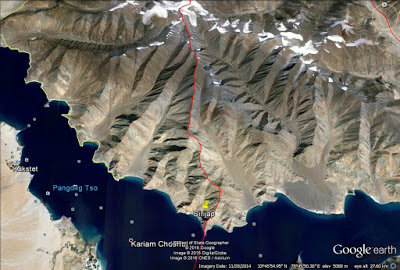
Apparently the incident took place between Finger Four and Finger Five on the Pangong Tso (lake): “India claims the area till Finger Eight but controls and dominates up to Finger Four. The situation was brought under control after thirty minutes of face-off, when both sides held their banners indicating either side to pull back to their respective positions,” says the HT.
The South China Morning Post reported from Hong Kong: “Indian and Chinese soldiers were involved in an altercation in the western Himalayas …further raising tensions between the two countries which are already locked in a two-month stand-off in another part of the disputed border. …The two sides have frequently accused each other of intrusions into each other’s territories, but clashes are rare.”
Some reports say that the Chinese soldiers carried iron rods and stones, and in the melee there were minor injuries on both sides.
Cancellation of the Border Personnel Meetings
Another sign that the tension is mounting: Border Personnel Meetings (BPM) were to be held like every August 15 at five places along the border. This year they did not take place.
India and China hold BPM at five points: Daulat Beg Oldie and Chusul in Ladakh, Kibithoo and Bumla in Arunachal Pradesh and Nathu La in Sikkim.
Though invited the Chinese officials did not turn up. It shows that Beijing has not digested as yet the Doklam incident and the fact that India stopped them building a road.
Some Indian media reported that the meetings could not be held as China’s PLA officials did not respond to communications from the Indian Army.
The Hand-in-Hand joint military exercises
The fate of the annual India-China Hand-in-Hand joint military drill hangs also in balance as India has not received any word from the Chinese side, which is supposed to host the exercise this year.
Since 2007, when it was first held, an Initial Planning Conference (IPC) is held in the host country in June-July but so far there has been a ‘studied silence’ from Beijing, says The Economic Times which cites a source in the Army: “The IPC takes place in the country where the exercise would be held. We sent a message to the Chinese side but there was no response. It should have happened latest but July end, but the IPC never took place.”
They will probably no joint exercises this year.
No Rivers’ flow data
Perhaps more serious, it appears that China had stopped sending the routine information on river water flow of the Sutlej and Brahamaputra.
According to The Hindustan Times: “At a time when major rivers in Himachal Pradesh are in spate due to heavy rain, lack of information from China on water inflow from Pareechu rivulet that meanders through the Tibetan Autonomous Region (TAR) has prompted the Central Water Commission (CWC) to seek intervention of the ministry of water resources.”
It had been agreed that India and China would annually renew the protocol on sharing information on two major rivers — Brahmaputra and Sutlej: “But China has reportedly stopped sharing information with India on water inflow in Pareechu. The lake across the Pareechu river, which was measured the size of 20 football grounds, burst in 2005 causing major flooding in the Sutlej. Gushing waters had washed away the strategic Hindustan-Tibet road, National Highway-22 at a number of places, 10 bridges and 11 ropeways. About 15 motorable bridges and 8 jeepable roads and footbridges were damaged on the 10-km stretch of NH-22 between Wangtoo in Kinnaur and Samdoh in Lahaul Spiti districts.”
The HT’s report continues: “No loss of life was reported as the army and civil authorities anticipating the breach in glacial lake in Pareechu had evacuated 5,000 people along the Sutlej. Total losses caused due to flooding had been pegged at Rs 800 crore.”
The Pareechu river originates in India, then it meanders into Tibet and then merges into the Sutlej near Sumdoh (a border post in India). A glacial lake on Pareechu formed behind a landslide dam in 2004; on June 26, 2005, it busted provoking Glacial Lake Outburst Floods (GLOF). After the 2005 GLOF, India and China signed a protocol for sharing information on the water level from Pareechu and the Sutlej.
China has apparently stop sharing information about the water inflow, which makes it dangerous for the local population in Kinnaur.
Senior scientific officer, SS Randhawa told the HT: “The Himachal government constantly monitors the water flow in Pareechu through its department of science technology. But so far the department has been unable to get clear satellite images. Last time, we checked images on July 8 and there was no danger at that time. We use remote sensing technology to monitor the water bodies in the river catchment. But we have been unable to get clear images in the last one week as there are thick clouds over the catchment area.”
I have earlier mentioned the long article in The Global Times about the diversion of the Yarlung Tsangpo/Brahmaputra.
Another warning that Beijing has started retaliating for to the ‘loss’ of its road in Bhutan?
China is indeed playing a dangerous game.
Thursday, August 3, 2017
The Truth from the Dragon's Mouth
Recently a book Spying Against India (Chinese Military Intelligence from 1962 to 2012) Volume 1, written by one Ben Keiler (probably a nom de plume) was published by Amazon Kindle.
It is difficult to verify the veracity of the content.
However it complements the above map that I posted a few weeks ago on this blog (China ties to alter the status quo in Bhutan).
One Chapter of the book is entitled: The Western Territories of Bhutan
It explains that the above map is a copy of Top Secret Chinese Intelligence map.
(it copy was probably published to hide the embarrassing information about the Indian and Bhutanese camps inside the area today claimed by China)
The book publishes the originals along the translation of the accompanying texts and provides its own comments.
For example, this Chinese Intelligence map provides an overview of the disputed areas in Western Bhutan with detailed textual explanations.
The map is said to have been compiled by Chinese intelligence some 30 years ago.
The original maps with the positions of the Bhutanese and Indian Armies were obviously not published in China, as they contradict China's version of the historical background of the present standoff with India near the trijunction.
Here are details of the above map.
The present standoff between the Chinese and Indian Army is taking place in the Southern part of the map.
The legend for the map is interesting. It says:
Today, China pretends that the area has always been Chinese territory!
This map marked Document 67 shows that the Royal Army of Bhutan and the Indian Army were in control of the area in the 1980s.
Not a single post occupied by the Chinese Army is marked.
The PLA was nowhere to be seen.

Here is the legend for the above map :
Further, according to the book Spying Against India:"If we go to the map [marked] as Doc 67 [above], we see the 1987 reality as reported by Chinese military intelligence: there are four bases by the Bhutanese army and one by the Indian army in that area alone. Those bases are located along the border and there is not one single Chinese base."
The author of the book further comments:
He points out at the contradiction in the Chinese Intelligence documents: "a second and different Chinese story appears is in Doc 67 where Chinese intelligence marks one base of the Bhutanese army clearly inside that very area and two more at the border."
See the legend above.
The book Spying Against India says:
All this shows that the situation is far more complicated than the one showed in the recent Chinese statement.
In other words, the PLA has blundered in entering Indian territory, a place that a few decades ago, China did claim as its own. Today, at best for Beijing, it is today 'disputed'.
It also shows the Chinese way of claiming new territories.
They first send grazers. If not objected, the grazers would visit every year.
Then a small patrol is sent.
The following year a tent (representing the Civil Administration) is planted.
After a few years, it becomes "Chinese territory administrated by China since immemorial times".
It is difficult to verify the veracity of the content.
However it complements the above map that I posted a few weeks ago on this blog (China ties to alter the status quo in Bhutan).
One Chapter of the book is entitled: The Western Territories of Bhutan(it copy was probably published to hide the embarrassing information about the Indian and Bhutanese camps inside the area today claimed by China)
The book publishes the originals along the translation of the accompanying texts and provides its own comments.
For example, this Chinese Intelligence map provides an overview of the disputed areas in Western Bhutan with detailed textual explanations.
The map is said to have been compiled by Chinese intelligence some 30 years ago.
The original maps with the positions of the Bhutanese and Indian Armies were obviously not published in China, as they contradict China's version of the historical background of the present standoff with India near the trijunction.
Here are details of the above map.
The present standoff between the Chinese and Indian Army is taking place in the Southern part of the map.
The legend for the map is interesting. It says:
The top text shows what the Chinese consider the international border.The fact that this area is shown in a separate colour (green), as well as the captions clearly demonstrates that the area was already disputed 30 years ago.
The second text is what India and Bhutan consider as the location of the border.
The third is the “illegal” McMahon Line (in Eastern Bhutan - not shown on this particular map)
Today, China pretends that the area has always been Chinese territory!
This map marked Document 67 shows that the Royal Army of Bhutan and the Indian Army were in control of the area in the 1980s.
Not a single post occupied by the Chinese Army is marked.
The PLA was nowhere to be seen.

Here is the legend for the above map :
Blue circle: Permanent base of the Royal Bhutan ArmyHere is the translation of text on the Chinese text accompanying the Intelligence map (as well as it 'edited' reproduction; see map on the top of this post - top most text).
Blue triangle outlined: Observation post of the Royal Bhutan Army
Blue triangle: Checkpoint of the Royal Bhutan Army
Light brown circle: Indian army base.
Luling (also called Ru-ling) area is located on southeast of the Rinchengang town, in the lower part of the Dro-mo [Lower Chumbi Valley].These facts contradict the Chinese propaganda: Beijing never maintained any army base, customs office or other government function in that area until 1983.
The area includes some of the small rivers in the east of Dromo Machu, Charthang river and Luling river.
The size of the area is around 340 sq. km and there are more than 40 grasslands (pastures). The source [of income] comes from the products of the forest; it is pretty marvelous.
According to some historical documents, before 1843 China put border stone pillars on the hill of Ha-la, which is the source of the Luling River. [Nobody has ever heard of these 'pillars'; my comment].
The western part of the Ha-la Mountain’s range was in the past the pastoral area of the nomads of the Dro-mo [Chumbi].
In the year of 1954, the Bhutanese army permanently settled at Charthang for whole year. There were around 100 troops occupying the area.
In 1960, the Bhutanese soldiers came again and set up an Observation Post at Ha-rar with more than 20 soldiers. There were sent from the pasture ground of Charthang.
In 1973, the people of the Dro-mo [Chumbi] restored their control over the border area and managed to send their animals grazing like before in the upland region of Lang-ma.
Moreover, in 1975, we [China] established a forest park in the Langma’s upland.
In 1983, we [China] a set up a civil administration.
Now the soldiers and nomads of Bhutan do not enter the lower part of Lang-ma’s upland grassland by crossing the Phu-tren pass as before.
Further, according to the book Spying Against India:"If we go to the map [marked] as Doc 67 [above], we see the 1987 reality as reported by Chinese military intelligence: there are four bases by the Bhutanese army and one by the Indian army in that area alone. Those bases are located along the border and there is not one single Chinese base."
The author of the book further comments:
First no Tibetan from Yatung [in Chumbi Valley] or any other Chinese lived there or even went there. After some 20 years after the arrival of the Chinese army in Yatung, they start to send local Tibetans as ‘nomads’ with their cattle into that area to stake a claim. If those Tibetans are not expelled for some ten years, they open a small civil administration post which could be only an unmarked tent operated during summer. Again if that civil administration station is not demolished they start to make propaganda to claim this area has been Chinese territory since ancient times.Perhaps more interesting is the Chinese description of the place where the conflict is presently going on. Here is the translation of the text:
Tunglang (Doklang) area is located in the south, moreover the valley of Tunglang river is an area of more than 100 sq. km.The author of the book rightly notes: "The names and areas of those disputed territories are not identical in China and Bhutan. Therefore if the Chinese talk about Tonglang it’s not identical in size and geographical location to what the Bhutanese and Indians called Doklam."
Northern parts of that area are plain with lots of lakes and there are more than 30 small and big grassland.
Southeast are mostly forest with steep mountains and deep valley.
According to the historical documents, Tunglang grassland is the summer pastoral area of the people of Lower Dro-mo [Lower Chumbi] region and the army of India and Bhutan both are not entering into the Tung lang area. They just observed to the nomads and people from a big stone.
From the year of 1975, China’s armies went around very carefully, almost once a every year.
Generally after we (Chinese) reached near to the Lhamasi through Shismo, we [China] returned back.
In 1983, the boundary line of our observation was expanded towards the south and later it was getting nearer to the Observation Post of the Bhutanese army in Dung-Tsona in South of Trae grassland.
He points out at the contradiction in the Chinese Intelligence documents: "a second and different Chinese story appears is in Doc 67 where Chinese intelligence marks one base of the Bhutanese army clearly inside that very area and two more at the border."
See the legend above.
The book Spying Against India says:
This was in 1987.In Doc 70, we can see the deployment of Bhutanese and Indian army units in western Bhutan in 1987. The first Battalion of the Bhutanese army defends the area close to the border with Sikkim.
In that location they make sure the Chinese army cannot take any shortcut through Bhutanese territory and cut-off and encircle the Indian border defense in the northern areas of Sikkim.
The 2nd, 3rd and 5th battalions were positioned to defend the area between Yatung and the capital Thimphu.
The 6th battalion serves as reserve force and can be deployed in any direction. The Indian troops are intermixed with the Royal Army of Bhutan to strengthen the defense but also to make sure the Chinese army cannot enter any area of Bhutan without fighting the Indian Army. This mix makes sure the Chinese cannot only target the Bhutanese army and grab more land without killing Indian soldiers.
All this shows that the situation is far more complicated than the one showed in the recent Chinese statement.
In other words, the PLA has blundered in entering Indian territory, a place that a few decades ago, China did claim as its own. Today, at best for Beijing, it is today 'disputed'.
It also shows the Chinese way of claiming new territories.
They first send grazers. If not objected, the grazers would visit every year.
Then a small patrol is sent.
The following year a tent (representing the Civil Administration) is planted.
After a few years, it becomes "Chinese territory administrated by China since immemorial times".
Sunday, July 23, 2017
India, China, Tibet and the curious case of the missing Sikkim Papers
![]() |
| Harishwar Dayal in front of The Residency in Gangtok |
Here is the link...
The present standoff at the trijunction between Sikkim, Tibet and Bhutan, on the southern tip of the Chumbi, is a worrying development. While recently addressing the foreign diplomats in Delhi, Foreign Secretary S Jaishankar rightly stated that China has been ‘unusually aggressive and articulate’.
Beijing seems to have only one argument, i.e. the 1890 Convention between the British and the Manchus, conveniently forgetting several other agreements, particularly the 1893 Trade Regulations (1890 twin accord) which allowed India to open a trade mart in Yatung in the Chumbi Valley.
Treasure
There is also general amnesia on the fact that the Tibetans never recognized the 1890 Convention as Lhasa and Paro were not consulted by the 'Great Imperial Powers'. Tsepon WD Shakabpa, the Tibetan historian explained: “In 1890 a convention was drawn up …without consulting the government of Tibet …and since [Tibet] was not represented at the Convention, those articles were not allowed to be put into practice by the Tibetans. The British were aware that China exercised no real power in Tibet at that time.”
To come back to the present day, Jaishankar told a panel of MPs that India has clearly outlined its position on the border though the Chinese have a differing position, “but they are misinterpreting it and so India was trying to clarify it. He said that India has been maintaining the same position since 1895 as per an Anglo-Chinese agreement.”
One can only hope that reason will prevail in Beijing, but a solution is bound to take time, certainly not before the leadership change in November during the Communist Party’s 19th Congress.
In this context, an anecdote came back to mind. A few years ago, an acquaintance who, as a young diplomat, was posted in Gangtok in the Political Officer’s office told me that in 1975-76, soon after the merger of the Himalayan State with India, he spent months going through all the historical records kept in Gangtok between 1889 to 1975; Delhi’s orders were to dispatch them to Delhi for safe custody. Once his work was over; the diplomat sent six truck-loads of old files to Delhi under CRPF escort. Since then, nobody seems to know where these Sikkim Papers are and if this archival treasure still exists.
It would have an immense historical value today to show that India and Tibet had a different relation than the one portrayed by China; further Beijing would be unable to bluff its way through with incorrect historical information.
The Political Officer (PO) was the Government of India’s eye over the entire Himalayan region. From the seasonal Indian Trade Agency (ITA) in Gartok in Western Tibet, to the ITA in Gyantse and Yatung, the Indian Mission (and later Consulate General) in Lhasa, all correspondence passed through Gangtok. It included the relations with Sikkim and Bhutan; the PO even overlooked the NEFA area in coordination with the Governor of Assam.
Gangtok has seen many remarkable personages serving as POs.
The first was Claude White, a British engineer who was send to Sikkim in 1887 to tackle the tense situation on the Sikkim–Tibet border in the north. A year later, White came back to Sikkim as an Assistant Political Officer of a British Expeditionary Force which defeated the Tibetans a year later; this resulted in the 1890 Convention. In the meantime, a post of Political Officer in Sikkim had been created, making Claude White, the Administrative head of the entire Himalayan region.
Tragedy
In his book Sikkim and Bhutan: 21 Years on the North East Frontier 1887-1908, the first PO wrote, “one of the first things to be done after his arrival in Sikkim was to build a house, the site for which was found in the midst of the jungles around Gangtok”; then called the Residency, it is today’s the Raj Bhavan. White also ordered a survey of the borders with Tibet, including the 1895 one.
Though South Block probably has copies of some of the Sikkim Papers, the entire set is not traceable (it is at least what I was told). It is a tragedy for researchers and it would undoubtedly help strengthen India’s case in the present circumstances.
History
Interesting officers occupied the Residency in Gangtok.
Amongst them, Sir Charles Bell who had developed a deep friendship with the Thirteenth Dalai Lama, when the latter was living in exile in Kalimpong, but also Frederick Bailey who was instrumental in mapping the North-East, what became the McMahon Line in 1914; and Sir Basil Gould, who in the 1930s, travelled to Tibet to establish diplomatic relations with a then Independent Tibet or Arthur Hopkinson, the religious-minded ICS officer, who was asked by the Government of India to continue for a year after Independence as the First ‘Indian’ PO.
Harishwar Dayal took over from Hopkinson and was officiating when Tibet was invaded by the Chinese troops in October 1950.
Once in a cable to the Prime Minister, Dayal dared quoting a dispatch sent from Hugh Richardson, the Scottish-born ‘Indian’ representative in Lhasa; on June 15, 1949, he suggested that India might consider occupying Chumbi Valley up to Phari ‘in an extreme emergency’.
This did not go well with Nehru, but in November 1950, Dayal wrote: “This suggestion was NOT favoured by Government of India at the time. It was however proposed as a purely defensive measure and with NO aggressive intention. An attack on Sikkim or Bhutan would call for defensive military operations by the Government of India.”
Though it is history now, it is what China’s PLA strategists would today call ‘active defence’. Let us hope that the Sikkim Papers could soon be traced, they contain the history of Modern Himalaya.
Thursday, July 20, 2017
Beijing banks on history, India on new confidence
![]() |
| In one voice? |
Here is the link...
China appears to have miscalculated New Delhi’s response to its attempt to change the status quo at the tri-junction. It believed that a ‘weak’ New Delhi would back out of a confrontation
The best form of defence is attack, believed Sun Tzu, the ancient Chinese military strategist. This probably explains the new diplomatic offensive undertaken by China which would like to convince the foreign diplomatic community in Beijing that India was in the wrong to ‘occupy Chinese territory’ in the southern tip of the Chumbi Valley.
According to a national English daily, officials of China’s Ministry of Foreign Affairs had closed-door briefings, giving their version of the events to several foreign diplomats posted in Beijing. A diplomat from one of the P-5 (permanent members of the UN Security Council) told the daily, “They have told our colleagues in Beijing that the Indian side has trespassed into Chinese territory and changed the status quo.”
In actual fact, the opposite happened. On June 30, the Ministry of External Affairs in Delhi clarified that, in 2012, it had mutually been decided that status quo would be maintained in the disputed area: “The two Governments had in 2012 reached an agreement that the tri-junction boundary points between India, China and third countries will be finalised in consultation with the concerned countries. Any attempt, therefore, to unilaterally determine tri-junction points, is in violation of this understanding”, explained South Block’s statement, which asserted that it was essential that “all parties concerned display utmost restraint and abide by their respective bilateral understandings not to change the status quo unilaterally”.
A blunder
This raises a serious question. Despite the noise emanating from Beijing, it does appear that, by starting a conflict which will take months or years to cool down, someone, somewhere, in China has serious blundered. Whether it is the People’s Liberation Army (PLA) or the civilian leadership which miscalculated India’s resolve to militarily defend Bhutan, is irrelevant; but it has triggered a vicious circle (though India had a measured and mature response).
Nevertheless, it is a huge intelligence blunder on the part of Beijing which took India for granted. Of course, the deciders in Beijing had previous historical cases, particularly that of Tibet in the early 1950s, when India refused to defend ‘small insects being eaten by big insects’, as the 13th Dalai Lama termed an earlier Chinese invasion in 1910. This time, India did not hesitate to defend Bhutanese interests, especially in an area which is so strategic for New Delhi.
Could have the central Chinese leadership have taken such a risky gamble without a green signal from the ground — their representation in India? Though nothing will immediately change, in the months to come, we may see some heads rolling. Did the Chinese Ambassador in Delhi report that the ‘weak’ Indians would not react to the construction of a road? We may never know. But there is no doubt that the preparations for building a road in the disputed area started several months ago, if not earlier.
One issue which is usually not mentioned by commentators on the current stand-off is the tense situation in China, before the Communist Party’s 19th Congress, which will witness a significant change of guard. Could serious differences within the party have influenced the situation at the tri-junction Sikkim-Tibet-Bhutan?
It is possible.
The case of Sun Zhengcai
Last Saturday, Sun Zhengcai, a member of the Communist Party’s Politburo, and a Xi Jinping heir-apparent, was removed from the scene. Sun was one of the top contenders for a seat in the Central Committee’s Standing Committee of the Politburo; serving as party boss of Chongqing megacity, Sun is apparently investigated by the anti-graft agency.
Quoting a source in Chongqing, The South China Morning Post wrote: “Sun Zhengcai, at 53, the youngest member of the party’s 25-strong Politburo, is suspected of serious violation of party discipline.”
After Sun lost his job, the Hong Kong newspaper commented: “The development could have a significant impact on the upcoming leadership reshuffle in the autumn... The internal briefing did not state whether he had been placed under official investigation.”
Sun was immediately replaced by Guizhou’s party chief, Chen Miner, a Xi Jinping protégé. Earlier in the day, on Saturday, a video footage on state-run CCTV showed Sun attending a high-level finance meeting in Beijing: Impermanence is the way of life in communist China.
The case of 1962
One can recall the deadly infighting during the first months of 1962. At a meeting known as the 7,000 Cadres’ Conference, in January 1962, President Lui Shaoqi stated: “…man-made disasters strike the whole country”. He was targeting Mao, who was sidelined for a few months. In the summer of 1962, Mao decided to stage a comeback against ‘Left adventurism’ and ‘capitalist roaders’.
One person stood up and supported Mao: This was Lin Biao, who had replaced Marshall Peng as Defence Minister. Lin, who would lead the attack on India a few months later, asserted: “The thoughts of Chairman Mao are always correct.” This new-found alliance between Mao and the PLA Chief was, no doubt, one of the most important factors in the 1962 conflict.
In September 1962, at the 10th Plenum of the party’s 8th Congress, Mao took back the fate of China into his hands, denouncing “the members of the bourgeoisie in the party ranks”. He even attacked his mild Premier Zhou Enlai and Foreign Minister Chen Yi, who were accused of trying to rehabilitate intellectuals and scientists: "The bourgeois spirit hangs over like a ghost over their heads.”
Nine years later, the heir-apparent, Lin Biao was ‘eliminated’ in mysterious circumstances in an air crash.
The present power struggle
There is no doubt that times have changed, and it is difficult to conceive today a full-fledged conflict between India and China, but the fact remains that the Chinese leadership tends to become irrational when there is an intense power struggle within the party.
Recently, when Xi Jinping visited Hong Kong, unprecedented security measures, including a last-minute decision of shifting hotels, was due to fierce in-fighting in the party, according to Apple Daily, Hong Kong’s second best selling newspaper: “The threat to Xi’s safety is, for sure, not from Hong Kong demonstrators, the non-existent Hong Kong separatists, or the overseas extreme religious or separatist forces. Rather, it is from the communist party’s power struggle.” It was at the last minute that Beijing decided to change hotels, creating utter chaos for the media and the Hong Kong police. “This arrangement let the outside world realise that the communist party’s power struggle has come to the point of life or death for its leaders” commented Apple Daily.
Presuming that the tension on the border will continue till after the 19th Congress (when the winter will set over Dokala), it may become more and more difficult for China to extricate itself from its own rhetoric, which is not based on facts. In any case, this makes the situation dangerous. Incidentally, China will celebrate the 90th anniversary of the PLA on August 1; other crucial date.
Thursday, July 13, 2017
China is on a sticky wicket in Bhutan
![]() |
| Most of the maps show Batang-la as the trijunction Sikkim-Tibet-Bhutan |
Here is the link...
Has China lost its gamble on a Himalayan ridge in Sikkim? It is too early to say, but some lessons can already be drawn from the scuffle between the Indian Army and the People's Liberation Army in Doka La, near the trijunction between Tibet (China), India and Bhutan.
The episode started when China began building a road on Bhutanese territory without informing Thimphu.
Beijing was certainly not expecting that India would come to the rescue and defend the small kingdom.
China, which dreams of becoming a 'Big Power', attempted to change the status quo south of the Doklam plateau on the Bhutan-Tibet border.
Statement
On June 29, the Royal Government of Bhutan, which had held 24 rounds of talks on the issue with China so far, explained the situation in a statement: 'On 16th June 2017, the Chinese Army started constructing a motorable road from Doka La in the Doklam area towards the Bhutan Army camp at Zompelri.
'Boundary talks are ongoing between Bhutan and China and we have written agreements of 1988 and 1998 stating that the two sides agree to maintain peace and tranquillity in their border areas pending a final settlement on the boundary question...
'The agreements also state that the two sides will refrain from taking unilateral action, or use of force, to change the status quo of the boundary.'
Bhutan conveyed to Beijing that the construction of the road inside Bhutanese territory was a direct violation of the agreements and that it would affect the ongoing demarcation process.
On June 30, 2017, the MEA too issued a press communiqué underlining that 'the two governments had in 2012 reached agreement that the trijunction boundary points between India, China and third countries will be finalised in consultation with the concerned countries.
'Any attempt, therefore, to unilaterally determine tri-junction points is in violation of this understanding.'
Beijing was well aware that the area has been under dispute for several decades; already some 50 years ago, nasty letters were exchanged between Delhi and Beijing on the issue.
The first lesson of the present episode is that India is eons behind China in terms of communication.
Though Beijing broke its pledge to Bhutan and India, the constant threatening statements by their spokesperson made it sound as if Beijing was the aggrieved party.
In 2003, China's Central Military Commission approved the concept of 'Three Warfares', namely: (1) the coordinated use of strategic psychological operations; (2) overt and covert media manipulation; and (3) legal warfare designed to manipulate strategies, defence policies, and perceptions of target audiences abroad.
The Chinese spokespersons efficiently demonstrated how, even when wrong, you can make it appear that it is the other parties, Bhutan and India in this case, who are the culprits.
History
Take the case of the 1890 Convention between Great Britain and China relating to Sikkim and Tibet.
The Chinese Ministry of Foreign Affairs' spokesperson managed to convince most of the Indian and foreign media of the importance of the treaty.
Beijing, however, forgot to mention that the two main stakeholders, Tibet and Sikkim, had not even been consulted by the then 'Great Imperial Powers'.
Tsepon WD Shakabpa, the famous historian, in his Tibet: a Political History, explained that in 1890, a convention was drawn up without consulting the government of Tibet: '…six articles related to Tibet, and since (Tibet) was not represented at the Convention, those articles were not allowed to be put into practice by the Tibetans.'
Shakabpa added: 'The British were aware that China exercised no real power in Tibet at that time; but it suited their interests to deal with the Manchus, because of the advantages they gained from the Convention.'
An unequal treaty in Chinese parlance! The Manchus agreed to 'offer' Sikkim to the British as they were afraid that Tibet and Britain might enter into direct negotiations with London; therefore, they signed the treaty to forestall such a possibility.
In 1904, Capt Francis Younghusband anyway mounted a military expedition to Tibet to make the recalcitrant Tibetans sign their first agreement with the Crown.
Wedge
China has always been interested to create a wedge between India and Bhutan.
In 1966, in similar circumstances, for the same disputed place, the Dokham plateau, the Chinese government attempted to convince Delhi that Bhutan did not require India's support 'as it was an independent country'.
The Communists did not accept that Delhi could advise Bhutan; they crudely wrote: 'inheriting the mantle of British imperialism, the Indian Government has all along been pursuing an expansionist policy and bullying its neighbouring countries.'
Chinese President Xi Jinping (right) shakes hands with Indian Prime Minister Narendra Modi to the G20 Summit on September 4, 2016 in Hangzhou, China (stock photo)
As at present, the Bhutanese Government had issued a press statement on October 3, 1966: 'The Government of Bhutan have, for some time, been concerned with reports received from its patrols of a number of intrusions by Tibetan grazers and Chinese troops in the Doklam pastures which are adjacent to the southern part of the Chumbi Valley.'
It concluded that the area has been traditionally part of Bhutan, and China had never disputed 'the traditional frontier which runs along recognisable natural features.'
However, later, China started claiming large strategic chunks of Bhutan's territory.
Incidentally, Article 1 of the much quoted 1890 Convention placed the trijunction at Gipmochi: 'The line commences at Mount Gipmochi on the Bhutan frontier, and follows the above-mentioned water-parting to the point where it meets Nepal territory.'
According to Sikkimese records, Gipmochi is in Batang La, 5 km north of Doka La.
It means the territory south of Batang La is indeed Bhutanese, and therefore India did not 'trespass' into Tibet.
So, why all this fuss?
Friday, July 7, 2017
China believes the best form of defence is attack
![]() |
| PLA's Tanks exercising on the plateau |
'How can a State, which claims to be a responsible power, unilaterally grab a "disputed" area to build a road on it?' asks Claude Arpi.
Hee is the link...
After completing my first book on Tibet in the 1990s, I looked for a title which could resume the content of my research.
At the end of the 19th century, Tibet was a mere pawn in the Great Game between Imperial Powers. The 1890 Treaty on Sikkim, today quoted ad nauseam by the Chinese government, was one of the ‘unequal treaties’ imposed on a smaller nation. Big insects had little consideration for the weak.
The Thirteenth Dalai Lama could grasp the forces at play and was determined to make Tibet an independent state. It did not work. Charles Bell, the British frontier officer recalled the Lama’s great deception when China invaded the Land of Snows in 1910. After deciding to temporarily take refuge in India, the Tibetan leader cabled the British Agent in Gyantse, Tibet, asking him to inform London that “Large insects are eating and secretly injuring small insects.”
The story seems to continue today with China building a road on Bhutanese territory without informing Thimphu. But this time, what Beijing had not expected is that India would come to the rescue and defend the small Kingdom.
China, which dreams of becoming a ‘big insect’ (without the name!) tried to change the status quo in the Doklam area of the Bhutan-Tibet border.
On June 29, the Royal Government of Bhutan, which had held 24 rounds of talks on the issue with China so far, explained the situation: “On 16th June 2017, the Chinese Army started constructing a motorable road from Dokola in the Doklam area towards the Bhutan Army camp at Zompelri. Boundary talks are ongoing between Bhutan and China and we have written agreements of 1988 and 1998 stating that the two sides agree to maintain peace and tranquility in their border areas pending a final settlement on the boundary question. …The agreements also state that the two sides will refrain from taking unilateral action, or use of force, to change the status quo of the boundary.”
Bhutan conveyed to Beijing “both on the ground and through the diplomatic channel,” that the construction of the road inside Bhutanese territory was a direct violation of the agreements and that it would affect the ongoing process of demarcating the China-Bhutan boundary (Beijing and Thimbu have already had a Joint Survey of the area).
Beijing was well aware that the area has been under dispute for several decades; some 50 years ago already, letters were exchanged between Delhi and Beijing using the same language for a similar incident.
Despite the fact that China has no proof to contradict that the pastures in the Dokham area have for centuries been used by Bhutanese nomads (the Chinese were nowhere to be seen before the first years of the 1960s), the Chinese spokesperson has stridently been speaking of ‘Chinese’ nomads using these pastures since immemorial times.
But let us come back to the 1966-67 correspondence which appeared in the Volumes 13 and 14 of the MEA’s White Papers on China.
In January 1966, China was the first to open the hostilities, Beijing complained of Indian troops entering Tibet on September 30, 1965 “four Indian soldiers crossed Toka La [Doka-la] and intruded into Tunglang pasture in Dongnan [Dokham plateau] grassland, and with their weapons intimidated Chinese herdsmen who were grazing cattle there.”
On September 30, 1966, South Block sent a note to the Embassy of China in Delhi to counter the Chinese propaganda; it spoke of a series of intrusions “in the Doklan pasture area which lies south of the traditional boundary between Bhutan and the Tibet region of China in the southern Chumbi area.”
The note pointed out: “It is reported that on the 13th of April 1966, a patrol of the Royal Bhutanese Army observed that a Chinese patrol of 13 men had intruded about three miles south-west of Sinchel La. …The Tibetan grazers were informed by the Bhutanese patrol that they were in Bhutanese territory and asked to withdraw.”
The situation continued during the following months.
The problem was that the trijunction between Tibet (China), Bhutan and India had never been agreed upon. The situation has not changed today.
On October 27, 1966, Xinhua News Agency replied to the Indian note on behalf of the Chinese government: “the Indian Government concocted stories about ‘intrusions’ into Bhutanese territory by Chinese herdsmen and patrols and claiming to be acting on behalf of Bhutan, lodged a so-called protest with the Chinese Government. Following that, with much fanfare [the] Indian Government set its propaganda machine in motion raising a hue and cry about Chinese intrusions into Bhutan and the Indian Prime Minister Indira Gandhi came out in person to conduct the campaign against China.”
It mentioned the ‘Doklam pasture’ where the Chinese intrusions took place, located in the vicinity of the trijunction of the boundaries of China, Bhutan and Sikkim.
At that time already, Beijing tried to create a wedge between India and Bhutan: “The King of Bhutan has long since solemnly declared that ‘Bhutan is an independent sovereign state and has the right to conduct her own foreign affairs’ …[but] inheriting the mantle of British imperialism, the Indian Government has all along been pursuing an expansionist policy and bullying its neighbouring countries.”
Like today, the Bhutanese Government had issued a press statement on October 3, 1966: “The Government of Bhutan have, for some time, been concerned with reports received from its patrols of a number of intrusions by Tibetan grazers and Chinese troops in the Doklam pastures which are adjacent to the southern part of the Chumbi Valley. This area is traditionally part of Bhutan and no assertion has been made by the Government of the People's Republic of China disputing the traditional frontier which runs along recognizeable natural features.”
Last week, the MEA issued a press communiqué underlining that “the two Governments had in 2012 reached agreement that the tri-junction boundary points between India, China and third countries will be finalized in consultation with the concerned countries. Any attempt, therefore, to unilaterally determine tri-junction points is in violation of this understanding.”
Despite the fact that Beijing loves to refer to the 1890 Treaty, which was an ‘unequal’ treaty signed by the Manchus and Great Britain (without the participation of Bhutan, Tibet and Sikkim, the stakeholders), China has clearly broken its promises given to Bhutan and India.
How can a State, which claims to be a responsible power, unilaterally grab a 'disputed' area to build a road on it, especially when it is aware that this road is so strategically located for a neighbour. Only Beijing can answer this question.
Some say that it is in Chinese DNA "to first change the status quo on the ground and then later to offer to 'talk".
Remember the South China Sea or the Aksai Chin.
India has to remain vigilant.
Tailpiece: As mentioned above, ‘differences of perceptions’ on the Tibet-Sikkim-Bhutan and the Sikkim-Tibet borders are not new. China used fully these differences during the Indo-Pakistan conflict of 1965, threatening to interfere in the War by opening a new front in Sikkim.
This has been well-documented in the Notes, Memoranda and Letters Exchanged between the Government of India and China (or White Papers) published by the Ministry of External Affairs in Delhi.
An incident which took place in Delhi on September 24, 1965 is worth relating (it appears in White Paper No. XII).
A delegation led by some Indian politicians (one of them would later become Prime Minister of India), took a herd of 800 goats to the Chinese Embassy in Delhi to make a point: is it worth starting a war over some pastures or simply because herds had crossed an unmarked line?
On September 26, 1965 the Ministry of Foreign Affairs lodged a strong (not to say rude) complaint to the Indian Embassy in Beijing: “In the afternoon of September 24, 1965, a mob of Indian hooligans went to the gate of the Chinese Embassy in New Delhi to make provocation led by Indian officials and Congress leaders and driving a flock of sheep before them.”
The Chinese note continues: “They made a huge din, yelling that China had invented absurd pretexts for threatening and intimidating India, that China wants to start a world war over some sheep and a few yaks, and so on and so forth.”
The note directly accused Lal Bahadur Shastri’s Government: “This ugly farce was wholly instigated and staged by the Indian Government.”
It continues in the same tone: “The Indian Government will definitely not succeed in its attempt, by staging this ugly anti-Chinese farce, to cover up its crimes of aggression against China and the wretched picture of its troops fleeing in panic from the Chinese side of the China-Sikkim boundary. For a number of years you have flatly denied that Indian troops had intruded into Chinese territory across the China-Sikkim boundary and built military works for aggression there. Yet within a few days of our demand for the dismantling of the military works for aggression within a specified time-limit, the Indian troops who had intruded into the Chinese side of the China-Sikkim boundary could not but flee helter-skelter under the surveillance of Chinese troops, leaving behind numerous evidence of their crime, thus suddenly exploding the falsehood which you had so painstakingly concocted over these years. How can you succeed in hiding your shame?”
The note concluded: “In staging a few forlorn and unseemly anti-Chinese demonstrations you have your undivulgeable motive - to seek reward from the imperialist and modern revisionists. But the Chinese Government must remind the Indian Government that there is a limit to everything, and that the exceeding of such a limit will not be tolerated.”
A few days later, Delhi simply replied that India is a democracy and demonstrations are allowed. It denied the Government’s involvement.
Let us hope that the Chinese missives are less rude now than 50 years ago, but then like now, Beijing believes that the best form of defense is attack.
![]() |
| Practicing |
Subscribe to:
Posts (Atom)