Showing posts with label 19th Congress. Show all posts

Thursday, January 4, 2018

China develops its border with India: Yume again in the news

Two months ago, I wrote about Yume, the hamlet north of the McMahon (Upper Subansiri district of Arunachal Pradesh).
At that time,  Xi Jinping had written a letter to two young Tibetan herders who had introduced their village to the Chinese President.
It looks like it is helpful to receive a letter from the President.
The Global Times has reported yesterday: "A sparsely populated township in Southwest China's Tibet Autonomous Region has been connected to the state electricity grid, ending life without electricity for its 32 residents."
The village is Yume.
Incidentally, why do China has to always write "China's Tibet Autonomous Region". India does not write "India's Tamil Nadu" or "India's Uttarakhand" or even "India's Arunachal"?
Beijing must be feeling insecure.
To come back to The Global Times' article, it quotes the contractor, a Xining-based electric power company who worked on the project: "The 15-kilometer 10-kilovolt power line, which took five months to complete, is connected to remote Yulmed [Yume] Township in Luntse [Luntse] county, Shannan [Lhoka], via 108 electric poles over a 5,000-meter-high mountain."
According to the tabloid, Yume (also spelt Yulmed) is located "at an average elevation of 3,650 meters above sea level and its population was once just a three-member household. Currently, it has nine households."
It is further explained that in 2008, the local government built a small hydropower station, but the project failed to meet the increasing power demands of the 32 residents: "Due to improved living standards and growing need for electricity of the residents, power outages were frequent."

India's infrastructure development
While Beijing is going full steam to built infrastructure on its side of the McMahon Line, it complains about India building roads in the border area.
The same Global Times commented on the recent visit of Indian Union Home Minister Rajnath Singh to Nilang: "An Indian road construction project connecting all border posts along the China-India frontier could lead to new military standoffs between China and India, Chinese experts warned."
The mouthpiece of the Communist Party quoted The Times of India: "During his New Year visit to the 'Indo-Tibet Border Police' at Nelong [Nilang] valley in Uttarkashi district bordering China, Indian Union Home Minister Rajnath Singh said that a number of border posts had already been connected with roads and many would soon be linked."
China is unhappy because Singh asserted that "this would enhance the operational efficiency of the officers and reduce mountain-related sickness among them."


Chinese Double Standards
Of course, China is entitled to do whatever it wants on its side of the border.
China Daily recently reported: "Investment in infrastructure in the Tibet Autonomous Region is helping to lift 628 villages along the border out of poverty."
It further asserted: "After getting access to electricity and the construction of new roads, tea farmers and herdsmen in a village some 200 kilometers southwest of Lhasa in Tsona county founded a cooperative that provides skills training and job opportunities for villagers."
Tsona is located north of Tawang district of Arunachal.
The area has been extensively developed. I have mentioned it earlier on this blog.
China admitted: "Starting last year, more than 100 million yuan ($15,263) has been invested in infrastructure in the village of less than 100 families as a part of a broader construction project to build model villages with moderate prosperity in the border area. The construction of well-off villages along the border is designed to advance the living and working conditions in surrounding villages."
China Daily estimated that the road access rate in the area will reach 100 percent and the per capita disposable income will double by the year of 2020.
Is it not double standard?

My November 2017 post

Soon after the conclusion of the 19th Congress, President Xi Jinping wrote a letter to two young Tibetan herders who had written to him introducing their village, Yume, north of Upper Subansiri district of Arunachal Pradesh.
According to Xinhua, Xi “encouraged a herding family in Lhunze [Lhuntse] County, near the Himalayas in southwest China's Tibet Autonomous Region, to set down roots in the border area, safeguard the Chinese territory and develop their hometown.”
Xi acknowledged “the family's efforts to safeguard the territory, and thanked them for the loyalty and contributions they have made in the border area. Without the peace in the territory, there will be no peaceful lives for the millions of families," he wrote.
The two Tibetan girls, Choekar and Yangzom had told the CCP’s Secretary General about their “experiences in safeguarding the border area and the development of their township over the years.”
Interestingly, the girls’ village, Yume (or Yumai or Yulmed) is located a few kilometers north of the McMahon Line, not far from the remote Indian village of Takshing.
Can this letter from Xi Jinping be considered as an acknowledgment of the McMahon Line, as the Indo-Tibet border? Xi clearly thanks the two herders for 'guarding' the border?
From the reporting of Xinhua, it seems so.
Xi further hoped that the girls’ family could “motivate more herders to set down roots in the border area ‘like galsang flowers’, and become guardians of the Chinese territory and constructors of a happy hometown.”
The report also explained that Yume is China's
smallest town in terms of population.

Galsang or Kelsang Flower
Yume on this blog
I had mentioned Yume several times on this blog, mainly because Yume Gompa was the last stage of the Tsari pilgrimage (see map below).
Already in November 2016, China Tibet Online spoke of Yume ‘town’ on the southern slope of the Himalayas as the border area of China and India: "If driving, you had to go south 400 km from Lhasa to Luntse of Lhoka (Shannan) City, then there was another 200 km of muddy mountain roads before you reached Yulmed.”
The Chinese site then asserted that “It is the least populous administrative town in China. With an area of 1976 square km, Yulmed has one subsidiary village, and only nine households with a total of 32 people. Yulmed has very few residents, but it is not impoverished nor backward.”
It added: “For a long time, there was only one family in Yulmed. After the Tibet Autonomous Region government dispatched officials and doctors, built the roads, and added a power station and a medical clinic, Yulmed became more and more lively. In 2015, the annual average per capita disposable income in Yulmed was 26,000 yuan.”

Four conclusions
By Xi Jinping admitting that Yume is a 'border' village, can it be concluded that Xi has acknowledged the McMahon Line? Probably not, but he has admitted that it was the present border (Line of Actual Control).
Another issue that I already brought up earlier on this blog: why not reopen the Tsari Pilgrimage and use it as a Confidence Building Measure between India and China?
Another conclusion is that China will develop very fast the 'border' areas in the years to come, I have often mentioned Metok County, but also Lepo village, north of Khenzimane on the McMahon Line.
Finally, it looks like the Communist Party has started to more and more use Tibetans in border areas and elsewhere yo defend the Middle Kingdom’s borders.
Delhi should be worried!


Sunday, October 29, 2017

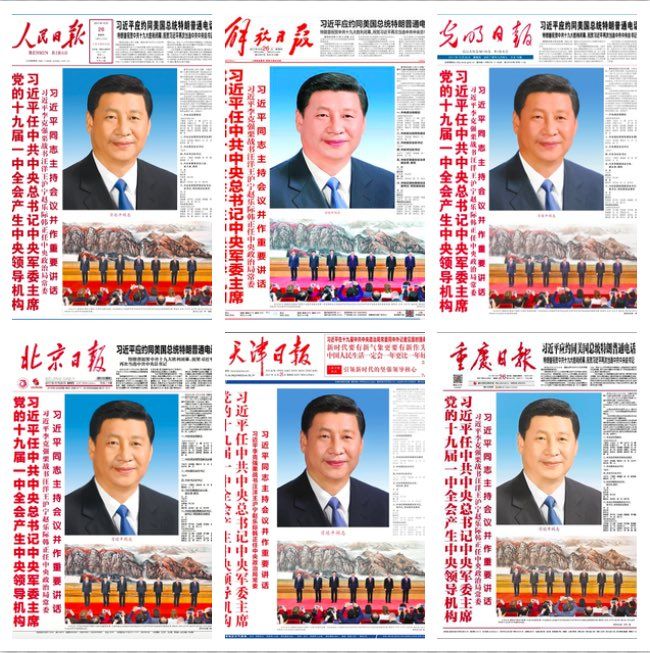
Is Mr Xi the winner?

Front-page of 6 different newspapers in China
My article Is Mr Xi the winner? appeared in The Statesman.

Here is the link...

At the end of the 19th Congress, most of the Western media have declared President Xi Jinping, the winner. He is the most powerful leader since Mao, say the China watchers. But is it true? A great difference between Mao and Xi is that the Great Helmsman controlled the Communist apparatus without intervening much in the day-to-day affairs.
He often travelled the countryside in luxurious trains for weeks, with just a few secretaries and several of his favourite ‘nurses’. He had no encrypted way of communicating with his colleagues (or ‘lackeys’ in Maoist parlance) in Beijing. He was not bothered. This is not the case of Xi Jinping who heads a large number of Leading Small Groups on many topics under the Middle Kingdom’s sky, but he is also General Secretary of the Communist Party of China, the President of the People’s Republic of China, the Chairman of the Central Military Commission and the Commander-in-Chief of the Joint Battle Command.
Xi has however undoubtedly emerged as the winner on several fronts in recent months. First and foremost, the 19th Congress approved an amendment to the Party Constitution enshrining Xi Jinping Thought on Socialism with Chinese Characteristics for a New Era.
Though the new Central Committee and Central Commission for Discipline Inspection are more or less along the expected lines, the Politburo and the Standing Committee brought some surprises. The new Politburo’s Standing Committee now comprises President Xi, Premier Li Keqiang, Li Zhanshu, Wang Yang, Wang Huning, Zhao Leji and Han Zheng.
The presence of Li Zhanshu, Xi’s chief of staff, who is to take over the chairmanship of the National People’s Congress, is a proof of Xi’s control over the appointments. Ditto for Wang Huning, the party theorist who will take the charge of ideology, propaganda and party organization, while Zhao Leji will replace Wang Qishan, as the new antigraft tsar. Wang Yang will take the seat of Yu Zhengsheng as chairman of the Chinese People’s Political Consultative Conference; as for Han Zheng, he will probably be drafted as Executive Vice-Premier in March.
But where are Xi’s presumed successors, Hu Chunhua and Chen Miner? Where is Wang Qishan, Xi’s right-hand man who, for five years, arrested the ‘tigers and the flies’? The absence in the Standing Committee of Chen Miner, the Party Secretary of Chongqing, who was expected to be anointed ‘heir apparent’ has been noticeable. Apparently Xi does not want a ‘successor’ as yet. Same for Hu Chunhua, Guangdong Party Secretary, who for several years was said to be a future new General Secretary.
Just before the Congress, the South China Morning Post (SCMP) which has been by far the bestinformed, noted: “Hu Chunhua ~ the widely tipped successor ~ and the president’s protégé, Chongqing party chief Chen Miner, are both likely to be missing from the Politburo Standing Committee. Instead, they will join the Politburo, which is one rank lower.” It is what happened. SCMP had good tips, despite the opacity of the party proceedings. The great surprise was that Wang Qishan, who is responsible for making thousands of party heads roll, has stepped down from the Standing Committee, due the age-limit norm.
It was confirmed when his name did not appear in the list of the new Central Committee members. Many ‘watchers’ were expecting Xi to break an unwritten retirement-age rule to keep his friend Wang in the Standing Committee. Two members of the powerful Central Military Commission (CMC) made it to the Politburo. Apart from Air Force General Xu Qiliang, presently CMC ViceChairman, General Zhang Youxia, a family friend of Xi, was selected as the second vicechairman.
Contrary to what many have written, Xi might not be all-powerful; he still has to deal with party norms and traditions: “He is careful not to break the age rule and to follow the order of seniority. These political norms are critical for the 89-million member Communist Party to have consensus at the top and maintain stability,” wrote the SCMP which also noted: “Xi is also not blindly following the established path.” Another sign that Xi may not have full control, is the reduced size of the CMC which has only 7 members (apart from the two Vice-Chairmen: Xu Qiliang, Zhang Youxia, others are Wei Fenghe, Li Zuocheng, Miao Hua, Zhang Shengmin) compared to 11 during the previous Congress. The day after the announcement of the new CMC, Xi met the PLA delegation and urged them to “follow the road maps set for it at the Congress.”
It is easier to agree on 7 than 11. Xi said socialism with Chinese characteristics has entered a new era, and the military should make all-out efforts to become a world-class force by 2050 while striving for the realization of the ‘great rejuvenation of the Chinese nation’. Xi ordered the PLA to be absolutely loyal to the party, to focus on how to win in wars, to pioneer reforms and innovation, to scientifically manage commanding a unit and to lead troops in accordance with the strictest standards. Strangely, there was no photo with the new CMC.
Another odd happening: General Song Puxuan, one of the rising star’s in the PLA and the newly appointed head of the CMC’s Logistics Support Department did not make it to the list of the Central Committee’ members. In 2014, Song was promoted to the rank of full general, taking the charge of the Northern Theatre Command, overseeing the defence of the capital and China’s border with North Korea. His failure to make it to the Central Committee is still unexplained. When the list of the delegates to the Congress was first released in July, many watchers thought that it would mark a new area for women, who made up 24.1 per cent of the 2,287 delegates. The official media pointed out that it reflected the efforts made by the party “to give women members a bigger say and improve gender equality and social stability.”
But Chinese women leaders are still practically excluded from the top of the hierarchy. Of the 204 members of the Central Committee, just 10 are women; the same figure as that for the 18th congress of 2012. And only one lady, Sun Chunlan made it in the Politburo. She will probably retain her job as Chief of the United Front Work Department.
That is disappointing. As for the ethnic minorities, they have got a slightly better deal in the Central Committee, with 16 members from ethnic origins compared to 10, five years ago. Incidentally, the Tibetans have four representatives who have been selected as members of the Central Committee (Lobsang Gyaltsen and Che Dalha) and Alternate members (Norbu Thondup and Yan Jinhai, a Tibetan from Qinghai); it is a first. Further, Wang Huning, the newly-appointed member of the Politburo’s Standing Committee will probably represent Tibet at the National People’s Congress in March. The question is why should a Han leader represent Tibet?
Han chauvinism will continue for some time more. In any case, Wang’s presence does not mean that life will become easier for the Tibetans or the Uyghurs. Chen Quanguo, the former Party Tibet Secretary presently posted in Xinjiang, has been rewarded with a seat in the Politburo for the repressive measures he introduced in the restive Muslim region.
What does all this mean for India? One will have to wait and see. As Deng Xiaoping liked to say, ‘Let us seek truth from facts’.

Friday, October 20, 2017

The Communist High-Mass

The High-Mass of the Chinese Communist Party (CCP) has started.
Every five years, it follows the same precise ritual. The outgoing CCP’s General Secretary (in the present case, Xi Jinping), gives a 3 hour long speech, describing the internal and external changes facing the country, which the party needs to address.
Everything is scripted.
First, the election of 2287 delegates to the 19th Congress which took place months ago, among 40 ‘electoral blocs’ – representing each of China’s 31 provinces as well as the central party organs, national State institutions, the People’s Liberation Army, etc.
There are two types of delegates, the ‘big shots’ who will make it to the 200-odd member Central Committee (CC) and the ‘grass-root’ delegates which count for nearly half of the delegates; and five or seven ‘big ones’ who will eventually reach the Communist Paradise, the Politburo’s Standing Committee.
The Party Congress has three main purposes.
First, it establishes a new party line to be followed for five years; the Congress is the authoritative body to do so. The ‘draft’ read by the General Secretary has been seen and commented by thousands and hundreds of amendments have already been incorporated.
Alice Miller, one of the best experts in CCP’s affairs wrote: “Over the course of its session, a party congress sets down a consensus evaluation of the party’s work over the five-year period since the preceding congress and an assessment of the party’s present situation, and it sets forth general guidelines—the party’s line—for the party’s priorities, emphases, and tasks for the coming five-year period until the next congress.”
At the end, a resolution will endorse Xi Jinping’s speech establishing the party’s consensus on all policies that the party leadership will face.
Then, according to the Constitution, a CC Plenum must convene at least once a year to follow up on the directions given by the Congress.
The second purpose of the Meet is to revise the Party’s Constitution and introduce changes such as a new theory, a brain-child of the current Secretary General.
Finally, the Congress nominates a new leadership for the five years to come. It includes the CC whose plenums give directions to the Party between two Congresses, but also some 170 alternate members whose role is replace the CC’s full-members when required (when full members are sent to jail for corruption for example), as well as a new Central Commission for Discipline Inspection (CDIC), whose job is to tackle corruption.
Finally, before the Congress closes its doors, the CC’s first Plenum will appoint the top party leadership. It also nominates the all-powerful Central Military Commission, a new Secretariat (the body that facilitates the implementation of Politburo decisions) as well as the State Council or Cabinet, headed by the Premier, usually the No 2 in the Party’s hierarchy.
During his speech on October 18, President Xi Jinping outlined his vision for the next five years of China’s development. According to The South China Morning Post, “he vowed to step up ideological guidance within the party, strengthen its anti-corruption campaign, retain the government’s grip on Hong Kong and Macau, and oppose any moves towards independence in Taiwan.”
One of the most expected parts of the speech was the inclusion of Xi’s so-called political philosophy; it will thereafter be known as ‘socialism with Chinese characteristics for a new era’.
The new motto will be repeated thousand times all-over the Middle Kingdom. It is said that there are 14 elements behind the elaborated concept; the first is that Party should lead in every aspect of life in China. Xi declared that “the dream of national rejuvenation would only be a fantasy without the leadership of China’s Communist Party. The party should lead in all areas and the authority of the party central leadership should be respected.”
Other highlights are ambitious targets to be achieved during the next 30 years and more, “From 2035 to 2050, China should become a nation with pioneering global influence.” The momentum of the anti-corruption campaign is ‘irreversible’ and rule by law would be maintained.
Of course, national security would be boosted and the Party would resolutely protect its sovereignty and interests. Xi spoke of ‘historical breakthrough’ in national defence and military reform: “The navy has protected the nation’s maritime interest and its army rapidly upgraded its weaponry. …The People’s Liberation Army should be a ‘world class’ force by 2050.”
Some in India may think, it is not necessary to worry; 2050 is far-away. However it is crucial to watch the CMC’s new composition. It may bring radical changes and surprises which could determine if new ‘Doklam’ incidents would take place in the years to come.
Sharp observers have predicted that the number of Vice-Chairmen of the Commission may go from two to four. Some of Xi Jinping’s close allies are expected to be promoted.
One is General Zhang Youxia, director of the Equipment Development Department, who is tipped to become one of two vice chairmen, while present vice chairman, Xu Qiliang, is expected to stay on. Zhang, like Xi is native from the northwestern province of Shaanxi and both he and Xi are children of former senior PLA officials.
The other two candidates are Li Zuocheng, director of the Joint Staff Department and Miao Hua, the new head of the Political Department; they may also make it.
Whether China will follow a ‘peaceful rise’ or a more tumultuous one, will depends on the capacity of Xi to impose a ‘rule of law’.
If the generals remain ‘wild’ as in the past, India may have to face a serious situation.
The battle is not yet played out.

The Tibetans in full costume 
Apart from the Secretary General's speech,  is it interesting to look at the attire of the delegates.
On the second day of the 19th Congress, the delegates of the 31 provinces met separately.
While most of the delegates wore suit and tie, the Tibetans had to show off their regional attire.
Just have a look at these photos.
Hubei Province delegation
Anhui Province delegation
Yunnan Province delegation

Fujian Province delegation
Delegation of the central financial organs

Qinghai Province delegation
Guangdong Province delegation

Gansu Province delegation

Zhejiang Province delegation
And now the Tibetan delegation.
Out of 29 delegates, 11 Tibetans are from the 'grass root'.
While the 'big shots', from the regional Standing Committee of the Tibetan Autonomous Region like Wu Yingjie, Lobsang Gyaltsen or Che Dralha wore suits and ties, the 'grass root' delegates have no choice but to show their regional costumes.
It is always a great attraction for the journalists and photographers.
Can it be considered as a display of Tibetan culture?
Are the delegates just for the show in Beijing ?
Difficult to say.


Thursday, September 28, 2017

Chairman Xi shuffles his pack as China begins to analyse the Doklam incident

My article Chairman Xi shuffles his pack as China begins to analyse the Doklam incident appeared in Daily Mail (UK) and Mail Today.

Here is the link...

While the Doklam incident is over and many still rejoice that India 'won' the battle, some uncertainty remains. And if corrective measures are not taken from the Indian side, it is clear that similar incidents will happen again with a different outcome the next time.
There is no doubt that China has started analysing the incident too. In this context it is interesting to look at the changes which have taken place in the Chinese defence forces since an agreement was found between Beijing and Delhi on Doklam.
First, it is obvious that China may remain belligerent for some time, partly because China had to withdraw from the Bhutanese territory without being able to build a road.
For example, the Communist media, particularly The Global Times, has gone ballistic against the Indian Army Chief: 'Rawat has such a big mouth that he could ignite the hostile atmosphere between Beijing and New Delhi. He not only turns a blind eye to international rules, but also made us see the arrogance probably prevailing in the Indian Army.'

Attack
For Beijing, attack remains the best form of defence, but vital changes have taken place within the People's Liberation Army (PLA).
On the positive side, some officials in Beijing seem to realise that aggression can lead China nowhere.
Maj Gen Qiao Liang, one of the best known military strategists and the co-author of Unrestricted Warfare, a book which created waves in strategic circles in the West, wrote in The Global Times: 'We should spare no efforts to avoid pushing the country into a war as peace is the best outcome.'
Qiao continued: 'Road construction in this area is not a matter of right and wrong, but we need to understand that it's not always right to do something right at any time.
'Only doing the right thing at the right time is correct… resorting to war is irresponsible. Whenever there may be a way to solve a conflict without war, war should be avoided.'
At the same time, Xi Jinping, the Chairman of the all-powerful Central Military Commission (CMC), has undertaken an overhaul of the defence forces.
A few weeks before the Party's 19th Congress (scheduled to start on October 18), new faces have appeared on the scene; a massive reshuffle of the PLA's generals, not only at the Group Army (Corps) level but also at the top of the hierarchy, is ongoing.
Analysts believe that Xi is promoting his favourites to PLA's top posts to gain absolute control over the military; in the process, two top generals got sacked hardly a month before retiring.
Gen Fang Fenghui, the equivalent of the US Chief of Defence Staff, was replaced as Chief of the PLA's Joint Staff Department by Gen Li Zuocheng, a Xi protégé.
Fang and Gen Zhang Yang, another CMC member, will not even participate in the forthcoming Congress.
The rumour mill said that they were being 'investigated', a term not usually auguring well for the targeted person.
This may indicate bad days ahead for the generals.

Impermanence
By mid-October, out of 11 members of the CMC, only two may remain, the Chairman and Gen Xu Qiliang, one of the two serving vice-chairmen.
Note that in China, unlike democratic India, there is no fuss about 'seniority'; superseded generals have only to learn the meaning of 'impermanence'.
Remember the case of Lt Gen Yang Jinshan, a former Deputy Commander of the former Chengdu Military Region (MR), who served several years in Tibet. He was a rising star of the PLA; in 2012, he was even promoted to Central Committee, the Party's top heaven; at that time, he was senior to his direct boss, Li Zuocheng, who then commanded the MR.
Today, Yang Jinshan is languishing jail, being 'investigated' while Li Zuocheng is the powerful Chief of the Joint Staff Department. On September 1, Gen Han Weiguo, only 61, was appointed commander of the PLA Army and Gen Ding Laihang, 60, commander of the PLA Air Force (PLAAF).
Gen Han served in Fujian in the 1980s at the time Xi was Deputy Mayor of Xiamen, while Gen Ding's career also overlapped when the latter was Governor of Fujian Province.

Surprises

The recently-released list of PLA's delegates to the 19th Congress had some surprises. The 303 'elected' members belong to 31 different units, compared with 19 in 2012; one example, the new PLA Rocket Force is now represented.
More than 90 per cent of those 'elected' will be first-time attendees, representing a new generation of officers who will owe their rise to Chairman Xi only.
Further, according to The Asia Times, the ethnicity factor still plays a negative role in promotions: 'While sweeping military change is on the cards at China's upcoming communist party Congress, few expect ethnic minority officers from unstable regions to make top brass.'
Though there is a slight rise in the number of 'ethnic' delegates (6 per cent of the delegates are ethnic minority officers, from 4.6 per cent in 2012), their number is relatively small and they don't occupy important post.
The Asia Times noted: 'The Manchus and Tibetans will each send three delegates, while the Uyghur, Hui and Tujia will each put forward two. The Zhuang, Xibe, Korean, Qiang, Bai and Naxi ethnicities will each send one delegate to the Congress.'
This remains the PLA's Achilles' heel.
The future of the relations between India and China is undoubtedly linked to the outcome of the seismic changes in the PLA.
India should not only watch carefully, but also get its acts together, particularly in the field of border infrastructure.

Monday, September 25, 2017

Tibet's Representation at the 19th Congress

Can Cui make it to the Central Committee
China has ‘elected’ 1,909 civilian delegates for the 19th Party Congress to be held in October.
They are representing Central Departments working under the CCP Central Committee (CC), Central State organs, Central Enterprises and China’s provinces and centrally-administered Municipalities.
How they were ‘elected’ is not clear.

Jayadev Ranade of the Center for China Studies and Analysis explains: “The Politburo Standing Committee (PBSC) members are, as per practice, all Delegates to the 19th Party Congress. Pertinently and possibly because of the focus this year on poverty alleviation, all PBSC members represent the poorer provinces. Xi Jinping is the Delegate from Guizhou, Li Keqiang from Guangxi, Zhang Dejiang from Inner Mongolia, Yu Zhengsheng from Xinjiang, Liu Yunshan represents Yunnan, Wang Qishan is the Delegate from Hunan and Zhang Gaoli from Shaanxi.”
Ranade quotes the Hongkong media: “at least eight prominent omissions from the list of Delegates to the upcoming Congress. All are either Full or Alternate members of the 18th CCP Central Committee and all are, interestingly, past members of the Communist Youth League (CYL). They are also eligible in terms of age."
The eight losers are:
  • Qin Yizhi - Head of the CYL; CC Member; 51 years.
  • Zhao Yang - Deputy Director of General Administration of Sports; Alt Member CC; 54 years.,
  • Deng Kai – Deputy Party Chief of the All China Federation of Trade Unions (ACFTU); Alt Member CC; 57 years.
  • Liu Jian – Chairman, State Development and Investment Corporation; Alt Member CC; 47 years.
  • Zhang Zhijun – Director Taiwan Affairs Office; CC Member; 64 years.
  • Nur Bekri – Director, National Energy Administration; CC Member; 55 years. Yang Yue – Vice Governor, Jiangsu Province; Alt CC Member; 49 years.
  • Wang Anshun - Head, State Council Development Research Centre; CC Member; 59 years.
The PLA list
More interesting perhaps are the changes in the People’s Liberation Army (PLA).
The list of representatives of the PLA and People’s Armed Police Force (PAP) has also come out. The PLA has a total of 253 delegates, while the PAP has 50 representatives.
A massive reshuffle of the PLA’s generals, not only at the Group Army (Corps) level, but at the top of the hierarchy too, is taking place and two top generals got the sack hardly a month before retiring.
Gen Fang Fenghui, the equivalent of the US Chief of Defence Staff, was replaced as Chief of the PLA’s Joint Staff Department by Gen Li Zuocheng, a Xi protégé and former Commander of the Chengdu Military Region (under which Tibet used to come).
Fang and Gen Zhang Yang, another CMC member will not even participate in the forthcoming Congress. The rumour mill said that they were being ‘investigated’, a term not usually auguring well for the targeted person. This may indicate bad days ahead for the generals.

The Lessons of Impermanence
Reading these lists is a teaching about impermanence.
Remember the case of Lt Gen Yang Jinshan, a former Deputy Commander of the former Chengdu Military Region (MR), who served several years in Tibet. He was a rising star of the PLA; in 2012, he was even promoted to Central Committee, the Party's top heaven; at that time, he was senior to his direct boss, Li Zuocheng, who then commanded the MR.
Today, Yang Jinshan is languishing jail, being 'investigated' while Li Zuocheng is the powerful Chief of the Joint Staff Department.
But in this game, connections are important, not to say vital.
On September 1, Gen Han Weiguo, only 61, was appointed commander of the PLA Army and Gen Ding Laihang, 60, commander of the PLA Air Force (PLAAF). Gen Han served in Fujian in the 1980s at the time Xi was Deputy Mayor of Xiamen, while Gen Ding’s career also overlapped when the latter was Governor of Fujian Province.

Other Surprises
The list of PLA’s delegates has some other surprises. The 303 ‘elected’ members belong to 31 different units, compared with 19 in 2012; one example, the new PLA Rocket Force is now represented.
More than 90 per cent of those ‘elected’ will be first time attendees, representing a new generation of officers who will owe their rise to Chairman Xi only.

Ethic Representations

Though there is a slight rise in the number of ‘ethnic’ delegates (6% of the delegates are ethnic minority officers, from 4.6% in 2012), their number is relatively small and they don’t occupy important posts, except for one Tibetan who is said to be a Major General.
Asia Times noted: “The Manchus and Tibetans will each send three delegates, while the Uyghur, Hui and Tujia will each put forward two. The Zhuang, Xibe, Korean, Qiang, Bai and Naxi ethnicities will each send one delegate to the Congress.”
Tibet is represented by a senior officer, Thupten Trinley alias Tidan Dan (土旦赤列), a Deputy Commander of the Tibet Military Region and two ladies, Kaslang, alias Gesangba and Sonam Dolma. Their qualification or designation is not mentioned.
Lt Gen Xu Yong (许 勇), the Commander of the PLA Tibet Military Region is also present in the list.
A Chinese lady, Zhang Aiying (张爱英), a communication officer and instructor posted in the Tibet Military Region has also been ‘elected’.
That is not much.
One can also note the absence in the list of Lt Gen Diao Guoxin (Political Commissar, Tibetan Military District), Maj Gen Song Baoshan (Commander, People's Armed Police, TAR) and Lt Gen Xiao Tang (Political Commissar, People's Armed Police, TAR).
Lt Gen Peng Yong (Commander of the Xinjiang Military District) has also disappeared from the radars.
[Please read the corrections sent by a reader, posted below]

The civilian list
The civilian list is posted below.
Noticeable is the absence of the most senior Tibetan official, namely Pema Thinley, alias Padma Choeling, an out-going member of the CC (and the only Tibetan in the CC).
Is Choeden La a wrong spelling for Che Dralha, the head of the TAR Government.
[Please read the corrections sent by a reader posted below. Some of the errors are due to the spelling mistakes in the list available to me.]
Lobsang Gyaltsen, the Governor of the Tibetan Autonomous Region (TAR) and an Alternate Member of the CC is in the list, making illegible for a seat in the CC.
In the list of 29 delegates, one finds six out of 13 or 14 members of the Standing Committee of the Regional Communist Party (Wu Yingjie, the TAR Party Secretary, Lobsang Gyaltsen, Ding Yexian, one of the TAR Party Deputy Secretary, Wang Yongjun and two relatively junior Tibetan cadres, Pema Wangdue and Penpa Tashi).

Will Cui represent Tibet?
Apart from Lobsang Gyaltsen, a possibility is that Cui Yuying, one of the few ‘ethnic’ Tibetans who today serves in a senior position in the Central government in Beijing, could become the ‘Tibetan representative’ in the CC.
Born in 1958 in Changle County of Shandong Province, she joined the Communist Party in 1980, and graduated from Tibet Agricultural and Animal Husbandry College with a Bachelor Degree in 1982. After occupying different junior posts in Tibet, she served as the Director in the Publicity Department of CPC’s TAR Regional Committee from 2006 to 2011.
In December 2011, she was transferred as Deputy Director of the Central Office for Overseas Publicity in Beijing; from 2012 to 2015, she became Deputy Director of the Information Office of the State Council.
In February 2015, she became Deputy Director of the Publicity Department of the CPC Central Committee, a ministerial level post.
Will she make in the CC? The bets are opened!
I will mention in a separate post the Tibetans ‘elected’ in the Qinghai, Yunnan and Sichuan delegations.

The list of the delegates to the 19th Congress has been published.

In red, members of the Standing Committee of the TAR Regional Party

1 Ding Yexian Han TAR SC
2 Ma Shengchang Han
3 Wang Yongjun Han TAR SC
4 Ba Zhen  Tibetan Female
5 Pema Yangchen Memba Female
6 Pema Wangdue Tibetan TAR SC
7 Nyima Dangqu  Tibetan
8 Penpa Tashi  Tibetan TAR SC
9 Penpa Tashi  Tibetan ChaThongMon
10 Da Boer Lhoba
11 Zhu Zhongkui Han
12 Ren Houmin Han
13 Xiang Batashi  Tibetan
14 Xiangba Pincao  Tibetan Jampa Phuntsok?
15 Choedon la  Tibetan Could it be Che Dralha?
16 Tsering Paldon  Tibetan Female
17 Tsering Yangchen  Tibetan
18 Xu Chengcang  Han
19 Wu Yingjie Han TAR SC
20 Zhang Yanqing Tibetan
21 Abu  Han
22 Lhatso  Tibetan Female
23 Sonji Tashi  Tibetan
24 Lhopon Dhondup Tibetan Is it Norbu Thondup, TAR SC?
25 Lobsang Gyaltsen Tibetan TAR SC
26 Yao Chi  Tibetan Female
27 Tan Haiyu  Han Female
28 Ceng Wanming Han Probably Zeng Wanming, TAR SC
29 Jampa Dolma Tibetan Female

Thursday, July 20, 2017

Beijing banks on history, India on new confidence

In one voice?
My article Beijing banks on history, India on new confidence appeared in the Edit Page of The Pioneer.

Here is the link...

China appears to have miscalculated New Delhi’s response to its attempt to change the status quo at the tri-junction. It believed that a ‘weak’ New Delhi would back out of a confrontation
The best form of defence is attack, believed Sun Tzu, the ancient Chinese military strategist. This probably explains the new diplomatic offensive undertaken by China which would like to convince the foreign diplomatic community in Beijing that India was in the wrong to ‘occupy Chinese territory’ in the southern tip of the Chumbi Valley.
According to a national English daily, officials of China’s Ministry of Foreign Affairs had closed-door briefings, giving their version of the events to several foreign diplomats posted in Beijing. A diplomat from one of the P-5 (permanent members of the UN Security Council) told the daily, “They have told our colleagues in Beijing that the Indian side has trespassed into Chinese territory and changed the status quo.”
In actual fact, the opposite happened.  On June 30, the Ministry of External Affairs in Delhi clarified that, in 2012, it had mutually been decided that status quo would be maintained in the disputed area: “The two Governments had in 2012 reached an agreement that the tri-junction boundary points between India, China and third countries will be finalised in consultation with the concerned countries. Any attempt, therefore, to unilaterally determine tri-junction points, is in violation of this understanding”, explained South Block’s statement, which asserted that it was essential that “all parties concerned display utmost restraint and abide by their respective bilateral understandings not to change the status quo unilaterally”.

A blunder
This raises a serious question. Despite the noise emanating from Beijing, it does appear that, by starting a conflict which will take months or years to cool down, someone, somewhere, in China has serious blundered. Whether it is the People’s Liberation Army (PLA) or the civilian leadership which miscalculated India’s resolve to militarily defend Bhutan, is irrelevant; but it has triggered a vicious circle (though India had a measured and mature response).
Nevertheless, it is a huge intelligence blunder on the part of Beijing which took India for granted. Of course, the deciders in Beijing had previous historical cases, particularly that of Tibet in the early 1950s, when India refused to defend ‘small insects being eaten by big insects’, as the 13th Dalai Lama termed an earlier Chinese invasion in 1910. This time, India did not hesitate to defend Bhutanese interests, especially in an area which is so strategic for New Delhi.
Could have the central Chinese leadership have taken such a risky gamble without a green signal from the ground — their representation in India? Though nothing will immediately change, in the months to come, we may see some heads rolling. Did the Chinese Ambassador in Delhi report that the ‘weak’ Indians would not react to the construction of a road? We may never know. But there is no doubt that the preparations for building a road in the disputed area started several months ago, if not earlier.
One issue which is usually not mentioned by commentators on the current stand-off is the tense situation in China, before the Communist Party’s 19th Congress, which will witness a significant change of guard. Could serious differences within the party have influenced the situation at the tri-junction Sikkim-Tibet-Bhutan?
It is possible.

The case of Sun Zhengcai
Last Saturday, Sun Zhengcai, a member of the Communist Party’s Politburo, and a Xi Jinping heir-apparent, was removed from the scene. Sun was one of the top contenders for a seat in the Central Committee’s Standing Committee of the Politburo; serving as party boss of Chongqing megacity, Sun is apparently investigated by the anti-graft agency.
Quoting a source in Chongqing, The South China Morning Post wrote: “Sun Zhengcai, at 53, the youngest member of the party’s 25-strong Politburo, is suspected of serious violation of party discipline.”
After Sun lost his job, the Hong Kong newspaper commented: “The development could have a significant impact on the upcoming leadership reshuffle in the autumn... The internal briefing did not state whether he had been placed under official investigation.”
Sun was immediately replaced by Guizhou’s party chief, Chen Miner, a Xi Jinping protégé. Earlier in the day, on Saturday, a video footage on state-run CCTV showed Sun attending a high-level finance meeting in Beijing: Impermanence is the way of life in communist China.

The case of 1962
One can recall the deadly infighting during the first months of 1962. At a meeting known as the 7,000 Cadres’ Conference, in January 1962, President Lui Shaoqi stated: “…man-made disasters strike the whole country”. He was targeting Mao, who was sidelined for a few months. In the summer of 1962, Mao decided to stage a comeback against ‘Left adventurism’ and ‘capitalist roaders’.
One person stood up and supported Mao: This was Lin Biao, who had replaced Marshall Peng as Defence Minister. Lin, who would lead the attack on India a few months later, asserted: “The thoughts of Chairman Mao are always correct.” This new-found alliance between Mao and the PLA Chief was, no doubt, one of the most important factors in the 1962 conflict.
In September 1962, at the 10th Plenum of the party’s 8th Congress, Mao took back the fate of China into his hands, denouncing “the members of the bourgeoisie in the party ranks”. He even attacked his mild Premier Zhou Enlai and Foreign Minister Chen Yi, who were accused of trying to rehabilitate intellectuals and scientists: "The bourgeois spirit hangs over like a ghost over their heads.”
Nine years later, the heir-apparent, Lin Biao was ‘eliminated’ in mysterious circumstances in an air crash.

The present power struggle
There is no doubt that times have changed, and it is difficult to conceive today a full-fledged conflict between India and China, but the fact remains that the Chinese leadership tends to become irrational when there is an intense power struggle within the party.
Recently, when Xi Jinping visited Hong Kong, unprecedented security measures, including a last-minute decision of shifting hotels, was due to fierce in-fighting in the party, according to Apple Daily, Hong Kong’s second best selling newspaper: “The threat to Xi’s safety is, for sure, not from Hong Kong demonstrators, the non-existent Hong Kong separatists, or the overseas extreme religious or separatist forces. Rather, it is from the communist party’s power struggle.” It was at the last minute that Beijing decided to change hotels, creating utter chaos for the media and the Hong Kong police. “This arrangement let the outside world realise that the communist party’s power struggle has come to the point of life or death for its leaders” commented Apple Daily.
Presuming that the tension on the border will continue till after the 19th Congress (when the winter will set over Dokala), it may become more and more difficult for China to extricate itself from its own rhetoric, which is not based on facts. In any case, this makes the situation dangerous. Incidentally, China will celebrate the 90th anniversary of the PLA on August 1; other crucial date.