Sunday, September 5, 2021
Mingling like the Pomegranate Seeds
We shall never know if the Tibetans agreed …but they had to clap, wave red flags and smile.
This was not the first time that Xi used this expression to talk about ‘ethnic unity’ in China, a country which is supposed to have 56 different minorities.
Already after the Second Xinjiang Work Forum held in Beijing on May 28 and 29, 2014, which was attended by the entire Politburo and over three hundred top CCP’s officials, Xinhua asserted: “The Party's strategy on Xinjiang has been proven correct and must be continued in the long run.”
A commentator in The China Brief of the Jamestown Foundation noted: “Yet, beneath the boilerplate, the language and policy direction outlined in the Forum statement marks a significant departure. Since the 18th Party Congress [in November 2012], Party officials have stressed that ‘new conditions’ in Xinjiang create ‘new requirements’.”
We know what happened to Xinjiang during the following years (and what still happens today).
During the Forum, Xi Jinping declared: “Xinjiang’s most sustained problem is the problem of ethnic unity,” he continued: “all ethnic groups should show mutual understanding, respect, tolerance and appreciation, and to learn and help each other, so they are tightly bound together like the seeds of a pomegranate."
In May 2016, Xi visited a Hezhe ethnic village in northeastern Heilongjiang Province. The Hezhe is one of the smallest ethnic minority groups in China; in 1990 their population was 4,300; they are nomads who live mainly from hunting and fishing in the plain formed by the Heilong, Songhua and Wusuli rivers. Their language is said to belong to the Manchu-Tungusic group.
Xi again told them that “all ethnic groups shall remain closely united like the pomegranate seeds on the way toward national rejuvenation.”
What does it mean ‘ethnic unity’ for large (like Tibetans or Uyghur) or smaller minority groups?
In most of the cases, it means assimilation under a Han majority.
Since 1949, Han Chauvinism has heralded doom for the Chinese minorities.
Again, in January 2017, in a letter to an Uygur family, Xi again asked “all ethnic groups to unite like the pomegranate seeds under the CPC leadership to build a bright future for Xinjiang Uygur Autonomous Region.”
Xi also used this expression during an inspection of Inner Mongolia Autonomous Region in 2019.
But let us take a very concrete example of the delegates from Tibet to the 13th National People’s Congress to find out if ethnic equality really exists in China today. Out of 20 members, the ‘Tibet’ delegation has 6 Chinese Hans, three big shots nominated by Beijing, Zhao Kezhi, Minister of Public Security, member of Political and Legal Commission, China’s Cop no 1; Jing Hanchao, member of the Supreme People's Procuratorate, equivalent to a Supreme Court judge and Guo Qingping, Chairman of People’s Bank of China (for the finances, I presume). Among ‘local’ Hans (also nominated by Beijing) are Wu Yingjie, Party Secretary of the Tibet Autonomous Region (TAR) and Maj Gen Liu Guorong, TAR Commander of the People’s Armed Police.
Is it what China meant by ‘unity’, considering that the Tibetan delegates are mostly nameless individuals, selected (by Beijing) for their love for the Party only?
It is doubtful if the senior Chinese ‘Tibet’ representatives really ‘mingle’ like pomegranate seeds with their Tibetan colleagues.
Let us look at the ethnic minorities in the delegation of the People’s Liberation Army (PLA) and PAP to 19th Congress help in October 2017.
Out of 2280 delegates, only 11.5% (262) were from ethnic minorities. The PLA/PAP has 303 delegates, the Manchus and Tibetans have three delegates each, while the Uyghur, Hui and Tujia have two representatives, while the Zhuang, Xibe, Korean, Qiang, Bai and Naxi ethnicities have one.
Two of the three Tibetan delegates are two young lady officers (Kalsang and Sonam Dolma); their qualification/rank is unknown, but obviously low.
Further, there is no ‘minority’ member in the Politburo and out of 204 members of the Central Committee (CC), the PLA has 41 members, all Hans while among the civilians, a few minorities are represented: Hui (2), Kazakh (1), Manchu (3), Miao (1), Mongol (3), Tibetan (2), Uyghur (2), Xibe (1) and Zhuang (2).
What does ‘ethnic unity’ mean in these conditions?
The article of The China Brief already mentioned said: “Since coming to power, Xi Jinping has repeatedly stressed the importance of forging a shared national identity. The ‘China dream’, he contends, is foremost about the great revival of the ‘Chinese nation’ or ‘Chinese race’, a term first coined by Liang Qichao in 1902 and employed by Chinese leaders from Chiang Kai-shek and Mao Zedong to Deng Xiaoping and Jiang Zemin in order to stress the conjoined history, fate and consanguinity of the Chinese people.”
This does not convince the Tibetans.
Chen Quanguo, a former Party Secretary in Tibet, who in 2016 was sent to Xinjiang to ‘pacify the province’ (he was promoted to the politburo in the process) started promoting inter-marriage between Tibetans and Hans before his transfer. Later the same policy of “mingling' and fusing through increased contact, cooperation and intermarriage”, was encouraged in Xinjiang.
Till recently it remained minimal in Tibet; analysts believed that it was doubtful if the new policy of 'mingling' or 'fusing' could work on the Roof of the World, with too many decades of suspicion, not to say hatred, between the 'ethnic' populations and the 'occupiers'.
But things are quickly changing, especially after the Seventh Tibet Work Forum held in August 2020 in Beijing.
Already on January 11, 2020, during the Third Session of the TAR Eleventh People's Congress, some Regulations on the Establishment of a Model Area for the Progress of Ethnic Unity and Progress in the TAR, were adopted.
The first article promotes “the cause of national unity and progress in an all-round way, to consolidate and develop the socialist ethnic relations of equality, solidarity, mutual assistance and harmony;” it says: “In keeping with the awareness of the Chinese Nation Community, Tibet will be established as a model area for the national unity and progress of the nation.”
These regulations are said to have been formulated in accordance to the Chinese Constitution, the Law of the People's Republic of China on Regional Autonomy and taking into account the realities of the Autonomous Region. But there is huge gap between the theory and reality.
This probably explains the present intensive propaganda campaign launched by Xi Jinping in the recent weeks.
Article 2 of the Regulations deals with the establishment of “a model area of ethnic unity and progress within the administrative region of the Autonomous Region,” while Article 3 speaks of Tibet as “an inalienable part of the great motherland since ancient times, and all ethnic groups are important members of the Chinese family. National unity is the lifeline of the people of all ethnic groups. It is the common responsibility and obligation of the people of all ethnic groups to maintain the motherland's unity and strengthen national unity.”
And it goes on…
More recently, The China Daily highlighted the cases of four Han-Tibetan intermarriages being “a great demonstration of ethnic unity in this new era of development.”
A few months ago, Xinhua had already touched upon the issue: “According to statistics, there are more than 560 multiethnic families in Metok [near Upper Siang of Arunachal Pradesh]. People of different ethnic groups help each other in farming and animal husbandry, and children of different ethnic groups study in the same classroom. People here celebrate the New Year's Day, the Lunar New Year, the Tibetan New Year or folk culture festivals of Monpa ethnic group.”
The news agency highlighted the case of Zhang Chunhuan and his family celebrating together the Chinese Lunar New Year. This could be the beginning of a real ‘mingling’ and the disappearence of the Tibetan nation.
The simple fact that tens of articles on the subject have been published in the last few days, shows the Communist Party is facing a serious problem which will not be solved by propaganda alone.
The real question is: can Han Chauvinism disappear from the Middle Kingdom? It is doubtful.
Wednesday, December 30, 2020
An 'Ethnic' Face in the Chinese Government
![]() |
| Cui Yuying: on her way to Lhasa? |
The post below was written in 2015.
Since then, Cui Yuying was appointed Chairperson and Party Secretary of the Fujian Provincial Committee of the Chinese People's Political Consultative Conference (CPPCC).
According to The Tibetan Journal in January 2018: "A woman politician of Tibetan origin has been appointed for the first time to the post of Secretary of Communist Party of China (CPC) for the province of Fujian [not Party Secretary of Fujian, but CPPCC's Party Secretary] , a state of economic significance for China. This appointment marked the first minority ethnic woman to be appointed to such an inner sanctum of political decision making."
It is indeed a big job, though not really a 'decision making' one but Fujian is an important province for future promotion.
If it is confirmed that Lobsang Gyatsen is out of the way, Cui could be transferred back to Tibet in the near future; she served there till 2011.
My 2015 post
Madam Cui Yuying is one of the few ‘ethnic’ Tibetans who today serves in a high position in Communist Party of China.
Born in 1958 in Changle County of Shandong Province, she joined the Communist Party in 1980, and graduated from Tibet Agricultural and Animal Husbandry College with a Bachelor Degree in 1982.
After occupying different junior posts in Tibet (see Cui’s CV at the end of this post), she served as the Director in the Publicity Department of CPC’s Tibet Autonomous Regional Committee from 2006 to 2011.
In December 2011, she was transferred as Deputy Director of the Central Office for Overseas Publicity in Beijing; from 2012 to 2015, she became Deputy Director of the Information Office of the State Council.
In February this year, she took a new important assignment as Deputy Director of the Publicity Department of the CPC Central Committee, a ministerial level post.
Soon after getting her new job, Xinhua reported that Cui Yuying went to Mexico.
The news agency commented: “The public has been noticing the increase in the ratio of high-level female officials in China’s central government departments.”
“With the present promotion, Cui became the sole vice minister of minority groups in her department, the Central Committee Publicity Department,” says Xinhua.
The Beijing Youth Daily noted that there were at least 15 minister-ranking female officials among the 25 ministries directly run by the State Council. The number of female ministry-level officials is the highest in the Ministry of Education and the National Health and Family Planning Commission (each has three female high-level officials).
I earlier mentioned on this blog, the name of Sun Chunlan, Tianjin's former Party Secretary and now member of the Politburo; she recently replaced the disgraced Ling Jihua, as Director of the United Front Work Department (responsible for the Tibetan affairs, amongst others things).
Cui Yuying is however in a special position, being a woman and from an 'ethnic' background.
Xinhua explains that, with the founding of the ‘New China’ in 1949, “came the proclamation that China's female populace will be given equal rights as men in all aspects -- economic, cultural, social and political -- hence, the large probabilities of such increase in the number of high-rank female government officials.”
This was never done. The 1949 resolution sounded promising, but 'ethnic' officials and female cadres rarely made it to the top in Communist China.
And as mentioned in my post on the ‘ethnic officers in the PLA’, when they made it, the Tibetans or Uyghurs never used their position to be a bridge between the ‘ethnic’ populations and the Mandarins in Beijing.
Note that a Mongol, Yang Jing is a member of the powerful Secretariat of the CPC Central Committee, while Nur Bebri, a former Deputy Secretary of the Xinjiang Uighur Autonomous Region is now Director of the National Energy Administration and Deputy Director of the National Development and Reform Commission. [Bekri has since then be jailed for corruption].
Cui Yuying in action
In May 2013, Bhuchung K. Tsering of International Campaign for Tibet mentioned that during an encounter with some visiting Indian and Nepali journalists in Lhasa, Cui told them: “Foreign media might have been spreading rumors that Tibetan people want repatriation of Dalai Lama. But this is not the situation. Our investigation has shown that Tibetans do not want to see Dalai Lama coming back.”
That is obviously why she has been posted in the Ministry of Propaganda/Information.
Beijing believes that if a ‘Tibetan face’ says this, it sounds truer.
As Bhuchung Tsering explained: “Leaving aside the issue of politics, it is not rocket science to get an idea of the aspirations of the Tibetan people vis-à-vis the Dalai Lama. The historical and spiritual bond between the Dalai Lama and the Tibetan people go beyond the birth of the People’s Republic of China. …the Dalai Lama and the Tibetan people are inseparable, to those who understand Tibetan culture and tradition.”
Bhuchung Tsering further argued: “Despite China’s claims that the Tibetan people enjoy religious freedom, the Chinese authorities have virtually banned the Tibetans from displaying portraits of the Dalai Lama in their houses, as is the Tibetan spiritual tradition.”
His conclusions speak of “the tunnel vision and the shortsightedness by which the Chinese authorities have framed their Tibet policy so far,” he added: “Rather than looking at this Tibetan tradition positively and finding ways to respect it, the Chinese authorities have chosen to project the Dalai Lama as an adversary.”
Last year (in 2014), Madam Cui opened the infamous ‘2014 Forum on the Development of Tibet, China’, organized in Lhasa with a few foreign fans of the Communist Party of China.
The ‘2014 Forum’ was jointly organized by the State Council Information Office of the People's Republic of China (The Cabinet) and the so-called People's Government of Tibet Autonomous Region. The official ‘invitees’ had no choice, but to agree to the terms dictated by the Party in Beijing. One can’t bite the hand which feeds you!
Cui Yuying, while inaugurating the ‘Forum’, used the old argument that only Beijing wants modernity for Tibet. The same argument was used in the 1950s, when Mao and his colleagues pretended that the Dalai Lama did not want ‘reforms’ and therefore Tibet needed to be ‘liberated’.
Cui insisted that for 'some' (read, the Dalai Lama): “Tibet should remain primitive and any development of the region equals the annihilation of Tibetan culture and the region's environment.” She added: “To their understanding, Tibetans should always ride yaks and live in tents.”
According to Xinhua, during the two days, representatives, including scholars, journalists, politicians and entrepreneurs, “voiced their understanding of Tibet's development”.
Like for the PLA ‘ethnic’ officers, the presence of Party cadres in the State Council does not help much to find a solution to the Tibetan issue, on the contrary!
That is a pity!
![]() |
| Cui Yuying wearing a Tibetan dress during a visit to Germany |
Here is Cui Yuying’s CV
Cui Yuying 崔 玉英
Presently: Deputy Director of the CPC Central Committee's Publicity Department
Born: 1958
Birthplace: Shandong Province, Changle County
- 2018.01—Chairperson of the Fujian Provincial Committee of the Chinese People’s Political Consultative Conference (CPPCC) and Secretary of the Party Leadership Group
- Representatives of the 17th and 19th National Congress of the Communist Party of China.
- On January 29, 2018, the first meeting of the 12th Fujian Provincial Committee of the CPPCC elected Cui Yuying as the chairperson of the Fujian Provincial CPPCC.
- 2011.12—2014.04, Deputy Director of the External Propaganda Office of the Central Committee of the Communist Party of China, Deputy Director of the Information Office of the State Council
- 2014.04-2015.01, member of the Ministry of Propaganda Department of the CPC Central Committee, deputy director of the State Council Information Office
- 2015.01—2018.01, Deputy Director of the Propaganda Department of the CPC Central Committee, Deputy Director of the Information Office of the State Council
- 2006—2011 Director, CPC, Autonomous Regional Committee, Publicity Department Tibet Autonomous Region
- 2002—2006 Vice-Chairman, Autonomous Region People's Government Tibet Autonomous Region
- 2002—2004 Student, CPC, Central Committee, Central Party School (Active-on-Duty)
- 1999—2000 Secretary, People's Insurance Company of China, Tibet Branch CPC, Party Committee Tibet Autonomous Region
- 1999—2002 General Manager, People's Insurance Company of China, Tibet Branch Tibet Autonomous Region
- 1997—1999 Deputy Secretary, People's Insurance Company of China, Tibet Branch CPC, Party Committee Tibet Autonomous Region
- 1996—1997 Deputy Secretary, People's Insurance Company of China, Tibet Branch CPC, Leading Party Group Tibet Autonomous Region
- 1996—1999 Deputy General Manager, People's Insurance Company of China, Tibet Branch Tibet Autonomous Region
- 1995—1996 Director, People's Insurance Company of China, Tibet Branch, Vehicle Insurance Division Tibet Autonomous Region
- 1992—1995 Assistant Director, People's Insurance Company of China, Tibet Branch, Business Division Tibet Autonomous Region
- 1987—1992 Staff Member, People's Insurance Company of China, Tibet Branch, Business Division Tibet Autonomous Region
- 1986—1987 Cadre, Economic Committee Tibet Autonomous Region
- 1982—1985 Teacher, Tibet Agricultural and Animal Husbandry College Tibet Autonomous Region
- 1978—1982 Student, Tibet Agricultural and Animal Husbandry College Tibet Autonomous Region
Sunday, October 29, 2017
Is Mr Xi the winner?
![]() |
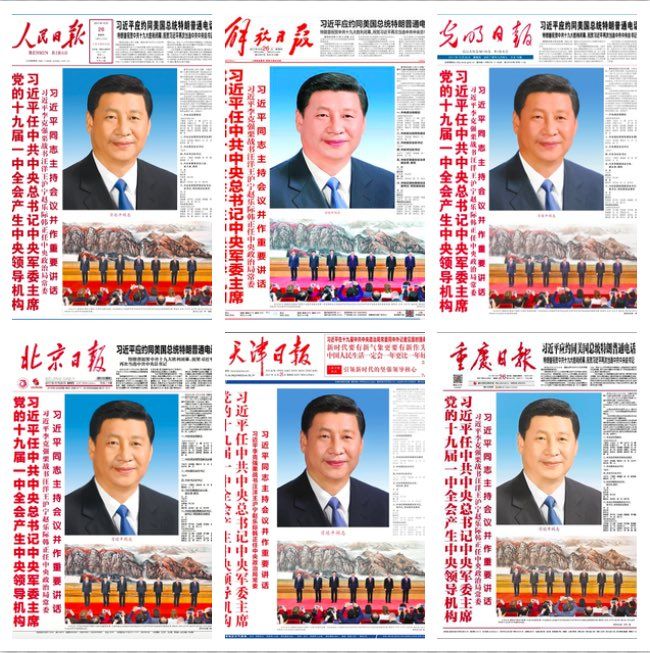
| Front-page of 6 different newspapers in China |
Here is the link...
At the end of the 19th Congress, most of the Western media have declared President Xi Jinping, the winner. He is the most powerful leader since Mao, say the China watchers. But is it true? A great difference between Mao and Xi is that the Great Helmsman controlled the Communist apparatus without intervening much in the day-to-day affairs.
He often travelled the countryside in luxurious trains for weeks, with just a few secretaries and several of his favourite ‘nurses’. He had no encrypted way of communicating with his colleagues (or ‘lackeys’ in Maoist parlance) in Beijing. He was not bothered. This is not the case of Xi Jinping who heads a large number of Leading Small Groups on many topics under the Middle Kingdom’s sky, but he is also General Secretary of the Communist Party of China, the President of the People’s Republic of China, the Chairman of the Central Military Commission and the Commander-in-Chief of the Joint Battle Command.
Xi has however undoubtedly emerged as the winner on several fronts in recent months. First and foremost, the 19th Congress approved an amendment to the Party Constitution enshrining Xi Jinping Thought on Socialism with Chinese Characteristics for a New Era.
Though the new Central Committee and Central Commission for Discipline Inspection are more or less along the expected lines, the Politburo and the Standing Committee brought some surprises. The new Politburo’s Standing Committee now comprises President Xi, Premier Li Keqiang, Li Zhanshu, Wang Yang, Wang Huning, Zhao Leji and Han Zheng.
The presence of Li Zhanshu, Xi’s chief of staff, who is to take over the chairmanship of the National People’s Congress, is a proof of Xi’s control over the appointments. Ditto for Wang Huning, the party theorist who will take the charge of ideology, propaganda and party organization, while Zhao Leji will replace Wang Qishan, as the new antigraft tsar. Wang Yang will take the seat of Yu Zhengsheng as chairman of the Chinese People’s Political Consultative Conference; as for Han Zheng, he will probably be drafted as Executive Vice-Premier in March.
But where are Xi’s presumed successors, Hu Chunhua and Chen Miner? Where is Wang Qishan, Xi’s right-hand man who, for five years, arrested the ‘tigers and the flies’? The absence in the Standing Committee of Chen Miner, the Party Secretary of Chongqing, who was expected to be anointed ‘heir apparent’ has been noticeable. Apparently Xi does not want a ‘successor’ as yet. Same for Hu Chunhua, Guangdong Party Secretary, who for several years was said to be a future new General Secretary.
Just before the Congress, the South China Morning Post (SCMP) which has been by far the bestinformed, noted: “Hu Chunhua ~ the widely tipped successor ~ and the president’s protégé, Chongqing party chief Chen Miner, are both likely to be missing from the Politburo Standing Committee. Instead, they will join the Politburo, which is one rank lower.” It is what happened. SCMP had good tips, despite the opacity of the party proceedings. The great surprise was that Wang Qishan, who is responsible for making thousands of party heads roll, has stepped down from the Standing Committee, due the age-limit norm.
It was confirmed when his name did not appear in the list of the new Central Committee members. Many ‘watchers’ were expecting Xi to break an unwritten retirement-age rule to keep his friend Wang in the Standing Committee. Two members of the powerful Central Military Commission (CMC) made it to the Politburo. Apart from Air Force General Xu Qiliang, presently CMC ViceChairman, General Zhang Youxia, a family friend of Xi, was selected as the second vicechairman.
Contrary to what many have written, Xi might not be all-powerful; he still has to deal with party norms and traditions: “He is careful not to break the age rule and to follow the order of seniority. These political norms are critical for the 89-million member Communist Party to have consensus at the top and maintain stability,” wrote the SCMP which also noted: “Xi is also not blindly following the established path.” Another sign that Xi may not have full control, is the reduced size of the CMC which has only 7 members (apart from the two Vice-Chairmen: Xu Qiliang, Zhang Youxia, others are Wei Fenghe, Li Zuocheng, Miao Hua, Zhang Shengmin) compared to 11 during the previous Congress. The day after the announcement of the new CMC, Xi met the PLA delegation and urged them to “follow the road maps set for it at the Congress.”
It is easier to agree on 7 than 11. Xi said socialism with Chinese characteristics has entered a new era, and the military should make all-out efforts to become a world-class force by 2050 while striving for the realization of the ‘great rejuvenation of the Chinese nation’. Xi ordered the PLA to be absolutely loyal to the party, to focus on how to win in wars, to pioneer reforms and innovation, to scientifically manage commanding a unit and to lead troops in accordance with the strictest standards. Strangely, there was no photo with the new CMC.
Another odd happening: General Song Puxuan, one of the rising star’s in the PLA and the newly appointed head of the CMC’s Logistics Support Department did not make it to the list of the Central Committee’ members. In 2014, Song was promoted to the rank of full general, taking the charge of the Northern Theatre Command, overseeing the defence of the capital and China’s border with North Korea. His failure to make it to the Central Committee is still unexplained. When the list of the delegates to the Congress was first released in July, many watchers thought that it would mark a new area for women, who made up 24.1 per cent of the 2,287 delegates. The official media pointed out that it reflected the efforts made by the party “to give women members a bigger say and improve gender equality and social stability.”
But Chinese women leaders are still practically excluded from the top of the hierarchy. Of the 204 members of the Central Committee, just 10 are women; the same figure as that for the 18th congress of 2012. And only one lady, Sun Chunlan made it in the Politburo. She will probably retain her job as Chief of the United Front Work Department.
That is disappointing. As for the ethnic minorities, they have got a slightly better deal in the Central Committee, with 16 members from ethnic origins compared to 10, five years ago. Incidentally, the Tibetans have four representatives who have been selected as members of the Central Committee (Lobsang Gyaltsen and Che Dalha) and Alternate members (Norbu Thondup and Yan Jinhai, a Tibetan from Qinghai); it is a first. Further, Wang Huning, the newly-appointed member of the Politburo’s Standing Committee will probably represent Tibet at the National People’s Congress in March. The question is why should a Han leader represent Tibet?
Han chauvinism will continue for some time more. In any case, Wang’s presence does not mean that life will become easier for the Tibetans or the Uyghurs. Chen Quanguo, the former Party Tibet Secretary presently posted in Xinjiang, has been rewarded with a seat in the Politburo for the repressive measures he introduced in the restive Muslim region.
What does all this mean for India? One will have to wait and see. As Deng Xiaoping liked to say, ‘Let us seek truth from facts’.
Monday, July 10, 2017
The Great Game over Arunachal
Implementation
In recent months, Beijing has been intensifying the implementation of this military doctrine.
It can be seen every day in the declarations of the Chinese spokespersons: even when on the wrong foot, China makes it sound that the other party is at fault ...by making more noise.
No contradictions
In this ‘Warfare’, there is no such a thing as ‘contradiction’.
Take an example, a couple of days ago, the Chinese embassy in New Delhi asked Chinese people in India to ‘strengthen self-protection’.
The Global Times commented on the “travel notice released amid a fermenting military standoff on the border;” it was referring to the standoff on the Sikkim-Tibet-Bhutan border.
According to the Chinese tabloid the advisory notice had to be issued because India trespassed on China’s territory.
Though the premise is untrue (see in my different postings on the subject), the Chinese embassy nevertheless released the notice on its website, urging "all Chinese citizens in India and those who are going to visit India to pay close attention to the local security situation and strengthen self-protection.”
It added: “Reduce unnecessary travel to India, and leave travel information with family members, colleagues and friends. Keep a low profile, and respect the local laws and law-enforcement personnel," it says.
Promoting Ziro
Now, you may think that the Chinese do not encourage its nationals to visit India.
Though it seems a contradiction with the Embassy's notice, an article published in July in the Chinese Travel Guide magazine promotes Ziro as a tourist destination.
But you may ask, why to ‘promote’ Ziro, headquarter of the Lower Subansiri of Arunachal Pradesh?
The answer is simple, for Beijing, Ziro is part of Southern Tibet and the local Apatanis are a Chinese tribe.
The 6 pages of the last issue of ‘Travel’ magazine describes in detail the ‘Chinese’ tribe, the Lhoba Apatanis.
In its introduction, the article explains that the Apatanis are ‘the most beautiful ethnic people’ …of China of course.
It says: “In the Tibetan area of Southern Tibet, there is a tribe named Apatani. The women of this tribe are known to be the most beautiful of all Tibetan tribes. But their beautiful appearance can also become a burden. In order to protect themselves from other tribal intruders’ attack, they make themselves less attractive, by plugging a big cork into the nose.
It continues: “…In the eyes of ordinary people, it can only be regarded as an alternative beauty, but for the Apatanis in Southern Tibet, this is considered as a protection to live a longer life. The choice to insert a cock in the nose of those beautiful compatriots was a helpless choice, but fortunately today, in the new society such a tragedy has been discarded, let us hope that it will not appear again.”
It further comments: “Other beautiful world women could say in the past, it is fortunate that I was not born in Apatani.”
The article describes the most important Apatani settlements “in the valleys of the southern mountainous region of Tibet, where 26,000 Apatanis live.”
China probably considers Ziro, though a part of Arunachal Pradesh, ‘a territory occupied by India’.
This article seems a further and determined step towards a more concretely claim for the entire Arunachal Pradesh.
This can be also be seen as part of the 'Three Warfares'.
Let us hope that Delhi notices.
One response could be to liberalize the antiquated Inner Line Permit/Protected Area Permit system.