Showing posts with label Central Military Commission. Show all posts

Tuesday, November 28, 2017

Chinese troops intrude in Ladakh: a coincidence?

Gen Zhang Yang in Ngari
Xinhua has just reported that General Zhang Yang, a former member of the Central Military Commission’s (CMC) and the boss of the CMC’s Political Work Department, committed suicide last week.
The South China Morning Post said that a source close to the former Guangzhou Military Command confirmed that Zhang hanged himself at his home in Beijing on the morning of November 23: “the news of his death had been relayed to all People’s Liberation Army theatre commands."
Later Xinhua confirmed the circumstances of his death.
Zhang was apparently linked to former disgraced CMC vice-chairmen Guo Boxiong and Xu Caihou who have been sentence for “serious disciplinary violations” in other words, corruption.

A couple of months back, I posted the following comments:

Yesterday while announcing the appointment of new PLA Army and Air Force Chiefs, Han Weiguo and Ding Laihang respectively, The Nikei in Tokyo pointed out:
[about] the rest of the 11-member Central Military Commission, Gen Fang Fenghui, Li's predecessor as head of the Joint Staff Department, and General Political Department chief Gen Zhang Yang were reportedly arrested in late August on suspicion of ‘disciplinary violations’. The allegations are believed to involve graft, though details have not been disclosed.
The Japanese newspaper added:
Though such arrests are extremely unusual, the two officers are not the only Central Military Commission members ensnared in Xi's anti-corruption campaign. Guo Boxiong and Xu Caihou, both loyal to former President Jiang Zemin, were previously ousted over bribery allegations. Fang and Zhang reportedly had close ties to Guo and Xu, respectively.
Reuters asserted that during his monthly news briefing, Defence Ministry spokesman Ren Guoqiang declined to comment on Fang, who turns 67 next year, usually around the age at which Chinese officials retire.
It is getting hot in Beijing.

I re-post here a piece posted in September 2015 about Gen Zhang Yang on the Indian border.

September 13, 2015
Was it a coincidence?
Just the day before the new stand-off between the Indian and Chinese defence forces in Ladakh started, a senior member of the Chinese Central Military Commission visited the region.
Let us look at the facts.
As it already happened before the visit of Premier Li Keqiang to India in April/May 2013 and also as President Xi Jinping arrived in Ahmedabad in September 2014, the Chinese People’s Liberation Army (PLA) intruded on India’s territory.
The face-off is currently happening in Burtse area, a few miles east of Daulat Beg Oldie (DBO), where the 2013 confrontation occurred.
According to The Times of India, “the bone of contention is a surveillance structure being erected by the PLA very close to the Line of Actual Control (LAC).”
The Indo-Tibetan Border Police apparently objected to the construction of the structure and, with the help of the Army, stopped the PLA.
Subsequently, the PLA called for reinforcements, followed by a massing of more Indian forces in the area.
The Times of India said: “The two forces are still locked in an eyeball-to-eyeball confrontation and efforts are being made to defuse the situation.”
General Zhang Yang 'inspects' a farm in Ngari

The Coincidence
On September 9 and 10, a member of the all-powerful Central Military Commission visited Ngari Prefecture, which borders Ladakh, in Western Tibet. General Zhang Yang was in Tibet to ‘celebrate’ the 50th anniversary of the creation of the Tibetan Autonomous Region.
At the end of the main function held in Lhasa, the ‘Central’ delegation divided itself into different groups. As mentioned in a previous post, Yu Zhengsheng went to Shigatse and visited the Tashilhunpo.
Vice-Premier Liu Yandong went to Shannan (Lhoka) Prefecture, while Jampa Phuntsok ‘inspected’ Nagchu. Another ‘sub-delegation’ led by Du Qinglin, Vice-chairman of the CPPCC, went to Nyingchi.
General Zhang Yang headed for a two-day tour of Ngari Prefecture. He went to convey the ‘loving care’ and the ‘deep feeling’ of the CPC Central Committee, the State Council, and the Military Commission to the ‘cadres and masses of all nationalities’.
Note that ‘of all nationalities’, just means ‘Tibetans’.

Like his colleagues, General Zhang brought along a banner carrying President Xi’s words, ‘Strengthen National Unity and Construct a Beautiful Tibet’.
Zhang was accompanied by Lt. Gen. Xu Yong, commander of the Tibet Military District.
Speaking at the main function in Lhasa, Lt Gen. Xu Yong had, a day earlier, declared that after 50 years of vicissitudes, with the region's rapid economic development and social progress, the living standards of the masses’ have markedly improved and social stability has overall been sustained: “During these 50 years in the same boat, the troops stationed in Tibet and police staff always depended on the Party's to write the bloody battles to defend Tibet, carve a new chapter the history of Tibet.”
What does General Xu refer to, when he speaks of ‘bloody battles’? It is not clear. The 1962 conflict with India?
Xu lavishly praised his boss, CMC's Chairman Xi: “All the troops stationed in Tibet and police officers must resolutely obey the Central Military Commission and Chairman Xi command; conscientiously implement the Sixth Tibet Work Forum’s spirit; vigorously carry forward the heritage of the ‘Old Tibet Spirit’ and faithfully fulfill our mission of responsibility,… and make new and greater contributions for the great prosperity of the motherland and border stability.”
Nothing new!
Also in the delegation, was Wang Yongjun of the Central Commission for Discipline Inspection (CCDI). A year ago, WantChinaTimes had reported that the CCDI’s boss, Wang Qishan had started ‘parachuting’ CCDI officials into key posts around China in order to strengthen the party's anti-graft campaign and bring new blood to certain regions.
In January, 2014, Wang Yongjun, formerly deputy dean of the China Discipline Inspection and Supervision Institute was transferred to head the Tibet regional branch of the dreaded (by the corrupts) CCDI.
The Political Commissar of the Tibet Armed Police Corps, Xiao Tang was also in attendance in Ngari.
Meeting the 'masses'
After the customary photo sessions with the ‘cadres and the masses’, (i.e. herders, farmers, toilers, etc.), the General who also heads the PLA’s Political Department, stressed “the need to thoroughly study and implement the spirit of the important speech Xi Jinping, in particular, his speech at the Sixth Work Forum and implement the good advices given by Yu Zhengsheng during the 50th anniversary function.”
He concluded, “seize the opportunity, work hard and continue to strive.”
This is the usual stuff.
But during his visit to Ngari, General Zhang Yang and his delegation “made a special trip to lay a wreath on the revolutionary martyrs’ cemetery.”
Which martyrs? 1962 again?
And perhaps more importantly, one line in the local press mentions that Zhang 'visited the troops'.
Was the 'political' general informed that the PLA was planning to build a structure in an area considered by India to be within her territory?
If Zhang was not informed, the PLA has a serious problem of command.
If he was informed, it is a serious issue for India.

PS: By the way, where was Lt. Gen. Peng Yong, the commander of the Xinjiang Military District, who looks after Ngari area?  Can a Yong (Xu) replace a Yong (Peng)?

Sunday, October 29, 2017

Is Mr Xi the winner?

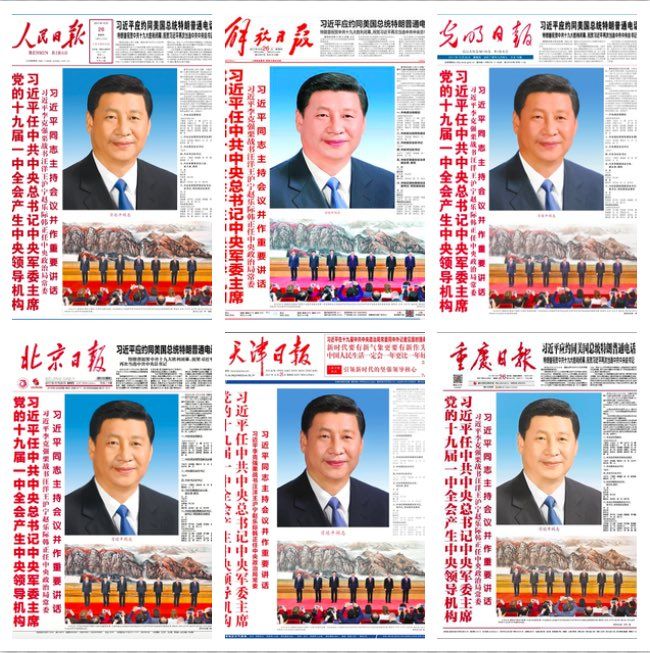
Front-page of 6 different newspapers in China
My article Is Mr Xi the winner? appeared in The Statesman.

Here is the link...

At the end of the 19th Congress, most of the Western media have declared President Xi Jinping, the winner. He is the most powerful leader since Mao, say the China watchers. But is it true? A great difference between Mao and Xi is that the Great Helmsman controlled the Communist apparatus without intervening much in the day-to-day affairs.
He often travelled the countryside in luxurious trains for weeks, with just a few secretaries and several of his favourite ‘nurses’. He had no encrypted way of communicating with his colleagues (or ‘lackeys’ in Maoist parlance) in Beijing. He was not bothered. This is not the case of Xi Jinping who heads a large number of Leading Small Groups on many topics under the Middle Kingdom’s sky, but he is also General Secretary of the Communist Party of China, the President of the People’s Republic of China, the Chairman of the Central Military Commission and the Commander-in-Chief of the Joint Battle Command.
Xi has however undoubtedly emerged as the winner on several fronts in recent months. First and foremost, the 19th Congress approved an amendment to the Party Constitution enshrining Xi Jinping Thought on Socialism with Chinese Characteristics for a New Era.
Though the new Central Committee and Central Commission for Discipline Inspection are more or less along the expected lines, the Politburo and the Standing Committee brought some surprises. The new Politburo’s Standing Committee now comprises President Xi, Premier Li Keqiang, Li Zhanshu, Wang Yang, Wang Huning, Zhao Leji and Han Zheng.
The presence of Li Zhanshu, Xi’s chief of staff, who is to take over the chairmanship of the National People’s Congress, is a proof of Xi’s control over the appointments. Ditto for Wang Huning, the party theorist who will take the charge of ideology, propaganda and party organization, while Zhao Leji will replace Wang Qishan, as the new antigraft tsar. Wang Yang will take the seat of Yu Zhengsheng as chairman of the Chinese People’s Political Consultative Conference; as for Han Zheng, he will probably be drafted as Executive Vice-Premier in March.
But where are Xi’s presumed successors, Hu Chunhua and Chen Miner? Where is Wang Qishan, Xi’s right-hand man who, for five years, arrested the ‘tigers and the flies’? The absence in the Standing Committee of Chen Miner, the Party Secretary of Chongqing, who was expected to be anointed ‘heir apparent’ has been noticeable. Apparently Xi does not want a ‘successor’ as yet. Same for Hu Chunhua, Guangdong Party Secretary, who for several years was said to be a future new General Secretary.
Just before the Congress, the South China Morning Post (SCMP) which has been by far the bestinformed, noted: “Hu Chunhua ~ the widely tipped successor ~ and the president’s protégé, Chongqing party chief Chen Miner, are both likely to be missing from the Politburo Standing Committee. Instead, they will join the Politburo, which is one rank lower.” It is what happened. SCMP had good tips, despite the opacity of the party proceedings. The great surprise was that Wang Qishan, who is responsible for making thousands of party heads roll, has stepped down from the Standing Committee, due the age-limit norm.
It was confirmed when his name did not appear in the list of the new Central Committee members. Many ‘watchers’ were expecting Xi to break an unwritten retirement-age rule to keep his friend Wang in the Standing Committee. Two members of the powerful Central Military Commission (CMC) made it to the Politburo. Apart from Air Force General Xu Qiliang, presently CMC ViceChairman, General Zhang Youxia, a family friend of Xi, was selected as the second vicechairman.
Contrary to what many have written, Xi might not be all-powerful; he still has to deal with party norms and traditions: “He is careful not to break the age rule and to follow the order of seniority. These political norms are critical for the 89-million member Communist Party to have consensus at the top and maintain stability,” wrote the SCMP which also noted: “Xi is also not blindly following the established path.” Another sign that Xi may not have full control, is the reduced size of the CMC which has only 7 members (apart from the two Vice-Chairmen: Xu Qiliang, Zhang Youxia, others are Wei Fenghe, Li Zuocheng, Miao Hua, Zhang Shengmin) compared to 11 during the previous Congress. The day after the announcement of the new CMC, Xi met the PLA delegation and urged them to “follow the road maps set for it at the Congress.”
It is easier to agree on 7 than 11. Xi said socialism with Chinese characteristics has entered a new era, and the military should make all-out efforts to become a world-class force by 2050 while striving for the realization of the ‘great rejuvenation of the Chinese nation’. Xi ordered the PLA to be absolutely loyal to the party, to focus on how to win in wars, to pioneer reforms and innovation, to scientifically manage commanding a unit and to lead troops in accordance with the strictest standards. Strangely, there was no photo with the new CMC.
Another odd happening: General Song Puxuan, one of the rising star’s in the PLA and the newly appointed head of the CMC’s Logistics Support Department did not make it to the list of the Central Committee’ members. In 2014, Song was promoted to the rank of full general, taking the charge of the Northern Theatre Command, overseeing the defence of the capital and China’s border with North Korea. His failure to make it to the Central Committee is still unexplained. When the list of the delegates to the Congress was first released in July, many watchers thought that it would mark a new area for women, who made up 24.1 per cent of the 2,287 delegates. The official media pointed out that it reflected the efforts made by the party “to give women members a bigger say and improve gender equality and social stability.”
But Chinese women leaders are still practically excluded from the top of the hierarchy. Of the 204 members of the Central Committee, just 10 are women; the same figure as that for the 18th congress of 2012. And only one lady, Sun Chunlan made it in the Politburo. She will probably retain her job as Chief of the United Front Work Department.
That is disappointing. As for the ethnic minorities, they have got a slightly better deal in the Central Committee, with 16 members from ethnic origins compared to 10, five years ago. Incidentally, the Tibetans have four representatives who have been selected as members of the Central Committee (Lobsang Gyaltsen and Che Dalha) and Alternate members (Norbu Thondup and Yan Jinhai, a Tibetan from Qinghai); it is a first. Further, Wang Huning, the newly-appointed member of the Politburo’s Standing Committee will probably represent Tibet at the National People’s Congress in March. The question is why should a Han leader represent Tibet?
Han chauvinism will continue for some time more. In any case, Wang’s presence does not mean that life will become easier for the Tibetans or the Uyghurs. Chen Quanguo, the former Party Tibet Secretary presently posted in Xinjiang, has been rewarded with a seat in the Politburo for the repressive measures he introduced in the restive Muslim region.
What does all this mean for India? One will have to wait and see. As Deng Xiaoping liked to say, ‘Let us seek truth from facts’.

Tuesday, February 2, 2016

Gen Zhao Zongqi lands on the plateau

Gen Zhao Zongqi, the new Western Theater Commander
receives the flag from Chairman Xi Jinping

According to China Military Online, President Xi Jinping, Chairman of the Central Military Commission (CMC) yesterday presided  over a ceremony to unveil five new Military Theater Commands (MTCs).
“The five MTCs are named by their strategic location in north, south, east, west and central China, replacing the current seven Military Area Commands (MAC) headquartered in Beijing, Nanjing, Chengdu, Jinan, Shenyang, Lanzhou and Guangzhou”, says the Chinese website.
The purpose of this major reform is to restructure the People's Liberation Army's (PLA) to better manage the armed forces and boost their combat capabilities.
According to The PLA Daily, Chairman Xi told the new commanders and political commissars that the MTCs should “shoulder the responsibilities of responding to security threats, safeguarding peace, [and work on] war containment [and be able to win] wars in each strategic direction.”
China had already unveiled the military reform blueprint in November 2015 with the formation of a three-tier command system (CMC - MTC – Troops): "an administrative system running  from the CMC, through various services down to the troops has been developed.”
Of course, Xi urged the new MTC’s commanders to “unwaveringly follow the leadership of the CPC and faithfully carry out instructions and orders from the CPC Central Committee (CC) and the CMC.”
He also asked them to study how to win modern wars, by using efficient joint theater command management.
Xi presented the flags of the new MTCs to the new Commanders: General Liu Yuejun, Commander of the Eastern Theater and General Zheng Weiping, the Political Commissar; General Wang Jiaocheng, Commander of the Southern Theater and General Wei Liang, the Political Commissar; General Zhao Zongqi, Commander of the Western Theater and and General Zhu Fuxi, the Political Commissar; General Song Puxuan, Commander of the Northern Theater and General Chu Yimin, the Political Commissar; and Lt Gen Han Weiguo, Commander of the Central Theater and Lt Gen Yin Fanglong, the Political Commissar.
According to the same source, Xi called on the MTC’s commanders “to keep their duties in mind and resolutely implement the country's military strategies.”
In the new structure, the CMC will look after the overall military administration, while the MTCs will focus on combat.
Xi said that the move to establish five theater commands and form a joint battle command system is a Party’s strategic decision in view of realizing the Chinese dream of a strong military: “It is a landmark progress in implementing the military reforms and building the PLA's joint battle system.”
Xi added that “the five theater commands are responsible for dealing with security threats in their respective strategic scopes, maintaining peace, containing wars and winning wars”.
He noted that the pivotal role of the commands “in safeguarding the country's overall national security and military strategies.”
Xi also said that the new commands should concentrate on fighting battles.
The commanders were asked “to study the mechanism of winning modern wars, grasp the law of employing military forces, speed up the development of a strategy for the theater commands and enhance the training of joint operations and command in order to win the initiative in future wars.”
The new commands “should be prepared to fight at any time and always be ready to act in response to the call of the people and the Party.”
Xinhua News Agency commented that, under the CMC's leadership, the MTCs should focus on engagement, while the PLA army, navy and air force will concentrate on developing their respective forces.
Fang Bing, a professor at the PLA National Defense University told The Global Times, the Party’s mouthpiece that more senior officers from the navy and air force will be assigned in the future as top leaders of the theater commands.
The Global Times also reported that though official details have not as yet been revealed about the exact areas covered by each theater command, analysts believe that the new commands are likely address the new challenges faced by China as a growing world power.
According to Song, a Beijing-based military expert, the Western MTC will have to shoulder more responsibilities in counterterrorism (read separatism in Xinjiang and Tibet), while the eastern and southern commands will face more threats from the East and South China Seas - each requiring a different style of joint battle command:
The different strategic locations will require an adjustment of different PLA forces inside each theater command. The PLA army, which formerly had a larger proportion in the previous military area commands, is likely to see a reduced proportion, while other forces - including the navy, air force and the rocket force - will see a bigger role.
All this will take time and is bound to create frictions within the PLA.
Chinese defense ministry spokesperson, Yang Yujun asserted that the establishment of the MTCs marks a historic progress in the PLA construction of a joint battle command system: “The PLA has also adjusted its different forces under the theater commands based on the functions of the PLA navy and air force, as well as previous military area commands.”
The spokesperson added that the new arrangement is in line with the practices of the world's leading military powers:
The previous mechanism with seven military commands was set up when China was under heavy military pressure from the north, but the nation's security environment has changed over the decades, hence requiring a re-drawing of area commands addressing different strategic locations.
Though it was denied that China's military reform meant more muscle-flexing, the future only will tell us if this is true.
The spokesman reiterated that China's defense policy is defensive in nature and its military strategy features active defense: “The Chinese military intends to seek more military cooperation and make greater contribution to safeguarding world peace.”
The South China Morning Post (SCMP) commented that commanders with battle experience have been posted in areas with ‘high risk of war’, though the selections for the central command reflect concerns about 'maintaining stability'.
In fact, this is also true for the Western MTC, which not only faces India, but also is responsible for the ‘instability’ in Xinjiang and Tibet.
While the new commanders and political commissars will look after the territorial defence of those areas, "they will no longer directly administer the troops in each region, but focus instead on joint command of the ground, naval, air and all other forces", added the Hong Kong newspaper.
The Commanders have also been reshuffled regionwise, for example, former Lanzhou MR’s chief, General Liu Yuejun has been transferred as the head of the Eastern MTC, while General Wang Jiaocheng goes from Shenyang MR to the Southern MTC and Jinan region commander General Zhao Zongqi becomes head of the Western MTC (General Zhao however served in Tibet for many years, as reported on this blog); and former Beijing region commander General Song Puxuan becomes head of the Northern MTC.
Retired colonel Yue Gang told the SCMP that it was making a big change and the leadership had to be cautious.
There is no doubt that the battle is not won for Chairman Xi, who will continue to take ‘cautious’ steps.
One indication is that several political commissars (of Nanjing, Guangzhou, Chengdu and Shenyang) have been kept and reposted as the commissars of the new commands.
The South China Morning Post points that the exception is the Central MTC, where Lt Gen Han Weiguo has been promoted Commander (he is not a full general or even a member of the Central Committee), and Lt Gen Yin Fanglong, former deputy chief of the General Political Department is the new commissar (he too is a Lt Gen, though a CC’s Alternate Member).
Col Yue commented: “Commanders with battle experience have been put in areas with a high risk of war but the selections for the central command reflect more concern about maintaining stability.”
It is only the beginning of a long process.
India should watch carefully, especially now that the entire northern border will be dealt by one command only; it will certainly improve its efficiency. Further General Zhao Zongqi, the new Western MTC’s Commander has a good knowledge of the situation on the Tibetan plateau, having been posted in Tibet for several years.


Theater Command Commander Commissar
North Song Puxuan Chu Yimin
South Wang Jiaocheng Wei Liang 
East Liu Yuejun Zheng Weiping 
West Zhao Zongqi Zhu Fuxi 
Central Han Weiguo Yin Fanglong 

Interestingly, on the day of the announcement of the new MTCs, a series of photos of J-11 fighter planes operating on the plateau were published. These planes will now be under the direct command of Gen Zhao Zonhqi.

Tuesday, January 12, 2016

General Zhao Zongqi: from Tibet to the CMC

Chairman Xi meets the old CMC and new commanders
Yesterday, President Xi Jinping announced the reorganization of the four PLA military headquarters or departments - staff, political, logistics and armaments - into 15 new agencies which will directly work under the Central Military Commission (CMC).
Xi Jinping, who also CMC Chairman, met the new bosses of each unit.
He described the reshuffle as ‘a breakthrough’ and ‘a crucial step’ toward a stronger military.
Xi added that all the military leaders should adhere to the Party spirit, obey political discipline, and be politically intelligent (sic)!
Xi urged the new leaders to ‘frequently, actively and resolutely’ align their direction with the CPC Central Committee and the CMC.
As mentioned earlier on this blog, the seven Military Area Commands are being replaced by five Combat Zones, primarily focusing on 'combat'.
The new Western Combat Zone will replace the two Military Area Commands today facing India in the High Himalaya (Chengdu and Lanzhou).
According to The South China Morning Post, General Zhao Zongqi will command the Western Combat Zone.
I re-posting an old piece on General Zhao.
That was a good prediction.
General Zhao should automatically become member of the CMC.
Here are the 15 New Units of the CMC
  1. General Office
  2. Joint General Staff
  3. Political Work Department
  4. Logistical Support Department
  5. Equipment Development Department
  6. Training Management Department
  7. Military Defense Mobilization Department
  8. Discipline Inspection Commission
  9. Politics and Law Commission
  10. Science and Technology  Commission
  11. Strategic Planning Office
  12. Reform and Establishment Office
  13. International Military Cooperation Office
  14. Auditing Administration Office
  15. Administration Affairs Management Office

General Zhao Zhongqi
General Zhao Zongqi: from Tibet to the CMC?
July 24, 2015
A couple of years ago, I wrote a piece The Chinese who matter in Tibetan Affairs. Since then, several officials who ‘mattered’ have lost their job or have disappeared from the Chinese political scene.
The prime case is of course Ling Jihua, who from 2007 to 2012 served under President Hu Jintao, as Director of the General Office of the CPC Central Committee and in 2012, became Head of the United Front Work Department, dealing with Tibet among other subjects.
His son's car accident (with two Tibetan girls) signaled the beginning of his downfall.
Jia is now investigated for six violations of law and Communist Party discipline, including taking bribes, adultery and illegally acquiring a large number of ‘core secrets’ of the State and Party. It is what a Politburo statement, relayed by Xinhua, said.
The South China Morning Post rightly says: “The accusation that Ling illegally obtained the secrets surprised some observers, who said he was supposedly entitled to access to the information”.
This is one of the mysteries of Chinese politics.
Another Chinese who matters(ed) is/was General Wang Jianping, a member of the 18th CCP Central Committee. In 2009, he became Commander of the Chinese People's Armed Police Force with a bigger budget than the PLA.
His name has often been mentioned on this blog. (A good chess player takes the initiative?)
Apparently, in January 2015 Wang was ‘transferred’ as deputy head of a coordinating group on military training; it is obviously a great fall.
Interestingly on July 17, The Hong Kang Oriental Daily published an article on the military leadership changes in China. It was titled, “Three Phenomenon at the Center of Army Restructuring.”
It was later republished in the Mainland under a different title, “Xi Jinping’s Big Move: Jiang Zemin’s Closest Army Allies Are No longer in Power.”
The article says that Xi has assigned several senior military generals to insignificant positions: "Over the last six months, those in the most important leadership positions in the armed forces have all been replaced. Those officials who were close to Xi were promoted."
Wang Jianping is one clearly one of those who lost their seat.
Another powerful figure who has disappeared from my list is Lieutenant General Yang Jinshan. In October 2014, I wrote about The Fall of a Powerful General.
After serving as Commander of the Tibet Military Area, in June 2013, General Yang was transferred (on promotion) to Chengdu as a Deputy Commander of the Chengdu Military Region. He was one of the rising stars in the PLA
His fall is probably related to Xu Caihou’s case.
He was even demoted from the Party's Central Committee.
And there is also the case of Le Dake, the head of External Intelligence in Tibet. A few weeks ago, Reuters had reported that the former top Chinese security official in Tibet was being investigated ‘for suspected graft’.
The news agency explained that it is “a rare example of corruption busters going into the restive and remote region.”

The new rising star: General Zhao Zongqi
While some officials have sunk into oblivion, some are rising very fast.
It is the case of the Jinan Military Region’s Commander, Lieutenant General Zhao Zongqi, who, earlier in his career spent 20 years in Tibetan Military District.
Recently, General Zhao went on an inspection trip with General Fan Changlong.  
The South China Morning Post reported: “A top leader from the Jinan military area command accompanied Fan Changlong, vice-chairman of the powerful Central Military Commission, on an inspection trip to the northwest, raising speculation over a personnel reshuffle.”
According to The PLA Daily, Lieutenant General Zhao Zongqi accompanied Fan to inspect garrisons in Gansu, Xinjiang and Ningxia.
The article says that “Zhao, 60, is the youngest commander among top leaders from the key military areas. He is also one of a handful of senior military officials who took part in China's border conflicts with Vietnam in the late 1970s.”
His long stint in Tibet is not mentioned.
However, the Chinese press parried: “The pairing of the two [Fan and Zhao] on the trip fueled speculation over whether Zhao would be promoted to even higher rank.”
'Higher rank' can only mean 'Central Military Commission'.
Last year, I mentioned on this blog a high level tour of General Fan Changlong in Tibet. He was then accompanied by three Military Region Commanders (Lt. Gen. Liu Yuejun, commander of the Lanzhou Military Region, General Li Shiming, Commander, Chengdu Military Region and Lt. Gen. Zhao Zongqi, Commander, Jinan Military Region).
I then wondered what was the Jinan MR Commander was doing there.
This was soon after the Chumur incident in Ladakh during the visit of President Xi Jinping in India.
I then wrote: “The main purpose of General Fan's Tibet tour was most likely to convince the PLA officers that they should follow Xi Jinping in his crusade against corrupt officers.”
At that time, Xinhua reported that General Fan told the army to firmly obey the command of President Xi Jinping and the Communist Party of China (CPC) Central Committee.
China's senior-most general told the troops that “the army and the armed police should resolutely implement the strategies made by the CPC Central Committee and Xi, also the CMC Chairman, and uphold the correct decisions to investigate Zhou Yongkang and punish Xu Caihou.”
To follow the orders of Chairman Xi was important, said Fan; the defence forces should implement the instructions by achieving ‘Four [questions] to Ask’.
One of the ‘Four to Ask’ was “To ask oneself whether one follows the correct guiding ideology in training, whether the practices followed are correct to [avoid] other negative phenomena [i.e. corruption?]”.
Apparently General Zhao got it right; he probably answered the question the correct way.
As the result, he may soon be the first Chinese ‘Tibet hand’ reaching the PLA’s Heaven (the Central Military Commission).

Thursday, December 31, 2015

The Fate of PLA Generals

General Li Zuocheng, new Chief of the Land Force Command
Fate is strange.
It is especially true in Communist China.
Two years ago, Lt Gen Yang Jinshan, a former Commander of the Tibet Military District of the Chengdu Military Region (MR) was a rising star in the PLA and the CPC.
He had been promoted as a member of the Party's Central Committee, which was not the case of his direct boss, General Li Zuocheng, the commander of the Chengdu Military Region.
Yang was therefore 'senior' to his boss, Li Zuocheng, in the Party hierarchy.
Today, Yang Jinshan is languishing jail, being 'investigated' and his boss Gen Li Zuocheng is tipped to become the first chief of a newly-formed land force command.
What a reversal of fate!
Li was born in Anhua, Hunan province. He joined the PLA in 1970. Li was named a 'War Hero' for his actions during the Sino-Vietnamese War as a company commander in 1979. He was also the Commander of the 41st Army in the relief effort in the 1998 great Yangtze flood. Li was promoted to deputy Chief of Staff of the Guangzhou Military Region in 2002, and moved to Chengdu in 2007 as deputy Commander. In 2013, he took the Command of the Chengdu MR and became full general in July 2015.

Lt Gen Yang Jinshan
That was a year ago...
I reproduce here what I wrote about Lt Gen Yang Jinshan  a year ago

It is the end of the road for Lt Gen Yang Jinshan, a former Commander of the Tibet Military District of the Chengdu Military Region (MR).
He lost his membership of the Central Committee of the CCP.
Lt Gen Yang Jinshan (Han nationality) is born in August 1954. He joined the Communist Party of China in May 1972. In December 2005, he was promoted to the rank of major general and in July 2011, he became a lieutenant general.
From 2007 to 2009, he served as the Head of Armament Department of Chengdu MR.
In 2009, he became Commander of Tibet Military District.
In November 2012, he was elected as Member of 18th CPC's powerful Central Committee.
Lt Gen Yang Jinshan had an Air Force background; this may explain the repeated 'air exercises' in the Tibet District, facing Arunachal Pradesh and Sikkim  during the last few years.
In June 2013, General Yang was transferred to Chengdu as a Deputy Commander of the Chengdu MR.
Yesterday, he was formally expelled from the Central Committee of the Communist Party of China 'for serious disciplinary violations'.

Lt Gen Yang, as one of 41 members of the PLA in the Central Committee, was 'senior' in the Party to his direct boss, Lt Gen Li Zuocheng, the Commander of Chengdu MR.
In July 2014, The South China Morning Post (SCMP) had reported "One of the top PLA officers leading the Chengdu military area command has been detained amid graft allegations making him the latest high-ranking officer to fall in a sweeping effort to clean up the image of the world's largest fighting force."
The Hong Kong newspaper quoting four different sources said: "Investigators took Yang Jinshan, a lieutenant general, to Beijing last week as part of a corruption investigation. His family members and secretary were also detained."
Apparently, the arrest of General Yang, 59 was part of the wider inquiry into Xu Caihou, the former Central Military Commission (CMC) vice-chairman.
Xu has been accused of accepting very large bribes.
In June, Xu was himself expelled from the Communist Party. Yang has now walked into his mentor's steps.
Further, Yang was probably connected with the disgraced Politburo leader, Bo Xilai, as Yang served in the 14th Group Army, based in Kunming, Yunnan province (under the Chengdu MR). One of the founders of the Group Army was Bo Yibo , Bo Xilai's father.
The SCMP suspects: "Bo Xilai visited Yunnan not long after his right-hand man Wang Lijun sought refuge in the US consulate in Chengdu in February 2012. Since that visit, some of the senior officers of the corps have been replaced, prompting speculation about whether the reshuffle was linked to Bo."
Again according to the SCMP: "Two PLA major generals with backgrounds that overlap Yang's were detained previously". It names Ye Wanyong , retired commissar of the Sichuan provincial military area, and Wei Jin, a deputy commissar of the Tibet military area."
Ye would have offered large amount of gold to Xu Caihou.

Acute Ideological Struggle
In the meantime, the Central Military Commission (CMC) warned that ideological struggles within the PLA were 'acute and complicated', and called for the military to remain loyal to the Party's leadership.
According to The Global Times, the CMC published an article in The PLA Daily which says that the PLA should be run according to rules and regulations of the Party.
It was the main theme of the Fourth Plenum of the Central Committee of the 18th National Congress, which focused on strengthening the nation's governance through the rule of law.
The Global Times asserts: "Military reform has entered 'uncharted waters' with concerns growing that reform could be impeded by 'structural problems'."
The CMC admits that among the problems facing the army, "the struggle over ideology has been exceptionally acute and complicated."
Apparently, "different ideologies and new ideas that have emerged in Chinese society have penetrated the military, and will have a disruptive impact", says the CMC.
It quotes Maj. Gen. Luo Yuan: "There have been some public intellectuals advocating the nationalization of the army through disaffiliating it from the Party's leadership."
Xu Guangyu, another military expert and senior consultant at the Chinese Military Disarmament Control Council explained that "some young military leaders may have been influenced by these ideas, and warned that they could cause a split within the army."
The CMC asked the PLA to be 'steadfast in their actions' and submit to the Party's authority and to the CMC.
It clearly means that they not always do.
Quite worrying!
Probably new Chumar episodes in the pipeline!

Friday, December 4, 2015

Reforms in the PLA

From 7 to 4 Military Regions
According to the new reforms recently announced by President Xi Jinping, the People’s Liberation Army (PLA) should soon be out of business.
Under the new rules, ‘PLA Inc’ will stop its song and dance, hospitals and other profit-making activities.
Will this help solving the problem of deep-corruption within the Chinese defence forces, is another question.
It is indeed a fact that the PLA, which once upon the time was a Peasants’ Army, has become corrupt, very corrupt and incompetent.
The South China Morning Post commented: “For decades, the PLA has profited from accepting civilian patients at military hospitals, leasing military warehouses to commercial firms, hiring PLA song and dance troupes for public events, outsourcing military construction companies, and opening military academies and institutions to public students.”
Yang Yujun, the Ministry of National Defense’s spokesman told a press briefing: “Bringing a full end to the PLA’s paid services to external parties will purify the military ethos and maintain the nature and the true colour of the people’s army.”
As the Hong Kong daily explains: “The PLA was extensively involved in economic affairs until the late 1990s, when the central leadership realised that the army’s profit-seeking operations had resulted in PLA top brass abusing their special privileges and power by promoting their business interests.” It cites the case of senior naval officers sending warships abroad to smuggle home appliances and cars.
This may change. For the defence forces which represent the most traditional segment of the Chinese society, the new catchword is ‘reforms’.
Beijing seems decided to shake up the PLA’s different branches by establishing a joint operational command structure by 2020 and reducing the existing Military Areas Commands (MACs) from 7 to 4.
In a long speech carried by Xinhua, the Chinese President gave a rather detailed report on the planned reforms. He also reiterated his September pledge to cut by 300,000, the number of the ground forces.
Xi asserted: "Under the leadership of the Communist Party, our military has gone from small to big, from weak to strong, from victory to victory. On this road, reform and innovation steps have never stopped."
Reuters commented: “The troop cuts are part of long-mooted reforms to simplify and further professionalize the military, especially command and leadership structures that are still largely run along Soviet lines.”
What is the objective of this exercise apart from cutting corruption rampant in each Department?
The declared purpose of the exercise is to have, by 2020, a military setup ‘capable of winning information-age warfare’.
It is clear that ‘efficiency’ is the new mantra.
According to Yang Yujun: “The reform plan will focus on the improvement of the leadership and management system, restructuring of CMC’s departments by function reallocation; [and setting up] a joint operational command organization and system to coordinate battle zone commands.”
It is obvious that if China wants to pick up a fight with the United States or Japan or even with its smaller neighbours, its armed forces need to be ready. Today, they are not.
Yang said the streamlining and downsizing of the military will start from the CMC. By focusing on major functions and merging similar functions, the multiple-department CMC should become more efficient to supervise and coordinate the defence forces.
The ratio between the Army, Navy, Air Force and strategic forces (known as Second Artillery Force) will need to be rebalanced to take care of “the increasingly complicated global situation faced by the world's largest rising power,” said The Global Times.
Major General Xu Guangyu, a senior consultant of the China Arms Control and Disarmament Association told the Party’s mouthpiece “Establishing a joint operational command system …coupled with the setting up of battle zone commands, could enable the military to conduct operations more efficiently.”
Again, ‘efficiency’!
General Xu further explained: “The joint operational command system will empower battle zone commands, which focus on operations, to deploy troops of all services and arms.”
Rear Admiral Yang Yi of the PLA navy, told the same publication that the reforms will help “training troops of all services in coordination from the very beginning, to ensure that they can work together closely in combat.”
Apparently, a large number of staff will be out of jobs, mainly in the Political Department. How will the retirees take this?
The Ministry of National Defence spokesman explained that “veterans are valuable to the Party and country, as they have completed strict training and important tasks, and will be granted special job placement policies upon transfer or retirement.” Easier said than done!
It was also announced that a new branch of the Central Commission for Discipline Inspection (CCDI) will be setup within the CMC. All officers may not welcome this. Already on November 18, before the ‘reforms’ were announced, The Trend Magazine, published in Hong Kong mentioned a gunshot fight between a military law enforcement team and some corrupt officers of the Shanxi Military Region.
The General Staff and the General Political Departments had sent a Joint Military Inspection and Law Enforcement Team to the Region’s Entertainment Club. During the unexpected visit, the inspectors ordered some officers ‘having-good-time’ to show their IDs. The officers resisted and started to threaten the law enforcement staff, who had to fire warning shots. After it failed to scare the corrupt officers, the law enforcement team tried to arrest an officer, who was inciting the others. At that point in time, some of the corrupt officers attacked the inspectors with gunshots.
This shows that Xi’s task is not going to be easy.

What do these reforms mean for India?
First and foremost, corrupt and untrained Chinese defence forces will be fitter and better prepared for any eventuality, including a conflict with India.
Further, the Indian border will probably come under one MAC instead of two as today; it will greatly improve the efficiency of the Chinese ‘border’ forces.
When General Zhang Yang, a member of the CMC visited Ngari (Western Tibet) after ‘celebrating’ the 50th anniversary of the Tibetan Autonomous Region in early September, he was accompanied by Lt Gen Xu Yong, Commander of the Tibet Military District. It was particularly surprising as Ngari falls under the jurisdiction of the Lanzhou MAC, while General Xu is posted in the Chengdu MAC. Why was Xu in Ngari?
It probably means that the reorganization of the MACs has already started.
Militarily, it makes sense for China; it also implies that India has 5 years to be ready (with the new Mountain Strike Corps for example).

Another sign of the forthcoming changes
A few days later, Yu Zhengsheng, a member of the Politburo’s Standing Committee (No 4 in the Party) attended the commemoration of the 60th anniversary of the founding of the Xinjiang Uyghur Autonomous Region. Accompanied by General Zhao Keshi, head of PLA's General Logistics Department, Yu visited the troops posted in the restive region.
Yu spoke of a 'protracted war' against terrorism. Reuters, quoting The PLA Daily, noted that the PLA in Xinjiang are at the ‘centre of the storm’ when it comes to fighting militants and separatists: “Their job is more than just fighting,” said the article, “pointing to the thousands of activities they have arranged in the last five years going into villages to ‘explain the party’s ethnic and religious policies ... and refute rumours.”
This could be one more reason why Beijing is thinking of bringing the entire Tibet and Xinjiang under the same MAC. It is however a fact that operational integration of complex and disparate systems across the command structure will be a major challenge.
In the past, regional level military commanders have enjoyed warlord-like status over their respective military region, making it difficult to exercise a centralized control which is today necessary …to win a war. This may change.
In any case, the ‘reforms’, even if they face difficulties, are a clear message to China’s neighbours: get ready!

Monday, August 3, 2015

PLA: on the right side at the right moment

CMC members in front, 10 new generals at the back.
On August 17, 2013, Xinhua reported that General Fan Changlong, a member of Communist Party’s Politburo and Senior Vice Chairman of the Central Military Commission (CMC) visited Tibet and Qinghai to inspect the forces “stationed on the snow-covered plateau, the loyal soldiers defending the frontiers”.
Interestingly, General Fan was accompanied by three Military Region Commanders (Lt. Gen. Liu Yuejun, commander of the Lanzhou Military Region, Lt. Gen.Zhao Zongqi, Commander, Jinan Military Region and General Li Shiming, Commander, Chengdu Military Region).
Though he had spend some 20 years in Tibetan Military District, why Lt. Gen. Zhao Zongqi was around was not clear at that time.
The main purpose of general Fan's Tibet tour was to convince the PLA officers that they should follow Xi Jinping in his crusade against corrupt officers.
Xinhua reported that General Fan told the army to firmly obey the command of President Xi Jinping and the Communist Party of China (CPC) Central Committee.
China's senior-most general told the troops that “the army and the armed police should resolutely implement the strategies made by the CPC Central Committee and Xi, also the CMC Chairman, and uphold the correct decisions to investigate Zhou Yongkang and punish Xu Caihou.”
Was it a coincidence, but yesterday the Central Military Commission (CMC) promoted 10 generals of the People's Liberation Army (PLA) and the Armed Police Force (APF) to the rank of full general.
The three generals who visited Tibet with General Fan in August 2013, have got one more star.
Lt Gens Liu Yuejun, Zhao Zongqi and Li Zuocheng, respectively commanders of Beijing, Lanzhou, Jinan and Chengdu Military Area Commands, are now full generals. The next stage will be the membership of the CMC.
Moral of the story: it is always good to denounce the 'corrupts' and side with the 'boss', especially on a visit to the Roof of the World.
To 'please the boss' tactic is not new.
The South China Morning Post reported that Guo Boxiong, the former vice-chairman of China's Central Military Commission, who now faces investigation for taking bribes "courted favour with ex-president Jiang Zemin to become one of the leaders of the country’s military."
The Hong Kong paper says: "Guo Boxiong, the alleged leader of the 'Northwest faction' [Lanzhou] in the military, secured a powerful future by becoming the first general to publicly declare his loyalty to Jiang Zemin during the early stages of his presidency," adding: "The relationship served both men well – Guo allegedly used his position to spin a network of personal businesses while Jiang secured the allegiance of a proxy within the circle of top generals, allowing him to wield power even after he left office.."

Saturday, April 18, 2015

China’s missing Generals

My article China’s missing Generals appeared in NitiCentral.

Here is the link...

Where have all the generals gone, long time passing?
The CCDI have picked them everyone.
Oh, when will they ever learn?


No, in his grave, Pete Seeger, the American pacifist folk singer could not know that the Central Commission for Discipline Inspection (CCDI) has in the past months decimated the ranks of the Chinese generals of the People’s Liberation Army.
But the question is valid: will they ever learn?
In March, a few days before the opening of the Two Meetings (The National People’s Congress and the Chinese People's Political Consultative Conference), a second group of 14 Chinese generals was placed under ‘investigation’ by the CCDI.
The South China Morning Post (SCMP) reported: “The most prominent of the officers is Guo Zhenggang, former deputy political commissar of the Zhejiang Military Area Command (MAC), who was promoted to major general in January.”
Incidentally, Guo is the son of a former Central Military Commission (CMC) vice-chairman Guo Boxiong (the 2 vice-chairmen are the higest uniformed officials in China, senior to the defense minister).
Already in January, 16 senior PLA officials of the rank of major general and above had been similarly ‘investigated’. They were all charged with having ‘violated Party discipline and laws’; in other words, they were corrupt, very corrupt.
President Xi Jinping, who is also CMC’s Chairman, announced that Beijing was in the process of ‘cleansing the influence’ of Xu Caihou, another former CMC’s vice-chairman.
It is quite remarkable that for the first time in the history of the Communist Party, during the 2 Meetings, PLA delegates openly spoke to the media about the extent of corruption in the PLA’s ranks.
The SCMP commented: “In a departure from previous years, military corruption is being discussed at the parliamentary sessions in Beijing, with several PLA delegates conducting high-profile media interviews describing examples of misconduct in striking detail.”
The Hong Kong newspaper quoted three retired PLA major generals who told local TV channels about the ‘horrible’ corruption in the military: “All PLA ranks have a price, getting a Communist Party membership has a price, and important military positions are reserved for cronies, senior officers’ children and in-laws.”
Major General Yang Chunchang, a retired deputy head of China’s Academy of Military Sciences, openly affirmed: “Everybody in society knows that in the PLA …you need to pay to join the party. Promotions to become leaders at platoon, company, regiment and division levels all have their own price tags.”
Consequently, several military experts have started asking: is the PLA ready for a War?
Xinhua quoted Communist historian Cai Xiaoxin, who in an interview with Sichuan-based Honesty Outlook, gave striking examples: “Weak-willed cadres of the PLA are treating performance troupes like their own personal harems.” Cai said that the troupes have been prone corruption scandals: “We cannot avoid the fact that some military cadres lacking in self-discipline have indeed treated the performance troupes as their own person harems.”
Cai noted that military corruption dates back to the late 1970s at the beginning of China's reforms and opening up policies, the military was then allowed to engage in business activities.
In The Global Times, Peng Guangqian, also a former official at the Academy of Military Sciences blamed ‘Western Ideology’: “[It] ensnared officials and corrupted their values. …These influences distorted their concept of moral evaluation and value orientation,” wrote Peng. That is too easy!
But with thirty generals fallen in three months, ‘will the PLA ever learn?’
The depletion of generals also raises questions about the Middle Kingdom’s level of military preparedness.
It has serious implications for India. Take Lt Gen Lt Yang Jinshan, a former Commander of the Tibet Military District, located opposite Indian forces in Sikkim and Arunachal. Last year, Yang lost his membership of the CCP’s Central Committee. After becoming Commander of Tibet Military District in 2009, the young general was promoted member of Central Committee in November 2012; by that time, he had been transferred to Chengdu and was holding the powerful post of Deputy Commander of the Chengdu MAC. He was one of the first to fall.
This shooting star in the Tibetan sky had purchased his elevation.
The recent arrests leave the senior ranks not only completely depleted, but also the PLA’s top hierarchy is deeply disorganized.
The People’s Daily mentions the other Military Area Command (MAC) facing India in Ladakh, the Lanzhou MAC, which had been the base of General Guo Boxiong, the senior most general with Cai to be put under ‘investigation’ (on April 11, he was reported to have been arrested).
Lieutenant General Liu Lei, the MAC’s Political Commissar affirmed: “The key to governing a country is to manage its officials, just as the key to governing an army is to manage the generals. Being lax in administering officials would bring endless disasters. …For a general to manage his men, he has to manage himself well first.”
A disaster for China might be a blessing for India, but Xi Jinping and his colleague Wang Qishan seem determined to clean up the PLA and change the stakes. Whether they can succeed is another issue.
Already some positive signs have appeared after the CMC began to reform the system of procurement. The PLA Daily quoted a statement of the PLA general armament department: “Five bidders, both military and civilian, won the first open tender for 2015 organized by the PLA for weaponry purchase. …The total purchase price was ‘significantly below’ the budgets in previous years. …This is the first time that weain.mil.cn, the PLA military weapon procurement website, has been used for open, competitive bidding.”
It is too early to say if it is just for the show, but “reforms [in military procurement] should promote competitiveness and efficiency,” states the PLA’s website.
A few days ago, China Military Online published an interesting article entitled ‘China can fight modern war for 4 reasons’. It is written by Chen Dingding, an assistant professor of Government and Public Administration at the University of Macau. The first reason was ‘equipment is essential’; the second, training is also important; the third, military experience is overvalued (China has not fought a war for 30 years) and the last one is that ‘resolve is absolutely critical’. The author believes that ‘resolve’ could make the difference in favour of China in case of a conflict with the US.
It is where Beijing fools itself, a corrupt (or recently corrupt) army has no resolve, because it has lost its ‘traditional’ incentive, i.e. money.
In Sinosphere, the blog of The New York Times, Michael Forsythe rightly questioned: “Who could possibly bemoan rising prosperity, greater economic freedom, a declining birthrate and increasing university enrollment?”
His answer points to the crux of the problem for Xi Jinping and his colleagues: “Perhaps a Chinese military recruiter. Anecdotal evidence suggests that a career in the People’s Liberation Army is becoming less attractive for talented young people, even as the country’s armed forces are increasingly in need of educated soldiers, sailors and airmen to operate its rapidly growing arsenal of advanced weapons.”
In the meantime, the PLA vowed to fully implement Xi Jinping’s strategic thought, known as the ‘Four Comprehensives’ in order to build a strong army. Xi’s ‘comprehensives’ are a moderately prosperous society, deepening reform, advancing the rule of law and China strictly being governed by the Party. Nice program, but without ‘incentives’, it may take decades to re-motivate China’s defense forces.

Monday, March 3, 2014

The People’s Liberation Army: Post Plenum III

CMC's Chairman Xi Jinping visiting troops in Inner Mongolia
My article on the People's Liberation Army after the Third Plenum of the 18th Chinese Communist Party's Central Committee (held from November 09 to 12, 2013) appeared in the Indian Defense Review (Issue Vol. 29.1 Jan-Mar 2014).
It is also posted on the Review's website.

The new leadership in Beijing had decided to bet on development and reforms…

The Central Committee’s Third Plenum
“China’s People’s Liberation Army (PLA) is striving to maintain its glorious wartime reputation by advancing military reform and putting paid to the ethos of decadence,” said an editorial of The PLA Daily, the day after the Third Plenum of the 18th Chinese Communist Party (CCP) Central Committee (a four day-conclave held from November 09 to 12, 2013). The Party had just delivered two new Leading Groups: one on reforms (it was expected) and more surprisingly, a National Security Committee (NSC).
The new leadership in Beijing had decided to bet on development and reforms, “The general objective of the approved reforms is to improve and develop socialism with Chinese characteristics …development is still the key to solving all problems in China,” affirmed a statement of the Central Committee. Xi Jinping and his colleagues seem to have seen the clouds gathering in the Middle Kingdom’s sky; for the present Emperors, the only way to avoid the fate of former Soviet Union (where the internal security apparatus had become weak, corrupt and ineffective), was to act fast; reforms needed to be introduced at once, or else the Communist Party’s days would be counted.
The Third Plenum admitted that the forthcoming reforms would decide the destiny of modern China. The statement concluded with “the need to deepen reforms in order to build a moderately prosperous society, and a strong and democratic country, as well as realize the Chinese dream of national rejuvenation.”
Xi Jinping’s reforms may remain a dream; Sinocism, an excellent newsletter which analyzes the current events in China, commented: “The decision is impressive and shows that the leadership is both aware of and committed to deep reforms. …the truly hard part is not the drafting but the implementation of changes that will affect interests throughout society. But at least Xi has clearly articulated [his] resolve and vision for reform.”
Is it enough?

Click here to continue reading...

Thursday, October 17, 2013

Casting a wall of copper and steel on India's frontier

New missiles being tested in Xinjiang
The Chinese Defence Minister, General Chang Wanquan visited the Xinjiang Military District dealing with the Aksai Chin area and India's border in Ladakh.
According to Xinhua, the Minister "called for a strengthened border and national defense in northwest China's Xinjiang."
He spent an entire week on an 'inspection tour' of the region.
Can you imagine AK Antony spending a week in Arunachal and visiting the forward posts?
One can always argue that it is impossible, he would have to walk too much, as India has no road there.
General Chang took the time to visit military units "to further consolidate border defense and cast a wall of copper and steel in the frontier."
What does it mean for India?
Just that China will be ready to any eventuality and the PLA will maintain its pro-active posture in the area.
The Defence Minister told the military units "to lay a solid basis for Xinjiang's long-term peace and stability by consolidating political power in grassroots governments and stepping up the fight against encroachment, separatist and terrorist activities."
Apart from the border with India, the Xinjiang Military District has to deal with the restive local Uyghurs who are resentful of the 'ethnic' policies imposed by Beijing.
Wang explained to the Chinese troops that "Xinjiang's stability was of great significance to safeguarding national unity, state security and the country's social stability."
Regarding the border with India, Xinhua reported: "Military units were told to put border and national defense into prominent place and contribute to the consolidation of the defense in China's borders."
And of course, the usual standing order, the PLA is "required to operate under the instructions of the Communist Party of China Central Committee, the Central Military Commission (CMC) and CMC Chairman Xi Jinping".
Is the PLA sometime not listening to Chairman Xi? Not impossible!
Interestingly, General Wang asked the local commanders to take 'initiatives in operations'. It is quite ominous for India; but nobody seems to be worried on this side of the border; nobody is even probably aware.
Xinhua said: "The minister demanded military officers to strengthen strategic thinking, carry forward construction projects as well as take initiatives (in operations)."
One wishes the local Indian commanders would sometimes have the same opportunity to 'take initiatives'.
In the meantime, the Indian press reported that India and China are expected to sign Border Defence Cooperation Agreement (BDCA) during Prime Minister Manmohan Singh's three-day visit to China starting from October 22.
Apparently, the Cabinet Committee on Security will today discuss the border pact, whose objective is "to prevent face-offs between the troops of the two countries along the over 4,000 km disputed Line of Actual Control (LAC)."
Will it really prevent anything?  Probably not.

Wednesday, May 15, 2013

Was the Chinese intrusion really a PLA strike against Xi Jinping?

My Rediff.com Article
 
Could some frustrated Chinese generals have decided to teach India a lesson to sink Xi Jinping's world dream, asks Claude Arpi.

What has China gained from its Daulat Beg Oldi excursion?
Many theories have been propounded: Some say the Chinese leadership wanted to show its displeasure on the new coziness between Delhi [ Images ] and Tokyo. But is it not putting the cart before the horse?
Indeed, such Himalayan happenings are bound to draw the US, Japan [ Images ] and India closer, not the other way around.
What about China's displeasure at the infrastructure that India has been building on its side of the Line of Actual Control? Was it worth this drama? Was it not possible to discuss this issue at the already scheduled ministerial meets?
'Experts' will argue that according to the Art of War, it is the Chinese way to get what they want. This is not certain, because the issue has serious negative collaterals for China.
They may have 'marked their territory' by 'camping' for three weeks in the 'Gateway to Hell,' but they have not earned goodwill from India.
This incident, even if it is 'successfully' solved by both diplomacies, will remain for years a scar in Sino-Indian relations which had just started looking up.
When Chinese scholars visit India, they like to say that both countries should sincerely work on the mutual trust deficit. It is clear the Chinese 'camping' has pushed back for years the earlier progress in closing the 'trust' gap.
Perhaps a more important issue which has escaped the analysts: What about the Chinese Dream?

Click here to read...

Wednesday, January 23, 2013

The Great Han Chauvinism

A year ago, I mentioned a debate which was raging is China: should 'nationalities' continue to enjoy the autonomy offered to them by the Constitution of the People's Republic of China?
I had written that Zhu Weiqun, Lodi Gyari's interlocutor in the Beijing-Dharamsala talks, wanted  the 'nationalities' to be divested of their special privileges to achieve 'national cohesion'.
In an earlier posting, I quoted Generalissimo Chiang Kai-Shek about the possibility of ‘independence' for Tibet. In 1945, Chiang announced in the Chinese Parliament that his Government desired to allow the ‘frontier racial groups’ to attain independence, if capable of doing so. He affirmed: “I solemnly declare that if the Tibetans should at this time express a wish for self-government our Government would, in conformity with our sincere traditions, accord it a very high degree of autonomy. If in the future, they fulfill economic requirement of independence, the nation’s Government will, as in the case of Outer Mongolia, help them to attain this status”. 
In the early days of the Chinese Revolution, the Communists also believed in giving a large autonomy to the 'nationalities'.
I had also quoted Tsering Woeser who wrote on her blog: "After the Red Army had firmly settled in Yan’an, Mao Zedong told the American journalist Edgar Snow: 'the Red Army’s only external debt is that it took away the food from the outer ethnic minorities and now owes them, one day, we must repay this debt.' But what does this 'external debt' mean? Does this not refer to owing a foreign country? It shows that at the time, Mao Zedong did not consider Tibet a part of China."
Bapa Phuntsok Wangyal, the 'first' Tibetan Communist in the 1940's has extensively worked (while in confinement) on the issue of nationalities, regional autonomy and Marxism in the People's Republic of China.
In 2004/2005, he wrote a series of letters to CCP's General Secretary Hu Jintao.  The first letter sent in 2004, is posted on my website. 

All this demonstrates that the Great Han Chauvinism and the racial discrimination against the non-Han 'nationalities' and the Tibetans in particular is still prevalent in China today. 
The issue of the passport raised in this article of the Radio Free Asia is another example showing that in the People's Republic of China, there are rules for Chinese and other rules for Tibetans.
The article speaks of a contradiction: "This is a contradiction of the law as the Chinese government, under national regulations, require the authorities to issue passports within 15 days after an application is made and to notify unsuccessful applicants within six days with the reasons why their applications were denied", but it is not a contradiction, it is part of a number of discriminatory policies which force young Tibetan to go for radical (and regrettable) solutions.
There are more examples
Take the posts in the defence services. A quick look at the composition of the CCP's Central Committee shows that there are 67 members with an Army background who made it as full or alternate members of the 18th Central Committee. 
Interestingly, there is only one woman, an alternate, among the 67 military CC members. All the military CC members  -- 100% of 67 -- are Han Chinese. 
Can you believe it?
In other words that are no non-Han military officers on the Central Committee. 
If one looks at the larger 18th Party Congress 300-person delegation list from the People's Liberation Army and the People's Armed Police (paramilitary forces), it includes 21 women and 14 minority nationality officers totaling only 33 people (two were both female and Manchu), it constitutes hardly 11% of the 300. The minorities included 4 Manchus, 4 Hui, 2 Mongols, 1 Uighur, 1 Tong, 1 Zhuang and 1 Tibetan from Sichuan. 
None of these officers got promoted to the Central Committee. The one woman, a Han, who did get an alternate seat for the PLA, but she was not on the delegates' list.
A glance at the Central Committee membership (205 persons), shows that there are  9 women (all Han) and 10 non-Han male officials. Combined they total 19 or about 9%. The minority nationality males constitute a little less than 5% of 205. There are 3 Mongols, 1 Hui, 1 Korean, 1 Uighur, 1 Manchu, 1 Miao and 1 Tibetan (Pema Trinley). 

Note that out of the top Communist cadres who rule China today, there is only one Tibetan! Is it not discrimination, or Great Han Chauvinism, whatever you want to call it?
The passport is yet another pointer to this issue which will have to be tackled by General Secretary Xi Jinping, he wants to avoid an implosion of China.


Tibetans Face Passport Dilemma
January 20, 2013
RFA

Hardly any Tibetans have been issued international passports since Chinese authorities introduced tough travel rules nearly a year ago in the Tibet Autonomous Region (TAR), according to sources.
Under the April 2012 procedures issued by the TAR authorities, prospective Tibetan travelers are subject to arduous—and what some call discriminatory—procedures in an apparent attempt by Beijing to clamp down on their travels abroad.
The procedures, contained in an official TAR document obtained by RFA's Tibetan Service, were introduced after many Tibetans attended the "Kalachakra" religious gathering in India in January 2012 presided over by exiled Tibetan spiritual leader the Dalai Lama, who is reviled by Chinese leaders as a separatist.
The move was also part of tightened security measures following self-immolation protests by Tibetans questioning Chinese rule in the TAR and Tibetan-populated areas of neighboring Chinese provinces. 
“Since February or March of last year, there has been no issuing of new Chinese passports to Tibetans and those in the TAR were hit hard by the move," Office of Tibet in Taiwan researcher Sonam Dorjee told RFA's Tibetan service.
Another source, who has contacts in Tibet and spoke on condition of anonymity, said he was only aware of Tibetan officials being issued passports by Chinese authorities.
"No new Chinese passports have been issued to Tibetan individuals in TAR, except for a few Tibetan officials who received the passports for official purpose and which they need to hand back upon their return," the source said.
Unlike Chinese nationals, Tibetans face a "very complicated and difficult process" to obtain passports, Dorjee said. "They may have to wait for years for their applications to be processed and may have to pay bribes along the way."
"For most Tibetans with no official connections, they cannot get a passport at all," Dorjee said.

Contradiction
This is a contradiction of the law as the Chinese government, under national regulations, require the authorities to issue passports within 15 days after an application is made and to notify unsuccessful applicants within six days with the reasons why their applications were denied, he said.
“There should be one set of regulations and procedures for all citizens of the country but for China, it is not the case," Dorjee said.
Tibetans have to first submit their passport applications to local government offices in the areas where they reside. The documents are scrutinized at the village, district, and county levels and then finally by the TAR police bureau.
"Even after the lengthy process, the applicant is required to sign a document guaranteeing that he will not engage in any 'illegal activities' or activities that are 'harmful to the nation' while abroad," Dorjee said.
Even if Tibetans successfully obtain passports and get to travel abroad, they have to surrender the travel document to the authorities within seven days on their return home.
They also have to report to the local police and subject themselves to interrogations—requirements not imposed on Chinese nationals whose passports are usually valid for five to 10 years and not collected back on their return from abroad.
“It shows that even though all are considered Chinese citizens, TAR passport applicants do not have the same rights as guaranteed in China for other applicants," Dorjee said.

Quandary

Tibetans already with passports are also in a quandary.
When the Chinese authorities began implementing a nationwide electronic passport scheme last year, Tibetans in TAR had to surrender their passports even before expiration and were subject to thorough investigation and screening procedures, according to Tibet-watcher Gonpo.
Many Tibetans with passports wanting to re-enter Tibet from Nepal were stranded in the border due to the change to electronic passports, he said.
A Tibetan businessman who arrived in the Nepali capital Kathmandu in the first week of January from Tibet said many Tibetans who had attended the Kalachakra festival in India a year ago had their passports seized by the authorities and have not got them back.
"Passports for all Kalachakra returnees are confiscated with the assurances that new passports will be issued, but to my knowledge no new passports have ever been issued to them," he said.
Tibetan businessmen shuttling between the TAR capital Lhasa and Nepal are also concerned their passports will be confiscated.
In fact, the number of Tibetans traveling to Nepal with Chinese passports is significantly reduced in recent days, impacting Tibetan businesses in Nepal, said a Tibetan resident in Nepal.
There are about 20,000 Tibetan refugees in Nepal and Beijing has urged Kathmandu to restrict their activities.
Reported by RFA's Tibetan Service. Translated by Dorjee Damdul. Written in English by Parameswaran Ponnudurai.