Showing posts with label Article Rediff. Show all posts

Wednesday, June 17, 2026

Why the Dalai Lama Matters

Prof Thurman is no more. We are republishing his interview for Rediff.cocm 
 
Professor Robert Thurman is a well-known figure in the United States. Not only because a few years ago, he was nominated as one of the 25 most influential Americans by Time magazine, but also for being a senior scholar at Columbia University, one of the Dalai Lama's oldest supporters and Hollywood beauty Uma Thurman's father.

He speaks to Claude Arpi about as diverse subjects as his years when he was a monk in north India in the 1960s, his relations with the Dalai Lama (Thurman's latest best-seller is entitled Why the Dalai Lama Matters), but also of 'capitalist' China, the Buddhist wave in the West, his idea of a Second Renaissance, his work for preserving Indian sastras at Columbia University, the Barack Obama-Dalai Lama encounter and his vision for the future of the planet.
My interview with Prof. Robert Thurman of Columbia University is posted in Rediff.com. Click here to read...


Tuesday, January 9, 2024

We were told that the Chinese will come in waves

2ns Lt A J S Behl, second from right, at Tsangdhar in early October 1962

The first part of my interview with Brig Amar Jit Singh Behl is posted in Rediff.com

'I will say with pride that at no stage did any of my jawans suggest to me that we should withdraw or tried to run away from the fight... not even one of my men deserted.'
'We had fired all our rounds and the Chinese were coming in. We had only our LMGs and guns. We did whatever we could, but ultimately, we had to surrender.'


Brigadier Amar Jit Singh Behl (retd) speaks to Claude Arpi in an exclusive interview, continuing our new series on the India-China War, 50 years later.
Fifty years after the debacle of the Namkha chu river, very few survivors remain to tell their side of the story of the 1962 India-China war.
Claude Arpi met one of them, Amar Jit Singh Behl, then a young and 'carefree' second lieutenant from the 17 Parachute Field Regiment.
After retiring as a brigadier, Behl lives with his wife in Chandigarh, where he is an avid golfer.
He spoke to Rediff.com about the most harrowing three weeks of his life on a plateau in NEFA (now Arunachal Pradesh), dominating a small, but now famous rivulet, the Namkha chu.
Behl and his men fought well, but were ultimately taken as prisoners of war to Tibet, where for seven months they ate boiled radish.
This is the story of a brave para gunner in a war which inflicted lasting scars on the country.


I joined the elite 17 Parachute Field Regiment on July 2, 1962 at the end of an officer's course at Agra cantonment. I was put through my probation tests, which included very high standards of physical efficiency tests, tactical and technical tests.
I was then allowed to wear the paratrooper's prestigious maroon turban. I also completed my parachute basic course which consisted of six day jumps and one night jump. By September 6, 1962, I was a full-fledged paratrooper with a wing on my right sleeve.
I reported to Captain (later Major General) H S Talwar for orders. He commanded the troop called 'E' troop, from 52 Parachute Field Battery. I was feeling very proud to be given a chance to go to NEFA with my troops.
On September 24, 1962, we were ordered to join the 7 Infantry Brigade with guns for fire support in the Operation Zone.
Captain Talwar was the troop commander and I was the GPO (Gun Position Officer), looking after the firing of the guns and the overall administration of the guns.
The troops with the equipment and 4 guns were loaded in five C 119 Fairchild Packet aircraft and one AN 12 aircraft. Captain Talwar travelled in the latter.
The rest of us moved to NEFA via Lucknow, Barrackpore and Jalpaiguri.
On October 3, we reached Tezpur where Captain Talwar received us.
We were given a briefing by Major Narender Singh, the General Staff Officer (GSO 2, OPS) of the 4 Infantry Division. We were told that the Chinese will come in waves, but there was nothing to worry about, because they were not well equipped.

You mean it was known that the Chinese will come in waves?

It was the normal doctrinal tactics of the Chinese in Korea and elsewhere, it is how they proceeded. After the briefing, I was given a sketch of the area.

Not a proper map?

No a blueprint only, a sketch of the Thagla ridge, Dhola Post, Namkha chu (river), etc. We were told that we will go to Tawang by road and later we will be airlifted.

The plans were changed and when we reached Bompu, we were told to come back to be airlifted.

It seems there were two beautiful girls, said to be locals, but later suspected to be Chinese spies, at this place.

Yes, I saw them. Everybody wanted to meet them and have a cup of tea in their teashop.

The next morning we were sent to Dirang near the Bhutan border in an Otter aircraft and the next day, we left for Ziminthang by MI 4 helicopters.

Ziminthang was the tactical headquarters of the 4 Infantry Division. I met Major General Niranjan Prasad, my old brigade commander of the 50 (1) Para Brigade, who was the GOC (General Commanding Officer) of the 4 Infantry Division.

Because he knew me, he called me though I was only a second lieutenant. He asked me to put up my best show. He expected very high standards from his para gunners.

The next morning, with my troops (43 men) we moved on towards our assigned positions, without acclimatisation and porters.

The first night we stayed at Karpola pass (16,000 feet). The next day, we reached Tsangdhar where I was to establish my gun position.

Tsangdhar is a flat plateau dominating the Namkha chu. The Dropping Zone (DZ) was a bit ahead; the idea was to bring the equipment as close as possible from the Namkha chu.

Unfortunately, some of the equipment went into Chinese hands and deep ravines.

It means the Chinese were only occupying the Thagla ridge, not places south of the Namkha chu.


Yes, though the 9 Punjab (regiment) was patrolling parts of the Thagla ridge. I established my gun position in two days; it was done by October 8.

Unfortunately, we had recovered only two guns out of four and 80 rounds out of 250 rounds.

It was because the terrain was very tough, there were many trees. But my men did well, they recovered the guns, assembled them, we were ready to launch an attack or defend the 7 Brigade, whatever the scenario would be.

Lieutenant General B M Kaul, the 4 Corps Commander, had planned to take back the Thagla ridge on October 10 (Operation Leghorn).


I don't know about October 10 or 8, but Pandit Nehru on his way to Sri Lanka made a statement: 'The Indian troops have been ordered to evict the Chinese; the time is left to the discretion of the Army.'

It is in this connection that General Kaul said that we will evict the Chinese on October 10. His plans eventually collapsed.

When did General Kaul visit Namkha chu?

Around October 8, when I was putting up my guns in Tsangdhar, 2 to 3 hours walking distance from the river. Later General Kaul went back to Delhi because he was not keeping well.

I believe he told the government that the operations should be called off and that Indian troops should only maintain a defensive posture.

But as a junior officer, I did not know about these things.

Did you meet General Kaul?

I met him on October 3 at Tezpur airport. He saw me, called me and ordered me to ensure that I should be in Tsangdhar before October 10. I said: "I will do it, Sir."

Had he any notion of the terrain and the respective positions?

I was too junior to question him (laughing), I had only nine months of service and he was a very senior officer.

But we completed everything on October 8, collecting the guns, assembling them, digging the gun pits, the ammunition pits, securing the area with machine guns, etc.

We were ready in time. We were 2, 3 hours walk above the Namkha chu.

On October 10 there was a clash in Tsangle (on the north of the river). Orders was that Tsangle should be held at all cost, we did know what it meant (as it was an isolated place).

After October 10, (presumably after General Kaul met with various people in Delhi), it was decided that we should go on a defensive posture.

He must have briefed Pandit Nehru and (then defence minister V K ] Krishna Menon who had selected him for the task (for evicting the Chinese). It was an impossible task.

What happened on October 20?

In fact, it started before October 20.

On October 19, with naked eyes, we could see troop movements in certain gaps between Chinese defences.

The Chinese were not trying to hide themselves; in fact they wanted to show: 'Look we are here in large numbers.'

At night, they lit up fires; their objectives were to prove their strength and show that they had come in the rear of our defence too.

All our telecommunication lines were cut. They had infiltrated through and gone to our rear.

You have to realise that the bridges on the Namkha chu were nothing else but a few logs of trees assembled together. They were not bridges in the real sense.

On the night of October, the message was clear, 'We are here.'

That day, my nursing assistant died of pulmonary oedema. Before that, in spite of treatment, my two JCOs and one havildar major were evacuated by helicopter due to high altitude sickness. I was left with 38 halvildars and my jawans.

The communications had been cut the night before, and we could not even use the wireless set due to very thick trees along the Namkha chu.

I had nobody senior to direct me. I could not get through to my commander, Captain Talwar, who was with Brigadier John Dalvi at the Brigade HQ. There was no communication with anybody.

On October 19, I went to Major Panicker who was with the OC (Office Commanding) of the brigade supply depot and asked him: "I don't know what is happening. I have no communication."

That night, I had my dinner, checked the sentries and went to sleep. The next morning (October 20) at around 4:30 am, even before I could check my trenches, the shelling started.

At around 9 am, while the shelling was going on, I saw a helicopter coming, but it did not take off. I sent a small patrol of two people to see what had happened. It was about 400 yards down to my gun position.

My patrol came back and said: "There is a Sikh officer with a maroon turban (Major Ram Singh of the Signals) and a non-Sikh pilot (Squadron Leader Vinod Sehgal)". They were dead.

After one-and-half or two hours, another helicopter came, the pilot went half way through and left.

I later learnt that it was Squadron Leader Arnold Williams; he must have gone back after seeing what was going on. He never landed; he went straight from Bridge II to Ziminthang.

Though we had no communication with anybody, I ordered my guns to start firing direct. There was a prominent area, the Black Rock, where we saw a number of Chinese, we kept firing there.

We fired 20, 30 rounds and kept quiet for a moment. There was one of our mortar batteries not far from us, the havildar major came to see me and ask what was happening. He was hit by an LMG (Light Machine Gun) burst and died.

By that time, troops had started withdrawing from Namkha chu and Tsangle area. These people were telling me, "Don't move, keep firing" (to protect their retreat). There were officers, JCOs, jawans running away. The brigade had altogether 3,000 people.

I was a young second lieutenant; I held my post, kept firing in direct roll, also using my LMGs and guns to control the situation.

I felt ashamed of those who were running away. I felt proud of my troops, everybody wanted to fight it out.

I will say with pride that at no stage did any of my jawans suggest to me that we should withdraw or tried to run away from the fight, though three jawans had died by this time, they all obeyed me till the end.

They saw a large number of all ranks running past our gun position, but not even one of my men deserted.

At about 3:30 or 4 pm, we had fired all our rounds and the Chinese were coming in. We had only our LMGs and guns. A large number of them came by waves.

We did whatever we could, but ultimately, we had to surrender.

In this period of 10, 11 hours, I had lost three jawans, two were seriously wounded, 6 or 7 were more lightly wounded.

I saved two seriously wounded soldiers: Gunner Awtar Singh and Operator Chamkaur Singh had got serious splinter hits. I tried to take them to the ADS (Advance Dressing Station), but it was not possible due to shelling.

I told them, "I have a bottle of brandy, I will give you 2 to 3 large doses and pour one on your wounds. Then, keep your tongue between your teeth."

I cleaned my hands with brandy and pulled out the big shrapnel and tied up a dressing on the wounds. We kept this bandage for one month. Later, the Chinese medical officer treated them in the PoW's camp; today, they are perfectly alright.

I got a splinter in my leg, but I never bothered about it.

By 4:30 pm, the whole thing was over, before this I reluctantly gave order to dismantle the guns and throw important parts in the nullah, so that they couldn't be used again.

We were not free soldiers anymore. I was shocked to realise that I was a prisoner of war, but felt consoled that all my jawans had stood by my orders and fought to the last.

The entire picture in the area did not show any signs of organised action, but showed a state of ad hocism.

Click to read Part II...

Wednesday, July 26, 2023

Son, roll down this nalla

On the occasion of the Kargil Vijay Day, I re-post my  interview with Param Vir Chakra, Jogender Singh Yadav entitled, Independence Day Special: The Hero of Tiger Hill is posted on Rediff.com.

Click here to read...

Yogender Singh Yadav survived 15 bullets while capturing Tiger Hill in the Kargil War and was awarded the Param Vir Chakra, India's highest award for gallantry.
On the eve of Independence Day, the 32-year-old soldier relives that night when he and his fellow commandos won one of India's most historic military victories.
Yogender Singh Yadav of the 18 Grenadiers believes that every deadly bullet has a name engraved on it. Yadav knows what he speaks about; after all he survived some 15 bullets while capturing Tiger Hill during the Kargil conflict and was awarded the highest award for gallantry: The Param Vir Chakra.
Yadav was a member of the 'ghatak' (assault) commando platoon which captured three strategic bunkers on Tiger Hill overlooking the Drass-Kargil road on the night of July 3-4, 1999.
Twenty-two highly-trained men approached the Pakistan-occupied peak via a vertical cliff at an altitude of 16,500 feet.
The Param Vir Chakra citation said Yadav 'Unmindful of the danger involved, volunteered to lead and fix the rope for his team to climb up. On seeing the team, the enemy opened intense automatic, grenade, rocket and artillery fire, killing the commander and two of his colleagues and the platoon was stalled. Realising the gravity of the situation, Grenadier Yogender Singh Yadav crawled up to the enemy position to silence it and in the process sustained multiple bullet injuries. Unmindful of his injuries and in the hail of enemy bullets, Grenadier Yogender Singh Yadav continued climbing towards the enemy positions, lobbed grenades, continued firing from his weapons and killed four enemy soldiers in close combat and silenced the automatic fire.'
Claude Arpi met the hero recently. Interestingly, the long list of prepared questions was soon set aside as the commando, now 32 years old, started to 're-live' his experience. It is only towards the end of the encounter that Claude could ask him a few clarifications.


Claude Arpi (CA): Some thirteen years ago, on July 3, you and your team was given the task of capturing Tiger Hill. What do you remember of these difficult days?
What were your feelings then? How do you recall the events today?


Yogender Singh Yadav (YSY): Even though 13 years have passed, I still feel that the Kargil war happened just yesterday. I will never be able to forget through my whole life the memories of Kargil.
During this war, I do not know how many comrades I lost; comrades who were even dearer than my own brothers.
Inside me live their memories and it will thus continue to be.
I do not know how many hundreds of my comrades were injured; today some among them cannot even walk or move.
Those are 13 years of memories... it is still as if it all just happened to me yesterday.
I remember, 13 years ago, on the night of July 3-4, my battalion was ordered to capture Tiger Hill top.
Tiger Hill was the highest peak in the Drass sector. To take control of it was very difficult; a height of 16,500 feet, with sheer, precipitous sides of ice and snow.
Before that we had won mastery over many hills (particularly Tololing), but our success could turn into failure, if the dominating feature of Tiger Hill was not won, all other victories could be nullified.
The senior commanders concluded that only after Tiger Hill is captured would our other gains bring a complete success.
Our battalion was then ordered to capture the top of Tiger Hill; attack plans were made. A 'ghatak' (assault) platoon was formed, with Lieutenant Balwan Singh as commander.
This 'ghatak' platoon, under the battalion, was to attack the top of Tiger Hill first. The path that we decided to take was such that the Pakistani forces could not envisage that the Indian Army would be using this path to reach the top.
The path to the Pakistani positions had sheer, vertical peaks.
We made plans on how to accomplish our task and finally on July 2, we set out to accomplish our goal. The whole battalion moved together. The attack could only happen at night as the enemy, from their heights, could observe us from afar.
If we had attacked during the day, they would have shot down our jawans; hence we could only attack in the dead of night, that too, when the moon was hidden.
After an arduous climb for two days, during the night of July 3-4, we went through a tremendously difficult path, a very small path. But hearing the stones sliding under our feet, the enemy surmised that the Indian Army has reached this area. They opened fire on us.
When the firing started, there were only seven jawans who were ahead; the others were slowly reaching up from below in a line. A bit of path was blocked and only those seven jawans had been able to reach this higher spot.
We reached up to a 8 to 10 feet level with Pakistani bunkers; 4 to 5 soldiers opened fire at us. All seven of us went on firing and sent several Pakistani soldiers into the valley of death.
We obtained victory on that ledge. But the top of Tiger Hill was still 30 to 35 metres higher. From there the enemy could see where the Indian soldiers had reached. They started firing at us so heavily that neither were we able to move higher, nor could we could come out from behind the rocks.

For five hours, the exchange of fire continued, however they were unable to estimate how many jawans were present below them.
At about 10.30 am, the Pakistanis sent some 10, 12 soldiers to check. When the enemy came close to us, we fired at them and killed them all, excepting one or two.
But by then our positions had been marked by the Pakistanis and they knew how many we were; they returned to the top to report to their commanders that there were only 8, 10 Indian soldiers below.
Within 30 minutes of getting this information, the Pakistani troops launched a counter attack on us; such a powerful attack, using several supporting weapons, throwing big boulders down on us.
As they slowly came closer and closer, they managed to damage our LMG (Light Machine Gun), our supporting weapon.
Then they got still closer and launched a hand to hand battle, during which six of my companions were martyred.
I still remember that moment, those preceding instants when we seven mates were discussing and talking together about what to do next and what was going to happen, and the instant later when all my comrades had been martyred.
I was bereft by this loss, but also glad that before losing their lives they had killed 10, 12 enemy soldiers. I too was severely wounded and was taken for dead by the enemy.
Two, three times, they returned to shoot some bullets into all the dead bodies and checked that no one was alive.
The enemy also shot bullets into my body, I was shot in the arm and leg, but had firmly resolved that unless I got a bullet in my heart or head, I would remain alive, even if they cut off my arms and legs.
It is due to that resolve and will that I am alive today.
Some 500 metres below was our MMG (Medium Machine Gun) post, the enemy then made plans to destroy it. Next to Tiger Hill was the Mushkoh valley, where their base camp was located. It is from there that the orders to destroy the MMG post came.
I heard this order; I knew that some 10, 12 of my fellow soldiers were manning the MMG post.
In my heart, a voice spoke to me and said that I must save my companions. It is true that if one remembers Ishwar (the Lord) with full faith, then Ishwar-shakti (the Lord's power) aids you. It can even appear before you.I prayed to Ishwar to keep me alive long enough to save my comrades.
Perhaps He heard my prayer.

When the Pakistani soldiers again shot at us and tried to take our weapons, I attacked them with a grenade. One of their soldiers was killed.
Another turned his muzzle at me and fired at my chest. In my breast pocket was my purse which contained some five rupee coins. The bullet hit the coins and ricocheted away; I felt that I had died.
But the next instant, when he bent to take my weapon, my eyes opened and I realised that I was still alive. Within a moment, I turned and grabbing a rifle, opened fire on them.
During the firing, four Pakistani soldiers were killed. I fired from one boulder, then rolled behind another to fire again and then a third.
They thought that some Indian reinforcements had reached from below and they ran away. I returned to my companions to check if any of them were alive, but to my deep sorrow, no one was.
I tried to see how to descend, when Devi-shakti appeared before me and told me how to go down.
My broken arm was useless at my side, I tried to tie it, I even tried to break it off with a jerk, but I could not manage. Finally, I fixed it into my belt behind my back and rolled downhill towards my companions.
I gave my mates the warning about the impending attack and told my team commander, Lieutenant Balwan Sahib the entire story.
He, in turn reported to our battalion commander that our leading section had been entirely destroyed, only one jawan had returned (Yogender Singh Yadav) and he is giving this information.
Battalion Commanding Officer Colonel Khushal Chand Thakur told them to get this jawan down to him as quickly as possible so that he could hear the information first hand.
At that time it must have been 1:30, 2 in the afternoon (of July 4). Blood was flowing from my wounds like water. Though my comrades gave me first aid, the bleeding would not stop. They brought me back to the CO and by the time we reached, it was completely dark, and I was unable to see.
The CO asked, "Son, do you recognise me?" but I could see nothing. He had me laid in his personal tent, and had 2, 3 stoves lit around me. When my body gradually got warmer, the RMO (Regiment Medical Officer) Sahib came and gave me again some first aid and made me drink some glucose.
I got some sort of energy back in my body and then the CO asked again, "Tell me now, son, what happened with you all?"
I told him the whole story and concluded that "Now Sir, they are going to attack the MMG post. Sir, you see, beyond this helipad there are stones, behind which are the living tents of the enemy, they have support weapons deployed there, and ammunition has been dumped there."
After I gave this information, RMO Sahib gave me an injection to put me to sleep.

When I woke up three days later, I was at the Srinagar base hospital. I learned that the same night, our reserve company had attacked the top of Tiger Hill, and without any casualties, had succeeded in capturing the top.
I was then shifted to the army hospital, New Delhi, and after 16 months of treatment, I could serve the army again.
It is the dream of every soldier to fight for his country and with his own blood to anoint this motherland. To be able to do this is his great fortune.
I consider myself fortunate to have taken birth on Mother India's soil and to be part of this great Indian Army, which is today considered to be one of the best in the world.
I am proud of my country and of our army and I would tell the youth of this country that we can be devoted to our nation from anywhere, but the real progress, the inner and outer protection only comes when we all come together, when we try to progress in every realm and each one tries to grow in our own sphere.
I would appeal to our youth that no matter which area you chose, you should work with honesty, straightforwardness and work hard and you should keep their devotion to their country awake, alive. Jai Hind!
You said that the Devi Ma's Shakti came to you. You had earlier already had a vision, telling you that you would be injured, but would not die. Please can you elaborate?
When, with full faith, a man surrenders everything he has to accomplish a certain task, and this, without reserve, (ulterior) motive or calculation, certainly then, an inner strength, a shakti, arises in him.
He becomes conscious of what is going to happen to him today or tomorrow or whenever.
This happened to me, I was given the awareness that I would be injured; my arms and legs would become useless, but that I would remain alive.
It is a fact that in Kargil we had surrendered ourselves fully to our task (to recover Tiger Hill from the Pakistanis), we were fully aware that we could lose our lives, but we still surrendered ourselves to the task ahead with complete faith in the Lord... then there is no question of thinking that one could fail in one's work.
The task has to be completed -- the Lord himself tests man, He tests how much a person can take, how much pain he can bear; only when one can bear the most intolerable pain does the divine strength comes (to accomplish the task).

CA: You had the certitude that you would not die, tell us more about this vision of 'Devi Ma' who showed you the way down to the MMG post?

YSY: At that time, I knew that I had to reach my comrades; it was a selfless wish, to try to save the lives of my mates, my brothers.
I had no desire to try to save my own life, in fact having witnessed my six companions sacrifice their lives, I was proud that I was now being given another opportunity to serve my motherland and follow in their footsteps.
This is the dream of every soldier, his glorious journey to fulfil the prime duty of his life.
When he returns home wrapped in the national Tricolour, his family, his country and even the whole world rejoices with tears at his self-sacrifice.
I was given that strength and She showed me the way down.

CA: The 'vision' told you which way you must take?

YSY: Yes, absolutely, in front was a being in white who said, "Son, roll down this nalla (gully)."

CA: Have you seen LOC Kargil, the Hindi movie made about your action?
They did not interview me for that. But the movie, LOC Kargil has my role played by Manoj Bajpai.
Did you see the movie? How did you find it?


YSY: I liked it. They have highlighted the task that I and my companions performed; our sacrifice for the good. The world could see this. It made the general public aware of the difficulties a soldier has to endure to do his duty successfully. I liked it very much.

CA: Thirteen years later, would you do it again?

YSY: Yes. Many citizens wants to join the army, (not all are selected), but those who are, feel they are blessed that out of so many aspirants they are the chosen few who will serve to protect their country.
A soldier's ultimate wish is that he should be allowed to do this job of protecting his country, and even if he has to lay down his life to do it, that is not too big a sacrifice.
I have merely shed some of my blood for my motherland, only put a tilak with my blood on her land, but I am still alive. But if I were given the chance, I would put down this life for her.

CA: Since that time, there have been a lot of changes in the army?

YSY: The Army is the Army.
At that time, there were many shortages in the army, lack of equipment, ammunitions, adequate clothing, etc. Has the situation improved?
At that time (in 1999), the war was declared all of a sudden. In those areas (Kargil-Drass sectors), there was little army deployment. The units which had to be called in from other parts of India, from the plains and they did not have the right clothing.
But the main need of the hour (during the war(, was neither adequate clothing nor right equipment available, but to accomplish the task at hand, and this, with whatever means we had.
It is a matter of pride that the Indian Army jawan has a dedication, a patriotism not present in any other army of the world.
It is only because of this that we were able to vanquish the enemy at those impenetrable mountain heights.

CA: It is said that a soldier believes that every bullet carries someone's name on it. Do you believe that too?

YSY: Of course. See, I am a soldier, and so is the man fighting against me, we are not bothered by which bullet carries whose name.
Definitely each bullet carries a name, just as we say that every morsel of food bears the name of the person who must eat it.
Similarly, for a soldier, he has a bullet with his name on it, the one which will kill him; perhaps the bullet with my name was not made and as a result, I am still alive.

Though not mentioned in this interview, one of the motivations of the jawans and officers during the Kargil conflict was the barbarian behaviour of the Pakistanis.
On May 15, 1999, India sent a patrol to ascertain if some parts of her territory were occupied by intruders.
The patrol was ambushed on the Indian side of the LoC and the patrol leader, Lieutenant Saurabh Kalia and five of his jawans were captured and tortured.
Their mutilated bodies were returned on June 9. Yogender and his companions knew this. It motivated them further to recapture Tiger Hill.
Before the attack on Tiger Hill, Yogender Singh Yadav's battalion had been involved in the battle for Tololing, another peak occupied by Pakistan. They fought for 22 days.
Many Indian jawans and officers lost their lives in the battle. Yogender who was just married and could only reach his battalion a few days after the battle had started was given the task of supplying ammunition to the forward troops.
The 19-year-old Grenadier managed to climb the peak twice a day to supply his companions.
In a booklet on his life, he stated: 'It was gruelling and back-breaking work. My officers noted that I had tremendous stamina and could climb these treacherous steep and snow-covered slippery slopes almost constantly for 2 days carrying heavy loads. Please see: Our Heroes: Param Vir Chakra, Grenadier Yogender Singh Yadav, Shyam Kumari, Vraja Trust, Pondicherry, 2011.
It is why he was selected to lead the final assault on Tiger Hill.


Claude Arpi gratefully acknowledges the help of Mrs Shyam Kumari, Lieutenant Colonel Uma Tewari (AMC, Retd) and Abha. The interview was conducted in Hindi.

Friday, June 4, 2021

Is Xi Scared of Tiananmen 1989?

They gave Death
My article Is Xi Scared of Tiananmen 1989? appeared in Rediff.com

Why omit the Tiananmen massacre from the history of China's Communist party? asks Claude Arpi.

Here is the link...

Since the beginning of the year, China has started celebrating the 100 years of the Communist Party of China.
For the occasion, Chairman Xi, the new Mao, has decided to teach the history of Modern China to everyone in China; every citizen should “learn about a century of party history and write a new great legend [for the Party].”
An article in Xinhua states: “General Secretary Xi Jinping attaches great importance to the Party history study and summarizes the main content of Party history study into 16 words, namely, "learning history to be clear [about the role of the Party], learning history to increase credit [points], learning history to respect morality, and learning history to practice [Communism].”
The ‘credit points’ refer to the way the totalitarian regime is keeping a tab on its citizens, by crediting (or debiting) each and every Chinese for his/her actions; even the most seemingly insignificant deed is recorded into the Communist Party’s mega computers’ memory.
The News Agency adds: “…The new journey of a modern socialist country has started well.”
On March 1, 2021, Xi addressed the young cadres at the Central Party School in Beijing; he told them that they were the successors of the old comrades, “the glory of the party is in your hands”, and exhorted them to be the “faithful successor of the tradition and fine work-style of the Communist Party, constantly enhancing willpower, perseverance and self-control and making contributions in the new journey of comprehensively building a modern socialist country in the New Era!” And, of course, “loyalty to the party is the primary political quality of Communists,” he added.
The words of the new Great Helmsman sound good, but there is another side to it; there are black (or ‘bloodied’ red) holes in the official history.
One of the ‘red’ holes occurred 32 years ago, on Tiananmen Square.
If Beijing has forgotten, the world has not.

The Black Book of Communism

In 1997, French scholar Stéphane Courtois, along with other European academics, published Le Livre noir du communisme which was later translated in several languages under the title The Black Book of Communism: Crimes, Terror, Repression.
The Black Book sold tens of millions of copies; it is still considered by many as one of the most influential publications written about the history of Communism in the 20th century. The authors documented the history of political repression by Communist states, including genocides, extrajudicial executions, deportations, killing populations in labour camps as well as artificially-created famines.
In the first chapter, The Crimes of Communism, Stéphane Courtois quoting Plato’s Republic and Thomas More as Communist examples of ‘utopian philosophy’, Courtois explains, “We must make a distinction between the doctrine of communism and its practice. As a political philosophy, communism has existed for centuries, even millennia.”
Courtois gave figures, people killed by Communist governments amount to more than 94 million, including 65 million in the People’s Republic of China, 20 million in the Soviet Union, 2 million in Cambodia, 2 million in North Korea, 1.7 million in Ethiopia, 1.5 million in Afghanistan, 1 million in Vietnam.
In China alone, there is no doubt today that the Great Leap Forward resulted in 40 to 50 million deaths. According to Frank Dikötter in his masterly Mao’s Great Famine: The History of China’s Most Devastating Catastrophe, 45 million people died unnecessarily. Yang Jisheng in Tombstone: The Great Chinese Famine, 1958–1962 put the tally between 43 million and 46 million.

No candle vigil any more

In the past, Hong Kong used to commemorate the Tiananmen Square events, today, the former British colony have banned to do so.
A historical event is worth recalling.
Dr Zhisui Li, Mao's private physician recorded the death of Zhou Enlai, the Chinese Premier and Mao Zedong’s reactions to it in 1976, Dr Li wrote: 'Beginning in mid-March, knowing that the Qing Ming festival for honoring the dead would be celebrated on April 4, the citizens of Beijing began going to the Monument to the Revolutionary Heroes in Tiananmen Square to place mourning wreaths for Zhou. The movement was spontaneous, and the crowds grew larger by the day. The country had not witnessed such an outpouring of popular sentiment since before the Communists came to power in 1949.”
As April 4 approached, Dr Li visited Tiananmen clandestinely: 'The Square was filled with tens of thousands of people singing, making speeches, and reading poems. The mourning wreaths stretched from the Monument to the Revolutionary Heroes in the centre of the square all the way to Changan Avenue just in front of the Gate of Heavenly Peace. …It was impressive and moving.”
A similar event occurred in 1989, 13 years later.
Though Hu Yaobang had been sacked as the secretary general of the Chinese Communist Party in January 1987, he was still a member of the Politburo and entitled to attend important meetings. On April 9, 1989, after uttering some strong words on the Communist Party's failures, the respected Hu Yaobang had a stroke. A week later he passed away (similarly, the Panchen Lama had a ‘stroke’ when he mentioned the misdeeds of the Party in January 1989 in Shigatse, Tibet).
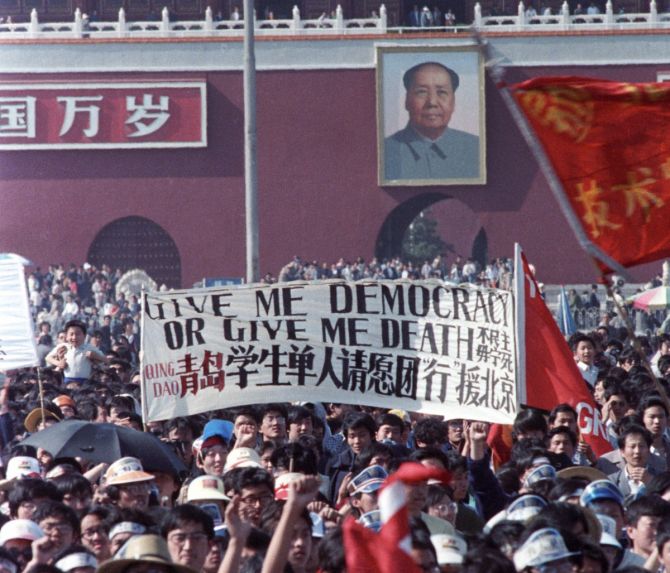
The death of Hu Yaobang was the beginning of the largest spontaneous student revolution since 1919.
During the following days and weeks, the students demanded freedom of speech and the press, democratic elections, greater transparency in government dealings.
The students believed that Hu Yaobang had been sacked though he had followed 'correct' policies. They demanded that the government “should affirm as correct Hu Yaobang's views on democracy and freedom.”
When The People's Daily termed the first spontaneous demonstrations as 'turmoil', the events took a new turn. For the students, the word 'turmoil' (‘dongluan’) had a strong meaning in Chinese reminiscent of the black days of the Cultural Revolution.
Zhao Ziyang was then the Party’s General Secretary; having the same conviction as Hu Yaobang, he thought that a possibility of political reform existed in Communist China. During the following weeks, he constantly tried to negotiate a compromise with the students. This could have changed the Middle Kingdom's fate.
We know what followed: during the night of June 3, Premier Li Peng ordered the tanks to roll out on the Square. Several thousand students lost their lives that night. The Party was saved and the fate of China was sealed (at least for the next few decades). One of the many ironies was that Li Peng was Zhou Enlai's adopted son.
In the meantime, the history of Modern Tibet is also rewritten; forgotten are the hundreds of thousands dead or the complete destruction of innumerable monasteries; on May 23, the Communist Party celebrated the 70th anniversary of the ‘Liberation of Tibet’, when the Dalai Lama’s representatives were forced under duress to sign that Tibet had ‘returned’ to the Motherland (China).
On the occasion, the local press in Lhasa reported: “Early in the morning, in the Potala Palace Square, the golden characters of the Tibet Peaceful Liberation Monument shined brightly. As evidenced by the monument, the peaceful liberation of Tibet 70 years ago not only shattered the delusional attempts of external forces to separate Tibet from China, safeguarded national sovereignty and territorial integrity, safeguarded the unity of the motherland and ethnic unity, and opened up the liberation of millions of serfs.” The Communist newspaper added: “This is a new day, and the sun shines all over the snowy plateau.”
The Xinhua article quoted earlier, concluded: “Looking back on the party’s history …our party has always adhered to the original aspiration and mission of seeking happiness for the Chinese people and rejuvenation for the Chinese nation, and it has never hesitated to advance toward this goal, thus winning the sincere and firm support of the people.”
If it was true, why omit the Great Leap Forward, the Cultural Revolution or the Tiananmen massacre from the history of the Party? It should at least have been analyzed to understand what went wrong; hiding a large portion of history does not give credibility to the Party.
Similarly, the Party is today hiding what happened in Wuhan.
It is time the world starts pressurizing Beijing to tell the truth.

Saturday, May 8, 2021

Can Dharamsala stop PLA's Tibetan gambit?


In the recent weeks, news of the recruitment of Tibetan soldiers in the People’s Liberation Army (PLA) has been reported in the Indian media.
We had often written about this on this blog as elsewhere.

See Tibetan Faces in the PLA

or Tibetans in the PLA Paramilitary 

or  The Colonizers’ Dilemma


My article Can Dharamsala stop PLA's Tibetan gambit? appeared in Rediff.com

The first priority for the new Tibetan administration in Dharamsala should be to look at Tibetan recruitment in the PLA, suggests Claude Arpi

Here is the link...

Last month, The Hindustan Times went a step further; it asserted that a special unit composed of Tibetans was being raised by PLA: “China’s military has stepped up efforts to recruit more Tibetans amid the dragging border standoff with India on the Line of Actual Control (LAC), holding special recruitment drives across Tibet Autonomous Region [TAR] since the beginning of the year.”
Quoting intelligence sources, it further noted: “PLA officials have criss-crossed the TAR to hold recruitment drives and to pick up Tibetan recruits who were already at PLA camps,” adding, citing intelligence reports and communications intercepts from three separate intelligence agencies: “There are also reports the PLA intends to create a Special Tibetan Army Unit. If this were to go ahead, this would be the first PLA formation comprising soldiers from a specific ethnicity.”

A New Sikyong
All this comes at a time when Penpa Tsering, the newly-elected president of the Central Tibetan Administration (CTA) — known as Sikyong — is going to take over his job.
In an interview with The Week, the Tibetan leader stated that he planned “to approach the Chinese government to facilitate a visit of the Dalai Lama to China;” he also hopes “to bring Beijing to the negotiating table with the representative of the Dalai Lama for the resolution of the Sino-Tibetan conflict.”
When asked about his priorities, Tsering said: “A key priority is the resolution of the Sino-Tibetan conflict. Keeping in mind the international situation and the political dynamics, we will have to study the issue more closely and come out with the right strategy. We also have to make good use of all the opportunities that come our way.”

China Today
It would extremely doubtful if the Chinese are in a mood to negotiate anything today with Dharamsala which should study the recent 11 rounds of talks between the Indian Army and the Chinese PLA in Ladakh; it will immediately be realized that even with muscles, tanks, artillery and 50,000 jawans, it is not easy (not to say nearly impossible) to make the Chinese bend.
Further, just look at the situation in Hong Kong, where the National People’s Congress in Beijing passed a new law ensuring that only ‘patriots’ can govern the former British colony; addressing the Chinese legislative body, Premier Li Keqiang showed that Beijing is serious about it, Li warned the world not to interfere.
According to the BBC: “Critics say Beijing is crushing dissent and removing the ‘one country, two systems’ agreement it made with the UK. Under the agreement, Hong Kong, a former British colony, was allowed to continue with its own legal system and have rights including free speech and freedom of the press.” It is all over now.
Lord Chris Patten, former governor of Hong Kong, observed that Beijing has “taken the biggest step so far to obliterate Hong Kong's freedoms and aspirations for greater democracy under the rule of law.”

Could it be different for Tibet?
Nearby, in the Taiwan Strait, the situation has also greatly deteriorated during last few weeks. According to Reuters, in March, in a day only, twenty Chinese military aircraft “entered Taiwan’s air defence identification zone, in the largest incursion yet reported by the island’s defence ministry and marking a dramatic escalation of tension across the Taiwan Strait.”
The island’s defence ministry announced “the air force deployed missiles to ‘monitor’ the incursion into the southwestern part of its air defence identification zone. ….[Taiwans’] planes warned the Chinese aircraft, including by radio.”
The situation in South China Sea is becoming tenser by the day, on April 23, Xi Jinping, China’s Supreme Leader, launched three new warships in just one day from the Hainan Island. China’s People’s Liberation Army Navy (PLAN) has acquired a new cruiser, an amphibious assault ship and A ballistic missile submarine. All using the latest technologies.
Popular Mechanics, a magazine reporting on science and technology, commented: “The commission [of the three ships] reflected the breakneck pace of China’s naval shipbuilding program, which has transformed the country’s navy from a meager coastal defense force into the second most powerful navy in the world in just 30 years.”
No need to mention the treatment of the Uyghurs in Xinjiang and the propaganda orchestrated by Beijing for defending the indefensible.
In these circumstances, Dharamsala has little chance to succeed, especially after nine rounds of talks between Beijing and the Dalai Lama’s representatives over nine years came to nil in 2010.
At the same time, the state of affairs in East Ladakh is far from improving, on the contrary. China is massing new weapons, radars, equipments and reinforcing the Xinjiang Military District (XMD).
PLA divisions are also being reorganized, enlarged and modernized, introducing at a fast pace the concept of Combined Armed Brigades.
Moreover, lands belonging to Tibetans living on the border are said to have been expropriated by the PLA to build new garrisons.
Xi’s China is certainly in no mood to ‘negotiate’ with Dharamsala, especially when the 100th anniversary of the Communist Party of China and the 70th of the so-called Liberation of Tibet are on the horizon.
Penpa Tsering will also have to be briefed about the intensive ‘historical’ education of the masses taking place in China and on the plateau.
Today all over China, the mood is Red. 

Everything Red
On May 5, China Daily mentioned the Zhaojin Beiliang Red Army Primary School in Shaanxi province: “In 2018, the school was designated a demonstration school for Red education, which refers to Chinese revolutionary history, the spirit of role models and stories of the Communist Party. All 160 pupils are immersed in Red songs, Red tales and Red films.”
In Lhasa, the local leaders recently gathered in the ‘Two Roads’ Museum consecrated to the pioneers who invaded Tibet in 1951 and built the two roads (between Sichuan to Lhasa and Qinghai to Lhasa) between 1951 and 1954, which was indeed a remarkable engineering feat.
Today, Red slogans are flying all over; for example, Red Tourism should use “Red Resources, Good Red Stories, carry out Red Education, inherit the Red Genes, cultivate core socialist values and keep the Spirit of Old Tibet, while remaining true to the Original Aspiration.”
Does it not sound like the Cultural Revolution?
In these circumstances, ‘negotiations’ with Dharamsala, seem far away.
The priority should perhaps be to reconnect with the Tibetans inside Tibet, especially on the border areas.
In an article similar to the one in The Hindustan Times, IANS also spoke of the PLA recruiting “exclusive military formations manned by ethnic Tibetans.”
Citing intelligence officials, the news agency said: “most of the recruits are mixed Tibetans -- mostly children of Tibetan mothers and Han Chinese fathers or otherwise. Most of them are children of ex-PLA Han Chinese soldiers who got married to Tibetans.”
The intelligence officials told the agency: “It is a fairly long process because the security vetting process after the initial selection on the basis of a tough physical and IQ test is very extensive," an intelligence official monitoring the process, told the news agency.
In is undoubtedly a risky business for the PLA who 70 years after the ‘Liberation of Tibet’, still does not trust Tibetans enough to give them the command of a unit (or to become TAR Party Secretary).
Only a couple of Tibetan officers made it to the rank of major general (namely, Maj Gen Thinley, responsible of the recruitment of Tibetans and Maj Gen Ngawang Dorjee).
It needs however to be noted that hardly any Tibetans served in operational postings on the Indian borders, and no Tibetan has ever commanded the Tibet Military District (TMD), a lieutenant general post (nor for that matter, a Uyghur, the XMD).

Settling Han Veterans in Tibet
Another serious development is taking place, which Dharamsala should take notice of. According to Xinhua News Agency, after retiring from the PLA, a number of Han soldiers who have served in TMD or XMD, “took the initiative to sign up and chose the highest county in the Tso Nyi County of Nagchu City to make their contributions [to the motherland]. Over the past few years, after retiring, 17 retired non-commissioned officers “used their true qualities as soldiers and have moved to areas with an altitude of more than 5,000 meters, dedicating their youthful glory to write a new chapter in their life.”
The Chinese agency cited several examples: “Most of them are post-90s party members’ (meaning in their thirties), have moved to settle in these remote districts “to help [the Tibetans?] to get rid of poverty in high-altitude areas and take care of everyone.”
The propaganda said that they wrote a youthful song about hard work and national unity in which the party and the people are one: “We just changed place (of residence) to realize our dream.”
Xinhua continues: “in 2017, Tibet recruited civil servants from PLA veterans across the country, and 17 people eventually came to work in Tso Nyi County. Fifteen of them are members of the Communist Party or reserve party members, 14 are ‘post-90s’ [born] and 11 are college veterans.”
Tso Nyi (‘the Two Lakes’) County is located “in the depths of the Northern Tibetan Plateau. It covers an area of nearly 120,000 square kilometers, has a population of only 14,000 people, and has an average elevation of more than 5,000 meters. There are 10 months of long winter, with a minimum temperature of minus 40°C.”
It is obvious that China plans to change the demography of these areas like never before. It is true for this remote desolate place of Northern Tibet, but also for India’s borders, whether north of Arunachal Pradesh, Sikkim, Uttarakhand or Himachal.
The first priority for the new Administration in Dharamsala (and the newly-elected Assembly) should be to look into the issues of recruitment in the PLA and resettlement of Han ‘veterans’ on the plateau. It may be less glamourous than to run to Washington to meet the State Department officials, but it is the need of the hour.
Reconnecting with their countrymen in occupied Tibet is indeed the first task of the new Sikyiong and Assembly.


Monday, January 18, 2021

Xi's mega projects: Should India worry?

Mining in the Aksai Chin
My article Xi's mega projects: Should India worry? appeared on Rediff.com

Here is the link...

After the Ladakh fiasco where Xi Jinping did not expect the Indian Army to resist his land-grabbing tactics, he has to save face before his colleagues in the Communist party.
To bring the threat of a mega-dam to the northern Indian border is a clever move, observes Claude Arpi.

On the occasion of the New Year, President Xi Jinping called the Communist Party “a gigantic vessel that navigates China's stable and long-term development;” he stated: “Upholding the principle of putting people first and remaining true to our founding mission, we can break the waves to reach the destination of realizing the great rejuvenation of the Chinese nation …China will embark on a new journey of development in 2021 and strive to achieve socialist modernization by the year 2035.”
Traditionally, the Chinese people’s respect for their Emperor increases when the latter undertakes projects that no human mind can conceive of. After all, the Emperor is the Son of Heaven, and only in Heaven can projects such as the Grand Canal or the Great Wall be dreamt of. It is also the role of the Emperor to bring Heaven’s vision down on earth. If he fails, his Mandate is terminated by Heaven and a Revolution or a Rebellion occurs.
This is what might soon happen to Xi Jinping, but in the meantime, he is thinking big.
The Seventh Tibet Work Forum (TWF), a mega meeting which decides the fate of Tibet for the years to come (to which rare Tibetans are invited), was held in Beijing on August 28 and 29, 2020.
The Seventh TWF was a crucial event not only as it concerns the fate of the Roof of the World, but also for the presently tense Indian frontiers and the precarious situation in Ladakh.
The TWF usually defines the policies for China’s western border (this explains the presence of the entire Central Military Commission, as well as the service chiefs, including the Chief of the PLA Navy at the Forum).
During the meeting, infrastructure development was linked with Border Defence; the construction of Xiaokang (moderately well-off) villages on India’s border, was mentioned.
A few weeks later, some massive projects were announced; first, the Pai-Metok (Pai-Mo) Highway linking Nyingchi to Metok, north of Upper Siang district of Arunachal Pradesh will be opened in July 2021.
After the completion of the highway, the length of the road from Nyingchi City to Metok County will be shortened from 346 kilometers to 180 kilometers and the driving time will be shortened from 11 hours to 4.5 hours. The Highway starts in Pai Town in Milin County of Nyingchi and uses a long tunnel to pass through the Doshong-la Mountain, ending South of Metok town, close to the Indian border (Tuting Circle). Though only 67 kilometers long, in strategic terms the highway will be a game changer and greatly accelerate the developments of new model villages, and therefore relocation of populations on the border. But more importantly, it will pave the way for a mega hydropower plant (HPP).
In December 2020, The Global Times announced Beijing’s plan to build a large hydropower plant (HPP) on the Yarlung Tsangpo River (which becomes the Siang and later the Brahmaputra in India).
The tabloid admitted that “it has raised concerns in India over potential political and ecological threats as the river passes through Southwest China, India and Bangladesh”, it however asserted that Chinese experts “refuted the claim that Chinese hydropower project have political aims, and said the project could help alleviate power shortage problem in northern India and boost regional economy.”
The Metok County government confirmed that the project would be built north of the McMahon Line. The mouthpiece of the Party added: “The head of Power Construction Corp of China (POWERCHINA) suggested the planned hydropower station - which is expected to have three times as much generating capacity as the world-leading Three Gorges power station - aims to maintain water resources and domestic security.”
After the Ladakh fiasco where President Xi Jinping did not expect the Indian Army to resist his land-grabbing tactics (‘salami slicing’ or whatever you call them), he has to save face in front of his colleagues of the Central Committee and Politburo. To bring the threat of a mega dam to the Northern Indian border is a clever move. The fact that the news came out in The Global Times, the mouthpiece of the Communist Party of China, is telling.
Xi believes that the Party (meaning himself) is always right, how could he have blundered in Ladakh; to regain some standing, he has to intimidate India. A mega dam or hydropower plant, thrice the size of the Three Gorges Dam, threatening the life in the North-East is the best way to divert the attention from the Pangong tso.
But it is not all, already in 2016, The China Daily had reported the construction of a 1,629-kilometer Sichuan-Tibet railway. It has now entered a crucial phase.
At that time, Lobsang Gyaltsen, the then Chairman of the Tibet Autonomous Region government, (Gyaltsen has recently ‘disappeared’ like Jack Ma), announced during the fourth session of the TAR’s 10th People's Congress in Lhasa: “The government will start a preliminary survey and research of the Kangding-Nyingchi railway project this year, and accelerate the construction of Sichuan-Tibet railway in the 13th Five-Year Plan (2016-20) period." Kangding is known as Dardo or Dartsedo in Tibet; it is today the capital city of Gartse Tibetan Autonomous Prefecture.
The railway will be connecting Lhasa to Chengdu; it will be divided into three sections from west to east: Lhasa-Nyingchi, Nyingchi-Kangding, and Kangding-Chengdu. The railway line will run some 1,000 km on the Tibetan plateau. The construction of the western and the eastern sections already started last year. The entire project is expected to be completed in mid 2030s.
The China Daily quoted Lin Shijin, a senior civil engineer at China Railway Corp, who stated: “The accumulated height it will climb reaches more than 14,000 meters, and it will cross many fault zones. It's like the largest rollercoaster in the world. With a designed service life of 100 years, it is believed to be one of the most difficult railway projects to build on Earth …it presents difficulties to overcome, such as avalanches, landslides, earthquakes, terrestrial heat, karst caves and underground streams, yet, it is still a worthwhile project."
It takes today 42 hours by train and three days by road to travel from Chengdu to Lhasa; the new rail line will shorten the travel time to less than 15 hours.
It will have incalculable strategic implications for India as the train will pass near the Indian border, north of the McMahon Line in Nyingchi City (Prefecture).
An even more formidable project is a new road between Xinjiang and Tibet.
The National Highway 216 (known as G216) may one day link northern Xinjiang to Kyirong County in Tibet (the border town with Nepal). It would be the second road link between the two restive provinces of Tibet and Xinjiang (the first one is the G219 or Aksai Chin road, running through Indian territory).
For obvious reasons, Beijing does not want to announce it as yet; the road should serve the under-developed parts of Gerze county of Western Tibet (Ngari Prefecture) ...and reached Nepal. It is probably an important part of the Belt & Road Initiative between Central and South Asia, dreamt by Xi Jinping.
But this is not the trickiest part of the project. How will the Chinese engineers manage to cross the Kunlun range?
Once on the plateau, the terrain (probably via Gerze county) will be easier.
Today many still believe that it is impossible to cross the Kunlun.
But Beijing has probably done its home work and studied the 19th century Western explorers such as Sven Hedin or Aurel Stein who moved around the area and found slightly-easier passages to cut across the formidable natural barrier.
Last, but not the least, Xi is planning to start a mega lead-zinc mining project in Huoshaoyun area, in the China-occupied Aksai Chin; according the Shanghai Nonferrous Metals Network: “In September 2016, Xinjiang geological prospecting made a new major breakthrough. Among them, the Huoshaoyun super large lead-zinc mine has a proven resource of 17.08 million tons, ranking seventh in the world, second in Asia, and first in China. …as early as the end of 2016, Guanghui Zinc, a subsidiary of Guanghui Group, had tendered for open-pit mining, explosive supply and blasting services at the Huoshaoyun lead-zinc mine. It was initially scheduled to be organized from April 2017 to the end of December 2019. At present, some areas of Huoshaoyun Mine have entered the exploration stage.”
Though the three first projects (the HPP in the Yarlung Tsangpo, the Sichuan Railway and the G216 Highway) are all affecting India, the last one (the mining in the Aksai Chin) is located on Indian territory.
Nobody seems to have thought about the pollution generated by these mines, it is a great tragedy in the making; moreover for India, the development of the ‘dual-use’ (civil and military) infrastructure in the Ladakh sector will take place on a much larger scale than today.
It is interesting to watch how the Mandarins of South Block will react. They will probably try to keep the information under the carpet as long as possible, not wanting “to hurt the Chinese sensibilities.”
But if they wait too long, it may be too late.
India will face a new fait-accompli.

Thursday, November 19, 2020

Indian Army ignores Chinese propaganda

Nubra Guards of Chhewang Rinchen in 1948

My article Indian Army ignores Chinese propaganda appeared in Rediff.com

Here is the link...

Today, the Ladakhis and Tibetans have been joined by the Sikhs, the Madrassis, the Garhwalis, the Rajputs who are well trained psychologically and otherwise to defend the nation, observes Claude Arpi.

“PLA unveils new smartwatch for combat rescue, it features IoT SIM card, health tracking, Beidou positioning, individual recognition, SOS voice calling, injury reporting, rescue sensing, one key data wiping, remote wipe, a one-key requesting assistance from combat support service,” said a report from a Chinese website.
When one reads the Chinese press related to defence issues, one gets this type on ‘scoop’ every day. However one has to remember that all publications in the Middle Kingdom are controlled by the Communist Party of China (CPC), therefore mere propaganda pieces.
One, of course, runs the risk of being brainwashed into believing that the People’s Liberation Army (PLA) is several generations ahead of India, at least in technological terms.
In just a few days, The Global Times reported that Chinese scientists have developed “an exoskeleton system specially designed for high-altitude regions, and the equipment is expected to conserve users' energy in tasks including patrol and logistics support.”
The end of the old infantry patrols?
Then, new-generation assault vehicles were said to have been commissioned into a battalion of the Tibet Military Command (TMD): “The vehicles will give PLA troops operating in high altitude regions high mobility, winning them advantages in stamina and time,” explained an article.
The TMD would have conducted long-distance exercises featuring heavy equipment, including dozens of Type 15 light tanks and different types of infantry fighting vehicles and trucks, “in a move experts said demonstrated the PLA's rapid, comprehensive deployment capabilities in high-altitude border regions.” All these ‘scoops’ are of course targeting India.
A video showed a combined arms brigade attached to the TMD using railways and motorized vehicles maneuver in a day-and-night long-distance exercise in mountainous areas located more than 4,000 meters above sea level: “…Most of the heavy weapons and equipment featured in the drills were newly commissioned.”
Another day, The Global Times mentioned “newly developed, self-powered dismountable insulated cabins [in Tibet] … amid the prolonged border tensions between China and India.” It added that the living conditions and combat capability of border defense troops has been greatly enhanced as the region entered winter. A video showed officers and soldiers of the Xinjiang Military Region (opposite Ladakh) wearing only short-sleeved shirts in the cabins.
Another report asserted that hot food was delivered to the PLA troops posted in forward positions, using the latest drones.
All this is obviously to try to demoralize the troops on this side of the border, but the Indian jawans are not much affected by this type of propaganda; they have their own motivations and professionalism, any day superior to their PLA opponents.
In the present context, it is worth remembering those who ‘saved’ Ladakh against the Pakistani invaders soon after Independence.
They did not have any gadgets, but were great soldiers with incomparable enthusiasm, strength and patriotism.
Take the case of a young Ladakhi, Chhewang Rinchen, who earned his first Maha Vir Chakra (MVC), the second-highest decoration in war time, in 1947 at the age of 17, after raising the Nubra Guard and protecting the mountainous region against the wild Pakistani raiders.
Fifteen years later, it is he who informed Delhi of the Chinese heavy build-up in the Aksai Chin; in June 1960, Chhewang was transferred to 14 J&K (Ladakhi) Militia, a newly raised battalion. On arrival at the Spituk Dak Bungalow in Leh, he was ordered to move with a company to Deskit in the Nubra Sector. He was soon given the responsibility of the construction of an airfield at Thoise; it was the first airstrip to be built in this area and the second in Ladakh, after the Leh airport built in 1948. After Chhewang accomplished this remarkable feat, the first Dakota could land on the new airfield on September 26, 1960.

Col Rinchen receives one of his MVCs from President Giri

The presence of the Chinese troops in the area only dates from that time; Chhewang’s mentor was Major (later Lt Col) Randhawa, who dispatched the young Ladakhi “on recces in uncharted wilderness of the Depsang Plains and desolate heights beyond.” Incidentally, Randhawa himself was awarded an MVC for his achievements in Ladakh during the years 1960 to 1962.
Chhewang’s biography states: “In August 1961, in pursuance of the Forward Policy, Rinchen was ordered to recce the area in the extreme north and establish a post at DBO, very close to the Karakoram.”
Located 120 km from Leh on the old Silk Route between Leh and Yarkand, DBO lies at an altitude of more than 5,000 metres, 16 kms south of the Karakoram Pass.
At that time, there were two routes from Leh to DBO; one via the Shyok river which was the winter route and the other one across the perilous Saser La (pass), the summer route; both routes converged at Murgo.
These names sound familiar since the Chinese advances in Ladakh in May this year.
In June 2020, The Hindustan Times reported: “India is working on two key roads near the China border in eastern Ladakh — the site of a tense weeks-long border stand-off with its northern neighbour — to provide connectivity to an important forward area that the military calls Sub-Sector North (SSN). While the first is the strategic Darbuk-Shyok-Daulat Beg Oldi (DS-DBO) road that provides connectivity to the country’s northern-most outpost, DBO; the second road being built from Sasoma to Saser La could eventually provide an alternative route to DBO near the Karakoram Pass. The Sasoma-Saser La road axis is south-west of DBO.” A key bridge inaugurated by the Indian Defence Minister, is called ‘Chhewang Rinchen bridge’.
In 1971, the young Ladakhi single-handedly recovered the Nubra Valley from the Pakistani troops. As he was proceeding to attack Khapalu in Baltistan, he was stopped by the Army Headquarters after securing Turtuk. Had he succeeded there would be no Siachen issue today. Why was he stopped? We will probably never know. Incidentally, there was no question of ‘drones’ to deliver the food to the Nubra boys; Rinchen just confiscated the supplies of the Pakistanis troops on the way; he and his men lived on their dhal and rotis. No fancy swatch either, Rinchen knew each and every ridge and valley.
In 1971, Col Rinchen was awarded a second Maha Vir Chakra for his prowess; he is one of only six defence personnel to have the MVC with bar (twice-awarded).

Army Commander and Khushal Chand's family in front of his memorial in Ladakh

The Lahauli Cousins
Soon after Col Rinchen earned his first MVC, Pakistan decided to ‘liberate’ its Buddhist ‘brothers’ in Ladakh.
No, the raiders did not want to convert to the Buddha Dharma, they just wanted to loot the monasteries of Ladakh and walk away with their treasures (gold, precious stones, wood for construction, etc).
In February 1948, two young Buddhist officers from Lahaul, Captains Khushal Chand and his cousin, Prithvi Chand, offered their services to the nation to stop the raiders. The duo managed the incredible feat of crossing on foot in winter the snow-bound Zoji-la between Kashmir and Ladakh; they were accompanied by a small caravan of men and mules carrying arms and ammunition. The young captains reached Leh safely to prepare a surprise for the raiders. Both were awarded the MVC.
The citation says: “In February 1948, Major Khushal Chand was one of the two officers who volunteered to go to Leh to help in raising a local militia force and to conduct the defence of the Ladakh Valley. For four months Major Khushal Chand with one platoon of J&K State Forces and about twenty local militia hastily trained delayed the enemy advance south towards Leh along the Indus Valley. He conducted guerrilla warfare of a skilful nature giving the impression to the enemy that he had many more men than he actually had. On one occasion he held the Khaltsi bridge for24 hours with just himself and one sepoy and later set it on fire. This delayed the enemy for a further week. Throughout these operations without proper rations, without mortars and with an acute shortage of ammunition, Major Khushal Chand led his small band with vigour and skill and by personal example of daring and ‘daredevilry’ he carried out his task successfully. He thus maintained the high traditions of the Indian Army and set a fine example to those serving with him.”

Col Sonam Wangchuk (MVC)
This daring act by the young Army officers, has since then emulated by many brave soldiers to defend the Indian territory. It is worth visiting the Hall of Fame near the Leh airport, where the exploits of Col Chewang Rinchen, Khushal Chand, Prithvi Chand and other heroes, are portrayed.
More recently, Major (later Colonel) Sonam Wangchuk (another Buddhist soldier to be awarded the MVC) and his Ladakh scouts recaptured some of the crucial peaks occupied by Pakistan during the Kargil war in 1999. I still have the image of Wangchuk, praying to the Dalai Lama, the Bodhisattva of Compassion, to give him the strength to defend India, his nation.
Today, the times have changed, so has the enemy. China is certainly much more powerful and better prepared that the Pakistanis in the 1940s or 1950s, but one should not read too much Communist propaganda; even if the PLA was able to have the latest armament or equipment, they miss the josh and motivation of the Indian troops; let us not forget that the Chinese belong to a single-child generation.
Today, the Ladakhis and Tibetans have been joined by the Sikhs, the Madrassis, the Garhwalis, the Rajputs, you name them, who are well trained psychologically and otherwise, to defend the nation. They all have the same motivation that the young Ladakhis or the Lahaulis had 70 years ago.
Today like yesterday, this is what will make the difference if a conflict takes place, it will not be the kitschy non-existent swatches.
Let us hope that President Xi Jinping realizes this at the earliest.

Monday, July 20, 2020

1962 War: 'Secret Reports' lost forever?

Top Secret and Lost
My article
1962 War: 'Secret Reports' lost forever? appeared in Rediff.com.


'The Himmatsinghji Report is still 'missing'.'
'It is a great loss for the knowledge of India's borders.'
'It would have an immense value at a time China is bound to shift its attention to other border fronts in the Himalayas,' notes Claude Arpi.

It was recently reported that 144 veterans of the Indian armed forces had signed a joint statement on the situation at the border, pointing to the failure of the 'political, civil and military establishments' which lead to the loss of 20 soldiers' lives in the Galwan Valley.
Without going into the necessity of such statement at a time when the nation should, in a unified manner, face the onslaught of the Chinese expansionism, I would like to discuss one of the veterans' requests.
Point 7 says: 'We also strongly urge that the un-redacted Henderson Brooks-Bhagat Report concerning the 1962 War against China be released into the public domain, so that the military-bureaucratic-political system and the public can learn from the mistakes of the past. There can be no sensible reason for this Report remaining secret even after 57 years.'
It is true that report prepared by Lieutenant General Henderson-Brooks and Brigadier Prem Bhagat mentioned some of the reasons for the defeat of the Indian army in 1962.
Discussed in Parliament in 1963, the report has since then been unnecessarily kept under wraps, though there is no doubt that it is not the government which opposed its release, but some officers at army headquaters.
In 2012, Sandeep Unnithan wrote in India Today: 'Officials who have read it say this is because the report squarely indicts senior army generals for the country's worst-ever military defeat...'
Sponsored
'The crux of the report in a 40-page summary by General Chaudhary (General J N Chaudhary, the army chief appointed after the war) says the army gave a better account of itself in the Ladakh sector by resisting the Chinese advance, because of better leadership.'
According to the same source, the three main findings of the report were the failure of the army's higher command, the organisation of the army and finally the appointment of 'the glib but militarily unsound corps commander Lt Gen Brij Mohan Kaul.'
Only two copies of the report are said to exist: One is with the defence secretary; the other deep in a vault at the directorate general of military operations.
If the Henderson-Brooks-Bhagat report is the symbol of the over-zealous attitude of those in power, it is not the only 'secret report' to remain in the drawers of the ministries of defence or external affairs.

The Himmatsinghji Report
Perhaps more crucial in the present tense days is the Himmatsinghji Committee Report of 1951.
This committee, known as the North and North East Border Defence Committee, sent its findings in two parts.
The first interesting aspect of the committee was that all the branches of the Indian State dealing with the borders were represented.
Besides Major General Himmatsinghji, Deputy Minister of Defence (Chairman), it included Lieutenant General Kulwant Singh, K Zakaria, head of the ministry of external affairs's historical division, S N Haksar, joint secretary, MEA, Group Captain M S Chaturvedi from the Indian Air Force and Waryam Singh, deputy director of the Intelligence Bureau.
B N Mullik, the intelligence chief, wrote in his China's Betrayal: My Years with Nehru that the decision to form a committee followed a note 'New Problems of Internal Security' sent by the Intelligence Bureau as well as Sardar Patel's letter, which 'were considered by all the ministries concerned within the next seven days.'
Mullik's words often need to be taken with a pinch of salt, having the habit to justify his own wrong decisions. In this case, however, there is no reason to doubt that Sardar Patel initiated the process before passing away on December 15, 1950.
The first part of the main Report consisted of recommendations regarding Sikkim, Bhutan, NEFA and the Eastern frontier bordering Burma; it was submitted in April, 1951.
The second part contained the recommendations on Ladakh and the frontier regions of Himachal Pradesh, Punjab, Uttar Pradesh and Nepal; it was submitted in September, 1951.
Mullik wrote: 'The Himmatsinghji Committee also had before it the recommendations which had been made by a smaller Committee formed in Assam to assess the dangers in NFFA and suggest the possibility of pushing the Assam Rifles Posts as far towards the frontier as possible.'
According to Mullik, it was decided that 'a small committee of military experts with a representative of the IB in Shillong would visit the NEFA agencies and propose the places near the frontier at which the Assam Rifles units should be posted.'

It is probably this 'smaller' Committee which decided to occupy Tawang.

The Himmatsinghji Committee further recommended an important increase in the Assam Rifles and the Civil Armed Police 'in larger concentration at strategic points from which effective patrolling could be regularly undertaken.'
The Committee also suggested the construction of new roads and the improvement of existing ones to link the Assam Rifles posts with headquarters, something which took 65 years to start.
The state governments were to extend modern administration right up to the frontier and this without interfering with the customs and the ways of life of the tribal people.
Now, where are these reports, which included findings on the trijunction between India, Tibet and Nepal, near Kalapani, which was recently in the news or the territory north of Harsil in Chamoli district of Uttarakhand, today disputed by China?
In November 2011, one Anil Mukherjee applied under the Right to Information Act to get a copy of the Report of the Himmatsinghji Committee as well five other reports.
In its order, the Central Information Commission recorded that appearing on behalf of the ministry of defence, P K Gupta (Director, Vigilance) made the submission that most of these reports were not traceable.
'It is, thus, clear that the reports mentioned at Serial Nos 01 to 04 and 06 (The Himmatsinghji Committee report was No 1) of the RTI application are not available with the MoD and the question of supplying them to the appellant does not arise.'
Practically, it meant that the Himmatsinghji Committee Report is lost forever.
For the CIC, the conclusion was: 'The MoD has not denied existence of these Reports; it has simply indicated their non-availability. Needless to say, the Reports deal with sensitive national security related issues and their 'non-availability' in the MoD is a serious matter.'

'In the premises, it is ordered that a copy of this order be sent to the defence secretary for information and appropriate action at his end.'
As usual, the defence ministry's babus did not do anything.

The takeover of Tawang
It is in all-probability the first Committee, based in its findings, who ordered the takeover of Tawang.
At the end of 1950, the entire area down to Dirang Dzong (South of the Sela Pass) was still under some vague Tibetan administration, with the Tibetan Dzongpon of Tsona in Tibet, collecting 'monastic' taxes from time to time in and around Tawang.
It is there that then Assam governor Jairamdas Daulatram and Major Bob Khathing entered the scene.
Summoned by Daulatram, Khathing was asked, 'Do you know Tawang?' He was then given a 'secret' file to study and told to 'go and bring Tawang under Indian administration.'
On January 17, 1951, Khathing, accompanied by Captain Hem Bahadur Limbu of the 5th Assam Rifles and 200 men, left Lokra, the Assam Rifles headquarters, for the foothills and Tawang, which they reached on February 9, 1951. The rest is history.
It appears that Sardar Patel and Sir Girja Shankar Bajpai, the MEA's secretary-general, decided the operation on their own and ordered Jairamdas Daulatram accordingly.
One can imagine what would have happened if Khathing had not 'liberated' Tawang and the areas around it in time.
On February 9, Nehru wrote to the foreign secretary: 'The Committee appointed recently to tour the North East Frontier etc, has taken some action which I consider of doubtful value.'
It was about Bhutan, he also commented on the takeover: 'Tawang has now been occupied. Probably the step taken was justified. But it was an important step and I should have been consulted about it. The instructions issued to the Officer Commanding (Major Khathing) should also have been placed before me before issue.'
'This is a frontier matter involving possibly some complications and no step should be taken without full consultation.'
Retrospectively, it was perhaps a grace that the prime minister was not consulted.

Today, the Himmatsinghji Report is still 'missing'. It is a great loss for the knowledge of India's borders. It would have an immense value at a time China is bound to shift its attention to other border fronts in the Himalayas.

Monday, December 9, 2019

How China released Indian troops after the 1962 War

Brig John Dalvi (left) followed by 2 Chinese guards while in captivity
(courtesy: Michael Dalvi)
My article How China released Indian troops after the 1962 War appeared in Rediff.com


Here is the link...

'All PoWs recounted that one of the worst aspects of their captivity in Tibet was the constant attempt at brainwashing by Chinese Communist propaganda,' reveals Claude Arpi.

While the media speaks of the ‘Wuhan Consensus’ or ‘Chennai Connect’, it is necessary not to forget that several aspects of the 1962 Sino-Indian War have never been properly clarified, mainly due to the lack of official records on the Indian side and the fact that successive governments have preferred to ‘hide’ what happened in 1962, sometimes by ignorance, more often due to an excessive sense of secrecy (or guilt?). It is a pity.
For the Indian nation, the 1962 conflict with China has been one of the most traumatic post-independence events; for the more than 3,000 Indian prisoners of war (PoWs), the experience was harrowing.
To give an example of the ‘hidden’ dark side-effect of the War, the record of the debriefing of the PoWs when they returned to India has never been made public. All PoWs recounted that one of the worst aspects of their captivity in Tibet was the constant attempt at brainwashing by Chinese Communist propaganda.
One officer remembers: “The Chinese discovered that their political propaganda was effectively countered by some of us whenever their officers came to us for ‘friendly chats’. In the event, it had no effect on any of our JCOs and the result was that when we met the NCOs at mealtimes (twice daily) the same was effectively countered by all of us for ensuring that they are not wrongly influenced. For this realization to set in, took the Chinese authorities almost one month. It was then that all eight of us were shifted to another hut. Although this reduced our contact time with the JCOs, we nevertheless still met twice daily at the langar and made it a point to counter some of the blatant lies which the Chinese were trying to spread. Somehow the Chinese had come to the firm conclusion that if they could mete out exemplary punishment to one of us, the articulation of opposing viewpoints to their propaganda would either stop or would be stifled to a low murmur.” To break their morale, some officers were eventually sent to solitary confinement for weeks; this too did not work.
The Chinese account of the camps does not mention the constant indoctrination sessions to which the Indian jawans and officers were subjected; China just notes that meetings were organized to discuss “according to the wishes of the Indian prisoners …on the right and wrong issues in the Sino-Indian border dispute.”
Sixty-seven years after the War, it is time to release these records.

The Role of the Red Crosses
Another regrettable aspect is that one forgets that the Red Cross played a crucial role in getting the PoWs released in several batches in 1962/63.
Having been unable to find records in the Indian archives, I decided to visit the archives at the seat of the International Committee of the Red Cross (ICRC) in Geneva, Switzerland, in order to reconstruct what happened between the different protagonists before the Indian PoWs were released by China.
My discoveries are captivating, particularly the correspondence between the Indian Red Cross’ president, Rajkumari Amrit Kaur, its General Secretary, Maj Gen CK Lakshmanan with the IRCR and the Chinese Red Cross Society (CRCS).

Some interesting findings
As both India and China were signatories to the Geneva Conventions of 1949, the ICRC had the mandate to protect all victims of international and internal armed conflicts; regrettably, the Communist regime in Beijing systematically refused to acknowledge this fact.
An important legal element needs to be noted; there was no formal Declaration of War between China and India and the diplomatic ties between the two nations were not severed during the months following the war. China used this fact to tell the ICRC that Delhi could directly deal with Beijing …if any problem existed.
While China remained keen to negotiate directly, on the Indian side, the Prime Minister probably felt betrayed and he preferred non-aligned countries to act on behalf of India. This greatly hampered an early solution to the PoWs’ issue.

The ICRC communicates with Beijing
On December 28, the ICRC handed over a Note Verbale to the Chinese Red Cross; this gives a summary of the events between October and December 1962 and put the narrative in perspective: “During the fighting which took place in October and November 1962 between Chinese and Indian forces, more than two thousand Indian military personnel were taken prisoner,” further noting that 600 wounded and sick were repatriated at the beginning of December and that the Chinese Red Cross had then transmitted to the Indian Red Cross the addresses and news of the health of 528 Indian prisoners.
The Note Verbale continues: ‘The Indian authorities for their part reported that no Chinese prisoner was held by them. On the other hand, as from November 20, they have interned about 2,000 civilians of Chinese nationality or origin.”
What is striking is that during the seven months between October 1962 and May 1963, the correct figure of PoWs will keep changing. Even today, two different figures exist, varying by some 600 prisoners.
The Note gives the chronology of the ICRC’s initiatives: “On October 23 [three days after the Chinese attacked], the ICRC offered its services to the IRC on behalf of all the victims of events, including prisoners. On November 1, it requested the Government of the People’s Republic of China and the Government of India, through the intermediary of their representatives in Geneva, to take position on the application of the Geneva Conventions.” The Note reminds Beijing that these Conventions had been ratified by India on November 9, 1950, and by the Chinese People’s Republic on December 28, 1956.
The ICRC wanted China to provide a list of the prisoners, information on their health as well as the authorization for an ICRC representative to visit the PoWs in Tibet.
On November 15, Beijing was informed that the ICRC had sent André Durand, its Delegate General for Asia to New Delhi to coordinate the release of the PoWs with the IRC and the Indian Government.
Four days later, a confirmation was given in writing by Delhi that it would adhere to the Geneva Conventions.
The Note to the Chinese government said that the Government of India having accepted the provisions of the Conventions, “it counted on the Government of the People’s Republic of China doing the same.”
Though some of the clauses would be implemented in the coming months, the Geneva Conventions would never be officially acknowledged by Beijing.
Despite repeated reminders to the Chinese government, an ICRC representative was never permitted to visit the PoWs’ camps in Tibet.
On November 28, the Chinese Red Cross argued that as normal contacts had been maintained between the Chinese and Indian Governments on all questions concerning Indian prisoners, the issue should be addressed directly between Delhi and Beijing.
On December 2, the Indian Red Cross asked for the authorization for its own delegates to visit the Indian prisoners of war in Chinese hands; this too was refused.

First PoWs Released
On December 5, a first batch of 64 wounded Indian PoWs was released from Bomdila in NEFA. Two weeks later, the IRC, while receiving another batch of Indian wounded soldiers in Dirang handed over 2,000 parcels of food and clothing for the Indian prisoners in Tibet; this was a major success for Rajkumari Amrit Kaur, Gen Lakshmanan and their team.
The ICRC again asked for repatriation ‘within a short space of time’ of all Indian PoWs still in Chinese hands.

The Chinese Internees in Deoli
The Chinese cleverly opened another propaganda front; they started equating the PoWs kept in Tibet with the Chinese civilians interned for security reasons in Deoli in Rajasthan; even after André Durand was allowed to visit Deoli on December 12, 1962, he was not allowed to visit Tibet. China, the victor could dictate its terms.
On February 18, Han Nien-Lung, the director of the General Office of the Ministry of Foreign Affairs declared that “the Indian Government cover up India's crime of persecuting Chinese nationals.” At the same time, he spoke of “the lenient treatment of the captured Indian military personnel by the Chinese side.” The Chinese propaganda machinery was working full steam.

What was the situation early 1963?
By early January, the Indian Red Cross had received the names of only 1,132 PoWs, while 715 wounded prisoners had been released and 13 bodies handed over. The names of more than 2,000 PoWs were still missing.
On January 25, 1963, the ICRC’s Executive Director wrote to Gen Lakshmanan to draw the IRC’s attention to the announcements of China News Agency that 2,156, (or 3,350) Indian POWs were still in Chinese hands. The released figures of the PoWs were, to say the least, confusing.

A Message to Marshal Chen Yi’s cable
Finally on February 6, the ICRC president decided to write directly to Marshal Chen Yi, the Chinese Minister of Foreign Affairs.
On February 18, an answer came to the cable sent to Marshal Chen: “Since the Sino-Indian border clashes, the Chinese government has all along given good treatment in every respect to the Indian military personnel who were captured in the course of their attacks on the Chinese frontier guards.”
Beijing kept repeating that it was India who attacked China. Beijing’s conclusion was it was not necessary for the ICRC to take the trouble to visit the prisoners. However it found most regrettable that the India PoWs “captured in the course of the Chinese frontier guards' counterattacks in self-defence” were equated with the “law-abiding overseas Chinese illegally detained by the Indian authorities.”
On February 27, the IRCR confirmed to Gen Lakshmanan that the total number of Indian prisoners of war still in Chinese hands was 3,319, excluding the 716 wounded and sick who have been repatriated and the 13 bodies returned by the Chinese Red Cross.”

Announcement of the Release of all PoWs
Finally on April 4, the CRC officially wrote: “Our government announced on April second its decision to release all Indian military men whom Chinese frontier guards in Tibet and Sinkiang regions captured during their counterattacks in self-defence stop we have contacted indcross [IRC] directly to make arrangements for their repatriation stop thanks for your concern.”
During the following weeks, all the PoWs detained by China would be released in batches.
The fact remains that many details are still ‘secret’; i.e. the number of camps, location of these camps, treatment of the PoWs, etc.
When the next ‘Connect’ takes place, India should request China to provide this information.

Other articles on 1962 War: