My article Is Xi Scared of Tiananmen 1989? appeared in Rediff.com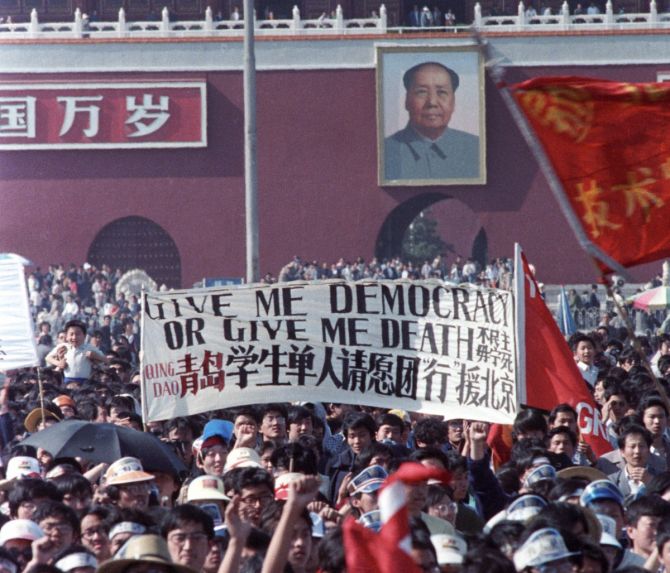
They gave Death
Why omit the Tiananmen massacre from the history of China's Communist party? asks Claude Arpi.
Here is the link...
Since the beginning of the year, China has started celebrating the 100 years of the Communist Party of China.
For the occasion, Chairman Xi, the new Mao, has decided to teach the history of Modern China to everyone in China; every citizen should “learn about a century of party history and write a new great legend [for the Party].”
An article in Xinhua states: “General Secretary Xi Jinping attaches great importance to the Party history study and summarizes the main content of Party history study into 16 words, namely, "learning history to be clear [about the role of the Party], learning history to increase credit [points], learning history to respect morality, and learning history to practice [Communism].”
The ‘credit points’ refer to the way the totalitarian regime is keeping a tab on its citizens, by crediting (or debiting) each and every Chinese for his/her actions; even the most seemingly insignificant deed is recorded into the Communist Party’s mega computers’ memory.
The News Agency adds: “…The new journey of a modern socialist country has started well.”
On March 1, 2021, Xi addressed the young cadres at the Central Party School in Beijing; he told them that they were the successors of the old comrades, “the glory of the party is in your hands”, and exhorted them to be the “faithful successor of the tradition and fine work-style of the Communist Party, constantly enhancing willpower, perseverance and self-control and making contributions in the new journey of comprehensively building a modern socialist country in the New Era!” And, of course, “loyalty to the party is the primary political quality of Communists,” he added.
The words of the new Great Helmsman sound good, but there is another side to it; there are black (or ‘bloodied’ red) holes in the official history.
One of the ‘red’ holes occurred 32 years ago, on Tiananmen Square.
If Beijing has forgotten, the world has not.
The Black Book of Communism
In 1997, French scholar Stéphane Courtois, along with other European academics, published Le Livre noir du communisme which was later translated in several languages under the title The Black Book of Communism: Crimes, Terror, Repression.
The Black Book sold tens of millions of copies; it is still considered by many as one of the most influential publications written about the history of Communism in the 20th century. The authors documented the history of political repression by Communist states, including genocides, extrajudicial executions, deportations, killing populations in labour camps as well as artificially-created famines.
In the first chapter, The Crimes of Communism, Stéphane Courtois quoting Plato’s Republic and Thomas More as Communist examples of ‘utopian philosophy’, Courtois explains, “We must make a distinction between the doctrine of communism and its practice. As a political philosophy, communism has existed for centuries, even millennia.”
Courtois gave figures, people killed by Communist governments amount to more than 94 million, including 65 million in the People’s Republic of China, 20 million in the Soviet Union, 2 million in Cambodia, 2 million in North Korea, 1.7 million in Ethiopia, 1.5 million in Afghanistan, 1 million in Vietnam.
In China alone, there is no doubt today that the Great Leap Forward resulted in 40 to 50 million deaths. According to Frank Dikötter in his masterly Mao’s Great Famine: The History of China’s Most Devastating Catastrophe, 45 million people died unnecessarily. Yang Jisheng in Tombstone: The Great Chinese Famine, 1958–1962 put the tally between 43 million and 46 million.
No candle vigil any more
In the past, Hong Kong used to commemorate the Tiananmen Square events, today, the former British colony have banned to do so.
A historical event is worth recalling.
Dr Zhisui Li, Mao's private physician recorded the death of Zhou Enlai, the Chinese Premier and Mao Zedong’s reactions to it in 1976, Dr Li wrote: 'Beginning in mid-March, knowing that the Qing Ming festival for honoring the dead would be celebrated on April 4, the citizens of Beijing began going to the Monument to the Revolutionary Heroes in Tiananmen Square to place mourning wreaths for Zhou. The movement was spontaneous, and the crowds grew larger by the day. The country had not witnessed such an outpouring of popular sentiment since before the Communists came to power in 1949.”
As April 4 approached, Dr Li visited Tiananmen clandestinely: 'The Square was filled with tens of thousands of people singing, making speeches, and reading poems. The mourning wreaths stretched from the Monument to the Revolutionary Heroes in the centre of the square all the way to Changan Avenue just in front of the Gate of Heavenly Peace. …It was impressive and moving.”
A similar event occurred in 1989, 13 years later.
Though Hu Yaobang had been sacked as the secretary general of the Chinese Communist Party in January 1987, he was still a member of the Politburo and entitled to attend important meetings. On April 9, 1989, after uttering some strong words on the Communist Party's failures, the respected Hu Yaobang had a stroke. A week later he passed away (similarly, the Panchen Lama had a ‘stroke’ when he mentioned the misdeeds of the Party in January 1989 in Shigatse, Tibet).
The death of Hu Yaobang was the beginning of the largest spontaneous student revolution since 1919.
During the following days and weeks, the students demanded freedom of speech and the press, democratic elections, greater transparency in government dealings.
The students believed that Hu Yaobang had been sacked though he had followed 'correct' policies. They demanded that the government “should affirm as correct Hu Yaobang's views on democracy and freedom.”
When The People's Daily termed the first spontaneous demonstrations as 'turmoil', the events took a new turn. For the students, the word 'turmoil' (‘dongluan’) had a strong meaning in Chinese reminiscent of the black days of the Cultural Revolution.
Zhao Ziyang was then the Party’s General Secretary; having the same conviction as Hu Yaobang, he thought that a possibility of political reform existed in Communist China. During the following weeks, he constantly tried to negotiate a compromise with the students. This could have changed the Middle Kingdom's fate.
We know what followed: during the night of June 3, Premier Li Peng ordered the tanks to roll out on the Square. Several thousand students lost their lives that night. The Party was saved and the fate of China was sealed (at least for the next few decades). One of the many ironies was that Li Peng was Zhou Enlai's adopted son.
In the meantime, the history of Modern Tibet is also rewritten; forgotten are the hundreds of thousands dead or the complete destruction of innumerable monasteries; on May 23, the Communist Party celebrated the 70th anniversary of the ‘Liberation of Tibet’, when the Dalai Lama’s representatives were forced under duress to sign that Tibet had ‘returned’ to the Motherland (China).
On the occasion, the local press in Lhasa reported: “Early in the morning, in the Potala Palace Square, the golden characters of the Tibet Peaceful Liberation Monument shined brightly. As evidenced by the monument, the peaceful liberation of Tibet 70 years ago not only shattered the delusional attempts of external forces to separate Tibet from China, safeguarded national sovereignty and territorial integrity, safeguarded the unity of the motherland and ethnic unity, and opened up the liberation of millions of serfs.” The Communist newspaper added: “This is a new day, and the sun shines all over the snowy plateau.”
The Xinhua article quoted earlier, concluded: “Looking back on the party’s history …our party has always adhered to the original aspiration and mission of seeking happiness for the Chinese people and rejuvenation for the Chinese nation, and it has never hesitated to advance toward this goal, thus winning the sincere and firm support of the people.”
If it was true, why omit the Great Leap Forward, the Cultural Revolution or the Tiananmen massacre from the history of the Party? It should at least have been analyzed to understand what went wrong; hiding a large portion of history does not give credibility to the Party.
Similarly, the Party is today hiding what happened in Wuhan.
It is time the world starts pressurizing Beijing to tell the truth.
Showing posts with label Tiananmen. Show all posts
Showing posts with label Tiananmen. Show all posts
Friday, June 4, 2021
Is Xi Scared of Tiananmen 1989?


Tuesday, June 1, 2021
When the Chinese Glasnost died again
 One the occasion of the 32th anniversary of the Tiananmen massacre, I re-post an article written in January 2005.
Two years ago, during the monthly briefing by senior Colonel Wu Qian, the spokesman of the Chinese Ministry of National Defence, a correspondent asked if the People's Liberation Army had any comment on the suppression of students 30 years ago.
Wu Qian replied: "I don't agree with the word 'suppression' in your question."
He added "Over the past 30 years, the process of our reform and development and our stability and achievements have already addressed your question."
Even this was deleted from the official transcript of the Press Conference...
It shows that China has not been nervous for a long time...
From Rediff.com, The Day Chinese Glasnost Died.
Did Zhao Ziyang die on January 8 or did he die on the morning of January 17? That is a million yuan question!
On the same day in 1976, another Chinese leader, its Prime Minister Zhou Enlai, passed away.
When Zhou died, the Great Proletarian Cultural Revolution had just ended. Modern China had gone through its 10 most tormented years.
During previous months, Mao had refused to provide treatment for his premier who had cancer; the Emperor wanted Zhou to die before him.
Even in Communist China, there is protocol!
In fact, the problem was that the premier was more popular than the Great Helmsman with the masses. Zhou's death was observed by Dr Zhisui Li, Mao's private physician who commented: 'What worried me most was the power struggle to follow.'
In Beijing, memories of the Cultural Revolution purges were still fresh in the populace's psyche. Though resentment was growing, nothing could be done openly as yet.
At that time, the Chinese New Year was approaching. When Mao decided to celebrate the event with firecrackers, the crowd outside Zhongnanhai (the residential enclave where Politburo members live) thought the Chairman rejoiced over his premier's death. Anger mounted, but the people of Beijing had to wait a few more weeks to express their respect for the deceased leader.
Dr Li wrote: 'Beginning in mid-March, knowing that the Qing Ming festival for honoring the dead would be celebrated on April 4, the citizens of Beijing began going to the Monument to the Revolutionary Heroes in Tiananmen Square to place mourning wreaths for Zhou. The movement was spontaneous, and the crowds grew larger by the day. The country had not witnessed such an outpouring of popular sentiment since before the Communists came to power in 1949.'
As April 4 approached, Dr Li visited Tiananmen clandestinely: 'The Square was filled with tens of thousands of people singing, making speeches, and reading poems. The mourning wreaths stretched from the Monument to the Revolutionary Heroes in the centre of the square all the way to Changan Avenue just in front of the Gate of Heavenly Peace, and thousands of banners were flapping in the breeze. It was impressive and moving.'
A similar event occurred 13 years later.
In 1989, though Hu Yaobang had been sacked as the secretary general of the Chinese Communist Party in January 1987, he was still a member of the Politburo and entitled to attend important meetings. On April 9, after uttering some strong words on the Communist Party's failures, the respected Hu Yaobang had a stroke. A week later he passed away.
Zhao Zhiang, then secretary general of the Chinese Communist Party, made the customary brief assessment of Hu's life: 'Comrade Hu was a loyal, tried and tested Communist fighter, a great proletarian revolutionary and politician, an outstanding political worker for the army.'
It was agreed that Hu would have a national funeral service with the norms of standing members of the Politburo. The plan was accepted by all the party's senior leaders including Deng Xiaoping. During that meeting, Zhao requested Qiao Shi, No 3 in the party and responsible for security, to 'keep a close watch on how Comrade Yaobang's death might impact society.' Qiao Shi is said to have replied: 'At the moment, society is in pretty good shape, Things are fairly stable.'
In the afternoon of April 17, 600 students of the Chinese University of Political Science and Law marched into Tiananmen Square with mourning banners and wreaths. They were 10,000 by the evening.
The next day, students and onlookers poured in from Beijing University and other places. Wreaths accumulated in front of the Monument to the Revolutionary Heroes.
The rest is history.
It was the beginning of the largest spontaneous student revolution since 1919.
During the following days and weeks, the students demanded freedom of speech and the press, democratic elections, greater transparency in government dealings.
The pretext for the explosion of the students' ire was the fact that Hu Yaobang had been sacked though he had followed 'correct' policies. They demanded that the government 'should affirm as correct Hu Yaobang's views on democracy and freedom.' When the People's Daily termed the first spontaneous demonstrations as 'turmoil', the events took a new turn. For the students, the word 'turmoil' (dongluan) had a strong meaning in Chinese reminiscent of the black days of the Cultural Revolution.
One man played a major role in the Tiananmen events -- Zhao Ziyang. Having the same conviction as Hu Yaobang, he thought that a possibility of political reform existed in Communist China. During the following weeks, he constantly tried to negotiate a compromise with the students. This could have changed the Middle Kingdom's fate.
One of his collaborators, Wu Guoguang, remembered in Time magazine: 'In the wrong place at the wrong time, Zhao Ziyang did the right thing. It was close to midnight on the night of May 19, 1989. China's leaders were finalising their plans to declare martial law and crush the Tiananmen Square democracy protests that had, in the preceding 48 hours, swelled to include more than a million demonstrators.
Zhao, then general secretary of the Chinese Communist Party, might have remained with the commissars inside Beijing's Great Hall of the People as they called in the troops. Instead, stooped with fatigue, tears in his eyes, he waded into the throngs of students and in the gathering darkness pleaded with them to abandon their vigil before it was too late.'
Three days earlier Zhau had received Mikhail Gorbachev, then general secretary of the Soviet Union Communist Party. Was Zhao trying to emulate his Soviet counterpart when he spoke to the students? The Chinese leader told Gorbachev, 'Some young people now had doubts about the superiority of socialism, that these doubts arose from genuine problems with the Party leadership and certain entrenched habits, and that the only way out for socialism was continued vigorous reforms.'
This view was certainly not shared by all in the standing committee of the Politburo. Just after Zhao had met Gorbachev, an important meeting was held, the verdict was split: two members were in favour of using force against the students, two were for a continuation of the dialogue and one, Qiao Shi, abstained.
The next day, the matter was referred to Deng Xiaoping. Zhao had told Gorbachev: 'Even though Deng Xiaoping had retired from his Party posts in 1987, the Party had recognised that his wisdom and experience were essential and that for the most important questions he would still be at the helm.'
Deng decided to use force. On May 20, the martial law order was signed by Prime Minister Li Peng. Two days later, Zhao Ziyang was sacked and Jiang Zemin was called from Shanghai to replace him.
During the night of June 3, Li Peng ordered the tanks to roll on the Square. Between 3,000 and 10000 students lost their lives that night. The Party was saved and the fate of China was sealed (at least for the next few decades). One of the many ironies was that Li Peng was Zhou Enlai's adopted son.
On October 17, 2004, Zhao celebrated his 75th birthday. The Human Rights in China group reported: 'In the past three days large groups of people have been gathering outside Zhao's Beijing home, requesting permission to see him. The groups, which range in size from a dozen to upwards of 100 people, seem to be made up largely of Zhao's former subordinates and his close friends and relatives.'
On the same day, a group of senior Chinese citizens and Zhao's supporters wrote to President Hu Jintao and Premier Wen Jiabao about Zhao's continuous detention: 'We strongly urge that you unconditionally and immediately release Mr Zhao Ziyang from house arrest, restore his freedom, and resume all his civil rights!
'No matter how the CPC (Chinese Communist Party and its government would now judge the 1989 political storm and whether Mr Zhao was right or wrong at that time, as a citizen of the People's Republic of China, his civil rights ought to be respected and protected. Without due legal procedure, his freedom and civil rights are not to be deprived. We believe that you share this common view with us, and with all those who respect the constitution and laws of China.'
On January 8, 2005, the media reported from Hong Kong that Zhao had died. This was denied by Chinese Foreign Ministry spokesman Kong Quan as totally untrue: 'Zhao Ziyang is an old man who is over 80. He fell ill, but after attentive treatment, his condition is currently stable,' he told reporters. However, one can doubt the veracity of this declaration (Zhao's daughter admitted he was in a coma).
Probably, like Yasser Arafat, the announcement of his death will be stage managed to ensure that all arrangements for his 'non-official' funeral are complete.
Already news from the BBC says, 'A thousand policemen are to be deployed every morning on Beijing's Tiananmen Square to escort visitors to the flag-raising ceremony. The new rules may be designed to prevent any dawn protests on the square, scene of a bloody pro-democracy crackdown in 1989.'
All this coincides with the publication of a Gallup report which concluded: 'The people of China may be far wealthier than they were a decade ago, but they are not very satisfied with their quality of life, a survey showed.'
In the meantime, the European Union prepares to lift the arms embargo imposed after the Tiananmen events.
This will be the third time Zhao died. Politically, he died at Tiananmen Square in May 1989; he probably died in a Beijing hospital earlier this month; and the principles he fought for will be buried for the sake of selling a few weapons more.
Monday, October 7, 2019
Prez Xi's Love for Guns & Glory

It also appeared in DailyO under the title 'Message for India in President Xi Jinping's love for guns and glory'
China is clearly getting ready in case of another showdown with India
“Observe calmly; secure our position; cope with affairs calmly; hide our capacities and bide our time; be good at maintaining a low profile; and never claim leadership,” such were the words of Deng Xiaoping, China’s Supreme Leader at the end of the 1970s.
Mao back in Vogue
Today’s People’s Leader, as President Xi Jinping calls himself, does not believe in these virtues; he thinks that ‘in the new era’, it is necessary to show the Middle Kingdom’s muscles …and more.
On the occasion of the 70th National Day of the People’s Republic of China, Xi returned to the ‘power coming from the barrel of the gun’ theory of his predecessor, Mao Zedong.
“No force can ever undermine China's status, or stop the Chinese people and nation from marching forward,” solemnly declared President Xi Jinping from the rostrum of Tiananmen Square.
Xi reminded the privileged who attended the function that “seventy years ago, Comrade Mao Zedong solemnly declared to the world that the PRC was founded and the Chinese people had stood up. This great event completely reversed China's miserable fate born from poverty and weakness and being bullied and humiliated over more than 100 years since the advent of modern times."
The Chinese State media was ecstatic as “China had reaffirmed its commitment to global peace and development”, and added: “we will continue to work with people from all countries to push for jointly building a community with a shared future for humanity.”
Neighbours, Japan, Korea and even India do not see it that way.
They witnessed 23 new weapons displayed, some of them seeming uncontrollable by the missile defence installed by Japan, South Korea or even the US.
Many watched in awe the DF-17 hypersonic ballistic missile (a hypersonic glide vehicle that can deliver both nuclear and conventional payloads) or the new-generation road-mobile DF-41, which made their debut in an official parade. Though one analyst said that it was “the ultimate show of insecurity and cold war thinking”, The South China Morning Post (SCMP) wrote: “For China it is a show of how its armed forces have been modernised.” The Hong Kong newspaper further pointed out: “Among them, the Dongfeng, or ‘East Wind’, series of missile systems drew the most attention,” it included not only the DF-17 and the DF-41, but also the DF-16 and DF-26 medium-range missiles.
Some 15,000 troops from 59 units, 47 belonging to the ground forces and a dozen airborne squadrons, participated in the display. Xi inspected 580 new weapon systems, almost all of them were ‘made in China’, proving that Beijing’s military industry is truly becoming self-sufficient. It is a lesson that India has hopefully noted a few days before the visit of the Chinese President in Mamalapuram.
Interestingly, the Jane’s Review mentioned that the parade showcased “a number of new land platforms that reflect growing needs within the People’s Liberation Army Ground Force (PLAGF) for improved mountain warfare capabilities;” the reputed publication noted that the show comes two years after Doklam: “Analysis conducted by Jane’s indicates that the PLA has since attempted to revise its military positions in the region to improve its readiness, while India has maintained a robust presence,”
further observing that China has built a number of all-weather roads through Tibet “but its primary armour assets capable of influencing the totality of the battlefield, such as the Type 99A2 and Type 96 main battle tanks, are too heavy to deploy and sustain in mountainous regions.”
Firepower in Show
A similar restriction applies to the PLA’s heavy artillery platforms, said Jane’s “this situation points to the need for lighter armoured vehicles that can provide direct and indirect fire support to PLAGF units operating in mountainous regions.”
ZTQ-15 lightweight tanks and the PLC-181 SPH vehicle-mounted howitzer, were paraded on Tiananmen Square: “The weight of those vehicles, which is not thought to exceed 35 tonnes for the ZTQ-15, means that these vehicles can be rapidly relocated using air or rail assets, if required.”
The ZTQ-105, a 105 mm gun and a 155 mm L52 gun for the PLC-181, have already been spotted in Tibet, they are “sufficient to counter all vehicles and forces that the Indian Army can currently deploy to the disputed territories at short notice.”
Incidentally, the PLA’s five theatre commanders appeared for the first time at the parade. General Zhao Zongqi, Western Theatre Command who looks after the Chinese forces facing India was present.
Notes for PM Modi
China is clearly getting ready in case of another showdown with India.
Something else is not auguring well for the Mamalapuram meet: Pakistani Prime Minister Imran Khan will visit Beijing a few days before Xi arrives in South India, to brief the Chinese President about Kashmir and deliver a speech at the China-Pakistan business forum to try to ‘revive’ the stalled China-Pakistan Economic Corridor (CPEC) projects.
In the meantime in Nepal the security in Kathmandu has greatly increased, partly to control the Tibetan refugees during the grand show on Tiananmen, but also in view of Xi’s probable visit later this month.

Opening a couple of more Border Personnel Meeting (BPMs) in the Himalaya and possibly, a new landport between India and Tibet, could be positive advances.
Prime Minister Modi should not to be influenced by the show of might displayed on the Tiananmen Square, but should take a leaf from Deng’s moto, ‘observe calmly, bide your time…’.
It will be wiser for India than to show its muscles.
Tuesday, June 4, 2019
Tiananmen Square: 30 Years Later

Here is the link...
Thirty years after the massacre at Tiananmen Square, coerced collective amnesia envelops the Chinese nation about that horrific event.
Claude Arpi glances back at how the student uprising could have changed the Middle Kingdom forever had the Chinese Communist party not traveled on the route of martial law.
In 2005, I wrote a piece The Day Chinese Glasnost Died for Rediff.com.
Former Chinese Premier Zhao Ziyang had just passed away.
Can you believe that fourteen years later, the leadership in Beijing is still afraid of Zhao's ghost.
On January 17, 2013, The South China Morning Post had reported: "More than 100 mourners flocked to a traditional house in a quiet alleyway in Beijing yesterday morning to pay their respects at the home of the late Zhao Ziyang on the eighth anniversary of the ousted party chief's death," explaining “before his death, Zhao had been under house arrest at the courtyard home at No 6 Fuqiang Alley since opposing the use of military force against the Tiananmen Square demonstrators in 1989.”
Bao Tong, Zhao Ziyang’s secretary, who published the former Premier's memoirs, Prisoner of the State: The Secret Journal of Premier Zhao Ziyang, knew the implications of being close to Zhao: his home telephone was constantly tapped, he was followed everywhere he went and he was banned from approaching 'sensitive' events or places.
The situation in the Middle Kingdom has not improved, it has even worsened; while aiming at becoming the World Economic Power No 1, with a myriad of stealth jet planes, warships (soon three aircraft carriers), with the latest missiles and futuristic gadgets using Artificial Intelligence (AI) to monitor the life of the ‘masses’, China seems unshakable; but the ‘human’ intelligence and humanity symbolized by Zhao, has disappeared entirely from China, to be replaced by a authoritarian system (and even worse for places like Xinjiang).
Six years ago, Bao had explained why Zhao was not popular with the regime; China's former Premier simply treated people as human beings. Bao elaborated, “This doesn't sound very extraordinary …he was instrumental in protecting the autonomy of farming communities, because he saw farmers as people. He was instrumental in protecting the autonomy of enterprises, because he saw entrepreneurs and their workforce as people. He was instrumental in stopping the Party pronouncing on everything, because he didn't see the Party as a judge…”
Today, the Party is above everyone, monitoring and controlling everything.
What happened thirty years ago?
In January 1987, another great Chinese leader, Hu Yaobang was sacked as the Communist Party’s General Secretary; on April 9, 1989, still a member of the Politburo and entitled to attend important meetings, while uttering strong words and speaking of the Communist Party's failures, the respected Hu had a stroke. A week later, he passed away.
Zhao Zhiang, then secretary general of the Chinese Communist Party, made the customary brief assessment of Hu's life: “Comrade Hu was a loyal, tried and tested Communist fighter, a great proletarian revolutionary and politician, an outstanding political worker for the Army.”
It was agreed that Hu would have a national funeral service reserved for the Politburo’s Standing Committee members. But in the afternoon of April 17, 600 students of the Chinese University of Political Science and Law marched into Tiananmen Square with mourning banners and wreaths. They were 10,000 by the evening.
The next day, students and onlookers poured in from Beijing University and other places. Wreaths accumulated in front of the Monument to the Revolutionary Heroes.
The rest is history. It was the beginning of the largest spontaneous student revolution since 1919.
One man played a major role in the Tiananmen events - Zhao Ziyang. Having the same conviction as Hu Yaobang, he saw that the possibility of political reform existed in Communist China. During the following weeks, he constantly tried to negotiate a compromise with the students. This could have changed the Middle Kingdom's fate. It was not to be.
On May 20, the martial law order was signed by Prime Minister Li Peng. Two days later, Zhao Ziyang was sacked and Jiang Zemin was called from Shanghai to replace him.
During the night of June 3, Li Peng ordered the tanks to roll on the Square. Some 3,000 students are said to have lost their lives that night. The Party was saved and the fate of China was sealed (at least for the next few decades).
Thirty Years Later
Today, the momentous events on the Tiananmen Square have been erased from the public memory; nobody wants to remember the June 4 massacre. Cary Huang, a senior columnist with The South China Morning Post, wrote recently: “In 2019, China ushers in a year full of both festive jubilation and political trouble. Its communist leadership places enormous emphasis on the anniversaries of important historical events …China has a lot to celebrate in 2019 but it also has old wounds to heal.”
Huang noted that with its packed 2019 calendar of commemorative events, Beijing may ‘forget’ some of them, “many of which are politically charged or divisive. For a nation moving forward, it’s time to acknowledge the difficult past,” he argued.
It will not happen on June 4; already on March 28, Beijing selectively remembered the date as the 60th anniversary of Serfs Emancipation Day; but what was this emancipation?
March 28, 1959 marked a massacre of the Tibetan population in Lhasa and the Communist Party taking full control over the Tibetan capital; 18 days earlier, the Dalai Lama had fled the Roof of the World to take refuge in India. On March 28, the revered Lama was sacked as chairman of the Preparatory Committee for the Tibet Autonomous Region and was replaced by a (then) more pliant Panchen Lama.
While these events are forgotten, the May Fourth Movement which took place in 1919 in the Chinese capital has been celebrated with pomp; on that day, students started protesting against the nationalist Government’s weak response to the Treaty of Versailles, allowing Japan to control the territories surrendered by Germany in Shandong.
On the occasion, Xi Jinping affirmed that patriotism was the core spirit of the 1919 event. He added that the May Fourth Movement inspired the ambition and confidence of the Chinese people and the nation to realize national rejuvenation. “It was also a great enlightenment and new cultural movement of disseminating new thought, new culture and new knowledge,” Xi said. But, of course, the students of 1989, did not exist, though they also wanted a better China.
On May 27, The South China Morning Post published an article entitled Generation Amnesia explaining why China’s youth don’t talk about Tiananmen; it looked at how censorship, silence and time have created a gulf between the young people who witnessed the events and those who came after them.
The Hong Kong newspaper quotes several witnesses of the tragic events, including Zhang Shijun, a medic with the People’s Liberation Army’s 54th Army Group, one of the military units engaged in enforcing martial law in Beijing; Zhang preferred that his daughter remains unaware of what happened.
Andrew Nathan, who compiled the Tiananmen Papers says that the Communist Party imposed complete censorship of June 4 because even discussing the possibility of ‘errors and crimes’ would make the party’s will to power seem weak: “Controlling speech sends a message that the party will not allow any opposition, and this message of determination makes people afraid that if they talk about forbidden topics they will be punished,” he said.
The lofty concepts of freedom and liberty have entirely disappeared from today’s China; a Reuters article describes how China's robot censors work overtime for this purpose.
The news agency affirms: “Censors at Chinese internet companies say tools to detect and block content related to the 1989 crackdown have reached unprecedented levels of accuracy, aided by machine learning and voice and image recognition.”
Two employees at Beijing Bytedance Co Ltd, a ‘censoring’ firm, said that censorship of the Tiananmen crackdown, along with other highly sensitive issues including Taiwan and Tibet, is now largely automated: “Posts that allude to dates, images and names associated with the protests are automatically rejected.”
They explained that AI is much more accurate, than the human intelligence.
Reuters commented: “June 4 itself is marked by a cat-and-mouse game as people use more and more obscure references on social media sites, with obvious allusions blocked immediately …even the word ‘today’ has been scrubbed.”
A question remains, how long can liberty and freedom of thought be stifled.
Certainly not for ever.
Thursday, May 9, 2019
Fading Memories
 |
| A Forgotten Student Revolution |
Here is the link...
While remembering the events of 1919 and seeking to better integrate the spirit of May 4 into the party’s narrative, the student revolt of 1989 has been completely blacked out
China is suffering from a strange disease, a sort of selective amnesia — certain things from the past are clearly remembered, while other events seem to have been completely erased from the nation’s collective memory (or at least from the party’s annals). Take the May Fourth Movement, which was recently celebrated with much fanfare in every corner of the Middle Kingdom. In this case, the memory of the event, which occurred a hundred years ago, is absolutely clear.
Following the 1911 Revolution in China, the Manchu (Qing) dynasty disintegrated, triggering the fall of imperial rule. Eight years later, the May Fourth Movement took place in the Chinese capital where students started protesting against the nationalist Government’s weak response to the Treaty of Versailles, allowing Japan to control the territories surrendered by Germany in Shandong.
On the morning of May 4, 1919, student representatives from 13 different local universities met in Beijing and drafted five resolutions, in particular, to oppose the granting of Shandong to the Japanese and the creation of a Beijing student union. Later in the afternoon, some 3,000 students of Beijing University marched to Tiananmen Square, shouting slogans such as “struggle for the sovereignty externally, get rid of the national traitors at home” and “don’t sign the Versailles Treaty.”
Nobody can deny that it was a true revolution. Hundred years later, Chinese President Xi Jinping affirmed that patriotism was the core spirit of the 1919 event. He added that the May Fourth Movement inspired the ambition and confidence of the Chinese people and the nation to realise national rejuvenation. “It was also a great enlightenment and new cultural movement of disseminating new thought, new culture and new knowledge,” Xi said.
The President urged Chinese youth “in the new era” to love the country, the party and adhere to the leadership of the Communist Party of China (CPC)…by the way, where was the party in 1919? Seventy years later, another student revolution took place on Tiananmen Square in Beijing and the Communist Party has no remembrance of it.
The aspiration of the students may have been very similar: A craving for a fairer world, more freedom for the youth to express themselves, a more democratic system (termed the ‘Fifth Modernisation’) and greater transparency and participation in the state’s affairs. A power struggle at the top of the party ended with the decision to send tanks on to the Square on June 4, 1989, which resulted in the death of some 3,000 youths.
The Tiananmen papers, prefaced by a Chinese scholar, Andrew Nathan, gave a clear picture of the decision process inside the Politburo, which led to the massacre. Nathan wrote: “For the first time ever, reports and minutes have surfaced that provide a revealing and potentially explosive view of decision-making at the highest levels of the Government and party in the People’s Republic of China (PRC)…the protests were ultimately ended by force, including the bloody clearing of Beijing streets by troops using live ammunition. The tragic event was one of the most important in the history of communist China and its consequences are still being felt.”
This has completely been blacked out by Beijing. In May 1968, students in France and elsewhere in Europe also dreamt of a better world, but the two-month revolution, often violent, did not result in any casualty, neither from the students nor the police side.
Wang Xiangwei, a former editor-in-chief of the South China Morning Post, wrote an editorial piece for the Hong-Kong newspaper. After mentioning the similarities between the student movement in 1919 and 1989, he commented: “But the Government will disregard the 30th anniversary of another student demonstration in 1989 that preceded its bloody crackdown on June 4. The latter protest may be less seminal in China’s modern history, but its core spirit should not be obscured.”
Wang also noted that before the beginning of the May 4 celebrations, Xi chaired a meeting of the Politburo “to discuss ways to enhance study into the movement’s history and significance. The President seeks to better integrate the spirit of May 4 into the party’s narrative that only it can lead the country’s youth to his goal of national rejuvenation.”
The sad fact is that today, China is probably worse off than in 1989. Sycophancy and repression have reached new heights. Recently, the regime re-established an alliance of nine colleges, called the “Yanhe University Talent Training Alliance,” in order to perpetuate what is called the Yan’an Red DNA. Yan’an was the place where the Long March ended; it later became the centre of the Chinese communist revolution. In the early years, nine university institutions were set up to train the next generation of communist cadres. It was called the ‘Red DNA college’, responsible for spreading the “fire of the Chinese revolution” to the whole country.
Another instance, during the cultural revolution, party committees in universities made the students report on the anti-party faculty members.
After the 1989 Tiananmen massacre, the regime systematically established student informants in key Chinese universities. In 2005, the arrangement was expanded to almost every university and even some high schools explained the well-informed site Chinascope: “Although on the surface, the purpose is to collect information on academic activities, the student informants are the ears and eyes of the communist party authorities in the universities.” One could multiply the examples. One can just guess that China’s freedom-loving students will again revolt one day.
Incidentally, in 1989, the Indian Government ordered the state television to pare down the Tiananmen coverage to the barest minimum. Analyst C Raja Mohan explained: “The Government’s monopoly over television helped Prime Minister Rajiv Gandhi signal Beijing that India would not revel in China’s domestic troubles and offer some political empathy instead.”
Rajiv Gandhi had travelled to China barely six months earlier. Sometimes, it is easier to be Alzeimerish.
Thursday, June 7, 2018
China's Secret Story

Every year during the first week of June, the thoughts of millions turn towards China and more particularly the Tiananmen Square, where 29 years ago thousands of young students lost their lives …while China lost a chance to become a ‘normal’ State.
Today the Middle Kingdom, under an ‘Emperor for life’, has become so powerful that very few dare to officially talk about ‘human rights’ and even less about the massacre of youngsters dreaming of freedom and democracy.
A publication dealing with China, Global Voice recently explained: “At the time, the Chinese Red Cross estimated that 2,700 civilians were killed, but other sources point to a much higher toll. A confidential US government document, revealed in 2014, reported that a Chinese internal assessment estimated that 10,454 civilians had died. Recently, a different report written by the then-British ambassador to China was declassified; it quotes a source from China's State Council who said that the minimum estimation of civilians killed is 10,000.”
What is amazing is that we still know very little about what really happened during those fateful weeks of 1989. Nearly 30 years later, the Chinese State pretends to have no knowledge of the events which changed the face of China which took a radical turn towards authoritarism.
Right to Kill
Even less known is the fact that a ‘rehearsal’ took place in Lhasa, the Tibetan capital three months earlier.
More than a year after the events, The Observer in London mentioned the massacre on the Bakhor, the circumambulation road around the Jokhang Cathedral in Lhasa: “On 5 March [1989], the People's Armed Police [PAP] had been given the right to kill. China's paramilitary force was marching into the centre of Tibet's capital, Lhasa, to begin a massacre that continued for days, leaving more than 450 monks, nuns and civilians dead.”
Tang Daxian, then a Chinese reporter working for a Mainland organization, told the British paper: “They knew the Tibetans were not armed and they knew they were free to kill them;” Tang had in his possession secret reports, proving that a massacre took place in Lhasa
According to Tang, the tragic events were provoked by members of the PAP dressed as Tibetans: “The disguised police - whose purpose is to crush civil disorder - attacked and burned shops, offices, and stores, providing the authorities with the excuse.” ‘Hooligans’ had threatened the civil order; martial law would subsequently be declared. At that time, a young cadre had recently taken over as Tibet's Communist Party Secretary; his name was Hu Jintao. The carnage would greatly benefit his career.
Qiao Shi, then China's security boss and one of the five-member of the Standing Committee of the Politburo, had in 1988 warned Tibetan dissidents of ‘merciless repression’.
It was probably the death of the Panchen Lama under mysterious circumstances in his Tashilhunpo monastery in January which triggered the March events: “the atmosphere in Tibet had become extremely tense; with disturbance throughout the region,” observed Tang.
The events leading to the massacre began early on February 7, when “the people of Lhasa woke up to see fluttering above the Jokhang the flag of the snow lions and the snow mountains, the forbidden symbol of Tibetan nationalism.”
Apparently, this act of defiance was brought to the attention of supreme leader Deng Xiaoping, the Party boss Zhao Ziyang and other leaders in Beijing; the same persons would play the leading roles three months later in Beijing.
Temple Siege
During the next two days, the PAP occupied the Jokhang temple, where the flag had already disappeared; 20 monks were arrested.
The situation worsened on March 2 when a crowd began to circumambulate the Jokhang, chanting slogans, ‘Dalai Lama back to Tibet’ or ‘Power back to the Tibetans’; the number of the protesters rapidly increased. Soon, a scuffle broke out between the crowd and 200 plainclothes police; but it ended up without violence.
Tang’s documents said that from dawn on March 3 to midnight the next day, party cadres and military leaders discussed the deteriorating situation. For many, the worsening was due to the PPA’s ‘lack of discipline’ while no officials “had heeded to the complaints of the people.”
The PAP sat quietly throughout the meeting; it had received instructions from Qiao Shi to “avoid discussions and debate over details...your function in Tibet cannot be performed by others.”
On March 5 in the morning, the PAP commander, General Li Lianxiu ordered to create the excuse: "The Special Task force should immediately produce 300 people dressed as ordinary citizens and monks. They are to co-operate with the plainclothes police to complete the task of creating a provocative atmosphere along the Bakhor.”
The orders were to be “kept secret from other co-operating units involved. Anyone violating these orders is to be severely punished.”
Grisly Episode
On March 6, with most of the foreigners parked in the Holiday Inn and with no witness around, the PAP struck: “The trap was sprung. Police appeared on the roofs overlooking the narrow Xuanjing alley with automatic weapons and blazed away. Within 10 minutes, 300 people had been shot," said Tang. During the next hours 450 people were killed and more than 3,000 arrested.
The next evening, Hu Jintao proclaimed that “the Armed Police, following the instructions of the Central Committee had maintained the unity of the motherland.” Hu warned that the majority of Tibetans who had joined the disturbance...must be made to feel guilt and promise they would never do so again. As a result of his strong action, Hu Jintao would soon be promoted to the Politburo.
One can only hope that Beijing will one day have to explain the Tiananmen and Bakhor episodes. It would be good for China too, if it wants exorcise its past.

Saturday, November 21, 2015
A great Chinese leader: Hu Yaobang
 |
| Hu Yaobang in Tibet |
President Xi Jinping honoured the memoir of Hu Yaobang,the liberal Communist Party boss whose death in April 1989, triggered widespread mourning in China, and culminated in the Tiananmen pro-democracy movement a few weeks later.
On Friday, China celebrated the birth centenary of the reformist leader with an official function attended by Xi Jinping and his 6 colleagues of the Standing Committee of the Politburo.
According to Xinhua, Xi Jinping stated: "To commemorate Hu Yaobang is to learn from his noble character, which was based on keeping the faith and being dedicated."
Xi asked all Chinese Communists "to have similar firm faith and ideals, and be more confident in Chinese socialist roads, theories and systems."
The Chinese President added that one should learn from Hu's spirit to always seek truth from facts and to blaze new trails.
Hu always stressed that Communists must 'seek truths from facts'; it is the basic requirement, and attempts to abandon this will result in setbacks, Xi said.
The President called for a clean political environment, social ethics, and asked the Party members "to win the trust and support of the general public with down-to-earth efforts."
It is the first time that China honours Hu in such way since 1989.
The South China Morning Post quoting an unidentified source, said: “The atmosphere at the ceremony held at Beijing’s Great Hall of the People was very, very moving."
The function was not reported in advance by the State media, though, The People’s Daily had earlier mentioned the publication of a collection of 77 of Hu’s essays and speeches between 1952 and 1986 – a year before he was purged.
One of the documents is an order passed by Hu to vindicate the people wrongly accused in the Cultural Revolution (1966-76).
The mouthpiece of the Party quoted Hu: “The cases where people were wrongly and unjustly accused must be corrected as quickly as possible.”
Hu Yaobang died on April 15, 1989, from a heart attack.
Hundreds of thousands turned out on the streets of Beijing to pay their homage to the reformist leader.
This event marked the beginning of the Tiananmen pro-democracy movement, which ended in the June 4 crackdown.
The liberal leader visited Lhasa in Tibet in May 1980.
I am posting here a report by Wang Yao who accompanied Hu in Lhasa.
During a speech, Hu told the Party cadres that the Tibetans should "exercise nationality autonomy in the region fully - that is to say, to let Tibetans really be the masters of their own lives."
This is not far from the 'genuine autonomy' asked by the Dalai Lama today.
 |
| With Hu Jintao and Wen Jiabao |
Hu Yaobang's Visit to Tibet
May 22-31, 1980
An Important Development in the Chinese Government's Tibet Policy
by Wang Yao
During the week from May 22 to May 31, 1980, Hu Yaobang led a Working Group of the Party Central Committee (PCC) to visit and inspect Tibet.
This event was watched with great interest by those, both at home and abroad, who were concerned with Tibetan society, and it can be said that this event marked the beginning of a new era for the PCC's Tibet policy.
In the ten years that followed that visit history marched on with its strong steps, leaving behind impressive footprints: amongst them, indisputably, the open door, a revitalised economy, changes in the social structure and an improvement in people's lives.
As for Hu Yaobang himself, he experienced his ups and downs with officialdom and left the world with his ambitions unfulfilled on April 15, 1989. The great honours that were paid to him at his funeral could not make up for the regrets during his life. But the past has passed.
According to Chinese custom, final judgement can only be passed on Hu when the lid is placed on his coffin, and this note is a reflection on the historical significance of Hu's visit to Tibet, as a mark of respect to him and as a way of cherishing the memory of a great man.
The Composition and Timing of the Working Group The importance of the Central Committee's Working Group can be judged from Wan Li's description of it: 'This is the first working group to be formed since Comrade Hu Yaobang became the General Secretary after the new secretariat was formed at the Fifth Plenary Session of the Eleventh Central Committee.' The Working Group was composed principally of five people: Hu Yaobang, the General Secretary of the Central Committee and a member of the Standing Committee of the Politburo of the Central Committee; Wan Li, member of the Central Committee and Vice-Premier of the State Council; Ahpeiahwangjinmei [Ngapo Ngawang Jigme], the Vice-Chairman of the National People's Congress; Yang Jingren, member of the Central Committee and the Head of the State Commission of Nationalities Affairs, and Zhao Zhengqing, Vice-Minister of the Organisation Department of the PCC.
There were several other staff members, amongst whom I was the only one who was not a government official. Edgar Snow, as an old friend of the Party leadership who knew their working style quite well, once said, 'Nothing carried out in public by the leaders of the Central Committee is ever casual or without significance.'
This was true of the date chosen for the visit, and there were at least three reasons which led the Working Group to select May 22 as the date when it should arrive in Lhasa.
First, the date indicated that the Central Government's policy on Tibet was based on the 'Seventeen-Point Agreement'. This was the agreement (entitled in full, 'Seventeen Points for the Peaceful Liberation of Tibet') signed in the Qinzheng Hall in Zhongnanhai, Beijing, on May 23, 1951, after a long period of discussion and consultation, by the delegation of the Central People's Government, headed by its plenipotentiary Li Weihan, and the delegation of the Tibetan Regional Government, headed by plenipotentiary Ahpeiahwangjinmei. That agreement marked the first time since its victory in the domestic revolution that the Chinese Communist Party had found a point of convergence with the Tibetan regional government; it was also the first agreement, based on compromise and harmony, which was acceptable to all the political forces in Tibet. It thus became the governing principle in Tibetan work and policy for a long period.
Secondly, the choice of date pointed out that the Central Government was willing to settle matters through consultation with the local people.
Thirdly, it aimed to show the Central Government's wish to restore the harmonious atmosphere of cooperation which had prevailed in the early 1950s. The Working Group arrived at Gong Ga [Gongkar] airport near Lhasa at 10 a.m. on May 22, and two hours later had reached Lhasa and begun its meetings with the Tibetan leaders. Hu Yaobang came straight to the point by asking Paba-la [Phagpala Gelek Namgyal] a question:”Comrade Paba-la, what is tomorrow?” This summed up the feelings and intentions of the Group.
At the cocktail party held on May 23 to celebrate the 39th anniversary of the Seventeen-Point Agreement, Wan Li held the hands of Sangpodunzhengdunzhu [Sampho Tenzin Dundrup] and said: 'You have rendered an outstanding service to history! Thank you!' Apart from Ahpeiahwangjinmei, Sangpodunzhengdunzhu was the only surviving member of the delegation sent by the Tibetan government who had signed the Agreement.
He had just been released after nearly twenty years in labour camps.

Hu's Speech
On May 29 Hu Yaobang made a very sincere and passionate political speech at a gathering of 5,000 cadres in Lhasa. The slogan put forward in the speech was 'Strive to build a united, prosperous and civilised new Tibet' ('Wei jianshe tuanjie fuyu wenmingde, xin Xizang xiang nuli douzheng').
In the speech Hu listed six tasks facing Tibet:
- To exercise nationality autonomy in the region fully - that is to say, to let Tibetans really be the masters of their own lives.
- A commitment by the Central Government to relieve and reduce burdens of the people, exempting the from agricultural and animal husbandry tax over the next three to five years in order to allow the Tibetan people a chance to recover.
- To adopt a special policy to revive the Tibetan economy, including the adoption or a system of private economy in line with Tibetan circumstances. Nationwide this initiative was developed into the economic (household) responsibility system.
- To make great efforts to develop agriculture and animal husbandry as well as the manufacture of consumer goods, in order to promote economic prosperity and enrich people's lives.
- To make efforts to develop Tibetan science, culture and education, and to prepare for the establishing of the University of Tibet.
- To implement the policy on minority nationality cadres correctly, to strengthen the unity between the Han and Tibetan cadres, and to transfer a large quantity of Chinese cadres who had worked in Tibet for many years back to the interior.
'Our present situation is less than wonderful because the Tibetan people's lives have not been much improved. There are some improvements in some parts, but in general, Tibetans still live in relative poverty. In some areas the living standards have even gone down. We comrades in the Central Committee, Chairman Hua as well as several vice-chairmen, were very upset when we heard about this situation. We feel that our party has let the Tibetan people down. We feel very bad! The sole purpose of our Communist Party is to work for the happiness of people, to do good things for them. We have worked nearly thirty years, but the life of the Tibetan people has not been notably improved. Are we not to blame? If we don't make this clear, people won't let us oft the hook; party members won't let us get away with it!'
What he said touched people's hearts. They admired him for his statesmanship and his broad-mindedness as a true Communist. It was open and honest, dared to act, dared to face reality and dared to bear responsibility. Ten years later Hu Yaobang's words still ring out forcefully. To this day, the Tibetan people still keep his likeness in their hearts, referring to him affectionately as 'sku-zhabs Hu' [Gentleman Hu].
The Two Cordial Conversations
In the first of the Two Cordial Conversations, Hu Yaobang invited three leading Tibetan cadres, Duojiecaidan [Dorje Tseten], Luosangsicheng [Lobsang Tsultrim, and Pengcuozhaxi [Phuntsog Tashi], to the hotel in which he was staying in Lhasa. Hu, in his sitting room, opened his hearts to them and said:
'You are all exemplary Tibetans. You are leaders as well as communists; the Tibetan cause relies on you. I hope that you will make further contributions towards the construction of a united, prosperous and civilised new Tibet. I did not know you before, but now we have become friends. Tibetan affairs will rely on you. You can directly come to see me if there are any problems.'
These three men were later appointed to important Positions.
Duojicaidan became Director of the TAR Department of Education, First Secretary of the Lhasa Party Committee, and Chairman of the TAR People's Government. Now he is the Director of the China Tibetology Center in Beijing. Luosangsicheng was appointed as the Director of the TAR Party Committee's Department of Organisation, and as the vice-Chairman of the Standing Committee of the Tibetan People's Congress. Unfortunately, he died of a heart attack shortly afterwards. Pengcuozhaxi became at various times in his career the Director of Publications for the Tibetan Administration, the vice-Chairman of the Tibetan People's Congress and the vice-Chairman of the Social Science Academy. Now he is the vice-Director of the China Tibetology Center. In the second of the Two Cordial Conversations, Ru invited two leading figures of the Old Tibet to talk with him. Xuekangtudengnima [Sholkhang Thubten Nyima] and Qiabagesangwangdui [Chapei Kelsang Wangdu] were old acquaintances of Ru, who as members of the Chinese Youth Delegation had been to visit Moscow and Bucharest with him in the 1950s. Ru did not forget his old friends although thirty years had passed. Hu held their hands and chatted delightedly. He looked back over their past friendship and hoped that they would guide the patriotic leading figures of the old Tibet to strive together to construct a new Tibet. Before long, Xuekangtudcngnima [Sholkhang] was appointed as the vice-Director of the Tibetan Cultural Department and the vice-Chairman of the People's Political Consultative Conference of the TAR, and Qiabagesangwangdui later became the Director of the People's Bank of the TAR.
Wednesday, June 4, 2014
The Tiananmen Square massacre: a rehearsal in Tibet

It happened in Lhasa, Tibet three months before the Square's crackdown; a young Party Secretary then demonstrated to the Elders in Beijing that he had the capacity to handle the most difficult situations.
He was suitably rewarded; a few years later, he became General Secretary of the Party and President of the People's Republic of China.
I am reposting here an article written in 2002 for Rediff.com.
As you can see, it pays to be tough in China.
At the Tiananmen's incident, I like the remarks made yesterday by Bill Bishop in his Newsletter Sinocism. He wrote:
I first came to China 25 years, to spend the second semester of my junior year at Peking University. We arrived in late January and I stayed until the third week of June. No one who was in Beijing then will ever forget the Beijing Spring and subsequent crackdown.China is not going to change soon and China will remain aggressive.
The one lesson I took away from those first few months in China is that it is always a mistake to underestimate what the Party will do to stay in power.
That lesson, which has held up very well over the last quarter century, is why I continue to believe that Xi Jinping is very serious about both economic reforms and reining in corruption. There is no shortage of people, inside and outside China, who believe Xi's efforts will fail without said political reform, but Xi and his colleagues appear to disagree. Political reforms in any Western or liberal sense seem even less likely now than they have in decades.
Te problem is that Beijing still believes that all its problems are due to her 'bad' and 'provocative' neighbours.
On May 30, The People’s Daily reported that Fu Ying, the Chairperson of the National People’s Congress Foreign Affairs Committee, suggested during a TV show that "all issues in the seas around China were caused by the provocative behavior demonstrated by China’s neighboring countries".
She, of course, mentioned that Japan which 'faces the question of whether it will continue on the path of being a peaceful nation or not".
After saying that China will not give up on peaceful resolutions, Fu added that "however, strong responses are necessary when facing challenges. This position is also needed to maintain the peaceful and stable order in the entire region".
India too will have to cope with these strong 'peaceful' responses from Beijing.
From Roof of the World to Top of the Party
Claude Arpi
Rediff.com
December 10, 2002
The suspense ended on the last day of China's 16th Communist Party Congress in Beijing when the nine chosen ones emerged in the Great Hall of the People. Hu Jintao, freshly appointed general secretary of the party, was leading his eight comrades. China had a new leadership. Hu's presence was not much of a surprise as the world knew he had been groomed for years by his mentor and China's last emperor Jiang Zemin. However, there was speculation about who Hu, the 'grey man of the party,' really was.
Most international media repeated that very little was known about China's new boss. However, one part of his life is quite well documented: the period before he ascended to the standing committee of the CCP's Politburo in 1992.
At that time, the 'core leader of the Forth Generation' was for four years party secretary of the Tibet Autonomous Region in Lhasa. It is interesting to have a closer look at the way Hu used his post in Tibet as a stepping stone to reach the top rung of the Middle Kingdom.
Hu always knew that to 'seek fame' does not help to climb the party's ladder. That is probably why he never liked to be in the limelight or give interviews to the foreign press. One can closely follow his steps by his declaration either on Lhasa television or through the official organs of the party.
Of his earlier years, we know little except that one of his best friends was Zhang Hong, who later became Deng Xiaoping's son-in-law. As a mechanical engineer, Hu was posted at different sites throughout China, but in 1980, he was noticed by Song Ping, the party boss in Gansu province and was rapidly promoted. He finally joined the Young Cadre Course at the party school in Beijing in 1981. It was there that he is supposed to have met Hu Yaobang, general secretary of the CCP, who became his first mentor.
The elder Hu was certainly one of the most remarkable leaders of modern China and a great reformer. Remember it is his funeral, after his sudden death during a meeting of the Politburo, which triggered the Tiananmen student revolution.
One of the most remarkable facts about the Elder Hu was that when he visited Tibet in 1980, he was so moved by the suffering of the Tibetan people under Communist rule, that he decided to address 5,000 officials assembled in Lhasa. He publicly admitted that the party 'has let the Tibetan people down' and he added: 'the life of the Tibetan people has not been notably improved' after the Chinese invasion in 1950.
When the Elder Hu tried to introduce reforms in China in the early eighties, he was violently opposed and criticized by conservative forces within the party. During this period, it seems Hu Jintao, who was first secretary of the Communist Youth League, defended him.
However, by the mid-eighties, the direction of the wind had begun to change in Beijing. This is when the Younger Hu showed he was already a Grand Master.
With the balance of power slowly shifting, the Elder Hu began losing to the most conservative elements led by Li Peng and Qiao Shi, and the Younger Hu realigned himself dexterously.
The changes in the party were reflected on the Tibetan question. After the Elder Hu's visit to Tibet in 1980, Beijing had for a few years an open Tibet policy. The Dalai Lama was allowed to send four fact finding delegations and two negotiating teams to Tibet and China. Discussions were held on the Dalai Lama's future role in Tibet. But in 1985, due to the changes in Beijing, the opening came to a sudden halt and a visit to Tibet and China by the Tibetan leader was cancelled.
Sensing the wind, Hu Jintao began leaning towards his new mentor Qiao Shi who was in charge of internal security in the Chinese cabinet.
In Tibet, events took a turn for the worse in September 1987 when some monks demonstrated in Lhasa against Chinese rule. During these days, hundreds of visitors and media persons were present in the Tibetan capital and the images of the repression which followed were reported the world over. In the following months, incidents continued to occur and several Tibetans lost their lives.
Beginning 1988, the Chinese leadership became more and more nervous as they felt they were losing face in the world's eyes. The monks, the very same people they were supposed to have 'liberated' from the clutches of the clergy, were now revolting against the 'motherland.' But worse for Beijing: if the situation was allowed to drift, China could follow the Soviet Union on the way to disintegration.
Something had to be done.
The first scapegoat was Wu Jinghua, the Elder Hu's protégé who lost his job as party secretary in Lhasa. Officially he had a heart attack during a meeting in June 1988 'due to a frigidly cold climate and the lack of oxygen, plus being overloaded with work for a long time.' His mistake was that he had scrupulously implemented the Elder Hu's policies towards Tibet.
In Beijing, Hu Yaobang was replaced by Zhao Ziyang who would be purged after the Tiananmen Square events.
The strong men in the Politburo were Li Peng and the Younger Hu's new mentor Qiao Shi who visited Tibet in July 1988. It is probably at that time that it was decided to appoint Hu Jiantao to replace Wu Jinghua as Tibet chief. It was to be the crucial turn in Hu's career. He probably knew he had to show results in very short time to repay the confidence placed in him by Qiao Shi. Hu knew he could not afford to fail. Had not Qiao Shi threatened of 'merciless repression' if the demonstrations were not immediately stopped?
The Younger Hu took over the rebellious region on January 12, 1989.
A Hong Kong paper Kuang Chiao Ching wrote at that time: 'If he can stabilize the situation in Tibet that would, of course, be the first step towards a rapid rise in Hu Jintao's political fortunes… If he rules Tibet successfully, perhaps the question on everyone's mind in the near future could be: Will Hu Jintao become a superstar on China's political stage?'
On January 19, Hu had a meeting with the People's Liberation Army. During his speech, he spoke about the 'the CCP Central Committee's new instructions on work in Tibet.' Referring to the PLA's role: indeed it was a bad omen for Tibetans, especially after Hu told the army: 'We must strengthen control of monasteries and temples.'
A week later a Beijing newspaper Zhongguo Xinwen She published an interview with Hu in which he described his two main tasks in Tibet: 'To safeguard the unification of the motherland, adopt a clear-cut stand to oppose separatism, and stabilize the situation in Tibet,' and then: 'to continue to carry out economic construction, make redoubled efforts to develop the commodity economy.' This would later be known as Hu's strategy of 'grasping with both hands.'
From that day, events moved very fast.
On January 23, Hu visited the Tashilhunpo monastery in Shigatse. He was accompanied by the Panchen Lama, the second highest ranking Tibetan Lama after the Dalai Lama. The official occasion was the consecration of a stupa containing the mortal remains of one of the previous Panchen Lamas. To everyone's surprise, during the function, the Panchen Lama denounced the Communist Party's role in Tibet: 'although there had been developments in Tibet since its liberation, this development had cost more dearly than its achievements. This mistake must never be repeated.'
Four days later, he passed away in mysterious circumstances. Though Tibetans believed he was murdered, it has never been proven. It is said the Panchen Lama had a serious quarrel with Qiao Shi just before he left for Tibet. Whether this was true or not, the stage was cleared for 'merciless repression.'
When a demonstration erupted on March 5, the People's Armed Police quickly took control of the situation. Chinese journalist Tang Daxian, who had connections in the party and witnessed some of the events, later wrote in London's The Observer that many events were stage managed by the PAP. Beijing had ordered repression. His information was that on March 6 alone, 387 Tibetans were massacred around the Central Cathedral in Lhasa.
The next day, Hu declared that 'the PAP following the instructions of the Central Committee (read Qiao Shi) had maintained the unity of the Motherland… the majority of Tibetans who had joined the disturbance… must be made to feel guilty and promise they would never do so again.'
Martial law was clamped on March 8. The tragic events in Lhasa seem to have been a rehearsal for an even more important episode: the student rebellion on Tiananmen Square three months later.
Hu Jintao told Xinhua news agency a few days after the events: 'We should maintain vigilance against possible activity by the handful of separatists and strike them with relentless blows. We should mete out more severe punishment to those who would start troublemaking after the declaration of martial law.' His ruthless implementation of his bosses' orders and the subsequent replay of Lhasa events at Tiananmen Square proved he was a leader who could be relied upon. When, after the massacre at the Square, Jiang Zemin replaced Zhao Ziyang, he remembered this.
Hu was to stay on for four more years in Tibet, though the job was done in three months. Hu never liked Tibet. He once told a journalist he 'disliked Tibet's altitude, climate and lack of culture.' During the following months and years, he began shuttling between Lhasa and Beijing where the real power was. There was a common joke about Hu amongst Tibetan cadres: 'Where is Hu?' The answer was: 'Hu is in Beijing Hospital.' He had to officially report sick each time he was going to Beijing!
In the following months, Hu further stabilized the situation by targeting Tibetan cadres 'harbouring separatist thoughts.' He believed the main 'evil' was religion, and particularly the monasteries which were 'using feudal and superstitious beliefs to swindle and harm people,' thereby delaying the 'socialist spiritual civilization' heralded by Jiang Zemin.
On April 30, 1990, martial law was finally lifted. Hu used his remaining years as party secretary to completely reverse the Elder Hu's policies. Instead of providing support to the Tibetans to safeguard their culture, the Younger Hu tried to assimilate it into Han culture. While the Elder Hu wanted the Tibetans to be autonomous and take their future into their own hands, he created schemes to bring in more Han officials and colonizers to the Roof of the World, further destroying Tibetan uniqueness.
During a visit to Tibet in 1990, Jiang Zemin echoed Hu's views: 'It is necessary to strengthen education in patriotism and socialism in the light of conditions in China and Tibet, so as to make the students know from childhood that Tibet is an inalienable sacred part of the big family of the motherland, and that there will be no socialist new Tibet if there is no CCP.'
It appears that during Jiang Zemin's visit to Tibet, a close relationship was established between the general secretary and his future protégé.
There is no doubt that the events of the three first months in Tibet earned Hu the admiration of many in Beijing. While the Chinese empire was on the verge of disintegrating and could have followed the example of the Soviet Union, his firm handling of the situation and obedience to party orders were rewarded in 1992 by a seat on the standing committee. It was the next step towards the summit.
It is probably true that in 1989 Hu saved China which could have plunged into the 'chaos' so feared by the Chinese emperors. Had Tibet been lost, no doubt other provinces such as Xinjiang would have followed in quick succession.
Now that the Younger Hu has reached the top, will he continue to 'grasp China with two hands' and tighten security to economically develop China? In many ways, China faces more serious problems now than 1989: unemployment, wild capitalism, corruption, regional aspirations, pollution, food problems are some of the issues the Younger Hu will have to tackle. For this, will he use force as his party elders had instructed him to do in Tibet, or will he choose the path of the Elder Hu, open up the system and ultimately give more power to the people, with all the risks it implies?
Only the future will tell, but he will certainly need more than two hands to grasp the future of the People's Republic.
Wednesday, June 5, 2013
Seven Don’t Speaks: Twenty Four Years Later

Millions of Chinese are craving for more freedom to express their problems and their aspirations. This could well be the beginning, even if small, of a sort of democratic process in the Communist nation.
Here is the link...
Is Mr. Xi cool?
No, according to a Beijing-based business magazine The Investor Journal, which was swiftly censured last week after publishing a full-page editorial asking the new leadership to start political reforms to ensure the future economic prosperity of the Middle Kingdom.
Without mentioning President Xi Jinping’s name, the editor-in-chief, Zhao Li daringly wrote: “When the debate [about constitutionalism] broke out and our new leader’s [Xi] verbal environment was confirmed — [we found that] he is far from cool.”
His argument is that the Chinese investors are unhappy with a society where the distribution of wealth is ‘stagnant and deformed’.
Zhao went a step further when he compared the ‘freedom’ experienced today on the Chinese microblogs Weibo and WeChat, to the Democracy Wall at the end of the 1970s or the situation in Beijing University campus in the early months of 1989.
But 24 years after the dramatic events of Tiananmen Square, freedom is relative in China. A recent study conducted by several US universities on ‘The Velocity of Censorship’ shows that the authors were able to detect deletions of posts within one minute of the event, “giving us a high-fidelity view of what is being deleted by the censors and when.”
While analyzing the deleted posts, they stumbled upon difficulties, for example neologisms or informal language used on Chinese social media; however their conclusion was that deletions occurred mainly in the first hour after a post has been submitted; some 30% of the total deletion events occur within 5-30 minutes, while nearly 90% of the deletions happen within the first 24 hours.
The deletions are faster when subjects combines current events and hot topics or sensitive issues such as the Party, the government, corruption or Tibet.
As Zhao Li pointed out, the hot discussion between Weibo and official media over ‘constitutionalism’ had an intensity close to, or perhaps even surpassing, the controversy caused by the World Economic Herald in the Spring of 1989. The pro-reform publication had then dared to praise the sacked Party General Secretary Hu Yaobang. Deng Xiaoping had accused Hu Yaobang, who had just passed away, of being soft on dissent. The Herald wanted Deng to retract his denunciation of Hu. Eventually, Shanghai’s Party secretary and future President Jiang Zemin was instrumental in the closure of the publication; Jiang would have said: “It’s not appropriate to publish these sensitive views in the current situation.”
Today why is Xi not cool?
Recently some 100 members of the Tiananmen Mothers Group published an open letter addressed to Xi ("Hope fades as despair draws near"); the mothers are disappointed by the President's public speeches and his reluctance to take political reforms head on. They point out that Xi had praised things that needed to be repudiated particularly the Cultural Revolution and June 4 (the Tiananmen massacre): “this has caused those individuals who originally harbored hopes in him in carrying out political reform to fall into sudden disappointment and despair. …What we see, precisely, are giant steps backwards towards Maoist orthodoxy.”
Professor Ding Zilin, the founder of the group said: "We thought Xi should have the backbone, like his father, to do something for China's political reform and democratic development, but now we've found he is just following what his predecessors Jiang Zemin and Hu Jintao did."
Bao Tong, the former aide of reformist leader Zhao Ziyang (Bao was the senior most party official to be jailed after June 4), was an admirer Xi Zhongxun, President Xi's father. Bao thinks on the same lines as the Tiananmen Mothers, he told The South China Morning Post: “I hope Xi Zhongxun's son will do well, otherwise I shall be very disappointed”.
Referring to The Chinese Dream, Xi Jinping’s pet project, Bo says that if Xi is not ready to implement China’s Constitution, his Dream will stay only a dream.
Twenty four years after the democracy movement was crushed by the tanks on the Square, Bao is still under house arrest in Beijing. For the few who manage to approach him, he remains outspoken. He told The Post: “The silencing of dissident voices had disastrous consequences. If you cover the mouths of a hundred people, there could still be hundreds, thousands, tens of thousands of mouths still speaking. But if they silence 1.3 billion people, that's frightening."
Unfortunately, the Party sticks to its guns. Xinhua quoted Foreign Ministry spokesman Hong Lei who accused the United States of ‘prejudice’ after the U.S. State Department stated last week that Beijing should ‘fully account for those killed, detained, or missing’ after the Square events.
Hong Lei said that Washington should immediately stop interfering in China's internal affairs “…the Party has already reached a ‘clear conclusion’ about the events of 1989”. It was a counter-revolutionary movement.
The Chinese masses may not agree with this assessment.
According to Xinhua, China had 564 million Internet users at the end of 2012; micro-blogging adepts surged to 309 million.
Sina-Weibo, the most active microblog site in China sent more than 100 million messages daily.
This makes the State nervous, very nervous. Already two years ago, Sina Corp’s Chief Executive Charles Chao had declared: "Because sometimes rumours can spread too quickly, Sina is now establishing more mechanisms to quash rumours through a variety of channels."
While the mechanisms are increasingly sophisticated, the number of users and their boldness increases fast.
A Party document recently issued by the General Office of the Central Committee, warned officials to combat ‘dangerous’ Western values.
As often for Party’s circulars, the document entitled ‘Concerning the Situation in the Ideological Sphere’ partially appeared on government websites, before disappearing.
An account saved before deletion said that Party cadres should “fully understand the dangers posed by views and theories advocated by the West [i.e. democracy]. …Strengthen management of the Internet, enhance guidance of opinion, purify the environment on the Internet, give no opportunities that lawless elements can seize on.”
Another Party posting explained: “The central leadership has made a thorough analysis of and shown a staunch stance toward seven serious problems in the ideological sphere that merit attention, giving a clearer understanding of the sharpness and complexity of struggle in the ideological sphere.”
The universities were also told about the ‘Seven Don’t Speak’: teachers should avoid discussing with their students universal values, freedom of speech, civil society, civil rights, the historical errors of the CCP, official bourgeoisie and judicial independence.
The West is an easy scapegoat, but the fact remains that hundreds of millions of Chinese are craving for more freedom to express their problems and their aspirations. Is it not the beginning of a sort of democratic process in China?
Today, Internet has another function: it forces the Government to take action against injustice. Hundreds of examples can be quoted: recently in Henan province, a black Honda knocked down a 10-year-old girl who was on her way home from school. The lady driver not only did not help the child, but insulted the mother telling her, "I am from an influential family." An angry crowd soon assembled and smashed the 26-year-old woman's car. A few minutes later photos and video footage of the scene were posted online. The police had no choice but to act.
In the blogosphere, it is called the ‘My dad is Li Gang syndrome’. In 2010, the drunken son of Party cadre (Li Gang) tried to tell the police ‘do you know that I am the son of Li Gang’. He had just crushed to death a student in a car crash.
Things are changing very fast in the Middle Kingdom. Better be cool, Mr Xi and accept that the people of China also long for freedom and justice.
Tuesday, January 22, 2013
Will history repeats itself?

The most striking aspect in the Tiananmen incident (and the subsequent massacre of the students on the Square) was the crucial role played by the so-called Elders and particularly Deng Xiaoping, who at that time had no official position in the Party or the Government.
You may think that the situation is different now and that things have changed. It is however not certain that the Chinese are today able to rule the Middle Kingdom in a more constitutional way.
In 1975, the CIA internally circulated a secret document entitled, "The Art of China Watching". The document declassified in 1994, is about the techniques used by professional China-watchers to decrypt China.
A para, 'The Pecking Order' explains:
Another favorite tool of the analytical trade is the scrutiny of leadership appearances. The order in which Chinese leaders are listed can be a reliable gauge of their relative standing in the leadership. The Chinese have often circumvented this system by listing their leaders in the Chinese equivalent of alphabetical order. On major holidays, the Chinese used to hold mass rallies in Peking, with the entire leadership standing before the assembled crowds. Who stood next to whom was another clue to the importance of individual leaders, but in recent years the rallies have been abandoned. Instead, several small groups of leaders appear in different parks in Peking, thus avoiding a public display of the entire pecking order.Yesterday, The South China Morning Post (SMCP) reported that the name of former president Jiang Zemin has been officially placed behind those of members of the CCP's Politburo Standing Committee.
When several important officials fail to appear over an extended period of time, it often means that a leadership meeting is in session. When at the same time the top officials in many of China's 29 provinces do not appear at home, the betting is that Peking has called in leaders from the provinces for a large meeting.
China Central Television said that at the funeral service for General Yang Baibing (brother of the former President, and one of the main actor on the Tiananmen Square in 1989), who died at the age of 93 in Beijing, the wreath placed in Jiang's name came behind that of President Hu Jintao , party general secretary Xi Jinping and the other members of the Politburo Standing Committee.
Observers are nevertheless of the opinion that Jiang may continue to play an important role behind the scene. The SMCP believes that the 86 years old Jiang "played a key role in the framing of the new leadership line-up for the party's 18th national congress, succeeding in getting allies including Zhang Dejiang , Yu Zhengsheng and Zhang Gaoli on to the Politburo Standing Committee."
Has Jiang now fully retired?
Beijing-based independent political analyst Chen Ziming told the SMPC that: "Jiang can still exert his power, even if he has no ranking in the top leadership", while Hong Kong-based Johnny Lau Yui-siu told the Hong Kong newspaper that the ranking did not necessarily mean that Jiang would play no role in Chinese politics from now on: "On the contrary, I think that his political influence will extend for quite a while at least."
One thing is sure, no reform will come through as long as the old man control (or remotely control) scores of senior officials in the Party.
And there will always be the danger of new wounds (such as the Tiananmen incident) in China's history.
The Wound of History
Rediff.com
June 4, 2008
Blindfolding us, you expect us to see no moreJune 4, 1989 will forever remain a wound in the history of modern China.
Plugging our ears, you want us to hear no more
Yet, the truth is in our heart
The pain is in the chest
How much longer do we have to endure
How much longer do we have to be kept silent?
If tears can wash away all dusts...
If blood can be exchanged for freedom...
Let tomorrow remember today's outcry
Let the whole world see the wound of history!
On that fateful night, hundreds, if not thousands were killed. Nineteen years later, the Chinese government maintains that no one died on the Square itself (only on the adjacent avenues) and it has still not released the list of those killed.
A few days after the event, Yuan Mu, the then spokesman of the State Council, declared that only 23 students had died, along with some ‘ruffians’.
A year later, Beijing tried to make their version more plausible. The Time Magazine quoted the official report of the upheaval: “Chen Xitong, Beijing's hard-line mayor, claimed that 200 civilians were killed and more than 3,000 were wounded.” But Chen insisted that casualties were mainly soldiers and policemen.
The Time continued: “[Chen’s] figures for civilians are almost universally dismissed as outrageous underestimates. On the day of the crackdown, Chinese Red Cross sources told reporters that 2,600 people died and 10,000 were injured, although the organization later denied it.”
Nicholas D. Kristof, the New York Times correspondent wrote: "The true number of deaths will probably never be known, and it is possible that thousands of people were killed without leaving evidence behind.”
One can immediately draw a parallel between the massacre of Tiananmen and the riots in Tibet in March/April this year. Soon after the events, when someone asked me: “How many people were killed?” I replied “We will never know!” Nearly three months after the March 14 incident in Lhasa, the Chinese authorities still claim that 13 people, mostly Chinese were killed, while the Tibetan Government-in-exile alleges that in Lhasa alone, nearly 100 Tibetans lost their lives. The analogy does not stop here. As in June 1989, according to Beijing the casualties in Lhasa were mainly policemen and paramilitary staff (People’s Armed Police) while according to the Dalai Lama’s Administration, it was mostly Tibetans who were shot at.
In both cases, the Chinese troops quickly removed the bodies and cleaned up and the consequences for the surviving participants in both cases were ruthless. One young Tibetan who managed to escape to India after the March events recounts: “[one day] around one hundred soldiers entered my house, broke down five doors, checked everything and threw it all on the floor and hit everyone present there. It was like a robbery or burglary. There were a lot of firearms and they were very rough with us. I was arrested. They took me with them, with my thumbs tied behind my back, very tightly, resulting in the whole area being numb for the last two or three months. They treated us very harshly. Talking to each other, they said, "This is our chance", and they beat us.”
The Tiananmen Square episode was prompted by the death of former Chinese Communist Party (CCP) Secretary General Hu Yaobang who had resigned from his position on January 16, 1987 (after some minor students’ unrest). At that time, the People's Daily had expressed some sympathy with the students while affirming that "the limits of official toleration were being approached". A US Embassy official had noted "political stability has always been a critical consideration in China. There can be no doubt that the authorities will crack down, and crack down hard, if stability seems to be being called into question."
It is what happened in June 1989, hardly 2 years later. In the case of Tibet, Zhang Qingli, the Party Secretary of the Tibet Autonomous Region declared that the punishment will follow the principles of "quick approval, quick arrest, quick trial, quick execution". The above testimony is a proof that it was not mere words.
As often in China, an external event (the death of Hu Yaobang on April 15, 1989) was the excuse which triggered the demonstrations against lack of democracy and corruption in the Middle Kingdom. During the first days, the Party was not directly targeted, but an Editorial of the People’s Daily on April 26 which termed the student movement as ‘turmoil’ (a highly pejorative word used during the Cultural Revolution) enflamed the students; their number on the Square began swelling. This Editorial quoted Deng Xiaoping who, though he had no government position was still taking all important decisions. Deng accused some "extremely small segments of opportunists" of plotting ‘turmoil’.
Interestingly, the Tiananmen Papers, the most remarkable collection of documents on the events of 1989 and the inner functioning of the CCP, show the crucial role of 8 Elders led by Deng Xiaoping. Though outside the Party structure, it is they who decided the course of the event.
During the following weeks, one of the main demands of the students was the withdrawal of the April 26 Editorial. (Incidentally, Premier Wen Jiabao also spoke of ‘turmoil’ in his press conference soon after the Lhasa incidents in March 2008).
What was the true motivation of the student movement on the Square in 1989? This question deeply divided the Chinese leadership who began to rally behind either Zhao Ziyang, the then General Secretary of the CCP or Li Peng. In his introduction to the Tiananmen Papers, Editor Andrew Nathan analyzed: “Zhao Ziyang’s instincts were to loosen up politically in order to invigorate the economy, accepting a consequent loss of control but maintaining authority through a more consultative style of leadership. Li Peng’s instinct was to focus on stability and keep political control”.
It is probable that these two tendencies are still prevalent among the top hierarchy today. But in June 1989, the latter hard-line prevailed, demonstrating at that time that tough decisions only could save China from going the Soviet Union’s way.
Gorbachev’s visit to China is usually considered as the turning point in the history of the events of the Square. The Soviet leader as proponent of the perestroika (or restructuring of the State) was a role model for the students; further the Sino-Soviet friendship was important to the leadership in Beijing. The details of the visit were discussed at the highest level of the Party. The transcript of a discussion held on May 11 between Deng and his ‘assistant’ Yang Shangkun (President of the PCR) put Gorbachev’s trip in perspective. “Deng Xiaoping: When Gorbachev’s’ here, we have to have order at Tiananmen. Our international image depends on it. What do we look like if the Square’s is a mess?
Yang Shangkun: “Tiananmen is our national face. Especially when Gorbachev’s here, we just can’t let it turn into a stinking mess. I’ll make sure that they [the top leadership] are clear on this”.
To save the face has always been crucial for China. This explains Beijing’s anger after the recent unrest in Tibet and the subsequent large media coverage of the riots. Beijing loose face before the Olympics.
On May 13, 1989, two days before Gorbachev’s arrival, the students started a hunger strike. Deng made it clear to his protégé Zhao Ziyang that this should be stopped; the welcoming function for the Soviet leader on the Square was to be held in a dignified manner.
Unfortunately, Zhao was not able to fulfill the Old Emperor’s wish; Gorbachev’s visit to the Square had to be cancelled.
During the following days and weeks, the consequences quickly followed: martial law was imposed; Zhao Ziyang was sacked; Li Peng was given the task to implement the decision of the Elders; Jiang Zemin was selected to replace Zhao (“he’s got it just right politically, has strong Party loyalty and can see the big picture” remarked Deng). The built-up of events culminated during the night of June 3-4 when the tanks of the 27th Army rolled on the Square. We know the rest.
Though Deng managed to keep the economic reforms on track, the West announced that it would boycott China until democracy was introduced. But business is business, two high US Officials, Scowcroft and Eagleburger returned to Beijing in December 1989 to "explore the possibility of developing a ‘road map’ toward better relations."
So goes the world, but nineteen year-old wound remains wide open, especially after the Tibet events. In fact, it is doubtful if the ‘negotiations’ between the Dalai Lama and Beijing can ever succeed as long as the ‘stability’ hard-line, today led by Hu Jintao prevails in the party.
Subscribe to:
Posts (Atom)