Showing posts with label China-India relations. Show all posts

Sunday, April 21, 2019

The Hidden Kingdom of Pemako ...hidden no more

Metok 'village'
Recently, several ‘official’ Chinese websites published a photo-feature on Metok county, North of Upper Siang district of Arunachal Pradesh.
While Delhi still lives with its century-old ‘Inner Line Permit’, China is fast developing its borders (with India) by building a modern infrastructure and wooing the local tribes, providing them hefty revenues. These Chinese websites carry the same text on each of the 20 or so photos depicting  “Medog [Chinese name for Metok] County of Nyingchi City of southwest China's Tibet Autonomous Region. [TAR]”
It is explained that ‘Metok’ means ‘Secret Lotus’ in Tibetan language (in fact it simply means ‘flower’), is located in Nyingchi (Tibetan ‘Nyingtri’): “on the lower reaches of the Yarlung Zangbo [Yarlung Tsangpo or Siang in Arunachal Pradesh and Brahmaputra in Assam] River and the south of the Himalayas.”
Metok County is thus described: “[it] boasts of amazing natural landscapes due to its unique geographical position. Before the traffic opened [in 2013], people could not arrive in Medog except for walking. Getting in and out of Medog was a dangerous journey. Frequent natural disasters such as avalanches, landslides, and mudslides blocked visitors from the outside world. The construction of roads to Medog is a tough task because of the complicated geological conditions and disastrous weather.”

The Opening of the Tunnel
The great change occurred in 2013: “With several attempts thwarted in the last decades, a 117-kilometer highway connecting Medog with neighboring Bomi County finally opened on October 31, 2013.”
The opening of the tunnel was a game changer for the remote area …and for India’s security.
View from the Chinese point of view, “the completion of the Medog highway not only promoted the communication between Medog and the outside world, but also benefited the poverty relief of border ethnic minorities. Crude stilted houses have been replaced with modern houses consisting of complete facilities. Commodity prices have been lowered to a level similar with the outside world. The local economy especially tourism develops fast in recent years, unfolding to the world a new Medog with its mysterious beauty.”
Not a word about the ‘dual’ use of the infrastructure by the civilian and military administration; there is no doubt that it is a boon for the People’s Liberation Army (PLA) which for the past six years has a far easier access to the Indian border in this sector.
The photos show the development of what was a tiny village a few years ago; it is flabbergasting (see below).

Danyang
Pressure on the local populations
While developing areas like Metok, the Chinese government tries to woo the local tribes, which have many similarities with the Indian ones, south of the McMahon line.
The propaganda has been going on full swing; Kangba TV reported that “Lhobas of Tibet find new ways of living.”
According to Wikipedia, 'Lhobas' are an amalgamation of Sino-Tibetan-speaking tribes living in and around Pemako, a region in southeastern Tibet including Mainling, Metok and Zayül Counties of Nyingchi City/prefecture and Lhünze County of Lhoka Prefecture.
The Chinese government officially recognizes the Lhobas as one of China's 56 ethnic minorities.
Linguistically and culturally, it is not a homogeneous group. The two main tribal groups falling under the designation ‘Lhoba’ designation are the Mishmi, who speak the Idu Mishmi language and tribes who speak the Bokar dialect (Abo Tani). These tribes are found on both side of the border though in greater numbers in Arunachal Pradesh.
The Tagins of Subansiri district of Arunachal are also identified by Chinese authorities as ‘Lhoba’.
Incidentally, out of the 20 delegates from the TAR to the National People’s Congress, three are from the border areas (with Arunachal):
  • Kesang Dikyi, Monpa, Female, Teacher from Metok
  • Drolkar, Tibetan, Female, from Yume
  • Tashi Gyaltsen, Lhoba, Female from Nyingchi

The Lhoba tribe
To come back to the TV Channel, it explains: “The Lhoba people, an ethnic minority group in the Tibet Autonomous Region took less than 40 years to modernize from their primitive hunting lives deep in the mountains.”
As mentioned in a previous posting, the policy of the Government in Beijing (and in Lhasa) has been to sedentarize the population, Kangba TV said: “Since 1984, when they moved down from the mountains with the help of the local government, they began to settle down in villages, earn regular wages and learn farming from their Tibetan counterparts. Now the Lhoba population in three villages in Manling county, Nyingchi City, have prospered greatly from the tourism industry.”
Since the Fifth Tibet Work Forum in 2010, Beijing has decided to play the ‘tourist card’ to bring some well-being and prosperity to the border areas ...and the infrastructure required by the PLA.
Among other things, it brought ‘modern’ facilities such as TV broadcasts: “In 1983, China created its first supercomputer, named Galaxy, and the country began seeing broadcasts of the Chinese New Year celebration gala on television.”
The article then quotes one Daniang, who, as 7-year-old “was busy hunting prey every day in the forest, carrying arrows and a bow on his back. His tribe was isolated from the outside world. They moved from place to place, following their prey, such as leopards, bears and boars, and lived in temporary wooden shelters. They ate the meat and sometimes traded the hides with local Tibetans for salt. They wore animal skins and rarely had enough food to fill their stomachs.”
In other words, China brought the ‘civilization’ …through the relocation: “In 1984, Daniang's tribe was discovered by the local government and relocated to a village. The government provided land and houses, and the local agriculture and animal husbandry bureau sent experts to teach them how to grow crops, including highland barley and wheat.”

Metok town, North of Arunachal Pradesh
A New Source of Income
According to the Chinese website: “In 2008, three villages with relatively high Lhoba populations in Mainling county began to develop tourism with the support of the local government, bringing them a new source of income.”
But it is only in 2010 that it became an official policy: “The beautiful mountain scenery, the exotic customs of the Lhoba ethnic group and their history of hunting life soon attracted many tourists from around the country.”
Dawa, the Party Secretary of the Mainling township, observed that the villages received 200,000 tourists from March to October last year: “they spent more than 2 million yuan. Each village household received a dividend of 15,000 yuan”.
Obviously the figures quoted are wrong; it would mean an expenditure of 10 yuans per tourist, but there is no doubt that the villagers run homestays, hotels, restaurants and food stalls, at least during the peak season: “Many of them have learned Mandarin for daily communication," said Dawa.
Tourism helps protect Lhoba culture according to the Party official: “many forms of intangible cultural heritage, such as bamboo weaving and fabric weaving were used in handicrafts. Traditional performances such at singing and dancing with long knives were preserved.”
The website admits that China has only 3,000 Lhoba people living in Tibet.
The Lhoba people who have their own language, though no written script, are struggling to preserve their heritage, said Daniang who added that the local government employs Lhoba teachers to revive the language.
He however admitted that the materials for their traditional costumes, including the shells and the turquoises …were provided by the government.
For the show?
With one stone, Beijing kills two birds, the ‘Lhoba’ culture is promoted, showing to the tribes living south of the McMahon Line, that China is looking after its ‘minorities’ and perhaps more importantly, the border is ‘stabilized’, with a ‘dual’ infrastructure developed.
In case of a conflict with India, China will be ready to bring (and accommodate) tens of thousands troops on India’s borders.
Thanks to tourism with Chinese characteristics…
Should not India wake up?

Here are some pictures of Metok...


Thursday, December 20, 2018

Building synergies

The Dakpa Shelri (The Pure Crystal Mountain)
My article Building synergies appeared in the Edit Page of The Pioneer

The re-opening of new pilgrimage routes can strengthen people-to-people contacts between India and China. The present scope of the Kailash-Manasarovar Yatra must be extended

Here is the link...

A first meeting of the newly constituted India-China High Level Mechanism on Cultural and People-to-People Exchanges will be held on December 21 in New Delhi. It will be co-chaired by External Affairs Minister Sushma Swaraj and Wang Yi, State Councillor and Chinese Foreign Minister. The decision to establish this new mechanism arose during the post-Doklam encounter between Prime Minister Narendra Modi and President Xi Jinping in Wuhan this April.
Both sides are now keen to build a greater synergy through people-to-people ties in order to enhance “exchanges in areas such as tourism, art, films, media, culture, sports and academic and youth exchanges.” This sounds good; though in the past, India has been put to sleep by promises of ‘greater synergy.’ New Delhi should certainly not forget the fact that China relentlessly enhances its presence on the Indian frontiers, particularly north of Arunachal Pradesh and near Ladakh.
A report tabled in the Lok Sabha by the Parliamentary Committee on External Affairs pointed to the dichotomy: “It comes as a matter of concern to the committee that even when India is overtly cautious about China’s sensitivities while dealing with Taiwan and Tibet, China does not exhibit the same deference while dealing with India’s sovereignty concerns.”
For the committee, given China’s muscular approach, it is difficult “to be content with India continuing with its conventionally deferential foreign policy towards China.” But the mandarins of South Block are absolutely unable to see this. It has been one of the greatest tragedies of modern India. There are, however, ways for India and China to build the trust long-cherished by Indian leaders.
Since the end of the 1950s, the Tibet issue has been an impediment to better relations between the two countries. Why is it so? There are many reasons but the most obvious one is simply because before the occupation of Tibet by the People’s Liberation Army in 1950/51, India had a special bond with that region which had different facets: One religious (the Buddha dharma is born in India); one cultural (the Himalayan belt in India shares many values and affinities with the northern neighbours); another is economic (for centuries India and Tibet traded across the passes).
Pilgrimage played an important role in this special relationship. New pilgrimage routes can strengthen people-to-people contacts and become a true Confidence Building Measure (CBM) between China and India. For this, the present scope of the Kailash-Manasarovar Yatra (KMY) needs to be extended. The 1954 Panchsheel Agreement lapsed in April 1962 and six  months later, India and China fought a bitter war over Tibet, the main subject of the agreement. The objective of the accord was to regulate trade and pilgrimage from India to Tibet and vice-versa.
The agreement specified a few points of entry into Tibet: “Traders and pilgrims of both countries may travel by the following passes and routes: Shipki-la pass, Mana pass, Niti pass, Kungri Bingri pass, Darma pass and Lipulekh pass.” Apart from the first one located in Himachal Pradesh, the other passes lie in today’s Uttarakhand.
It is only in the early 1980s that Beijing officially agreed to reopen the KMY. Since then, the yatra is being organised every year by the Ministry of External Affairs. Yatris have to walk via Pittoragarh district before crossing into Tibet at Lipulekh pass. In 2014, a second extremely long route was opened via Nathu-la pass in Sikkim. As a CBM, other traditional yatras could be reopened — one of them is the Tsari pilgrimage.
In the Tibetan psyche, Tsari has always been synonymous with a ‘sacred place’. With the Mt Kailash and the Amye Machen in eastern Tibet, the pilgrimage around the Dakpa Shelri, the ‘Pure Crystal Mountain’, has for centuries been one of the holiest of the Roof of the World. The ‘Pure Crystal Mountain’ lies at 5,735 metres above the sea, north of today’s Upper Subansiri district of Arunachal Pradesh.
The yatra has the particularity to cross over from Tibet to Arunachal Pradesh and return to Tibet. Toni Huber, one of the foremost scholars on the subject, wrote: “The large-scale, 12-yearly circumambulation of Tibetan Buddhist pilgrims around the mountain known as the Rongkor Chenmo had the character of a state ritual for the Ganden Phodrang [Tibetan Government] …Pilgrims in this huge procession crossed the McMahon Line below the frontier village of Migyitun in Tsari district.”
After crossing the Tibet-India border, the pilgrimage proceeded southwards along the Tsari Chu (river) and then turned westwards to follow the Subansiri, to finally cross back into Tibet to reach the first frontier village in Chame county. The southern leg of the Rongkor procession used to pass through the tribal Tsari/Subansiri areas.
Despite the fact that it crossed into India, New Delhi always facilitated the Tsari pilgrimage on the Indian side of the border till 1956. Today, with no solution in sight to solve the border dispute between China and India, the re-opening of the Rongkor pilgrimage could be a significant CBM between India, China and the Tibetan Buddhist population from both sides of the border.
Regarding the logistics, it should be much easier since India has been working on infrastructure in the area, while China has already undertaken development on its side, particularly in Yumed region.  Another area of possible contact is between Ladakh and western Tibet. For centuries, the trade and pilgrimage route for the Kailash-Manasarovar region followed the course of the Indus, passed Demchok, the last Ladakhi village, and then crossed the border to reach the first Tibetan settlement, Tashigang, some 15 miles inside Tibet.
A way forward could be to re-open this route for the KMY pilgrims in a first step; the next one should be to re-open the border for trade. Remember the skirmishes at the end of the 1960s in Sikkim! When the Nathu-La pass was officially re-opened to trade in July 2006, it had the effect of ‘fixing’ the border, drastically reducing tensions in the area. Considering the ‘Nathu-La’ effect, re-opening the Demchok route could be an efficient CBM between India and China.  There would be an additional benefit — it would stop smuggling between China and Ladakh, which poses serious security risks of infiltration for India. We could add to the list the re-opening of the KMY via Mana in Uttarakhand — it would probably be the easiest route. If China is interested in creating a good feeling among the Indian population, it should agree to this small gesture.

Tuesday, July 4, 2017

When China refuses to talk about Bhutan and Sikkim boundaries.

Yesterday, the Chinese Foreign Ministry's spokesperson Geng Shuang stated that the border in Sikkim was well demarcated, according to the 1890 Convention between Great Britain and China and Doka La, the area of contention ‘belongs to China’.
He added that Indian Prime Minister Jawaharlal Nehru endorsed the 1890 Sino-British Treaty on Sikkim in a letter to Zhou Enlai in 1959.
Geng also said that successive Indian governments have also endorsed this.
This far from the truth.
In the Notes, Memoranda and letters Exchanged and Agreements signed between The Governments of India and China (White Paper IV for the period between September 1959 - March 1960), published by the Ministry of External Affairs, Government of India, Nehru’s letter to Zhou Enlai is reproduced (Letter from the Prime Minister of India to the Prime Minister of China, 26 September 1959)The issue of the 1890 Agreement is mentioned in para 17 of the letter.
The Indian Prime Minister makes 2 points:
One, Sikkim and Bhutan borders need to be included in any talk on the boundary; two, India stands by the 1890 agreement as far as Northern Sikkim is concerned.
Nehru writes:
It is not clear to us what exactly is the implication of your statement that the boundaries of Sikkim and Bhutan do not fall within the scope of the present discussion. In fact, Chinese maps show sizeable areas of Bhutan as part of Tibet. Under treaty relationships with Bhutan the Government of India are the only competent authority to take up with other Governments matters concerning Bhutan's external relations, and in fact we have taken up with your Government a number of matters on behalf of the Bhutan Government.
The Indian Prime Minister remarks that
The rectification of errors in Chinese maps regarding the boundary of Bhutan with Tibet is therefore a matter which has to be discussed along with the boundary of India with the Tibet region of China in the same sector.
It is exactly what is the problem today.
The para concludes:
As regards Sikkim, the Chinese Government recognised as far back as 1890 that the Government of India 'has direct and exclusive control over the internal administration and foreign relations of that State'.
This Convention of 1890 also defined the boundary between Sikkim and Tibet; and the boundary was later, in 1895, demarcated. There is thus no dispute regarding the boundary of Sikkim with the Tibet region.
This clearly refers to northern Sikkim and not to the trijunction which needed to be discussed with Bhutan and Sikkim and which is today the contentious area.
And once more, let us not forget that the 1890 Treaty was an unequal treaty as Tibet, Sikkim and Bhutan were not involved.

The 1960 Negotiations

In the Report of the Officials of the Governments of India and the Peoples’ Republic of China on the Boundary Question, India mentioned time and again that Sikkim and Bhutan (and therefore the trijunction) should be included in the agenda of the talks.
In a Statement Leading to The Adoption of The Agenda (summarized by the Indian side), the Indian Officials stated in Para 2:
The Chinese side in commenting on the Indian suggestion showed that they had a radically different conception of the procedure to be adopted for the meetings of the officials. For one thing, the Chinese side did not consider it necessary to exchange maps and descriptions for the fulfillment of the assignment given to the officials.
Further, the Chinese side stated that the question of the boundaries of Bhutan and Sikkim fell outside the purview of these meetings. According to them, the task envisaged in the Joint Communique could best be taken up by both sides making preliminary general statements of their viewpoints on the Sino-Indian boundary question and from the text of these statements a list of questions could, be drawn up and such a list could serve as the Agenda for the meetings.
This was not acceptable to India, as to reach a comprehensive solution for the dispute all the aspects/parts of the boundary had to be included.
In Para 17, the Indian side further also pointed out
that since the terms of reference for the meetings of the officials were to examine factual material on the differences which had arisen between the Indian and the Chinese Governments regarding the border areas, it was not justified to exclude from consideration the boundaries of Bhutan and Sikkim.
Indeed, references to these boundaries had already been made in the correspondence between the two Governments. For example, the Chinese Government's note of the 26th December, 1959, in reply to the Indian Prime Minister's letter of the 26th September, had dealt with the question of Bhutan and Sikkim. By the terms of the Treaties between these States and India, the latter clearly had responsibility for the external relations of Bhutan and Sikkim and at Bhutan's request the Government of India had already represented to the Chinese Government on matters pertaining to her interests in Tibet.
The question was important because there existed a discrepancy between the correct delineation of the boundaries of Bhutan and that shown on Chinese maps. Moreover, the relevance of these questions to the present dispute had been clearly affirmed by the Prime Minister of India in his talks with Premier Chou En-lai.
China stubbornly refused to discuss the issue. As a result, Beijing can today pretend that the boundary was fixed in 1890.


The Special Representatives take over
More recently, the issue has been taken on by the Special Representatives (SRs) and as mentioned in the June 30’s Statement of the Ministry of External Affairs,
the Indian side has underlined that the two Governments had in 2012 reached agreement that the tri-junction boundary points between India, China and third countries will be finalized in consultation with the concerned countries. Any attempt, therefore, to unilaterally determine tri-junction points is in violation of this understanding.
It also asserted:
Where the boundary in the Sikkim sector is concerned, India and China had reached an understanding also in 2012 reconfirming their mutual agreement on the 'basis of the alignment'. Further discussions regarding finalization of the boundary have been taking place under the Special Representatives framework.
During the 2012's talks between the SRs, the two Governments had reached an agreement that the tri-junction boundary points between India, China and a third countries would be finalized in consultation with the concerned countries. It was agreed that any attempt to unilaterally determine tri-junction points would be a violation of this understanding.
As far as the boundary in the Sikkim sector was concerned, India and China had reached reconfirmed their mutual agreement on the 'basis of the alignment' and that further discussions regarding finalization of the boundary would take place under the Special Representatives framework.
It was also pointed out that it was essential that all parties concerned display utmost restraint and abide by their respective bilateral understandings not to change the status quo unilaterally. The consensus reached between India and China through the Special Representatives process was to be scrupulously respected by both sides.
A few weeks ago, China unilaterally started building a road in the contentious area; they have therefore broken the 2012 agreement.

The 1890 treaty is clearly a diversion from the historical facts.
It is however regrettable that the MEA is unable to explain better these facts.

Saturday, January 14, 2017

Why China is angry with the Puja in Bodh Gaya

My article  Why China is angry with the Puja in Bodh Gaya appeared in Rediff.com


China's ruling Communist Party has cracked down on Tibetans who planned to attend the Kalachakra Puja in Bodh Gaya.
But the Tibetan people have dared the Communists by listening to the Dalai Lama's sermons on the Internet and sharing videos on social media, says Claude Arpi.


Here is the link...

Some say 100,000, others speak of 200,000 devotees, from nearly 90 countries around the world, assembled in Bodh Gaya, Bihar — the place where Gautama Buddha attained enlightenment — to get the blessings of the Dalai Lama, who offered the Kalachakra empowerment.
Soon after the New Year, the Dalai Lama gave the devout crowd preliminary teachings on Buddhist texts such as Shantideva's A Guide to the Bodhisattva's Way of Life.
Though the preparatory teachings took place since January 2, the main puja lasted from January 11 to 13.
It did not amuse China, which became angrier with the Tibetan religious leader. These days, the Communist leadership systematically sees red when the Dalai Lama’s name is mentioned.
It could simply be because all religious activities in the Middle Kingdom are subordinated to the Communist Party’s diktats?

The Chinese Kalachakra
Xi Jinping and his colleagues say that they have nothing against religion; in fact they supported their own Kalachakra in Tibet in July 2016.
Gyalsten Norbu, the boy selected by the Party in doubtful circumstances as the Eleventh Panchen Lama, officiated in Shigatse, the second largest town in Tibet, while for the past 20 years. the boy recognized by the Dalai Lama as the Panchen Lama still languishes under house arrest ‘somewhere’ in China.
At that time, The Global Times, the mouthpiece of the Party reported: “Following strict religious traditions, the ritual lasted from July 21 through July 24. During this time, the Panchen Lama restored statues each morning, and from two o’clock in the afternoon began reading scriptures for the ritual for monks and believers. The Panchen Lama initiated the Kalachakra for more than 426,000 monks and believers during this time.”
The atheist Communist Party, recently greatly knowledgeable in religious affairs, explained: “The Kalachakra ritual is the highest level of rituals in the Tibetan Buddhist tradition, and only high monks and lamas with profound attainments in Buddhist philosophy can hold the ritual. Data shows that the Panchen Lama has received more than 1,000 tantric rituals including the Kalachakra ritual to date, and his tantric Buddhist philosophy knowledge becomes increasingly sophisticated.” The fact that Gyaltsen Norbu is highly inexperienced does not bother Beijing.
In Tibet, there was of course no mention of the Dalai Lama.
The farce was held outside the Tashi Lhunpo Monastery, the traditional seat of the Panchen Lamas; the Chinese authorities built for the occasion a new palace, the Dechen Kelsang Phodrang on a 112,000 square meters areas.
The Chinese media reported that more than 100,000 Buddhist followers, some 100 ‘high’ lamas and 5,000 monks and nuns attended the function. Monks and lay people had come from the Tibetan Autonomous Region as well as from the adjoining provinces of Sichuan, Gansu, Qinghai, and Yunnan. It is at least what the Chinese propaganda says.
The truth is that many ‘devotees’ were coerced to attend the rituals.

The Bodh Gaya Kalachakra
Do not be mistaken, Beijing has not become enamoured of religious practices. The Communist authorities were quick to denounce the Bodh Gaya event as ‘illegal’, the Tibetans (from Tibet) intending to attend it were threatened with dire punishment.
Radio Free Asia (RFA) reported: “Thousands of pilgrims from Tibetan-populated areas of western China who had hoped to attend have been forced to return home though, while others have been blocked from leaving China.”
While in Tibet, ‘devotees’ were forced to attend the Shigatse Kalachakra, in India, they are forbidden to participate.
RFA got hold of an official notification which was circulated in Dechen prefecture of Yunnan province: those who would not obey the orders could spend between 10 days to five years in jail, it says.
It was addressed to ‘all relevant departments at all levels, township, county, and prefecture’; it warned Tibetans not to share information — including audio or video clips — related to the Kalachakra either on the Internet or on social media: “Other related activities, such as organizing celebrations in support of the Kalachakra, are also forbidden.”
The notice added: “Anyone engaging in these acts will be in violation of Article 55 [pertaining to national security] of the Public Security Law and will face severe consequences,” the notice adds.
The notice was distributed in December asking each Tibetan household to immediately provide information about any county’s residents already in India. The families were further warned “that anyone found to have participated in the Kalachakra teachings will lose their passport and ration card after they return. If they are monks or nuns, their right to study Tibetan Buddhism will also be revoked.”
The message was clear: only the Kalachakra organized by the Party is legal.
The Chinese press had explained that Kalachakra means ‘Wheel of Time’; the ritual prepares devotees to be reborn in Shambhala, a celestial kingdom which will vanquish the forces of evil in a future cosmic battle.
An interesting program!

New Border Regulations
Probably related to the ‘Indian’ Kalachakra, reinforced border regulations were recently announced. According to The Global Times: “The designated border areas under the new regulation now include land ports, trade zones and scenic spots, expanding the scope of the old regulation that has been in effect since 2000.”
Badro, deputy head of the Tibet border police explained: “As Tibet further opens up with fast economic development, the border areas have witnessed more disputes and diverse criminal activities, including those involving separatism, illegal migration and terrorism.”
But the real purpose was the Bodh Gaya Kalachakra. .
The new regulation include a compulsory ‘Border Resident New Identity Card’ (BRNIC), issued for border residents.
A notification said: “Border residents can apply BRNIC for one time. ...Border Public Security Department is issuing BRNIC without any payment. …[Soon] the Border Public Security Department will make BRNIC procedure online to avoid difficulties. …Border residents can go through border check post with BRNIC without any difficulties.” BRNIC holders may be allowed to go through border check posts, but not to Bodh Gaya.
As a result of the new rules, some 7,000 Tibetans hoping to attend the empowerment had to cancel their plans.
RFA asserted: “Thousands of pilgrims from Tibetan-populated areas of western China who had hoped to attend have been forced to return home, though, while others have been blocked from leaving China.”
RFA quotes one of the organizers, Karma Gelek: “It is extremely unfortunate and sad that so many Tibetans who wanted to attend could not come, and that many others who were able to come have had to return to Tibet under strict deadlines,” Gelek added, “This raises serious questions concerning China’s claim that it allows religious freedom.”

The Dalai Lama’s influence
The Dalai Lama has still a tremendous influence on Tibetan crowds; a telling example: religious observances and prayers are held in Tibet while the function goes on Bihar. A source living in Tibet told RFA that this was done in open defiance to authorities’ warnings: “Residents of at least one Tibetan-populated county in Sichuan have been gathering in small groups to pray and to listen to the Dalai Lama’s teachings on the Internet.”
The source added: “They have also shared videos of the Dalai Lama’s teachings over social media, translating them from the [Dalai Lama’s] Central Tibetan dialect to the local dialect so that people can understand. …Several hundred elders have also gathered to recite mantras and say other prayers.”
More than one thousand Tibetans, who were ordered to return home, had a special audience of the Dalai Lama in Dharamsala, before their departure.
Mostly from Eastern Tibet, they received religious advice from the Dalai Lama. Though they had dreamt to be in Bodh Gaya for the Kalachakra teachings, the Dalai Lama told that they could get the same benefit wherever they are and that he would keep them in his mind.

Double Standards
But all this shows China’s double standards in the field of religion today.
In Tibet, people are forced to attend the ‘empowerment’; when it comes to India and the Dalai Lama, they are threatened if they dare to participate.
But the Tibetan people are no fools; they know which function carries the most Sacred Blessings.

Wednesday, November 16, 2016

It pays to be tough with China

Tibet across the nalla (view from the Indian side)
My article It pays to be tough with China appeared in The Asian Age/Deccan Chronicle.

Here is the link...

The change in Chinese maps began with the objective to protect a new road linking Tibet to Xinjiang in Aksai Chin area in the mid-1950s.

Interesting news has been coming in from the high plateau of Ladakh. For three days, the Indian Army and the Indo-Tibetan Border Police had an eyeball-to-eyeball confrontation with the People’s Liberation Army on the Line of Actual Control in the border village of Demchok. While this village of Nyoma block in Leh district is small (with 74 inhabitants, the last census said), its location on the Indus river is strategic. It’s been a part of Ladakh and thus Indian territory for centuries. In fact, no Chinese was ever seen in this rather desolate area before the 1950s. Today, however, Beijing claims Demchok as Chinese. It’s not that China is Alzheimerish; it’s simply convenient to rewrite history for its strategic purpose. Before India’s independence nobody ever contested the fact that Demchok was the last village on the road to western Tibet on the Kailash Mansarovar pilgrimage. It was agreed to by all.
Take Rai Bahadur Dr Kanshi Ram, the British trade agent in western Tibet. Starting from Simla on May 20, 1937, he reached Srinagar seven days later; and from there was joined by Wazir Wazarat, commissioner of Ladakh, on his onward journey to the Tibetan border. Both officers were to meet the garpon (governor) of western Tibet for a tripartite inquiry into an alleged murder, in Ladakh a few years earlier, of a Tibetan, Champa Skaldan, by Zaildar, a Ladakhi of Rupchu. After a week’s halt in Leh, they reached Demchok on July 17, 1939, where they were to meet the senior and junior garpons; and the inquiry started three days later. Dr Kanshi Ram, in his report to Simla, notes: “On the night of July 21 the stream by the side of which we were camping suddenly rose to higher level and began to flow over our camping ground at midnight. We were abed as alarm was raised and we then got up and took our luggage and other belongings to a place of safety, and had to keep awake throughout the night. The rain, which began to pour down since morning, was still continuing. The next morning we crossed the stream and camped on the Tibetan border at a place of safety ... This stream forms a natural boundary between Tibet and Kashmir at Demchok.”
This is interesting because it shows that just before Independence the Indo-Tibet border in Ladakh was well defined and agreed upon by the government of British India (represented by the trade agent), the state of J&K (wazir) and the Tibetan government (garpons). Unfortunately, the Chinese “claims” have resulted in what is prosaically called today “differences of perception” on the Line of Actual Control. Why did China start claiming the area? The change in Chinese maps, particularly in the Demchok sector, began with the objective to protect a new road linking Tibet to Xinjiang in Aksai Chin area in the mid-1950s (the famous Aksai Chin road). Though the issue would only become public through a debate in the Lok Sabha in August 1959, in early 1950s New Delhi was already aware that China was building a road, but South Block was not ready to acknowledge it. Changing the map of the frontier was the best way for China to create a strategic buffer for the new road. But let us come back to the present stalemate.
In April, the residents of Demchok had appealed to the deputy commissioner in Leh for their resettlement elsewhere in the district; the reason was the continuous obstructions to development work in the area by Chinese troops. Quoting Army sources, scoops.news, a Ladakhi website, said last week that on November 2: “Nearly two platoons of the PLA came close to Indian territories in Demchok village and objected to laying of a water pipe for use in irrigation and drinking purpose, a project carried out by the state rural development department in the area.” The same source explained that the PLA personnel “appeared on the scene and raised objections to ongoing civilian construction work and stayed there for whole day and returned in late evening. Surprisingly, they appeared once again next day morning.”
The PLA asked local people to immediately stop their work; the Chinese quoted the agreement between India and China, which says either side needs prior permission before undertaking any construction work. This argument did not fool the Indian Army, who pointed out to the Chinese that the Indo-Sino border agreement specifically says information about the construction needs to be shared only in case the development was for defence purposes, not otherwise, certainly not for civilian work. While both sides continue to deny any incursions or transgressions, the Indian side clarified that issues, if any, would be resolved at a local level with Chinese officials at the border meeting point (Chushul in this case).
Finally, on the third day, local engineers could finish laying a water pipeline for irrigation of the remote Indian village. The pipeline is nearly a kilometre long. The stalemate ended on November 5 in the evening. The scene witnessed the holding of “vritual” banners by the PLA: “It is my territory, go back”; but the Army and ITBP personnel did not allow the PLA guards to erect a hut and the Chinese ultimately had to take the material back to their base camp in Tibet. In the end, the work was done: India didn’t back out while confronting the PLA troops in Demchok. Almost a few thousand kilometres away, also near the LAC, India took another great step to defend its borders. For the first time, the Indian Air Force successfully carried out a test landing and takeoff of the C-17 Globemaster-III at Mechuka’s Advanced Landing Ground.
After the upgradation of Mechuka’s ALG, the giant Boeing C-17 could land. It should eventually ensure the transport of men and material to the remote border village of west Siang district of Arunachal Pradesh, which was invaded by the Chinese in 1962. Let us not forget that Dibrugarh, the nearest air/rail head, is located some 500 km away (practically a drive of two days). A few days later, the eighth meeting of the China-India Defence and Security Consultation was held in New Delhi and Xinhua reported all was well at the border between India and China. Around the same time, Meng Jianzhu, China’s security tsar and member of the all-powerful politburo, discreetly visited New Delhi and met Prime Minister Narendra Modi (and home minister Rajnath Singh); apparently not about any border issues, but for a serious discussion on “global” terrorism. It always pays to take a tough position with China.

Tuesday, November 8, 2016

Some good news on the border front

C-17 lands in Menchuka
First the Indian Air Force successfully carried out a test landing and take-off of C-17 Globemaster-III at Mechuka’s Advanced Landing Ground (ALG).
A couple of years ago, I visited Mechuka which is strategically located in Arunachal Pradesh just 29 km from the border. (See The last village in 'our' Arunachal)
After the upgradation of Mechuka's ALG, the giant Boeing C-17 could land. It should eventually ensure transport of men and material in the remote border village of West Siang district of Arunachal, which was invaded by the Chinese in 1962.
Let us not forget that Dibrugarh the nearest air/rail head is located some 500 km away (practically 2 days drive).
India Today reported: “The aircraft was received by the Detachment Commander Fight Lieutenant S. Dixit on its maiden landing in Mechuka. The aircrew who, were part of this historic landing, included Group Capt TR Ravi, Wing Commander P Sisodia, Wing Commander AK Patnaik, MWO Tripathi and WO Nirana Ram. In the event of a disaster in the region, C-17 operations to the remote ALG can enhance the speed and quantum of national relief effort.”
This is a great step for the defence of the border in Arunachal and for the welfare of the local population.

The other good news
India did not back out when confronted to the People’s Liberation Army (PLA) is Demchok village in South-East Ladakh.
The national press reported that the Indo-Tibetan Border Police (ITBP) and the Indian Army were caught in an eyeball to eyeball situation with PLA on the Line of Actual Control (LAC) in Demchok.
As mentioned on this block, in April, the residents of Demchok had appealed to the Deputy Commissioner in Leh for their resettlement elsewhere in the district because of continuous obstructions to any developmental work in the area by the Chinese troops.
Quoting some Army sources, Scoops.news, a Ladakhi website says that “nearly two platoons of PLA came close to Indian territories in Demchok village and objected to laying of a water pipe for use irrigation and drinking purpose, a project being carried out by the state Rural Development Department (RDD) in the area.”
The same source explained: “Both sides have been holding their respective positions. On Wednesday [November 2], PLA personnel appeared on the scene and raised objection to ongoing civilian construction work and stayed there for whole day and returned in the late evening. Surprisingly, they appeared once again next day morning.”
The PLA asked the local people to immediately stopped the work; the Chinese quoted the agreement between India and China, which says that either side needs prior permission before undertaking any construction work.
This argument did not fool the Indian Army who pointed out to the Chinese that the Indo-Sino border agreement specifically says that information about the construction needs to be shared only in case the development was meant for defence purpose and not otherwise, particularly NOT for civilian works.
While both sides denied incursions or transgressions, the Indian side clarified that issues, if any, can be resolved at a local level with the Chinese officials at Border Meeting Point (Chushul in this case).
Meetings are regularly held to sort out of contentious issues between the two sides.
The interesting point is that despite the Chinese presence, the local population continued to work on the irrigation channels.

The work is completed
Finally on the third day, local engineers could finish laying a water pipeline for irrigation of the remote Indian village. The pipeline is nearly a kilometre long. The stalemate ended on November 5 in the evening.
India Today says that “the formula of 'active patrolling' adopted by the ITBP and the Army ever since 2013's fortnight-long stand-off near Daulat Beig Oldie [DBO] has been reaping rich dividends and Chinese have been cautious in carrying out incursion especially in Ladakh sector.”
The Army and the ITBP personnel did not allow the PLA guards to erect a hut and the Chinese ultimately had to take the material back to their base camp in Tibet.
The scene witnessed the holding of 'ritual' banners: “It is my territory, Go back”.
Construction was completed in the Indian side of the nalla
The fact remains that the work was done.

Some History
Historically Demchok has always belonged to Ladakh and has never been part of Tibet. I am quoting here from one on my articles on the subject.

On August 14, 1939, as he camped near Gartok, one of the three British (Indian) Trade Agencies in Tibet, Rai Bahadur Dr Kanshi Ram, the British Trade Agent (BTA) in Western Tibet, found finally time to write to the Political Agent of the Punjab Hill States in Simla: “I have the honour to submit herewith the following report of my journey from Simla to Gartok via Srinagar and Leh, Kashmir,” Ram started.
He had left Simla on May 20 to reach Srinagar on May 27; after a week-long stay in the Valley, he began his journey to the Tibetan border. He was accompanied by the Wazir Wazarat of Ladakh; both were to meet the Garpon or Governor of Western Tibet for a tripartite inquiry into the alleged murder of a Tibetan, Champa Skaldan by Zaildar, a Ladakhi of Rupchu. The crime had been committed in Ladakh a few years earlier.
After a week-halt in Leh, they started for Demchok, the last Ladakhi village before the Tibetan border. They reached Demchok on July 17, 1939, where they were to meet the Senior and Junior Garpons; the inquiry started three days later.
Dr Kanshi Ram, in his report to Simla, notes: “On the night of July 21 the stream by the side of which we were camping suddenly rose to higher level and began to flow over our camping ground at midnight. We were abed as alarm was raised and we then got up and took our luggage and other belongings to a place of safety, and had to keep awake throughout the night. The rain which began to pour down since morning was still continuing. The next morning we crossed the stream and camped on the Tibetan border at a place of safety. The Wazir also renewed his camp some yards away from the stream amongst the boulders. This stream forms a natural boundary between Tibet and Kashmir at Demchok.”
This is interesting because it shows that before Independence, the Indo-Tibet border in Ladakh was well defined and agreed upon by the government of British India (represented by the BTA), the State of J&K (the Wazir) and the Tibetan Government (the Garpons).
It is not true anymore; since the end of the 1950s, a very large area around Demchok is claimed by Beijing though no Chinese had ever been seen in the area. The fact is that soon after invading the Tibetan plateau, the Communist regime in Beijing started claiming more and more of India’s territory in the Himalaya.
Demchok is in fact a case study of Chinese ‘advances’ which resulted in what today is called a ‘difference of perceptions’ on the LAC.

The building of the Aksai Chin road
The Chinese ‘advances’ in the Demchok sector began with the objective to protect a new road linking Tibet to Xinjiang in the Aksai Chin area.
Though the issue would only become public through a debate in the Lok Sabha in August 1959, in the early 1950s already, Delhi was aware that China was building a road, but South Block was not ready to acknowledge it.
The Official Report of the 1962 War published by the MoD states: “The preliminary survey work on the planned Tibet-Sinkiang road having been completed by the mid-1950’s, China started constructing motorable road in summer 1955. The highway ran over 160 km across the Aksai Chin region of north-east Ladakh. It was completed in the second half of 1957. Arterial roads connecting the highway with Tibet were also laid. On 6 October 1957, the Sinkiang-Tibet road was formally opened with a ceremony in Gartok and twelve trucks on a trial run from Yarkand reached Gartok. In January 1958, the China News Agency reported that the Sinkiang-Tibet highway had been opened two months earlier and the road was being fully utilised.”
In his book The Saga of Ladakh, Maj Gen Jagjit Singh mentions that in 1956, the Indian Military Attaché in Beijing, Brig Mallik received information that China had started building a highway through Indian territory in the Aksai Chin area. Mallik had reported the matter to Army Headquarters in New Delhi which passed the report to South Block.
Other examples could be given, but the fact that the road lies close to Demchok, triggered the Chinese claims on the area.

Sunday, March 1, 2015

Minsar, an Indian principality in Tibet

Minsar and Kailash/Manasarovar area
My article Minsar, an Indian principality in Tibet appeared in NitiCentral.

Click here to read...

Prime Minster Narendra Modi was on his way to Arunachal Pradesh when Hua Chunying, China's Foreign Ministry spokeswoman again got virulent about Arunachal Pradesh. In a statement, she said: “the act of the Indian side is not conducive to properly resolving and controlling disputes between the two sides, nor in conformity with the general situation of growth of bilateral relations.”
Apart from the fact that Beijing has never thought of asking the people of Arunachal Pradesh on which side they would like to be (obviously, Beijing does not believe in democracy), her statement that Arunachal is a ‘disputed’ place is historically incorrect.
Xinhua added to the confusion by saying: “Modi visited a disputed zone in the eastern part of China-India borders to attend activities marking the founding of the so-called ‘Arunachal Pradesh’, a state that Indian authorities illegally and unilaterally declared in 1987.”
As I mentioned in an earlier article, the McMahon Line, signed by the Prime Minister of Tibet (Lochen Shatra) and India’s Foreign Secretary (Sir Henry McMahon) in March 1914 is very much legal.
Ms. Hua’s allegations do not make Arunachal a ‘disputed’ area, even if she claims: “The Chinese government has never recognized the so-called Arunachal Pradesh …it's an universally recognized fact that huge disputes exist on the eastern section of China-India borders.”
A ‘universal fact’ recognized by China only!
It is however true that the Middle Kingdom has always been under the impression that China and the Universe are the same thing!
Ms. Hua misplaced statements are certainly not conducive to properly resolving disputes between the two sides.
But does Beijing realize that? Probably not!
The time has perhaps come for Delhi to ask Beijing for the return of all the territories belonging to India presently occupied by China.
Apart from the J&K State’s areas illegally ‘offered’ by Pakistan to China in 1963, the Government should ask for the return of Minsar, an Indian principality in Tibet. The Indian rights to this small town were inherited from the Peace Treaty between Ladakh and Tibet signed in Tingmosgang in 1684. Besides the confirmation of the delimitation of the border between Western Tibet and Ladakh, the Treaty affirmed: “The king of Ladakh reserves to himself the village of Minsar in Ngari-khor-sum [Western Tibet]”. For centuries, Minsar has been a home for Ladakhi and Kashmiri traders and pilgrims visiting the holy mountain.
A report of Thrinley Shingta, the 7th Gyalwang Drukpa, head of the Drukpa school of Tibetan Buddhism, who spent three months in the area in 1748, makes interesting reading: “Administratively, it is established that the immediate village of Minsar and its surrounding areas are ancient Ladakhi territory. After Lhasa invaded West Tibet in 1684, it was agreed and formally inscribed in the Peace Treaty between Tibet and Ladakh, signed in 1684, that the King of Ladakh retained the territory of Minsar and its neighbourhood as a territorial enclave, in order to meet the religious offering expenses of the sacred sites by Lake Manasarovar and Mount Kailash.”
For centuries, the inhabitants of Minsar, although surrounded by Tibetan territories, paid their taxes to the kingdom of Ladakh. During in the 19th century, when Ladakh was incorporated into Maharaja Gulab Singh’s State, Minsar became de facto part of the Jammu & Kashmir State which regularly collected taxes from Minsar. This lasted till the early 1950s.

Minsar today
What happened then?
In 1953, wanting to sign his Panchsheel Agreement, Jawaharlal Nehru decided to abandon all Indian ‘colonial’ rights, inherited from the British. Though he knew that the small principality was under the Maharaja of the Jammu & Kashmir’s suzerainty and therefore part of the Indian territory, he felt uneasy about this Indian possession, near Mt. Kailash in Tibet. Nehru was aware that Minsar had been providing revenues to maintain the temples around the sacred mountain and the holy Manasarovar lake, however Nehru believed that India should unilaterally renounce her rights as a gesture of goodwill towards Communist China.
He instructed the diplomats negotiating the Panchsheel accord in Beijing: “Regarding the village of Minsar in Western Tibet, which has belonged to the Kashmir State, it is clear that we shall have to give it up, if this question is raised. We need not raise it. If it is raised, we should say that we recognize the strength of the Chinese contention and we are prepared to consider it and recommend it.”
Though Beijing did not have to ask anything, the Indian Prime Minister recognized ‘the strength of the Chinese contention’; Nehru added: “But the matter will have to be referred to the Kashmir Government. The point is that we should not come to a final agreement without gaining the formal assent of the Kashmir Government.” However, Delhi never referred the issue to the Kashmir government.
We should remember that treaties, conventions or agreements signed by any states, do not depend on an individual or a political party; they remain in force whoever is in power. The Chinese occupation of Tibet did not change this fact.
Further, the return of any part Indian Territory needs to be ratified by the Indian Parliament only, through an amendment of the Constitution. Therefore the so-called ‘return’ of Minsar to Tibet (and China) is still today illegal and invalid in law.
John Bray, the noted scholar and President of the International Association of Ladakh Studies wrote: "the Sino-Indian boundary dispute remains unresolved. Since the 1960s, the attention of the two governments has focused on the demarcation of the frontier and, more recently, on the prospects for mutual trade. The status of Minsar is no more than a minor footnote to these concerns, but one that has still to be cleared up."
Nehru’s perception that old treaties or conventions could be discarded or scraped greatly weakened the Indian stand in the 1950s (and later when China invaded India). Nehru’s wrong interpretation made it easy for the Chinese to tell their Indian counterparts “look here, McMahon was an imperialist, therefore the McMahon line is an imperialist fabrication, therefore it is illegal”.
Minsar, today located on the National Highway 219
The disastrous consequences of Nehru’s stand can still be seen some sixty years later. Ms. Hua’s statements have their origin in these wrong views.
But if Beijing continues to raise the ‘illegal’ occupation of the Arunachal by India, Delhi should definitely bring Minsar and the Shaksgam Valley on the negotiating table.
Further, it would be useful to have an Indian enclave near the Kailash, at a time when Indian pilgrims, in ever-increasing in number, are keen to visit the sacred mountain.

Wednesday, June 4, 2014

The Tiananmen Square massacre: a rehearsal in Tibet

There was a rehearsal for the Tiananmen incident which saw the Army taking over the Square and killing hundreds of students.
It happened in Lhasa, Tibet three months before the Square's crackdown; a young Party Secretary then demonstrated to the Elders in Beijing that he had the capacity to handle the most difficult situations.
He was suitably rewarded; a few years later, he became General Secretary of the Party and President of the People's Republic of China.
I am reposting here an article written in 2002 for Rediff.com.
As you can see, it pays to be tough in China.
At the Tiananmen's incident, I like the remarks made yesterday by Bill Bishop in his Newsletter Sinocism. He wrote:
I first came to China 25 years, to spend the second semester of my junior year at Peking University. We arrived in late January and I stayed until the third week of June. No one who was in Beijing then will ever forget the Beijing Spring and subsequent crackdown.
The one lesson I took away from those first few months in China is that it is always a mistake to underestimate what the Party will do to stay in power.
That lesson, which has held up very well over the last quarter century, is why I continue to believe that Xi Jinping is very serious about both economic reforms and reining in corruption. There is no shortage of people, inside and outside China, who believe Xi's efforts will fail without said political reform, but Xi and his colleagues appear to disagree. Political reforms in any Western or liberal sense seem even less likely now than they have in decades. 

China is not going to change soon and China will remain aggressive.
Te problem is that Beijing still believes that all its problems are due to her 'bad' and 'provocative' neighbours.
On May 30, The People’s Daily reported that Fu Ying, the Chairperson of the National People’s Congress Foreign Affairs Committee, suggested during a TV show that "all issues in the seas around China were caused by the provocative behavior demonstrated by China’s neighboring countries". 
She, of course, mentioned that Japan which 'faces the question of whether it will continue on the path of being a peaceful nation or not".
After saying that China will not give up on peaceful resolutions, Fu added that "however, strong responses are necessary when facing challenges. This position is also needed to maintain the peaceful and stable order in the entire region".
India too will have to cope with these strong 'peaceful' responses from Beijing.
 
From Roof of the World to Top of the Party
Claude Arpi
Rediff.com
December 10, 2002

The suspense ended on the last day of China's 16th Communist Party Congress in Beijing when the nine chosen ones emerged in the Great Hall of the People. Hu Jintao, freshly appointed general secretary of the party, was leading his eight comrades. China had a new leadership. Hu's presence was not much of a surprise as the world knew he had been groomed for years by his mentor and China's last emperor Jiang Zemin. However, there was speculation about who Hu, the 'grey man of the party,' really was.
Most international media repeated that very little was known about China's new boss. However, one part of his life is quite well documented: the period before he ascended to the standing committee of the CCP's Politburo in 1992.
At that time, the 'core leader of the Forth Generation' was for four years party secretary of the Tibet Autonomous Region in Lhasa. It is interesting to have a closer look at the way Hu used his post in Tibet as a stepping stone to reach the top rung of the Middle Kingdom.
Hu always knew that to 'seek fame' does not help to climb the party's ladder. That is probably why he never liked to be in the limelight or give interviews to the foreign press. One can closely follow his steps by his declaration either on Lhasa television or through the official organs of the party.
Of his earlier years, we know little except that one of his best friends was Zhang Hong, who later became Deng Xiaoping's son-in-law. As a mechanical engineer, Hu was posted at different sites throughout China, but in 1980, he was noticed by Song Ping, the party boss in Gansu province and was rapidly promoted. He finally joined the Young Cadre Course at the party school in Beijing in 1981. It was there that he is supposed to have met Hu Yaobang, general secretary of the CCP, who became his first mentor.
The elder Hu was certainly one of the most remarkable leaders of modern China and a great reformer. Remember it is his funeral, after his sudden death during a meeting of the Politburo, which triggered the Tiananmen student revolution.
One of the most remarkable facts about the Elder Hu was that when he visited Tibet in 1980, he was so moved by the suffering of the Tibetan people under Communist rule, that he decided to address 5,000 officials assembled in Lhasa. He publicly admitted that the party 'has let the Tibetan people down' and he added: 'the life of the Tibetan people has not been notably improved' after the Chinese invasion in 1950.
When the Elder Hu tried to introduce reforms in China in the early eighties, he was violently opposed and criticized by conservative forces within the party. During this period, it seems Hu Jintao, who was first secretary of the Communist Youth League, defended him.
However, by the mid-eighties, the direction of the wind had begun to change in Beijing. This is when the Younger Hu showed he was already a Grand Master.
With the balance of power slowly shifting, the Elder Hu began losing to the most conservative elements led by Li Peng and Qiao Shi, and the Younger Hu realigned himself dexterously.
The changes in the party were reflected on the Tibetan question. After the Elder Hu's visit to Tibet in 1980, Beijing had for a few years an open Tibet policy. The Dalai Lama was allowed to send four fact finding delegations and two negotiating teams to Tibet and China. Discussions were held on the Dalai Lama's future role in Tibet. But in 1985, due to the changes in Beijing, the opening came to a sudden halt and a visit to Tibet and China by the Tibetan leader was cancelled.
Sensing the wind, Hu Jintao began leaning towards his new mentor Qiao Shi who was in charge of internal security in the Chinese cabinet.
In Tibet, events took a turn for the worse in September 1987 when some monks demonstrated in Lhasa against Chinese rule. During these days, hundreds of visitors and media persons were present in the Tibetan capital and the images of the repression which followed were reported the world over. In the following months, incidents continued to occur and several Tibetans lost their lives.
Beginning 1988, the Chinese leadership became more and more nervous as they felt they were losing face in the world's eyes. The monks, the very same people they were supposed to have 'liberated' from the clutches of the clergy, were now revolting against the 'motherland.' But worse for Beijing: if the situation was allowed to drift, China could follow the Soviet Union on the way to disintegration.
Something had to be done.
The first scapegoat was Wu Jinghua, the Elder Hu's protégé who lost his job as party secretary in Lhasa. Officially he had a heart attack during a meeting in June 1988 'due to a frigidly cold climate and the lack of oxygen, plus being overloaded with work for a long time.' His mistake was that he had scrupulously implemented the Elder Hu's policies towards Tibet.
In Beijing, Hu Yaobang was replaced by Zhao Ziyang who would be purged after the Tiananmen Square events.
The strong men in the Politburo were Li Peng and the Younger Hu's new mentor Qiao Shi who visited Tibet in July 1988. It is probably at that time that it was decided to appoint Hu Jiantao to replace Wu Jinghua as Tibet chief. It was to be the crucial turn in Hu's career. He probably knew he had to show results in very short time to repay the confidence placed in him by Qiao Shi. Hu knew he could not afford to fail. Had not Qiao Shi threatened of 'merciless repression' if the demonstrations were not immediately stopped?
The Younger Hu took over the rebellious region on January 12, 1989.
A Hong Kong paper Kuang Chiao Ching wrote at that time: 'If he can stabilize the situation in Tibet that would, of course, be the first step towards a rapid rise in Hu Jintao's political fortunes… If he rules Tibet successfully, perhaps the question on everyone's mind in the near future could be: Will Hu Jintao become a superstar on China's political stage?'
On January 19, Hu had a meeting with the People's Liberation Army. During his speech, he spoke about the 'the CCP Central Committee's new instructions on work in Tibet.' Referring to the PLA's role: indeed it was a bad omen for Tibetans, especially after Hu told the army: 'We must strengthen control of monasteries and temples.'
A week later a Beijing newspaper Zhongguo Xinwen She published an interview with Hu in which he described his two main tasks in Tibet: 'To safeguard the unification of the motherland, adopt a clear-cut stand to oppose separatism, and stabilize the situation in Tibet,' and then: 'to continue to carry out economic construction, make redoubled efforts to develop the commodity economy.' This would later be known as Hu's strategy of 'grasping with both hands.'
From that day, events moved very fast.
On January 23, Hu visited the Tashilhunpo monastery in Shigatse. He was accompanied by the Panchen Lama, the second highest ranking Tibetan Lama after the Dalai Lama. The official occasion was the consecration of a stupa containing the mortal remains of one of the previous Panchen Lamas. To everyone's surprise, during the function, the Panchen Lama denounced the Communist Party's role in Tibet: 'although there had been developments in Tibet since its liberation, this development had cost more dearly than its achievements. This mistake must never be repeated.'
Four days later, he passed away in mysterious circumstances. Though Tibetans believed he was murdered, it has never been proven. It is said the Panchen Lama had a serious quarrel with Qiao Shi just before he left for Tibet. Whether this was true or not, the stage was cleared for 'merciless repression.'
When a demonstration erupted on March 5, the People's Armed Police quickly took control of the situation. Chinese journalist Tang Daxian, who had connections in the party and witnessed some of the events, later wrote in London's The Observer that many events were stage managed by the PAP. Beijing had ordered repression. His information was that on March 6 alone, 387 Tibetans were massacred around the Central Cathedral in Lhasa.
The next day, Hu declared that 'the PAP following the instructions of the Central Committee (read Qiao Shi) had maintained the unity of the Motherland… the majority of Tibetans who had joined the disturbance… must be made to feel guilty and promise they would never do so again.'
Martial law was clamped on March 8. The tragic events in Lhasa seem to have been a rehearsal for an even more important episode: the student rebellion on Tiananmen Square three months later.
Hu Jintao told Xinhua news agency a few days after the events: 'We should maintain vigilance against possible activity by the handful of separatists and strike them with relentless blows. We should mete out more severe punishment to those who would start troublemaking after the declaration of martial law.' His ruthless implementation of his bosses' orders and the subsequent replay of Lhasa events at Tiananmen Square proved he was a leader who could be relied upon. When, after the massacre at the Square, Jiang Zemin replaced Zhao Ziyang, he remembered this.
Hu was to stay on for four more years in Tibet, though the job was done in three months. Hu never liked Tibet. He once told a journalist he 'disliked Tibet's altitude, climate and lack of culture.' During the following months and years, he began shuttling between Lhasa and Beijing where the real power was. There was a common joke about Hu amongst Tibetan cadres: 'Where is Hu?' The answer was: 'Hu is in Beijing Hospital.' He had to officially report sick each time he was going to Beijing!
In the following months, Hu further stabilized the situation by targeting Tibetan cadres 'harbouring separatist thoughts.' He believed the main 'evil' was religion, and particularly the monasteries which were 'using feudal and superstitious beliefs to swindle and harm people,' thereby delaying the 'socialist spiritual civilization' heralded by Jiang Zemin.
On April 30, 1990, martial law was finally lifted. Hu used his remaining years as party secretary to completely reverse the Elder Hu's policies. Instead of providing support to the Tibetans to safeguard their culture, the Younger Hu tried to assimilate it into Han culture. While the Elder Hu wanted the Tibetans to be autonomous and take their future into their own hands, he created schemes to bring in more Han officials and colonizers to the Roof of the World, further destroying Tibetan uniqueness.
During a visit to Tibet in 1990, Jiang Zemin echoed Hu's views: 'It is necessary to strengthen education in patriotism and socialism in the light of conditions in China and Tibet, so as to make the students know from childhood that Tibet is an inalienable sacred part of the big family of the motherland, and that there will be no socialist new Tibet if there is no CCP.'
It appears that during Jiang Zemin's visit to Tibet, a close relationship was established between the general secretary and his future protégé.
There is no doubt that the events of the three first months in Tibet earned Hu the admiration of many in Beijing. While the Chinese empire was on the verge of disintegrating and could have followed the example of the Soviet Union, his firm handling of the situation and obedience to party orders were rewarded in 1992 by a seat on the standing committee. It was the next step towards the summit.
It is probably true that in 1989 Hu saved China which could have plunged into the 'chaos' so feared by the Chinese emperors. Had Tibet been lost, no doubt other provinces such as Xinjiang would have followed in quick succession.
Now that the Younger Hu has reached the top, will he continue to 'grasp China with two hands' and tighten security to economically develop China? In many ways, China faces more serious problems now than 1989: unemployment, wild capitalism, corruption, regional aspirations, pollution, food problems are some of the issues the Younger Hu will have to tackle. For this, will he use force as his party elders had instructed him to do in Tibet, or will he choose the path of the Elder Hu, open up the system and ultimately give more power to the people, with all the risks it implies?
Only the future will tell, but he will certainly need more than two hands to grasp the future of the People's Republic.

Wednesday, November 6, 2013

Who are the Joint India-China anti-terror exercices targetting?

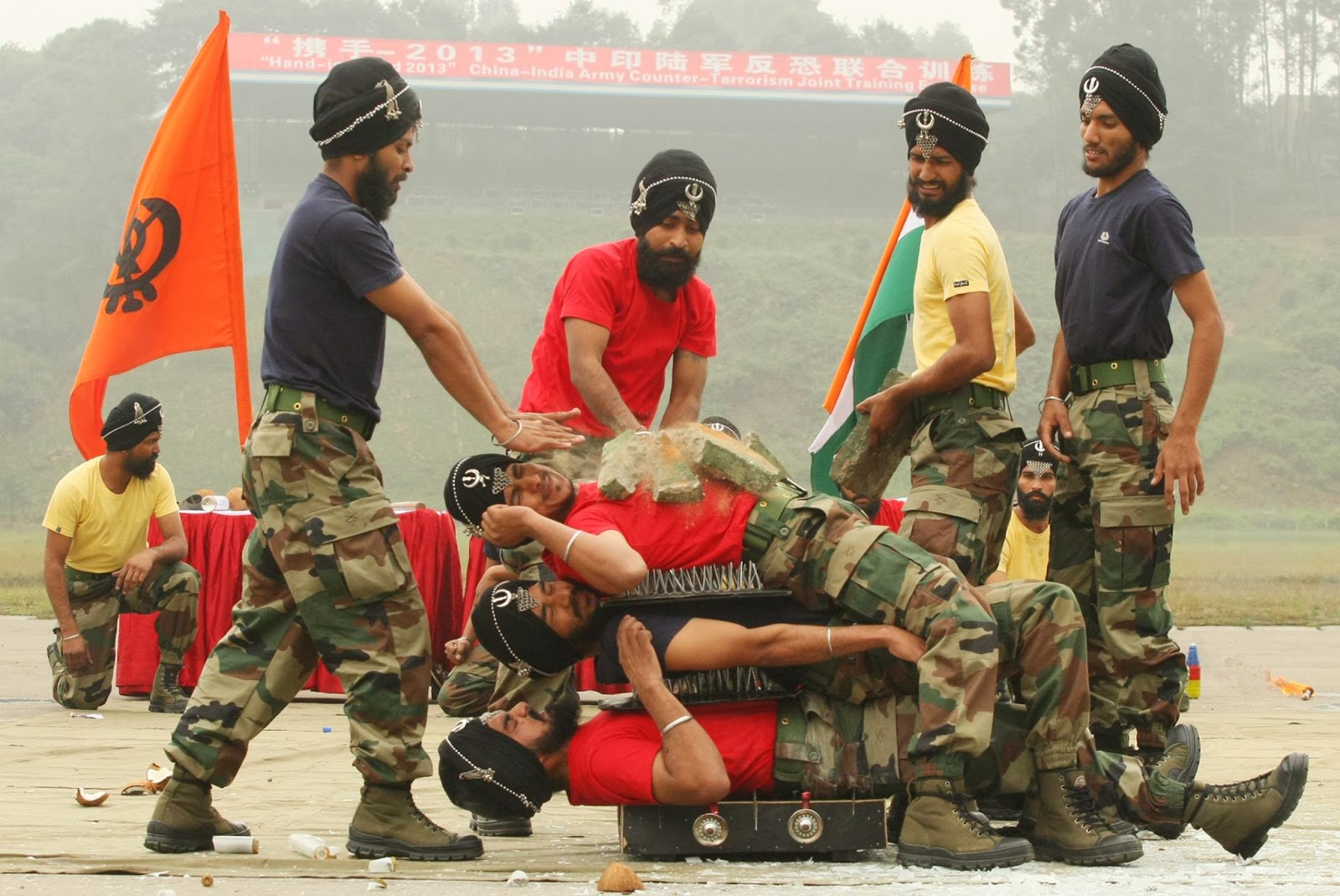
The Indian press as well as Xinhua and The Global Times have reported the joint military exchanges betwen India and China.
Xinhua wrote: "The Chinese and Indian armies started a joint anti-terrorism military training drill in Southwest China's Sichuan Province. During the training, code-named 'Hand-in-Hand 2013', participating soldiers will conduct drills in tactical hand signals, arrest and escort, hostage rescue and joint attack, as well as a comprehensive anti-terror combat drill. China and India each sent one company of 144 soldiers to participate in the drill."
This is third edition of the exercises between the two countries. The previous drills, under the same code-name 'Hand-in-Hand' were held in Kunming in China in 2007 and Belgaum in Karnataka in 2008.
This time, the 16 Sikh Light Infantry of India and 1st Battalion Infantry Division of 13 group PLA participated.
Chinese troops from the 1st Company of Infantry Battalion of Chengdu Military Area Command and the Indian Army troops from 8 Maratha Light Infantry Battalion took part in 'Hand-in-Hand 2008'.
The 'Hand-in-Hand 2007' involved 103 ground troops from the PLA and an equivalent number from the Indian Army belonging to 15 Jammu and Kashmir Light Infantry (JAK LI). It was held at the PLA's Kunming Military Academy in Yunnan Province.
There is a disturbing question: these anti-terror exercises are directed at who? At the Tibetans? At the Uigyurs who have been branded 'terrorists' after the recent Tiananmen incident?
Obviously, the official communique does not tells us.
Xinhua however mentions: "Yang Jinshan, head of a Chinese military observer delegation and deputy commander of the Chengdu Military Area Command of the People's Liberation Army of China, said the training is intended to exchange anti-terror experiences, enhance mutual understanding and trust, and boost cooperation between the Chinese and Indian armies."
Who is Lt. Gen. Yang Jinshan?
Lt. Gen. Yang Jinshan is a member of the all-powerful 18th CPC Central Committee
He is born in 1954 in Xi County of Henan Province. He joined the Communist Party in 1972. He headed the PLA’s Armament Department of Chengdu Military Region from 2007 to 2009. He later became Commander-in-Chief of Tibet Military District under Chengdu Military Area Command.
In November 2012, he was elected member of the Central Committee of China's Communist Party (CCP).
General Yang had become a major general in 2005 and a lieutenant general in 2011. He served most of his career in Chengdu (Sichuan) and Tibet.
He was (is) probably the PLA representative in the Central Tibet Work Coordination Working Group, the group which decides the Party's policies for Tibet and their implementations on the ground.
Today, General Yang is one of the 5 or 6 Deputy Commanders of Chengdu Military Area Command. He probably continues to look after Tibet affairs, which means all military/security issues as well as borders with India and Nepal. He also liaises with the People's Armed Police Forces as well as the Public Security Bureau and the Peoples' Liberation Army Air Force.
Here are some pictures of the successive 'Hand-in-Hand' exercises:


Pictures of the recent joint exercises