Showing posts with label Panchen Lama. Show all posts

Monday, July 13, 2026

Himalayan earthquakes


Hardcore Tibetan Communist Raidi with Chinese Panchen Lama
Once upon a time, Raidi was a powerful Tibetan Communist cadre. He was the leader of the Nagchu clique, ruling over the Tibetan plateau.
Now, he is honorifically titled, vice chairman of the 10th Standing Committee of China's National People's Congress, but he is very old.
Nonetheless, he recently sent a letter to the Tibet Autonomous Region’s government to “express his sympathies for the victims of the recent earthquake, offer his condolences to the relatives of those injured or killed, and pay his respects to the relief workers.”
Raidi explains to his comrades in the Communist administration that Tibet being located in “an alpine area, the mountains are high, valleys are deep, and the geology is complex”.
Relief work is therefore very difficult: “In such a serious disaster, it is really not easy to have achieved such results in the phased earthquake relief efforts."
Nothing wrong. Raidi then speaks of the massive 8.6-magnitude earthquake on August 15, 1950, whose epicenter was located in Metok County (Dzong) and Zayul Dzong.
Raidi recalled that he was 12 years old at that time: “At the quake’s epicenter, there were landslides from the mountains and the ground opened up, and the Yarlung Tsangpo (Siang/Brahmaputra) was divided into four parts. Some villages were thrown on the opposite of the river and houses collapsed. Even places that were far from the epicenter, like Lhasa, Chamdo, and Nagchu, were also greatly affected. According to incomplete statistics from the time, more than 2,000 people were killed, countless people went missing, and the disaster area was covered in ruins.”
Now comes the ideological part of the letter: “Tibet was still ruled by the old Tibetan government. Led by the 14th Dalai Lama, not only did the government not care about the lives of common people, but they also increased several taxes.”
Raidi’s conclusion is: "There is a sharp contrast between the earthquake relief in Old Tibet and in New China. …this shows that only under the leadership of the CPC, in a socialist society can the Tibetan people have the confidence, courage, and ability to overcome any disaster and rebuild their homeland. Thus Tibet, especially those areas affected by the recent earthquake, will achieve leapfrog development and long-term stability.”
There is no doubt that the infrastructure is very different today from what it was in 1950. In Nepal too, it is far easier to bring food, supplies, warm cloths to those affected by the tragedy. In 1950, Lhasa, without speaking of Metok or Zayul, located north of the McMahon Line, had never an ‘iron birds’, helicopters or planes.
But to compare the rescue operations during the recent tragedy and the ones, 65 years ago is unbecoming of a former senior Communist cadre. Mr. Raidi should have kept quiet. He probably does not realize that the progress in infrastructure, roads, airfields, transportation have been planetary and due to the Communist Party only.
By the way, the Chinese Panchen Lama (also a Nagchu native) has personally donated 200,000 yuan(32,300 US dollars), for the quake-affected areas, “to show his sympathy for the needy people.”
I am wondering how, under a Communist dispensation, Lamas can become rich, like their predecessors in Old Tibet.
How do they get richly-endowed labrangs (estates) like in the past?
Buddha too must be wondering: is what I thought my monks.

The 1950 Earthquake
To give an idea of the devastating 1950 Earthquake, known in India as the ‘Assam Earthquake’, I post the report of the famous British botanist Kingdon-Ward.

THE EARTHQUAKE 
(AUGUST 15, 1950) 

By F. KINGDON-WARD
A vividly-written account of an unforgettable experience.
The Author is a well-known Himalayan explorer, and describes how, while camping near the Tibetan frontier, he and his wife narrowly escaped with their lives from the havoc wrought by one of the most violent earthquakes on record.
Finishing an entry in my diary, I shut it and lay back in the deck chair near the entrance to our tent. On the camp table beside me the hurricane-lamp burnt dimly; my wife was already in her cot, half asleep. I told myself I must soon put out the light and turn in; we were due to start off again early the following morning, and a good night’s rest was essential. First of all, however, I wanted to lie back and relax for ten minutes, enjoying the comparatively cool night air. The date was August 15th, 1950, the time about 8 p.m. and the place the wilds of Upper Assam.
Everything seemed very quiet. Now and then a dog barked in the village of Rima, away behind us, and I could just detect the muffled echo of the river as it entered a narrow part of the deep gorge. Occasionally an owl shrieked somewhere close by.
Suddenly, as I reclined there in a semi-doze, the chair on which I sat, the table, and finally the tent itself began to shiver. Aroused, my wife sat up in her cot. A split second later the whole valley appeared to be convulsed, and the air was filled with a loud roaring. Involuntarily I sprang to my feet.
“What on earth’s that?” I asked, startled, and thrust my head out between the tent-flaps.
The high mountains were silhouetted against a riband of clear, star-flecked sky, but their outlines, instead of being sharp and hard, were strangely fuzzy. Meanwhile noise continued, becoming louder even as I stared about me in bewilderment. Then the dread truth dawned on both of us but it was my wife who put it into words.
An earthquake the cried, now thoroughly awake and forth with leaped from her bed. “Outside –quick!”
I seized the lantern, with some vague idea of a fire risk, and together we rushed out into the most awful pandemonium. The turmoil was terrifying. Mingled with the dreadful sound of the tearing and shearing of the earth’s crust came the roar of mountains that were apparently tumbling downing every direction. It appeared as though the very arch of heaven was falling.
Directly we left the tent a violent tremor threw us to the ground, and we felt the earth beneath us bucking and heaving madly. Every moment I expected it to split open and precipitate us into some yawning figure. Great rocks were crashing from the mountainsides; dust rose like the smoke of some vast conflagration, blotting out the stars. Meanwhile a rain of gigantic hammer-blows thundered on the ground below; it seemed that it must soon be pulverized into fragments.
Too frightened to move, we lay where we had fallen, with the familiar world around us breaking up bodily. For quite five minutes—minutes as long as years—mountains and valleys shook, shivered, and trembled to the accompaniment of ear-splitting sounds of destruction. It is impossible to convey an adequate idea of our sensations or the impression of overmastering terror and utter helplessness in the face of stupendous disaster.
At last, however, the earth-tremors began to die away. Then, quite suddenly, there came a series of five explosions high in the sky; they followed one another, loud and distinct, at equal intervals of a few seconds. The detonations reminded me of anti-aircraft shells bursting round enemy planes, but their effect was very different. Abruptly the shaking of the ground ceased, the last boulders rumbled down the mountains, the splintering trees stood firm. Even the river—which had roared like a wild beast in pain throughout the cataclysm—became quieter. There could be no doubt the earthquake was over.
What caused that extraordinary “gunfire” is a complete mystery. The explosions were heard on the plains of Assam, two hundred miles away, where the soft earth “wobbled like a jelly” during the worst phases of the quake.
We rose slowly to our feet, thanked to be alive and unhurt, but not yet quite sure that we were. Had we passed through some terrible nightmare, or had it all really happened? It seemed hard to believe it was an actual experience—but there was the dust which filled the air and now began to settle, silently and impalpably. It was in our eyes, our ears, our mouths; already it was lining our lungs and forming a grey film on our faces. For days thereafter we were eating dust as well as breathing it!
The quake was mercifully over, but its dread aftermath was only just beginning. From the village came no sound of barking dogs, no shouting of men. Had all those poor souls been killed? Fortunately, this was not the case, for presently there strolled into our camp the familiar figure of a villager of our acquaintance—and he had a broad grin on his face! I envied his stolidity, in the midst of this tremendous calamity he still contrived to remain cheerful! The sight of that simple Hillman put new life and confidence into us, and especially into our two Sherpa boys, who had been badly frightened.
Our friend told us that the village had been badly damaged, despite the fact that the houses—massively built of logs resting on solid stone foundations—were only one storey high. By great good luck, however, nobody had been killed.
“Let’s have some tea,” suggested my wife; there was no thought of going back to bed again after such an awakening. The wood fire was still burning, and we re-lit the lanterns. The stream from which we drew our water was only a dozen yards from the cook-house and boys’ tent, and one of the Sherpas took the kettle and went off. Next moment he gave a shout of dismay, and we all rushed towards him to see what had happened. The brook, which two hours previously had flowed swiftly along its bed, was now nothing but a trickle. Even as we watched it grew smaller and smaller.
    “Quick!” I shouted. “Bring buckets, saucepans—anything!”
We filled a couple of kettles and a pail, but only with difficulty, for the trickle soon died away to a mere thread and, finally, intermittent drops. Our water supply had vanished, and there was nothing we could do about it!
    We sat around sipping tea and talking for an hour. We still felt slightly dazed; it seemed incredible that these mighty mountains, rising ten or twelve thousand feet above our heads—the village in the gorge was itself 5000 feet above sea-level—should have been in the grip of a force which shook them as a terrier shakes a rat. The previous day they had looked as solid and immovable as the Rock of Gibraltar; now they were riven and shattered, their rocky slopes disintegrating like sand-dunes in a breeze.
Inside our tent, curiously enough, everything appeared exactly as it had done before the quake. Nothing was broken, nothing disarranged, even the aluminium tent-poles had not Shifted! The knoll on which our little camp was pitched had withstood the terrific shaking and battering unharmed, moreover-very fortunately for us—it had not been in the line of descent of the falling rocks. Thousands of huge boulders, dislodged from the mountainsides by the violent tremors, had leaped, bounced, and rolled down the steep slopes, snapping off stout trees like match-sticks. Any one of these flying masses could have demolished our tents and swept them away, leaving nothing but rags and shattered corpses to mark the site. Yet we had emerged scatheless!
Though the disturbance was over, there was as yet no reassuring restfulness about our surroundings. Those adjustments of the earth’s crust which inevitably follow a severe earthquake-especially in regions so notoriously unstable as the mountains on the Assam frontier—had still to come. We were blissfully unaware of the fact at the moment, but these minor movements were destined to continue for months! In our state of nervous tension, in the dust and darkness of that night of terror, it was enough for us that, practically every half-hour, the tortured ground gave a convulsive shudder. Each of these tremors—some of hall a minute’s duration—was accompanied by a roaring sound, like a great wind, and by fresh rock-falls close at hand, either on the opposite side of the big Lohit River or on our own bank, close to the village and camp.
Not knowing the ways of major earthquakes—indeed, we were ignorant as yet that it was a major earthquake—we feared a repetition of the major shock, and before venturing to lie down on our beds again we made careful preparations for a rapid get-out if necessary. There was no sleep for any of us during the remainder of the night, although I believe I dozed off once or twice for half an hour.
Meanwhile, in England, California, South Africa, and almost every modern city in the world, seismographs had been registering the greatest upheaval of the earth’s crust since these delicate instruments were invented. As a matter of fact, seismographs thousands of miles distant had been thrown off balance; they either ceased to record or the tremendous oscillations extended beyond the limits of the graph paper. Within a few hours scientists were hard at work trying to decide in what part of the globe this terrific cataclysm had occurred, and later the newspapers announced that there had been an earthquake of great intensity somewhere in north-east India. Not for several days was the real magnitude of the disaster realized.
Its “epicenter,” according to American physicists, was in the south-eastern corner of Tibet, about twenty-five miles from the frontier with Assam. The ‘quake shook the whole of Upper Assam, two hundred miles away, and must also have done the same with a large area in Tibet, but as this region is almost uninhabited no record of what happened there has come to hand.
Dawn arrived at last, and we got up and looked outside once more. Things appeared more or less normal. A bird was singing sweetly; in a nearby field a small boy was shouting to scare birds off the ripening crops. Presently, from the village, there emerged a file of old women and young girls plodding out to work, as they had done every morning for months. We felt very thankful; evidently the world was nor completely topsy-turvy!
Nevertheless, the sun rose on a scene very different from that on which it had set the previous evening. The flanks of the mountains were mutilated and torn asunder, the wounds gleaming white as snow against the prevailing green of summer. The broad terraces that led step by step down to the river—many of them cultivated—were now corrugated and fissured with deep cracks, sometimes raised, sometimes downwards. The high river-bank itself had slipped in a hundred places, piling up mounds of gravel. The village, in its bower of trees, appeared to be in ruins. It was true that the stout main timbers of the twelve or fifteen log houses still held firm, but every roof had gone, and flimsier erections lay flat. Many of the hapless cattle and pigs, shut up in pens that had collapsed, lay dead or dying—a sad loss to their owners. The monastery building lay on its side, hurried clean off its foundations, and a bottle-shaped chorten (religious memorial) had been stripped to its core.
The most amazing sight of all, perhaps, was the Lohit River, now a wildly-tossing sea of liquid mud which had suddenly risen several feet. On its turbulent bosom it carried innumerable great tree-trunks, plunging and tossing amidst huge waves, dancing madly in the swirling eddies, and rushing headlong through the gorge. Literally millions of big trees must have been uprooted or smashed; they passed in endless procession. The stench of the mud was horrible.
No less wonderful, though on a smaller scale was the spectacle presented by the minor tributary which swept swiftly down from the Burma border to join the Lohit at Rima. The previous afternoon it had been crystal-clear; carefully choosing the right place, one could easily have waded across it. Now, like the Lohit, it was just liquid mud—the colour of coffee—laced with froth, and considerably deeper. Three mills housed to timber cabins along its bank in ruins the primitive cantilever bridge that spanned it was in grave danger of collapse and shaking like a leaf. I shouldn’t have cared to essay a crossing.
We learned later that on the plains of Assam, two or three hundred miles from where we were, the earth had swayed sickeningly and sagged in many places. Over a wide area several buildings had fallen, railway lines had snapped, bridges had been shattered, and roads had sunk. On the whole, however, direct damage had been comparatively slight. But the damage had been comparatively slight. But the floods resulting from the damming of rivers far away back in the mountains, long after the earthquake was over, eventually caused the death of hundreds of people by drowning.
So much for external matters; I will now return to our own position. Once it was fully light we were able to get a better idea of the havoc the ‘quake had wrought, but we still had no idea of its extent and intensity. As the sun rose over the mountain ridge the air began to heat up, and the usual daily wind swept through the river gorge. Loosened rocks started to fall again, and soon the shaken mountains were disgorging avalanches of gravel and boulders, which swept down their slopes to the accompaniment to rise from these rock slides, spread far and wide by the wind until the sun was veiled and the mountains across the river, only a mile away, appeared dimly outlined through the choking fog.
Meanwhile, every hour or so, there was a terrifying subterranean rumble, after which the ground shook for several seconds. These earth-tremors felt—and sounded—exactly as though an enourmous train were rushing through a tunnel just beneath our feet.
You will already have gathered that when all this happened my wife and I were far away from anything representing civilization. It was three weeks before we were able to cross the flooded river and start our difficult homeward journey. This was because the rope bridge across the impassable Lohit had been destroyed and—with the stream in gigantic flood—it proved impossible to replace it. Even then it was nearly three months, after a series of adventures, before we succeeded in getting out of the mountains and safely back to the plains. Here we discovered that our friends had been exceedingly anxious as to our fate; even the Home newspapers had indulged in speculation as to what had happened to us. We learned also, for the first time, that we had been at the very heart of one of the greatest earthquakes on record—and, luckily, survived uninjured to tell our story!
From the strictly scientific point of view, however, all that occurred was the sudden collapse of a relatively small block of the earth’s crust a few miles down. Possibly the fracture was several miles long, and one half of it slipped downwards, thus creating a geological “fault.” On the other hand, the roof of some vast subterranean cavern may have given way, thereby jarring the upper crust. Nobody knows for certain; it is just a matter of theory. At all events, whatever its cause, the displacement produced the awe-inspiring phenomenon I have endeavoured to describe, and which my wife and I will never forget.

Thursday, July 10, 2025

‘Beijing Cannot Select Dalai Lama’s Successor’

A recording for the Gist

‘Beijing Cannot Select Dalai Lama’s Successor’ by Ramananda Sengupta

Even if China and the Tibetan clergy select rival Dalai Lamas, Claude Arpi felt a spiritual schism is unlikely. “The Tibetan people will not accept a Chinese-appointed figure,” he said


The High Stakes In Dalai Lama's Succession

My article The High Stakes In Dalai Lama's Succession appeared in Rediff.com

Here is the link...

On July 2 or July 6, the Dalai Lama will reveal his mind on his successor.
This makes Beijing extremely nervous as the Communist regime fully realises the importance of controlling the next Dalai Lama, points out Claude Arpi.

Nobody will disagree that the world is in turmoil; time seems to have accelerated on every continent and violence has reached every corner of the planet.

In India, we witnessed a four-day war between India and Pakistan, triggered by constant acts of terrorism from Islamabad; in the Middle East, a bloody war has been going on for months between Israel and Hamas; now a new conflict has erupted between Iran and Israel while there is no solution in view for the Ukraine-Russia war; yet while another bloody conflict may now take place between China and Taiwan for control of the rebel island.

In the midst of all this, a man preaches love and compassion (Ahimsa and Karuna) to other human fellows.

For 66 years, he lives as a refugee in India, his name is Tenzin Gyatso, he is the 14th Dalai Lama of Tibet, but also the leader of one million Buddhists from the Indian Himalayas (from Ladakh to Arunachal Pradesh) as well as several million Buddhists from every continent.

This man will turn 90 on July 6.

His followers are worried about his succession; what will happen if he departs for The Heavenly Fields? Will a 15th Dalai Lama replace him? Who will select him? These are still unanswered questions.

According to The Deccan Chronicle: 'The Dalai Lama will issue a message on July 2, days ahead of his 90th birthday and a hugely anticipated decision as to whether he will have an eventual successor.'

Earlier this year, the Tibetan leader released a book, Voice for the Voiceless, in which he asserted: 'Since the purpose of a reincarnation is to carry on the work of the predecessor, the new Dalai Lama will be born in the free world (outside China) so that the traditional mission to be the voice for universal compassion, the spiritual leader of Tibetan Buddhism, and the symbol of Tibet embodying the aspirations of the Tibetan people, will continue.'

It was certainly a shock for China who expects to control the succession process ... and the next Dalai Lama.

The Background


On October 7, 1950, Chinese troops crossed the Upper Yangtze and began their 'liberation' of Eastern Tibet, then known as Kham province.

Ten days later, after sporadic battles, Chamdo, the capital of Kham, fell and Ngabo Ngawang Jigme, the Tibetan Governor, surrendered to the Chinese without fighting.

It would take more than two weeks for the information to filter out.

Till October 25, the Tibetan government in Lhasa knew nothing, the Indian government had heard nothing, and the Chinese were keeping quiet; other governments, depending on India for news, were not 'informed' either.

On October 26, a brief communique of the New China News Agency (Xinhua) broke the news: 'People's army units have been ordered to advance into Tibet to free three million Tibetans ...the conquest of Tibet was a 'glorious task' which would put the final seal on the unification of Communist China.'

Hardly three weeks later in Lhasa, the Gods spoke through the Nechung State Oracle: 'Make Him King'.

Thus, Tenzin Gyatso was enthroned as the 14th Dalai Lama of Tibet at the young age of 15; the 'God King' became the temporal and religious leader of Tibet.

Nine years later, under mounting Communist pressure, the Dalai Lama had no choice but to take refuge in India, where he was received as an honoured guest by the Government of India.

In the early 1970s, the Tibetan leader started travelling all over the world; for more than five decades he would be instrumental in giving a concrete shape to the prophecy often attributed to Guru Padmasambha: 'When the iron bird flies and horses run on wheels, the dharma will come to the land of the red faces.'

The Dalai Lama tirelessly traveled to spread the Buddha's message of Love and Compassion.

Origin of the reincarnation system


Dusum Khyenpa, the First Karmapa Lama, was a disciple of the Tibetan master Gampopa, himself a disciple of the famous yogi and poet Milarapa.

The First Karmapa is said to have attained enlightenment at the age of 50; he then became known as the Karmapa.

The Second Karmapa, Karma Pakshi (1204-1283), was recognised as the reincarnation of Dusum Kyenpa, who had predicted the circumstances and time of his rebirth.

This is the origin of a system which has been prevalent in Tibet since then.

The Dalai Lama is 90 years old; due to his age and health, he has practically stopped going abroad; he remains most of the time in his residence in the Himalayan hill station of Dharamsala, north of Delhi.

In recent years, his succession has been widely debated in the media, the diplomatic and other circles.

Dalai Lamas 'reincarnate' in a young boy, who is then groomed to take over as the next Dalai Lama.

'Reincarnation' is, of course, the fascinating topic at a time when everything is 'scientifically' decided (and soon by Artificial Intelligence).

However, it entails a 20-year gap in spiritual governance, a period often used in the past by China to intervene in the Roof of the World's religious affairs; it does not seem to be a system adapted to our quick-changing world.

Traditionally, the Dalai Lama had two roles, one temporal (as head of the Tibetan State, though today in exile) and the other spiritual (guiding millions of Tibetans, but also Himalayan and foreign followers of Tibetan Buddhism).

In May 2011, the Tibetan leader decided to relinquish his secular power and offer it to the people of Tibet, who could thereafter elect their own 'political' leader.

Today, a Sikyiong or president runs the Tibetan administration from Dharamsala.

A few months later, on September 24, 2011, the Dalai Lama released a long statement about his succession, he mentioned two options: A traditional reincarnation (leaving written instructions how to find the reincarnation) or an 'emanation', which would mean the transfer of his consciousness and knowledge into a selected young boy (or girl).

In the same message, the Tibetan leader wrote that it was entirely his decision, though he would consult senior lamas: 'Reincarnation is a phenomenon which should take place either through the voluntary choice of the concerned person ... Therefore, the person who reincarnates has sole legitimate authority over where and how he or she takes rebirth.'

The 2011 statement further explained: 'When I am about ninety I will consult the high Lamas of the Tibetan Buddhist traditions, the Tibetan public, and other concerned people who follow Tibetan Buddhism, and re-evaluate whether the institution of the Dalai Lama should continue or not.'

It is what his followers (and probably the Indian Government too) are expecting to happen on July 2 or 6.

This makes Beijing extremely nervous as the Communist regime fully realises the importance of controlling the next Dalai Lama.

Already in February 2023, The Global Times, the mouthpiece of the Communist party, asserted: 'Recognition of new Dalai Lama must be conducted in China'.

It emphasised that the religious ritual for the selection of a new lama 'has been supervised by the Chinese Central Government and conducted within Chinese territory since the late 13th century', omitting that in the past 'religious rituals' (if any) for the recognition of the Dalai Lamas were conducted by Tibetans, not by the Communist party.

But half truths and blatant lies in Beijing's narrative continue: The Global Times dishonestly omits that the boy recognised as the Panchen Lama by the Dalai Lama was arrested and more than 30 years later is still in the custody of the Chinese government somewhere in China.

The Panchen Lama was the second highest lama in the Yellow School of Tibetan Buddhism.

Xi Jinping meets the Chinese Panchen Lama

On June 6, China's President Xi Jinping summoned Gyaltsen Norbu, the Panchen Lama imposed by Beijing, to Zhongnanhai, the official compound where live the Communist party's senior leaders.

Xi requested the young lama 'to make greater contributions to promoting ethnic unity and religious harmony.' The Chinese leader called upon the young lama to 'play an even better role in forging a strong sense of community for the Chinese nation, systemically promoting the principle that religions in China must be Chinese in orientation'.

In plain words, it means the 'Sinization' of Tibetan Buddhism and eradication of the Indian origin and influence in the spread of Buddhism on the plateau.

Many believe that the times of Dusum Kyenpa have gone and a gap of 20 years in spiritual governance is too risky; Buddhism should adapt to the modern world and a new system of succession should be devised, but ultimately, it remains the choice of the Dalai Lama alone and certainly not of any Marxist government to decide on this highly esoteric issue.

It remains that the planet needs a Dalai Lama.

Saturday, June 14, 2025

China is preparing the Dalai Lama’s succession

Gyaltsen Norbu, the Chinese Panchen Lama visits the Indian Border
north of Upper Subansiri (Arunachal)

China is at it again: “Recognition of new Dalai Lama must be conducted in China”, asserted an article in The Global Times on February 22.
The mouthpiece of the Communist Party explained that the China Central Television has already given a detailed historical account “of the search for the reincarnations of the Dalai Lama and Panchen Lama, who hold equal positions in Tibetan Buddhism. It emphasized that this religious ritual has been supervised by the Chinese Central Government and conducted within Chinese territory since the late 13th century.”
Not only have the Dalai Lama and the Panchen Lama never held ‘equal position’ on the roof of the World, but Tibet was not part of the Chinese territory before 1951 when Mao invaded it; further, in the past in Tibet ‘religious rituals’ for the recognition of the Dalai Lamas were conducted by Tibetans, not by Chinese (or the Emperor).
But half truths and blatant lies continue in Beijing’s narrative: “the reincarnation convention of Living Buddhas in Xizang was established during the Yuan Dynasty (1271-1368), developed in the Ming Dynasty (1368-1644) and improved during the Qing Dynasty (1644-1911) under the administration of the central government.”
‘Xizang’ is the new name given to Tibet. Like for the Tibet-Indian border, Beijing believes that by changing names, it can change historical facts.
The Global Times continues: “Since Xizang's peaceful liberation in 1951, the central government of the People's Republic of China showed its respect by preserving this convention and religious ritual. In 1995, the 11th Panchen Lama was conferred with his title by the central government through this strict religious ritual.”
The Global Times dishonestly omits that the boy recognized as the Panchen Lama by the Dalai Lama was arrested and more than 25 years later, he is still in custody of the Chinese government somewhere in China. Does Beijing believe that the world has forgotten?
The article then cites the ‘Measures on the Management of the Reincarnation of Living Buddhas of Tibetan Buddhism’ announced in 2007 by Beijing: “It stipulated that the reincarnation of Living Buddhas should not be interfered with or manipulated by any external forces.”
According to Beijing, the Dalai Lama has no say in his own succession.

Continuous Propaganda

On January 5, quoting so-called experts on Tibet issues, the same Global Times already announced: “The Chinese Central Government will support and guide the work of finding the successor of the 14th Dalai Lama and the successor, like his predecessors, will be finally approved by the Central government.” It added that this was “refuted reports from India media quoting Penpa Tsering, the current head of the ‘Tibetan government-in-exile’, who claimed that China will interfere with the Dalai Lama's succession.” This declaration shows that Beijing prepares itself to interfere in the succession.
Interestingly, the main ‘expert in reincarnation’ quoted by The Global Times is a hard-core Communist, Zhu Weiqun, former head of the Ethnic and Religious Affairs Committee of the Chinese People's Political Consultative Conference (CPPCC) who, a few years ago, derailed the negotiations between Beijing and Dharamsala: "For years, the Dalai Lama himself has been making lies to fool people who are not clear about history and the facts,", Zhu told the tabloid.
However, who is fooling who is clear. How an atheist ‘expert’ does suddenly becomes knowledgeable about the return of a boy’s soul on earth.

Concrete Steps taken?
More worrying than the persistent propaganda about the Communist Party new skills at finding ‘souls, are the concrete steps taken to announce the Dalai Lama’s return on earth.
Shi Taifeng, member of the Political Bureau of the CPC Central Committee and Minister of the United Front Work Department, met with Gyaltsen Norbu, the Chinese selected Panchen Lama on February 17 in Beijing.
The occasion (or excuse) was to ‘congratulate’ Norbu and Tibetan Buddhists for the Tibetan Water Rabbit New Year.
Shi Taifeng started by praising Gyaltsen Norbu for his progress in various domains, then he asserted that he “hoped that he [Norbu] would keep in mind the ardent wishes of General Secretary Xi Jinping and maintain a high degree of consistency with the Party Central Committee with Comrade Xi Jinping as the core in ideology, politics and action; play a leading and exemplary role, study and implement the spirit of the 20th CPC National Congress in depth.”
Does it mean that the Chinese-selected Panchen Lama is not trusted and remains a Tibetan at heart? Apparently, he does not fully understand and follow the ‘The Two Establishes’?
In Communist jargon, the Two Establishes are: "To establish the status of Comrade Xi Jinping as the core of the Party's Central Committee and of the whole Party and to establish the guiding role of Xi Jinping Thought on Socialism with Chinese Characteristics for the New Era."
Shi’s message clearly was, “you better follow Xi and the Party, otherwise…”
Beijing must still have in mind the 10th Panchen Lama, who was also selected and groomed by the Party in the 1950s, but openly declared in 1964: “Long Life to His Holiness the Dalai Lama”. He was subsequently jailed for 14 years.
Shi also told Norbu to “refine his knowledge and moral character, and make new achievements in upholding the Chinese orientation of our religion and promoting the adaptation of Tibetan Buddhism to socialist society.”

The Objective of the Communist Party
On the eve of Tibetan New Year, a Chinese government website, China News Service (ECNS) published an interview with Sheng Kai, vice president of Tsinghua University's Institute of Ethics and Religion, about the real objective of the Communist Government: the sinization of Tibetan Buddhism.
The journalist asked Sheng: “Since Buddhism was introduced from India to China more than 2,000 years ago, it has not only merged with Chinese culture and philosophy, but also deeply integrated into the daily lives of Chinese people without their noticing. Has the Sinicization of Buddhism been completed? Can the historical process be interpreted as the secularization and Sinicization of Buddhism?”
Sheng explained that Buddhism, though it came from India, it had “to be compatible with the traditional inheritance of Confucian and Taoist cultures, blended into the faith and belief of the Chinese ritual culture …so discussion of the historical connotation of the Sinicization of Buddhism means exploring the process and laws of Buddhism’s transformation from an alien civilization to Chinese religion…”
One of his conclusions is that Buddhism in China has four fundamental characteristics; the last being: “an integration of globalization and localization. As a result of the Sinicization of Buddhism, Chinese Buddhism is not only a local transformation of religious civilization from overseas [read India] but also a rediffusion to East Asia and Southeast Asia.”
Clearly Xi Jinping and the Party would like to forget that Buddhism came from India and transform it into a Chinese secular Marxist religion which would in turn spread in Asia.
The control over the succession of the Dalai Lama is the key for this plan.
Can Beijing succeed?

A Way Out
One solution to avoid controversies after the present Dalai Lama’s departure has been mentioned by the Tibetan leader himself in 2011.
The Dalai Lama spoke of the origin of the custom of recognizing ‘Emanation Bodies’ or ‘tulkus’; he further elaborated: “The main purpose of the appearance of a reincarnation is to continue the predecessor’s unfinished work to serve Dharma and beings.”
The Tibetan leader spoke of an alternative, which would be less disruptive: “Alternatively it is possible for the Lama to appoint a successor who is either his disciple or someone young who is to be recognized as his emanation.”
A problem linked to incarnations is that finding the new reincarnation can be manipulated at will; for example, serious doubts have been be raised about the authenticity of lamas such as Gyaltsen Norbu, the Chinese-selected Panchen Lama.
Viewed from a political angle, many issues would be solved if the Dalai Lama decides to go for an ‘emanation’.
He himself would select the next Dalai Lama and the Chinese would have nothing to say in the process; it would certainly bring far greater stability to the political scene of Tibetans in exile and the Himalayan belt.
But the final decision is the Dalai Lama’s choice.
In the meantime, India should clearly state that the 15th Dalai Lama will be a ‘guest of honour’ if he decides to come back to India, whether as a reincarnation or an emanation.

Friday, June 6, 2025

Hot Summer on the Tibetan Plateau

The political climate is hotting up on the Tibetan plateau.
Xinhua has announced that President Xi Jinping ‘accepted an audience’ with the Chinese-selected Panchen Lama Gyaltsen Norbu at Zhongnanhai in Beijing on June 10. The term ‘accepting an audience’ is a euphemism to say the least, because the ‘audience’ seemed more like summon-cum-lecture, I shall come back to it.
A few weeks ago, the United Front Work Department (UFW) of the Central Committee held a 3-day Conference in Beijing (from May 18 to 20) to take stock of China’s ‘internal threats’. The UFW usually deals with the ‘minorities’ such as Tibetans and Uyghurs as well as non-Communist Party organizations. The Conference decided to recruit ‘three types of people’ for ‘Party Work’. Who are these 3 types?
Xi Jinping named them: overseas students, media representatives, and ‘private’ businesspersons, like Jack Ma of Alibaba. A few days later, China Tibet Online asked a pertinent (for Beijing) question: “do overseas Tibetans count among the ‘three types of people’?”
The Tibetan Diaspora was painted in black and white: “Among the exiled Tibetans, only a handful of ‘high-ranking officials’ Tibetans can obtain the ‘nationality status’ or ‘green cards’ from their host countries, such as several Kalons (cabinet ministers) of the ‘Tibetan government-in-exile’. Most of the overseas Tibetans, especially those living in India and Nepal, are living in poverty and are basically dependent on others.”
However, the Party seemed keen to return to the Deng Xiaoping’s days, when China ‘opened-up’: “all patriots belong to one family …patriotism can be shown at any time”. These ‘patriotic Chinese’ should be given “the freedom to come and go, letting bygones be bygones” adding that “expatriate Tibetans are welcome to come home.”
It sounded like an open invitation to the refugees to return, ‘let the bygones, be bygones’. How many will take the ‘socialist’ bite in the present repressive atmosphere is another question.
The UFW Conference nevertheless “reiterated the bottom line that so long as overseas Tibetans are not involved in separatist activities, but safeguarding the unity of the motherland, they [should be] the targets of the united front’s work.”
This brings us back to the Panchen Lama’s invitation to Zhongnanhai.
He seems to be the No. 1 target of the UFW.
“Why did Xi Jinping meet with the Panchen Lama just now?” asked a Chinese website. But before answering the question, the article notes that the two leaders (Xi and Norbu) have already met in 2006, on the occasion of the first World Buddhism Forum in Hangzhou; then, when Xi, then vice-president went to Tibet in July 2011 and paid homage to the 10th Panchen Lama at the Tashilhunpo Monastery. Xi even offered a khata, a ceremonial scarf, on the tomb of the great Tibetan leader.
The article forgets to mention that for decades, Xi Zhongxun, the President’s father, had been extremely close to the 10th Panchen Lama and even wrote his official obituary in The People’s Daily, when the Tibetan leader passed away in mysterious circumstances in January 1989 in Shigatse.
The present meeting is ‘very appropriate’ says Xinhua, because it shows that the Party “has consistently given a high level of attention to Tibet.” It also indicates, says the news agency, “the great importance that the Central Committee attaches to the religious work,” affirming that Xi Jinping has “set an example for the rest of the Party members by taking the lead in uniting the religious figures.”
What happened during the Xi-Panchen encounter?
First, if one looks at the picture published by Xinhua, apart from Xi, three other members of the Politburo were in attendance (Yu Zhengsheng of the Standing Committee, Sun Chunlan, the UFW head and Li Zhanshu, director of the General Office of the Party); also present was Jampa Phuntsok (the senior-most Tibetan in the Party). Why such a rare lineup?
Apparently Gyaltsen Norbu needed to be briefed.
Xi did most of the talking. If bygones have to be bygones, the Party has to be reassured that those who are supposed to represent the Party understand properly the stand of the Party.
In Beijing’s game plan, Gyaltsen Norbu is destined to play a central role. He has been especially selected by Beijing from a family of faithful Communist cadres from Nagchu prefecture (let us not forget that the boy selected by the Dalai Lama as the Panchen Lama, has for the past 20 years been languishing under house arrest).
What will happen if Norbu, though groomed by the Party, behaves like the Great Tenth, who sent a 70,000 charcater letter to Zhou Enlai in 1962 criticizing the Party’ actions in Tibet and who, a few hours before his death, again asked, what good 30 years of ‘liberation’ had brought to Tibet.
A frightful thought for the Party!
Xi told Gyalsten Norbu to “keep the motherland and its people in his heart and firmly work for the unification of the country and all its ethnic groups.” Is there any doubt in Beijing’s mind?
The Panchen Lama was told that he is expected to grow into "a Tibetan Buddhist leader with great religious achievement, deeply loved by the monks and secular followers." Further, the young Lama should “carry on the legacy of his predecessor and actively engage in the cause to incorporate Tibetan Buddhism into socialist society under the Buddhist principles of equality and compassion among all beings.” This is a tricky one, because the 10th Panchen was a rebel, a courageous monk who never hesitated, at the cost of his own security, to call a spade a spade, even if it was a Party spade.
Gyaltsen Norbu was told to “promote positive Buddhist doctrines, such as those upholding kindness, denouncing wickedness, promoting equality and generosity as well as helping the needy.”
Am I dreaming: the Secretary General of the Communist Party, giving a religious lecture to a Buddhist monk!
Not a word about what the Lama said! It is rare in a Xinhua communiqué.
Clearly China is preparing the 6th Tibet Work Forum which, later this year, should decide on the new Tibet policy for the 5 or 10 years to come.
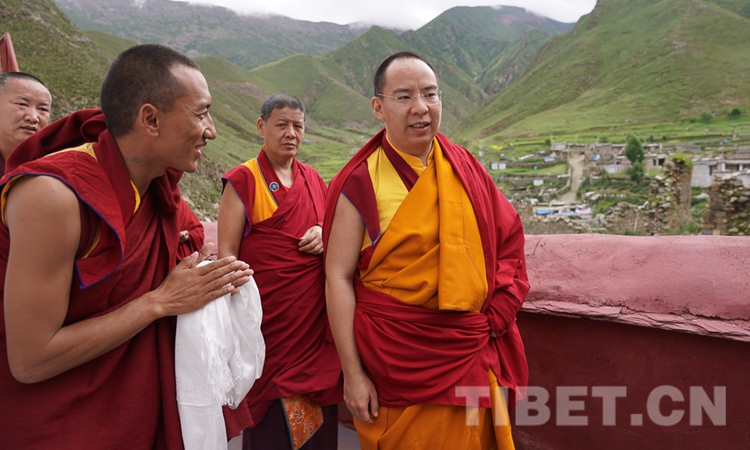
A few days earlier, Xinhua had reported that the Panchen Lama had concluded a seven-day tour in Yunnan Province where he visited several Buddhist sites. Two places are of particularly interest to decipher the role that Beijing would like the Lama to play.
The Zongfo Temple in Jinghong of Xishuangbanna Prefecture is a Theravada monastery, located in Yunnan, close to the Thailand border. The visit was clearly a political one as Beijing is keen to show that Norbu can take the lead not only of the Mahayana, but of the Hinayana Buddhism too. Beijing wants to use the young Lama for this purpose in the future.
The second ‘political’ important stop was at the Ganden Sumtsenling Monastery in Gyalthang county. It is the largest Tibetan-Buddhist temple in Yunnan. It has been linked to the Shugden practice denounced by the Dalai Lama. Does it mean that the Panchen Lama will lead an anti-Dalai Lama movement in the years to come? It is too early to say, but it was probably part of Xi’s ‘lecture’.
Where is the Dalai Lama in all this? In early June, China Tibet Online had asked “Will the Dalai Lama be united by the CPC?”
The website says: “In the 1950s, Chairman Mao Zedong often wrote to him and sent valuable gifts. However, after the rebellion in 1959, the Dalai Lama fled the country. What is more ridiculous is that recently he called himself a ‘Son of India’, even though he still has the Chinese nationality.”
Xinhua’s publication answers its own question: “The Dalai Lama does not seem to be a person who can be united. For decades he has not totally given up separatist activities. …he seems to be more a qualified force to be united by the United States and other western powers than by the CPC,” adding: “Furthermore, he is neither a patriot who supports socialism and the reunification of the motherland, nor is he dedicated to the rejuvenation of the Chinese nation.”
The conclusion is that only the Chinese Panchen Lama is left to do the ‘United Front Work, therefore the need of a high level ‘briefing’ in Zhongnanhai. Will it work, is a billion yuan question.

Sunday, July 24, 2022

Chinese Panchen Lama visits an 'Indian' Village

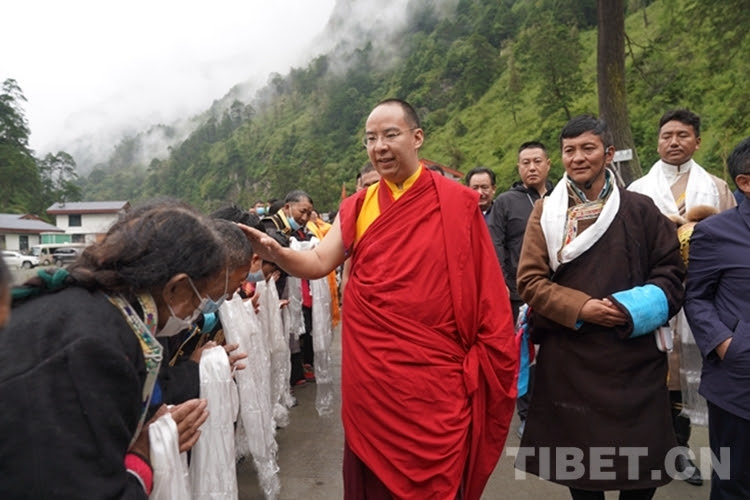
On July 22, China Tibet Network posted an article announcing that the Chinese-selected Panchen Lama (Gyaltsen Norbu) visited a village on the Indian border: “Panchen: Guarding the border is a great cause,” was the title of the article.
It mentioned the name of a 71-year-old Tibetan lady “wearing new clothes, wearing new hats and holding white khatas eagerly waiting, with faithful masses, in the fine rain,” for the arrival of the Lama
The name of the village as given by the article is Lowa.
It is probably a Tibetan translation for Lho(pa)-wa, i.e. Lhopa tribe village.
But the newly-built village is in fact Longju, the site of the first bloody clash between India and China in August 1959.

The line depicted on this map is the approximative LAC in the area.
though Longju is south of the International Border (IB)

For decades, India has considered the place, where the new village is located, to be in Upper Subansiri district of Arunachal Pradesh and not in Tsari Township of Lhuntse county in Lhoka prefecture as mentioned by the Chinese.
"Knowing that Panchen Rinpoche was today going to visit our village for inspection, we waited at the entrance of the village early in the morning, looking forward to seeing Rinpoche as early as possible," said the lady.
The article added: “On July 21 in the morning, the Panchen Erdeni [Chinese name for Gyaltsen Norbu] a member of the Standing Committee of the National Committee of the Chinese People's Political Consultative Conference (CPPCC), Vice-president of the Chinese Buddhist Association and President of the Tibetan branch of the Chinese Buddhist Association, came to Lowa New Village.”
The narrative continued: “The new village lying quietly at the foot of the Himalayas became lively with a strong smell of mulberry smoke in the air; the masses of believers welcomed him, bowed and prayed.”

Gyaltsen Norbu being explained the history of Longju

 Wang Shu [Wangchuk], the secretary of the Party Branch of the new village gave an introduction to the Panchen Lama about the situation in the new village.
According to China Tibet Network, the new village is located on the border at 2,735 meters above sea level, 7 kilometers from the seat of the township government (Tsari/Migytun): “in the village, two-story small buildings are lined up, staggered and greenery is found in front of each house with flowers in full bloom, a vibrant scene.”
The article admitted that the ‘Lowa’ new village is part of the ‘relocation’ scheme and new inhabitants arrived on January 15, 2021. Since then, more than 90 families have moved in.
The village Party Branch Secretary showed the Panchen Lama around and explained the construction of the new village on an exhibition board showing the new village's relocation; the role of the villagers, living in well-off houses, who have to guard the border and improve the rural revitalization conditions as well as the industrial and ecological development of the area.
The local Party Secretary added: “In addition to the high standard construction of well-off houses, the Party and the government also invested in the supply of water, electricity, telecommunications and other infrastructure facilities as well as the construction roads. It is supporting the construction of bamboo processing plant, Tibetan incense plant, greenhouses and other special industries.”

Meeting the 'masses'
Gyaltsen Norbu asked: “How many children do you have? Where do the children go to school? Where are the teachers from?”
He later went into the first floor of the Village Committee House and visited two households “to talk to the masses of relocated households to understand their living situation after relocation.”
"Going around the village, you can see that our current housing, living and other conditions which are particularly good," said the villagers.
The Panchen Lama looked at the happy smile on the face of the border people and told that they were different from others; your tasks to guard the border: “it is a great cause, you should feel the Party's grace, listen to the Party, follow the Party, to do a good job in the new era of garrison people, continue to work hard to guard the territory of the motherland. I believe your future life will be even better.”
The article mentioned that in 2021, the per capita disposable income of the new village of Lowa reached 25,804.08 yuan. It is pure propaganda as the village did not exist a few months earlier.
But in 2022, the villagers' income has doubled and more prosperous days are ahead, said one of the villagers while guarding the border is not only “our unshirkable responsibility, but also our glory, we firmly believe that under the wise leadership of the Party and the State, the new village of Lowa will have a better tomorrow.”

Blessing the 'masses'

At the end of the inspection, Gyaltsen Norbu walked out of the new village on foot, touched the heads of the villagers and gave his blessings to the religious people lined up at the entrance of the village, and presented the religious people in the village with enlightened Vajra knots, dharma photos and medals.”
No photos of the Dalai Lama, of course.
The article concluded that after receiving the blessing from Panchen Lama, “still many religious people who did not want to leave for a long time.”
One of the villagers said: “I didn't expect Rinpoche to travel so far to visit us in the village. Before, I had only occasionally seen Rinpoche on TV, but I never thought I could see him with my own eyes in this life.”
With tears in her eyes, the old lady immediately enshrined the picture of Lama on the altar of her house after returning home.
Probably along with the photo with Xi Jinping.
It is pure propaganda to show that Longju belongs to China, and the Tibetans are given the freedom to practice their religion, but where are the stupa, the gompas, the prayer flags, the prayer mills in the new villages.
Nowhere, but is clearly a provocation in retaliation against the Dalai Lama's visit to Ladakh.
But a poor retaliation, for the Dalai Lama there was a 10-km line-up in Leh, in Longju hardly 20 people, representing the 'masses'.

Wednesday, August 19, 2020

More Mysteries on the Roof of the World

Screenshot of Wang Yi's visit to the Indian border (north of Tawang district)
On August 14, a mysterious visit took place in Tibet.

Two days later, Beijing issued a communiqué mentioning that State Councilor and Minister of Foreign Affairs Wang Yi “conducted an investigation in Tibet and held discussions with leaders of the autonomous region party …Wang Yi introduced the current international situation and the main status of diplomatic work.”
It further emphasized that in recent years, the Tibet Autonomous Region (TAR) had adhered to the strong leadership of the Party Central Committee; the release continued with the usual stuff; complimenting the TAR leadership for following “the guidance of Xi Jinping Thought on Socialism with Chinese Characteristics for a New Era.”
Nothing mysterious in this.
As a good Communist, Wang Yi repeated the words of his boss, Xi Jinping, “Tibet's security and stability are related to the overall development of the party and the country and the diplomatic front could only work if the comrades of the TAR earnestly implement the party’s strategy for governing Tibet in the new era, establish the ‘four consciousnesses’ and strengthen the ‘four confidences’ to achieve the ‘Two Maintenances’.”
That is the usual Communist jargon.
The communiqué ended saying that during his visit, Wang Yi went to the border areas of Tibet “to conduct field investigations on poverty alleviation, border infrastructure and construction of well-off villages.”

Wang Yang in Tibet

So why call the visit ‘mysterious’?
For a number of reasons.
First, it was the third ‘important’ visit by a Chinese big shot to Tibet in the last five weeks.
On July 9, Xinhua reported that Wang Yang visited the mountainous region. Wang is a member of the all-powerful Politburo’s Standing Committee and chairman of the Chinese People's Political Consultative Conference National Committee; in other words, No 4 in the Red hierarchy.
Wang spoke of “continuous efforts to consolidate the foundations of enduring peace and stability in southwest China's Tibet.”
Please note ‘China’s Tibet’.
Do we need to write ‘India’s Tamil Nadu’ or ‘India’s Uttarakhand’?
Does it mean the communist leadership is not sure that Tibet is part of China? Otherwise, what is the need (apart from insecurity) to repeat this formula in every article or press release?
In Lhasa, Wang Yang observed: “The efforts should center on safeguarding the country's unity and strengthening ethnic solidarity, resolutely combating separatism, forestalling and defusing major risks and challenges and continuously consolidate the foundations of long-term peace and stability.”
Wang Yang, who spent three days in Tibet, did not speak of the situation in the frontier with Ladakh.
He visited several villages ‘relocated’ under the pretext of poverty alleviation, pastoral areas, industrial parks and religious sites in Shigatse and Lhasa.
During a symposium, he mentioned his favorite themes, “raising the social awareness of religious believers, as well as the promotion of patriotism to adapt Tibetan Buddhism to the socialist society.” In other words, monks should be good Communists.

Politburo Member Hu Chunhua in Tibet (with Che Dralha, TAR Governor)

Another visit
What makes Wang Yi’s visit strange is that another ‘important’ visit had taken place four weeks after Wang Yang’s.
From August 3, Vice-Premier Hu Chunhua, a member of the Politburo and head of the national leading group on poverty alleviation, also ‘inspected’ many sites in Tibet.
Two weeks later Chinese websites were still urging the Tibetans to “carry out the spirit of Vice Premier Hu Chunhua to extremely high altitude areas.”
Apparently, Hu, who served in Tibet several years ago “went deep into the eastern part of Ngari Prefecture, western Nagchu City and other extremely high altitude areas to investigate poverty alleviation and animal husbandry development.” He had to give feedback to the leadership assembled in the seaside resort of Beidaihe for the annual ultra secret conclave.
It was reported that Hu Chunhua went to the home of herders in the remote Dawa Village in Tsochen County in Ngari Prefecture to check the production and conditions of farmers and nomads living in high altitude areas.
It was probably the first time that these neglected populations met a politburo member (and for many, Xi Jinping’s heir-apparent).
The Chinese media reported that Hu ‘successively’ walked into the most remote counties of Ngari Prefecture; he went deep into villages, visited enterprises and grassroots organizations (incidentally, Hu speaks good Tibetan).

Heir apparent Hu Chunhua in Ngari?

 So, what was the need of a third visit?

According to The South China Morning Post (Jack Ma’s newspaper is fast becoming a mouthpiece for Beijing), Wang Yi’s visit to Tibet was to “send message to India over border dispute.”
The Hong Kong paper says: “China’s Foreign Minister Wang Yi made a rare visit to Tibet on Friday, including a trip to the disputed border with India, as the three-month military stand-off between the two countries continued to drag on with little sign of resolution. Although a terse statement issued by the foreign ministry did not mention India, Wang’s border trip was described by Chinese observers as an unusual and symbolic gesture.”
But there is more to the mystery of Wang’s visit.
Why was his ‘inspection’ not mentioned by the Chinese and Tibetan websites dealing with Tibet (contrary to the two earlier VIP’s visits)? After hours of search, I could only get a screenshot which appeared two days after the ‘important’ visit (soon after this was removed).
About the threat to India, Beijing seems to be shooting from The Post’s shoulders.
The ‘mysterious’ border area that Wang Yi visited is most likely Tsona county, north of Tawang district of Arunachal Pradesh.
Was the visit intended to remind India of 1962?
In which case, the Foreign Minister should have done some homework; despite the over-all defeat of the Indian troops, he should have known how valiantly some of the Indians troops fought on the front, just south of the place he visited, particularly the 2 Rajput battalion in the Namkha chu area who inflicted heavy causalities to the People’s Liberation Army; ditto in the east in the Walong sector or in Rezang la in Ladakh.
Would China decide to ‘teach another lesson’ to India, there will be many Rezang las or Walongs and this time, India would use its Air Force, without speaking of severe economic and political retaliations (Beijing could forget about its dear ‘One China Policy’) – Tibet and Taiwan could immediately be recognized by India.
There is no doubt that Wang Yi (who is also the Special Representative in the border talks between India and China and the counterpart of Ajit Doval, the National Security Advisor), has been sent by the top leadership who is bound to have discussed India’s stand in Ladakh.
What report could he give, he did even meet the top brass of the Tibet Military District, including the powerful Political Commissar Lt Gen Zhang Xuejie and the Commander, Lt Gen Wang Haijiang, who were nowhere to be seen during Wang’s visit to the border with India?
How powerful is such a message, with most of the Chinese media, particularly in Tibet, were banned to report about Wang’s visit?
Strange are the ways of a State which suddenly realized that it has taken a too big a piece to chew; if Xi Jinping thought that the Ladakhi adventure would a quick and easy one to digest, he has not probably fully read The Art of War of Sun Tzu.

The Chinese Panchen Lama prays in Jokhang Cathedral in Lhasa

 in ne One more important visit
That is not all; Gyaltsen Norbu, China’s selected Panchen Lama, described by Radio Free Asia (RFA) as “a senior Buddhist monk hand-picked by Beijing to replace a candidate more widely recognized by Tibetans as authentic,” is also on an ‘inspection’ in Tibet.
While the Panchen Lama recognized by the Dalai Lama is languishing in undisclosed place in Beijing, Norbu arrived in Lhasa on July 31; he was “greeted by Chinese authorities, students, and civil servants,” said the Chinese media.
The photos however show a handful of people around him.
On August 3, he went to pray at Lhasa’s Jokhang temple: “few in Lhasa appear to have been aware of the Panchen Lama’s visit,” wrote RFA, adding that “access to the Jokhang and Lhasa’s central Barkhor old town area are usu ally tightly restricted …but a few days ago even more police were deployed there than usual. Gyaltsen Norbu was probably visiting then. …Not many Tibetans know about the China-appointed Panchen Lama, and only those who don’t know his background will care much about him.”
All this shows that all is not rosy in ‘China’s Tibet’, the region is boiling.
And if the Communist leadership counts on the Tibetans to defend the Middle Kingdom’s frontiers, they may be in for an unpleasant surprise.

One more mystery
On August 1, I announced the transfer of Ding Yexian (No 4 in the TAR) to Qinghai Province.
I wrote: "The Communist Party of the TAR has a new Deputy Secretary; his name is Yan Jinhai. Yan has been transferred from the neighbouring Qinghai province where he served most of career. Yan, a Tibetan and is also an Alternate Member of the 19th Central Committee. Yan’s predecessor, Ding Yexian was a Han who served most of his career in Tibet."
Now, it looks like Ding is back in the saddle.
He was seen on August 18 chairing a meeting for the security during the forthcoming Shoton Festival.
What happened is one more mystery.
Probably, the authorities in Lhasa are nervous before the Festival and they required Ding's expertise and experience.  Hu Chunhua under whom Ding worked, may have put his foot down during his visit.
Now, where is Yan Jinhai? Mystery.

No huge crowds to welcome the Chinese Panchen Lama

Please note that while Wang Yi's visit was hardly covered by the Chinese media, Gyaltsen Norbu is in the press everyday.


Saturday, April 25, 2020

The Panchen Lama reincarnation

Twenty-five years ago, Gedhun Choeki Nyima, the Panchen Lama selcted by the Dalai Lama was arrested by the Chinese.
Since then he has been kept under detention by the People's Republic of China.

I found an old article that I had written on the subject of the Panchen Lama's reincarnation in 1995 for Blitz magazine.
It was a few months after his arrest.
It shows again that the Chinese are planning their moves well in advance, though their justifications are as lame today as they were yesterday.
How can an atheist Government be knowledgeable about something that they don't believe in?
Is it not a highly spiritual matter?
In the meantime, the young reincarnation of the Panchen Lama remains a prisoner in China. This is tragic.

By foisting its own Panchen Lama on Tibet, China commits Sacrilege
December 23, 1995
Does history always repeating itself? One can only hope that it will not in the case of the Panchen Lama. When at the end of 1950, the People’s Liberation Army (PLA) troops walked into the Eastern Tibetan province of Kham, a weak and divided Lhasa Government could not put up any resistance to the communist troops: it was the beginning of the “peaceful liberation” of Tibet.

A couple of months later, the Dalai Lama, his government and other officials from the big monasteries, had to flee Lhasa to take refuge at Yatung in the Chumbi Valley where the British had their trade mission, near the Indian border.  Soon the Communist Chinese became keen to officialise their occupation of Tibet by signing an agreement with Lhasa recognising that Tibet had been “peacefully liberated” by the PLA.
The only existing agreement on Tibet at that time was the Simla Agreement signed with Sir Henri McMahon after month­long negotiations in Simla between British, Chinese and Tibetan delegates. In order to erase this agreement at the earliest and to record as a fait-accompli the invasion of Tibet, in April 1951 Mao Zetong summoned Tibetan plenipotentiaries to Beijing to hold negotiations and sign a new agreement with the Chinese Communist government.
Two members of the delegation left Yatung the headquarters of the Dalai Lama and after a short stop over in New Delhi to seek the support of Nehru (which they did not get) proceeded to Beijing where they met the other members who had been brought from the occupied province of Kham. The leader of the delegation, Ngabo Jigme was at that time of the invasion the Governor of Kham and he had been a virtual prisoner of the Communist since October 1950.
The negotiations were scheduled to begin immediately but the Chinese refused to start unless the delegation recognised the new Panchen Lama born in Sining, China and chosen by them. Since 1942, the Tibetans had refused to accept the Chinese candidate as he was only one of the possible choices and he had not gone through any of the usual formal rituals and procedures to recognise an incarnate lama.
A few times, the Nationalist government unilaterally announced that their candidate was the official one and he was even once enthroned by the Chinese at the Kumbum monastery in the Eastern Province of Amdo, but the Chinese Communists (like the Nationalists earlier) knew that without the stamp of Lhasa it would be very difficult to get their choice accepted by the masses, thus their insistence on having their candidate accepted by Lhasa. For more than a month, Ngabo Jigme refused to cede to the Chinese pressure.
But at the end, he was forced to put his seal as he felt that it was the only way to come to the negotiating table.
However thereafter there were no further negotiations: a 17-point “Agreement for the Peaceful Liberation of Tibet” was signed under duress a few days later even though the Tibetan delegates who had objected to many points (in particular to the one referring to the role of the Dalai Lama and the Panchen Lama and putting them on the same level) were given no choice, but to paragraph the text.
The Dalai Lama and his Government in Yatung were informed much later by telegram of the agreement, when it was already too late. This was the result of an extremely weak Tibetan government dominated by the conservative power of the large monasteries who never had wanted to have contacts with the outside world, the lack of concern shown by great powers like the USA and India (Nehru always believed that China and India should be friends whatever will be the cost) and of a 15-year old Dalai Lama who was far too inexperienced to fight political masters like Mao or Zhou En-lai.
On December 8 1995, history seems to repeat itself once more: a Chinese candidate was imposed by the Communist Party on the Tibetan People and “officially” enthroned in the Tashi Lhunpo monastery in Shigatse, the second largest Tibetan town. The ceremony had been kept secret by the Chinese until the last moment as they feared the backlash of an angry Tibetan population at this unilateral imposition of their candidate.
The candidate, Gyaltsen Norbu had been chosen after a mock “Golden Urn” ceremony had been organised in the Jokhang Cathedral in Lhasa on 29th November by the dignitaries of the Communist Party. The parents of Gyaltsen Norbu are themselves said to be Communist Party members in Lhari. The usual traditional joy expressed by the Tibetan crowds when one of its high incarnate lamas (and specially the Dalai Lama or the Panchen Lama) has come back to our world to continue to fulfil his Bodhisattva vows to return again and again in order to help all sentient beings to be one day liberated from this world of suffering, was absent.
This time curfew was imposed in Shigatse, Lhasa and Chamdo, the three largest cities in Tibet and the boy had to be isolated under protection in one of the estate of the previous Panchen Lama in Shigatse after his arrival from Lhasa on 30th November. The high lamas, officials and monks of the Tashi Lhunpo were informed only on the eve of the event and threatened with dire consequences if they feign ill heath for not attending the enthronement.
The head of Religious Affairs in Beijing, Zhao Puchu had specially come from Beijing to supervise the ceremony and represent the Central government. More than 500 soldiers and members of the Public Security Bureau guarded the entrance of the monastery and screened the selected “invitees”.
The big difference with 1951 is that now the story has come to all the news agencies of the world and the wave of sympathy for the Tibetan Buddhist is widespread. Also this time the Tibetan people are united like never before around their leader: the Dalai Lama and firmly decided not to accept the “divide and rule” policy of Beijing. The fate of the Panchen Lama flashed for the first time in the news in May when on the occasion of the day of Buddha Poornima, the Dalai Lama formally announced that Gedhun Choeki Nyima, a six-year old boy from Lhari district in Tibet was the XIth Panchen Lama. This was the culmination of a long process started soon after the death of the Xth Panchen Lama in his Tashi Lhunpo monastery in 1989.
The Dalai Lama who had been performing different religious and spiritual practices for the past four years in order to recognise without fail the genuine reincarnation of the Panchen Lama, had been in touch with the Chinese-appointed head of the Search Committee, Chatrel Rinpoche who had twice consulted the Lhamoi Lhatso, the Lake of Vision in which signs are always seen to indicate the path to follow to discover the soul of a departed lama. For two years, the divination had indicated that the boy was already born in Tibet, but the time had not yet come to disclose more details. Each time this divination was confirmed by the Nechung, the State Oracle of Tibet and the Tsangpa Oracle who is specifically dealing with the Tashi Lhunpo monastery affairs. In 1994, the Nechung had confirmed that “if the Tibetans are united the incarnation will soon be found in Tibet.” It is only in early 1995, that the Dalai Lama through another divination found out that Gedhun was a “very good” candidate. It was confirmed during the following months and on May 13th, a last divination confirmed that his boy was the reincarnation of the Panchen Lama and that it was now time to announce it to the world. This was done the next day. The Chinese reaction was not long in coming. Infuriated that they had been out played by the Dalai Lama who had announced the name of the boy before them and also by the fact that the Search Committee chosen by them had passed information to Dharamsala without their knowledge, they immediately arrested Chatrel Rinpoche who is since missing and the newly recognised Panchen Lama was brought to Lhasa were he is still under house arrest. One interesting point to note here is that even after years of indoctrination, communist education and re-education, even though Chatrel Rinpoche had been specially chosen for his pro-Chinese sentiments, still at the end of the process he chose to refer the matter for the final choice to the Dalai Lama. It is symptomatic of the immense faith the people of Tibet from the most humble nomad to the greatest abbot keep in their tradition. It certainly reminded the world of the role played by the previous Panchen Lama who was born in China, chosen by the Party, educated by the Communists, “re-educated” in prison for more than 15 years and generally considered for years by Tibetans and Western Tibet watchers as a traitor, but who denounced the forty years of Chinese rule in Tibet in 1989 only four days before his mysterious death and thus becoming a hero for the Tibetans. The worse thing for the Chinese psyche is to publicly loose face, and after the Dalai Lama’s announcement they had definitively lost face (at least in their own eyes). This explains why the matter was taken up at the highest level of the State and Jiang Zemin and Li Peng personally took charge of the case. It was decided that no time should be lost to announce their own candidate. The name of Gedhun Choekyi Choekyi Nyima was immediately deleted from the list of possible candidates while only a few weeks earlier he was for the Chinese one of the very strong contenders for becoming the Eleventh Panchen Lama. For months the Beijing government did its utmost to rope in senior Tibetan lamas and monks to participate in the selection and denounce the Dalai Lama’s choice. Finally, on November 8, Jiang Zemin, the Chinese President received some 75 monks in Beijing. Most of these monks, said to have been hand-picked from Beijing itself, met in a conclave to nominate out of a list of twenty seven names the three candidates whose names would be put in the Golden Urn.  A French journalist reported from Beijing that “at this occasion, the television and the press have given a prominent place to the very unusual “family photo” of Jiang and four other members of the politburo (including the Army Chief Liu Huaquing in uniform) posing with the lamas.” The journalist added: “One could read on the faces of the religious men more reserve than enthusiasm and they did not appear to be as in a hurry as the officials”. The fact that a totalitarian communist regime could start dealing with the search of incarnated souls put a smile on the lips of many, except the Tibetans who were more and more concern about the fate of Gedhun Choekyi Nyima. The question could be asked as to why the Chinese leadership chose to have a confrontation with the Dalai Lama and the people of Tibet at this point of time. A few years back, the Chinese government had for the first time decided to recognise Tulkus (reincarnated lamas), when the head of the Kargyui-pa sect of Buddhism, the 17th Karma-pa was officially recognised by the Communist government. What is worth noting is that the Karma-pa had been discovered by one of his disciples, Situ Rinpoche while conducting the search in Tibet and was subsequently approved by the Dalai Lama after the appropriate tests had been performed. It is only later that the Chinese government “officially appointed” the boy as the 17th Karma-pa and enthroned him in Tsurphu, north of the Lhasa the traditional seat of the Karma-pas. The process could have been the same for the choice of the Panchen Lama as in any case the boy, being born in Tibet, was going to remain “in the hands” of the Chinese government. In the case of the Karma-pa, though he was recognised by the Dalai Lama, the Chinese has completely taken over his education and he is already been used for political purposes.
On May 1st, he was paraded with Jiang on the rostrum of Tiananmen Square on the occasion of the celebration of the Workers Day. More recently he was offered the latest luxurious Toyota by the Party Central Committee. The story of the Panchen Lama could have been similar, but for other reasons the Chinese leadership decided “not to loose face” and show that they were in full control of the situation. The draw from the Golden Urn was an easy and the only way out for the Chinese as it did not require any special religious qualifications to go through. Prof. Samdong Rinpoche, the Chairman of the Tibetan Assembly-in-exile immediately issued a clarification on this procedure which was very rarely used in Tibet.
He quoted for the purpose the previous Panchen Lama who declared in 1988 “according to Tibetan history, the confirmation of either the Dalai or the Panchen Lama must mutually recognised.” This was published in China Reconstructs, an official organ of the Chinese government. Four days before his untimely death in 1989, the Panchen Lama again said: “In the past most of the reincarnates were confirmed by the Father and the Son Aryas (meaning the Dalai Lama and the Panchen Lama).”
Prof. Samdong Rinpoche raised also the question which is in everybody’s mind: “Does the Chinese communist regime believes in the reincarnation theory as practised by Tibetans? If not, then the whole process adopted by them is a mockery of its own philosophy!”
Since many weeks, meetings have been organised in the great monasteries of Tibet to inform the monks that there would be serious consequences if any Tibetan accept the choice of the Dalai Lama.
Another report from Tibet says that the monks from two of the largest monasteries of Sera and Drepung were recently invited for a great prayer ceremony. But soon the monks saw a monk known for his Chinese sentiments distributing offerings followed by a battery of video cameras; they suspected some foul play and that the participation to the ceremony would later be shown as a celebration of the Panchen Lama’s recognition and their acceptance of the Chinese choice, they all walked out of the puja. In October, the Dalai Lama appealed personally to Jiang Zemin: “I am deeply concerned that the whereabouts of Gedhun Choekyi Nyima whom I have recognised as the incarnation of the late Panchen Lama are not known publicly since some time”.
I appeal to you for your government’s recognition to the young Panchen Lama”. The Dalai Lama in his letter further regretted that the proclamation “has further strained our relationship” and he recalled all the efforts he had made in the past years to communicate with and seek assistance of the Chinese government in the search of the reincarnation. “Unfortunately, there has been no response at all from the concerned officials of your government. On the contrary, to my great disappointment the concerned official of your government repeatedly made categorical statements that no involvement on my part will be tolerated... The recognition of the Panchen Lama’s reincarnation is in no way intended to challenge your Excellency’s government”.
The Dalai Lama concluded by another appeal to the Chinese President to seat on a negotiations table “I hold in firm belief that it is possible for us to find a mutually acceptable and beneficial solution on the Tibetan question. With this conviction, I have consistently endeavoured to enter in negotiations with your government any time, any where, keeping in mind the long-term and larger interests of both the Tibetan and the Chinese people”.
The response to the letter was that the Chinese government decided to go ahead with the confrontation approach even at the probable risks of law and order problems, riots, etc… in Tibet. If one observes the situation in China during the last few weeks and tries to read into it, one can see an hardening of the position of the Chinese leadership in three directions: vis-à-vis Tibet, Taiwan and the internal dissidence.
The main reason for this is that Deng Xiao Ping will soon pass away and the struggle for his succession has accentuated over the last months. Jiang Zemin, for the time being the favourite in the succession line has been recently travelling abroad and through his meetings with President Clinton and other heads of state in particular on the occasion of 50th Anniversary of the UN has established himself as a leader with an international stature.
But this does not seem to be enough to make of him the new emperor: he has to assure his basis in China itself and for this he has to remove the three thorns from the Communist government foot. Wei Jingsheng, the most prominent dissident was officially arrested on 21st November on the very serious charges of “engaging in activities to overthrow the government”.
Despite of the protests of many Western countries, scholars and human rights activists, the government declared that Wei was arrested in accordance with the country’s judicial procedure and that “on the contrary, some foreign organisations violated international standard by trying to interfere with the internal affairs of China.” The second case of hardening in the Chinese stand was shown when at the end of November the Xinhua News Agency announced army exercises including amphibious landing.
This was obviously targeted at Taiwan which was on the eve of the legislative polls. The Beijing’s’ TV showed clips proving that the exercises were meant to show that the armed forces were capable of defending the State sovereignty and integrity and safeguarding the unity of the motherland”. Clearly the Chinese government was trying to intimidate the voters to vote against the Kuomintang and the Democratic Progressive Party and give their favours to the pro reunification New Party.
Another compulsion that the future emperor has, is to deal with is the army. The strong feeling amongst the generals of the People’s Liberation Army was shown in a recent interview given by Lt. Gen. Xiong Guangkai an Assistant Chief of Staff to the New York Times. It has been a fact since 1949 that no leader can rule in Beijing without the strong support of the PLA.
The Panchen Lama episode should be seen in the same line. The future leader of China has to show that he has full control over the minorities and specially over the most restive ones: the Tibetans.
Another question in the mind of all the Tibetans and their well-wishers is: is the Panchen Lama’s “recognition” and enthronement a rehearsal for a more important recognition: the Dalai Lama’s. The Chinese always like to create precedents to be able to quote them later as historical tradition. A few weeks back the Beijing Review consecrated four pages in an article to show (with totally distorted historical facts) that the XIVth Dalai Lama had been himself recognised and enthroned by them.
The news that a Chinese spy ring was recently broken in Dharamsala added to the anguish that one day the Tibetans will have to face a succession crisis for their revered leader.
The only hope for the Tibetans now is that they remain united and that democracies like India, the European Community or the USA will take a strong position in favour of the young Panchen Lama.
Already two hundred members of the French Parliament issued an official protest against the Chinese actions and expressed their support for Gedun whom they agreed to sponsor as the youngest prisoner of conscience.
Could not the new Panchen Lama be offered asylum Fang Lizhi and many other dissidents who had to take refuge in the free world after the 1989 pro-democracy movement in China?