Showing posts with label Wang Yang. Show all posts

Friday, July 22, 2022

Hot 'Political' Summer on the Plateau

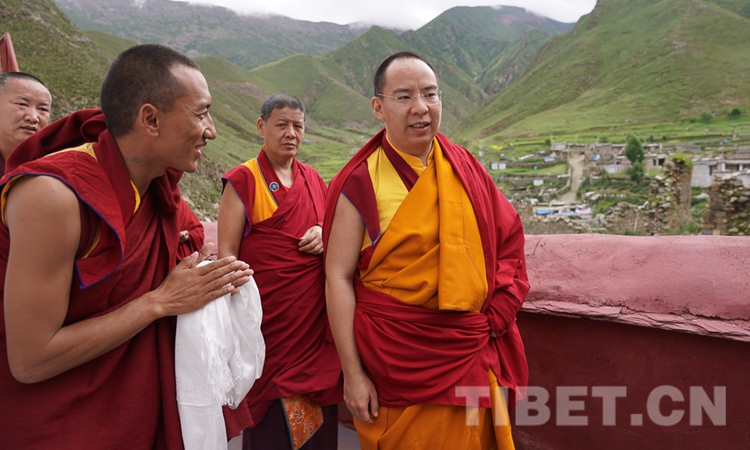
Wang Yang in Tibetan areas in Qinghai
In the recent months, several ‘important’ visits have taken place in Tibet.
One was of these visits was by Hu Chunhua, a member of the Politburo, a Vice-Premier of the State Council and head of the National Leading Group on Poverty Alleviation.
Last year in August, he had already 'inspected' many sites in Tibet.
Let us remember that at one point, Hu was Xi Jinping’s heir apparent.

In July 2021, Hu, who served several years ago in Tibet, “went deep into the eastern part of Ngari Prefecture, western Nagchu City and other extremely high altitude areas to investigate poverty alleviation and animal husbandry development.”
He had then to give a feedback to the leadership assembled in the seaside resort of Beidaihe for the annual ultra secret conclave.
At that time, it was reported that Hu Chunhua went to the home of herders in the remote Dawa village in Tsochen county in Ngari Prefecture to check the production and conditions of farmers and nomads living in high altitude areas.
It was probably the first time that these neglected populations met a politburo member.
The Chinese media had reported that Hu had 'successively' walked into the most remote counties of Ngari Prefecture; deep into villages while visiting enterprises and grassroots organizations (incidentally, Hu speaks good Tibetan).

Hu's 2022 Visit
According to Xinhua, Hu Chunhua was again on the ground in Tibet Autonomous Region (TAR) from July 1 to 4 “to supervise the work of consolidating and expanding the results of poverty eradication and revitalizing the countryside.”
Hu is said to have stressed the need “to thoroughly implement the spirit of General Secretary Xi Jinping's series of important speeches and important instructions, resolutely and forcefully consolidate and expand the results of poverty eradication, accelerate the comprehensive promotion of rural revitalization, ensure that there is no return to poverty on large scale, and strive to take the people out of poverty at even higher level.”
The ‘important’ speeches of Xi Jinping are leitmotivs in the Chinese official reports. Every officials, high or low has to pay homage to the Emperor.
The report of the news agency continues: “Tibet combines ethnic areas, border areas, high altitude areas in one, the development foundation is relatively weak, the task of consolidating and expanding the results of poverty eradication is very heavy. Hu Chunhua has come to Chamdo City, Biru County, Lhorong County, Pelbar County, Nagchu City, Lhari County, Lhasa City, Meldro Gungkar County.”
It was an in-depth field inspection for studying “poor village households, relocation community, agricultural products processing enterprises, schools and hospitals, etc.”
Hu Chunhua’s objective was to get a detailed understanding “of the employment of the masses out of poverty to increase income, the development of special agricultural and animal husbandry, the rural infrastructure construction and the public service development.”
The Vice Premier stated that “the areas out of poverty should continue to consolidate and expand the results of poverty eradication in the first place, so that the foundation of poverty eradication obtains more solid, more sustainable results.”
He encouraged the local leaders to rely on the plateau characteristic advantageous resources, “for better and stronger modern agriculture and animal husbandry, to speed up the development of agricultural products processing, the rural tourism and in order to realize the integration of the industries and the growth of the county rich people's industry, and promote the sustained income of people out of poverty.”
Hu has probably visited the area of Nagchu City (prefecture) from where large percentage of the population has been removed in order to be relocated South of Lhasa, near Gongkar airport (see our post last week). 

The objective of the Chinese government is said to “successively promote the development of ethnic areas, and promote the common unity and struggle of all ethnic groups, common prosperity and development.”
It is what Beijing says…

Wang Yang speaking to the children

Wang Yang Visit to Qinghai
A few days earlier, Wang Yang, a member of the Standing Committee of the Politburo and chairman of the National Committee of the Chinese People's Political Consultative Conference (CPPCC), visited several Tibetan areas in Qinghai Province “to research counterpart aid work for youth.”
During his tour, Wang, No 4 in the Party, stressed the need “to deeply understand the Communist Party's strategy for governing Tibet in the new era, adhere to the main line of casting a firm sense of Chinese national community, to bring innovative ideas for the youth-aid work, to enhance the comprehensive benefits of youth-aid, to help Tibet-related states and counties in their high-quality development, and not fall behind in the overall modernization process of the Chinese nation.”
From June 27 to 28, Wang went to Xining City (which had just come out a severe lockdown), Huangnan Tibetan Autonomous Prefecture; he also visited Shanghai-supported Xining Golok High School, Tianjin-helped Tsim Sha Tsui County Deji Village and other places. He wanted to understand the situation in detail, says the official report.
Wang asserted that since the 18th Party Congress (2012), provinces and cities as well as central state organs and central enterprises have implemented the directives of the Central Committee to support Qinghai: “to build a moderately prosperous society. …In the new journey, more attention should be helping the recipient to develop industries with special advantages as well as develop markets.”
Wang Yang urged the local cadres to make efforts to explore new approaches for ethnic minority areas and march towards modernization and common prosperity.

Learn Chinese and Blend
He also mentioned ‘intellectual support’ and the consolidation of the results of education assistance to Qinghai, i.e. helping people in ethnic areas to master the common language (read Mandarin): “More attention should be paid to encouraging ethnic minority people to go out, providing assistance for them to study, work and start businesses in the central and eastern regions, broadening the channels of income and wealth, and promoting exchanges and blending of ethnic groups.”
Wang Yang visited the Qinghai Tibetan Culture Museum, the Dragon Tree Painting Garden and ancient temples to understand the historical and cultural protection heritage.
The next day, Wang presided over a meeting on supervision and consultation over some key proposals concerning protecting and keeping alive the historical and cultural heritage in the course of planning and construction in urban and rural areas.
On June 29, Wang presided over a meeting for the supervision and consultation of some key proposals concerning protecting and keeping alive the historical and cultural heritage in the course of planning and construction in urban and rural areas.
He wanted that the CPPCC play its role in implementing related decisions and plans of the Central Committee. Wang further stressed that “from the height of enhancing historical consciousness, firm cultural confidence, in-depth understanding of General Secretary Xi Jinping on the protection of historical and cultural heritage heritage and effectively implement the relevant decisions of the Party’s Central Committee.”
Wang recommended that the revision of the Law on the Protection of Cultural Relics and the Law on Intangible Cultural Heritage should be accelerated, and local regulations be formulated to reasonably define the scope of protection and inheritance of cultural objects.
A census of historical and cultural heritage should be carried out and a database of immovable cultural relics should be established, he said and in order to strengthen the study of historical and cultural heritage, “excavate the historical stories, cultural values and spiritual connotations contained therein, to avoid the loss of its form and its essence.”
The Sinicization of Tibetan Buddhism, dear to Xi Jinping, was not mentioned.

Li Zhangshu inspecting an afforestation project

Visit of Li Zhanshu
Two more members of the Standing Committee of the Politburo visited Tibet around the same time that Xi Jinping was in Xinjiang.
First, Li Zhanshu, member of the Standing Committee of the Politburo and Chairman of the Standing Committee of the National People's Congress was in Tibet from July 12 to 15 “for research on ecological protection legislation on the Qinghai-Tibet Plateau.”
During his visit, he stressed the need to have a legislation to protect the ecology of the Qinghai-Tibet Plateau; his objective is “with Xi Jinping's thought of ecological civilization, to adhere to systematic protection, coordinated protection and special protection, and develop a good law that can stand the test of history and the people in the spirit of science.”
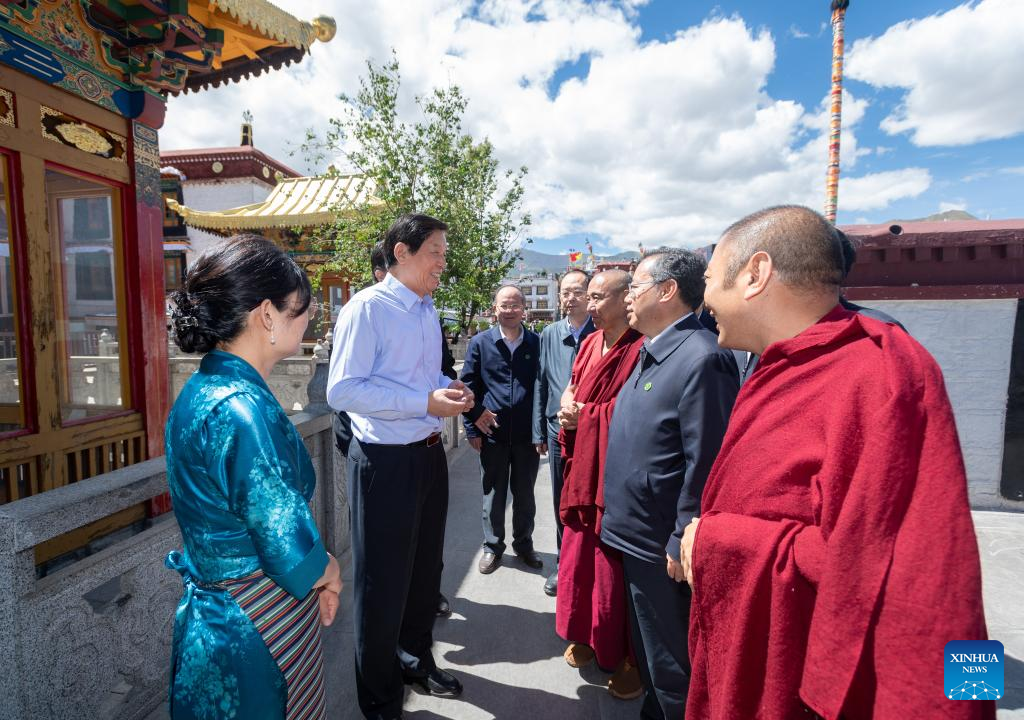
Li Zhanshu in the Tashilhunpo monastery

On July 13, Li Zhanshu went to Shigatse and visited the north bank of the South Woodland Ecological Demonstration Area of the Yarlung Tsangpo to investigate the planting of trees. He was accompanied by Wang Junzheng, the TAR Party Secretary.
Li Zhanshu inspected the protection of wetlands, river mudflats, reforestation projects, water resources protection, mine restoration among other things; during a forum, he listened to the views and suggestions of the stakeholders. He spoke of the great achievements made in ecological environmental protection on the Qinghai-Tibet Plateau, and discussed with everyone the key issues involved in the development of the new law.
Li Zhanshu noted that the Qinghai-Tibet Plateau Ecological Protection Law is a major initiative “to implement the important instructions of General Secretary Xi Jinping on the ecological protection of the Qinghai-Tibet Plateau: "The Qinghai-Tibet Plateau has a special ecological status and value, and plays an extremely important role in the national and even global ecological security."

Li Zhangshu In Tibet
A question could be asked: will tens of millions of tourists visiting the plateau every year conducive to the protection of the environment?


For Li, the Qinghai-Tibet Plateau Ecological Protection Law will be a special regional protection law, but its significance and impact will reach far beyond the plateau to which the law will apply; he said while drafting this law, it was necessary “to have a big picture of the overall situation and the very high altitude; the idea of the legislation is to support ecological protection policy initiatives and also reflect Tibet’s own characteristics.”
Li Zhanshu noted that to implement the new development concept, one should adhere to systemic thinking, in a scientific attitude and problem-solving spirit, in order to strengthen the protection, governance, restoration and risk prevention and control of each important ecosystem, and provide a strong rule of law protection for the ecological protection of the Qinghai-Tibet Plateau.”
Once again it sounds good (despite the verbiage), but what about the high speed development (roads, railway lines, airports) already started.
Li Zhanshu visited the Potala Palace, Jokhang Temple in Lhasa and the Tashilunpo monastery in Shigatse.
He said that “the most fundamental issue lies in the strong leadership of the Party Central Committee with Comrade Xi Jinping as the core, in the scientific guidance of Xi Jinping thought of socialism with Chinese characteristics in the new era, uncompromisingly put into practice the important statements of General Secretary Xi Jinping on the work of Tibet and the party's strategy for governing Tibet in the new era. It is necessary to further implement the strategic thought of "ruling the country must be ruling the border, and ruling the border must first stabilize Tibet", implement the Party's guidelines and policies on ethnic and religious work, make safeguarding the unity of the motherland and strengthening ethnic unity the focus and point of emphasis, achieve long-term peace and stability, and promote high-quality development.”
Li is clearly on Xi Jinping’s side in the power struggle ahead to the 20th Congress in November.
In Beidaihe, he will present a report on the ecological achievements of the General Secretary on the Plateau. The reality might be different.

Vice-Premier Han Zheng in Tibet

Han Zheng’s Visit
Xinhua also reported that Han Zheng, a member of the Politburo’s Standing Committee and Vice Premier of the State Council visited Nyingchi and Yushu in Qinghai province from July 14 to 15.
He stressed to unswervingly take the road of ecological green development and constantly promote high-quality development to achieve new results.
As usual, Han Zheng stressed the need to adhere “to the Xi Jinping thought of socialism with Chinese characteristics in the new era as a guide, in-depth implementation of the new development concept, unswervingly take the ecological priority, green development and solidly promote the construction of major projects and ecological protection, and constantly promote high-quality development to achieve new results.”
On July 14, Han inspection the Sichuan-Tibet Railway presently under construction (only the section between Nyinchi and Lhasa is completed).
Han Zheng went to the Serkhyem La pass at an elevation of 4.567m (14,983ft) above the sea level. The new railway line will go through a tunnel and the line will apparently run parallel China’s National Highway 318 (G318), also known as China-Nepal Highway and the Friendship Highway.
According to a website for tourists: “The road is asphalted. Usually impassable from October to June. The summit offers a breathtaking scenery. The road is long and arduous and crosses several mountain passes through remote areas, so you need to be prepared. Do not take this drive if you have respiratory problems or any type of heart condition. Notorious lack of oxygen that tests the organisms and a high degree of steepness. A major hazard of altitude is the sickness that can indiscriminately affect anyone regardless of age or fitness. The zone is prone to heavy mist and can be dangerous in low visibility conditions.”
This pass links Bayi and Bomi counties; on top of the pass, one gets the incredible view of Namcha Barwa (7756m) …when the weather is clear.
Han Zheng was shown an exhibition explaining the overall situation of the construction of the railway; he conducted a field inspection of the construction of the energy-saving and environmental protection features of the tunnel.
Han said that “the construction of the Sichuan-Tibet Railway will implement the new era of the party's strategy for the governance of Tibet a major initiative to promote the western region, especially the economic and social development of Sichuan and Tibet provinces.”
He added that during the construction of the project, everyone should adhere to the time and quality and to ensure the safety of the project. 

Han Zheng inspects the new railway line between Tibet and Sichuan

Probably more Worrying for India
Han Zheng first came to Milin County in Nyingchi City to “listen to the development of clean energy on the Yarlung Tsangpo River and he was briefed about the construction of the major hydropower development project.
Apparently, this refers to the mega HPP on the Yarlung Tsangpo, which has often been mentioned on this blog.
Han pointed out that “it is necessary to coordinate the rational development and utilization of water resources and protection, and build a national clean energy base. The construction of major projects should adhere to scientific evidence, comprehensive consideration of geological conditions, ecological environment and other multiple factors, and do a solid job in the preliminary work of the project.”
Han clearly bats for the giga project on the Yarlung Tsangpo, which will bring destruction in the Great Bent area ...and in India.
It means that China will go ahead with the project on the transnational river, which becomes the Siang in India and later the Brahmaputra.

The Sanjiangyuan National Park
The Sanjiangyuan (Chinese: Source of Three Rivers) is an area of the Tibetan Plateau in today’s Qinghai province; it is the headwaters of the Yellow, the Yangtze, and the Mekong which originate from this area. They come under the Sanjiangyuan National Nature Reserve (SNNR), or Three Rivers Nature Reserve.
According to Wikipedia: “The reserve consisted of 18 subareas, and each contained three zones which were managed with differing degrees of strictness. In 2015, the Chinese government decided to implement a new national park system, and created Sanjiangyuan National Park, which is set to open officially in 2020.”
To protect the grasslands, pastoralists are not permitted to graze their animals in designated called ‘core zones’ and grazing is supervised in the SNNR. In addition, residents have been resettled from these core zones and other grassland areas of the SNNR, and the rangelands have been fenced; they are in the process of being privatized throughout the Sanjiangyuan Area.
After his visit of the Yarlung Tsangpo, Han Zheng inspected the Yushu Ecological Environment Monitoring Center and was briefed on the ecological protection in Qinghai Province.
Han got a report on the construction of Sanjiangyuan National Park through the remote video monitoring system; he virtually visited the Sanjiangyuan projects, met grassroots cadres, he had a field inspection of the waters of the Tongtian River. He later went to the site of the Sanjiangyuan Nature Conservation Monument.
The Shi Chu (Tibetan) or Tongtian River is 1,012 km long; it flows within Qinghai Province. It is begins at the confluence of Togtog (or Mar chu) River and Dang chu River and flows towards southeast and becomes a Jinsha River near the border of Qinghai and Sichuan. The Jinsha River is a primary and westernmost tributary of the Yangtze River (‘Chang Jiang’).
Han Zheng noted the achievements of the construction of the Sanjiangyuan National Park; he mentioned the benefits of the project for the whole country, as well as for future generations.
He said that “to protect the Sanjiangyuan as the top priority of the construction of ecological civilization in Qinghai, to guard the natural ecology, conservation of natural resources, to protect the Chinese water tower.”
Han Zheng later went to the Qinghai Longbao (National) Nature Reserve where he interacted with the staff of the station.
The Longbao National Nature Reserve was established in 1986 and has an area of about 100 km2 covering wetlands and meadows. The reserve is located about 50 km northwest of Jyekundo, the Yushu County seat, lying just south of the highway connecting Yushu and Ritoe Counties. The reserve’s primary area of ecological importance is a wetland that is approximately 14 km long with a maximum width of about 3.5 km. The maximum depth of the wetland is reported to be about 4 m, but most of the wetland is generally much shallower. This wetland lies at an elevation of about 4,200 m in a broad mountain valley flanked by ridges that typically rise up to 750 m above the wetland. The wetland is fed by groundwater, streams, precipitation, and snow-melt, and it drains into the Yi Chu River to the northwest, a short tributary of the nearby Tongtian River.
Han Zheng stressed again the need “to actively promote the construction of wetlands, strengthen biodiversity protection, reduce human activity interference, promote the harmonious coexistence of man and nature, and continue to build a solid national ecological security barrier.”
The visit of the site of the mega HPP on the Yarlung Tsangpo should worry India.
In the meantime, a lot to discuss in Beidaihe next month...

HPPs on the Yarlung Tsangpo


Sunday, September 12, 2021

The Importance of Tibet – ‘Ethnic Work’ in Progress

My article The Importance of Tibet – ‘Ethnic Work’ in Progress has been published on the Chanakya Forum website.

Here is the link...

Why are Members of the politburo of the Communist Party of China’s (CPC) Central Committee so attracted by Tibet these days? During the last two months, ten out of the twenty-five members of the politburo travelled to the Roof of the World.

One remembers a Party Secretary, who later became Chinese President (and General Secretary of the CPC), who during his three years posting in Tibet tried his best to avoid to fly to Lhasa; the young Hu Jintao did not like the place. He once told a journalist that he “disliked Tibet’s altitude, climate and lack of culture”. During his tenure, he shuttled between Lhasa and Beijing where the real power was; there was a common joke about Hu amongst Tibetan cadres: ‘Where is Hu?’ The answer was: ‘Hu is in Beijing Hospital.’ He often reported sick each time he was going to leave Beijing!

That was some thirty years ago.

Today, ‘important’ cadres have to make sure that they are seen in Tibet.

Xi Jinping Visit to Nyingchi and Lhasa

The ‘Emperor’ himself, the ‘Core Leader’, Xi Jinping paid an ‘inspection tour’ of Central and Southern Tibet between July 21 and 23; it was his first visit to Lhasa after a gap of ten years, though he had visited the Northeastern province of Amdo (today Qinghai) in June.

Five members of the Politburo accompanied the General Secretary (concurrently serving as Chairman of the all-powerful Central Military Commission).

It is interesting to look at Xi’s delegation; the composition of a delegation is a clear indicator of the purpose of the ‘inspection tour’, especially in a system where the information is entirely monitored by the State and where watchers are left to read signs.

Xi’s Delegation from Beijing

First, Ding Xuexiang, CPC’s General Secretary and a Secretary of the Party Secretariat; he usually accompanies Xi on his visits/inspection tours. His role is to make sure that decisions are implemented and that there is a concrete follow-up.

Also regularly seen during Xi’s tours is Liu He, Vice-Premier and member of the Politburo. Liu further serves as Director of the Office of the Central Financial and Economic Affairs Commission. Liu He is Xi’s trusted lieutenant, who has several times been used to fill up the ‘perception’ gap between China and the US. He takes care of the financial aspects of the visit.

Yang Xiaodu is the Director of the National Supervisory Commission and also Deputy Secretary of the Central Commission for Discipline Inspection (CCDI) which makes sure that everybody follows the line of the Party. We shall see in a few months if a few heads roll; if it happens, Yang’s hand will certainly be behind.

Incidentally, during his early political career, Yang served several years in Tibet (1986-1992, Deputy Commissioner, Nagchu Prefecture; 1992-1995, Deputy Secretary, Chamdo, 1998-2001, vice-chairman, TAR government); Yang knows Tibet well, having served fifteen years.

One noted the absence of another Politburo member and old Tibet hand: Hu Chunhua; the Vice Premier was not on board for the visit. He had served in Tibet from 1983 to 2007 and is the only member of the Politburo who can fluently speak Tibetan. Probably, the emperor does not like to be in the shade.

Then Chen Xi, also a member of the politburo and head of the Organization Department and like Xi Jinping a graduate from Tsinghua University (they know each other since that time). Chen is President of the Central Party School and Vice-minister of Education and Vice Chairman of the China Association for Science and Technology. Xi clearly wants to bring modernity …to the borders with India.

The presence of General Zhang Youxia, Vice-Chairman, Central Military Commission (CMC), also member of the politburo is explained by the ‘important’ meeting between the CMC Chairman (Xi) and all the officers of the Tibet Military District (TMD), including the Commander and the Political Commissar of the Western Theater Command or WTC (based in Chengdu) which had a new Commander, Gen Xu Qiling. The WTC not only looks after Tibet but also the Ladakh front (incidentally Gen Xu Qiling lost his job since then, but we shall come back to this).

The CMC Chairman was certainly briefed in detail about the borders with India when he met the top brass of the Theater Command.

To this list of six members of the politburo, one should add He Lifeng, Minister in charge of the National Development and Reform Commission (NDRC), the equivalent of our Planning Commission. His presence means that a number of large projects, including the railway line between Lhasa and Chengdu and the Giga hydropower plants on the Yarlung Tsangpo will soon be undertaken. Xi was personally explained the implications of these projects while on the banks of the mighty river, which becomes the Siang and the Brahmaputra in India.

The People’s Daily resumed the tour’s objectives: “implement the Party’s strategy for governing Tibet in the new era and write a new chapter in long-term stability and high-quality development of the snow-covered plateau.” This refers to the 7th Work Forum held in August 2020 which defined the development policies for Tibet for the five next years, particularly the Sinicization of Tibetan Buddhism.

But undoubtedly, the emphasis was the military and economic development of the borders with India. An indication: in the Annual Report presented by the Tibet Autonomous Region’s government a few months earlier, the word ‘border’ was mentioned 54 times, while ‘Dalai Lama’ only once.

Xi Jinping wants to change the organization of the border for good; we shall see how.

Visit of Wang Yang in Tibet

But that was not all; on August 19, a central delegation led by Wang Yang, a member of the Politburo’s Standing Committee and chairman of the National Committee of the Chinese People’s Political Consultative Conference (CPPCC) arrived in Lhasa to attend the 70th anniversary functions. Wang is No 4 in the Communist pantheon.

One can ask, why not celebrate the so-called liberation when the ‘Core leader’, Xi Jinping visited Tibet in July. I have no answer to this.

Wang had been ‘entrusted’ by Xi Jinping to “lead Beijing officials in Tibet along with veteran senior Tibetan officials” to Tibet; a cohort of old Tibetan collaborators was honoured by the visiting VVIP.

Wang Yang was accompanied by Admiral Miao Hua, a CMC member, who will probably be the lone uniformed member to survive when the term of the present CMC comes to an end. It was the first visit of a three-star admiral in Tibet.

Did Wang and Miao knew that a few days later, Xi would change the commander of the Western Theater Command for the third time in nine months and Xu Qiling, who had met Xi a few weeks earlier, would be replaced by General Wang Haijiang, a former commander of the Tibet Military Region. Probably not.

The visit has also to be seen in the context of the CPC’s 100th anniversary and the 70th anniversary of the so-called Liberation of Tibet (read ‘invasion’).

Three more important visits

From September 2 to 4, Li Xi, Party Secretary of Guangdong and Ma Xingrui, Governor of the same wealthy province, visited Lhasa and Nyingchi “to earnestly study and implement the important speeches and instructions of General Secretary Xi Jinping’s inspection tour …[and] implement the spirit of the Central Ethnic Work Conference.”

Guangdong province economically helps Tibet, which for decades was considered remote and backward and out of range for modernization. The instability of the restive province and the importance of the border with India have changed all this.

From September 5 to 6, Cai Qi, also a politburo member and Beijing Party Secretary “led a Beijing delegation to Tibet to research counterpart support work and further promote exchanges and cooperation between Beijing and Tibet,” said a release.

The delegation wanted to “conscientiously implement the spirit of important instructions of General Secretary Xi Jinping’s important speech on his inspection of Tibet and a series of important instructions on Tibetan work and counterpart support work, and implement the spirit of the Central Ethnic Work Conference.”

Finally, Wang Chen, vice chairman of the Standing Committee of the National People’s Congress, was in Tibet from September 5 to 8 to be sure that the region had “a firm sense of Chinese national community” and to preach “for long-term stability and high-quality development of the snowy plateau.”

Ten visits of politburo’s members (plus two CMC members) have never been seen in the past.

Ethnic Work

Two words explain this new interest in Tibet: Ethnic Work.
This word has an ominous meaning. It practically means ‘sinicization’ of the Roof of the World, which includes building new ‘mixed’ villages on the Indian border, recruiting a large number of Tibetans in the PLA, and giving Chinese characteristics to Tibetan Buddhism.

On September 1, Xinhua had reported that the Central Party School started its Fall Training Class for Young and Middle-Aged Cadres. It was attended by Xi who gave an ‘important’ speech (his speeches are always ‘important’).

Xi recommended that cadres have a fighting spirit in the current situation; he said that at the present moment, “the world’s unprecedented changes have been accelerating and the great rejuvenation of the Chinese nation has arrived at a critical period. The risks and challenges that the CCP faces have increased significantly. It is impractical to dream of always living in a peaceful environment without taking on any struggles.”

He advised the young cadres: “dare to fight … at any time, Communists should have the bones and courage not to be afraid of anything, and not to yield to anyone.”

All this is quite ominous for India’s Northern borders.

Sunday, August 22, 2021

Wang Yang on the Roof of the Word

'Pigeons' flying over the Potala Square
What is the Liberation of Tibet?
China wants us to believe that it liberated Tibet 70 years ago.
It did not really happen like this.
It is true that on May 23, 1951, Tibet and China signed an ‘Agreement on Measures for the Peaceful Liberation of Tibet’; it is also known as the 17-Point Agreement. But it sealed the invasion of Tibet, not its 'liberation'.

The 17-Point Agreement
In his memoirs, the Dalai Lama has said that the Agreement had been signed 'under duress' and that the seals on the Agreement had been forged.
When he crossed the Indian border in March 1959 and reached Tezpur in Assam, the Tibetan leader denounced the Agreement.
He stated (using the third person) that in any case, the Chinese never respected the accord:

In 1951, under pressure of the Chinese Government, a 17-Point Agreement was made between China and Tibet. In that Agreement, the suzerainty of China was accepted as there was no alternative left to the Tibetans. But even in the Agreement, it was stated that Tibet would enjoy full autonomy. Though the control of External Affairs and Defence were to be in the hands of the Chinese Government, it was agreed that there would be no interference by the Chinese Government with the Tibetan religion and customs and her internal administration. In fact, after the occupation of Tibet by the Chinese armies, the Tibetan Government did not enjoy any measure of autonomy even in internal matters, and the Chinese Government exercised full powers in Tibet's affairs. In 1956, a Preparatory Committee was set up for Tibet with the Dalai Lama as Chairman, the Panchen Lama as Vice-Chairman and General Chang Kuo Hun [Zhang Guohua] as the Representative of the Chinese Government. In practice, even this body had little power, and decisions in all important matters were taken by the Chinese authorities. The Dalai Lama and his Government tried their best to adhere to the 17 Point Agreement, but the interference of the Chinese authorities persisted.
Later on June 20, 1959, in a press conference in Mussorie, the Dalai Lama was more explicit. He explained:
To understand and appreciate the significance and implication of the recent tragic happenings in Tibet, it is necessary to refer to the main events which have occurred in the country since 1950.It is recognised by every independent observer that Tibet had virtually been independent by enjoying and exercising all rights of sovereignty, whether internal or external. This has also been impliedly admitted by the Communist Government of China, for the very structure, terms and conditions of the so-called agreement of 1951 conclusively show that it was an agreement between two independent and sovereign States. It follows, therefore, that when the Chinese armies violated the territorial integrity of Tibet they were committing a flagrant act of aggression. The agreement which followed the invasion of Tibet was also thrust upon its people and government by the threat of arms. It was never accepted by them of their own free will. The consent of the government was secured under duress and at the point of the bayonet. My representatives were compelled to sign the agreement under threat of further military operations against Tibet by the invading armies of China leading to utter ravage and ruin of the country. Even the Tibetan seal which was affixed to the agreement was not the seal of my representatives but a seal copied and fabricated by the Chinese authorities in Peking, and kept in their possession ever since.
But today the Chinese authorities are using this event to celebrate the 'Liberation of Tibet'.

Wang Yang arrives at Gongkar Airport

Visit of Wang Yang in Tibet
Strangely, the Chinese Communist Party (CPP) has decided to celebrate the May-23 event in August. Beijing was probably too nervous in May.
God knows!
On August 19, a central delegation from Beijing, led by Wang Yang, a member of the Standing Committee of the Political Bureau and chairman of the National Committee of the Chinese People's Political Consultative Conference (CPPCC) arrived in Lhasa to attend the 70th anniversary functions.
Wang is No 4 is the Communist pantheon.
One can ask, why not celebrated the so-called liberation when the ‘Core leader’, Xi Jinping visited Tibet in July.
There is no answer to this.

Photos quickly circulated of Wang putting a khata around his own neck (strange tradition) and waving to the crowds “as the delegation was warmly welcomed at the Gongkar Airport by representatives from various ethnic groups and from all walks of life,” said Xinhua.
The Chinese agency further reported: “In the afternoon, Wang led the members of the central delegation to the Tibet Museum to attend the opening ceremony of an exhibition on achievements made during the 70 years”.
The exhibition includes “the peaceful liberation [1951], the democratic reform [1959], the establishment of the autonomous region [1965], the socialist construction, the reform and opening-up [1978], and the new era [Xi Jinpng’s], showcasing the significant progress achieved in Tibet's economic and social development under the leadership of the CPC.”
Wang had been ‘entrusted’ by Xi Jinping to “lead officials in Tibet along with veteran senior Tibetan officials” to Tibet: “Wang recognized the high reputation they enjoy among various ethnic groups and their important contributions to developing Tibet,” said a release.

Congratulating the Gang of Five
The Gang of Five Tibetan Communists
The ‘Gang of Five’ was Padma Choeling, a former Governor of Tibet and presently Vice Chairman of the Standing Committee of the National People's Congress (NPC), Phakphala Gelek Namgyal, the first ‘rinpoche’ to join the Party in the early 1950s, Legchok, a former Deputy Secretary of the TAR, former Red Guard Pasang and Ngabo Tenzin Jigme, representing his father the famous collaborator Ngabo Ngawang Jigme.
Xinhua noted that the CPC Central Committee, the NPC, the State Council, the CPPCC and the Central Military Commission (CMC) congratulated Xi Jinping by unveiling a plaque on which "Building a Beautiful and Happy Tibet and Fulfilling the Dream of Great Rejuvenation [of China]" was engraved.
The agency added that “20,000 cadres and masses of all ethnic groups gathered on the Potala Palace Square on the morning of the 19th to warmly celebrate the 70th anniversary of the Peaceful Liberation of Tibet.”

Wang Yang and Wu Yingjie and Lobsang Gyaltsen (in Tibetan attire)
Wang Yang then gave a speech.

Xinhua said: “The ancient city of Lhasa is full of colorful flags, flowers and a joyful and festive atmosphere everywhere. Under the majestic Potala Palace, set up a podium in Tibetan style. Above the podium, the solemn national emblem and the banner of "Celebrating the 70th anniversary of the Peaceful Liberation of Tibet" stood out, and the background wall was hung with the emblem of the big celebration and the words ‘1951’ and 2021’ and 10 red flags on both sides. On the Potala Palace Square opposite the podium, people of all ethnic groups dressed in festive attire gathered here early from all directions, waving flags and bouquets in their hands, converging into a sea of joy.”
However, the faces were rather grim in the audience, although the ‘masses’ had to clap from time to time to the speech of Wang and others.
An interesting aspect of the ‘celebration’s was the composition of the delegation.
You Quan, minister of the United Front Work Department (UFWD) who deals with minorities (and Tibet in particular) accompanied Wang. Other delegates were Padma Choeling, Zhang Qingli (who infamously called the Dalai Lama, a ‘wolf in monk’s garb when he was serving as TAR Party Secretary) and presently Vice Chairman of the National Committee of the CPPCC and more importantly for India, Admiral Miao Hua, member of the Central Military Commission and Director of the CMC’s Political Work Department.

The Speech: from darkness to light
Under a warm 'applause' (a bit forced?), Wang Yang delivered a passionate speech, said Xinhua; Wang Yang observed that “the Peaceful Liberation of Tibet in 1951 was a major victory for the cause of liberation of the Chinese people and the unification of the motherland, and an epoch-making historical turn for Tibet. Since then, Tibet has embarked on a path from darkness to light, from backwardness to progress, from poverty to affluence, from autocracy to democracy, from closed to open, and a thriving new socialist Tibet stands tall at the top of the world.”
It sounds upanishadic!!
Wang mentioned the infamous Xiaogang villages on the border with India: “After persistent efforts, 628,000 poor people have all been lifted out of poverty, 266,000 people have been relocated from the bitterly cold land in the high mountains to live and work happily in river valley towns, and Tibet has joined the nation in building a moderately prosperous society on schedule.”
According to Xinhua, Wang Yang pointed out: “today the world is experiencing a major change that has not been seen in a hundred years, China is at a critical period to achieve the great rejuvenation of the Chinese nation, a new journey to build a modern socialist country has begun, and the economic and social development of Tibet also stands at a new historical starting point. 

Happy? Unhappy?

The Tibetans warned
Tibetans were however warned, they need to “fully implement the party's strategy for governing Tibet in the new era, conscientiously implement the decision and deployment of the party central committee, and strive to write a new chapter of long-term stability and high-quality development on the snowy plateau.”
Wang concluded “…let us closely unite around the Party Central Committee with Comrade Xi Jinping as the core, carry forward the great spirit of building the Party, inherit the ‘Old Tibet Spirit’ [the invasion of Tibet in 1950/51] and ‘Two Roads Spirit’ [the Sichuan-Tibet and the Qinghai-Tibet highways opened in December 1954], build a new socialist modernized Tibet that is united, rich, civilized, harmonious and beautiful, and make unremitting efforts to realize the Chinese dream of great rejuvenation of the Chinese nation.”
There was no mention of the Dalai Lama, Beijing’s bête noire.

The Tibet Military Region, the Tibet General Force of the Armed Police, the TAR Political and Legal Department and the Tibet Branch of the Buddhist Association of China were congratulated.
It was noticed that the Chinese–selected Panchen Lama, Gyaltsen Norbu who is President of the Tibet Branch of the Buddhist Association of China, only furtively appeared in the TV reports.
he is clearly not in Beijing's good papers, though his services will be needed for the succession of the Dalai Lama.

Lt Gen Wang Kai, the commander of Tibet Military Region, one Tenzin, ‘representing the masses’ and Liang Nangyu, the representative of Tibetan aid cadres, also spoke at the function. 

Adm Miao, Padma Choeling, Wang, You Quan and Zhang Qingli (behind Wang is Red Pasang)

A Grand Gala
Later in the day, a ‘grand gala’ was held to celebrate of the so-called Peaceful Liberation of Tibet.
Xinhua reported that in the afternoon of August 19, Wang Yang watched the cultural performance 'Tibetan Children's Heart to the Party', together with more than 600 cadres and people from all walks of life in the TAR.”
However, the Chinese Panchen Lama was missing in action. He was probably unhappy to have been relegated to the third row in front of Potala in the morning; he played a very marginal role during the entire visit, it was noted.
The CCP’s mouthpiece continued: “The performance reflected the glorious course of Tibet from peaceful liberation to prosperous development over the past 70 years through the first part ‘Sunshine Shines on the Plateau’, the second part ‘Striving for a New Era’ and the slogan ‘Always Follow the Party’, showing the great importance and deep concern of the Party Central Committee to Tibet with Comrade Xi Jinping as the core, and expressing the boldness of Tibetan people of all ethnic groups to unswervingly follow the Party and strive for building a new socialist modernized Tibet.” Propaganda is Thy Name.

Inaugurating the Nagchu-Yangpachen section of the Beijing-Tibet G6 highway
Visit to Nagchu
“With comrade Xi Jinping as the core of the Party Central Committee's cordial care and the fond wishes of the people of the country”, Wang Yang and some members of the Beijing’s delegation visited Nagchu City (earlier called Prefecture); they visited the cadres and masses of all ethnic groups in Nagchu, continued the propaganda.
Wu Yingjie, the TAR Party Secretary accompanied Wang and his colleagues.
Xinhua observed: “Early in the morning of the 20th, Wang Yang and his party took the train to Nagchu City. Once off the train, the central delegation took a car to the Seni County ecological animal husbandry industry demonstration base. Wang Yang walked into the shed, detailed understanding of the base intelligent forage planting, yak dairy products traditional processing, etc., the base to drive the employment of farmers and herdsmen, to promote the local people's income practice affirmed.”
Here again, he left behind a plate with the inscription sent by Xi Jinping, "Building a beautiful and happy Tibet and fulfilling the dream of great rejuvenation". 

Wang Yang, Zhang Qingli, Zhuang Yan, Adm Miao, Wu Yingjie

Visiting some projects
Wang Yang is said to have inspected the grass-roots party organization construction work in Dronyi (Gemar) village, Gemar Lhoma town, Seni county. The usual propaganda speeches were given: “Hangjia Middle School in Seni county, built in 2017, is the largest single project in Zhejiang Province's 13th Five-Year Plan to aid Tibet, with more than 2,000 students, and the new semester has begun. Wang Yang came here to learn more about the work of education aid to Tibet, hoping to continuously improve the level of education in Tibet, so that more children grow up to become successful.”
He also visited a hospital and inspected the progress of high-altitude scientific and technological tree planting in Nagchu City.
Perhaps more importantly Wang Yang opened the Nagchu-Yangpachen section of the Beijing-Tibet National Highway G6.
In Nagchu he was accompanied by Zhang Qingli, Admiral Miao Hua and other members of the central delegation. Again it must be a first for Nagchu to see a three-star admiral in this remote, cold, deserted high-altitude region. But Miao had probably come to the Roof of the World for ‘political work’ and to follow up on his colleague General Zhang Youxia’s visit in July.
This is a serious issue for India.

Other Visits
While Wang was in Ngachu, You Quan of the UFWD went to Lhoka (Shannan) to meet the ‘masses’ while Padma Choeling visiting Shigatse and the Tashilhunpo, where he briefly met …guess who?
Gyaltsen Norbu, the Chinese-designated Panchen Lama.
It is not known if they discussed in Tibetan or in Mandarin.
Lobsang Gyaltsen, the Chairman of the TAR Regional Congress and No 2 in Tibet accompanied Padma Choeling in Shigatse, while Che Dalha, head of the TAR government (and no 3 in the TAR hierarchy) went to Lhoka.

Lobsang Gyaltse, Padma Choeling, Gyaltsen Norbu

Gyaltsen Norbu was briefly seen in the Tashilhunpo monastery with Padma Choeling and Lobsang Gyaltsen.

Other Officials present
Zhang Yijiong, a senior member of the UFWD and designated-interlocutor of the Tibetans was in attendance.  He was following his boss, You Quan everywhere.
Another UDWD official, Sithar (or Sitar) was also present during the visit. He was once described as: 'one-time Tibetan serf, now frontman for China.
A few years ago, Reuters wrote: “For many fellow Tibetans, Sitar is a Chinese government puppet, but for the Communist Party, the former serf is a model of loyalty and rising political star.”
Reuters' correspondent continues: “Sitar, who goes by one name and whose ancestors were serfs for generations until 1959, has risen to be a vice-minister of the Party's UFWD and a key defender of government policy in Tibet. The article further said: “[Sithar] has emerged as one of the most prominent ethnic Tibetans backing China's fight against Tibet's spiritual leader, the Dalai Lama, and his government-in-exile based in northern India. In that role, Sitar has come to embody the divide between a Tibetan political elite that has embraced China's programme for controlling and developing the region, and discontented Tibetans and exiles who instead see exploitation and repression.”

All this does not mean that negotiations with Dharamsala will start soon.

In any case, to discuss what? 

When one reads the speeches of the delegation, the positions are too far part.
In Lhasa, the function concluded with these words: “O Party, O Party. You are the sun rising in the east, shining on the snowy mountains and grasslands ...A song ‘Always follow the Party’ contains the ambition of the Tibetan people of all ethnic groups to forge ahead with a new journey under the guidance of Xi Jinping's thought of socialism with Chinese characteristics in the new era, pushing the atmosphere to a climax.”

There is clearly no negotiations possible today. 

It has to be noted that it is the third visit by a member of the Standing Committee of the Politburo in two months (Xi in Amdo in June and in Central and Southern Tibet in July and now Wang in Lhasa and Nagchu).

Tail End: Don't you think that the 'pigeons' figuring in the photo at the beginning of this article, look like drones? Was China nervous during the Celebrations? Is Beijing not sure that Tibet has really been liberated? To be followed...

A few photos of the visit:


Wednesday, August 19, 2020

More Mysteries on the Roof of the World

Screenshot of Wang Yi's visit to the Indian border (north of Tawang district)
On August 14, a mysterious visit took place in Tibet.

Two days later, Beijing issued a communiqué mentioning that State Councilor and Minister of Foreign Affairs Wang Yi “conducted an investigation in Tibet and held discussions with leaders of the autonomous region party …Wang Yi introduced the current international situation and the main status of diplomatic work.”
It further emphasized that in recent years, the Tibet Autonomous Region (TAR) had adhered to the strong leadership of the Party Central Committee; the release continued with the usual stuff; complimenting the TAR leadership for following “the guidance of Xi Jinping Thought on Socialism with Chinese Characteristics for a New Era.”
Nothing mysterious in this.
As a good Communist, Wang Yi repeated the words of his boss, Xi Jinping, “Tibet's security and stability are related to the overall development of the party and the country and the diplomatic front could only work if the comrades of the TAR earnestly implement the party’s strategy for governing Tibet in the new era, establish the ‘four consciousnesses’ and strengthen the ‘four confidences’ to achieve the ‘Two Maintenances’.”
That is the usual Communist jargon.
The communiqué ended saying that during his visit, Wang Yi went to the border areas of Tibet “to conduct field investigations on poverty alleviation, border infrastructure and construction of well-off villages.”

Wang Yang in Tibet

So why call the visit ‘mysterious’?
For a number of reasons.
First, it was the third ‘important’ visit by a Chinese big shot to Tibet in the last five weeks.
On July 9, Xinhua reported that Wang Yang visited the mountainous region. Wang is a member of the all-powerful Politburo’s Standing Committee and chairman of the Chinese People's Political Consultative Conference National Committee; in other words, No 4 in the Red hierarchy.
Wang spoke of “continuous efforts to consolidate the foundations of enduring peace and stability in southwest China's Tibet.”
Please note ‘China’s Tibet’.
Do we need to write ‘India’s Tamil Nadu’ or ‘India’s Uttarakhand’?
Does it mean the communist leadership is not sure that Tibet is part of China? Otherwise, what is the need (apart from insecurity) to repeat this formula in every article or press release?
In Lhasa, Wang Yang observed: “The efforts should center on safeguarding the country's unity and strengthening ethnic solidarity, resolutely combating separatism, forestalling and defusing major risks and challenges and continuously consolidate the foundations of long-term peace and stability.”
Wang Yang, who spent three days in Tibet, did not speak of the situation in the frontier with Ladakh.
He visited several villages ‘relocated’ under the pretext of poverty alleviation, pastoral areas, industrial parks and religious sites in Shigatse and Lhasa.
During a symposium, he mentioned his favorite themes, “raising the social awareness of religious believers, as well as the promotion of patriotism to adapt Tibetan Buddhism to the socialist society.” In other words, monks should be good Communists.

Politburo Member Hu Chunhua in Tibet (with Che Dralha, TAR Governor)

Another visit
What makes Wang Yi’s visit strange is that another ‘important’ visit had taken place four weeks after Wang Yang’s.
From August 3, Vice-Premier Hu Chunhua, a member of the Politburo and head of the national leading group on poverty alleviation, also ‘inspected’ many sites in Tibet.
Two weeks later Chinese websites were still urging the Tibetans to “carry out the spirit of Vice Premier Hu Chunhua to extremely high altitude areas.”
Apparently, Hu, who served in Tibet several years ago “went deep into the eastern part of Ngari Prefecture, western Nagchu City and other extremely high altitude areas to investigate poverty alleviation and animal husbandry development.” He had to give feedback to the leadership assembled in the seaside resort of Beidaihe for the annual ultra secret conclave.
It was reported that Hu Chunhua went to the home of herders in the remote Dawa Village in Tsochen County in Ngari Prefecture to check the production and conditions of farmers and nomads living in high altitude areas.
It was probably the first time that these neglected populations met a politburo member (and for many, Xi Jinping’s heir-apparent).
The Chinese media reported that Hu ‘successively’ walked into the most remote counties of Ngari Prefecture; he went deep into villages, visited enterprises and grassroots organizations (incidentally, Hu speaks good Tibetan).

Heir apparent Hu Chunhua in Ngari?

 So, what was the need of a third visit?

According to The South China Morning Post (Jack Ma’s newspaper is fast becoming a mouthpiece for Beijing), Wang Yi’s visit to Tibet was to “send message to India over border dispute.”
The Hong Kong paper says: “China’s Foreign Minister Wang Yi made a rare visit to Tibet on Friday, including a trip to the disputed border with India, as the three-month military stand-off between the two countries continued to drag on with little sign of resolution. Although a terse statement issued by the foreign ministry did not mention India, Wang’s border trip was described by Chinese observers as an unusual and symbolic gesture.”
But there is more to the mystery of Wang’s visit.
Why was his ‘inspection’ not mentioned by the Chinese and Tibetan websites dealing with Tibet (contrary to the two earlier VIP’s visits)? After hours of search, I could only get a screenshot which appeared two days after the ‘important’ visit (soon after this was removed).
About the threat to India, Beijing seems to be shooting from The Post’s shoulders.
The ‘mysterious’ border area that Wang Yi visited is most likely Tsona county, north of Tawang district of Arunachal Pradesh.
Was the visit intended to remind India of 1962?
In which case, the Foreign Minister should have done some homework; despite the over-all defeat of the Indian troops, he should have known how valiantly some of the Indians troops fought on the front, just south of the place he visited, particularly the 2 Rajput battalion in the Namkha chu area who inflicted heavy causalities to the People’s Liberation Army; ditto in the east in the Walong sector or in Rezang la in Ladakh.
Would China decide to ‘teach another lesson’ to India, there will be many Rezang las or Walongs and this time, India would use its Air Force, without speaking of severe economic and political retaliations (Beijing could forget about its dear ‘One China Policy’) – Tibet and Taiwan could immediately be recognized by India.
There is no doubt that Wang Yi (who is also the Special Representative in the border talks between India and China and the counterpart of Ajit Doval, the National Security Advisor), has been sent by the top leadership who is bound to have discussed India’s stand in Ladakh.
What report could he give, he did even meet the top brass of the Tibet Military District, including the powerful Political Commissar Lt Gen Zhang Xuejie and the Commander, Lt Gen Wang Haijiang, who were nowhere to be seen during Wang’s visit to the border with India?
How powerful is such a message, with most of the Chinese media, particularly in Tibet, were banned to report about Wang’s visit?
Strange are the ways of a State which suddenly realized that it has taken a too big a piece to chew; if Xi Jinping thought that the Ladakhi adventure would a quick and easy one to digest, he has not probably fully read The Art of War of Sun Tzu.

The Chinese Panchen Lama prays in Jokhang Cathedral in Lhasa

 in ne One more important visit
That is not all; Gyaltsen Norbu, China’s selected Panchen Lama, described by Radio Free Asia (RFA) as “a senior Buddhist monk hand-picked by Beijing to replace a candidate more widely recognized by Tibetans as authentic,” is also on an ‘inspection’ in Tibet.
While the Panchen Lama recognized by the Dalai Lama is languishing in undisclosed place in Beijing, Norbu arrived in Lhasa on July 31; he was “greeted by Chinese authorities, students, and civil servants,” said the Chinese media.
The photos however show a handful of people around him.
On August 3, he went to pray at Lhasa’s Jokhang temple: “few in Lhasa appear to have been aware of the Panchen Lama’s visit,” wrote RFA, adding that “access to the Jokhang and Lhasa’s central Barkhor old town area are usu ally tightly restricted …but a few days ago even more police were deployed there than usual. Gyaltsen Norbu was probably visiting then. …Not many Tibetans know about the China-appointed Panchen Lama, and only those who don’t know his background will care much about him.”
All this shows that all is not rosy in ‘China’s Tibet’, the region is boiling.
And if the Communist leadership counts on the Tibetans to defend the Middle Kingdom’s frontiers, they may be in for an unpleasant surprise.

One more mystery
On August 1, I announced the transfer of Ding Yexian (No 4 in the TAR) to Qinghai Province.
I wrote: "The Communist Party of the TAR has a new Deputy Secretary; his name is Yan Jinhai. Yan has been transferred from the neighbouring Qinghai province where he served most of career. Yan, a Tibetan and is also an Alternate Member of the 19th Central Committee. Yan’s predecessor, Ding Yexian was a Han who served most of his career in Tibet."
Now, it looks like Ding is back in the saddle.
He was seen on August 18 chairing a meeting for the security during the forthcoming Shoton Festival.
What happened is one more mystery.
Probably, the authorities in Lhasa are nervous before the Festival and they required Ding's expertise and experience.  Hu Chunhua under whom Ding worked, may have put his foot down during his visit.
Now, where is Yan Jinhai? Mystery.

No huge crowds to welcome the Chinese Panchen Lama

Please note that while Wang Yi's visit was hardly covered by the Chinese media, Gyaltsen Norbu is in the press everyday.


Tuesday, May 7, 2019

China hopes that Gyaltsen Norbu will take a firm political stand

On May 5, China's top political advisor Wang Yang met with the Chinese-selected 11th Panchen Lama Gyaltsen Norbu in Beijing. According to Xinhua, the Panchen Lama presented Wang a white khata (ceremonial scarf) and briefed the chairman of the Chinese People's Political Consultative Conference (CPPCC) about his studies and his life.
What was the purpose of this meeting?
First to check on Gyaltsen Norbu. Does he follows faithfully the line of the Party?
It was also a way to make the Chinese people forget about Gedun Choekyi Nyima, the Tibetan Panchen Lama, in house-arrest for the past 24 years. It diverted the attention of the 'masses' inside the Mainland.
Perhaps more importantly, Beijing also wants Gyaltsen Norbu to take the lead to 'discover' the new Dalai Lama ...when the moment comes.  One more reason, he needed to be 'briefed'.

Hot Summer in Beijing
This reminded me, something I wrote four years ago: ‘Hot Summer on the Tibetan Plateau’.
I noted: “The political climate is hotting up on the Tibetan plateau.”
Xinhua had announced that President Xi Jinping ‘accepted an audience’ with Gyaltsen Norbu at Zhongnanhai in Beijing on June 10, 2015.
The term ‘accepting an audience’ was a euphemism to say the least, because the ‘audience’ seemed more like summon-cum-lecture.
A few weeks earlier, the United Front Work Department (UFWD) held a 3-day Conference in Beijing (from May 18 to 20) to take stock of China’s ‘internal threats’. The UFWD usually deals with the ‘minorities’ such as Tibetans and Uyghurs as well as non-Communist Party organizations.
The Conference decided to recruit ‘three types of people’ for ‘Party Work’. Who are these 3 types? A few days later, China Tibet Online asked a pertinent (for Beijing) question: “do overseas Tibetans count among the ‘three types of people’?
The Tibetan Diaspora was painted in black and white: “Among the exiled Tibetans, only a handful of ‘high-ranking officials’ Tibetans can obtain the ‘nationality status’ or ‘green cards’ from their host countries, such as several Kalons (cabinet ministers) of the ‘Tibetan government-in-exile’. Most of the overseas Tibetans, especially those living in India and Nepal, are living in poverty and are basically dependent on others.”
The Chinese website asked another question: “Why did Xi Jinping meet with the Panchen Lama just now?”
The article noted that the two leaders (Xi and Norbu) had already met in 2006, on the occasion of the first World Buddhism Forum in Hangzhou; then, when Xi, then vice-president went to Tibet in July 2011 and paid homage to the 10th Panchen Lama at the Tashilhunpo Monastery. Xi even offered a khata, a ceremonial scarf, on the tomb of the great Tibetan leader.
The meeting was ‘very appropriate’ says Xinhua, because it showed that the Party “has consistently given a high level of attention to Tibet.” It also indicated “the great importance that the Central Committee attaches to the religious work,” affirming that Xi Jinping had “set an example for the rest of the Party members by taking the lead in uniting the religious figures.”

What happened during the Xi-Panchen encounter?
First, looking at the picture published by Xinhua, apart from Xi, three other members of the Politburo were in attendance (Yu Zhengsheng of the Standing Committee, Sun Chunlan, the UFW head and Li Zhanshu, director of the General Office of the Party); also present was Jampa Phuntsok (the senior-most Tibetan in the Party). Why such a rare lineup?
Apparently Gyaltsen Norbu needed to be briefed.
Xi did most of the talking. If bygones have to be bygones, the Party has to be reassured that those who are supposed to represent the Party understand properly the stand of the Party, he said.
In Beijing’s game plan, Gyaltsen Norbu was destined to play a central role. He had been especially selected by Beijing from a family of faithful Communist cadres from Nagchu prefecture.
See my yesterday article on the Tibetan Panchen Lama.
What will happen if Norbu, though groomed by the Party, started behaving like the Great Tenth, who sent a 70,000 character letter to Zhou Enlai in 1962 criticizing the Party’ actions in Tibet and who, a few hours before his death, again asked, what good 30 years of ‘liberation’ had brought to Tibet?
A frightful thought for the Party!

The Wang-Panchen Lama encounter
Let us come to the May 5 encounter with Wang, a member of the Standing Committee of the Political Bureau and No 4 in the Party.
The meeting was well-attended; Wu Yingjie, the Party boss in Tibet had come all the way from Lhasa. Also in attendance, the main players in the United Front Work Department (the Director, You Quan, the Executive Director Zhang Yijiong and the old Tibet hand Sithar, who is still an advisor).
Apparently Wang fully recognized “the progress made by the Panchen Lama in terms of Buddhist attainments, cultural literacy, and religious influences.”
Xinhua quoted Wang affirming: “The Panchen Lama, as a leader of Tibetan Buddhism, shoulders a great responsibility of leading Tibetan Buddhism in the right direction, and safeguarding the unification of the motherland and the ethnic solidarity.”
Now comes the crucial sentence, Wang said “he hoped the Panchen Lama will take a firm political stand and lead the religious figures and believers in fighting against all separatist elements.”
Like in 2015, Gyaltsen Norbu was lectured by a Standing Committee’s member; he was asked “to take the lead in interpreting religious doctrines to adapt them to China's socialism and improve his religious practice and study to earn support from believers.”
In other words, Buddhism ...with Communist characteristics.
Gyaltsen Norbu answered that he was ready to “make his contributions to safeguarding the unification of the motherland, ethnic solidarity, social stability, and religious harmony.”
The full-booted 'Panchen Lama' pledged that he will always remember “the instructions given by CPC leaders and devote himself to religious studies and practices to serve his believers.”
I don’t know why he had to wear these old traditional boots; I though the atheist Party was rejected the Four Olds (Old Customs, Old Culture, Old Habits, and Old Ideas). Perhaps not!
When the young 10th Panchen Lama visited India in 1956/57, he never wore these old boots.