Showing posts with label Nagchu. Show all posts

Monday, July 4, 2022

Forced Relocation: for what?

Three years ago, we mentioned a large scale relocation program on this blog.
It looks as if the Chinese government has decided for another round.
On June 30, The China Daily published an article announcing “Thousands to be relocated from high altitudes.” 
 Two days earlier, Xinhua had published another article on the same topic with different figures.
The second article reported that some 26,300 rural residents (from 6,306 households) would be relocated to a site named Sinpori in Lhoka prefecture (City) before August 11, 2022.

Sinburi is located in Gongkar (Konggar) county in Lhoka at 29°18′57″N 90°46′55″E; it is also known as Senburi Cun (森布日村) or Shengbore (省波热).

When one looks at the location, it is strikingly close to the Gongkar airport, the main airport  for civil and military use on the plateau.
Why to bring a new town in this strategic area is a mystery.

The China Daily says that thanks to the Tibet Autonomous Region's (TAR's) relocation policy, “started in 2016, many rural residents living at altitudes above 4,800 meters have been moved to lower valleys more suitable for human habitation.”
The rationale for the scheme is that the nomads living in high altitude in Ngachu City can’t breath at altitude above 4,000 or 4,500 meters. But they survived quite well for centuries.
The mouthpiece of the Communist Party further explains: “The latest relocation plan will help residents from 58 villages in 12 townships in the counties of Tsonyi, Amdo and Nyima in Nagchu. With an average altitude above 4,500 meters, Nagchu is one of the region's highest cities. Residents are mainly herders and nomads, most of whom change their dwelling and herding pastures a few times in a year.”
Why to move nomads to sedentary ghettos?

One of the reasons is that it is easier to control  and monitor the nomadic population when they are brought in these new townships, often located at the border with India (and equipped with facial recognition cameras, etc). 

perhaps because nomads are born-free, they are an issue for the totalitarian regime in Tibet.

Scheme Over in August
The China Daily says that the relocation is planned to be over on August 11, 2022: “The first group of families is expected to arrive in their new community by July 15.”
The article adds that being the busiest time for the nomads: “some residents will remain in their original places.”
What is the big hurry in any case …except if the TAR government is planning to immediately re-employ the nomads on some large infrastructure projects near the airport or at the airport.
Finally, the article says that to ensure the safety, smooth traffic, control of the pandemic as well as proper medical rescues and emergencies, “more than 200 government workers from all walks of life have been dispatched to relocation sites to provide support.”
The government of Lhoka was asked to accelerate infrastructure construction, including housing, water and electricity supplies, traffic, schools and clinics.

A First Article
A few earlier, Xinhua had announced that a total of 17,555 people were to be relocated away from Nagchu City, ”thanks to a local program to improve people's living and protect the plateau region's fragile ecosystem.”
Quoting Wu Wei, director of the regional forestry and grassland administration, Xinhua asserted: “The people had lived in places with harsh weather and relatively backward production and living conditions, where the grassland degraded. The relocation scheme reflects a people-centered development thought, taking into consideration both the ecological protection and people's demand for a better life," Wu said.
The fact is that for centuries, it is the nomads and herders who looked after the conservation of the natural environment; it is of course not mentioned (or even taken into account).
The objectives of the relocation scheme is somewhere else, as Xinhua admits: “The region's overall relocation plan will cover more than 130,000 people in Tibet's nearly 100 townships in eight years.”
This is big, and for India, it is a worry, as many of these new township may come near the border.

The Three Counties

It is worth looking at the three counties from where the relocated herders will come from.
The chart below shows the area and the population of the three counties of Nyima, Amdo and Tsonyi of Nagchu City.

What is striking is that ONE-THIRD of the population is being relocated.
Why such large percentage?
What will happen to these already sparsely inhabited areas?
It looks a certain death for these counties?

Tsonyi (Shuanghu) County


Location of Tsonyi Special County

Total Area  =  116,700 km2 (45,100 sq mi)
Elevation = 4,960 m (16,270 ft)
Total Population (2014) =  13,470
Density  =  0.12/km2 (0.3/sq mi)

Simplified Chinese  =  双湖县
Tibetan =   མཚོ་གཉིས་རྫོང་

 Amdo County


Location of Amdo County within Tibet Autonomous Region

Total Area  =  43,410.85 km2 (16,761.02 sq mi)
Total Population (2000) =  32,843
Chinese name =安多县
Tibetan name = ཨ་མདོ་རྫོང་།


Nyima County


Location of Nyima County within Tibet 

Tibetan: ཉི་མ་རྫོང་།, Wylie: nyi ma rdzong,
Simplified Chinese: 尼玛县; traditional Chinese: 尼瑪縣; pinyin: Nímǎ Xiàn)
The northern part of the county is within the Changtang area.
With an area of 72,499 km2 (27,992 sq mi) and a population of 29,000 (2012), it has an average population density of less than 0.4 people per square kilometre.

The scheme raises some important questions:

  • Why one third of the population of these three counties are forcibly relocated south of Lhasa.
  • What will the life of the pastoral populations who for generations have lived in the Changthang? 
  • Can they survive in the new ‘urban’ conditions?
  • Why to relocate such a large number of people near the airport?
  • Which type of employment will they be given? 
  • Is there a mega infrastructure in the pipeline? The area is already served by the Expressway to Lhasa, by the railway line (Lhasa-Nyingchi), by different haighways (G318, G4218), etc. 
  • Which type of new infrastructure is China planning?
  • A new airstrip for the dual use airport?
The developments in the area need to be watch carefully.

Sunday, August 22, 2021

Wang Yang on the Roof of the Word

'Pigeons' flying over the Potala Square
What is the Liberation of Tibet?
China wants us to believe that it liberated Tibet 70 years ago.
It did not really happen like this.
It is true that on May 23, 1951, Tibet and China signed an ‘Agreement on Measures for the Peaceful Liberation of Tibet’; it is also known as the 17-Point Agreement. But it sealed the invasion of Tibet, not its 'liberation'.

The 17-Point Agreement
In his memoirs, the Dalai Lama has said that the Agreement had been signed 'under duress' and that the seals on the Agreement had been forged.
When he crossed the Indian border in March 1959 and reached Tezpur in Assam, the Tibetan leader denounced the Agreement.
He stated (using the third person) that in any case, the Chinese never respected the accord:

In 1951, under pressure of the Chinese Government, a 17-Point Agreement was made between China and Tibet. In that Agreement, the suzerainty of China was accepted as there was no alternative left to the Tibetans. But even in the Agreement, it was stated that Tibet would enjoy full autonomy. Though the control of External Affairs and Defence were to be in the hands of the Chinese Government, it was agreed that there would be no interference by the Chinese Government with the Tibetan religion and customs and her internal administration. In fact, after the occupation of Tibet by the Chinese armies, the Tibetan Government did not enjoy any measure of autonomy even in internal matters, and the Chinese Government exercised full powers in Tibet's affairs. In 1956, a Preparatory Committee was set up for Tibet with the Dalai Lama as Chairman, the Panchen Lama as Vice-Chairman and General Chang Kuo Hun [Zhang Guohua] as the Representative of the Chinese Government. In practice, even this body had little power, and decisions in all important matters were taken by the Chinese authorities. The Dalai Lama and his Government tried their best to adhere to the 17 Point Agreement, but the interference of the Chinese authorities persisted.
Later on June 20, 1959, in a press conference in Mussorie, the Dalai Lama was more explicit. He explained:
To understand and appreciate the significance and implication of the recent tragic happenings in Tibet, it is necessary to refer to the main events which have occurred in the country since 1950.It is recognised by every independent observer that Tibet had virtually been independent by enjoying and exercising all rights of sovereignty, whether internal or external. This has also been impliedly admitted by the Communist Government of China, for the very structure, terms and conditions of the so-called agreement of 1951 conclusively show that it was an agreement between two independent and sovereign States. It follows, therefore, that when the Chinese armies violated the territorial integrity of Tibet they were committing a flagrant act of aggression. The agreement which followed the invasion of Tibet was also thrust upon its people and government by the threat of arms. It was never accepted by them of their own free will. The consent of the government was secured under duress and at the point of the bayonet. My representatives were compelled to sign the agreement under threat of further military operations against Tibet by the invading armies of China leading to utter ravage and ruin of the country. Even the Tibetan seal which was affixed to the agreement was not the seal of my representatives but a seal copied and fabricated by the Chinese authorities in Peking, and kept in their possession ever since.
But today the Chinese authorities are using this event to celebrate the 'Liberation of Tibet'.

Wang Yang arrives at Gongkar Airport

Visit of Wang Yang in Tibet
Strangely, the Chinese Communist Party (CPP) has decided to celebrate the May-23 event in August. Beijing was probably too nervous in May.
God knows!
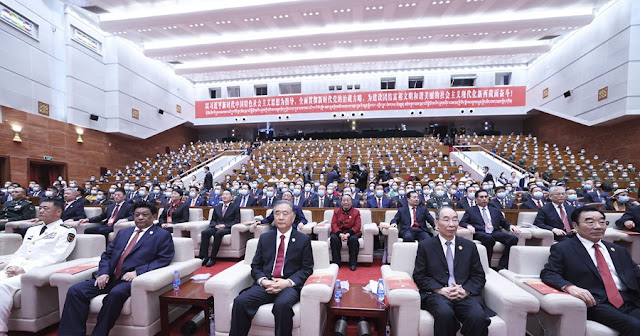
On August 19, a central delegation from Beijing, led by Wang Yang, a member of the Standing Committee of the Political Bureau and chairman of the National Committee of the Chinese People's Political Consultative Conference (CPPCC) arrived in Lhasa to attend the 70th anniversary functions.
Wang is No 4 is the Communist pantheon.
One can ask, why not celebrated the so-called liberation when the ‘Core leader’, Xi Jinping visited Tibet in July.
There is no answer to this.

Photos quickly circulated of Wang putting a khata around his own neck (strange tradition) and waving to the crowds “as the delegation was warmly welcomed at the Gongkar Airport by representatives from various ethnic groups and from all walks of life,” said Xinhua.
The Chinese agency further reported: “In the afternoon, Wang led the members of the central delegation to the Tibet Museum to attend the opening ceremony of an exhibition on achievements made during the 70 years”.
The exhibition includes “the peaceful liberation [1951], the democratic reform [1959], the establishment of the autonomous region [1965], the socialist construction, the reform and opening-up [1978], and the new era [Xi Jinpng’s], showcasing the significant progress achieved in Tibet's economic and social development under the leadership of the CPC.”
Wang had been ‘entrusted’ by Xi Jinping to “lead officials in Tibet along with veteran senior Tibetan officials” to Tibet: “Wang recognized the high reputation they enjoy among various ethnic groups and their important contributions to developing Tibet,” said a release.

Congratulating the Gang of Five
The Gang of Five Tibetan Communists
The ‘Gang of Five’ was Padma Choeling, a former Governor of Tibet and presently Vice Chairman of the Standing Committee of the National People's Congress (NPC), Phakphala Gelek Namgyal, the first ‘rinpoche’ to join the Party in the early 1950s, Legchok, a former Deputy Secretary of the TAR, former Red Guard Pasang and Ngabo Tenzin Jigme, representing his father the famous collaborator Ngabo Ngawang Jigme.
Xinhua noted that the CPC Central Committee, the NPC, the State Council, the CPPCC and the Central Military Commission (CMC) congratulated Xi Jinping by unveiling a plaque on which "Building a Beautiful and Happy Tibet and Fulfilling the Dream of Great Rejuvenation [of China]" was engraved.
The agency added that “20,000 cadres and masses of all ethnic groups gathered on the Potala Palace Square on the morning of the 19th to warmly celebrate the 70th anniversary of the Peaceful Liberation of Tibet.”

Wang Yang and Wu Yingjie and Lobsang Gyaltsen (in Tibetan attire)
Wang Yang then gave a speech.

Xinhua said: “The ancient city of Lhasa is full of colorful flags, flowers and a joyful and festive atmosphere everywhere. Under the majestic Potala Palace, set up a podium in Tibetan style. Above the podium, the solemn national emblem and the banner of "Celebrating the 70th anniversary of the Peaceful Liberation of Tibet" stood out, and the background wall was hung with the emblem of the big celebration and the words ‘1951’ and 2021’ and 10 red flags on both sides. On the Potala Palace Square opposite the podium, people of all ethnic groups dressed in festive attire gathered here early from all directions, waving flags and bouquets in their hands, converging into a sea of joy.”
However, the faces were rather grim in the audience, although the ‘masses’ had to clap from time to time to the speech of Wang and others.
An interesting aspect of the ‘celebration’s was the composition of the delegation.
You Quan, minister of the United Front Work Department (UFWD) who deals with minorities (and Tibet in particular) accompanied Wang. Other delegates were Padma Choeling, Zhang Qingli (who infamously called the Dalai Lama, a ‘wolf in monk’s garb when he was serving as TAR Party Secretary) and presently Vice Chairman of the National Committee of the CPPCC and more importantly for India, Admiral Miao Hua, member of the Central Military Commission and Director of the CMC’s Political Work Department.

The Speech: from darkness to light
Under a warm 'applause' (a bit forced?), Wang Yang delivered a passionate speech, said Xinhua; Wang Yang observed that “the Peaceful Liberation of Tibet in 1951 was a major victory for the cause of liberation of the Chinese people and the unification of the motherland, and an epoch-making historical turn for Tibet. Since then, Tibet has embarked on a path from darkness to light, from backwardness to progress, from poverty to affluence, from autocracy to democracy, from closed to open, and a thriving new socialist Tibet stands tall at the top of the world.”
It sounds upanishadic!!
Wang mentioned the infamous Xiaogang villages on the border with India: “After persistent efforts, 628,000 poor people have all been lifted out of poverty, 266,000 people have been relocated from the bitterly cold land in the high mountains to live and work happily in river valley towns, and Tibet has joined the nation in building a moderately prosperous society on schedule.”
According to Xinhua, Wang Yang pointed out: “today the world is experiencing a major change that has not been seen in a hundred years, China is at a critical period to achieve the great rejuvenation of the Chinese nation, a new journey to build a modern socialist country has begun, and the economic and social development of Tibet also stands at a new historical starting point. 

Happy? Unhappy?

The Tibetans warned
Tibetans were however warned, they need to “fully implement the party's strategy for governing Tibet in the new era, conscientiously implement the decision and deployment of the party central committee, and strive to write a new chapter of long-term stability and high-quality development on the snowy plateau.”
Wang concluded “…let us closely unite around the Party Central Committee with Comrade Xi Jinping as the core, carry forward the great spirit of building the Party, inherit the ‘Old Tibet Spirit’ [the invasion of Tibet in 1950/51] and ‘Two Roads Spirit’ [the Sichuan-Tibet and the Qinghai-Tibet highways opened in December 1954], build a new socialist modernized Tibet that is united, rich, civilized, harmonious and beautiful, and make unremitting efforts to realize the Chinese dream of great rejuvenation of the Chinese nation.”
There was no mention of the Dalai Lama, Beijing’s bête noire.

The Tibet Military Region, the Tibet General Force of the Armed Police, the TAR Political and Legal Department and the Tibet Branch of the Buddhist Association of China were congratulated.
It was noticed that the Chinese–selected Panchen Lama, Gyaltsen Norbu who is President of the Tibet Branch of the Buddhist Association of China, only furtively appeared in the TV reports.
he is clearly not in Beijing's good papers, though his services will be needed for the succession of the Dalai Lama.

Lt Gen Wang Kai, the commander of Tibet Military Region, one Tenzin, ‘representing the masses’ and Liang Nangyu, the representative of Tibetan aid cadres, also spoke at the function. 
Adm Miao, Padma Choeling, Wang, You Quan and Zhang Qingli (behind Wang is Red Pasang)

A Grand Gala
Later in the day, a ‘grand gala’ was held to celebrate of the so-called Peaceful Liberation of Tibet.
Xinhua reported that in the afternoon of August 19, Wang Yang watched the cultural performance 'Tibetan Children's Heart to the Party', together with more than 600 cadres and people from all walks of life in the TAR.”
However, the Chinese Panchen Lama was missing in action. He was probably unhappy to have been relegated to the third row in front of Potala in the morning; he played a very marginal role during the entire visit, it was noted.
The CCP’s mouthpiece continued: “The performance reflected the glorious course of Tibet from peaceful liberation to prosperous development over the past 70 years through the first part ‘Sunshine Shines on the Plateau’, the second part ‘Striving for a New Era’ and the slogan ‘Always Follow the Party’, showing the great importance and deep concern of the Party Central Committee to Tibet with Comrade Xi Jinping as the core, and expressing the boldness of Tibetan people of all ethnic groups to unswervingly follow the Party and strive for building a new socialist modernized Tibet.” Propaganda is Thy Name.

Inaugurating the Nagchu-Yangpachen section of the Beijing-Tibet G6 highway
Visit to Nagchu
“With comrade Xi Jinping as the core of the Party Central Committee's cordial care and the fond wishes of the people of the country”, Wang Yang and some members of the Beijing’s delegation visited Nagchu City (earlier called Prefecture); they visited the cadres and masses of all ethnic groups in Nagchu, continued the propaganda.
Wu Yingjie, the TAR Party Secretary accompanied Wang and his colleagues.
Xinhua observed: “Early in the morning of the 20th, Wang Yang and his party took the train to Nagchu City. Once off the train, the central delegation took a car to the Seni County ecological animal husbandry industry demonstration base. Wang Yang walked into the shed, detailed understanding of the base intelligent forage planting, yak dairy products traditional processing, etc., the base to drive the employment of farmers and herdsmen, to promote the local people's income practice affirmed.”
Here again, he left behind a plate with the inscription sent by Xi Jinping, "Building a beautiful and happy Tibet and fulfilling the dream of great rejuvenation". 

Wang Yang, Zhang Qingli, Zhuang Yan, Adm Miao, Wu Yingjie

Visiting some projects
Wang Yang is said to have inspected the grass-roots party organization construction work in Dronyi (Gemar) village, Gemar Lhoma town, Seni county. The usual propaganda speeches were given: “Hangjia Middle School in Seni county, built in 2017, is the largest single project in Zhejiang Province's 13th Five-Year Plan to aid Tibet, with more than 2,000 students, and the new semester has begun. Wang Yang came here to learn more about the work of education aid to Tibet, hoping to continuously improve the level of education in Tibet, so that more children grow up to become successful.”
He also visited a hospital and inspected the progress of high-altitude scientific and technological tree planting in Nagchu City.
Perhaps more importantly Wang Yang opened the Nagchu-Yangpachen section of the Beijing-Tibet National Highway G6.
In Nagchu he was accompanied by Zhang Qingli, Admiral Miao Hua and other members of the central delegation. Again it must be a first for Nagchu to see a three-star admiral in this remote, cold, deserted high-altitude region. But Miao had probably come to the Roof of the World for ‘political work’ and to follow up on his colleague General Zhang Youxia’s visit in July.
This is a serious issue for India.

Other Visits
While Wang was in Ngachu, You Quan of the UFWD went to Lhoka (Shannan) to meet the ‘masses’ while Padma Choeling visiting Shigatse and the Tashilhunpo, where he briefly met …guess who?
Gyaltsen Norbu, the Chinese-designated Panchen Lama.
It is not known if they discussed in Tibetan or in Mandarin.
Lobsang Gyaltsen, the Chairman of the TAR Regional Congress and No 2 in Tibet accompanied Padma Choeling in Shigatse, while Che Dalha, head of the TAR government (and no 3 in the TAR hierarchy) went to Lhoka.

Lobsang Gyaltse, Padma Choeling, Gyaltsen Norbu

Gyaltsen Norbu was briefly seen in the Tashilhunpo monastery with Padma Choeling and Lobsang Gyaltsen.

Other Officials present
Zhang Yijiong, a senior member of the UFWD and designated-interlocutor of the Tibetans was in attendance.  He was following his boss, You Quan everywhere.
Another UDWD official, Sithar (or Sitar) was also present during the visit. He was once described as: 'one-time Tibetan serf, now frontman for China.
A few years ago, Reuters wrote: “For many fellow Tibetans, Sitar is a Chinese government puppet, but for the Communist Party, the former serf is a model of loyalty and rising political star.”
Reuters' correspondent continues: “Sitar, who goes by one name and whose ancestors were serfs for generations until 1959, has risen to be a vice-minister of the Party's UFWD and a key defender of government policy in Tibet. The article further said: “[Sithar] has emerged as one of the most prominent ethnic Tibetans backing China's fight against Tibet's spiritual leader, the Dalai Lama, and his government-in-exile based in northern India. In that role, Sitar has come to embody the divide between a Tibetan political elite that has embraced China's programme for controlling and developing the region, and discontented Tibetans and exiles who instead see exploitation and repression.”

All this does not mean that negotiations with Dharamsala will start soon.

In any case, to discuss what? 

When one reads the speeches of the delegation, the positions are too far part.
In Lhasa, the function concluded with these words: “O Party, O Party. You are the sun rising in the east, shining on the snowy mountains and grasslands ...A song ‘Always follow the Party’ contains the ambition of the Tibetan people of all ethnic groups to forge ahead with a new journey under the guidance of Xi Jinping's thought of socialism with Chinese characteristics in the new era, pushing the atmosphere to a climax.”

There is clearly no negotiations possible today. 

It has to be noted that it is the third visit by a member of the Standing Committee of the Politburo in two months (Xi in Amdo in June and in Central and Southern Tibet in July and now Wang in Lhasa and Nagchu).

Tail End: Don't you think that the 'pigeons' figuring in the photo at the beginning of this article, look like drones? Was China nervous during the Celebrations? Is Beijing not sure that Tibet has really been liberated? To be followed...

A few photos of the visit:


Wednesday, July 18, 2018

Yumemania continues

Yume weather station
I often mentioned Yume (or Yumai or Yumed) the tiny hamlet, north of the McMahon Line (Upper Subansiri district of Arunachal Pradesh), on this blog.
Since it was adopted by President Xi Jinping through a letter to two sisters living in Yume, yuans have been pouring. In fact, it is deluge.
Roads have come up, electricity and water supply are no more a problem, new houses have been built, not only for the 32 ‘original’ inhabitants, but also for the tourists who will soon arrive in the border village.
The Global Times (GT) reported earlier this week that China has built an unmanned ‘automatic’ weather station in Yume.
According to the tabloid, Beijing has set up a new observation station “to provide meteorological support to national defense.”
It is clear that the new station is not only for forecasting the weather for the tourists wanting to experience the life in the model village.
The GT explains: “The station in Yumai township under Lhunze [Lhuntse] county of Shannan [Lhoka] Prefecture in Tibet will eliminate a blind area of meteorological services.”
A ‘blind’ meteorological corner, located so close to the Indian border?!
Quoting a statement the Tibet Weather Bureau, the newspaper candidly admits: “It will also provide strong meteorological support for national defense and further promote border development as well as military-civilian integration.”
The idea to support ‘national defense’ and promote ‘military-civilian integration’ (sometimes called 'fusion') seems the main objectives of the project. The latter scheme, so dear to Xi, translates into dual-use of all infrastructure assets on the plateau, whether airports, roads, highways, OFC links, etc.
Tashi Norbu, a technician in charge of the station, told the mouthpiece of the Party: “The station can observe six factors, including air temperature, air pressure, wind speed, wind direction, humidity and precipitation, with more accuracy than before.”
All this does not have direct military applications, though meteorological data are always helpful when an airport is planned not faraway (in Lhuntse in this case).
Norbu frankly added: “Yumai is at the border. The station could provide data to help with transportation and communication in national defense. It could also offer support during regional live-fire conflicts.”
Therefore, it is not only for the nine households and 32 residents that the new infrastructure has come up.

Yume Township
The ‘New Era demo village for comfortable living on China’s border’, as Yume is known, is already bustling, commented the GT a few weeks ago.
The village has even a new Party chief, Dawa who looks after the public services (including water drainage, power, communications, roads, county government, medical clinic, schools,) and the new construction sites.
According to the GT, the project with a total investment of some 17.2 million US dollars, will take place on 440.98 square mu (72.65 acre) and a total construction area will be 17,254 sqm: " In addition, there will be a central park and six plazas. The project is estimated to complete by October of 2018.” There is no doubt that the schedule will be kept.
The tabloid explained further that every year, Yume “has 260 days of snow and rain. Due to the extended rainfall period, highland barley is impossible to grow locally and the natural environment is challenging. Before the end of 2017, the township was snow-bound almost six months of the year. With snowy and narrow mountain roads, it took more than a dozen hours to cross Mt. Relha, and another eight kilometers to reach car transport. Every year, as it got closer to winter, the locals’ priority was always to store supplies for the season, and residents always had to store an entire winter’s worth of food and resources.”
Even before the weather station was publicized, Dawa had announced: “We are now receiving accurate information sent by meteorological departments every day. The station is necessary as it fills the gaps in meteorological and hydrological information, which could support our development."
He then added that it would help a lot for the local pastures and for the road construction, before concluding: “more weather stations will be set up when the road is completed.”
He is talking of a new road to the border (Asaphila)?
Some articles speak of the Chuyul highway.
Song Zhongping, a military expert told the GT that weather is “an important factor that could influence the take-off and landing of aircraft and the launch of missiles during a battle. The small weather observation station could provide such information,” adding that “grasping accurate weather information could help seize good opportunities in the battles.”
According to Dawa: “Residents will enjoy better meteorological services to better safeguard every blade of grass and tree on the territory of the motherland.”
The set up of the station is definitively not innocent.

The case of Nagchu
Another place is also building weather stations on the plateau.
It is Nagchu (also written Nagqu). Here, the projected purpose is tourism development …and an airport.
In June, China Tibet News reported: “In recent years, Nagqu City has been vigorously implementing the government-led tourism development strategy. It aims to develop tourism into an economic leading industry and significant results have been made.”
The government website elaborated: “During the 13th Five-Year Plan period, combining the actual situation of local tourism development and with a total investment of 80 million yuan, Nagqu has declared 10 projects including 4 key tourism infrastructure projects and 6 rural tourism infrastructure construction projects. Nagqu vigorously promotes tourism propaganda,” adding “In addition, leading group for the evaluation of star hotels and star scenic spots and leading group for the creation of boutique scenic spots are established in Nagqu. Safety inspection work in the tourism industry is carried out and no travel safety accidents occur.”
Before starting these projects, weather stations were built.
The objective was clearly for getting data for the construction of the airport.

A strange case
The Nagchu Dagring Airport was announced in 2010.
It was supposed to be completed by 2014; it was to be the highest airport in the world at 4,436 m (14,554 ft), surpassing Chamdo Bangda Airport as the highest. Though the construction was said to have started in 2011, the airport was never built. This is a rare case of an announced project which has been temporarily abandoned.
The new weather stations in Nagchu are probably linked to the second coming of the airport.

Wang Yang, today CPPCC's Chairman
Incidentally, Wang Yang, then a Vice Premier (now member of the Standing Committee of the Politburo) visited a meteorological station in Nagchu in 2015.
China Meteorological News Press said that Wang Yang investigated "relevant work including poverty alleviation and development, husbandry, tourist industry and meteorological services. He visited a meteorological station from Nagqu Prefecture located in a plateau region and extended regards to meteorological workers. He expressed respect to those who work in the remote areas, high mountain regions and islands and contribute to meteorological undertaking persistently, and extensive basic-level meteorological staffs."
The article said: "The hardworking and plain-living spirit of plateau meteorological members also touched Vice Premier Wang Yang. Tibet took pride in advancements and achievements of meteorological cause, which impressed as well as inspired us."
Wang would have declared: "The meteorological observation data of Tibet are crucial to weather forecasts and climate prediction for downstream regions since it lies on the upstream of weather system. As a result, to ramp up the research of meteorological science and technology along with climate change on the basis of Tibet’ own edges carries a significant implication.”


Why was the airport stopped in the first place?
One of the reasons was the serious law and order problems faced by Nagchu a few years ago; they have eased now, making the City more conducive to take up large infrastructure projects.
Another reason was that Nagchu was well-served by the train (it is the main hub, for military purpose too, of the railway line between Xining and Lhasa).
And finally, it was announced in 2015, “In a bid to tighten the safety of its airports, China will stop building airports higher than 4,411 meters above sea level in the next two years, as it is yet to work out a set of technology standards to build such airports.”
Li Jian, a deputy head of the Civil Aviation Administration of China (CAAC) told the media three years ago, “Super-high plateau airports, namely those no less than 2,438 meters above sea level, face stricter safety challenges than their low altitude counterparts. There are no international technology standards for super-high plateau airports and it will take China two or three years to work out a set of standards. Before this, no plans will be approved.”
Not only altitude was a problem, but the weather too.
Three years have passed and the Nagchu airport will probably see the light in the coming years.

A Landing Ground in Yume?

One of the reasons for setting up a sophisticated weather station in Yume is probably the construction of an Advanced Landing Ground which would serve the border, particularly Asaphila, a border pass which is disputed by China and which has witnessed regular PLA’s intrusions in the past.
In 2014, Indian troops blocked PLA’s attempts to construct a road in the Asaphila area.
The Hindu then commented that “the incident, however, did not lead to a prolonged military face-off but it is a clear indication of the continuation of ongoing aggression between the two sides along the 4,057 km long LAC.”
More recently in April, it was reported that China lodged a strong protest against the Indian Army for transgression into Asaphila. India rejected the complaint.
According to PTI, “the Chinese raised the issue at a ‘Border Personnel Meeting’ (BPM) on March 15 here but the Indian Army dismissed it, saying that the area in the upper Subansiri region of Arunachal Pradesh belongs to India and it has regularly been carrying out patrols there.”
When the Chinese called India’s patrolling in the area a 'transgression', the Indian Army objected to the terminology.
Yume is not very far away. Weather station or more infrastructure means a reinforcement of the border in this area and probably more Chinese transgressions or intrusions.
There is no doubt that China wants to put more pressure in Asaphila-Takshing area, before the road from Limeking to Takshing is fully serviceable.

A few more weather stations near the border of Arunachal Pradesh.

In Zhayul County, north of Kibithu
In Lunang, Nyingchi County
In Nyingchi County

Monday, August 29, 2016

A new boss for Tibet: Wu Yingjie

Wu Yingjie presents a thanka of Tara to a European politician in 2013
Between two swims at the beach resort of Beidaihe, the top Communist leadership undertook a first round of reshuffles in the provinces.
Tibet has now a new boss, Wu Yingjie, 59.
Wu is the longest serving Chinese officer on the Roof of the World. He has been around for more than 40 years. Till yesterday's he was deputy party secretary (a post that he has been occupying since 2011).
The interesting aspect of the reshufle is that Wu supersedes two Tibetans (Pema Choeling, Chairman of the Regional Congress and Lobsang Gyaltsen, the head of the Tibetan Autonomous Region’s government).
But let us remember that the Communist Party follows a very strict rule, no Tibetan for the top slot.
By appointed Wu, the leadership in Beihaide has obviously played it safe, as he is not a controversial figure and has a long experience in Tibet (mainly in education).
Wu’s predecessor, Chen Quanguo, 61, is expected to become Xinjiang’s party secretary replacing Zhang Chunxian, who according to The South China Morning Post "will be reassigned to a semi-retired role similar to that of his predecessor in Xinjiang, Wang Lequan."
The Hong Kong paper says that China’s leadership reshuffle “in line with Xi’s plan to promote reformists.”

Other changes
Hunan party chief Xu Shousheng, 63, has been replaced by his deputy and governor, Du Jiahao, 61. Vice-minister of industry Xu Dazhe was named as Hunan deputy party chief.
Yunnan governor Chen Hao, 62, was promoted to replace the province’s party chief, Li Jiheng, 59.
Another change, Li Xiaopeng, son of former Premier Li Peng, will succeed Yang Chuantang as the transport minister.
Li Xiaopeng was Shanxi provincial governor.
As mentioned earlier on this blog, Yang Chuantang, a member of the Central Committee is an old Tibet hand. A native of Yucheng, Shandong province, he started working in June 1972 and he joined the CPC in June 1976. In 1993, Yang was transferred to Tibet, where he held the position of administrative vice-chairman of the Tibet Autonomous Regional Government. He was elected vice-governor of Qinghai province in 2003. In 2004, he became party secretary. Two years later, he was transferred to Beijing where from 2006 to 2011, he served as Vice-Chairman of the State Ethnic Affairs Commission.
No new posting (or ‘demoting’) has been announced for Yang so far.
After the next round of swim?
Passing the red baton: Chen (left) to Wu (right)

Wu Yingjie
Wu Yingjie (Chinese: 吴英杰) is born in December 1956 in Changyi County, Shandong province.
He arrived in Nyingchi, Tibet, in October 1974 at the end of the Cultural Revolution.
In 1977 he began working for a power generation station in the western suburbs of Lhasa.
In August 1983 he joined the TAR's department of education where he worked for the next two decades.
In 1987 he began overseeing elementary and secondary education.
In 1990, he was put in charge of accepting donations of educational resources from other parts of the country.
In 1994 he joined the Autonomous Region Education Commission, rising to deputy secretary in May 1998.
In March 2000 he was named deputy head of the education department, then promoted to head in 2000.
In January 2003, Wu was named Vice Chairman of the Tibet Autonomous Region;
In June 2005 he took on the regional propaganda portfolio, and joined the regional party standing committee next month.
In November 2006 he became Executive Vice Chairman of the Tibet Autonomous Region.
In November 2011 he was named deputy regional party chief.
In April 2013 he was named executive deputy party chief.
In August 2016, he became the Communist Party Secretary of the Tibet Autonomous Region.

I repost here an old piece on Wu

The Most Amazing Photo of the Year
As 2013 ends, it is time to distribute awards for the past year.

The Award for the Most Amazing Photo (which was went unnoticed by the French and Western press) is a picture of the senior Chinese Han cadre, Wu Yingjie offering a Tibetan katha (ceremonial scarf) and a thanka (scrolled painting) of Goddess Dolma (Green Tara) to a gullible Member of the French Parliament.
Wu Yingjie was heading a 'Tibetan' Han delegation from China's National People's Congress to Spain and France.
Wu is also Vice Executive Secretary of Tibet Autonomous Region (TAR) and has become famous for spending months (without any tangligle results) in the restive Nagchu Prefecture of the TAR.
The French parliamentarian, Alain Rodet is the deputy (and mayor) of Limoges from the Socialist Party. Rodet is also Vice-president of France-China Friendship Group in the French National Assembly.
The duo met in Paris on December 17.
China Tibet Online reported: "After briefing French friends [about] the religious policies and conservation status of Tibetan culture, Wu detailed them the great changes in Tibet since its peaceful liberation carried out and the life of local residents who have the biggest voice on the real Tibet.
Wu also wished more French friends could pay a visit to Tibet."
Mr. Wu just forgot to speak the situation in Nagchu. I often wrote about Mr. Wu's activities in Nagchu Prefecture on this blog.
I can bet that Monsieur Rodet has never heard of Nagchu and Driru.
But the good deputy will probably soon rewarded a free jaunt to the Middle Kingdom where he will be lavishly received. Having received Wu in the National Assembly should be reciprocated and not asking embarrassing questions to a foreign host too.
A hard core Han Communist cadre distributing a thanka of Tara, considered by all the Tibetans as the Mother of the Tibetan Nation, is a novelty.
This justifies the Award of the Most Amazing Photo of the Year.

Second Prize
A Second Prize to Le Louvre Museum for their knowledge of Tibetan painting.
The Chinese media announced that Han Shuli, 'a famous Tibetan artist' has earned rave reviews and won silver award in the 2013 Louvre International Art Exhibition with his work 'Foresight'.
Han Shuli, is the president of the Tibet Art Association.
The 2013 Louvre International Art Exhibition was held in the Louvre Museum in Paris between December 11 and 15.
Some 500 artists from over 10 countries participated in the contest.
The 'Tibetan' Han Shuli explained that his 'Foresight portrait' depicts "a goshawk perched high on the Marnyi stone".
One can presume that this 'Marnyi stone' is a sinization of 'Mani stone' on which the six-syllabled Tibetan mantra ' of Avalokiteshvara (Om mani padme hum) is engraved.
Han said that his black ink and wash painting has benefited from the Tibetan black thangka and the wall painting in the temples of Tibet, while 'integrating some representative elements of the central plain [Chinese] culture'.
For Han, his masterpiece 'Foresight' expresses blessing and rosy prospect for Tibet and the whole country.
Where is Tibet in Mr. Han's piece is not clear.
Anyway, Mr. Han is said to have brought fame to 'Tibet'.

Friday, July 31, 2015

The dual use of airports in Tibet

This is an update of a two-year old post about the airports in Tibet.
I have often mentioned on this blog the dual-use of the airports on the plateau.
Yesterday, Xinhua announced the integration of civil-military airports to "strengthen aviation safety and combat support capabilities."
A joint statement from the People Liberation Army Air Force (PLAAF) and General Administration of Civil Aviation (CAAC) said that the integration will include joint maintenance of airport support facilities, joint flight safety support and joint airport management.
Interestingly the Lhasa Gongkar Airport in Tibet and Sunan Shuofang International Airport in  Wuxi in Jiangsu province, will be the first two pilot PLA/civil airports to implement the 'integration'.
It will be done during the second half of 2015.
The PLAAF/CAAC circular further affirms that "All the civil-military airports will conduct strengthened integration next year."
Is this decision linked with the 6th Tibet Work Forum?
Probably!
Apparently, the first meeting of the Forum took place yesterday.
Xinhua reported that top Chinese leaders have met "to discuss economic and social development in Tibet, and how to ensure the autonomous region achieve prolonged stability."
The statement of the Political Bureau of the Central Committee of the Communist Party of China (CPC) further noted: "Safeguarding national unity and strengthening ethnic unity should be highlighted in work involving Tibet."
It added that: "Efforts should be made to unswervingly carry out the anti-separatism battle, promote the region's economic and social development, safeguard and improve people's welfare, and enhance exchanges and integration of different ethnic groups."
The Politburo (or probably an extended Politburo) is said to have agreed that "strengthening Tibetan infrastructure, helping it foster competitive industries while ensuring environmental protection are the means to achieve marked improvement in living conditions and more social cohesion," were the priorities for the restive region.
The PLA/Civil integration of the airports in Tibet will probably help Beijing to 'strengthen the infrastructure' and consolidate its presence on the Plateau, i.e. 'to stabilize Tibet' in Marxist terminology.

(Here starts my old post)
To flood the Tibetan plateau with more and more Chinese tourists, a good infrastructure is required.
Airports and the railway line are the backbones of a booming tourism in Tibet. China is working hard to get the latest facilities in these fields.
Xinhua recently reported that the airport in Chamdo (known as the Bangda Airport) is to be reopened soon after major repairs.
Xinhua says: "The Bangda Airport, the world's highest-altitude civilian airport currently in use, is expected to resume operations after months of repairs, local aviation authorities said."
The Chamdo airfield was closed on June 22 to 'repair' the 19-year-old runway.
The airport operates two flights, one is Chamdo-Lhasa and the other Chamdo-Chengdu, capital of Sichuan Province. With an elevation of 4,334 meters above sea level, it is still the highest in Tibet.
The 4,411-metre-high Kardze Daocheng Yading airport, being built in Kardze (Garze) in Sichuan province will become the world’s highest civilian airport when put into operation later this year (a year earlier than planned!!).
The Civil Aviation Administration's officials say that its main purpose is to boost local tourism.
The Yading airport will cost of 1.5 billion yuan ($ 245 million). The Sichuan authorities plan to bring one million tourists (and get 1.5 billion yuan revenue!) by 2015. A quick return on investment!
But as important as tourism, the airport will facilitate the transportation of fresh troops from the Military Area Command in Chengdu to Kardze prefecture in a short time. It has been one of the most restive areas on the Tibetan plateau.
The new Kardze Yading airport will greatly facilitate the transportation of PAP's reinforcements in case of unrest. With one stone, two birds are killed: the Tibetan protesters are 'pacified' and the deluge of Chinese tourists brings hefty revenues.
Has anybody thought of doing something similar in Chushul in Ladakh, of course not to 'pacify' anybody but to bring some revenue for the region and 'occupy' India's territory?
By the way, an article by Virendra Sahai Verma and P. Wangdus appeared in The Hindu last month. It suggested a railway line in Ladakh: "A rail link in the Indus Plains in Ladakh, similar to the Kashmir Railway, will have spin-offs for environment conservation, military logistics, tourism and the local economy."
It explains: "After the Banihal-Baramulla railway, the Indian Railways should now plan to build a line in the plains of Ladakh along the Indus river. Its alignment could be from Batalik-Khalatse-Leh-Karu to Chushul. The stretch, of approximately 500 kilometres, is plain, interspersed with populated and fertile regions and is along an arterial road in Ladakh, from Batalik to Chushul."
Why not? 

Other airports in Tibet


Lhasa Gongkar
Lhasa Gonggar Airport (Chinese: 拉萨贡嘎机场, Tibetan: ལྷ་ས་གོང་དཀར་རྫོང་) (IATA: LXA, ICAO: ZULS) is the airport serving Lhasa, the capital city of the Tibet Autonomous Region, China. It is located about 62 kilometres (39 mi) southwest of the city in Gonggar County of Shannan Prefecture. The airport is close to the road to Tsetang, the capital of Shannan Prefecture.
At an elevation of 3,570 metres (11,710 ft), Lhasa Airport is one of the highest airports in the world. The airport was built in 1965, a second runway was built in 1994 and terminal facilities were upgraded in 2004.

Ngari Airport
Ngari Gunsa Airport
Ngari Gunsa Airport (Chinese: 阿里昆莎机场; pinyin: Ālǐ Kūnshā Jīchǎng) (IATA: NGQ, ICAO: ZUAL) is a dual-use military and civil airport serving the town of Shiquanhe in Ngari Prefecture, in the southwest of China's Tibet Autonomous Region near the Indian border. It started operations on 1 July 2010, becoming the fourth civil airport in Tibet after Lhasa, Nyingchi, and Chamdo airports.
Situated at 4,274 m (14,022 ft) above sea level, Gunsa Airport is the third highest airports in the world after Qamdo Bangda Airport (elevation 4,334 m (14,219 ft)) and Kangding Airport (elevation 4,280 m (14,042 ft)). Gunsa airport has a 4,500-meter runway. It is expected to handle 120,000 passengers by 2020. Construction began in May 2007 and cost an estimated 1.65 billion yuan (241.22 million U.S. dollars).

Nyingtri Mainling Airport
Nyingchi [Nyingtri] Mainling Airport (Tib: Nyingtri, simplified Chinese: 林芝米林机场; traditional Chinese: 林芝米林機場; pinyin: Línzhī Mǐlín Jīchǎng) (IATA: LZY, ICAO: ZUNZ) is an airport in Mainling, Nyingchi Prefecture, Tibet Autonomous Region, China. It is suggested to be one of the most challenging instrument approaches in the world, since the airport is in a winding valley.
Nyingchi Airport is the third airport that Tibet has put into operation. Built at a cost of 780 million yuan (96.18 million U.S. dollars), including investment by the General Administration of Civil Aviation of China (CAAC), the airport is 2,949 meters above sea level, lower than the other two civil airports, with a designed annual passenger flow of 120,000.

Chamdo Bamda Airport
Qamdo [Chamdo] Bamda Airport (IATA: BPX, ICAO: ZUBD), also known as Changdu Bangda Airport, located in Bamda, Chamdo, Tibet, China.
The airport is the highest airport in the world, at an elevation of 4,334 metres (14,219 ft) and has the longest publicly used paved runway in the world, at 5.5 km (3 mi).
Chamdo Airport
The low air density at this altitude makes a higher takeoff and landing true airspeed necessary, and therefore a longer runway. Also, the aircraft's engines produce less thrust at higher elevation than near sea-level.
The airport is 2.5 hours by mountain road from the county seat of Chamdo. The long commute is the result of no flat land closer to the city being available to construct an airport.
Visitors are warned before landing to move slowly on leaving the plane and that they may feel light headed or dizzy because of the thin air.


Shigatse Airport
Shigatse Peace Airport
Shigatse Peace Airport (IATA: RKZ, ICAO: ZURK), or Shigatse Air Base, is a dual-use military and civilian airport serving Shigatse, the second largest city in Tibet Autonomous Region, China. It is located in Jiangdang Township, 43 kilometers from Shigatse. With an elevation of 3,782 metres (12,408 ft), it is one of the highest airports in the world.
Construction of Shigatse Airport started in 1968 and was completed in 1973. It was solely for military use until 2010, when a 532 million yuan expansion was completed. On 30 October 2010, the airport was opened as the fifth civilian airport in Tibet.

Nagchu Dagring Airport
Nagqu [Nagchu] Dagring Airport (Chinese: 那曲达仁机场; pinyin: Nàqū dárén jīchǎng) is an airport under construction near Nagchu in the Nagchu Prefecture of Tibet. When completed in 2014 it will be the highest airport in the world at 4,436 m (14,554 ft), surpassing Chamdo Bangda Airport as the highest. Construction began in 2011 and is scheduled to take three years. The airport is part of a Chinese government development scheme to build 97 airports across China by 2020. By then, the authorities intend that four-fifths of China's population will be within a 90-minute drive of an airport.

Wednesday, December 24, 2014

Ling Jihua haunted by Tibet

I am reposting an article written in June 2013 about Ling Jihua who has yesterday been put under investigation for 'suspected serious disciplinary violations'.
Now, the media says that the two girls in Ling Gu's car where Tibetan and Uyghur. At the time of the accident, both were Tibetans.
Today, The South China Morning Post comments:
Intriguingly, a few days after the accident, mainland media reports went quiet about the incident. The South China Morning Post broke the story, naming Ling Gu, six months later.
It later also emerged that Ling enlisted the help of the former oil company chief Jiang Jiemin.
Jiang, then chairman of the state-run China National Petroleum Corporation, paid hefty compensation to the families of the two female victims in the crash, a Tibetan and a Uygur, to stop details being made public.
The families of the two young women, both university students, each pocketed tens of millions of yuan, sources said, which was transferred to their banks from China National Petroleum.
More importantly, what is now happening to the United Front Work Department headed by Ling?
The work of assimilating Tibetans and Uyghurs within the Great Chinese family will certainly continue.
Yesterday, Beijing released a document called a 'guideline' (it is a Guideline, not a White Paper), promising "to cultivate and appoint more officials from minority groups and ensure they are given full trust."
If implemented, it will certainly makes a difference. But it could be just propaganda.
According to Xinhua, the document entitled, 'Opinions on Strengthening and Improving Ethnic Work in New Situations' gives special attention "to the cultivation of intellectuals in ethnically-diverse regions, especial those from minority backgrounds."
In other words to the Tibetans and the Uyghurs.
It also promotes understanding among different ethnic groups and the cultural identity of the Chinese nation. This is more ominous. How can someone be a Han (the 'identity' of the Chinese nation) and a Ughyur or a Tibetan at the same time?
The Guideline, issued by the Central Committee of the Communist Party and the State Council, asserts, that it will: "vigorously foster, audaciously select, fully trust and use officials from ethnically-diverse backgrounds, and cultivate experienced Han officials in ethnically-diverse regions."
The document called on ethnic minority officials to master Mandarin Chinese, while urging Han officials to learn the local dialects of the areas where they work.
The real test: will China increase the number of 'minorities' senior officers in the PLA? This is doubtful.
According to the official communique, the 'guideline' stresses "an overall language education in ethnic regions, [it] laid out policies to help bilingual teachers who can teach students Mandarin while respecting the local tongue."
The conclusions of the document are: "China is a country built by all ethnic groups of the nation; Chinese culture is made up of the culture of all 56 ethnic groups; Chinese civilization is created by all ethnic groups; and the Chinese nation is a community of all ethnic groups."
With Han characteristic, one could add.
Hu Yaobang made similar promises in May 1980; nothing happened thereafter. Will this time be different?
Let us keep watching!
In the meantime, Beijing will have now to find a new Director for the United Front Work Department to implement this audacious project.

[My post dated June 4, 2013]
Remember this article in The South China Morning Post.
One night of March 2012, Ling Jihua, aide and confidant of President Hu Jintao lost his son and a seat in the coveted Politburo.
The South China Morning Post reported:
The 25-year-olds were pulled half-naked from a car smash. The two young women at the centre of the Ferrari crash that killed the son of high-level Communist Party official Ling Jihua have been named.
In its latest issue, Hong Kong-based news magazine Asia Weekly writes that the two young women in the vehicle when Ling Gu died upon impact after crashing his Ferrari were Tashi Dolma (Zhaxi Zhuoma), daughter of a deputy director of the Qinghai Provincial Public Security Department, and Yang Ji, then a student at China University of Political Science and Law in Beijing, reportedly the daughter of a well-known living Buddha also from Qinghai.
According to Asia Weekly, Yang passed away unexpectedly last month despite showing signs of positive recovery from the serious injuries she sustained in the accident. It is claimed she felt unwell and was given an injection last month, after which she fell into a coma and later died.
High-level Communist Party official Ling Jihua lost his son in the accident.
The magazine, citing 'informed Beijing sources', claims both the women are ethnic Tibetans and were each 25 years old at the time of the accident.
The accident happened in the early hours of March 18 when the speeding Ferrari smashed into a wall, rebounded and crushed a railing on the opposite side of the road. One naked body and two half-naked bodies were thrown from the wreckage. A half-naked man Ling Gu died immediately while two young women – one naked and one half-naked – were seriously injured.
Photos of the wreckage circulated online and many Internet users took it as another drink-driving accident involving the "second-generation rich".
Wild stories began to spread that the trio were playing sex games in the car when the accident took place. Different versions of who was driving and who was in the front and back seats became the subject of gossip in Beijing's corridors of power.
The accident would come to affect behind-the-scenes political jockeying in the run-up to next month’s 18th party congress – which will produce China’s new generation of leaders.
Ling Jihua is considered an important member of Hu's camp and was being groomed to become one of the People's Republic's sixth generation of leaders in another 10 years.
This was more than a year ago.
Since then, Ling Jihua, who did not make it in the Politburo, looks after the less-glamorous United Front Work Department and particularly the volatile Tibetan affairs.
For the past two weeks, Tibet has been on the boil and Mr. Ling must bear the brunt. Tibet is haunting him once again.
As reported on this blog, sometimes in May, Yu Zhengsheng chaired his first Central Tibet Work Coordination Small Group in Beijing.
Chen Quanguo, the TAR's Party Secretary was one of the attendees.
On his return to Tibet, Chen immediately went for an inspection tour of the Nagchu Prefecture (from May 21 to 24); the day he was returning to Lhasa (May 24), thousands of Tibetans gathered in Driru county, one of the largest demonstration in years.
For the Party, it is an extremely serious incident; particularly as it came at the time of the visit of the powerful Party Secretary in Nagchu Prefecture.
The situation was so serious that on May 25,  Ling Jihua rushed from Beijing to Lhasa for an 'investigation/research mission'. It appears that Ling stayed nearly a week in Tibet.
There is no doubt that his visit is linked with the incidents in Nachu
During his stay, the United Front Department's boss met most of the senior Party cadres of the Tibetan Autonomous Region, including Chen Quanguo.
Since then, officials in Tibet are repeating that everybody should study and follow the directions given by Comrade Xi Jinping in March when he met the Tibetan delegation on the side of the National People's Congress.
See my posting on the subject.
Will it help?
In the meantime, a strange news appeared in a Hong Kong publication.
A religious group would have invited the Dalai Lama to visit Hong Kong in September.
Philip Li Koi-hop, chairman of the Hong Kong Tibetan and Han-Chinese Friendship Association, said he has visited the Dalai Lama four times in India between 2009 and 2011 and invited the Tibetan leader to come to Hong Kong. Li affirmed that he was confident that the trip will go ahead, and this, despite the tensions between the Tibetan spiritual leader and the mainland's government.
Li declared: "One time I asked him if he wanted to come to Hong Kong. He answered 'Yes', and said a University of Hong Kong professor had invited him earlier. But the Hong Kong government rejected the visit."
Is it a trail balloon sent by Beijing, realizing that their minorities' policies in Tibet have failed. Reading and even putting in practice Xi Jinping's speeches does not seem to help.
It is too early to say, but the fact remains that if Ling had to rush so quickly to Lhasa, it proves that there is a serious problem on the Roof of the World.