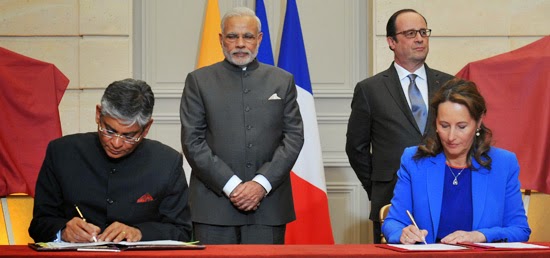
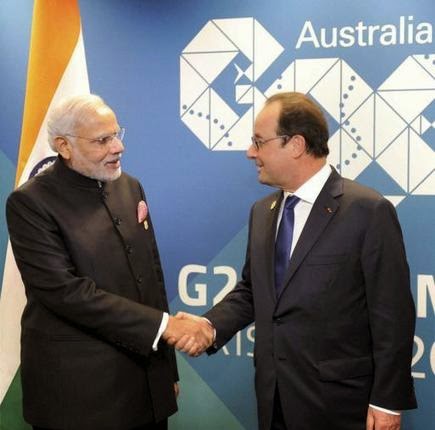
My article The Rafale deal is Modi's 'masterstroke' appeared last week in Rediff.com.
Here is the link...
Under the present Defence Procurement Procedure, it would have been a nightmare, and a long, long one at that, to build 108 Rafales in India. Modi realised this and took the wise decision, though it is a definitive setback for his Make in India scheme,' says Claude Arpi.
Has the Congress started using the Aam Aadmi Party's tactics? You make any allegations against your opponent, whether true or not, and the media believes you; at the worst, nobody will check the veracity of your declarations.
It is the way the Congress trained its best gunners on the Rafale deal. According to PTI: 'The Congress alleged non-transparency in the multi-crore Rafale deal and questioned the Centre's move to bypass defence procurement procedure in the absence of inter-governmental agreement with France.'
The news agency quotes Congress spokesperson Tom Vadakkan, who 'informed' reporters in Goa: 'Till date, even the price of aircraft has not been disclosed by the Modi government. India does not have inter-governmental agreement with France for government-to-government purchases.'
There was no clarity even on the transfer of technology agreement, Vadakkan added.
The former defence minister, probably upset with his successor who was reported to have said that A K Antony had 'killed the deal by making several notings on the file,' also participated in the blitzkrieg: 'The present government has compromised our national security.' Antony also criticised the deal for the French fighter plane.
But let us come back to the facts.
First, no contract has been signed so far, negotiations are still on between the French team nominated by President Francois Hollande and its Indian counterpart. The details of the talks are not known, except that France agreed to a 25 per cent 'discount on its earlier offer for an off the-shelf purchase of 36 Rafale aircraft: This will be the base on which further negotiations will take place,' a French source told the Economic Times.
The basic price of the aircraft should be the same as the one paid by the French air force for a similar configuration.
'The overall cost is not expected to cross $8 billion for the entire 36 aircraft fleet,' ET added. The final price will include the cost of the aircraft, and also include maintenance facilities, training of pilots and technicians, some armaments and spares.
It is what is presently being negotiated.
Details of government to government talks are never made public during the negotiations; it is the normal procedure.
How did the 'deal' reach this stage?
On April 9, 2015, an Indian delegation arrived in Paris, ahead of Prime Minister Narendra Modi. Till that time, discussions were still on for the 126 planes (the bone of contention being the 108 planes to be manufactured by Hindustan Aeronautics Limited in Bengaluru), but the negotiations had reached a dead-end as Dassault was not ready to take on the responsibility for the work done by HAL and there were too many uncertainties/complications in the Defence Procurement Procedure to make the deal viable.
Modi's decision to purchase 'off-the-shelf' was a quick, pragmatic, and smart move. He brought the IAF's 'critical operational necessity' on the negotiating table, while dropping the Medium Multi-Role Combat Aircraft framework. We shall see why.
Prime Minister Modi confirmed the decision for a government to government deal during his press conference with President Hollande.
A few days later, Defence Minister Manohar Parrikar hoped that the Rafale would be inducted into the IAF in two years's time, adding: 'India has finally broken the ice over the deal which has been pending for the last 17 years.'
The Congress's accusation, that there is no procedure to by-pass the Defence Procurement Procedure, is absolutely wrong and it shows that Congress leaders have not done their homework.
Article 71 of the Defence Procurement Procedure deals with the possibility of direct purchase: 'There may be occasions when procurements would have to be done from friendly foreign countries which may be necessitated due to geo-strategic advantages that are likely to accrue to our country. Such procurements would not classically follow the Standard Procurement Procedure and the Standard Contract Document but would be based on mutually agreed provisions by the governments of both the countries.'
Article 72 further confirms the advisability of direct purchases in some cases: 'In cases of large value acquisition, especially that requiring product support over a long period of time, it may be advisable to enter into a separate inter government agreement (if not already covered under an umbrella agreement covering all cases) with the government of the country from which the equipment is proposed to be procured after the requisite inter ministerial consultation. Such an inter governmental agreement is expected to safeguard the interests of the Government of India and should also provide for assistance of the foreign government in case the contract(s) runs into an unforeseen problem.'
In the case of France, though it may not be considered as an 'umbrella' agreement, there is an 'agreement on defence cooperation' signed on February 20, 2006, by Pranab Mukherjee, then defence minister, and his French counterpart (Madame Michele Alliot-Marie). Article 4-3 says: 'The defence equipment sub-committee shall organise and direct cooperation in the field of equipment. It shall also be responsible for examining the issues relating to export controls of defence equipment and related items.'
Further, Article 73 of the Defence Procurement Procedure mentions a special procedure on 'strategic considerations:' In certain acquisition cases, imperatives of strategic partnerships or major diplomatic, political, economic, technological or military benefits deriving from a particular procurement may be the principal factor determining the choice of a specific platform or equipment on a single vendor basis.'
In this case, the IAF's 'critical operational necessity' was the imperative.
India regularly buys equipment from the US in a similar manner under the foreign military sales programme (for example, six Lockheed Martin C 130J transport aircraft were thus inducted in 2011. By who, did you ask? Why, by Antony himself!). The condition is that each deal is treated separately. With Russia, contracts are negotiated through a government agency called Rosoboronexport.
Major General Mrinal Suman, one of the foremost Defence Procurement Procedure experts, confirms that in any case 'a separate inter government agreement has to be signed for every deal.'
In the present case, it will be done when both parties will have agreed on the details (price, delivery, conditions, etc). General Suman adds: 'I think it was a master stroke by Modi. There will be no bribes and no middlemen. Further, it will be for the French government to negotiate price with the manufacturers and deliver the planes to India. Most importantly, the deal will carry the sovereign guarantee of the French government.'
As for HAL, the situation is complicated, and everyone agrees that it would have not been possible to build 108 jets in Bengaluru in the required time delays.
A couple years ago, Wing Commander I M Chopra, a former HAL chairman, explained to me one of the many difficulties: 'HAL is a vertically integrated company. Practically every item is made in-house, ranging from accessories, avionics, and engines to aircraft. It is a management nightmare. No company in the world attempts such vertical integration. About 60, 70 per cent of a Boeing aircraft is made by subcontractors. When I tried to get engine fuel pump components for the Jaguar made by MICO, Bengaluru (a Bosch subsidiary), it was a non-starter because we needed manufacturing tolerance of five microns and MICO had experience of working with 25 microns.'
'I think now, 20 years later, it would be possible to induce the private sector to set up high-tech units for building accessories etc,' Chopra added. 'It should be possible also to subcontract high technology work as I believe a few companies have set up machining centres with very modern CNC machines. Such companies have started taking up defence sector work. All of us are interested in indigenisation but there are difficulties to achieve it in high technology items.'
Under the present Defence Procurement Procedure, it would have been a nightmare, and a long, long one at that, to build 108 Rafales in India. Modi realised this and took the wise decision, though it is a definitive setback for his favourite 'Make in India' scheme.
Interestingly, recently, Xinhua commented on the purchase of the Rafales by India. The Chinese news agency wrote: 'The fighter established its reputation with airstrikes against targets in Libya in 2011 when it proved capable of carrying out a mission lasting a total of nine hours and 35 minutes with an in-flight refueling. In 2013, the fighter's twin engines proved they could withstand the heat of the Sahara when France attacked rebel camps in eastern Mali. The aircraft has also been outstanding in reconnaissance and precision bombing in Iraq, where it is one of the main aircraft used in airstrikes against Islamic State.'
'The aircraft's aerodynamic design, avionics and engines are superior to its Chinese counterpart, the Chengdu J-10, which has entered service with the PLA,' Xinhua admitted, to conclude that the Rafale also has 'the capacity to carry the ASMP-A, a cruise missile that can be fired as a warning shot before a nuclear strike. Both India and Pakistan are nuclear powers, but the means to deploy nuclear weapons is crucial in establishing a credible deterrent.'
Congress leaders should not forget this either.
Showing posts with label Modi in France. Show all posts
Thursday, June 11, 2015
Friday, April 17, 2015
Modi’s ‘Yugantar’ moment
Here is the link...
It was perhaps the first time that a PM considered the defence procurement priority of the country over the babus’ and other considerations... and over his own pet project ‘Make in India’, which will now be delayed for years
Official visits by heads of state or government are like vital surgical operations — if you come out of the operation theatre alive and are back in your room, it is deemed a success. However, it is only with the passing months or years that the quantum of success can really be determined.
At the end of the second day of Prime Minister Narendra Modi’s visit to France, the suave ministry of external affairs spokesperson Syed Akbaruddin said, “…the visit was extremely successful. It met all the key goals that were targeted and we hope this will enhance our ties with France and take them to the next level.”
Mr Akbaruddin mentioned the nuclear front, “a wide variety of issues including defence”, the railways, the “Make in India” programme and visas “within 48 hours” for Indian tourists wanting to go to France. All this is good, but not special.
The spokesman also spoke of “smart cities”. It is true that in India, very few (apart from the Prime Minister) care about smart cities; we know too well that local politicians would first have to become “smart” themselves: a difficult proposition.
But what was “smart” was the unexpected Rafale deal.
It was perhaps the first time that a Prime Minister considered the defence procurement priority of the country over the babus’ and other considerations… and over his own pet project “Make in India”, which will now be delayed for years, at least as far as the technology transfer for the Rafale is concerned.
The move was particularly smart as it will cost India much less. To buy 36 “off-the-shelf” Rafales will come to some $4 billion, which means one-fourth or one-fifth the original plan to “Make in India” 108 planes with Hindustan Aeronautics Ltd (HAL), a government undertaking always prone to delays and over-costs.
Though there is nothing about the multi-role combat aircraft in the 20-point “list of agreements/initiatives/announcements” inked during Mr Modi’s visit in Paris, the French and Indian media were unanimous in saying that the main outcome of the Hollande-Modi encounter was the “purchase” of 36 Rafales for the Indian Air Force (IAF).
Only the joint statement issued at the end of the meeting between the French President and Indian Prime Minister mentioned the Rafales. Point 14 says: “The Government of India conveyed to the Government of France that in view of the critical operational necessity for multi-role combat aircraft for Indian Air Force, Government of India would like to acquire (36) Rafale jets in fly-away condition as quickly as possible.”
The fact that (36) is in bracket shows that the agreement about the number was arrived at the very last minute.
The interesting point is that “the two leaders agreed to conclude an inter-governmental agreement for supply of the aircraft… the delivery would be in time-frame that would be compatible with the operational requirement of IAF,” and the plane will be in the same configuration “as had been tested and approved by Indian Air Force.”
In other words, a separate “inter-government” contract will be signed. So is the Rafale deal really done? Probably. In December 1981, the purchase of 150 Mirage 2000s was announced to counter the American F-16 ordered by Pakistan, but the final agreement was for 40 planes only, although a preferential credit rate of 9.25 per cent was then offered to India. At that time too, the IAF needed the fighter aircraft quickly. Defence minister Manohar Parrikar later clarified that India took the government to government (G2G) route because three years’ negotiations for the transfer of technology produced no results. His hope is that the Rafales would be inducted in the IAF in two years’ time.
The 126 medium multi-role combat aircraft (MMRCA) scheme is clearly defunct. The tragedy is that India has lost years to reach the decision to buy “off-the-shelf”. The initial request for information had been issued in 2001, 14 years ago! It was only six years later that the request for proposal (RFP) was published, as the then defence minister, A.K. Antony, wanted to add new clauses, such as the total life-cycle costs, in the Indian defence procurement policy.
Five years later, in January 2012, Dassault Aviation was selected for supplying to the IAF after a long competitive process, which lasted five years with the American F/A-18 and F-16, Russian MiG-35, European Eurofighter and Swedish Saab Gripen in the race. Why so many years to come back to the starting blocks?
Because of the complicated and tortuous defence procurement policy drafted by the former “honest” defence minister. The inter-governmental agreement will put the last nail into the MMRCA deal. Considering that until the time the Indian delegation arrived on Thursday ahead of the Prime Minister, tough discussions were still on for the 126 planes (the bone of contention being the 108 to be manufactured in Bengaluru), it was a quick, pragmatic, “out of the box” and smart move to bring the “critical operational necessity” of the IAF on the negotiating table and dropping the MMRCA framework.
The modalities, number and delivery framework could not be completed in time to be included in the joint statement, but the French were relieved when the Indian Prime Minster confirmed the “deal” during his joint press conference with Mr Hollande. The IAF and the Indian finance minister, Arun Jaitley, must be relieved too.
A French defence blog wrote that till the time Mr Modi spoke, the French had been like Saint Thomas wanting to “see” before believing. The rest is history.
When Mr Modi visited the Airbus headquarters, he was told that the European company is ready to increase their sourcing from India by 500 per cent during the next five years (from $400 million today to $2 billion in 2020). It was a cherry on Mr Modi’s “Make in India” programme.
A touching moment was the visit to a World War I memorial in Neuve Chapelle, near Lille in northern France. Mr Modi spoke about the 10,000 Indians who lost their lives while fighting alongside France: “India is known as the land of sacrifice and devotion.” He reiterated that Indians never fought to expand their territorial boundaries, but for justice: “India is a nation that has always believed in world peace.”
The French persons of Indian origin, assembled in the Carrousel du Louvre, Paris, were delighted to hear the Prime Minister say: “From my experience I can say that India has no reason to remain poor.”
A special event was the visit to the United Nations Educational, Scientific and Cultural Organisation where Mr Modi spoke on Indian and universal values. Before reaching the main auditorium, he bowed in front of Sri Aurobindo’s statue installed outside the building.
An Indian agency said that he paid tribute to Rabindranath Tagore. Despite the lapsus, the great poet had an immense admiration for the rishi. After visiting Puducherry in 1928, Tagore wrote: “Rabindranath, O Aurobindo, bows to thee! O friend, my country’s friend, O voice incarnate, free, of India’s soul.” The poet added, “You have the word and we are waiting to accept it from you. India will speak through your voice to the world. Hearken to me!”
The message of India not only as a great economic, but also civilisational nation is slowly percolating to foreign countries.
This also helped to make the visit a success.
Tuesday, April 14, 2015
The benefits of having a Gujarati prime minister
My article The benefits of having a Gujarati prime minister is posted in Rediff.com.
Click here to read...
Narendra Modi knows how to calculate and remain pragmatic.
Take the unexpected Rafale deal -- perhaps the first time a PM has considered the country's defence procurement as a priority, over the considerations of the babus' and over his own 'Make in India' project,' says Claude Arpi.
The advantage of having a Gujarati prime minister is that he knows how to calculate and he remains pragmatic.
Take the unexpected Rafale deal agreed in Paris during Narendra Modi's visit. It is perhaps the first time that a prime minister has considered the country's defence procurement a priority, over the considerations of babus' and over his own pet project 'Make in India', which will now be delayed for years, as far as the technology transfer for the Rafale is concerned.
The move was particularly pragmatic because it will cost less to India's exchequer. Buying 36 Rafales 'off-the-shelf' will cost some 4 billion Euros, which means one-fourth or one fifth the original plan to 'Make in India' 108 planes with Hindustan Aeronautics Ltd, a government undertaking always prone to delays and over-costs.
Further, it will bring the required 'oxygen' for the Indian Air Force which faces two rather aggressive neighbours with a rapid depletion of its fleet.
Defence Minister Manohar Parrikar, who did not accompany the prime minister on his trip (Modi travelled without a single minister, the senior-most member of his delegation being Ajit Doval, the national security advisor), said that it is a 'great decision.'
He hoped that the Rafale will be inducted into the IAF in two years time, adding that: 'India has finally broken the ice over the deal which has been pending for the last 17 years.'
Parrikar had it wrong, it is 14 years, but that is a detail.
To continue reading, click here...
Click here to read...
Narendra Modi knows how to calculate and remain pragmatic.
Take the unexpected Rafale deal -- perhaps the first time a PM has considered the country's defence procurement as a priority, over the considerations of the babus' and over his own 'Make in India' project,' says Claude Arpi.
The advantage of having a Gujarati prime minister is that he knows how to calculate and he remains pragmatic.
Take the unexpected Rafale deal agreed in Paris during Narendra Modi's visit. It is perhaps the first time that a prime minister has considered the country's defence procurement a priority, over the considerations of babus' and over his own pet project 'Make in India', which will now be delayed for years, as far as the technology transfer for the Rafale is concerned.
The move was particularly pragmatic because it will cost less to India's exchequer. Buying 36 Rafales 'off-the-shelf' will cost some 4 billion Euros, which means one-fourth or one fifth the original plan to 'Make in India' 108 planes with Hindustan Aeronautics Ltd, a government undertaking always prone to delays and over-costs.
Further, it will bring the required 'oxygen' for the Indian Air Force which faces two rather aggressive neighbours with a rapid depletion of its fleet.
Defence Minister Manohar Parrikar, who did not accompany the prime minister on his trip (Modi travelled without a single minister, the senior-most member of his delegation being Ajit Doval, the national security advisor), said that it is a 'great decision.'
He hoped that the Rafale will be inducted into the IAF in two years time, adding that: 'India has finally broken the ice over the deal which has been pending for the last 17 years.'
Parrikar had it wrong, it is 14 years, but that is a detail.
To continue reading, click here...
Saturday, April 11, 2015
Rafales and Sri Aurobindo
![]() |
| Prime Minister Narendra Modi paying homage to Sri Aurobindo at UNESCO |
I write ‘purchase’ because the deal is not signed as yet.
There is nothing about the multi-role combat aircraft in the 20-point ‘List of agreements/initiatives/announcements signed/agreed during visit of Indian Prime Minister to France’, published by the Ministry of External Affairs.
Only the Joint Statement issued at the end of the meeting between the French President and Indian Prime Minister mentioned the Rafales.
Point 14 says: “Government of India conveyed to the Government of France that in view of the critical operational necessity for Multirole Combat Aircraft for Indian Air Force, Government of India would like to acquire [36] Rafale jets in fly-away condition as quickly as possible. The two leaders agreed to conclude an Inter-Governmental Agreement for supply of the aircraft on terms that would be better than conveyed by Dassault Aviation as part of a separate process underway; the delivery would be in time-frame that would be compatible with the operational requirement of IAF; and that the aircraft and associated systems and weapons would be delivered on the same configuration as had been tested and approved by Indian Air Force, and with a longer maintenance responsibility by France.”
In other words, a contract still needs to be negotiated ...and signed.
Let us not forget that in December 1981, the purchase of 150 Mirages 2000 was announced to counter the American F 16 ordered by Pakistan, but the final agreement was for 40 planes only, although a preferential credit rate of 9,25 % was then offered to India.
At that time too, the Indian Air Force needed the fighter aircraft quickly; it was therefore decided to ship an initial batch of 26 single-seaters and 4 two-seaters in 1985. The second part of this initial batch consisted of 10 more single-seater with the M53-P2 engine, with these aircraft designated Mirage 2000H.
A second consignment of six Mirage 2000H single-seater and three Mirage 2000TH two-seater was shipped in 1987-1988. Nine more planes were ordered in 1986. At that time, as a ‘bonus’, Indian engineers received a six-month training in France with Dassault and Dassault-Systems.
Further in 1984, a core group started the Aeronautical Development Agency (ADA) in Bangalore. The ADA was to oversee the development of India's Light Combat Aircraft (LCA) program. For a short time, French engineers worked on the Tejas program.
The tragedy is that India has lost 14 years to reach yesterday’s decision.
Can you imagine that the initial Request for Information had been issued in 2001, 14 years ago!
It is only 6 years later that the Request for Proposal (RFP) was published, as the then minister, AK Antony wanted to add new clauses, such as the Total Life-cycle Costs, in the Indian defence procurement policy. This is where the ‘complications’ started.
Five years later, in January 2012, Dassault Aviation was selected for supplying 126 Medium Multi-Role Combat Aircrafts (MMRCA) to the IAF after a long competitive process which lasted five years, with the American F/A-18 and F-16, Russian MiG 35, European Eurofighter and Swedish Saab Gripen in the race.
Why so many years from nothing?
The answer is mainly because of the complicated and tortuous Defence Procurement Policy drafted by the former ‘honest’ Defence Minister.
If one believes yesterday’s Joint Statement, an Inter-Governmental Agreement will now be signed, putting the last nail into the MMRCA deal.
As soon as a new Defense Procurement Policy is published, negotiations for a transfer of technology to HAL or any other Indian firm involved in defense production, can start.
It may take some time.
It is worth noting that the Indian Prime Minister gave priority to the requirement of the Indian defense forces versus his pet project 'Make in India', which will be delayed for a few years, as far as the Rafale transfer of technology is concerned.
![]() |
| With Madam Bokova |
Another highlight of Modi’s first day in Paris (he arrived late in the evening of the previous day) was the visit to UNESCO and his speech on Indian and Universal values.
Before reaching the main auditorium, he was received by Madam Irena Bokova (read my interview with the UNESCO's Director General) in front of Sri Aurobindo statue outside the building.
The Indian Prime Minister paid floral tribute to the Indian rishi.
Always well-informed, an Indian agency said that he paid tribute to Rabindranath Tagore.
It is true that the great Poet had a great admiration for the integral yogi. After visiting Pondicherry in 1928, Tagore wrote: ‘Rabindranath, O Aurobindo, bows to thee! O friend, my country's friend, O Voice incarnate, free, Of India's soul.’ The poet added ‘You have the Word and we are waiting to accept it from you. India will speak through your voice to the world. Hearken to me!’
Tagore’s prophesy is slowly coming through; in his speech, Mr. Modi spoke about the unity of human race and Sri Aurobindo’s vision.
The 'vegetarian' menu at the Elysee Palace (and the list of snacks on the péniche on River Seine) are not yet known.
Today, the Indian Prime Minister will be landing on the ‘Chinese’ airport in Toulouse-Blagnac (China recently bought 49% of the shares of Toulouse airport) and visit the Airbus and CNES headquarters.
In the evening, he will perform a mini 'Madison Square Show' and addressed the French PIOs living in France and overseas.
A few photos courtesy the French MFA.
![]() |
| Arrival at the Airport |
![]() |
| French PIOs at the airport |
![]() |
| French PIOs at the airport |
![]() |
| With President of the French National Assembly |
![]() |
| Guard of Honour in the Invalides |
![]() |
| With Laurent Fabius, MFA |
![]() |
| Indo-French CEOs Forum |
![]() |
| Relaxing on the Seine River |
Thursday, April 9, 2015
Bon appetit Mr Modi!
My article Bon appetit Mr Modi! appeared in Rediff.com'Make in India' will be central to Mr Modi's visit to Europe and Canada. It is difficult to predict what will happen with the Rafale deal, but if it goes through, it will undoubtedly become the 'Mother' of all 'Make in India' projects,' says Claude Arpi.
Remember when President Xi Jinping landed at Ahmedabad in September 2014? Prime Minister Narendra Modi was determined to give Xi and Peng Liyuan, his beautiful wife (and renowned former opera singer), a genuine taste of ModiLand.
The two leaders took a stroll down the picturesque Sabarmati riverfront with Madame Peng and sat on a traditional Gujarati swing; it set the stage for difficult bilateral talks.
Similarly, French President Francois Hollande will give a taste of Douce France (Sweet France) when Narendra Modi arrives in Paris.
The Elysee Palace has planned a romantic evening boat ride on the river Seine in Paris, the first stop of Modi's three-nation trip to Europe and Canada which begins on April 9.
Diplomatic sources quoted by The Hindustan Times affirmed: 'A boat ride on the Seine river will not only make the trip memorable but bring the two leaders closer to pushing for a bilateral partnership.'
The strategic partnership signed in 1998 during President Jacques Chirac's visit to India will need a 'push' because a lot of water has flowed under the 37 bridges over the Seine (in Paris only) since then.
Mr Modi is now determined to sell his flagship 'Make in India' scheme soon after it was launched, many foreign investors discovered they were already doing this, without realising it, it was indeed encouraging.
At the time he embarks on his European visit (after France, the prime minister will open the Hanover Fair with German Chancellor Angela Merkel), this should be helpful.
Click to continue reading...
High on potential, and high on hopes too
![]() |
| Add caption |
During Modi’s France visit, it is difficult to predict what will happen with the Rafale deal, but if it goes through, it will become the ‘mother' of all ‘Make in India' projects and herald a number of win-win situations for India
A few days ago, before he embarked on a nine-day trip abroad, Prime Minister Narendra Modi tweeted: “My France, Germany and Canada visit is centered around supporting India’s economic agenda and creating jobs for our youth.” About the French leg of his journey, Mr Modi announced that he would “discuss strengthening India-France economic cooperation and visit some high-tech industrial units outside Paris, [while] seeking greater French involvement in our Make in India programme, including in the defence manufacturing sector.” Mr Modi’s visit to France should be seen in this perspective. Is it a coincidence that three days before Mr Modi’s departure for Paris, Defence Minister Manohar Parrikar ‘undocked’ the first of the six Scorpene submarines built in collaboration with the Directions des Constructions et Armes Navales of France at the Mazagon Docks Limited?
Intentional or not, it is an interesting example to look at because it is a great leap forward for the Make in India, which is not about manufacturing toys or cheap appliances, but being able to integrate the latest state-of-art technologies into India’s industrial process. The Scorpene submarine also shows that despite difficulties and delays, it is possible for India to assimilate, in a relatively short time, the latest technologies. After the ‘undocking’ function, Mr Parrikar blamed the delay on what he termed as the incompetence of the previous Government. He might be right, but the fact remains that it is not an easy proposition to transfer technologies in an environment which is not always prepared to receive such technologies. And how to eliminate delays, frictions with the ‘supplier’ and price overruns?
Click here to continue...
Subscribe to:
Comments (Atom)