My article Rafale row: How India's pain is now China and Pakistan's gain? appeared in Mail Today/DailyO
Here is the link...
Amid political blame game, the IAF suffers and will continue to suffer.
A lot of ink has recently flowed over the Rafale (‘gust of wind’ in French) planes, but to understand the issue, it is necessary to go back a few years.
In February 2013, during the biannual Aeroshow at Yelahanka in Bangalore, the main topic was the supply of 126 Rafale fighter planes by Dassault Aviations to the Indian Air Force.
A few weeks earlier, news had circulated that the French company was keen to have a deal with Reliance Industries to help build 108 Rafales in India; Dassault and Reliance Industries had apparently already signed a partnership for the purpose.
Private player
During a press conference, AK Antony, the then defence minister, was categorical; he did not want to hear about a private player in the deal.
Observers felt that Antony continued to live in the Soviet era where the defence industry must be owned by the state.
If Boeing, Dassault, Safran, Lockheed-Martin or Rafael of Israel are able to serve their respective countries well, why can’t the Tatas or Reliances and others do so in India?
Two points need to be noted.
First, the association between Reliance and Dassault predates the arrival of Modi at the Centre (though at that time, the collaboration was with Mukesh Ambani, and not Anil as today) and second, why did Dassault select Reliance?
Simply because the French companies (with Thales for the avionics and Safran providing the engine) needed a strong Indian industrial group which could facilitate the transfer of technology and help manufacture the fighter planes in India; none of the industrial players had ‘experience’, mainly due to the ‘socialist’ policies of the government.
The situation is different today.
In the new deal, there is no transfer of technology, though there is an offset component. Some 50 per cent of the entire contract needs to be reinvested in India; it explains why an Indian partner is required for Dassault.
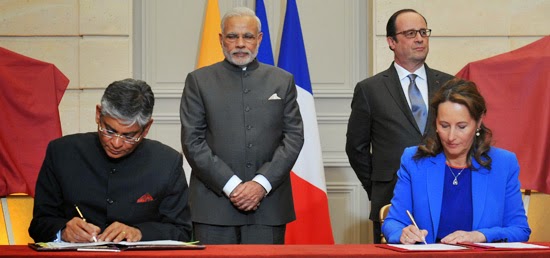
In 2015, the negotiations between Dassault and HAL had reached an impasse when PM Narendra Modi unlocked the situation; on April 9, he looked into the possibility to purchase 36 planes ‘off-the-shelf ’.
It was a pragmatic move. While dropping the former framework, India considered primarily the national interests and the IAF’s ‘critical operational necessity’.
Eighteen months later, after tough negotiations, the deal was finally signed to buy 36 Rafale fighter jets.
The details, obviously secret, were contained in several thousand pages of the inter-governmental agreement. It would give a breathing space to the IAF (which has been systematically and sadly forgotten in the present debate).
The saga started in 2001 and could have lasted decades more if Antony’s MMRAC (medium multi-role combat aircraft) formula had been stuck to. Air Marshal BK Pandey, one of India’s best experts, explained: “Dassault lacked confidence in the capability of Hindustan Aeronautical Ltd (HAL) with respect to Quality Standards, Time Lines and Cost, the OEM (Original Equipment Manufacturer, i.e. Dassault) was not prepared to partner with HAL and risk their reputation.”
Serious question
The Congress tweeting “chor, chor” every day, without any understanding of the situation and without proof to corroborate the accusations, raises a serious question: can an issue of supreme national importance be discussed on the public stage via Twitter?
The normal course would be to let the CAG find out if there is indeed a scam. Why can’t the CAG be trusted to meticulously go through the details of the inter-governmental deal?
But with the elections approaching, ‘national interests’ are shelved. In any case, politicians do not care much for such niceties; they want quick political gains. Unfortunately, the present ‘debate’ may jeopardise future defence procurements.
In April, the defence ministry issued a Request for Information (RFI) for the purchase of 114 new jets. Under the proposed scheme, 18 jets will come in ‘a flyaway condition’ (like the 36 Rafales); the rest will be produced in India under the new ‘strategic partnership’ policy, i.e., a joint venture between the selected foreign aviation major and its Indian partners. It is feared that the present noise around the 36 planes from France could be a precedent to question each and every defence acquisition.
India’s interest
Air Marshal Pandey feels that there is an apprehension “that the fresh move termed as MMRCA 2.0 could meet with the same fate (as the present deal). This will be a big disaster for the IAF which will be left with no choice but to depend largely on the LCA Tejas and the AMCA (Advanced Medium Combat Aircraft, a hypothetic HAL project) if it does become a reality.”
To make things murkier, former French President François Hollande claimed that the Modi government suggested industrialist Anil Ambani’s company as an offset partner.
It was apparently later denied by Hollande, with AFP reporting that during a visit in Canada, Hollande declared that he was unaware and “only Dassault can comment on this”.
In the meantime, the harm was done, though the Indian and French governments, as well as Dassault, categorically denied any truth in Hollande’s first statement. The French press reported that it was linked to funds received from the Ambanis by Hollande’s girlfriend. Though in France nobody takes Hollande very seriously, even as President, he had the lowest approval rate that a French leader has ever had, the Indian politicians jumped on the occasion.
Ultimately, it is India’s defence preparedness and the IAF, which suffers and will continue to suffer. But the problem is that many politicians seem not to care much for India’s interests. And who is laughing today? China and Pakistan.
Showing posts with label Hollande. Show all posts
Saturday, September 29, 2018
Saturday, April 11, 2015
Rafales and Sri Aurobindo
![]() |
| Prime Minister Narendra Modi paying homage to Sri Aurobindo at UNESCO |
I write ‘purchase’ because the deal is not signed as yet.
There is nothing about the multi-role combat aircraft in the 20-point ‘List of agreements/initiatives/announcements signed/agreed during visit of Indian Prime Minister to France’, published by the Ministry of External Affairs.
Only the Joint Statement issued at the end of the meeting between the French President and Indian Prime Minister mentioned the Rafales.
Point 14 says: “Government of India conveyed to the Government of France that in view of the critical operational necessity for Multirole Combat Aircraft for Indian Air Force, Government of India would like to acquire [36] Rafale jets in fly-away condition as quickly as possible. The two leaders agreed to conclude an Inter-Governmental Agreement for supply of the aircraft on terms that would be better than conveyed by Dassault Aviation as part of a separate process underway; the delivery would be in time-frame that would be compatible with the operational requirement of IAF; and that the aircraft and associated systems and weapons would be delivered on the same configuration as had been tested and approved by Indian Air Force, and with a longer maintenance responsibility by France.”
In other words, a contract still needs to be negotiated ...and signed.
Let us not forget that in December 1981, the purchase of 150 Mirages 2000 was announced to counter the American F 16 ordered by Pakistan, but the final agreement was for 40 planes only, although a preferential credit rate of 9,25 % was then offered to India.
At that time too, the Indian Air Force needed the fighter aircraft quickly; it was therefore decided to ship an initial batch of 26 single-seaters and 4 two-seaters in 1985. The second part of this initial batch consisted of 10 more single-seater with the M53-P2 engine, with these aircraft designated Mirage 2000H.
A second consignment of six Mirage 2000H single-seater and three Mirage 2000TH two-seater was shipped in 1987-1988. Nine more planes were ordered in 1986. At that time, as a ‘bonus’, Indian engineers received a six-month training in France with Dassault and Dassault-Systems.
Further in 1984, a core group started the Aeronautical Development Agency (ADA) in Bangalore. The ADA was to oversee the development of India's Light Combat Aircraft (LCA) program. For a short time, French engineers worked on the Tejas program.
The tragedy is that India has lost 14 years to reach yesterday’s decision.
Can you imagine that the initial Request for Information had been issued in 2001, 14 years ago!
It is only 6 years later that the Request for Proposal (RFP) was published, as the then minister, AK Antony wanted to add new clauses, such as the Total Life-cycle Costs, in the Indian defence procurement policy. This is where the ‘complications’ started.
Five years later, in January 2012, Dassault Aviation was selected for supplying 126 Medium Multi-Role Combat Aircrafts (MMRCA) to the IAF after a long competitive process which lasted five years, with the American F/A-18 and F-16, Russian MiG 35, European Eurofighter and Swedish Saab Gripen in the race.
Why so many years from nothing?
The answer is mainly because of the complicated and tortuous Defence Procurement Policy drafted by the former ‘honest’ Defence Minister.
If one believes yesterday’s Joint Statement, an Inter-Governmental Agreement will now be signed, putting the last nail into the MMRCA deal.
As soon as a new Defense Procurement Policy is published, negotiations for a transfer of technology to HAL or any other Indian firm involved in defense production, can start.
It may take some time.
It is worth noting that the Indian Prime Minister gave priority to the requirement of the Indian defense forces versus his pet project 'Make in India', which will be delayed for a few years, as far as the Rafale transfer of technology is concerned.
![]() |
| With Madam Bokova |
Another highlight of Modi’s first day in Paris (he arrived late in the evening of the previous day) was the visit to UNESCO and his speech on Indian and Universal values.
Before reaching the main auditorium, he was received by Madam Irena Bokova (read my interview with the UNESCO's Director General) in front of Sri Aurobindo statue outside the building.
The Indian Prime Minister paid floral tribute to the Indian rishi.
Always well-informed, an Indian agency said that he paid tribute to Rabindranath Tagore.
It is true that the great Poet had a great admiration for the integral yogi. After visiting Pondicherry in 1928, Tagore wrote: ‘Rabindranath, O Aurobindo, bows to thee! O friend, my country's friend, O Voice incarnate, free, Of India's soul.’ The poet added ‘You have the Word and we are waiting to accept it from you. India will speak through your voice to the world. Hearken to me!’
Tagore’s prophesy is slowly coming through; in his speech, Mr. Modi spoke about the unity of human race and Sri Aurobindo’s vision.
The 'vegetarian' menu at the Elysee Palace (and the list of snacks on the péniche on River Seine) are not yet known.
Today, the Indian Prime Minister will be landing on the ‘Chinese’ airport in Toulouse-Blagnac (China recently bought 49% of the shares of Toulouse airport) and visit the Airbus and CNES headquarters.
In the evening, he will perform a mini 'Madison Square Show' and addressed the French PIOs living in France and overseas.
A few photos courtesy the French MFA.
![]() |
| Arrival at the Airport |
![]() |
| French PIOs at the airport |
![]() |
| French PIOs at the airport |
![]() |
| With President of the French National Assembly |
![]() |
| Guard of Honour in the Invalides |
![]() |
| With Laurent Fabius, MFA |
![]() |
| Indo-French CEOs Forum |
![]() |
| Relaxing on the Seine River |
Thursday, April 9, 2015
High on potential, and high on hopes too
![]() |
| Add caption |
During Modi’s France visit, it is difficult to predict what will happen with the Rafale deal, but if it goes through, it will become the ‘mother' of all ‘Make in India' projects and herald a number of win-win situations for India
A few days ago, before he embarked on a nine-day trip abroad, Prime Minister Narendra Modi tweeted: “My France, Germany and Canada visit is centered around supporting India’s economic agenda and creating jobs for our youth.” About the French leg of his journey, Mr Modi announced that he would “discuss strengthening India-France economic cooperation and visit some high-tech industrial units outside Paris, [while] seeking greater French involvement in our Make in India programme, including in the defence manufacturing sector.” Mr Modi’s visit to France should be seen in this perspective. Is it a coincidence that three days before Mr Modi’s departure for Paris, Defence Minister Manohar Parrikar ‘undocked’ the first of the six Scorpene submarines built in collaboration with the Directions des Constructions et Armes Navales of France at the Mazagon Docks Limited?
Intentional or not, it is an interesting example to look at because it is a great leap forward for the Make in India, which is not about manufacturing toys or cheap appliances, but being able to integrate the latest state-of-art technologies into India’s industrial process. The Scorpene submarine also shows that despite difficulties and delays, it is possible for India to assimilate, in a relatively short time, the latest technologies. After the ‘undocking’ function, Mr Parrikar blamed the delay on what he termed as the incompetence of the previous Government. He might be right, but the fact remains that it is not an easy proposition to transfer technologies in an environment which is not always prepared to receive such technologies. And how to eliminate delays, frictions with the ‘supplier’ and price overruns?
Click here to continue...
Thursday, April 19, 2012
Sarkozy set to lose race
My article Sarkozy set to lose race appeared in The Pioneer.
Click here to read...
Saturday, April 14, 2012
French presidential elections: A lacklustre affair.
My article posted below appeared yesterday in the DNA under the title French presidential elections: A lacklustre affair.
Click here to read...
Friday, April 13, 2012
Non, Non, Non
Her video uploaded in December 2010 on YouTube immediately went viral: it has been watched 14 million times.
She has now a French avatar; the chubby baby who always says ‘no’, has been adapted for the sake of the forthcoming French presidential elections.
The interviewer asks Charlotte: “Tu votes pour Nicolas Sarkozy?” (Do you vote for Sarkozy?” Charlotte says “Non!”. For François Hollande? “Non!” For Jean-Luc Mélenchon (the Communist Party’s candidate)? Non!” For Marine Le Pen (the aspirant of the far-right National Front? “Non!” Francois Bayrou? ‘Non!’
And so on, for all the 10 candidates! The 2012 two-round French presidential election will be held on April 22 and May 6; the two first candidates on April 22 being selected for the second round.
The President of the French Republic is the elected Head of State with extended powers in the fields of defence and foreign affairs and some control over a Prime Minister nonetheless answerable to the Parliament.
Charlotte has a point: since the beginning of the Fifth Republic in 1958, France has never witnessed such boring elections.
The new Constitution of the Fifth Republic which replaced the old parliamentary system, undoubtedly brought a stability to the institutions;, a majority of the electors is however aware that the future President will not be able to solve all the tough problems facing the country.
Sarkozy, once the hyper-President, has lost his halo. He even had to apologize for his ‘people’ (Page Three) period during the first years of his Presidency while less and less electors believe that he can deliver new miracles.
Hollande has never been an exciting postulant; further he does not have the charm of his ex-companion Ségolène Royal, Sarkozy’s rival in 2007; the Socialist candidate remains ahead in all surveys and will in all probability be the next President. He has the advantage of incumbency. But this does not make the campaign thrilling.
Bayrou, the eternal looser is unable to bring enthusiasm to a campaign becoming duller by the day; Bayrou, who wants to be the ‘alternative’ has been downgraded to the fifth place in the surveys.
Marine Le Pen, the daughter of the veteran extreme-right provocateur, Jean-Marie Le Pen is not doing as well as she expected. A few months ago, she thought that she could topple Sarkozy and reach the second round. She now arrives in the fourth place behind Mélenchon, the only candidate who keeps progressing, probably thanks to his wild populist promises. But one can’t expect a modern country to return to a Bolshevik system à-la-Chinese.
The less one speaks of the other candidates, the better.
Will the last days of the race, become more ‘sexy’ or at least slightly less boring? No, no, no would say Charlotte.
The real issue is that nobody has the solutions to sort out the economic and social problems facing the country. There is no readymade panacea.
More than 75 % of the French believe today that the globalization is something negative and that the concurrence of countries like India or China will affect further employment.
Very few believe today that a solution will come from the European Union, which is ‘too bureaucratic’ and excessively centralized in its decision process.
The British press never misses an occasion to make fun of the French. The Economist calls France 'A Country in Denial'. The cover story points out: “What is most striking about the French election is how little anybody is saying about the country’s dire economic straits. The candidates dish out at least as many promises to spend more as to spend less. Nobody has a serious agenda for reducing France’s eye-watering taxes. Mr Sarkozy, who in 2007 promised reform with talk of a rupture, now offers voters protectionism, attacks on French tax exiles, threats to quit Europe’s passport-free Schengen zone and talk of the evils of immigration and halal meat.”
Hollande will probably be unable to fulfill his promises “to expand the state, creating 60,000 teaching posts, partially roll back Mr Sarkozy’s raise of the pension age from 60 to 62, and squeeze the rich” charging them with an income-tax rate upto 75% of their revenue?
Many thought the gruesome killings of military personnel and Jewish kids in Southern France could bring some spice into the campaign, or at least open a real debate. Though each candidate presented his own recipe to tackle this tricky issue, the barometer of the surveys did not move.
When candidates have not much to promise, what is left to say?
In India, it is easier, you can always promise a fridge, a cycle (or a motorbike), a laptop or a grinder, but the French already have all this.
So what to promise? A brighter future?
But who can be certain to deliver the goods?
One should ask Charlotte!
Subscribe to:
Posts (Atom)