|
| Narendra Modi will dine on a péniche on the river Seine |
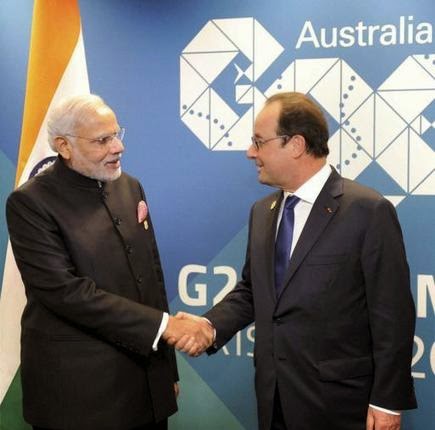
Prime Minister Narendra Modi is embarking on a 9-day tour abroad during which he will visit France, Germany and Canada. His first stop will be in Paris (April 9-12).
A few comments on his visit to France:
The good news first
On April 6, Defence Minister Manohar Parrikar ‘undocked’ the first of the six Scorpene submarines to be built in collaboration with France under Project 75, at the Mazagon Docks Limited (MDL).
The ceremony for ‘floating out' the first Scorpene submarine was an occasion for Mr. Parrikar to review the progress of the Project 75, in collaboration with DCNS of France.
After the ‘undocking’, for the first time the submarine entered into waters (with the help of a pontoon).
An Indian Navy official told the media: “While the launch would be a more significant event, the floating out of Scorpene will commence its sea trials and more importantly, clear the dry dock that it presently occupies for the construction of the next one.”
It is a promising progress for the ‘Make in India’ scheme. It is also shows that despite the difficulties and the delays, it is possible.
The ‘refitted’ Mirages
Perhaps as an appetizer for the Rafales deal, the IAF got its first two upgraded Mirage-2000 with new avionics and weapons at the end of March.
An ‘acceptance’ ceremony for the IAF’s Mirage 2000 I/TI was held at Istres, in South France on March 25. Among those present were Arun K. Singh, ambassador of India to France, Eric Trappier, chairman and CEO, Dassault Aviation and Pierre Eric Pommellet, executive vice president of Thales. The contract for ‘refitting’ the IAF's Mirage 2000 was signed in July, 2011. The upgrade ‘kit’ provided by Thales comprised new radar, electronic warfare suite and mission computer.
An official told
The Times of India: “The upgraded Mirages have been stripped down and virtually re-built with state-of-the-art avionics, radars, mission computers, glass cockpits, helmet-mounted displays, electronic warfare suites and long-range missiles.”
Of course, the appetizer can’t replace the main course (Rafales), but one has to remain patient.
The ‘Maitri’ project
An important decision was recently taken by the Defence Acquisition Council: it approved the ‘Maitri’ project for the co-development of a Short Range Surface-to-Air Missile (SR-SAM) by the Defence Research and Development Organisation (DRDO) with MBDA of France.
The project has been ‘pending’ since 2007 and apparently, Delhi will now go for the marine version as the DRDO’s Akash missile system satisfies the Indian Army and the Air Force.
The ‘Maitri’ project, like the ‘Brahmos’ with Russia, could become a success story for the ‘Make in India’. The signature on the SR-SAM deal could be the ‘main dish’ of Modi’s present visit.
Coastal Surveillance Radar System
According to
The Economic Times (ET), India and France are expected to discuss the sharing of radar data in the Indian Ocean as part of their strategic talks during Narendra Modi's visit to Paris.
India is setting up a grid of coastal surveillance radars in the Indian Ocean Region (IOR) which should help monitoring the region. France has apparently expressed an interest in sharing data from its surveillance systems.
The ET says that “the modalities of sharing maritime domain awareness data from at least three French monitoring sites in the Indian Ocean is set to be on the agenda. French territories in the region include the Reunion Islands and Mayotte, besides military bases in UAE and Djibouti.”
Apparently, the Indian Navy is keen on the French proposal and would like it to be part of an ambitious plan to set up a 24-nation radar grid in the IOR to monitor all traffic, civilian and military. “As part of the plan, India could also lend financial aid to littoral nations for setting up radars. In the future, surveillance data from other military sites, including the American base at Diego Garcia, could be integrated,” says the ET.
It is however doubtful if France will agree to ‘counter’ China in the region.
On April 3, Chinese and French military officials reached a consensus in Beijing “on enhancing cooperation in exchange of ship visits, joint drilling and countering terrorism at sea.”
Gen. Fang Fenghui, chief of general staff of the Chinese People's Liberation Army (PLA) met with Admiral Bernard Rogel, chief of staff of the French Navy in Beijing.
According to Xinhua, Admiral Bernard Rogel during his recent visit to China, declared that the rapid development of Chinese Navy's armaments and the excellent personnel quality left a deep impression on him: “He pledged to deepen mutual understanding and enhance cooperation with the Chinese side in the aspects of fleet visits, joint drilling and training as well as fighting against maritime terrorism.”
‘Varuna’ Joint Exercices with the Charles de Gaulle Carrier
The French aircraft carrier Charles de Gaulle, which has recently been inducted against the Islamic State from the Persian Gulf, will participate in the Indo-French exercises ‘Varuna’ later this month.
Varuna will be held for 10 days in the Arabian Sea between the French and Indian Navies. It will also involve India's aircraft carrier, the INS Vikramaditya as well as other Indian warships and a submarine.
During the exercises, the French Navy will use Rafales (M), the ‘navalised’ version of the Rafale currently under negotiations with Delhi.
The exercise will begin on April 23 and continue till May 3. The French will also bring two destroyers and a support ship.
The Indian media reported: “The navalised version of the aircraft is adapted to land and take off from carriers. The Indian Navy's main fighter jet is the Russian MiG29K. The fleet is being integrated with the Vikramaditya.”
The French side is keen to expose the Indian Navy to the Rafale (M), with the hope that a first-hand experience of the fighter jet, may convince the Indian Navy, if not the MoD, to add a few Rafales (M) in India’s wish list.
Visit to ToulouseOne highlight of the PM’s trip will be the visit to Airbus Industries headquarters in Toulouse. At stake in Toulouse, a $2-billion contract for eight Airbus A-330 MRTT mid-air refuelers, a deal pending for over two years. There is also a proposal for buying two Airbus A-330 aircraft for the IAF which is keen to acquire AWACS (Airborne warning and control system). India’s ‘eye in the sky’ could be mounted on Airbus A-330 with Defence Research and Development Organisation (DRDO)-developed rotodome radar fitted on it.
The Prime Minister will probably be shocked when he discovers that the Chinese recently bought the Toulouse Blagnac airport.
What is the ‘Make in India’ scheme?
Mr. Modi’s ‘Make in India’ dream is something which should kept in mind while analyzing the significance of the Prime Minister to France (and Germany).
I witnessed the new craze during the recent Aero India 2015, organized at Yelahanka Airport in Bangalore (‘Make in India’ was the theme of the event).
Most of the foreign participants, even the Americans, were effusively enthusiastic about the scheme.
Foreign investors understood that the government was serious when, in August 2014 , Delhi notified an increase in foreign direct investment (FDI) limit to 49 % in the defence sector. The move was aimed at boosting India’s domestic industry and creating confidence amongst eventual investors.
A Policy Change
In Bangalore, the Prime Minister had the opportunity to clarify that India is ready for a major change in direction: “I am confident that India will emerge as a major global centre for defence industry. We want to develop an industry that is dynamic.”
The Indian Prime Minister wanted to end India's status as the world's number one defence importer; India’s objective is to have 70 % (from the current 40 %) of hardware manufactured domestically by 2020.
Mr. Modi explained: “We have the reputation as the largest importer of defence equipment in the world, that may be music to the ears of some of you here. But this is one area where we would not like to be number one."
‘Make in India’ will undoubtedly be central to the Prime Minister’s visit to Europe.
But there is a long, long way to go.
A Civil Nuclear Deal?
Apart from French investments in India, space and civil nuclear cooperation, infrastructure investment, terrorism and other security issues, will also be on the table. Narendra Modi has redrawn his week-long tour of Europe-Canada tour to make Paris the first stop, before proceeding to Hannover.
In September 2008, India and France signed the first civilian nuclear agreement and consequently, a General Framework Agreement between Areva and the Nuclear Power Corporation of India Limited (NPCIL) for the construction of 6 European pressurized reactors (EPR) at Jaitapur in Maharashtra was inked in December 2010 during President Sarkozy’s visit to India.
An Indian diplomat told
The Hindustan Times: “The supply of EPRs will be on top of PM Modi’s agenda but much depends on the closure of commercial negotiations between the two companies.”
The finalization of the plans however depends on the economic and technical viability of these nuclear plants and as important, on an accord about ‘nuclear liabilities’.
The Indo-French Economic Cooperation
The French investments in India are progressing rather well with the total investment stock of French companies in India reaching nearly $19 billion.
French Embassy sources believe that in the next to 4 to 5 years, the stock of French investments in India will significantly increase with the consolidation and extension of existing investments, and the influx of new French companies in India. A Special Representative for Indo-French Economic Relations (Paul Hermelin, the CEO Capgemini) has been appointed by the French President for the purpose.
Today 950 French companies (350 companies and 400 subsidiaries, as well as 200 individual entrepreneurs) are said to be implanted in India; they employ some 3,00,000 skilled Indian workers.
French Embassy sources say that these French companies have brought their know-how and technology and many have begun opening research and development centres in India (already employing between 15,000 and 20,000 persons).
France and ‘Make in India’
Last September, more than 20 French companies attended the launch of the ‘Make in India’ campaign; to cite a few: Alstom, Dabon-Bongrain, Danone, Faurecia, Lafarge, Legrand, L’Oréal, Michelin, Renault, Roquette, Safran, Sanofi Pasteur India, Schneider Electric, SEB, SERAP, Saint-Gobain, Total, Valeo and Vicat.
Let us look at a few examples: Renault-Nissan has begun production in May 2010 on a 640-acre integrated plant in Chennai, with an investment of €700 million. It has now an annual capacity of 480,000 units with a workforce of more than 15,000 employees.
Michelin set up a 290-acre campus, 50 km north of Chennai; it already manufactures a wide range of radial truck/bus tyres.
Last October, Safran, a world leader in aerospace, defence and security, which provides the engine of the Rafale (through its subsidiary SNECMA) signed two agreements with Indian Institute of Technology (IIT), Delhi, and Indian Institute of Science (IISc), Bangalore, to develop advanced pattern recognition algorithms for complex data and advanced computing platform for the next-generation avionics applications.
Another case is Saint-Gobain’s modern manufacturing facility in Rajasthan. A French press release says: “this state-of-the-art, fully automated float line covers a surface area of 27 acres and has a manufacturing capacity of close to 1000 tons of glass per day (3,00,000 metric tons per year). Once the plant is fully operational (by mid-2015), Saint-Gobain will have a total installed production capacity of 9,000 tons of glass per day.”
The French presence in South India
The French presence in South India, particularly in Chennai and Pondicherry is worth noting; more than 100 enterprises are implanted in the South.
Apart from Renault and Michelin already mentioned, large French groups such as Alstom, Saint-Gobain, Lactalis have set up factories in Chennai. Interestingly, the management of these large companies is progressively transferred to local cadres, while the French personnel continue to focus on quality control and over-all financial management.
The main focus is presently automobiles and transport (such as Alstom Transport which produces metro bogies) and energy like Sicame (electric material), Schneider, Cryolor (cryogenic tanks), Legrand and Socomec (UPS). Saint-Gobain also has a large factory in Chennai.
In Pondicherry, the focus is more on hospitality, tourism as well as Internet editions and web design.
Cooperation in the field of Education
During the visit of President Hollande in India in February 2014, some 15 Memoranda and Letters of Intent were signed in the field of education. An example: the MOU between the Indian Institute of Science, Bangalore and the Centre National de la Recherche Scientifique, Paris was inked aiming at cooperating ‘within any field of mutual interest related to science and technology’. This series of MoUs not only deepens the Indo-French academic relations, but will have long-term consequences for the over-all relations between the 2 countries.
More recently, an 'Advanced Masters Course in Air Navigation Service Provider Management' was launched at the CATC (Civil Aviation Training College) facilities in Hyderabad. It is a joint project of ENAC (Ecole Nationale de l'Aviation Civile), CATC and AAI (Airports Authority of India). The objective is to train a new generation of AAI Managers to ensure airport security and safe operations.
Hopefully, other such projects will see the light during Mr. Modi’s visit to France.
Indian companies in France
One usually forgets that some 100 Indian companies are today operating in France. In December 2012, according to the Banque de France, their investment-stock was $ 565 million.
The main investments in France are in textile, clothing and accessories (25%), software and IT services (13%), aerospace, naval and railway (13%), consulting, engineering and business services (13%), pharmaceuticals and biotechnologies (13%), metalworking (13%).
More than 50 % of these investments are located in 2 regions (Paris- Ile-de-France and Nord-Pas de Calais).
It is usually not known that 4% of all foreign R&D investment projects in France come from Indian companies.
Sintex Industries (chemicals, plastics), Tata Steel, Tata Sons (IT Services) and Deltronix and Motherson Sumi Systems (both automotive industry) are the largest Indian employers in France.
Brussels: the visit that never was
It is unfortunate that the visit of Prime Minister Modi was cancelled due to the callousness of the Brussels bureaucracy; they just forgot to answer the PMO about a date for the visit.
The EU had earlier hoped for a 'political push' to restart the stalled talks for the Free Trade Agreement (FTA) as well as “sticky issues relating to intellectual property rights (IPR), data security for IT services and tariff in the automobile sector,” said PTI.
The EU has been India's largest trading partner and the two-way commerce reached $ 101.5 billion in 2013-14.
A small positive step: the EU has recently lifted the ban imposed on the import of Indian mangoes. In April last year, the EU had temporarily banned import from India of Alphonso mangoes and four vegetables, taro, bitter gourd, snake gourd and eggplant, for which the ban has still not been lifted. More positive signs will have to come from Brussels to start meaningful talks.
India is active and keen to open new avenues. For example, in October 2014, Harsimrat Kaur Badal, the Indian Minister for Food Processing Industries, visited France and reiterated the need to strengthen Indo-French cooperation in the agro-processing sector. She inaugurated the Indian Pavilion at the SIAL 2014 (Salon International de l’Alimentation) Food Fair. It was for her an occasion to discuss further collaboration with Stephane Le Foll, her French counterpart.
Nuclear Fusion Collaboration
International Thermonuclear Experimental Reactor (ITER), the six-country scientific collaboration to generate nuclear fusion energy in France, will get its heart from Gujarat.
The Institute of Plasma Research (IPR) in Gandhinagar is responsible for the fabrication of the reactor's crucial parts — the cryostat and the vacuum vessel, at a L&T plant in Hazira near Surat.
IPR director Dhiraj Bora, speaking at the recently-held Gujarat Science Congress in Ahmedabad explained: “The cryostat and the vacuum vessel of the ITER Tokamak fusion reactor is the heaviest, the largest and the most central component. The reactor intends to produce 500 megawatts of power from 50 megawatts input. The plant would start first experiments by 2020.”
Bora added: “We have started fabricating it at L&T Hazira and it will be taken to ITER site in Cadarache (near Saint-Paul-lès-Durance in South France) where we have a workshop to integrate the components."
The first consignment is scheduled to be shipped out in December.
India has started participating in the project in 2005, joining the EU, China, Japan, S Korea, Russia and the United States in the mega-project.
Space Collaboration
The Indo-French cooperation in the domain of space is one of the oldest and most stable facets of the ‘strategic’ relationship, even if not the best-known. In May 1964, France's Centre National d'Etudes Spatiales (CNES) and India's Department of Atomic Energy (DAE) embarked upon a programme of continuing cooperation in space research of mutual interest for peaceful scientific purposes.
The DAE agreed to manufacture, under license in India, the Belier and Centaure types of sounding rockets developed by the French firm Sub-Aviation. CNES eventually supplied to DAE four Centaure rockets with payloads used for vapour cloud experiments. The programme started at the end of 1964. The main protagonists were the legendary Professor Jacques Blamont of the Aeronautic Laboratory of the Centre National de la Research Scientifique and Dr P.D. Bhavsar of the Physical Research Laboratory in Ahmedabad.
Since then, the collaboration has continued flawlessly.
On February 25, 2013, ISRO launched, from the Satish Dhawan Space Center at Sriharikota in Andhra Pradesh, an Indo-French satellite called SARAL. The satellite was placed on a perfect orbit in the presence of President Pranab Mukherjee and the Chairman of CNES.
The Polar Satellite Launch Vehicle PSLV-C20 first dropped the Indo-French satellite before placing into orbit 6 other mini and micro satellites from different countries.
For the Indian launcher, PLSV with its 230 tons and 44.4 meters, it was its 23rd mission (and the 21st successful one)
Encouraged by the financial and technical performances of the Indian launcher, France asked ISRO to send a 717 kg-observation satellite, SPOT-7 into orbit. This was done by the PSLV-C23 on June 30, 2014 in presence of the recently-elected Prime Minister Narendra Modi.
In the years to come, space will continue to play a prominent role in the strategic partnership between France and India.
Incidently, Narendra Modi will visit the headquarter of the CNES while in Toulouse and a MoU on Space between France and India will be signed.
Smart Cities
According to
The Hindu, Mr. Modi will get “a first look at the future of his plan for ‘100 smart cities’ during his visit to France, when he travels to the city of Toulouse.”
Will the French President Francois Hollande and Mr Modi discuss some French investment for the Indian government’s pet project? We will know very soon.
Apparently, Puducherry and Chandigarh are top contenders for development as a smart city. French Ambassador Francois Richier told The Hindu, “I am happy that we would be able to put our energies together for a smart city project, which would allow us to bring together our understanding of urban development, preserving heritage and attracting tourism for such places.”
It is easier said than done. It is indeed difficult to see Pondicherry (where I have lived for 40 years) becoming smart.
And let us hope that the airport will not be sold to China like in Toulouse.
Addressing the French PIOs
On April 10, Prime Minister Modi will address the Indian Diaspora from Paris. Interestingly, many will listen to him via videoconference from overseas French territories (‘departements’) where the majority of the French PIOs live.
A senior government official told The Telegraph: “India's consulates and Diaspora organisations will broadcast Modi's Paris speech live in the Reunion and Mayotte islands in the southwest Indian Ocean and in Guadeloupe, Martinique and French Guiana in Latin America.”
Via the video link, Modi will have an opportunity to see them; he could eventually answer questions of the PIOs watching the mini ‘Madison Square Show’ from their far-away ‘departements’.
France has five overseas territories and spread across two continents. Together they are home for over four lakh people of Indian origin, while about one lakh French PIOs live on the French mainland.
Modi had never the opportunity to visit a country where most of the Indian Diaspora community is based overseas.
The Rafale Deal
The Rafale deal could of course become the ‘mother’ of all ‘Make in India’ projects and herald many new win-win situations for India and her partners.
In the long-delayed $20-billion deal to supply to India 126 Medium Multi-Role Combat Aircrafts (MMRCA), 108 planes will be manufactured in India; it is probably the largest transfer of technology of the decade.
In January 2012, Dassault Aviation of France had won the right ‘for exclusive negotiations’ with the Ministry of Defence for the supply of these combat aircrafts.
The complexity of the ‘Deal’ explains the 3 long years of negotiations. Can a ‘political’ decision be reached before the arrival of Mr. Modi in Paris? It is not certain.
Recently a major obstacle was crossed when Dassault Aviation and Hindustan Aeronautics Ltd. (HAL) reached an agreement to share the responsibility of the 108 Indian-built aircrafts. Eric Trappier, the Chairman of Dassault stated in France: "This is the first time Dassault agrees to be a co-contractor. Dassault and HAL will both take responsibility for the part they will each build on the Rafale aircraft made in India." He asserted that this arrangement was in line with the Indian government’s initial tender (request for proposals or RFP).
The final cost of the ‘Deal’ still needs to be finalized.
In the meantime, President Francois Hollande said there will be no news on the sale of Rafale to India before the arrival of Narendra Modi in Paris: "There will be no announcement on the Rafale sales before the visit of Prime Minister Modi in France and I do not want the Indian premier's visit to be put in the context of a contract. We are working on it," said the French President.
Goût de France/Good France
And now the desert!
As a prelude to the Prime Minister’s visit to France, India participated in the French “Goût de France/Good France” project to celebrate French gastronomy worldwide under the Three Star Chef Alain Ducasse’s supervision. In India, 48 restaurants participated in the culinary feat.
One can hope that after Mr. Modi’s visit to France, a “Goût de l’Inde” festival will soon be held in France. French people are quite fond of Indian Tastes.
Bon appétit Mr. Modi!