My article From Kashgar to Syria appeared in The Statesman
Here is the link...
In 1949, a few months after the new People's Republic of China was proclaimed, Mao moved to ‘liberate’ large areas at the periphery of the Middle Kingdom.
While the remnants of the Nationalist forces were slowly and systematically annihilated in the Mainland; Mao annexed Xinjiang using two tactics: a large number of troops were sent in the New Dominion and the surrender of some Nationalist leaders was induced. It was relatively easy for the Great Helmsman who had got the assurance from the Soviets that they would not interfere.
The PLA had however to cross deserts, walk over high snow-capped mountains and suffer starvation to realize this unbelievable military feat, walking some 3,000 kms in six months, to complete their mission.
Strategically, Communist China was at the Gate of Tibet …and of India; a couple of years later, the construction of a road across the Indian territory in the Aksai Chin area would start.
A recently released CIA report gives a good oversight on what happened in Kashgar in 1949/50. Although written March 1951, the note remarked: "the Chinese troops stationed in Sinkiang use systematic, disciplined violence for political reasons, …[while] rations, ammunition and military stores are received from the USSR.”
The local government officials assured the people that "the Chinese in the administrative structure were there simply to teach the natives of Sinkiang the art of governing, and that soon the full Governmental administrative responsibility would be turned over to the people of Sinkiang."
It is ironic that nearly seventy years later, Han are still struggling to manage the restive province and still use systematic violence.
Retrospectively today, one understands the importance for China of the annexation of Xinjiang with its natural resources such as oil, but also for trade routes which are now revived under schemes such as One Belt One Road initiative or the China Pakistan Economic Corridor.
But Xinjiang remains far from being ‘liberated’; on the contrary, the Chinese State is slowly transforming the restive province into a nursery for terrorism.
The South China Morning Post recently explained: “For many in the Muslim ethnic group, China has become unlivable since Beijing launched a security crackdown in Xinjiang in 2009.”
The Hong Kong newspaper takes the case of one Ali, an Uygur who has been fighting in Syria. Ali had paid smugglers to get him into Turkey and then to Syria, where he was trained to use a Kalashnikov …to later return to China. After spending two-and-a-half years in Syria with him, his brother told the newspaper: “We’ll avenge our relatives being tortured in Chinese jail. …Since 2013, thousands of Uygurs, a Turkish-speaking Muslim minority from western China, have travelled to Syria to train with the Uygur militant group Turkestan Islamic Party and fight alongside al-Qaeda, playing key roles in several battles. Syrian President Bashar al-Assad’s troops are now clashing with Uygur fighters as the six-year conflict nears its endgame.”
According to Uygur exiles, more than 10,000 Uygurs fled China following the repression. The SCMP concluded: “But the end of Syria’s war may be the beginning of China’s worst fears.”
As the vicious circle continues, Debka, the Israeli Weekly reported that according intelligence sources: “2,500 Chinese elite troops are on the way to Syria to fight Chinese Uighur Islamist extremists and their Turkish-backed plan to set up an autonomous enclave in the rebel-held Idlib province of northern Syria.” Will it help?
Debka’s sources affirmed that China has secured permission from Damascus to send Chinese troops from two elite units: the ‘Siberian Tigers’, a PLA Navy Special Force from northeast China's Shenyang Military Region and the ‘Night Tigers’, a Special Forces Unit from Lanzhou.
Already two years ago, a new Chinese Counterterrorism Law made it legal for China's PLA to get involved in anti-terror operations abroad. The legislation allows the PLA and Armed Police’s forces to carry out counter-terror missions overseas with the approval of the Central Military Commission.
Xinhua affirmed: “Public security and national security authorities could also send personnel overseas for counter-terrorist missions, but these must be approved by the State Council and agreements signed with the countries concerned.”
Having borders with eight nations: Mongolia, Russia, Kazakhstan, Kyrgyzstan, Tajikistan, Afghanistan, Pakistan and India, Xinjiang is a convenient conduit for terrorist movements towards the Middle East and the world in general.
In the meantime, repression is every day increasing in Xinjiang.
Radio Free Asia (RFA) recently reported that the authorities have earmarked a substantial amount of cash to reward the residents of Hotan prefecture (north of India’s Aksai Chin) who report ‘acts of terrorism’: “The Counter-Terrorism Reward Resolution, enacted by the government of Hotan Prefecture, set aside 100 million yuan (US $15.2 million) for information on suspicious activities, and for individuals who attack or kill terrorists,” the official Hotan Daily newspaper said in a post on its WeChat social media account.
A security guard from Aqsaray police station in Hotan’s Qaraqash county read to RFA an official notice posted in the station; it is entitled “Announcement of Payment Categories for Rewarding Members of the Public Who Provide Information on Illegal Activities Relating to Acts of Terrorism or Violence.”
The notification said: “People from all ethnic backgrounds who provide tips or clues of any illegal activities relating to acts of violence or terrorism will receive high rewards, once the information has been confirmed to be genuine after investigation.”
Also according to RFA, nearly 10 percent of the population of Bullaqsu township, a county near Kashgar, have been detained. A former resident of Bullaqsu told RFA that “a large number of people have been arrested in the county this year, leaving some townships with hardly any males to be seen.”
The person who now lives in exile asserted: “Bullaqsu was one of the townships most affected by the arrests in Kashgar …groups of people have been arrested and sent to detention centers every week.”
Most of this happened after the appointment of Chen Quanguo as Communist Party Chief in August 2016: “a series of harsh policies have been initiated targeting Uygurs in the region, where members of the mostly Muslim ethnic group complain of religious and cultural repression and harassment under Chinese rule,” says RFA.
Since then, Chen, who had earlier practiced his ‘recipe’ in Tibet for five years, has been rewarded with a seat on the Politburo.
Thousands of Uygurs, who have been accused of harboring ‘extremist and politically incorrect’ views, have been detained in re-education camps and prisons throughout Xinjiang since April.
Earlier this year, Human Rights Watch (HRW) released a ‘glossary’ of special slogans or ‘formulations’ (tifa) used by the Chinese officials in Tibet when referring to party policies. The same apply today to Xinjiang.
‘Poetic’ tifas such as Social Management, Comprehensive Rectification, Preventive Control, Eliminate-Unseen-Threats, Nets-in-the-Sky-Traps-on-the-Ground or Copper-Ramparts-Iron Walls, are regularly used. The latter one for example, translates into “an impenetrable public security defense network consisting of citizen patrols, border security posts, police checkposts, surveillance systems, internet controls, identity card monitoring, travel restrictions, informant networks, and other mechanisms.”
The implementation of these tifas, is often dreadful... but efficient for Beijing. Beijing has for example decided to collect DNA samples from all Xinjiang’s residents; the name Mohamed is banned for newborns, men can’t have beards, etc.
China is definitely breeding more terrorists.
Showing posts with label Article Statesman. Show all posts
Wednesday, January 3, 2018
Sunday, October 29, 2017
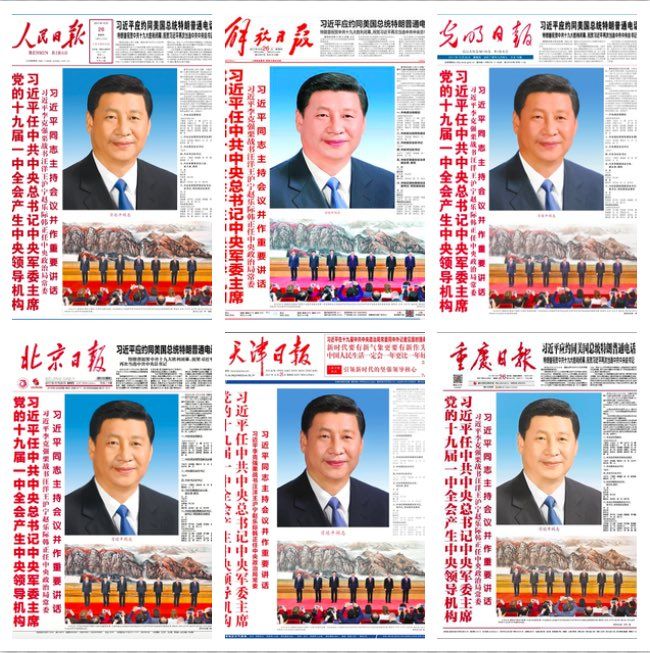
Is Mr Xi the winner?
![]() |
| Front-page of 6 different newspapers in China |
Here is the link...
At the end of the 19th Congress, most of the Western media have declared President Xi Jinping, the winner. He is the most powerful leader since Mao, say the China watchers. But is it true? A great difference between Mao and Xi is that the Great Helmsman controlled the Communist apparatus without intervening much in the day-to-day affairs.
He often travelled the countryside in luxurious trains for weeks, with just a few secretaries and several of his favourite ‘nurses’. He had no encrypted way of communicating with his colleagues (or ‘lackeys’ in Maoist parlance) in Beijing. He was not bothered. This is not the case of Xi Jinping who heads a large number of Leading Small Groups on many topics under the Middle Kingdom’s sky, but he is also General Secretary of the Communist Party of China, the President of the People’s Republic of China, the Chairman of the Central Military Commission and the Commander-in-Chief of the Joint Battle Command.
Xi has however undoubtedly emerged as the winner on several fronts in recent months. First and foremost, the 19th Congress approved an amendment to the Party Constitution enshrining Xi Jinping Thought on Socialism with Chinese Characteristics for a New Era.
Though the new Central Committee and Central Commission for Discipline Inspection are more or less along the expected lines, the Politburo and the Standing Committee brought some surprises. The new Politburo’s Standing Committee now comprises President Xi, Premier Li Keqiang, Li Zhanshu, Wang Yang, Wang Huning, Zhao Leji and Han Zheng.
The presence of Li Zhanshu, Xi’s chief of staff, who is to take over the chairmanship of the National People’s Congress, is a proof of Xi’s control over the appointments. Ditto for Wang Huning, the party theorist who will take the charge of ideology, propaganda and party organization, while Zhao Leji will replace Wang Qishan, as the new antigraft tsar. Wang Yang will take the seat of Yu Zhengsheng as chairman of the Chinese People’s Political Consultative Conference; as for Han Zheng, he will probably be drafted as Executive Vice-Premier in March.
But where are Xi’s presumed successors, Hu Chunhua and Chen Miner? Where is Wang Qishan, Xi’s right-hand man who, for five years, arrested the ‘tigers and the flies’? The absence in the Standing Committee of Chen Miner, the Party Secretary of Chongqing, who was expected to be anointed ‘heir apparent’ has been noticeable. Apparently Xi does not want a ‘successor’ as yet. Same for Hu Chunhua, Guangdong Party Secretary, who for several years was said to be a future new General Secretary.
Just before the Congress, the South China Morning Post (SCMP) which has been by far the bestinformed, noted: “Hu Chunhua ~ the widely tipped successor ~ and the president’s protégé, Chongqing party chief Chen Miner, are both likely to be missing from the Politburo Standing Committee. Instead, they will join the Politburo, which is one rank lower.” It is what happened. SCMP had good tips, despite the opacity of the party proceedings. The great surprise was that Wang Qishan, who is responsible for making thousands of party heads roll, has stepped down from the Standing Committee, due the age-limit norm.
It was confirmed when his name did not appear in the list of the new Central Committee members. Many ‘watchers’ were expecting Xi to break an unwritten retirement-age rule to keep his friend Wang in the Standing Committee. Two members of the powerful Central Military Commission (CMC) made it to the Politburo. Apart from Air Force General Xu Qiliang, presently CMC ViceChairman, General Zhang Youxia, a family friend of Xi, was selected as the second vicechairman.
Contrary to what many have written, Xi might not be all-powerful; he still has to deal with party norms and traditions: “He is careful not to break the age rule and to follow the order of seniority. These political norms are critical for the 89-million member Communist Party to have consensus at the top and maintain stability,” wrote the SCMP which also noted: “Xi is also not blindly following the established path.” Another sign that Xi may not have full control, is the reduced size of the CMC which has only 7 members (apart from the two Vice-Chairmen: Xu Qiliang, Zhang Youxia, others are Wei Fenghe, Li Zuocheng, Miao Hua, Zhang Shengmin) compared to 11 during the previous Congress. The day after the announcement of the new CMC, Xi met the PLA delegation and urged them to “follow the road maps set for it at the Congress.”
It is easier to agree on 7 than 11. Xi said socialism with Chinese characteristics has entered a new era, and the military should make all-out efforts to become a world-class force by 2050 while striving for the realization of the ‘great rejuvenation of the Chinese nation’. Xi ordered the PLA to be absolutely loyal to the party, to focus on how to win in wars, to pioneer reforms and innovation, to scientifically manage commanding a unit and to lead troops in accordance with the strictest standards. Strangely, there was no photo with the new CMC.
Another odd happening: General Song Puxuan, one of the rising star’s in the PLA and the newly appointed head of the CMC’s Logistics Support Department did not make it to the list of the Central Committee’ members. In 2014, Song was promoted to the rank of full general, taking the charge of the Northern Theatre Command, overseeing the defence of the capital and China’s border with North Korea. His failure to make it to the Central Committee is still unexplained. When the list of the delegates to the Congress was first released in July, many watchers thought that it would mark a new area for women, who made up 24.1 per cent of the 2,287 delegates. The official media pointed out that it reflected the efforts made by the party “to give women members a bigger say and improve gender equality and social stability.”
But Chinese women leaders are still practically excluded from the top of the hierarchy. Of the 204 members of the Central Committee, just 10 are women; the same figure as that for the 18th congress of 2012. And only one lady, Sun Chunlan made it in the Politburo. She will probably retain her job as Chief of the United Front Work Department.
That is disappointing. As for the ethnic minorities, they have got a slightly better deal in the Central Committee, with 16 members from ethnic origins compared to 10, five years ago. Incidentally, the Tibetans have four representatives who have been selected as members of the Central Committee (Lobsang Gyaltsen and Che Dalha) and Alternate members (Norbu Thondup and Yan Jinhai, a Tibetan from Qinghai); it is a first. Further, Wang Huning, the newly-appointed member of the Politburo’s Standing Committee will probably represent Tibet at the National People’s Congress in March. The question is why should a Han leader represent Tibet?
Han chauvinism will continue for some time more. In any case, Wang’s presence does not mean that life will become easier for the Tibetans or the Uyghurs. Chen Quanguo, the former Party Tibet Secretary presently posted in Xinjiang, has been rewarded with a seat in the Politburo for the repressive measures he introduced in the restive Muslim region.
What does all this mean for India? One will have to wait and see. As Deng Xiaoping liked to say, ‘Let us seek truth from facts’.
Monday, June 27, 2016
Roads to the Border?
My article Roads to the Border appeared in The Statesman
Here is the link...
Is the Indian Government slowly waking up from its slumber?
It seems so, but it is wise to not celebrate too early.
Union Road and Transport Minister Nitin Gadkari announced that his government was “hopeful of completing by next April the construction of highways through Uttarakhand for Kailash-Mansarovar to make it easy for people to visit the abode of Lord Shiva. “
The Minister told PTI: “Kailash-Mansarovar is the identity of our rich ancient culture and heritage. …We are cutting rocks through Himalayas to make a new alignment of highways through Uttarakhand for going to Mansarovar.”
Though this sudden interest in India’s borders is welcome, it is not clear if the minister is aware that ‘Shiva’s abode’ is not located in India, but in China; Mr Gadkari claimed: "We can reach Mansarovar directly through Uttarakhand,” it is not certain that Beijing, in its present mood, will agree to receive hordes of Indian pilgrims.
Though it did not receive the same publicity than the Lipulekh road, the Jammu & Kashmir government last month ‘approved’ the construction of the 150 km long Chushul-Demchok road. It was a positive move, though the proposal has now been sent to National Board for Wildlife for clearance!
And as usual in India, ‘final clearance’ may take years …and the construction decades.
In 2013, Thuptsan Chhewang, the MP for Ladakh, had advised Delhi: “If we say Ladakh is our territory then why anyone who wants to go beyond Pangong, has to get permission from New Delhi.” He had suggested that Demchok, the border village with Tibet, should be opened for tourists: “That would make our claim strong and help in the development of border areas.”
It would certainly go a long way to improve the lives of the local population.
But has Delhi the guts and foresight …and simply the time, to look into the issue?
The Echo of India, being a daily publication from Siliguri, understands better the reality of the border issue. In an editorial, it points out: “Chinese troops making occasional incursions into Arunachal Pradesh and then going back on their own is not something new. Each time such an incursion took place, whether under the UPA rule or under the NDA rule, the official explanation of New Delhi was that it was a matter of ‘perception’ of the line of actual control and where exactly it lies.”
Early this month, ‘transgressions’ happened again in the Kameng district of Arunachal and one minister stated that it was not so serious: after being involved in a ‘hand-to-hand fight’ with Indian soldiers, some 250 Chinese troops distributed chocolates. The Government seems satisfy with the chocolates distribution.
The Daily concludes: “New Delhi must spell out its policy clearly: whether it wants to avoid a military confrontation with China anyhow, or whether it intends to defend the territorial integrity of the country, come what may. A policy of appeasement will only tempt China to be bolder and more aggressive.”
To solve the problem, there is one solution: to build proper infrastructure to the border.
During a visit in Uttarakhand, Union Home Minister Rajnath Singh declared that all-out efforts should be made to ensure prosperity in the State by “creating employment opportunities for the local youth so that the growing ‘forced migration’ from the resource-crunched state could be checked.”
Singh also spoke of the mountain region’s sensitivity as a border state: in other words, build road, provide telecom facilities, open schools and hospitals.
It is what Nehru had understood and planned to do in the early 1950s.
Unfortunately nothing happened during the following decades.
One can only hope that it will be different this time, but it is not obvious.
For example, it was recently announced that some 73 roads in border areas are ‘way behind schedule’.
While the Ministry of Home Affairs (MHA) has recently approved 27 new roads to the border (at an estimated cost of Rs 1,937 crore for a length of 805 km), the Ministry of Defence has given its ‘operational clearance’ for 55 roads.
According to The Deccan Herald (DH), both the home and defence ministries are finding it tough “to complete the roads already approved by the government following the recommendations of the China Study Group under the Prime Minister’s Office, which identified 73 such roads.”
The Border Roads Organisation was asked to build 61 of the 73 roads with a total length of 3,417 km; they were to be completed by 2012, but the completion schedule has now been pushed back to 2020: “The roads to be constructed are located in high altitude areas between 9,000 to 14,000 feet. Oxygen depletion limits working capacity of labourers. Other constraints are air support, hard rock, natural calamities and limited working season,” says the document accessed by the DH.
What is making India’s situation more critical is that on the other side of the Himalayan slopes, a deluge of Chinese tourists are arriving. Last year, more than 20 million visited the Tibetan Autonomous Region.
According to Lhasa’s Tourism Bureau, this year Lhasa received 176,100 tourists during the May Day holiday (April 30-May 2).
Bayi, located north of the Indian border of Arunachal Pradesh, received more than 174,000 tourists from January to March in 2016, up by 53 percent. Incidentally, Bayi (or ‘8-1’) means that the area belongs to the People’s Liberation Army whose anniversary falls on 8-1 or August 1.
At the same time, Western Tibet (opposite Ladakh) has seen a five-fold increase in visitors over a year.
In order to welcome millions of tourists, Beijing develops at a fast pace the infrastructure on the plateau.
The Economist recently wrote: “A COLOSSAL roller-coaster is how a senior engineer described it. He was talking about the railway that China plans to build from the lowlands of the south-west, across some of the world’s most forbidding terrain, into Tibet.”
Xinhua also mentions the importance of Chinese ‘tourism’ to defend the borders with India; about National Highway 219, known in India as ‘the Aksai Chin road’ it speaks of a ‘heavenly road bringing the high life to Tibetan Plateau’.
Xinhua remarks: “It is the melon season in neighboring Xinjiang Uygur Autonomous Region, fresh fruit is stacked up at the roadside, waiting to be ferried through the Kunlun Mountains and up to the plateau along the Xinjiang-Tibet Highway.”
This road has not only linked the two most strategic (and restive) provinces of China (Tibet and Xinjiang) but also helped to tremendously cut the cost of the PLA ‘defending the Indian border’.
According to the Chinese news agency: “With a safe, modern highway, transportation costs from Yecheng [in Xinjiang] to Ngari [in Tibet] have fallen by 55 percent, leading to cuts of about 40 percent in the price of commodities in the Tibetan town. Better yet, the number of tourists in Ngari has surged five-fold.”
In other words, China’s ‘Indian front’ will get its supplies faster and cheaper.
Border infrastructure is particularly important at a time when China has undertaken deep military reforms; one of the most important is that the two fronts facing India (in Ladakh and Arunachal), have been merged into one Western Theater Command (formerly Lanzhou and Chengdu Military Regions), greatly improving the management of the borders with India.
But all this does not deter the Indian Government from its archaic policies: an antiquated ‘Inner Line Permit’ dating from the Raj still prevails in border areas; will this ever change? It was recently announced that it may change soon, but here again, one has to see it to believe it.
Here is the link...
Is the Indian Government slowly waking up from its slumber?
It seems so, but it is wise to not celebrate too early.
Union Road and Transport Minister Nitin Gadkari announced that his government was “hopeful of completing by next April the construction of highways through Uttarakhand for Kailash-Mansarovar to make it easy for people to visit the abode of Lord Shiva. “
The Minister told PTI: “Kailash-Mansarovar is the identity of our rich ancient culture and heritage. …We are cutting rocks through Himalayas to make a new alignment of highways through Uttarakhand for going to Mansarovar.”
Though this sudden interest in India’s borders is welcome, it is not clear if the minister is aware that ‘Shiva’s abode’ is not located in India, but in China; Mr Gadkari claimed: "We can reach Mansarovar directly through Uttarakhand,” it is not certain that Beijing, in its present mood, will agree to receive hordes of Indian pilgrims.
Though it did not receive the same publicity than the Lipulekh road, the Jammu & Kashmir government last month ‘approved’ the construction of the 150 km long Chushul-Demchok road. It was a positive move, though the proposal has now been sent to National Board for Wildlife for clearance!
And as usual in India, ‘final clearance’ may take years …and the construction decades.
In 2013, Thuptsan Chhewang, the MP for Ladakh, had advised Delhi: “If we say Ladakh is our territory then why anyone who wants to go beyond Pangong, has to get permission from New Delhi.” He had suggested that Demchok, the border village with Tibet, should be opened for tourists: “That would make our claim strong and help in the development of border areas.”
It would certainly go a long way to improve the lives of the local population.
But has Delhi the guts and foresight …and simply the time, to look into the issue?
The Echo of India, being a daily publication from Siliguri, understands better the reality of the border issue. In an editorial, it points out: “Chinese troops making occasional incursions into Arunachal Pradesh and then going back on their own is not something new. Each time such an incursion took place, whether under the UPA rule or under the NDA rule, the official explanation of New Delhi was that it was a matter of ‘perception’ of the line of actual control and where exactly it lies.”
Early this month, ‘transgressions’ happened again in the Kameng district of Arunachal and one minister stated that it was not so serious: after being involved in a ‘hand-to-hand fight’ with Indian soldiers, some 250 Chinese troops distributed chocolates. The Government seems satisfy with the chocolates distribution.
The Daily concludes: “New Delhi must spell out its policy clearly: whether it wants to avoid a military confrontation with China anyhow, or whether it intends to defend the territorial integrity of the country, come what may. A policy of appeasement will only tempt China to be bolder and more aggressive.”
To solve the problem, there is one solution: to build proper infrastructure to the border.
During a visit in Uttarakhand, Union Home Minister Rajnath Singh declared that all-out efforts should be made to ensure prosperity in the State by “creating employment opportunities for the local youth so that the growing ‘forced migration’ from the resource-crunched state could be checked.”
Singh also spoke of the mountain region’s sensitivity as a border state: in other words, build road, provide telecom facilities, open schools and hospitals.
It is what Nehru had understood and planned to do in the early 1950s.
Unfortunately nothing happened during the following decades.
One can only hope that it will be different this time, but it is not obvious.
For example, it was recently announced that some 73 roads in border areas are ‘way behind schedule’.
While the Ministry of Home Affairs (MHA) has recently approved 27 new roads to the border (at an estimated cost of Rs 1,937 crore for a length of 805 km), the Ministry of Defence has given its ‘operational clearance’ for 55 roads.
According to The Deccan Herald (DH), both the home and defence ministries are finding it tough “to complete the roads already approved by the government following the recommendations of the China Study Group under the Prime Minister’s Office, which identified 73 such roads.”
The Border Roads Organisation was asked to build 61 of the 73 roads with a total length of 3,417 km; they were to be completed by 2012, but the completion schedule has now been pushed back to 2020: “The roads to be constructed are located in high altitude areas between 9,000 to 14,000 feet. Oxygen depletion limits working capacity of labourers. Other constraints are air support, hard rock, natural calamities and limited working season,” says the document accessed by the DH.
What is making India’s situation more critical is that on the other side of the Himalayan slopes, a deluge of Chinese tourists are arriving. Last year, more than 20 million visited the Tibetan Autonomous Region.
According to Lhasa’s Tourism Bureau, this year Lhasa received 176,100 tourists during the May Day holiday (April 30-May 2).
Bayi, located north of the Indian border of Arunachal Pradesh, received more than 174,000 tourists from January to March in 2016, up by 53 percent. Incidentally, Bayi (or ‘8-1’) means that the area belongs to the People’s Liberation Army whose anniversary falls on 8-1 or August 1.
At the same time, Western Tibet (opposite Ladakh) has seen a five-fold increase in visitors over a year.
In order to welcome millions of tourists, Beijing develops at a fast pace the infrastructure on the plateau.
The Economist recently wrote: “A COLOSSAL roller-coaster is how a senior engineer described it. He was talking about the railway that China plans to build from the lowlands of the south-west, across some of the world’s most forbidding terrain, into Tibet.”
Xinhua also mentions the importance of Chinese ‘tourism’ to defend the borders with India; about National Highway 219, known in India as ‘the Aksai Chin road’ it speaks of a ‘heavenly road bringing the high life to Tibetan Plateau’.
Xinhua remarks: “It is the melon season in neighboring Xinjiang Uygur Autonomous Region, fresh fruit is stacked up at the roadside, waiting to be ferried through the Kunlun Mountains and up to the plateau along the Xinjiang-Tibet Highway.”
This road has not only linked the two most strategic (and restive) provinces of China (Tibet and Xinjiang) but also helped to tremendously cut the cost of the PLA ‘defending the Indian border’.
According to the Chinese news agency: “With a safe, modern highway, transportation costs from Yecheng [in Xinjiang] to Ngari [in Tibet] have fallen by 55 percent, leading to cuts of about 40 percent in the price of commodities in the Tibetan town. Better yet, the number of tourists in Ngari has surged five-fold.”
In other words, China’s ‘Indian front’ will get its supplies faster and cheaper.
Border infrastructure is particularly important at a time when China has undertaken deep military reforms; one of the most important is that the two fronts facing India (in Ladakh and Arunachal), have been merged into one Western Theater Command (formerly Lanzhou and Chengdu Military Regions), greatly improving the management of the borders with India.
But all this does not deter the Indian Government from its archaic policies: an antiquated ‘Inner Line Permit’ dating from the Raj still prevails in border areas; will this ever change? It was recently announced that it may change soon, but here again, one has to see it to believe it.
Thursday, March 10, 2016
Future of China
My article Future of China appeared in The Statesman.
Here is the link...
China-watchers are divided. Many believe that the Middle Kingdom will collapse in the new future, some don’t. It is a fact that writing about China’s fall can make you rich and famous; the West loves this hypothesis. But is it not wishful thinking?
A few months ago, David Shambaugh, a respected Chinese expert who is director of the China Policy Program at George Washington University, did this exercise in a Saturday Essay in The Wall Street Journal. ‘Coming Chinese Crackup’ circulated widely on social media and hundreds with an interest in the ‘cracking up’ of China, enjoyed.
Wide circulation being the objective of the journal, Shambaugh’s piece was a great success. I shall come back to David Shambaugh, who has now elaborated his theory in a 203-page new book, China’s Future, where he argues that “China is in a state of ‘atrophy’ and ‘decline’, which will continue if no major political reform takes place in the near future.”
Watching the beginning of the deliberations of the two sessions, i.e., the Chinese People’s Political Consultative Conference (CPPCC) and the National People’s Congress, made me think that China is bound to face serious difficulties in the near future. A last Chinese catchphrase calls the slowing down of the economy the ‘new normal’. It shows, says The South China Morning Post, “the government’s higher tolerance for slower growth compared with the breakneck expansion China’s economy has seen over the past three decades.” Well, it will have consequences.
The first one is the unexpected cut in the PLA defence budget. It was announced at the National People’s Congress that the increment will only be 7.6 per cent (to $140 billion) compared to 10.1 per cent last year; it is the smallest military budget increment in several years; the first single-digit since 2010. Even The Global Times, the party mouthpiece admitted that the news came as a surprise “as some media previously predicted that the defence budget would increase by as high as 20 per cent.”
It is also what the usually well-informed Post had expected. One consequence is the modest rise is that the Communist Party may find it difficult to tackle ‘unhappiness’ in the PLA ranks at a time the party has undertaken sweeping reforms and with renewed tensions over the South China Sea and Taiwan Strait. Never since 1949 have reforms been so drastic; one can mention the retrenchments of 300,000 defence personnel, the reshuffle of the Theater Commands, the setting up of a PLA Rocket Force and a Strategic Support Force or the 15 new departments, offices and commissions.
All this requires funds. In this context, the reduction in defence budget does not appear completely ‘normal’. The Post reported that “military officers have taken the rare step of publicly registering disappointment at the increase in China’s defence budget.” While some analysts argued that the ‘surprisingly low’ budget increase shows that President Xi Jinping is in full control and that he is not scared of offending senior military officials, Major-General Qian Lihua, former head of the foreign affairs office of the Ministry of National Defence, acknowledged during a CPPCC panel discussion that this year’s represented a ‘big reduction’.
This type of acknowledgement is rare in China.
Retired Rear Admiral Yin Zhuo, also a member of the CPPCC, openly said that “the growth in defence spending should be commensurate with the national economy, but it also needed to be proportional to the country’s security need.” Yin Zhuo further told China National Radio: “We should not let our military’s development stall... because the security challenges at our peripherals, especially at sea, have been increasing.”
Yin added that the current share of defence spending to GDP (which is around 1.5 per cent) was still too low: “I think 2 to 2.5 per cent would be optimum,” Yin asserted, adding: “And we are slashing 300,000 military personnel - additional resources are needed to resettle these veterans.” There is clearly resentment in the PLA, traditionally China’s ‘stabilizing’ pillar.
But let us come back to David Shambaugh? What had he ‘prophesied’ last year? He remarked: “The endgame of communist rule in China has begun, and Xi Jinping’s ruthless measures are only bringing the country closer to a breaking point.”
The professor’s main argument is the following: “Despite appearances, China’s political system is badly broken, and nobody knows it better than the Communist Party itself. China’s strongman leader, Xi Jinping, is hoping that a crackdown on dissent and corruption will shore up the party’s rule.” His new book elaborates on his earlier conclusions. According to Shambaugh, it is the political system which is not up to the mark; he cites Bill Clinton, ‘It’s the economy, stupid’ and the American scholar says: “when it comes to China, it’s the political system!”
If China continues on its present track of hard authoritarian rule, then the mainland will crack up, he believes. The only way out would be to “unleash innovation and effectively reform the financial system” but this is unlikely, as the Communist Party is too insecure; it can’t’ envisage any means other than control and coercion. Shambaugh argues that continuing with the current repressive policies is “a recipe for further social volatility.”
A few days ago, Ren Zhiqiang, a property tycoon, one of the richest men in China and a long-time ‘outstanding party member’, dared to question President Xi Jinping’s ‘absolute loyalty to the party’; Ren’s microblogging accounts were swiftly blocked. A party official announced that Ren would be ‘dealt with seriously’ for his critical postings: “Any remark that does not accord with the party’s lines, principles and policies …is not allowed under party discipline,” the official stated. Ren has (or had) 26 million microblog followers. Last week, when President Xi Jinping paid a highlypublicized visit to China’s top media organizations, journalists had to pledge ‘absolute loyalty’ to Xi. A Guardian article was entitled, ‘Love the party, protect the party: How Xi Jinping is bringing China’s media to heel’.
It asserted: “The Communist party is in a ‘no holds barred’ battle to wrestle absolute control of all media to project a better image of China.” Quoting an editorial in The China Daily, the British publication affirmed: “It is necessary for the media to restore people’s trust in the party… The nation’s media outlets are essential to political stability.” Read ‘stability of the party’. Does this make sense? Add the instability of the so-called ‘minorities’ areas (Tibet, Xinjiang, etc.) which remain an explosive issue if it continues to be mishandled by Beijing, as it is presently. Ultimately, nobody knows if (and when) China will crack up, collapse or simply reform.
The last would be the best alternative for China and the rest of the world, but authoritarianism has limits and President Xi seems to have entered a vicious circle with the impossibility to reset the Middle Kingdom to ‘normal’. India does not have these problems. In terms of tolerance, incredibly chaotic India is eons ahead of China with an opinionated press, scores of anti-government news channels and an extra-vigilant judiciary.
It can’t collapse.
Here is the link...
China-watchers are divided. Many believe that the Middle Kingdom will collapse in the new future, some don’t. It is a fact that writing about China’s fall can make you rich and famous; the West loves this hypothesis. But is it not wishful thinking?
A few months ago, David Shambaugh, a respected Chinese expert who is director of the China Policy Program at George Washington University, did this exercise in a Saturday Essay in The Wall Street Journal. ‘Coming Chinese Crackup’ circulated widely on social media and hundreds with an interest in the ‘cracking up’ of China, enjoyed.
Wide circulation being the objective of the journal, Shambaugh’s piece was a great success. I shall come back to David Shambaugh, who has now elaborated his theory in a 203-page new book, China’s Future, where he argues that “China is in a state of ‘atrophy’ and ‘decline’, which will continue if no major political reform takes place in the near future.”
Watching the beginning of the deliberations of the two sessions, i.e., the Chinese People’s Political Consultative Conference (CPPCC) and the National People’s Congress, made me think that China is bound to face serious difficulties in the near future. A last Chinese catchphrase calls the slowing down of the economy the ‘new normal’. It shows, says The South China Morning Post, “the government’s higher tolerance for slower growth compared with the breakneck expansion China’s economy has seen over the past three decades.” Well, it will have consequences.
The first one is the unexpected cut in the PLA defence budget. It was announced at the National People’s Congress that the increment will only be 7.6 per cent (to $140 billion) compared to 10.1 per cent last year; it is the smallest military budget increment in several years; the first single-digit since 2010. Even The Global Times, the party mouthpiece admitted that the news came as a surprise “as some media previously predicted that the defence budget would increase by as high as 20 per cent.”
It is also what the usually well-informed Post had expected. One consequence is the modest rise is that the Communist Party may find it difficult to tackle ‘unhappiness’ in the PLA ranks at a time the party has undertaken sweeping reforms and with renewed tensions over the South China Sea and Taiwan Strait. Never since 1949 have reforms been so drastic; one can mention the retrenchments of 300,000 defence personnel, the reshuffle of the Theater Commands, the setting up of a PLA Rocket Force and a Strategic Support Force or the 15 new departments, offices and commissions.
All this requires funds. In this context, the reduction in defence budget does not appear completely ‘normal’. The Post reported that “military officers have taken the rare step of publicly registering disappointment at the increase in China’s defence budget.” While some analysts argued that the ‘surprisingly low’ budget increase shows that President Xi Jinping is in full control and that he is not scared of offending senior military officials, Major-General Qian Lihua, former head of the foreign affairs office of the Ministry of National Defence, acknowledged during a CPPCC panel discussion that this year’s represented a ‘big reduction’.
This type of acknowledgement is rare in China.
Retired Rear Admiral Yin Zhuo, also a member of the CPPCC, openly said that “the growth in defence spending should be commensurate with the national economy, but it also needed to be proportional to the country’s security need.” Yin Zhuo further told China National Radio: “We should not let our military’s development stall... because the security challenges at our peripherals, especially at sea, have been increasing.”
Yin added that the current share of defence spending to GDP (which is around 1.5 per cent) was still too low: “I think 2 to 2.5 per cent would be optimum,” Yin asserted, adding: “And we are slashing 300,000 military personnel - additional resources are needed to resettle these veterans.” There is clearly resentment in the PLA, traditionally China’s ‘stabilizing’ pillar.
But let us come back to David Shambaugh? What had he ‘prophesied’ last year? He remarked: “The endgame of communist rule in China has begun, and Xi Jinping’s ruthless measures are only bringing the country closer to a breaking point.”
The professor’s main argument is the following: “Despite appearances, China’s political system is badly broken, and nobody knows it better than the Communist Party itself. China’s strongman leader, Xi Jinping, is hoping that a crackdown on dissent and corruption will shore up the party’s rule.” His new book elaborates on his earlier conclusions. According to Shambaugh, it is the political system which is not up to the mark; he cites Bill Clinton, ‘It’s the economy, stupid’ and the American scholar says: “when it comes to China, it’s the political system!”
If China continues on its present track of hard authoritarian rule, then the mainland will crack up, he believes. The only way out would be to “unleash innovation and effectively reform the financial system” but this is unlikely, as the Communist Party is too insecure; it can’t’ envisage any means other than control and coercion. Shambaugh argues that continuing with the current repressive policies is “a recipe for further social volatility.”
A few days ago, Ren Zhiqiang, a property tycoon, one of the richest men in China and a long-time ‘outstanding party member’, dared to question President Xi Jinping’s ‘absolute loyalty to the party’; Ren’s microblogging accounts were swiftly blocked. A party official announced that Ren would be ‘dealt with seriously’ for his critical postings: “Any remark that does not accord with the party’s lines, principles and policies …is not allowed under party discipline,” the official stated. Ren has (or had) 26 million microblog followers. Last week, when President Xi Jinping paid a highlypublicized visit to China’s top media organizations, journalists had to pledge ‘absolute loyalty’ to Xi. A Guardian article was entitled, ‘Love the party, protect the party: How Xi Jinping is bringing China’s media to heel’.
It asserted: “The Communist party is in a ‘no holds barred’ battle to wrestle absolute control of all media to project a better image of China.” Quoting an editorial in The China Daily, the British publication affirmed: “It is necessary for the media to restore people’s trust in the party… The nation’s media outlets are essential to political stability.” Read ‘stability of the party’. Does this make sense? Add the instability of the so-called ‘minorities’ areas (Tibet, Xinjiang, etc.) which remain an explosive issue if it continues to be mishandled by Beijing, as it is presently. Ultimately, nobody knows if (and when) China will crack up, collapse or simply reform.
The last would be the best alternative for China and the rest of the world, but authoritarianism has limits and President Xi seems to have entered a vicious circle with the impossibility to reset the Middle Kingdom to ‘normal’. India does not have these problems. In terms of tolerance, incredibly chaotic India is eons ahead of China with an opinionated press, scores of anti-government news channels and an extra-vigilant judiciary.
It can’t collapse.
Wednesday, January 20, 2016
A Talk with Hollande
| 2 Garwhal Rifles with the 35 Infantry Regiment of France |
Here is the link...
The French have recently rediscovered their old Gaulish belligerent genes. The list of France’s present military intervention outside its territory is long and the locations spread over two continents: Africa and the Middle-East. French troops are deployed in Syria (Ops Chammal, 3.500 men); in Central African Republic (Ops Sanaris, 900 men); in the Sahel (Ops Barkhane, 3.500 men); in Libya (Ops Daman, 900 men); it is a lot for a country like France. To this should be added, 10,000 army personnel (Ops Sentinelle), participating in the security measures accompanying the state of emergency declared after the Paris terrorist attacks in November.
While France has been at the forefront of the battle against ‘terrorism’, waging a long war against Al-Qaida and the Islamic State, Delhi too has for years had firsthand knowledge of terrorism, though in India’s case, the terror often comes from a neighbouring country; the country has not been engaged in outside military operations after the sad Sri Lankan episode.
This shared concern between India and France for terrorism, is one of the reasons why in December 2015, it was announced that President Hollande would be the Chief Guest on the occasion of the Republic Day celebrations: “This invitation conveys the excellent quality and dynamism of the strategic partnership between India and France, which will be further strengthened on this occasion. This visit will also follow on from the Paris Climate Conference, at which India played a decisive role in reaching an ambitious agreement,” said the brief communiqué from the French Presidency.
The French government was just recovering from the November 13 horrific attacks in Paris and was commemorating the killings of several journalists of Charlie Hebdo in December 2014, when attackers from the other side of the Indian border, stepped into the Pathankot airbase and created havoc for nearly 3 days.
On January 4, France condemned “the attack perpetrated against the Indian military base in Pathankot”, adding: “We extend our condolences to the victims’ families as well as to the Indian government. France stands alongside India in the fight against terrorism.”
Terrorism, security and strategic dialogue will dominate the visit of the French President in Delhi, although it is clear that Hollande comes to India first and foremost to take the next step in the Rafale deal. During the last few weeks, both sides have been zealously working to seal an agreement on January 25, when the French President meets with Prime Minister Narendra Modi.
President Hollande may also discuss the realizations of Le Corbusier, the French architect who built Chandigarh in the 1950s and 1960s or even the change of climate, for which France worked hard for several months in preparation of COP21 in Paris, but it will not be the main dish of the visit.
But the ‘deal’ is far from being signed. While Defence Minister Manohar Parrikar recently remarked, ‘it's closer to completion’ and refused to go into the details, his French counterpart Jean-Yves Le Drian is quoted by Reuters saying ‘nothing has been finalised as yet.’
The sudden rush of Ajit Doval, the National Security Advisor to Paris ‘to talk about terrorism’, was part of the efforts to make the Republic Day a real success. During his talks in Paris, the NSA’s brief was not only ‘terrorism’, but the purchase of 36 Rafales for the Indian Air Force.
Hardly five days after Doval’s return to Delhi, Le Drian is to fly to Delhi to ‘save the deal’ or ‘fine-tune the agreement’, depending on the optimism of the analyst.
One positive sign is that the Modi Sarkar recently reinstated with immediate effect, 'services' as an eligible option for offsets in defense deals. The Government amended the 2013 Defense Procurement Procedure (DPP-2013) just before the release of the revised DPP-2015. It should be helpful to sort out the differences between Dassault Aviation and the Indian government over the offset obligations of the former.
The Rafale deal is indeed the raison d’être of the busy French President’s visit to New Delhi and it is vital for his failing popularity in France, while it also important for Narendra Modi’s credibility.
A telling symbol of the closeness between India and France is the fact that for the first time since Independence, foreign troops will participate in the Republic Day parade and the soldiers will be French, belonging to the 35th Infantry Regiment (35 RI), based in Belfort in Eastern France.
While some participants will come from Afghanistan, others are already in India, where they participated in the Shakti-2016 joint-exercises with the 2 Garhwal Rifles of the Indian Army in Bikaner.
Defence spokesperson Lt Col Manish Ojha explained the context: “The size and scope of this combined exercise is unparalleled and will be characterized by regular, realistic, academic and natural exchange which would form a part of Shakti-2016. The broadened and unprecedented scope of the exercise stands as a testament to the well-knit people to people and military to military ties between France and India.”
The 35 RI is not an ordinary regiment!
Presently associated with the 7 Armoured Brigade, it is one of the oldest French regiments, created in 1604. During its long history, the regiment was renamed several times, i.e. Anjou (in 1671) and Aquitaine (in 1753); later it participated in Napoleon’s campaigns and earned laurels for its heroic actions during the battle of Wagram in 1809 and the Russian campaign in 1812.
The regiment carries four citations on to its flag earned during WWI: Alsace-The Ourcq in 1914, Champagne in 1915, Verdun in 1916 and Reims in 1918.
More recently, the 35 RI was engaged in external operations in places like Afghanistan, Lebanon, Ivory Coast, Kosovo, Chad or Centre African Republic; the 35 RI has also been extensively used for internal security ops in France. It is not only the best French infantry regiment, but also the best equipped unit with the latest gadgetry in its armoured vehicles.
Its 1195 members are known as ‘les gaillards’, which could be translated as ‘the tough guys’ (though female jawans also serve in the 35 RI).
India is reciprocating the honour given to the Indian Army when its troops marched down the Champs Elysees on July 14, 2009 on the occasion of French Bastille Day.
But that is not all; India is in the process of finalizing an order for three more French Scorpene submarines, after the construction of the first six presently built at the Mazagon Docks is completed. Next year, Delhi should issue a tender for six new-generation stealth submarines; France is on the ranks for the tender.
Navy chief Admiral Robin Dhowan recently announced: “[our] aim is to ensure the islands are not only well protected but also act as a strategic location for basing aircraft, warships and submarines. The proximity of A&N Islands to Malacca Strait makes them very strategic since they overlook busy sea lanes and choke points." Here too France would like to be on India’s side.
Hopefully, the cultural and other aspects of the relations will also be covered during the French President’s visit. It is significant that Hollande will spend his first day in Chandigarh, the first ‘Smart City’ in India, created by a French man, Le Corbusier.
A train à grande vitesse (bullet train) between the city of Le Corbusier and the Indian capital, as well as some mega solar energy collaboration is also on the cards. That would be very smart.
A few photos of the Shakti-2016 Joint Exercises between the 2 Garwhal Rifles and the 35 RI (most of the photos are from the Facebook page of the 35 RI)
Friday, June 12, 2015
Threats to China
![]() |
| Chinese commandos trying new QSZ-92 pistols in Urumqi, Xinjiang |
Here is the link...
The recent White Paper (WP) on China's military strategy affirms that the country generally enjoys a favourable environment for development, but external challenges are increasing. Though only briefly mentioned, the Middle Kingdom faces many internal threats too. The WP speaks of many multiple and complex security risks, “leaving China an arduous task to safeguard its national unification, territorial integrity and development interests?”
Of course in Beijing’s eyes, the main villain is Washington; Beijing does not appreciate the US ‘rebalancing’ strategy’ and its enhanced military presence in the region. Then, there is Japan. Mao would have probably called Tokyo a US lackey; the WP affirms that Japan is “sparing no effort to dodge the post-war mechanism, overhauling its military and security policies.”
In view of these major threats, Beijing believes that China now “faces a long-standing task to safeguard its maritime rights and interests.” Other nations certainly do not share the same perception about peace and stability in the region; this does not bother Beijing as the WP affirms: “Some of its offshore neighbours take provocative actions and reinforce their military presence on China’s reefs and islands that they have illegally occupied.” It further adds: “Some external countries are also busy meddling in South China Sea affairs; a tiny few maintain constant air and sea surveillance and reconnaissance against China”.
Well, there is another side to the coin. Ask Vietnam, Taiwan, the Philippines or even India for that matter, they can tell you.
The WP lists the Korean Peninsula and North-east Asia as being ‘shrouded in instability and uncertainty’, but perhaps more importantly for Beijing, the “Taiwan independence separatist forces”, are described as the biggest threat to the peaceful development of cross-Straits relations. That is not all, and here come the ‘internal’ threats “Separatist forces for ‘East Turkistan independence’ (Xinjiang) and ‘Tibet independence’ have inflicted serious damage, particularly with escalating violent terrorist activities by ‘East Turkistan independence’ forces.” Beijing should seriously consider this particular menace at a time when China is financing the Pakistan Economic Corridor. It is also an open admission that Beijing is more bothered by a ‘terrorist’ Xinjiang than a non-violent ‘Tibet’.
One of the WP’s conclusions is that “China’s national security is more vulnerable to international and regional turmoil, terrorism, piracy, serious natural disasters and epidemics, and the security of overseas interests concerning energy and resources, strategic sea lines of communication.”
In the years to come, this will practically translate to an important enhancement of the capacity of the Peoples’ Liberation Army Navy (PLAN). China believes that the future belongs to those who will run the Sea. Has Delhi got the message?
Though Beijing has not given them the same pre-eminence as the ‘external threats’, the ‘internal’ ones, mainly Xinjiang and Tibet and the Internet, are serious enough to call a three-day special meeting (held from May 18 to 20 in Beijing) of the United Front Work Department (UFW) of the CPC’s Central Committee. To tackle the internal dangers, Beijing badly needs the support of those still outside the Party. Addressing the UFW delegates, President Xi Jinping asked them to befriend and recruit more non-CPC intellectuals and business people. He further stressed their crucial role in economic development as well as in ‘cleansing’ the Internet. Xi invited the expertise of people like Jack Ma of Alibaba Group Holding Ltd and Lei Jun of Xiaomi Corp, to join the collective effort to build the Chinese Dream: “To unite the non-CPC intellectuals is basic and strategically important work under the party’s efforts to unite the nation and pool strength for realization of the Chinese dream of national rejuvenation”.
According to Xinhua, Xi vowed to develop the widest patriotic united front to support the great Chinese renaissance. The President added: “Students studying abroad should also be encouraged to return home and serve the country in various ways.”
He asked communist officials to make friends with non-CPC intellectuals in ‘doing ideological work’ “Excellent non-CPC representatives should be guided to grasp the theory of socialism with Chinese characteristics.”
Easier said than done!
He concluded by exhorting the cadres to be “sincere, modest and clean so that they can gain respect from non-CPC members and help them work together with the party.”
Xinhua noted that the conference came “against the backdrop of mounting challenges to the party’s agenda, including pro-democracy protests last year in Hong Kong and ethnic unrest in the far western region of Xinjiang.”
While the Defence publication is meant to tackle external threats, the UFW meeting was about ‘internal’ issues.
Around that time, Voice of America (Chinese programme) quoted the Ming Pao published in Hong Kong, which reported that the Central Committee of the Communist Youth League (CYL) had decided to recruit 10.5 million Internet youth ‘propagandists’, mainly from colleges and universities.
What is a ‘propagandist’?
Beijing needs to keep a tab and ‘help’ some 650 million Chinese Internet users to think as the Party wants them to think. This was revealed after the database of the Shanghai and Chongqing Communist Youth League (CYL) was hacked. On 4 April this year, a ‘Report on Public Opinion on the Internet’ from Donghua University came to light; it contained instructions on what should be tolerated (and what shouldn’t) on the Internet on a wide number of subjects, including military, political, and economic topics. In China, the ‘propagandists’ are known as the ‘Fifty Cent Party’ because they are paid 50 cents per ‘propaganda’ post supporting the Party. Thus they are able to monitor, control and direct the thought process of students. Beijing uses also ‘religion’ to control the masses.
At the time of the UFW conference, Madam Sun Chunlan, head of the UFW Department met some Tibetan Buddhist monks, who had just graduated as geshe (doctor) in Buddhist philosophy.
Incidentally, this is first time in recent years that a member of the Politburo also heads the UFW. It shows the importance of ‘co-opting’ non-Communist forces into the Chinese Dream and controlling the restive provinces. China Tibet Online reported that the awards ceremony was held at the Tibetan Buddhism College of China in Beijing on 20 May.
Madam Sun declared that the academic degree system advanced by the present Tibetan Buddhists is “an important measure in fostering Tibetan Buddhist religious believers to love their country and religion, as well as adapting religion to socialist society.” In other words, China trains Tibetan geshes with ‘socialist and Chinese characteristics’!
Madam Sun believed that these new geshes “would cherish and honour their award, help religious people, promote social development and the fine Tibetan Buddhism tradition of loving their country and religion,” and of course “observe and uphold the law, protect the country and its people, promote economic development and social and religious harmony.”
During the UFW conference, Xi Jinping also spoke of the “the positive influence that religious people and believers have on social and economic development.”
He pleaded with the UFW officials to make ‘active efforts’ to incorporate religions in socialist society, adding that ‘religions in China must be Chinese’.
Even the Tibetan religion should be ‘Chinese’!
In the meantime, another self-immolation was reported on the Tibetan plateau: a Tibetan woman set fire to herself protesting against Chinese repression in Gansu province. It is the second self-immolation this month. The International Campaign for Tibet based in Washington said that Sangye Tso, a 36-year-old mother of two, committed the fatal act outside a Chinese government building in Gannan Tibetan Autonomous Prefecture. She died immediately.
There is clearly a great disconnect between the official speech and the reality in Tibet and Xinjiang; this is the most serious ‘internal’ threat facing China today; a few ‘socialist’ geshes will not solve the problem.
Tuesday, May 5, 2015
China’s Land of Snows
My article China’s Land of Snows appeared in The Statesman.
Here is the link...
The State Council Information Office (China’s Cabinet) recently released a White Paper (WP), ‘on the development path of Tibet’. It is not the first WP published by the Chinese Government on Tibet; in fact, it is the 13th since 1992. The characteristic of the latest avatar is best described by the Central Tibetan Administration in Dharamsala: “[it] tries to belittle His Holiness the Dalai Lama by questioning his sincerity in dealing with China.”
Why such an aggressive posture, when many in China realise that the Tibetan leader is Beijing’s best bet if it wants to find a solution to the Tibetan issue. But reading through the longish paper, it is clear that for the communist regime, there is no ‘Tibetan issue’; everything is wonderful on the Roof of the World. Beijing, however, warns: “The wheels of history roll forward and the tides of the times are irresistible. …Any person or force that attempts to resist the tide will simply be cast aside by history and by the people.”
Beijing mistakenly judges the tides’ direction. Democracy, freedom of thought and speech are accepted concepts everywhere on the planet, except in the Middle Kingdom which seems to have passed into reverse gear. The WP asks the Dalai Lama to ‘put aside his illusions’ about talks on Tibet’s future status. For Beijing, the Dalai Lama has little understanding of modern Tibet, but keeps ‘a sentimental attachment to the old theocratic feudal serfdom’.
The WP argues: “The only sensible alternative is for the Dalai Lama and his supporters to accept that Tibet has been part of China since antiquity. …The Central Government [Beijing] hopes that the Dalai Lama will …face up to reality in his remaining years.”
The publication raises a question: Why take such a strong position at this point in time?
An article, which appeared in China Tibet Online soon after the WP’s publication puts the release into perspective. The WP’s timing was obviously ‘synchronized’ with the 50th anniversary of the establishment of the Tibetan Autonomous Region (TAR): in 1965, Tibet was arbitrarily divided into five areas, with Southern and Western Tibet becoming the Tibetan Autonomous Region, while other parts of historic Tibet were officially integrated in the Chinese provinces of Yunnan, Sichuan, Gansu and Qinghai. But there is clearly more behind the attack against the Dalai Lama.
The article gives a hint of what is up Beijing’s sleeves; it is titled: “Guess what? Sixth Tibet Work Conference may be convened this year, netizens say.”
The fact that the Chinese netizens are aware of ‘State Secrets’ such as holding crucial meetings …and their timings is a novelty; it is further surprising that they are allowed to make comments about it on the social media! The announcement of a Sixth Conference (or Forum) on Tibet Work by the Chinese ‘netizens’ is clearly an information gimmick.
But first, what is a Work Forum on Tibet? It is a large meeting held every 5 to 10 years, during which a new Tibet policy is decided; it is attended by several hundreds of officials, including all the members of the Standing Committee of the Politburo. The previous Forums were held in Beijing in 1980, 1984, 1994, 2001 and 2010: “it has played a significant role in advancing the economic and social development in Tibet”, says the Chinese State media which adds: “Now people are eagerly anticipating the Sixth Tibet Work Conference.”
Who are the ‘people’ eagerly expecting a new direction for the Tibet Policy?
The ‘netizens’ (they were called the ‘masses’ under Mao), says the article, which gives the official background: “This year marks the 50th anniversary of the establishment of the Tibet Autonomous Region. On March 5, during the Third Session of the 12th National People’s Congress, Chinese Premier Li Keqiang highlighted that celebrations should be organized for the 50th anniversary in the government work report.”
To prepare the ground for the celebrations (and the new Forum), the official media explains that from November 2014 to March 2015, “many in the central leadership as well as various government departments went to Tibet and Tibetan-inhabited areas in Qinghai, Gansu, Sichuan, and Yunnan provinces to conduct research and make inspections”. They included Yu Zhengsheng, Chairman of the Chinese People’s Political Consultative Conference (CPPCC) and Madam Sun Chunlan, member of the Politburo and director of the United Front Work Department.
According to the Chinese media, the ‘masses’ (oops sorry, the ‘netizens’) have been guessing that “the central authorities [Beijing] may initiate a big move to aid Tibet.”
Netizen ‘Costa’ says: “After much research, I think the next conference will be held sometime between August 28 and September 1, 2015”; while Netizen ‘i3broadaxe’ believes that “the reasonable time frame is from June to July”.
The Communist mouthpiece admits, “these statements are not necessarily credible,” but adds, “it might be a good news if the Sixth Tibet Work Conference could be held this year. This would comply with Chinese President Xi Jinping’s important strategic ideology.”
What does Xi say about Tibet? The Chinese President believes that “to govern the country well, we must govern the border areas first, and to govern the border areas well, we must stabilize Tibet first”.
And who is on the other side of the border? India, of course!
How does this translate on the ground?
The masses will have to follow Xi’s new theory of the Four Comprehensives: “upholding the [Communist] rule of law in governing Tibet, maintaining a long-term development of Tibet, seeking for public [masses] consent, and laying a solid foundation.”
But more importantly, it will signify pushing the ‘One Belt, One Road’ project, while ‘developing’ the Roof of the World. In practical terms, it translates into opening Tibet to neighbouring provinces and countries …except India.
By bringing some prosperity and encouraging ‘international’ exchanges, Beijing believes that it can solve the Tibetan issue.
In all probability, the Sixth Work Forum on Tibet will decide to transform the Land of Snows into an important economic and touristic hub, under the New Silk Road project.
One of the decisions might be to lay a Tibet-Xinjiang railway line through the disputed Askai Chin area. To complete it at the earliest.
To complete it at the earliest could be a major policy decision of the Forum. Tibet would then be linked by rail to Xinjiang and Central Asia …and Pakistan through the new Economic Corridor.
Where is India in all that? Beijing may not seek Delhi’s permission to run a railway line through what India considers her own territory; further, India will be nowhere in this new scheme because all Himalayan landports to Tibet remained closed (except for some restricted trade via Nathula in Sikkim, Shipkila in Himachal and Lipulekh in Uttarakhand).
If China is truly serious about the New Silk Road, (and wants India’s participation), it should reopen the traditional Himalayan border passes/routes, such as the Karakoram pass and Demchok in Ladakh; Niti, Mana, Darma passes in Uttarakhand; Jelep-la between West Bengal and Tibet; Bumla and Kibitoo in Arunachal.
One should not forget that for millennia, the Himalaya has been a place of passage and exchanges between the Tibetan world and the subcontinent.
Unfortunately, Jawaharlal Nehru’s irresponsible Panchsheel policy effectively closed these Himalayan routes in 1954. He only realized his blunder when the PLA started rolling down the slopes of the Thagla ridge and marching into the high plateau of Ladakh.
Prime Minister Modi might well pre-empt the decisions of the Tibet Work Forum and take up these issues with President Xi when he visits China.
As for the Tibetans, their future is bleak.
Here is the link...
The State Council Information Office (China’s Cabinet) recently released a White Paper (WP), ‘on the development path of Tibet’. It is not the first WP published by the Chinese Government on Tibet; in fact, it is the 13th since 1992. The characteristic of the latest avatar is best described by the Central Tibetan Administration in Dharamsala: “[it] tries to belittle His Holiness the Dalai Lama by questioning his sincerity in dealing with China.”
Why such an aggressive posture, when many in China realise that the Tibetan leader is Beijing’s best bet if it wants to find a solution to the Tibetan issue. But reading through the longish paper, it is clear that for the communist regime, there is no ‘Tibetan issue’; everything is wonderful on the Roof of the World. Beijing, however, warns: “The wheels of history roll forward and the tides of the times are irresistible. …Any person or force that attempts to resist the tide will simply be cast aside by history and by the people.”
Beijing mistakenly judges the tides’ direction. Democracy, freedom of thought and speech are accepted concepts everywhere on the planet, except in the Middle Kingdom which seems to have passed into reverse gear. The WP asks the Dalai Lama to ‘put aside his illusions’ about talks on Tibet’s future status. For Beijing, the Dalai Lama has little understanding of modern Tibet, but keeps ‘a sentimental attachment to the old theocratic feudal serfdom’.
The WP argues: “The only sensible alternative is for the Dalai Lama and his supporters to accept that Tibet has been part of China since antiquity. …The Central Government [Beijing] hopes that the Dalai Lama will …face up to reality in his remaining years.”
The publication raises a question: Why take such a strong position at this point in time?
An article, which appeared in China Tibet Online soon after the WP’s publication puts the release into perspective. The WP’s timing was obviously ‘synchronized’ with the 50th anniversary of the establishment of the Tibetan Autonomous Region (TAR): in 1965, Tibet was arbitrarily divided into five areas, with Southern and Western Tibet becoming the Tibetan Autonomous Region, while other parts of historic Tibet were officially integrated in the Chinese provinces of Yunnan, Sichuan, Gansu and Qinghai. But there is clearly more behind the attack against the Dalai Lama.
The article gives a hint of what is up Beijing’s sleeves; it is titled: “Guess what? Sixth Tibet Work Conference may be convened this year, netizens say.”
The fact that the Chinese netizens are aware of ‘State Secrets’ such as holding crucial meetings …and their timings is a novelty; it is further surprising that they are allowed to make comments about it on the social media! The announcement of a Sixth Conference (or Forum) on Tibet Work by the Chinese ‘netizens’ is clearly an information gimmick.
But first, what is a Work Forum on Tibet? It is a large meeting held every 5 to 10 years, during which a new Tibet policy is decided; it is attended by several hundreds of officials, including all the members of the Standing Committee of the Politburo. The previous Forums were held in Beijing in 1980, 1984, 1994, 2001 and 2010: “it has played a significant role in advancing the economic and social development in Tibet”, says the Chinese State media which adds: “Now people are eagerly anticipating the Sixth Tibet Work Conference.”
Who are the ‘people’ eagerly expecting a new direction for the Tibet Policy?
The ‘netizens’ (they were called the ‘masses’ under Mao), says the article, which gives the official background: “This year marks the 50th anniversary of the establishment of the Tibet Autonomous Region. On March 5, during the Third Session of the 12th National People’s Congress, Chinese Premier Li Keqiang highlighted that celebrations should be organized for the 50th anniversary in the government work report.”
To prepare the ground for the celebrations (and the new Forum), the official media explains that from November 2014 to March 2015, “many in the central leadership as well as various government departments went to Tibet and Tibetan-inhabited areas in Qinghai, Gansu, Sichuan, and Yunnan provinces to conduct research and make inspections”. They included Yu Zhengsheng, Chairman of the Chinese People’s Political Consultative Conference (CPPCC) and Madam Sun Chunlan, member of the Politburo and director of the United Front Work Department.
According to the Chinese media, the ‘masses’ (oops sorry, the ‘netizens’) have been guessing that “the central authorities [Beijing] may initiate a big move to aid Tibet.”
Netizen ‘Costa’ says: “After much research, I think the next conference will be held sometime between August 28 and September 1, 2015”; while Netizen ‘i3broadaxe’ believes that “the reasonable time frame is from June to July”.
The Communist mouthpiece admits, “these statements are not necessarily credible,” but adds, “it might be a good news if the Sixth Tibet Work Conference could be held this year. This would comply with Chinese President Xi Jinping’s important strategic ideology.”
What does Xi say about Tibet? The Chinese President believes that “to govern the country well, we must govern the border areas first, and to govern the border areas well, we must stabilize Tibet first”.
And who is on the other side of the border? India, of course!
How does this translate on the ground?
The masses will have to follow Xi’s new theory of the Four Comprehensives: “upholding the [Communist] rule of law in governing Tibet, maintaining a long-term development of Tibet, seeking for public [masses] consent, and laying a solid foundation.”
But more importantly, it will signify pushing the ‘One Belt, One Road’ project, while ‘developing’ the Roof of the World. In practical terms, it translates into opening Tibet to neighbouring provinces and countries …except India.
By bringing some prosperity and encouraging ‘international’ exchanges, Beijing believes that it can solve the Tibetan issue.
In all probability, the Sixth Work Forum on Tibet will decide to transform the Land of Snows into an important economic and touristic hub, under the New Silk Road project.
One of the decisions might be to lay a Tibet-Xinjiang railway line through the disputed Askai Chin area. To complete it at the earliest.
To complete it at the earliest could be a major policy decision of the Forum. Tibet would then be linked by rail to Xinjiang and Central Asia …and Pakistan through the new Economic Corridor.
Where is India in all that? Beijing may not seek Delhi’s permission to run a railway line through what India considers her own territory; further, India will be nowhere in this new scheme because all Himalayan landports to Tibet remained closed (except for some restricted trade via Nathula in Sikkim, Shipkila in Himachal and Lipulekh in Uttarakhand).
If China is truly serious about the New Silk Road, (and wants India’s participation), it should reopen the traditional Himalayan border passes/routes, such as the Karakoram pass and Demchok in Ladakh; Niti, Mana, Darma passes in Uttarakhand; Jelep-la between West Bengal and Tibet; Bumla and Kibitoo in Arunachal.
One should not forget that for millennia, the Himalaya has been a place of passage and exchanges between the Tibetan world and the subcontinent.
Unfortunately, Jawaharlal Nehru’s irresponsible Panchsheel policy effectively closed these Himalayan routes in 1954. He only realized his blunder when the PLA started rolling down the slopes of the Thagla ridge and marching into the high plateau of Ladakh.
Prime Minister Modi might well pre-empt the decisions of the Tibet Work Forum and take up these issues with President Xi when he visits China.
As for the Tibetans, their future is bleak.
Monday, April 6, 2015
New Silk road
![]() |
| The nalla marking the border between Ladakh and Tibet |
Click here to read...
For more than a year now, China has been batting for a grand scheme with a mind-blowing investment, to create a modern Silk Road. Speaking on the sidelines of the Asian Davos at Boao, President Xi Jinping said the scheme would stimulate trade and investment between China and countries along the route. We hope that the annual trade volume between China and these countries surpasses $2.5 trillion in a decade or so, affirmed the Chinese President.
At the same forum, the Chinese Commerce Minister, Gao Hucheng, explained that more than 50 countries have shown interest in the initiative known as One Belt, One Road to build a modern Silk Road Economic Belt as well as a 21st Century Maritime Silk Road.
These projects include a network of railways, highways, oil and gas pipelines, power grids, Internet networks, maritime and other infrastructure links across Central, South Asia and the West as far as Greece and Russia. Beijings declared objective is to drastically increase Chinas trade connections.
While Beijing makes these grandiose plans to open new routes, it still refuses to open the Demchok road in Ladakh, the main traditional trade route linking the subcontinent to Tibet and Xinjiang. On 23 May, Scoop News reported that the Chief Executive Councilor of the Ladakh Autonomous Hill Development Council (LAHDC), Rigzin Spalbar wrote to J&K Chief Minister Mufti Mohd Sayeed requesting Srinagars support on this issue vital for the people of the mountainous region. Spalbar wanted Mufti to take up with Delhi the opening (or more exactly, the reopening) of the Kailash Manasarovar route via Demchok, in Leh district of Ladakh.
During President Xi Jinpings visit to India in September 2014, China announced a political gesture; the Chinese President agreed to the opening of a new route, via Nathu-la in Sikkim, for Indian pilgrims wanting to go on the Kailash Manasarovar yatra. It is a fact that the Ministry of External Affairs yatra, via the Lipulekh-Purang route has always been rather treacherous. For those who are unaware of the topography of the Himalayas, the Chinese offer to open Nathu-la seemed exciting.
PTI then explained: The new route, though longer, takes pilgrims from Nathu La to Shigatse (and) from there the pilgrims could comfortably travel to Manasarovar and Kailash using the well laid-out highway. It would be part of the big gesture of friendship not only to strike a chord with Mr Modi but also the people at large, specially the Hindus and Buddhists considering its religious importance. It was obviously Beijings rationale, but was it really in Indias interests?
It is clear now that this gesture of friendship from Beijing was driven by self-interest. In his letter to Mufti Mohd Sayeed, Spalbar mentioned the historical and spiritual importance of Mount Kailash and Manasarovar Lake as pilgrimage places for Buddhists as well as Hindu and Jain believers. He further pointed out that the Buddhist population of Ladakh had a long tradition of visiting the Kailash area, at least till China occupied Tibet in the early 1950s; the pilgrims till then always used the Demchok road. Spalbar added that till the 17th century, the Manasarovar Lake and Mount Kailash were part of the Kingdom of Ladakh and the village of Minsar, near the Kailash continued to pay revenues to the J&K State up to 1960. He cited Ven. Kushok Bakula Rinpoche, then a Minister in J&K Government who in 1954, along with Sonam Khangsar, a judicial clerk of the Leh District Commissioners Office, visited Kailash/Manasarovar via Demchok; at that time, they collected taxes from the Minsar villagers.
The Chief Executive Councillor highlighted the fact that the Lipulekh and Nathu-la routes are difficult as it involves trekking at high altitudes up to 19,500 feet under inhospitable conditions including extreme cold and rugged terrain. The yatra usually takes more than three weeks. Spalbar suggested using the Demchok route because the Holy Lake and Mountain are located a mere two-day drive from Leh; further the road is relatively easy as it does not encounter any major pass en route.
The letter further states that the opening of the Leh-Demchok route to Kailash Manasarovar route has been a persistent demand from the people of Ladakh since last many decades and has been relentlessly taken up with previous Governments at Centre. According to the Chief Councillor, the opening up of the Demchok road could be a catalyst for the local economy as well as for the overall development of Ladakh as it would give a new dimension in the trade and tourism sector to the Ladakh district and the entire J&K State. Moreover, the long lost historical and spiritual relations [between Tibet and Ladakh] will be revived, wrote Spalbar.
A couple of days later, the Legislature Party leader from Ladakh, Rigzin Jora alleged: Modi government has failed to take up opening of Demchok It is unfortunate that he has not taken up with China the opening of a new route although this was BJPs commitment in the parliamentary election. Jora used the same argument as Spalbar: One can drive upto Kailash Mansarovar from Leh in two days without going through any high pass. Demchok provides the easiest access.
A pilgrim can visit the holy site and be back in Delhi in a weeks time. Jora asserted that during former Prime Minister Manmohan Singhs second tenure, Delhi was given to understand by Beijing that China was not averse to open the Demchok road as it was not a disputed area. Joras assertions cannot be confirmed as it is not known whether or not the National Security Adviser, Ajit Doval, could take up the issue of Demchok with his Chinese counterpart, State Councilor Yang Jiechi, when they recently discussed the IndiaChina boundary issue.
But it is a fact that at a time when Beijing promotes its New Silk Road, the traditional routes, Demchok and the Karakoram Pass linking Ladakh to Tibet and Xinjiang remain closed to tourism, pilgrimage and trade. Cant this be called double-standards? It is encouraging, however, that the J&K State has decided to increase the areas coming under the Inner Line Permit system (or Protected Area Permit) in Ladakh.
The Chief Minister recently declared that the matter regarding extending the inner-line permit for foreign tourists from Panamik to Varshi, including Yarma, Gumpa and Yarma Gongu monastery (in protected areas) in Nubra valley of Leh district, has been taken up with the Ministry of Home Affairs in February. These areas fall under the border districts of J&K which are covered by the Protected Area Regime under the Foreigners (Protected Areas) Order, 1958; it means that this order predates the time India discovered that China had built a road through the Aksai Chin.
The area was so well protected that nobody noticed that a road was being built! In January, the J&K administration issued an order allowing domestic tourists to enter some of the so-called protected areas in Nubra sub-division. The Indian Army was however not keen to allow foreign tourists in these protected areas without certain precautions. While the security concerns should certainly be taken into consideration, it is also important to show to the world (and first, China) that these areas fall under Indias jurisdiction, by issuing the permits.
The same principle applies to many areas of Arunachal Pradesh and Sikkim. Regarding Demchok, Chinas hypocrisy on the issue should be publicized; India cant be roped in a Silk Road project if her interests are not taken into consideration and it is clearly in Indias interest to open up Demchok to pilgrimage and later trade.
Saturday, February 7, 2015
How can we trust China?
My article How can we trust China? appeared in The Statesman.
Here is the lnk...
On Christmas Day, The New York Times reported: “Within a few days, water that has travelled more than 800 miles for two weeks in one of the world’s most ambitious, and controversial, engineering projects is expected to begin flowing through Beijing faucets.”
The objective of the scheme is to bring water from the upper reaches of the Han river, a tributary of the Yangtze, through the central route of the South-to-North Water Diversion project, the second of three routes planned to transfer water from China’s wet south to the dry north. Once fully functional, the Central Diversion is expected to provide a third of the capital’s water needs.
The project is estimated at $ 80 billion, says Xinhua, adding: “The completi on of the water sche me mar ked major prog ress in the na ti on’s enormo us south-to-nor th water diversion project, the largest of its kind in the world.”
The official news agency boasts: “It is ano ther engineering achi evement by the Chi ne se,” quoting the Beijing-Hangzhou Grand Canal, the wor l d’s longest man-made river, opened in the 13th century for transporting grain.
The pros and the cons of the present project will continue to be debated in the months and years to come; in the meanwhile, some researchers in China have thought of another smaller ‘pilot’ project Rs to divert the Indus river towards Xinjiang. A detailed report on the scheme is posted by a blogger on the website ScienceNet.cn
Beijing will argue that this new project is merely the product of the fertile brain of some freelance scientists, and that it has ‘nothing to do with the government’.
You may ask, what is this ScienceNet.cn? According to Wikipedia: “ScienceNet.cn is a science virtual community and science blog,” launched by Science Times Media Group (STMG) and supported by the Chinese Academy of Scienc es, the Chinese Academy of Engineering, and the National Natural Science Foundation of China “with the mission of establishing a global Chinese science community.”
Since January 2007, more than 5,000 scientists and graduate students have posted their papers on ScienceNet. Its editorial board claims that it has been ranking first among Chinese science websites.
The blogger quotes Chinese researchers who argue that the other planned ‘diversions’ require extremely complicated construction plans, large investments, long building periods and face a lot of engineering problems due to the complexity of the issues involved (I would add, and ‘displacing millions of people’). It makes these projects difficult to undertake, while a small-scale one, with low investment and quickly realizable, could be an ideal pilot project.
The ‘researchers’ propose to add a South-Western segment to the Western Diversion Route (not yet started), which is the third part of the South-to-North Water Diversion project. It would involve the diversion of the waters from the Indus river in Western Tibet (before it enters Ladakh) towards the Tarim Basin in Xinjiang. According to the authors, the scheme would meet the requirements of a ‘pilot’ scheme.
In summary, the ‘scientists’ explain that the water diversion project referred to in their paper could be called “the South Western section of Western Route Project”; wa ter could be taken from the Tibetan Plateau in the West and brought by gravity to the Tarim Basin in Xinjiang. The text describes the preliminary survey of the South-Western part of the Western Route Project. The size of the diversion programme and a brief description of China’s north-west after the transfer of the Indus’ water, are given. The main conclusion is that the diversion will help maintain long-term stability in Xinjiang. The paper explains why and sugges ts deepening the research before an early implementation of the South-Western section.
According to the ‘resear chers’, the diversion of the Ind us could bring ten benefits to China:
The question is, while Beijing is very quick to remove internet content which contests its rule, why is such a crazy and highly objectionable project allowed to be posted on a semi-government website?
Similarly, the website of the Yellow River Conservancy Commission of China’s Ministry of Water Resources has a 50-page report on the diversion of the Brahmaputra, and though Beijing denies any bad intention, the project remains on the ‘official’ website.
How can we trust China?
Here is the lnk...
On Christmas Day, The New York Times reported: “Within a few days, water that has travelled more than 800 miles for two weeks in one of the world’s most ambitious, and controversial, engineering projects is expected to begin flowing through Beijing faucets.”
The objective of the scheme is to bring water from the upper reaches of the Han river, a tributary of the Yangtze, through the central route of the South-to-North Water Diversion project, the second of three routes planned to transfer water from China’s wet south to the dry north. Once fully functional, the Central Diversion is expected to provide a third of the capital’s water needs.
The project is estimated at $ 80 billion, says Xinhua, adding: “The completi on of the water sche me mar ked major prog ress in the na ti on’s enormo us south-to-nor th water diversion project, the largest of its kind in the world.”
The official news agency boasts: “It is ano ther engineering achi evement by the Chi ne se,” quoting the Beijing-Hangzhou Grand Canal, the wor l d’s longest man-made river, opened in the 13th century for transporting grain.
The pros and the cons of the present project will continue to be debated in the months and years to come; in the meanwhile, some researchers in China have thought of another smaller ‘pilot’ project Rs to divert the Indus river towards Xinjiang. A detailed report on the scheme is posted by a blogger on the website ScienceNet.cn
Beijing will argue that this new project is merely the product of the fertile brain of some freelance scientists, and that it has ‘nothing to do with the government’.
You may ask, what is this ScienceNet.cn? According to Wikipedia: “ScienceNet.cn is a science virtual community and science blog,” launched by Science Times Media Group (STMG) and supported by the Chinese Academy of Scienc es, the Chinese Academy of Engineering, and the National Natural Science Foundation of China “with the mission of establishing a global Chinese science community.”
Since January 2007, more than 5,000 scientists and graduate students have posted their papers on ScienceNet. Its editorial board claims that it has been ranking first among Chinese science websites.
The blogger quotes Chinese researchers who argue that the other planned ‘diversions’ require extremely complicated construction plans, large investments, long building periods and face a lot of engineering problems due to the complexity of the issues involved (I would add, and ‘displacing millions of people’). It makes these projects difficult to undertake, while a small-scale one, with low investment and quickly realizable, could be an ideal pilot project.
The ‘researchers’ propose to add a South-Western segment to the Western Diversion Route (not yet started), which is the third part of the South-to-North Water Diversion project. It would involve the diversion of the waters from the Indus river in Western Tibet (before it enters Ladakh) towards the Tarim Basin in Xinjiang. According to the authors, the scheme would meet the requirements of a ‘pilot’ scheme.
In summary, the ‘scientists’ explain that the water diversion project referred to in their paper could be called “the South Western section of Western Route Project”; wa ter could be taken from the Tibetan Plateau in the West and brought by gravity to the Tarim Basin in Xinjiang. The text describes the preliminary survey of the South-Western part of the Western Route Project. The size of the diversion programme and a brief description of China’s north-west after the transfer of the Indus’ water, are given. The main conclusion is that the diversion will help maintain long-term stability in Xinjiang. The paper explains why and sugges ts deepening the research before an early implementation of the South-Western section.
According to the ‘resear chers’, the diversion of the Ind us could bring ten benefits to China:
- It could increase the total amount of water resources in the Tarim Basin, which is located in the hinterland of Taklima kan Desert and suffers from important sand dune mobility. In this highly arid region, which re ceives low precipitations, wa ter is extremely valuable.
- The diversion could increase the local hydropower capacity. Water would flow from the high Qinghai-Tibet plateau, at an elevation of over 3,000 [in fact 4,000] meters and at the receiving end, water would be at only 1,500 meters above sea level.
- Once this section is completed, the water could create an oasis in the desert. The Western section would transform an entire region into an oasis; it would further bring a great return on the investment.
- Once the project is fully implemented, the total amount of water resources locally available could greatly increase; it could provide a substantial increase in the amo unt of hydroelectric power; the desert could become an oasis, it could improve the ecological environment, which in turn could promote local economic development of the region and the living standards of the local people.
- According to some scientific hypotheses, the water brought by the diversion could also increase precipitations in the region.
- The research says that the new oasis could in turn ‘curb global warming’ [sic]. If the global warming argument is indeed correct, say the ‘scientists’, the South-Western section could increase the rainfall in China; this counter-measure could help curb global warming for the entire humanity; this is why the diversion project must be able to get the global support and backing of most countries (what about India?). China can then get a substantial increase in the local precipitation; the desert in the north-west (Xinjiang) would disappear; the desert would become an oasis which would be able to grow food and have power plants; humans would be able to reduce the need for fossil fuels; after additional diversion, the oasis would absorb large amounts of greenhouse gases each year, thus it would achieve the goal of curbing global warming. What an argument!
But that is not all: - It could contribute to China’s food and energy security. After the diversion, the desert turned-oasis could increase the country’s arable land for China to contribute to world food security.
- The western development could make a significant contribution by reducing regional disparities. China’s population distribution is unbalanced; the development gap between China and western regions and other regions is too large; it has been extremely detrimental to the country’s development.
And now the cherry on the cake: - The diversion could strengthen China’s actual control of Aksai Chin, and help to resolve the territorial dispute. The Sino-Indian border has not been formally delimited in the Aksai Chin and Pangong Lake areas; there are some territorial disputes (with India). The water diversion project, through Aksai Chin, could help the actual control of this region; the implementation of the project could also help to resolve the territorial dispute (with India).
- Finally, the project could promote national unity and maintain long-term stability of Xinjiang. This, according to the authors, is the main benefit of the South-Western section the long-term stability of Xinjiang.
The question is, while Beijing is very quick to remove internet content which contests its rule, why is such a crazy and highly objectionable project allowed to be posted on a semi-government website?
Similarly, the website of the Yellow River Conservancy Commission of China’s Ministry of Water Resources has a 50-page report on the diversion of the Brahmaputra, and though Beijing denies any bad intention, the project remains on the ‘official’ website.
How can we trust China?
Sunday, November 16, 2014
Who is Taming who?
My review of Taming Tibet, Landscape Transformation and the Gift of Chinese Development appeared in The Statesman today
It is a well-researched book
Who is Taming who?
Taming Tibet, Landscape Transformation and the Gift of Chinese Development
By EMILY T YEH
Cornell University Press
Yeh’s book is a scholarly and refreshing addition to the study of the ‘Chinese gift of development’ to inhabitants of the Roof of the World... A review by Claude Arpi
IT is very fashionable to write about Tibet. You get a couple of interviews with the Dalai Lama; you pay one or two visits to Dharamsala, the ‘Little Lhasa’ in Himachal where the Tibetan leader lives in exile since 1960; you write a few chapters on human rights’ violations in ‘occupied’ Tibet, without forgetting the horrendous self-immolations and that is it. You have got the right cocktail to profitably sell your book and propagate the usual clichés about the Tibetan Diaspora and their cause.
The book under review is different, primarily because Yeh has been to Tibet; she lived with Tibetans and speaks perfect Tibetan as well as the ‘new’ language (Chinese). Further with her academic background, she has been able to understand and analyse the issues at stake.
Yeh starts with a beautiful description of the Tibetan ‘landscape’, a word which will come again and again in her narration: “Sunlight pierces through the thin air above the Tibetan plateau and reflects off the golden roof of the Jokhang Temple, the religious centre not just of Lhasa, but of all Tibet. Buddhist chronicles envision the Tibetan landscape as a gargantuan supine demoness, and Tibet’s conversion to Buddhism as her taming by a set of temples that bolt her to the earth across vast expanses of territory. At the centre is the Jokhang, the temple that pins down her heart. It is the destination of a lifetime for Tibetan pilgrims.”
For 13 centuries, the Central Cathedral in Lhasa has been the ‘heart’ of Tibet and despite the Communist takeover in 1950, scenes like in Jokhang can still be witnessed; it is what makes Tibet so different from any other nation living under a ‘foreign’ yoke. The outside landscape has however greatly changed during the past 50 years or so. Yeh notes that the ones prostrating are only pilgrims and old local Tibetans, not students, Chinese Communist Party members or Tibetans employed by government; they would get into serious trouble with the party, if they dared to do so.
Let us not forget that Tibet is still under the Communist Party’s control. A few days ago, The Tibet Daily reported that Chen Quanguo, Tibet’s Party Secretary, affirmed that China would not hesitate to stamp out any separatist inclinations: “As for cadres who harbor fantasies about the 14th Dalai [Lama] Group, follow the Dalai Group, participate in supporting separatist infiltration sabotage activities, they will be strictly and severely punished according to the law and party disciplinary measures.”
Secretary Chen’s position is not new, but one could have hoped for a softening of Beijing’s Tibet policy with the arrival of President Xi Jinping on the scene.
Yeh speaks of Princess Wencheng, the Chinese wife of Emperor Songtsen Gampo who is “constantly evoked to symbolise the close past and future intertwining of the Tibetan and Han peoples, the apotheosis of the unity of the nationalities, for which all citizens of the People’s Republic of China must strive.”
The situation has recently worsened. In July 2013, The People’s Daily announced a Wencheng Opera showing how the Chinese princess “overcame difficulties on her way to Tibet to promote socio-economic and cultural communication between Hans and Tibetans.”
Bhikruti, the Emperor’s Nepalese wife has been sent to the oubliettes of history; it would not be 'politically correct’ to tell mainland Han tourists that the wisdom (i.e. Buddhism) came from the Indian subcontinent.
It is said that more than $120 million had been invested in the project; the Opera is enacted by 600 actors on a 100 meter-long stage in front of a newly-built mini Potala Palace, a few kilometres away from the real one. The Tibetan blogger and dissident Tsering Woeser, who lives in Beijing, but frequently visits Tibet, explained: “In reality this is a project to rewrite history, to ‘wipe out’ the historical memory and culture of a people. This is a ‘win-win’ project that can both make money and be a tool for brainwashing people with propaganda.”
Yeh’s Taming Tibet, is the result of sixteen months of ethnographic fieldwork between 2000 and 2009. “Yeh traces how the transformation of the material landscape of Tibet between the 1950s and the first decade of the twenty-first century has often been enacted through the labor of Tibetans themselves”, says her publisher.
In her introduction the author mentions: “the violent protests in Lhasa in 2008 against Chinese rule were met by disbelief and anger on the part of Chinese citizens and state authorities, perplexed by Tibetans’ apparent ingratitude for the generous provision of development.”
For the Communist leadership, before 1950, the ‘old society’ in Tibet was ‘poor, backward, isolated, and stagnant feudal serf society’; then, the Communists came and Tibet was ‘liberated’. Yeh argues: “With the incorporation of Tibet into the territorial boundaries of the PRC as a modern nation-state, the performance of gratitude became a demand on citizens rather than just a ritual between rulers.”
She points out that Beijing’s central argument is that “the (Chinese) State and Han migrants selflessly provide development to the supposedly backward Tibetans, raising the living standards of the Han’s ‘little brothers’.”
Some particularly fascinating chapters deal with “Cultivating Control: Nature, Gender, and Memories of Labor in State Incorporation”, of Tibetan landowners preferring to rent their land than cultivate themselves, often becoming prey to unscrupulous migrants who refuse to pay their due; captivating too is Yeh’s analysis of “Indolence and the Cultural Politics of Development”, which shows that Tibetans prefer ‘indolence’ and accept the present situation without protesting too much (except when violence erupts like in 2008).
Since Yeh wrote her book, the situation in Tibet has changed for the worse. In January 2010, Beijing decided on a large-scale promotion of tourism on the Roof of the World. The Communist propaganda today says: “Tibet with its mystery is the spiritual Garden of Eden; and is longed by travellers at home and abroad. Only by stepping on the snowy plateau, can one be baptised by its splendor, culture, folklore, life, snow-mountains, holy mountains, sacred lakes, residences with local characteristics and charming landscape.”
Tibet is fast becoming the largest entertainment park in the world; a thousand times larger than Disneyland. The leadership in Beijing has found a more sophisticated way to submerge the Tibetan population under waves of Han Chinese. Tibet has two unique assets: first, its physical reality. The beauty of the landscape, the imposing mountain ranges, the purity of the air and the rivers, the dry pure sky. The second advantage is the rich historical past of the Roof of the World, the mysterious Land of the Lamas. In Tibet, you can find everything, says the Chinese propaganda: the monasteries and nunneries, seat of a wisdom lost in the mainland; the folkloric yak or snow-lion dances, etc. Of course, the ‘locals’ are not always reliable and their knowledge of Mandarin is often not that good; it is not so important as the shows can go on without them.
When 13 millions of ‘tourists’ pour in a relatively small place like Lhasa, one has to be ready to ‘receive’ them and provide them ‘entertainment’. It is what the Party does. In the last three years, the Communist leadership has managed to completely change the ‘landscape’ of the Roof of the World. It is a real tragedy. Yeh’s book is a scholarly and refreshing addition to the study of the ‘Chinese gift of development’ to inhabitants of the Roof of the World.
The reviewer is an expert on China-Tibet relations and author of Fate of Tibet
It is a well-researched book
Who is Taming who?
Taming Tibet, Landscape Transformation and the Gift of Chinese Development
By EMILY T YEH
Cornell University Press
Yeh’s book is a scholarly and refreshing addition to the study of the ‘Chinese gift of development’ to inhabitants of the Roof of the World... A review by Claude Arpi
IT is very fashionable to write about Tibet. You get a couple of interviews with the Dalai Lama; you pay one or two visits to Dharamsala, the ‘Little Lhasa’ in Himachal where the Tibetan leader lives in exile since 1960; you write a few chapters on human rights’ violations in ‘occupied’ Tibet, without forgetting the horrendous self-immolations and that is it. You have got the right cocktail to profitably sell your book and propagate the usual clichés about the Tibetan Diaspora and their cause.
The book under review is different, primarily because Yeh has been to Tibet; she lived with Tibetans and speaks perfect Tibetan as well as the ‘new’ language (Chinese). Further with her academic background, she has been able to understand and analyse the issues at stake.
Yeh starts with a beautiful description of the Tibetan ‘landscape’, a word which will come again and again in her narration: “Sunlight pierces through the thin air above the Tibetan plateau and reflects off the golden roof of the Jokhang Temple, the religious centre not just of Lhasa, but of all Tibet. Buddhist chronicles envision the Tibetan landscape as a gargantuan supine demoness, and Tibet’s conversion to Buddhism as her taming by a set of temples that bolt her to the earth across vast expanses of territory. At the centre is the Jokhang, the temple that pins down her heart. It is the destination of a lifetime for Tibetan pilgrims.”
For 13 centuries, the Central Cathedral in Lhasa has been the ‘heart’ of Tibet and despite the Communist takeover in 1950, scenes like in Jokhang can still be witnessed; it is what makes Tibet so different from any other nation living under a ‘foreign’ yoke. The outside landscape has however greatly changed during the past 50 years or so. Yeh notes that the ones prostrating are only pilgrims and old local Tibetans, not students, Chinese Communist Party members or Tibetans employed by government; they would get into serious trouble with the party, if they dared to do so.
Let us not forget that Tibet is still under the Communist Party’s control. A few days ago, The Tibet Daily reported that Chen Quanguo, Tibet’s Party Secretary, affirmed that China would not hesitate to stamp out any separatist inclinations: “As for cadres who harbor fantasies about the 14th Dalai [Lama] Group, follow the Dalai Group, participate in supporting separatist infiltration sabotage activities, they will be strictly and severely punished according to the law and party disciplinary measures.”
Secretary Chen’s position is not new, but one could have hoped for a softening of Beijing’s Tibet policy with the arrival of President Xi Jinping on the scene.
Yeh speaks of Princess Wencheng, the Chinese wife of Emperor Songtsen Gampo who is “constantly evoked to symbolise the close past and future intertwining of the Tibetan and Han peoples, the apotheosis of the unity of the nationalities, for which all citizens of the People’s Republic of China must strive.”
The situation has recently worsened. In July 2013, The People’s Daily announced a Wencheng Opera showing how the Chinese princess “overcame difficulties on her way to Tibet to promote socio-economic and cultural communication between Hans and Tibetans.”
Bhikruti, the Emperor’s Nepalese wife has been sent to the oubliettes of history; it would not be 'politically correct’ to tell mainland Han tourists that the wisdom (i.e. Buddhism) came from the Indian subcontinent.
It is said that more than $120 million had been invested in the project; the Opera is enacted by 600 actors on a 100 meter-long stage in front of a newly-built mini Potala Palace, a few kilometres away from the real one. The Tibetan blogger and dissident Tsering Woeser, who lives in Beijing, but frequently visits Tibet, explained: “In reality this is a project to rewrite history, to ‘wipe out’ the historical memory and culture of a people. This is a ‘win-win’ project that can both make money and be a tool for brainwashing people with propaganda.”
Yeh’s Taming Tibet, is the result of sixteen months of ethnographic fieldwork between 2000 and 2009. “Yeh traces how the transformation of the material landscape of Tibet between the 1950s and the first decade of the twenty-first century has often been enacted through the labor of Tibetans themselves”, says her publisher.
In her introduction the author mentions: “the violent protests in Lhasa in 2008 against Chinese rule were met by disbelief and anger on the part of Chinese citizens and state authorities, perplexed by Tibetans’ apparent ingratitude for the generous provision of development.”
For the Communist leadership, before 1950, the ‘old society’ in Tibet was ‘poor, backward, isolated, and stagnant feudal serf society’; then, the Communists came and Tibet was ‘liberated’. Yeh argues: “With the incorporation of Tibet into the territorial boundaries of the PRC as a modern nation-state, the performance of gratitude became a demand on citizens rather than just a ritual between rulers.”
She points out that Beijing’s central argument is that “the (Chinese) State and Han migrants selflessly provide development to the supposedly backward Tibetans, raising the living standards of the Han’s ‘little brothers’.”
Some particularly fascinating chapters deal with “Cultivating Control: Nature, Gender, and Memories of Labor in State Incorporation”, of Tibetan landowners preferring to rent their land than cultivate themselves, often becoming prey to unscrupulous migrants who refuse to pay their due; captivating too is Yeh’s analysis of “Indolence and the Cultural Politics of Development”, which shows that Tibetans prefer ‘indolence’ and accept the present situation without protesting too much (except when violence erupts like in 2008).
Since Yeh wrote her book, the situation in Tibet has changed for the worse. In January 2010, Beijing decided on a large-scale promotion of tourism on the Roof of the World. The Communist propaganda today says: “Tibet with its mystery is the spiritual Garden of Eden; and is longed by travellers at home and abroad. Only by stepping on the snowy plateau, can one be baptised by its splendor, culture, folklore, life, snow-mountains, holy mountains, sacred lakes, residences with local characteristics and charming landscape.”
Tibet is fast becoming the largest entertainment park in the world; a thousand times larger than Disneyland. The leadership in Beijing has found a more sophisticated way to submerge the Tibetan population under waves of Han Chinese. Tibet has two unique assets: first, its physical reality. The beauty of the landscape, the imposing mountain ranges, the purity of the air and the rivers, the dry pure sky. The second advantage is the rich historical past of the Roof of the World, the mysterious Land of the Lamas. In Tibet, you can find everything, says the Chinese propaganda: the monasteries and nunneries, seat of a wisdom lost in the mainland; the folkloric yak or snow-lion dances, etc. Of course, the ‘locals’ are not always reliable and their knowledge of Mandarin is often not that good; it is not so important as the shows can go on without them.
When 13 millions of ‘tourists’ pour in a relatively small place like Lhasa, one has to be ready to ‘receive’ them and provide them ‘entertainment’. It is what the Party does. In the last three years, the Communist leadership has managed to completely change the ‘landscape’ of the Roof of the World. It is a real tragedy. Yeh’s book is a scholarly and refreshing addition to the study of the ‘Chinese gift of development’ to inhabitants of the Roof of the World.
The reviewer is an expert on China-Tibet relations and author of Fate of Tibet
Subscribe to:
Posts (Atom)