Showing posts with label New Silk Road. Show all posts

Wednesday, July 29, 2015

The New Strategic Importance of Tibet?

The Bangladesh, China, India, Myanmar Economic Corridor
It is very rare for China to mention the ‘strategic importance of Tibet’, but it is what an article posted on the portal China Tibet Online recently did.
It explains: “Tibet’s strategic status is of great importance. It is an important national security barrier; an important ecological security barrier; an important reserve base for strategic resources; an important base for agricultural products; an important area for the protection of China’s unique ethnic culture and a popular tourist destination.”
It then develops each of these strategic areas.
Why to mention this now?
One of the reasons is the forthcoming 6th Tibet Work Forum which will decide the direction Tibet takes during the next decade.
The ‘opening’ of Tibet towards Central and South Asia will be probably one the main decisions taken during the Forum.
Tibet could become central to the promotion of President Xi Jinping’s pet project, ‘One Belt, One Road’.
The article calls Tibet a ‘strategic focal point’ for the scheme.
Why?
China Tibet Online elaborates: “The ‘One Belt, One Road’ strategy involves comprehensive opening up to the outside world and establishment of lasting peace, universal security and common prosperity”
It quotes an article already published on the same portal in March: "The visions and actions of promoting the Silk Road Economic Belt and the Maritime Silk Road". With 18 provinces directly involved, Tibet, adjacent to the ‘One Belt, One Road’, certainly holds particular significance, argues the article.
By integrating Tibet to the grandiose project, Beijing believes that it can bring some prosperity to the region and more importantly, the corollary of ‘prosperity’, ‘stability’.
The piece in China Tibet Online first mentions the Bangladesh, China, India, Myanmar Economic Corridor (BCIM-EC).
The author reminds its readers that in May 2013, Premier Li Keqiang put forward the BCIM-EC proposal during his visit to India, “asking that India, Bangladesh and Myanmar to respond positively.”
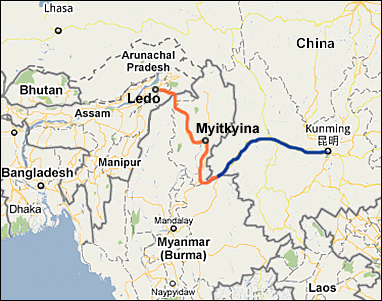
The Old Stillwell Road
The article adds: “The proposal holds great significance for the deepening of friendly relations between the four countries and in driving the joint development of the three economic areas - South Asia, Southeast Asia and East Asia. Tibet is an important passage to South Asia and a crucial part of the ‘corridor’.”
But it is not clear how the BCIM-EC will connect to Tibet.
Possibly via Kunming and the Western part of Yunnan province, but it is a long detour to reach Tibet.
The Stillwell Road, from Arunachal to Burma, skirts Tibet, further there is no land port between Tibet and Arunachal Pradesh which would permit the trade to flourish in this remote part of the world.

The Tibetan, Qiang and Yi Corridor
Then the article speaks of the ‘Ethnic Tibetan, Qiang and Yi culture industry corridor’: “Historically, the ethnic Tibetan, Qiang and Yi culture industry corridor has been crucial for the migration and communication of many ethnic groups. It possesses a unique natural environment and rich cultural resources; it is an important historical and cultural deposition zone; and the pattern of development and construction of culture in the region hold a special status. The core area is located at the junction of Sichuan, Guizhou, Yunnan, Tibet, Shaanxi, Gansu and Qinghai.”
A Chinese scholar who wrote a dissertation on the Tibetan-Qiang-Yi Corridor (‘Du Yao Mao’), thus described the area, “[it] comprises the Hengduan Mountains which located in the southeast of Tibet plateau and the high mountains and valleys area among six paralleled rivers of Min River, Dadu River, Brahmaputra, Jinsha River, Lancang River, and Nu River, as well as the adjacent area between Yunnan, Sichuan and Tibet. It’s a natural corridor for the ancient Diqiang, tribes to migrate from northwest to south where some minorities from Zang-Mian of Han-Zang language family live in, such as Zang, Qiang, Yi, Lisu, Bai, Naxi, Pumi, Dulong, Nu, Hani, Jingpo, Lahu and so on.”
Even if China develops that ‘mythic’ corridor, it is not clear once again how it will be linked with the New Silk Road. It might be a branch of the ‘Belt’.

The Source of Rivers Ecological Protection Zone
Strategically and environmentally more important is Tibet, ‘the Source of Rivers Ecological Protection Zone’
China Tibet Online affirms: “The Qinghai-Tibet Plateau is not only the source of some of Asia’s major rivers, such as the Yangtze, Yellow, Lancang-Mekong, Ganges and Indus, but it’s also one of the world’s most concentrated areas of biodiversity, so its ecological status is very important. In recent years, due to the combined effect of global warming and human intervention, the ecological environment at the Yangtze and Yellow River source areas has shown signs of serious damage and deterioration. The Source of Rivers Ecological Protection Zone was established to restrict environmental degradation and to restore and conserve the ecological environment.”
It might be one of the policies which will be decided during the Tibet Work Forum, but once again it does not seem to directly affect the ‘One Belt, One Road’ project.
Shangri-la in Yunnan Province

The Shangrila Circle
Then the ‘Shangri-La eco-tourism circle’ is mentioned. Shangri-la is one of the favorite tourist destinations of Eastern Tibet (in today’s Yunnan province).
According to the article, the ‘circle’ includes the triangular border areas of Tibet, Sichuan and Yunnan. Once more it is more an environmental project which is certainly important for the Tibetan plateau. It says: “It is the Yangtze River’s downstream soil and water conservation area and an important ecological barrier for a number of industries. It plays an important role in the modernization and sustainable development of China. It has already been listed as a key national tourist development area and has become a popular destination for domestic and foreign tourists.”
Here too nothing concrete about Xi’s project to link Central Asia and Europe to the mainland.

A Corridor to South Asia?
The last part of the article is more interesting for South Asia as it deals with ‘China-India and China-Nepal border trade zones’.
It says: “Tibet has already opened border ports in Zham [Dram], Burang [Purang], Gyirong [Kyerong], Riwo and Nathu La. These ports are located on the overland route to South Asia and follow the same basic conditions as a comprehensive free trade zone or a border economic cooperation zone. They are the main distribution areas for trade along the China-India and China-Nepal borders.”
While Dram, Purang (the trade via Lipulekh in Uttarakhand also transit via Purang), Gyirong Kyerong and Riwo are all land ports with Nepal, Nathu-la, was opened for trade between India and Tibet in 2006.
If Beijing is serious about linking Tibet with South Asia, more will be required to ‘open’ the borders which is presently limited to Sino-Indian ‘petty’ trade at Nathu-la. Lipulekh-la and Shipki-la (HP).
The article mentions the recent reopening of the Sino-Indian border at Nathu La Pass to Indian pilgrims traveling to Tibet on pilgrimage: “This news was greatly received by Indian pilgrims.”
This will not change anything in the trade and will not bring any serious boost to the New Silk Road.
The conclusions of the article on the strategic location of Tibet are rather misleading in the present circumstances: “Some of the regional strategies mentioned above have already become national strategies; others have entered academic discussion or debate. Tibet is an important player in the history of the ‘Southern Silk Road’, ‘Tang-Tubo Ancient Road’ and the ‘Tea Horse Road’. It is a vital communication hub for the adjacent provinces and autonomous regions on the ‘One Belt, One Road’ strategic belt, including Xinjiang, Qinghai, Sichuan and Yunnan. It is also an important gateway for exchange with South Asian countries, such as India, Nepal, Myanmar, Bhutan and others.”
The fact is that Beijing is not ready to open land ports such as Demchok and the Karakoram pass in Ladakh, Niti-la, Mana-la in Uttarakhand, Kibutu or Tuting in Arunachal Pradesh. Why in the present circumstances, speak of ‘opening of the ‘new silk road’ to South Asia?
It is more a propaganda gimmick, to test the Indian waters and see Dehi’s reaction.
It is however true that Nepal mainly through Dram and Kyirong land ports will be flooded with Chinese tourists and Chinese goods.
But this is one-way traffic, it will not create places of cultural, spiritual and trade exchanges like the Old Silk Road did.
In other words, it is doubtful if South Asia can benefit from the project.

Sunday, June 7, 2015

Is The Tibet Issue Dead?

My article Is The Tibet Issue Dead? appeared in Swarajya Magazine.

Here is the link...

Beijing believes that only ‘development’ can bring ‘stability’ in the TAR and Tibetan-inhabited areas of Yunnan, Sichuan, Gansu and Qinghai; in such a scenario, Beijing solves the Tibetan issue and the Dalai Lama becomes irrelevant.

A few days before Prime Minister Modi departed for Beijing, the news agencies announced that a scheduled meeting between BJP president Amit Shah and the Dalai Lama would not happen. The encounter, to be held in Dharamsala, was cancelled after a message from the Prime Minister’s Office (PMO) said that it would be ‘highly inappropriate’. A senior BJP leader later clarified that the cancellation of meeting did not change India’s relationship with the Tibetan spiritual leader.
This and other recent happenings raise a serious question: where is the Tibetan issue at?
A few months ago, The Global Post published a story about the Dalai Lama, asking: ‘is the Tibet issue dead?’. It mentions South Africa’s denial of a visa to the Tibetan leader to attend the 14th world summit of Nobel peace laureates in Cape Town. The article argues: “The Dalai Lama is losing friends all over the place as the world undergoes a geopolitical realignment.”
It is a fact that today China has become so powerful that most heads of state or government think twice before receiving the ‘simple monk’. Further, Beijing seems more assured that it is in control of the situation on the Roof of the World.
It perhaps explains why in December 2014, the Buddhist leader told the BBC that it “would be better that the centuries-old tradition [of having a Dalai Lama] ceased at the time of a popular Dalai Lama.” He hinted that a Dalai Lama ‘found’ by China could be extremely unpopular with the Tibetan people. The 80-year old monk added: “There is no guarantee that some stupid Dalai Lama won’t come next, who will disgrace himself or herself. That would be very sad.”
The present Dalai Lama is not stupid and he knows perfectly well that the Rule by Incarnation, in other words, the rule of the Dalai Lamas over Tibet, is a flawed system of governance.
It has been unsatisfactory for several reasons.
First and foremost, one is never sure that the choice of a new reincarnated lama is the right one. During some troubled periods of Tibetan history, the Mongols or the Manchu dynasty did use their influence for imposing ‘their’ choice, through the Golden Urn system or by other ways. The selection of the correct candidate has always been a major problem in Old Tibet. This is true not only for the Dalai Lamas and the Panchen Lamas at the top of the hierarchy, but also for ‘local’ hierarchs who presided over a county, a province, a school of Buddhism, a monastery or even over a particular lineage.
Another reason that made the system unworkable is the gap of 20 odd years, between the death of a Lama and the time when his reincarnation is able to take over the job; during the interregnum, the nation is left without governance, or it depends on regents who often have more knowledge of mundane matters than good governance.
In the past, this led to very difficult transitions, to say the least.
If the system is not terminated (by the Dalai Lama himself), it is certain that there will be 2 Dalai Lamas a few years after the death of the present hierarch: one enthroned by the Party in Beijing and one recognized by the Tibetans. It is what has happened with the Panchen Lama (one is promoted by the Party, while the one recognized by Dharamsala is under house arrest for the past 20 years somewhere in China). The temptation is too strong for political leaders (especially in Beijing) not to choose ‘their’ own candidate.
This explains why the Dalai Lama, who installed an elected leader in 2011 to replace him for temporal matters, told the BBC: “The Dalai Lama institution will cease one day. These man-made institutions will cease.”
The Communist Party was obviously furious with the Dalai Lama’s declaration. The New York Times speculated: “That would confound the Chinese government’s plans to engineer a succession that would produce a putative 15th Dalai Lama who accepts China’s presence and policies in Tibet.”
Zhu Weiqun, a former interlocutor of the Dalai Lama’s Envoys, told the media the Tibetan leader will have no say over his own reincarnation: “Decision-making power over the reincarnation of the Dalai Lama, and over the end or survival of this lineage, resides in the central government of China.” The Party is omniscient, even about ‘reincarnation’!
Zhu further affirmed: “The 14th Dalai Lama has taken an extremely frivolous and disrespectful attitude toward this issue.”
One can understand that Beijing is furious to suddenly see its dream of having a Dalai Lama anointed by the Party evaporating in the mist of the Roof of the World.
But there is more, China is today sure of itself. The State Council (China’s Cabinet) recently released a White Paper (WP) ‘on the development path of Tibet’. It is not the first WP published by the Chinese Government on Tibet; in 1992 already, the State Council tried to justify its position about ‘ownership and human rights’. The characteristic of the latest avatar is best described by the Central Tibetan Administration in Dharamsala:
“[it] tries to belittle His Holiness the Dalai Lama by questioning his sincerity in dealing with China. His Holiness admired around the world and revered by the Tibetan people, does not need any certificate on his motivation from the Chinese Government.”
Why such a violent attack on the Tibetan leader, when many in China realize that he is undoubtedly the best bet if Beijing wants to find a solution to the Tibetan issue? But reading through the longish paper, it is clear that for the communist regime, everything is fine and wonderful on the Roof of the World. Nonetheless, Beijing warns the Dalai Lama: “The tides of the times are irresistible. …Any person or force that attempts to resist the tide will simply be cast aside by history and by the people.”
The WP asks the Dalai Lama to ‘put aside his illusions’ about talks on Tibet’s future status. For Beijing, the Dalai Lama keeps ‘a sentimental attachment to the old theocratic feudal serfdom’.
The WP’s timing was obviously ‘synchronized’ with the 50th anniversary of the establishment of the Tibetan Autonomous Region (TAR), but also with the holding of a Sixth Forum on Tibet Work.
What is a Work Forum on Tibet?
It is the large Party gathering where a new Tibet policy is decided. It is attended by several hundreds of officials, including all the members of the Standing Committee of the Politburo.
The previous Forum was held in Beijing in January 2010. Before that, four Tibet Work Fora were organized in 1980, 1984, 1994 and 2001.
In 2010, it was decided to make Tibet a giant tourist attraction park; last year alone, 15 million mainlanders visited the Disneyland of Snows.
President Xi was recently quoted as saying that “to govern the country well, we must govern the border areas first, and to govern the border areas well, we must stabilize Tibet first.”
During the forthcoming Tibet Forum, the ‘One Belt, One Road’ scheme (New Silk Road) will be extended to Tibet; Beijing believes that only ‘development’ can bring ‘stability’ in the TAR and Tibetan-inhabited areas of Yunnan, Sichuan, Gansu and Qinghai; in such a scenario, Beijing solves the Tibetan issue and the Dalai Lama becomes irrelevant.
The Sixth Work Forum on Tibet is certain to make the Land of Snows an important economic and touristic hub for the New Silk Road project. One of the collaterals will be the construction of the Tibet-Xinjiang railway through the disputed Askai Chin area (this will have serious implications for India).
Where is the place of Dalai Lama this scheme?
Nowhere! But all is not lost.
The Modi Sarkar has certainly not said its last word on the Tibet issue; another silver lining is that despite all its assurance, not to say arrogance, Beijing is nervous.
Take the Joint Statement, signed after Narendra Modi’s meet with his Chinese counterpart; about the Kailash yatra it says: “The Indian side appreciated the support and cooperation by the Ministry of Foreign Affairs and the local government of Tibet Autonomous Region of the People’s Republic of China to Indian pilgrims for the Kailash Manasarover Yatra.”
Why does Beijing always speak of ‘Tibet Autonomous Region of the People’s Republic of China’? Delhi never speaks of ‘Tamil Nadu of the Republic of India’ or ‘West Bengal of India’. Perhaps it shows that Beijing is still unsure about the legal ground of its ‘presence’ in Tibet.
Nervousness is not a sign of the ‘stability’ mentioned by President Xi Jinping. It is perhaps why many analysts believe that China may ‘crack’ in the not too far future.
The dies of history are not fully cast as yet.

Saturday, May 16, 2015

Beijing to offer more 'gifts' to Tibet

More tourists for Tibet
As Prime Minister Narendra Modi arrived in Xi'an, capital city of Shaanxi Province, as the first leg of his high profile visit to China, analysts wonder if he would speak about Tibet with the Chinese leadership.
Apparently, he did not!
The ‘T’ word appears only once in the Joint Statement, when the Kailash yatra is mentioned:
The Indian side appreciated the support and cooperation by the Ministry of Foreign Affairs and the local government of Tibet Autonomous Region of the People’s Republic of China to Indian pilgrims for the Kailash Manasarover Yatra (Gang Renpoche [sic] and Mapam Yun Tso Pilgrimage). To further promote religious exchange between the two countries and provide facilitation for Indian pilgrims, the Chinese side would launch the route for the Yatra through Nathu La Pass in 2015.
Though it is a separate issue, it is worth noting that Beijing always says, ‘Tibet Autonomous Region of the People’s Republic of China’.
Delhi never speaks of ‘Tamil Nadu of the Republic of India’ or ‘West Bengal of …’. It perhaps shows that Beijing is still unsure about the legal ground of its ‘presence’ in Tibet.
But apart from this reference, nothing on 'T'.
The Brahmaputra is not even mentioned, except to say:
The Indian side expressed appreciation to China for providing flood-season hydrological data and the assistance in emergency management. The two sides will further strengthen cooperation through the Expert-Level Mechanism on the provision of flood-season hydrological data and emergency management, and exchange views on other issues of mutual interest.
The names of the Yarlung Tsangpo/Siang/Brahmaputra and the Sutlej are not cited. Does it means that Delhi has got some assurance from Beijing that China will not go for mega-dams on the trans-boundary rivers? It is possible!

An unusual comment
An interesting remark during Modi’s speech at Tsinghua University: the Prime Minister said that both nations needed to ensure that their relationships with other countries did not become a concern for each other: “If we are able to deepen mutual trust and confidence, we will also be able to reinforce each other's efforts of connecting Asia with itself and the rest of the world."
The South China Morning Post quotes an analyst saying: “Modi's comment was somewhat unusual as diplomatic visitors to Beijing normally called for further consolidation of bilateral ties.”
Fang Tien-sze, a South Asia study expert and a Taiwanese former diplomat in India explains: “By asking the mainland to reconsider its approach in dealing with India, Modi meant to say there is a need for Beijing to work hard with New Delhi to really find a way to resolve their border disputes if the two sides are to closely cooperate to form the Asian Century."
It is true that Beijing needs to 'work hard' to fill up the trust deficit.

A gift for Tibet?
In the meantime, Beijing is thinking of ‘what kind of gift to give to Tibet its 50th anniversary?’ China Tibet Online elaborates:
The Year 2015 marks the 50th anniversary of the establishment of the Tibet Autonomous Region, and it is reported that the Sixth Conference on the Work of Tibet may also be convened this year. Since the central government has always presented gifts to Tibet on major celebrations, we may wonder what kind of gift it will send to Tibet this year.
Will it be the genuine autonomy demanded by the Dalai Lama?
Don't be so hopeful!
The Chinese ‘Tibetan’ website reminds us that in March 2015,
Chinese Premier Li Keqiang mentioned in the Government Work Report that China is a unified and multi-ethnic country, and it is important to uphold and improve the system of the regional ethnic autonomy. It is also important to provide more support to the development of ethnic minority areas, to protect and develop ethnic cultures and characteristic towns in order to promote exchanges among various ethnic groups.
It recalls Year 2011 which marked the 60th anniversary of the so-called peaceful liberation of Tibet (Beijing does not say that it resulted in more than 1 million casualties). At that time, a delegation from Beijing, “presented the Tibetan people with essential life products, including stainless steel pressure cookers, handheld solar-powered torches, and portable solar-powered televisions.”
The website justifies the generous ‘gifts’ thus: “Although people living in developed areas might not consider these items, for those living on the high plateau, especially rural residents in remote areas, the gifts are very practical and useful.”
It was indeed useful, especially if the Tibetans were last without pressure cookers in the Middle Kingdom.

A new gift for Tibet
I have already mentioned China's next gift to Tibet on this blog, the Roof of the World will made an integral part of the New Silk Road. 
Is it better than a stainless pressure cooker for the common man on the high plateau? Not certain!
China Tibet Online asserts: "The ‘One belt, One road’ strategy is seen as an opportunity to accelerate Tibet’s development. Gifts from the central government to Tibet also include policy support in public finance and banking.”
A Xinhua article in March had quoted Xiao Gang, chairman of the China Securities Regulatory Commission, who proposed some "policies that would support an equity shares market, a bond market, and a futures contract market in the Tibet Autonomous Region as well as efforts that would broaden financing channels for businesses, support funding for small-scale businesses, which will play a role in supporting the development of a futures contract market in Tibet.”
It further commented that to promote the development of a capital market, Tibet needs to improve its own economic capacity.
Shang Fulin, chairman of the China Banking Regulatory Commission had proposed a solution to ‘improve’ Tibet’s economic capacity: “In order to improve the banking institution in Tibet and provide credit resources, China must focus on developing Tibet’s local tourism and culture, Tibetan medicine and pharmacology, and characteristic industries such as agriculture and animal husbandry.”
Instead of 15 million Han tourists, Tibet will then become a full-fledged tourist resort; the largest amusement park in the world.
The article says that China must further expand the ‘Horseback Bank’, the ‘Tent Bank’, and mobile servicing vehicles "according to the particular characteristics of Tibet."
In other words, Beijing will bring ‘development' to the countryside, to the farmers and nomads (and bring tourists along).
The conclusion of the apparently well-informed website is that these gifts will be beneficial “for accelerating Tibet’s leapfrog development and for promoting the building of a moderately prosperous society in Tibet.”
It even cites statistics from the TAR’s Taxation Bureau: in 2014 Tibet’s GDP reached 92 billion yuan, (15 billion US dollars), an increase of 10.8 percent over the previous year.
As Tibet prepares to ‘celebrate’ the 50th anniversary of the foundation of the so-called Autonomous Region, Xinhua admits: “Tibet is the country’s only region with vast concentrated poverty areas.”
What was the point of ‘liberating Tibet, if it so?
It reminds me of the words of the 10th Panchen Lama who, a few hours before his mysterious death in 1989, asked “what was the point of liberating Tibet 30 years ago, if Tibet remains so poor.”
Two points are clear: China will increase the number of Chinese tourists visiting the Roof of the World (and for the purpose will tremendous increase the construction of ‘dual-use’ infrastructure in Tibet) and then Tibet will become an integral part of the ‘One Road, One Belt’ project, so dear to President Xi Jinping.
Can all this be considered as ‘gifts’ to the Tibetan people?
To settle the border issue with India, Beijing will probably wait for Tibet to be ‘stabilized’?
Tibetans will crawling under ‘gifts’, but will they be satisfied?
After all, the 'stabilization' depends of the happiness of the 'masses', isn't it?

Thursday, May 14, 2015

Mr Modi, be wary of the Chinese!

Chinese and Russian navies leaving for joint drills in the Mediterranean Sea
My article on Prime Minister Narendra Modi's visit to China, entitled Mr Modi, be wary of the Chinese! appeared in Rediff.com

Here is the link...

'Chinese leaders rarely receive their foreign guests in cities other than Beijing. Such respect for India!' 
'Does it mean that Modi could replicate "the warmth and unconventional way" by sending Indian troops into Tibet, as Xi did in Chumur (Ladakh) when he arrived in India? Of course, Indians are far too polite to do so,' says Claude Arpi.

‘Hello China’, Prime Minister Narendra Modi tweeted in Chinese as his first message on the Chinese microblog Weibo: “Looking forward to interacting with Chinese friends through Weibo.”
Will a few tweets help Modi, the third-most followed world leader on Twitter to tackle the issues facing the Sino-Indian relations? The answer is ‘no”.
Immediately after Modi’s ‘hello’, a Chinese Weibo shot back: “The southern part of Tibet belongs to China, and Kashmir belongs to Pakistan. Mr PM please return the lands of other countries first before we start talking about how to get along well”
The relations between Delhi and Beijing are too complicated for a few slogans to make the difference, while at every level, the balance of power tilts in favour of China.
In fact, all bilateral issues, whether it is the border dispute, the trade imbalance, the stapled visas for Kashmiris and Arunachalis, the opening of new consulates, the Tibet issue; none of these problems can be solved easily due to the economic imbalance, as well the difference in border infrastructure and military power.
But there is an imbalance of ‘vision’ too.
A few weeks ago, a PIB communique announced that the Prime Minister “will visit Xian, Beijing and Shanghai from May 14 – 16, 2015.” That was the ‘normal’ pattern for the Prime Minister’s visit; the problem is that China is not a normal country.
The Middle Kingdom dreams of dominating Asia and the World; India is only incidental to the Chinese Dream.
Further, India and China live in different worlds, with often-opposite mindsets and while adhocism is the hallmark of the Elephant, the Dragon thinks far, far ahead.
China watcher, Francesco Sisci recently wrote in The Asia Times: “China works with long terms plans, its way of thinking and its political organization is all geared for long term — and of course they do not have elections every two or four years to press politicians into daily routines.”
Sisci cites China’s New Silk Road, an extremely long term scheme: “China now wants to make some progress on the development of the Silk Road and it can do it with Russia and Pakistan, the safest bets.”
And Beijing acts fast, China and Russia have just conducted a joint naval drill in the Mediterranean; a move which extends greatly the Middle Kingdom’s sphere of influence. Though the Chinese defense ministry spokesperson Geng Yansheng said: “The aim of the drills is to deepen both countries' friendly and practical cooperation and increase our navies' ability to jointly deal with maritime security threats," Sina Military Network explained the rationale: “there is no doubt that joint military drills will always send a signal,” further admitting: “the target of the maritime exercise is obviously the US, which China feels has been interfering in China's expansion activities in the East and South China seas by strengthening ties with Japan and the Philippines.” It also mentions the economic sanctions against the Russian Federation for annexing Crimea from Ukraine.
It is clear that China will first defend its interests.
Now the question comes: how should India deal with China?
There are no simple answers, though it would be useful if the Prime Minister team starts thinking ahead (a few years to start with) and find schemes on which India’s friends and partners can rely.
In this perspective, the recently-held Varuna Indo-French naval exercises, which saw the Indian and French Carrier Strike Groups (CSG) interact in the most sophisticated naval training so far, were interesting. It is vital for Delhi to engage with ‘friendly’ navies and learn from those who have the required experience, ships and armament and there are very few!
This too will not stop China’s rise.

China wants to dominate the World
While several American ‘experts’ have started talking of the ‘cracking up’ of the Middle Kingdom, Beijing does not bother much and continues with its initiative to build a ‘parallel’ new world order, centered on China and Asia.
WantChinaTimes, a Taiwanese publication mentions “new political, economic and security systems that China is setting up around the world in an attempt to realign the established international order dominated by the United States.”
During the Boao Forum for Asia (BFA), the Asian ‘Davos’, President Xi Jinping went on about his favorite topic, the ‘One Belt, One Road’ initiative. Xi asserted that the scheme would ultimately benefit 'all nations'.
The scheme has different rationales, though the main objectives are clearly for China to take the leadership of Asia and reenergize its economy.
The Silk Road Economic Belt will eventually link China, Central Asia, Russia and Europe, while the 21st-Century Maritime Silk Road, will stretch China’s influence to Europe through the South China Sea and the Indian Ocean in the West and to the South Pacific in the East.
The Silk Road projects would add more than 60,000 kilometres of road, including 4,070 km expressways, and improve the connectivity of the existing transportation network.
Both new ‘silk roads’ would involve 65 countries from three continents and 4.4 billion people. Xi spoke of an annual trade volume exceeding US $ 2.5 trillion in a decade: “cooperation and coordination of policies will be win-win for all involved”, he affirmed.
Another much-talked about initiative is the Asian Infrastructure Investment Bank (AIIB). Beijing no longer wants to be subjected to US financial controlling or monitoring.
The Chinese initiative is already considered as a success if one looks at the number of countries and territories from five continents who have applied to join the Beijing-led Bank as founding members.
Though Japan will not be immediately joining, many Western capitals, including London have declared their intention to jump into the boat. Washington, completely taken on the wrong foot, seemed to have lost a battle. In the US, former US Secretary of State Madeleine Albright noted that the United State has ‘screwed up’ on the way it dealt with the AIIB.
Now take Xi Jinping’s trip to Islamabad. The enormity of the ‘gifts’ that Chinese President brought in his luggage as he landed in Pakistan, is flabbergasting.
The Washington Post remarked: “Xi arrived in Islamabad bearing real gifts: an eye-popping $46 billion worth of planned energy and infrastructure investment to boost Pakistan's flagging economy.”
It sounds like a Chinese Dream for Islamabad!
Beijing has decided to help Pakistan to develop a China-Pakistan Economic Corridor which will eventually link up the One Belt and One Road.
In other words, the Chinese-sponsored port of Gwadar on the Arabian Sea will be connected through the Karakoram Highway, to the Xinjiang province in China’s Far West and Central Asia …and later Middle East, Africa and Europe.
The ‘corridor’ will have railways, roads, optical fiber cables, dams (to produce the necessary electricity), pipelines, etc!
Observers marveled at Beijing’s kindness (and wealth), but one should not be fooled by Chinese generosity: Beijing is investing for China!
With the country facing financial difficulties at home, with a slowdown of the economic engine, the leadership has devised the double Roads scheme to rebalance its own economy and perhaps more importantly, to become the sole leader of Asia.
Where is India in this scheme? Nowhere!
Does Delhi have such a ‘Grand Project’? The answer is ‘No’.

Modi’s visit to China
It was announced (in India) that Xi Jinping and his wife Peng Liyuan wanted to replicate “the warm and unconventional welcome extended to him [Xi] by Indian Prime Minister on his visit to India” by taking Modi for a trip to the ancient city of Xian, the capital of Xi's home province Shaanxi.
It will probably be enough to melt the soft hearts of the Indian delegation; the Chinese leaders rarely receive their foreign guests in cities other than Beijing. Such respect for India!
Does it mean that Modi could replicate ‘the warmth and unconventional way’ by sending Indian troops into Tibet, as Xi did in Chumur (Ladakh) when he arrived in India? Of course, Indians are far too polite to do so. Once again, the gap in mindsets is too wide.
Analyst Brahma Chellaney believes: “Indian diplomacy has long been shaped by personalities at the helm. Their propensity to act in haste and repent at leisure has been legendary, as India has ignored the sound advice of Talleyrand, Napoleon’s famous foreign minister: ‘By no means show too much zeal’.”
Without showing too much ‘zeal’, Modi could perhaps:
• Ask Xi Jinping if he knows that once upon a time, Tibetans kings ruled over China from Xi’an.
• Ask to meet the Panchen Lama recognized by the Dalai Lama and kept ‘somewhere in China’ for the past 20 years.
• Ask China to reopen the Himalayan passes which were closed in 1962, namely, Demchok (Ladakh), Mana and Niti pass (Uttarakhand) , Jelep-la (West Bengal), and a few others routes in Arunachal Pradesh like Kibithu (Anjaw district), Bumla (Tawang district), Gelling-Tuting (Upper Siang district)
• Reopen the Indian Consulate in Lhasa in exchange of a Chinese consulate in Chennai or elsewhere in India.
• What has happened of the Indian Trade Agency’s building in Yatung in the Chumbi Valley adjacent to Sikkim.
• Have a frank discussion on the Tibet issue.
It is however doubtful if the guest wants to embarrass the host.
In which case, India will have to wait for the ‘cracking up’ of the Communist Dynasty. It may take some time.

Thursday, May 7, 2015

Advantages of having water-tight friendship

Lynx antisubmarine helicopter taking off for a joint mission
One more article on the Varuna joint naval exercises between India and France.
This time in the Edit page of The Pioneer. It is entitled: Advantages of having water-tight friendship

Here the link...

By initiating the Maritime Silk Road, China hopes to take Asia's leadership. The Indo-French exercise, Varuna, should be seen in this context. It is vital for New Delhi to engage with friendly navies and learn from them

Have you heard of the SLOC? In the years to come, this acronym for Sea Lines of Communication will take a more and more preponderant place. In times of peace, the control of the maritime routes used for trade, logistics or naval operations, provides a definitive advantage for commerce and raw material supplies; in time of war, it gives a country a decisive lead over the enemy.
Napoleon realised this too late, the British blockade of countries associated with France was one of the reasons for the Emperor’s downfall. At the time of India’s independence, in his book, Asia and Western Dominance, the good historian (and poor diplomat) KM Panikkar argued that from the time of Vasco da Gama till the middle of the 20th century, Western powers ruled over Asia and the world, by dominating the sea.
Panikkar remarked: “India never lost her independence till she lost the command of the sea in the first decade of the 16th century.” During the second part of the 20th century, air power became the major tool of ‘dominance’; the sea was temporarily left in the background. But times are changing; Beijing was quick to realise that the rise of China will pass not only through land, but through the seas too. This fact is particularly important at a time when Prime Minister Narendra Modi prepares for his maiden trip to China.
I had this in mind when I joined the 10-day Indo-French naval exercise, code-named Varuna, recently held off the Goa coast. The event, which escaped most of the Indian editors, was important for several reasons. President Xi Jinping argues that his ‘two Silks Roads’ mega-project follows the worldwide pattern of regional integration, but tellingly, the People’s Daily calls the ‘historic’ scheme, ‘China’s one belt, one road’.
By initiating the 21st century Maritime Silk Road, which will eventually stretch from China to South-East Asia and Africa, China clearly hopes to take Asia’s leadership. The Indo-French exercises should be seen in this context. It is vital for New Delhi to engage with ‘friendly’ navies and learn from those who have the required experience, ships and armament and there are very few!
Varuna’s 14th edition saw the Indian and French Carrier Strike Groups interact in the most sophisticated naval training so far, (it was only the fifth time that aircraft carriers participated). Apart from aircraft carrier Charles de Gaulle, the flagship of the French Navy, two destroyers Chevalier Paul and Jean de Vienne and the replenishment tanker La Meuse were present.
One of the attractions was the presence of the marine version (Rafale M) of the Rafale combat aircraft recently selected by India to equip the Indian Air Force; it was accompanied by Super Etendard strike aircraft, an E2C Hawkeye Airborne Warning And Control System and several helicopters. The French probably had an elusive nuclear combat submarine hiding somewhere, but isn’t it the nature of a sub to remain invisible?
On the Indian side of the naval ‘battle’ was aircraft carrier INS Viraat (the oldest carrier in the world, originally built by the British and several times refitted and ‘modernised’), destroyer INS Mumbai, stealth frigate INS Tarkash, (both had just participated in the repatriation operations in Yemen), guided-missile frigate INS Gomati, replenishment tanker INS Deepak and the submarine INS Shankul.
Rear Admiral Eric Chaperon, the Commander of Task Force 473, which had just been involved for two months in operations against the Islamic State in Iraq, admits that the objectives of the Indian CSG were different from the French one, which is often asked to intervene in regional conflicts. The Indian CSG is more defensive in nature, he said, though it remains an important instrument of projection of the nation’s power to defend its interests at sea as well on land.
For Admiral Chaperon, the exercises were not just ‘reciting’ a script or an occasion to show off (nor merely for a ‘naval parade’, he said), India has indeed a professional and motivated Navy. One of the interesting features of Varuna was that the partnership was balanced. Though organised at short notice (the date was finalised at the end of February) and despite other constraints to prepare agreed tactics and decide on common procedures and protocols, the exercises were extremely meaningful.
Indian naval officers onboard the French ships felt that it was a good training for both navies, and though most of the protocols were largely similar, they were impressed by the fact that the French sailors could do most of the tasks with less people, perhaps a question of experience …or culture, they said. And of course, the Indian Navy does not have, like its French counterpart, a strong contingent of ladies (up to 15 per cent). Again a question of culture!
But these exercises had another dimension: It included ‘all scenarios’ of maritime operations, from aircraft carrier operations, anti submarines detection, maritime interdiction operations to multi-ship replenishment exercises, which were all conducted to the satisfaction of both Navies’ senior staff. One interesting aspect was the presence of Liaison officers from the Indian Navy aboard each French ship and vice-versa.
These friendly exchanges are crucial for India, because apart from the US and Russia, only France has an operational CSG to practice with and today, combat readiness is a critical aspect to project one’s power on the seas (and defend one’s interests). All the officers interviewed agreed that a CSG is the best instrument of ‘regional influence’ and ‘deterrence’.
Though the French officers did not want to comment on the ‘rise’ of China, nobody can deny that the Middle Kingdom progresses with giant strides. A report recently released by the US Office of Naval Intelligence explains: “During 2014 alone, more than 60 naval ships and craft were laid down, launched, or commissioned, with a similar number expected through the end of 2015.”
It is clear that India can’t match China, though a smaller, disciplined and well-equipped naval force and some ‘good friends’ could be a deterrent factorin case of need. Before his visit to China, Mr Modi probably realises that he can’t stop the rise of the Middle Kingdom, neither on land or on the seas. But in the years to come, despite today’s grim situation, a professional and well-trained Indian Navy can act as a deterrent.
A great regret: Nobody was allowed on board the Indian ships. I was told that it was South Block’s decision. ‘Communication’ has never been the babu’s forte. It is a great pity, because the nation is entitled to know that the Indian Navy is doing well, despite its budgetary constraints. Would the bureaucrats, still living in a bygone era, be more mature, they would know that good ‘communication’ is a form of deterrence too.

Wednesday, May 6, 2015

Can Indian Navy deter China’s Two Silk Roads

INS Mumbai refueling with French replenishment tanker La Meuse
My article Can Indian Navy deter China’s Two Silk Roads appeared in NitiCentral.

Here is the link...

The 10-day Indo-French naval exercise code-named ‘Varuna’ recently held off the Goa coast did not get much coverage in the Indian media.
The event was important for several reasons which escaped the editors.
First and foremost, it is vital to note that Planet Earth has slowly been changing its axis from a US dominated world to a Chinese-led one.
At the time of India’s Independence, in his book Asia and Western Dominance, the ‘famous’ Indian historian K.M. Panikkar argued that from the time of Vasco de Gama till the middle of the 20th Century, the Western powers ruled over Asia and the world, by dominating the Sea.
In 1945, Panikkar remarked: ‘India never lost her independence till she lost the command of the sea in the first decade of the 16th Century’. He also said:
“A navy is not meant for the defense of the coast. The coast has to be defended from the land. The objective of the navy is to secure the control of an area of the sea, thus preventing enemy ships from approaching the coast or interfering with trade and commerce.”
During the second part of the 20th Century, Air Power became the major tool of ‘dominance’ and the Sea was temporarily left in the background.
A few years ago, the Beijing leadership realised that the Rise of China will pass not only through land, but through the seas too.
The acceptance of this fact is particularly important at a time when Prime Minister Narendra Modi prepares for his maiden trip to China as Prime Minister.
President Xi Jinping likes to say that his favorite ‘Two Silks Roads’ mega-project follows the worldwide pattern of regional integration, but tellingly The People’s Daily calls the ‘historic’ scheme ‘China’s One Belt, One Road’.
Even if Xi says that the “initiatives will not be a solo for China but a real chorus comprising all countries along the routes,” it remains a project by China for China; the chorus’ conductor will be Chinese.
The 21st Century Maritime Silk Road will eventually stretch from China to Southeast Asia and Africa and though: “The vision, once realised, will directly benefit 4.4 billion people, or 63 percent of the global population,” don’t be fooled, it will primarily benefit Beijing.
The Indo-French exercises should be seen in this context.
India needs to counter-balance China and to be ready to do so, Delhi should engage with ‘friendly’ Navies, who have the required experience and ships. There are not many.
While attending the joint exercises and spending 4 days aboard 3 French ships (including the Aircraft Carrier Charles de Gaulle), I realised the significance of the Sea in tomorrow’s world, though the ‘C’ word was rarely pronounced.
When President Chirac of France visited India in March 1998, ‘China’ was not in everybody’s mind like today, but using a de Gaulle-like language, the French President saluted India, ‘a nation which has affirmed its personality on the world stage’. At that time, India and France signed a framework for a strategic partnership. It was 17 years ago.
Amongst other things, it was then decided to hold regular joint naval exercises (Varuna), air force exercises (Garuda) and drills between the 2 Armies (Shakti).
Varuna’s 14th edition saw the Indian and French Carrier Strike Groups (CTG) interact in the most sophisticated naval training so far, (it was only the 5th time that aircraft carriers participated).
Apart from aircraft carrier Charles de Gaulle, the flagship of the French Navy, two destroyers Chevalier Paul and Jean de Vienne and the replenishment tanker La Meuse were present.
One of the attractions was of course the Marine version (Rafale M) of the Rafale combat aircraft recently selected by India to equip the IAF. Super Etendard strike aircrafts, an E2C Hawkeye Airborne Warning And Control System (AWACS) and several helicopters such as the anti-submarine Lynx, a Dauphin and a few Alouettes, also participated.
The French probably had an elusive nuclear combat submarine, but it is the nature of a sub to remain invisible!
On the Indian side of the naval ‘battle’ was aircraft carrier INS Viraat (the oldest carrier in the world, originally built by the British in 1943 and several times refitted and ‘modernised’), destroyer INS Mumbai, stealth frigate INS Tarkash, guided missile frigate INS Gomati, replenishment tanker INS Deepak, submarine INS Shankul. A few Sea Harriers aircrafts, Seaking 42B and Chetak helicopters (the Indian version of the Alouette) also participated.
Incidentally the INS Mumbai and INS Tarkash participated in the evacuation operations in Yemen. Rear Adm Eric Chaperon, the Commander of Task Force 473 which had just been involved for 2 months in operations against the Islamic State in Iraq complimented the Indian side for ‘Operation Rahat’ and explained that exercises such as the Varuna helped “developing understanding and cooperation between ships and facilitate their cooperation for any kind of mission.”
But these exercises had another dimension: it included ‘all the scenarios’ of maritime operations from aircraft carrier operations, anti-submarines detection, maritime interdiction operations to multi-ship replenishment exercise. All were conducted to the satisfaction of both Navies’ senior staff.
While discussing with the French Admiral, he admitted that the objectives of the Indian CTG were different from the French, which is often asked to intervene in regional conflicts. The Indian CTG is more defensive in nature, he said, though it remains an important instrument of projection of the nation’s power to defend its interests at sea as well on land.
For Admiral Chaperon, the exercises were not just ‘reciting’ a script or something to show off (not merely for a ‘naval parade’, he said), India had now a real power.
He felt that India has crossed over to a new stage (compared to previous Varunas). What was interesting, he believed that the partnership between France and India was balanced; though organised at short notice (the date was finalised at the end of February only), the exercises were extremely meaningful. Despite time constraints (to prepare the tactics and decided on common procedures, using protocols similar to the ones used with NATO’s allies), the results were satisfying.
One interesting aspect was the presence of Liaison Officers from the Indian Navy aboard each French ship and vice-versa (some Indian pilots practicing on the recently commissioned INS Vikaramaditya, the new Indian carrier were also present).
The possibility of integrating the Rafale M was briefly mentioned, though it could only be on the indigenous INS Vikrant which may feature a catapult-assisted take-off.
These friendly exchanges are important because, apart from the US and Russia, only France has an operational CTG to practice with and combat readiness is a crucial aspect if India wants to project its power on the seas (and defend its interests). All the officers interviewed agreed that a CTG was the best instrument of ‘influence’ and ‘deterrence’.
At the same time, China progresses with giant strides. A report recently released by the US Office of Naval Intelligence explains: “During 2014 alone, more than 60 naval ships and craft were laid down, launched, or commissioned, with a similar number expected through the end of 2015. Major qualitative improvements are occurring within naval aviation and the submarine force, which are increasingly capable of striking targets hundreds of miles from the Chinese mainland. Although the PLA (Navy) faces capability gaps in some key areas, it is emerging as a well-equipped and competent force.”
It is clear that India can’t match China in this type of speed and quantity, but a smaller, disciplined and well-equipped naval force and some ‘good friends’ could be a deterrent factor …in case of need.
Before his visit to China, Mr. Narendra Modi probably realises that he can’t stop the rise of the Middle Kingdom, neither on land or on seas, but in the years to come, a professional and well-trained Indian Navy could act as a deterrent against the fast occupation of the Sea by a today-peaceful China.
Some pictures of the Varuna exercises.

Indian Navy Officer attending the briefing on La Meuse
Lynx Helicopter on French anti-submarine Frigate Jean de Vienne
Indian Navy officer watching the shooting exercises
Rafale M landing of Charles de Gaulle aircraft carrier
Refueling a French Frigate
E2C Hawkeye and Rafales on the Charles de Gaulle
Super Etendard on the Charles de Gaulle
E2C Hawkeye on the Charles de Gaulle
Charles de Gaulle carrier in Goa

Tuesday, May 5, 2015

China’s Land of Snows

My article China’s Land of Snows appeared in The Statesman.

Here is the link...

The State Council Information Office (China’s Cabinet) recently released a White Paper (WP), ‘on the development path of Tibet’. It is not the first WP published by the Chinese Government on Tibet; in fact, it is the 13th since 1992. The characteristic of the latest avatar is best described by the Central Tibetan Administration in Dharamsala: “[it] tries to belittle His Holiness the Dalai Lama by questioning his sincerity in dealing with China.”
Why such an aggressive posture, when many in China realise that the Tibetan leader is Beijing’s best bet if it wants to find a solution to the Tibetan issue. But reading through the longish paper, it is clear that for the communist regime, there is no ‘Tibetan issue’; everything is wonderful on the Roof of the World. Beijing, however, warns: “The wheels of history roll forward and the tides of the times are irresistible. …Any person or force that attempts to resist the tide will simply be cast aside by history and by the people.”
Beijing mistakenly judges the tides’ direction. Democracy, freedom of thought and speech are accepted concepts everywhere on the planet, except in the Middle Kingdom which seems to have passed into reverse gear. The WP asks the Dalai Lama to ‘put aside his illusions’ about talks on Tibet’s future status. For Beijing, the Dalai Lama has little understanding of modern Tibet, but keeps ‘a sentimental attachment to the old theocratic feudal serfdom’.
The WP argues: “The only sensible alternative is for the Dalai Lama and his supporters to accept that Tibet has been part of China since antiquity. …The Central Government [Beijing] hopes that the Dalai Lama will …face up to reality in his remaining years.”
The publication raises a question: Why take such a strong position at this point in time?
An article, which appeared in  China Tibet Online soon after the WP’s publication puts the release into perspective.  The WP’s timing was obviously ‘synchronized’ with the 50th anniversary of the establishment of the Tibetan Autonomous Region (TAR): in 1965, Tibet was arbitrarily divided into five areas, with Southern and Western Tibet becoming the Tibetan Autonomous Region, while other parts of historic Tibet were officially integrated in the Chinese provinces of Yunnan, Sichuan, Gansu and Qinghai. But there is clearly more behind the attack against the Dalai Lama.
The article gives a hint of what is up Beijing’s sleeves; it is titled: “Guess what? Sixth Tibet Work Conference may be convened this year, netizens say.”
The fact that the Chinese netizens are aware of ‘State Secrets’ such as holding crucial meetings …and their timings is a novelty; it is further surprising that they are allowed to make comments about it on the social media! The announcement of a Sixth Conference (or Forum) on Tibet Work by the Chinese ‘netizens’ is clearly an information gimmick.
But first, what is a Work Forum on Tibet?  It is a large meeting held every 5 to 10 years, during which a new Tibet policy is decided; it is attended by several hundreds of officials, including all the members of the Standing Committee of the Politburo. The previous Forums were held in Beijing in 1980, 1984, 1994, 2001 and 2010: “it has played a significant role in advancing the economic and social development in Tibet”, says the Chinese State media which adds: “Now people are eagerly anticipating the Sixth Tibet Work Conference.”
Who are the ‘people’ eagerly expecting a new direction for the Tibet Policy?
The ‘netizens’ (they were called the ‘masses’ under Mao), says the article, which gives the official background: “This year marks the 50th anniversary of the establishment of the Tibet Autonomous Region. On March 5, during the Third Session of the 12th National People’s Congress, Chinese Premier Li Keqiang highlighted that celebrations should be organized for the 50th anniversary in the government work report.”
To prepare the ground for the celebrations (and the new Forum), the official media explains that from November 2014 to March 2015, “many in the central leadership as well as various government departments went to Tibet and Tibetan-inhabited areas in Qinghai, Gansu, Sichuan, and Yunnan provinces to conduct research and make inspections”. They included Yu Zhengsheng, Chairman of the Chinese People’s Political Consultative Conference (CPPCC) and Madam Sun Chunlan, member of the Politburo and director of the United Front Work Department.
According to the Chinese media, the ‘masses’ (oops sorry, the ‘netizens’) have been guessing that “the central authorities [Beijing] may initiate a big move to aid Tibet.”
Netizen ‘Costa’ says: “After much research, I think the next conference will be held sometime between August 28 and September 1, 2015”; while Netizen ‘i3broadaxe’ believes that “the reasonable time frame is from June to July”.
The Communist mouthpiece admits, “these statements are not necessarily credible,” but adds, “it might be a good news if the Sixth Tibet Work Conference could be held this year. This would comply with Chinese President Xi Jinping’s important strategic ideology.”
What does Xi say about Tibet? The Chinese President believes that “to govern the country well, we must govern the border areas first, and to govern the border areas well, we must stabilize Tibet first”.
And who is on the other side of the border? India, of course!
How does this translate on the ground?
The masses will have to follow Xi’s new theory of the Four Comprehensives: “upholding the [Communist] rule of law in governing Tibet, maintaining a long-term development of Tibet, seeking for public [masses] consent, and laying a solid foundation.”
But more importantly, it will signify pushing the ‘One Belt, One Road’ project, while ‘developing’ the Roof of the World. In practical terms, it translates into opening Tibet to neighbouring provinces and countries …except India.
By bringing some prosperity and encouraging ‘international’ exchanges, Beijing believes that it can solve the Tibetan issue.
In all probability, the Sixth Work Forum on Tibet will decide to transform the Land of Snows into an important economic and touristic hub, under the New Silk Road project.
One of the decisions might be to lay a Tibet-Xinjiang railway line through the disputed Askai Chin area. To complete it at the earliest. 
To complete it at the earliest could be a major policy decision of the Forum. Tibet would then be linked by rail to Xinjiang and Central Asia …and Pakistan through the new Economic Corridor.
Where is India in all that?  Beijing may not seek Delhi’s permission to run a railway line through what India considers her own territory; further, India will be nowhere in this new scheme because all Himalayan landports to Tibet remained closed (except for some restricted trade via Nathula in Sikkim, Shipkila in Himachal and Lipulekh in Uttarakhand).
If China is truly serious about the New Silk Road, (and wants India’s participation), it should reopen the traditional Himalayan border passes/routes, such as the Karakoram pass and Demchok in Ladakh; Niti, Mana, Darma passes in Uttarakhand; Jelep-la between West Bengal and Tibet; Bumla and Kibitoo in Arunachal.
One should not forget that for millennia, the Himalaya has been a place of passage and exchanges between the Tibetan world and the subcontinent.
Unfortunately, Jawaharlal Nehru’s irresponsible Panchsheel  policy effectively closed these Himalayan routes in 1954.  He only realized his blunder when the PLA started rolling down the slopes of the Thagla ridge and marching into the high plateau of Ladakh.
Prime Minister Modi might well pre-empt the decisions of the Tibet Work Forum and take up these issues with President Xi when he visits China.
As for the Tibetans, their future is bleak.

Sunday, April 26, 2015

I am going to visit the home of my own brother, says Xi


The world press has focused on the enormity of the ‘gifts’ that President Xi Jinping brought in his luggage as he landed in Islamabad.
The Washington Post remarked: “Xi arrived in Islamabad bearing real gifts: an eye-popping $46 billion worth of planned energy and infrastructure investment to boost Pakistan's flagging economy. This would include adding some 10,400 megawatts to Pakistan's national grid through coal, nuclear and renewable energy projects.”
This sounds like a Chinese Dream for Islamabad!
Beijing has decided to help Pakistan to develop a China-Pakistan Economic Corridor which will eventually link up its pet project, the two New Silks Roads (also known as ‘One Belt, One Road’).
In other words, the Chinese-sponsored port of Gwadar on the Arabian Sea will be connected through the Karakoram Highway, to the Xinjiang province in China’s Far West and Central Asia …and later Middle East, Africa and Europe.
The ‘corridor’ will have railways, roads, optical fiber cables, dams (to produce the necessary electricity), pipelines, you name it!
Observers marveled at Beijing kindness (and wealth), but you should not be fooled by the Chinese generosity: Beijing is investing for Beijing!
China, which is facing financial difficulties at home, with a slowdown of the economic engine, has devised a double Roads scheme to rebalance its own economy and perhaps more importantly, to become the sole leader of Asia. The two Silk Roads project and the Asian Infrastructure Development Bank have to be seen in this perspective.
Pakistan, China’s good friend, is the perfect ‘partner’ (or vassal state, if you look from another angle). It is geographically ideally positioned with an access to the sea in the South and to Central Asia in the North.
In 1946-47, as the British were ready to depart the subcontinent, they devised a way to keep their influence in Asia and the world. During the previous two centuries, the defence of the Empire had been centered on the Indian subcontinent and the Indian Ocean (also known as the British lake). The British chiefs of staff had submitted a report on the strategic consequences of Britain’s departure from India; the generals agreed that Pakistan was crucial for the Empire to keep its influence; more important than the other future dominion (India), was the Islamic State which could provide air bases in the north of the country (to control Soviet Union) and naval bases opening to the Arabian Sea in the south. A brotherly contact with the Muslim states in the Middle East was an added bonus.
It explains why London put its stakes on Pakistan.
The dies were cast in May 1947, when the chiefs of staff filed their final report: "From the strategic point of view there were overwhelming arguments in favour of West Pakistan remaining within the Commonwealth, namely that we should obtain important strategic facilities..."
Subsequently this policy was implemented, partly with the unknowing (not to say foolish) collaboration of the Congress Party.
Today, China is in the same position as the British at the time of India’s independence. By buying Pakistan’s allegiance, Beijing believes that it will be able to control and dominate Asia by linking the Belt and the Road.
A discredited and financially broke Islamabad, is only too happy to rely on their ‘dependable’ friend (as per Nawaz Sharif’s words, when he received Xi Jinping).
Billboards in Chinese and English were seen in Islamabad, the friendship between the Lord and the Vassal is now ‘higher than mountains, deeper than oceans, sweeter than honey, and stronger than steel.’
China plays on the credulity of their all-weather ‘friend’; in an article published in some Pakistani papers before his arrival, Xi wrote: “This will be my first trip to Pakistan, but I feel as if I am going to visit the home of my own brother.” He added that the bilateral relationship ‘has flourished like a tree growing tall and strong’. It is very touching, isn’t it?
The Washington Post sees it differently: “After all, China and Pakistan may share a border, but cultural ties between the two nations and its people are thin, to put it mildly.”
However, there is a far more serious problem faced by Beijing: Pakistan is a haven for terrorists and China likes neither terrorism, nor dissidence.
A couple of weeks ago, Beijing started a crackdown on ‘visible signs of Muslim religious observance’ among the Uighurs, the ethnic minority living in Xinjiang. A man is said to have been condemned to a six-year prison sentence for daring to grow a beard in the Muslim region.
Without even talking of extreme cases like this one, how is Beijing going to tackle the movements of terrorists from Pakistan to Xinjiang, once the ‘corridor’ is wide open to goods and people. Or will it be open only for oil, gas and raw materials? It does not make sense.
The only solution for Beijing is to twist Pakistan’s arm and make sure that terrorism stops or at least is reduced to its ‘export to Kashmir’.
On March 26, when the Chief of Naval Staff of Pakistan, Admiral Muhammad Zakaullah, visited Beijing to prepare President Xi’s trip to Islamabad, the Vice Chairman of China's Central Military Commission, General Fan Changlong pledged to ‘deepen cooperation with Pakistan in anti-terrorism, maritime security and military technology.’ Beijing is clearly nervous that their investment may be jeopardized by the jihadis. Fan told Zakaullah that China hopes to enhance coordination and cooperation with Pakistan on regional security affairs (read terrorism).
As President Xi Jinping arrived in Pakistan, he immediately met with Pakistani Chairman Joint Chiefs of Staff Committee, Rashad Mahmood and his colleagues of the Army, Air Force and Navy in Islamabad.
Xinhua reported: “Hailing the important role the Pakistani military has played in the development of China-Pakistan relations, Xi said that the understanding and support of the Pakistani military is necessary for the two countries to forge a community of shared destiny,” adding that “Xi spoke highly of the anti-terror cooperation between the two countries ...and staunchly back Pakistan's efforts to counter terrorism and safeguard national security.”
The message is clear, “we are going to help you, we are going to invest billions and billions of dollars to save your economy, but control the terror in your country, we are with you.”
As a bonus, China will sell eight Type 041 Yuan-class diesel-electric submarines to Pakistan for nearly US $ 5 billion. Who will pay for China’s ‘biggest-ever arms export deal’ is irrelevant (Beijing is likely to extend a long-term loan, at a low interest rate, to cover the cost for the submarines).
The sharp-tongued Foreign Ministry spokesperson Hua Chunying explained: "China and Pakistan are neighbours boasting traditional friendship, and the two sides maintain normal cooperation in the military industry and arms trade."
If Islamabad manages to control terrorism infiltration along the Silk Road, it is worth the investment for Beijing; especially as Pakistan as use the subs to keep a tab on India in the Arabian Sea. If it does not happen, Beijing has a big problem.
The irony is that China may succeed where the United States and India have always failed: to control the Pakistani Army and its different branches and ultimately tackle terrorism, at least in its more blatant forms.