Showing posts with label Uyghurs. Show all posts

Sunday, November 11, 2018

How old CIA reports reveal that China has been repressing Muslims since the 1950s

The Communists 'advising' the Uyghurs in the 1950s
My article How old CIA reports reveal that China has been repressing Muslims since the 1950s appeared in Mail Today/DailyO

Here is the link...

State-run media Xinhua, however, promotes Xinjiang Uygur Autonomous Region — home to many ethnic minority groups — as a ‘paradise on earth’

The Human Rights Watch (HRW) recently released a 117-page report entitled “Eradicating Ideological Viruses - China’s Campaign of Repression Against Xinjiang’s Muslims;” it gave fresh evidence of Beijing’s “mass arbitrary detention, torture, and mistreatment, and the increasingly pervasive controls on daily life.”
The US based agency affirmed: “Throughout the region, the Turkic Muslim population of 13 million is subjected to forced political indoctrination, collective punishment, restrictions on movement and communications, heightened religious restrictions, and mass surveillance in violation of international human rights law.”

History of abuse
Bloomberg, citing a United Nations’ assessment, said that the Chinese authorities have detained more than one million Uighurs: “As its mosques are shuttered and travel across its borders restricted, Xinjiang - once at the intersection of ancient Silk Road trade routes - threatens to become a black hole in President Xi Jinping’s effort to build new ones.”
But the fact that the Uyghurs are badly treated by Beijing, is not new; one just needs to go through some old reports of the Central Intelligence Agency (CIA) to understand that it has been ongoing process since the 1950s.
One such report of January 1951 states: “Muslims in Sinkiang [Xinjiang] are discontented with the Communist regime. Officially there are no restrictions on prayers, but orchestras play for dancing at evening-prayer time to distract the young, and young men enlisted as soldiers have no time to attend religious services. Gatherings of more than four people are prohibited.”
Another CIA report of September 1952 notes: “Prior to June 1952 the Chinese Communist Government in southwestern Sinkiang Province had adopted a policy of deporting all persons whose families originally migrated to Sinkiang from the area which is now West Pakistan. Deportation was preceded by confiscation of property, and the persons being deported were accompanied to the Sinkiang-Pakistan border by an armed guard.”
Today, the Chinese authorities have detained a number of Uighur women who are married to Pakistani businessmen from Gilgit-Baltistan region. It has deeply angered Pakistan, supposedly China’s all-weather friend.
In 1952, two years after the arrival of the first Chinese troops in former Eastern Turkestan, the CIA says: “all major government departments, including those of agriculture, police, secret police, magistrates, revenue, and engineering, were headed by Chinese officials and advised by Soviet officials.” The Uyghurs were not trusted and removed from all their posts; ditto today.
In March 1953, a CIA report asserts: “In the fall of 1952 no one was permitted to travel from southwestern Sinkiang …where the authorities were engaged in liquidating large numbers of people accused of having participated in the 1944 revolt against Chinese rule.”
The CIA agents reported that the fortification walls surrounding Kashgar had been torn down by forced labor: “All women in both cities were compelled to work at removing the debris resulting from the destruction. The men of Kashgar were being forced to work on the construction of roads and buildings.”

Communists take over
By the end of year, all profitable business, including the silk industry in Hotan had been taken over by the Communist authorities: “Private business was discouraged, and almost all shops had been turned into government owned cooperative stores. The salaries paid to shopkeepers were barely enough to cover their living expenses.”
And like the Communist officials would do in Tibet a couple of years later, the new government of Xinjiang told the people: “the Chinese in the administrative structure are there simply to teach the natives of Sinkiang the art of governing, and that soon the full governmental administrative responsibility would be turned over to the people of Sinkiang.”
The same report cited a long list of purges, arrests and executions.
More than 60 years later, ferocious repression and forced assimilation still takes place in the restive region; the Uyghurs face repression, reeducation and relocation.
On July 6, The People's Daily noted that Beijing has relocated “461,000 poverty-ridden residents to work in other parts of the region during the first quarter of the year,” in a bid to “improve social stability and alleviate poverty.”
The report asserted that the Xinjiang government planned to further transfer 100,000 residents from southern Hotan and Kashgar prefectures by 2019, to get employed somewhere else.

Current practices
Yu Shaoxiang, an ‘expert’ at the Chinese Academy of Social Sciences, told The Global Times: “poverty alleviation in Xinjiang is more difficult compared to other places because, aside from poverty, Xinjiang also faces ethnic issues.”
The irony is that this region is the hub the ‘humanist’ Belt and Road Initiative (BRI) which is to bring prosperity and happiness to the local populations.
It does not mean that China does face serious challenges, not only from infiltration from its friend in the South, but also from the Syrian-trained Uighurs returning to Xinjiang.
But can this be a pretext for such drastic policies?
On August 31, during a hearing at the United Nations Committee on the Elimination of Racial Discrimination (CERD), Hu Lianhe, the Chinese representative countered  the claims that the Muslim minorities was being subjected to extrajudicial detention and political indoctrination. Hu denied the existence of ‘re-education camps’, asserting instead that China is ‘a victim of terrorism’, and that the Xinjiang has only initiated a “special campaign to crack down on violent terrorist activities according to law.” He however admitted to the trial and imprisonment of ‘a number of criminals’ and that people guilty of minor offenses were sent “to vocational education and employment training centers…to assist with their rehabilitation and reintegration”
In the meantime, Xinhua promotes the Xinjiang Uygur Autonomous Region, as a ‘paradise on earth’. It affirms that 130 million tourists visited the Western province during the first nine months of 2018. Can you believe it? But for sure, the Han tourists did not visit the reeducation camps.

Friday, February 17, 2017

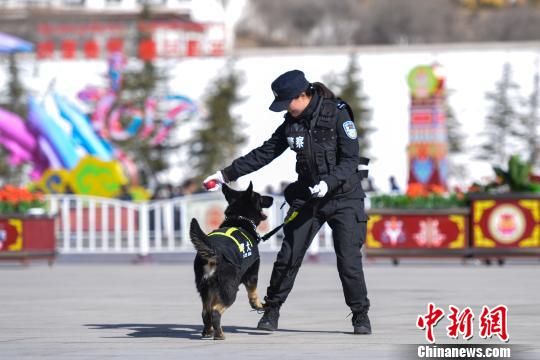
Chinese dogs to patrol Lhasa

Police dogs will now patrol the streets of Lhasa, the Tibetan capital; it was announced yesterday.
It is a first.
For the first time on February 16, the Tibet Autonomous Region's Public Security Bureau (PSB) used dogs for patrolling the streets of Lhasa.
According to China News Network, the dogs will “enhance the actual capacity and level of the Tibetan police force.”
Pictures of the dogs in front of the Potala Palace Square were released for the occasion.
Police dog's instructors ‘displayed’ the skills of the new ‘patrol’.
The same source reported that the security guards’ dogs will patrolled different areas of the City, such as the Potala Palace Square, the Jokhang Temple Square, the Barkhor Street, the railway station and major streets of the Capital.
The PSB, responsible for the security in Lhasa, said that the dogs can serve for security duty, patrols, vigilance, hunting and other tasks, ...and comprehensively enhance the effectiveness of public security as well as achieve deterrence of crime and enhance people's sense of security.
It looks like China does not feel secure?

Explosive situation in Xinjiang
But Tibet is still far better than Xinjiang.
The Chinese media reported that eight people were killed in a violent attack in Hotan in Xinjiang on Wednesday.
Hotan is located just north of the Aksai Chin on the NH 315.
According to the news portal of the Hotan local overnment, three knife-wielding men attacked and stabbed several people in Pishan county.
Finally, the Police shot dead the three attackers.
Some ten people were injured in the attack. Among them, five were declared dead after being sent to hospital.
The Chinese media added: "Order has been restored and an investigation is ongoing. The identity of the attackers were not disclosed."
The were obviously Uyghurs.
A few days earlier, Radio Free Asia (RFA) reported "scenes reminiscent of China’s Cultural Revolution."
Uyghurs have been called to meetings to confess their 'crimes'.
Those whose misdeeds come to light in other ways, will be punished, declared the Police.
According to RFA, these meetings are part of a campaign called “Revealing Errors”. They were held in Xinjiang’s Aksu Prefecture "to uncover behavior considered politically destabilizing in the restive, mostly-Muslim region in China’s far northwest."
A letter from an Aksu resident received by RFA mentioned: "Village residents from 18-65 years of age are being brought to their village office every day to admit to their mistakes or to point out mistakes they have seen others make."
The same source added: "Residents are called to a podium one by one to confess these errors after they have listed them on a 39-question form. They are also told they will face legal consequences if they attempt to cover up their own or anyone else’s anti-state activities.”
It really sounds like the return of the Great Proletarian Cultural Revolution.
Where is China going?
It is quite frightening to think about it.
 

Tuesday, May 3, 2016

Don’t rock the boat

In November 1949, the Tibetan Cabinet in Lhasa wrote to the American Secretary of State, requesting the US’ support for Tibet’s admission to the UN: “As Tibet being an independent state, we have no dangers from other foreign countries but in view of the spread of communism and their successes in China, there is now an imminent danger of Communist aggression towards Tibet.”
Lhasa was advised by the Americans not to ‘rock the boat’.
Later, an officer of the Ministry of External Affairs told Loy Henderson, the US Ambassador to India: “[India] feels that making issue of Tibetan question at present might precipitate Communist decision invade pursuant their declared intention liberating country.”
Around the same time, a cable from Henderson to Dean Acheson, the US Secretary of State stated, “during the conversation, Mr. Graves [of the UK High Commission in Delhi] showed me a Hansard report [verbatim report of proceedings of the British Houses] of December 14, 1949,” to which was attached a 1943 memorandum mentioning the British position with respect to Tibet; the memorandum stated the Tibet was a ‘de facto independent’ country.
However the British too did not want to ‘rock the boat’.
This came back to mind, when the controversy erupted regarding the cancellation of a ‘tourist visa’ for Dolkun Isa, Executive Chairman of the Munich-based World Uyghur Congress. Isa was to attend a ‘conference’ at Dharamsala in Himachal Pradesh.
The media immediately took up the issue: why was the visa suddenly revoked without reason? Soon the Modi Sarkar was accused of behaving like its predecessors.
Most observers saw a retaliation against China’s decision to put a hold India’s request to add Masood Azhar, head of the Pakistani-based group Jaish-e-Mohammad, to the UN’s blacklist.
On the Isa issue, China was quick to respond: the Chinese Foreign Ministry said that the Uyghur leader was under a ‘red-corner’ Interpol notice and should be arrested as he was a terrorist.
The restive province of Xinjiang is an extremely sensitive issue for China, as Beijing believes that Islamist militants and Uyghur dissidents are colluding to establish an independent state, Eastern Turkestan.
Though the Ministry of External Affairs was apparently not aware of the Conference and the visa given to Isa, most observers first thought that Prime Minister Narendra Modi was finally decided to ‘rock the boat’.
It may not be that simple.
First, could Isa have attended the ‘conference’ on a tourist visa (or e-visa)?
Whoever has organized this type of event in India, knows that foreign participants need a ‘conference visa’ which is not easy to obtain.
Further, the Dharamsala ‘conference’ was bound to be controversial; it was organized by the US-based Citizen Power for China, a group led by Yang Jianli, one of the protagonists of the 1989 Tiananmen Square protests (incidentally Yang was present in Dharamsala).
Granting Isa an electronic visa made it easier to cancel the permission to visit Dharamsala at short notice. The MEA could show its ignorance of the event.
Cancelling the visa while still holding the meet, even in camera, indicates that the Indian Government was keen to convey the message to Beijing, ‘don’t play with fire concerning terrorism’, and at the same time, allowed Delhi a strategic retreat.
Delhi wanted to ‘rock the boat’ to a certain extent only. It is why visas granted to other Chinese dissidents like Lu Jinghua and Ray Wong were also cancelled.
Lu, also a participant in Tiananmen protests, figures on a Chinese list of ‘major criminals’. She learnt of the withdrawal of her visa only after reaching JFK to enplane for India on April 25. The visa for Hong Kong pro-democracy activist Ray was also reportedly withdrawn around the same time.
Delhi later said that Lu’s visa was withdrawn because her documents were ‘ineligible’ and there was an ‘inconsistency’ about the purpose of her visit. Obviously, she was not going to Himachal for ‘tourism’.
According to the Chinese website of Radio Free Asia, several other activists were banned from the meet, in particular five individuals associated with the World Uyghur Congress.
Hong Kong activist Alex Chow, who co-organized the pro-democracy Umbrella Movement in 2014, told Quartz that he too was denied a visa.
But it is not the point; the important point is that the gathering took place.
One may well ask: has Delhi become an adept of Sun Tzu’s Art of War?
The Chinese Master in one of the 13 chapters of the book, writes about ‘Variations and Adaptability’, emphasizing on flexibility during a conflict.
Mao himself explained: “People may ask if there is contradiction to abandon a territory gained by heroic battle. This is to put the wrong question. Does one eat to no purpose simply because he relieves himself later?”
Delhi needed to use flexibility after the high profile visits of Defence Minister Manohar Parrikar and National Security Advisor Ajit Doval to China (and before President Prabab Mukherjee’s trip to Beijing later this month).
To cancel a ‘tourist visa’ was abandoning a bit of territory, but the main ‘battle’ was won; the ‘conference’ was held, though informally and amidst media blackout.
And before that, 60 participants were granted a two-hour audience with the Dalai Lama to discuss …China and democracy.
Edward Leung Tin-kei of Hong Kong Indigenous was one of them.
Hong Kong radical activist described the encounter with the Tibetan leader as a ‘rare opportunity’: “I’ve never thought I could meet Dalai Lama, the spiritual leader. This doesn’t happen every day,” Leung told The South China Morning Post.
Chow Hang-tung, working for an Alliance in Support of Patriotic Democratic Movements in China was another Hongkonger attending the closed-door meet. “It was very inspiring”, Chow said.
Ursula Gauthier, the French correspondent of L’Obs, who was recently expelled from China for questioning China’s interpretation of ‘terrorism’ and Anastasia Lin, Miss World Canada, were also present.
In the meantime, Beijing is nervous about the democratization of the Tibetan society. The Global Times commented on the recent Tibetan elections for a Prime Minister and Deputies: “Although the [Tibetans] resorted to ‘democratization’ after fleeing, this did not mean they would give up their original characteristics. …After all, feudal serfdom under theocracy has long been abandoned by Western countries.”
Who takes this Cold War language seriously today?
Participating in the 5th Moscow Conference on International Security, China’s Defense Minister Chang Wanquan also lectured on terrorism: “a comprehensive approach should be taken through political, diplomatic, economic and cultural means in order to eliminate the root of terror.”
General Chang obviously forgot ‘democratic means’ in his list.
Though the perception in India was that the Modi Sarkar had retreated, it may not be the case. Beijing has got the message loud and clear: India can do it again and the next time, with proper ‘conference visas’.
Beijing knows this.

Monday, October 12, 2015

Xinjiang : The Thorn in China’s Might

YU Zhengsheng and delegation arrive in Urumqi
My article Xinjiang: the thorn in China’s might appeared in NitiCentral.

Here is the link...

The dust had hardly settled down on the Potala Square in Lhasa where the celebrations for the 50th anniversary of the foundation of the so-called Tibetan Autonomous Region (TAR) were he, that the Chinese leadership moved to Xinjiang to commemorate the 60th anniversary of the Xinjiang Uygur Autonomous Region.
According to the Chinese media, everybody rejoiced in Tibet, but it was not the case in the restive far-western region of China.
In Tibet, the Communist leadership openly said that Tibet had entered the Golden Age, it is not the case in Xinjiang.
On September 10, an article in China Daily had proclaimed: “The now-50-year-old Tibet autonomous region has every reason to rejoice: The national regional autonomy mechanism is working well and benefiting ordinary Tibetans,” adding that even though: “the 14th Dalai Lama and those in Dharamsala of India will not be sharing the festive mood.”
In Xinjiang, the situation is more difficult, in fact extremely thorny for the Communist Party. Though like in Lhasa, a large delegation of Party cadres landed in Urumqui for the ‘festivities’, nobody spoke of the Golden Age.
Yu Zhengsheng, Chairman of the Chinese People's Political Consultative Conference (CPPCC) and member of the Politburo’s Standing Committee led the delegates, without fanfare.
Vice-Minister Liu Yandong was also there like in Lhasa, but the other lady member of the Politburo Sun Chunlan was ‘missing in action’, though she is the powerful Director of The United Front Work Department which overlooks Xinjiang affairs. Why she was missing is not clear.
Surprisingly, Zhang Qingli, a former infamous Party boss in Tibet, who had called the Dalai Lama ‘a wolf in monk’s garbs’ had come as a CPPCC’s Vice-Chairman. Zhang Chunxian, current party chief of the Xinjiang Uygur Autonomous Region was the host of the party, though nobody was in a festive mood.
A few days earlier, Reuters had reported a fatal attack which occurred in a coal mine, in which 50 Chinese Hans lost their lives. As he arrived, Yu Zhengsheng warned that everything was not under control in the region. He stated: “We must fully recognise that Xinjiang faces a very serious situation in maintaining long-term social stability, and we must make a serious crackdown on violent terror activities the focal point of our struggle,” and he invited the local cadres ‘not to rest on their laurels’, while Beijing faces a grave ‘threat from militants and separatists’.
In recent years, the energy-rich Muslim province has witnessed hundreds of deaths in ‘separatist’ violence.
Mid-September, Radio Free Asia (RFA) had reported that “at least 50 people died in an attack on a Chinese coal mine in the far-western region of Xinjiang”. The incident occurred at the Sogan colliery in Aksu; all the casualties belonged to the Han Chinese majority.
Although local police have immediately blamed the attack on knife-wielding separatists, the incident was not reported by state media; at that time the Chinese television beamed happy ‘ethnic minorities’ dressed in colourful outfits dancing and celebrating the great Chinese Motherland.
While the Chinese government put the blame on a handful of Muslim fundamentalists, Uyghur exiles and rights groups point out that Beijing “never presented convincing evidence of the existence of a cohesive militant group fighting the government, and that much of the unrest can be traced back to frustration at controls over the culture and religion of the Uyghur people who live in Xinjiang”.
According to Radio Free Asia, when police officers arrived at the mine, attackers “rammed their vehicles using trucks loaded with coal”.
One police officer, Ekber Hashim later told RFA: “Nearly all the workers who were not on shift at the time were killed or injured. …Some workers were sleeping, while others were preparing to work when the attackers raided the building after killing the security guards.”
According to RFA, the colliery has 3 separate coal mine shafts with a six-storey dormitory to house some 300 or 400 workers - around 90 per cent being Han.
This new incident shows that gravity of the situation.
Despite the extremely tight security in place since weeks for the 60th anniversary’s celebrations and the announced visit of Yu and his colleagues in Urumqi, the attack could still occur.
It is not the first time that this has happened.
Last year, in May, as President Xi Jinping was wrapping up a high-profile four-day visit to the restive region, a bomb attack in Urumqi railway station killed three people and injured 79.
It was the third major incident in seven months targeting civilians, following earlier fatal attacks in the heart of Beijing and Kunming
A few weeks later another terrorist attack in Urumqi, left 31 people dead and a large number of Han Chinese was injured. At that time, Xi ordered troops in Xinjiang to deliver a ‘crushing blow’ to terrorism.
This time, Xinhua quoted Yu as saying In Urumqi: “Firmly fighting violent terrorist activities should be the priority of our battle at present.”
Yu was accompanied by General Zhao Keshi, a member of the all-powerful Central Military Commission, also head of PLA's General Logistics Department, and Lt Gen Peng Yong, Commander of the Xinjiang Military District.
Yu, who oversees the United Front Work including the Xinjiang affairs addressed the troops and highlighted the role of the PLA for Xinjiang stability, saying troops should play a bigger role in fighting separatism, terrorism and extremism.
During the special meeting, Yu spoke to all senior military officers from the Xinjiang Military Area Command, the Xinjiang Division of the Chinese People's Armed Police and Xinjiang Production and Construction Corps (XPCC), an economic and semi-military organization, about the gravity of the situation. Yu even spoke of a protracted war.
Already last month, Yu had announced a government-backed aid programme to send professionals to Xinjiang whose aim would also be to curb ‘terrorism’.
Interestingly, General Zhao Keshi did not visit the Indian border (let us remember that the Xinjiang Military district borders Ladakh/Aksai Chin of India); he only went to Turpan, in Xinjiang’s northwest on September 29 to meet the ‘local residents’.
The Indian border is clearly not the priority in Xinjiang, like it is for Tibet. Zhao’s colleague, General Zhang Yang, a member of the ‘central leaders’ delegation to Tibet for the TAR’s 50 anniversary had visited the ‘border’ a few weeks earlier.
It is worth noting that the PLA posted in the unruly region has been recently ordered to ‘teach folk dances and songs as part of efforts to improve relations with the minority people’ (i.e. the Uyghurs).
Reuters, quoting the People’s Liberation Army Daily, says that the PLA in Xinjiang are at the ‘centre of the storm’ when it comes to fighting militants and separatists: “Their job is more than just fighting,” said the article, “pointing to the thousands of activities they have arranged in the last five years going into villages to ‘explain the party’s ethnic and religious policies ... and refute rumours.” It is not an easy task to force Communism down the Uyghurs’ throats.
Another telling sign: on the occasion of the Grand Parade for the 70th anniversary of the end of WWII, Xi Jinping had announced a cut in China’s military forces and a readjustment of the ratio between its army, navy and air force.
WantChinaTimes, published in Taiwan says: “If the adjustment is made, the number of troops in the navy and air force will be increased while the army will be reduced from 1.6 million to 1 million,” adding, “Sources claimed the troops to be cut may be transferred to form ten armed police tactical units and 100 armed police warfare groups, with both likely to be stationed in the restive Xinjiang Uyghur Autonomous Region.”
The situation is definitively not rosy in the restive ‘Autonomous Region’, especially with a neighbour like Pakistan at the door.
The giant Chinese Dragon is indeed terribly unstable.

Sunday, April 26, 2015

I am going to visit the home of my own brother, says Xi


The world press has focused on the enormity of the ‘gifts’ that President Xi Jinping brought in his luggage as he landed in Islamabad.
The Washington Post remarked: “Xi arrived in Islamabad bearing real gifts: an eye-popping $46 billion worth of planned energy and infrastructure investment to boost Pakistan's flagging economy. This would include adding some 10,400 megawatts to Pakistan's national grid through coal, nuclear and renewable energy projects.”
This sounds like a Chinese Dream for Islamabad!
Beijing has decided to help Pakistan to develop a China-Pakistan Economic Corridor which will eventually link up its pet project, the two New Silks Roads (also known as ‘One Belt, One Road’).
In other words, the Chinese-sponsored port of Gwadar on the Arabian Sea will be connected through the Karakoram Highway, to the Xinjiang province in China’s Far West and Central Asia …and later Middle East, Africa and Europe.
The ‘corridor’ will have railways, roads, optical fiber cables, dams (to produce the necessary electricity), pipelines, you name it!
Observers marveled at Beijing kindness (and wealth), but you should not be fooled by the Chinese generosity: Beijing is investing for Beijing!
China, which is facing financial difficulties at home, with a slowdown of the economic engine, has devised a double Roads scheme to rebalance its own economy and perhaps more importantly, to become the sole leader of Asia. The two Silk Roads project and the Asian Infrastructure Development Bank have to be seen in this perspective.
Pakistan, China’s good friend, is the perfect ‘partner’ (or vassal state, if you look from another angle). It is geographically ideally positioned with an access to the sea in the South and to Central Asia in the North.
In 1946-47, as the British were ready to depart the subcontinent, they devised a way to keep their influence in Asia and the world. During the previous two centuries, the defence of the Empire had been centered on the Indian subcontinent and the Indian Ocean (also known as the British lake). The British chiefs of staff had submitted a report on the strategic consequences of Britain’s departure from India; the generals agreed that Pakistan was crucial for the Empire to keep its influence; more important than the other future dominion (India), was the Islamic State which could provide air bases in the north of the country (to control Soviet Union) and naval bases opening to the Arabian Sea in the south. A brotherly contact with the Muslim states in the Middle East was an added bonus.
It explains why London put its stakes on Pakistan.
The dies were cast in May 1947, when the chiefs of staff filed their final report: "From the strategic point of view there were overwhelming arguments in favour of West Pakistan remaining within the Commonwealth, namely that we should obtain important strategic facilities..."
Subsequently this policy was implemented, partly with the unknowing (not to say foolish) collaboration of the Congress Party.
Today, China is in the same position as the British at the time of India’s independence. By buying Pakistan’s allegiance, Beijing believes that it will be able to control and dominate Asia by linking the Belt and the Road.
A discredited and financially broke Islamabad, is only too happy to rely on their ‘dependable’ friend (as per Nawaz Sharif’s words, when he received Xi Jinping).
Billboards in Chinese and English were seen in Islamabad, the friendship between the Lord and the Vassal is now ‘higher than mountains, deeper than oceans, sweeter than honey, and stronger than steel.’
China plays on the credulity of their all-weather ‘friend’; in an article published in some Pakistani papers before his arrival, Xi wrote: “This will be my first trip to Pakistan, but I feel as if I am going to visit the home of my own brother.” He added that the bilateral relationship ‘has flourished like a tree growing tall and strong’. It is very touching, isn’t it?
The Washington Post sees it differently: “After all, China and Pakistan may share a border, but cultural ties between the two nations and its people are thin, to put it mildly.”
However, there is a far more serious problem faced by Beijing: Pakistan is a haven for terrorists and China likes neither terrorism, nor dissidence.
A couple of weeks ago, Beijing started a crackdown on ‘visible signs of Muslim religious observance’ among the Uighurs, the ethnic minority living in Xinjiang. A man is said to have been condemned to a six-year prison sentence for daring to grow a beard in the Muslim region.
Without even talking of extreme cases like this one, how is Beijing going to tackle the movements of terrorists from Pakistan to Xinjiang, once the ‘corridor’ is wide open to goods and people. Or will it be open only for oil, gas and raw materials? It does not make sense.
The only solution for Beijing is to twist Pakistan’s arm and make sure that terrorism stops or at least is reduced to its ‘export to Kashmir’.
On March 26, when the Chief of Naval Staff of Pakistan, Admiral Muhammad Zakaullah, visited Beijing to prepare President Xi’s trip to Islamabad, the Vice Chairman of China's Central Military Commission, General Fan Changlong pledged to ‘deepen cooperation with Pakistan in anti-terrorism, maritime security and military technology.’ Beijing is clearly nervous that their investment may be jeopardized by the jihadis. Fan told Zakaullah that China hopes to enhance coordination and cooperation with Pakistan on regional security affairs (read terrorism).
As President Xi Jinping arrived in Pakistan, he immediately met with Pakistani Chairman Joint Chiefs of Staff Committee, Rashad Mahmood and his colleagues of the Army, Air Force and Navy in Islamabad.
Xinhua reported: “Hailing the important role the Pakistani military has played in the development of China-Pakistan relations, Xi said that the understanding and support of the Pakistani military is necessary for the two countries to forge a community of shared destiny,” adding that “Xi spoke highly of the anti-terror cooperation between the two countries ...and staunchly back Pakistan's efforts to counter terrorism and safeguard national security.”
The message is clear, “we are going to help you, we are going to invest billions and billions of dollars to save your economy, but control the terror in your country, we are with you.”
As a bonus, China will sell eight Type 041 Yuan-class diesel-electric submarines to Pakistan for nearly US $ 5 billion. Who will pay for China’s ‘biggest-ever arms export deal’ is irrelevant (Beijing is likely to extend a long-term loan, at a low interest rate, to cover the cost for the submarines).
The sharp-tongued Foreign Ministry spokesperson Hua Chunying explained: "China and Pakistan are neighbours boasting traditional friendship, and the two sides maintain normal cooperation in the military industry and arms trade."
If Islamabad manages to control terrorism infiltration along the Silk Road, it is worth the investment for Beijing; especially as Pakistan as use the subs to keep a tab on India in the Arabian Sea. If it does not happen, Beijing has a big problem.
The irony is that China may succeed where the United States and India have always failed: to control the Pakistani Army and its different branches and ultimately tackle terrorism, at least in its more blatant forms.

Saturday, March 7, 2015

The 'Ethnic' Faces in the PLA

Saimati Muhammat,
alias Halimulati Abdul Rehman?
The third session of China's 12th National People's Congress (NPC) opened with fanfare at the Great Hall of the People in Beijing on March 5, 2015.
Two days earlier, the Chinese People's Political Consultative Conference had started its deliberations.
Since the founding of the NPC, the People's Liberation Army (PLA) has had the largest delegation; still today the PLA has about 9 percent of the total 2987 NPC's seats.
Unfortunately, the PLA is mainly represented by Han officers.
However, in the recent years, officers with an 'ethnic' background (read Tibetans, Uyghurs, Mongols, Huis, etc.) have come to play a more visible role. Beijing has probably realized that 'faces' were needed to support their pretense of 'regional autonomy'.
Here are a few lines on 3 senior 'ethnic' officers: one Uyghur and 2 Tibetans. 

Representing Xinjiang
One remembers that on March 1, 2014, some 33 people were killed and 130 wounded when a group of attackers dressed in black went on the rampage in Kunming railway station. The ‘terrorists’ went around indiscriminately hacking and stabbing passers-by.
According to official sources the death toll includes 29 civilian victims killed by the attackers and four assailants shot dead by riot police. Witnesses said that six men and two women used long knives to ‘crazily’ attack innocent passengers. Terrified victims ran away seeking protection.
The Legal Daily newspaper reported that the SWAT (Special Weapons And Tactics unit) arrived on the scene less than 15 minutes after the beginning of the carnage and after firing 2 warning shots; the SWAT leader gunned down a masked woman who threatened him with a knife; he later shot four of the attackers in 15 seconds.
A couple of days later, Xinhua, quoting Kunming officials, said that the initial investigations suggested the deadly attack was "planned and organised by separatist forces from Xinjiang."
The horrible Kunming massacre should be seen in the perspective of the situation in the restive Xinjiang.
For the first time on this occasion, we heard about Saimati Muhammat, a deputy commander of the Xinjiang Military Area Command. In an interview to Xinhua, he affirmed that counter-terrorism in Xinjiang Uygur Autonomous Region had the strong backing from the People's Liberation Army (PLA): “Counter-terrorism arrangements are in place to prevent serious incidents in Xinjiang," said Saimati.
For Beijing, Xinjiang is at the front line struggle against 'The Three Forces’, namely terrorism, extremism and separatism.
Saimati Muhammat, a Uygur ethnic and member of the NPC, said the armed forces in Xinjiang will never ease border controls: “We watch the border closely. Any oversight, which lets terrorists in or out, is unacceptable."
Saimati Muhammat affirmed that the border troops in Xinjiang, who ‘operate under extreme conditions’, have stepped up counter-terrorism training to armed forces, especially special forces: “to protect the safety of local people, the armed forces also work with the police force in patrols and training.”
Saimati further explained: “The fight against the three forces is not about ethnic issues, religion or cultural differences. They are enemies of people of all ethnic groups. The battle is complicated, harsh, fierce and cruel."
Who is General Saimati Muhammat?
As far as I could find out, he is also known as Halimulati Abdul Rehman.
He is one of the first Uyghurs to be promoted as a Major General in the PLA.He is presently Deputy Commandant of Lanzhou Military Command Area (MAC).
Born in 1961, he graduated from the PLA’s Shijiazhuang Army Command College, specializing in military high-tech military applications and management. He earlier served as Deputy Commander of South Xinjiang Military District’s Political Department.
As a Uyghur, his postings appeared more ‘political’ than operational.
He was promoted as a Major General in January 2015, along with 8 others (all Hans) serving in the Lanzhou MAC.
This year too, the Uyghur general spoke to the press on the side of the NPC in Beijing. He said that terrorist attacks will not affect the overall stability of Xinjiang Uyghur Autonomous Region, nor will they can hinder its fast economic development, ethnic unity or religious harmony.
Saimati Muhammat was quoted by Xinhua: “Everyone in Xinjiang is against terrorism and expects peace. Now those few terrorists have no support there, and people just hate them."
Last May, two months after the Kunming incident, Beijing started a one-year anti-terrorism campaign in Xinjiang. Saimati commented that it has helped people realize that "terrorists are their common enemies. Everyone is obligated to battle terrorism and maintain peace."
Saimati, who has become the ‘Uyghur face’ of the PLA, noted: "Terror attacks are sometimes committed in the name of Islam, but even Muslims condemn them. These extreme activities represent a violation of Islamic doctrine. They're a crime. The [Party’s] policies protect religious needs while helping to deter extremists."
The Uyghur general has become a de facto spokesperson for the Uyghur government. It is convenient for Beijing to have an ethnic face.

Ngawang (Ang Mong) Sonam
Representing Tibet
Apart from General Saimati, there are other 'ethnic' officers who are attending the NPC (last year too, they were present at during the sessions).
Though I mention here two Tibetans, a couple of Mongols and Manchus are also attending the NPC.
Ngawang [Ang Mong] Sonam is a Deputy Commander of Military District, Qinghai Military District of Lanzhou Military Area Command. A Chinese publication noted: “These [officers] bring pride to the rugged western China [Tibet and Xinjiang], they are absolutely honest and have defended the country's frontiers with their blood; they feel from their heart for the people.”
The publication added: “Minority officers, who represent the people in ethnic minority areas in the country's highest political authority [the NPC] are dedicated to a strong army and China’s steadfast dream.”
Major General Ngawang Sonam was born in Qinghai Yushu (Jyekundo) in 1964. He decided to follow the footsteps of his elder brother and join the army.
Many Tibetans like Ngawang Sonam have a pastoral background; most of them did not even know how to use chopsticks, explained a Chinese publication; they learned the skill in the PLA: “We were also taught Chinese, we learned to write Chinese characters, as the Chinese soldiers did know how speak the minority language (Tibetan),” Sonam recalled, adding: “By the time the [Tibetan] soldiers are demobilized, they are usually proficient in Chinese and can read the local language as well.”
Jiang Yong

Another Tibetan officer is Jiang Yong which is not a very Tibetan name! (His Tibetan name might be Jamyang).
He is born in Chamdo in 1977.
Late 1990s, Jiang Yong, then a Tibetan teenager, had a dream; he wanted to join the PLA. In an interview, he explained that when the 'western development' scheme started, the Central  (Beijing) government initiated a preferential education policy for young Tibetans; Jiang Yong, who had got excellent grades in the junior high school, eventually graduated from the Tibet University. He later joined Kunming Military Academy.
Now, he serves in the Special Forces; he recalled: “I was enrolled in Special Forces selection, conditions were very tough.”
He is posted (probably as a Colonel) in Chengdu Military Region.
He is a member of the 12th NPC.

While Han and ethnic deputies will give 'important' speeches on Xi Jinping's 'Four Comprehensives', particularly
the Rule of Law in ethnic areas, nothing much will be done for a larger and truer representation of the 'ethnics'.
Though Xinhua affirns that 'as year 2015 marks the 50th anniversary of the founding of the Tibet Autonomous Region, the central government's policies on governing Tibet will attract attention from home and abroad", nothing concrete will be announced for the ethnic representation in the local governments (Lhasa or Urumqi) or the PLA.
Today, like 50 years ago, Beijing has just 'faces' (from Ngabo Nwang Jigme to Pema Thinley and Lobsang Gyaltsen).
Beijing is clearly more interested by Xi Jinping's twin babies: the Silk Road Economic Belt and the 21st Century Maritime Silk Road: "it has drawn the attention of many countries around the world, especially China’s neighboring countries including India, which borders with southwest China’s Tibet Autonomous Region," said Xinhua.

Saturday, June 21, 2014

Ethnic Mingling in Xinjiang and Tibet?

Xi Jinping in Xinjiang
I have often mentioned on this blog that Beijing's 'ethnic' policies for Tibet and Xinjiang have a lot of similarities.
For example, when President Xi speaks of introducing “nets in the sky and traps on the ground" in Xinjiang, the policy was  (successful for Beijing) experimented in Tibet earlier. 
Last year, a delegation from Xinjiang's capital Urumqi visited Lhasa to learn the tricks of 'security' and 'stability'. The delegation was taken around by Tibet's Security Czar, Deng Xiaogang who is also the Party's Deputy Secretary of the Tibet Autonomous Region. Deng is responsible for the 'net in the sky and traps on the ground' in the TAR.
This excellent article of the China Brief describes the situation after the second Central Work Forum on Xinjiang quite accurately. 
What is interesting (and sad), is the introduction of the 'mingling' factor in both the policies of Xinjiang and Tibet. 
In Tibet, the Party Secretary, Chen Quanguo recently promoted inter-marriage between Tibetans and Hans. It is definitively a new policy, though senior leaders like Gyalo Thondup or the late Panchen Lama opened the way several decades ago. It appears that the same policy of 'mingling' and 'fusing through increased contact, cooperation and intermarriage', will now be encouraged in Xinjiang. 
What could happen is that the migrant Han workers will take a 'temporary' Uyghur wife, but this will not solve Beijing's problem. 
This reminded me of Robert Ford, the British radio operator posted in Chamdo in the late 1940s, in his book, Captured in Tibet, he wrote: "I became quite friendly with Horkhang Se [a Tibetan noble], and he even offered to find me a temporary wife. I was not far from getting one under my own steam. Her name was Pema. She was about seventeen, perhaps less. I met her through her stepfather, a junior official named Khona.
It all began when I asked Lhalu if some one could monitor the news-broadcasts from Peking in Chinese."

Ford eventually did not take a 'temporary' wife, but that is another story.
In Xinjiang, as in Tibet, it is doubtful if the new policy of 'mingling' or 'fusing' can work, there are too many decades of suspicion, not to say hatred, between the 'ethnic' populations and the 'occupiers'.
I wonder what the Dalai Lama has to say about the 'mingling'.

Xinjiang Work Forum Marks New Policy of ‘Ethnic Mingling’
China Brief Volume: 14 Issue: 12
June 19, 2014
James Leibold

The recently concluded Central Work Forum on Xinjiang (zhongyang Xinjiang gongzuo zuotanhui) marked a subtle yet significant departure in the Chinese Communist Party’s approach to ethnic policy. Economic development remains a top priority; yet the new generation of Party leaders understands that money alone will not mollify ethnic and religious tensions in Tibet and Xinjiang. Instead, Chinese President Xi Jinping is seeking a more comprehensive solution to the problems confronting these long-restive frontier regions.

The official Xinhua summary of the Forum’s proceedings outlined a number of priority areas for Xinjiang (Xinhua, May 30):
  • Boosting employment and income levels among Uighurs in Southern Xinjiang through a new round of fiscal transfers and investment.
  • More urbanization and interregional migration aimed at expanding the contact and cooperation between different ethnic groups.
  • Fortifying Party organs and personnel at the grassroots level in order to eliminate the “three evil forces”: splittism, extremism and terrorism) and shore up social stability.
  • Strengthening state education and bilingual instruction so that all minority youth are conversant in the national language and culture.
None of these proposals are particularly new. Yet, the Forum frames them around a new strategic intent: the erosion of ethnic differences, the removal of obstacles to the free “mingling” (jiaorong) of Chinese citizens and the forging of a shared national identity.
For over a decade now, a group of intellectuals and party officials have called for “adjustments” to current ethnic policies, some even speak of the need for a “second generation of ethnic policies” that would eliminate ethnic-based rights and autonomy (China Brief, July 6, 2012). The Xinjiang Work Forum reveals their burgeoning influence on top Party leaders; yet it remains unclear how far the new Chinese administration is willing or able to pursue this contentions agenda.

New Policies for New Conditions
The Second Xinjiang Work Forum, attended by the entire Politburo and over three hundred top Party officials in Beijing from 28–29 May, came a mere four years after the first gathering in 2010. Unlike the Central Work Forum on Tibet, which has been held five times (each roughly a decade apart) since the 1980s, Xinjiang is a far more recent, and now more pressing, concern for the post-Mao Party-state.
Since the 18th Party Congress in November 2012, Xi Jinping has chaired seven Politburo meetings on Xinjiang, while issuing over thirty directives on Xinjiang work (Xinjingbao, May 30; Xinhua, May 3). In April, he personally toured the region. Fellow Politburo Standing Committee member Yu Zhengsheng, who is the Party’s point man on ethnic and religious issues, has made four official visits to Xinjiang, compared to only one to the Tibetan Autonomous Region.
Several times over the last couple of months, Xi Jinping has stressed that: “Xinjiang work possesses a position of special strategic significance in the work of the Party and the state” and “the long-term stability of the autonomous region is vital to the whole country's reform, development and stability, as well as to national unity, ethnic harmony and national security” (Xinhua, May 26; Xinhua, May 1).
It is easy to see why. China has witnessed an ugly spate of ethnic and religious violence since Xi came to power, leaving well over 200 people dead and hundreds more injured. Most of these incidents pit China’s embattled Uighur Muslim minority against a steadily encroaching Chinese state and its Han majority. Even more worrying for the Party-state is the spread of this violence out of Southern Xinjiang, where eighty percent of China’s 10 million Uighurs live, into the regional capital of Urumqi and inland cities like Changsha, Guangzhou and Beijing. The savage March 1 knife-attack on travelers at the Kunming Railway Station shocked the nation, with several commentators dubbing it China’s 9/11.
The official Xinhua News Agency summary of the Work Forum contains many of the usual statements: “The Party's strategy on Xinjiang has been proven correct and must be continued in the long run” (Xinhua, May 30). Yet, beneath the boilerplate, the language and policy direction outlined in the Forum statement marks a significant departure. Since the 18th Party Congress, Party officials have stressed that “new conditions” (xin xingshi) in Xinjiang create “new requirements” (xin yaoqiu).
Like the initial Work Forum, economic development is identified as an important agenda item, and we are likely to see a raft of new initiatives and money aimed at boosting Uighur skills, employment and living conditions over the coming months. Yet, the Xinhua statement leads with ethnic and religious issues rather than economic ones, and the First Work Forum’s key phrase, “leapfrog-style development” (kuayueshi fazhan), is mentioned only once. Rather the Forum stressed the complex and protracted nature of the “Xinjiang problem,” subtly recalibrating the “general goal” of Xinjiang work towards “safeguarding social stability and achieving an enduring peace.”
In contrast to previous assurances that trouble in Xinjiang is not linked to ethnic and religious issues, the Forum unambiguously asserts: “Xinjiang’s most sustained problem is the problem of ethnic unity,” and Xi Jinping is quoted as urging “all ethnic groups to show mutual understanding, respect, tolerance and appreciation, and to learn and help each other, so they are tightly bound together like the seeds of a pomegranate."

New Focus on Ethnic Fusion
Since coming to power, Xi Jinping has repeatedly stressed the importance of forging a shared national identity. The “China dream,” he contends, is foremost about the great revival of the “Chinese nation” or “Chinese race” (Zhonghua minzu), a term first coined by Liang Qichao in 1902 and employed by Chinese leaders from Chiang Kai-shek and Mao Zedong to Deng Xiaoping and Jiang Zemin in order to stress the conjoined history, fate and consanguinity of the Chinese people.
In a speech at the Central Party School on the importance of studying history then Vice President Xi Jinping praised the “all-under-heaven grand union” (tianxia datong) tenet, which he maintains bound together the Chinese nation/race for centuries (Phoenix, September 5, 2011). “In the course of the great family of the Zhonghua minzu’s formation, there was more exchange and fusion than contradiction and conflict among different ethnic groups, so that relations became more intimate through this conflict and fusion and became the main current of ethnic relations….thousands of years of exchange and fusion caused all the ethnic groups to be inextricably linked together, and in the end, took shape in the linked blood relations, common fate, and joint advancement of the great family of the Zhonghua minzu that is collectively formed by 56 ethnic groups.”
When he visited Inner Mongolia in early 2014 (Xinhua, January 29), Xi spoke about the need to “bind the people of each ethnic group into a single strand of rope.” On several occasions, Xi Jinping and Yu Zhengsheng have stressed the importance of the “four identifications” (sige rentong): identification with the motherland, with the Chinese nation/race, with Chinese culture and with the socialist road with Chinese characteristics. The aphorism was first employed in the early 2000s, but seldom appeared in Hu Jintao’s official speeches.
Xi Jinping’s new language bears the distinct influence of Zhu Weiqun, the former Executive Director of the Party’s United Front Works Department (UFWD) who moved across to the Chinese People’s Political Consultative Conference (CPPCC) at the 18th Party Congress, and now works under Yu Zhengsheng as the Director of the CPPCC’s Ethnic and Religious Affairs Committee. In the past, Zhu has echoed Peking University Professor Ma Rong in declaring that ethnic “blending and mingling is not ‘Hanification,’” but rather the natural course of Chinese history (Study Times, February 15, 2012).
Despite his less prominent position today, Zhu Weiqun's public and media profile remains high, far greater than his successor at the UFWD Zhang Yijiong. In recent months, for example, he delivered an important speech on urbanization in frontier regions at the CPPCC (Xinhua, March 9), gave a wide-ranging and widely circulated interview with Hong Kong-based Phoenix media (Phoenix, April 2), and led an inspection tour of grassroots religious management in Southern Xinjiang (Xinjiang Daily, May 7).
In the Xinjiang Work Forum summary there is repeated talk about the need to remove ethnic barriers and forge collective identity. The statement includes the controversial phrase “strengthen interethnic contact, exchange and mingling” (jiaqiang minzu jiaowang jiaoliu jiaorong), which the influential Qinghua University economist Hu Angang declared a “new policy orientation” when he outlined his contentious proposal for a “second generation of ethnic policies” in late 2011 (Aisixiang, March 31, 2012).
In his interview with Phoenix, Zhu Weiqun admits the concept of interethnic “mingling” elicited a strong response following its inclusion in Hu Jintao’s remarks at the Fifth Tibet Work Forum in January 2010. This was due to fears that, in his words, “this would mingle the ethnic minorities out of existence,” and thus the phrase was subsequently left out of the official statement that concluded the First Xinjiang Work Forum.
However, Zhu argues: “In adjusting to the general trend of today’s socialist market economy, we must place more emphasis on the common ground and communality of the Zhonghua minzu, minimizing and getting rid of those things that set apart different ethnic groups and ethnic autonomous regions from non ethnic autonomous regions” (Phoenix, April 2).
The sort of “melting pot” Zhu and other ethnic policy reforms believe is in keeping with both Chinese tradition and global norms. Yet there remains hefty opposition to these proposals in the Chinese bureaucracy and other parts of society, not to mention concerns about the implications of any radical shift in the status quo. If Xi Jinping sympathizes with these reformers, as his public statements seem to suggest, it is still unclear whether he possesses either the political capital or the desire to pursue this sort of agenda to its full conclusion.

Policy Implications

This new focus on interethnic fusion will see the Party-state pursue two potentially contradictory courses in Xinjiang over the coming year. First, it seeks to build a more ethnically integrated labor market by allowing minorities like the Uighurs to migrate into both regional cities like Urumqi as well as costal centers like Shanghai and Beijing. Second, it will redouble its hold over Xinjiang through a deeper penetration into the daily lives of Xinjiang residents by the Party and its security apparatuses.
By calling for “the establishment of a mutually embedded social structure and social environment,” the Xinjiang Work Forum signaled a new intention to break down barriers to interethnic migration. The Forum’s concluding statement calls for “orderly expanding the number of Xinjiang minorities who receive education, find employment and live in the interior,” and “orderly guiding the masses of each ethnic group in entering cities for employment.” The building of a “silk road economic belt,” which would link Central Asia with China proper via a network of infrastructure and human flows running through Xinjiang, is also mentioned.
At present, over 63,000 Xinjiang students (mainly Uighurs from Southern Xinjiang) are studying at inland schools as a part of a dislocated schooling program started in 2000 (Xinjiang Daily, February 20). There have been similar “export labor” schemes that send unemployed Uighur men and women to work in factories along the Chinese coast. Yet, the scope of these programs is small compared to the size of the idle work force in Southern Xinjiang.
Going forward, we can expect these programs to be ramped up, as will the number of Uighur migrants in Xinjiang cities. The regional government has ambitious plans to double the number of urbanites in Xinjiang by 2030 from 9 million at present to 20 million (Xinjiang Academy of Social Sciences, June 4, 2012). Han inward migration is not mentioned, but the Forum did call for the expansion of the Bingtuan, the paramilitary Xinjiang Production and Construction Corps, which is nearly ninety percent Han.
Increased interethnic mobility necessitates new social management tools. In order to counter any instability, the Forum stressed the need to beef-up early warning and mass prevention controls, with Xi Jinping quoted as calling for “nets in the sky and traps on the ground” aimed at curbing ethnic and religious violence. Since 2009, the official public security budget for Xinjiang has quadrupled and now amounts to nearly $1 billion per year (Ministry of Finance, February). Money is being spent not only on new equipment and personnel but also new methods of social monitoring.
Early this year, the regional government announced it would dispatch 200,000 high level Party cadres to live and work in grassroot communities for a year at a time (Xinjiang Daily, February 15). They are tasked with not only assisting and consoling the masses, but also gathering intelligence in order to nip any potential problems in the bud. In urban areas, Xinjiang is following other cities in building a “grid-style” (wangge hua) social management system. The technique divides communities into geometric zones and then assigns personal responsibility for social stability to a team of party members who are equipped (in theory at least) with the latest computer-enhanced technologies for near total surveillance (Yaxin, January 24, 2012). “In order to achieve complete grassroots coverage,” Xinjiang Party boss Zhang Chunxian recently stressed, “[we must] thoroughly enter and garrison [Xinjiang society] in order that no blank spaces are left behind” (Xinjiang Daily, March 5).

The Rocky Road Ahead
The Forum’s full set of recommendations has yet to be made public, and any new initiatives will face serious implementation challenges on the ground. In the past, vested interests and poor governance have blocked reform efforts, with, for example, the current hukou (household registration) system hindering large-scale interethnic migration. In addition, there are at least two blind spots in the Party’s optics on Xinjiang, important obscurations that portent more trouble ahead.
First, increased interethnic contact will intensify labor competition as Uighur and Han workers more directly contend for limited resources and opportunities in shared urban settings. There is ample social scientific evidence demonstrating how ethnic competition fortifies ethnic boundaries and, under the right circumstances, increases ethnic conflict and violence.
The Party, for example, recently announced new hiring quotas mandating that state-owned enterprises in Xinjiang employ seventy percent of their new staff locally, including twenty-five percent from ethnic minorities (South China Morning Post, June 1). Yet, the Party-state’s “two hands,” the invisible hand of the market and the visible hand of state power, often work at cross-purposes (Foreign Affairs, June 3). The size of Xinjiang’s state-owned sector is shrinking, and thus undermines hiring quotas; and the rumored opening of the massive petrochemical sector to private investment will only make matters worse. China’s current political and legal environment lacks the necessary safeguards to ensure that reforms benefit Xinjiang’s ethnic communities equally.
Second, Xi’s new approach fails to address the underlying yet chronic racism in Chinese society. Despite lofty statements about a unified, inclusive, and harmonious nation-state, most Uighurs feel unwelcome and unwanted in China. Their language, religion and cultural traditions are alien to mainstream Chinese society, and despite efforts to create multicultural spaces, Party-defined pluralism is colorful yet largely hollow. Uighurs, in the eyes of most Han, are dangerous criminals and thieves to be avoided; the Han, for most Uighurs, are dirty and infidel invaders who cannot be trusted. Faced with these mutual suspicions, neither community is likely to welcome the other to live side-by-side in the same community, let alone “fuse” through increased contact, cooperation and intermarriage.

Thursday, March 13, 2014

Han chauvinism hurts China’s ‘ethnic unity’

Urumqi, Xinjiang's capital
My article Han chauvinism hurts China’s ‘ethnic unity’ appeared in today's Edit Page of The Pioneer.

After writing this, I came across an article published in China.com. It reported that during the NPC's meeting, Zhang Chunxian stated that "technologies like breaking the Chinese Internet Great Firewall are contributing to an increase in the number of violent terrorist attacks."
Zhang made these comments in response to a question from the press asking for his opinion on the recent violent in Kunming. The remark of Xinjiang's Party boss triggered a large wave of criticism on the Chinese Internet. It is said that millions of Chinese netizens use various ways to bypass the 'Great Firewall' to access international websites blocked by Beijing. Wang's opinion was widely viewed as a typical 'evil position' against freedom of speech. Most of the websites that reported Zhang’s comments later removed his remarks.

Here is the link to my article...

Be it in Tibet, where locals rarely uses violence but are frustrated by Central policies, or in Xinjiang, where the temptation to use violence is stronger, Beijing has utterly failed in its so-called minority strategy

On March 1 shortly after 9 pm, some 33 people were killed and 130 wounded when a group of attackers dressed in black went on the rampage in Kunming railway station. The ‘terrorists’ went around indiscriminately hacking and stabbing passers-by.
According to official sources the death toll includes 29 civilian victims killed by the attackers and four assailants shot dead by riot police.
Witnesses said that six men and two women used long knives to ‘crazily attack innocent passengers. Terrified victims ran away seeking protection.
The Legal Daily newspaper reported that the SWAT (Special Weapons And Tactics unit) arrived on the scene less than 15 minutes after the beginning of the carnage and after firing 2 warning shots, Captain Zhang Jun (not his real name), the SWAT leader gunned down a masked woman who threatened him with a knife; he later shot four of the attackers in 15 seconds.
Zhang Jun recounted: “I didn’t have time to think, I shot them as fast as I could. After I shot all five, the first one, also the nearest to me, stood up again and threw a knife at me. Luckily I tilted my head.”
Beijing immediately described the incident as a ‘terrorist attack’.
A couple of days later, Xinhua, quoting Kunming officials, said that the initial investigations suggested the deadly attack was "planned and organised by separatist forces from Xinjiang."
The attack came a day ahead of the opening of the Chinese People’s Political Consultative Conference (CPPCC), and two days before the first session of the National People’s Congress.
The South China Morning Post commented: “It is traditionally the most politically sensitive time of the year, with the government eager to maintain stability and paint a rosy picture as thousands of delegates and government leaders head to the capital.”
The horrible Kunming massacre should be seen in the perspective of the past events in the restive Xinjiang. It is worth recalling the long series of violent happenings in the western province.
On June 25, 2009, two Uighur factory workers were killed and dozens injured in a huge brawl with Han Chinese in Shaoguan, in the southern province of Guangdong. As retaliation, thousands of Uighurs went on rampage in Urumqi, Xinjiang’s capital soon after security forces were sent to control the protest.
According to government’s sources, some 200 people died in the unrest and more than 1,600 were injured. Hundreds were arrested and at least 26 are sentenced to death. Uyghur sources said the number of victims could be as high as 500. ‘Ethnic separatist forces’ were blamed.
On July 18, 2011, the Chinese Police killed 20 protesters in Hotan in southern Xinjiang. The State media affirmed that the police had to fire on demonstrators who attacked a police station.
A month later, 13 Han Chinese were killed by suspected Uighur separatists.
On February 28, 2012, rioters armed with knives killed at least 10 people in Yecheng; the police was reported to have shot dead on the spot at least two attackers.
The unrest continued in 2013; for Beijing, one the most sensitive incidents (because it happened at the heart of the Capital) occurred on October 28 when three Uyghurs belonging to the same family crashed their car into Chinese tourists on the Tiananmen Square, killing two. The occupants of the car later set themselves on fire.
On December 16, 14 Uighurs and two police officers are killed in Shufu county; the attackers were once again described by the authorities as members of an extremist Islamist group.
On January 15, 2014 an eminent Uighur academic (and government critic) Ilham Tohti was detained by police and charged with separatism, carrying the death penalty. The list is indeed long.
After the Yunnan incident, the Government machinery was quick to denounce ‘terrorists’. Even pepresentatives from various religious bodies assembled during a session of the CPPCC denounced ‘terrorism’ which ‘undermined the social stability and unity’.
Losang Shandan of the Tibet Branch of the Buddhism Association of China, called on people of different nationalities to come together to fight against the violent activities and terrorists.
Who were the Kunming ‘terrorists’?
According to Radio Free Asia (RFA) the group of eight ‘has acted in desperation’. A Uyghur source in Kunming told RFA's Uyghur Service: “I believe the attackers may have been a desperate group of Uyghurs who fled Xinjiang to Yunnan and were trapped there after the Chinese authorities discovered their plans to get across to Laos."
The source added that he believes that the gang fled Xinjiang, trying to avoid police crackdown in Hanerik township (in Hotan prefecture).
It was later confirmed by Qin Guangrong, Yunnan’s Communist Party boss who declared the eight attackers travelled to his province and Guangdong, which borders Hong Kong, as they tried to leave the country: “These eight individuals originally wanted to join the jihad …They couldn’t get out at Yunnan so tried to get out in other places, but they also couldn’t leave Guangdong, so once again they returned to Yunnan.”
Wang Lixiong, the Chinese dissident (and husband of Tibetan blogger Woeser) gives his own perception of the Kunming incident. The outspoken writer knows Xinjiang well; he travelled there nine times between 1980 and 2007.
After the Kunming attack, he wrote: “People asked how I look at the incident. The issue lies not in the incident itself but beyond it, and it has been long in the making.”
Wang quotes from his book My West China; Your East Turkestan 2007 in which he argues that the name ‘Xinjiang’ itself shows where the problem lies. He asks: “What is Xinjiang? Its most straightforward meaning is ‘new territory’. But for the Uighurs, how could the land possibly be their ‘new territory’ when it has been their home and their ancestors’ home for generations. It is only a new territory for the occupiers.”
Wang Lixiong adds: “The Uighurs don’t like to hear the name 'Xinjiang' because it is itself a proclamation of an empire’s expansion, the bragging of the colonists, and a testimony of the indigenous people’s humiliation and misfortune. Even for China, the name 'New Territory' is awkward.”
He rightly asks that if Beijing claims that Xinjiang has belonged to China ever since ancient times, why call it ‘new territory’?
One often makes a comparison between India and China. But here Beijing has many lessons to learn from India if it wants to solve the ‘terrorist’ issue in Xinjiang.
Whether it is Tibet, where the local population rarely uses violence, but remains frustrated by the Central policies or in Xinjiang where the temptation to use violence is stronger (the proximity with Pakistan making things worse), Beijing has utterly failed in its so-called minority strategy.
The circle of violence in Xinjiang makes it all the more difficult for the leadership in Beijing to tackle the New Dominion’s issue.
Patience and wisdom are required; it is however not the forte of the Communist Party of China.

Saturday, March 8, 2014

China’s policies behind troubles in New Dominion

My article China’s policies behind troubles in New Dominion appeared in NitiCentral.

Here is the link...

On March 1 shortly after 9 pm, some 33 people were killed and 130 wounded when a group of attackers dressed in black went on the rampage in Kunming railway station. The ‘terrorists’ went around indiscriminately hacking and stabbing passers-by.
According to official sources the death toll includes 29 civilian victims killed by the attackers and four assailants shot dead by riot police.
Witnesses said that six men and two women used long knives to ‘crazily attack innocent passengers. Terrified victims ran away seeking protection.
The Legal Daily newspaper reported that the SWAT (Special Weapons And Tactics unit) arrived on the scene less than 15 minutes after the beginning of the carnage and after firing 2 warning shots, Captain Zhang Jun (not his real name), the SWAT leader gunned down a masked woman who threatened him with a knife; he later shot four of the attackers in 15 seconds.
Zhang Jun recounted: “I didn’t have time to think, I shot them as fast as I could. After I shot all five, the first one, also the nearest to me, stood up again and threw a knife at me. Luckily I tilted my head.”
Beijing immediately described the incident as a ‘terrorist attack’.
A couple of days later, Xinhua, quoting Kunming officials, said that the initial investigations suggested the deadly attack was "planned and organised by separatist forces from Xinjiang."
The attack came a day ahead of the opening of the Chinese People’s Political Consultative Conference (CPPCC), and two days before the first session of the National People’s Congress.
The South China Morning Post commented: “It is traditionally the most politically sensitive time of the year, with the government eager to maintain stability and paint a rosy picture as thousands of delegates and government leaders head to the capital.”
The horrible Kunming massacre should be seen in the perspective of the past events in the restive Xinjiang. It is worth recalling the long series of violent happenings in the western province.
On June 25, 2009, two Uighur factory workers were killed and dozens injured in a huge brawl with Han Chinese in Shaoguan, in the southern province of Guangdong. As retaliation, thousands of Uighurs went on rampage in Urumqi, Xinjiang’s capital soon after security forces were sent to control the protest.
According to government’s sources, some 200 people died in the unrest and more than 1,600 were injured. Hundreds were arrested and at least 26 are sentenced to death. Uyghur sources said the number of victims could be as high as 500. ‘Ethnic separatist forces’ were blamed.
On July 18, 2011, the Chinese Police killed 20 protesters in Hotan in southern Xinjiang. The State media affirmed that the police had to fire on demonstrators who attacked a police station.
A month later, 13 Han Chinese were killed by suspected Uighur separatists.
On February 28, 2012, rioters armed with knives killed at least 10 people in Yecheng; the police was reported to have shot dead on the spot at least two attackers.
The unrest continued in 2013; for Beijing, one the most sensitive incidents (because it happened at the heart of the Capital) occurred on October 28 when three Uyghurs belonging to the same family crashed their car into Chinese tourists on the Tiananmen Square, killing two. The occupants of the car later set themselves on fire.
On December 16, 14 Uighurs and two police officers are killed in Shufu county; the attackers were once again described by the authorities as members of an extremist Islamist group.
On January 15, 2014 an eminent Uighur academic (and government critic) Ilham Tohti was detained by police and charged with separatism, carrying the death penalty. The list is indeed long.
After the Yunnan incident, the Government machinery was quick to denounce ‘terrorists’. Even pepresentatives from various religious bodies assembled during a session of the CPPCC denounced ‘terrorism’ which ‘undermined the social stability and unity’.
Losang Shandan of the Tibet Branch of the Buddhism Association of China, called on people of different nationalities to come together to fight against the violent activities and terrorists.
Who were the Kunming ‘terrorists’?
According to Radio Free Asia (RFA) the group of eight ‘has acted in desperation’. A Uyghur source in Kunming told RFA's Uyghur Service: “I believe the attackers may have been a desperate group of Uyghurs who fled Xinjiang to Yunnan and were trapped there after the Chinese authorities discovered their plans to get across to Laos."
The source added that he believes that the gang fled Xinjiang, trying to avoid police crackdown in Hanerik township (in Hotan prefecture).
It was later confirmed by Qin Guangrong, Yunnan’s Communist Party boss who declared the eight attackers travelled to his province and Guangdong, which borders Hong Kong, as they tried to leave the country: “These eight individuals originally wanted to join the jihad …They couldn’t get out at Yunnan so tried to get out in other places, but they also couldn’t leave Guangdong, so once again they returned to Yunnan.”
Wang Lixiong, the Chinese dissident (and husband of Tibetan blogger Woeser) gives his own perception of the Kunming incident. The outspoken writer knows Xinjiang well; he travelled there nine times between 1980 and 2007.
After the Kunming attack, he wrote: “People asked how I look at the incident. The issue lies not in the incident itself but beyond it, and it has been long in the making.”
Wang quotes from his book My West China; Your East Turkestan 2007 in which he argues that the name ‘Xinjiang’ itself shows where the problem lies. He asks: “What is Xinjiang? Its most straightforward meaning is ‘new territory’. But for the Uighurs, how could the land possibly be their ‘new territory’ when it has been their home and their ancestors’ home for generations. It is only a new territory for the occupiers.”
Wang Lixiong adds: “The Uighurs don’t like to hear the name 'Xinjiang' because it is itself a proclamation of an empire’s expansion, the bragging of the colonists, and a testimony of the indigenous people’s humiliation and misfortune. Even for China, the name 'New Territory' is awkward.”
He rightly asks that if Beijing claims that Xinjiang has belonged to China ever since ancient times, why call it ‘new territory’?
One often makes a comparison between India and China. But here Beijing has many lessons to learn from India if it wants to solve the ‘terrorist’ issue in Xinjiang.
Whether it is Tibet, where the local population rarely uses violence, but remains frustrated by the Central policies or in Xinjiang where the temptation to use violence is stronger (the proximity with Pakistan making things worse), Beijing has utterly failed in its so-called minority strategy.
The circle of violence in Xinjiang makes it all the more difficult for the leadership in Beijing to tackle the New Dominion’s issue.
Patience and wisdom are required; it is however not the forte of the Communist Party of China.

Friday, March 7, 2014

A wall of bronze and iron for ethnic unity in China?

Zhang Chunxian with 'ethnic minorities' in Xinjiang
At the end of January, I questioned 'Where is Yu?'
In Communist China, leaders of the Politburo (particularly of the Standing Committee) are usually assigned a specific job with specific responsibilities.
I then wrote: "Yu Zhengsheng, No 4 in the Standing Committee of the CCP's Politburo is normally considered as the leader in charge of the country's (restive) minorities, as well as Taiwan. One could have thought that he would have been a pillar of the new National Security Commission (NSC) which will oversee, coordinate and monitor the country's foreign policy as well as the domestic and defense issues related to security."
Why Mr. Yu was not made a member of the NSC remains a mystery as he still Chairman of both Central Working Coordination Small Groups on Tibet and Xinjiang; he is also responsible for the relations with Taiwan.
Even more intriguing, this article which appeared in The South China Morning Post today. It quotes Zhang Chunxian, the Party Secretary of the Xinjiang Uyghur Autonomous Region.
Zhang says: "We will properly conduct our work in Xinjiang under the leadership of the National Security Commission"?
Does it mean that the Central Working Coordination Small Groups on Xinjiang will have no role to play anymore in the restive region's affairs?
Does it mean that in addition of his other tasks, Xi Jinping will also look after Xinjiang, sidelining the Small Group and Mr. Yu?
Answers to these questions may (or not) emerge during the next few months.
For the time being, it looks like the 'normal' Chinese norms of governance are not followed by Xi Jinjing, who yesterday called for 'resolute opposition to any words and actions that damage the country's ethnic unity.'
He joined a panel discussion with members from the so-called minority ethnic groups of the National Committee of the Chinese People's Political Consultative Conference (chaired by Yu).
Xi stated: "We will build a 'wall of bronze and iron' for ethnic unity, social stability and national unity," adding that the ethnic groups were "breathing the same air and sharing the same fate".
This is certainly a simplification of history.
In any case, Beijing's air is not known for its quality.
Xi also said: "Unity and stability are blessings, while secession and turmoil are disasters. People of all ethnic groups of the country should cherish ethnic unity."
The point is that they don't cherish it today.
How is Mr Xi planning to make the Uyghurs, the Mongols or thw Tibetans cherish 'ethnic unity' is a billion yuan question.


Xinjiang to work with National Security Commission to curb violence, Zhang Chunxian says
March 7, 2014
Teddy Ng in Beijing
Xinjiang party chief Zhang Chunxian says the restive autonomous region will work closely with the newly formed National Security Commission.
Zhang said the commission, headed by President Xi Jinping, would play a leading role in maintaining security in the far-western region, where violence has recently flared amid ethnic tensions. Nearly half Xinjiang's population are Turkic Uygurs.
"We will properly conduct our work in Xinjiang under the leadership of the National Security Commission," Zhang said on the sidelines of the National People's Congress yesterday.
The commission also includes Premier Li Keqiang and the chairman of the legislature, Zhang Dejiang. The names of other members have not been disclosed.
There was speculation earlier that the Xinjiang party chief would be a member. Zhang offered only a cryptic reply when asked whether he coud say more about the body and Xinjiang's representation on it. "I can tell you more information about the National Security Commission," he said, but did not elaborate.
Officials say Uygur separatists from Xinjiang carried out a knife attack last Saturday at the railway station in Kunming , capital of Yunnan province in the southwest, in which 29 people were killed and 143 wounded. Authorities also blamed Uygur separatists for a suicide car attack in Tiananmen Square in October.
Zhang said about 90 per cent of Xinjiang's suspected terrorists bypassed the country's internet controls - often called the Great Firewall - to exchange extremist views. He said efforts were needed to stop the spread of such information. The remark appeared to a be reference to virtual private network, or VPN, technology, which many mainlanders rely on to access blocked overseas websites.
Zhang dismissed concerns a recent crackdown on Uygur separatism had fuelled anger among members of the minority group.
Nur Bekri, the head of the regional government, said external forces with ulterior motives were creating instability in Xinjiang.
"We will resolutely crack down [on separatism]," he said. "They make chaos time after time, but they also fail time after time. We are confident in our work."