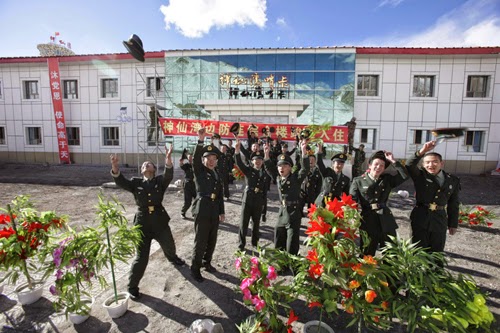
My article The Army that we must watch out for appeared in the Edit Page of The Pioneer today.
Here is the link...
President Xi Jinping is faced with a daunting task to reform his Army. While he will have to face hurdles, India must get ready as Chinese defence forces will become fitter and better prepared for any eventuality
Chairman Xi, as the Chinese President is known in the defence circles in China (he chairs the all-powerful Central Military Commission), will face his most serious challenge in the weeks to come as he has undertaken to ‘reform’ the People’s Liberation Army.
On November 7, The People’s Daily carried a commentary calling on military authorities to win the ‘battle of military reforms’. It clearly means that the battle is not won. The Communist Party’s mouthpiece reiterated the party’s absolute leadership over the military and asked the Armed Forces “to remain consistent with the Central authorities’ decisions.”
One reform is to cut the troops by 300,000 by 2020. The People’s Daily warned: “Senior leading departments and officials should play a guiding role in the process. They must back the Central authorities’ decisions and oppose political liberalism. They must not act on their own, gossip or make irresponsible remarks.”
Under the new rules, ‘PLA Inc’ will stop its song and dance troupes, hospitals and other profit-making activities. Will this help solving the problem of deep corruption within the Chinese defence forces, is another question. It is indeed a fact that the PLA, which once upon the time was a Peasants’ Army, has become corrupt, very corrupt and incompetent.
The South China Morning Post commented: “For decades, the PLA has profited from accepting civilian patients at military hospitals, leasing military warehouses to commercial firms, hiring PLA song and dance troupes for public events, outsourcing military construction companies, and opening military academies and institutions to public students.”
The Hong Kong daily cites the case of senior Naval officers sending warships abroad to smuggle home appliances and cars. This will change now.
Mr Xi has decided to shake up the PLA’s different branches by establishing a joint operational command structure for the land forces by year end and restructuring the seven Military Areas Commands into five combat or strategic zones.
The Jinan MAC, for example, is said to be ‘finishing its historical mission’; it would be dismantled along with the other MACs on December 20. The South China Morning Post commented: “The restructure is part of Xi’s massive military overhaul, which aims to shift the PLA from an Army-centric system towards a Western-style joint command, in which the Army, Navy and Air Force are equally represented.”
Last month, in a long speech carried by Xinhua, Mr Xi gave a rather detailed report on the planned reforms. Mr Xi asserted: “Under the leadership of the Communist Party, our military has gone from small to big, from weak to strong, from victory to victory. On this road, reform and innovation steps have never stopped.”
Reuters commented: “The troop cuts are part of long-mooted reforms to simplify and further professionalise the military, especially command and leadership structures that are still largely run along Soviet lines.”
What is the objective of this exercise apart from cutting the corruption rampant in each department? The declared purpose of the exercise is to have, by 2020, a military setup ‘capable of winning information-age warfare’. ‘Efficiency’ is clearly the new mantra.
It is obvious that if China wants to pick a fight with the US or Japan or even with its smaller neighbours, its Armed Forces need to be ready. Today, they are not.
Streamlining and downsising of the military will start from the CMC. By focusing on major functions and merging similar functions, the multiple-department CMC should become more efficient to supervise and coordinate the defence forces.
The ratio between the Army, Navy, Air Force and Second Artillery Force (the strategic forces) will need to be re-balanced to take care of “the increasingly complicated global situation faced by the world’s largest rising power,” said The Global Times.
Apparently, a large number of staff will be out of jobs, mainly in the political department. How will the retirees take this?
The Ministry of National Defence spokesman explained that “veterans are valuable to the party and country, as they have completed strict training and important tasks, and will be granted special job placement policies upon transfer or retirement.” Easier said than done!
The PLA Daily recently published a commentary: “Whether one gets to stay or is retired, officers and soldiers will inevitably have their own thoughts and may become unstable.”
It called for those who will lose their positions to “jump out of the box of self-interest …those with ulterior motives, officers and soldiers must maintain their ideological and political convictions.” It acknowledges that it will require that the high-level authorities and senior cadres provide the example.
It was also announced that a new branch of the Central Commission for Discipline Inspection will be setup within the CMC. All officers may not welcome this. Already on November 18, before the ‘reforms’ were announced, The Trend magazine, published in Hong Kong mentioned a gunshot fight between a military law enforcement team and some corrupt officers of the Shanxi Military Region.
The general staff and the general political departments had sent a joint military inspection team to the Region’s Entertainment Club. During the unexpected visit, the inspectors ordered some officers ‘having-good-time’ to show their IDs. The officers resisted and started to threaten the law enforcement staff, who had to fire warning shots. After it failed to scare the corrupt officers, the law enforcement team tried to arrest an officer, who was inciting the others.
This shows that Mr Xi’s task is not going to be easy. What do these reforms mean for India? First and foremost, corrupt and untrained Chinese defence forces will become fitter and better prepared for any eventuality, including a conflict with India.
Further, the Indian border will probably come under one MAC instead of two as today; it will greatly improve the efficiency of the Chinese ‘border’ forces.
When General Zhang Yang, a member of the CMC visited Ngari (Western Tibet) after ‘celebrating’ the 50th anniversary of the Tibetan Autonomous Region in early September, he was accompanied by Lt Gen Xu Yong, Commander of the Tibet Military District. It was particularly surprising as Ngari falls under the jurisdiction of the Lanzhou MAC, while General Xu is posted in the Chengdu MAC.
Militarily, it makes sense for China; it also implies that India has a few years to be ready (with the new Mountain Strike Corps for example). In the past, regional level military commanders have enjoyed warlord-like status over their respective military region, making it difficult to exercise a centralised control which is today necessary… to win a war. This may change.
Showing posts with label Lanzhou Military Region. Show all posts
Thursday, December 17, 2015
Friday, October 9, 2015
Big Changes in the People’s Liberation Army?
![]() |
| General Zhao Keshi: he did not go to the border |
One of these changes could be the phasing out of Soviet-style command structures which would be replaced by a US-style model. the Hong Kong daily had further mentioned that the PLA’s seven Military Areas Command (MAC) could be merged into four only.
Till now, this was speculations only.
But this week, a Chinese military newspaper has openly called for the PLA to learn from the joint command system used by the US.
Writing in the Zhongguo Guofangbao (‘China National Defence News’), a publication of the PLA Daily group, a PLA officer, Li Wenqing said:
the PLA's outdated structure was the biggest obstacle to developing President Xi Jinping's vision of a modern army capable of defending the country and leading it to victory.The South China Morning Post quoted a Beijing-based retired major general Xu Guangyu: "The article is so far the most explicit statement by a military news outlet to highlight the need to learn from the Western model."
Another analyst, a PLA senior-colonel noted:
It is almost certain the seven military commands will be remodelled [into] four, the air force and navy will be expanded, and some military departments and institutions will be integrated or even scrapped. …But it's foreseeable that such a big step would face strong resistance inside the army as many senior officials would be required to hand over powers.Zhongguo Guofangbao attributed the US victory in the first Gulf war to its 'C4ISR' systems (computerised command, control and communications; intelligence, surveillance and reconnaissance), saying that this was the model the PLA should follow, though it warned, “the overhaul would not only aggravate some existing disputes [within the PLA] but could also raise new problems. …[But] we should not stick to yesterday's paradigm when considering tomorrow's warfare."
Is it possible to make an omelet without breaking eggs, asks the French proverb.
Other reforms are in the pipeline.
As I already mentioned on this blog, during the September Grand Parade on the Tiananmen Square, Xi Jinping announced a 300,000 troops cut in the PLA (70 per cent of those cut would be officers in the land force).
Other 'reforms' are in preparation.
Earlier this week, The PLA Daily said that the State Council and Central Military Commission (CMC) have approved a pension and insurance scheme under which all veterans decommissioned since last October would receive a one-off subsidy based on length of service. Local authorities would help them find new jobs and provide financial support.
Another big change is the large scale entry of the private sector in the development and production of military equipment and weapons. For the purpose, the license requirements for private companies to enter the defense sector, will be greatly eased.
The Beijing-based Economic Daily said that the State Administration of Science, Technology, and Industry for National Defense of China recently released an updated catalog of military equipment and weapons that require a license for production or development.
WantChinaTimes, a Taiwanese website wrote: “The number of categories that require a license has been streamlined and reduced from 1,988 in the previous edition of the catalog, published in 2005, to 755.”
Xinhua also announced that China will recruit more civilian personnel who could play a role within the PLA and the People's Armed Police Force (PAPF): “The spouses and offspring of military personnel who have fallen in the line of duty, and the spouses of those still in service will be eligible to apply for certain posts.”
The news agency added: “More positions will be made available for candidates with relevant work experience. It is hoped that the drive will improve recruitment in remote areas and unpopular positions.”
Many more changes are in the offing.
The entire Tibet in Chengdu MAC
Let us come back to the reform on the MACs.
When General Zhang Yang, a member of the Central Military Commission (CMC) visited Ngari (Western Tibet) after ‘celebrating’ the 50th anniversary of the so-called Tibetan Autonomous Region, he was accompanied by Lt. Gen. Xu Yong, commander of the Tibet Military District.
This surprised me as Ngari falls under the jurisdiction of the Lanzhou MAC, while General Xu is posted in the Chengdu MAC.
Before departing for Ngari (the Ladakh and Himachal border), Lt Gen. Xu Yong said in Lhasa that after 50 years of vicissitudes, thanks to the region's rapid economic development and social progress, the living standards of the masses have markedly improved and social stability has overall been sustained: “During these 50 years in the same boat, the troops stationed in Tibet and police staff always depended on the Party's to write the bloody battles to defend Tibet, carve a new chapter the history of Tibet.”
Which 'bloody battles to defend Tibet' is General Xu referring to, is not clear.
However, Xu Yong lavishly praised his boss, CMC's Chairman Xi: “All the troops stationed in Tibet and police officers must resolutely obey the Central Military Commission and Chairman Xi command.”
More importantly, why was Xu in Ngari?
It can only be seen in the context of the reorganization of the MACs.
Could Tibet, i.e. the border with India, be regrouped under one MAC only (Chengdu?) instead of two presently.
It is what the presence of Lt Gen Xu Yong seems to indicate.
And militarily, it would make sense for China.
![]() |
| General Zhao Keshi in Xinjiang |
Another sign of the forthcoming changes?
A couple of weeks after General Zhang Yang’s visit to the Indian border in Ladakh, one of his colleagues of the all-powerful CMC, General Zhao Keshi, head of PLA's General Logistics Department attended the commemoration of the 60th anniversary of the founding of the Xinjiang Uyghur Autonomous Region.
He accompanied Yu Zhengsheng, Chairman of the Chinese People's Political Consultative Conference (CPPCC) and member of the Politburo’s Standing Committee (No 4 in the Party).
Though General Zhao met senior military officers from the Xinjiang MAC, the Xinjiang Division of the PAPF and Xinjiang Production and Construction Corps (XPCC - an economic and semi-military organization), he did not go to the border.
During the same meeting with the troops and officers, Yu spoke of a 'protracted war' against terrorism, but nothing about the border with India (it was soon after the Burtse incident).
Instead of visiting the Ladakh/Aksai Chin area, falling under the Xinjiang Military District of Lanzhou MAC, General Zhao Keshi went to Turpan, in Xinjiang’s northwest to meet the ‘local residents’.
Reuters, quoting The PLA Daily, says that the PLA in Xinjiang are at the ‘centre of the storm’ when it comes to fighting militants and separatists: “Their job is more than just fighting,” said the article, “pointing to the thousands of activities they have arranged in the last five years going into villages to ‘explain the party’s ethnic and religious policies ... and refute rumours.”
It is certainly not an easy task to force Communism down the Uyghurs’ throats.
This could be one more reasons why Beijing is thinking of bringing the entire Tibet under the same MAC? We may not have to wait too long to know if it is Xi's intention.
Saturday, March 7, 2015
The 'Ethnic' Faces in the PLA
![]() |
| Saimati Muhammat, alias Halimulati Abdul Rehman? |
Two days earlier, the Chinese People's Political Consultative Conference had started its deliberations.
Since the founding of the NPC, the People's Liberation Army (PLA) has had the largest delegation; still today the PLA has about 9 percent of the total 2987 NPC's seats.
Unfortunately, the PLA is mainly represented by Han officers.
However, in the recent years, officers with an 'ethnic' background (read Tibetans, Uyghurs, Mongols, Huis, etc.) have come to play a more visible role. Beijing has probably realized that 'faces' were needed to support their pretense of 'regional autonomy'.
Here are a few lines on 3 senior 'ethnic' officers: one Uyghur and 2 Tibetans.
Representing Xinjiang
One remembers that on March 1, 2014, some 33 people were killed and 130 wounded when a group of attackers dressed in black went on the rampage in Kunming railway station. The ‘terrorists’ went around indiscriminately hacking and stabbing passers-by.
According to official sources the death toll includes 29 civilian victims killed by the attackers and four assailants shot dead by riot police. Witnesses said that six men and two women used long knives to ‘crazily’ attack innocent passengers. Terrified victims ran away seeking protection.
The Legal Daily newspaper reported that the SWAT (Special Weapons And Tactics unit) arrived on the scene less than 15 minutes after the beginning of the carnage and after firing 2 warning shots; the SWAT leader gunned down a masked woman who threatened him with a knife; he later shot four of the attackers in 15 seconds.
A couple of days later, Xinhua, quoting Kunming officials, said that the initial investigations suggested the deadly attack was "planned and organised by separatist forces from Xinjiang."
The horrible Kunming massacre should be seen in the perspective of the situation in the restive Xinjiang.
For the first time on this occasion, we heard about Saimati Muhammat, a deputy commander of the Xinjiang Military Area Command. In an interview to Xinhua, he affirmed that counter-terrorism in Xinjiang Uygur Autonomous Region had the strong backing from the People's Liberation Army (PLA): “Counter-terrorism arrangements are in place to prevent serious incidents in Xinjiang," said Saimati.
For Beijing, Xinjiang is at the front line struggle against 'The Three Forces’, namely terrorism, extremism and separatism.
Saimati Muhammat, a Uygur ethnic and member of the NPC, said the armed forces in Xinjiang will never ease border controls: “We watch the border closely. Any oversight, which lets terrorists in or out, is unacceptable."
Saimati Muhammat affirmed that the border troops in Xinjiang, who ‘operate under extreme conditions’, have stepped up counter-terrorism training to armed forces, especially special forces: “to protect the safety of local people, the armed forces also work with the police force in patrols and training.”
Saimati further explained: “The fight against the three forces is not about ethnic issues, religion or cultural differences. They are enemies of people of all ethnic groups. The battle is complicated, harsh, fierce and cruel."
Who is General Saimati Muhammat?
As far as I could find out, he is also known as Halimulati Abdul Rehman.
He is one of the first Uyghurs to be promoted as a Major General in the PLA.He is presently Deputy Commandant of Lanzhou Military Command Area (MAC).
Born in 1961, he graduated from the PLA’s Shijiazhuang Army Command College, specializing in military high-tech military applications and management. He earlier served as Deputy Commander of South Xinjiang Military District’s Political Department.
As a Uyghur, his postings appeared more ‘political’ than operational.
He was promoted as a Major General in January 2015, along with 8 others (all Hans) serving in the Lanzhou MAC.
This year too, the Uyghur general spoke to the press on the side of the NPC in Beijing. He said that terrorist attacks will not affect the overall stability of Xinjiang Uyghur Autonomous Region, nor will they can hinder its fast economic development, ethnic unity or religious harmony.
Saimati Muhammat was quoted by Xinhua: “Everyone in Xinjiang is against terrorism and expects peace. Now those few terrorists have no support there, and people just hate them."
Last May, two months after the Kunming incident, Beijing started a one-year anti-terrorism campaign in Xinjiang. Saimati commented that it has helped people realize that "terrorists are their common enemies. Everyone is obligated to battle terrorism and maintain peace."
Saimati, who has become the ‘Uyghur face’ of the PLA, noted: "Terror attacks are sometimes committed in the name of Islam, but even Muslims condemn them. These extreme activities represent a violation of Islamic doctrine. They're a crime. The [Party’s] policies protect religious needs while helping to deter extremists."
The Uyghur general has become a de facto spokesperson for the Uyghur government. It is convenient for Beijing to have an ethnic face.
![]() |
| Ngawang (Ang Mong) Sonam |
Apart from General Saimati, there are other 'ethnic' officers who are attending the NPC (last year too, they were present at during the sessions).
Though I mention here two Tibetans, a couple of Mongols and Manchus are also attending the NPC.
Ngawang [Ang Mong] Sonam is a Deputy Commander of Military District, Qinghai Military District of Lanzhou Military Area Command. A Chinese publication noted: “These [officers] bring pride to the rugged western China [Tibet and Xinjiang], they are absolutely honest and have defended the country's frontiers with their blood; they feel from their heart for the people.”
The publication added: “Minority officers, who represent the people in ethnic minority areas in the country's highest political authority [the NPC] are dedicated to a strong army and China’s steadfast dream.”
Major General Ngawang Sonam was born in Qinghai Yushu (Jyekundo) in 1964. He decided to follow the footsteps of his elder brother and join the army.
Many Tibetans like Ngawang Sonam have a pastoral background; most of them did not even know how to use chopsticks, explained a Chinese publication; they learned the skill in the PLA: “We were also taught Chinese, we learned to write Chinese characters, as the Chinese soldiers did know how speak the minority language (Tibetan),” Sonam recalled, adding: “By the time the [Tibetan] soldiers are demobilized, they are usually proficient in Chinese and can read the local language as well.”
![]() |
| Jiang Yong |
Another Tibetan officer is Jiang Yong which is not a very Tibetan name! (His Tibetan name might be Jamyang).
He is born in Chamdo in 1977.
Late 1990s, Jiang Yong, then a Tibetan teenager, had a dream; he wanted to join the PLA. In an interview, he explained that when the 'western development' scheme started, the Central (Beijing) government initiated a preferential education policy for young Tibetans; Jiang Yong, who had got excellent grades in the junior high school, eventually graduated from the Tibet University. He later joined Kunming Military Academy.
Now, he serves in the Special Forces; he recalled: “I was enrolled in Special Forces selection, conditions were very tough.”
He is posted (probably as a Colonel) in Chengdu Military Region.
He is a member of the 12th NPC.
While Han and ethnic deputies will give 'important' speeches on Xi Jinping's 'Four Comprehensives', particularly
the Rule of Law in ethnic areas, nothing much will be done for a larger and truer representation of the 'ethnics'.
Though Xinhua affirns that 'as year 2015 marks the 50th anniversary of the founding of the Tibet Autonomous Region, the central government's policies on governing Tibet will attract attention from home and abroad", nothing concrete will be announced for the ethnic representation in the local governments (Lhasa or Urumqi) or the PLA.
Today, like 50 years ago, Beijing has just 'faces' (from Ngabo Nwang Jigme to Pema Thinley and Lobsang Gyaltsen).
Beijing is clearly more interested by Xi Jinping's twin babies: the Silk Road Economic Belt and the 21st Century Maritime Silk Road: "it has drawn the attention of many countries around the world, especially China’s neighboring countries including India, which borders with southwest China’s Tibet Autonomous Region," said Xinhua.
Thursday, July 24, 2014
General Xu visits the Indian Border
The recent heavy traffic of VIPs/VVIPs in Ngari (Western Tibet) was not only due to the presence of the Dalai Lama in Ladakh.
It has also to do with Beijing's decision to consolidate its borders, whether there are sea borders in the South China Sea or land borders with India (mainly in Aksai Chin region).
Yesterday, China Military Online reported that Xu Qiliang, a member of the Politburo of the CCP's Central Committee and also one of the 2 vice chairmen of the Central Military Commission (CMC) inspected Xinjiang and Tibet garrisons.
According to the official website: "Xu Qiliang recently [when is not disclosed] inspected the troops of the People’s Liberation Army (PLA) and the People’s Armed Police Force (PAPF) garrisoning Xinjiang and Tibet."
The article adds: "During the inspection, General Xu Qiliang visited the officers and men in frontier areas, and held talks with the leaders of the troop units garrisoning in Hotan [Xinjiang, near the Aksai Chin], Ali [Ngari or Gar] and Lhasa [in the Tibetan Autonomous Region or TAR] areas to discuss the development and reform of frontier troop units.
This means that General Xu inspected troops belonging to 2 separate Military Area Commands (Lanzhou and Changdu).
Xu Qiliang also visited sentries of the Shenxianwan (just north of the Karakoram Pass and the Depsang Plains) frontier defense company who were performing duties at the altitude of 5,380 meters.
Xu Qiliang went to the barracks of the Khurnak Fort frontier (opposite the Indian troops in Ladakh, north of the Panggong tso) defense company and Banmozhang (near Sirijp on the Panggong Lake where many incursions have taken place) to inspect a water [speed-boats] squadron and inquire about the soldiers’ work, study and life.
According to the same source: "Xu Qiliang also inspected weaponry and equipment and observed training and drills in a training base of a 'Red Army' regiment of the Xinjiang Military Area Command (MAC), an infantry brigade of the Tibet Military Command (TMC) and the First Detachment of the Tibet Contingent of the People's Armed Police Force (PAPF)."
He was accompanied by a battery of generals, amongst them, Gen. Sun Jianguo, deputy chief of general staff of the PLA, Gen. Miao Hua, political commissar of the Lanzhou MAC and Gen. Zhu Fuxi, political commissar of the Chengdu MAC.
This visit is also probably linked to the arrival of the railway line in Shigatse.
Another official Chinese site announced a few days ago that the completion of an extension of the world's highest Qinghai-Tibet railway, Lhasa-Shigatse railway. The construction started on September 26, 2010 will be officially opened in August.
Test trains are already running on the newly-built line, which will have an overall length of 253 km; trains will be able to run at a speed of 120 km per hour. It will take only 2 hours from Lhasa to Shigatse, the seat of the Panchen Lamas' and the TAR's second largest city.
China Tibet Online says that the city already attracts thousands of pilgrims and visitors each year: "In recent years, Panchen Lama's palace, Tashihunpo Monastery in Shigatse has received over 200,000 visitors from home and abroad annually. The opening of Lhasa-Shigatse railway will surely make the journey of worshippers to Tashihunpo Monastery safer and easier."
The first train reached Lhasa in July 2006, and though Beijing says: "it has positively impacted on Tibet's tourism, hospitality and manufacturing sectors", the main beneficiary has been the PLA.
The new line will be another progress for the PLA and PAPF stationed on Western Tibet.
To come back to General Xu's visit, did he come to distribute new accurate maps to the troops?
A Chinese military site recently reported: "A batch of new-version paper-made battle maps with a scale of 1:50,000 obtained by a motorized infantry brigade under the Lanzhou Military Area Command (MAC) of the Chinese People’s Liberation Army (PLA) from a measuring and mapping information center under the PLA Lanzhou MAC were quickly transferred to the frontline troop units participating in the trans-regional base training on the morning of July 9, 2014, marking that the distribution of a total of over 15 million new-version paper-made battle maps to the troop units under the Lanzhou MAC has been completed."
The website added: "This is the first time for the PLA to completely update a single type of map in the past 30 years."
Now the time is ready for Beijing to exchange maps of its 'perceived borders' with Delhi, something it has refused to do till today.
It has also to do with Beijing's decision to consolidate its borders, whether there are sea borders in the South China Sea or land borders with India (mainly in Aksai Chin region).
Yesterday, China Military Online reported that Xu Qiliang, a member of the Politburo of the CCP's Central Committee and also one of the 2 vice chairmen of the Central Military Commission (CMC) inspected Xinjiang and Tibet garrisons.
According to the official website: "Xu Qiliang recently [when is not disclosed] inspected the troops of the People’s Liberation Army (PLA) and the People’s Armed Police Force (PAPF) garrisoning Xinjiang and Tibet."
The article adds: "During the inspection, General Xu Qiliang visited the officers and men in frontier areas, and held talks with the leaders of the troop units garrisoning in Hotan [Xinjiang, near the Aksai Chin], Ali [Ngari or Gar] and Lhasa [in the Tibetan Autonomous Region or TAR] areas to discuss the development and reform of frontier troop units.
This means that General Xu inspected troops belonging to 2 separate Military Area Commands (Lanzhou and Changdu).
Xu Qiliang also visited sentries of the Shenxianwan (just north of the Karakoram Pass and the Depsang Plains) frontier defense company who were performing duties at the altitude of 5,380 meters.
Xu Qiliang went to the barracks of the Khurnak Fort frontier (opposite the Indian troops in Ladakh, north of the Panggong tso) defense company and Banmozhang (near Sirijp on the Panggong Lake where many incursions have taken place) to inspect a water [speed-boats] squadron and inquire about the soldiers’ work, study and life.
According to the same source: "Xu Qiliang also inspected weaponry and equipment and observed training and drills in a training base of a 'Red Army' regiment of the Xinjiang Military Area Command (MAC), an infantry brigade of the Tibet Military Command (TMC) and the First Detachment of the Tibet Contingent of the People's Armed Police Force (PAPF)."
He was accompanied by a battery of generals, amongst them, Gen. Sun Jianguo, deputy chief of general staff of the PLA, Gen. Miao Hua, political commissar of the Lanzhou MAC and Gen. Zhu Fuxi, political commissar of the Chengdu MAC.
This visit is also probably linked to the arrival of the railway line in Shigatse.
Another official Chinese site announced a few days ago that the completion of an extension of the world's highest Qinghai-Tibet railway, Lhasa-Shigatse railway. The construction started on September 26, 2010 will be officially opened in August.
Test trains are already running on the newly-built line, which will have an overall length of 253 km; trains will be able to run at a speed of 120 km per hour. It will take only 2 hours from Lhasa to Shigatse, the seat of the Panchen Lamas' and the TAR's second largest city.
China Tibet Online says that the city already attracts thousands of pilgrims and visitors each year: "In recent years, Panchen Lama's palace, Tashihunpo Monastery in Shigatse has received over 200,000 visitors from home and abroad annually. The opening of Lhasa-Shigatse railway will surely make the journey of worshippers to Tashihunpo Monastery safer and easier."
The first train reached Lhasa in July 2006, and though Beijing says: "it has positively impacted on Tibet's tourism, hospitality and manufacturing sectors", the main beneficiary has been the PLA.
The new line will be another progress for the PLA and PAPF stationed on Western Tibet.
To come back to General Xu's visit, did he come to distribute new accurate maps to the troops?
A Chinese military site recently reported: "A batch of new-version paper-made battle maps with a scale of 1:50,000 obtained by a motorized infantry brigade under the Lanzhou Military Area Command (MAC) of the Chinese People’s Liberation Army (PLA) from a measuring and mapping information center under the PLA Lanzhou MAC were quickly transferred to the frontline troop units participating in the trans-regional base training on the morning of July 9, 2014, marking that the distribution of a total of over 15 million new-version paper-made battle maps to the troop units under the Lanzhou MAC has been completed."
The website added: "This is the first time for the PLA to completely update a single type of map in the past 30 years."
Now the time is ready for Beijing to exchange maps of its 'perceived borders' with Delhi, something it has refused to do till today.
![]() |
| Shenxianwan Frontier Sentry Post |
![]() |
| Shenxianwan Frontier Sentry Post |
![]() | |
| Shenxianwan Frontier Sentry Post |
Thursday, May 1, 2014
The Lion is Trembling in the New Dominium
![]() |
| Xi Jinping and Yu Zhengsheng in Kashgar |
Recently, on arriving in Paris to commemorate the 50th anniversary of diplomatic relations with France, President Xi Jinping quoted Bonaparte. But, in presence of President Francois Hollande, he slightly modified Bonaparte’s words: "Today, the Lion has woken up. But it is a peaceful, pleasant and civilized lion."
China may be a sweet lion, but these days, it appears to be a trembling big cat too.
Xinhua reported that Xi Jinping mentioned the word ‘anti-terrorism’ in no less than six speeches within the last two months.
On April 25, during a meeting of the Chinese Communist Party's Politburo, Mr. Xi spoke of the importance of safeguarding national security and social stability ‘in the face of the new situation and new challenges’. The Party’s General Secretary had earlier mentioned several times the ‘T’ word.
Xi told his 24 Politburo’s colleagues: "We must soberly pay attention to the increasing threats and challenges to national security and social stability under the new situation.”
He then added: “The fight against terrorism matters for national security, for the vital interests of the masses, and for the overall situation of reform, development and stability. It is a battle to defend our national unity, social stability, and people's happiness. We must take decisive measures.”
Xi also asserted that China should “resolutely crack down on terrorism and secessionism.”
Already on March 2, soon after the stabbing incident at Kunming's railway station in which 30 innocent passengers were killed, presumably by Uyghur separatists, Xi Jinping asked the Party “to understand deeply the seriousness and complexity of the anti-terrorism situation and take effective measures to crack down resolutely on violent and terrorist criminal activities.”
Two days later, as President Xi Jinping met some ‘minority ethnic groups’, he told them: "We must resolutely punish and battle violent terrorist activities according to the law, and we must build an impregnable fortress of ethnic solidarity, social stability, and national unity."
The same day, Mr. Xi had a phone conversation with his Russian counterpart, Vladimir Putin, to whom he reiterated China’s willingness to maintain and strengthen anti-terrorist cooperation with Russia.
A website affiliated to The Wall Street Journal, Chinarealtime quotes official People’s Daily saying it is not 6 but 15 times that Xi has stressed China’s anti-terrorism efforts.
Whether it is 6 or 15 times is secondary, but there is no doubt that Beijing is nervous, very nervous at the internal situation in China, particularly in Muslim-populated Xinjiang.
Chinarealtime commented: “Xi Jinping is taking a page out of George W. Bush’s playbook. China’s president has signaled aggressively in recent weeks that a central element of his leadership will be fighting those the government views as terrorists.”
On April 9, Xi Jinping visited near Beijing, a Police Academy specialized in anti-terrorism and attended a drill by top anti-terrorist commandos. Later, he commended the exercise and presented a flag to the ‘Falcon Commando’ special forces of the People's Armed Police (PAP).
He reminded the commandos that the PAP was an important national counter-terrorism force. He asked the force to be conscientious in implementing the decisions and following the orders of the Party’s Central Committee. He urged the troops to be resolute in cracking down on violent terrorist crimes. Their job was to safeguard national security and social stability, he said.
Xi also asked the public to build a ‘wall of bronze and iron’ to fight terrorism, adding “China must make terrorists become like rats scurrying across a street, with everybody shouting ‘beat them!”
The function got very wide coverage in official Chinese media.
A day later, on March 10, during a phone communication with Barak Obama, Xi Jinping assured the US President of his willingness to strengthen cooperation with the international community, including the U.S., in fighting terrorism.
Two days after the 25th April Politburo meeting, Mr. Xi flew to the restive Xinjiang Uyghur Autonomous Region.
In his surprise visit, the President was accompanied by a very high-level delegation; four other members of the Politburo were on the flight: Yu Zhengsheng, member of the Standing Committee of the Politburo and Chairman of the Central Working Coordination Small Group on Xinjiang; General Fan Changlong, senior vice-chairman of the Central Military Commission; Zhang Chunxian, Party Secretary in Xinjiang Uyghur Autonomous Region and Wang Huning, Mr. Xi’s confidant who had already accompanied him to the Police Academy on April 9.
Mr. Xi headed to Kashgar, not far from the Indian border in Ladakh. When he met the troops of the Xinjiang Military Region facing India in Ladakh, he told them: "I hope that you care about each other, help each other, learn from each other, safeguard national unity and defend the motherland frontier."
But perhaps more importantly he lectured the PAP’s SWAT (for ‘Special Weapons And Tactics’): "The more you sweat in peacetime, the less you bleed in wartime."
In other words, practice and be ready to deal with 'terrorists'.
On April 28, Xi Jinping visited the Kashi [Kashgar] City's Public Security Bureau (police station). He inspected video surveillance cameras and other equipment to be used against ‘terrorists’.
According to Xinhua, the Party General Secretary also said: "I am very concerned about your equipment and training to deal with violent terrorist criminals. You must have the effective means. You must train in real combat environment."
Why so much emphasis on ‘terror’?
Is it such a vital issue for China?
Probably, the leadership in Beijing does not want to see a repeat of the Tiananmen events of 1989; the Party is aware that unrest could be the trigger for such ‘chaos’.
The South China Morning Post believes that the high-level Xinjiang’s trip is a proof that Beijing may soon bring new legislations aimed at improving responses to security threats: “it will likely pave the way for the government to introduce new anti-terrorism laws”. In Kashgar, Xi repeatedly told the security forces that they were on the front line of combating terrorism and needed the tools and the support to do the job.
At the same time, Uyghur exile groups and human rights organisations regularly blame Beijing’s policies “for stoking tensions in the region by showing a lack of respect towards the ethnic group's culture and religion.”
Probably sensing that tougher policies and more repression could only reinforce the vicious circle, Xi met with some of the Han teachers and urged them to learn the Uyghur language and to teach the Uyghur students Putonghua (Mandarin).
According to Xinhua, Xi explained that it is important to have bilingual education for ‘minority children’. Speaking Chinese is a way to find jobs more easily, “…and more importantly, they will contribute more to national unity”, added Xi.
Xi’s colleague in the Standing Committee, Yu Zhengsheng has probably other ideas to break the vicious circle. Promoting economic growth in Xinjiang and Tibet has been his main objective as Chairman of the Small Groups on Tibet and Xinjiang.
Xi did lecture local officials about the importance of developing new industries and launching projects which can create jobs.
Undoubtedly, the lion is trembling. If the resentment of the ‘minorities’ is not dealt with on a war footing, and in a humane manner, during the coming months, it will probably be too late for the Middle Kingdom which risks implosion.
Mr. Xi seems to be aware of the imminent danger.
A few photos in Kashgar.
(As I had just finished writing this paper, a bomb exploded in Urumqi, Xinjiang's capital).
Three killed as explosion rocks Urumqi train station
South China Morning Post
Li Jing
April 30, 2014
Explosion outside railway station in Xinjiang capital follows vow by President Xi Jinping to crack down on terrorism in tour of the region
Three people were killed and 79 injured yesterday in a terror attack outside the largest railway station in Urumqi, capital of troubled Xinjiang.
Police said knife-wielding assailants attacked people and set off explosives shortly after 7pm at the exit of the Urumqi South railway station, Xinhua reported after midnight.
The attack came as President Xi Jinping wrapped up his four-day tour of the restive region.
State television reported Xi was in Urumqi yesterday morning, meeting workers ahead of Labour Day today as well as local religious leaders.
Xinhua said the attack happened after a train arrived from Chengdu. Police said they are still investigating the case.
Citing witnesses, Xinhua reported that the explosion was centered around luggage left between the station exit and a bus stop.
"The blast was powerful. A man at a nearby hotel said he thought it was an earthquake," Xinhua reported.
Police cordoned off all entrances to the station square and armed police were deployed, Xinhua added. Xinjiang government spokesman Luo Fuyong said the situation was “well under control” after the blast, according to Reuters.
Hong Kong Travel Industry Council executive director Joseph Tung Yao-chung said he was not aware of any Hong Kong tour groups in Urumqi.
A resident working at a nearby hostel told the South China Morning Post over the phone: “The blast was quite powerful and there were possibly deaths.”
But another witness told the Post that "the bomb seemed home made, as the blast was not massive. Nobody had their limbs blown off."
Yesterday’s blast took place as state television broadcast reports about Xi’s visit to Xinjiang during the main evening bulletins. Xi vowed to deploy a “strike first” strategy against terrorism to “deter enemies and inspire the people”, Xinhua reported.
At a mosque in Urumqi yesterday morning just two kilometres from the station, Xi called on religious leaders to help followers to better understand religious teachings so people could live in peace.
Xinhua reported in early hours today that Xi urged "decisive actions" against Wednesday's attack.
Xinjiang, which is rich in resources and strategically located, has for years been beset by violence that Beijing blames on Islamist militants and separatists.
Li Wei, a Beijing-based counter-terrorism expert, said the blast showed that there were still “weak links” in security precautions.
“Security checks at the exit of a railway station are more relaxed than at the entrance,” he said.
Li said the terrorist attacks would not disappear soon even though the top leadership has highlighted it’s the the importance of tightening security.
Thursday, January 9, 2014
All is not well with the PLA?
![]() |
| Liaoning aircraft carrier and escort |
Here is the link...
China watching is a risky game.
But at the dawn of the new year, it is worth taking some risks and ‘predicting’ a few serious issues that the new Emperors in Beijing will be facing in 2014.
My ‘guessing game’ is however based on some hard facts: all is not rosy in the People’s Liberation Army (PLA).
While the foreign (and the Chinese) press, keeps announcing reforms of the Chinese military, the ‘official’ media denies it.
The day after the Third Plenum of the 18th Communist Party of China Central Committee ended last November, an editorial of The PLA Daily stated: “China’s People’s Liberation Army is striving to maintain its glorious wartime reputation by advancing military reform and putting paid to the ethos of decadence”.
Beijing was quite frank: “The people have noticed that certain Army cadres have only a vague understanding of their mission after a long break from combat, and have become lazy in their primary tasks,” asserted the PLA publication, which criticized officers who lack the ‘awareness of always being ready to fight’; it even admitted that some soldiers “have not been trained hard enough and the quality of military training is not good enough. They are just not up for the fight.”
The newspaper reminded its readers that the primary task and ultimate duty of military leaders should be to lead soldiers in battles and win wars. Nobody can disagree, even in South Block, where things usually move at a snail’s pace.
But if this needs to be said by the Party bosses in Beijing, it means probably that something does not go smoothly in the Middle Kingdom.
More recently, The Global Times, a publication affiliated to the Communist Party’s mouthpiece The People’s Daily, affirmed: “China's defense ministry denied news reports that China will implement a joint command system …such reports are groundless.”
It nevertheless admitted that “establishing such a system is a fundamental requirement in an era of information, and the military has begun positive programs in this regard.”
While saying that the rumors about the proposed reforms are ‘without basis’, the defense ministry still accepts that these are required.
Does it make sense?
It simply means that today in China, there are strong disagreements between the four services (Army, Navy, Air Force and 2nd Artillery for the missile force). Historically, from Mao’s days, the Army (PLA) has played the leading role in all the military operations (Korea, India or Vietnam). There is no doubt that in a future ‘modern war’, the other three services will be called upon to play a major role; the apparent ‘reform-no reform’ contradiction indicates that the PLA is ready to give up its supremacy.
Though Yang Yujun, a spokesperson for the Ministry of National Defense (MND), told at the press conference that “after studies, the PLA will deepen reform in good time and blaze a trail in reform on a joint operation command system with Chinese characteristics,” the PLA’s General Political Department affirmed that it has no information about any plan.
A well-informed Japanese newspaper had reported that China was considering reorganizing its seven geographic military regions into five and each of the new military regions would create a joint operations command controlling the army, navy, air force and a strategic missile unit to ‘ensure a more mobile and integrated management’.
That made sense and despite the denial from the defense ministry, observers believe that implementing a joint operational command could be the right move to start China's military reforms.
The fact that Beijing calls the needed changes, ‘rumours’ shows that President Xi Jinping’s reforms are not unanimously appreciated in the PLA.
The Global Times quoted a military expert (who asked to remain anonymous) saying “the establishment of a joint command system is in line with the general trend”, while the MND website continues to affirm: "Online speculation about a military reorganization and system adjustments are just rumours".
One of the rumours directly interests India: “The military areas in Xinjiang Uyghur and Tibet Autonomous Region will be merged into one force.” In case of a conflict with India, it seems logical for the PLA to have a single Military Area Command facing India, instead of having to coordinate the Western Front (Lanzhou MAC) with the Eastern Front (Chengdu MAC), with all the complications and coordination issues implied.
This is also denied, perhaps because: "China has built an iron bastion in its border regions. The major concern lies at sea," as Li Qinggong, deputy secretary-general of the China Council for National Security Policy Studies explains.
One often criticizes New Delhi for the Indian defence forces’ lack of preparedness, but it is clear that the Chinese too have their own problems. Another issue reported in The PLA Daily is the urgent need for standardisation in the Chinese armed forces. The MND’s publication admitted that the lack of coordinated standardisation among the Army, Navy, and Air Forces could become the Achilles heel of China’s defence system.
As we may not be able to fully understand the Chinese contradictions on the issue of reforms of the defence forces, one should look at the lighter side of the issue: China has a novel strategic theory and this time, it is not for the East China Sea.
The Global Times recently affirmed that smog could thwart missile attacks and hamper hostile air reconnaissance. That is indeed an interesting military doctrine!
The Global Times' headline is "The impact of smog on military equipment", it argues: "smog may affect people’s health and daily lives … but on the battlefield, it can serve as a defensive advantage in military operations."
The South China Morning Post commented on the Chinese netizen's reactions to China's new defensive weapon: “Are you saying the smog is not air pollution, but a national defence measure?” wrote a blogger on Sina Weibo microblog.
Another reader said: “But enemies wouldn’t need to resort to missile attacks if the smog continues to increase – people will simply be poisoned to death.”
If one cold winter morning you are stuck at Palam Airport, think about it, there is a strong possibility that South Block has started live military exercises.
In the meantime, ‘defence reforms’ may not be for tomorrow in China.
Friday, December 13, 2013
The top killer weapon to attack the most stubborn provocateur
Most interesting is a short 'denial' in The Global Times which says: "The MND [Ministry of National Defence] denies rumors of military restructuring."
Usually in China, an official denial means that there is some truth behind the rumors, but it is too early to say it..
An official statement published on the MND website affirms: "Online speculation about a military reorganization and system adjustments are just rumors".
It however admits: "The defense ministry is researching a military reform plan which should be in accordance with reform decisions made last month by the Communist Party of China's Central Committee."
The Global Times details the 'rumours': "Online speculation over the reforms claimed that a ground force headquarters will be added to the current air force, navy and the second artillery force (missile force)."
An Army headquarters makes sense.
The second rumour quoted by the Communist Party mouthpiece is even more interesting for India: "The military areas in Xinjiang Uyghur and Tibet autonomous regions will be merged into one force."
In case of a conflict with India, it would be logical. Instead of having to coordinate the Western Front (Lanzhou Military Area Command) with the Eastern Front (Chengdu Military Area Command), with all the complications and coordination issues implied, India would be facing one 'Tibet' Military Area Command (MAC). Though it has officially been denied, it also makes sense for the PLA to have a single MAC facing India.
Another rumor/speculation is that the PLA's garrison in Hong Kong would be withdrawn, and naval and air forces would be administered by other military bases. It would be a step further towards the integration of the former British colony in the Mainland. Also denied.
Xu Qiliang, one of the two vice chairmen of the Central Military Commission recently told The People's Daily that "The Chinese military will strengthen and enhance the navy, air force and the second artillery force in accordance with the challenges and threats the country is facing."
It is how the rumors started...
Urgent need for standardization
In the meantime, The People's Liberation Army Daily published a report highlighting the urgent need for standardization in the Chinese armed forces.
It affirms that "standardization would multiply the troops' combat capabilities", admitting that the lack of coordinated standardization among the army, navy, and air forces could become the 'Achilles heel' of China's defence system.
This newly-found transparency is interesting.
The report gives concrete examples: "during a military exercise, sailors on the four ships were able to hear one another. However, they could not transmit combat data because their information system was not compatible with that of the recipients."
Another instance is cited: "A brigade in the Second Artillery responded to an emergency with more than 300 vehicles and equipment, but there were as many as 90 different brands and models. The communications battalion alone had 12 different models of generators. The brigade commander complained that if there were a war, they would need to have several truckloads of spare parts."
It is clear that the time for 'reforms' announced after the Third Plenum of the Central Committee has come.
Top Killer Weapon to Attack the Most Stubborn Provocateur
Another piece of news, on December 10, 2013, Huanqiu, the Chinese edition of The Global Times, wrote about the security threats facing China.
It explains that "China has to deal with complicated security threats from outside and inside of China, as well as security threats that are intertwined both externally and internally."
Of course for Beijing, 'external security threats' are mainly due to what China calls 'evil return to Asia' of the United States. According to Huanqiu, the internal security threats are the consequences "of unbalanced economic development, pollution, the huge gap between the rich and the poor, social conflicts, and the splits in political consensus among the leadership."
The article sees a collusion between 'outside hostile forces' and inside forces using modern information technology (i.e. the Internet); it believes that "China faces intertwined external and internal security threats, such as Western hostile forces' political, ideological and cultural infiltration", adding that the 'Western hostile forces' have also "selected and trained some public intellectuals, known as Big Vs (online celebrities or influential microbloggers) and young government and military officials to spread a lot of dangerous information on the Internet in order to confuse the Chinese people."
The article quotes the unrest in the Arabic countries as an example of what can happen 'if the Chinese government does not watch out'; it will be the chaos in the Middle Kingdom!
Several ways to solve the security problems are suggested:
- Strengthen co-ordination under the leadership of the newly established National Security Council.
- Strengthen power building in national security research, the military, information, technology, finance, transportation, nuclear, and the biochemistry industries.
- Apply strategies wisely in order to isolate the small numbers of enemies and strengthen united front work. Increase scientific and technological innovation and have the courage to surpass others.
Though the 'stubborn provocateur' is usually Beijing, whether in Depsang Plain or in the East China Sea!
From the other side of the border
A good news from the other side of the McMahon Line.
We thought that the Ministry of Defence (MoD) had gone into hibernation before the 2014 General Legislative Elections, but it is apparently wrong.
PTI affirms that: "France's Dassault Aviation and Reliance Industries are planning to set up a facility to produce wings of Rafale combat aircraft selected by IAF for meeting its requirement of 126 fighter planes [Medium Multi-Role Combat Aircraft or MMRCA] .The two firms are planning to set up a Rs. 1,000-crore facility for producing the wings of the Rafale combat aircraft and it is most likely to come up in Bangalore."
If this is confirmed, it is good news for India's defence forces.
PTI further explains that Dassault Aviation would help Reliance to establish The news agency's source asserts that the MoD and other agencies concerned, have given a green light to Dassault and Reliance to go ahead with the project.
Hindustan Aeronautics Limited (HAL) would however remain the lead integrator for the 126 MMRCAs: "The differences over the issue have been resolved and Dassault and HAL have started readying their teams for implementing the project after it is signed."
It may not be the 'top killer weapon', but a serious deterrent, in case China is tempted by another 1962-adventure (from a single MAC or two).
Wednesday, July 24, 2013
About Tibet and Xinjiang Military Districts
![]() | |
| Night Exercises in Lhasa |
Xinhua reported about "PLA Air Force holds night flight training in Lhasa", which comes under Tibet Military District of Chengdu Military Region.
The recent border incidents and intrusions (in Ladakh) occurred in the Xinjiang Military District of Lanzhou Military Region.
Regarding the choppers' night flight, Xinhua commented on the picture: "A helicopter of China's PLA Air Force takes part in a night flight training at an airport in Lhasa, capital of southwest China's Tibet Autonomous Region, July 22, 2013. This is the first time for the PLA Air Force to hold such training."
I earlier mentioned that the Tibet Military District has a new Commander, Major General Xu Yong.In 2007, General Xu was awarded the rank of major general and a year later, he was given the command of the Thirteenth Group Army.
Interestingly his predecessor in Tibet, Lt. General Yang Jinshan, who has been promoted as a Deputy Commander of the Chengdu Military Region; he is a member of the powerful CCP's Central Committee. It is not the case of General Xu.
![]() |
| Night Exercises in Lhasa |
The Tibet Military District has also a new Political Commissar, Maj. Gen. Diao Guoxin. In December 2010, he became Political Commissar of the Thirteenth Group Army. He has therefore worked closely with his colleague, General Xu Yong who also served in this Group Army (equivalent of a Corps).
Once again, these postings (and exercises) have nothing to do with Ladakh, though amusingly,the Commander of the Xinjiang Military District is also named 'Yong'.
General Peng Yong is born in Lulong County, Hebei Province. He joined the Communist Party in 1971, and graduated from Shijiazhuang Army Academy Long-Distance Education Program with a Bachelor Degree in 1998. From 2004 to 2011, he was Commander of 47th Group Army of PLA, under the Lanzhou MR. Since 2011, he is Commander-in-Chief, Xinjiang Military District. Unlike, his colleague in Tibet, he is Member of the 18th Central Committee.
He is directly responsible of the operations in Ladakh.
By the way, 'Yong' means 'brave, courageous, fierce' in Chinese. Let us hope that both face many 'Singhs' on the other other side of the LAC.
![]() |
| Chengdu Military Region |
PTI
July 23, 2013
BEIJING: China's Air Force has conducted high-altitude night flying exercises at Lhasa, the capital of the Tibet region that borders India.
Photographs of helicopters participating in the exercises at Lhasa airport, located about 500 km from the Indian border, were issued today by state-run Xinhua news agency.
The Chinese military regularly holds exercises for its troops in the Himalayan region to get them acclimatised to mountain warfare.
Last year, the People's Liberation Army held its "first ground to air military exercise" in the Tibetan plateau. The wargame involved scores of fighter jets, hundreds of battle tanks and a large number of ground troops.
'Unwise to let isolated incidents to affect China-India ties'
Amid reports of frequent incursions by Chinese troops along the Line of Actual Control (LAC), Chinese state media said it was "unwise" to let the "isolated incidents" to affect the "promising" China-India ties.
While the Chinese foreign and defence ministries were yet to respond to queries relating to the fresh reports of incursions in Ladakh sector, a commentary in the state-run Xinhua news agency accused the Indian media of putting out "sensational reports", "harming" the bilateral relations.
"The disputes, a historical hangover, were not created in one day, neither will they be resolved overnight. It is unwise to let isolated incidents along the border to negatively affect the promising China-India relationship," it said.
Observers say "isolated incidents" remark referring to the recurring incidents of incursions is the first comment from Beijing on the issue since the first intrusion reported on April 15 at the Daulat Beig Oldi (DBO) in Ladakh sector.
So far the Chinese foreign ministry's comments on the incident confined to assertions that the Chinese troops are patrolling their side of the border or played down the incidents saying that the over all situation at the border is peaceful and both the countries signed several agreements to maintain peace and trust building between the two militaries.
Significantly the Xinhua commentary was timed to coincide with the talks between officials of the two countries on incursion issue being held in New Delhi today.
"Looking back on Indian media hype about Chinese border intrusions, one has to admit such sensational reports are indeed harmful to the China-India relationship," it said.
"Such reports have only served to further sow misunderstandings between Indians and Chinese even at a time when their leaders are working hard to manage their differences and to build a constructive relationship that can benefit both sides".
It also highlighted the repeated assertions by Beijing and New Delhi that they are committed to maintaining peace and stability along the border before the issues are completely resolved.
Indian media traditionally focused heavily on the border disputes between New Delhi and Beijing, are now asserting again that Chinese troops have crossed the "border" between the two countries, it said.
Tuesday, December 11, 2012
China: Peaceful, but prepared
"China pledges more contribution to world peace"!
It is what China has been saying for years; it is what Foreign Minister Yang Jiechi repeated during the CCP's 18th Congress.
Yang stated: "China will, together with all other countries, share opportunities, tackle challenges, and make new and greater contribution to the lofty cause of peace and development for mankind."
Yang was briefing foreign diplomats during a reception hosted by the Foreign Ministry. He explained that "China will continue to hold high the banner of peace, development, cooperation and mutual benefit; promote equality, mutual trust, inclusiveness, mutual learning and mutually beneficial cooperation in international relations; firmly pursue an independent foreign policy of peace; unwaveringly follow the path of peaceful development and grow friendship and cooperation in all fields with other countries on the basis of the Five Principles of Peaceful Coexistence."
In other words, China is a peaceful country, holding the Panchsheel spirit high.
At the same time, China is prepared to any eventuality.
A Chinese military website recently reported that China's Air Force (PLAF) staged one of its largest-ever drills.
Foreign commentators linked the drills with the tensions with Japan and China's southern neighbors over territorial claims. But according to The People's Daily, the "air combat exercises involving more than 100 pilots were held over 11 days last month in the vast northwestern region of Xinjiang. Pilots practiced engaging in dog fights and countering electro-magnetic interference."
One question can be raised, why to organise the drills in Xinjiang, which part of Lanzhou Military Region (MR) bordering Central and India (Ladakh/Aksai Chin), if the exercises are meant to improve the preparedness for an eventual conflict in East China Sea.
Let us come back to the report:
The Western press said that the drills came "amid stepped-up sea patrols around East China Sea islands claimed by China but controlled by Japan that followed an explosion of violent anti-Japanese protests across China in September."
Fine, but why to exercise near the Indian (and Central Asian countries) borders?
It has also been reported that while the exercises were being held, for the first time, China's navy launched and recovered aircraft from the country's first aircraft carrier, a refurbished Ukrainian craft that will be armed with J-15 fighter-bombers, a Chinese adaptation of the Russian Sukhoi Su-33.
China is peaceful, but definitely getting prepared.
But that is not all, China Military Online announced yesterday that the PLAF "recently conducted a comprehensive support drill for multi-types of aircraft on double-runway under information conditions at an airport in southwest China. Nearly 100 fighters of over 10 different types open the curtain of the base-oriented transformation of the combat support mode of the PLA Air Force."
This time it was in the Chengdu Military Area Command (MAC) of the Chengdu Military Region which borders Arunachal, Bhutan and Nepal.
According to Zhan Houshun, Chief Commanding Officer of the drill and Deputy Commander of the Militray Command Air Force "there was only one runway for taking-off and landing at the airports of the PLA Air Force in the past, which could only support relatively a few types of aircraft to simultaneously implement the combat and training missions. But the airports with two runways for aircraft to take off and land at the same time can not only simultaneously support the flight of various types of active fighters, but also be used for the taking-off and landing of all types of domestic civil airplanes."
As often mentioned on this blog, it is clear that all the 'civil' airports recently built in Tibet can also have a military use.
China Military Online asserted that the aircraft took off and landed on the double-runway for 12 sorties within 10 minutes, adding: "At the same time, more than 200 support vehicles of various types and hundreds of officers and men were making preparation before aircraft's taking-off and carrying out maintenance after aircraft's landing for various types of aircraft on the parking aprons on the east and west sides of the airport."
Zhang Jian, the Commanding Officer of the main control tower of the airport told the press: "The aircraft throughput per hour for the first drill was one third more than that at the airport in the past, and the peak throughput was even doubled, exceeding the aircraft throughput per hour at the civil airport with the same size, which was beyond the imagination of an old pilot with more than 20 years of flying experience like me."
Fang Dianrong, Air Force Commander for the Chengdu MAC asserted that "the goal of the drill is to explore the new mode for base construction, operation and management of multi-type-aircraft comprehensive support."
Well, China is a peaceful country, but is prepared.
India is also a peaceful country, but is India prepared?
It is what China has been saying for years; it is what Foreign Minister Yang Jiechi repeated during the CCP's 18th Congress.
Yang stated: "China will, together with all other countries, share opportunities, tackle challenges, and make new and greater contribution to the lofty cause of peace and development for mankind."
Yang was briefing foreign diplomats during a reception hosted by the Foreign Ministry. He explained that "China will continue to hold high the banner of peace, development, cooperation and mutual benefit; promote equality, mutual trust, inclusiveness, mutual learning and mutually beneficial cooperation in international relations; firmly pursue an independent foreign policy of peace; unwaveringly follow the path of peaceful development and grow friendship and cooperation in all fields with other countries on the basis of the Five Principles of Peaceful Coexistence."
In other words, China is a peaceful country, holding the Panchsheel spirit high.At the same time, China is prepared to any eventuality.
A Chinese military website recently reported that China's Air Force (PLAF) staged one of its largest-ever drills.
Foreign commentators linked the drills with the tensions with Japan and China's southern neighbors over territorial claims. But according to The People's Daily, the "air combat exercises involving more than 100 pilots were held over 11 days last month in the vast northwestern region of Xinjiang. Pilots practiced engaging in dog fights and countering electro-magnetic interference."
One question can be raised, why to organise the drills in Xinjiang, which part of Lanzhou Military Region (MR) bordering Central and India (Ladakh/Aksai Chin), if the exercises are meant to improve the preparedness for an eventual conflict in East China Sea.
![]() |
| Lanzhou MR |
Aircraft taking part came from 14 separate units and included China's most modern jet fighters, the J-10 and J-11, along with older models and two-seater Sukhoi Su-30s purchased from Russia.
The exercises are a vivid demonstration of China's vastly improved military capabilities that have unnerved other Asian nations and spur a renewed U.S. focus on the region.
The Global Times termed these exercises "the largest in recent years in both firepower and numbers of aircraft, [as] they involved large numbers of technicians and experts on missiles, radar and other related technologies."
The Western press said that the drills came "amid stepped-up sea patrols around East China Sea islands claimed by China but controlled by Japan that followed an explosion of violent anti-Japanese protests across China in September."
Fine, but why to exercise near the Indian (and Central Asian countries) borders?
It has also been reported that while the exercises were being held, for the first time, China's navy launched and recovered aircraft from the country's first aircraft carrier, a refurbished Ukrainian craft that will be armed with J-15 fighter-bombers, a Chinese adaptation of the Russian Sukhoi Su-33.
![]() |
| J-15 |
China is peaceful, but definitely getting prepared.
But that is not all, China Military Online announced yesterday that the PLAF "recently conducted a comprehensive support drill for multi-types of aircraft on double-runway under information conditions at an airport in southwest China. Nearly 100 fighters of over 10 different types open the curtain of the base-oriented transformation of the combat support mode of the PLA Air Force."
This time it was in the Chengdu Military Area Command (MAC) of the Chengdu Military Region which borders Arunachal, Bhutan and Nepal.
![]() |
| Chengdu MR |
As often mentioned on this blog, it is clear that all the 'civil' airports recently built in Tibet can also have a military use.
China Military Online asserted that the aircraft took off and landed on the double-runway for 12 sorties within 10 minutes, adding: "At the same time, more than 200 support vehicles of various types and hundreds of officers and men were making preparation before aircraft's taking-off and carrying out maintenance after aircraft's landing for various types of aircraft on the parking aprons on the east and west sides of the airport."
![]() |
| China is a peaceful nation |
Zhang Jian, the Commanding Officer of the main control tower of the airport told the press: "The aircraft throughput per hour for the first drill was one third more than that at the airport in the past, and the peak throughput was even doubled, exceeding the aircraft throughput per hour at the civil airport with the same size, which was beyond the imagination of an old pilot with more than 20 years of flying experience like me."
Fang Dianrong, Air Force Commander for the Chengdu MAC asserted that "the goal of the drill is to explore the new mode for base construction, operation and management of multi-type-aircraft comprehensive support."
Well, China is a peaceful country, but is prepared.
India is also a peaceful country, but is India prepared?
Subscribe to:
Posts (Atom)