Showing posts with label China's Defence. Show all posts

Sunday, July 7, 2019

How many Tibetans in the Liberation Army? A difficult guess!

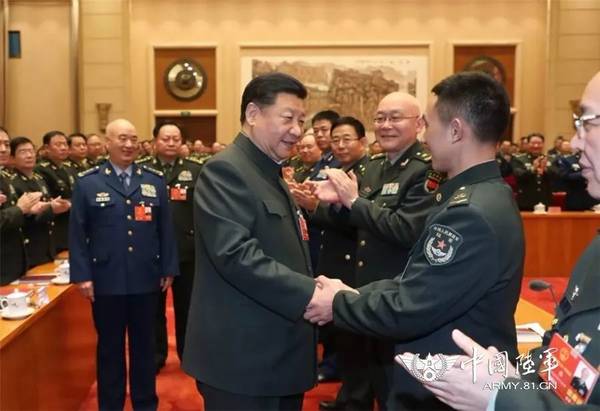
Chairman Xi meeting a young Tibetan Officer at a NPC meet
In an interview to The Week, the Dalai Lama recently said that “the Tibetan issue is no longer a struggle for political independence”. He asserted that there is a need to focus on preservation of Tibet's cultural, religious and linguistic identity.
The Tibetan leader added that “Political independence is mainly meant for the happiness of the people, but does it alone guarantee happiness.”
This can’t be argued that Independence alone does not provide happiness.
The Dalai Lama also stated that “There is a growing feeling among the top leaders in China that their policies have not been able to solve the Tibet issue in the last 70 years. So they should follow a more realistic approach. Even though Tibet was an independent country, politically China occupies Tibet today.”
It is not certain that the top leadership in China believe that Beijing’s Tibet policies have not solved the Tibetan issue for good.
Looking at some current development, it seems the opposite.
The Dalai Lama concluded: “Under the given circumstances, I have been saying for some time now that there is a need to focus on preservation of Tibetan culture, religion and identity. It is no longer a struggle for political independence."
That is an aspect of the problem.

Tibetans in the Communist Party
Another issue should be worrying for India (if not the Tibetans): if the Tibetans become ‘Chinese nationals’ what will happen to the ‘Sino-Tibet’ border? Can we envisage Tibetans fighting Indians soldiers in the Himalaya one day?
A few days ago, The Tibet Daily in Lhasa published a Statistical Communiqué issued by the Tibet Autonomous Region’s (TAR) branch of the Communist Party of China.
On December 31, 2018, the total number of party members in the Autonomous Region was 382,000, a net increase of 18,000 from the previous year.
Further the Party has 21,000 grassroots organizations, an increase of 6.2% compared to 2017. Among them, there are 2,200 grassroots Communist Party’s Committees.

About Party members
•    Out of 382,000, there are 111,000 female party members, accounting for 28.8% of the total number of party members.
•    There are 312,000 minority party members, meaning Tibetans, which make 81.7% of the Communist card holders are local Tibetans. This represents more than 10% of the entire population of the TAR. It is consequent amount of the population who, for whatever reasons, are ‘Communists’ and working for China’s present ethos.
Some 113,000 party members aged 30 and below
71,000 party members aged 31 to 35
51,000 party members aged 36 to 40
39,000 party members aged 41 to 45
34,000 party members aged 46 to 50
24,000 members are between 51 to 55
18,000 party members aged 56 to 60,
and 32,000 party members aged 61 and over.
It shows that a lot of young Tibetans have joined the Communist Party.

•    Job Repartition
There are 13,000 workers (and technicians)
189,000 farmers and herdsmen
47,000 professional and technical personnel in enterprises, institutions and social organizations,
15,000 enterprises and institutions, social organization management personnel,
and 77,000 working in government organs.
Few others are students, professional staff and retired people.
A lot more statistics are given which is not useful to repeat here.

By the end of 2018, there were 77,000 applicants for party membership.
• There are 81 local Communist Party Committees at all levels of the party. Among them, there are 1 Party Committee for the TAR, 6 Municipal Committees (prefecture/city level) and 74 County (dzong) Committees.
• Cities, townships, neighborhood committees and villages have also Party Committees.
• 12 cities, 685 townships, 217 neighborhoods and 5261 recognized villages are covered by Party’s Committees.
• All the 44,000 government agencies in the region have established a Party organization.
• Some 2 million of institutions in the TAR are covered at 99.3% by Party organs; so are the public enterprises at 99.7%.
All this, of course, does not automatically bring happiness.
How the Dalai Lama’s scheme of ‘genuine autonomy’ fits into this scenario is not clear.

More worrying
But the most worrying aspect is the large presence of ethnic Tibetans in the People’s Liberation Army (PLA) and the People’s Armed Police (PAP).
There are no reliable figures, as the Party obviously does not want the people to know how successful the integration of the Tibetan population into the PLA/PAP has been.
This should however cause genuine concerns in India.


How to find out?
For the PLA/PAP, one way to guess is to look at the composition of the local institutions which is in China often based on representative percentages.
If one takes as an example the composition of the 11th TAR People's Congress and the size of the PLA & PAP delegation in it; The Congress has 53 defense delegates (mostly middle level officers with a few senior officers). There are 31 are Han Chinese, 20 Tibetans, one Manchu and one Hui.
Of course, the Tibetan representation in the PLA/PAP is very far from this percentage, but it could indicate, future projections for the Party.
Today, the ‘ethnic’ representation in the PLA/PAP could be at the most 10% of troops serving on the plateau. But the above figures of the Regional Congress’ representation could suggest that in the future the Chinese aim to have a have a pool of junior officers in the TAR reaching 25-30% of the total PLA/PAP personnel posted in Tibet.
It will of course take a long time, as trust of the ‘ethnic minority’ is still lacking today.
This is a serious matter, which needs to be looked into by the Tibetans and India as it has serious implications for the future of the borders.
Incidentally, it is worth looking at the PLA delegation at the National People’s Congress (NPC). There are 269 members in the PLA/PAP delegation, out of 2980 members (75% are new faces).
In the PLA/PAP delegation are represented:
•    The Commanders of the Five Services
•    The Directors of the 15 Departments and Commissions
•    The Commanders of the Five Theater Commands (including Gen Zhao Zongqi for the Western Theater Command)
•    The Commandants of Military academies like the PLA National Defence University
•    and ‘Unknown’ soldiers/officers
Before the NPC gathering in March, it was announced that the current structure of the PLA delegation “has been optimized and fully demonstrated the Universality, Advancement and Representation. All the deputies are outstanding members drawn from all fronts.”
There are three relatively junior Tibetan officers in the Delegation:
Name: Yuk Bak Chu (?)
Delegation: PLA & PAP (1st Lt)
Ethnicity: Tibetan from Kangding, Sichuan
Date of birth: March 1989
Current position: deputy to the NPC
Name:  Tsering Tashi (?)
Delegation: PLA & PAP (Lt)
Ethnicity: Tibetan from Shannan
Date of birth: June 1990
Current position: deputy to the NPC
Name: Yang Chu Geshe (?)
Delegation: PLA & PAP (Sergeant)
Ethnicity: Tibetan from Aba, Sichuan
Date of birth: July  1990
Current position: deputy to the NPC
It is a fact that the leadership in Beijing does not fully trust the Tibetans, but there is nevertheless a clear will to bring more junior and middle-level Tibetans on board. Once again, it will become a challenge for India in the future, especially in the context of a post-Dalai Lama scenario.
Happiness is still a far away dream for the Tibetans; the Indian population bordering Tibet/China too, may suffer about the 'ethnic' changes in China's defense forces.

Wednesday, March 11, 2015

Roads to the Border ...and tourism

While we regularly come across articles about the Border Road Organization (under the Ministry of Defence) struggling to build roads in Arunachal Pradesh and Ladakh, China is going faster and faster on the other side of the border/LAC.
The Economic Times gave yesterday a partial explanation for the slow development on the Indian side: “the delay in execution of the ambitious Trans Arunachal Highway (TAH) project is mainly because of the compensation issue with the affected people and delay in final forest clearance by the Union ministry of Environment and Forest.”
It is what Arunachal Pradesh PWD Minister, Gojen Gadi stated in the Arunachal Assembly.
Gadi gave the example of the Ziro-Koloriang portion of the TAH: “though the cost of the project in that stretch was Rs 48 crore, the compensation sought was Rs 135 crore.” Apparently the Union Ministry of Road Transport and Highway (MoRTH) objected and the construction of the road is presently stopped.
In Itanagar, according to the same The Economic Times, while the initial compensation claim was Rs 195 crore, it is now Rs 334 crore and the ministry had to reduce the width of the road from 45 meters to 18 meters.
This is how India functions.
The situation is much worst for the projects close to the border, (though they do not require environmental clearance anymore).
Other issues (bureaucracy, corruption, lack of manpower and materials, difficult terrain, etc.) are hampering a faster development of the infrastructure.
China does not seem to be facing such problems.
China Military Online announced that “The highways leading to six frontier defense units in Tibet has been under construction, according to relevant departments of the PLA Chengdu Military Area Command (MAC).”
These frontier units are located opposite the Indian posts, north of the LAC (i.e. the McMahon Line).
The Chinese website continued: “The six frontier defense troop units are the last ones in the PLA Tibet Military Command which haven't no access to the highways. Many frontier defense companies and sentry posts in Tibet are stationed in forests, valleys or in snowy mountains, it is very difficult and costly to build highways in these places with adverse terrain conditions. Without highways, it is a headache for the frontier defense troops to hold maneuvers, replenish materials and have a vacation leave.”
It is true that the headache is more acute on the Indian side, where the terrain is in many cases extremely difficult.
For example, one of the reasons why the road between Limeking and Taksing (near the LAC) in Upper Subansiri district takes so much time, is the terrain.
Though China’s overall defence budget has ‘only’ been increased by 10% this year, during the 3 last Five-Year Plan (from the 9th to the 11th), the Chinese government “continuously increased investment in the construction of frontier defense installations, as a result, the number of frontier defense units in Tibet without traffic has decreased to six from 19,” says the military website, adding that the construction of the six (last) highways which started successively in 2014 is scheduled to be completed this year.
Another article on VTIBET.com explained that in recent years, “road traffic rapidly develops in Nyingchi [or Nyingtri] prefecture, especially in rural areas. Data shows that the total length of road up to 5,351 kilometers in Nyingchi Prefecture, and the rate of road access in towns and villages respectively occupy 96.3 % and 95.7 %.”
Nyingchi, located north of Arunachal, is one of the 7 prefectures of the Tibetan Autonomous Region.
The website added: “At present, Nyingchi basically forms a transportation network that centers on Parkyip County [this county does not exist, the author perhaps means Mainling], and links with all towns and villages of Nyingchi. All these achievements cannot be achieved without the hard work of road constructors and maintenance workers.”
In another article, Wangdu, commissioner of Nyingchi Prefecture and a member of the 12th NPC stated on the sideline of the Conference: "In Nyingchi Prefecture alone, the tourism sector employs 350,000 people and the number of family inns has risen to 213."
Tashi Yangjen, his colleague from Doyul Township in Lhoka Prefecture added: "The environment in my hometown is quite similar to Nyingchi. We have already built a model ecological village. Our next step is to develop the tourism industry with a strong Lhopa flavor. ...Like Nyingchi, we focus not only on economic progress, but also environment protection.”
According to the deputy, the annual per capital income in Doyul reached 10,000 yuan (1,597 US dollars): "The town now has access to hospital, school, plaza, and training center [thanks to tourism]," he said.
On the same site, some photos show an artillery regiment under the Tibet Military Command (MC) stationed in the Tibet Autonomous Region undertaking a 'long distance maneuver training'.
It demonstrates the dual (military and civilian) use of the infrastructure in the area.
One difference between India and China, is that while India keeps a tight Inner Line Permit system in place, China invites millions of tourist to visit the area north of the McMahon Line/LAC.
The amount invested in roads is therefore recovered extremely fast by the revenue earned from tourism.
A few months ago, China Tibet Online affirmed: “In recent years, Nyingchi [Nyingtri] Prefecture has attracted countless tourists for the unique beautiful scenery of Qinghai-Tibet plateau. Nyingchi Prefecture is expected to receive 2.8 million tourists in 2014, with tourism income of 2.6 billion yuan [US $ 450 millions]. The tourism industry has driven related industries realize the added value of 3.69 billion yuan, accounting for 38% of Nyingchi Prefecture’s GDP.”
Why can’t the construction of the roads in Arunachal be given to the private sector and tourism opened on a large scale (a quick registration for foreigners could be arranged when the visitor crosses the border with Assam, like in Rangpo, in the case of Sikkim).
A few lakhs of Indian and foreign tourists could bring a good revenue to the State and help financing the development required to receive them well. Further, it will be the best proof that Arunachal belongs to India and will always remain so.
A few photos from the Tibetan side of the LAC. The river is the Yarlung Tsangpo, which becomes the Siang and then the Brahmaputra.
The landscapes are not very different on the Indian side.


Wednesday, October 1, 2014

When India was feeding the PLA

I am posting below an article that I had written several years ago for a Tibetan journal; it is about India feeding the Chinese troops in Tibet.
It came back to my mind when I read a report published yesterday by Xinhua: Transportation regiments of Qinghai-Tibet Corps of PLA.
Yesterday's report shows 'trucks park for being loaded with cargoes at a troop's warehouse of an army service station on the Qinghai-Tibet Highway.'
The photos were taken on September 25, 2014.
The caption says:
The transportation regiments of the Qinghai-Tibet Corps of the Chinese People's Liberation Army (PLA) has been undertaking cargo transportation for PLA troops in Tibet region since 1954. For 60 years, they conveyed more than 800 metric tons of materials, accomplishing about 80 percent of troop transportation task in the Qinghai-Tibet Plateau.
In 1952, in his annual report to Delhi, the Indian Consul General in Lhasa, A.K. Sen mentions the 'feeding' incident. Sen links it to the absence of roads between Tibet and China:
The Chinese Government had requested the Government of India for an agreement allowing facilities for the transport of food and other supplies through India. While pointing out the transport problems involved in the proposal, Government of India expressed their willingness to consider it together with all outstanding issues regarding their position in Tibet. Later the Chinese Government, as a special case, asked for transit facilities for 10,000 tons of food grains through India. The Government of India, after careful consideration, agreed to allow the transit of about 3000 tons of rice to Tibet.
Any estimate of the total number of Chinese troops in Tibet during the period under review could only be a guess. In reply to a query once made by the Tibetan Government (Tibetan Government having agreed to provide fresh supplies for one year) the Chinese stated that for reasons of security they could not disclose the number of their troops but added, it was their original intention to bring an Army of 50,000 troops in Tibet, but had to revise their plans due to lack of supplies. They, however, felt more troops would be required to guard the borders of Tibet. The estimate in Tibetan circles put the total figure between 20,000 and 25,000. But if the road workers were included (as part of the Liberation Army) the number would be considerably more.

Road construction. There is no doubt that thousands of Liberation Army men were engaged in road construction work viz., Kantse - Chamdo Road, Giamda – Lhasa Road, Nathula – Phari and Gyantse Road. Of these, the Kantse – Chamdo Road was said to have been completed by the end of November and was open to wheeled traffic. Peking Radio announced the arrival of the first Car at Chamdo after Liberation amidst enthusiastic jubilations of the local people. The Giamda - Lhasa road was also nearing completion. The Nathula – Phari Road was kept in constant repair to bear the mule traffic carrying rice from Gangtok.
By 1954, the Chinese will not need Indian rice anymore.
Today, the times have obviously changed, but the 'feeding' of the PLA shows the importance of a reliable infrastructure (railway, roads, airports) on the Plateau.

Here is my old article
On September 9, 1951, several thousand Communist troops of the People’s Liberation Army (PLA) entered Lhasa under the command of General Wang Chi-Mei. Subsequently 20,000 troops began to occupy the most strategic points on the Tibetan Plateau.
The years which followed, saw one of strangest upshots of the so-called ‘liberation’ of Tibet and the nascent ‘eternal’ friendship between India and China, the supply by India of grain for the Chinese troops stationed in Tibet.
There is no doubt that the grain was intended to help sustain the Chinese Liberation Army troops. Before the arrival of the Chinese army on the Roof of the World in the early 50’s, very few Tibetans had ever eaten rice; roast barley, known as tsampa, had been the staple food for centuries.

The liberation of Tibet was a well-planned operation and the PLA were quite well organized. For example, for the first time in Tibet, motor-vehicle, of which some were even air-lifted to reach their destinations were used by the troops.
The Chinese strategy had been prepared with scientific perfection by Mao’s army commander, Lui Pocheng, and Deng Xiaoping, the Political Commissar for Western China. After having forced the 17-Point Agreement on the Tibetan government in May 1951, the PLA began to consolidate their military position on the high plateau before the year was out.
The first skirmishes with the Indian troops  date from this period.
The next step for Beijing was to subdue the Indian government with a well-orchestrated propaganda of ‘eternal friendship’ (followed by ‘brotherhood’ or Hindi-Chini Bhai Bhai) between the two Asian giants.
Once the military take-over of Tibet had been ‘legalized’ by the 17-Point Agreement, the communist plans unfolded. With very little objection from the Government of India to the take-over of Tibet, Mao wanted the supremacy of the PLA to be established on the ground and proceeded to built motorable access roads to the new ‘borders’ of China.
The influx of fresh troops brought with it the first real problem in the new co-existence between the Chinese occupants and the Lhasa government. The first test arose over the availability of food. It was the most important logistical problem.
The Chinese army commanders had drafted very strict rules for the troops: “You must obey orders. You cannot take even one needle from the masses, you must turn over to the government things acquired from the enemy.” The young Chinese soldiers had “The Eight Things to Keep in Mind” which included advice such as: “You must speak gently, you must buy and sell honestly, you must return the things you borrow, you must not tease or bother females, you may not abuse prisoners of war.”
On the ground, however, the situation was different. In Tibetan government circles, one question kept recurring: “will the Chinese implement the 17-Point Agreement without disturbing the existing social and environmental balance in Tibet?” They did not have to wait long to get an answer.
Soon after its arrival in Lhasa, the military command began requisitioning food supplies for its troops and land for its army camps. It has to be pointed out that Tibet had for centuries practised sustainable development and had been self-sufficient in food. Starvation was unheard of on the Roof of the World. For the first time in its history, the arrival of the PLA produced a breakdown of the Tibetan economy and it soon became difficult for the Tibetan (and the Chinese) Government to deal with the problem.
For a few months, Lukhangwa, the courageous Tibetan Prime Minister attempted several times to raise the matter with the Chinese authorities; he argued that it was unfair to put such a burden on the Tibetan poor and that it was not necessary to keep so many troops around Lhasa. He even tried to point out that the actions of the Chinese military command were against the 17-Point Agreement. One day, after the Prime Minister had sent a petition to the Chinese General Chang, the latter became so furious that he requested the Dalai Lama to immediately remove Lukhangwa from Office since he "was obstructing their welfare program”.
Chang told the Dalai Lama that the Tibetans had signed an agreement which mentioned that "Chinese forces should be stationed in Tibet ” and he added that the Tibetan Government was “therefore obliged to provide them [the Chinese] with accommodation and supplies”. He added that the Chinese “...had only come to help Tibet ... to protect her against imperialist domination and that they would go back to China…. when you can stand on your feet, we will not stay here even if you ask us to.”
The Dalai Lama had no alternative but to dismiss Lukhangwa:
… to oppose and anger the Chinese authorities could only lead us further along the vicious circle of repression and popular resentment...Our only hope was to persuade the Chinese peaceably to fulfil the promises they had made in their agreement. Non-violence was the only course which might win us back a degree of freedom in the end, perhaps after years of patience. That meant co-operation whenever it was possible, and passive resistance whenever it was not.
It was the first breach of the Agreement, which stipulated that the Chinese would maintain the existing political system and the status and powers of the Dalai Lama. Removing the Prime Minister as an intermediary between the Dalai Lama and the Cabinet resulted in the young Dalai Lama having subsequently to deal directly with the Cabinet and the Chinese.
The last resistance had fallen, but could it have been otherwise? Non-violence and passive resistance had no meaning for the Chinese invaders. During the course of her history, China has shown more respect for power and force (the barrel of the gun) than for anything else. While China had to request food from India, it has to be mentioned here that India was having very serious problems of food grain supply at that time and Nehru’s government had no alternative but to import food grain. China readily agreed when he asked it to export rice to India, this help was not without a price.

On April 5, 1952 Panikkar, the Indian Ambassador to China, called on Zhou Enlai, the Chinese Prime Minister, who clearly told him that in his view “for many years Tibet would have to depend on India for several daily necessities and desired facilities for transportation of food supplies to Tibet via Calcutta”.
It was ironic that the Indian side immediately succumbed to the argument, they should have known (in fact most probably they did know) that Tibet had always been self-sustainable in food and the extra demand was coming only from the Chinese troops. But at that time it was not too hard to fool the Indian Ambassador.
Zhou Enlai  went a step further: he wanted to know “India’s attitude to the construction of a road connecting India with Lhasa”. The clever Chinese Prime Minister added that China had “agreed to continued supply of foodgrains to India for the whole year in exchange for certain commodities”.
At that point in time, a controversy erupted when Roche Victoria, the Food Minister of Madras declared that at a meeting of the Food Ministers on 22 March, 1952, it was said that China had refused to send any more food grains to India.
One month later, Roche Victoria was no longer a minister in the Madras cabinet, and K.M. Munshi, the Union Food Minister, clarified that the government had only said that unlike the previous year, when the Chinese had helped India by sending food grains, this year they might not be able to send any rice due to their own difficult food position.
A few days later, Nehru replied in detail to Panikkar’s telegrams.
Rice supplies. Government of India are grateful to the Chinese Government for offer of 100,000 tons of rice. Food Ministry is communicating with you on this subject directly. This question should be kept entirely separate from provision of transit facilities to Tibet through India.
The Indian Prime Minister was more clear-minded than his ambassador, he immediately saw the difficulties, but did he realize that the grain needed by China was for the troops who were building strategic roads to the Indian border?
Nevertheless, Nehru knew that logistically it was not an easy proposition to transport food grains or any other merchandise from India through the Sikkim road to Lhasa and then eventually to China. Nehru told his ambassador:
We should distinguish between continuance of old border trade between India and Tibet and new proposals of trade in bulk between China and Tibet passing through India. Latter raises important problems of transit which have to be considered by several Ministries. Burden on our transport system is already heavy and we have to consider carefully any additional burden. It must be remembered also that direct route from Calcutta to Darjeeling now passes through Pakistan territory [now Bangladesh], and this leads to political complications and is causing us continuous trouble. Any other route is a roundabout one. Indeed it has only recently become feasible by opening of narrow Assam railway link which is not enough even for our present requirements.
In the same telegram, the political implications were pointed out. In fact, when the deal was finally concluded, a senior Chinese officer had to be posted in Gangtok to oversee the trans-shipment through the Chumbi valley. In view of the strategic importance of the place (Kalimpong had been for centuries the observation post for the Himalayan region), it was certainly an added advantage for Chinese intelligence. With one stone, Beijing killed many birds: they were feeding their troops who were building roads leading to India; they were releasing the pressure on the Tibetan population which was becoming restive due to the shortage of commodities; and they were also posting an intelligence officer to keep an eye on the gate to Tibet.
Nehru quite rightly wrote:
The other proposal of China trade passing through India to Tibet raises, as we have pointed out above, very difficult problems of transport. Apart from this it has certain political implications. It would probably involve Chinese agencies operating transit and other arrangements at several points inside India. It means modifying existing patterns of trade and grant of transit facilities on a large and continuous scale. We are prepared to examine this matter but this would be a concession which we should retain as a bargaining counter for negotiations for an overall settlement between China and us. It is not advantageous to us to accept such proposals piecemeal and yet have no general settlement.
Here again Nehru as in the case of the downgrading of the Lhasa Mission to a Consulate General and other matters, Nehru spoke about a bargaining counter, but eventually everything would be given away for the sake of ‘brotherhood’ at the time of the negotiations for the Panchsheel Agreement in 1953-54.
We have to point out that Nehru was not that innocent and had clearly understood the destination of the rice bags. Here is the conclusion of his letter:
Presumably these food supplies are meant for Chinese army in Tibet which, from all accounts, is in great need of them. We are not particularly anxious to facilitate movement and retention of large numbers of Chinese troops in Tibet.
Panikkar informed Nehru that it had been made clear to the Chinese that India could guarantee transit of only a limited quantity of food grains, though he promised that the Indian government would try its best to transport five hundred tons per month. This was of course subject to weather conditions and availability of mules from Tibet. The transport would be done at the Chinese government’s risk.
Panikkar suggested that India might offer to transport 3,500 tons of rice by the end of 1952.
On May 24, Nehru replied:
We have agreed to grant transit facilities for food grains up to end of 1952 at the rate of 500 tons a month. Subject to weather and availability of mules we are willing to work for transport of target figure of 3,500 tones. We see little prospect, however, of achieving this, since first shipment is not likely to reach India before some time next month and bad weather may interrupt transit for a month on land journey. Two thousand five hundred tons is, therefore, the probable attainable target and it might be worthwhile explaining this to the Chinese so as to avoid future misunderstanding.
However Nehru was not too happy with the deal. He saw that India had some cards in its hand and though Tibet could not be saved, India should use the Tibetan card to settle the newly arisen border problem with China. But these cards were also eventually surrendered a few months into the emerging Bhai-Bhai policy. No benefit was obtained from showing favour to Beijing.
Early in 1952, however, Nehru could still see the advantages of India’s position and was keen to preserve them:
We have told you that any permanent or semi-permanent arrangements can be discussed only as a part of general settlement of our interests in Tibet. (These interests, as you know, are not confined to trade relations but involve political interests such as affirmation of the Frontier.) It would be preferable not to mention this in your proposed note. We had really intended this for your information only.
But the Chinese were becoming greedier, they now wanted the rice to be delivered at Phari instead of Yatung.
John Lall, a former Dewan of Sikkim, was posted in Gangtok when the supply of rice was in transit; he could witness the long caravan of mules leaving in the direction of Nathu-la. In his book on Aksai Chin, he recalled:
But suddenly all was sweetness and light. The reason became apparent when a request was made for shipment of Chinese rice through India and Sikkim to their troops in Tibet. This could, and indeed should, have been made the occasion for a settlement of the major problems with China as a prelude to the altogether unprecedented help requested from the Government of India It simply did not occur to anyone in Delhi, and which caution as I advised was brushed aside. Released from anxiety on accounts of supplies, the Chinese and local Tibetan labour were able to press ahead with the vitally important task of creating a network of communications to defend frontiers of China with India.
Soon after the matter became public. Suddenly Nehru had to explain how it was that India could supply rice to the Chinese occupying Tibet. During a press conference in New Delhi, he was asked: “Is it a fact that you allowed rice to be sent to Tibet?”
Nehru explained his policy:
Not in big quantities. We did allow a small quantity of rice, relatively small quantity, as an exceptional case. You know, it is a very difficult route; it is not easy to go to Tibet from Calcutta-mule tracks, difficult mountain terrain and the rest of it. It is not an easy matter, but because of their great need, we have allowed some quantity of rice to go through. And, as you know, China sent us one lakh tons of rice.  That is not a very great figure, but it merely was a generous gesture of the Chinese Government especially as this year has been a difficult year for them from the point of view of food. It was not easy for them to spare even this for us, nevertheless they did it.
When asked if the arrangement was on an ad hoc basis, he answered 'completely'.
But it was not to be a one-time affair: negotiations continued for the supply of more rice during the following years. On 12 April 1953, during a meeting with Raghavan, the new Indian Ambassador to China, Zhou Enlai said that he was “anxious for friendly relations with India and had offered help in transport of various articles to Tibet via India”.
On April 19, Nehru cabled his Ambassador:
As we have told you, we are prepared to allow the 1,000 tons of Chinese rice which are already in India to be sent to Tibet, subject to transport arrangements. But, it must not be taken for granted that this is a normal procedure. This transport business gives us a lot of trouble.
I might inform you that our rice position is much better now and we are not in terribly urgent need of it. But if we can get rice from China on reasonable terms, we will be prepared to take it for future use.
When the Panchsheel Agreement was signed in April 1954, it was considered by many as Nehru’s final capitulation to communist China.
In surrendering without any compensation or even guarantee the century-old buffer that was Tibet, the doors of North India were open wide to the communist Chinese. However Nehru still considered it the best thing he had ever done.
The ‘friendship’ or the ‘foolishness’ reached a new height when on October 20, 1954 it was announced that although China had enough rice, India had decided to supply again rice to the PLA stationed in Tibet. It was a first in military annals that the government of a country supplied food to enemy troops! But of course, at that time nobody thought of China as an enemy.
As quoted in an article in The Hindu:
Mr. Kung Yuan, leader of the Chinese trade delegation announced the conclusion of another agreement for the purchase of 1,500 tons of Indian rice by China for supply to Tibet and that the negotiations were in progress in regard to the purchase of one other 1,000 tons.
…Rice which China would buy was intended exclusively for Tibet and only difficulties of transport has necessitated this purchase by China.
India was supplying rice to the Chinese troops, engaged in building a road on Indian territory!  Not just ordinary roads, it has now been proved that the Aksai Chin road, which cuts through Indian territory in Ladakh, was already under construction.  The road was be completed and inaugurated by Zhou Enlai in 1957.
The first recorded intrusions on Indian territory occurred just a few months after signing the Panchsheel Agreement. The Chinese accused Indian border patrols of having crossed Niti-la in western UP, while in fact it was the Chinese officers who had tried to assert possession of this part of the Indian territory called Hoti, southeast of the Nita-la border pass. The correspondence between the Government of India and China which began in July/August 1954 marks the beginning of hundreds of letters, notes and memoranda exchanged on the border issue during the following eight years.
But at that time, euphoria over the newly- found ‘brotherhood’ was too great for anyone to realize the strategic and other implications for India’s security.
In October 1954, the Indian Prime Minister went to Peking to celebrate the ‘friendship’. One newspaper wrote: “The meeting of Nehru and Mao may change history.” During the banquet Nehru “spoke in Hindustani was applauded at the end of each sentence,” though nobody understood Hindustani!

Photos published by Xinhua:


Friday, June 27, 2014

People's Armed Police's Chief in Tibet: more repression in sight

Wang Jianping with Tibet Party Secretary Chen Quanguo
Tibet received the visit of an important guest, General Wang Jianping, the Commander of the People's Armed Police Forces (PAPF).
Who are the PAPF?
According to the latest Chinese White Paper on Defence:
In peacetime, the PAPF's main tasks include performing guard duties, dealing with emergencies, combating terrorism and participating in and supporting national economic development. In wartime, it is tasked with assisting the PLA in defensive operations. Based on the national information infrastructure, the PAPF has built a three-level comprehensive information network from PAPF general headquarters down to squadrons. It develops task-oriented weaponry and equipment and conducts scenario-based training so as to improve its guard-duty, emergency-response and counter-terrorism capabilities. The PAPF is composed of the internal security force and other specialized forces. The internal security force is composed of contingents at the level of province (autonomous region or municipality directly under the central government) and mobile divisions. Specialized PAPF forces include those guarding gold mines, forests, hydroelectric projects and transportation facilities. The border public security, firefighting and security guard forces are also components of the PAPF."
The PAPF is over-all responsible for the 'security' of the Middle Kingdom, and incidentally for extinguishing Tibetan 'immolators' (fire-fighting). The border guards (in the case of Tibet, the borders with India) are also under the PAPF.
And let us not forget that the PAPF's budget is larger than the PLA's.
See my earlier posting on this, the Defence White Paper on Tibet.

General Wang Jianping is an old Tibet-hand.
Han by nationality, he is a native of Hebei province. He was born in 1953, joined the Army in 1969. In 1997, he was promoted to major general and lieutenant general in 2007.
He served as PAPF's deputy commander for one year. before becoming Commander of the Chinese People's Armed Police Force in 2009.
General Wang replaced General Wu Shuangzhan, 64, who retired after having served a record ten years as head of the paramilitary force. At that time, Wang and about two dozen officers were promoted in what the Chinese media described "as one of the largest-ever reshuffles since the PAP was set up in 1983.”
Wang during an inspection with Xi Jinping
General Wang was one of Hu’s favorite. He was elevated twice in 2009 — from PAP chief of staff to Vice-Commander, and then Commander.
Importantly, he served as Commander of the Tibet Autonomous Region's (TAR) PAPF from 1996 to 2000. He knows Tibet well and particularly the Ngari region.

The TAR's entire Standing Committee (minus Deng Xiaogang still roaming in Western Tibet) was in attendance to receive General Wang.
But rest assure, Deng was soon back in Lhasa to report to the General about his long 'inspection tour' in the Indian borders of Western Tibet. (see my posting Why is Deng watching the Seaguls).
While in Lhasa, General Wang inspected the troops on the square in front of the Potala Palace! The choicest place for a parade, for the Chinese leadership.
In the meantime, military exercises continue on the Tibetan plateau.
Chinamil.com reported that "an anti-aircraft artillery detachment of an air-defense brigade under the Chengdu Military Area Command (MAC) fired  targets in the air on June 19, 2014. The brigade took its troops to an unfamiliar [sic] area to conduct live-ammunition firing training in mid-June, 2014."
A few pictures:


Further, according to The People's Daily: "On June 17, an air force division of Chinese People's Liberation Army (PLA) conducted actual combat exercise at a military airport on the snow-covered plateau to improve combat capability of the troops."


What is going on Tibet?
This morning, The South China Morning Post annouced: "Two major generals in the PLA with connections to Sichuan province have been detained as part of a corruption investigation, two sources with knowledge of the matter said. The detention of the senior officers is thought to be part of a wider inquiry into alleged graft in the military. Both men were taken into custody last month, the sources said. One of those detained, Ye Wanyong, is retired, having formerly served as a commissar in the Sichuan military region."
Maj. Gen. Ye Wanyong spent some 37 years in Tibet before transferring to Sichuan in 2006. He served in Nyingtri, Lokha and Lhasa where he was posted as a Deputy Political Commissar.
Are the corruption charges related to the time when Ye was posted in Tibet?
We may never know.

Saturday, June 7, 2014

The Highway to the Indian Border

Lhasa-Nyingchi Highway in Taktse County near Lhasa
On June 5 , 2014, China Tibet Online reported the progress of the construction of the Lhasa-Nyingchi Highway.
Quoting tibetnews.com, the Chinese website said: "As a main trunk connecting a dozen of key highways in Tibet, Lhasa-Nyingchi [Nyingtri] Highway bears great significance in building a flexible traffic network covering China’s border provinces as well as upgrading China’s national defense capacity."
It is interesting that the 'defence capacity' is mentioned; this is usually not.
It is probably an answer to India's determination to built roads to the border areas in Arunachal Pradesh.
The reports continues: "On May 23, 2013, construction of the Lhasa-Nyingchi Highway started at Taktse County of Tibet. The construction budget totals 38 billion yuan [US $ 6 billion], and the highway is expected to cover 409.2 km, with the carrying capacity reaching 80 km/h via four lanes. Upon completion it will save at least 2 hours to travel from Lhasa to Nyingchi."
China National Highway 318 (known as G318) which runs from Shanghai to Zhangmu on the China-Nepal border, passes through Taktse County. G318 is the longest National Highway in China (5,476 kilometres).
From Lhasa to Zhangmu, it is known as the Friendship Highway; it connects China to 'friendly' Nepal (via the 115 km long Araniko Highway to Kathmandu).
I wonder if some sections of the Lhasa-Nyingchi Highway, will be suitable for fighter planes to land like on the Zhengzhou-Minquan Highway.
By the way, the Pentagon published yesterday its annual report on China's military power. There is a chart showing the comparison between China’s official defense budget and other regional powers: 
  • 2013 Defense Budget Comparison (Adjusted for Inflation) in billion (USD)
  • China (Official Budget) $ 119.5
  • Russia (National Defense Budget) $ 69.5
  • Japan $ 56.9
  • India $ 39.2
  • Republic of Korea $ 31.0
  • Taiwan $ 10.8
The Defense Ministry in Beijing was furious; on its website, it stated that it is 'resolutely opposed' to the Pentagon report: "Year after year the United States issues this so-called report on 'Military and Security Developments in China,' making preposterous criticisms of China's normal defense and military building, exaggerating the 'China military threat', which is totally wrong."
The point is that the Lhasa-Nyingchi Highway will certainly not show in China's next defence budget.

Backgrounder: Difference between regular highway and highway runway for airplanes
China Military Online
May-27, 2014

Planes landing on the Zhengzhou-Minquan Highway.
BEIJING, May 27 (ChinaMil) Not any section of the highway is suitable for the aircraft to take off or land. It should have higher pavement strength with no big and tall buildings or trees around.
Chen Hong, an air force expert, said that there are strict requirements on a highway runway for the aircraft to take off from it or land on it. It has different standards of the pavement from that of the regular highway, especially for the Y-7 and the Su-27 aircraft, which pose very high-demanding requirements on the pavement strength. The regular highway has risks of collapse especially in the process of the aircraft's take-off or landing. A helicopter has less strict requirements in contrast, but it needs a platform the double size or larger of the rotor wings of the helicopter.
In terms of the thickness of groundwork, the concrete or stone groundwork of the regular highway is about 5 centimeters while the highway runway for the aircraft needs a higher strength with the groundwork to be dozens of centimeters in thickness.
In terms of the road surface, the highway runway for the aircraft has a very high-demanding requirement for the evenness. The road surface should be free of stones or metal particles lest they will be sucked into the engine and cause dangers.
In terms of the materials, the top layer is paved with a specially-improved asphalt concrete capable of water absorption to filter the detained water caused by rain or snow, while the regular concrete road surface is easy to detain water.
In terms of the surrounding environments, it demands a "clear" condition. There should be no obstacles in the surrounding to affect the aircraft so that it can insure the take-off or landing of the aircraft not be blocked by any tall and big buildings or trees.
When the highway serves as a runway for the aircraft to take off or land, all dividing blocks in the middle of the road should be removed, and the seam between the lanes in opposite directions should join together well. There shouldn't be big cracks or seams. The road surface under the dividing blocks should also be very flat and even.
According to Chen Hong, not any section of the highway can be used for the aircraft to take off or land. A certain section of the highway should be preset to serve the military purpose and it needs special maintenance and protection. When needed, several sections are put to the temporary use. Generally, a range of 2,000-plus meters on the highway runway is installed mostly for emergency use. It's an international practice to have such highways used as emergency runways. It's a measure to serve both the military and the civilian purposes.
The Zhengzhou-Minquan Highway used for the test flight is a highway from Zhengzhou to Minquan in Henan province. It is the first highway in Henan province to be constructed with the function of highway runway. Built in completely compliance to the standard designs by the Survey and Design Institute of the Chinese People's Liberation Army Air Force (PLAAF), it was completed and opened to traffic at the end of 2011.
It is learned that both sides of the highway runway cannot have protective fence. Since the dividing blocks are removable when needed, they are installed with wheels on the inner side so that they can be put down on the inner side and wheeled to the roadside.
According to the report of the China Central Television (CCTV), several hundred concrete dividing blocks along the 2.6km-long reserve highway runway on the Zhengzhou-Minquan Highway can be all moved to the road side within one hour to make the room out of the six-lane runway for the aircraft to take off or land.
Moreover, a highway runway also needs to reserve a turn-around apron and a service area for the aircraft. It is learned that this service area is big enough to accommodate 20-odd large-size aircraft, more than three times of the size of regular service area, with multiple functions, such as refueling, inspection and repairs, turn-around, and others. On both ends of the runway is built a mobile control tower and an aircraft navigation radar platform.

Wednesday, May 21, 2014

In Chinese blood, there is no DNA for aggression or hegemony?

General Xu Qiliang signing a defence agreement in Colombo
The day after Chinese nationals were violently attacked in Vietnam, President Xi Jinping stated: "In Chinese blood, there is no DNA for aggression or hegemony."
That is nice to hear.
Xi was addressing a function marking the 60th anniversary of the Chinese People's Association for Friendship with Foreign Countries.
Analysts related his remarks to the dispute with Hanoi regarding the setting up of an oil rig in the South China Sea.
But China’s DNA is not unicolour.
At the same time, General Fang Fenghui, the PLA’s Chief used a threatening tone during a press conference with his US counterpart General Martin Dempsey in Washington; he affirmed: “the US Asia pivot had inflamed tensions in the South China Sea”, adding that “some neighbouring countries were using the [US] policy as a pretext for provocations.”
Though President Xi had just explained: “Chinese people do not accept the logic that a strong country must also be hegemonic,” General Fang vowed that China would never ‘lose an inch of its territory’.
Does Fang have different DNA than Xi?
No, Xi and Fang's remarks belong to one single Chinese DNA!
It is called the Chinese Art of Diplomacy …and War.
A few days later, Hua Chunying, the Foreign Ministry spokeswoman expressed China's willingness to work with India's new government to promote the two countries' bilateral partnership. That’s the ‘good’ DNA!
She said: “China has always attached great importance to ties with India. …China and India are friendly neighbors, and the current relations between the two countries are maintaining a good momentum.”
A day earlier, one of the senior most PLA officers, General Xu Qiliang, a member of the Communist Party’s Politburo and vice chairman of the all-powerful Central Military Commission left for a tour of three Asian countries, Cambodia, Bangladesh and Sri Lanka.
Interestingly, for his visit to India’s two strategic neighbours, General Xu was accompanied by Maj. Gen. Diao Guoxin, the political commissar of the PLA Tibet Military Command.
What was General Diao, whose troops face India in Arunachal Pradesh and Sikkim, doing in Bangladesh and Sri Lanka?
In Dacca, bdnews24.com reported that the Chinese delegation signed four military agreements with Bangladesh ‘to enhance Dhaka’s defence capabilities’.
Under these agreements signed with the Bangladesh Armed Forces and the Bangladesh University of Professionals, China will provide military support to Bangladesh’s armed forces and train its military personnel. Beijing will also help setting up a language laboratory. And of course, all these will be free of charge.
General Xu Qiliang in Bangladesh
Bangladesh top defence brass, including Maj. Gen. Tarique Ahmed Siddique, the Prime Minister’s Security Adviser; General Iqbal Karim Bhuiyan, the Army Chief, Admiral M. Farid Habib, the Naval Chief; Air Marshal Muhammad Enamul Bari, the Air Force Chief attended the function.
Tarique explained that Bangladesh and China have similar history, culture and traditions, adding that the two countries have had close cooperation and exchanges in the fields of politics, economy and culture.
The Security Adviser hoped that the two militaries could consolidate and deepen pragmatic exchanges and cooperation in all fields.
General Xu Qiliang asserted that China and Bangladesh are friendly neighbors (is not India in between??), and the people of the two countries have had a history of friendly contacts for thousands of years; a fact which may surprise you, if you still believe that Bangladesh was born in 1971.
The fact that the Chinese delegation appreciated Dacca’s firm support to Beijing’s policy vis-à-vis Taiwan, Xinjiang and Tibet, probably explains Maj. Gen. Diao Guoxin’s presence.
Let us not forget that according to the Sweden-based think-tank Stockholm International Peace Research Institute (SIPRI), during the last five years, China has been the largest supplier of arms to Bangladesh.
Prime Minister Sheikh Hasina recently announced that two Chinese submarines would be inducted in the Bangladesh Navy by 2015, while two new frigates (Abu Bakar and Ali Haider) also from China were commissioned in March this year.
The visit to Sri Lanka was more discreet, probably because the results of the Indian elections were going to be out by the time General Xu left Dacca.
It is certainly an indirect Chinese reaction to Modi’s election as Prime Minister of India. For three days, not a word about the Sri Lanka’s visit in the Chinese press, including specialized publications like The PLA’s Daily.
A friend of mine joked: ‘here is a new Flight 370 affair’; Xu seems to have disappeared from the radar from the time he left Dacca. Has Xu (the first Air Force officer to make it as a vice-chairman of the Central Military Commission) crashed in the Bay of Bengal?
Now, finally on May 19, Beijing announced that the Sri Lankan President Mahinda Rajapaksa had met with Xu Qiliang on May 16. But it is a clear indicator that Beijing did not want to negatively attract the attention the new Government in Delhi. For sure, Beijing will thread more carefully with Modi’s government than with the Congress’.
The Sri Lankan President expressed Sri Lanka’s gratitude to China for its long-term strong support and help and assured Xu that Sri Lanka will adhere to the friendly policy towards China, firmly upholding the ‘One-China’ policy.
According to a communique from Colombo, Xu also met Gotabaya Rajapaksa, Secretary in the Ministry of Defence on the same day and three important ‘agreements of mutual cooperation’ were signed. Gotabaya Rajapaksa expressed Sri Lanka’s sincere appreciation for the financial and material support extended by the Chinese Government for several projects under the Defence portfolio.
General Xu Qiliang answered that the "sincere mutual assistance and friendship from generation to generation is the reality of the bilateral ties between China and Sri Lanka”. He noted that the challenges faced by Sri Lanka were due to the strategic concerns of other nations rather than the actual human rights situation of the island.
But that is not all in India’s neighbourhood.
General Chang Wanquan, China’s defense minister paid a visit Laos and Myanmar around the same dates. In Myanmar, the ‘goodwill’ visit was at the invitation of Wai Lwin, the Burmese defense minister.
Very little news has filtered out so far about Chang’s visit.
On the western front, the all-weather friend is always ready to work with Beijing. Islamabad is presently organizing a joint drill with the Chinese Air Force; code-named ‘Shaheen (Eagle)-3’, it is held at the Rafiqui airbase in the northeastern province of Punjab.
But this too has been rather discreet.
China is probably aware that India has changed its DNA, dropping the old Nehruvian ones.
Narendra Modi could, without hesitation, say: "in the Indian blood, there is no DNA for aggression or hegemony, but India will not lose an inch of its territory.”
Sensing that the new acquired Indian DNA may resemble the Chinese, Beijing apparently may force Beijing to accept the logic that even a strong country cannot always be hegemonic, there is a price to pay. This was demonstrated when China had to evacuate thousands of its nationals from Vietnam.

Wednesday, May 14, 2014

Tibet: a Zone of Ahimsa or Himsa?

In 1987 in Washington DC, the Dalai Lama proposed the establishment of a Zone of Peace on the Tibetan plateau.
It was the first point of his Five-Point Peace Plan for Tibet. He said:
I propose that the whole of Tibet, including the eastern provinces of Kham and Amdo, be transformed into a zone of 'Ahimsa', a Hindi term used to mean a state of peace and non-violence.
The establishment of such a peace zone would be in keeping with Tibet's historical role as a peaceful and neutral Buddhist nation and buffer state separating the continent's great powers.  It would also be in keeping with Nepal's proposal to proclaim Nepal a peace zone and with China's declared support for such a proclamation.  The peace zone proposed by Nepal would have a much greater impact if it were to include Tibet and neighbouring areas.
The establishment of a peace zone in Tibet would require withdrawal of Chinese troops and military installations from the country, which would enable India also to withdraw troops and military installations from the Himalayan regions bordering Tibet.  This would be achieved under an international agreement which would satisfy China's legitimate security needs and build trust among the Tibetan, Indian, Chinese and other peoples of the region.  This is in everyone's best interest, particularly that of China and India, as it would enhance their security, while reducing the economic burden of maintaining high troop concentrations on the disputed Himalayan border.
Today, China is militarizing more and more the ecologically-fragile plateau.
Recently China tested again its HQ-16/LY-80 Surface-to-Air Missile (SAM) Air Defense System  on the plateau and posted pictures of the exercise on its official websites.
Already in September 2012, it was reported that the PLA had staged "a live-fire test of what appears to be a new fully functioning high altitude surface-to-air missile (SAM) somewhere in the Tibetan plateau on 20 July [2012] in a move intended to prepare for potential US strikes against Chinese interests in the region."
US strikes or Indian strikes?
Why should the US strike the Tibetan plateau?
Though geographic details of the launch site were not mentioned, The PLA Daily said the test was conducted under the authority of the Lanzhou Military Area command (MAC).
It probably meant in the Aksai Chin or Ngari area.

What is a HQ-16 missile?
According to a specialized website: "The LY-80 is the export variant of the HQ-16 mobile, medium-range, Surface-to-Air (SAM) Air Defense System and developed by China Aerospace Science and Technology Corporation (CASC).
The HQ-16 can be used to defend in all-weather conditions against multiple targets, such as aircraft, helicopters, unmanned aerial vehicles, cruise missiles and other precision guided munitions. The HQ-16 can be integrated with other Air Defense Systems, such as the long-range HQ-9, short-range HQ-7 and close-range LD-2000 to form a multi-layer Integrated Air Defense System (IADS)."
Another defence website explains:
The HQ16A or LY-80 is a Chinese-made ground-to-air defence missile system which was introduce in the Chinese armed forces in September 2011. This is a land based version of the HQ-16 system used in ships (and fired from a Vertical Launch System) containers. The HQ-16A is based on a joint development of the Russian Buk-M1 (SA-11 'Gadfly') and Ural/Buk-2M (SA-17 'Grizzly') Surface-to-Air Missile (SAM) systems, for use from mobile ground vehicles and later from ships. The HQ-16A is able to engage aerial targets at high altitude; the mid-range HQ-16 is also able to intercept very low-flying targets at a distance of up to about 40 kilometers, filling the gap between the HQ-7 short-range SAM and the HQ-9 long-range SAM systems. The HQ-16A missile can hit targets of an altitude from 400 to 10,000 meters.
The HQ16A (LY-80) launcher missile system is carried by an 8x8 truck that contains a command and control station behind the cab, and behind those are six firing missile containers in two rows of three. These containers are tilted back so that the missiles can be fired straight up, just as they are from Vertical launch System cells. In firing position, the wheels are raised off the ground and the carriage is supported at four points by hydraulic jacks, two at the rear and one on each side.
Missile
The HQ16A (LY-80) missile can intercept an aerial flying target from an 15 m to 18 km of altitude, while its maximum interception range for combat aircraft is 40km, and between 3.5 km and 12 km for cruise missiles flying at an altitude of 50 meters at a speed of 300 meters/second. Single-shot kill probability is a claimed figure of 85 per cent against combat aircraft, and 60 per cent against cruise missiles. The missile guidance system is of the composite type, comprising initial independent inertial guidance and intermittent illumination and semi-active homing terminal guidance.

Control and command systems
The HQ16A (LY-80) SAM components comprise a searching radar vehicle, command vehicle, radar tracking and guidance vehicle, launcher unit vehicle, and missiles canister. Technical support equipment includes missile transportation and loading vehicle, power supply vehicle, maintenance vehicle, and missile-test equipment. A single radar guidance vehicle controls two to four launcher units with six missiles ready to launch. The command vehicle is responsible to send target information and combat orders.
The searching radar vehicle is equipped with solid-state S-band 3-D passive phased-array radar mounted on the top of a mast. When the target is detected, the searching radar vehicle performs automatic IFF (Identification Friend-or-Foe), threat judgment, flight path processing and provide target engagement information for the tracking-and-guidance radar. The S-band radar has a range of 140 km and can detect targets flying at an altitude of 20 km.


But that is not all.
A few days ago, The People's Daily reported that J-11 fighters from the PLA Air Force (PLAAF) based in the Chengdu Military Area Command (MAC) practice 'in actual-combat training' over the Tibetan plateau.
Impressive pictures!


Last week, it was reported that the People's Liberation Army Air force (PLAAF) of the Chengdu Military Area Command (MAC) conducted night actual-combat training somewhere in Tibet.
The report says: "China's J-11 fighters from the air force of the Chengdu Military Area Command (MAC) of the People’s Liberation Army (PLA) took part in night actual-combat training in complex meteorological conditions over plateau. "


Another exercise: on May 11, 2014, the Scouts of the Shigatse Military Sub-Command of the Chinese People's Liberation Army (PLA) in Tibet conducted 'a military skills training on the plateau'.
According to The People's Daily the objective was to improve their combat capability.
The photos seem to have been taken near the Indian border, as the landscapes appear to be near the gorges of the Yarlung Tsangpo (Brahmaputra)


A few days back, I already wrote an article on a similar subject (The more you sweat in peacetime, the less you bleed in wartime).

Today, 'Tibet as a Zone of Peace' seems a faraway concept.