Showing posts with label Bangladesh. Show all posts

Monday, March 9, 2015

The ‘Ethnic’ Religious Faces of China

Dupkang Rinpoche received the 'Atisha' Award
In continuation with my posts on the ‘ethnic faces’ in the PLA and the Communist Party, I will today deal with the ‘ethnic religious faces’ who help Beijing in its endeavor to progressively takeover the leadership of the Buddhist World (in Asia at least).
On March 5, China Tibet Online reported the visit of a ‘Buddhist’ delegation from Tibet to Bangladesh. Can you believe it?
Quoting the Chinese Embassy in Bangladesh, the website said: “At the invitation of the Buddhism Association of Bangladesh, the China Tibetan Buddhism delegation, led by Rinpoche Dupkang Tupden Kedup, visited Bangladesh from February 21 to 25.”
I have often mentioned this ‘political’ rinpoche on this blog (particularly the rinpoche's visit in Kalmikya Republic of Russia).
Dupkang, who is close to the Communist Party, is vice chairman of the CPPCC Tibet Committee and Chairman of the Tibet Branch of Buddhist Association.
It appears that he has been awarded the ‘2015 Atisha Peace Gold Award’ by the Buddhism Association of Bangladesh (BAB).
The fact that Dupkang is not a monk does not seem to have bothered the BAB.
Dupkang Rinpoche in Bikrampur
Atisha Dipamkara Srijana was a Buddhist teacher from Bengal, who lived during the 11th century (at the time of the Pala Empire). He was one of the major saintly figures who spread Mahayana and Vajrayana Buddhism in Asia and particularly in Tibet; he is still revered as one of the great religious gurus in Tibet and India (and apparently in Bangladesh).
The Dupkang delegation from Tibet is said to have exchanged views with local Bangladeshi Buddhists and visited the Atisha Memorial Hall and the Buddhist ruins in . A reception was hosted for the Tibetans by Ma Mingqiang, the Chinese Ambassador to Bangladesh.
China Tibet online says that Buddhism is the third largest religion in Bangladesh with about 0.7 percent of the population (they mainly live in the Chittagong hills); they followed the Theravada tradition.
This visit raises a very serious question and the Tibetan Administration in Dharamsala should ponder upon it.
Why has the Dalai Lama been unable to visit Nepal, Bhutan, Myanmar, Bangladesh, Thailand (he went once in the 1970s, I think) or Sri Lanka? Most of these countries (apart from Bangladesh) have a large Buddhist population? Why should a Communist rinpoche like to Dupkang, relatively junior in the Buddhist hierarchy, be ‘honoured’ with the ‘Atisha Award’, when the Dalai Lama has never been able to visited Bangladesh.
One should not also forget that that the Tibetan Army (SSF) actively participated to the Liberation War in 1971; and this, at the cost of many Tibetan jawans’ and officers’ lives.
Why the Dalai Lama is not welcome in all these countries?
It is often due the Chinese political pressure, but also inter-school rivalry (the Drukpa Kargyu tradition in Bhutan, for example) or the great Mahayana/Theravada divide.
But are the differences so insurmountable?
An intra-Buddhist dialogue seems the need of the hour.
The time has perhaps come for Dharamsala (the Central Tibetan Administration or the Office of the Dalai Lama) to create a South Asian Bureau for Buddhists Affairs. A respected Buddhist figure (Tibetan or India) could visit the South Asian countries (including Baltistan in Pakistan) and start establishing contacts with local Buddhists.
This could eventually pave the way to a visit by the Dalai Lama. It is something that the Modi Sarkar should strongly support, (the Prime Minister could start discretely mentioning this during his forthcoming visit to Sri Lanka).
Gyaltsen Norbu, the Chinese-selected Panchen Lama

In the meantime in Tibet, Beijing is fully using Gyaltsen Norbu, China’s Panchen Lama for its political purpose.
On March 4, Xinhua reported: “As the youngest member of the Standing Committee of the Chinese People's Political Consultative Conference (CPPCC) National Committee, the Panchen Lama, donning a red cloak, joined in discussions among religious members of the Third Session of the 12th CPPCC National Committee.”
The young Lama (25) spoke about "Cultivating talent, making Tibetan Buddhism better adapted to a socialist society."
He quoted Yu Zhengsheng, the CPPCC chairman, saying: “China supports the religious members to continue to play a unique role in carrying out targeted work in Tibet and Xinjiang and actively guide religions to adapt themselves to the socialist system."
Gyaltsen Norbu, who is the main ethnic face of Buddhism in today’s China, commented: "[Yu’s] remarks on religious work delivered clear expectations. In my opinion, Tibetan Buddhism can play an important role in national economic and social development, social harmony and maintaining stability."
There is no doubt that Beijing will continue to fully play the ‘Panchen Lama card’ in the years to come. For the purpose, in March, 2013, Norbu had been elevated to the ‘important’ (but ceremonial) post of member of the Standing Committee of the CPPCC National Committee.
On the side of the CPPCC meet, Gyaltsen Norbu explained that he daily devotes most of his time and attention “to cultivating a religious spirit in the Tibetan people. There's an urgent need to cultivate talent, which is important for Tibetan Buddhism in the present and future."
He added: “I hope to see a batch of Tibetan Buddhist talents who will unswervingly follow the path to a socialist society with Chinese characteristics." The last sentence is pure political propaganda, but has the young Lama the choice to speak differently?
Like the other ‘ethnic’ faces, probably not!

Religious ceremony at Kumbum Monastery
In the meantime, photos and videos have appeared on the social media showing heavy security presence at the annual Monlam Prayer Festival at Kumbum monastery, in Qinghai province.
Voice of America reported: “The heavy security presence with armored vehicles and troops with automatic weapons doing drills and marching through one of the major Tibetan monasteries appears to have deeply hurt the feelings of the Tibetan people in the area. In rare acts of expression on the heavily policed Chinese social media sites, one person asks, ‘Are we supposed to watch the army or watch the prayer festival’, while another laments, ‘I was so afraid that I forgot to pray’, and one person puts the armed intimidation of prayer goers in the context of China’s repeated calls for social stability by posting, ‘With this many soldiers at a prayer festival, are you working for harmony or war?’”
The 500 year old Monlam Prayer Festival is traditionally dedicated to teachers of all religious traditions, social harmony, and world peace.
In Beijing, the Chinese leaders speak of a ‘New Normal’ for China.
Is the military presence in Kumbum another ‘New Normal’?

Wednesday, May 21, 2014

In Chinese blood, there is no DNA for aggression or hegemony?

General Xu Qiliang signing a defence agreement in Colombo
The day after Chinese nationals were violently attacked in Vietnam, President Xi Jinping stated: "In Chinese blood, there is no DNA for aggression or hegemony."
That is nice to hear.
Xi was addressing a function marking the 60th anniversary of the Chinese People's Association for Friendship with Foreign Countries.
Analysts related his remarks to the dispute with Hanoi regarding the setting up of an oil rig in the South China Sea.
But China’s DNA is not unicolour.
At the same time, General Fang Fenghui, the PLA’s Chief used a threatening tone during a press conference with his US counterpart General Martin Dempsey in Washington; he affirmed: “the US Asia pivot had inflamed tensions in the South China Sea”, adding that “some neighbouring countries were using the [US] policy as a pretext for provocations.”
Though President Xi had just explained: “Chinese people do not accept the logic that a strong country must also be hegemonic,” General Fang vowed that China would never ‘lose an inch of its territory’.
Does Fang have different DNA than Xi?
No, Xi and Fang's remarks belong to one single Chinese DNA!
It is called the Chinese Art of Diplomacy …and War.
A few days later, Hua Chunying, the Foreign Ministry spokeswoman expressed China's willingness to work with India's new government to promote the two countries' bilateral partnership. That’s the ‘good’ DNA!
She said: “China has always attached great importance to ties with India. …China and India are friendly neighbors, and the current relations between the two countries are maintaining a good momentum.”
A day earlier, one of the senior most PLA officers, General Xu Qiliang, a member of the Communist Party’s Politburo and vice chairman of the all-powerful Central Military Commission left for a tour of three Asian countries, Cambodia, Bangladesh and Sri Lanka.
Interestingly, for his visit to India’s two strategic neighbours, General Xu was accompanied by Maj. Gen. Diao Guoxin, the political commissar of the PLA Tibet Military Command.
What was General Diao, whose troops face India in Arunachal Pradesh and Sikkim, doing in Bangladesh and Sri Lanka?
In Dacca, bdnews24.com reported that the Chinese delegation signed four military agreements with Bangladesh ‘to enhance Dhaka’s defence capabilities’.
Under these agreements signed with the Bangladesh Armed Forces and the Bangladesh University of Professionals, China will provide military support to Bangladesh’s armed forces and train its military personnel. Beijing will also help setting up a language laboratory. And of course, all these will be free of charge.
General Xu Qiliang in Bangladesh
Bangladesh top defence brass, including Maj. Gen. Tarique Ahmed Siddique, the Prime Minister’s Security Adviser; General Iqbal Karim Bhuiyan, the Army Chief, Admiral M. Farid Habib, the Naval Chief; Air Marshal Muhammad Enamul Bari, the Air Force Chief attended the function.
Tarique explained that Bangladesh and China have similar history, culture and traditions, adding that the two countries have had close cooperation and exchanges in the fields of politics, economy and culture.
The Security Adviser hoped that the two militaries could consolidate and deepen pragmatic exchanges and cooperation in all fields.
General Xu Qiliang asserted that China and Bangladesh are friendly neighbors (is not India in between??), and the people of the two countries have had a history of friendly contacts for thousands of years; a fact which may surprise you, if you still believe that Bangladesh was born in 1971.
The fact that the Chinese delegation appreciated Dacca’s firm support to Beijing’s policy vis-à-vis Taiwan, Xinjiang and Tibet, probably explains Maj. Gen. Diao Guoxin’s presence.
Let us not forget that according to the Sweden-based think-tank Stockholm International Peace Research Institute (SIPRI), during the last five years, China has been the largest supplier of arms to Bangladesh.
Prime Minister Sheikh Hasina recently announced that two Chinese submarines would be inducted in the Bangladesh Navy by 2015, while two new frigates (Abu Bakar and Ali Haider) also from China were commissioned in March this year.
The visit to Sri Lanka was more discreet, probably because the results of the Indian elections were going to be out by the time General Xu left Dacca.
It is certainly an indirect Chinese reaction to Modi’s election as Prime Minister of India. For three days, not a word about the Sri Lanka’s visit in the Chinese press, including specialized publications like The PLA’s Daily.
A friend of mine joked: ‘here is a new Flight 370 affair’; Xu seems to have disappeared from the radar from the time he left Dacca. Has Xu (the first Air Force officer to make it as a vice-chairman of the Central Military Commission) crashed in the Bay of Bengal?
Now, finally on May 19, Beijing announced that the Sri Lankan President Mahinda Rajapaksa had met with Xu Qiliang on May 16. But it is a clear indicator that Beijing did not want to negatively attract the attention the new Government in Delhi. For sure, Beijing will thread more carefully with Modi’s government than with the Congress’.
The Sri Lankan President expressed Sri Lanka’s gratitude to China for its long-term strong support and help and assured Xu that Sri Lanka will adhere to the friendly policy towards China, firmly upholding the ‘One-China’ policy.
According to a communique from Colombo, Xu also met Gotabaya Rajapaksa, Secretary in the Ministry of Defence on the same day and three important ‘agreements of mutual cooperation’ were signed. Gotabaya Rajapaksa expressed Sri Lanka’s sincere appreciation for the financial and material support extended by the Chinese Government for several projects under the Defence portfolio.
General Xu Qiliang answered that the "sincere mutual assistance and friendship from generation to generation is the reality of the bilateral ties between China and Sri Lanka”. He noted that the challenges faced by Sri Lanka were due to the strategic concerns of other nations rather than the actual human rights situation of the island.
But that is not all in India’s neighbourhood.
General Chang Wanquan, China’s defense minister paid a visit Laos and Myanmar around the same dates. In Myanmar, the ‘goodwill’ visit was at the invitation of Wai Lwin, the Burmese defense minister.
Very little news has filtered out so far about Chang’s visit.
On the western front, the all-weather friend is always ready to work with Beijing. Islamabad is presently organizing a joint drill with the Chinese Air Force; code-named ‘Shaheen (Eagle)-3’, it is held at the Rafiqui airbase in the northeastern province of Punjab.
But this too has been rather discreet.
China is probably aware that India has changed its DNA, dropping the old Nehruvian ones.
Narendra Modi could, without hesitation, say: "in the Indian blood, there is no DNA for aggression or hegemony, but India will not lose an inch of its territory.”
Sensing that the new acquired Indian DNA may resemble the Chinese, Beijing apparently may force Beijing to accept the logic that even a strong country cannot always be hegemonic, there is a price to pay. This was demonstrated when China had to evacuate thousands of its nationals from Vietnam.

Monday, April 8, 2013

Arunachal and Bangladesh discuss the Brahmaputra dams

After my article China’s water war on India appeared in nitycentral.com on April 5, PTI released an interesting piece of news: "Arunachal, Bangladesh discuss management of Brahmaputra".
It appears that Arunachal Pradesh and Bangladesh have discussed several measures for a better management of the Brahmaputra basin.

The talks include the question of the dams being built by China on the Yarlung Tsangpo (Brahmaputra) in Tibet.
According to PTI, Arunachal Pradesh Water Resources Development Minister Newlai Tingkhatra met the Bangladesh High Commissioner to India Tariq A. Khan in Itanagar and discussed ways "to tackle the problem of siltation through river dredging and building embankments so that proper water depth was developed for inland water transportation."
Mr. Khan would have said that Bangladesh was equally concerned and apprehensive over diversion of Brahmaputra’s water in China.

It is the first time, to my knowledge, that this has been articulated by Bangladesh.
PTI says that Bangladesh Commerce Minister Md. Habibur Rahman Khan was also present.

The High Commissioner told the Arunachal Pradesh officials: "Arunachal Pradesh is the source of water for Brahmaputra basin and thus the primary stakeholder in all respects in the management of Brahmaputra in terms of hydropower generation and navigation."
The Bangladesh delegation also called on the Governor, General (Retd) J J Singh at Raj Bhawan to discuss "various matters including inland waterways, Brahmaputra River project and areas of prospective trade and commercial activities."
The Governor mentioned the mutual benefits of cooperation in energy (hydropower) sharing and the importance of people to people contact and opening up of more avenues for economic opportunities.


China’s water war on India
niticentral.com
As ‘emergent’ leaders returned from the BRICS meeting in South Africa, PTI reported that Manmohan Singh had ventured to ask the new Chinese President Xi Jinping to set up a joint mechanism for the dams being built on the Yarlung Tsangpo in Tibet (known downstream as Siang and Brahmaputra).
According to PTI: “Notwithstanding pledges to take the bilateral relationship to a new level, Prime Minister Manmohan Singh in his first meeting with new Chinese President Xi Jinping has sought a joint mechanism to assess the construction work on dams on Brahmaputra river in Tibet.” That sounds good, but is it enough?
Talking to the journalists traveling with him in the plane, the Prime Minister explained, “I took the opportunity to raise the issue of trans-border river systems. I requested the Chinese Government to provide a joint mechanism to enable us to assess the type of construction activity that is going on in the Tibetan Autonomous Region.”
Apparently, President Xi assured Dr Singh that China was quite conscious of its responsibilities as well as of the interest of the lower riparian countries.
The report further added: “As regards the specific mechanism that he had asked, the Chinese President told him that they would further look into it.”
One could ask, why just a ‘joint mechanism’ and not a treaty on the lines of the Indus Waters Treaty signed with Pakistan in 1960?
The Prime Minister seemed to have been rather reticent to even bring the topic on the table: “As of now, [India’s] assessment is that whatever activity that is taking place on the Brahmaputra region in Tibet, it is essentially run-of-the-river projects and therefore there is no cause of worry on our part.”
But what about the Sutlej and the Indus?
On August 4, 2000, The Tribune reported a strange event in the Kinnaur district of Himachal Pradesh: flash floods washed away most of the bridges on the Sutlej, killing many in the process.
The Chandigarh daily explained: “Even three days after the disaster, the mystery of the flashfloods in the Sutlej which wrecked havoc along its 200 kilometres in length in the State, remains unresolved,” adding: “Experts are at a loss to understand where the huge mass of water came from.”
Imagine a 50 feet high wall of water descending into the gorges of Kinnaur!
In a few hours, more than 100 persons died, 120 kilometres of a strategic highway (Chini sector) was washed away and 98 bridges destroyed. While traveling to the Spiti valley a few days after the incident, I witnessed the extent of the damage.
Oddly, the details of the mishap were similar to others which had occurred in Arunachal Pradesh a week earlier.
A detailed study carried out a few months later by Indian remote sensing agencies confirmed that the release of excess water accumulated in the Sutlej and the Yarlung Tsangpo basins in Tibet had led to the flooding.
On June 25, 2001, nearly a year later, the weekly India Today published an article entitled ‘Made in China’: “While the satellite images remain classified, officials of the Ministry of Water Resources indicate that these pictures show the presence of huge water bodies or lakes upstream in Sutlej and Siang [Brahmaputra] river basins before the flash floods took place. However, these lakes disappeared soon after the disaster struck Indian territory. This probably means that the Chinese had breached these water bodies as a result of which lakhs of cusecs of water were released into the Sutlej and Siang river basins.”
It is not difficult to imagine what could ‘naturally’ (or less naturally) happen if a large structure is constructed north of the McMahon line during a time of conflict.
The only solution lies in bringing the matter to the negotiating table. India and China should reach a bilateral water agreement. If a river-water treaty has been signed between India and Pakistan, why can’t a similar accord be found between China and India (and why not Bangladesh), in order to assure a decent life to all in the region
Further there is a Convention on the Law of the Non-Navigational Uses of International Watercourses adopted by the UN in 1997 (though not yet an international law, because it was not ratified by enough nations); it could serve as a model for bilateral or multilateral treaties/conventions with China and others.
Beijing does not usually like to be ‘constrained’ in the straitjacket of an international agreement, but the new leadership will have to decide if China wants to be a ‘normal’ State, fully assuming responsibility as a neighbour or a rogue State like North Korea.
According to Xinhua, the Indian Prime Minister would have said that India, which “adheres to an independent foreign policy, will not be used by the Tibetan (refugees) as a tool to contain China.” This is fine, but there should be some reciprocity.
The PM would have added that India is willing to make concerted efforts with China to show the world that they are cooperative partners instead of rivals. A water bilateral agreement would a first step.
In any case, the fruition of the projected mega projects such the diversion of the Brahmaputra will entirely depend on the new leadership in China. If he is wise (and let us hope for the best), Xi Jinping will take into account the negative environment and strategic impact of the mega-dams for the Indo-Chinese relations.
A formal agreement/treaty, whether in line with the 1997 UN Water Convention or any other formal agreement, is the only solution which can give some guarantees to the lower riparian States.
India should not be hesitant to demand what it is entitled to.

Sunday, December 11, 2011

Forty Years ago: the US role in the Bangladesh War

Five years ago, I wrote this article '1971 War: How the US tried to corner India'. It appeared in Rediff.com on December 26, 2006.

"India won a glorious victory against Pakistan in the 1971 war. It was the first decisive victory in a major war in centuries. And it was won singlehandedly, in the face of opposition and threats from a majority of the UN member-States, including a superpower. Every Indian patriot felt proud of this glittering chapter in the nation's history.'
(Dr S N Prasad in his introduction to the Indian government's Official History of the 1971 War).


I am not usually a great defender of United States policies, but I have to admit that in the field of right to information, the US is far ahead of the Indian babus who obstinately block access to Indian archives under the lame pretext that this could 'endanger national security'.
A few months ago, the Office of the Historian at the US State Department released Volume XI of the Foreign Relations of the United States devoted to the 'South Asia Crisis, 1971': in other words, the Bangladesh War.
This 929-page publication groups together documents which were already known like the minutes of Henry Kissinger's secret visit to China in July 1971 as well as scores of freshly declassified material available for the first time to the public.
It throws light on a less known angle of the India-Pakistan conflict: The role of the nascent friendship between the United States and China. This is a welcome new piece in the puzzle of the history of the 1971 War.
Another piece is the Hamidur Rahman Report, ordered by the government of Pakistan after the war, which analyses the Pakistani defeat. 'Due to corruption... lust for wine and women and greed for land and houses, a large number of senior army officers, particularly those occupying the highest positions, had not only lost the will to fight but also the professional competence necessary for taking the vital and critical decisions demanded of them for the successful prosecution of the war.'
The US administration saw the unfurling events differently.
According to Kissinger, then American President Richard M Nixon's national security adviser, 'When the Nixon administration took office, our policy objective on the subcontinent was, quite simply, to avoid adding another complication to our agenda.'
But events in the subcontinent and the Chinese factor forced Nixon to change his stand. The new closeness between Washington, DC and Beijing and the involvement of the Pakistan president as a secret go-between greatly influenced US policy.
Then US President Richard Nixon According to the State Department historian, 'When the fighting developed, the Nixon administration tilted toward Pakistan. The tilt involved the dispatch of the aircraft carrier USS Enterprise to the Bay of Bengal to try to intimidate the Indian government. It also involved encouraging China to make military moves to achieve the same end, and an assurance to China that if China menaced India and the Soviet Union moved against China in support of India, the United States would protect China from the Soviet Union. China chose not to menace India, and the crisis on the subcontinent ended without a confrontation between the United States and the Soviet Union.'
The first US documents deal with the background of the conflict. Nixon's position was clear: 'We should just stay out -- like in Biafra, what the hell can we do?'
But everybody did not agree with him. In a telegram sent on March 28, 1971, the staff at the US consulate in Dhaka complained, 'Our government has failed to denounce the suppression of democracy. Our government has failed to denounce atrocities. Our government has failed to take forceful measures to protect its citizens while at the same time bending over backwards to placate the West Pak dominated government... We, as professional public servants express our dissent with current policy and fervently hope that our true and lasting interests here can be defined and our policies redirected in order to salvage our nation's position as a moral leader of the free world.'
When US Secretary of State Will Rogers received this 'miserable' cable, he informed President Nixon that the 'Dacca consulate is in open rebellion.' This did not change Nixon's opinion: 'The people who bitch about Vietnam bitch about it because we intervened in what they say is a civil war. Now some of the same bastards...want us to intervene here -- both civil wars.'
From the start, the Nixon administration knew 'the prospects were "poor"... the Pakistani army would not be able to exert effective control over East Pakistan.' Washington believed India was bound to support Mujibur Rahman. The CIA had reported that 'India would foster and support Bengali insurgency and contribute to the likelihood that an independent Bangladesh would emerge from the developing conflict.'
It is here that the Chinese saga began. In a tightly guarded secret, Nixon had started contacts with Beijing. The postman was Pakistani dictator Field Marshal Yahya Khan.
When on April 28 1971, Kissinger sent a note defining the future policy option towards Pakistan, Nixon replied in a handwritten note: 'Don't squeeze Yahya at this time.' The Pakistan president was not to be squeezed because he was in the process of arranging Kissinger's first secret meeting to China. The events of the following months and the US position should be seen in this perspective.
In May, Indira Gandhi wrote to Nixon about the 'carnage in East Bengal' and the flood of refugees burdening India. After L K Jha, then the Indian ambassador to US, had warned Kissinger that India might have to send back some of the refugees as guerillas, Nixon commented, 'By God we will cut off economic aid (to India).'
A few days later when the US president said 'the goddamn Indians' were preparing for another war, Kissinger retorted 'they are the most aggressive goddamn people around.'
During the second week of July, Kissinger went to Beijing where he was told by then Chinese prime minister Zhou Enlai: 'In our opinion, if India continues on its present course in disregard of world opinion, it will continue to go on recklessly. We, however, support the stand of Pakistan. This is known to the world. If they (the Indians) are bent on provoking such a situation, then we cannot sit idly by.' Kissinger answered that Zhou should know that the US sympathies also lay with Pakistan.
On his return, during a meeting of the National Security Council, Nixon continued his India bashing. The Indians, he noted, are 'a slippery, treacherous people.'
The State Department historian says, 'in the perspective of Washington, the crisis ratcheted up a dangerous notch on August 9 when India and the Soviet Union signed a treaty of peace, friendship and cooperation.' It was a shock for Washington as they saw a deliberate collusion between Delhi and Moscow.
During the following months, the situation deteriorated and many more refugees came to India. The Indian prime minister decided to tour Western capitals to explain the Indian stand. On November 4 and 5, she met Nixon in Washington, who told her that a new war in the subcontinent was out of the question.
The next day, Nixon and Kissinger assessed the situation. Kissinger told Nixon: 'The Indians are bastards anyway. They are plotting a war.'
To divert the pressure applied by the Mukti Bahini on the eastern front, the Pakistan air force launched an attack on six Indian airfields in Kashmir and Punjab on December 3. It was the beginning of the war.
The next day, then US ambassador to the United Nations George H W Bush -- later 41st president of the United States and father of the current American president -- introduced a resolution in the UN Security Council calling for a cease-fire and the withdrawal of armed forces by India and Pakistan. It was vetoed by the Soviet Union. The following days witnessed a great pressure on the Soviets from the Nixon-Kissinger duo to get India to withdraw, but to no avail.
The CIA reported to the President: 'She (Indira Gandhi) hopes the Chinese (will) not intervene physically in the North; however, the Soviets have warned her that the Chinese are still able to "rattle the sword" in Ladakh and Chumbi areas.'
For Kissinger it was clear that Indira Gandhi wanted the dismemberment of Pakistan.
On December 9, when the CIA director warned Nixon that 'East Pakistan was crumbling', Nixon decided to send the aircraft carrier USS Enterprise into the Bay of Bengal to threaten India.
Let me recount an anecdote related to me by Major General K K Tewari (retd), Chief Signal Officer, Eastern Command, during the 1971 War.
General Tewari was present at a briefing the three defence services held for Indira Gandhi. She was seated at a large table. On one side was General S H F J Manekshaw, the army chief, and on the other Admiral S M Nanda, the navy chief.
During the course of the presentation, the admiral intervened and said: 'Madam, the US 8th Fleet is sailing into the Bay of Bengal.' Nothing happened; the briefing continued. After sometime, the admiral repeated, 'Madam, I have to inform you that the 8th Fleet is sailing into the Bay of Bengal.' She cut him off immediately: 'Admiral, I heard you the first time, let us go on with the briefing.'
All the officers present were stunned. Ultimately, their morale was tremendously boosted by the prime minister's attitude. She had demonstrated her utter contempt for the American bluff.
On November 10, Nixon instructed Kissinger to ask the Chinese to move some troops toward the Indian frontier. 'Threaten to move forces or move them, Henry, that's what they must do now.'
This was conveyed to Huang Hua, China's envoy to the United Nations. Kissinger told Huang the US would be prepared for a military confrontation with the Soviet Union if the Soviet Union attacked China.
On December 12, the White House received an urgent message. The Chinese wanted to meet in New York. General Alexander Haig, then Kissinger's deputy, rushed to the venue, but was disappointed. Huang just wanted to convey his government's stand in the UN, no words of an attack in Sikkim or in the then North East Frontier Agency (now, the northeastern states).
The myth of the Chinese intervention is also visible in the secret Pakistani dispatches. Lieutenant General A A K Niazi, the Pakistani army commander in Dhaka, was informed: 'NEFA front has been activated by Chinese although the Indians for obvious reasons have not announced it.'
Until the last day of the war, Pakistan expected its Chinese saviour to strike, but Beijing never did.
In Washington, Nixon analysed the situation thus: 'If the Russians get away with facing down the Chinese and the Indians get away with licking the Pakistanis...we may be looking down the gun barrel.' Nixon was not sure about China. Did they really intend to start a military action against India?
Finally, on December 16, Niazi surrendered to Lieutenant General Jagjit Singh Aurora. Nixon and Kissinger congratulated themselves for achieving their fundamental goal -- the preservation of West Pakistan. They were also happy for having 'scared the pants off the Russians.'
Kissinger's South Asia policy upset many in the US, not only the American public, the press but also the State Department, and more particularly, Secretary of State Rogers who was kept in the dark most of the time.
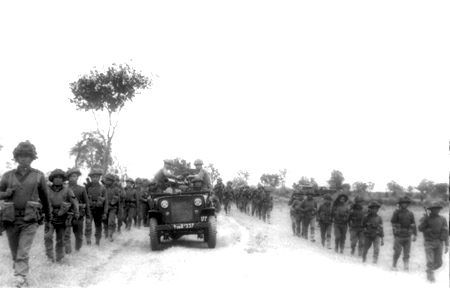
It is worth mentioning an episode which, of course, does not appear in the American archives -- The Tibetan participation in the conflict. After the debacle of 1962, the Government of India had recruited some Tibetans youth in the eventuality of another conflict with China. The Special Frontier Force was trained in Chakrata in Uttar Pradesh [ Images ] under the command of an Indian general.
In 1971, nine years after its creation, the SFF was sent to East Pakistan to prepare for the arrival of regular Indian troops. Their saga is one of the least known parts of the Bangladesh war.
Late October 1971, an AN-12 airlifted nearly 3,000 Tibetans who later assembled at Demagiri close to the India-East Pakistan border. On the other side of the border were the Chittagong Hill Tracts. Armed with Bulgarian-made assault rifles, the SFF was given the task of organising guerrilla raids across the Chittagong Hill Tracts. Opposite the SSF, in thick jungles and leech-infested marshes, was stationed a Pakistan brigade, including a battalion of its elite Special Services Group.
The Indian army knew this brigade was a threat to one of its corps preparing to advance on Dhaka.
During the second week of November, Operation Eagle began. Leaving Demagiri in canoes, the Tibetans commandos entered East Pakistan. The SFF then started overrunning one Pakistani post after another.
By the time the war was officially declared, the Tibetans had already been inside East Pakistan for more than three weeks. Using both their Bulgarian rifles and native knives, they advanced swiftly. Their Indian commandaner, Major General S S Uban later said, 'They were unstoppable.'
On December 16, the SSF was 40 kilometers away from Chittagong port, having successfully managed to neutralise the Pakistani brigade.
After Pakistan's surrender, they paraded through Chittagong. Unfortunately, 49 Tibetans lost their lives for a nation which was not theirs.
The release of the State Department volume on the 1971 conflict is a posthumous homage to the courage of the Indian Army which despite heavy odds and the might of the United States freed Bangladesh from Pakistani clutches.
Some aspects are still missing to make the puzzle complete.
First, the Indian history from the Ministry of Defence does not detail the political compulsions of Indira Gandhi's government. Second, the secret operation involving the Tibetan Special Frontier Forces in the Chittagong Hill Tracts is virtually unknown. Lastly, the Chinese involvement from the Chinese point of view remains unexamined.

Like the Henderson Brooks' report on the 1962 border war with China, it may take a few decades more to be revealed.

Claude Arpi

Forty year ago: the People's War

Forty years ago, the Indian Army, Air Force and Navy liberated Bangladesh.
But the Liberation War was not just a military operation, it was truly a People's War.
Number of artists, intellectuals, politicians and others participated in their own way in the liberation of East Pakistan from the joke of the Pakistani tyrants.

George Harrison organized the famous Concert for Bangladesh with the help of Ravi Shankar, Bob Dylan and Joan Baez.
This great fund raising event was held on August 1, 1971 in Madison Square Garden, New York.
Some 40,000 fans attended the Concert and $250,000 was collected and later presented to UNICEF for the war-affected children of Bangladesh.
An album was later produced with the artists who participated in the concert (Bob Dylan, George Harrison, Ravi Shankar, Ustad Allarakha, Ringo Star, Eric Clapton,Don Preston, Leon Russell, etc.).
Let us not forget that at the same time, the Nixon Administration, as allies of Pakistan, was dead against a Bangladesh’s liberation war (tomorrow, I will post on this blog a note on the role of the Nixon administration).

Now, listen to George Harrison


My friend came to me, with sadness in his eyes
He told me that he wanted help
Before his country dies
Although I couldn’t feel the pain, I knew I had to try
Now I’m asking all of you
To help us save some lives
Bangla Desh, Bangla Desh
Where so many people are dying fast
And it sure looks like a mess
I’ve never seen such distress
Now won’t you lend your hand and understand
Relieve the people of Bangla Desh.Bangla Desh, Bangla Desh
Now it may seem so far from where we all are
It’s something we can’t neglect
It’s something I can’t neglect
Now won’t you give some bread to get the starving fed
We’ve got to relieve Bangla Desh
Relieve the people of Bangla Desh

And to Joan Baez (she did not participate to the Madison Square Concert)


Bangladesh, Bangladesh
When the sun sinks in the west
Die a million people of Bangladesh, Bangladesh
Bangladesh, Bangladesh
When the sun sinks in the west
Die a million people of the Bangladesh

And the students at the university
Asleep at night quite peacefully
The soldiers came and shot them in their beds
And terror took the dorm awakening shrieks of dread
And silent frozen forms and pillows drenched in red..

The story of Bangladesh
Is an ancient one again made fresh
By blind men who carry out commands
Which flow out of the laws upon which nation stands
Which is to sacrifice a people for a land … f the Bangladesh

And the students at the university
Asleep at night quite peacefully
The soldiers came and shot them in their beds
And terror took the dorm awakening shrieks of dread
And silent frozen forms and pillows drenched in red..

The story of Bangladesh
Is an ancient one again made fresh
By blind men who carry out commands
Which flow out of the laws upon which nation stands
Which is to sacrifice a people for a land …

Allen Ginsberg wrote his famous poem September on Jessore Road.


Millions of souls nineteen-seventy-one
homeless on Jessore road under grey sun
A million are dead, the million who can
Walk toward Calcutta from East Pakistan

Where are our tears? Who weeps for the pain?
Where can these families go in the rain?
Jessore Road’s children close their big eyes
Where will we sleep when Our Father dies?

Ring o ye tongues of the world for their woe
Ring out ye voices for Love we don’t know
Ring out ye bells of electrical pain
Ring in the conscious of America brain

How many millions of children die more
before our Good Mothers perceive the Great Lord?
How many good fathers pay tax to rebuild
Armed forces that boast the children they’ve killed?

Millions of babies in pain
Millions of mothers in rain
Millions of brothers in woe
Millions of children nowhere to go


Early 1971, André Malraux, General de Gaulle companion, declared that he was ready to go and fight on the side of Mujibur Rehman's people.
It was the last battle of the author of L'Espoir (Hope).
His participation on the battle field did not materialize, but Malraux visited Dacca in April 1973.
On his arrival he declared: “I kiss poverty on a single face. Since I cannot kiss everybody, I kiss Bangladesh on a single face.”
Addressing the students of Dacca University, Malraux forcefully asserted: “Students of Dacca, I am speaking today, for the first time, in the only university in the world, which has more dead than living students ...All your dead ones had a rendezvous with destiny, but now, it is for you to build the nation.”
He later wrote:
Salutations to you, O dead ones of the forests that surround us!
You have shown the world that an enemy can never assassinate enough to kill the soul of a people which does not surrender!
One biographer wrote: "André Malraux's fight for Bangladesh was an example and symbol, a symbol of his compassion, his love of India, his concern for the human soul."

Thursday, December 8, 2011

'I cut my leg off and ordered: 'Go and bury it'

Here is the second part of my interview with Major General Ian Cardozo who was a young major in the 5 Gorkha Rifles in the 1971 war with Pakistan.
In a swift military offensive, India defeated Pakistan within 13 days, liberated a region and led to the creation of Bangladesh.
In the war, the then Major Cardozo stepped on a landmine and had to cut off his badly wounded leg with his own khukri.
Yet, through sheer will power and determination, he did not let his disability come in the way of his duty as a soldier and went on to become the first disabled officer in the Indian Army to command an infantry battalion and a brigade.

Click here to read.

Forty Years After: General Cardozo's incredible story


My interview of Maj Gen Ian Cardozo is posted in Rediff.com under the title 1971, A War Hero Remembers.
In the second part of the interview, General Cardozo will tell us how after he walked on a mine, he amputated himself with his khukri.

On December 3, 1971, Pakistan attacked several Indian Air Force stations in the West. At midnight, Indian Prime Minister Indira Gandhi in a broadcast to the nation declared that India was at war with Pakistan. Inset: Major General Ian Cardozo
War Hero Major General Ian Cardozo (retd)was wounded in the battle of Sylhet in Bangladesh in the 1971 war with Pakistan.
He lost his leg in a landmine blast, but conquered his disability and became the first disabled officer in the Indian Army to command an infantry battalion and then a brigade.
Awarded a Sena Medal for gallantry, General Cardozo is presently Chairman of the Rehabilitation Council of India and has authored The Sinking of INS Khukri -- Survivors Stories and Param Vir -- Our Heroes In Battle.
In conversation with Claude Arpi, the general looks back at the war where more than 93,000 Pakistani prisoners were taken, a region was liberated and a new nation born.
 
A young major 40 years ago, he recounts the heroic battles fought by the Fifth Gorkha Rifles in the Eastern theatre, where he and a brave band of men played a pivotal role in the defeat of Pakistan.


We are celebrating 40 years of the most resounding victory of the Indian armed forces, tell us about your involvement in the 1971 Operations and the role of your battalion, the Fifth Gorkha Rifles.
I was in the Staff College doing a course. My battalion was already on the front. The second-in-command (known as '2IC') of the battalion had been killed; the army had to replace him.
They looked around and found this guy (then Major Cardozo) in the Staff College. My posting was cancelled and I was sent to the front.
I was permitted to drop my family back home (my wife and three sons). I returned to Delhi by train on December 3.
The war had already started, but we did not know, though we heard aircraft flying above us. In Delhi there was a blackout. Next morning, I went to Palam airport to catch the plane to Assam, but it was cancelled: it would have been a lovely target.
I jumped into a taxi, rushed to the railway station. The train was moving out of the platform, I managed to pull the chain and board it. The next night we reached a place called Dharmanagar. We have a wonderful system in the army of contractors. Over 150 years the same family of banias have served particular units in the army. One of them was there to meet me.
He said: 'Sahib, the hospital train is coming. Wounded officers from our unit are on that train, you should meet them.' I met four young badly wounded officers and then jumped into a jeep and drove night and day to reach my battalion.


Click here to read the entire interview.

Tuesday, July 12, 2011

A Joint Approach


This is good news. If India and Bangladesh decide to collaborate and jointly make efforts to share the Brahmaputra's waters. 
It can only pressurize China to join and sign a Treaty which will assure the co-riparian States of a fair deal. 

It goes in the sense of my recent posting: a Joint Treaty on Water Sharing with China.
It is a great pity that the Prime Minister has decided to kick the Environment Minister up; he could understand these important issues. 
As often, wrong decisions at a crucial time. 
Once again, powerful lobbies must have prevailed.

B'desh suggests joint approach on Brahmaputra water-sharing
PTI |
July 07,2011
From Pallab Bhattacharya Dhaka, July 7 (PTI) Bangladesh today suggested a joint approach by co-riparian countries to address the issue of sharing of the Brahmaputra waters in the wake of reports that China was planning to build a dam on the river in Tibet. "We have been talking about joint sharing of water resources among countries of the region. I think there is now an understanding among all neighbours of the region to work together in this regard," i told a group of Indian journalists here.Answering a question on the Chinese plan to build a dam on Brahmaputra river in Tibet, she said "co-riparian countries will have to act together on the issue but it is going to take a long time." Moni expressed the hope that none of the neighbours would do anything which would have a negative impact on each other. Her remarks assume significance in the backdrop of reports about the Chinese move to construct a dam on the river Yarlung Tsangpo, as Brahmaputra is known in Tibet, and deep concerns over its impact on water availability to northeastern India and further downstream Bangladesh. External Affairs Minister S M Krishna, who is on a three-day visit here, had said earlier that India was monitoring China's activities on the river, but dismissed the reports about a firm plan to construct the dam. Reports also said China is planning to build a run-of-the river project on Yarlung Tsangpo.

Friday, June 18, 2010

Xi Jinping, Bangladesh and the Brahmaputra


I think that it is the first time that the Bangladesh government takes up the damming of the Brahmaputra with China. Beijing must have promised to share similar data as the ones promised to India.
Business between China and Bangladesh is fast increasing and India has already been replaced by China as the main exporter to Dhaka. It is ominous for India.


China makes strategic forays into Bangladesh 
IANS
June 15, 2010
In another sign of its growing strategic inroads into South Asia, China has proposed to help Bangladesh build a deep-sea port in Chittagong and agreed to exchange data about the Brahmaputra river that flows from Tibet to Bangladesh through India.
China has also promised assistance in installing Bangladesh's first space satellite.
All these issues came up Monday during talks between visiting Chinese Vice President Xi Jinpeng and Prime Minister Sheikh Hasina which covered cooperation on political, economic and cultural fronts, The Daily Star newspaper reported.
Bangladesh officials said Xi's was a 'return visit' to the one paid by Hasina in March this year and would see updating on the pacts signed then.
Hasina had travelled to China, seeking closer cooperation in a number of areas, including building a road link from Chittagong to Kunming in eastern China.
According to strategic analysts, the port development in Chittagong is part of China's 'String of Pearls' strategy that it wants to use to secure sea lanes that cross the Indian Ocean and link its industrialized eastern seaboard with the energy resources of the Middle East.
China has been developing ports in Gwadar, Pakistan, and at Hambantota in Sri Lanka. It has expanded its influence in Myanmar in recent years.
This is the first visit by a Chinese state leader since the Awami League-led government assumed power in January last year. Xi is leading a 35-member delegation and will sign an agreement regarding economic cooperation, under which China will provide 40 million yuan ($5.8 million) as grant.
Over the past few years, China has emerged as the largest supplier of military hardware to Bangladesh.
China has also replaced India as Bangladesh's biggest import destination with trade between the two nations standing at $4.58 billion, though heavily skewed in favour of Beijing with Bangladesh import being $ 4.4 billion.
China offered last month duty-free access to some 5,000 Bangladeshi products in a 'goodwill gesture'.
Bilateral trade between Bangladesh and China is expected to increase to $5 billion in 2010 from $4.58 billion in 2009.
Interestingly, China had opposed Bangladesh's independence from Pakistan in 1971 and recognized it only in 1975.

Saturday, February 6, 2010

The Phantoms of Chittagong


What about the Tibetan boys who died during the Bangladesh Operations? 
Today, it is  convenient (for everybody) to forget about their existence. 
A few years ago, I wrote an article on the Phantoms of Chittagong. It was the name given to them by their Commander, Maj. Gen. S.S. Uban.
Click here to read the article.


Dhaka to honour Indian soldiers killed in 1971 Liberation War
The Pioneer, 
February 3, 2010
Anisur Rahman
Bangladesh would honour the Indian Army for its key role in the country's 'Liberation War' against Pakistan by inscribing the names of Indian soldiers killed in the 1971 military operation at a special memorial in
the heart of the capital.
Bangladesh will seek a list of martyred Indian soldiers in the 1971 Liberation War against Pakistan in a bid to honour them by inscribing their names at a memorial at Suhrawardy Udyan park, Tajul Islam, the State Minister of Liberation War Affairs, said on Tuesday.
"We are yet to know how many Indian soldiers lost their lives in our Liberation War. We will soon seek a list through the Foreign Ministry," Islam told reporters. He said the names of the martyred Indian soldiers
would be inscribed at the memorial. "Bangladesh will never forget India's role in 1971 war," he underlined. The announcement to honour the Indian soldiers came as a visiting military delegation led by Lt-Gen Vijay
Kumar Singh, the next chief of the Indian Army, called on Islam at his office.
Lt-Gen Singh, currently Eastern Army Command chief at Kolkata, will take over as the next Army chief from General Deepak Kapoor on March 31.
Bangladesh won its independence after nine months of bloody struggle with the Pakistani military with crucial Indian support.


Tuesday, November 3, 2009

China bullies Bangladesh

 
China bullies small and big ones without discrimination.
Most of the time, it unfortunately works.  After getting Obama to kowtow, they managed to bully the Germans during the Frankfurt Book Fair. With Bangladesh, it was easier. India still resists on the Dalai Lama's visit to Tawang.


Chinese pressure force Bangladesh to bar Tibet exhibition 
Phayul November 02, 2009
An exhibition "Into Exile - Tibet 1949 - 2009" featuring the journey of "Tibetans from their Homeland to Exile" has been banned by police on Sunday, organizers said.
Bangladeshi police in the country's capital Dhaka on Sunday barred a prominent picture gallery from holding a photo exhibition on Tibet following complaints from Chinese diplomats, the government and organisers have said.
Police in riot gear arrived at the Drik Gallery at the capital's posh Dhanmondi area and sealed the place ahead of the ahead of the opening of the exhibition on Sunday evening. However, defying orders from police and requests from Chinese embassy, the organisers staged the exhibition depicting the plight of Tibetans on the street outside the venue.
The exhibition "Into Exile | Tibet 1949 - 2009" featuring the journey of "Tibetans from their Homeland to Exile" was organized by the Students for a Free Tibet, Bangladesh (SFTBD)' in partnership with Drik Gallery, and includes some very rare photos of the Dalai Lama's journey into exile in 1959.
An hour before the launch, scheduled for 5 pm on Sunday, police shut the gates of the Drik Gallery preventing public from entering the gallery, according to a spokesperson from SFTBD.
Drik managing director Dr Shahidul Alam reportedly said Bangladesh Police Special Branch spoke with him and asked him to stop the exhibition citing a "government order". Police also demanded to know the names of the organizers and are said to be looking out for them.
Alam said, although the police officers could not produce any document of the order, they threatened to shut down the show by force if the organisers did not do so willingly.
The SFTBD spokesperson earlier told Phayul that two Chinese diplomats approached the venue on Friday to request the organizers to stop the exhibition.
"After that I also received a series of phone calls from the ministry of cultural affairs and from a number of MPs," bdnews24.com quoted Alam as saying.
"On Saturday, officers from the Special Branch of police came and exerted pressure to stop the exhibition according to a 'government order'. I wanted a written copy of the government order but they refused to show me."
Alam also said he received a call from MP Hasanul Huq Inu on Saturday at 3:55 PM to remind him that Bangladesh had a One China policy.
Officers from Dhanmondi police station have reportedly said the show was closed on directives of the higher authorities as prior permission was not sought for the exhibition.
Officials of Drik — a world- renowned photo library, media and communication organisation — said they have arranged countless minor and major exhibitions over the past 20 years and never needed any permission.
Organisers say the government is acting purely under Chinese pressure.
On Sunday, at 5.44 pm, Professor Muzaffar Ahmed, former chairman of Transparency International Bangladesh and chief guest at the launch, informally inaugurated the exhibition on the street outside Drik Gallery as police continued to block the gates to the premises.
Activists were seen demonstrating in support of the show. Protesters held placards reading “Free Tibet” and “Freedom of Expression” slogans to protest the ban.
In a short speech, Muzaffar focused on the importance of freedom of expression.
"The ideal of one world that the United Nations talk about will only be established when the right to freedom of everybody's expression is protected," bdnews24.com quoted Muzzaffar as saying.