Showing posts with label Buddhism. Show all posts

Monday, August 12, 2019

Strategic and Spiritual

India and China facing each other in Ladakh ...and talking
My article Strategic and Spiritual appeared in the Edit Page of The Pioneer.

Here is the link...

With Ladakh being granted a Union Territory status, one hopes that locals can finally  adopt an economically and environmentally responsible model for its development

Though divided into Leh and Kargil district in July 1979, Ladakh, the “Land of the Passes”, has the particularity of being one of the largest administrative units of the country, with only one Member of Parliament (the 36-year-old BJP member, Jamyang Tsering Namgyal). It has another distinctness: It is India’s most strategic region, facing two not-too-friendly neighbours (Pakistan and China) and it is one of the most beautiful places on earth. It is also a place of spirituality, with a number of gompas (monasteries) perched on the hills in the valleys of the Indus and the Nubra.
To visit Ladakh is to experience the celebrated peace of the place, the grandeur of the landscapes and the hospitality of the Ladakhis. Over the last two decades (since I visited Leh for the first time), the region has completely changed: Alongside the majestic gompas, a myriad cement shops, symbolising daily faster development, have appeared — all due to the craze of Indian and foreign tourists for the mountainous region, and, perhaps, the publicity given by the success of the Hindi film, 3 Idiots.
During the last several decades, the Kashmir Valley, though geographically a very small portion of the Jammu & Kashmir State, has constantly drawn the attention of the world media (and the chancelleries in Delhi) for negative reasons. It is unfortunate that Ladakh was clubbed to Kashmir at the time of Kashmir’s accession to India in October 1947 but there was probably no other choice. Successive Governments in Srinagar have regularly deprived Leh of any say on its development. Hopefully, this is finally and slowly changing.
When in 1948, Karachi decided to also liberate its Buddhist “brothers” in Ladakh, two young Buddhist officers from Lahaul, Captains Kushal Chand and his cousin, Prithvi Chand, offered their services to the nation to stop the raiders. The duo managed the incredible feat of crossing on foot in winter the snow-bound Zoji-la between Kashmir and Ladakh; they were accompanied by a small caravan of men and mules carrying arms and ammunition. The young captains reached Leh safely to prepare a surprise for the raiders. Both were awarded the Maha Vir Chakra (MVC), the second-highest decoration in war time.
It was the first daring act by young Army officers, who since then, have bravely defended the Indian territory. It is worth visiting the Hall of Fame near the Leh airport, where their exploits as well as those of other local heroes, are portrayed. One should mention Col Chewang Rinchen, who was twice awarded the MVC — first for having stopped the advance of raiders in the Nubra Valley in June 1948 and the second for the bravery he displayed in the Turtuk sector in December 1971.
More recently, Major (later Colonel) Sonam Wangchuk (another Buddhist soldier to be awarded the MVC) and his Ladakh scouts recaptured some of the crucial peaks occupied by Pakistan during the Kargil war in 1999. I still have the image of Wangchuk, praying to the Dalai Lama, the Bodhisattva of Compassion, to give him the strength to defend India, his nation.
Ladakh is also the land of spirituality. A large number of Tibetan and Ladakhi Lamas visit the gompas and Buddhist institutions in summer. Prof Samdhong Rinpoche, the former Prime Minister of the Tibetan Government-in-exile, recently visited the Central Institute of Buddhist Studies (CIBS) near Leh. He stressed the seriousness of the global climate crisis: “We are moving into a dangerous period where the entire planet earth is posed with the risk of complete disintegration, of becoming unliveable. The scientists are now accepting it and have clearly accepted that science and technology may not have any remedy to these challenges,” he asserted. He further observed: “Unless the entire humanity alters or changes their way of life, the destruction of eco-balance is going to destroy the entire planet.”
Only in Ladakh is there this blend of spirituality and strategic presence. Today, it faces one the most intense moments of its history — not only because of its belligerent neighbours but also because fast development, triggered by tourism, is becoming a bane, after being a boon.
More and more tourists literarily descend on Leh. They provide employment but also created the first water crisis of the region. While the population is far better-off economically, environment is clearly in peril. How to sort out the dilemma?
Sonam Wangchuk, a Magsaysay awardee and the inspiration for 3 Idiots, believes that the solution lies in changing the pattern of tourism in space and time. He advocates bringing tourism to the villages (space) and all-year long (time).  Let us hope that it will work, though there is no easy solution.
Ladakh has an advantage over other Indian regions — it has a more responsive administration, ie, the Ladakh Autonomous Hill Development Council and with the division status recently granted by the Central Government, the region should get a better capacity to solve such problems.
Perhaps to give a “pause” to the local population, this year tourism inflow declined by over 50 per cent due to several reasons — the Lok Sabha elections, the bankruptcy of Jet Airways, the late opening of Leh-Manali road and the law and order situation in the State.
Leh district is said to house hundreds of hotels and guest houses to cater to foreign and domestic tourists, bikers and trekkers. Hotelier Amrit Badam, told The Kashmir Times: “There is a drastic fall in the arrival of tourists to Ladakh this year. There is nearly 50 per cent fall in tourist footfall in these months as compared to last year during the same period.”
He explained: “As compared to 80 to 95 per cent of occupancy of hotels in May last year, there was only 40 per cent occupancy in May this year.” The overall tourist arrivals in Leh district in 2018 crossed three lakh for the first time. A senior official of the State tourism department announced: “A total of 3,27,366 tourists, including 49,477 foreigners, visited Leh in 2018, marking an increase of over 50,000 compared to the previous year.”
This article was written just a few hours before the long-cherished dream of the Ladakhis to be granted a Union Territory status was realised. This will, of course, open new avenues for the development of the strategic border area. Now the responsibility to make it a success or a failure will lie with the people of Ladakh. Let us hope that they will adopt an economically and environmentally responsible model.

Monday, August 27, 2018

Wang in Tibet: Sinicization of the religions in China

Tibet is an extraordinarily popular destination these days, not only for the 26 million Chinese tourists visiting the Roof of the World, but also for the members of the Standing Committee of the Politburo of the Communist Party of China (CPC) Central Committee.
In just one month, two almighty members visited Tibet (Number 2 and 4 in the hierarchy).
I mentioned the visit of Premier Li Keqian just before Beidaihe 'summer holidays' and now it is the turn of Wang Yang, chairman of the National Committee of the Chinese People's Political Consultative Conference (CPPCC) to spend three days on the plateau (apparently in Chamdo and Lhasa).
Xinhua reported that Wang visited a Tibetan family in Chamdo, during his three-day 'inspection tour' on the plateau from August 24 to 26.
The news agency commented: “Top political advisor stresses poverty relief, religious work in Tibet.”
His visit was to urge the Tibetans (and the local cadres), to do more “to advance targeted poverty relief and accelerate the paces of building a moderately prosperous society in all respects” and also to take care of the “religious work to ensure prosperity, development and lasting stability in Tibet Autonomous Region.”
“Winning the tough battle of eliminating poverty in Tibet is of great significance to people's well-being and ethnic solidarity,” Wang said.
Apparently he came for the same objective than the Premier at the end of August.
Strange!
Is there so much poverty on the plateau more than 60 years after the so-called Liberation?
Wang advised the cadres: “Priority should be given to improving the quality of poverty relief, with a reasonable sequence of work and no hastening to meet deadlines.”
He spoke of the long-term effects of relief (of poverty) work: “The current standard of poverty relief must be strictly implemented,” he added.
Wang also stressed ecological protection, “ecological relocation work in high-altitude mountainous areas should proceed steadily and in an orderly manner. The national ecological security shield must be strengthened.”
What does ‘relocation work’ mean? It is not clear, probably to relocate the nomads in ‘new cities’, often looking like ghettos.

Sinicization of the religions in China
Wang also visited Sera monastery near Lhasa, where he asked the monks to work  for “improved and innovative temple management and advancing anti-separatism efforts.”
Are the monasteries still the hot-beds of ‘separatism’?
It looks like.
Wang was accompanied by Drukhang Rinpoche Thubten Khedrup, the President of the Tibet branch of the China Buddhist Association.
The CPPCC Chairman chairman spoke of “social stability and prosperity of Tibet in the long term, urging preparedness and precautions for danger in times of safety.”
What danger? From Dharamsala? From India?
While visiting the monastery, he mentioned the new of theme of Xi Jinping’s religious campaign, “Sinicization of the religions in China”.
More efforts should be made to integrate Tibetan Buddhism into China’s socialist society, he explained, asking the monks “to firmly uphold the leadership of the CPC, inherit and promote patriotism, and be courageous to battle all separatist elements, in order to further protect the national reunification, ethnic unity and social stability.”
Why was the Panchen Lama, who has been camping in Lhoka prefecture in the past few days, not accompanying Wang is a mystery?
In terms of seniority, he is certainly ‘senior’ to Thubten Khedrup.
Why was he not around is rather strange, though some more pictures may emerge in a few days, showing an encounter.
While in Sera, Wang instructed the monasteries to better cultivate “talents in religious work within the religious circle, to preserve the good image of Buddhism, and push forward the healthy development of Tibetan Buddhism.”
With Chinese Communist characteristics of course…
Was there a meeting with the PLA officers and soldiers posted on the platea?
Nothing has appeared so far.Wang was accompanied by Zhang Yijiong, who since 2012 serves as executive deputy director of the United Front Work Department and as such is responsible for the Tibetan affairs in Beijing.
Incidentally, Zhang succeeded Hu Chunhua as Deputy Secretary of the TAR.
Today Hu is a member of the Politburo (at one time, he was the heir-designate of the Emperor).
All this does not explain why two visits by members of the Politburo’s Standing Committee were necessary.
To enter in the Guinness Book of Records?
We will have to wait to know.
As mentioned earlier, it was Wang Yang who should have visited Tibet in the first place.

In Sera Monastery

In Chamdo
In Chamdo

Wednesday, July 25, 2018

We can't ignore Tibetan turmoil

Waiting for the Dalai Lama
My article We can't ignore Tibetan turmoil appeared in Mail Today/Daily O

Tibetan Buddhism is in turmoil.
Take the case of Sogyal Rinpoche, the Tibetan lama who wrote The Tibetan Book of Living and Dying (and sold three million copies); he guided an organisation called Rigpa, which has more than 100 centres in 40 countries around the world. Lerab Ling, in the Hérault department of France, was the jewel on his crown; it was visited by VIPs and stars including Carla Bruni Sarkozy and French ministers.
For years, rumours had been circulating about Sogyal’s (mis)behaviour, but last year, his ‘Crazy Wisdom’ caught up with the Buddhist teacher, particularly the way he used women for his pleasure, as well as his eccentric food habits; he had ultimately to retire from Rigpa’s leadership and go into ‘retreat’.
The Telegraph, in a long piece on the murky situation in Lerab Ling, explained the background: “Largely thanks to the benign, smiling example of the Dalai Lama, Tibetan Buddhism has grown enormously in popularity in the West over the past thirty years, largely escaping the scandal that has dogged other religious institutions.”
Earlier this month, a similar story came from the US about Mipham Rinpoche, the leader of the Shambhala Buddhist Sangha – an organisation with more than 200 meditation centres.
It was alleged that the leader sexually assaulted women when drunk and used his personal staff ‘to procure women students for his own sexual gratification’. He would also have been using hard drugs.
The Dalai Lama remains a rock of serenity, virtues and stability in the chaotic world of Tibetan Buddhism.
Another case is the Karmapa Urgyen Trinley Dorjee, who escaped from Tibet and reached Dharamsala in 2000.
In a recent speech he explained to his disciples: “One reason I came to India was to study and to receive the Dharma lineages, that is why I came.” But due to suspicions surrounding his escape, he could not meet his teachers: “I had no one to guide me. So when we first began discussions with the Indian government. …They said that I was sent by the Chinese or that I was a Chinese spy,” he asserted.
The Lama, who at one time was said to be the Dalai Lama’s successor (mostly by journalists), left for America in May 2017; it is now rumoured that he may never come back. The Tribute quoting intelligence sources in Dharamsala said: “he may extend his stay indefinitely or even seek asylum in the US.” Apparently, he had gone to the US for ‘medical reasons’ and was scheduled to return India before June 30.
This leaves not much leadership for the Tibetan movement in the future (incidentally, there are two Karmapas, the other one who lives in Delhi was recognized by a Regent of the previous Karmapa).
The situation is also messy in the Dalai Lama’s own Yellow School.
In Tibet, the Panchen Lamas were the second most prominent religious figures. Following the passing away of the 10th Panchen Lama in January 1989, the Dalai Lama formally proclaimed a six-year-old boy, Gedhun Choekyi Nyima as his reincarnation on May 14, 1995. Three days later, the Chinese government arrested him; he was never seen again.
Another boy, Gyalsten Norbu, sponsored by the Communist regime presently seats on the throne in Tibet (in fact mostly in Beijing). Recently, the Dalai Lama said that “according to reliable source, [Gedhun] is alive and carrying normal education.” He has also said that the existence of two 11th Panchen Lamas may not be all that unusual in Tibetan Buddhism; he was citing historical instances for this. Not easy to understand for common men; two Karmapas, two Panchen Lamas!
But nobody wants two Dalai Lamas in the future.
The Dalai Lama’s strong presence in India is crucial, especially for the border areas like Ladakh, where he is presently preaching during his summer tour.
But the Tibetan leader is getting older; false rumours about his poor health were recently circulated in an Indian media always keen on scoops; it was denied by his personal physician as well as by facts: someone ‘dying’ does not have the busy schedule the Dalai Lama has …with scribes and cameras following him all-over.
It remains important for Delhi to think of the post-Dalai Lama period.
Would it not be the best thing, if he announces that he will ‘return’ as the 15th Dalai Lama from Ladakh or alternatively another Himalayan region?
Tibet can be discarded as a place of birth; the Communist authorities have already planned his ‘return’ through Communist Party’s Regulations promulgated in 2007; the 15th Dalai Lama would have to be a Communist first and then a religious leader.
This leaves little alternative to the Tibetan leader, as it is doubtful that he would take birth in the West where he would be far away from the majority of his Tibetan and Himalayan devotees.
Ladakh would be an interesting alternative as it would also be a political statement. The fact that Beijing keeps the border between Tibet and Ladakh closed since 1962, despite Beijing’s great love for old trade routes, is telling. Why has Beijing never permitted the reopening of the traditional route to Kailash Manasarovar via Demchok in Ladakh? Simply because China never officially accepted the J&K State’s accession to India in 1947. Parcels of the J&K territory was even ‘offered’ by Pakistan to China in 1963, a proof of a collusion between the two; acknowledging Demchok as a border would be a proof that Ladakh ‘belongs’ to India.
In the present turmoil, while wishing the Tibetan leader a long life, one can hope for a ‘return’ of the Tibetan leader in the Indian Himalaya. It is vital for Tibetan Buddhism but for India’s borders too.

Monday, November 27, 2017

Faking the Fake

The New Chinese Lhasa
Gyaltsen Norbu, the Panchen Lama nominated by the Communist Party of China (CPC) has recently been in the news. The Global Times said that young Lama accused vendors on Taobao, an online shopping website affiliated to the Alibaba Group “of selling artworks that are falsely attributed to him.”
He asked the public not to buy these items.
In a WeChat post, the 27-year-old Tibetan Lama, himself considered ‘fake’ by the Tibetans in exile, said that “all calligraphy being sold on the e-commerce platform bearing his name are fake.”
The Panchen Lama said he himself discovered that a dozen Taobao vendors were selling such works.
He had done a keyword search for his own name.
Incidentally, he probably did not find the name of Gedhun Choekyi Nyima, the boy recognized by the Dalai Lama as the ‘real’ Panchen Lama, who is languishing in ‘house arrest’ for 22 years; Gedhun’s name, like the Dalai Lama’s is strictly banned in China.
The ‘fake’ Panchen Lama wrote: "None of them are my authentic artworks, please don't buy them.”
The Chinese media claims that Gyaltsen Norbu is known for his calligraphy skills: “Since childhood, he spends an hour each day practicing the art both in Chinese and Tibetan”, reported Tibet.cn.
All items were apparently later removed from the website.
The South China Morning Post (SCMP), also belonging to the Alibaba Group, picked up the story: “Senior Tibetan Buddhist leader found dozens of shops on Taobao selling counterfeit calligraphy and paintings.”
The article, quoting a regional government’s official, asserts: “A top religious leader in Tibet has accused dozens of shops on Alibaba’s Taobao e-commerce platform of selling counterfeit art bearing his name.”
The SCMP affirms that the Panchen Lama is the second-highest figure in Tibet’s spiritual hierarchy,  giving some recognition to Gyalstsen Norbu.
The Hong Kong paper explains: “Tibetan Buddhism has become increasingly popular in China in recent years, especially among upper-middle class people.”
More popular than the Communist Party with its 89 millions adherents?
Certainly!
At the end of the article, it is admitted: “The Dalai Lama, the Tibetan spiritual leader who lives in exile in Dharamsala, India, opposed Beijing’s selection and proposed a different candidate as the 11th Panchen Lama. That boy, Gedhun Choekyi Nyima, was taken into custody by the Chinese government and has not been seen in public since May 1995.”

The Regulations for reincarnations
On November 24, 2017, the website en.tibetol.cn reported that the Lama “together with over 60 Tibetan Buddhists from the High-level Tibetan Buddhism College of China and the Lama Temple attended the Exhibition on the Reincarnation System of Living Buddhas held by Tibetan Culture Museum in Beijing.”
Apparently, the CPC suddenly acquired a great knowledge in the ‘reincarnation’ process?
Could it be called ‘atheist reincarnations’?
Or is it simply ‘political’ reincarnations?
We are told by the website: “The exhibition was held to celebrate the tenth anniversary of the implementation of the Regulations on the Reincarnation System of Living Buddhas in Tibetan Buddhism.”
Living Buddhas is the name given to reincarnated lamas, usually known as tulkus or rinpoches.
One remembers that in 2007, the State Council had published ‘Regulations’ to be able to control the reincarnation of the next Dalai Lama (for example, the 'regulations' assert that all Living Buddhas should be recognized by the Party).
The website says: “The exhibition highlighted the history of the reincarnation system of living Buddhas and the religious rituals of the reincarnation of Dalai and Panchen Lamas.”
I mentioned on this blog the ‘fake’ recognition ceremony of Gyaltsen Norbu.
According to the website, the Chinese Panchen Lama declared that the Living Buddhas “have not only gained high accomplishments in religion but also made great contribution to the unity of the country and the prosperity and security of the contemporary society.”
‘Contribution to the unity of the country’ refers to the time when Tibet was an independent nation and Tibet was not ‘unified’. But it is probably true that some lamas collaborated with the Communist Party in the 1950’s to ‘unify’ the country.
According to Gyaltsen Norbu: “The implementation of the ‘Regulations’ safeguards the inheritance of the reincarnation system.”
He urged the new generation of Living Buddhas “to protect the unity and solidarity of the country and guide the religion suitable to the socialist society.”
Once again, the ‘unity’ of China is emphasized.


Commercialization of religion
On November 24, 2017, another article in the SCMP mentions that Beijing has decided to ban “commercialisation of Buddhist and Taoist activities.” This is seen as a move to tighten the Party’s grip on religion believes the Hong Kong paper: “The State Administration for Religious Affairs and 11 other departments rolled out measures to step up governance over commercialisation of the two religions in a 10-point directive which will be implemented by local governments across the nation.:
According to the Xinhua news agency, issues such the “commercialising the two religions are a key public concern.”
One of the problems of the Communist State today is that there are more and more followers of the Buddha in the Middle Kingdom. It is not the case for the followers of the Communist Party.
The new regulation says: “All commercial investment in Buddhism and Taoism is prohibited under the directive, with the basis that their temples are non-profit in nature. The religions are important in Chinese culture and society and some of the country’s most popular tourist attractions revolve around centuries-old Buddhist and Taoist temples.”
Interestingly, the local Party cadres have specifically been requested to stop “promoting and profiting from religious activities in the name of fostering economic development.”
Karl Marx was probably right: religion is the Opium of the People, more so in today’s China.
The commercialization regulations order: “Investing in or contracting out the operation of temples or other religious venues is also banned, along with any other profit-making activities associated with the two religions. Temples in scenic spots cannot overcharge tourists for entry, while they are banned from building any new large outdoor religious statues. Existing ones will also be under scrutiny.”
According to the SCMP, these measures will be protecting the religions …while maintaining social stability. The latter rationale is probably the most important because religion in China becomes more and more a concurrent of the Communist Party despite the fact that the 19th Congress has promoted Marx’ religion on a grand scale.
Further the Regulations say that any revenues gained from religious operations should be used for charity and maintenance purposes only, and religious groups must follow a standard taxation, banking and accounting system.
It seems that it has not been the case in the past: “commercialisation could be destructive for Buddhism and Taoism, disrupt normal religious activities and breed corruption.”
In the meantime, the Dalai Lama recently declared in Kolkata that he does seek independence from China: “The past is past. We will have to look into the future. We are not seeking independence... We want to stay with China. We want more development."
However, it is not clear what does it practically means in the present circumstances.
What would be, for example, the relation between the ‘fake’ Panchen Lama and the Dalai Lama, in case Beijing accepts the Dalai Lama’s plea.
His ‘return’ would certainly raise many many more such questions.
To paraphrase Zhou Enlai, it is obvious that: “Time is not ripe for settlement.”
But in the former Chinese Premier’s case, he was referring to the border dispute with China.
That was in 1954.

Thursday, February 9, 2017

China’s new-found but fake love for religion

The Happy Mr Luo with the Bhutanese PM
My article China’s new-found but fake love for religion appeared in the Edit Page of The Pioneer

Here is the link...

Double standards on religion is not new in China. In 2016, while people were forced to attend a Kalachakra initiation in Tibet, devotees were threatened if they participated in a similar ceremony being held in India
 
Today’s world is confusing. Take China. It is an atheist Marxist regime, with a strong allergy to religion, but it is sponsoring religion. During a recent visit to the Buddhist Kingdom of Bhutan, Chinese Ambassador to India, Luo Zhaohui told Kuensel, a local newspaper, that China was a Buddhist country. Explaining to the reporter that, though divided by the Himalayas, the Chinese have friendly sentiments towards the Bhutanese people. The Ambassador mentioned the engagement of the two countries whose “history can be traced back a few thousand years.” He added, “We share quite a similar history, culture, religion and even some languages.”
Luo went on to speak about religion: “We know that Bhutan is known for the Kagyu sect and China is also following Mahayana Buddhism.” The Ambassador remarked that last year, “a very high level Chinese Buddhist delegation visited Bhutan and we also invited a Buddhist delegation from Bhutan to visit China”.
Are you not confused? China, a Buddhist country having similar history, culture, religion and even some languages with Bhutan? Modern China is full of such dichotomies. At the same time, in Afghanistan, China is busy destroying the ancient Buddhist city of Mes Aynak, for mining copper.
A film, Saving Mes Aynak, recently showed the Metallurgical Group Corporation (MCC) and Jiangxi Copper digging an open-pit copper mine located 40km from Kabul. According to the documentary, the two Chinese state-owned mining companies are planning to destroy the ancient site to extract copper.
Under Hamid Karzai’s administration, the MCC agreed to lease the Mes Aynak area from Afghanistan for 30 years for three billion dollars. Once the project is fully functional, MCC expects to extract more than $100 billion worth of copper. While archaeologists have started campaigning to save the site, Zabih Sarwari of the Afghan Ministry of Mines and Petroleum, asserted that the project was slated to start soon.
The South China Morning Post reported that about 2,300 items have already been removed from the site to the National Museum of Afghanistan. But many are not satisfied. The residents of a dozen villages have been permanently shifted to clear the way for the mining, adds the documentary.
Zhengou Liu, MCC’s deputy president, claimed that the villagers were informed in advance: “MCC has outsourced some jobs to Afghan companies and is providing jobs to Afghans.”
All this does not seem very Buddhist. Afghans still remember the fate of the famous giant Buddhas at Bamiyan, which were destroyed in 2001 by another atheist regime; for the Taliban, it was simply because the statues were blasphemous. The destruction attracted world condemnation and the site was ‘posthumously’ awarded UN world heritage status.
Double standards in the field of religion is not new in China. In 2016, while people were forced to attend a Kalachakra initiation in Tibet, devotees were threatened with dire consequences if they participated in the same ceremony in India. In July 2016, Beijing supported a Kalachakrapuja performed by Gyalsten Norbu, the boy selected by the Party (in doubtful circumstances) as the Eleventh Panchen Lama.
While Norbu officiated in Shigatse, the boy recognised by the Dalai Lama as the Panchen Lama, languished under house arrest ‘somewhere’ in China.
One more dichotomy: The atheist Party, suddenly greatly knowledgeable in religious affairs, explained: “The Kalachakra ritual is the highest level of rituals in the Tibetan Buddhist tradition, and only high monks and lamas with profound attainments in Buddhist philosophy can hold the ritual.” The fact that Gyaltsen Norbu is highly inexperienced didn’t bother Beijing.
The Chinese media reported that more than 100,000 Buddhist followers, some 100 ‘high’ lamas and 5,000 monks and nuns attended the function. The truth is that many ‘devotees’ were coerced to be present. Beijing has not become enamoured of religious practices. Six months later, the communist authorities were quick to denounce the Bodh Gaya Kalachakra event as ‘illegal’.
Though some 1,75,000 devotees from nearly 90 countries around the world assembled in Bodh Gaya to get the blessings of the Dalai Lama, Tibetans (from Tibet) and their families were threatened in case they chose to attend it. The communist leadership just can’t stomach the Dalai Lama’s popularity.
Radio Free Asia reported: “Thousands of pilgrims from Tibetan-populated areas of western China, who had hoped to attend, have been forced to return home, while others have been blocked from leaving China.”
The dichotomy extends to Islam. Last year, a White Paper asserted that freedom of religious belief in Xinjiang “cannot be matched by that in any other historical period, and is undeniable to anyone who respects the facts.” Though sounding good, it is only official rhetoric: A ban on fasting was declared on several categories of people. “Party members, cadres, civil servants, students and minors must not fast for Ramzan and must not take part in religious activities”, said a notice posted on the Government website. It added, “During the month of Ramzan, food and drink businesses must not close.”
Another example is The Larung Gar Buddhist Academy located in Serthar county of Ganzi Tibetan Autonomous Prefecture, in Sichuan Province. According to Radio Free Asia, Beijing has decided to bring down large sections of the monastery: “Massive cuts are being planned for the number of monks and nuns allowed to live at a large Buddhist study centre.”
The institute probably enjoys too great a popularity among the Chinese: Between 20,000 and 30,000 monks and nuns, (a large proportion from the mainland) had joined the institute over the years. Now the institute’s population will be capped at 5,000.
But there is worse. The University of California San Diego (UCSD) has recently announced that the Dalai Lama will visit the university in June and speak at an event on campus. The Global Times, the mouthpiece of the Party asserted: “The announcement has triggered strong opposition from students from the Chinese mainland at the university.”
There was a veiled threat: “The university needs to bear any negative consequences which may be brought by the Dalai Lama’s (visit). It is hoped that the US and its institutions will not pointedly work at odds with China’s concerns but should learn about Chinese history to better bilateral relations.”
Once again, such type of threats does not sound very Buddhist; but it is perhaps Buddhism with Chinese characteristics.

Tuesday, July 5, 2016

We are all followers of the same Buddha?

Bhutan's Prime Minister Tshering Tobgay inaugurates the Conference
A Press Information Bureau (PIB) communiqué reported yesterday that ‘at the invitation of the Minister of Home & Cultural Affairs, Royal Government of Bhutan, Mr. Lyonpo Dawa Gyeltshen, Minister of State for Home Affairs, Shri Kiren Rijiju visited Bhutan from July 2-4, 2016 to attend the International Conference on Tradition and Innovation in Vajrayana Buddhism.”
We are also informed that Rijiju addressed the Closing Session of International Conference on “Vajrayana Buddhism: A Mandala of 21st Century Perspectives” at the Royal Institute for Tourism & Hospitality (RITH) in Thimphu.
A few words about this three-day conference on Vajrayana.
Last year, I wrote on this blog a piece titled, Buddhist Union – Spiritual Confluence or Geo-Politics? 
In another piece, I mentioned: "Prime Minister Modi has been promoting a new term, ‘spiritual neighbourhood’. He used it during his trips to Sri Lanka and more recently to Mongolia to link up with Buddhism. It makes for good diplomacy."
On March 19, 2015 the Dalai Lama had met with a delegation of Sri Lankan Theros (senior monks), to discuss about Vinaya, the Buddhist monastic discipline. It was a rather rare occurrence, as the followers of the Buddha rarely ‘exchange’ their views on their respective interpretations of the Buddha’s words.
The Dalai Lama told his Sri Lankan colleagues: “We are all followers of the same Buddha. At a time when scientific minded people are expressing some doubts about religion, many of them are expressing an interest in aspects of the Buddha’s teachings.”
The Tibetan leader then added: “To think of yourself as different from them, as someone special, is to create distance and a barrier between yourself and others, which can lead to isolation and loneliness.”
I then wrote: “It is unfortunately what has happened between the different Buddhist schools over the years (or perhaps centuries),” and I added: “This religious happening [meeting the Sri Lankan monks] has however some strong political connotation and it is a direct outcome of Prime Minister Narendra Modi’s recent visit to Sri Lanka.”

Kiren Rijiju arrives at the Conference
The Thimbu Conference
The Thimbu Conference saw some 300 international participants discussing “continuity and change within both historical and contemporary expressions of Vajrayāna Buddhism.”
Though Vajrayana is often associated to ‘Tibetan Buddhism’, no Tibetan invited in Bhutan.
Why?
The answer can probably be found in the historical antagonism between Tibet and Bhutan, but also (and linked to it), in the sectarian clashes between the Drukpa and Gelukpa schools of Buddhism.
The conference was organized by the Central Monastic Body and the Centre for Bhutan Studies & GNH Research (with inputs from Ian Baker, a Buddhist scholar and board member of the International Society for Bhutan Studies, says the official announcement).
The organizers had announced that the speakers would be world-renowned spiritual leaders as well as prominent scholars and neuroscientists researching the effects of yogic and contemplative practices on the human brain and wellbeing. It sounds similar to the decade-old ‘Mind and Body’ programs of the Dalai Lama.
The announcement explained that the 65 speakers from seventeen different countries were “to share their insights and experiences, and engage in discussion.”
The main theme was “Vajrayāna’s dialogue with 21st century science, medicine, and ethics …and contributions to comprehensive human flourishing.”
The conference was linked to Bhutan’s policy of Gross National Happiness (GNH), “a philosophy based on the premise that true development takes place when material, emotional, spiritual, cultural, and environmental well-being are cultivated in unison and mutually reinforcing.”
Prime Minister Tshering Tobgay while opening the Conference declared: “This conference is not only about what we Bhutanese can share with all of you who have come from across the world to experience Vajrayana Buddhism in its living context. We ourselves will benefit greatly by learning more about the forms that Vajrayana Buddhism has adopted in Mongolia, India, Nepal, Myannmar, Russia, Australia, Brazil, Japan, China, Europe, and the United States.”
Kiren Rijiju participates

No Tibet!
What does it mean?
For Bhutan, it is certainly a unique opportunity to push its ‘Happiness’ USP and promote its cultural and heritage.
The Royal Government should be complimented for this.
For Dharamsala, the time has perhaps come to start an ‘intra-faith dialogue’, it is as important (if not more) as the present ‘inter-faith dialogue’ for the survival of the Tibetan identity.
A lot could be said on this. I leave it for some future posts.

Monday, March 9, 2015

The ‘Ethnic’ Religious Faces of China

Dupkang Rinpoche received the 'Atisha' Award
In continuation with my posts on the ‘ethnic faces’ in the PLA and the Communist Party, I will today deal with the ‘ethnic religious faces’ who help Beijing in its endeavor to progressively takeover the leadership of the Buddhist World (in Asia at least).
On March 5, China Tibet Online reported the visit of a ‘Buddhist’ delegation from Tibet to Bangladesh. Can you believe it?
Quoting the Chinese Embassy in Bangladesh, the website said: “At the invitation of the Buddhism Association of Bangladesh, the China Tibetan Buddhism delegation, led by Rinpoche Dupkang Tupden Kedup, visited Bangladesh from February 21 to 25.”
I have often mentioned this ‘political’ rinpoche on this blog (particularly the rinpoche's visit in Kalmikya Republic of Russia).
Dupkang, who is close to the Communist Party, is vice chairman of the CPPCC Tibet Committee and Chairman of the Tibet Branch of Buddhist Association.
It appears that he has been awarded the ‘2015 Atisha Peace Gold Award’ by the Buddhism Association of Bangladesh (BAB).
The fact that Dupkang is not a monk does not seem to have bothered the BAB.
Dupkang Rinpoche in Bikrampur
Atisha Dipamkara Srijana was a Buddhist teacher from Bengal, who lived during the 11th century (at the time of the Pala Empire). He was one of the major saintly figures who spread Mahayana and Vajrayana Buddhism in Asia and particularly in Tibet; he is still revered as one of the great religious gurus in Tibet and India (and apparently in Bangladesh).
The Dupkang delegation from Tibet is said to have exchanged views with local Bangladeshi Buddhists and visited the Atisha Memorial Hall and the Buddhist ruins in . A reception was hosted for the Tibetans by Ma Mingqiang, the Chinese Ambassador to Bangladesh.
China Tibet online says that Buddhism is the third largest religion in Bangladesh with about 0.7 percent of the population (they mainly live in the Chittagong hills); they followed the Theravada tradition.
This visit raises a very serious question and the Tibetan Administration in Dharamsala should ponder upon it.
Why has the Dalai Lama been unable to visit Nepal, Bhutan, Myanmar, Bangladesh, Thailand (he went once in the 1970s, I think) or Sri Lanka? Most of these countries (apart from Bangladesh) have a large Buddhist population? Why should a Communist rinpoche like to Dupkang, relatively junior in the Buddhist hierarchy, be ‘honoured’ with the ‘Atisha Award’, when the Dalai Lama has never been able to visited Bangladesh.
One should not also forget that that the Tibetan Army (SSF) actively participated to the Liberation War in 1971; and this, at the cost of many Tibetan jawans’ and officers’ lives.
Why the Dalai Lama is not welcome in all these countries?
It is often due the Chinese political pressure, but also inter-school rivalry (the Drukpa Kargyu tradition in Bhutan, for example) or the great Mahayana/Theravada divide.
But are the differences so insurmountable?
An intra-Buddhist dialogue seems the need of the hour.
The time has perhaps come for Dharamsala (the Central Tibetan Administration or the Office of the Dalai Lama) to create a South Asian Bureau for Buddhists Affairs. A respected Buddhist figure (Tibetan or India) could visit the South Asian countries (including Baltistan in Pakistan) and start establishing contacts with local Buddhists.
This could eventually pave the way to a visit by the Dalai Lama. It is something that the Modi Sarkar should strongly support, (the Prime Minister could start discretely mentioning this during his forthcoming visit to Sri Lanka).
Gyaltsen Norbu, the Chinese-selected Panchen Lama

In the meantime in Tibet, Beijing is fully using Gyaltsen Norbu, China’s Panchen Lama for its political purpose.
On March 4, Xinhua reported: “As the youngest member of the Standing Committee of the Chinese People's Political Consultative Conference (CPPCC) National Committee, the Panchen Lama, donning a red cloak, joined in discussions among religious members of the Third Session of the 12th CPPCC National Committee.”
The young Lama (25) spoke about "Cultivating talent, making Tibetan Buddhism better adapted to a socialist society."
He quoted Yu Zhengsheng, the CPPCC chairman, saying: “China supports the religious members to continue to play a unique role in carrying out targeted work in Tibet and Xinjiang and actively guide religions to adapt themselves to the socialist system."
Gyaltsen Norbu, who is the main ethnic face of Buddhism in today’s China, commented: "[Yu’s] remarks on religious work delivered clear expectations. In my opinion, Tibetan Buddhism can play an important role in national economic and social development, social harmony and maintaining stability."
There is no doubt that Beijing will continue to fully play the ‘Panchen Lama card’ in the years to come. For the purpose, in March, 2013, Norbu had been elevated to the ‘important’ (but ceremonial) post of member of the Standing Committee of the CPPCC National Committee.
On the side of the CPPCC meet, Gyaltsen Norbu explained that he daily devotes most of his time and attention “to cultivating a religious spirit in the Tibetan people. There's an urgent need to cultivate talent, which is important for Tibetan Buddhism in the present and future."
He added: “I hope to see a batch of Tibetan Buddhist talents who will unswervingly follow the path to a socialist society with Chinese characteristics." The last sentence is pure political propaganda, but has the young Lama the choice to speak differently?
Like the other ‘ethnic’ faces, probably not!

Religious ceremony at Kumbum Monastery
In the meantime, photos and videos have appeared on the social media showing heavy security presence at the annual Monlam Prayer Festival at Kumbum monastery, in Qinghai province.
Voice of America reported: “The heavy security presence with armored vehicles and troops with automatic weapons doing drills and marching through one of the major Tibetan monasteries appears to have deeply hurt the feelings of the Tibetan people in the area. In rare acts of expression on the heavily policed Chinese social media sites, one person asks, ‘Are we supposed to watch the army or watch the prayer festival’, while another laments, ‘I was so afraid that I forgot to pray’, and one person puts the armed intimidation of prayer goers in the context of China’s repeated calls for social stability by posting, ‘With this many soldiers at a prayer festival, are you working for harmony or war?’”
The 500 year old Monlam Prayer Festival is traditionally dedicated to teachers of all religious traditions, social harmony, and world peace.
In Beijing, the Chinese leaders speak of a ‘New Normal’ for China.
Is the military presence in Kumbum another ‘New Normal’?

Sunday, December 7, 2014

Will China take the leadership of the Buddhist World?

The Chinese Panchen Lama addressing the WFB Confrence
On October 27, 2014, The Buddhist Channel, a global news platform which provides news on Buddhism, reported the recently-held Conference of the World Fellowship of Buddhists (WFB).
The Channel titled “China lays claims to Leadership of the Buddhist World”.
Is it a correct assessment?
According to Xinhua, China’s official news agency: “Hundreds of the world's Buddhists gathered at an ancient temple in northwest China's Shaanxi Province to open the World Fellowship of Buddhists' 27th general conference. Congregating around a relic said to contain one of the Buddha's finger bones at the Famen Temple in Baoji City, more than 600 representatives from 30 nations and regions were in attendance.”
It is not new that Communist China believes in the Buddha’s relics. Remember in 1957, Zhou Enlai brought some relics to India on the occasion of the 2500th anniversary of Gautam Buddha’s birth.
It was however the first time that the three-day event, organized by the Bangkok-headquartered WFB met on the Chinese soil (from October 16 to 18).
Xinhua says: “Buddhist leaders at the opening ceremony included the 11th Panchen Lama, Bainqen Erdini Qoigyijabu [Gyaltsen Norbu], and Nichiyu Mochida, chief abbot of Japan's Sogen-ji Temple.”
Dr Kalinga Seneviratne, who attended the WFB on behalf of the German Dharmadutta Society delegation from Sri Lanka, commented on the impressive display of Chinese Buddhist culture and hospitality.
There is no doubt that the Chinese are good hosts.
Like many other delegates, Seneviratne praised China: “Though not officially acknowledged, China is today home to between 200-300 million Buddhists thus making it the country with the world’s largest Buddhist population. The restored grand Buddhist temples in Baoji and in close by Xian, and the impressive Buddhist cultural display at the opening ceremony of the WFB meeting is anything to go by, it indicates that Chinese Buddhism has undergone a remarkable revival, after Buddhist temples were destroyed and Buddhist practices disrupted during the Cultural Revolution of the late 1960s.”
Interestingly, according to the Buddhist Association of China (BAC) – the Conference’s co-organizer with the Shaanxi Province – there are only 240,000 Buddhist monks and nuns in China, living in some 28,000 monasteries (over 3,000 in Tibet alone) – and 38 Buddhist Academies.
These 240,000 practitioners are officially registered followers of the Buddha Dharma. What about the non-registered monks and nuns?
For example, it is said that Larung Gar monastery in Eastern Tibet hosts more than 30,000 monks and nuns, while the official ‘government quota’ is 10,000 only. We shall come back on these discrepancies.
Lou Qinjian, the Governor of Shaanxi Province opened the conference by stating: “Buddhism has become an important part of Chinese civilization for over 1800 years [sic] and Shaanxi has been the gateway for the flow of Buddhism from India to China. …Over this period Buddhism has spread the ideas of equality, benevolence and harmony that have become important parts of Chinese civilization.”
Lou affirmed that the Chinese government has been renovating many historic Buddhist monuments in recent years and has also been encouraging the development of Buddhist cultural practices.
It is not what the Tibetans say.
Radio Free Asia (RFA) recently reported that the Chinese authorities have expelled more than 100 Tibetan nuns from a convent in a southwestern Tibetan county near the border with Nepal, sending them back to their family homes and forcing them to wear lay dress.
The same source affirmed that the Party has “tightened restrictions on monastic life in a restive county in Tibet [Driru in Nagchu prefecture], expelling 26 unregistered nuns from a nunnery and study center offering courses in Buddhist philosophy,” adding that “the nuns were not among the 140 allowed to live in Jada nunnery.”
The authorities had only approved 140 nuns to reside at Jada. Only ‘official’ nuns were permitted to continue their studies.
At the WFB's conference, Lou Qinjian praised the Buddhist community in the Shaanxi Province “for practicing Buddhist charity and carrying out many charitable activities outside China”. He concluded by hoping that: “with the new project of the Chinese government to revitalize the Silk Route that originates from here [Shaanxi] , the conference will help to carry forward the virtues of Buddhism to contribute to social harmony and peace in Asia.”
This was a small ‘political’ aside and indirect praise of President Xi Jinping, who is very promoting the Silk Road project (for economic reasons).
At the Conference, many speakers pointed out that Shaanxi was the native place of the famous Buddhist monk-pilgrim, Xuanzang, “who took the Silk Route to India in 605 AD and spent some 12 years at Nalanda University to bring back Buddhist scriptures to China. …Over 20 years, he translated these into Chinese and other languages, which helped to spread Buddhism to other parts of China, Korea, Japan and Vietnam”, wrote a commentator.
The organizers took the international delegates on a special tour to the newly renovated temple in Xian, about 150 km from Baoji, where the famous pilgrim lived and translated the Buddha's words.
In a message to the Conference, Yu Zhengsheng, chairman of the National Committee of the Chinese People's Political Consultative Conference (CPPCC) said: “Buddhism, which extols peace, compassion and virtue, has been an example of the exchange and two-way learning of different civilizations.”
Yu mentioned Xuanzang’s journey as one of the wonderful episodes of ‘cultural exchange’ (with India?). The member of the Standing Committee of the Politburo looking after religious affairs (as well as Tibet and Xinjiang), declared that “Buddhist tenets can help mankind tackle current challenges and hoped that Buddhist circles in various nations could make concerted efforts in promoting the mutual understanding of people in different nations and contribute more to lasting peace and prosperity in the world,” adding that “the focus of the conference on charity and good will, is significant because it reflects the shared attentions of Buddhists in different nations on enhancing the well-being of mankind.”
Du Qinglin, vice chairman of the CPPCC's National Committee and a former interlocutor of the Dalai Lama’s envoys affirmed that “China supports Buddhist circles to play a positive role in shoring up economic development and social harmony and encourages Buddhists and other religions to promote cultural exchange with other nations.”
Of course, there was no question or even a mention about the Dalai Lama, a taboo subject for the Party.
More interesting was the speech of the Chinese-selected Panchen Lama Gyalsten Norbu. He said that the WFB as an organization has strengthened Buddhists' communication and the development of different schools of Buddhism.
Norbu urged Buddhists worldwide to jointly strive for deepened exchange and cooperation and work together to boost environmental protection and safeguard world peace. He also told the international gathering that the Chinese government’s support for this conference was “a proof that religious freedom which exists in the country.”
In this case why not inviting the Dalai Lama?
The young Lama added: “Buddhism has already integrated into the Chinese culture and it is recognized by the Chinese government. For over thousand years Tibetan Buddhism has become the precious gem of the Chinese nation.”
But there is another side to the coin.
While Buddhism is promoted for ‘political reasons’, it is banned for entire sections of the Chinese society.
Zhu Weiqun, chairman of the ethnic and religious affairs committee of the CPPCC and former senior official of the United Work Front Department wrote an op-ed in the Global Times soon after the visit to Tibet of an inspection team of the Central Commission for Discipline Inspection (CCDI).
The team had criticized local party members for following religion and taking part in religious activities: “Communist Party members cannot follow any religion – this is the important ideological and organisational principle which has been upheld since the founding of the party. There is no doubt about it,” affirmed Zhu who continued: “Without the foundation of the worldview, the mansion of the party’s ideologies, theories and organisations will all collapse. We could no longer be called the ‘Chinese Communist Party’.”
Zhu affirmed: “If the stronger the religion is, the higher a society’s moral level is, then Middle Ages Europe under the influence of the Vatican should have been the golden age of human morality, and there would have been no need for the Renaissance”. Zhu denounced scholars “who advocate that party members should be free to follow religion”.
As mentioned on this blog, last month The Tibet Daily had had reported a speech of Chen Quanguo, the Party Secretary of the Tibetan Autonomous Religious (TAR). He had vowed to severely punish Communist cadres in Tibet who 'harbor fantasies' (or illusions): "As for cadres who harbor fantasies about the 14th Dalai [Lama] Group, follow the Dalai Group, participate in supporting separatist infiltration sabotage activities, (they will be) strictly and severely punished according to the law and party disciplinary measures."
Reuters had commented that "Chen's denunciation of the Dalai Lama signals a hardening stance against the Nobel Peace Prize winner whom they label a 'wolf in sheep's clothing'."
China today faces a serious dichotomy.
On one side, Beijing would like to become the ‘World Buddhist Leader’, but on the other hand, the Party which leads the nation bans Buddhism for its members on ideological grounds.
One understands that 200-300 million ‘official’ Buddhists could be very subversive for the regime. Today, the membership of the Communist party is a small percentage of these figures, how could Buddha be more popular than Karl Marx?
And if Party card holders are not allowed to practice, does it mean that for the Party, there is something wrong with these practices.
This half-hearted promotion of the Buddha Dharma is certainly an obstacle to the rise of China as the world leader in this field.
Then, the continuous denigration of the Dalai Lama is also an impediment to become ‘the leader’.
Who in the West (and in India) is going to follow China when it constantly bashes the revered Tibetan leader?
Beijing’s famous hospitality may get China a few 'pliable' delegates to attend a Conference in China, but more is required to take the leadership of the Buddhist movement.
This is true for China’s ‘soft policies’ in general.
Veteran China watcher, Willy Lam wrote in the latest volume of the China Brief of the Jamestown Foundation, 'China’s Soft-Power Deficit Widens as Xi Tightens Screws Over Ideology'.
Lam explained his point: “Even for a country that is notable for its myriad contradictions, the gap between China’s hard and soft power has never been more pronounced. The year 2014 has witnessed the kind of global hard-power projection that is unprecedented in recent Chinese history. The two-year-old Xi Jinping administration has used China’s growing economic and military might to impose its stamp on the world order. Yet the Chinese Communist Party’s (CCP) increasingly draconian efforts to impose ideological control on 1.3 billion Chinese has not only stifled their creativity but also detracted from the worldwide appeal of the ‘China model’.”
China can’t be a hard power and a soft power at the same time.
In the meantime, some participants to the conference they that they would like to develop a global voice for Buddhists, something like the Organisation of Islamic Countries (OIC) for Muslims.
A Chinese Dream which will never manifest.

Wednesday, October 22, 2014

Who is Living Buddha Number One?

The Dalai Lama's Summer Palace
Xinhua recently reported that "the 11th Panchen Lama, Bainqen Erdini Qoigyijabu, [Panchen Gyaltsen Norbu] concluded two and a half months of religious activities in southwest China's Tibet Autonomous Region and returned to Beijing."
The young lama selected by Beijing (the Dalai Lama's candidate has been  under house arrest for nearly 20 years) pays every year such a visit to Tibet. This time he spent more time in 'his' Tashilhunpo monastery in Shigatse.
But what was most interesting were Xinhua's comments : "Bainqen Erdini Qoigyijabu, one of the two most revered 'Living Buddhas' in Tibetan Buddhism, left Tibet on Monday after giving blessings and presiding over a series of religious rituals at several monasteries in Xigaze [Shigatse] Prefecture."
Though the communique speaks of 'two' revered Living Buddhas, only the Panchen Lama's name is mentioned.
It is left to you to guess who is the second, whose name (and photo) are banned in Tibet.
Why to mention 'two' Living Buddhas, if the existence of the second one is not even acknowledged on the Plateau?
What an irony! While the Dalai Lama lives in the heart of each and every Tibetan, his name cannot be printed in Tibet (and China).
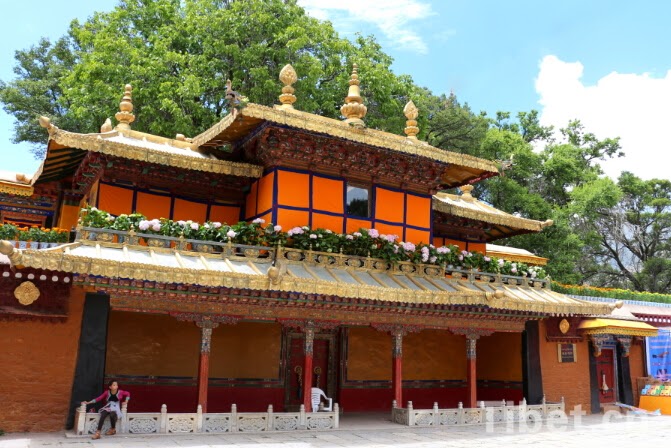
Another example, China Tibet Online just published a series of beautiful photos of the Norbulingka, the Summer Palace of the Dalai Lama in Lhasa.
The caption reads: "Norbulingka meaning 'Treasure Park' in Tibetan, is one of national key cultural relics protection units. Situated in the western suburb of Lhasa city, Norbulingka Summer Palace covers an area of 360,000 square meters with more than 100 kinds of plants in it."
Whose Palace it is, is not mentioned!
The name of the Palace's owner is banned!
In the meantime, Chinese cadres have started studying Tibetan Buddhism. Can you believe it?
China Tibet Online announced that on October 20,a seminar on the doctrines of Tibetan Buddhism was held at the China Tibetology Research Center in Beijing. The theme of the in-depth discussion was 'Tibetan Buddhism and Equality'. It was a two-day seminar sponsored by the China Tibetology Research Center and the High-level Tibetan Buddhism College of China.
Lhagpa Phuntshogs,the director-general of the China Tibetology Research Center explained that "the seminar is aimed at promoting Tibet’s economic and social progress by giving a full play to the role of religious figures and followers. It is the key subject for furthering the sound development of Tibetan Buddhism in the new century and an important channel to adapt Tibetan Buddhism to socialist society."
Of course, 'giving full play to the role of religious figures' is understood minus Monk Number One.
The seminar's objectives were to integrate Buddhism and Marxism. The communique says: "the Tibetan Buddhism doctrine is mainly focused on discovering, summarizing and advancing the fine traditions of Tibetan Buddhism, and integrating the idea of progress to serve the society and the people."
The seminar promoted books on four themes such as patriotism,belief in Tibetan Buddhism,establishment of the ethnic standard and commandment, and harmonious progress, for the country,the people and the religion.
But was not an ordinary religious teaching for Chinese citizens turning towards spirituality, as the research group participating to the exercise will submit the outcome of its research to the Communist Party.
The report will be titled 'Anthology of the Research results and Interpretation of Tibetan Buddhism—Special Edition on Tibetan Buddhism and Equality.'
Who were the students?
The organizers says: "Over 70 people attended the meeting, including leaders of the United Front Work Department of the CPC, revered lamas of the Tibetan Buddhism, scholars and experts in the area of Tibetan Buddhism research, leaders of the departments concerned of the Tibet Autonomous Region as well as the sutra teachers and students of the 12th 'Tho Ram Pa' [Geshe Lharampa students,  equivalent to a PhD in Buddhism]."
In other words, senior Party cadres are learning Buddhism ...without, of course, ever referring to Living Buddha No One.
Interesting!
To be followed...
In the meantime, envoy pictures of the Dalai Lama's Summer Palace, the Norbulingka.


Sunday, May 18, 2014

China to follow the Middle Path?

Group of Islamic Scholars during a Symposium in Urumqi
Will China follow the Middle Path?
Yes, if one is to believe what was reported by the Chinese press a couple of days ago.
The Ta Kung Pao in Hong Kong titled: “In Urumqi, a group of Imams called on the congregation to keep the Middle Path.”
But a day later, the reference to ‘Middle Path’ was removed from the English communique of Xinhua which just says “Muslims urged to resist religious extremism”.
It explained: “Religious leaders and scholars have called on Chinese believers in Islam to resist religious extremism and condemn terrorism. The call was made at a symposium that ended Thursday [May 15] in Urumqi, capital of northwest China's Xinjiang Uygur Autonomous Region, which gathered over 100 participants including officials of Islamic associations, well-respected religious people and academic scholars. The symposium is hosted by the China Islamic Association.”
But in the earlier Chinese version, many references were made to the Dalai Lama’s favorite political concept: the Middle Path.
According to the Chinese version, the China Islamic Association organized for the first time such symposium, gathering a hundred well-known Islamic scholars, imams and mullahs from around China. They met to discuss Islam’s ‘Middle Path Thinking’. They called upon Chinese Muslims to "stick to the Middle Path, away from extreme ideology”.
The Muslim imams and scholars strongly condemned the recent violent terrorist incidents which occurred in the Mainland [in Kunming, Yunnan].
It says that in recent years, serious terrorist attacks repeatedly occurred in Xinjiang; it has now spreads to the Mainland. This cannot be ignored as religious extremist ideas have become the ideological basis of these violent terrorist activities. Under the banner of Islam, by tampering and distorting the teachings of Islam, some people advocates the so-called ‘holy war’ [jihad], says the Chinese version.
The scholars agreed that this way of thinking not only undermines communal peace, but also desecrates Islam. The seminar exposed the 'really ugly forces' of violence and terrorism speaking and acting in the name of Islam; it urged the mobilization of the Muslim masses to fight terrorist violence, maintain national unity and social stability. Islam should be the guardian of peace, love and tolerance of Islam.
According to the Chinese news agency’s report, many of the participants spoke of the ‘Middle Way Thinking’, away from extremism.
This sounds like a Tibetan Buddhist teaching, isn’t it?
Professor Pan Shijie from Henan Academy of Social Sciences said that most of the scholars emphasized that the ‘Middle Way Thinking’ was a basic idea in the Koran.
Xinhua, in the later English version, removed all references to ‘Middle Path’.
In a more politically correct (for Beijing), Xinhua just states that the keynote speakers “illustrated the spirit of harmony and unity implied in the thinking of Islam and called on Muslims to resist religious extremism and condemn terrorism. They also upheld the spirit of respecting others, upholding fairness, being tolerant and friendly and rejecting excess in the thinking of Islam.”
The organizer, Chen Guangyuan, chairman of China Islamic Association stated that the aim of the symposium was to carry forward the fine tradition of Islam, guide Muslims to understand of real meaning of Islam, advocate peace and oppose violence, so as to defend the purity of Islam.
The symposium was called by the State Administration of Religious Affairs.
Wang Zuo'an, director of the State Administration of Religious Affairs declared that religious extremism is ‘completely off the page’ of the fundamental spirit of Islam. [Extremism] maliciously distorts and kidnaps the religion. Religious extremism is a deliberate blasphemy, and has become the most viperous enemy of Islam.”
Let us hope that more and more people will follow the Middle Path approach in China, including the central leadership in Beijing.
But if it is good for Islam, it should also be good for Buddhism, don't you agree?
It seems logical to me, not as yet in Zhongnanhai.

Wednesday, February 5, 2014

Buddha is money in the Middle Kingdom

Some of the Buddhas in China (Illustration, SCMP)
Buddha is getting bigger and bigger.
Why?
Because Buddha is money.
The South China Morning Post reported yesterday: "Giant statues of sage spring up all over mainland as developers and officials bid to lure tourists".
Tourism has become one of the most lucrative businesses in the Middle Kingdom.
The Hong Kong daily suggests: "Local officials on the mainland are drawing inspiration from Buddha, but perhaps not in a way he might have intended," adding "Tourism bureaus and developers are racing to build ever-higher statues of Buddha, in an attempt to copy the success of the Lingshan Grand Buddha in Wuxi, Jiangsu province."
The Lingshan Buddha is 88-metre-high statue/attraction; it got some 3.8 million visitors last year, generating more than 200 million US dollars for an investment of 725 tonnes of bronze. That's good business.
Hong Kong seems frustrated: five others Buddhas are taller than its Tian Tan Buddha (34 metres only). The tallest is of course the 208-metre-high Spring Temple Buddha in Lushan county in Henan province, while the Lingshan Grand Buddha, a 99-metre bodhisattva Ksitigarbha in Anhui province and a 48-metre statue of Amitabha Buddha at Lu Mountain in Jiangxi province, are also taller than the Hong Kong one.
Buddha is indeed money: the Lingshan park charges 210 yuan (US $ 3.5) per ticket; it gets hugely crowded during holiday times.
Kent Cai, a visitor from Ningbo in Jiangsu told The South China Morning Post (SCMP): "I felt dazed when I saw so many incense packages on sale - 50 yuan to pray for health, 128 yuan to pray for a child, 398 yuan to pray for vast happiness and 598 yuan for huge fortune."
What would Buddha say about this?
He would probably keep silent or meditate on human cupidity.
Xue Yu, a staff of the department of cultural and religious studies at the Chinese University of Hong Kong told the SCMP that local governments view giant Buddhas as an ambitious way to boost tourism: "The projects use the popularity of Buddhism and are a politically safe way to help build social harmony."
Whether it is 'politically' safe  is debatable, but it explains the growing popularity of Tibet amongst the Chinese masses (see yesterday's post).
Tibet too is money.
Chinese people not only love statues of Buddha, but they are also fond of  burning incense.
China News reported that on the eve of the Chinese New Year, tens of thousands of people lined up outside Buddhist temples overnight to have the opportunity to burn the first incense of the Year; the down-to-earth temples managers did not miss the opportunity to raise their prices.
One temple in Zhejiang Province is said to have priced the first incense at US $ 20,000. The China News article admits that people have ‘misconceptions’ and are misled by the belief that the first incense will make their New Year wishes come true. 
But there is another side to the newly-found popularity of the Buddha, remember my earlier post on the Serthar Institute.
Buddha can be very subversive too.

Monday, January 6, 2014

The Year of the Horse: a Prediction

2014: Year of the Horse
2014 will be the Year of the Horse (Horse-Wood for the Tibetans). It should be an Energetic Year.
Some have tried to predict the main features of the Year 2014.
The Weekly Newsletter Sincism, made 10 predictions which may turn correct (mostly in the economic and diplomatic fields).
The interesting point made by the  author (Bill Bishop) is that 2014 will witness an increase "recognition that Beijing has a well-crafted strategy, not ad-hoc and uncoordinated actions".
This might not be the case of India where ad hocism has been (and is) the rule.
In China, there is another aspect which is worth watching: the 'spiritualization of the Chinese society.
In October, I mentioned on this blog  'A Spiritual revival in China' with some extraordinary photos of Larung Gar in Kardzi Tibetan Prefecture of Sichuan Province (formerly Kham).
China Tibet Online publishes today an article entitled 'Beijing Lama Temple welcomes mass pilgrims in New Year'.
The Communist mouthpiece reported: "The first day of 2014 saw mass pilgrims to worship Buddha in the Lama Temple in Beijing."
It describes the scene at the Buddhist temple:
By 10:30, the temple had already taken in over 11,000 pilgrims. Even though the notion of vying for the most auspicious first incense had faded away, there were still a large number of people paying homage to the temple on the New Year's Day, which was also the first day of the last month of 2013 in lunar calendar.
By 7:30, the line people queuing in had reached the bus stop on the outside street, which was some 150 meters long. In order to keep warm in the cold winter morning, some kept stamping their feet while others rubbing their hands, and all wore down jackets.
Even though the Lama Temple in Beijing has started offering free incense to visitors since Dec. 10 2013 and forbids people bringing various incenses from the outside as a way of environment protection, there are still vendors peddling incenses around the temple.
The Yonghe Temple or ‘Lama Temple’ is a Tibetan monastery (Geluk tradition) located in the northeastern part of Beijing. Building and frescoes is a blend of Han Chinese and Tibetan styles.
Wikipedia says: 
Building work on the Yonghe Temple started in 1694 during the Qing Dynasty. It originally served as an official residence for court eunuchs. It was then converted into the court of the Prince Yong (Yin Zhen), a son of the Kangxi Emperor and himself the future Yongzheng Emperor. After Yongzheng's ascension to the throne in 1722, half of the building was converted into a lamasery, a monastery for monks of Tibetan Buddhism. The other half remained an imperial palace.
After Yongzheng's death in 1735, his coffin was placed in the temple. The Qianlong Emperor, Yongzheng's successor, gave the temple imperial status signified by having its turquoise tiles replaced with yellow tiles which were reserved for the emperor. Subsequently, the monastery became a residence for large numbers of Tibetan Buddhist monks from Mongolia and Tibet, and so the Yonghe Lamasery became the national centre of Lama administration. The temple is said to have survived the Cultural Revolution due to the intervention of Prime Minister Zhou Enlai. It was reopened to the public in 1981.

My prediction for 2014 is that the spiritual search of the Chinese people will continue to intensify during the Year of the Horse.
President Xi Jinping should take it into account in his 'Chinese Dream' and his "Massline Campaign', if he seriously want them to be successful.
The question however remains: does Party Ideology can rhyme with Spiritual Aspiration?
Can a 'spiritualization of China influence Beijing's Tibet Policy?
I will not do any prediction on this one.
Here are some pictures of 'Lama Temple' on January 1.


Predictions For 2014
The Sinocism China Newsletter 
January 5, 2014

1. 2014 is the Year of the Horse but it will also likely become known as the Year of the Grind as Beijing works through its many political, economic, environmental and social challenges;

2. Xi Jinping will continue to consolidate power. The apparent ongoing purge of Zhou Yongkang and his allies will result in Xi having more control over both the security services and the military than any leader in decades;

3. Xi's appointment to head the leading group for comprehensively deepening reform is positive for reform prospects. Some had expected Premier Li Keqiang to lead the group and now see this move as a diminution of Li, but given that the scope of the group is much broader than just the economy it makes more sense for the General Secretary to lead it. Only Xi may have the authority and the bureaucratic power to push through reforms that affect so many entrenched interests (though of course reform will also bring new opportunities to some). If Xi is successful in rebuilding Party discipline through the Mass Line Campaign and the corruption crackdown then there is a decent chance the reforms will succeed. But there is a reason some in Beijing say that Xi is the Party's last chance to make the changes needed to keep it in power;

4. The corruption crackdown will intensify and while it will not solve the root issues it will be more successful than most have predicted. Zhou Yongkang may be the first tiger to fall in 2014 but there will be others. There will be increasing pockets of resistance as cadres are squeezed but Xi appears to have the power base to continue the crackdown. And business prospects will not improve for luxury goods merchants;

5. The economy will continue to struggle, in large part to due to the excessive buildup of corporate and government debt. The recent audit and the listing of "resolving risk associated with local government debt" as a key task in 2014 by the Central Economic Work Conference are signs of both how worried Beijing is and how serious it is taking the debt mess. There are no quick fixes though, moral hazard is a huge issue and while a debt crisis is unlikely (but never say never) Beijing's options are increasingly constrained and any overly aggressive efforts to rein in credit growth could dramatically slow the economy. GDP growth should come in around 7% (and there will be plenty of debate about how "healthy" or real" that growth is), the Shanghai Composite will end 2014 15% higher, the RMB will appreciate to between 5.8-5.9 to the US Dollar and first-tier and maybe second-tier city real estate markets will continue to see price appreciation, though at least one high profile real estate developer will be taken down as a scapegoat for the high housing prices;

6. The Party has made much progress towards its goal of seizing the commanding heights of the Internet and those efforts will continue, as will a continued shift in social media usage from Weibo to Wechat. The stepped up control of the Internet will continue part of the broader, ongoing ideological tightening;

7. Alibaba and the Hong Kong Stock Exchange will both make concessions by the second quarter that will allow the company to list on the HKSE. The IPO will be bigger than Facebook's even though Tencent's Wechat will increasingly be seen as serious threat and Laiwang, Alibaba's Wechat clone, will have little traction;

8. There will be more China pain for US technology companies in the wake of the Snowden revelations. Do not be surprised if Beijing bans military and security personnel and cadres above a certain rank from using Apple products;

9. There will be progress on cleaning up the environment though the problems are so huge that not much will change substantively in a year. But there will be more bureaucratic will and policy support as Beijing has come to realize that the environmental disaster is one of the core threats to the country. One of my predictions for 2013 was that the environmental issues would lead to "more protests as citizens become more aware of their rights and are emboldened to protect them." In fact there were fewer large scale ones than in 2012 as Beijing narrowed the public sphere.

10. Verbatim from last year's predictions: China’s external environment is increasingly complex. Mr. Xi is likely to work hard on maintaining stable relations with the United States, while at the same time expanding China’s military capabilities and asserting its regional interests. China has unsettled its neighbors with its approach to the disputes over the Diaoyu/Senkaku Islands in the East China Sea and the various islands in the South China Sea. Both issues look intractable, so a solution is unlikely in 2013. Expect a quickening arms race in Asia, increasingly nationalist rhetoric, continued tensions with Japan, Vietnam and the Philippines and growing risks of misunderstandings — and possible mishaps — as the various countries send more vessels into the disputed areas.

What I will add for 2014 is that there will be increasing recognition that Beijing has a well-crafted strategy, not ad-hoc and uncoordinated actions, that it believes will demonize and isolate Japan in the region and force the US to choose between supporting an increasingly unpopular regional partner or applying pressure on Japan such that other countries will see the US as an unreliable ally. I am not convinced it will work but it does look to be a significant part of Beijing's strategy. And Prime Minister Abe is starting to look like a gift for Beijing.

Of course any unforeseen, exogenous events could render some or all of these non-operative...