Showing posts with label Gyaltsen Norbu. Show all posts

Sunday, August 24, 2025

Celebrating the Partition of Tibet

On August 20, at noon, Chinese President Xi Jinping, also General Secretary of the Communist Party of China and Chairman of the Central Military Commission, landed at Lhasa Gongkar airport. 
His fourth visit to Tibet was to celebrate sixty years of the Tibet Autonomous Region (TAR).

But what is the TAR?
In 1965, a Tibet Autonomous Region was established to ‘administrate’ Central and Westen Tibet. The area corresponded to the former Ü-Tsang Province and some parts of western Kham. It was a tragedy for the Tibetans because it meant the Partition of Tibet. 
Traditional, ethnic, linguistic Tibet was composed of three provinces Ü-Tsang, Kham and Amdo. Suddenly Tibet was divided in five parts, TAR was one of them, and the remaining parts were amalgamated to the Chinese provinces of Qinghai, Gansu, Sichuan and Yunnan.
Tibet was dismembered. It has always been one of the Dalai Lama’s demands to reunite the five parts of Tibet into one administrative and political entity.
Further, the autonomy promised in the name itself was never given; for the past 60 years the First Secretary of the TAR Communist Party, is not a Tibetan, but a Han. There are very few ethnic Tibetans in the higher echelons of the Party, as we could see in the videos of Xi Jinping’s recent visit.

The Delegation
Xi was accompanied by a large delegation from Beijing.
The Xinhua release observed that Xi was looking at “the long-term stability and high-quality development of Tibet in the new era and the construction of a socialist modern Tibet.”
Xi was greeted by “a cheering crowd when he stepped out of the cabin and waved to the people. Dressed in festive attire, people from different ethnic groups waved red flags and flower bouquets, dancing to joyful rhythms.” 
It looked more a North-Korea type of reception with everyone clapping at unison. Did the Tibetans ‘crowds’ have the choice to not participate? Probably not.
During the following day, the ‘clapping’ continued wherever Xi went. 
During such visits, it is always important to look at the composition of the ‘Central’ delegation; it is the best way to decipher the visit. 
Xi was accompanied by Wang Huning, No 4 in the Party, chairman of the Chinese People's Political Consultative Conference and member of the Politburo’s Standing Committee. Wang’s colleague, Cai Qi, No 5 in the Partry and director of the General Office of the Central Committee who often accompanies Xi in his tours, was present.
Three other members of the Politburo came to Lhasa: Li Ganjie, head of the United Front Work Department along with He Lifeng and Zhang Guoqing; also present was the powerful Minister of Public Security Wang Xiaohong and Gen Zhang Shengmin, a member of the Central Military Commission who replaced the CMC’s strong man Gen Zhang Youxia, who had accompanied Xi in 2021. Why Gen Zhang did not come is probably because Xi and Zhang have lately not seen eye to eye. 
More importantly and hardly noticed was the presence of Hu Chunhua, a former Party Secretary in Tibet who was at one time Xi’s heir apparent. After being apparently disgraced, he seems to be back in favour; his eventual return needs to be followed closely. Incidentally, Hu is one of the very few Han leaders who can speak Tibetan.
Apart from Gen Zhang Youxia, Gen Wang Haijiang who since August 2021 has been commanding the Western Theatre Command opposite India, was missing in action. Earlier Wang had a long career in Tibet. Has he been purged? Everything is possible in China today. Also missing, Lt Gen Wang Kai, the commander of the Tibet Military District; only the TMD’s Political Commissar Lt Gen Yuan Honggang was seen around. 
These absences are intriguing.

The Fourth Visit
It was Xi’s fourth visit to the Roof of the World. 
In June 1998, then deputy secretary of the Fujian Provincial Party Committee, he came to Tibet for the first time to take back a first batch of Tibet Aid cadres in Fujian and bring a second batch. 
In 2011, Xi Jinping, then Vice-President, led a delegation from the Central Committee to attend the celebration of the 60th anniversary of the so-called Peaceful Liberation of Tibet. He then said “the ecological protection of Tibet is an important issue, and it is necessary to protect Tibet's blue sky.”
His next visit was in 2021. From July 21 to 23, the General Secretary was in Tibet “to congratulate the 70th anniversary of the peaceful liberation of Tibet and visit and comfort the cadres and masses of all ethnic groups in Tibet.”
He also visited Nyingchi Prefecture, near the Indian border where he inspected the ecological environment protection of the Yarlung Tsangpo River and the Nyang River basin. Later, he travelled by train to Lhasa.

The Program
President Xi met six representative groups: people of ethnic groups and ‘all walks of life living in Lhasa’; then cadres who are posted in Tibet; next were judicial workers and police officers, followed by ‘grassroots role models’ and ‘patriotic members of the religious circles’, finally, he had a photo session with military officers ranked colonel and above.
During all these sessions, Xi looked tired, sometime haggard (while the other leaders visited the six Cities/Prefectures outside Lhasa, Xi remained in the capital to rest).  
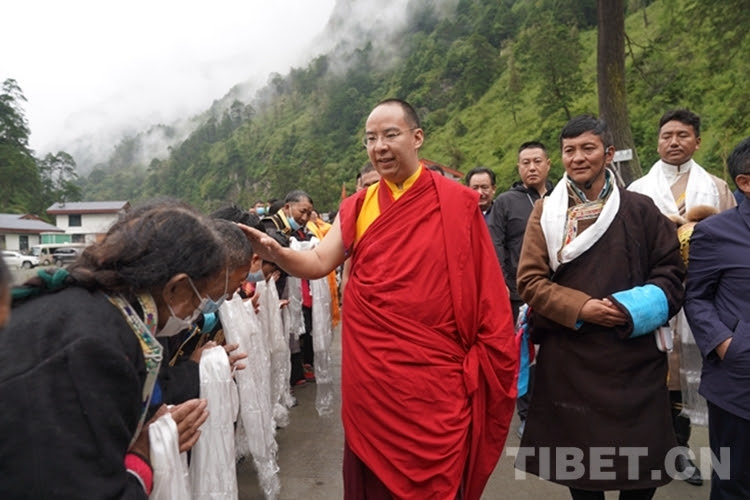
During his meeting with the religious leaders, Xi had a brief encounter (not more than 5 seconds) with Gyaltsen Norbu, the Chinese selected Panchen Lama. It was the only time that the latter was seen during the visit, which probably means that Norbu will not play an important role in the selection of the next Dalai Lama as he was not given any prominent role during the visit. 
Wang Huning and Cai Qi attended all the meetings.

The Work Report
Xi was invited to listen to the work report of the TAR government.
During his interaction, Xi stressed that “Tibet should fully implement the party's strategy of governing Tibet in the new era, adhere to the general tone of steady progress, implement the new development concept in a complete and accurate manner, solidly promote high-quality development, continue to grasp the four major events of stability, development, ecology and strong edge, and strive to build a socialist modern new Tibet that is prosperous, civilized, harmonious and beautiful.”
The usual  jargon. Do the Tibetans really believe this? It is doubtful but do they have a choice?
The Chinese President then made a summary of the Party’s successes for 60 years: “its economic and social development has achieved remarkable progress, leading to profound changes in the plateau region.” It cannot be denied that materially Tibet has changed.
Xi explained Beijing’s policies: “Governing Tibet, ensuring its stability and promoting its prosperity must begin with maintaining political and social stability, ethnic unity and amity among different religions, calling for further advancing the building of a community for the Chinese nation,” Xi asserted. Stability is a recurrent issue in Xi’s discourse.
Xi then emphasized the need to guide “Tibetan Buddhism in adapting itself to socialist society.” He did not use the usual term of ‘sinisation’ of Tibetan Buddhism, but the result will be the same, erasing all traces of Indian influence on the propagation of Buddhism in Tibet.
He also asserted that Tibet (now called ‘Xizang’ by the Chinese government) “needs to develop competitive plateau industries based on local conditions, with a particular focus on industries of agriculture and animal husbandry with local features, as well as the clean energy sector.” This is being done on a large scale, completely changing the landscape of the Roof of the World and worse, changing the demography of the plateau by bringing lakhs of migrants from China.
Finally, he mentioned the construction of a series of hydropower plants on the Yarlung Tsangpo/Brahmaputra which cause deep anxiety in India: “major projects such as the hydropower project in the lower reaches of the Yarlung Tsangpo River and the Sichuan-Xizang Railway project in a vigorous, orderly and effective manner.”
He spoke of the promotion of ecological conservation: “to make coordinated efforts to cut carbon emissions, reduce pollution, expand green development, and pursue economic growth, so as to protect the roof of the world and the water tower of Asia."
It does not make practical sense. One can’t destroy and protect the environment at the same time.


The Return of Zhao Zongqi
During the Gala reception in the evening, India was in for a surprise: Gen Zhao Zongqi, the artisan of the Doklam confrontation (2017) and the Eastern Ladakh Chinese intrusions in 2020, was posturing, seated in full uniform in the row behind the top leader. Gen Zhao has retired in December 2020 as Commander of the Western Theatre Command after spending two decades posted in Tibet; after taking the command of this sensitive area facing India, he created havoc in the Sino-Indian relations by trying to occupy five places in Ladakh. So, why was he invited? 
Probably to show India, that the border issue is far from being settled, despite the recent meeting of the Special Representatives in Delhi.
This visit (the shortest of Xi’s four visits) is ominous for the Tibetans as well; gaining any type of autonomy in the present circumstances is utopic.
And the question remains: are the Tibetans allowed to not clap?


Gen Zhang Shengmin member CMC in Lhoka


Stage managed reception for Xi Jinping in Lhasa Airport


Friday, June 6, 2025

Hot Summer on the Tibetan Plateau

The political climate is hotting up on the Tibetan plateau.
Xinhua has announced that President Xi Jinping ‘accepted an audience’ with the Chinese-selected Panchen Lama Gyaltsen Norbu at Zhongnanhai in Beijing on June 10. The term ‘accepting an audience’ is a euphemism to say the least, because the ‘audience’ seemed more like summon-cum-lecture, I shall come back to it.
A few weeks ago, the United Front Work Department (UFW) of the Central Committee held a 3-day Conference in Beijing (from May 18 to 20) to take stock of China’s ‘internal threats’. The UFW usually deals with the ‘minorities’ such as Tibetans and Uyghurs as well as non-Communist Party organizations. The Conference decided to recruit ‘three types of people’ for ‘Party Work’. Who are these 3 types?
Xi Jinping named them: overseas students, media representatives, and ‘private’ businesspersons, like Jack Ma of Alibaba. A few days later, China Tibet Online asked a pertinent (for Beijing) question: “do overseas Tibetans count among the ‘three types of people’?”
The Tibetan Diaspora was painted in black and white: “Among the exiled Tibetans, only a handful of ‘high-ranking officials’ Tibetans can obtain the ‘nationality status’ or ‘green cards’ from their host countries, such as several Kalons (cabinet ministers) of the ‘Tibetan government-in-exile’. Most of the overseas Tibetans, especially those living in India and Nepal, are living in poverty and are basically dependent on others.”
However, the Party seemed keen to return to the Deng Xiaoping’s days, when China ‘opened-up’: “all patriots belong to one family …patriotism can be shown at any time”. These ‘patriotic Chinese’ should be given “the freedom to come and go, letting bygones be bygones” adding that “expatriate Tibetans are welcome to come home.”
It sounded like an open invitation to the refugees to return, ‘let the bygones, be bygones’. How many will take the ‘socialist’ bite in the present repressive atmosphere is another question.
The UFW Conference nevertheless “reiterated the bottom line that so long as overseas Tibetans are not involved in separatist activities, but safeguarding the unity of the motherland, they [should be] the targets of the united front’s work.”
This brings us back to the Panchen Lama’s invitation to Zhongnanhai.
He seems to be the No. 1 target of the UFW.
“Why did Xi Jinping meet with the Panchen Lama just now?” asked a Chinese website. But before answering the question, the article notes that the two leaders (Xi and Norbu) have already met in 2006, on the occasion of the first World Buddhism Forum in Hangzhou; then, when Xi, then vice-president went to Tibet in July 2011 and paid homage to the 10th Panchen Lama at the Tashilhunpo Monastery. Xi even offered a khata, a ceremonial scarf, on the tomb of the great Tibetan leader.
The article forgets to mention that for decades, Xi Zhongxun, the President’s father, had been extremely close to the 10th Panchen Lama and even wrote his official obituary in The People’s Daily, when the Tibetan leader passed away in mysterious circumstances in January 1989 in Shigatse.
The present meeting is ‘very appropriate’ says Xinhua, because it shows that the Party “has consistently given a high level of attention to Tibet.” It also indicates, says the news agency, “the great importance that the Central Committee attaches to the religious work,” affirming that Xi Jinping has “set an example for the rest of the Party members by taking the lead in uniting the religious figures.”
What happened during the Xi-Panchen encounter?
First, if one looks at the picture published by Xinhua, apart from Xi, three other members of the Politburo were in attendance (Yu Zhengsheng of the Standing Committee, Sun Chunlan, the UFW head and Li Zhanshu, director of the General Office of the Party); also present was Jampa Phuntsok (the senior-most Tibetan in the Party). Why such a rare lineup?
Apparently Gyaltsen Norbu needed to be briefed.
Xi did most of the talking. If bygones have to be bygones, the Party has to be reassured that those who are supposed to represent the Party understand properly the stand of the Party.
In Beijing’s game plan, Gyaltsen Norbu is destined to play a central role. He has been especially selected by Beijing from a family of faithful Communist cadres from Nagchu prefecture (let us not forget that the boy selected by the Dalai Lama as the Panchen Lama, has for the past 20 years been languishing under house arrest).
What will happen if Norbu, though groomed by the Party, behaves like the Great Tenth, who sent a 70,000 charcater letter to Zhou Enlai in 1962 criticizing the Party’ actions in Tibet and who, a few hours before his death, again asked, what good 30 years of ‘liberation’ had brought to Tibet.
A frightful thought for the Party!
Xi told Gyalsten Norbu to “keep the motherland and its people in his heart and firmly work for the unification of the country and all its ethnic groups.” Is there any doubt in Beijing’s mind?
The Panchen Lama was told that he is expected to grow into "a Tibetan Buddhist leader with great religious achievement, deeply loved by the monks and secular followers." Further, the young Lama should “carry on the legacy of his predecessor and actively engage in the cause to incorporate Tibetan Buddhism into socialist society under the Buddhist principles of equality and compassion among all beings.” This is a tricky one, because the 10th Panchen was a rebel, a courageous monk who never hesitated, at the cost of his own security, to call a spade a spade, even if it was a Party spade.
Gyaltsen Norbu was told to “promote positive Buddhist doctrines, such as those upholding kindness, denouncing wickedness, promoting equality and generosity as well as helping the needy.”
Am I dreaming: the Secretary General of the Communist Party, giving a religious lecture to a Buddhist monk!
Not a word about what the Lama said! It is rare in a Xinhua communiqué.
Clearly China is preparing the 6th Tibet Work Forum which, later this year, should decide on the new Tibet policy for the 5 or 10 years to come.
A few days earlier, Xinhua had reported that the Panchen Lama had concluded a seven-day tour in Yunnan Province where he visited several Buddhist sites. Two places are of particularly interest to decipher the role that Beijing would like the Lama to play.
The Zongfo Temple in Jinghong of Xishuangbanna Prefecture is a Theravada monastery, located in Yunnan, close to the Thailand border. The visit was clearly a political one as Beijing is keen to show that Norbu can take the lead not only of the Mahayana, but of the Hinayana Buddhism too. Beijing wants to use the young Lama for this purpose in the future.
The second ‘political’ important stop was at the Ganden Sumtsenling Monastery in Gyalthang county. It is the largest Tibetan-Buddhist temple in Yunnan. It has been linked to the Shugden practice denounced by the Dalai Lama. Does it mean that the Panchen Lama will lead an anti-Dalai Lama movement in the years to come? It is too early to say, but it was probably part of Xi’s ‘lecture’.
Where is the Dalai Lama in all this? In early June, China Tibet Online had asked “Will the Dalai Lama be united by the CPC?”
The website says: “In the 1950s, Chairman Mao Zedong often wrote to him and sent valuable gifts. However, after the rebellion in 1959, the Dalai Lama fled the country. What is more ridiculous is that recently he called himself a ‘Son of India’, even though he still has the Chinese nationality.”
Xinhua’s publication answers its own question: “The Dalai Lama does not seem to be a person who can be united. For decades he has not totally given up separatist activities. …he seems to be more a qualified force to be united by the United States and other western powers than by the CPC,” adding: “Furthermore, he is neither a patriot who supports socialism and the reunification of the motherland, nor is he dedicated to the rejuvenation of the Chinese nation.”
The conclusion is that only the Chinese Panchen Lama is left to do the ‘United Front Work, therefore the need of a high level ‘briefing’ in Zhongnanhai. Will it work, is a billion yuan question.

Sunday, July 24, 2022

Chinese Panchen Lama visits an 'Indian' Village

On July 22, China Tibet Network posted an article announcing that the Chinese-selected Panchen Lama (Gyaltsen Norbu) visited a village on the Indian border: “Panchen: Guarding the border is a great cause,” was the title of the article.
It mentioned the name of a 71-year-old Tibetan lady “wearing new clothes, wearing new hats and holding white khatas eagerly waiting, with faithful masses, in the fine rain,” for the arrival of the Lama
The name of the village as given by the article is Lowa.
It is probably a Tibetan translation for Lho(pa)-wa, i.e. Lhopa tribe village.
But the newly-built village is in fact Longju, the site of the first bloody clash between India and China in August 1959.

The line depicted on this map is the approximative LAC in the area.
though Longju is south of the International Border (IB)

For decades, India has considered the place, where the new village is located, to be in Upper Subansiri district of Arunachal Pradesh and not in Tsari Township of Lhuntse county in Lhoka prefecture as mentioned by the Chinese.
"Knowing that Panchen Rinpoche was today going to visit our village for inspection, we waited at the entrance of the village early in the morning, looking forward to seeing Rinpoche as early as possible," said the lady.
The article added: “On July 21 in the morning, the Panchen Erdeni [Chinese name for Gyaltsen Norbu] a member of the Standing Committee of the National Committee of the Chinese People's Political Consultative Conference (CPPCC), Vice-president of the Chinese Buddhist Association and President of the Tibetan branch of the Chinese Buddhist Association, came to Lowa New Village.”
The narrative continued: “The new village lying quietly at the foot of the Himalayas became lively with a strong smell of mulberry smoke in the air; the masses of believers welcomed him, bowed and prayed.”

Gyaltsen Norbu being explained the history of Longju

 Wang Shu [Wangchuk], the secretary of the Party Branch of the new village gave an introduction to the Panchen Lama about the situation in the new village.
According to China Tibet Network, the new village is located on the border at 2,735 meters above sea level, 7 kilometers from the seat of the township government (Tsari/Migytun): “in the village, two-story small buildings are lined up, staggered and greenery is found in front of each house with flowers in full bloom, a vibrant scene.”
The article admitted that the ‘Lowa’ new village is part of the ‘relocation’ scheme and new inhabitants arrived on January 15, 2021. Since then, more than 90 families have moved in.
The village Party Branch Secretary showed the Panchen Lama around and explained the construction of the new village on an exhibition board showing the new village's relocation; the role of the villagers, living in well-off houses, who have to guard the border and improve the rural revitalization conditions as well as the industrial and ecological development of the area.
The local Party Secretary added: “In addition to the high standard construction of well-off houses, the Party and the government also invested in the supply of water, electricity, telecommunications and other infrastructure facilities as well as the construction roads. It is supporting the construction of bamboo processing plant, Tibetan incense plant, greenhouses and other special industries.”

Meeting the 'masses'
Gyaltsen Norbu asked: “How many children do you have? Where do the children go to school? Where are the teachers from?”
He later went into the first floor of the Village Committee House and visited two households “to talk to the masses of relocated households to understand their living situation after relocation.”
"Going around the village, you can see that our current housing, living and other conditions which are particularly good," said the villagers.
The Panchen Lama looked at the happy smile on the face of the border people and told that they were different from others; your tasks to guard the border: “it is a great cause, you should feel the Party's grace, listen to the Party, follow the Party, to do a good job in the new era of garrison people, continue to work hard to guard the territory of the motherland. I believe your future life will be even better.”
The article mentioned that in 2021, the per capita disposable income of the new village of Lowa reached 25,804.08 yuan. It is pure propaganda as the village did not exist a few months earlier.
But in 2022, the villagers' income has doubled and more prosperous days are ahead, said one of the villagers while guarding the border is not only “our unshirkable responsibility, but also our glory, we firmly believe that under the wise leadership of the Party and the State, the new village of Lowa will have a better tomorrow.”

Blessing the 'masses'

At the end of the inspection, Gyaltsen Norbu walked out of the new village on foot, touched the heads of the villagers and gave his blessings to the religious people lined up at the entrance of the village, and presented the religious people in the village with enlightened Vajra knots, dharma photos and medals.”
No photos of the Dalai Lama, of course.
The article concluded that after receiving the blessing from Panchen Lama, “still many religious people who did not want to leave for a long time.”
One of the villagers said: “I didn't expect Rinpoche to travel so far to visit us in the village. Before, I had only occasionally seen Rinpoche on TV, but I never thought I could see him with my own eyes in this life.”
With tears in her eyes, the old lady immediately enshrined the picture of Lama on the altar of her house after returning home.
Probably along with the photo with Xi Jinping.
It is pure propaganda to show that Longju belongs to China, and the Tibetans are given the freedom to practice their religion, but where are the stupa, the gompas, the prayer flags, the prayer mills in the new villages.
Nowhere, but is clearly a provocation in retaliation against the Dalai Lama's visit to Ladakh.
But a poor retaliation, for the Dalai Lama there was a 10-km line-up in Leh, in Longju hardly 20 people, representing the 'masses'.

Wednesday, February 26, 2020

Playing the Gyaltsen Norbu 'Card'

Something rather unusual happened on the occasion of the Tibetan Losar (New Iron-Mouse Year).
Gyaltsen Norbu, the Chinese-selected Panchen Lama addressed his countrymen …in English: “I would like to extend to all my fellow Tibetans at home and abroad my best greetings for the new Tibetan year of the Iron Rat,” he said.
Incidentally, for the Tibetans, it is the Year of the Mouse, not the Rat Year as in China, but why to speak in English.
With a relatively good accent and subtitles (and obviously a prompter), Gyaltsen Norbu said: “In 2019, we stayed apace with the great times. Every family made progress and reaped benefits. Each and every person gained new understandings and personal growth. At present, people of all ethnic groups across China are fighting against the novel coronavirus outbreak. I firmly believe under the strong leadership of the CPC Central Committee, with the whole society united in taking action and working together to help each other, we will definitely achieve the ultimate victory.”
Though he mentioned the Communist Party, he did not say a word about the 'People’s Leader', Xi Jinping.
After speaking of the fight against the Coronavirus, his conclusions were: “I wish and pray for world peace and social harmony. I wish and pray for the prosperity of our country. I wish and pray for the health and well-being for our people. And I wish and pray for all living beings to achieve happiness by staying away from all sufferings.”
A few days earlier, The People’s Daily announced that the Chinese Panchen Lama had donated medical supplies worth 1 million yuan (about $1,43,000) through the Tibet Development Fund: “to help fight the novel coronavirus in southwest China's Tibet Autonomous Region [TAR].”
The Lama is obviously well-off.
Xinhua reported that the medical supplies, including medical gloves, isolation gowns, masks and thermometers, have been dispatched to the 'frontline' of epidemic control in the region.
Where is the ‘frontline’ when the TAR is said to be the only region in China without declared case?
More importantly, the fact that Gyatsen Norbu addressed the Tibetans in English shows that Beijing is planning a much larger role for him in the future.
It could even dispense China to ‘find’ a 15th Dalai Lama, a move which would be controversial to say the least; Beijing could play the ‘Gyaltsen Norbu’ card on a much larger scale and probably on a restricted international level.
Beijing is aware that after the Dalai Lama’s passing away, it will take a few years for his reincarnation to return and during the next two decades, he will not be able to play a political role due to young age, therefore it would be safe for Beijing to use Gyaltsen Norbu for a few decades.
But it is if…
The fate of a nation (or an individual) is never a straight line.
In 1931, two years before passing in the Heavenly Fields, the 13th Dalai Lama had written: “While I was returning to Tibet, [in 1910] the Ambans [the Chinese Resident] in Tibet sent false reports to the Chinese Emperor and as a result commander Lui Chan and his soldiers were ordered to march into Tibet. They started interfering and even managed to take considerable political power into their hands. Consequently, I, my ministers and important officials of the State, inspite of the difficult journey, had to leave Tibet and go to the noble land of India [The Dalai Lama stayed in Kalimpong]. There, I appealed to the then English Government of India who brought the matter to the notice of the Chinese king. However, the Chinese king refused to reply and nothing came out of it. [But in 1912] as a result of our past meritorious karma and the numerous prayers and services that were conducted in Tibet, internal strife took place in China. It was no problem, therefore, to completely drive out the Chinese force from Tibet.”
A few months later, the Dalai Lama declared Tibet’s Independence.
History does not often repeat, however many unpredictable events can happen… It would not be wise for Beijing to bet too much on Gyaltsen Norbu.

Thursday, September 12, 2019

China readies for Next Dalai Lama

China objects to the Dalai Lama's birthday being celebrated in Ladakh
My article China readies for Next Dalai Lama appeared in Mail Today and DailyO

Here is the link...

The Dalai Lama’s answers about his succession often make the headlines; in some cases, his words were even misinterpreted. But, on August 18, a video addressed to members of the Minnesota Tibetan Association which received a wide circulation on social media, brought joy to his followers; the Nobel-laureate said that he was presently in the best of health and would live to be 110 years old.
Concerns were raised about his health in April, when the 84-old leader was flown from Dharamsala to Delhi where he was admitted to a private hospital for a serious chest infection.

Fears allayed

In his talks with the American Tibetans, he recalled a dream in which Goddess Palden Lhamo, the special protector deity of Tibet, while riding on his back, proclaimed that he would live for 110 years. "Tibetans have not forgotten me, and I will not forget you," asserted the Dalai Lama.
At the same time, on the other side of the Himalaya, the Chinese are actively planning for the return of his reincarnation.
The Global Times, the mouthpiece of the atheist Communist Party, recently reported that some 100 Tibetan Buddhist monks attended “a training session on reincarnation for a living Buddha in Tibet Autonomous Region, which includes government regulation on management of the reincarnation system, and was hailed by Chinese experts and officials as a necessary method to maintain religious harmony in the region.”
‘Living Buddha’ is a term invented by China to designate the tulkus, the Lamas who consciously return to this world to continue what they have not achieved in their previous life; Beijing appears busy making preparation to appoint its own 15th Dalai Lama.
According to The Global Times, the training session which was organized by the Institute of Socialism in Tibet, the Tibet Buddhist Association and regional authorities, covers the history and rituals for the reincarnation of Living Buddhas. The course lasted some 10 days; at the end of it, the newly-educated monks were received by Wu Yingjie, the Party boss in Lhasa.
Sonam Rinchin, a deputy secretary of the regional Chinese People's Political Consultative Conference, explained that the reincarnation system was "never a religious-only issue or a living Buddha's personal right" but an important representation of the Communist Party of China's strategies and policies in the region. It meant that for Beijing, it is a Party affair, to be decided by the Communist leadership.
The "Management measures for the reincarnation of living Buddhas in Tibetan Buddhism" were notified on July 13, 2007.
Article 1 spoke of “protecting religious concord and social harmony, and protecting the normal order of Tibetan Buddhism.”
It asserted that: “Reincarnating living Buddhas should respect the religious rituals and historically established systems of Tibetan Buddhism,” insisting on an old ritual rarely used, the Golden Urn which can easily be manipulated, …further “Reincarnating living Buddhas shall not be interfered with or be under the dominion of any foreign organization or individual.”
This is practically a ban on the Dalai Lama to return from India.

Chine eyes succession
Pema Lhamo, head of the South Asia Institute of the Tibetan Academy of Social Sciences explained that holding such a training session helped the process of reincarnation, “written in government regulations and embedded in Tibetan Buddhism …to be carried out properly and not affected by any individual or the Dalai Lama's separatist clique.”
China wants a reincarnation of the Dalai Lama without Dalai Lama’s involvement!
But the Chinese preparations are not limited to ‘convert’ a few monks to a ‘socialist’ Buddhism, the Chinese-selected Panchen Lama, Gyaltsen Norbu has been conducting an extensive 'inspection tour' on the Tibetan plateau, including a village bordering Ladakh, trying to assert himself as the heir apparent to the Dalai Lama.
Norbu toured areas such as Purang (near the trijunction Nepal-Tibet-India), Mt Kailash, Manasarovar lake, the monasteries in Tholing, Ngari town, Rutok, the Panggong Lake (of The Three Idiots’ fame on the Indian shores) and even a village on the Indian border; all these areas are close to the Indian border.

Norbu's Border Tour
The Chinese media extensively covered his three-week long visit.
China Tibet Online reported that on July 26, Gyalsten Norbu traveled to Jaggang village in Rutok County “for survey and research”; he paid a visit to two Tibetan families. The Chinese website said that “Jaggang Village is located in the southern part of Rutog County, 70 kilometers away from the county town. It is a typical plateau village.”
But it is not an ordinary village, it is also known as Chiakang and situated close to Demchok in Ladakh.
It is the first time, that such a ‘senior’ religious leader, goes himself the Indian border, which China claims as ‘disputed’.
Norbu's visit was probably a message to Delhi and Dharamsala; Beijing is doing its homework on the ‘succession' of the Dalai Lama. For at least the next twenty years, Norbu will be the face of Tibetan Buddhism in China, which seemed decided to fully play the Gyaltsen Norbu card against the Dalai Lama.
Even if China selects its own Dalai Lama (with the help of Norbu), the latter will continue to ‘rule’ on behalf of the Communist Party for decades (provided, the Communist Dynasty lasts that long).
Incidentally, Norbu also visited a Nyingma (old school) monastery (Tirthapuri Gompa near Mt Kailash). This shows that China plans to use him as ecumenical leader, not just a Lama of the Geluk School of Tibetan Buddhism.
China is clearly putting people and systems in place for the succession of the Dalai Lama.
One can hope that that Palden Lhamo’s prediction is right and the Dalai Lama will continue to live a healthy life for many years. It is important for Tibet, but for India too, particularly for the Himalayan region where he brings a great harmony, stability and a refreshing presence.

Friday, July 5, 2019

Lambs before the dragon

My article Lambs before the dragon appeared in the Edit Page of The Pioneer.

In other continents, too, nations have to kowtow to China in return for investment and debt funding, though they are slowly waking up to the fact that all is not rosy

China has managed to tame the wild Tibetans yaks, according to Xinhua: “Under the touch of the petite scientist Yan Ping, the tall and powerful black yak, weighing over 400 kg, is as obedient as a lamb.” And the news agency adds: “Unlike other yaks, this one has no horns.”
Yan, who works for the Lanzhou Institute of Husbandry and Pharmaceutical Sciences explained: "The Ashidan yak has no horns and has a mild temperament, easy to keep and feed.”
Beijing seems to have developed some expertise in taming humans and nations too.
The Taiwan News reported “Manila kowtows to Beijing, cedes Exclusive Economic Zone in South China Sea.”
The once-wild President of the Philippines, Rodrigo Duterte is said to have ceded “ground in the South China Sea through an ‘informal’ and ‘undocumented’ [agreement] with President Xi Jinping.”
The Taiwanese newspaper noted that many citizens of the Philippines were “already concerned over the government’s unwillingness to safeguard the territory of the country’s Exclusive Economic Zone (EEZ).” The article concluded that this makes the Duterte government appear even weaker on protecting the nation’s maritime territory.
But it is not only the Philippines which have been tamed and have accepted Beijing’s diktats. India’s Northern neighbour, Nepal, seems to have fallen in the trap.
Newsgram, an independent media agency, recently pointed out that it is the Nepal Government in Kathmandu which forces local journalists to avoid critical reporting on China, the largest investor of the Himalayan land-locked nation.
Anil Giri, the foreign affairs correspondent for The Kathmandu Post, told Voice of America that “journalists are discouraged from covering Tibetan affairs to mollify China and that government officials shy away from commenting on China-related issues. China sponsors junkets for Nepalese journalists and that’s why probably we don’t see lots of criticism about China’s growing investment in Nepal, Chinese doing business in Nepal and China’s growing political clout in Nepal.”
The lamb-lamb attitude in Kathmandu appeared in an incident which recently took place at the Tribhuvan International airport in Kathmandu; The Himalayan Times reported: “Man labelled Dalai Lama’s agent, deported to US”.
Apparently the Nepal immigration mistook a Tibetan called Penpa Tsering, holding a US passport and arriving from the US, with his homonym the former Dalai Lama’s Representative in the US; Nepali officials argued that the man was ‘on China’s most-wanted list’. In Dharamsala, the former Tibetan Representative observed: “It clearly shows that the Chinese government’s pressure on Nepal is working.”
Nepal’s Home Minister Ram Bahadur Thapa affirmed that the deportation was only an act “of honouring the ‘One-China’ policy.”
A few weeks earlier, two members of Nepal’s Parliament, Ekwal Miyan and Pradip Yadav had to apologize for having attended the 7th World Parliamentarians’ Convention on Tibet, which was held in Latvia’s capital Riga between May 7 and 10, after Beijing pressurized Kathmandu.
In a joint press statement, the two MPs declared that they “happened to inadvertently attend the conference …due to wrong information …when they were on a private visit to Turkey, Switzerland and Latvia.”
They had even given speeches by mistake!
It shows how China can today dictate terms to ‘small’ countries like Nepal.
At the same time, Xinhua proudly reminded its readers that in the summer of 1921: “a dozen Communist Party of China (CPC) members were forced to leave a small building in the French concession area of Shanghai, and boarded a boat on Nanhu Lake in Jiaxing, Zhejiang Province, concluding the first National Congress of the CPC. …Since then, the [Communist] Party has managed to lead a vulnerable country to move closer toward the world's center stage.”
The news agency asserted: “The Chinese nation has stood up, grown rich and is becoming strong. …Socialism with Chinese characteristics have maintained stability and vitality in the tide of global changes.”
The Tibetans, who have been tamed more than 60 years ago, are an easy prey. A couple of weeks ago, a Tibetan minister in the Central Tibetan Administration (CTA) in Dharamsala was denied a visa to attend a conference in Mongolia. Karma Gelek Yuthok, Minister of Religion and Culture was to attend the Asian Buddhist Conference in the Mongolian capital, Ulaanbaatar. The minister could only say that it was “the clearest sign yet of China’s aggressive campaign of undermining core democratic freedoms across the world.”
On the Roof of the World, China has now all the cards in hand to nominate its own 15th Dalai Lama. Gyaltsen Norbu, the Panchen Lama selected and groomed by Beijing has been elected as the President of Tibet’s Branch of the Buddhist Association of China. Gyaltsen Norbu recently visited Thailand; on his return to Beijing, he affirmed “We are fortunate to be in the era of the development and rise of New China, and thank the Communist Party of China for leading the Chinese people in achieving the tremendous transformation of standing up, growing rich, and becoming strong.”
In other continents too, nations have to kowtow, though they are slowly waking to the fact that all is not rosy; the examples of Sri Lanka and the Maldives are often cited, but in Africa too.
The Ethiopian Business Review recently had a cover-story: “Africa falling into debt-trap” while The African Exponent, an online outlet for African news dared to write: “Horror Awaits African Leaders as China Withdraws Debt Funding”. It explained: “After an impressive run of a good relationship with China, scooping up at least $9.8bn between 2006 and 2017, making it Africa’s third-largest recipient of Chinese loans, the good ‘friendship’ between the two countries seems to have come to a snag,” commented the Review.
The reporter noted that in September, China promised another $60bn in aid and loans to the continent: “Xi Jinping promised the money would come with no political strings attached’.”
But all good things have an end. When Uhuru Kenyatta, the Kenyan President visited to China in May “the atmosphere that greeted him was unfamiliar to the China of old. Questions were raised about corruption, as well as the figures and sums [that Kenya] had proposed.” Kenyatta did not like it.
The Chinese even wanted to know if he planned to stand for office again in 2022: “It was like talking to the World Bank,” observed an aide to the Kenyan leader.
All this, as well as the recent events in Hong Kong, show that the taming of humans or nations cannot be taken for granted; nobody remains a lamb forever.

Monday, July 1, 2019

Red Star over Tibet

Phagpala and Gyaltsen Norbu, Beijing places its pawns
My article Red Start over Tibet appeared in Mail Today.

Rumours recently circulated about the Dalai Lama restarting negotiations with China. Nine rounds of fruitless talks were held between 2002 and 2010 between Lodi Gyari Rinpoche, the Dalai Lama’s Special Envoy and Zhu Weiqun of the Communist Party’s United Front Work Department.
Since then China’s control over Tibet has hardened; countries which earlier had some sympathy for the Tibetans, are now hostile.
Take the strange incident which took place at the Tribhuvan International airport in Kathmandu; The Himalayan Times reported: “Man labelled Dalai Lama’s agent, deported to US”.
Apparently the Nepal immigration mistook a Tibetan holding a US passport called Penpa Tsering arriving from the US, with his homonym the former Dalai Lama’s Representative in the US; Nepali officials argued that the man was ‘on China’s most-wanted list’. In Dharamsala, the former Tibetan Representative observed: “It clearly shows that the Chinese government’s pressure on Nepal is working.”
Nepal’s Home Minister Ram Bahadur Thapa affirmed that the deportation was only an act “of honouring the ‘One-China’ policy.”
A few weeks earlier, two members of Nepal’s Parliament, Ekwal Miyan and Pradip Yadav had to apologize for having attended the 7th World Parliamentarians’ Convention on Tibet, which was held in Latvia’s capital Riga between May 7 and 10, after Beijing pressurized Kathmandu.
In a joint press statement, the two MPs declared that they “happened to inadvertently attend the conference …due to wrong information …when they were on a private visit to Turkey, Switzerland and Latvia.”
They had even given speeches by mistake!
It shows how China can today dictate terms to ‘small’ countries like Nepal. This reminds me of what the 13th Dalai Lama, on his way to exile in India, writing to a British official in 1910: “Why do big insects always eat small insects?” More than 100 years later, the situation does not seem to have changed much.
In a similar incident with China, a Tibetan minister of the Central Tibetan Administration (CTA) in Dharamsala was denied a visa to attend a conference in Mongolia. Karma Gelek Yuthok, Minister of Religion and Culture was to attend the Asian Buddhist Conference in the Mongolian capital, Ulaanbaatar. For the minister, it was “the clearest sign yet of China’s aggressive campaign of undermining core democratic freedoms across the world, and even hampering the basic exercises of other countries through severe political intimidation.”
What could a Dalai Lama’s representative discuss with China in these circumstances? How could talks be meaningful?
Zhu Weiqun, recently came back from his supposedly retirement, reacted to Terry Branstad, the US ambassador’s visit to Tibet.
On June 9, he wrote in The Global Times, the mouthpiece of the Party, strongly criticizing the ambassador, who dared, according to him, to encourage Beijing “to engage in substantive dialogue with the Dalai Lama without preconditions.”
Not only was it blatant interference in China's internal affairs, said Zhu, but he also questioned the meaning of a ‘substantive dialogue’. Though time and again the Dalai Lama has said that he wanted an association, not a separation from China, Zhu still considers the Dalai Lama a splittist.
Already in 1981, Hu Yaobang, the CPC’s General Secretary had submitted to Gyalo Thondup, the Dalai Lama’s elder brother, a “Five-Point Policy towards the Dalai Lama”. The ‘conditions’ were not related to Tibet, but only to the Dalai Lama’s future.
Zhu Weiqun reiterated that there was nothing to discuss about Tibet, the ‘negotiations’ could only be about the condition of the Dalai Lama's return to the Motherland and his status ...in Beijing.
Beijing has other cards; it has taken a first step to nominate one day its own 15th Dalai Lama.
Gyaltsen Norbu, the Panchen Lama selected and groomed by Beijing has been elected as the President of the Tibet’s Branch of the Buddhist Association of China, replacing Drukhang Thubten Khedup, a Lama who had been officiating since 2003. Phagpalha Gelek Namgyal a stooge of the Communist Party since the 1950s was ‘invited’ to be the honorary president.
Interestingly, Gyaltsen Norbu recently visited Thailand; on his return to Beijing, he affirmed “that he was able to deeply appreciate the greatness of the motherland while he was in a foreign country.”
He was part of a Buddhist delegation led by Yanjue, the acting President of the Buddhist Association of China. It was Norbu’s first trip abroad, according to the Chinese media, which forgot that he had attended a conference in Hong Kong in 2012; of course, that was not counted as a foreign visit!
Norbu remarked: “We are fortunate to be in the era of the development and rise of New China, and thank the Communist Party of China for leading the Chinese people in achieving the tremendous transformation of standing up, growing rich, and becoming strong.”
In the meantime in Tibet, monks were invited to pass 'legal knowledge' examinations. Monks and nuns are supposed to specialize not only in the Teachings of the Buddha, but they need to grasp intricacies of mundane laws. The monks had to answer questions on the Chinese Constitution, the State Security Laws, Anti-Terrorism Laws, Anti-Spying Laws, Environmental Protection Laws, Internet Safety Laws and Regulations on Religious Affairs Matters. According to the statistics quoted by Xinhua, some 30,000 passed the examination.
Around the same time in Dharamsala, 45 regional chapters of the Tibetan Youth Congress elected new executive members and a new President, Tenzing Jigme who stated that economic and military development has no meaning unless matched by freedom for the people. He also declared: “Independence is our right. We are the rightful owners of Tibet. Irrespective of how strong China is we must continue to fight for our rights.”
If the Dalai Lama wants to negotiate a return to Tibet, he will have to take all this into consideration. The situation seems bleak today.

Wednesday, June 19, 2019

China-Tibet concord dream fading fast

The Chinese Panchen Lama in Thailand: a political card?
My article China-Tibet concord dream fading fast appeared in The Asian Age and The Deccan Chronicle.

Here is the link...

One man has destabilized China. For the purpose, he has used something which hardly existed a decade ago, Twitter. Though his messages are sometimes eccentric, President Donald Trump has changed the course of the US-China relations. For the first time in recent years, the US has taken the ascendant on the Middle Kingdom in term of communication and propaganda.
This can be seen in all aspects of the bilateral relations.
As a result, Beijing feels insecure like never before; this probably explains the rare authorization given to Terry Branstad, the US Ambassador to China, to visit the Roof of the World between May 19 and 25; a first for a US ambassador since 2015.
A statement issued from Washington said that Branstad spoke his mind; he “urged China to open substantive dialogue with exiled Tibetan Buddhist leader, the Dalai Lama and give the Himalayan region’s Buddhists freedom to practice their religion.”
The State Department added that Branstad “raised our long-standing concerns about lack of consistent access to the TAR. …He also expressed concerns regarding the Chinese government’s interference in Tibetan Buddhists’ freedom to organize and practice their religion."
The ambassador visited several historic places such as the Potala Palace, the Jokhang Temple or the Norbulingka Palace linked to the Dalai Lama and when he met the senior Communist leaders, he encouraged them “to engage in substantive dialogue with the Dalai Lama or his representatives, without preconditions, to seek a settlement that resolves differences.”
All this was obviously not reported in the Chinese press.
Wu Yingjie, Tibet’s Communist Party Chief explained to the ambassador the ‘huge achievements’ undertaken for guaranteeing the rule of law, religious freedom and traditional culture.
According to the Communist Tibet Daily newspaper, Wu added that he sincerely welcomed more American friends to visit the TAR.
On the ambassador’s return, Beijing used a well-known hawk, Zhu Weiqun to counter the US diplomacy. Zhu, though retired, holds the honorific post of Chairman of the Ethnic and Religious Affairs Committee of the Chinese People's Political Consultative Conference; for years, as Executive Deputy Director of the United Front Work Department, Zhu was the interlocutor of the Dalai Lama’s Envoys (2002-2010).
Once, when asked whether if ‘religious’ members could be admitted in the Party, Zhu famously retorted: "No Chinese Communist Party members should be allowed to be religious."
On June 9, Zhu commented on the visit of Branstad to Tibet, in The Global Times, the mouthpiece of the Party. Zhu strongly criticized the ambassador, who dared, according to him, to encourage Beijing “to engage in substantive dialogue with the Dalai Lama without preconditions.”
This was not appreciated by Zhu (in fact by the Party, as the tabloid represents the Party’s views). Why?
Not only it was blatant interference in China's internal affairs, said Zhu, but he also questioned the meaning of ‘seeking a settlement without preconditions’ and the definition of a ‘substantive dialogue’.
Though time and again the Dalai Lama has said that he wanted an association, not aseparation with China, Zhu considers the Dalai Lama a splittist.
While giving an assurance that the CPC's Central Committee had not closed the door to contacts and negotiation with the Dalai Lama, Zhu showed the Party’s hard-line stance, “the proposed negotiation cannot come without preconditions.”
In my book The Negotiations that Never Were, I argued that the ‘talks’ never really took off, because the two sides did not speak the same language.
Already in 1981, Hu Yaobang, the CPC’s General Secretary had submitted to Gyalo Thondup, the Dalai Lama’s elder brother a “Five-Point Policy towards the Dalai Lama”. The ‘conditions’ were not related to Tibet, but only to the Dalai Lama’s future.
One of the Points said: “The central authorities sincerely welcome the Dalai Lama and his followers to come back to live [in China]. This is based on the hope that they will contribute upholding China's unity and promoting solidarity between the Han and Tibetan nationalities.” It was also said: “It is suggested that he not go to live in Tibet or hold local posts there. Of course, he may go back to Tibet from time to time.”
Zhu Weiqun reitarated that there was nothing to discuss about Tibet, the ‘negotiations’ could only be about the condition of the Dalai Lama's return to the Motherland and his status ...in Beijing.
Zhu explained: “First, it must be made clear that in nature, contact and consultation [these] are not talks between China's central government and the Tibetan government-in-exile or ‘Central Tibetan Administration’, nor are [they] ‘Tibetan-Han Talks’ or ‘Tibetan-China Talks’. The Dalai separatist political group is illegitimate and ineligible to have a ‘dialogue’ with representatives of the CPC Central Committee.”
Beijing wants only to talk to the Dalai Lama’s personal envoys.
Such conditions did not yield positive results during the nine rounds of ‘talks’ held between 2002 and 2010, when Lodi Gyari was the Dalai Lama’s Special Envoy.
The second point mentioned by Zhu was: “the Dalai Lama must accept Tibet as an integral part of China, abandon all attempts about so-called Tibet independence, stop all separatist and destructive activities, and recognize Taiwan as an integral part of China.”
Why Beijing wants to link Taiwan to Tibet is perplexing!
Regarding the second point, China has been insisting that the Dalai Lama agrees that historically Tibet has always been a part of China.
When a senior Tibetan exiled Lama went to China a couple of years ago, the Chinese told him that the Dalai Lama should sign a statement acknowledging that Tibet has been part of China since ancient times. This is obviously not acceptable to the Dalai Lama and the People of Tibet, as it is a falsification of history.
Taking a hard stand, Zhu affirmed that in these two preconditions “there is no so-called Tibet issue, but just the problem of the Dalai Lama.”
It means that today, the Chinese stand has not changed since 1981.
All this does not much leave any margin for substantive negotiations and the recent events in Hong Kong, the pressure in Taiwan and the tragic situation in Xinjiang do not indicate a positive change in the Chinese attitude.
Beijing is playing another card; on June 10, the official China News Service announced that Gyaltsen Norbu, the Panchen Lama selected by the Communist Party in 1995 had visited Thailand in May, “the first time he had ever left China”, while the boy chosen by the Dalai Lama as the 11th Panchen Lama still languishes for more than two decades under house arrest.
The announcement came nearly one month after Norbu’s visit; it show Beijing’s nervousness. Norbu just gave a speech at a Buddhist university, but his visit made him even more aware of the “greatness of the motherland and the Chinese Communist Party.”
Tibetans will not be fooled by such cheap propaganda. Substantive progress between the two parties seems to have slipped further away, with or without tweets.

Friday, May 17, 2019

‘United Front Work’ is now Xi’s most potent tool

Zhang Yijiong, UFWD Executive Director, Gyaltsen Norbu, Wang Yang,
You Quan, Gyaltsen Norbu's teacher
My article ‘United Front Work’ is now Xi’s most potent tool appeared in Asian Age/Deccan Chronicle.


The consolidation of borders, the selection of the next Dalai Lama or influencing of personalities should concern India.

Here is the link...

Big changes are in offing in China; Beijing has already announced its objective to become the No 1 power in the world by 2049, when the Communist regime will celebrate its hundred years at the helm of the Middle Kingdom.
The ongoing ‘trade war’ with the United States, with President Trump not accepting to see China replacing his own country as the world leader, is a sign of it.
President Xi Jinping is aware that the Communist Party needs new tools, new organization to fulfill its ‘China Dream’; the radical reforms undertaken by the People’s Liberation Army are part of this attempt.
Another organization has recently come into preeminence to help China to attain its goal; it is the United Front Work Department, today the most potent tool in the hand of the leaders of the Chinese Communist Party (CCP).
Earlier this month, The China Brief of the Jamestown Foundation consecrated an entire issue to this organization. It explained the meaning of United Front Work as: “the process of building a ‘united front’ coalition around the CCP in order to serve the Party’s objectives, subordinating targeted groups both domestically and abroad. United front work is viewed by Party leaders as a crucial component of the CCP’s victory in the Chinese Civil War (1945-1949), and is now central to controlling and utilizing domestic groups that might threaten the CCP’s power, as well as projecting influence abroad.”
UFWD coordinates various vital activities inside the Party and at the periphery of the Party, like the relations with religious and ethnic ‘minorities’ or the overseas Chinese.
For The China Brief: “Without question, united front activities have taken on renewed importance under General Secretary Xi Jinping. …The past four years have seen united front work expand in scope, resourcing and top-level coordination.”
Some of the twelve bureaus of the Department deal with Chinese ‘democratic’ parties, ethnic affairs, Hong Kong, Macau and Taiwan (Bureau 3), Tibet (Bureau 7), Xinjiang (Bureau 8), overseas Chinese (Bureau 9 & 10) or religious affairs (Bureau 11 & 12). A vast encompassing program!
Note that the last three bureaus have recently been added.
It means that the Department has greatly extended its scope by adding the activities of the Chinese overseas which are now monitored and controlled; conducting external propaganda or ‘influencing’ important foreign personalities.
The Seventh Bureau, the Tibetan Affairs has for decades been one of the most central to the UFWD’s activities.
To give an example, on May 5, Wang Yan, the Chairman of the Chinese People's Political Consultative Conference National Committee (CPPCC) and de facto the UFWD supremo, met with Gyaltsen Norbu, the Chinese-selected Panchen Lama in Beijing. After offering a khata (ceremonial scarf), the young Lama considered as a Chinese puppet by the exiled Tibetans, (the ‘real’ Panchen Lama has been under house arrest for the past 24 years, he was kidnapped by the Chinese State at the age of 5), briefed Wang Yang about “his studies and life in recent years.” Norbu is important to China because he is the key for the recognition of a future ‘Chinese’ Dalai Lama.
Wang told the young Lama: “The Panchen Lama, as a leader of Tibetan Buddhism, shoulders a great responsibility of leading Tibetan Buddhism in the right direction, and safeguarding the unification of the motherland and the ethnic solidarity”. He added that he hoped the Panchen Lama “will take a firm political stand and lead the religious figures and believers in fighting against all separatist elements.”
The Panchen Lama was urged to take the lead in interpreting religious doctrines in order to adapt them to socialism; in other words Tibetan Buddhism with Communist characteristics.
The Panchen Lama agreed to safeguard “the unification of the motherland, ethnic solidarity, social stability, and religious harmony.” He also promised that he will always remember the CCP leaders’ instructions.
You Quan, the powerful director of the UFDW was present when Wang Yang checked on the Chinese Panchen Lama.
A couple of days later, You went on a four-day inspection cum research tour in the restive Xinjiang Uygur Autonomous Region (XUAR), which has been in the news in recent months, after the information leaked that more than one million local Uyghurs are kept in captivity …to be reeducated.
According to Xinhua news agency, You called on the Xinjiang Production and Construction Corps (XPCC) and urged the corps “to maintain stability in and garrison the country's border areas.”
Speaking highly of the achievements of the Corps, You asked the participants “to further understand and grasp the responsibilities and missions of the corps in the new era and improve their emergency system in maintaining stability.”
The XPCC is an autonomous economic and paramilitary organization with administrative authority over large areas in Xinjiang; it fulfills governmental functions such as healthcare and education, but more importantly, it looks after Xinjiang’s borders. Founded by Wang Zhen, one of the CCP’s Eight Elders in 1954, the XPCC’s goals are “to develop frontier regions, promote economic development, ensure social stability and ethnic harmony, and consolidate border defense.”
Border with whom? First and foremost India, but also the Central Asian republics whose stability will make the Belt and Road Initiative, dear to President Xi a success …or a failure.
You Quan spoke highly of the Corps’ achievements; he asked the Corps to mobilize cadres and common people “to develop, construct and stabilize southern Xinjiang;” we know what it means for the Uyghur population.
As mentioned earlier, the UFWD has recently gone through a major reorganization; three new bureaus were created: “The new bureaus reflect the UFWD’s absorption of two State Council agencies responsible for overseas Chinese and religious affairs—the Overseas Chinese Affairs Office (OCAO) and the State Administration for Religious Affairs (SARA)”, noted The China Brief; in the meantime, the State Ethnic Affairs Commission, an essential government organ, has been placed under the UFWD.
The new Tenth Bureau, known as the Overseas Chinese Affairs Bureau has the responsibility for educational and cultural affairs, the media as well as the Chinese living abroad. This includes managing China’s official international media network, China News Service, which in turn, influences foreign organizations and individuals around the world, while promoting Chinese language via organizations such the Confucius Institutes.
Another important responsibility of the UFWD is to prepare the reunification with Taiwan. On May 12, Wang Yang sent a message to the fourth annual conference of media organizations from China and Taiwan, a pro-Mainland group. Wang warned Taiwan that the United States will not be able to preserve Taiwan's security and that time is on China's side: “Taiwanese authorities cannot even guarantee what will happen two years from now. Therefore, we are confident in saying that both time and momentum are on our side, the side of mainland China,” he said.
He heavily criticized those "placing their bets on the Americans" in Taiwan: “The Americans] are just using Taiwan as a pawn. Will they go to war with China for Taiwan? I'm guessing they won't. If we really go to war, will the Americans win? I'm guessing not," Wang hammered.
The UFWD is also used to ‘influence’ intellectuals, journalists, academics or deciders abroad. The consolidation of the borders, the selection of the next Dalai Lama or influencing of personalities should concern India; hopefully Delhi is carefully watching these new developments.


Wang Yang visiting an exhibition for the 60th anniversary of the so-called Democratic Reforms in Tibet.
Wu Yingjie, Gen Zhao Zongqi, Gen Xu Yong (behind), Lepchog visiting a similar exhibition in Lhasa

Tuesday, May 7, 2019

China hopes that Gyaltsen Norbu will take a firm political stand

On May 5, China's top political advisor Wang Yang met with the Chinese-selected 11th Panchen Lama Gyaltsen Norbu in Beijing. According to Xinhua, the Panchen Lama presented Wang a white khata (ceremonial scarf) and briefed the chairman of the Chinese People's Political Consultative Conference (CPPCC) about his studies and his life.
What was the purpose of this meeting?
First to check on Gyaltsen Norbu. Does he follows faithfully the line of the Party?
It was also a way to make the Chinese people forget about Gedun Choekyi Nyima, the Tibetan Panchen Lama, in house-arrest for the past 24 years. It diverted the attention of the 'masses' inside the Mainland.
Perhaps more importantly, Beijing also wants Gyaltsen Norbu to take the lead to 'discover' the new Dalai Lama ...when the moment comes.  One more reason, he needed to be 'briefed'.

Hot Summer in Beijing
This reminded me, something I wrote four years ago: ‘Hot Summer on the Tibetan Plateau’.
I noted: “The political climate is hotting up on the Tibetan plateau.”
Xinhua had announced that President Xi Jinping ‘accepted an audience’ with Gyaltsen Norbu at Zhongnanhai in Beijing on June 10, 2015.
The term ‘accepting an audience’ was a euphemism to say the least, because the ‘audience’ seemed more like summon-cum-lecture.
A few weeks earlier, the United Front Work Department (UFWD) held a 3-day Conference in Beijing (from May 18 to 20) to take stock of China’s ‘internal threats’. The UFWD usually deals with the ‘minorities’ such as Tibetans and Uyghurs as well as non-Communist Party organizations.
The Conference decided to recruit ‘three types of people’ for ‘Party Work’. Who are these 3 types? A few days later, China Tibet Online asked a pertinent (for Beijing) question: “do overseas Tibetans count among the ‘three types of people’?
The Tibetan Diaspora was painted in black and white: “Among the exiled Tibetans, only a handful of ‘high-ranking officials’ Tibetans can obtain the ‘nationality status’ or ‘green cards’ from their host countries, such as several Kalons (cabinet ministers) of the ‘Tibetan government-in-exile’. Most of the overseas Tibetans, especially those living in India and Nepal, are living in poverty and are basically dependent on others.”
The Chinese website asked another question: “Why did Xi Jinping meet with the Panchen Lama just now?”
The article noted that the two leaders (Xi and Norbu) had already met in 2006, on the occasion of the first World Buddhism Forum in Hangzhou; then, when Xi, then vice-president went to Tibet in July 2011 and paid homage to the 10th Panchen Lama at the Tashilhunpo Monastery. Xi even offered a khata, a ceremonial scarf, on the tomb of the great Tibetan leader.
The meeting was ‘very appropriate’ says Xinhua, because it showed that the Party “has consistently given a high level of attention to Tibet.” It also indicated “the great importance that the Central Committee attaches to the religious work,” affirming that Xi Jinping had “set an example for the rest of the Party members by taking the lead in uniting the religious figures.”

What happened during the Xi-Panchen encounter?
First, looking at the picture published by Xinhua, apart from Xi, three other members of the Politburo were in attendance (Yu Zhengsheng of the Standing Committee, Sun Chunlan, the UFW head and Li Zhanshu, director of the General Office of the Party); also present was Jampa Phuntsok (the senior-most Tibetan in the Party). Why such a rare lineup?
Apparently Gyaltsen Norbu needed to be briefed.
Xi did most of the talking. If bygones have to be bygones, the Party has to be reassured that those who are supposed to represent the Party understand properly the stand of the Party, he said.
In Beijing’s game plan, Gyaltsen Norbu was destined to play a central role. He had been especially selected by Beijing from a family of faithful Communist cadres from Nagchu prefecture.
See my yesterday article on the Tibetan Panchen Lama.
What will happen if Norbu, though groomed by the Party, started behaving like the Great Tenth, who sent a 70,000 character letter to Zhou Enlai in 1962 criticizing the Party’ actions in Tibet and who, a few hours before his death, again asked, what good 30 years of ‘liberation’ had brought to Tibet?
A frightful thought for the Party!

The Wang-Panchen Lama encounter
Let us come to the May 5 encounter with Wang, a member of the Standing Committee of the Political Bureau and No 4 in the Party.
The meeting was well-attended; Wu Yingjie, the Party boss in Tibet had come all the way from Lhasa. Also in attendance, the main players in the United Front Work Department (the Director, You Quan, the Executive Director Zhang Yijiong and the old Tibet hand Sithar, who is still an advisor).
Apparently Wang fully recognized “the progress made by the Panchen Lama in terms of Buddhist attainments, cultural literacy, and religious influences.”
Xinhua quoted Wang affirming: “The Panchen Lama, as a leader of Tibetan Buddhism, shoulders a great responsibility of leading Tibetan Buddhism in the right direction, and safeguarding the unification of the motherland and the ethnic solidarity.”
Now comes the crucial sentence, Wang said “he hoped the Panchen Lama will take a firm political stand and lead the religious figures and believers in fighting against all separatist elements.”
Like in 2015, Gyaltsen Norbu was lectured by a Standing Committee’s member; he was asked “to take the lead in interpreting religious doctrines to adapt them to China's socialism and improve his religious practice and study to earn support from believers.”
In other words, Buddhism ...with Communist characteristics.
Gyaltsen Norbu answered that he was ready to “make his contributions to safeguarding the unification of the motherland, ethnic solidarity, social stability, and religious harmony.”
The full-booted 'Panchen Lama' pledged that he will always remember “the instructions given by CPC leaders and devote himself to religious studies and practices to serve his believers.”
I don’t know why he had to wear these old traditional boots; I though the atheist Party was rejected the Four Olds (Old Customs, Old Culture, Old Habits, and Old Ideas). Perhaps not!
When the young 10th Panchen Lama visited India in 1956/57, he never wore these old boots.