Showing posts with label Longju. Show all posts

Sunday, July 24, 2022

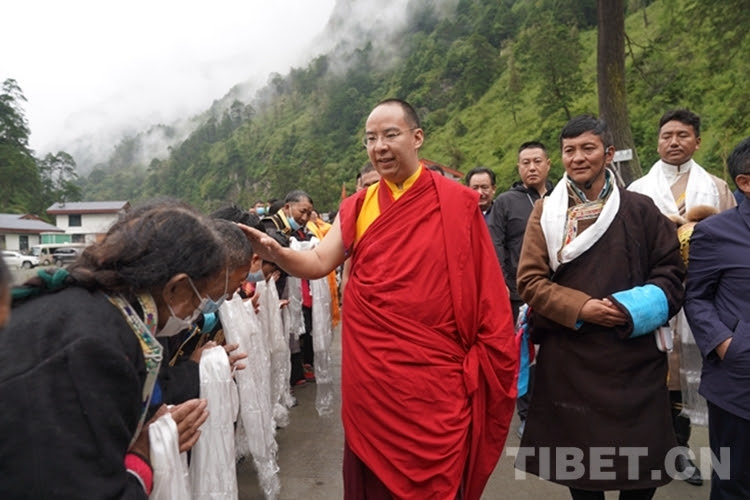
Chinese Panchen Lama visits an 'Indian' Village

On July 22, China Tibet Network posted an article announcing that the Chinese-selected Panchen Lama (Gyaltsen Norbu) visited a village on the Indian border: “Panchen: Guarding the border is a great cause,” was the title of the article.
It mentioned the name of a 71-year-old Tibetan lady “wearing new clothes, wearing new hats and holding white khatas eagerly waiting, with faithful masses, in the fine rain,” for the arrival of the Lama
The name of the village as given by the article is Lowa.
It is probably a Tibetan translation for Lho(pa)-wa, i.e. Lhopa tribe village.
But the newly-built village is in fact Longju, the site of the first bloody clash between India and China in August 1959.

The line depicted on this map is the approximative LAC in the area.
though Longju is south of the International Border (IB)

For decades, India has considered the place, where the new village is located, to be in Upper Subansiri district of Arunachal Pradesh and not in Tsari Township of Lhuntse county in Lhoka prefecture as mentioned by the Chinese.
"Knowing that Panchen Rinpoche was today going to visit our village for inspection, we waited at the entrance of the village early in the morning, looking forward to seeing Rinpoche as early as possible," said the lady.
The article added: “On July 21 in the morning, the Panchen Erdeni [Chinese name for Gyaltsen Norbu] a member of the Standing Committee of the National Committee of the Chinese People's Political Consultative Conference (CPPCC), Vice-president of the Chinese Buddhist Association and President of the Tibetan branch of the Chinese Buddhist Association, came to Lowa New Village.”
The narrative continued: “The new village lying quietly at the foot of the Himalayas became lively with a strong smell of mulberry smoke in the air; the masses of believers welcomed him, bowed and prayed.”

Gyaltsen Norbu being explained the history of Longju

 Wang Shu [Wangchuk], the secretary of the Party Branch of the new village gave an introduction to the Panchen Lama about the situation in the new village.
According to China Tibet Network, the new village is located on the border at 2,735 meters above sea level, 7 kilometers from the seat of the township government (Tsari/Migytun): “in the village, two-story small buildings are lined up, staggered and greenery is found in front of each house with flowers in full bloom, a vibrant scene.”
The article admitted that the ‘Lowa’ new village is part of the ‘relocation’ scheme and new inhabitants arrived on January 15, 2021. Since then, more than 90 families have moved in.
The village Party Branch Secretary showed the Panchen Lama around and explained the construction of the new village on an exhibition board showing the new village's relocation; the role of the villagers, living in well-off houses, who have to guard the border and improve the rural revitalization conditions as well as the industrial and ecological development of the area.
The local Party Secretary added: “In addition to the high standard construction of well-off houses, the Party and the government also invested in the supply of water, electricity, telecommunications and other infrastructure facilities as well as the construction roads. It is supporting the construction of bamboo processing plant, Tibetan incense plant, greenhouses and other special industries.”

Meeting the 'masses'
Gyaltsen Norbu asked: “How many children do you have? Where do the children go to school? Where are the teachers from?”
He later went into the first floor of the Village Committee House and visited two households “to talk to the masses of relocated households to understand their living situation after relocation.”
"Going around the village, you can see that our current housing, living and other conditions which are particularly good," said the villagers.
The Panchen Lama looked at the happy smile on the face of the border people and told that they were different from others; your tasks to guard the border: “it is a great cause, you should feel the Party's grace, listen to the Party, follow the Party, to do a good job in the new era of garrison people, continue to work hard to guard the territory of the motherland. I believe your future life will be even better.”
The article mentioned that in 2021, the per capita disposable income of the new village of Lowa reached 25,804.08 yuan. It is pure propaganda as the village did not exist a few months earlier.
But in 2022, the villagers' income has doubled and more prosperous days are ahead, said one of the villagers while guarding the border is not only “our unshirkable responsibility, but also our glory, we firmly believe that under the wise leadership of the Party and the State, the new village of Lowa will have a better tomorrow.”

Blessing the 'masses'

At the end of the inspection, Gyaltsen Norbu walked out of the new village on foot, touched the heads of the villagers and gave his blessings to the religious people lined up at the entrance of the village, and presented the religious people in the village with enlightened Vajra knots, dharma photos and medals.”
No photos of the Dalai Lama, of course.
The article concluded that after receiving the blessing from Panchen Lama, “still many religious people who did not want to leave for a long time.”
One of the villagers said: “I didn't expect Rinpoche to travel so far to visit us in the village. Before, I had only occasionally seen Rinpoche on TV, but I never thought I could see him with my own eyes in this life.”
With tears in her eyes, the old lady immediately enshrined the picture of Lama on the altar of her house after returning home.
Probably along with the photo with Xi Jinping.
It is pure propaganda to show that Longju belongs to China, and the Tibetans are given the freedom to practice their religion, but where are the stupa, the gompas, the prayer flags, the prayer mills in the new villages.
Nowhere, but is clearly a provocation in retaliation against the Dalai Lama's visit to Ladakh.
But a poor retaliation, for the Dalai Lama there was a 10-km line-up in Leh, in Longju hardly 20 people, representing the 'masses'.

Friday, November 12, 2021

Chinese village in Arunachal: India must speak up!

My article Chinese village in Arunachal: India must speak up! appeared in Rediff.com

'China wants to change the status quo of India's Northern Border and proves that it can do whatever it wants in what it perceives as its own territory,' states Claude Arpi.

Here is the link...

On August 28, 1959, the Indian Ambassador in Beijing sent a strong note to China’s Foreign Ministry, to protest the fact that Chinese troops had violated Indian territory; after mentioning other trespassing in the Tawang and Ladakh sectors, the note says: “Another serious instance of violation of the Indian border and unlawful trespass into Indian territory by Chinese forces has just been brought to the notice of the Government of India. On the 25th August a strong Chinese detachment crossed into Indian territory south of Migyitun on the NEFA [North East Frontier Agency] border and fired without notice on an Indian forward picket [of the 9 Assam Rifles]. They arrested the entire picket which was twelve strong but eight Indian personnel somehow managed to escape. Thereafter the Chinese detachment outflanked the Indian outpost at Longju and opened fire on it from a distance of about 800 yards.”
For Delhi, the Indian outpost was “well within our territory, about two miles south of the international border.” The protest note affirmed: “There could be no doubt about the international frontier in this area and this is a case of deliberate aggression on Indian territory.”
Delhi concluded that it had taken very serious notice of the incident.
Three days later, the Indian public discovered with stupefaction that India and China had serious differences on the border; Prime Minister Nehru reported the incident in the Lok Sabha …and mentioned the construction of a Chinese road in the Aksai China area of Ladakh. India realized that large chunks of Indian territory, several thousand square kilometres in the Aksai Chin, were under Chinese control. It was the first time that the Government had made the legislators and the Indian public, privy to the situation on the border. 

Xiaogang Village
Sixty-two years later, China has built one of its infamous ‘Xiaogang’ (‘well-off’) border villages, a few hundred meters from the place where the Longju incident took place in 1959.
Since 2015, Tibet is said to have built 965 Xiaogang villages and relocated 266,000 people, many on India’s border. Official Chinese statistics said that by the end of 2019, “Tibet had lifted 628,000 people out of poverty and delisted 74 county-level areas from the poverty list.” ‘’Lifting out of poverty’ is a euphemism for relocating thousands of Tibetans.
Longju now has one of such villages; it was reported by NDTV: China had built some 101 homes in the remote place of Upper Subansiri district of Arunachal Pradesh.
The TV channel acquired satellite imagery dated November 1, 2020; the images, analyzed by several experts, confirmed:“the construction, approximately 4.5 kms within Indian territory of the de facto border. [the McMahon Line]”
It is of huge concern to India, added the channel: “Though this area is Indian territory, according to official government maps, it has been in effective Chinese control since 1959 [which is not correct as we shall see]. However, earlier only a Chinese military post existed, but this time a full-fledged village that can house thousands has been built. The village, located on the banks of the River Tsari Chu, an area which has been long disputed by India and China.”
As we have seen, the new village is located near Longju, a highly symbolic place, which witnessed the first clash between India and China in 1959. Incidentally, it was five months after the arrival of the Dalai Lama in India and the attack on the Assam Rifles’ platoon seemed to have been a ‘punishment’ for granting asylum to the Dalai Lama.

Year 1956
The year of the Monkey-Fire was a special year; the young Dalai and Panchen Lamas were honoured guests of India on the occasion of the 2500th anniversary of the birthday of the Buddha, 1956 also witnessed another momentous event: the last Tsari Pilgrimage.
In the Tibetan psyche, Tsari has always been synonymous of ‘sacred place’. With the Mount Kailash and the Amye Machen in eastern Tibet, the pilgrimage around the Dakpa Sheri, the ‘Pure Crystal Mountain’ has, for centuries, been one of the holiest of the Roof of the World. The ‘Pure Crystal Mountain’ lies at 5,735 meters above the sea in the Tsari district, north of the McMahon Line.
Toni Huber, one of the foremost scholars on the subject, wrote a great deal about the site of the pilgrimage, between Tsari and today’s Upper Subansiri district of Arunachal Pradesh: “The large-scale, 12-yearly circumambulation of Tibetan Buddhist pilgrims around the mountain known as the Rongkor Chenmo, had the character of a state ritual for the Ganden Phodrang [Tibetan Government]. Pilgrims in this huge procession crossed the McMahon Line below the frontier village of Migyitun in Tsari district,” wrote Huber. After crossing the McMahon line, the procession would proceed southwards along the Tsari chu (‘river’) towards Longju and Maja, where an Indian Army post is today located and then turn westwards to follow the Subansiri, to finally cross back into Tibet to reach the first frontier village in Chame county.
The southern leg of the Rongkor procession crosses the tribal areas of Upper Subansiri. This was the territory of the Mara clan of the Tagin tribe who live downstream in the Tsari chu valley and around its confluence with the Subansiri at Gelensiniak.
It is most regrettable that this sacred place has today become the symbol of Chinese aggressive and hegemonic policies. The now-retired Gen Zhao Zhongqi, who headed the Western Theater Command till recently, probably made it a point to build this village on Indian territory, knowing that India would not know how to respond.

India continues to patrol
Let us return to history.
Throughout 1962, the Indian Assam Rifles continued to patrol the place. In a letter addressed by Nehru to his Chinese counterpart on December 1, 1962 (two weeks after the cease-fire), Nehru pointed out: “In Longju both Governments agreed that neither Chinese nor Indian personnel should occupy the village. However, it is known that Longju lies within the Indian side of the line of control, whereas Migyitun is on the Chinese side.”
A week later, the Chinese Ministry of Foreign Affairs in Beijing gave its own version: “Longju is a village in the Migyitun area, and India itself has admitted that Migyitun is situated to the north of the illegal McMahon Line. This village was invaded and occupied by Indian troops in June 1959, but was recovered by China after the armed conflict instigated by Indian troops in August 1959. Following that, China not only restored its administrative control over Longju, but also maintained a post there for a period of time.”
Beijing added that the Indian allegation that both sides had agreed that neither Chinese nor Indian personnel should occupy the village, was ‘pure fabrication’.
On December 19, 1962, Delhi strongly objected to China ‘very boldly’ saying that the Indian stand was ‘pure fabrication’, it requested Beijing to read again Zhou Enlai’s latter of December 17, 1959 addressed to Nehru, in which the former had stated: "Pending the above-mentioned agreement, the Chinese Government, in a conciliatory spirit and out of the desire to move towards the withdrawal of armed forces along the entire border, is prepared to agree first to reach a partial solution by applying the proposal you have made in your letter for the non-stationing of the armed forces of both sides at Longju to the other disputed places on the border as well."
During the following years, China started slowly creeping in, eventually a small border post in the area. Delhi kept quiet.
Today, China wants to change the status quo of the Indian Northern Border and proves that it can do whatever it wants in what it perceives as its own territory. It has serious implications elsewhere on the border, particularly in the Aksai Chin area, where Beijing has started exploiting the largest zinc deposits in the Middle Kingdom. If India does not object now, it will be too late in Aksai Chin too.
If China was really interested by peace, as it pretends in every international fora, it should reopen the Rongkor pilgrimage for world peace around the Dakpa Sheri, instead of opening new fronts against India.


Wednesday, June 30, 2021

The Queen of Yume: Implications for India


On the occasion of the 100th anniversary of the Communist Party of China (CPC), President Xi Jinping distributed a number of ‘July 1 Medals’ to people “embodying a staunch faith in the CPC.”
“Maintaining staunch faith is to stay true to the original aspiration and dedicate everything, even one’s precious life, to the cause of the Party and people,” Xi said.
One of the recipients was a Tibetan girl called Choekar (or Dolkar). She lives in Yume, in Lhuntse county of Lhoka City (Prefecture); she is already one of the 20 members representing Tibet at the National People’s Congress (NPC).
Important for India is that the place is north of Asaphila, one of the disputed places in Arunachal Pradesh (in Upper Subansiri district) and Lhuntse is the site of a soon-to-be-built airport (see my previous post, Thee new Airports near the Border pose threat).

How did Choekar reach this position?
This is rather strange that an unknown person of a remote hamlet comes so fast into pre-eminence, but it typically related to the Communist tradition of ‘model’ cadres, workers or soldiers.
But first a few words about the History of Yume village.
A year after the conclusion of the 19th Congress in November 2016, President Xi Jinping sent a letter to two young Tibetan herders, who had introduced their village, Yume, north of the Indian border, to the President.
According to Xinhua, Xi “encouraged a herding family in Lhuntse County, near the Himalayas [sic] in southwest China's Tibet Autonomous Region, to set down roots [sic] in the border area, safeguard the Chinese territory and develop their hometown.”
Xi acknowledged “the family's efforts to safeguard the territory, and thanked them for the loyalty and contributions they have made in the border area. Without the peace in the territory, there will be no peaceful lives for the millions of families." 

 What Choekar did for the border has never been clear, but never mind, the CPC’s Central Committee (and the Emperor) had decided.
The two Tibetan sisters, Choekar and Yangzom had told the CCP’s Secretary General in their letter about their “experiences in safeguarding the border area and the development of their township over the years.”
Interestingly, the girls’ village, Yume (or Yumai or Yulmed) is located a few kilometers north of the McMahon Line, not far from Asaphila and the remote Indian village of Takshing.
Xi had hoped that the girls’ family could “motivate more herders to set down roots in the border area ‘like galsang [Kalsang] flowers’, and become guardians of the Chinese territory and constructors of a happy hometown.”
The report also explained that Yume was the China's smallest town in terms of population.

Yume Village

Yume: 32 Inhabitants
Already in November 2016, China Tibet Online had mentioned Yume ‘town’ on the southern slope of the Himalayas, as the border area between China and India: "By road, you will have to drive 400 km south from Lhasa to Lhuntse, then there was another 200 km of muddy mountain roads before you reached Yulmed.”
The Chinese site then asserted that “It is the least populous administrative town in China. With an area of 1,976 km2, Yulmed has one subsidiary village, and only nine households with a total of 32 people. Yulmed has very few residents, but it is neither impoverished nor backward.”
Incidentally, Yume has today some 300 inhabitants (probably many of them Chinese).
The journalist added: “For a long time, there was only one family in Yulmed. After the Tibet Autonomous Region (TAR) government dispatched officials and doctors, built the roads, and added a power station and a medical clinic, Yulmed became more and more lively. In 2015, the annual average per capita disposable income in Yulmed was 26,000 yuan.”

Dakpa Shelri sacred mountain

The Pure Crystal Mountain Pilgrimage of Tsari
Not far from Yume is the Tsari Valley, one of the most sacred places in Tibet and the location for a famous pilgrimage.
China Tibet Online, a Chinese website thus praised the area: "Dzari (Tsari) Township, 2,800 meters above the sea level, is located in Lhuntse County of Lhoka Prefecture. Tsari means the holy mountain in Tibetan language. Hailed as the Tibet’s Shambhala, Tsari Township boasts its lush vegetation, moderate weather, still lake, running brook, vast forest, holy mountains as well as a satisfactory variety of herbs."
But Tsari has been more than just this.
It was once one of the most sacred pilgrimages in Tibet and the site of the first clash between the Chinese and Indian troops in Longju in August 1959.
One of the characteristics of this pilgrimage was that it was running across the Indo-Tibet border (the McMahon Line); half being in Tibet, half in NEFA (India).

Tsari Pilgrimage
Tsari has always been synonymous of ‘sacred place’ in the Tibetan psyche. With the Mount Kailash and the Amye Machen in Eastern Tibet, the pilgrimage around the Dakpa Shelri, the Pure Crystal Mountain has, since centuries, been one of the holiest of the Roof of the World.
The ‘Pure Crystal Mountain’ lies at 5,735 meter above the sea in the Tsari district of southeastern Tibet.
Toni Huber is one of the foremost scholars who wrote a great deal about this region from which the Subansiri and the Tsari chu (river) flow: “The area of the two rivers into which [Gen] Tsarong [at the beginning of the 20th century] ventured for military and commercial reasons had for centuries defined a very significant territory for both Tibetans and neighbouring non-Tibetans ”.
Huber describes thus the region:

“[these] rivers encompassed the southern slopes of the famous Tibetan holy mountain of Dakpa Shelri at Tsari. The large-scale, 12-yearly circumambulation of Tibetan Buddhist pilgrims around the mountain known as the Rongkor Chenmo, had the character of a state ritual for the Ganden Phodrang [Tibetan Government]. Pilgrims in this huge procession crossed the McMahon Line below the frontier village of Migyitün in Tsari district and followed the Tsari Chu southwards. They then turned back up the Subansiri westwards, crossing the McMahon Line once again to reach the first Tibetan frontier settlements in Chame district. In doing so, they traversed non-Tibetan lands during this entire southern leg of the procession. This was the territory of the Mra (Tibetan: Morang Loba) clan, which ran downstream along the Tsari Chu valley and around its junction with the Subansiri at Geling Sinyik, and also of the neighbouring Na (Tibetan: Khalo, Lungtu Lopa) community of Taksing, which extended upstream along the Subansiri heading westwards towards Tibet.”

The pilgrims went down the Tsari chu, past Migyitün which was recognised as the frontier of Tibet - to a place where the Tsari chu joined the combined waters of the Char, Nye and Chayul chus.
It is interesting to note that in the early 20th century, Migyitün was already considered to be the border with Tibet.
The McMahon Line, drawn a few months later (under the supervision of Capt Bailey, a British intelligence officer who had visited the area in 1913), only acknowledged this fact.
Bailey had noted:

“This was five or six days' journey. Then they turned up the combined rivers, towards Sanga Choling, which they reached about a fortnight later. Some pilgrims went very much slower, the minor official said; and I inferred there was merit in delay. The slower, the better.”

The terminus of the pilgrimage was Yume.

Longju Village on India's Territory

Tsari in the News for the Bad Reasons
Apart from the celebrity bestowed on Choekar, Tsari has been in the news when a few months ago, it was discovered that China had built one of its ‘Xiaogang’ (‘well-off’) border villages on the model of Yume, a few hundred meters within the Indian territory at the place where the Longju incident took place in August 1959.
Since 2016, Tibet has built 965 Xiaogang villages and relocated 266,000 people, many on India’s border. Official Chinese statistics said that by the end of 2019, “Tibet had lifted 628,000 people out of poverty and delisted 74 county-level areas from the poverty list.” ‘’Lifting out of poverty’ is a euphemism for relocating thousands of Tibetans.
Longju now is one of such villages; it was reported by NDTV that “China had built some 101 homes in the remote place of Upper Subansiri district of Arunachal Pradesh.”
The TV channel acquired satellite imagery dated November 1, 2020; analysed by several experts, the images confirmed: “the construction, approximately 4.5 kms within Indian territory of the de facto border [the McMahon Line].”
India should be seriously concerned, added the channel: “Though this area is Indian territory, according to official government maps, it has been in effective Chinese control since 1959 [which is not correct, it remained in India’s control for many more years]. However, earlier only a Chinese military post existed, but this time a full-fledged village that can house thousands has been built. The village, located on the banks of the River Tsari chu, an area which has been long disputed by India and China.”
The location of the new village of Longju is a highly symbolic; five months after the arrival of the Dalai Lama in India (March 1959), the Chinese attacked an Assam Rifles’ platoon; it was a first ‘punishment’ for granting asylum to the Dalai Lama.
Today, China wants to change the status quo of the Indian Northern Border and proves that it can do whatever it wants in what it perceives as its own territory. It has serious implications elsewhere on the border, particularly in the Aksai Chin area, where Beijing has started exploiting the largest zinc deposits in the Middle Kingdom. If India does not object now, it will be too late in Aksai Chin too.
If China was really interested by peace, as it pretends to be in international fora, it should reopen the Rongkor pilgrimage for world peace around the Dakpa Shelri, instead of opening new fronts against India.

Tsari Town

More about Tsari
On June 22, Chinanews.com mentioned about the duties of “the immigration management police.”
It seems a bad joke as there is no question of ‘immigration’ in this area.
The article said that the Network Information Office of the Tibet Autonomous Region (TAR) and the Tibet Entry-Exit Frontier Inspection Station jointly searched for ‘the Most Beautiful Frontier People’.
Of course, the Tsari area has many of them.
The article stated that the Tsari Border Police Station is “responsible for border prevention and control, public security and rescue tasks for this small town in southern Tibet, China. The police station is located at an altitude of 2,800 meters, and its jurisdiction has natural scenery such as virgin forests and meadows, which is a typical subtropical climate. The climate here is humid and rainfall is abundant,” wrote a reporter.
What were journalists from Beijing doing in this most remote areas of Tibet is a mystery; but there is no doubt that something is cooking up.
The reporter followed the immigration management police “into the primeval forest to experience their different patrol roads. In fact, there is no way to enter the primeval forest. Everyone walks carefully on the rotted branches and dead leaves. It is extremely difficult to go uphill and downhill, and beware of dangerous wild animals such as black bears from time to time.”
A policeman told the journalists that the patrol route is different each time, during their own visit “[as we did not go] too far, the equipment was simpler, usually for farther places, the load is about 40 kilograms,” explained the policeman.
The article said: “During this period, the wild strawberries on the mountain were ripe. During the rest, the immigration management police picked fruits to quench their thirst, wild fruits are a rare pleasure for them while patrolling the road to the border.”

Patrolling the Border

Another article on Tsari
Chinanews.com had published another article the previous day.
The reporter wrote: “Tsari Township is close to India, with an altitude of about 2,800 meters. There are dense virgin forests and occasional snow on the tops of the mountains. The climate is warm and humid. The misty town is like a beautiful picture scroll in the south of the Yangtze River.”
The article continued: “The rapid development of infrastructure and the rapid improvement of people's lives have made this border town in the deep mountains more and more active. Jin Xianwei, a police officer from the Lhuntse-Tsari border police station, who has been working here for 11 years, has a good memory of his experience when he first came to report: [it was] a 14-hour drive from Shannan (Lhoka) City to Tsari.”
After two years, Jin Xianwei had the opportunity to go home in China on vacation for the first time. Then, there was no regular bus; Jin explained that “cooking at the time, we had to burn firewood, and to pay phone bills, we had to but phone cards, there was no continuous power supply, meat and vegetables would always be damaged before being eaten. It's like a village in the interior of China that has gone backwards for many years. …since 2016, the development of this border town has pressed the fast forward button, from a static development to a hot development.”
This corresponds to the time XI Jinping wrote to the two sisters.
The policeman said: “Vegetables do not need to be collected once a month, and our table is more abundant. Online express shopping can send special products from the south and the north, and the most remote duty stations also have the Internet.”
Jin Xianwei thought he would work here until retirement; he hoped that the living conditions was getting better and better and the area becoming more and more prosperous.
Kesang Wangmo, a local villager explained to the reporter: “In recent years, subsidies for border residents in Tibet have increased manyfold, and the subsidies for frontier residents have risen to as high as 6,000 yuan per person per year.”
Kesang Wangmo pointed out that the Central and the TAR governments had decided to invest in the borders. She also believed that even without subsidies, many people would still protect their homes (against India?).

Patrolling the Borders

Xiaogang Villages
In 2017, the scheme of setting up well-off demonstration villages on the border of Tibet has been implemented and villages have come up one after another
Kesang told the reporter: “The houses are built uniformly, which is more spacious and beautiful. The pavement in the village is hardened, and there are street lights, which is much more convenient.”
Tsari Township, close to her beautiful home, is still undergoing infrastructure construction.
Another interviewee, Dechen Dolma said that “The roads used to be difficult, and it was usual for the mountain roads to be blocked by snow in winter. His elder brother once took his son to the county seat to study in the elementary school."

Now it takes 4 hours instead of 2 days earlier: “In the past, the township primary school was only up to the third grade. From this year, our children here can complete primary school nearby."
According to the article, the traditional income of Tsari comes “from grazing, digging wild medicinal materials and weaving bamboo utensils. In recent years, the central government and the local government in Tibet have made this area more and more open [to tourism], and it has also brought more opportunities to local herdsmen. …more and more people doing business in the local area, and more villagers have bought construction trucks and transport vehicles, and private cars have also become family vehicles.”
Han tourists will soon flood this area ... and bring prosperity according to the Chinese propaganda.

Conclusions
There is no doubt that infrastructure development is going on full swing in the highly strategic area of the Indian border.
The need of the hour is not to ‘wait and watch’, a formula often used by Indian government officials, but to develop the border areas, in particular the Upper Subansiri district and provide decent roads, good schools and proper communication facilities to the local population. Agriculture (fruits) and arboriculture could also easily be developed and bring good recenues. 

Perhaps only mindsets of the local babus need to change. 

This is not an easy task, but let us not forget that the airport will soon serve the other side of the border.


Some photos of Chinese patrols in Asaphila area, south of Yume. Note that it is not Choekar and Yangzom who are patrolling the border.
Their role seems to be tourist guides (for Han visitors), more than 'Guardian of the Sacred Border'.

Tourists already arrive in Yume

Patrol in Asaphila Area


Saturday, October 1, 2016

Did Xi Jinping acknowledge the McMahon Line?

Yume village becoming a town
Soon after the conclusion of the 19th Congress, President Xi Jinping wrote a letter to two young Tibetan herders who had written to him introducing their village, Yume, north of Upper Subansiri district of Arunachal Pradesh.
According to Xinhua, Xi “encouraged a herding family in Lhunze [Lhuntse] County, near the Himalayas in southwest China's Tibet Autonomous Region, to set down roots in the border area, safeguard the Chinese territory and develop their hometown.”
Xi acknowledged “the family's efforts to safeguard the territory, and thanked them for the loyalty and contributions they have made in the border area. Without the peace in the territory, there will be no peaceful lives for the millions of families," he wrote.
The two Tibetan girls, Choekar and Yangzom had told the CCP’s Secretary General about their “experiences in safeguarding the border area and the development of their township over the years.”
Interestingly, the girls’ village, Yume (or Yumai or Yulmed) is located a few kilometers north of the McMahon Line, not far from the remote Indian village of Takshing.
Can this letter from Xi Jinping be considered as an acknowledgment of the McMahon Line, as the Indo-Tibet border? Xi clearly thanks the two herders for 'guarding' the border?
From the reporting of Xinhua, it seems so.
Xi further hoped that the girls’ family could “motivate more herders to set down roots in the border area ‘like galsang flowers’, and become guardians of the Chinese territory and constructors of a happy hometown.”
Galsang or Kelsang Flower
The report also xplained that Yume is China's smallest town in terms of population.

Yume on this blog
I had mentioned Yume several times on this blog, mainly because Yume Gompa was the last stage of the Tsari pilgrimage (see map below).
Already in November 2016, China Tibet Online spoke of Yume ‘town’ on the southern slope of the Himalayas as the border area of China and India: "If driving, you had to go south 400 km from Lhasa to Luntse of Lhoka (Shannan) City, then there was another 200 km of muddy mountain roads before you reached Yulmed.”
The Chinese site then asserted that “It is the least populous administrative town in China. With an area of 1976 square km, Yulmed has one subsidiary village, and only nine households with a total of 32 people. Yulmed has very few residents, but it is not impoverished nor backward.”
It added: “For a long time, there was only one family in Yulmed. After the Tibet Autonomous Region government dispatched officials and doctors, built the roads, and added a power station and a medical clinic, Yulmed became more and more lively. In 2015, the annual average per capita disposable income in Yulmed was 26,000 yuan.”

Four conclusions
By Xi Jinping admitting that Yume is a 'border' village, can it be concluded that Xi has acknowledged the McMahon Line? Probably not, but he has admitted that it was the present border (Line of Actual Control).
Another issue that I already brought up earlier on this blog: why not reopen the Tsari Pilgrimage and use it as a Confidence Building Measure between India and China?
Another conclusion is that China will develop very fast the 'border' areas in the years to come, I have often mentioned Metok County, but also Lepo village, north of Khenzimane on the McMahon Line.
Finally, it looks like the Communist Party has started to more and more use Tibetans in border areas and elsewhere yo defend the Middle Kingdom’s borders.
Delhi should be worried!


(Old Post of October 2016)

Visit Wu Jingje in Yume
Earlier in April 2016, I had mentioned the visit of TAR’s Party Secretary Wu Jingje

According to The China Daily, Wu Yingjie, the Party Secretary of the Tibet Autonomous Region, visited Yümé (or Yumai) ‘the most sparsely populated town in China’ on October 12.
The village (termed as a 'township' by China) is located north of the McMahon Line (and the Upper Subansiri district of Arunachal).
It is a border village with India.
The China Daily reported that Wu met frontier troops in the remote area: “[Wu] conducted a field survey on how to promote development and stabilization of the border region, people's livelihood, grass-root-level Party building and poverty alleviation.”
The Chinese publication adds: “Setting out from Lhasa, capital of Tibet Autonomous Region, you must drive 400km to reach Lhunze [Lhuntse] county, Shannan city [in Lhoka] and another 200km muddy mountain road to reach the township.” The ‘township’ covers an area of 1,976 square kilometers and has one village comprising nine families …and 32 people.
Wu Yingjie told the local residents: "You defend the border areas of our country and protect our country from being nibbled or divided. I salute you."
A flag raising ceremony was held in Yümé on the occasion of the Party boss.
The China Daily notes: “Frontier soldiers and local residents patrol in the township. Every resident of the township has a strong awareness of border defense and make it part of their life,” adding  “Though far away and less populated, Yumai township is not under-developed. It once had only one family. Then cadres and doctors were dispatched there by the government and the road, power station and health center were built to make it more suitable for living. By 2015, the residents' per capita disposable income reached 26,000 yuan ($3,838).”
Who is to verify this?
On October 28, (two weeks after the visit to the border), Wu Yingjie presided over a meeting 'to deliver the spirit' of the just-held Sixth Plenum.
After calling everyone to closely unit 'around Comrade Xi Jinping as the core', Wu noted that the Central Committee was "very concerned about Tibet Autonomous Region and its people of all ethnical groups".
He mentioned "the important strategic thought: governing border areas is the key for governing a country, and stabilizing Tibet is a priority for governing border areas". Later, he gave "important instruction for enhancing ethnic unity, building a beautiful Tibet”.
The Yümé's visit should be seen as a pre-Plenum inspection tour.         
Interestingly, Yümé is located in the vicinity of Lo Mikyimdun or Mygytun, the place where the first clash between the People’s Liberation Army and the Indian troops took place in August 1959.


In a Note given to the Ambassador of India on September 1, 1959, the Ministry of Foreign Affairs of China blamed India for the clash:

Extract from White Paper II on China: 

According to verified investigation conducted by the Chinese Government it is confirmed without any doubt that the armed clash between Chinese and Indian troops which occurred on August 25 1959 in the southern part of Migyitun in the Tibet Region of China was solely caused by Indian troops unlawful intrusion into the Migyitun area and their unwarranted provocative attack on Chinese troops. The facts pointed out in the Note of the Ministry of Foreign Affairs handed over to the Embassy on August 27 were true and established.
The Indian troops must bear full responsibility for this serious border incident. The actual fact was as follows: Around 06-00 hours on August 25, when Chinese troops were patrolling in the southern part of Migyitun, a group of Indian troops which had intruded into that area suddenly opened fire on the Chinese troops without giving any warning, discharging dozens of rounds of machine-gun and rifle shots. Only after the Chinese troops under compulsion fired back in self defense, did the Indian troops withdraw from the area of clash. The Chinese troops then neither arrested any Indian soldiers, nor out-flanked any out-post of the Indian troops at Longju. But in the morning of the next day, that is, August 26, the Indian troops at the Longju out-post went further in carrying out new provocations, once again launching a violent attack on the Chinese troops in Migyitun discharging as many as several hundreds of rounds of rifle sten-gun and light and heavy machine-gun shots. On the same day, Indian aircraft many times violated China's air space over this area. At the time the Chinese troops merely held their own posts; they did not strike back against the Indian troops' provocation, not to speak of so-called encircling Indian troops’ outpost at Longju.”
This is of course, the Chinese version.
The area was also part of the Tsari Pilgrimage often mentioned on this blog.
Toni Huber in his The Cult of Pure Crystal Mountain — Popular Pilgrimage and Visionary Landscape in Southeast Tibet described the ‘Administration and Community Structure’ of the area before the Chinese invasion.
During the 1950s the Tsari District had an estimated population of five to six hundred persons. It was grouped predominantly within extended family household units in four main village communities (Yümé, Chosam, Chikchar, and Lo Mikyimdun) and three minor settlements (Domtsen, Yarab, and Phodzo Sumdo). There were also small monastic and retreat communities at Yümé and Chikchar and a nunnery near Lo Mikyimdun. Various other localities around the mountain were only seasonally occupied or used by resthouse keepers, meditators, pilgrims, or local pastoralists.
Although the district was small in total area and population compared to many others in Tibet, it came under a complex civil and religious administration. Tsari fell within the area of Central Tibet (Ü), being located right at its southern margins.
It was subject to the authority of the Lhasa government by way of the system of regional Dzong, or administrative centers, several of which were located in neighboring districts. At the district level there were three divisions: Tsari Nub, or ‘Western Tsari’; Tsari Shar, or ‘Eastern Tsari’; and the Lo Mikyimdun-Tsar Tsokar area. Each division had different administrative regimes. In relation to the central government, all three fell under the overall control of Kurab Namgyel Dzong, located in the Drulung valley of Dakpo to the north.
The Dzong had interests in collecting taxes; control of access to grazing land; law enforcement and defense; the transmission of various government decrees from Lhasa; and their execution in the districts, for example, the policing of religious environmental restrictions. Tsari Nub also fell under the religious administration of the Drigung sect, who had some historical rights over certain religious sites and lands in the area. Tsari Shar and Lo Mikyimdun fell under the religious administration of the Sangnag Choling Drukpa of Char, who maintained the temple and retreat center at Chikchar, oversaw affairs at Tsari Tsokar, and enjoyed some rights over certain lands and persons. Accordingly, many of the people in these districts identified themselves as either Drigung or Drukpa. In addition, the area of Lo Mikyimdun had another level of government control, mainly involving certain tax obligations, imposed on it through Kyemdong Dzong located not far to the north at the Kongpo-Dakpo border.
The interface between central government interests at Tsari and each community was maintained via the village headman. This person communicated with the Dzong and the monasteries when needed, as well as acting as intermediary between them and the local households. He (for they were always men) represented the interests of all the main village households, as well as those of the Dzong, by ensuring that taxation dues were paid; that festivals, religious ceremonies, and service duties were conducted as per tradition or contract; that government decrees were communicated and observed, and that disputes were referred to higher authorities. In return for these services he received a modest annual payment of grain from the Dzong. The local headmen were either called chimi (‘leader’) or thumi (literally ‘representative’),and their ‘deputies’ were called thuntsob; the terminology reflected the fact that they were usually elected by each village rather than appointed from outside.
In principle, such positions were supposed to change every two to three years, and candidacy depended on one's reputation for being a strong man, someone who could organize and direct people to do things when need be, and work effectively with external officials. There were variations in this system. For example, in the 1950s Lo Mikyimdun rotated the position of headman every few years among its even main tax-paying households, and at Chikchar the Sangnag Choling Drukpa, who often cooperated with Lhasa in running affairs at Tsari, assigned the job to the senior cleric at their retreat center there on the sudden death of the former representative.
All the senior heads of the main full member status households worked closely with the headman as a group or council for decision-making and organization at the level of the village as a whole.

Monday, July 22, 2013

They went with bows and arrows

It started with the Tibetan uprising
Year 1959 has been crucial for the Sino-Indian relations, first and foremost because the uprising in Tibet (March 10) and the subsequent flight of the Dalai Lama to India.
No doubt that the refugee status offered by Nehru to the Tibetan leader and his followers angered the Communist regime in Beijing.
For Mao and his colleagues it was the worst slap that they could get in the face; after pretending  to have ‘liberated’ Tibet for 8 years, the ‘masses’ revolted against the occupiers and left the Roof of the World to accompany their leader in exile.
On my website, I have uploaded a large numbers of documents related with the events of 1959. You can consult them.
On this blog, I have recently posted the fascinating transcript of the first encounter between the Dalai Lama and Nehru in April in Mussorie.
Today, you will find another interesting document which is the transcript of a press conference held by the Indian Prime Minister in Delhi on September 11.
Some comments are required.
As an introduction, the Prime Minister speaks about radio ‘jamming’ along the border with China.
Of course, the Chinese are doing much better today and ‘jamming’ is only a tiny part of the present cyberwar.
At the beginning of the press conference, Nehru informs the journalists that the Secretary of Ministry of Information and Broadcasting has no authentic information about the jamming.
Today, we would surely get a similar answer about cyber attacks.
It has to be noted that the Prime Minister gives this long press conference between 2 sessions of the Parliament. He himself mentions: “I spoke yesterday on this and I am likely to speak tomorrow in the Lok Sabha”.
If such press conference was held today, the Opposition would rightly scream that the Prime Minister has no business to speak when the House is in session. But Nehru was then above these details.
At the outset, Nehru repeats his argument about the McMahon Line: he does know who initialed it, but speaks of notes attached explaining ‘specific points’ (“this place is on this side of the line or that side of the line”).
This is not really the case, except for 3 requests made by Lochen Shatra, the Tibetan plenipotentiary, to Sir Henry McMahon, the two emissaries just signed the map. There is just a short covering letter; in any case, the Chinese were not part of the deal.
About the Line, Nehru speaks of minor changes which were then ‘suggested for practical reasons’. It has never appeared in the correspondence with Beijing, though Nehru speaks of “a Buddhist temple, which was slightly on this side, India's side; but it was greatly valued by Tibetans; so it was put on the Tibetan side”.
This is rather vague, though one can presume that he refers to the Tsari pilgrimage in Upper Subansiri area. The 1914 Simla bilateral agreement between India and Tibet suggests: “The sacred places of Tso Karpo and Tsari Sarpa fall within a day’s march of the British side of the frontier, they will be included in Tibetan territory and the frontier modified accordingly.”
It was one of the 3 points made by Lochen Shatra.
No other agreement exists and once again China was not in the picture (as they had not invaded as yet).
A journalist then requests the Prime Minster to clarify a statement made the previous day in the Lok Sabha (in which Nehru said that Zhou Enlai, the Chinese Premier, thrice accepted the McMahon line in the course of a meeting with Nehru in 1956). “Were things written down?”, asks the journalist.
The Prime Minister answers: “No. Subsequently, long afterwards, I did send him [Zhou] an extract from it.”
With no official bilateral records, it was easy for the Chinese Premier to later repudiate what he had said.
Worse, in early September 1959, (a few days before the press conference), Zhou had written to his Indian counterpart, claiming parts Indian territory in NEFA on the basis of some earlier claims made by the Tibetan government in 1947. Nehru replies that as far as he remembers, it was “some petty areas in dispute on the border… I would not like to answer it because I have not referred to it again and this is the old impression when we were busy with Independence and all the change-over.”
Well, busy or not, this was an important issue and it was wrong to have not tackled it at that time.
Regarding Longju, which had been attacked by Chinese troops a few weeks earlier, the Prime Minister explains that the border “was not strictly delimited or marked. And, as you know, it is mostly in areas where no human beings dwell; may be some do very occasionally, in a very small village somewhere; but broadly speaking, no people live there”.
The Longju incident is dealt in details in the White Paper I, which can be downloaded from my website.
When one journalist asks: “listening to your speech yesterday, one got the impression that you were trying to make a fundamental difference between Soviet communism and Chinese communism”, Nehru denies having mentioned this topic during his intervention.
When someone asks the Prime Minister about ‘changes’ in China, Nehru misunderstands the question, though interestingly, he admits that the changes in Tibet have triggered a change in China’s attitude towards China: “it has angered and irritated them”.
The uprising in Tibet clearly marks the end of the Hindi-Chini Bhai-Bhai; during the following months and years, the relation between Delhi and Beijing would harden more and more, till the fatal day of October 1962.
When a correspondent raises the issue of India’s allies: “if in case of war, will India seek allies in the large world?”, the Prime Minister is furious, he retorts: “Just don't think vaguely; think precisely and think a little definitely. It is one thing to have friendship of countries, it is another thing to have military alliances and the like,” and he concludes: “I hope, our country will not suffer that weakness of character.”
Well, three years later, in one day (November 19, 1962), Nehru sent 2 letters begging Kennedy for military help; that was weakness of character.
When someone asks about “violations of the NEFA border and pressure on NEFA than you were pleased to disclose” Nehru gets upset: “Is that an indirect refection on my integrity, or what?”
Prime Minister adds: “I can't obviously say with certainty that there has been no straying of some personnel across the border. I believe there has been once or twice, but not exactly military personnel; because, in some areas, there is no demarcation… That might happen anywhere. But I do not think that we have kept secret any marked incursion across the border”.
A day later, Nehru would disclose the big one, the Aksai Chin.
Again, he mentions that Zhou Enlai’s latest letter “showed a certain hardening of attitude” and adds: “And it is always serious thing when in a controversy, any country digs its toes in.”
When asks if the government has decided to provide “weapons of offense to the Indian troops”, the Prime Minister quips: “What do you think? They go about with bows and arrows?” And he really gets upset with the journalist: “Well, you are an expert at it!”
The fact is that 3 years later, the Indians jawans had not much better than bows and arrows.
Nehru acknowledges a statement issued by the Tass agency, showing that Soviet Union sides with India against China: “Considering everything, it was a very fair statement, and an unusual statement for the Soviet Government to sponsor.”
It was part of the bitter power struggle between the two fraternal Communist countries. It was a way for Khrushchev to put Mao down.
When a journalist inquires about a possible mediation between India and China, Nehru says: “You can't make these small matters increase their importance and ask other countries to mediate – ridiculous.”
He then advises the journalists to consult the Chinese maps claiming part of the Indian territory; Nehru had made them available to the Members of Parliament and he proposes to provide a copy to the press.
A correspondent raises an amusing question about the rumour that General Ayub has offered military aid to India in case the country is invaded by China, Nehru just says: “It has not reached me - the report. Highly unlikely, if you say anything like that.”
Regarding the Tibetan question being taken to the United Nations, the Prime Minister reiterates his arguments for being against; first and foremost, “Tibet has not been recognised by any country, practically speaking, as an independent nation. Therefore, it has no independent status there. From that point of view, therefore, you cannot deal with it, as if an independent nation comes to you.”
A few months later, the Dalai Lama nevertheless took the issue to the UN where he obtained a relatively successful resolution.
The Prime Minister still believes that what has happened in Tibet was deplorable, but: “this world is full of deplorable things about which perhaps, as an individual, one might do something ….A country, although, supposed to be much more powerful than the individual, has to function in a more limited sphere, the Government of a country, anything.”
In another words, India can’t do anything for Tibet.
His conclusions are: “the seriousness of the situation is not some border trouble, a mile on this side and a mile on that side, but the growing feeling of estrangement, irritation and sometimes anger, on both sides.”
Nehru philosophically explains: “The moment you get that, whatever the rights and wrongs of a question might be, the moment you get that, you have got into the wrong atmosphere, you lose your moorings, mental, psychological. You are excited, passionate, angry and it is not a good thing for a country or a people to become that.”
The Prime Minister would remain calm and dispassionate during the three next years, but in 1964, he would eventually die of the blow inflicted by China in October 1962.


Indian Prime Minister’s Press Conference on China

New Delhi, September 11, 1959

Among the points suggested by correspondents for discussion at the Press Conference was “Jamming of Indian news broadcasts by China":

Prime Minister: There might have been, I have no precise information. I am told by Mr. Ramadhyani (Secretary, Ministry of Information and Broadcasting) that he has no authentic information about it. In fact, he is inclined to think there is no jamming. There might be sometimes, nobody can say. There is no regular jamming.
***
Prime Minister: We will go on to the India-China issue. There is not really very much for me to say, unless you want to ask me a question, because I spoke yesterday on this and I am likely to speak tomorrow in the Lok Sabha.
Question: Could you tell us where the definitive map of the McMahon line is and who initialed it?
Prime Minister: We have got maps in our Ministries; I don't know where else they are - may be elsewhere too. I cannot at the moment say who initialled it; but we have got notes attached to it, explanation notes by McMahon and others who worked with him, and there specific points are mentioned - this place is on this side of the line or that side of the line. You see, the broad approach was, I think, to get at the water-shed - make that the dividing line - waters flowing towards India, waters flowing towards China. In one or two places, the names I forgot, some minor changes were suggested for practical reasons. For instance, there was a Buddhist temple, which was slightly on this side, India's side; but it was greatly valued by Tibetans; so it was put on the Tibetan side. I think it was not McMahon, it was subsequently agreed.
Question: Yesterday in your speech in Rajya Sabha you said that Chou had repeated thrice his acceptance of the McMahon line in the course of his conversations with you in 1956 and that you did not entirely rely on your memory, but had those things written down. Did you exchange those written notes with Chou?
Prime Minister: At that time?
Question: Yes, Sir.
Prime Minister: No. Subsequently, long afterwards, I did send him an extract from it; it appears in the White Paper. I did not at that time send it to him.
Question: When was that extract sent to him?
Prime Minister: It is given in the White Paper - in one of my letters.
Question: Were the minutes of the talks confirmed by Chou En-lai?
Prime Minister: No; I am telling you I did not send him the minute. The minute I wrote was for record in our own Ministry and for our Ambassador etc., in Peking to be informed about it; but it was not sent to Mr. Chou En-lai.
Question: Even now, I don't think Mr. Chou En-lai has specifically repudiated that talk.
Prime Minister: No; that is true.
Question: Mr. Chou En-lai in his letter referred to telegrams sent by the Tibetan Administration in 1947. Have you got these or studied these telegrams or is it just…
Prime Minister: I had not seen it recently; but I have a vague recollection and in examining Chou's letter we tried to find these things out. But I have a vague recollection that a telegram did come to us at the time we were becoming independent. As far as I remember, at any rate the impression created in my mind was not about any major change there; but about some petty areas in dispute on the border. There had been disputes before; but I would not like to answer it because I have not referred to it again and this is the old impression when we were busy with Independence and all the change-over.
Question: Yesterday you made an offer of neutralisation to China over Longju. What will be the position if the Chinese refuse to quit Longju? What will India do, if they refuse to evacuate?
Prime Minister: As a matter of fact, I believe, the Chinese say that they are not actually in possession of Longju - may be round about it. The distances are very small. According to us, Longju is just on this side of the border. It is marked so in the map we have and it is the factual position. A little way round about there, presumably are Chinese forces; a little to the south of that, possibly, small Indian detachments - on our side, pretty small. We will have to see what developments take place, but obviously we want to avoid a show of force to push this or that, because one thing acts and reacts. This has been the first time, at Longju, that this firing took place between the Chinese and Indian detachments.
Question: Could you kindly throw some light as to what precisely was the Sino-Tibetan border before the 1914 treaty? Did the McMahon line, by and large, confirm a traditional border?
Prime Minister: Well, the idea was that it confirmed some kind of a border; but it was not strictly delimited or marked. And, as you know, it is mostly in areas where no human beings dwell; may be some do very occasionally, in a very small village somewhere; but broadly speaking, no people live there; or, if people use it, they use it in summer for grazing purposes, retiring in winter. So, there was no urgent need for anyone to define it accurately, neither for the Tibetans nor on this side. But I could not answer your question very precisely.
Question: Is Longju a city, or a village? What is the population of this place?
Prime Minister: I suppose it is a very small village with a few huts.
Question: In the light of your statement yesterday in the Rajya Sabha that Premier Chou En-lai's recent letter has shaken confidence in the assurances and words of either side and the presence of large Chinese forces in Tibet, do you envisage any large-scale change in our defence expenditure vis-a-vis our future planning? .
Prime Minister: No, I do not and I hope not.
Question: Listening to your speech yesterday, one got the impression that you were trying to make a fundamental difference between Soviet communism and Chinese communism. Will that impression be correct?
Prime Minister: I thought I did not refer to either. I do not think, as far as I remember, that I used the word 'communism' in the whole course of my speech.
Question: But there was some reference to it.
Prime Minister: I said nothing about communism. I do not think communism has much to do with it.
Question: Yesterday you said something that these things may be happening because of internal happenings in China. But you did not elaborate on it. Can you say what internal changes you had in mind?
Prime Minister: Are you referring to that minor event that happened ten years ago, the Chinese Revolution, or what?
Question: You were saying yesterday that gradually, step by step, there had been a change in the Chinese attitude.
Question: Some internal changes…
Prime Minister: That was only a remark. Various factors have produced certain results, and one, I actually said, was may be, what has happened in Tibet and our reaction to it. I said that it has angered and irritated them; and there may be other factors.
Question: Could you say something about the possible conflict of views in the leadership of China?
Prime Minister: How do I know about it? Many of you talk about conflict of views in the leadership of India!
Question: In the Lok Sabha, the other day, you said that though you do not expect a war with China, one must be prepared for any eventuality. In case of war, will India seek allies in the large world, is there is a full-scale attack from China?
Prime Minister: That is a very interesting question. I should like you, for your own benefit, just to think and answer it for yourself. It is interesting because I just don't see what I can do about it. Just don't think vaguely; think precisely and think a little definitely. It is one thing to have friendship of countries; it is another thing to have military alliances and the like. One does not know, if the whole world is at war, what might happen. That is a different matter. But this vague thinking of searching for allies is a sign of utter weakness of character in an individual and in a nation. I hope, our country will not suffer that weakness of character.
Question: As a result of this Khampa revolt in Tibet, there have been many more violations of the NEFA border and pressure on NEFA than you were pleased to disclose. Is it not true?
Prime Minister: Is that an indirect refection on my integrity, or what?
Question: Probably, you might not have sent diplomatic notes about them because they were of a minor nature.
Prime Minister: No; I do not think that is a correct statement. I think that we have in recent weeks disclosed this. I can't obviously say with certainty that there has been no straying of some personnel across the border. I believe there has been once or twice, but not exactly military personnel. Because, in some areas, there is no demarcation. A survey party or somebody comes across and once or twice they came across into the Indian territory and they went back. That might happen anywhere. But I do not think that we have kept secret any marked incursion across the border.
Question: In your Rajya Sabha speech, you referred to the letter of Mr. Chou En-lai in some grave terms and indicated that a grave situation has arisen. Would that mean that you would be able to undertake your visit to these countries (Afghanistan and Iran) in the next few days, or stay back?
Prime Minister: I am certainly going to Kabul and Teheran in three days' time. What has that got to do with it? That is taking an extraordinary, alarmist view? When I referred to the letter in same serious terms, it was not because I expected some remarkable development quickly or even later, but that the letter showed a certain hardening of attitude. And it is always serious thing when in a controversy any country digs its toes in. Then, it becomes a question of prestige, how to undig or pull out your toes. In that sense, I said, it is a serious matter, but I do not expect at all any sudden development which would lead to any kind of conflict, even a small one.
Question: Is it in pursuance of this belief that you are not issuing any weapons of offence to our Indian troops?
Prime Minister: What do you think? They go about with bows and arrows?
The Press Correspondent: There is a lot of difference between weapons of defence and weapons of offence.
Prime Minister: Well, you are an expert at it!
Question: What was your assessment, of the Communist Party's attitude towards this controversy - yesterday's speech by the Communist spokesmen?
Prime Minister: The Communist Party of India? There is no question of assessment. Anybody can make his assessment. One felt that they were in an embarrassing position. That is the main assessment.
May I say one thing - it is really worth your attention - the statement that was issued by the Tass agency yesterday presumably representing the Soviet Government's view. Considering everything, it was a very fair statement, and an unusual statement for the Soviet Government to sponsor.
Question: May I invite your attention to your statement in the Lok Sabha about wrong Chinese maps being circulated. Now Mr. Chou says his maps are right. Does it show an attitude of imperialism on the part of China?
Prime Minister: This is an argument.
Question: Your comment on the Soviet position?
Prime Minister: I appreciate it very much.
Question: In your speech yesterday you mentioned that something had happened because of the change of policy in China. Were you referring to the Tibet part only or to internal changes inside China itself?
Prime Minister: I cannot tell you what I had in my mind at that time. But I should imagine all these things inside also were somewhere at the back of my mind.
Question: You referred to the Tass statement which reminds me of your statement in the Lok Sabha yesterday that you would welcome mediation by parties acceptable to both China and India.
Since some of those possible mediators have already accepted and published officially the maps as in China Pictorial, would it be possible for this country, to envisage mediation by countries which may be slightly different, say some of the Bandung countries?
Prime Minister: When I talked about mediation, conciliation etc., I was thinking about a number of small border disputes. Some of them are old disputes going back to the days when the British Government functioned here - small disputes about two miles, three miles here, a village here, a meadow there. They had no great importance in those days because neither party attached much importance to that area. But these were continuing small disputes. They are those which have become important now because of various developments. Of course, every party now is very much conscious of that border and frontier. Previously they were not, they took it for granted. They have become important. I really was referring to that. When I talked about mediation, I was not thinking of inviting any country, Bandung or other. It is a small matter. Normally what is done is, each country affected appoints a representative to discuss and those representatives choose, may be, a third and they sit down and deal with the matter. You can't make these small matters increase their importance and ask other countries to mediate - ridiculous.
We resort to some procedure, whatever it may be. But the bigger question - I had not spoken of the bigger question that is of large areas which are shown in the Chinese maps. That I had not in mind then.
Question: Do you share the view of the President of the Indian National Congress that Communists in India are potential fifth-columnists? The statement in Moga…
Prime Minister: Look here, do you want to create family quarrels? (Laughter). It is always unsafe to make general and sweeping statements, even though the statements may have a grain of truth in it.
Question: You have promised Parliament that you will make available in the library maps which show places involved in the border incidents. Would it be possible for a copy to be made available to the Press?
Prime Minister: Well, the maps we have placed in the library of Parliament are four or five. One is a Chinese map, a wall map which shows these frontiers according to China. But, really, unless you know Chinese it is little good to you. You won't understand it. Then, we have placed two copies of Chinese periodicals giving that map on a smaller scale. You probably have seen it. Some of you might have seen China Pictorial and others. We have also placed a map of India, one of our maps, indicating where the Chinese map comes in the border and indicating the passes etc. I will find out from my Ministry what can be done to provide you with this assistance to understand this border.
Question: Have the Chinese explained anywhere where exactly is the boundary?
Prime Minister: No. Not in all the correspondence anywhere. We will go to the next subject. There have been too many questions on one item.
Question: About Bhutan and Sikkim, yesterday you avoided any reference to Mr. Chou En-lai's statement in that connection, in his latest letter. Would you comment on that portion?
Prime Minister: No, no. I would not comment on that question. There is nothing to comment really. If I say anything I will say it tomorrow.
Question: There is a report going about that General Ayub has offered military aid to India in case India is invaded by China. Is there any basis of truth in it?
Prime Minister: It has not reached me - the report. Highly unlikely, if you say anything like that.
Question: One question on Tibet. You said several times that taking the Tibetan question to the United Nations will not do any good. In view of the strength of feeling of the Dalai Lama, could you say what harm you think it will do?
Prime Minister: I have mentioned two reasons, because in my view - and I have been advised by people who know better these things - procedurally and according to the Charter it cannot be brought up there. Of course, you may go beyond the Charter or anything, but Tibet has not been recognised by any country, practically speaking, as an independent nation. Therefore, it has no independent status there. From that point of view, therefore, you cannot deal with it, as if an independent nation comes to you.
On the other hand, the other part may be on the basis of human rights. Possibly, the fact that China is not a member, has not accepted the Charter or the Human Rights Declaration, or indeed is not in the United Nations at all, also makes it difficult to do that. But the real answer, I think, to your question is not a legal or procedural one, but what good or harm it might do. Obviously, it cannot lead to any positive results, as far as I can see, except strong speeches. Now, if you think that those strong speeches are going to result in achieving any objective, I do not see it. Tibet immediately becomes, even more than it is, the Tibetan question, a part of the cold war; and everything that becomes a part of the cold war becomes in that context more insoluble than ever till some wonderful, sea change comes over all the world. Instead of bringing relief to Tibet or the people of Tibet it actually may have the opposite effect.
Question: What shall be India's attitude if some other country sponsors Tibet's case in the United Nations?
Prime Minister: I have told you and I have announced publicly what we think about it. It may depend on what comes up, in what form it comes up. There are so many things. But our views are quite clear about it.
Question: You told the Lok Sabha last week that no doubt many things have happened in Tibet which are deplorable. Is there anything that any outsider can do in this respect? Is there anything that can be done from the outside?
Prime Minister: I do not know if an outsider - an individual, or a group or a country - can do anything. It is difficult to answer that question. This world is full of deplorable things about which perhaps, as an individual, one might do something, at any rate, I might say, in the shape of protests and dissociation and at that. A country, although, supposed to be much more powerful than the individual, has to function in a more limited sphere, the Government of a country, anything.
One thing I should like to say. We began today with discussing the India-China question. I do not think, and I told you, that anything big is going to happen in the foreseeable future, because I cannot imagine any greater folly of either country than to encourage anything or permit it. Nevertheless, the seriousness of the situation is not some border trouble, a mile on this side and a mile on that side, but the growing feeling of estrangement, irritation and sometimes anger, on both sides. That is 'a bad thing and that is a thing we have fought against not in regard to China only but in regard to any country in the world. That is to say, it is a feeling which accompanies the cold war outlook. The moment you get that, whatever the rights and wrongs of a question might be, the moment you get that, you have got into the wrong atmosphere, you lose your moorings, mental, psychological. You are excited, passionate, angry and it is not a good thing for a country or a people to become that. I attach very great importance to it because that is the normal war psychosis or whatever you call it. There may be no war. I would beg of you - I do not ask you to treat this question lightly because it is a serious matter - to help in preventing people from getting excited. It is very easy for people to do that, it is so easy. And because of this I have regretted some type of demonstrations that have taken place here in Delhi and elsewhere before the Chinese Embassy. You know that we have all kinds of demonstrations and troubles internally. I do not like them but they do not very much matter. After all it is an internal matter, but you cannot project this internal behaviour on to the external field. That is dangerous. Something happens on the other side of the same type, then you get angrier still. This kind of thing does not lead to anything. It should not be the behaviour of a mature, thoughtful country. We should be firm but we should be at the same time not function in an angry and excited way. We should avoid these demonstrations which are no signs of strength. They do not affect anybody outside, nobody is frightened by them.