Showing posts with label Taksing. Show all posts

Wednesday, June 30, 2021

The Queen of Yume: Implications for India


On the occasion of the 100th anniversary of the Communist Party of China (CPC), President Xi Jinping distributed a number of ‘July 1 Medals’ to people “embodying a staunch faith in the CPC.”
“Maintaining staunch faith is to stay true to the original aspiration and dedicate everything, even one’s precious life, to the cause of the Party and people,” Xi said.
One of the recipients was a Tibetan girl called Choekar (or Dolkar). She lives in Yume, in Lhuntse county of Lhoka City (Prefecture); she is already one of the 20 members representing Tibet at the National People’s Congress (NPC).
Important for India is that the place is north of Asaphila, one of the disputed places in Arunachal Pradesh (in Upper Subansiri district) and Lhuntse is the site of a soon-to-be-built airport (see my previous post, Thee new Airports near the Border pose threat).

How did Choekar reach this position?
This is rather strange that an unknown person of a remote hamlet comes so fast into pre-eminence, but it typically related to the Communist tradition of ‘model’ cadres, workers or soldiers.
But first a few words about the History of Yume village.
A year after the conclusion of the 19th Congress in November 2016, President Xi Jinping sent a letter to two young Tibetan herders, who had introduced their village, Yume, north of the Indian border, to the President.
According to Xinhua, Xi “encouraged a herding family in Lhuntse County, near the Himalayas [sic] in southwest China's Tibet Autonomous Region, to set down roots [sic] in the border area, safeguard the Chinese territory and develop their hometown.”
Xi acknowledged “the family's efforts to safeguard the territory, and thanked them for the loyalty and contributions they have made in the border area. Without the peace in the territory, there will be no peaceful lives for the millions of families." 

 What Choekar did for the border has never been clear, but never mind, the CPC’s Central Committee (and the Emperor) had decided.
The two Tibetan sisters, Choekar and Yangzom had told the CCP’s Secretary General in their letter about their “experiences in safeguarding the border area and the development of their township over the years.”
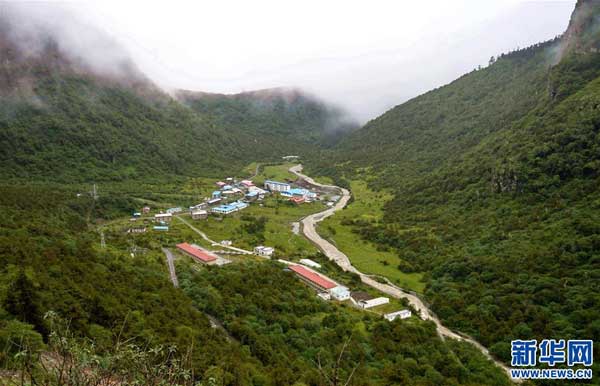
Interestingly, the girls’ village, Yume (or Yumai or Yulmed) is located a few kilometers north of the McMahon Line, not far from Asaphila and the remote Indian village of Takshing.
Xi had hoped that the girls’ family could “motivate more herders to set down roots in the border area ‘like galsang [Kalsang] flowers’, and become guardians of the Chinese territory and constructors of a happy hometown.”
The report also explained that Yume was the China's smallest town in terms of population.

Yume Village

Yume: 32 Inhabitants
Already in November 2016, China Tibet Online had mentioned Yume ‘town’ on the southern slope of the Himalayas, as the border area between China and India: "By road, you will have to drive 400 km south from Lhasa to Lhuntse, then there was another 200 km of muddy mountain roads before you reached Yulmed.”
The Chinese site then asserted that “It is the least populous administrative town in China. With an area of 1,976 km2, Yulmed has one subsidiary village, and only nine households with a total of 32 people. Yulmed has very few residents, but it is neither impoverished nor backward.”
Incidentally, Yume has today some 300 inhabitants (probably many of them Chinese).
The journalist added: “For a long time, there was only one family in Yulmed. After the Tibet Autonomous Region (TAR) government dispatched officials and doctors, built the roads, and added a power station and a medical clinic, Yulmed became more and more lively. In 2015, the annual average per capita disposable income in Yulmed was 26,000 yuan.”

Dakpa Shelri sacred mountain

The Pure Crystal Mountain Pilgrimage of Tsari
Not far from Yume is the Tsari Valley, one of the most sacred places in Tibet and the location for a famous pilgrimage.
China Tibet Online, a Chinese website thus praised the area: "Dzari (Tsari) Township, 2,800 meters above the sea level, is located in Lhuntse County of Lhoka Prefecture. Tsari means the holy mountain in Tibetan language. Hailed as the Tibet’s Shambhala, Tsari Township boasts its lush vegetation, moderate weather, still lake, running brook, vast forest, holy mountains as well as a satisfactory variety of herbs."
But Tsari has been more than just this.
It was once one of the most sacred pilgrimages in Tibet and the site of the first clash between the Chinese and Indian troops in Longju in August 1959.
One of the characteristics of this pilgrimage was that it was running across the Indo-Tibet border (the McMahon Line); half being in Tibet, half in NEFA (India).

Tsari Pilgrimage
Tsari has always been synonymous of ‘sacred place’ in the Tibetan psyche. With the Mount Kailash and the Amye Machen in Eastern Tibet, the pilgrimage around the Dakpa Shelri, the Pure Crystal Mountain has, since centuries, been one of the holiest of the Roof of the World.
The ‘Pure Crystal Mountain’ lies at 5,735 meter above the sea in the Tsari district of southeastern Tibet.
Toni Huber is one of the foremost scholars who wrote a great deal about this region from which the Subansiri and the Tsari chu (river) flow: “The area of the two rivers into which [Gen] Tsarong [at the beginning of the 20th century] ventured for military and commercial reasons had for centuries defined a very significant territory for both Tibetans and neighbouring non-Tibetans ”.
Huber describes thus the region:

“[these] rivers encompassed the southern slopes of the famous Tibetan holy mountain of Dakpa Shelri at Tsari. The large-scale, 12-yearly circumambulation of Tibetan Buddhist pilgrims around the mountain known as the Rongkor Chenmo, had the character of a state ritual for the Ganden Phodrang [Tibetan Government]. Pilgrims in this huge procession crossed the McMahon Line below the frontier village of Migyitün in Tsari district and followed the Tsari Chu southwards. They then turned back up the Subansiri westwards, crossing the McMahon Line once again to reach the first Tibetan frontier settlements in Chame district. In doing so, they traversed non-Tibetan lands during this entire southern leg of the procession. This was the territory of the Mra (Tibetan: Morang Loba) clan, which ran downstream along the Tsari Chu valley and around its junction with the Subansiri at Geling Sinyik, and also of the neighbouring Na (Tibetan: Khalo, Lungtu Lopa) community of Taksing, which extended upstream along the Subansiri heading westwards towards Tibet.”

The pilgrims went down the Tsari chu, past Migyitün which was recognised as the frontier of Tibet - to a place where the Tsari chu joined the combined waters of the Char, Nye and Chayul chus.
It is interesting to note that in the early 20th century, Migyitün was already considered to be the border with Tibet.
The McMahon Line, drawn a few months later (under the supervision of Capt Bailey, a British intelligence officer who had visited the area in 1913), only acknowledged this fact.
Bailey had noted:

“This was five or six days' journey. Then they turned up the combined rivers, towards Sanga Choling, which they reached about a fortnight later. Some pilgrims went very much slower, the minor official said; and I inferred there was merit in delay. The slower, the better.”

The terminus of the pilgrimage was Yume.

Longju Village on India's Territory

Tsari in the News for the Bad Reasons
Apart from the celebrity bestowed on Choekar, Tsari has been in the news when a few months ago, it was discovered that China had built one of its ‘Xiaogang’ (‘well-off’) border villages on the model of Yume, a few hundred meters within the Indian territory at the place where the Longju incident took place in August 1959.
Since 2016, Tibet has built 965 Xiaogang villages and relocated 266,000 people, many on India’s border. Official Chinese statistics said that by the end of 2019, “Tibet had lifted 628,000 people out of poverty and delisted 74 county-level areas from the poverty list.” ‘’Lifting out of poverty’ is a euphemism for relocating thousands of Tibetans.
Longju now is one of such villages; it was reported by NDTV that “China had built some 101 homes in the remote place of Upper Subansiri district of Arunachal Pradesh.”
The TV channel acquired satellite imagery dated November 1, 2020; analysed by several experts, the images confirmed: “the construction, approximately 4.5 kms within Indian territory of the de facto border [the McMahon Line].”
India should be seriously concerned, added the channel: “Though this area is Indian territory, according to official government maps, it has been in effective Chinese control since 1959 [which is not correct, it remained in India’s control for many more years]. However, earlier only a Chinese military post existed, but this time a full-fledged village that can house thousands has been built. The village, located on the banks of the River Tsari chu, an area which has been long disputed by India and China.”
The location of the new village of Longju is a highly symbolic; five months after the arrival of the Dalai Lama in India (March 1959), the Chinese attacked an Assam Rifles’ platoon; it was a first ‘punishment’ for granting asylum to the Dalai Lama.
Today, China wants to change the status quo of the Indian Northern Border and proves that it can do whatever it wants in what it perceives as its own territory. It has serious implications elsewhere on the border, particularly in the Aksai Chin area, where Beijing has started exploiting the largest zinc deposits in the Middle Kingdom. If India does not object now, it will be too late in Aksai Chin too.
If China was really interested by peace, as it pretends to be in international fora, it should reopen the Rongkor pilgrimage for world peace around the Dakpa Shelri, instead of opening new fronts against India.

Tsari Town

More about Tsari
On June 22, Chinanews.com mentioned about the duties of “the immigration management police.”
It seems a bad joke as there is no question of ‘immigration’ in this area.
The article said that the Network Information Office of the Tibet Autonomous Region (TAR) and the Tibet Entry-Exit Frontier Inspection Station jointly searched for ‘the Most Beautiful Frontier People’.
Of course, the Tsari area has many of them.
The article stated that the Tsari Border Police Station is “responsible for border prevention and control, public security and rescue tasks for this small town in southern Tibet, China. The police station is located at an altitude of 2,800 meters, and its jurisdiction has natural scenery such as virgin forests and meadows, which is a typical subtropical climate. The climate here is humid and rainfall is abundant,” wrote a reporter.
What were journalists from Beijing doing in this most remote areas of Tibet is a mystery; but there is no doubt that something is cooking up.
The reporter followed the immigration management police “into the primeval forest to experience their different patrol roads. In fact, there is no way to enter the primeval forest. Everyone walks carefully on the rotted branches and dead leaves. It is extremely difficult to go uphill and downhill, and beware of dangerous wild animals such as black bears from time to time.”
A policeman told the journalists that the patrol route is different each time, during their own visit “[as we did not go] too far, the equipment was simpler, usually for farther places, the load is about 40 kilograms,” explained the policeman.
The article said: “During this period, the wild strawberries on the mountain were ripe. During the rest, the immigration management police picked fruits to quench their thirst, wild fruits are a rare pleasure for them while patrolling the road to the border.”

Patrolling the Border

Another article on Tsari
Chinanews.com had published another article the previous day.
The reporter wrote: “Tsari Township is close to India, with an altitude of about 2,800 meters. There are dense virgin forests and occasional snow on the tops of the mountains. The climate is warm and humid. The misty town is like a beautiful picture scroll in the south of the Yangtze River.”
The article continued: “The rapid development of infrastructure and the rapid improvement of people's lives have made this border town in the deep mountains more and more active. Jin Xianwei, a police officer from the Lhuntse-Tsari border police station, who has been working here for 11 years, has a good memory of his experience when he first came to report: [it was] a 14-hour drive from Shannan (Lhoka) City to Tsari.”
After two years, Jin Xianwei had the opportunity to go home in China on vacation for the first time. Then, there was no regular bus; Jin explained that “cooking at the time, we had to burn firewood, and to pay phone bills, we had to but phone cards, there was no continuous power supply, meat and vegetables would always be damaged before being eaten. It's like a village in the interior of China that has gone backwards for many years. …since 2016, the development of this border town has pressed the fast forward button, from a static development to a hot development.”
This corresponds to the time XI Jinping wrote to the two sisters.
The policeman said: “Vegetables do not need to be collected once a month, and our table is more abundant. Online express shopping can send special products from the south and the north, and the most remote duty stations also have the Internet.”
Jin Xianwei thought he would work here until retirement; he hoped that the living conditions was getting better and better and the area becoming more and more prosperous.
Kesang Wangmo, a local villager explained to the reporter: “In recent years, subsidies for border residents in Tibet have increased manyfold, and the subsidies for frontier residents have risen to as high as 6,000 yuan per person per year.”
Kesang Wangmo pointed out that the Central and the TAR governments had decided to invest in the borders. She also believed that even without subsidies, many people would still protect their homes (against India?).

Patrolling the Borders

Xiaogang Villages
In 2017, the scheme of setting up well-off demonstration villages on the border of Tibet has been implemented and villages have come up one after another
Kesang told the reporter: “The houses are built uniformly, which is more spacious and beautiful. The pavement in the village is hardened, and there are street lights, which is much more convenient.”
Tsari Township, close to her beautiful home, is still undergoing infrastructure construction.
Another interviewee, Dechen Dolma said that “The roads used to be difficult, and it was usual for the mountain roads to be blocked by snow in winter. His elder brother once took his son to the county seat to study in the elementary school."

Now it takes 4 hours instead of 2 days earlier: “In the past, the township primary school was only up to the third grade. From this year, our children here can complete primary school nearby."
According to the article, the traditional income of Tsari comes “from grazing, digging wild medicinal materials and weaving bamboo utensils. In recent years, the central government and the local government in Tibet have made this area more and more open [to tourism], and it has also brought more opportunities to local herdsmen. …more and more people doing business in the local area, and more villagers have bought construction trucks and transport vehicles, and private cars have also become family vehicles.”
Han tourists will soon flood this area ... and bring prosperity according to the Chinese propaganda.

Conclusions
There is no doubt that infrastructure development is going on full swing in the highly strategic area of the Indian border.
The need of the hour is not to ‘wait and watch’, a formula often used by Indian government officials, but to develop the border areas, in particular the Upper Subansiri district and provide decent roads, good schools and proper communication facilities to the local population. Agriculture (fruits) and arboriculture could also easily be developed and bring good recenues. 

Perhaps only mindsets of the local babus need to change. 

This is not an easy task, but let us not forget that the airport will soon serve the other side of the border.


Some photos of Chinese patrols in Asaphila area, south of Yume. Note that it is not Choekar and Yangzom who are patrolling the border.
Their role seems to be tourist guides (for Han visitors), more than 'Guardian of the Sacred Border'.

Tourists already arrive in Yume

Patrol in Asaphila Area


Wednesday, August 28, 2019

China: Changing the demography of the Indian border

The French edition of China Tibet Online recently published a photo feature of Yume village which, over the years, has often been mentioned on the blog.
Yume (or Yumed or also Yumai) is located north of the Upper Subansiri district of Arunachal Pradesh.
The main characteristic of the village is that it has been adopted by President Xi Jinping, and as such it is the Model Township for the 200 or so other 'Xiaogang' (moderately well-off) villages near the Indian border.
The French article speaks of “Renaissance of the least populated township in China”.
During the last couple of years, Yume has witnessed a lot of development, some worrying for India.

Least Populated Village?
The article explained: “Yumai County, under the jurisdiction of Lhunze County in the Tibet Autonomous Region, is the least populated municipality in China.”
Incidentally, Lhuntse Dzong (county) will have the first airport in the area in 2021; it not far away.
China Tibet Online continues: ‘At present, the upgrading of the canton's infrastructure is underway. For example, the nine original households and the 47 relocated households moved into their new apartment, one room of which is reserved for private housing or a store.”
Nine ‘original' households correspond to the population of the village announced a few years ago (32 or 37 inhabitants), but we are now told that there are 47 ‘relocated’ households.
It means that Yume has already 5 times more migrant families than local villagers.
It is a serious issue as it signifies that China is changing the demography of its borders with India.
If you look at it at level of the entire Sino-Indian border, it probably means that China will have a new population of ‘migrants’ selected for their good deals on the Indian border.
It is still not clear if these ‘migrants’ are Tibetans or Hans; there are probably a blend.
The French article continues: “In addition, a road leading to the exterior is under construction which will be put into operation at the end of this year. This new road will end the blocking season due to snowfall.”
No mention is made of the airport, not too far away.
In 2021, hordes of mainland tourists will probably descend on Yume ...in opposition, Takshing, the Indian village does not have a road in working condition as yet.
In Yume, the website say that the construction of a primary school will be completed soon and will welcome more than 30 children in September.
It means that there is alreday as many children in the 'model' village than there were inhabitants two years ago.
Another objective of the Chinese is to show the rural population that they are looking better on their own people than the Indian Government. 


Choekar (on the right) and Yangzong (on the left), China's 'Models of Our Era'

Choekar's apartment

Yangzong's family business.


The construction of Yumai Primary School

The Road to Yume

Thursday, October 18, 2018

Good life in the smallest Tibetan village?

China Tibet News yesterday reported about the "Villagers’ good life in Yulmed".
Yulmed is Yume, the small village adopted by Emperor Xi, north of Upper Subansiri district of Arunachal Pradesh,
This village has often been mentioned on this blog.
It was said to be the smallest village in Tibet.
According to yesterday's article, it is still "China’s smallest township, located in the foothills of the Himalayas near the border of China and India," but, Oh Miracle, the population has grown from 32 inhabitants to 197.
How? The Chinese media does not explain this detail.
The article just affirms that Yume, located about 200 kilometers from the county seat of Luntse (which incidentally will soon have an airport) is 'happy': "with the development of economy and the improvement of environment of Yume Township [yes, it has become a township!!], it has built numerous new houses for local villagers."
Villagers and obviously outsiders.
It was said that later this month, "197 villagers of the township will be moved into their new houses, and their living environment will be greatly improved."
What does it mean?
There is a definitive plan to repopulate the borders with India by creating new model 'townships'.
This should be a serious issue for Delhi.
Some two years ago, long before anybody had heard of the hamlet, Wu Yingjie the Party Secretary of the Tibet Autonomous Region,  had visited the area.
Probably based on his report, Chairman Xi adopted the tiny village.
For India, whether the villagers have a good life or not, is not the question; this new development is bound to put pressure on the border, at a time, when Indian villagers are migrating in large number from the border areas toward the cities (in Uttarakhand for example, it is an extremely serious issue).
Why can't India open its border villages to eco-tourism?


Tuesday, May 29, 2018

A Better but Bumpy Border Road Lies Ahead

My article A Better but Bumpy Border Road Lies Ahead appeared in Mail Today/DailyO


The Indian media likes to publish ‘scoopy’ news. It was recently the case with an article in The South China Morning Post which spoke of “large-scale mining operations on the Chinese side of the border with India;” it argued that it “may create a new military flashpoint with India.”
Though it sounded like fake news, it got large coverage, while one of the greatest achievements for India’s defence preparedness went practically unnoticed.
On May 9, the Border Roads Organization (BRO) created history by establishing a road link beyond Limeking in Upper Subansiri district of Arunachal Pradesh, between Tama Chung Chung (TCC) to Takshing, the last Indian village before the border with China. The road covers a distance of some 80 kilometers before reaching the small village.
The BRO's 23 BRTF commander Col Tanish Kumar asserted that with his team, he drove from Limeking to Takshing ‘for spot verification.’
Long time frustrated villagers of Takshing have for years been lamenting that “the road will never happen, we will always remain isolated and at the mercy of Chinese intruding patrols.”
The conditions, the terrain, the hardness of the rock seemed insurmountable obstacles. The work on the TCC-Taksing link began in 2009, the BRO explained, “it continued unabated despite number of challenges and hindrances, including inhospitable terrain, inclement weather conditions with rains for almost nine months in a year, no access to this stretch of uncut road having dense foliage, undergrowth, rugged and steep mountains, while ferocious river Subansiri flowing nearby posed greatest challenge for transportation of men and materials.”.
Interestingly, the Chinese noticed the feat and several bloggers commented on this major strategic development; one commented: “The low altitude also has a negative side - it is rainy, and it often destroys roads. This is how our Metok’s road (in Tibet) road has been constructed.” Another even said: “Have to admire the spirit of the Indian perseverance!”
Another news which, like the Takshing road, will greatly improve India’s defence preparedness, got better coverage; the Prime Minister inaugurated the Zojila project; the 14.2 km tunnel will provide an all-weather connectivity between Srinagar and Leh. It will eventually cut down the time to cross the Zojila pass, situated at an altitude of 11,578 ft on the Srinagar-Kargil-Leh National Highway, from the present 3.5 hours to 15 minutes.
The construction of Asia’s longest bi-directional tunnel will cost some 6,809 crore to the exchequer and is expected to be completed in five years. After unveiling a plaque, the Prime Minister asserted: “The Centre and the state government are working together to take the development work forward.”
The state-of-art tunnel will have a transverse ventilation system, uninterrupted power supply, tunnel emergency lighting, CCTV monitoring, pedestrian cross passages at every 250 metres, as well as emergency telephones and fire-fighting cabinets. The construction will also provide employment for local people for the years to come.
Ambassador P. Stobdan, a Ladakhi, wrote in The Quint: “A tunnel through Zoji La has remained a constant dream for the last several decades. The initial survey for the tunnel was carried out in 1997, but the actual planning had started only after the Kargil war in 1999. …With the completion of this strategic tunnel, …[it] will enable traffic to move swiftly and safely between Kashmir and Ladakh.”
This may open the way to an even more strategic project: a railway line to Ladakh, which is scheduled as one of the 14 strategic connectivity projects initiated by the Ministry of Defence to protect India’s border areas.
Stobdan commented: “Leh rail network will have enormous strategic significance for boosting India’s defence capabilities and preparedness, enhancing the communication network both along the China border and the border with Pakistan occupied Kashmir (PoK).”
Already in November 2017, the BRO constructed the world's highest motorable road in Ladakh, passing through Umlingla Top at a height of over 19,300 feet. Starting near Hanle in East Ladakh, the 86 km long strategic road runs close to the Line of Actual Control (LAC); it connects Chisumle to Demchok village.
All this could be a first step towards another historic development.
The Daily Excelsior reported a press conference of the Himalayan Buddhist Cultural Association (HBCA) which urged the Prime Minister to fulfill the long pending demands of Ladakhi people; namely the inclusion of Bhoti language in 8th Scheduled of Indian Constitution and the opening of the Kailash Mansarovar road from Ladakh via Demchok.
HBCA President Tashi Targais said that the Kailash Mansarovar route via Demchok is not only the shortest route but it will also boost the economy of Ladakh region.
Reopening the Demchok landport could be a great benefit for Ladakh, but also for Western Tibet and China; it would not only give a tremendous boost to trade and pilgrimage, but it also could have a ‘Nathu-la’ effect: remember the skirmishes in Sikkim before the pass officially reopened in July 2006. The opening for trade had the effect to fix the border, drastically reducing the tensions in the area; since then the pass has become an important Border Personnel Meeting point between India and China.
For years, the people of Ladakh have asked for the reopening of the ancient route via Demchok; if it happens, it could become part of the New Silk Road project, dear to President Xi Jinping.
Beijing should let people and goods flow again over the Himalaya. China should allow the devotees wanting to visit Kailash-Manasarovar to use the Demchok route again.
It would have an additional benefit; it would stop the smuggling between China and Ladakh, which poses serious security risks of infiltration for India.
The Prime Minister should definitely raise this question with his Chinese counterpart when they meet next month.
In the meantime, kudos to the BRO.


Tuesday, March 13, 2018

How to be elected to the People's National Congress

Xi Jinping made it.
He can remain in his seat for life.
The voting process was completed in record time and the constitutional revisions got the highest approval since 1999.
The South China Morning Post (SCMP) reported: “Under the watch of a confident and relaxed President Xi Jinping, nearly 3,000 Chinese lawmakers were nearly unanimous in their approval of changes to the state constitution that included removing the term limit on the presidency.”
The Hong Kong newspaper said that Xi, who had maintained a poker face throughout the opening day of People’s National Congress (NPC), appeared much more at ease after the vote: “He even smiled when Wang Cheng, the vice-chairman of the National People’s Congress, announced the final result of the voting. Only two of the 2,964 deputies voted against the constitutional revisions, three others abstained and one ballot was declared invalid.”
That is not much opposition for a so-called democratic process.
In 2004, when China's constitution was last amended, it had taken two hours.
This time the process was over in just one hour: no debate took place, no discussion and not even canvassing.
SCMP remarked: “The whole event was meticulously managed to the last detail. All the deputies gathered at the Great Hall of the People in Beijing at 3pm sharp. Each received a pink ballot paper the size of an A4 sheet. They were given a short briefing on how to use a specially designed pen to tick the box of their choice before putting the completed ballot papers in 28 red, electronic ballot boxes designed to immediately scan and record the results.”
Done!
Xi can remain as long as he wants ...or as long as his health permits.

Data on the NPC
Before the vote, a website npcobserver.com published data about the NPC; the figures are derived from the raw data provided on the NPC’s site: "The 2,980 delegates—roughly three-quarters of whom have never held such a position—are set to vote on the draft constitutional amendment in just a few hours. … But who exactly are these delegates, allegedly ‘hand-picked’ by President Xi Jinping and poised to reward him with indefinite tenure? "
Three quarters at least owe their jobs to Xi.
The analysis about the NPC's ethnicity is particularly interesting : « There are 55 officially recognized ethnic minorities in China. Collectively, they are apportioned 14.7% of the seats in the 13th NPC—a percentage both higher than their proportion in the Chinese population and than the guideline value set by the 12th NPC a year ago ('approximately 12%').  The figure shows the ten ethnic minorities with the most seats in the 13th NPC. Except the Manchu, they are also the ten largest minorities in China, according to the 2010 national census (though the order is different). While all 56 ethnic groups are represented in the 13th NPC, half (28) are each represented by only one delegate. Han delegates are on average almost five years older than non-Han delegates, more likely to be CPC members, and significantly (not in the statistical sense) likely to be male."
from npcobserver.com

How are these delegates elected?
Take the case of a Tibetan delegate Choekar (or Dolkar).
Choekar (left)
As mentioned in this blog in November, soon after the conclusion of the 19th Congress, President Xi Jinping wrote a letter to two young Tibetan herders who had written to him introducing their village, Yume, north of Upper Subansiri district of Arunachal Pradesh.
Xinhua then reported that Xi “encouraged a herding family in Lhunze [Lhuntse] County, near the Himalayas in southwest China's Tibet Autonomous Region, to set down roots in the border area, safeguard the Chinese territory and develop their hometown.”
Xi acknowledged “the family's efforts to safeguard the territory and thanked them for the loyalty and contributions they have made in the border area. Without the peace in the territory, there will be no peaceful lives for the millions of families," he wrote.
The two Tibetan girls, Choekar and Yangzom had told Xi about their “experiences in safeguarding the border area and the development of their township over the years.”
Choekar's village, Yume (or Yumai or Yulmed) is located a few kilometers north of the McMahon Line, not far from the remote Indian village of Takshing.
Choekar (center)
It was enough for getting appointed a NPC delegate
It appears that many Tibetans from the nearby villages now want to move their homes to Yume. Choekar's sudden celebrity will certainly help  her village to grow exponentially ...and the border to be better protected.
Han tourists have already started pouring.
Villagers will build new guest accommodations and the border village will become wealthier  ...and the border will become more stable.
That is the Emperor's plan.
Of course, the Government of India is unable to think in this manner (in fact, can the Government think?)
Should a local girl from Takshing village on the Indian side of the border, write a letter to Delhi, it would go unnoticed by the authorities; it may not even be delivered.
Choekar had written about the importance for the border population to protect the sovereignty of the Motherland: by developing the border economy, poverty could be reduced.
Choekar, before her elevation was officially Village Affairs Oversight Committee Director, but now she is more, she is one of the 2,964 Chinese who took part in the historic vote; they ‘elected’ the new emperor.
The story does not say what has happened to the two who voted against the amendment of the Constitution.
Probably, the lenient ruler can allow this much dissidence.
It does not mean that the task will be easy for Chairman Xi; his new promotion may not help him to solve the immense problems facing the Middle Kingdom.
But this is another story.

Thursday, January 4, 2018

China develops its border with India: Yume again in the news

Two months ago, I wrote about Yume, the hamlet north of the McMahon (Upper Subansiri district of Arunachal Pradesh).
At that time,  Xi Jinping had written a letter to two young Tibetan herders who had introduced their village to the Chinese President.
It looks like it is helpful to receive a letter from the President.
The Global Times has reported yesterday: "A sparsely populated township in Southwest China's Tibet Autonomous Region has been connected to the state electricity grid, ending life without electricity for its 32 residents."
The village is Yume.
Incidentally, why do China has to always write "China's Tibet Autonomous Region". India does not write "India's Tamil Nadu" or "India's Uttarakhand" or even "India's Arunachal"?
Beijing must be feeling insecure.
To come back to The Global Times' article, it quotes the contractor, a Xining-based electric power company who worked on the project: "The 15-kilometer 10-kilovolt power line, which took five months to complete, is connected to remote Yulmed [Yume] Township in Luntse [Luntse] county, Shannan [Lhoka], via 108 electric poles over a 5,000-meter-high mountain."
According to the tabloid, Yume (also spelt Yulmed) is located "at an average elevation of 3,650 meters above sea level and its population was once just a three-member household. Currently, it has nine households."
It is further explained that in 2008, the local government built a small hydropower station, but the project failed to meet the increasing power demands of the 32 residents: "Due to improved living standards and growing need for electricity of the residents, power outages were frequent."

India's infrastructure development
While Beijing is going full steam to built infrastructure on its side of the McMahon Line, it complains about India building roads in the border area.
The same Global Times commented on the recent visit of Indian Union Home Minister Rajnath Singh to Nilang: "An Indian road construction project connecting all border posts along the China-India frontier could lead to new military standoffs between China and India, Chinese experts warned."
The mouthpiece of the Communist Party quoted The Times of India: "During his New Year visit to the 'Indo-Tibet Border Police' at Nelong [Nilang] valley in Uttarkashi district bordering China, Indian Union Home Minister Rajnath Singh said that a number of border posts had already been connected with roads and many would soon be linked."
China is unhappy because Singh asserted that "this would enhance the operational efficiency of the officers and reduce mountain-related sickness among them."


Chinese Double Standards
Of course, China is entitled to do whatever it wants on its side of the border.
China Daily recently reported: "Investment in infrastructure in the Tibet Autonomous Region is helping to lift 628 villages along the border out of poverty."
It further asserted: "After getting access to electricity and the construction of new roads, tea farmers and herdsmen in a village some 200 kilometers southwest of Lhasa in Tsona county founded a cooperative that provides skills training and job opportunities for villagers."
Tsona is located north of Tawang district of Arunachal.
The area has been extensively developed. I have mentioned it earlier on this blog.
China admitted: "Starting last year, more than 100 million yuan ($15,263) has been invested in infrastructure in the village of less than 100 families as a part of a broader construction project to build model villages with moderate prosperity in the border area. The construction of well-off villages along the border is designed to advance the living and working conditions in surrounding villages."
China Daily estimated that the road access rate in the area will reach 100 percent and the per capita disposable income will double by the year of 2020.
Is it not double standard?

My November 2017 post

Soon after the conclusion of the 19th Congress, President Xi Jinping wrote a letter to two young Tibetan herders who had written to him introducing their village, Yume, north of Upper Subansiri district of Arunachal Pradesh.
According to Xinhua, Xi “encouraged a herding family in Lhunze [Lhuntse] County, near the Himalayas in southwest China's Tibet Autonomous Region, to set down roots in the border area, safeguard the Chinese territory and develop their hometown.”
Xi acknowledged “the family's efforts to safeguard the territory, and thanked them for the loyalty and contributions they have made in the border area. Without the peace in the territory, there will be no peaceful lives for the millions of families," he wrote.
The two Tibetan girls, Choekar and Yangzom had told the CCP’s Secretary General about their “experiences in safeguarding the border area and the development of their township over the years.”
Interestingly, the girls’ village, Yume (or Yumai or Yulmed) is located a few kilometers north of the McMahon Line, not far from the remote Indian village of Takshing.
Can this letter from Xi Jinping be considered as an acknowledgment of the McMahon Line, as the Indo-Tibet border? Xi clearly thanks the two herders for 'guarding' the border?
From the reporting of Xinhua, it seems so.
Xi further hoped that the girls’ family could “motivate more herders to set down roots in the border area ‘like galsang flowers’, and become guardians of the Chinese territory and constructors of a happy hometown.”
The report also explained that Yume is China's
smallest town in terms of population.

Galsang or Kelsang Flower
Yume on this blog
I had mentioned Yume several times on this blog, mainly because Yume Gompa was the last stage of the Tsari pilgrimage (see map below).
Already in November 2016, China Tibet Online spoke of Yume ‘town’ on the southern slope of the Himalayas as the border area of China and India: "If driving, you had to go south 400 km from Lhasa to Luntse of Lhoka (Shannan) City, then there was another 200 km of muddy mountain roads before you reached Yulmed.”
The Chinese site then asserted that “It is the least populous administrative town in China. With an area of 1976 square km, Yulmed has one subsidiary village, and only nine households with a total of 32 people. Yulmed has very few residents, but it is not impoverished nor backward.”
It added: “For a long time, there was only one family in Yulmed. After the Tibet Autonomous Region government dispatched officials and doctors, built the roads, and added a power station and a medical clinic, Yulmed became more and more lively. In 2015, the annual average per capita disposable income in Yulmed was 26,000 yuan.”

Four conclusions
By Xi Jinping admitting that Yume is a 'border' village, can it be concluded that Xi has acknowledged the McMahon Line? Probably not, but he has admitted that it was the present border (Line of Actual Control).
Another issue that I already brought up earlier on this blog: why not reopen the Tsari Pilgrimage and use it as a Confidence Building Measure between India and China?
Another conclusion is that China will develop very fast the 'border' areas in the years to come, I have often mentioned Metok County, but also Lepo village, north of Khenzimane on the McMahon Line.
Finally, it looks like the Communist Party has started to more and more use Tibetans in border areas and elsewhere yo defend the Middle Kingdom’s borders.
Delhi should be worried!


Thursday, November 9, 2017

China is reinforcing its border with India

Choekar and Yangzom wrote to Xi Jinping
My article China is reinforcing its border with India appeared in the Edit Page of The Pioneer.


Here is the link...

The Middle Kingdom is winning the trust of the locals to safeguard its border. This must worry India. But can China win over the Tibetans who have largely been sympathetic towards India?

At the end of the 19th Congress, Chinese President Xi Jinping appears to emerge the winner on most fronts. First and foremost, the 19th Congress approved an amendment to the Party Constitution, enshrining ‘Xi Jinping Thought on Socialism with Chinese Characteristics for a New Er’.
Though the new Central Committee and Central Commission for Discipline Inspection were more or less along the expected lines, the Politburo and the Standing Committee brought some surprises. Apart from these party issues, in his three and half hour speech, President Xi mentioned several times “border” and “minorities” areas.
Xi particularly asserted: “We will devote more energy to speeding up the development of old revolutionary base areas, areas with large ethnic minority populations, border areas, and poor areas. We will strengthen measures to reach a new stage in the large-scale development of the western region [ie  Tibet and Xinjiang].”
To start implementing his policy, the Chinese President sent a personal letter to two young Tibetan herders soon after the conclusion of the Congress. They had written to him introducing their village, north of Indian border.
According to Xinhua, Xi “encouraged a herding family in Lhuntse County, near the Himalayas in southwest China’s Tibet Autonomous Region, to set down roots in the border area, safeguard the Chinese territory and develop their hometown.”
Safeguarding China’s territory against whom? India obviously!
Xi acknowledged “the family’s efforts to safeguard the territory, and thanked them for the loyalty and contributions they have made in the border area. Without the peace in the territory, there will be no peaceful lives for the millions of families,” he wrote.
The two Tibetan girls, Choekar and Yangzom, had told the Communist Party of China’s (CCP) Secretary General about their “experiences in safeguarding the border area and the development of their township over the years.”
Interestingly, the girls’ village, Yume, is located a few kilometers north of the McMahon Line, not far from the remote Indian village of Taksing.
Xi also hoped that the girls’ family could “motivate more herders to set down roots in the border area ‘like kalsang flowers’, and become guardians of the Chinese territory and constructors of a happy hometown.”
Yume is said to be China’s smallest town in terms of population. In the years to come, Beijing will undoubtedly put pressure on India not only by using Tibetan populations living north of the McMahon Line, but also by influencing the Indian tribes south of the Line, enticing them with a better life on the Chinese side.
Can this letter from Xi Jinping be considered as an acknowledgment of the McMahon Line, as the Indo-Tibet border? From the reporting of Xinhua, it seems so. Xi clearly thanks the two herders for ‘guarding’ the border?
Already in November 2016, China Tibet Online had mentioned Yume ‘town’ on the southern slope of the Himalayas as the border area of China and India: “If driving, you had to go south 400 km from Lhasa to Lhuntse in Shannan (‘Lhoka’ for the Tibetans) City, then there was another 200 km of muddy mountain roads before you reached Yume.”
The official website asserted that “It is the least populous administrative town in China. With an area of 1976 square km, Yume has one subsidiary village, and only nine households with a total of 32 people. Yume has very few residents, but it is not impoverished, nor backward.”
The article concluded: “For a long time, there was only one family in Yume. After the Tibet Autonomous Region Government dispatched officials and doctors, built the roads, and added a power station and a medical clinic, Yume became more and more lively. In 2015, the annual average per capita disposable income in Yume was 26,000 yuan.”
On October 12, 2016, the powerful Tibetan Autonomous Party Secretary, Wu Yingjie, surprisingly landed in the area. According to The China Daily, Wu met frontier troops posted in this remote area: “[Wu] conducted a field survey on how to promote development and stabilisation of the border region, people’s livelihood, grass-root-level Party building and poverty alleviation.”
Wu told the local residents: “You defend the border areas of our country and protect our country from being nibbled or divided. I salute you.” A flag raising ceremony was held in Yume on the occasion of the party boss’ visit.
Why so much interest in this tiny border community? Just to protect the border against India?
The China Daily notes: “Frontier soldiers and local residents patrol in the township. Every resident of the township has a strong awareness of border defense and make it part of their life.”
On the other side of the McMahon line is Taksing; it is the last village in Upper Subansiri district of Arunachal Pradesh and …certainly the first place susceptible to be invaded in case the People’s Liberation Army (PLA) decides to retaliate after the recent confrontation in Doklam.
The problem is that the village still has no access road and the local inhabitants believe that it will take at least five to 10 years to see a road reaching Taksing.
It is not that nothing is happening. On April 6, 2017, the Border Roads Organisation (BRO) managed to open a new section connecting Tame Chung Chung (known as TCC) and Nacho. The inhabitants living in the TTC' vicinity had dreamed of seeing this road for decades, but like many other things for the border population, it had remained a dream.
A BRO’s communiqué explained: “The area is located in an extremely remote area with rugged terrains, thick vegetation and inhospitable weather. The place has remained inaccessible since 2009.” The road was to be opened in 2009.
As an aftershock of the Doklam incident and the subsequent ‘speeding’ up of the border projects, the TTC-Taksing road may hopefully be opened in two years.
In October 2014, The Deccan Chronicle reported that the Chinese People’s Liberation Army (PLA) had been focusing on the Taksing area: “After the recent Ladakh incursions, frequent intrusions by China’s PLA in Arunachal Pradesh’s Taksing region have come to the notice of the security agencies.”
At that time, some local villagers had managed to shoot a short video on their phones of the PLA ‘visiting’ their village.
In the meantime, China is building up pressure by enticing and cajoling the Tibetan population on their side of the McMahon Line.
In several places, China has started developing ‘border’ infrastructure on fast track, bringing large number of Chinese tourists; not only to Yume, but also in Metok County, north of Upper Siang district or Lepo village, near Khenzimane on the McMahon Line.
Xi’s letter tends to show that Beijing has decided to use more and more the local Tibetan populations in border areas to ‘defend’ the Middle Kingdom’s borders. This should deeply worry Delhi; so far the Tibetan population has been sympathetic towards India, can China manage to change this?