Showing posts with label Ladakh. Show all posts

Saturday, April 5, 2025

Mr Xi, what have you gained in Ladakh?

My open letter to Chairman Xi Jinping (Mr Xi, what have you gained in Ladakh?) has been published by Rediff.com on the occasion of his 68th birthday (and one year of the Galwan incident)

'Why did your generals try to grab a few square kilometres of Indian territory in Ladakh?'
'And what happened to the hard work that you and Prime Minister Modi put into the Wuhan and Mamallapuram meets?'
Claude Arpi writes a letter to Xi Jinping, China's self-styled supreme leader, who turns 68 today, June 15.

Here is the link...

Comrade Xi Jinping
General Secretary, Communist Party of China’s Central Committee
President, People’s Republic of China,
Chairman, Central Military Commission (CMC)
Beijing, China

Dear Chairman Xi,
Greetings!
You may think it is presumptuous on my part to send a letter to you, the President of one of the two most powerful nations of the world, but being born in the country which invented Liberty, Equality, Fraternity and living in the one that believes in ‘Satyamev Jayate’ (‘The Truth will prevail’), it emboldened me to send you this letter.
I hope you will not misinterpret my audacity.

I was not sure how to address you, but here in India we see you first as the CMC Chairman, particularly since your Western Theater Command generals started an unnecessary confrontation with the Indian Army in Ladakh last year.
What has China gained from it? I don’t know.
What can the PLA gain in the future? Probably nothing.
In India, it has been taken very badly as it coincided with the chaos of the pandemic due to the COVID-19 which is said to have originated in Wuhan.
Till January 2020, ‘Wuhan’ was synonymous of ‘hope’: India and China could live together as partners in the changing world. It is why Prime Minister Modi invited you in Mamalapuram, to proceed on the sacred path of peace. It is no more the case today, after your generals forced India’s armed forces to spend a winter (and now a spring and a summer) in the previously paradisiacal and serene Himalayan mountains.
I am sure you realize that you lost a friend in the process.

A Community of Shared Future for Mankind

Mr Chairman, though I regularly read your speeches and follow your visits across your country, I must admit that I don’t always understand the actions of your Party.
Take your speech on the occasion of the New Year 2021.
Xinhua reproduced your article ‘Work Together to Build a Community of Shared Future for Mankind’ which had first appeared in the Qiushi Journal (the flagship magazine of the CPC’s Central Committee).
In it, you mention that “mankind is in an era of major development as well as profound transformation and change, and is also in an era of numerous challenges and increasing risks.”
Nobody can disagree with this.
When asked how to respond to this, you proposed “to build a community with a shared future for humanity and achieve shared and win-win development.” This is good.
You even added that “actions hold the key to building such a community, while  adding that “the international community should promote partnership, security, growth, inter-civilization exchanges and the building of a sound ecosystem.”
On this, everyone will agree with you in India; several thousand years ago, a rishi spoke of Vasudhaiva Kuṭumbakam (‘the world is one family’).
The Upanishad says:

One is a relative, the other stranger,
say the small minded.
For those who live magnanimously
the entire world constitutes but a family.

What I don’t understand is that if we share the same values, why did your generals try to grab a few square kilometers of Indian territory in Ladakh? What was the point that they were trying to make? Had they grasped the essence of your speeches?
And what happened to the hard work that you and the Indian Prime Minister put into the Wuhan and Mamallipuram meets?
Are you aware that the Ladakh episode has created a huge setback for the bilateral relations and that the Indian public will not forget soon?

About the Environment: the Irresistible Law
I wanted also to mention the all-important issue of environment
On April 30, 2021, you presided over a meeting of the Politburo of the Central Committee.
You had the occasion to speak of the construction of an ecological civilization; it is said to be a prominent objective for the Communist Party; you insisted on “comprehensively strengthening the construction of ecological civilization, and integrating the management of mountains, rivers, forests, fields, lakes, grasses and sand, and carried out a series of fundamental and pioneering activities.”
You further observed: “Ecological environmental protection and economic development are dialectically unified and mutually reinforcing. The construction of ecological civilization and the promotion of green and low-carbon circular development can not only meet the people’s growing demand for a beautiful ecological environment, but also promote the realization of higher quality, more efficiency, and more Fair, more sustainable, and safer development, and a civilized development path featuring production development, affluent life, and good ecology.”
The Chinese media emphasized your role in this: “General Secretary Xi Jinping’s important exposition on the construction of ecological civilization, with a lofty purpose, rich connotation, and profound thinking, is for us to deeply understand the significance of the construction of ecological civilization, fully and accurately implement the new development concept, and correctly handle the relationship between economic development and ecological environmental protection.”
On another occasion you ‘profoundly’ stated: “Humans and nature are the community of life, and humans must respect, conform to, and protect nature. Heaven and earth live side by side, and everything is one …When mankind makes rational use of nature and protects nature in a friendly manner, nature's rewards are often generous; when mankind develops disorderly and rudely plunders nature, nature's punishment must be ruthless. Human damage to nature will ultimately hurt mankind. This is an irresistible law."
Hundreds of millions on this planet agree with this.
It is why I can’t understand the announcement in The Global Times in December 2020 that your government was planning to build a cascade of mega hydropower plants (HPP) on the Yarlung Tsangpo: “The head of Power Construction Corp of China (POWERCHINA) suggested the planned hydropower station - which is expected to have three times as much generating capacity as the world-leading Three Gorges power station - aims to maintain water resources and domestic security.”
The information was confirmed by the administration of Metok County (of Nyingchi City); the project would be built north of the Indian border; a series of nine hydropower plants in cascade, which will threaten the life of India’s entire North-East region.
This would create unbelievable havoc not only in Pemakoe, the sacred Tibetan realm in the Great Bend of the Yarlung Tsangpo, but also downstream in Arunachal Pradesh (that you call ‘Southern Tibet’), Assam and Bangladesh. You are certainly aware that it is the most seismic area of the planet.
What will you achieve by going ahead with such a project?
You will certainly earn bad will from your neighbours while creating more anger, distrust, without speaking of the risk of a confrontation with India.

The Tibetan Issue

Mr Chairman, I am sure that you remember what your father the respected Xi Zhongxun wrote in The People’s Daily on February 20, 1989 after the untimely death of the revered Tenth Panchen Lama.
Your father condoled the death of the Tibetan leader: “Buddhist Master Panchen Lobsang Trinley Lhündrub Chökyi Gyaltsen died suddenly due to a heart ailment. The Chinese Communist Party has lost a loyal friend, and I have lost a colleague and intimate friend of 40 years standing.”
In the Panchen Lama’s obituary, your father noted “Over the past 40 years, the Panchen Lama and I established a deep friendship. Prior to his trip to Tibet to dedicate a statue at Tashilunpo Monastery, he took time to bid farewell to me and presented me with a khata (ceremonial silk scarf). It was his long-established habit to bid farewell to me when he left on trips, and to have a heart-to-heart talk with me when he returned. I knew him well. He was very enthusiastic, easily excited, and when he was working he could barely control his emotions. I advised him that because there was a severe lack of oxygen in this season in Tibet, he must be careful of his health, not get short-tempered, and that he should balance work and rest. He told me that he would die happy once his project was completed. I told him that Buddha didn’t want him to go yet, nor did Marx want him to go.”
That was the last time your father met the Tenth Panchen Lama.
In his long obituary, after mentioning the difficulties that both (him and the Panchen Lama) went through during the Cultural Revolution, your father wrote: “After the Third Plenary Session of the Eleventh Communist Party Congress in 1978, the Panchen Lama and I reunited. When old friends meet, all kinds of feelings well up. When the Panchen Lama saw me, he said uneasily: Because of my ‘70,000-Character Petition’ I got you in trouble, I’m very sorry for that. I answered: No one got anyone in trouble. We all got physically tempered, endured challenges and increased our experience. The Communist Party understands you.” At that time, we all hoped for a new China under reformist leaders like your father. Unfortunately, it has not yet happened, especially for Tibetans and the Uyghurs.
Your father had concluded: “I grieve the sudden death of the Panchen Lama, I hope that he is reincarnated. We must complete …make new contributions to a united, prosperous and civilized socialist new Tibet, and to the common prosperity of all ethnic groups.”
Today, the opposite is happening. It is difficult to understand why.
You must be realizing that the Tibetan question has been sullying the image of People's Republic for 70 years now. Why can’t you find a durable solution agreeable to all, it would be a win-win outcome.
The Dalai Lama is a sincere leader. Do you think that you can find a better interlocutor to bring about a radical change in the relations between Hans and Tibetans? I don’t think so.
I could, of course, mention several other issues, but it is better to leave at that today.

Mr Chairman, I feel that China has lost (or is losing) a golden opportunity to play a respectable place in the world, and this despite your vision of a shared future for humankind.

Yours sincerely
Claude Arpi


Monday, February 20, 2023

LAC vs IB: Why India's assessment of the length of border along China is misleading

My article LAC vs IB: Why India's assessment of the length of border along China is misleading appeared in FirstPost.

 Here is the link...

The length given by India's Ministry of Home Affairs (3,488 km) is unfortunately wrong

What is the length of India’s border with China?
You may think that it is easy to answer this question, but unfortunately, it is not.
The Ministry of Home Affairs states: “India has 15,106.7 Km of land border and a coastline of 7,516.6 Km including island territories.” It then gives the length of India’s land borders with neighbouring countries; Bangladesh has the longest border (4,096 km), then China (3,488 km) and Pakistan (3,323 km).

India’s International Border (IB) with China is 4,056 km.
Let me explain why.
The length given by the MHA (3,488 km) is the length of the Line of Actual Control (LAC), not the IB.
The concept of LAC was introduced by the Chinese Premier Zhou Enlai, during a press conference in Delhi in April 1960 (he had earlier vaguely mentioned it at the end of 1959 in a letter to Prime Minister Jawaharlal Nehru).
Zhou proposed six points to solve the border issue; the first two points were:

  •     There exist disputes with regard to the boundary between the two sides.
  •     There exists between the two countries a line of actual control (LAC) up to which each side exercises administrative jurisdiction.

The fact that the Indian government then rejected the Premier’s proposal is irrelevant to the present argument.
Zhou had come to Delhi to set up talks with India on the boundary dispute. Subsequently, the officials of India and China met for several months during which Delhi made its position clear: “The India-China boundary starts from the tri-junction of the boundaries of India, China and Afghanistan and runs eastward through the Kilik Pass, Mintaka Pass, Kharchanai Pass, Parpik Pass, and the Khunjerab Pass. These passes lie on the watershed between the Hunza river flowing into the Indus system in India and the Qara Chukar river flowing into the Yarkand system in Sinkiang. From the Khunjerab Pass the boundary lies along a spur down to the north-western bend of the Shaksgam or Muztagh river which it crosses at that point and ascends the crest line of the Aghil mountains. It then runs along the crest of the Aghil watershed through the Aghil Pass the Marpo Pass and the Shaksgam Pass to the Karakoram Pass.” The coordinates for each of these places were given.
Historically, there is no doubt that Gilgit-Baltistan (GB) was part of the Maharaja of Jammu and Kashmir’s territory and that the IB presently starts at the trijunction with Afghanistan while the LAC begins at the Karakoram Pass.

Rajnath Singh’s declaration
On 28 October, 2022, Defence Minister Rajnath Singh, while addressing a function in Srinagar to mark 75th year of induction of the Indian Army in Kashmir, reiterated that GB was part of India, though presently under occupation. “India’s development march towards the North will be complete after reaching GB,” he stated.
The minister also referred to the 1994 Resolution passed in the Indian Parliament to recover the territories under illegal occupation of the ‘neighbouring country’. “We have only started our northward journey. Our journey will be complete when we fully implement the unanimous resolution passed by the Parliament on February 22, 1994, and we reach our remaining areas like GB,” said Singh.

A little bit of history
In 1935, the viceroy prevailed upon Maharaja Hari Singh of Kashmir, ‘in the interests of the security of the British empire’ to lease the Gilgit Agency as well as the hill-states Hunza, Nagar, Yasin and Ishkoman for 60 years to the British. Thereafter, Gilgit was administered by the Political Department, with a Political Officer reporting to the viceroy.
The British Paramountcy lapsed on 1 August, 1947, and Gilgit reverted to the Maharaja’s control. Lt Col Roger Bacon, the British Political Agent, handed his charge to Brig Ghansara Singh, the new governor appointed by the Maharaja. A British officer, Maj Brown remained in-charge of the Gilgit Scouts.
On 26 October 1947, after the brutal tribal invasion of Jammu and Kashmir organised by Pakistan, Maharaja Hari Singh signed an Instrument of Accession and joined the Union of India. However, Maj Brown refused to acknowledge the orders of the Maharaja, under the pretext that some leaders of the Frontier Districts Province (in GB) wanted to join Pakistan. He took it upon himself to hand over the entire area to Pakistan on 1 November, 1947.
An interesting announcement was published in the 1948 London Gazette which mentioned that the King “has been graciously pleased… to give orders for… appointments to the Most Exalted Order of the British Empire…” The list included “Brown, Major (acting) William Alexander, Special List (ex-Indian Army).”
Why awarding Brown? Simply because Brown had just ‘offered’ to Pakistan this strategically important area for London.

A British Article
In 2017, an IANS article, When the British poured scorn over Gilgit, explained the background of the 1947 rebellion in Gilgit: “A carefully chosen force capable of rapid movement in the mountainous territory controlled by British officers, the Gilgit Scouts, provided the muscle to the administration.”
The article continued: “The bloodless coup d’etat was planned by Brown to the last detail under the code name ‘Datta Khel’, which was also joined by a rebellious section of the J&K 6th Infantry under Mirza Hassan Khan.”
In his memoirs, Gilgit Rebellion: The Major who Mutinied over the Partition of India, Brown described his encounter with Pakistan prime minister Liaquat Ali Khan in November 1947: “Colonel Bacon, Colonel Iskander Mirza, and I were called into the ante-room. The Pakistan Premier was seated at a desk, poring over a large-scale map of Kashmir and Central Asia. …Mr Liaquat Ali Khan started by congratulating me and thanking me for all I had done in preserving peace in the Gilgit Agency.”
Liaquat then said: “Brown, give me your ideas [for Gilgit] from a military point of view.” The major explained in detail his plans to defend the area by reorganising the Scouts. “Right” said the Premier: “That disposes of the military angle.”
Though there is no doubt about the illegality of the mutiny, one paramount question remains: was the British Headquarters informed?
At the time, the entire Pakistani Army hierarchy was British. So, the answer can only be that Maj Brown’s British bosses were aware of his ‘gift’ to Pakistan. The fact that he was nominated to the OBE is further proof. The King usually does not appoint ‘deserters’ or ‘rebels’ to the august Order.

The length of the IB
Even today, this has serious implications for India, though it does not change the length of the IB (4,056 km), beginning at the trijunction with Afghanistan in the West and ending at the trijunction with Burma (Myanmar) in the east. The report of the officials cited above gives the Indian position in the East: “The boundary crosses the Yonggyap Pass and the Kangri Karpo Pass in this sector. It then crosses the Lohit river a few miles south of Rima and joins the tri-junction of the India, Burma and China boundaries near the Diphu Pass.”

The UN Resolutions
The UN resolutions of 17 January, 1948, and 13 August, 1948, and 5 January, 1949, (UNCIP Resolutions) made it clear that “Pakistan cannot claim to exercise sovereignty in respect of J&K.” In 1963, a secret note from the MEA clarified further that according to the term of the UN Resolutions, “Pakistan cannot purport to exercise even ‘actual control’ over the defence of these areas.”
Practically, it also means that the agreement signed on 2 March, 1963, between Pakistan and China about the Shaksgam Valley of the Gilgit Agency being transferred to China is legally invalid.
Another logical conclusion is that inhabitants of the area if they want to move to India, should be entitled to Indian citizenship.

A British Resolution

Amazingly, in 2017, the British Parliament passed a resolution confirming GB was part of Jammu and Kashmir.
The motion was tabled on 23 March, 2017, by Bob Blackman of the Conservative Party. It reads: “GB is a legal and constitutional part of the state of Jammu and Kashmir, India, which is illegally occupied by Pakistan since 1947, and where people are denied their fundamental rights including the right of freedom of expression.”
Two years later, the new maps released by the Government of India showing the Leh district of Ladakh including the districts of Gilgit, Gilgit Wazarat, Chilhas and Tribal Territory of 1947, made this clear.
Interestingly, the Indian media reported last month: “Amidst news of flour and food crisis across Pakistan, the Pakistan Occupied Kashmir (PoK), GB is again making headlines as residents are furious over the discriminative policies of the Pakistan government that has exploited the region for several decades and are now demanding a reunion with India in Ladakh”, noted India Today, adding: “Several videos on the internet show the extent of the discontent among residents.”
Let us hope that the correct length of India’s border with China will soon be obvious to all.

Tuesday, November 22, 2022

Changing Ladakh

Chushul Village near the Spangur Gap

Ladakh is changing
I still remember my first visit in 2002. There were hardly any roads outside Leh and the approach from Manali in Himachal Pradesh or Zoji-la in Jammu and Kashmir was not an easy one; only a few flights were landing at the Bakula Rinpoche airport and it was always tricky to get a seat in a plane.
Three years ago, I had the chance of visiting Leh again; it was a few months after the mountainous region became a Union Territory (a long-time demand of the Ladakh Hill Development Council, the Ladakh Buddhist Association and the people in general).
By that time, Leh and a few selected areas had tremendously developed.
But all this was before what the historians will one day call ‘the BC era’ (‘before COVID’) and perhaps more importantly before the confrontation with China in several places on the northern boundary.  
Incidentally, is it not a paradox that one of the most peaceful spots on earth, with its high-perched monasteries, its innumerable stupas and prayers flags floating around everywhere, has witnessed the bloodiest conflicts since independence? It is only due to the belligerence of the neighbours.

Some History
At the time of Kashmir's accession to India in October 1947, political and economic power was offered to Sheikh Abdullah's National Conference government in Srinagar despite the fact that Ladakh covered 70 per cent of the area under India's administration. Dominated by the successive Kashmiri governments for several decades, practically Ladakh was deprived of any say in its development.
Soon after the signature of the Instrument of Accession in October 1947, raiders from the North West Frontier Province began pouring into the valley, looting and burning villages; Ali Jinnah and his colleagues’ motto was: “Let us liberate our Muslim brothers from the yoke of the Dogras”.
But thr Pakistanis leaders' greed had no limit. Their 'two nations' theory, according to which the Muslim dominated areas of the subcontinent were to become part of Pakistan and the Hindus, Sikhs and others were to remain with India, was thrown into the wind when Karachi decided to 'liberate' their Buddhist brothers in Ladakh. The motivation for Operation Sledge, which aimed to take over the vast Ladakh plateau, was not ideological: the treasures of the Buddhist gompas (monasteries) were a great lure for finance-starved Pakistan.
In February 1948, Brig 'Bogey' Sen, the brigade commander in Srinagar was in a fix; how to save Ladakh. The formidable Zoji-la pass was an uncrossable barrier between the valley and Ladakh and there was no way to airlift reinforcements to Leh.
It was then that Capts (later Colonels) Kushal Chand and Prithvi Chand, two young Buddhist officers from Lahaul offered their services; they told the brigadier they were ready to cross Zoji-la in winter with a small caravan of men and mules carrying arms and ammunitions. Though Buddhists and believers in ahimsa, these men were ready to risk their lives and fight their way through the weather, the altitude and the raiders to defend their co-religionists in Ladakh. Nobody thought the mission feasible, but there was no other solution. They succeeded and saved Ladakh (and were awarded Mahavir Chakra or MVC).
One should also mention the Ladakhi, Col Chewang Rinchen, who was twice awarded the MVC-- first for having stopped the advance of raiders in the Nubra Valley in June 1948 and the second for the bravery he displayed in the Turtuk sector in December 1971.
More recently, Col Sonam Wangchuk (another Buddhist soldier to be awarded the MVC) and his Ladakh Scouts recaptured some of the crucial peaks occupied by Pakistan during the Kargil war in 1999.
These Buddhist heroes had to first conquer their own non-violent Buddhist principles before they could take on the invaders; they knew the survival of their dharma was at stake.
From the start, the Ladakhis took the stand that their future was linked with India, though culturally, racially and linguistically they had in the past been close to Tibet.
In May 1949, the first delegation of the Young Men's Buddhist Association of Ladakh led by Kalon Chhewang Rigzin met Nehru in Delhi and presented him a memorandum: “We seek the bosom of that gracious Mother India to receive more nutriment for growth to our full stature in every way. She has given us what we prize above all things -- our religion and culture.”

Creation of a Union Territory

Things started moving faster after the Central Government decided to abrogate Article 370 of the Constitution on August 5, 2019; the Parliament of India voted in favour of a resolution tabled by the Home Minister to revoke the temporary special status, or autonomy, granted under Article 370 of the Indian Constitution to Jammu and Kashmir. Ladakh could finally become a Union Territory (UT).
Then early 2020, the COVID wave swept Ladakh, stopping tourism, the newly created UT’s main revenue. A few months later, the northern borders were subject to armed attack at several locations by the People’s Liberation Army. It was a turning point in the history of the relations with China, but ironically the development of the border region got a boost due to the new requirements of the Indian Army and large-scale infrastructure projects started to reach the remotest parts of the UT for the first time.
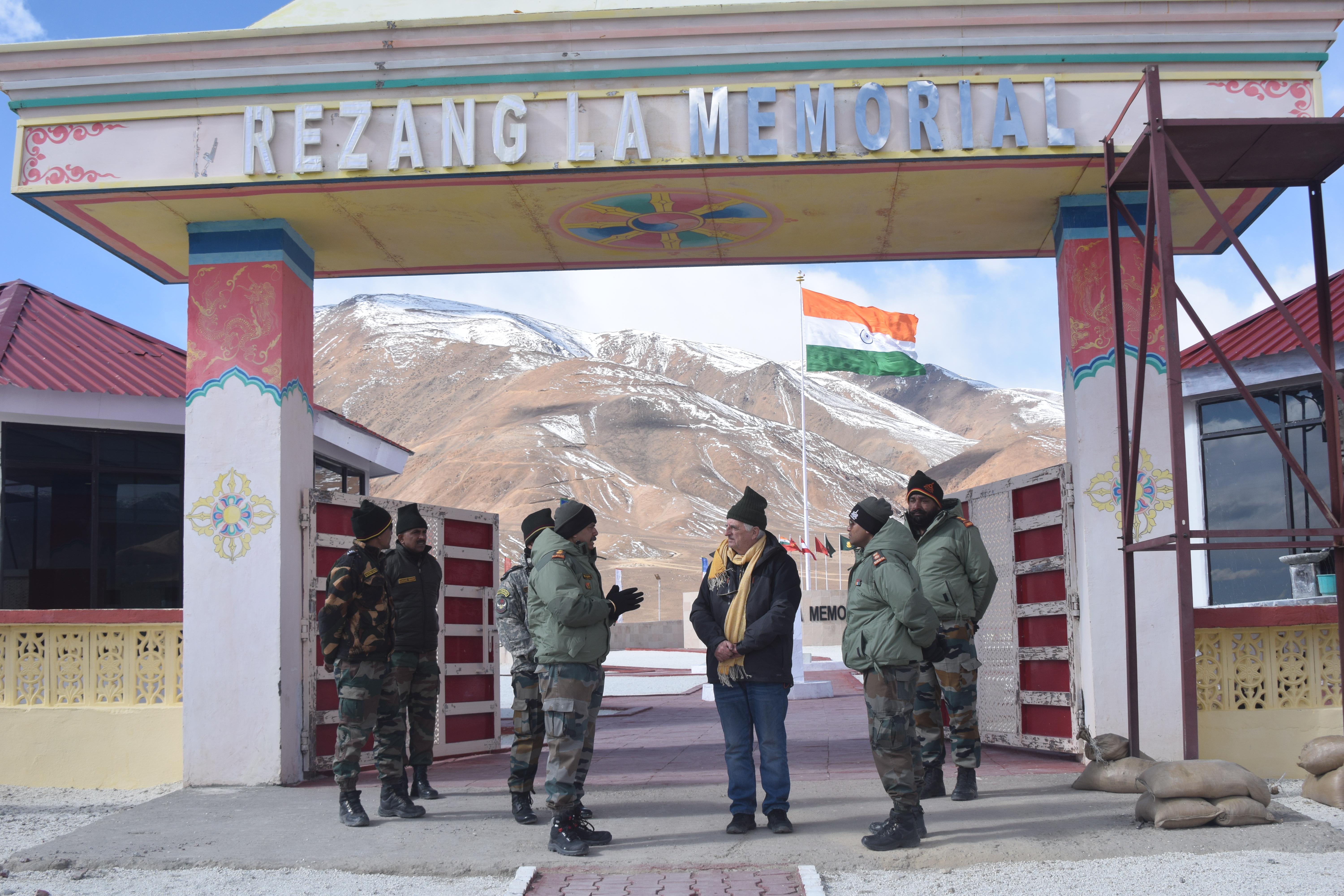
During a recent visit to Rezang La and Chushul, I could personally witness the changes over the last three years.
But let us first remember the events which took place 60 years.

The Battle of Rezang La
On 18 November 1962, the ‘Charlie’ Company of the 13th Battalion of the Kumaon Regiment fought at Rezang La Pass at the incredible height of 18,000 feet, one of the greatest battles in history; 114 soldiers of the 124-strong company led by Maj Shaitan Singh, lost their lives, heroically defending the nearby Chushul airstrip, the last defence before Leh.
Shaitan Singh was posthumously awarded the Param Vir Chakra, the highest military decoration; his battalion received eight VCs (Vir Chakras), four SMs (Sena Medals) and one Mention-in-Dispatches, making it one of the highest decorated companies of the Indian Army.
A recent book on the battle says: “The valour of the Charlie Company not only successfully stopped China’s advance, but it also resulted in the Chushul airport being saved, thereby preventing a possible Chinese occupation of the entire Ladakh region in 1962. According to reports, a total of 1300 Chinese soldiers were killed trying to capture Rezang La.”
Visiting the War Memorial, one has a feeling of super-humans defending the Indian territory against the Chinese onslaught; it is deeply touching; remember that most of the soldiers of the Charlie Company who fought the battle at this altitude had come from the plains of Haryana.

The Role of the Army
One of the greatest changes in the region is the opening of the area to Indian visitors, something which was not possible during my last visit in 2019.
It is necessary to mention the exemplary role of the Indian Army, which has not only encouraged these changes, but due their own strategic requirements, have built dual-use roads, facilitated the construction of schools and the erection of communication towers (one gets 4G Jio connection in Chushul, nearby the Rezang La Memorial).
During an encounter with some local herders, they unanimously agreed that their lives had definitively changed, they have better access to education (though they would like the school in Chushul to go up to Class 12), health services and communications have greatly improved.
The local population has benefited from the many changes brought by the Indian Army and the UT Administration; they can now provide taxi services (thanks to the opening of the area and better roads); they can open home stay which helps them to add to their poor pastoral revenue and contrary to what has been said in some poorly-informed media articles, the grazers are able to take their yaks till the LAC (except for a small area which has been demilitarized in the vicinity of the Spangur Gap, north of the Kailash Range). The rapid changes are likely to continue in the years to come, hopefully taking care of the fragile environment.
It remains striking that these majestic mountains remain the theater of an armed conflict, some sixty years after the Battle of Rezang La.
Looking at the snowy peaks, one wonders what are the objectives of President Xi Jinping when he speaks of ‘The Peaceful Rise of China’? However, Beijing’s belligerence has indirectly brought a better life to these deprived populations.

Friday, November 18, 2022

The Heroes Who Saved Ladakh For India

My article The Heroes Who Saved Ladakh For India appeared in Rediff.com.

Here is the link...

Visiting the Rezang La Memorial, one has a feeling of super-humans defending Indian territory against the Chinese onslaught, says Claude Arpi on the 60th anniversary of the heroic battle of the 1962 War.

Several years ago, I had the opportunity to interview one of the most renowned Indian mountaineers, who had chosen to live like local folks in the Himalaya. She recounted an anecdote which took place during the All-Women Himalayan Traverse expedition; one day the expedition arrived in a small mountain village; speaking about the majestic surroundings, the mountaineer told one of the villagers: ‘Kitne sundar!’ (How beautiful they are!), the local pahari’s immediate reply was, ‘Kitna dukh!’ (So much suffering!).
Somehow, the pithy phrase summarized the hard life in these high mountainous areas.
These words came back to mind when I recently visited the site of the the Battle of Rezang La, near Chushul village in Ladakh at more than 15,000 feet.
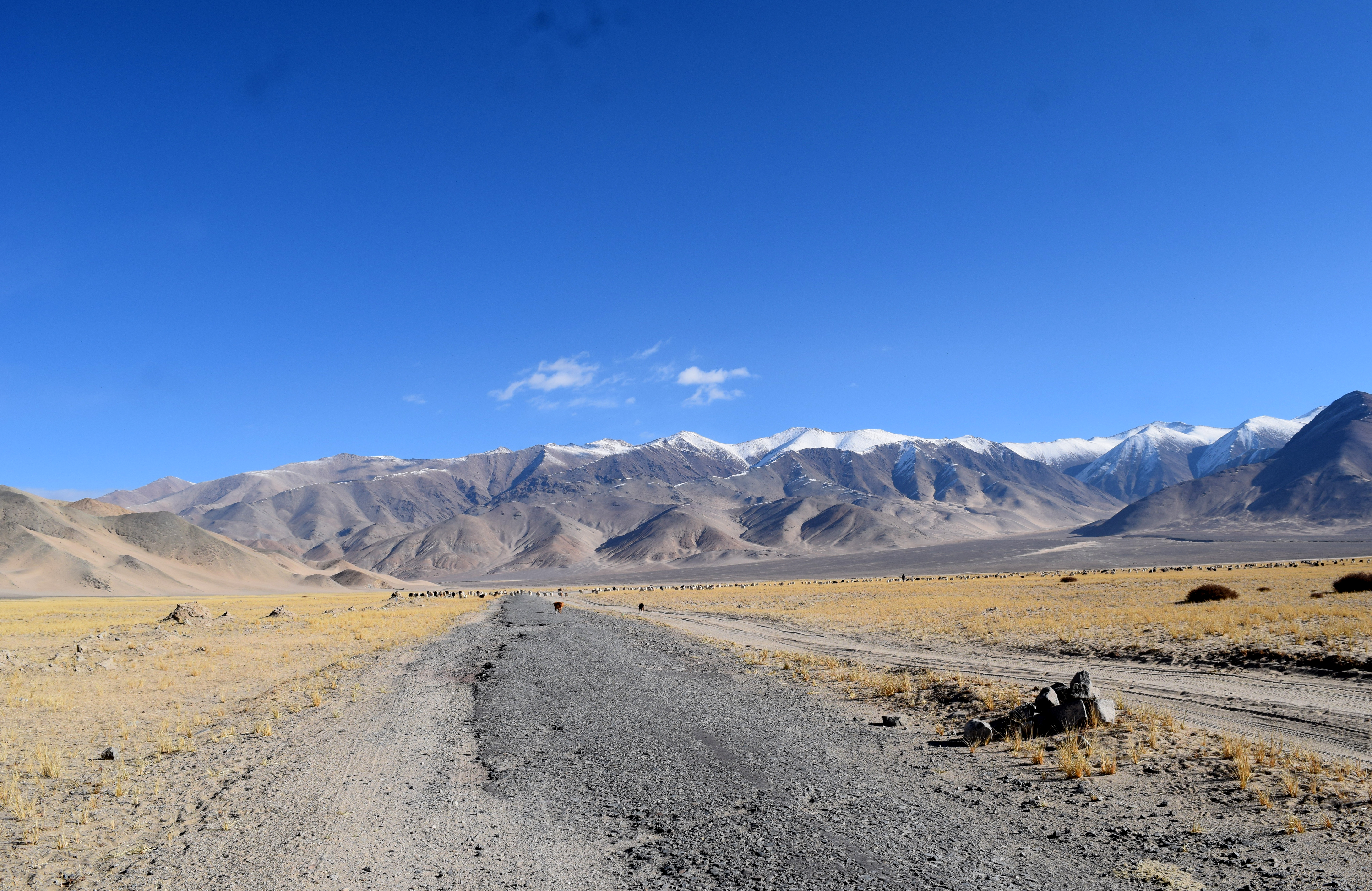
As one arrives by car from Nyoma, the track follows the imposing Kailash range, covered with snow. Immediately, one is confronted by this paradox faced by one of the most peaceful and magnificent spots on earth, which has however witnessed some of the bloodiest battles since independence.
After crossing the Tsaga La (pass) and a few kilometers before arriving at the site of the newly-renovated War Memorial in honour of the ‘Charlie’ Company of the 13th Battalion of the Kumaon Regiment, one can have the magnificent sight of a tri-colour flag floating in the blue sky.

 The ‘dukh’ side
On 18 November 1962, a battle was fought at Rezang La (pass) at the incredible height of 16,000 feet, one of the greatest battles in history; 114 soldiers of the 124-strong company led by Maj Shaitan Singh, PVC, lost their lives heroically defending the nearby Chushul airstrip, the last defence before Leh, Ladakh’s capital.
Maj Shaitan Singh was posthumously awarded the Param Vir Chakra (PVC), the highest military decoration; his battalion received eight VCs (Vir Chakras), four SMs (Sena Medals) and one Mention-in-Dispatches, making it one of the highest decorated companies of the Indian Army.
The citation which appeared in the gazette, said: “Major Shaitan Singh was commanding a company of an Ahir infantry battalion deployed at Rezang La in the Chusul sector at a height of about 16,000 feet. The locality was isolated from the main defended sector and consisted of five platoon-defended positions. On 18 November 1962, the Chinese forces subjected the company position to heavy artillery, mortar and small arms fire and attacked it in overwhelming strength in several successive waves. Against heavy odds, our troops beat back successive waves of enemy attack.”
It is further mentioned that “Major Shaitan Singh dominated the scene of operations and moved at great personal risk from one platoon post to another sustaining the morale of his hard-pressed platoon posts. While doing so he was seriously wounded but continued to encourage and lead his men, who, following his brave example fought gallantly and inflicted heavy casualties on the enemy. For every man lost to us, the enemy lost four or five. When Major Shaitan Singh fell disabled by wounds in his arms and abdomen, his men tried to evacuate him but they came under heavy machine-gun fire. Major Shaitan Singh then ordered his men to leave him to his fate in order to save their lives. Major Shaitan Singh's supreme courage, leadership and exemplary devotion to duty inspired his company to fight almost to the last man.”
Visiting the War Memorial, one has a feeling of super-humans defending the Indian territory against the Chinese onslaught; it is deeply touching; remember that most of the soldiers of the Charlie Company who fought the battle at this altitude had come from the plains of Haryana.
The Ladakh Range and particularly Rezang La and the nearly peaks/passes have an extraordinary strategic importance as they dominates the Spangur Tso (lake), the Spangur Gap (the narrow area between the Pangong Tso and the Spangur Tso) as well as the strategic road to Rutok, the main garrison in Western Tibet and the route to Leh.
By controlling these ridges, the Indian Army stopped the Chinese advance on Leh and probably saved Ladakh. Incidentally, the cease-fire was declared by China four days later. Was it a coincidence?
Though still classified, parts of the Henderson-Brooks-Bhagat Report (hereafter the Report) on the 1962 conflict have found their way to the Internet. It is worth quoting some extracts.
In November 1961, a ‘Forward Policy’ was ordered by the Government; the Report commented: “the ‘Forward Policy’ was primarily introduced to bunk the Chinese claims in Ladakh. Had the developments stemming out of it been correctly apprised by the General Staff at Army Headquarters and correlated to NEFA [North East Frontier Agency], it is possible that we would NOT have precipitated matters till we were better prepared in both theatres.” This sentence has been used by anti-India elements like Neville Maxwell to put the blame on Delhi.
The General Staff of the Army Headquarters knew that any move in NEFA would have consequences in Ladakh, here the level of preparations was minimal; according to the Report: “we acted on a militarily unsound basis of not relying on our own strength but rather on believed lack of reaction from the Chinese. We forgot the age old dictum of the ‘Art of War summed up so aptly by Field Marshal Lord Roberts.”
The latter had said “The art of war teaches us to rely not on the likelihood of the enemy NOT coming, but on our own readiness to receive on the fact that we have made our position unassailable.”
But till the last minute, the government (primarily the Defence Minister Krishna Menon) believed that “The Chinese will not dare”.
The Report continued: “Militarily, it is unthinkable that the General Staff did not advise the Government on our weakness and inability to implement the ‘Forwards Policy’. General [BM] Kaul [Chief of General Staff] on his report has brought out that, on a number of occasions in 1961-62, the Government were advised of our deficiencies in equipment, manpower, and logistic support, which would seriously prejudice our position in the event of a Chinese attack on us.”
At the same time: “orders were given by the General Staff in December 1961 for the implementation of the ‘Forwards Policy’ without the prerequisite of ‘Major Bases’ for restoring a military situation, as laid down by Government. Indeed General KAUL as CGS and the DMO [Director of Military Operations, Maj Gen DK Palit], time and again, ordered in furtherance of the ‘Forward Policy’ the establishment of individual posts, overruling protests made by Western Command.”
Winds of folly were blowing over the Army Headquarters in Delhi; we know what happened a few months later, in October/November 1962.
Maj Shaitan Singh and hundreds of his comrades sacrificed their lives to undo the foolishness of the politicians; the Report added: “There might have been pressure put on by the Defence Ministry, but it was the duty of the General Staff to have pointed out the unsoundness of the ‘Forwards Policy’ without the means to implement it.”
Further, Gen Henderson pointed out: “It is apparent that none of this planning took place and NO operation orders or instructions were issued by the General Staff. It was therefore NOT possible for Command or lower formations to issue any comprehensive order without a directive from the General staff.”
Is it the reason why the Report is still classified 60 years after the event?
One of the conclusions of the Report was: “It was a junior leaders and jawans battle and there is no doubt that they acquitted themselves well. They fought under grave handicaps and in face of defeat; yet there was no sign of undue panic and never a rout. The main reason for this was that troops fought under commanders they knew and trusted. There was no interference or short-circuiting in the chain of command and commanders on the spot were given freedom of action. The good name of our Army was NOT completely marred in LADAKH and the grave errors committed by the General Staff to an extent mitigated, thanks to the fighting ability of our troops.”
Indeed the 13 Kumaon and other units fought like lions. It is said that some 3,000 Chinese lost their lives in a couple of days in this sector.
Leh was probably saved by their act of heroism.
Ironically, the 58 years later, the Tibetan commandos captured the same peaks to have a strategic peep on the Rutok road.
In the process of the negotiations in Chushul and Moldo in the nearby Spangur Gap, the area was demilitarized in exchange of an agreement in the Fingers area on the Pangong Lake. Without commenting on the wisdom of this political move, one can only say Kitna dukh these stunning mountains have witnessed.
While on the spot, an idea came to me, when Chinese officers come to Chushul/Moldo for LAC talks, they should be invited to visit the Memorial to understand what the Indian soldiers are made of. 


Sunday, July 17, 2022

Season of Coincidences and Change

Do you believe in coincidences?
Tenzin Gyatso, the 14th Dalai Lama reached Ladakh on July 15.
Two days later, the 16th round of Corps Commander-level meeting between India and China is to be held at Moldo/Chushul, near the Pangong tso (lake). Led by Lt Gen A Sengupta, the Fire and Fury Corps Commander, the Indian side will discuss disengagement from friction points along the Line of Actual Control (LAC) in Eastern Ladakh with the Chinese commander of the Kashgar Sub-Area Command of the Xinjiang Military District (XMD).
Was it a coincidence, but on July 6, Prime Minister Narendra Modi greeted the Dalai Lama over the phone on the occasion of his birthday: “Conveyed 87th birthday greetings to His Holiness the Dalai Lama over the phone earlier today. We pray for his long life and good health," PM Modi tweeted.
We can’t call everything a coincidence, but President Xi Jinping, General Secretary of the Communist Party of China (CPC) visited Urumqi, the capital of the restive Xinjiang Uygur Autonomous Region (XUAR) two days before the Dalai Lama arrived in Ladakh. According to Xinhua, he inspected a university, an international land port area, a residential community and a museum.

The Dalai Lama in Ladakh
But let us first look at the Tibetan leader’s visit to Ladakh first.
The Chinese are not going to be happy, though they still consider the Union Territory as a ‘disputed territory’ between India and Pakistan and cannot claim it as their as they do for Arunachal Pradesh.
This reminds us the long negotiations for the so-called Panchsheel Agreement in 1954. The discussion was stuck on the issue of Ladakh and more particularly on naming Demchok a landport for the mountainous region.
On April 24, 1954, the Indian Ambassador to China, N. Raghavan, who was himself conducting the talks, informed his Foreign Secretary in Delhi (NR Pillai) that at the suggestion of Zhang Hanfu, the Chinese deputy foreign minister, the plenary sessions on the previous day had been cancelled “he and I carried on informal discussions between 12:00 and 13:00 hours and 19:00 to 23:15 hours.” Raghavan explained that it was ‘royal fight’ from beginning to end: “Zhang took a very recalcitrant attitude but finally gave in on most points,” …except for Demchok.
The Chinese virulently objected to this route been included in the Agreement; they quoted an oral understanding “they would not like in writing even by implication to have any reference to Ladakh.”
For Beijing, the mountainous region was a ‘disputed’ area.
India had taken the stand that Ladakh was part of Indian territory and the route should be mentioned, as its omission would be invidious, but the Chinese remained adamant.
Raghavan finally accepted a compromise which meant that most of the other routes between Ladakh and Western Tibet (particular via Rutok) were abandoned and the trade stopped. This anecdote shows the importance of Ladakh for Beijing (incidentally, the unresolved dispute over Demchok, dates from that day).

The PM’s Birthday Call
With regard to the one-month visit of the Tibetan leader to Leh, the spokesperson of the Ministry of Foreign Affairs of China has so far kept quiet, but Zhao Lijian earlier protested about the Prime Minister’s phone call to the Dalai Lama: “The Indian side also needs to fully understand the anti-China and separatist nature of the 14th Dalai Lama. It needs to abide by its commitments to China on Tibet-related issues, act and speak with prudence and stop using Tibet-related issues to interfere in China's internal affairs."
External Affairs Ministry Spokesperson Arindam Bagchi immediately answered that it was “a consistent policy of the government to treat the Tibetan spiritual leader as an honoured guest and as a respected religious leader who enjoys a large following in India."
The fact that the Dalai Lama will stay for a month in Ladakh is definitively a re-assertion of India’s policy vis-à-vis the Tibetan leader.

Xi Jinping’s visit to Xinjiang and the 16th Round of Talks
Tough low-key, during his visit to Xinjiang, Xi meet with officials of the Xinjiang Production and Construction Corps (XPCC), an organization intimately linked with the PLA. In the past, through its numerous economic activities the state-owned economic and paramilitary organization has not only built towns, farms and provided land and employment for disbanded military units, but also looked after the re-settlement of Han migrants as part of the infamous campaign of sinicization in Xinjiang.
Xi, who is Chairman of the Central Military Commission also met the top brass of the XMD, including Lt Gen Liu Lin, formerly responsible for the talks in Ladakh and now XMD’s Commander, a rising star in the PLA; they are bound to have discussed the forthcoming round of talks in Moldo/Chushul and the XMD has certainly received instructions from the Big Boss.
The 15th round China-India Corps Commander-Level Meeting had been held at the border meeting point on March 11, while the 14th round had taken place on January 12. Earlier, according to media reports, the PLA had pulled back troops from the Galwan valley, PP-15 (Patrolling Point 15) and Hot Springs in Eastern Ladakh area by 2-2.5 kms; the Indian side has consequently pulled back some of its troops and equipment from these areas.
Today it is doubtful if China will agree to a further disengagement from existing friction points in Depsang plains, Gogra and Demchok, especially a few months before the crucial 20th Congress in Beijing; too much is at stake for Xi Jinping. 

Change in India’s Policy?
Many observers see all this as a signal to China of a change in India's Tibet policy.
It is true that in the recent weeks, India has hardened its stance; for example the situation in Eastern Ladakh prominently figured in the talks between External Affairs Minister Dr Jaishankar and his Chinese counterpart Wang Yi in Bali on the sidelines of a conclave of foreign ministers of the G20 nations earlier this month (on July 6, the Dalai Lama’s birthday). During the encounter, Jaishankar strongly conveyed to Wang the need for an early resolution of the outstanding issues in Ladakh.
Back in India, Dr Jaishankar, while attending an interactive session with young voters said that India had explained: “We would like to resolve it on terms that are fair, equitable, mutually agreed upon and do justice to our claims. We can’t resolve it by having one country saying that this is the solution and for us to accept it.” This had been the case in 1954.
Here too, the tone seems to have changed.

The Season of Coincidences and Change
While entering the Season of Coincidences and Change, it is worth mentioning a bill recently introduced in US Congress. According to International Campaign for Tibet, it will be a ‘concrete action’ to resolve China’s decades-long illegal occupation of Tibet by fully recognizing Tibet’s unresolved status and faulting China for violating the Tibetan people’s right to self-determination.
The Act “Promoting a Resolution to the Tibet-China Conflict” affirms that Tibet’s legal status remains to be determined under international law, despite more than six decades of China’s illegal occupation and the Chinese government’s disinformation falsely claiming that Tibet has been part of China since ancient times.
If the legislation is passed by the Congress and the Senate, the official US policy will be that Tibetans have the right to self-determination.
Here again, the spokespersons of the Ministry of Foreign Affairs in Beijing are bound to see red and be displeased.
The new policy would not only reject as ‘historically false’ China’s claim that Tibet has been part of China since ancient times, but also “make clear that Tibet includes not only the so-called Tibet Autonomous Region of China but also Tibetan areas of Gansu, Sichuan, Qinghai and Yunnan provinces.”
It is serious implications for the Tibet-India border too.
It will be interesting to see how Delhi will react in case the bill is passed.
Today, there is no doubt that the poet might have been right, “for the times they are a-changin'.”
Interesting times indeed.
 

Saturday, April 23, 2022

Historical Roots of India-China Border Conflict Lie in Mao Zedong’s Conquest Designs in Xinjiang and Tibet: Historian

My interview with The Epoch Times By Venus Upadhayaya: "Historical Roots of India-China Border Conflict Lie in Mao Zedong’s Conquest Designs in Xinjiang and Tibet: Historian".

Here is the link...

Since the bloody clash between Indian and Chinese soldiers in the remote Galwan region of the Himalayas in 2020, border tensions between the two neighbors have shown little sign of easing.
The decades-long border dispute finds its roots in the Chinese regime’s first leader Mao Zedong’s conquest designs in western regions of Xinjiang and Tibet, according to a leading historian on the issue.
Claude Arpi, a French-born Tibetologist now living in India told The Epoch Times that China’s aggression in the western sector in India’s northernmost Ladakh region started not long after Mao came to power in October 1949 when the Chinese Communist Party’s (CCP) People’s Liberation Army (PLA) marched into Tibet and Xinjiang, the two territories that today share a long border with India.


Until then the Chinese were not present on the Indian frontier and it was the Soviets who were “monitoring and controlling” the borders of East Turkestan, a Central Asian satellite state of the Soviet Union that is today known as the western frontier of Xinjiang, with India, according to Arpi.

By December 1949, the PLA, without artillery and with only a few hundred vehicles provided by the Soviets that had to be abandoned a few weeks in due to lack of fuel and spare parts, had descended on Xinjiang by foot.
“The PLA took over the entire Xinjiang and came at the gate of India in two months,” Arpi said.
Arpi, an author of two books on the 1962 India-China war and multiple other books on Tibet and the Sino-India territorial dispute, said that it’s obvious that Soviet leader Joseph Stalin knew of the CCP’s operations in East Turkestan but it’s not clear why the Soviets gave up this territory under their control to the Chinese communists.
“They probably thought that Mao would do the ‘dirty’ work and the Soviet control over these areas could continue as before,” he said.
At this time India had a consulate in Kashgar in East Turkestan that it had to close and its consul general had to escape on foot crossing the Karakoram mountains to reach Leh town in India’s Ladakh. It considered this closure as a fait accompli since a revolution had taken place.
The geopolitical placement of India’s northernmost dominion, Jammu and Kashmir in 1947, two years before Mao Zedong took over Xinjiang and came to India’s border–today that’s China’s western frontier.


Aksai Chin
At the junction between India-, China- and Pakistan- controlled territories today, there’s an uninhabited cold desert called Aksai Chin—also the only land connection between Xinjiang and Tibet.
By the time the CCP finished its conquest of Tibet in 1951 to 1952, Mao realized that Aksai Chin, the desert area in the north of Ladakh was strategically extremely important for the regime’s future.
“It was an uninhabited area, nobody could live there, but the Chinese decided to build a road there because it was the easiest way to connect the two new provinces [of Tibet and Xinjiang],” said Arpi. “That’s how in Aksai Chin today’s Chinese Highway G219 came into being. Was surveyed in 1952-53, China started building it in 1954 and it was inaugurated in July 1957.”
After marking the road in 1952, the CCP didn’t stop there. “In 1956 China agreed to a map that gets more or less half of the Aksai Chin and in 1959 it pushed it further south,” said Arpi.
India was born as a nation in 1947 and was taken unaware of the Chinese Communist Party’s activities in its dominion of Jammu and Kashmir which included the province of Ladakh and hence Aksai Chin.
The Indian administration in New Delhi came to know of G219 on its territory only after an Indian patrol party was detained by the Chinese in Haji Langar in September 1958. Haji Langar was an extreme Indian patrolling point in the north of Aksai Chin; It was also a place where Mecca-bound pilgrims were fed. The 1962 war between India and China ignited after Mao annexed Indian territory and built G219. India was defeated in the conflict and lost the Aksai Chai region in a matter of days.
The Epoch Times has obtained a booklet published by the government of India in 1963 entitled “Chinese Aggression in Maps.” and it’s a cartographic description of how without provocation the CCP entered the uninhabited Indian territory of Aksai Chai and how the Chinese claim lines unilaterally continued to change from 1956 to 1962.
The Indian administration in its booklet said the Chinese were claiming boundary lines in Ladakh according to their “bargaining convenience and progressively increasing extent of occupation of Indian territory through force.”
Arpi said even the international community was taken unaware of the Chinese activities in this desolate part of the world. “The Soviet Union might have known, but by that time, it was no more their ‘business,’” he said.
 “And after that the 1962 war took place, the PLA pushed south and occupied some other places that they have not vacated to date. China vacated some areas and some didn’t vacate. In the end, where is the LAC?” said Arpi, adding that China’s “bargaining convenience” continues untill date.
The Line of Actual Control (LAC) is a notional line of demarcation between India-controlled territory and China-controlled region. The Chinese Premier Zhou Enlai first spoke about the existence of the LAC during his visit to Delhi in 1960.
Arpi said nobody actually knows the specific position of the LAC; Zhou sent a map of what he considered was LAC in 1962 but it didn’t correspond to the reality on the ground in several places.
India and China started the process of exchanging maps only in 2000. Since then they have shared maps only of a central sector called the Barahoti area but nothing has been exchanged on Ladakh where there’s a massive military buildup on both sides today.
 “In 2002, there was a meeting, China brought maps of its own perceptions and India did the same. After 20 minutes China and India took back their maps, probably realizing that the perceptions were too far apart,” said Arpi.
 “It has however to be noted that detailed maps of the western sector have never been exchanged,” he added.
Arpi said the Chinese have continued with the same strategy of “salami-slicing”—encroaching on the territory a bit at a time—until recently when they tried to grab a few miles in the Himalayan Galwan region to gain a better altitude for a view of the strategic road Indians were building there. It ended in the June 2020 clash, a hand-to-hand fight where the PLA attacked the Indians with metal rods wrapped with barbed wire.
The clash killed 20 Indian soldiers and an estimated dozens of Chinese soldiers, though Beijing has only officially acknowledged a small handful of deaths.
“China grabs what it wants or what it ‘needs’, whether in Ladakh or in the South China Sea, and then says: ‘Now let us negotiate’. But later, nothing happens during the negotiations,” said Arpi.


Negotiations Between Armies
The 2020 conflict in Galwan led to heavy military build-up on both sides of the disputed border, and to ease tensions the two countries’ militaries started bilateral talks.
But despite 15 rounds of these talks between commanders on both sides little progress has been made. Arpi said it’s “remarkable” that for the first time the negotiations involve the army because the branch has better ground perception, and this is important in Ladakh, a high altitude plateau where height means gaining a strategic advantage over the other.
 “Modi government did a good thing to give the negotiation to the army, to the 15 Corps Commander in Leh. And of course, there is one additional secretary from the Ministry of External Affairs who has attended all these talks. Modern negotiations need to involve all the stakeholders,” said Arpi.
When Chinese Foreign Minister Wang Yi landed in India on March 24, India’s Foreign Minister S. Jaishankar said the bilateral ties between the two countries can’t be normal until the border tensions persist.
 “Is it not strange that there has been so much coverage about Ukraine; so much criticism of Putin, but nobody has said anything to Xi Jinping when in May of 2020 he started grabbing land in Ladakh. In that case, it is only because of the Indian Army with the Indian government’s support, that the Chinese advances were stopped,” said Arpi.
The historian noted that it would be very difficult for the CCP to concede in this dispute because domestically it has promoted disinformation and propaganda about the Galwan conflict, including pointing to India as the aggressor in the clash and covering up the total Chinese casualties.
“Today, if Beijing gives back some areas in Depsang [a disputed area in Aksai Chin], it’ll be known in China. It will be known by the members of the [CCP’s] Central Committee, the Politburo, it will be known by the media, and Xi Jinping will lose face. Xi Jinping is not in a position to lose face before November’s 20th Congress,” said Arpi, referring to an important CCP meeting where Xi is bidding for an unprecedented third term in power.
The CCP has also been seizing territory in the South China Sea as well where it is building and militarizing islands, Arpi said. While the West can only “make a lot of noise” and “put sanctions,” India is the only country that stood “physically, militarily” against the PLA, he said.
Venus Upadhayaya reports on wide range of issues. Her area of expertise is in Indian and South Asian geopolitics. She has reported from the very volatile India-Pakistan border and has contributed to mainstream print media in India for about a decade. Community media, sustainable development, and leadership remain her key areas of interest.
 

Wednesday, October 20, 2021

Dragon flaunts ‘firepower’ across LAC to ward off growing internal challenges

Bunkers near the LAC in Arunachal Pradesh
My article Dragon flaunts ‘firepower’ across LAC to ward off growing internal challenges published in Firstpost

Here is the link...

President Xi Jinping has not left China for almost two years; it is not difficult to understand why if one looks at the domestic problems he has on his plate

What is going on in China? One thing is sure that the Middle Kingdom is going through turbulent times, to say the least. One just needs to look at the 13th round of the India-China Corps Commander level meeting, held at Chushul-Moldo post in Ladakh on 10 October. We are now told that the process of disengagement failed to move forward.

India said that it was necessary for the Chinese “to take appropriate steps in the remaining areas so as to restore peace and tranquility along the LAC in the Western Sector”. The Indian side, therefore, “made constructive suggestions for resolving the remaining areas, but the Chinese side was not agreeable and also could not provide any forward-looking proposals. The meeting thus did not result in resolution of the remaining areas”.

While the Indian negotiators regretted that “the atmosphere has changed suddenly”, China had been quicker to move… and blame India. Most commentators could not explain why the negotiations failed.

A quick look at the two press releases (the Indian one quoted above and the one provided by Col Long Shaohua, the spokesperson of the Western Theatre Command based in Chengdu-Sichuan), helps us to understand. Nowhere are mentioned the names of the commanders who met for nearly nine hours. Why?

From the Indian side, like for the previous rounds, the talks were led by the General-Officer-Commanding (GOC) of the 14 Corps based in Leh, a post presently held by Lt Gen P G K Menon (earlier, Menon’s predecessor, Lt Gen Harinder Singh conducted the first rounds).

What is strange is that nobody seems to know who led the Chinese side. It is usually the commander of the South Xinjiang Military District (SXMD), a post held till recently by Maj Gen Liu Lin. A few weeks ago, Liu Lin was promoted to the rank of Lieutenant General and transferred to Urumqi (Xinjiang) as commander of the Xinjiang Military District (XMD) overlooking the SXMD (and the Ladakh front).

Liu Lin’s promotion meant that the Central Military Commission or CMC (read Xi Jinping, its Chairman) was happy about the way that he dealt with India. Since then, the SXMD, China’s most strategic and ‘hot’ front, has had no commander.

Can you believe it?

This is why both sides agreed to leave a blank on the names of those who conducted the talks (it is rumoured that an officer posted in Urumqi, without a real mandate, was nominated as a stop-gap to replace Gen Liu Lin). What does this mean?

It shows that in India, a democracy, the passing over between commanders at all levels is a smooth affair, announced well in advance in the media; it is not the case in totalitarian China, unable to ‘replace’ its commanders in time, resulting in confusion and an inability to “provide forward-looking proposals”. Some Chinese social media have suggested that it was due to the high rate of “mountain sickness” among the officers and soldiers.

It probably means that President Xi Jinping, also CMC Chairman, is unable to find adequate officers who can fit the bill of professionalism, knowledge of the terrain and, critically, are faithful to the Party, i e the Emperor; the latter being the most important criteria.

As a result, the two armies will probably face each other during the forthcoming harsh winter. India will have no choice but to be prepared; this was stated by Gen M M Naravane, the Chief of Army Staff.

Knowing that the talks were bound to fail in the absence of someone mandated to discuss with India, China was quick to move. The Western Theatre Command headquarters immediately released a communiqué: “Instead of misjudging the situation, the Indian side should cherish the hard-won situation in China-India border areas,” commented Senior Colonel Long Shaohua, the spokesperson, who said that the Chinese side had made great efforts “to promote the easing and cooling of the border situation and fully demonstrated China’s sincerity of maintaining overall interests of bilateral military relations. However, the Indian side still persisted in its unreasonable and unrealistic demands, which added difficulties to the negotiations”.

It pointed out that China was firm in its resolve to safeguard national sovereignty: “The Indian side should avoid misjudging the situation and cherish the hard-won situation in the China-India border areas. The Indian side should abide by the relevant agreements and consensus reached between the two countries and two militaries, show sincerity and take concrete actions to jointly safeguard peace and stability in the border areas with China.”

China, it is well known, has great expertise to point a finger at others for mischiefs that it has itself committed.

A few hours later, The Global Times followed the same track and accused India, warning: “PLA border troops maintain high alert, prepared for upcoming confrontations… The harshly worded statement issued by the Chinese government on China and India failing to reach an agreement during their latest round of corps commander-level talks, showed China's subtle change of attitude toward India, and the country's staunch determination to protect its territorial and sovereign integrity.”

In other words, China was now fed-up with India (for the PLA having entered India’s territory); to prove its points, the Communist mouthpiece quoted different ‘analysts’.

These ‘experts’ brought up in the process a couple of incidents created by the PLA in Barahoti in Chamoli district of Uttarakhand, where over 100 soldiers and 55 horses transgressed over five km into the Indian territory by walking south of the watershed — the Tunjun-la pass. A few days later, a large number of Chinese soldiers entered into India at Yangtze in the Tawang sector of Arunachal Pradesh; the Indian Army and Intelligence Bureau later confirmed the reports of border transgression which lasted for three hours on 9 October.

The Chinese scholars conveniently said: “India has been triggering new incidents along the eastern section of the border recently.” They argued that China should not only refuse “to give in to India's arrogant demands at the negotiating table, but also be prepared to defend against new Indian military aggression.”

But there is more than the local situation. The Sixth Plenum of the Communist Party of China is soon coming up (probably mid-November) and Xi Jinping is under great pressure from many quarters and in these circumstances, he could not afford to ‘give away’ anything in Ladakh.

The forthcoming Plenum explains the PLA’s latest aggression on India’s northern borders, but also near Taiwan where hundreds of Chinese planes have recently trespassed into Taipei’s airspace.

The same Global Times published an editorial stating that mainland China will have a showdown with Taiwan if the Taiwanese authorities continue to make trouble colluding with the United States and Japan. It suggested that the PLA fighter planes could fly over the island of ‘rebel’ Taiwan: “This is a step we must take… It will be a clear and unmistakable declaration of China’s sovereignty over Taiwan, and will create unprecedented conditions for us to further implement this sovereignty.”

Xi has several other problems on his plate, whether it is in Xinjiang, with the continuous unrest of the Uyghur population; in Hong Kong, which is slowly being assimilated to the mainland; with the endless power-cuts affecting the industries and individuals; the quick collapse of Evergrande Group and the real estate market; the purge of more and more senior Party officials (on October 2, the Central Commission for Discipline Inspection said that Fu Zhenghua, the former minister of justice, was being investigated), and many more issues.

In the circumstances, one understands that Xi does not have the time to find a replacement for Gen Liu Lin and can’t afford to withdraw from more disputed areas of Ladakh. The media onslaught on India has simply been to divert the attention of the Chinese public, from far more serious issues. Incidentally, President Xi has not left China for almost two years; it is not difficult to understand why

Thursday, October 14, 2021

Stop China from erasing ‘the heart of the world’

My article Stop China from erasing ‘the heart of the world’ appeared in The Asian Age and The Deccan Chronicle

Unfortunately, we can’t expect an atheist regime in Beijing to understand the meaning of the word 'sacred'

Here is the link...

Have you heard of the “Hidden Land of Pemako”?

It is the area where China is planning to build mega hydropower stations in the Great Bend of the Yarlung Tsangpo (Brahmaputra) during its forthcoming 14th Five Year Plan.
This project, three times the size of the Three Gorges dam, which is extremely hazardous for downstream nations such as India, has another dimension -- the disappearance of one of the world’s most sacred places.

Unfortunately, we can’t expect an atheist regime in Beijing to understand the meaning of the word “sacred”.

In pursuit of Xi Jinping’s theory, “to govern the nation, govern the borders; to govern the borders, strengthen the development of border regions”, China has given a concrete shape to the new Great Helmsman’s slogan by building some 600 “model” villages, many in sacred areas on the Tibetan side of the Indian border.

Whether it is with the hydropower plants or the new villages, the hallowedness and pristine purity of these areas are being lost forever.
Ian Baker, a Buddhist scholar and author of The Heart of the World: A Journey to the Last Secret Place, extensively wrote on Guru Padmasambhava, “the king of all hidden lands”, visiting Pemako in the eighth century.
Baker explained: “The very eastern end of the Himalayan range is [Pemako], where the [Yarlung] Tsangpo Brahmaputra river makes this great bend, a hairpin bend, around the peak of Namcha Barwa, at the very terminus of the Himalayan range … just hearing about the great and blissful land of Pemako …that is the path to enlightenment.”
Baker visited Pemako several times: “I tried to follow what is called the sequence of the outer and inner circles into Pemako, leading into a kind of a paradisiacal round at the very heart of the circumambulation.”
That mythical place will soon be destroyed by Chinese engineers.

Baker writes: “Shambhala was represented as the mandala, with different ways leading into it from the peripheries. …As one enters the mandala, it is a transforming as well as a transformed space and condition. In Pemako, people describe the body of Dorjee Phagmo, a particular tantric Buddhist goddess called Vajravarahi in Sanskrit.”
What will happen to this paradise on earth after the tunnel-digging machines arrive? The Chinese propaganda nevertheless speaks of creating a beautiful place by preservation of “ecology and [providing] livability, health, charm, and happiness”. Is this compatible with a hydel plant three times the size of the Three Gorges Dam? Where will the goddess take refuge? Moreover, will she agree to these “human” plans?
Another travesty: Drolkar, an unknown Tibetan woman from a remote hamlet in southern Tibet, suddenly came into pre-eminence in China when, this year, she was awarded the “July 1 Medal”, the most prestigious recognition by President Xi Jinping on the occasion of the Communist Party of China’s completion of 100 years. Why?
In October 2017, Mr Xi had sent a letter to two young Tibetan herders, Drolkar and her sister, who had introduced their village, Yume, north of the Indian border, to him.
President Xi thanked them “for the loyalty and contributions they have made in the border area. Without peace in the territory, there will be no peaceful lives for the millions of families”.
The girls’ village, Yume, located a few kilometers north of the McMahon Line, not far from the remote Indian village of Takshing, suddenly became the model village for the next 600.
Yume was one of the most sacred places in Tibet and the terminus for the holy Tsari pilgrimage. China Tibet Online, a Chinese website, praised the area thus: "Hailed as Tibet’s Shambhala, Tsari township boasts its lush vegetation, moderate weather, still lake, running brook, vast forest, holy mountains as well as a variety of herbs.”
While still one of the most sacred pilgrimages in Tibet along with the Kailash Yatra, Tsari was incidentally the site of the first clash between the Chinese and Indian troops in Longju in August 1959.

One of the unique characteristics of this pilgrimage was that it ran right across the Indo-Tibetan border (McMahon Line), one half being in Tibet, the other in the North East Frontier Agency (India).
Yume played an important spiritual role in the Yatra. Toni Huber, the author of The Cult of Pure Crystal Mountain: Popular Pilgrimage and Visionary Landscape in Southeast Tibet, wrote: “During the second week of the third Tibetan month, the initial rituals for ‘mountain opening’ began in the village of Yume in the western part of Tsari. At that time the protective deities of the mountain were worshiped. This annual, week-long period of ceremony and festival was called Chöle Chenmo or ‘The Great Religious Work’, and it was primarily a ritual performed by local villagers [of Yume].” Today the villagers worship the red flag of CPC and paint the rocks around the village in red colour.
 Huber speaks of “a knowledgeable local man who had taken over the role of annually opening the mountain from two hereditary lamas …As their names suggest, they used certain magical powers generated by way of ritual formulae to facilitate the clearing of a path through the often deep spring snows encountered on the mountain, and to avert avalanches that might sweep down on the pilgrims”. These were Drolkar’s ancestors.
The inhabitants of Yume and the Tsari valley were the “servants’ or ‘keepers” of the Yatra’s tradition; they had “an active role in staging village-based festivals of worship for the gods and goddesses of the mountain”. According to Huber: “Yume was the original centre of development for tantric retreats at Tsari …It is said that the original meaning of Chöle Chenmo was to mark the end of the winter meditation retreat by yogins in the Yume area and to worship the tantric sky-goers.”
All this ended with the invasion of Tibet in 1951.

While totalitarian China has almost completely erased the sacred tradition, it is certainly something that democratic India could promote; New Delhi should develop all the sacred places near the borders with Tibet (in Ladakh, Uttarakhand, Himachal, Sikkim or Arunachal Pradesh), particularly all the places which have been blessed by Padmasambhava, Guru Nanak, the lamas or local saints.

Wednesday, July 21, 2021

The Butterfly Effect in Ladakh

 My article The Butterfly Effect in Ladakh appeared in The Daily Guardian

Here is the link...

For years, China and the US, the world’s two superpowers, have been competing to win the battle of supremacy, then the Covid-19 arrived, as insignificant as the flutter of a butterfly’s wings; it has, however, triggered immense changes in the world.
 

The term Butterfly Effect is usually associated with the ‘chaos theory’. Mathematician and meteorologist Edward Lorenz’s discovery of the metaphorical term ‘Butterfly Effect’ is derived from his research on a tornado: Tthe time of its formation and the path it takes is often influenced by “minor perturbations such as a distant butterfly flapping its wings several weeks earlier.”

Wikipedia explained that Lorenz discovered the effect “when he observed runs of his weather model with initial condition data that were rounded in a seemingly inconsequential manner… A very small change in initial conditions had created a significantly different outcome.”

When future scholars will write the history of modern China, a landmark will certainly be the day Mao Zedong founded the People’s Republic of China from the rostrum on Tiananmen Square in October 1949; but perhaps an even more important event will be the appearance of the Covid-19 virus in Wuhan in December 2019.

In early 2020, Moustapha Dahleb, a Chadian doctor and poet, provided a great description of Covid-19, the pandemic that has been plaguing the planet, killing more than 4 million humans and affecting some 220 millions. He wrote, “Humanity Shaken by a Small Thing (Un Petit Machin).” He argued, “A small microscopic thing called coronavirus is upsetting the planet. Something invisible has come to make its law. It questions everything and upsets the established order. Everything is put back in place, otherwise, differently.”

For years, China and the US, the world’s two superpowers, have been competing to win the battle of supremacy, then the ‘petit machin’ arrived, as insignificant as the flutter of a butterfly’s wings; it has however triggered immense changes in the world, that we have started witnessing.

At the end of 2019, China was triumphant; Beijing could get any country (small or big) to obey its diktats— who could afford to lose the lucrative business opportunities ‘offered’ by the Middle Kingdom?

Countries like France were even ready to provide Beijing with a P4 Lab, with the most sophisticated technology (and its inherent dangers), despite wise voices to the contrary in Paris: “The future of our economy depends on the Middle Kingdom”, kept repeating the politicians, forgetting in the process that the Communist regime in Beijing was totalitarian and mistreated those who were not ready to follow the Party line.

In India too, the ‘trust’ with China reached such levels in February 2018 that Foreign Secretary Vijay Gokhale asked the Cabinet Secretary to issue a classified advisory note addressed to all Ministries and Departments of the Central as well as state governments not to meet the Dalai Lama.

Long ago, Napoleon Bonaparte is said to have remarked, “Let China sleep. For when she wakes, the world will tremble.”

But since one year, the planet has begun waking up to the Dragon’s belligerent behaviour and it is now the Communist regime in Beijing that has started trembling.

As often depicted in Indian epics, it is the ‘villain’ who helped Delhi to come out of its torpor; in May 2020, at a time when India was struggling with the Wuhan virus, widely acknowledged to have originated in the megacity which had ironically witnessed the ‘Consensus’ between Modi and Xi less than two years earlier, the People’s Liberation Army (PLA) advanced into several areas in Ladakh. India decided to resist the Chinese bully, something which in turn upset the Dragon further (‘How could such a small ‘non-violent’ chaotic country like India resist it for a few kilometers of territory on a desolate plateau?’).

Since then, especially after the deadly clash in Galwan in June 2020, the situation has drastically changed; apart from some hardcore ‘experts’ whose business still depends on the old relation with China, the Indian nation is today aware that business cannot continue as before …Even External Affairs Minister Dr. Jaishankar recently admitted: “…for the last one year, there has been a lot of concern about the relationship because China has not observed agreements it had signed up for when it came to our border.”

Then another flap of wing: on 6 July, the Prime Minister tweeted: “Spoke on phone to His Holiness the @DalaiLama to convey greetings on his 86th birthday. We wish him a long and healthy life.”

This simple phone call is significant for many reasons; first and foremost it shows that the Indian government is behind the Dalai Lama in his succession dispute with Beijing; it will also be noted by Beijing at a time the PLA is trying to recruit more Tibetans in its ranks, to one day raise a Tibetan unit to match the Indian Special Frontier Force (SFF), composed of Tibetan refugees in India.

It further sends a clear message to the other side of the frontier in Ladakh. Not only did the populations in Rutok county adjoining India get to know about the PM’s phone call, but this year, large crowds were allowed to celebrate the 86th anniversary of their leader in the vicinity of the LAC; some 200 Ladakhis and Tibetan refugees gathered in U Bend area of the Indus (where the river takes a turn westwards in direction of Nyoma). A car cavalcade, carrying photos of the Dalai Lama, drove around a Mani (a pile of stones with sacred mantras such as Om Mani Padme Hum), while chanting prayers for the Dalai Lama’s long and healthy life.

Obviously, the PLA ‘border guards’ posted near Dumchele, on the opposite side of the Indus, were not happy and a few soldiers in mufti displayed a red banner, protesting the event; eyewitnesses said the banner was poorly made and barely readable, showing that China had probably not anticipated the ‘special’ phone call from Delhi to Dharamsala as well as the size of the celebrations in Ladakh, which ended with a prayer and the traditional bara khana.

But that is not all, festivities also took place at Hanle, on the western side of the Ladakh range, where some 600 people assembled; it was the largest ever gathering for the Dalai Lama’s birthday; men and women dressed in their colouful attires, performed ‘happiness’ dances and played games. Similar scenes were seen near the LAC in Ladakhi villages of Koyul, Dungti, and Nyoma.

That such functions took place at a time the COVID pandemic is not fully over is a great change, especially when the border remains extremely tense, with the 12th round of talks between the 14 Corps Commander and his Chinese counterpart still to take place. The close coordination between the local sarpanchs, the civil administration, the gompas, and the defence forces made the events a great local success.

Apart from the ‘Bharat Mata ki Jai’ which reverberated on the banks of the Indus and Hanle rivers, the event remained apolitical, a première in Ladakh.

A few flaps of butterfly wings more and tectonic changes could happen in India’s China policy; it is certainly in India’s interests.