Showing posts with label Rutok. Show all posts

Wednesday, July 21, 2021

The Butterfly Effect in Ladakh

 My article The Butterfly Effect in Ladakh appeared in The Daily Guardian

Here is the link...

For years, China and the US, the world’s two superpowers, have been competing to win the battle of supremacy, then the Covid-19 arrived, as insignificant as the flutter of a butterfly’s wings; it has, however, triggered immense changes in the world.
 

The term Butterfly Effect is usually associated with the ‘chaos theory’. Mathematician and meteorologist Edward Lorenz’s discovery of the metaphorical term ‘Butterfly Effect’ is derived from his research on a tornado: Tthe time of its formation and the path it takes is often influenced by “minor perturbations such as a distant butterfly flapping its wings several weeks earlier.”

Wikipedia explained that Lorenz discovered the effect “when he observed runs of his weather model with initial condition data that were rounded in a seemingly inconsequential manner… A very small change in initial conditions had created a significantly different outcome.”

When future scholars will write the history of modern China, a landmark will certainly be the day Mao Zedong founded the People’s Republic of China from the rostrum on Tiananmen Square in October 1949; but perhaps an even more important event will be the appearance of the Covid-19 virus in Wuhan in December 2019.

In early 2020, Moustapha Dahleb, a Chadian doctor and poet, provided a great description of Covid-19, the pandemic that has been plaguing the planet, killing more than 4 million humans and affecting some 220 millions. He wrote, “Humanity Shaken by a Small Thing (Un Petit Machin).” He argued, “A small microscopic thing called coronavirus is upsetting the planet. Something invisible has come to make its law. It questions everything and upsets the established order. Everything is put back in place, otherwise, differently.”

For years, China and the US, the world’s two superpowers, have been competing to win the battle of supremacy, then the ‘petit machin’ arrived, as insignificant as the flutter of a butterfly’s wings; it has however triggered immense changes in the world, that we have started witnessing.

At the end of 2019, China was triumphant; Beijing could get any country (small or big) to obey its diktats— who could afford to lose the lucrative business opportunities ‘offered’ by the Middle Kingdom?

Countries like France were even ready to provide Beijing with a P4 Lab, with the most sophisticated technology (and its inherent dangers), despite wise voices to the contrary in Paris: “The future of our economy depends on the Middle Kingdom”, kept repeating the politicians, forgetting in the process that the Communist regime in Beijing was totalitarian and mistreated those who were not ready to follow the Party line.

In India too, the ‘trust’ with China reached such levels in February 2018 that Foreign Secretary Vijay Gokhale asked the Cabinet Secretary to issue a classified advisory note addressed to all Ministries and Departments of the Central as well as state governments not to meet the Dalai Lama.

Long ago, Napoleon Bonaparte is said to have remarked, “Let China sleep. For when she wakes, the world will tremble.”

But since one year, the planet has begun waking up to the Dragon’s belligerent behaviour and it is now the Communist regime in Beijing that has started trembling.

As often depicted in Indian epics, it is the ‘villain’ who helped Delhi to come out of its torpor; in May 2020, at a time when India was struggling with the Wuhan virus, widely acknowledged to have originated in the megacity which had ironically witnessed the ‘Consensus’ between Modi and Xi less than two years earlier, the People’s Liberation Army (PLA) advanced into several areas in Ladakh. India decided to resist the Chinese bully, something which in turn upset the Dragon further (‘How could such a small ‘non-violent’ chaotic country like India resist it for a few kilometers of territory on a desolate plateau?’).

Since then, especially after the deadly clash in Galwan in June 2020, the situation has drastically changed; apart from some hardcore ‘experts’ whose business still depends on the old relation with China, the Indian nation is today aware that business cannot continue as before …Even External Affairs Minister Dr. Jaishankar recently admitted: “…for the last one year, there has been a lot of concern about the relationship because China has not observed agreements it had signed up for when it came to our border.”

Then another flap of wing: on 6 July, the Prime Minister tweeted: “Spoke on phone to His Holiness the @DalaiLama to convey greetings on his 86th birthday. We wish him a long and healthy life.”

This simple phone call is significant for many reasons; first and foremost it shows that the Indian government is behind the Dalai Lama in his succession dispute with Beijing; it will also be noted by Beijing at a time the PLA is trying to recruit more Tibetans in its ranks, to one day raise a Tibetan unit to match the Indian Special Frontier Force (SFF), composed of Tibetan refugees in India.

It further sends a clear message to the other side of the frontier in Ladakh. Not only did the populations in Rutok county adjoining India get to know about the PM’s phone call, but this year, large crowds were allowed to celebrate the 86th anniversary of their leader in the vicinity of the LAC; some 200 Ladakhis and Tibetan refugees gathered in U Bend area of the Indus (where the river takes a turn westwards in direction of Nyoma). A car cavalcade, carrying photos of the Dalai Lama, drove around a Mani (a pile of stones with sacred mantras such as Om Mani Padme Hum), while chanting prayers for the Dalai Lama’s long and healthy life.

Obviously, the PLA ‘border guards’ posted near Dumchele, on the opposite side of the Indus, were not happy and a few soldiers in mufti displayed a red banner, protesting the event; eyewitnesses said the banner was poorly made and barely readable, showing that China had probably not anticipated the ‘special’ phone call from Delhi to Dharamsala as well as the size of the celebrations in Ladakh, which ended with a prayer and the traditional bara khana.

But that is not all, festivities also took place at Hanle, on the western side of the Ladakh range, where some 600 people assembled; it was the largest ever gathering for the Dalai Lama’s birthday; men and women dressed in their colouful attires, performed ‘happiness’ dances and played games. Similar scenes were seen near the LAC in Ladakhi villages of Koyul, Dungti, and Nyoma.

That such functions took place at a time the COVID pandemic is not fully over is a great change, especially when the border remains extremely tense, with the 12th round of talks between the 14 Corps Commander and his Chinese counterpart still to take place. The close coordination between the local sarpanchs, the civil administration, the gompas, and the defence forces made the events a great local success.

Apart from the ‘Bharat Mata ki Jai’ which reverberated on the banks of the Indus and Hanle rivers, the event remained apolitical, a première in Ladakh.

A few flaps of butterfly wings more and tectonic changes could happen in India’s China policy; it is certainly in India’s interests.


Saturday, May 23, 2020

A new road between Tibet and Xinjiang

G216 cutting across the Taklamakan Desert
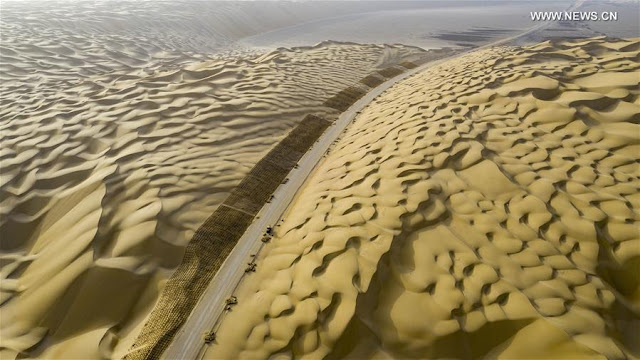
On May 16, 2020, impressive pictures of workers driving bulldozers on a construction site in the Taklamakan Desert were released by Xinhua.
The caption explained: “The construction of Yuli-Qiemo highway, the third north-south route running through Taklamakan Desert, has entered the final rush. Workers of China Communications Construction Company Ltd are working on the largest dune in this project, with an estimated volume of 1.2 million cubic meters of sand to deal with.”

The Yuli-Qiemo highway is a section of the National Highway 216 (known as G216) linking northern Xinjiang to Kyirong county in Tibet (the border town with Nepal). A few years ago, I had mentioned the possibility of having a second road link between the two restive provinces of Tibet and Xinjiang (the first one is the G219 or Aksai Chin road, running through the Indian territory).

Xinhua’s caption continued: “They established camps next to the dune for the convenience of work, and receive daily necessities on a regular basis. The completion of the highway is expected to improve the transport conditions in southern Xinjiang and promote local development.”

For obvious reasons, Beijing does not want to announce as yet that they are building this new highly strategic link, which will serve the under-developed parts of Gerze county of Western Tibet (Ngari Korsum) ...and reached Nepal. It is probably an important part of the Belt & Road Initiative  between Central and South Asia, dreamt by Xi Jinping.

But this is not the trickiest part of the project.
How will the Chinese engineers managed to cross the Kunlun range and reach Rutok county?
Once on the plateau, the terrain (probably via Gerze county) will be easier.
Today many still believe that it is impossible to cross the Kunlun.
But Beijing has probably done its home work and studied the 19th century Western explorers such as Sven Hedin or Aurel Stein who moved around the area and found slightly-easier passages to cut across the formidable natural barrier.
It is interesting to see if this new road link will be included in the next Five-Year Plan (2021-2025).

Some twenty pictures show workers on the lunar ‘dune’ landscape around the future highway crossing the Taklamakan Desert.


Here is a tentative route to be followed by the G216.

Incidentally, on May 14, the Xinjiang Production and Construction Corps (XPCC)  announced that it will pump a lot of funds into transportation projects during the current year.
According to Xinhua: "The [Xinjiang] authorities will invest 9.5 billion yuan (about 1.34 billion U.S. dollars) in 60 major road projects, with plans to build or upgrade roads with a combined length of 2,281 km, according to the local transportation bureau. Of the investment, the Xinjiang Production and Construction Corps will allocate 5.7 billion yuan to its areas of jurisdiction in the southern part of Xinjiang."
It was said that the XPCC has already resumed work on a number of major transportation projects.
It is ominous for the Ladakh border, where the Chinese have started creating serious problems on the Indian side of the LAC, for example in Galwan area and north of the Panggong tso.

Another Section of G216
On May 20, Xinhua published a series of photos showing the construction site of Tianshan Shengli tunnel, a six-year project on the Urumqi-Yuli highway. The news agency says: "it passes through a cold and high altitude zone, with harsh climate and geological condition." This is apparently part of the same G216 Highway project.


Yet another Infrastructure Project in Xinjiang
Tracklaying has started on the Ruoqiang–Hotan railway project south of the Taklamakan Desert.
According to Construction Review Online: “Running east from the current rail-head at Hotan south of Kashgar to Qiemo and then northeast to Ruoqiang, the 825 km line will have 65 stations, serving a string of small towns between the Tarim Basin and the Altun Shan mountain range. It will connect at Ruoqiang with the 1214 km Golmud–Korla line now nearing completion.”
The portal provides further details: “Designed for operation at up to 120 km/h, the single track line was authorised by the National Development and Reform Commission in May 2018. Construction was formally started on December 20 that year, and completion is expected by mid-2022. Capacity is being provided for up to eight daily passenger trains each way and around 15 million tonnes of freight per year. Total cost of the project is put at US 3.1 bn, of which the national government is contributing 54.2%, Xinjiang Uyghur Autonomous Region 23.3% and China Railway 22.5%. This budget includes 790m yuan for rolling stock.”
The Project Manager Zhang Gang of China Railway 14th Bureau Group said that a management and construction team with ‘rich experience in desert railway construction’ to work in the ‘intricate natural environment’ has been working on the project: “the construction teams will be ‘working around the clock’ to lay an average of at least 2km per day. The target is to complete 520km of track and 19 stations by the end of this year.”
China is in a hurry; India should realize this.

Here is my old posting dated 2016:

 The Changthang or ‘Northern plain’ (in Tibetan), occupies a large part of the Tibetan plateau.
In April 2000, with the approval of the State Council, the Changthang National Nature Reserve, located in northern Tibet, south of the Kunlun Mountains, became a national reserve.
It spreads on a total area of 391,200km, which makes it the second largest nature reserve in the world, after the Northeast Greenland National Park.
With the recently-established adjoining reserves, there is now a total of 496,000 km2 of connected Nature Reserves.
The Changthang National Nature Reserve lies at an average elevation of 4,500 meters. Administratively, it comes under the Prefectures of Nagchu and Ngari. Some parts of the Reserve are located in the County of Rutok, bordering Ladakh and the Aksai Chin.
Only a few Tibetan nomads permanently live there, but it is a paradise for wild animals such as wild yak (Bos grunniens), Tibetan wild ass or kiang (Equus kiang), Himalayan blue sheep or Bharal (Pseudois nayaur), Argali (Ovis ammon), Mongolian gazelle (Procapra gutturosa) and Tibetan antelope or chiru (Pantholops hodgsonii). The list of predators is also long; it includes snow leopards (Panthera uncia or Uncia uncia), Tibetan wolves (Canis lupus chanco), Turkestan lynx (Lynx lynx isabellinus) and Tibetan blue bears (Ursus arctos pruinosus).

Road will cut through the eastern part of the Reserve
An Environmental Impact Assessment
Recently, a “Public Announcement for the Environmental Impact Assessment [EIA] of the New Reconstruction Project of National Highway No. 216 (Tibet Area)” was made from Ngari Prefecture in Western Tibet.
According to published abstracts of the EIA: "The State Environmental Protection Bureau of the National Highway 216 (Tibet area) area has basically completed the project environmental impact, for pollution prevention and control.”
(National Highway 216 (G216) runs in the Xinjiang Uyghur Autonomous Region in the southern direction from Altay City to Baluntai in Hejing County, where it joins China National Highway 218. It is 857 kilometres in length). 
The EIA says: “Control measures analysis and evaluation have been completed in accordance with the relevant provisions of the Interim Measures for Public Participation in Environmental Impact Assessment”.
Some ‘relevant’ contents of the EIA have even been made public, probably a first in China.

Here some extracts of the Chinese documents (please excuse inexactitudes; it is a translation through Google language).

I.    Overview of construction projects

The Overview provides an idea of the route followed by the new highway starting from Xinjiang (near Dunhuang? Crescent Lake?) and joining the G 219 (the Aksai Chin road) in the Rutok County.
The Highway will be connecting Xinjiang and Tibet via Minfeng, it should ultimately connect with the Highway G 216 in Xinjiang.
The project is 558 km long.
The deeply-worrying aspect of the project is that it crosses the highly eco-sensitive Changthang National Nature Reserve.
It will run for 110 km in the main reserve, about 270 km in the buffer zone and some 100 km in the ‘experimental area’.
The starting point of this project is the Jieze Lake near the G 219 highway (north of Rutok).
According to the EIA, the road will be built “in accordance with the two-lane highway construction.”
The total investment for the project is RMB 6.453 billion (more than 1 billion US dollars). The construction should start by the end of the current year and the road will be put into operation early 2021. The construction period has been estimated at 48 months.
The main environmental impact assessment says:

1- During the construction period
  1. Noise: The main noise sources during the construction period will be the mechanical bulldozers, the loaders, the excavators and other construction equipment and transportation vehicles. Construction units will carry out the construction work in accordance with the relevant laws and regulations of the State (China) and the Tibet Autonomous Region.
  2. It will be characterized by “a reasonable layout of the construction site; reasonable arrangements for operating time of the work; scientific management and civilized construction [sic]”.
  3. Exhaust gas: Strict implementation of the relevant provisions of the State and the Tibet Autonomous Region will be followed.
  4. Dust: Measures will be taken to minimize the dust: the earth mixer/cement mixer will be closed; the area will be sprinkled; the site will be regularly cleaned; the asphalt mixing station will used ‘good sealing’ materials; high efficiency dust mixing equipment will be used to create the less possible impact on the atmospheric environment.
  5. Wastewater: Construction camps will prevent the seepage of the domestic sewage. After use, the wastewater will go through a sedimentation treatment plant; dust suppression will be taken care of.
  6. Solid wastes: All excavated soils produced by the project shall be reused or transported in closed vehicles. Offloading shall be prohibited to prevent spillage. Earthworks dumps shall be selected according to relevant requirements and measures shall be taken to prevent soil erosion.
  7. Ecological: The construction should be strictly in accordance with the provisions of the approved design. The construction should remain within the scope of plans and it shall not be allowed to expand. At the same time [at the end of the project?] a project evaluation shall seriously be implemented and an assessment made of biological and ecological diversity according with the environment protection laws. At the end of the construction period, timely measures will be taken to reclaim the land (of the construction site).
2 -After the construction period
  1. Environmental noise: Near the sensitive points, speed will be limited and other measures to reduce traffic noise will be taken. Appropriate measures will be taken for the traffic noise in the sensitive areas. The future planning of both sides of the open space should be based on the results of noise assessment.
  2. Ambient air: The air pollution will come mainly from automobile exhausts; the vehicle control, particularly of the automobile exhaust, will be strengthened.
  3. Water environment: During the operation period, the domestic sewage generated from the maintenance area will be treated by anti-seepage aqua plants. Bridge across the river will set up runoff collection systems at both ends of the bridge using sedimentation tanks.
3 - The preliminary conclusions of the EIA report are:
The proposed project is in line with the National Highway Network Plan (2013-2030). The route selection takes full account of the economic, environmental and technical feasibility principles.
It is line with the strict implementation of the ‘three simultaneous’ system, respectively, for the ecological environment, water environment, atmospheric environment.
It takes effective protection measures, will effectively control the adverse environmental impact of roads, along the area to promote economic and social development [of the area]
The project is considered to be viable from the perspective of environmental protection under the premise of obtaining the forest assessment and the biodiversity evaluation report and obtaining the approval of the related project of forestry department.

4 - Seek public views on the main issues
In order to listen to the views and suggestions of the community on the environmental protection work of the national highway 216 (Tibet border) and the 'rebuilt' section of the highway, the project will be publicized to solicit the public's valuable opinions and suggestions.
The main issues include: whether you are aware of the construction of this project; after the completion of the project, your views on the surrounding environment and the impact on your working life; your views and suggestions on environmental protection work.

5 - The public views 
During the ‘publicity period’ for the environmental impact assessment of the project, the public can contact the Construction Unit and the EIA unit.
The public may contact the project construction unit or the EIA unit by way of letter, telephone, e-mail, etc. to obtain supplementary information or to express opinions and opinions on the project construction and EIA work.

The environmental impact assessment unit will record the opinions and suggestions of the public in the environmental impact report of the project and forward the public's valuable opinions and suggestions to the construction unit and the relevant departments of the Government.

Construction Unit:
Key Project Management Center of Transportation Bureau of Ngari District, Tibet Autonomous Region

Evaluation unit:
Beijing Yan State Environmental Technology Development Co., Ltd located in Beijing

Implications for India
This of course does not deal with the strategic implications of the new road which should shorten the time to travel from Urumqi to Rutok (near the Indian border).

Thursday, August 15, 2019

The Chinese Panchen Lama on the Indian Border

Interesting developments have recently taken place in Western Tibet (Ngari
Prefecture).
The Chinese Panchen Lama, Gyaltsen Norbu is said (by the Chinese media) to have conducted an 'inspection tour' of the region, including a village bordering Ladakh.


Extensive Media Coveage
Hundreds pictures were published showing the Chinese-selected 11th Panchen Lama touring areas such as Purang/Taklakot, Mt Kailash, Manasarovar lake, Minsar, the monasteries in Tholing/Tsaparang, Ngari town, Rutok, the Panggong tso Lake and even a village on the Indian border in East Ladakh.
He visited monasteries, villages, and larger towns such as Tholing, Nagari and Rutok; he ‘inspected’ many projects i.e. an Ecological Agricultural Industry Park of Gar County.
The Chinese media extensively covered his two-week long visit.
Norbu had come to Ngari prefecture five years ago, but he then had remained in Purang and Kailash area.
China Tibet Online reported that on July 26, Gyalsten Norbu (called Choskyi Gyalpo by the Chinese media) traveled to Jaggang Village in Rutok County “for survey and research”; he paid a visit to two Tibetan families named as Wangdul Phuntsok's and Tashi Dundrup's.
The Chinese website said that “Jaggang Village is located in the southern part of Rutog County, 70 kilometers away from the county town. It is a typical plateau village.”
But it is not an ordinary village, it is also known as Chagkang or Chiakang and situated very close to Demchok in Ladakh.
It seems that it is the first time, that such a ‘senior’ religious leader, adventures himself on the Indian border, which China says is ‘disputed’.

A 'disputed' border?
One still remembers that three weeks earlier, some ‘Tibetans’ (probably PLA soldiers in disguise) protested against the Ladakhis and Tibetans in Demchok/Koyul/Dungti area of India who had celebrated the Dalai Lama’s 84th birthday.
China Tibet Online wrote that Gyaltsen Norbu went inside the home of one Wangdul Phuntsok and ‘carefully’ asked about the family's production and living conditions. "Are there changes between your past and present life?" "Are you keeping well; what about your knees?" "Do you go out for a travel?" "How do you keep warm in winter?" "How do the livestock sustain when it snows?" "How many TV channels do you get?"
The website reported that Norbu chatted happily with Wangdul Phuntsok and his family.


Everything seemed scripted, including the tape-recorder on the table. Wangdul Phuntsok would have said: "The previous generation of our family were all nomads, and living conditions were very poor. Now we live a happy life. And our life has improved a lot."
The discussion continued, Norbu learnt that there is a college graduate in Wangdul Phuntsok's family who hoped to stay in his hometown (village) and find a good job, Norbu advised: "Your generation has already grown up, you should return home and contribute to the development of your hometown."
Later, the Lama visited the home of one Tashi Dundrup, probably a Communist cadre in the village: "Our family used to live in a mud brick house, but look at this big house where my family lives now. I only paid 60,000 yuan (8,500 US dollars), and the rest of the money was paid by the government,"
Tashi Dundrup informed the Lama about his financial situation: "This amount of money was no burden on my family. Because the government gives us grassland subsidies, border resident subsidies, and forestry subsides, this earns us around 50,000 yuan (7,120 US dollars) per year."
It is interesting to note that the villages bordering India are getting ‘border resident subsidies’.
Incidentally, there is no forest in the area as it is located above the tree-line.
According to the news article, the 63-year-old Tashi Dundrup's most important task was to take his grandchild (courtesy one-child policy!!) to school and bring him back home every day.
Gyaltsen Norbu advised: "You must prioritize education and educate your children well, because the future development depends on the next generation. This way, future generations will live happy lives one after another. I will pray for you every day and pray for your happiness and health. When I have the chance, I will come visit you again."


This raises serious questions:
  1. Norbu's visit was probably a message to Delhi and Dharamsala; Beijing has already done a lot of homework on the ‘succession' of the Dalai Lama. Norbu will be projected as the next Tibetan leader by Beijing.
  2. China has decided to fully play the card of Gyaltsen Norbu in the years to come. Today, Norbu is a member of the Standing Committee of the Chinese People's Political Consultative Conference (CPPCC) National Committee and vice president of the Buddhist Association of China.
  3. Beijing trusts Norbu enough to let him visit the border with India. And let us not forget that China today claims large parts of Ladakh.
    Chinese Foreign Minister Wang Yi recently told his Indian counterpart Dr. Jaishankar that the Indian government's announcement of the establishment of the Ladakh Union Territory, "involves Chinese territory, [it] has posed a challenge to China's sovereignty and violated the two countries' agreement on maintaining peace and stability in the border region".
    The fact that the Chinese Panchen Lama visited this area a few days before Jaishankar’s trip to Beijing, should not be over-looked by Delhi.
  4. China banks on the fact that the system of ‘succession’ by reincarnation’ is a poor system of governance, as it has a gap of 20/25 years between the passing away of a Lama and the time, the 'returned' one is capable to ‘rule’ spiritually or otherwise.
    Even if China selects its own Dalai Lama (with the help of Gyaltsen Norbu), the latter will continue to ‘rule’ on behalf of the Communist Party for decades (provided, the Communist Dynasty lasts this much).
  5. On July 21,Gyatsen Norbu visited the Chuguo (Trügo) Gompa near Mt Kailash, on the southern banks of Lake Manasarovar. He is said to have held a grand lake worship ceremony: “Hearing that the 11th Panchen Lama would come to Chuguo Temple, local people dressed in festive clothing and came one after another, waiting for the 11th Panchen Lama to receive his blessings.” If the photos are to be believed (see below), a large gathering welcomed him.
    From July 24 to 25, he visited Toling Monastery in Zanda (Tsamda) County “to worship the Buddha and gave longevity empowerment to local Buddhist followers. During his stay, the 11th Panchen Lama also visited the site of the Guge Kingdom ruins and visited local farmers,” said the Chinese media.
  6. Incidentally, Norbu also visited a Nyingma monastery (Tirthapuri Gompa) in the vicinity of Mr. Kailash. This shows that China plans to use him as ecumenical leader, not just a Lama of the Geluk School of Tibetan Buddhism..
  7. Let us remember that the 10th Panchen Lama was also ‘fake’ (because recognized by China, groomed by China and trained by China) and later in his life he became one of the most patriotic Tibetans.
  8. Later, Gyalsten Norbu visited Nam tso and Nagchu prefecture where he witnessed the Ling Kesar Horse race. He was then accompanied by Danko, a Tibetan member of the Standing Committee of the Tibetan Autonomous Region’s Communist Party and United Front Dept Head (and TAR CPPCC Vice Chairman).
  9. China is clearly putting people/system in place for the succession of the Dalai Lama. Though the Dalai Lama may hopefully remain on this planet to guide his people for many years, it would seem prudent to have something in place at the earliest to counter China in the Great Reincarnation Game; Dharamsala should take a decision at the earliest and tell the world which direction it wants to go and announce it.


Model Village of Chiagang on the border
In Indian border villlage

Add caption

Monday, June 19, 2017

The Tibet Recipe, a New Airport in Xinjiang

Xinhua announced yesterday the construction of a new regional airport in Xinjiang.
It will be built in Yutian, a remote County of Hotan/Khotan Prefecture in Xinjiang Uygur Autonomous Region (XUAR). Yutian is also known as Keryia.


Already in 1953
On July 15, 1953, a CIA note dealing with “Chinese Communist Troops, West Tibet” and “Road Construction, Sinkiang to Tibet and Ladakh” mentioned that late 1952, the 2 Cavalry Regiment, commanded by one Han Tse-min, had set up his headquarters at Gartok (the main trade centre in Western Tibet).
It announced that the regiment had 800 camels and 150 men garrisoned at Rutok, in the vicinity of the Panggong lake.
At that time, the 2 Cavalry’s commandant spoke of the Chinese intention to built three new roads in the area.
  • A road from Rutok to Keriya, south of the Taklamakan desert (the construction is ‘contemplated’ says the report); on the eastern edge of the Aksai Chin.
  • A motorable road from Khotan to Suget Karaul ending at Vanjilga (at the western end of the Aksai Chin).
    It later became the Aksai Chin road (now National Highway 219), though the alignment may have been slightly different from the present one as it was then probably impracticable for heavy vehicles (only 4 years later, heavy trucks were able to ply on the road).
  • A road from Khotan (or Hotan) to Rutok to be completed in June or July 1953. 
Though the road between Rutok and Keriya was never completed, the Chinese engineers never dropped the project.The main difficulty is to cross the Kunlun range, south of Keriya
In December 2016, I mentioned on this blog the construction of a new road linking Xinjiang and Tibet. National Highway 216 (G216) runs in the XUAR in the southern direction from Altay City to Baluntai in Hejing County, where it joins China National Highway 218. It is 857 kilometres in length.
The starting point of this project is the Jieze Lake near the G 219 highway (north of Rutok). The road will be built “in accordance with the two-lane highway construction,” asserted then a Chinese report.

New airport planned in Keriya
In this context, and in view of the proximity of the Indian border, it makes sense for China to have a new ‘civil’ airport at Keriya (Yutian is the Chinese name), considering that there is no such thing as a 'civil' airport in China, especially so close to the Indian border (Aksai Chin).
Keriya airport is designed to annually handle 180,000 passengers and 400 tonnes of cargo; it will cost 104 million US dollars and witness more than 2100 annual take-offs and landings every year.
The airport will have a 3,200-meter runway, a 3,000-square-meter terminal building, four aprons, and facilities for air traffic control and power, water, heat and fuel supplies, says Xinhua.
The project has been cleared by the National Development and Reform Commission (NDRC) and the Civil Aviation Administration of China and announced by the regional NDRC.
The Yutian/Keriya County, located south of the Taklimakan Desert, and north of the Kunlun range, covers 39,500 square kilometers and has 277,400 permanent residents.
It is a major stop over on the ancient Silk Road (OBOR), according to the Chinese news agency. The nearest airport, in Khotan/Hotan City, some 200 km away and north of the disputed Aksai Chin.
Interestingly, Yutian airport is one of 10 new airports to be built in Xinjiang by 2020.
Six older airports will also be soon renovated and expanded.

The Tibet recipe

At the end of August 2016, Wu Yingjie took over as Party Secretary of the Tibetan Autonomous Region (TAR) from Chen Quanguo who was sent to ‘pacify’ Xinjiang. The decision had been taken during the annual closed-door meeting at Beidahe.
An official statement released had then announced that Zhang Chunxian would be replaced by Chen Quanguo as secretary of the XUAR’s Committee of the Communist Party of China (CPC).
This was indeed a promotion for Chen, given the fact that Xinjiang's Party Secretaries often serve in the Politburo (though Chen will have to wait until the 19th Party Congress later this year to find out if he has made it).
His selection was linked to the Tibet recipe, the way Chen managed to ‘pacify’ Central Tibet.
There is no doubt that Chen will apply the same formula in Xinjiang: bring millions of tourists and ‘dilute’ the Uyghur characteristics.
The 10 new airports, particularly the new one in Keriya/Yutian have to be seen in this perspective.

Sunday, June 29, 2014

China lacks human infrastructure, is weakest state in the world

Deng Xiaogang visited Rutok County
My article China lacks human infrastructure, is weakest state in the world appears in NitiCentral.

Here is the link...

Tsering Woeser, a Tibetan blogger living in Beijing, says on her blog that she knew a Chinese traveller who had been told by a travel agency that Tibetans were no longer able to obtain permission to travel in border areas of Tibet such as Purang.


China often says one thing and does another.
In Athens, the visiting Chinese Premier Li Keqiang declared that China is committed to settling maritime disputes through dialogue and negotiation on the basis of respecting historical facts and international law.
Of course, ‘historical facts’ for Beijing mean its own interpretation of history; ditto for international law.
Li also spoke about Beijing’s views on a ‘sea of peace’ with other countries.
After China installed an oil rig in the South China Sea in what Vietnam considers its territorial waters in May, Chinese State Councilor Yang Jiechi met with the Vietnamese Deputy Prime Minister and Foreign Minister Pham Binh Minh in Hanoi on June 18, 2014. Though China and Vietnam pledged ‘to rein in maritime tensions’, little has changed after the high level discussions, on the contrary another Chinese oil rig is being set up.
Beijing wants to make clear that China is the most powerful State around and it can send diktats according to its interpretation of ‘history’ to every ‘smaller’ nation, whether it is Japan, Vietnam, the Philippines or India.
It is called the Law of the Bully; and often, it works.
When Li was in London last week, he told David Cameron that if London wanted to do business with China, it should keep quiet on Tibet and human rights issues; the British Prime Minister obeyed.

But is The Bully truly that powerful?
There is no doubt that an aging Europe often has to listen to orders from a still economically strong Middle Kingdom, which however suffers from acute problems — it has miserably failed to pacify its own ‘masses’.
In 1950, Mao sent its First and Second Field Armies to ‘liberate’ Tibet. Nehru’s India acquiesced, Tibet needed to be liberated (though Nehru had doubts, he asked in the Lok Sabha, ‘liberated from what?’).
More than 60 years later, whether it is in Xinjiang or Tibet, the masses are revolting against the ‘liberators’.
While President Xi Jinping speaks to the ‘masses’ about his Chinese Dream, anyone questioning his dream is immediately imprisoned, often without trial.
A recent two-day Xinjiang Work Forum attended by all the members of the Politburo devised new schemes to bring the Party closer to the masses:
  • Boosting employment and income levels.
  • Encouraging urbanisation and interregional migration aimed at expanding the contact and cooperation between different ethnic groups.
  • Strengthening Party organs at the grassroots level in order to eliminate the ‘three evil forces’ —  splittism, extremism and terrorism.
  • Bilingual instruction to make all minority youth conversant in the national language and culture.
This type of policy has not worked in the past and will not work in the future, for the simple reason that the Party says something and does something else, like for foreign affairs issues.
Just for Xinjiang, authorities last week claimed that they had broken up 32 terrorist groups and arrested more than 380 suspects. In the first month of a ‘security campaign’ … and 13 had been executed.
The outspoken Uygur economist and respected university professor, Ilham Tohti, has been detained since January. He would have been charged with spreading separatist ideas, i.e. promoting the Uyghur language. Is that a crime?
When one closely looks at the situation in China, one realises that the leadership lives in fear.
Take Tibet again. A few days ago, it was reported that Deng Xiaogang, Deputy Party Secretary of the Tibetan Autonomous Region (TAR) has been in Purang County, located near Mount Kailash at the tri-junction of India-Tibet-Nepal. He was said to be inspecting security issues faced by the border guards on India’s border.
The International Campaign for Tibet, based in Washington, deduced: “Deng’s visit was likely to be intended to send a signal of vigilance by the Party authorities in the build-up to the Kalachakra in Ladakh. Deng … was cited by the state media as saying that border security checkpoints are key to maintaining social stability in the TAR.”
Is China trembling just because the Dalai Lama is going to give the Kalachakra initiation to tens of thousands of devotees in Leh?

Is it the sign of a great power?
Tsering Woeser, a Tibetan blogger living in Beijing, says on her blog that she knew a Chinese traveller who had been told by a travel agency that Tibetans were no longer able to obtain permission to travel in border areas of Tibet such as Purang.
It is rather surprising, considering the promotion (not to say propaganda), made by Beijing a few months ago about the Mount Kailash.
In February, The China Daily wrote: “2014, the ‘Year of the Wooden Horse’ is the ‘recurrent birth year’ of Kang Rinpoche (Mount Kailash), a holy mountain in west Tibet. Since circling Kang Rinpoche in the Year of the Horse is a sacred tradition among Tibetan Buddhists, this year has seen an endless stream of people flocking to the region to perform pilgrimage.”
What has happened between the Tibetan New Year in February and today?
Just the Kalachakra? The arrival of the Modi government in Delhi?
The powerful Deng Xiaogang has been roaming around the Ngari (Western Tibet) region for the last few weeks. Why?
On June 20, an article in The Tibet Daily asserted: “The TAR Deputy Chairman, Deng Xiaogang inspected the border county of Rutok in Ngari Prefecture and conveyed to the rank and file of the border policemen, the Party’s cordial greetings”. Rudok is a border town close to Ladakh.
Apparently Deng Xiaogang told the local people that the party has “a great trust in those who are stationed at borders, facing cold and lack of oxygen; facing harsh environmental conditions, fulfilling conscientiously their duties, sacrificing without fear or fatigue, in order to defend the national sovereignty and the territorial integrity of the southwest border of the motherland.”
Does China fear some Indian infiltrations or local Tibetans taking refuge in India?
Deng Xiaogang ordered the border guards to “crack down on all criminal activities that endanger national security and social stability, and never let separatism, terrorism and other violent criminals undermine the excellent situation of stability and unity in our region.”
Why should such a senior officer spend weeks on the border?
China is probably nervous about possible infiltrations of Uyghur militants through the Aksai Chin road which enters Tibet via Rutok.
The point is that while China has built a tremendous infrastructure — roads, telecommunications, airports, etc, in border areas in Tibet — the ‘human infrastructure’, so important in case of conflict, is entirely lacking. This is the condition 60 years after the ‘liberation’.
In this field, China is one of the weakest States of the world.

Saturday, June 28, 2014

A good chess player takes the initiative?

The Hindustan Times reported today: “On June 24, four Chinese high-speed interceptor boats were spotted moving from Sirijap I posts around 8.25 am to Sirijap VIII, VI and V detachments on northern banks of the [Panggong] lake. Twenty minutes later, Indian troops on the four American - made boats moved from Thukang base and intercepted Chinese vessels. The two sides first were locked in a face-off and then conducted a so-called banner drill to remind the other side of the Line.”
Is this lake-intrusion related to the visit of Deng Xiaogang to Ngari and General Wang Jianping’s (see yesterday’s posting) to Lhasa?
Deng, the Tibetan Autonomous Region's security tsar has been touring border areas of Western Tibet for days and weeks accompanied by Maj. Gen. Gao Wanhai, the Commander of the Public Security Bureau at the Border Defence General Headquarters.
On June 24, when the intrusion occurred, Deng was in Ali, the capital of Gar Country of Ngari Prefecture. A few days earlier, he was in Rutok, in the vicinity of the Lake.
Just a coincidence?
According to South Block sources, on June 24, the Chinese People’s Liberation Army (PLA) boats came 5.5 kilometres into the Indian territorial waters on the Pangong Lake (tso).
Some parts of the lake are under Chinese control in the Tibetan Autonomous Region (TAR), while others are under Ladakh (J&K State).
The incursion lasted over two hours, involving four high-speed Chinese interceptor boats that were pushed back by Indian troops, wit their US-built interceptor vessels.
The Hindustan Times says that the picturesque lake, 134 km long and at a height of 4,350 metres above sea level, has seen 12 face-offs between Indian and Chinese troops this year alone: “In 2013, there were no less than 18 face-offs between Indian and Chinese troops in Panggong Tso due to serious difference in perception on the LAC and also due to massive Chinese infrastructure build-up close to the line,” a government official told the Indian newspaper.
Sirijap area on the Panggong tso

Moreover, let us not forget that General Wang Jianping, the Commander of the People’s Armed Police (PAPF) visited Lhasa on June 26.
He inspected the TAR’s People’s Armed Police training base, a Traffic police detachment, Tibet’s Forest Armed Police Corps, the 117 Police Division, a detachment of Ngari Police.
According to The Tibet Daily, he wanted to get a detailed understanding of the situation.
For the purpose, he called on officers and men of the People’s Armed Police.
The Chinese newspapers reported that Wang Jianping acknowledged the success achieved by the Armed Police's Tibet Corps and the Armed Police Forces in every work and asked all the armed police officers and men to understand the serious and complicated situation that they are facing at present. He told them to strengthen the police force for war preparation and continue the good job of building up (the police forces).
He said a good chess player takes the initiative.
He asked the Force to ensure the completion of every task, giving first priority to the tasks that need to be dealt with urgently, providing a strong support for Tibet’s continuous stability, long term stability and comprehensive stability.
‘Stability’ has been the motto of each and every leader coming to Tibet in the recent months.
While on the Potala Palace Square, Wang Jianping “cordially greeted and expressed sympathy to the officers and men on duty, encouraged everybody to stand guard for the Party and the people and to be on alert.”
Walking to the Potala Palace Square’s Police Station, Wang Jianping said that the police should understand in detail the work [in Tibet]; for example, the duty of the Police Station, the range of service, the promotion the urban grid management.
The Police has to strongly protect the stability of vast areas, protect people of every ethnic minority, as well as Chinese tourists and visitors from abroad. Wang spoke of the important measures taken by the Tibet Communist Party’s Standing Committee and the TAR government’s to implement the Central Government’s policies for governing Tibet.
He mentioned the unprecedented measures to strengthen [the Party] and the innovative social management introduced. He spoke of the "effective steps which promote China’s administrative system and the modernization of the administrative capability as well as the need to seriously gain experience to continuously improve the quality of [police] work in order to become a strong pillar for Tibet’s developmental breakthrough and long term peace and stability.”
Behind this Communist jargon, published by The Tibet Daily, lies the firm resolve to control Tibet (and particularly the TAR) in an always firmer hand.
This is not good omen for Tibet; the Middle Path promoted by the Tibetans in exile seems far, far away.
It remains to be seen if the visit of General Wang and Deng Xiaogang’s tour of the border areas in Western Tibet, is linked to the new aggressiveness on the Panggong tso. It is probably the case in view of the high lever delegation accompanying Deng Xiaogang in Ngari.
A few pictures of Panggong tso from the Tibet's side:


Sunday, June 22, 2014

Why is Deng watching the Seagulls?

A few days ago, International Campaign for Tibet, reported that last month, Deng Xiaogang, Deputy Party Secretary of the TAR visited Purang County in Ngari Prefecture to inspect the border security and the People’s Liberation Army bases. Purang is located near Mt. Kailash and not far from Dram, the border town with Nepal.
The ICT deducted: "Deng’s visit was likely to be intended to send a signal of vigilance by the Party authorities in the buildup to the Kalachakra in Ladakh. Deng, who is also secretary of the Party Committee on Politics and Law in the TAR, was cited by the state media as saying that border security checkpoints are key to maintaining social stability in the Tibet Autonomous Region."
ICT further added: "Woeser, a noted Tibetan writer who lives in Beijing, cited a Chinese traveller who had been told by a travel agency that Tibetans were no longer able to obtain permission to travel in border areas of Tibet such as Purang where Mount Kailash is located."
It is rather surprising, considering the promotion (not to say propaganda) made by Beijing a few months ago about the Mt. Kailash.
The China Daily wrote: "The year 2014 marks the beginning of the Year of the Horse in China and the 'Year of the Wooden Horse' in the lunar calendar of Tibetan people. The Year of the Horse is also the 'recurrent birth year' of Gang [Kang] Rinpoche (or Mount Kailash), a holy mountain in west Tibet. Since circling Gang Rinpoche in the Year of the Horse is a scared tradition among Tibetan Buddhists, this year has seen an endless stream of people flocking to the region to perform pilgrimage,"
The Chinese newspaper added: "The Tibetan people's freedom of worship has been respected and protected in the Tibet autonomous region and other areas inhabited by Tibetan people since the region's peaceful liberation, especially since the adoption of reform and opening-up. ...Monks and nuns from different Buddhist sects now enjoy a full freedom to preach and conduct religious activities. Believers are also free to visit monasteries and holy mountains to worship and perform religious rituals. They can circle the holy mountains, recite Buddhist scripture and spread Buddhist teachings, and take part in all kinds of religious activities."
What has happened between the Tibetan New Year in February and today?
Just the Kalachakra? The arrival of the Modi government in Delhi?
What is more surprising is that the powerful Deng Xiaoping still roams around
the Ngari region.
Remember Wu Yingjie, another Deputy Party Secretary of the TAR who camped for weeks in Nagchu last year.
This exercise was part of the 'massline' campaign initiated by Xi Jinping, the Party's General Secretary. 
Is Deng going to replay the Wu episode?
On June 20, an article in The Tibet Daily mentions: "Deng Xiaogang comforts the rank and file of the police in border County".
It reports that "the Deputy Chairman of the Tibetan Autonomous Region, the Party Secretary of the Politics and Law Committee, Deng Xiaogang inspected [Rutok], the border county in Ngari [Prefecture] and conveyed to the rank and file of the border policemen, [the Party’s] cordial greetings.
The article explains that troops stationed on the border, in this county, live at the highest elevation of the country [read China].
The Tibet Daily continues:
Deng Xiaogang traveled to inspect and provide guidance to the [Rudok] county. He cordially shook hands with the soldiers and comforted them.
Deng Xiaogang pointed out that since long time, the party and the people have a great trust in those who are stationed at borders, facing cold and lacking of oxygen; facing harsh environmental conditions, while always sticking to their positions, fulfilling conscientiously their duties, carrying forward the sacrifice, without fear of fatigue, fighting tenaciously and continuously to overcome the difficulties and challenges, in order to defend the national sovereignty and the territorial integrity and maintain the stability of the southwest border of the motherland, to maintain harmony, peace, economic development and stability for the region, promote national unity, border stability while improving people's livelihood, promoting religious harmony.
Further, Deng Xiaogang stressed that: "Tibet is very special strategic location, is an important barrier for the national security, development and stability in the border areas is an important part of the region's overall situation. In recent years, under the strong leadership of the CPC Central Committee, the regional party committee, the government is firmly asking the people to unite and lead the development of the region, go all out to maintain stability, and improve people's livelihood as much as possible, to build prosperity, harmony, happiness, rule of law, a beautiful new socialist Tibet and work hard."
He further hoped that the officers serving on the border keep this strategic and overall perspective in view and fully realize the extreme importance of doing the [Party's] work on the border, increasing the sense of responsibility and sense of mission and urgency, establishing a long-term battle plan, [and that they] are determined for a continuous fighting, conscientiously implement the General Secretary Xi Jinping series of important speech, etc. etc. etc.
White seagulls flying from India to Tibet
Apparently Deng Xiaogang was very satisfied: he ordered the policemen [border guards]: "...according to the law to crack down on all criminal activities that endanger national security and social stability, and never let separatism and terrorism and other violent criminals undermine the excellent situation of stability and unity in our region. 
He was accompanied by a high level delegation.
Apart from th Communist usual jargon, the question remains why should a senior, powerful leader like Deng spend weeks in such a remote places.
Just to watch the seagulls fly over the Panggong lake or to circumbulate the Kailash?
There is another possibility, Deng may be nervous about possible infiltrations of Uyghur militants through the Aksai Chin road which enters Tibet in Rutok.
That would be a more serious issue for China!

Monday, January 27, 2014

Is Western Tibet Polluted?

Amazing news!
An article in China Tibet Online tells us, 'Safe water available for locals in Tibet's remote county'.
What does it mean?
Since when Rutok County (Dzong), this remote area east of Ladakh is polluted?
Quoting The Tibet Daily, the reporter explains: "The Rutok County in the remote Ngari Prefecture in western Tibet, has access to safe drinking water in [since?] 2013."
Is the Indus river flowing not far away polluted too?
What about the beautiful Panggong Tso, located some 15 km from Rutok town (Rutok is also the name of the County, Rutok Dzong)?
The article affirms: "The Rutok County has achieved the goal of providing safe drinking water, which has benefitted 1,860 farmers and 277 faculty members and students. Moreover, the livestocks in the rural area also got access to the drinking water last year."
Wikipedia thus describes Rutok: "It is the seat of Rutok County in the Ngari Prefecture. It is located 126 kilometres by road northwest of Ngari [town]. The town has a population of about 1000 people. Older reference works give the name as Rudok. It lies approximately 10.5 miles east of Zhabsang near Panggong Tso [lake]. ...Rutok is a small town on the Ladakh frontier of Tibet, close to India. Rutok is picturesquely situated on the side of a hill standing isolated in the plain near the east end of Lake Panggong in Ladakh."
Historically, Rutok was the seat of the Garpons, the Governors of Western Tibet.
For centuries, nomads from Tibet and Ladakh have sent the herds grazing around the salted lake, did they know that the rivulets flowing in the lake was 'unsafe'?
Now, it appears that the local government has drilled over 300 wells "to solve the problem of shortage of safe drinking water".
The Chinese have invested some 2.42 million yuan (400,000 US $) in the project.
'Safe drinking water' has also been provided to the Lhundrup Choden Monastery, costing 574,000 yuan (95,000 US $) to the Chinese exchequer.
The article does not mention the PLA garrison posted nearby.
Are they drinking 'safe water'?
If this article is to be believed, one of the most pristine regions of the world is now polluted? Why?
Perhaps too many migrants sent from China?