Showing posts with label Yume. Show all posts

Wednesday, June 30, 2021

The Queen of Yume: Implications for India


On the occasion of the 100th anniversary of the Communist Party of China (CPC), President Xi Jinping distributed a number of ‘July 1 Medals’ to people “embodying a staunch faith in the CPC.”
“Maintaining staunch faith is to stay true to the original aspiration and dedicate everything, even one’s precious life, to the cause of the Party and people,” Xi said.
One of the recipients was a Tibetan girl called Choekar (or Dolkar). She lives in Yume, in Lhuntse county of Lhoka City (Prefecture); she is already one of the 20 members representing Tibet at the National People’s Congress (NPC).
Important for India is that the place is north of Asaphila, one of the disputed places in Arunachal Pradesh (in Upper Subansiri district) and Lhuntse is the site of a soon-to-be-built airport (see my previous post, Thee new Airports near the Border pose threat).

How did Choekar reach this position?
This is rather strange that an unknown person of a remote hamlet comes so fast into pre-eminence, but it typically related to the Communist tradition of ‘model’ cadres, workers or soldiers.
But first a few words about the History of Yume village.
A year after the conclusion of the 19th Congress in November 2016, President Xi Jinping sent a letter to two young Tibetan herders, who had introduced their village, Yume, north of the Indian border, to the President.
According to Xinhua, Xi “encouraged a herding family in Lhuntse County, near the Himalayas [sic] in southwest China's Tibet Autonomous Region, to set down roots [sic] in the border area, safeguard the Chinese territory and develop their hometown.”
Xi acknowledged “the family's efforts to safeguard the territory, and thanked them for the loyalty and contributions they have made in the border area. Without the peace in the territory, there will be no peaceful lives for the millions of families." 

 What Choekar did for the border has never been clear, but never mind, the CPC’s Central Committee (and the Emperor) had decided.
The two Tibetan sisters, Choekar and Yangzom had told the CCP’s Secretary General in their letter about their “experiences in safeguarding the border area and the development of their township over the years.”
Interestingly, the girls’ village, Yume (or Yumai or Yulmed) is located a few kilometers north of the McMahon Line, not far from Asaphila and the remote Indian village of Takshing.
Xi had hoped that the girls’ family could “motivate more herders to set down roots in the border area ‘like galsang [Kalsang] flowers’, and become guardians of the Chinese territory and constructors of a happy hometown.”
The report also explained that Yume was the China's smallest town in terms of population.

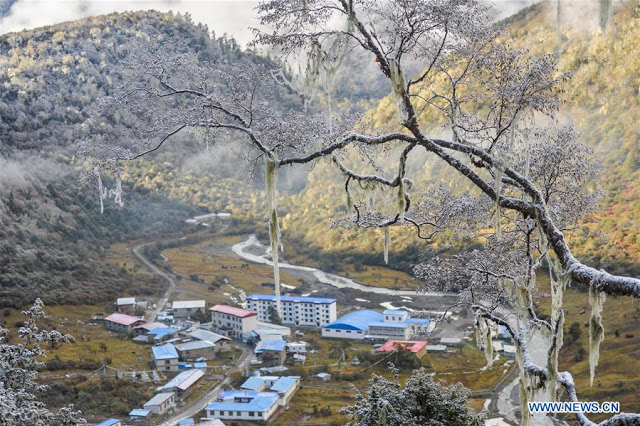
Yume Village

Yume: 32 Inhabitants
Already in November 2016, China Tibet Online had mentioned Yume ‘town’ on the southern slope of the Himalayas, as the border area between China and India: "By road, you will have to drive 400 km south from Lhasa to Lhuntse, then there was another 200 km of muddy mountain roads before you reached Yulmed.”
The Chinese site then asserted that “It is the least populous administrative town in China. With an area of 1,976 km2, Yulmed has one subsidiary village, and only nine households with a total of 32 people. Yulmed has very few residents, but it is neither impoverished nor backward.”
Incidentally, Yume has today some 300 inhabitants (probably many of them Chinese).
The journalist added: “For a long time, there was only one family in Yulmed. After the Tibet Autonomous Region (TAR) government dispatched officials and doctors, built the roads, and added a power station and a medical clinic, Yulmed became more and more lively. In 2015, the annual average per capita disposable income in Yulmed was 26,000 yuan.”

Dakpa Shelri sacred mountain

The Pure Crystal Mountain Pilgrimage of Tsari
Not far from Yume is the Tsari Valley, one of the most sacred places in Tibet and the location for a famous pilgrimage.
China Tibet Online, a Chinese website thus praised the area: "Dzari (Tsari) Township, 2,800 meters above the sea level, is located in Lhuntse County of Lhoka Prefecture. Tsari means the holy mountain in Tibetan language. Hailed as the Tibet’s Shambhala, Tsari Township boasts its lush vegetation, moderate weather, still lake, running brook, vast forest, holy mountains as well as a satisfactory variety of herbs."
But Tsari has been more than just this.
It was once one of the most sacred pilgrimages in Tibet and the site of the first clash between the Chinese and Indian troops in Longju in August 1959.
One of the characteristics of this pilgrimage was that it was running across the Indo-Tibet border (the McMahon Line); half being in Tibet, half in NEFA (India).

Tsari Pilgrimage
Tsari has always been synonymous of ‘sacred place’ in the Tibetan psyche. With the Mount Kailash and the Amye Machen in Eastern Tibet, the pilgrimage around the Dakpa Shelri, the Pure Crystal Mountain has, since centuries, been one of the holiest of the Roof of the World.
The ‘Pure Crystal Mountain’ lies at 5,735 meter above the sea in the Tsari district of southeastern Tibet.
Toni Huber is one of the foremost scholars who wrote a great deal about this region from which the Subansiri and the Tsari chu (river) flow: “The area of the two rivers into which [Gen] Tsarong [at the beginning of the 20th century] ventured for military and commercial reasons had for centuries defined a very significant territory for both Tibetans and neighbouring non-Tibetans ”.
Huber describes thus the region:

“[these] rivers encompassed the southern slopes of the famous Tibetan holy mountain of Dakpa Shelri at Tsari. The large-scale, 12-yearly circumambulation of Tibetan Buddhist pilgrims around the mountain known as the Rongkor Chenmo, had the character of a state ritual for the Ganden Phodrang [Tibetan Government]. Pilgrims in this huge procession crossed the McMahon Line below the frontier village of Migyitün in Tsari district and followed the Tsari Chu southwards. They then turned back up the Subansiri westwards, crossing the McMahon Line once again to reach the first Tibetan frontier settlements in Chame district. In doing so, they traversed non-Tibetan lands during this entire southern leg of the procession. This was the territory of the Mra (Tibetan: Morang Loba) clan, which ran downstream along the Tsari Chu valley and around its junction with the Subansiri at Geling Sinyik, and also of the neighbouring Na (Tibetan: Khalo, Lungtu Lopa) community of Taksing, which extended upstream along the Subansiri heading westwards towards Tibet.”

The pilgrims went down the Tsari chu, past Migyitün which was recognised as the frontier of Tibet - to a place where the Tsari chu joined the combined waters of the Char, Nye and Chayul chus.
It is interesting to note that in the early 20th century, Migyitün was already considered to be the border with Tibet.
The McMahon Line, drawn a few months later (under the supervision of Capt Bailey, a British intelligence officer who had visited the area in 1913), only acknowledged this fact.
Bailey had noted:

“This was five or six days' journey. Then they turned up the combined rivers, towards Sanga Choling, which they reached about a fortnight later. Some pilgrims went very much slower, the minor official said; and I inferred there was merit in delay. The slower, the better.”

The terminus of the pilgrimage was Yume.

Longju Village on India's Territory

Tsari in the News for the Bad Reasons
Apart from the celebrity bestowed on Choekar, Tsari has been in the news when a few months ago, it was discovered that China had built one of its ‘Xiaogang’ (‘well-off’) border villages on the model of Yume, a few hundred meters within the Indian territory at the place where the Longju incident took place in August 1959.
Since 2016, Tibet has built 965 Xiaogang villages and relocated 266,000 people, many on India’s border. Official Chinese statistics said that by the end of 2019, “Tibet had lifted 628,000 people out of poverty and delisted 74 county-level areas from the poverty list.” ‘’Lifting out of poverty’ is a euphemism for relocating thousands of Tibetans.
Longju now is one of such villages; it was reported by NDTV that “China had built some 101 homes in the remote place of Upper Subansiri district of Arunachal Pradesh.”
The TV channel acquired satellite imagery dated November 1, 2020; analysed by several experts, the images confirmed: “the construction, approximately 4.5 kms within Indian territory of the de facto border [the McMahon Line].”
India should be seriously concerned, added the channel: “Though this area is Indian territory, according to official government maps, it has been in effective Chinese control since 1959 [which is not correct, it remained in India’s control for many more years]. However, earlier only a Chinese military post existed, but this time a full-fledged village that can house thousands has been built. The village, located on the banks of the River Tsari chu, an area which has been long disputed by India and China.”
The location of the new village of Longju is a highly symbolic; five months after the arrival of the Dalai Lama in India (March 1959), the Chinese attacked an Assam Rifles’ platoon; it was a first ‘punishment’ for granting asylum to the Dalai Lama.
Today, China wants to change the status quo of the Indian Northern Border and proves that it can do whatever it wants in what it perceives as its own territory. It has serious implications elsewhere on the border, particularly in the Aksai Chin area, where Beijing has started exploiting the largest zinc deposits in the Middle Kingdom. If India does not object now, it will be too late in Aksai Chin too.
If China was really interested by peace, as it pretends to be in international fora, it should reopen the Rongkor pilgrimage for world peace around the Dakpa Shelri, instead of opening new fronts against India.

Tsari Town

More about Tsari
On June 22, Chinanews.com mentioned about the duties of “the immigration management police.”
It seems a bad joke as there is no question of ‘immigration’ in this area.
The article said that the Network Information Office of the Tibet Autonomous Region (TAR) and the Tibet Entry-Exit Frontier Inspection Station jointly searched for ‘the Most Beautiful Frontier People’.
Of course, the Tsari area has many of them.
The article stated that the Tsari Border Police Station is “responsible for border prevention and control, public security and rescue tasks for this small town in southern Tibet, China. The police station is located at an altitude of 2,800 meters, and its jurisdiction has natural scenery such as virgin forests and meadows, which is a typical subtropical climate. The climate here is humid and rainfall is abundant,” wrote a reporter.
What were journalists from Beijing doing in this most remote areas of Tibet is a mystery; but there is no doubt that something is cooking up.
The reporter followed the immigration management police “into the primeval forest to experience their different patrol roads. In fact, there is no way to enter the primeval forest. Everyone walks carefully on the rotted branches and dead leaves. It is extremely difficult to go uphill and downhill, and beware of dangerous wild animals such as black bears from time to time.”
A policeman told the journalists that the patrol route is different each time, during their own visit “[as we did not go] too far, the equipment was simpler, usually for farther places, the load is about 40 kilograms,” explained the policeman.
The article said: “During this period, the wild strawberries on the mountain were ripe. During the rest, the immigration management police picked fruits to quench their thirst, wild fruits are a rare pleasure for them while patrolling the road to the border.”

Patrolling the Border

Another article on Tsari
Chinanews.com had published another article the previous day.
The reporter wrote: “Tsari Township is close to India, with an altitude of about 2,800 meters. There are dense virgin forests and occasional snow on the tops of the mountains. The climate is warm and humid. The misty town is like a beautiful picture scroll in the south of the Yangtze River.”
The article continued: “The rapid development of infrastructure and the rapid improvement of people's lives have made this border town in the deep mountains more and more active. Jin Xianwei, a police officer from the Lhuntse-Tsari border police station, who has been working here for 11 years, has a good memory of his experience when he first came to report: [it was] a 14-hour drive from Shannan (Lhoka) City to Tsari.”
After two years, Jin Xianwei had the opportunity to go home in China on vacation for the first time. Then, there was no regular bus; Jin explained that “cooking at the time, we had to burn firewood, and to pay phone bills, we had to but phone cards, there was no continuous power supply, meat and vegetables would always be damaged before being eaten. It's like a village in the interior of China that has gone backwards for many years. …since 2016, the development of this border town has pressed the fast forward button, from a static development to a hot development.”
This corresponds to the time XI Jinping wrote to the two sisters.
The policeman said: “Vegetables do not need to be collected once a month, and our table is more abundant. Online express shopping can send special products from the south and the north, and the most remote duty stations also have the Internet.”
Jin Xianwei thought he would work here until retirement; he hoped that the living conditions was getting better and better and the area becoming more and more prosperous.
Kesang Wangmo, a local villager explained to the reporter: “In recent years, subsidies for border residents in Tibet have increased manyfold, and the subsidies for frontier residents have risen to as high as 6,000 yuan per person per year.”
Kesang Wangmo pointed out that the Central and the TAR governments had decided to invest in the borders. She also believed that even without subsidies, many people would still protect their homes (against India?).

Patrolling the Borders

Xiaogang Villages
In 2017, the scheme of setting up well-off demonstration villages on the border of Tibet has been implemented and villages have come up one after another
Kesang told the reporter: “The houses are built uniformly, which is more spacious and beautiful. The pavement in the village is hardened, and there are street lights, which is much more convenient.”
Tsari Township, close to her beautiful home, is still undergoing infrastructure construction.
Another interviewee, Dechen Dolma said that “The roads used to be difficult, and it was usual for the mountain roads to be blocked by snow in winter. His elder brother once took his son to the county seat to study in the elementary school."

Now it takes 4 hours instead of 2 days earlier: “In the past, the township primary school was only up to the third grade. From this year, our children here can complete primary school nearby."
According to the article, the traditional income of Tsari comes “from grazing, digging wild medicinal materials and weaving bamboo utensils. In recent years, the central government and the local government in Tibet have made this area more and more open [to tourism], and it has also brought more opportunities to local herdsmen. …more and more people doing business in the local area, and more villagers have bought construction trucks and transport vehicles, and private cars have also become family vehicles.”
Han tourists will soon flood this area ... and bring prosperity according to the Chinese propaganda.

Conclusions
There is no doubt that infrastructure development is going on full swing in the highly strategic area of the Indian border.
The need of the hour is not to ‘wait and watch’, a formula often used by Indian government officials, but to develop the border areas, in particular the Upper Subansiri district and provide decent roads, good schools and proper communication facilities to the local population. Agriculture (fruits) and arboriculture could also easily be developed and bring good recenues. 

Perhaps only mindsets of the local babus need to change. 

This is not an easy task, but let us not forget that the airport will soon serve the other side of the border.


Some photos of Chinese patrols in Asaphila area, south of Yume. Note that it is not Choekar and Yangzom who are patrolling the border.
Their role seems to be tourist guides (for Han visitors), more than 'Guardian of the Sacred Border'.

Tourists already arrive in Yume

Patrol in Asaphila Area


Wednesday, August 28, 2019

China: Changing the demography of the Indian border

The French edition of China Tibet Online recently published a photo feature of Yume village which, over the years, has often been mentioned on the blog.
Yume (or Yumed or also Yumai) is located north of the Upper Subansiri district of Arunachal Pradesh.
The main characteristic of the village is that it has been adopted by President Xi Jinping, and as such it is the Model Township for the 200 or so other 'Xiaogang' (moderately well-off) villages near the Indian border.
The French article speaks of “Renaissance of the least populated township in China”.
During the last couple of years, Yume has witnessed a lot of development, some worrying for India.

Least Populated Village?
The article explained: “Yumai County, under the jurisdiction of Lhunze County in the Tibet Autonomous Region, is the least populated municipality in China.”
Incidentally, Lhuntse Dzong (county) will have the first airport in the area in 2021; it not far away.
China Tibet Online continues: ‘At present, the upgrading of the canton's infrastructure is underway. For example, the nine original households and the 47 relocated households moved into their new apartment, one room of which is reserved for private housing or a store.”
Nine ‘original' households correspond to the population of the village announced a few years ago (32 or 37 inhabitants), but we are now told that there are 47 ‘relocated’ households.
It means that Yume has already 5 times more migrant families than local villagers.
It is a serious issue as it signifies that China is changing the demography of its borders with India.
If you look at it at level of the entire Sino-Indian border, it probably means that China will have a new population of ‘migrants’ selected for their good deals on the Indian border.
It is still not clear if these ‘migrants’ are Tibetans or Hans; there are probably a blend.
The French article continues: “In addition, a road leading to the exterior is under construction which will be put into operation at the end of this year. This new road will end the blocking season due to snowfall.”
No mention is made of the airport, not too far away.
In 2021, hordes of mainland tourists will probably descend on Yume ...in opposition, Takshing, the Indian village does not have a road in working condition as yet.
In Yume, the website say that the construction of a primary school will be completed soon and will welcome more than 30 children in September.
It means that there is alreday as many children in the 'model' village than there were inhabitants two years ago.
Another objective of the Chinese is to show the rural population that they are looking better on their own people than the Indian Government. 


Choekar (on the right) and Yangzong (on the left), China's 'Models of Our Era'

Choekar's apartment

Yangzong's family business.


The construction of Yumai Primary School

The Road to Yume

Thursday, October 18, 2018

Good life in the smallest Tibetan village?

China Tibet News yesterday reported about the "Villagers’ good life in Yulmed".
Yulmed is Yume, the small village adopted by Emperor Xi, north of Upper Subansiri district of Arunachal Pradesh,
This village has often been mentioned on this blog.
It was said to be the smallest village in Tibet.
According to yesterday's article, it is still "China’s smallest township, located in the foothills of the Himalayas near the border of China and India," but, Oh Miracle, the population has grown from 32 inhabitants to 197.
How? The Chinese media does not explain this detail.
The article just affirms that Yume, located about 200 kilometers from the county seat of Luntse (which incidentally will soon have an airport) is 'happy': "with the development of economy and the improvement of environment of Yume Township [yes, it has become a township!!], it has built numerous new houses for local villagers."
Villagers and obviously outsiders.
It was said that later this month, "197 villagers of the township will be moved into their new houses, and their living environment will be greatly improved."
What does it mean?
There is a definitive plan to repopulate the borders with India by creating new model 'townships'.
This should be a serious issue for Delhi.
Some two years ago, long before anybody had heard of the hamlet, Wu Yingjie the Party Secretary of the Tibet Autonomous Region,  had visited the area.
Probably based on his report, Chairman Xi adopted the tiny village.
For India, whether the villagers have a good life or not, is not the question; this new development is bound to put pressure on the border, at a time, when Indian villagers are migrating in large number from the border areas toward the cities (in Uttarakhand for example, it is an extremely serious issue).
Why can't India open its border villages to eco-tourism?


Friday, June 1, 2018

China woos the Tibetans

My article China woos the Tibetans appeared in The Statesman

Here is the link...

Govern the nation by governing the borders; govern the borders by first stabilizing Tibet; ensure social harmony and stability in Tibet and strengthen the development of border regions.” Thus did President Xi Jinping speak of China’s relations with Tibet.
For a few months, the authorities in Tibet have started implementing the theory of their boss and the party’s propaganda is doing its best to entice the local Tibetan population to side with the Communist Party. This is a serious development, unfortunately ignored in India.
The new formula can be found in every speech of the local satraps ~ the inhabitants of China’s borders (with India) should be “the protectors of the sacred homeland and the builders of happy homes.”
It has taken concrete shape with the mushrooming of new ‘model’ villages and towns on the Tibetan side of the Indian border, mainly north of Arunachal Pradesh; officially, this development is linked with ‘poverty alleviation’ and the ‘defence of the borders’.
Several senior Communist leaders have visited these new villages, either north of Kibithu in the Lohit valley; in Metok, north of Upper Siang district; in Yume (also written Yumai), north of Takshing in Upper Subansari or in Lepo, Marmang and Tsona, north of Khenzimane and Tawang. Wu Yingjie, the Party Secretary of the Tibetan Autonomous Region (TAR) recently gave an interview to The People’s Daily on the development in the border areas.
When the reporter asked Wu about the significance of implementing the new strategy of “rejuvenating villages under the banner of the protectors of sacred homeland and the builders of happy homes”, Wu answered: “This is the first requirement for carrying out the important strategic thinking of General Secretary Xi Jinping to govern the country and administrate the borders first.”
In fact, it all started soon after the conclusion of the 19th Congress, when Xi Jinping sent a reply to two young Tibetan herders who had written to him introducing their village, Yume. According to Xinhua, Xi “encouraged a herding family in Lhuntse County to set down roots in the border area, safeguard the Chinese territory and develop their hometown.” Xi acknowledged “the family’s efforts to safeguard the territory, and thanked them for the loyalty and contributions they have made in the border area. Without the peace in the territory, there will be no peaceful lives for the millions of families,” he wrote.
The two Tibetan girls, Choekar and Yangzom had told the CCP’s Secretary General about their “experiences in safeguarding the border area and the development of their township over the years.”
The girls’ village, Yume is located a few kilometers north of the McMahon Line, not far from the remote Indian village of Takshing, which incidentally has got for the first time a motorable road this month. Xi further hoped that the girls’ family could “motivate more herders to set down roots in the border area like kalsang flowers [which bloom in hard conditions].”
On May 8, a function celebrating the ‘Happy and Beautiful New Frontier in the New Area’ took place in Yume, the least-populated township in China. A reporter of China-Tibet Online  wrote: “At sunrise, the construction site of the Yume ‘new era’s border well-off township’ is already going on full swing. I saw dozens of construction machinery working in an orderly manner. The roar of excavators and bulldozers was also heard. Heavy trucks shuttled back and forth.”
China is ready to invest 110 million yuan in the Yume Well-Off Rural Construction Project; to start with, 56 sets of light-steel prefabricated residential houses are being built, linked by two new municipal roads, a central park and six squares. Electricity and water have already reached the border village.
Luo Yuguang, executive manager of the Construction Project admitted: “To ensure that the project can be completed on schedule, we are racing against time and working overtime. The construction started on December 19, 2017 and it is expected to be completed by October 2018.”
It is the Emperor’s project, no question of delay.
These measures seem to be post-Doklam; the rationale is “to consolidate border and to promote the deep integration of the military and the people.” Tourism and ‘cultural’ industries remain the pillars of the scheme; it is supposed to help the population to get rid of poverty through participation in tourism while promoting ‘ethnic exchanges’ …with Han tourists. Yume is the model for the entire scheme.
In his interview, Wu Yingjie concluded: “Let the people of all ethnic groups have more feelings of happiness; to take a clear-cut stand against splitting, in order to maintain the stability of Tibet and always be the guardians of sacred land and the builders of happy homes.”
Another pet project of Xi Jinping is the Military Civilian Integration (or ‘Fusion’); this too applies to the border. Consider Zhayul County located north of Anjaw district of Arunachal Pradesh in the Lohit valley. According to China Tibet News, the villages of the county have started implementing the ‘double-support model city’ which translates into full military and civilian integration: “For decades, on the borders stretching several hundred kilometers, the border guards and soldiers stationed have been working with the local people to protect the sacred territory and build a beautiful home.”
The article speaks of the civilian population and the soldiers working ‘hand in hand’ and the love of the local people who support the New Age Army.
On May 10, Wu Yingjie participated in a plenary session of the Military and Civil Integration Development Committee in Lhasa for an “in-depth implementation of Xi’s strategic thinking and “to provide a strong momentum for Tibet’s long-term development and long-term stability.”
Another aspect needs to be noted ~ a ‘cultural’ one. China is building memorials on the border to celebrate the 1962 victory against India. The Zhayul County Hero’s Memorial Park is located north of the Indian border. According to China Tibet News Network, the project covers an area of 42,420 square meters; it has a building area of 1,680 square meters surrounded by large gardens. The project honours 997 martyrs with a tall monument, historical exhibition halls, a martyrs’ wall and tombs of the heroes.
The exhibition area displays photos, videos, cultural relics, ‘technology simulation scenes and some 18 CDs and 33 books are for sale.
It celebrates the Chinese ‘martyrs’ who died in Walong in November 1962, the famous battle took place some 50 km south in the same valley. It is in Walong that the 11th Infantry Brigade and in particular the 6 Kumaon of the Indian Army managed to stop the Chinese advances and paid a high price for it. The Chinese too suffered heavy casualties.
Che Dalha, the TAR Governor, who is also director of the district border defence committee, recently inspected a Hero Memorial Park. He told the villagers that the masses should deeply cherish the memory of the revolutionary martyrs. The memorial is also in honour of the Chinese soldiers who fought the Tibetan resistance in the late 1950s.
Another memorial stands north of the Thagla ridge in Tsona County. The Forward Command post of General Zhang Guohua, who commanded the PLA operations in 1962, which are called by Beijing the ‘Sino-India Self-Defence Counter Attack Battles’, has been reconstituted and opened to tourists.
It is located in Marmang village, the first hamlet north of the McMahon Line. Hotels are already mushrooming to receive the visitors. All this is part of the Information Warfare that China has started waging on India. Has Delhi grasped the importance of this? Not sure.


Che Dalha, the Governor of Tibet near the Indian border

Monday, May 14, 2018

The guardians of the sacred land and the builders of happy homes

In the recent weeks, I often mentioned the mushrooming a new ‘model’ villages on the Tibetan side of the Indian border, mainly north of Arunachal Pradesh. This development has been linked with ‘poverty alleviation’ and the ‘defense the borders’.
Several senior Communist leaders have visited these new villages, either north of Kibithu (there is War Memorial as a bonus); in Metok, north of Upper Siang district; in Yume (also written Yumai), north of Takshing in Upper Subansari or in Lepo, Marmang and Tsona, north of Khenzimani and Tawang.
It is interesting to look at the recent increase of visitors in the TAR and the rationale behind this Chinese move.

Tourism in the Tibetan Autonomous Region (TAR)
According to China Tibet News, Lhasa received 918,900 tourists (mainly inland tourism) during the first three months of 2018. It represents a year-on-year increase of 38%. The influx of visitors brought 1.2 billion yuan in tourism revenue, up 30%.
The accommodation in star-hotels soared by 35%.
Tourist attractions such as the Potala Palace and Jokhang Temple witnessed a double number of visitors (despite the ‘structural restrictions’ for the Potala).
The sales of souvenirs have doubled over last year.
During the tomb-sweeping holiday (around April 4 and 5), Lhasa welcomed 284,600 tourists generating 214 million yuan (35 million US $) in tourism revenue.
The representation of the epic opera about Chinese Princess Wencheng started on April 20; after five days only, this performance has attracted 8,531 tourists, a growth of 19% compared with the same period of last year.
But there is something new in the TAR and perhaps more important for India; it is the ‘border tourism’.

Development of border areas
TAR’s Party Secretary Wu Yingjie recently gave an interview to The People's Daily about the TAR’s development, particularly in the border areas.
As required by the Party etiquette, Wu Yingjie first quoted General Secretary Xi Jinping’s “series of important instructions for the work in Tibet.”
‘Pointing out the direction to follow for doing Tibet's good work’, he stated: “Being the guardians of sacred land and the builders of happy homes, this is the political task that the Party Central Committee with Comrade Xi Jinping as the core has handed over to the cadres and people of all ethnic groups in Tibet.”
‘Guardians of the sacred land and builders of the happy homes” is the new motto for Party’s work with the borders’ Tibetan populations.
Wu added: “We must firmly establish ‘four consciousnesses’ and firm up the ‘four confidences’, i.e. “Strengthen the ideals and beliefs, and vigorously promote the 'old Tibet spirit' and the 'two-way spirit' [it is not clear what the ‘two-way spirit’ is] and work hard to promote long-term development and long-term peace in Tibet in the new era."
'Old Tibet spirit' refers to the work of the first Communist cadres who worked in Tibet in the 1950s.
When the reporter asked Wu about the significance of implementing the new strategy of “rejuvenating villages under the banner of the protectors of sacred homeland and the builders of happy homes” for managing the borders and maintaining the stability of Tibet, Wu answered: “This is the first requirement for carrying out the important strategic thinking of General Secretary Xi Jinping to govern the country and administrate the borders first.”

To govern the Nation

Let us recall that Xi Jinping has said: “Govern the nation by governing the borders, Govern the borders by first stabilizing Tibet, Ensure social harmony and stability in Tibet and strengthen the development of border regions.”
Wu also quoted Xi on the management of Tibet, the rule of law, the improvement of the life of the local people, the long-term construction of Tibet and the consolidation of the people’s minds.
These were the basic principles, said Wu.
The latter plan (consolidation of people's mind) is the Party's propaganda work to induce the local Tibetan population on the side of the Communist Party.
Making the inhabitants of the borders (with India) ‘the protectors of sacred homeland and the builders of happy homes,” can be found in each speech these days.

A confirmation of the Indian border?
As I mentioned a few months ago, one could be read in the scheme, the confirmation of the border with India in all the places mentioned above (where new model villages have come up).
However for China, the maintenance of Tibet’s stability is always the first priority; Wu asserted: “We must never allow the secession of an inch of land from the motherland in Tibet.”
He mentioned the Chinese nation’s “sense of community and the Chinese culture giving an emotional support, spiritual destination and spiritual homeland of all ethnic groups in Tibet.”
Whether this is true or not is another issue.
Wu boldly stated that the Tibetan culture is an inseparable part of the Chinese culture and is rooted in the minds of the people of the borders.”
He advised to ‘work hard on these lines’ and continue to promote the adaptation of the [Buddhist] religion to the socialist doctrine: “Education will guide the masses to treat religions rationally”, he argued.
This is of course debatable if ‘education’ can change the religious mindset of the Tibetan population.
The village-level party organizations should be built into strong fighting bastions that listen to the Party, reunite the people, develop the villages, get them wealthier and maintain Tibet’s stability, without failing 'to be confused'. The idea is to 'strengthen the feelings of the masses'.

A series of effective measures
Then, Wu dealt directly with “a series of effective measures to accelerate the development of the border areas”.
These measures are clearly post-Doklam.
The rationale is “to consolidate border security and to promote the deep integration of the military and the people.”
The Party boss spoke of improvement of infrastructure in the border areas, and “improving the dealing with the residents.”
Taking the example of Metok, north of Upper Siang district of Arunachal, he said that the county was now well-connected by concrete roads (and a tunnel!); Wu also mentioned the construction of Yumai, “the well-off village on the border as a breakthrough which is steadily progressing.”
As often mentioned on this blog, this is Chairman Xi Jinping’s pet project.
Every cadre has to praise it.
Wu added that “more and more border people are taking root in the snow-covered areas like Kelsang flowers.” Once again an expression used by Xi.

Different requirements
Wu mentioned different requirements for the proper implementation of this new policy of strengthening the border villages; one is the selection of the impoverished villages (in Chamdo, Nagchu, and Shigatse and other places in Western Tibet), he mentioned.
Another one is the industry’s precise requirements to support poverty alleviation and employment. Industries such as the barley production and selling of yak products have already lifted 32,300 people of poverty, affirmed the Party Secretary.
However, tourism and cultural industries remain the pillars of the scheme; it helps the poor to get rid of poverty through participation 'in tourism and cultural industries' and it promotes 'ethnic exchanges'.
Another requirement which is very controversial is the relocation of some truly poor people from areas “with extreme water and soil conservation conditions, such as high altitude and ecologically fragile areas” to ‘productive’ areas with good resources and weather conditions.

A smart village?
It means practically shifting nomads to ‘smart’ villages, which are not that ‘smart’.
Wu mentioned other requirements such as ensuring that 80% of Tibet's aid funds are spent on the most remote and poorer regions.
Once again Yume (or Yumai) is the ideal village selected as the model for the scheme.
The Party Secretary’s conclusions were: “Let the people of all ethnic groups have more feelings of happiness; to take a clear-cut stand against splitting, in order to maintain the stability of Tibet …and always be the guardians of sacred land and the builders of happy homes.”
He added: “This is the purpose of high-quality development, and it is also our job to implement this project and work for the people’s livelihood. …We shall always put the people of all ethnic groups at the top of our hearts; we shall give prominence to the work of people’s livelihood focusing on employment; we shall formulate and improve policies and measures; we shall encourage more college graduates to return to their hometowns, and further promote medical education for groups aiding Tibet.”
Efforts would continue to be made “to enable all ethnic groups to enjoy high-quality medical education services at their doorstep. We have actively promoted the construction of beautiful Tibet and deepened the practice of green development”, he concluded.

Military Civilian Integration
Zhayul County is located north of Anjaw district of Arunachal Pradesh in the Lohit valley.
According to China Tibet News, some of the villages of the county have started implementing the ‘double-support model city’ which translates into full of military and civilian integration: “For decades, on the borders stretching several hundred kilometers, the border guards and soldiers stationed have been working with the local people to protect the sacred territory and build a beautiful home.”
The article speaks of the civilian population and the soldiers working 'hand in hand’; the love of the people supporting the New Age Army.
The reporter gave a few examples: “On April 10, a border guard stationed in the town of Chagao [?] was going to perform patrols. After hearing of  a border incident, Atolima, a 37-year-old member of the village who helped to build houses in the village, asked his boss for leave. With three militiamen working with him on the construction site, they went straight to the border defense company. The mountains are densely forested and patrols often take seven or eight days in this area. All the supplies of the border guards have to be carried. However, in this case, the nearby militia did not hesitate to lay down their work and take the initiative to participate in the patrols and provide the soldiers with the strongest protection.”
It is not clear if this refers to an Indian ‘intrusion’ on China’s perceived territory.
The reporter then took another example: “In Shama village, if there are strangers or suspicious people, the villagers, regardless of their age, will step up to cross-examination and find suspicious points [of entry] which will be reported to village officials and frontier defense officers, effectively preventing the penetration of hostile saboteurs.” The article speaks of an ‘Invisible Great Wall' to guard the country.
It also mentioned “a touching scene in which soldiers and civilians united to fight the catastrophic rain and snow disaster was being staged on the town of Chaga,” and the cadres and people of Zhayul County celebrating the major festivals with the officers and soldiers stationed in the [local] garrison.”
Though it is difficult to position these villages on a map, it shows that China is trying hard to enlist the border Tibetan populations on the side.
Can it succeed is another issue. But it is certain that incentives (and employment) are thus provided to the local Tibetans.

The Military and Civil Integration Development Committee
On May 10, China Tibet News Network reported that Wu Yingjie participated in a plenary session of the Military and Civil Integration Development Committee in Lhasa for a “in-depth implementation of the strategic thinking of General Secretary Xi Jinping's integration of military and civilian development and provide a strong momentum for Tibet's long-term development and long-term stability.”
Wu Yingjie who is also first secretary of the Party Committee of the Tibet Military Region, and the director of the TAR’s Military and Civil Integration Development Committee, presided over.
Deputy Party Secretary Che Dalha (also Deputy Director of the Military and Civil Integration Development Committee) and Lt Gen Xu Yong, the Commander of the Tibet Military Region (also a Deputy Director of the Military and Civil Integration Development Committee) attended.
They all reported about the rapid integration of the civil and military development in the TAR in 2017; the key issues to be dealt with in 2018 by the task force of the Committee was the integration of military and civilian in the ‘13th Five-Year Plan’ of the TAR’s Development Plan.
Civil and military integration is also a pet project of Xi Jinping.

Some conclusions
The above gives insights in the theoretical background of the new Chinese campaign on the borders of India.
In the coming months, Beijing will continue to try to enlist the Tibetan populations on their side of the boundary, not only in Nyingtri area (Nyingchi City), but also in Western Tibet.
Similar stories have been reported from Purang, near the trijunction with Nepal and Tibet.
At the same time, the empowerment of the border villages can be read as a reiteration of the border between India and China.
But on this, Delhi should be cautious and it needs to closely watch the unfolding situation.

Saturday, April 21, 2018

China develops the Indian border

War Memorial for the Chinese soldiers who dies=d during the Battle of Walong
Che Dalha (alias Qizhala), the head of the Tibetan Autonomous Region’s (TAR) Government (and TAR’s Senior Deputy Secretary) visited Zhayul, north of the McMahon line in the Lohit Valley.
Walong, which witnessed the famous battle in November 1962 is located some 50 km south in the same valley.
It is in Walong that the 11th Infantry Brigade and in particular the 6 Kumaon of the Indian Army managed to stop the Chinese advances and paid a high price for it.
The Chinese too suffered heavy casualties.
There is an excellent account on Bharat Rakshak website
The end of the battle is thus described.
From three sides, the Chinese poured in artillery and MG fire. But the Kumaonis held till 11 a.m. till the situation became militarily futile and orders were given to withdraw. As Lt. Bikram Singh started extricating his men he was cut down. The Chinese suffered terrible casualties (almost 5 times). By midday all troops were asked to withdraw. Some managed to get back through the treacherous terrain. But many NEVER GOT THE ORDERS. They slugged it out to the last man, to the last bullet. As Brigadier N.C. Rawlley said, "6th Kumaon at Tri Junction fought and fought and fought till there was nothing left. After this there was eerie silence." Sikhs, Kumaonis, Gorkhas and Dogras fought shoulder-to-shoulder to the bitter end. Two months after the cease-fire when the Indians returned they found that the Chinese had marked the positions of the dead. Many of the bunkers showed the dead where they had last manned their weapons.

CheDalha's vist
Che, who is also director of the district border defense committee, inspected a Hero Memorial Park in Zhayul area. He told the villagers that the masses should deeply cherish the memory of the revolutionary martyrs.
He laid a wreath for 447 Revolutionary Martyrs' War Memorial.
The memorial is in the honour of the Chinese soldiers who died during the Walong battle as well as the 'heroes' who fought the Tibetan resistance in the late 1950s.
Che, a Tibetan from Yunnan province, is a member of the all-powerful Central Committee of the Communist Party of China.
According to The China Daily the memorial consists of a mausoleum, a monument, a memorial hall and a hero wall. It is said the memorial for the 447-revolutionary martyrs' memorial is nestled in a forest of pines and cypresses. There is an engraved plate reading ‘The Revolutionary Martyrs are immortal’.
According to the Daily, Che slowly walked around the mausoleum, visited the memorial hall, and paid homage to ‘loyal souls’.
With ‘emotion’, he is said to have declared: “a hopeful nation cannot be without a hero, and a nation that does not remember his heroes has no way out (future).”
He expressed the Party’s high respect for the martyrs, who will be remembered forever. It is necessary, he said, to keep them in mind, learn from them, and receive ideological education and spiritual baptism from them.
He concluded by saying that everyone should firmly consolidate the dream of the future, inherit the good Red genes, and not forget the martyrs.
He urged the villagers in Zhayul to watch for strangers or suspicious persons, whether men, women or children; they would have to cross-examine them and send a report to the PLA manning the Indian border.
Che then quoted President Xi “ideals and beliefs are the spiritual ‘bones’ of the party members. We must always strengthen our ideals and beliefs, and more and more closely unite around the party Central Committee with Comrade Xi Jinping as its core.”
And then he said: "we must stick to the Party’s spiritual ideals; have a firm position and convictions in the depths of our hearts. Strive for a bright future and use faith to create a bright future."
Nothing very new, except for the fact that this took place near the Indian border.

The border defense forces

Che also addressed the border defense forces.
He urged them to hold high the banner of socialism with Chinese characteristics in Xi Jinping’s new era; implement Xi Jinping’s strong military ideology and resolutely safeguard and implement the chairmanship responsibility system of the Central Military Commission.
The usual State’s propaganda.
He added that all actions must of the society resolutely follow Xi’s command and stand on the side of the Chinese motherland while strengthening the national defense education, supporting the PLA and the masses, promoting the deep integration of military and civilian and educating and guiding the cadres and masses of all ethnic groups to bloom like a Kalsang flower in the snow-covered lands, while conscientiously be a guardian of the sacred homeland and a builder of happiness at home.


Phurbu Dhondup
It is not only Che Dalha who visited the border areas.
Phurbu Dhondup, the Governor of Lhoka (Shannan), in other words the head the prefectural government, recently ‘inspected’ some border counties of Southern Tibet, particularly in Tsona area, north of Tawang district of Arunachal Pradesh.
While on ‘inspection tour’, he asked the three counties of Nagartse, Lhobrag and Lhuntse to seriously study and learn from their mistakes and “adhere to the government’s policies; adhere to the Party’s planning and guidance, highlighted decisions; adhere to an exemplary life; adhere to the Party’s policies and systematically promote these policies.”
What does it mean?
Some local leaders are not adhering to the Party line?
Probably.
During the recently-concluded National People’s Congress (NPC), Phurbu Dhondup had affirmed that there were 96 border villages under the poverty line in Lhoka Prefecture alone; the prefecture is located north of Bhutan and Tawang district.
Dhondup asserted that the Provinces of Hunan, Hubei and Anhui would help Lhoka “make the dramatic transition” from poor border villages to prosperous ones with electricity, first rate access roads, irrigation systems and potable water. The participation of the ‘rich’ Provinces of China in the scheme is an important factor.
Inspecting the construction of a new village near the Indian border (Xiaokang Village), Phurbu Dhondup emphasized that everyone must adhere to the 'two directions': the protection of China’s sacred territory and the construction of a happy homeland.
Same words than Che Dalha.
Phurbu mentioned about the fight for poverty alleviation which should include scientific planning and the respect for the will of the masses; it should a combination of government support and self-reliance.
This village, like many others, is a border village, being developed with tourism in mind.
The question remains: why so much interest for the Indian borders?
Post-Doklam, Beijing has probably realized the importance of the border populations in case of a conflict with India. And more than 60 years after the ‘liberation’, many of these areas still live in poverty.
The Communist leadership is banking on mass tourism to change this.
And roads will come to the Indian border...

Phurbu Dhondup


Thursday, March 29, 2018

China's inroads near the Indian borders

The Indian side of the border
On the way to Takshing...
My article China's inroads near the Indian borders appeared in the Edit Page of The Pioneer

Here is the link...

Relaxing PAP scheme is a good idea but as a modern state we must use electronic means to control visitors to India’s frontiers even as we promote border tourism

The Union Government is thinking of relaxing the Protected Area Permit (PAP) scheme to enable foreign tourists visit border areas. This is half good news. Why half? Simply because after the Government starts to ‘think’, results often takes months or years to materialise. Let us hope that it will be done soon.
Apparently, the move was triggered by requests from border States of Arunachal Pradesh, Himachal Pradesh, Sikkim, Uttarakhand, Nagaland and Manipur as well as the Union Tourism Ministry. It was announced by Minister of State for Home Kiren Rijiju, who, as an elected Lok Sabha member from Arunachal Pradesh, has long been aware of the issue. Under the Foreigners (Protected Areas) Order, 1958, all areas falling between the ‘Inner line’ and the International Border of the state are considered to be a ‘Protected Area’.
Responding to a tweet by Pema Khandu, Chief Minister of Arunachal Pradesh, Rijiju announced the decision about the PAP regime which will allow foreigners to visit the ‘paradise on earth’; he was referring to Shungetser lake north of Tawang, often known as ‘Madhuri Lake’, because the Bollywood actress shot Koyla, also staring Shah Rukh Khan, in the ‘idyllic’ spot.
It is a pity that the Government could not, at the same time, do away with the ‘Inner line’ permit system (for Indian nationals) once and for all. At a time when Artificial Intelligence (AI) has started permeating our lives, the Government is still attached to this 19th century-old scheme which has no place in a modern state. If required, the authorities could find other ‘electronic’ means to control visitors in the Indian frontiers. Hopefully, this would be the next bold decision.
‘Relaxing’ the PAP is nonetheless good for India; after all, these areas are part of the Indian territory and there is no reason why a discriminating ‘Philosophy of North-East Frontier Agency’ put in place by Nehru and his ‘tribal’ advisor Verrier Edwin, should remain in existence. During the 20th century, it has not often protected the local population, while more often alienated them from the main stream of Indian society.
It is also a positive development because happenings on the other side of the border show extremely worrying trends. China is fast developing its frontiers, trying to woo the Tibetan locals, often akin to the Indian populations on the other side of the border.


Yume, the Tibetan side of the border
A few weeks ago, The Tibet Daily asserted, “making the border villages prosperous and well-off is the top priority of the poverty alleviation campaign.” Beijing has, however, a second objective that is to build-up the border defenses against India. With tourism, it plans to kill two birds in one go.
During the recently-concluded National People’s Congress (NPC), Phurbu Dhondup, a deputy and Governor of Lhoka affirmed that there were 96 such border villages in Lhoka Prefecture alone; the prefecture is north of Bhutan and Tawang district.
Dhondup asserted that the Provinces of Hunan, Hubei and Anhui would help Lhoka “make the dramatic transition” from poor border villages to prosperous ones with electricity, first rate access roads, irrigation systems and potable water. The participation of the ‘rich’ Provinces of China in the scheme is an important factor.
Out of the 17-member Tibetan delegation at the NPC, four members were from the borders with India. One Kesang Dikyi, who comes from Metok, north of Tuting sector of Arunachal, which recently witnessed a border intrusion (with Chinese excavators), is a primary school teacher. During a Press conference in Beijing, she remarked: “Our school building was very poor; teachers and students had to pick grass to cover the roof. The grass was taller than we were, so when we were walking back we’d often trip, and we often had our hands cut. If we didn’t pick the grass, rainwater would leak into the classroom.” All this has changed in the recent past.
On March 4, Xinhua announced: “Tibet will strive to make highways reach all townships and administrative villages by 2020 in a bid to boost rural development. …By 2020, all townships which meet necessary conditions and 80 per cent of administrative villages would have access to bus service.”
This includes the border villages north of Arunachal Pradesh, Sikkim, Uttarakhand and Ladakh.
According to a senior transport official of the Tibet Autonomous Region (TAR), “road construction will help the region reduce poverty and increase the income of farmers and herders.”
In 2018, the region will launch projects to make 13 townships and more than 1,000 villages connected by asphalt or cement roads; in other words, ‘an integrated transportation system’ reaching the border with India.
The New Helmsman, Xi Jinping has articulated the dual objective to combat poverty and protect the borders. An article in China Tibet Online noted: “Through accurate identification of those requiring help, the number of poverty-stricken people has reduced by more than 500,000 in the last four years. The TAR’s Poverty Alleviation Office has gradually established a targeted poverty alleviation system, whereby the causes of poverty are analysed.”
For Beijing, tourism is the best way to tackle poverty ...and to protect its borders (by buying the local population on China’s side).
A turning point was Yume. In October 2017, President Xi wrote a letter to two young Tibetans who had introduced to the Chinese President, Yume, their hamlet located north of the McMahon Line (Upper Subansiri district of Arunachal Pradesh).
Soon after, The Global Times reported: “A sparsely populated township [Yume] has been connected to the state electricity grid, ending life without electricity for its 32 residents.”
The China Daily noted another development north of Arunachal: “After getting access to electricity and the construction of new roads, tea farmers and herdsmen in a village some 200 kilometers southwest of Lhasa in Tsona county founded a cooperative that provides skills training and job opportunities for villagers.” Tsona, an area now extensively developed, is the first small town in Tibet, north of Tawang district of Arunachal.
At the end of the NPC’s sessions, Beijing announced the complete withdrawal of “civilian-oriented, firefighting and frontier defence troops” from the control of the People’s Liberation Army.
What does it mean? The Global Times explained: “The withdrawal of armed police force units engaged in civilian affairs would disentangle the previous complicated chain of command.” It signifies that the PLA will only be given the responsibility of manning the border with India, without having to waste time in ‘fire-fighting’ and other tasks.
The former militia and ‘frontier forces’ will be put under the command of the local party bosses, in a way empowering the local population to man the borders.
With all these happenings on the other side of the India’s northern border, it was high time that India starts promoting border tourism, including for foreigners, and develops these areas, while keeping the environment as idyllic as possible. There is no harm in copying China once in a while.

Monday, March 26, 2018

China develops India's borders: one stone, many birds

Tsona village, north of Tawang district
A quick review at the Chinese press related to Tibet during the last few weeks shows an extremely worrying trend for India.
While the Indian media has been concentrating on Doklam, the happenings on the other side of the border, especially north of Arunachal Pradesh are disturbing.
A few weeks ago, an article in The Tibet Daily mentioned these new developments: “Making the border villages prosperous and well-off is the top priority of the poverty alleviation campaign."
China's second objective is to build-up the border defenses.
It says that some 628 border villages needed to be turned into prosperous and well off administrative villages.
But let us go through some of the articles/comments.

Border Representation at the National people’s Congress
During the recently-concluded National People's Congress (NPC), Phurbu Dhondup, a deputy and Governor of Lhoka, said there were 96 such border villages in Lhoka Prefecture alone.
He asserted that the provinces of Hunan, Hubei and Anhui would help Lhoka “make the dramatic transition" from poor border villages to prosperous ones with electricity, first rate access roads, irrigation systems and potable water.
The participation of the 'rich' provinces of China in the scheme is to be noted.
As earlier mentioned in this blog, Drokar (alias Choekar) has been in the news.
Other delegates from the borders with India are:
  1. Tashi Gyaltsen, a 29 year old Lhoba who worked in building village organization
  2. Mi-ma Guo-ji, (his Tibetan name is not clear), a young man who builds electricity transmission lines to villages.
  3. Kesang Dikyi who comes from Metok, north of Tuting sector of Arunachal, which recently witnessed a border intrusion (with Chinese excavators). She is a primary school teacher in a village near Metok.
    As mentioned earlier, Kelsang Dekyi was born in 1978, symbolically the beginning of an era which saw the Chinese people “relying on knowledge to change its destiny;” she grew up in Metok County “once a remote, poverty-stricken, and information-poor area.”
    Kelsang Dekyi told a press conference in Beijing: “Our school building was very poor; teachers and students had to pick grass to cover the roof. The grass was taller than we were, so when we were walking back we'd often trip, and we often had our hands cut. However, if we didn't pick the grass, we couldn't cover the roof, and rainwater would leak into the classroom."
The CPPCC’s TAR delegation has a member from the border area, a Loba lady from Tsari village, east of Yume.
Let us remember that the Tsari chu (river) enters India south of Migyitun which saw the first border incident between India and China in August 1959 (Longju).
The lady cadre is called by what seems a Chinese
name, Gong-jue Qu-zhen.

All townships in Tibet to be reached
On March 4, Xinhua announces ‘Highways to reach all townships in Tibet by 2020’.
 The article says: “Tibet will strive to make highways reach all townships and administrative villages by 2020 in a bid to boost rural development. …By 2020, all townships which meet necessary conditions and 80 percent of administrative villages would have access to bus service.”
This includes the border villages, north of Arunachal, Sikkim, Uttarakhand and Ladakh.
According to a senior transport official of the Tibet Autonomous Region (TAR), “road construction will help the region reduce poverty and increase the income of farmers and herders, according to the official.”
In 2018, the region will launch projects to make 13 townships and more than 1,000 villages connected by asphalt or cement roads. Rural road mileage in Tibet is currently 60,421 km, compared with 53,244 km in 2012.
In other words, 'an integrated transportation system'.

The Dual Mission

The objective is dual, poverty alleviation and ‘protection' of the border.
When the People’s Liberation Army (PLA) entered Lhasa in September 1951, General Zhang Jingwu, the representative of the CPC’s Central Committee told Sumul Sinha, the head of the Indian Mission in Lhasa that the Chinese had come to Tibet for two reasons only (he spoke of ‘a dual mission’): to eliminate all imperialist influences and to improve the standard of living of the Tibetans.
Of course, there was no ‘imperialist influence’ on the Roof of the World, but poverty was there.
What is surprising is that, 66 years later, the Chinese government still speaks about fighting poverty on the Tibetan plateau.
It means a colossal failure for the Communist State.
The new Helmsman wants to rectify this.
An article in China Tibet Online recently noted: “Through the establishment of archives, and accurate identification of those requiring help, the number of poverty-stricken people has reduced by more than 500,000 in the last four years. The TAR's Poverty Alleviation Office has gradually established a targeted poverty alleviation system, whereby the causes of poverty are analyzed and the limited special funds are used on the poor people.”
Apart from the Targeted Poverty Alleviation, the article speaks of Industry Poverty Alleviation, Education Poverty Alleviation, Tourism Poverty Alleviation, Health Poverty Alleviation, while asserting: “Tibet explores the practice of ‘the rich helping the poorer to wealth’, and uses the capable people as one of the main driving forces of poverty alleviation.”
One Tsering, deputy director of the Lhasa Poverty Alleviation Office, told the website: "these capable people have experience, skills and the mind, and also have the ability to help the poor escape poverty. With some help they are running a series of projects, which can provide the poor families with an income salary as well as a bonus and other secure incomes. The results are clear to see.”
For Beijing, tourism is perhaps the best way to alleviate poverty ...and to protect the border (by buying the local population on China's side).
And provinces have been called to the rescue to 'invest'.
It is worrying, because there is no doubt that each investor will want a 'return'. What does it mean for Tibet is difficult to predict.


Infrastructure development
On March 23, VTIBET.com writes ‘Tibet builds integrated transportation system.'
The website publishes a photo of the new roads, taken near Gongkar Lhasa Airport with the caption “expressway from Lhasa to Zedang (Tsetang in Tibetan) Township of Lhoka City.”
The article says: “In the past five years, China has been increasing the investment in infrastructure construction in Tibet Autonomous Region. An integrated transportation system based on highway, railway, aviation and pipeline has been built up to now, which provided a strong support for the economic development and prolonged stability of Tibet Autonomous Region.”
The repetition of the word ‘stability’ while speaking of the region, probably means that presently the TAR is not too ‘stable’.
How to stabilize Tibet?
By bringing millions of tourists who will bring good revenue to the local population.
How to stabilize the borders?
By bringing millions of tourists to the borders and develop the border villages
Another site en.tibetol.cn mentions the 'New highway to link Chamdo with Tibet’s highest-altitude airport.'
It says that the construction of the Chamdo-Bamda Airport section of the National Highway 214, linking Tibet's highest-altitude airport at an elevation of 4,334 meters to Chamdo city has started. It will greatly help to develop tourism in Eastern Tibet.
The article asserts that the distance of 120 kilometers can be presently covered in two hours; once the new highway is completed, it will take just one hour: “The highway will also facilitate communication between east Tibet and the outside.”
Some technical details are given: “The first phase is to be completed within 24 months. 21 mega bridges, 11 medium bridges, 2 tunnels and 11 cross-river bridges will be built along the 26.9 kilometers highway with a design speed of 80km/h. Tibet has already opened seven high-level roads including the Lhasa-Nyingchi road, with a total length of 660 kilometers.”
Another site, China Tibet Online notes that  'Tibet on fast track to facilitate travelers'.
According to Wang Songping, head of the Tourism Development Committee of Tibet: “The increasingly improved transportation infrastructure has allowed travelers to spend less time on road as they tour in Tibet.
Wang said that highways, railways and airports have improved continuously to facilitate travelers' trips and meet their need to move fast on their way to scenic spots.
With most part of the Lhasa-Nyingchi Highway opened to traffic, “it will be more convenient for travelers to pay a visit to Nyingchi,” noted Wang.
All this infrastructure being built for 'dual use' (civil and military), means that ultimately, it will bring more pressure on the Indian border.


Extended tourist season
The season has been extended and winter is promoted as the best season to visit the Roof of the World.
Photos appeared on one website showing the scenery in Lhasa: “the Potala Palace is extremely beautiful after the strongest snowfall since last year's winter arrives in Lhasa, capital city of southwest China's Tibet.”
Note the Land of Snows, is always called ‘China’s Tibet’.
Would we write in India, ‘India’s Tamil Nadu or India’s Arunachal’?
No.
Does it mean that China is not sure if Tibet is China's?
Beijing seems to have a serious problem here.
Other pictures show a Park in Lhasa, capital of China's Tibet, “after the strongest snowfall since last year's winter arrives in the evening of March 17, 2018;” another illustration pictures a child is playing in the snow.

Developing the Indian Borders
I often wrote about Yume, the hamlet north of the McMahon (Upper Subansiri district of Arunachal Pradesh).
In October 2017, Chairman Xi Jinping had written a letter to two young Tibetan herders who had introduced their village to the Chinese President.
A letter from the Emperor always shows the trend in the Kingdom.
Yume village
The Global Times recently reported: "A sparsely populated township in Southwest China's Tibet Autonomous Region has been connected to the state electricity grid, ending life without electricity for its 32 residents."
The village is Yume.
The Global Times' article quotes the contractor, a Xining-based electric power company who worked on the project: "The 15-kilometer 10-kilovolt power line, which took five months to complete, is connected to remote Yulmed [Yume] Township in Luntse [Luntse] county, Shannan [Lhoka], via 108 electric poles over a 5,000-meter-high mountain."
According to the tabloid, Yume (also spelt Yulmed) is located "at an average elevation of 3,650 meters above sea level and its population was once just a three-member household. Currently, it has nine households."
It is further explained that in 2008, the local government built a small hydropower station, but the project failed to meet the increasing power demands of the 32 residents: "Due to improved living standards and growing need for electricity of the residents, power outages were frequent."
But that is not all.

Uplifting the border villages
The China Daily recently announced: "Investment in infrastructure in the Tibet Autonomous Region is helping to lift 628 villages along the border out of poverty." It further asserted: "After getting access to electricity and the construction of new roads, tea farmers and herdsmen in a village some 200 kilometers southwest of Lhasa in Tsona county founded a cooperative that provides skills training and job opportunities for villagers."
Tsona is located north of Tawang district of Arunachal.
The area has been extensively developed.
In November 2016, I wrote The Chinese tourists arrive on the Indian border. It was about the village between Tsona and the Indian border. 
Now China admits: "Starting last year, more than 100 million yuan (15,263 million US dollars) has been invested in infrastructure in the village of less than 100 families as a part of a broader construction project to build model villages with moderate prosperity in the border area. The construction of well-off villages along the border is designed to advance the living and working conditions in surrounding villages." 
The China Daily estimated that the road access rate in the area will reach 100 percent and the per capita disposable income will double by the year of 2020.

Dances in Tsona
Tsona again in the news
On March 23, China Tibet News reports, “Tibet’s border villages speed up development of rural tourism.”
The short article is accompanied by a photo showing “the beautiful border village in Tsona: “the construction of Tibet's border moderately prosperous villages, tourism in border villages develops rapidly. Tsona County, Shannan City of southwest China's Tibet Autonomous Region, makes great efforts to boost rural tourism, which also increases the income of local villagers.”
Again in China’s TAR!
Tsona is also been linked with Tsangyang Gyaltso, the Sixth Dalai Lama born in Urgyeling, near Tawang. He would have stayed in Tsona on his way to Lhasa to be enthroned. Every year, a Tsangyang Gyaltso Festival is being organized by the Communist authorities, who, when it is convenient, promote the Dalai Lamas.

Chumbi Valley
Danses in Yatung (Dromo)
On February 28, VTIBET.com mentions that “Dromo County held sending culture and art to villagers activities”.
Though the title is not very clear, Dromo is the Tibetan name for the Chumbi Valley, east of Sikkim.
Probably due the vicinity of Dolkam, the activities were not only ‘cultural’, a photo showed officers from People’s Court of Dromo County handing out ‘basic legal knowledge’ leaflets to villagers.
What were these ‘legal leaflets’ about is not clear?
That the entire Chumbi Valley belongs to China?
Other illustrations shows Dromo County’s folk art troupe “performing wonderful song and dance programs.”
Nothing has been published in the railway line to Yatung in Chumbi Valley recently.
China is keeping quiet about it, since the Doklam episode.

Ngari, Western Tibet
According to VTIBET.com, the prefecture of Ngari received over 660,000 visitors in 2017
The website says: "Ngari, an ancient prefecture located in West Tibet, received a total of more than 660,000 domestic and overseas visitors last year, with a year-on-year growth of 20 percent. The tourism revenue totaled about 750 million yuan, up by 10 percent over the same period last year.”
Ngari Tourism Bureau affirms “Hailed as ‘Roof of the Roof of the World’, Ngari, at an average elevation of 4,500 meters above, is the birthplace of the four major rivers in Asia. It’s the place where the Himalayas, the Gangdise, the Kunlun Mountains and Karakorum Mountains meet. …There are great mountains, beautiful lakes, vast grasslands and spectacular snow mountains in Ngari. Famous tourist landscapes, including Mapam Yumtso [Manasarovar], Kangrinpoche [Kailash], Guge Kingdom Relics [Tsaparang, Tholing], Piyang-Donggar Caves Relics, Zanda Clay Forest.”
According to Liu Qilin, deputy director of Ngari Tourism Development and Reform Commission: “In 2017, more than 12,000 farmers and herdsmen in Ngari participated in tourism industry, creating income of 153 million yuan, and promoting tourism development of 11 poor villages with tourism development conditions.”
Further, it is said that 12 new tourism projects were built in Ngari last year, with a total investment of about 11,62 million yuan, and a total of 96.6 million yuan budget was approved by the central government to invest 6 key tourism projects that were declared to the 13th Five-Year Plan.

The Pangong Lake
Pangong tso from the Indian side
The report also mentioned Pangong tso (lake), “inscribed in 50 awe-inspiring natural wonders by CNN.”
Part of the lake is in eastern Ladakh, part in Ngari: “This beautiful lake sits at an elevation of 4,350 meters. The lake and sky are both amazing shades of blue that make it become one of the must see scenes.”
The quick development of tourism in Western Tibet is bound to bring more pressure on the Indian border in Uttarakhand and Ladakh.
And this without mentioning, “the smooth progress towards the world's highest altitude gravitational wave telescopes in Tibet Autonomous Region to detect the faintest echoes resonating from the universe, a project insider disclosed.”
During the CPPCC’s 13th National Committee, Zhang Xinmin, chief scientist of the project said that the main part for the first stage of the ‘Ngari plan’, which was launched by China in March 2017 to eyeball the Big Bang cosmic waves at Ngari, is almost completed,
Zhang, a senior researcher at the Institute of High Energy Physics in the Chinese Academy of Sciences (CAS) observed that the project will start operations in 2020 and observation results will be available in 2022.
More tourists in view.

Tibet to limit visitors for 'high quality' tourism
On March 22, according to The Global Times, China's Tibet “vows to control the number of visitors in the region's scenic spots, including Mount Chomolangma, known as Mount Everest in the West.
This is what Qi Zhala (or Che Dralha), chairman of the TAR and a deputy to the 13th National People's Congress, told the China National Radio (CNR)
Tibet will develop ‘high quality’ tourism: “The number of tourists will be strictly restricted at some scenic spots. We introduced a cap of 5,000 visitors for the Patala [Potala] Palace in summer, and we will strictly control the number of tourists to Mount Chomolangma."
Che also admitted that “Tourism is the main channel for the opening-up of the region's economic development and the main force to improve residents' lives,” he added that “developing tourism must stick to the bottom line of environmental protection.”
With the winter tourism promotion scheme offers free admission to 115 major tourist attractions in the region, including the Potala Palace, from February 1 to April 30, plus discounted fares for hotels, local transport, flights and train services.

Some conclusions
In Tibet, China is pursuing a dual policy to tackle ‘poverty alleviation’ and ‘protect' its borders (with India).
Tourism is used in the grand scale to achieve these two objectives.
The support of the ‘rich’ provinces of China is also asked for.
To develop the borders means to ‘stabilize’ the borders.
By 'stabilizing' the border areas, Beijing protects its borders.
Extensive ‘dual use’ (civil and military) infrastructure is built for the purpose.
This creates a worrying scenario for India.