Showing posts with label border. Show all posts

Sunday, July 24, 2022

Chinese Panchen Lama visits an 'Indian' Village

On July 22, China Tibet Network posted an article announcing that the Chinese-selected Panchen Lama (Gyaltsen Norbu) visited a village on the Indian border: “Panchen: Guarding the border is a great cause,” was the title of the article.
It mentioned the name of a 71-year-old Tibetan lady “wearing new clothes, wearing new hats and holding white khatas eagerly waiting, with faithful masses, in the fine rain,” for the arrival of the Lama
The name of the village as given by the article is Lowa.
It is probably a Tibetan translation for Lho(pa)-wa, i.e. Lhopa tribe village.
But the newly-built village is in fact Longju, the site of the first bloody clash between India and China in August 1959.

The line depicted on this map is the approximative LAC in the area.
though Longju is south of the International Border (IB)

For decades, India has considered the place, where the new village is located, to be in Upper Subansiri district of Arunachal Pradesh and not in Tsari Township of Lhuntse county in Lhoka prefecture as mentioned by the Chinese.
"Knowing that Panchen Rinpoche was today going to visit our village for inspection, we waited at the entrance of the village early in the morning, looking forward to seeing Rinpoche as early as possible," said the lady.
The article added: “On July 21 in the morning, the Panchen Erdeni [Chinese name for Gyaltsen Norbu] a member of the Standing Committee of the National Committee of the Chinese People's Political Consultative Conference (CPPCC), Vice-president of the Chinese Buddhist Association and President of the Tibetan branch of the Chinese Buddhist Association, came to Lowa New Village.”
The narrative continued: “The new village lying quietly at the foot of the Himalayas became lively with a strong smell of mulberry smoke in the air; the masses of believers welcomed him, bowed and prayed.”

Gyaltsen Norbu being explained the history of Longju

 Wang Shu [Wangchuk], the secretary of the Party Branch of the new village gave an introduction to the Panchen Lama about the situation in the new village.
According to China Tibet Network, the new village is located on the border at 2,735 meters above sea level, 7 kilometers from the seat of the township government (Tsari/Migytun): “in the village, two-story small buildings are lined up, staggered and greenery is found in front of each house with flowers in full bloom, a vibrant scene.”
The article admitted that the ‘Lowa’ new village is part of the ‘relocation’ scheme and new inhabitants arrived on January 15, 2021. Since then, more than 90 families have moved in.
The village Party Branch Secretary showed the Panchen Lama around and explained the construction of the new village on an exhibition board showing the new village's relocation; the role of the villagers, living in well-off houses, who have to guard the border and improve the rural revitalization conditions as well as the industrial and ecological development of the area.
The local Party Secretary added: “In addition to the high standard construction of well-off houses, the Party and the government also invested in the supply of water, electricity, telecommunications and other infrastructure facilities as well as the construction roads. It is supporting the construction of bamboo processing plant, Tibetan incense plant, greenhouses and other special industries.”

Meeting the 'masses'
Gyaltsen Norbu asked: “How many children do you have? Where do the children go to school? Where are the teachers from?”
He later went into the first floor of the Village Committee House and visited two households “to talk to the masses of relocated households to understand their living situation after relocation.”
"Going around the village, you can see that our current housing, living and other conditions which are particularly good," said the villagers.
The Panchen Lama looked at the happy smile on the face of the border people and told that they were different from others; your tasks to guard the border: “it is a great cause, you should feel the Party's grace, listen to the Party, follow the Party, to do a good job in the new era of garrison people, continue to work hard to guard the territory of the motherland. I believe your future life will be even better.”
The article mentioned that in 2021, the per capita disposable income of the new village of Lowa reached 25,804.08 yuan. It is pure propaganda as the village did not exist a few months earlier.
But in 2022, the villagers' income has doubled and more prosperous days are ahead, said one of the villagers while guarding the border is not only “our unshirkable responsibility, but also our glory, we firmly believe that under the wise leadership of the Party and the State, the new village of Lowa will have a better tomorrow.”
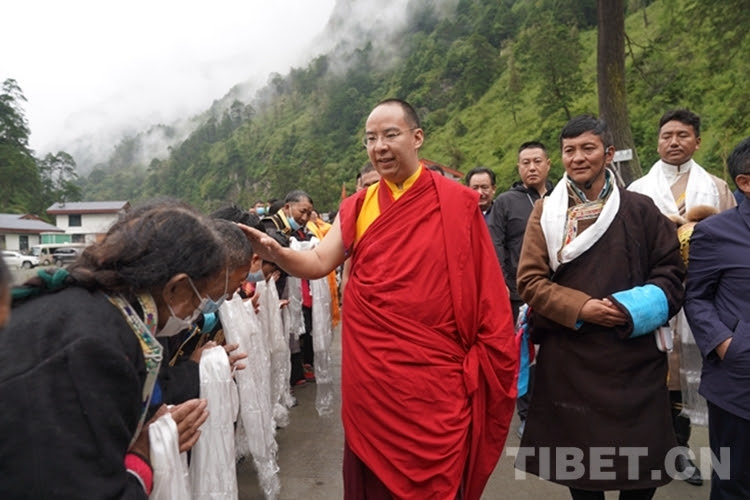
Blessing the 'masses'

At the end of the inspection, Gyaltsen Norbu walked out of the new village on foot, touched the heads of the villagers and gave his blessings to the religious people lined up at the entrance of the village, and presented the religious people in the village with enlightened Vajra knots, dharma photos and medals.”
No photos of the Dalai Lama, of course.
The article concluded that after receiving the blessing from Panchen Lama, “still many religious people who did not want to leave for a long time.”
One of the villagers said: “I didn't expect Rinpoche to travel so far to visit us in the village. Before, I had only occasionally seen Rinpoche on TV, but I never thought I could see him with my own eyes in this life.”
With tears in her eyes, the old lady immediately enshrined the picture of Lama on the altar of her house after returning home.
Probably along with the photo with Xi Jinping.
It is pure propaganda to show that Longju belongs to China, and the Tibetans are given the freedom to practice their religion, but where are the stupa, the gompas, the prayer flags, the prayer mills in the new villages.
Nowhere, but is clearly a provocation in retaliation against the Dalai Lama's visit to Ladakh.
But a poor retaliation, for the Dalai Lama there was a 10-km line-up in Leh, in Longju hardly 20 people, representing the 'masses'.

Sunday, January 2, 2022

What about Patia-la?

Did Beijing ask the local population if they want to be part of China?

Since 1984, the Chinese and Bhutanese officials have been meeting to discuss their common border. 

The Bhutanese negotiators are usually bullied by the big ‘Northern Neighbour’ (the Bhutanese prefer to call China thus).
A few years ago, in the course of a 'discussion', the Chinese side gave a long presentation about the names of the places which, according to them, proved that Bhutan occupied some Chinese territory at several locations. 

They started arguing the ‘la’ was a Chinese word (it means ‘pass’ in Tibetan and Bhutanese, not in Chinese).  Even after the Bhutanese negotiators told their Chinese counterparts that it was not a Chinese name, the latter continued to insist.
It is then that a senior smart Bhutanese official interrupted the Chinese argument and asked: “What at Patia-la? Is it a Chinese place?”
The Chinese were so much taken by surprise that they kept quiet …at least for some time.
This anecdote came to mind when I read that Beijing had released the second batch of ‘new’ names for places in Arunachal Pradesh.
On December 30, the Ministry of Civil Affairs in Beijing announced that it had “standardized in Chinese characters, Tibetan and Roman alphabet the names of 15 places in Zangnan [they now call thus the southern part of Xizang or Tibet], in accordance with regulations on geographical names issued by the State Council, China's cabinet.”
'Zangnan' is probably an abbreviation of (Xi)Zang = Tibet and 'Nan' (south in Mandarin).
China has never used this term before.
Why Beijing has used a Chinese abbreviation for the area and Tibetan names for the 15 locations is not clear.

The 15 Places
According to The Global Times, among the official names of the 15 places, which were given with precise coordinates, eight were residential areas, four were mountains, two were rivers and one is a mountain pass (Sela).
It was the second batch of so-called standardized names of places published by the ministry; the first batch of the so-called standardized names of six places in was released in 2017 (see article below).
Contrary to what the Indian media wrongly mentioned, the names are not ‘invented’ names; they are transcription of the Tibetan names for these 15 areas.
It is far more serious than ‘invented names’ as by ‘proving’ that these places had Tibetan names, China can come to the easy conclusion that they have been Tibetan places and therefore Chinese.
The argument is tenuous, as it is often the case, but it does not stop China from using it.
It however gives a clear message to India: whatever has been Tibetan (or even have a Tibetan name) belongs to China.
One day, places in Ladakh, Sikkim or Kinnaur will thus be claimed.
Lian Xiangmin, from the China Tibetology Research Center in Beijing, explained to The Global Times that “it is part of a national effort to standardize the management of place names. The places have existed for hundreds of years.”
Interestingly, as mentioned earlier on this blog, the claim on NEFA as being part of the Chinese territory dates only from the end of 1930s, when the newly-created Xikang Province engulfed some these areas of the North-East.
Lian said: “It is a legitimate move and China's sovereign right to give them standardized names. More standardized place names in the region will be announced in the future.”
Another so-called expert, Zhang Yongpan, from the Institute of Chinese Borderland Studies under the Chinese Academy of Social Sciences said that these areas were named by the central and local (Tibetan) governments “throughout history, as well as ethnic groups such as the Tibetan, Lhoba, and Monba who have long lived in the region.”
Historically, it is again entirely wrong.
The move is apparently part of the implementation of the new the Land Border Law, which has come into effect on January 1, 2022.
The Global Times explained: “The eight residential places in the second batch are Sêngkêzong [Senge Dzong] and Daglungzong [Taklung Dzong] in Cona [Tsona] County of Shannan [Lhoka] Prefecture, Mani'gang [Manigong], Duding [Tuting]and Migpain [Migpan] in Medog [Metok] County of Nyingchi [Nyingtri], Goling, Damba [Tampa] in Zayu [Zayul] County of Nyingchi, and Mêjag [Mechag or Maja] in Lhunze [Lhuntse] County of Shannan Prefecture. ‘The four mountains are Wamo Ri, Dêu [Deu] Ri, Lhünzhub [Lhungrup] Ri and Kunmingxingzê [Guming Shingtse] Feng. The two rivers are Xênyogmo He [Syiom] and Dulain [Tulan] He, and the mountain pass is named Sê La [Sela], in Cona [Tsona] County.”
This chart shows that the ‘new’ names derive from Tibetan names (click to enlarge).

Why this mixture of different places is not clear.
But what is worrying is that Maja, south of Longju, where China built a new village on Indian territory a few months is included.
So is Tuting (Duding) in the Upper Siang district is also mentioned.
The time has perhaps come for India to reassert its claim on Minsar, the Indian principality near Mt Kailash.

My 2017 article...


China has announced 'official standardised' names for six places in Arunachal Pradesh.
It is a childish reaction to the Dalai Lama's visit to the State earlier this month.
The Chinese media said that Beijing's objective was to reaffirm China's claim over Arunachal, 'South Tibet' for the Chinese.
A few days earlier, Beijing had started naming ‘Tawang’ as ‘Dawang’, according to its pin yin spelling.
The Global Times reported: "China's ministry of civil affairs announced on April 14 that it had standardised in Chinese characters, Tibetan and Roman alphabet the names of six places in 'South Tibet', which India calls 'Arunachal Pradesh', in accordance with the regulations of the central government."
The official names of the six places (transcribed in Roman alphabet) are:

  • Wo'gyainling,
  • Mila Ri,
  • Qoidengarbo Ri,
  • Mainquka,
  • Bumo La and
  • Namkapub Ri.
Let us have a look where these places are located.

Wo'gyainling is the new spelling for Urgyeling, the birthplace of Tsangyang Gyaltso, the Sixth Dalai Lama, a few kilometers south of Tawang Town.
One understands the reasons why China is so attached to the place. Beijing is not ready to accept that a Dalai Lama could be born outside Tibet (China).

The second place is Mila Ri.
It is a lake known as Mila Nagula.
Mila Ri is one of the ridges above the lake.
‘Ri’ means ‘mountain’ or ‘ridge’ in Tibetan/Monpa.
It is situated near the famous 'Madhuri' Lake, north of Tawang and South of Bumla. The place is mentioned in the 1962 War records.


The third place is Qoidengarbo Ri, for 'Chorten Karpo’ or ‘White Stupa’.
It probably refers to Gorsam Chorten, the only large white stupa in the area (and the largest in Arunachal).
It is not far from Ziminthang, the tactical HQ of the 4 Infantry Division during the 1962 War.
The name may refer to one of the ridges around the stupa.


Mainquka is Menchuka in West Siang.
China is not happy that India recently landed a C17 Hercules transport aircraft in the area. Watch the video.
I have often written on Menchuka (or Mechuka, alternative spelling) on this blog.
Menchuka was occupied by the Chinese in October/November 1962.


Bumo La is the border post of Bumla where the Indian Army and the Chinese PLA meet several times a year.
Incidentally 'bumo' means 'girl' in Tibetan/Monpa.


Namkapub Ri is probably link to Namkha chu river, the theater of the first Chinese attack in 1962.
It is one of the ridges above the river (Hathungla?).


By naming these six places, Beijing probably wants to remind India of the 1962 War and the fact that the Dalai Lama ‘belongs to China’.
But renaming names is not new.
It has been done by all colonizers.
In this case, it will be difficult for China to convince the local populations to join them under the Communist banner.

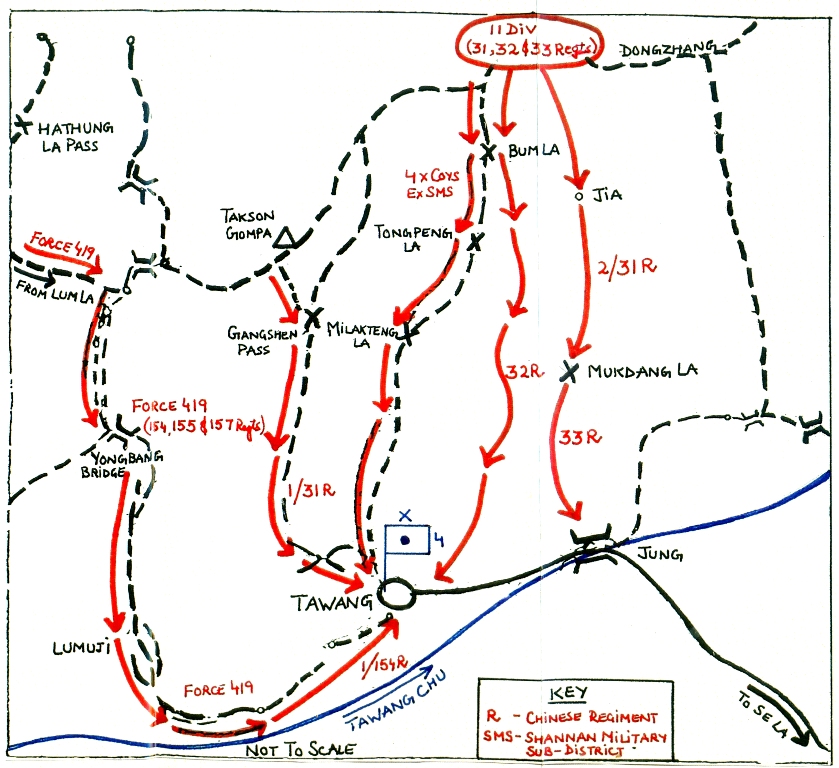
Below a map showing the Chinese advances toward Tawang on October 23-24 1962 (courtesy: Maj Gen PJS Sandhu, retd) from the book 1962: A view from the Other Side of the Hill published by United Service Institution of India.
One can see Milakteng (Mila Ri) and Bumla. The stupa is not marked on the map.
Map by Brig John Dalvi, 7 Infantry Brigade commander in October 1962
The Gorsam Chorten (Stupa) and the Namkha Chu are shown.


Sunday, September 12, 2021

The Importance of Tibet – ‘Ethnic Work’ in Progress

My article The Importance of Tibet – ‘Ethnic Work’ in Progress has been published on the Chanakya Forum website.

Here is the link...

Why are Members of the politburo of the Communist Party of China’s (CPC) Central Committee so attracted by Tibet these days? During the last two months, ten out of the twenty-five members of the politburo travelled to the Roof of the World.

One remembers a Party Secretary, who later became Chinese President (and General Secretary of the CPC), who during his three years posting in Tibet tried his best to avoid to fly to Lhasa; the young Hu Jintao did not like the place. He once told a journalist that he “disliked Tibet’s altitude, climate and lack of culture”. During his tenure, he shuttled between Lhasa and Beijing where the real power was; there was a common joke about Hu amongst Tibetan cadres: ‘Where is Hu?’ The answer was: ‘Hu is in Beijing Hospital.’ He often reported sick each time he was going to leave Beijing!

That was some thirty years ago.

Today, ‘important’ cadres have to make sure that they are seen in Tibet.

Xi Jinping Visit to Nyingchi and Lhasa

The ‘Emperor’ himself, the ‘Core Leader’, Xi Jinping paid an ‘inspection tour’ of Central and Southern Tibet between July 21 and 23; it was his first visit to Lhasa after a gap of ten years, though he had visited the Northeastern province of Amdo (today Qinghai) in June.

Five members of the Politburo accompanied the General Secretary (concurrently serving as Chairman of the all-powerful Central Military Commission).

It is interesting to look at Xi’s delegation; the composition of a delegation is a clear indicator of the purpose of the ‘inspection tour’, especially in a system where the information is entirely monitored by the State and where watchers are left to read signs.

Xi’s Delegation from Beijing

First, Ding Xuexiang, CPC’s General Secretary and a Secretary of the Party Secretariat; he usually accompanies Xi on his visits/inspection tours. His role is to make sure that decisions are implemented and that there is a concrete follow-up.

Also regularly seen during Xi’s tours is Liu He, Vice-Premier and member of the Politburo. Liu further serves as Director of the Office of the Central Financial and Economic Affairs Commission. Liu He is Xi’s trusted lieutenant, who has several times been used to fill up the ‘perception’ gap between China and the US. He takes care of the financial aspects of the visit.

Yang Xiaodu is the Director of the National Supervisory Commission and also Deputy Secretary of the Central Commission for Discipline Inspection (CCDI) which makes sure that everybody follows the line of the Party. We shall see in a few months if a few heads roll; if it happens, Yang’s hand will certainly be behind.

Incidentally, during his early political career, Yang served several years in Tibet (1986-1992, Deputy Commissioner, Nagchu Prefecture; 1992-1995, Deputy Secretary, Chamdo, 1998-2001, vice-chairman, TAR government); Yang knows Tibet well, having served fifteen years.

One noted the absence of another Politburo member and old Tibet hand: Hu Chunhua; the Vice Premier was not on board for the visit. He had served in Tibet from 1983 to 2007 and is the only member of the Politburo who can fluently speak Tibetan. Probably, the emperor does not like to be in the shade.

Then Chen Xi, also a member of the politburo and head of the Organization Department and like Xi Jinping a graduate from Tsinghua University (they know each other since that time). Chen is President of the Central Party School and Vice-minister of Education and Vice Chairman of the China Association for Science and Technology. Xi clearly wants to bring modernity …to the borders with India.

The presence of General Zhang Youxia, Vice-Chairman, Central Military Commission (CMC), also member of the politburo is explained by the ‘important’ meeting between the CMC Chairman (Xi) and all the officers of the Tibet Military District (TMD), including the Commander and the Political Commissar of the Western Theater Command or WTC (based in Chengdu) which had a new Commander, Gen Xu Qiling. The WTC not only looks after Tibet but also the Ladakh front (incidentally Gen Xu Qiling lost his job since then, but we shall come back to this).

The CMC Chairman was certainly briefed in detail about the borders with India when he met the top brass of the Theater Command.

To this list of six members of the politburo, one should add He Lifeng, Minister in charge of the National Development and Reform Commission (NDRC), the equivalent of our Planning Commission. His presence means that a number of large projects, including the railway line between Lhasa and Chengdu and the Giga hydropower plants on the Yarlung Tsangpo will soon be undertaken. Xi was personally explained the implications of these projects while on the banks of the mighty river, which becomes the Siang and the Brahmaputra in India.

The People’s Daily resumed the tour’s objectives: “implement the Party’s strategy for governing Tibet in the new era and write a new chapter in long-term stability and high-quality development of the snow-covered plateau.” This refers to the 7th Work Forum held in August 2020 which defined the development policies for Tibet for the five next years, particularly the Sinicization of Tibetan Buddhism.

But undoubtedly, the emphasis was the military and economic development of the borders with India. An indication: in the Annual Report presented by the Tibet Autonomous Region’s government a few months earlier, the word ‘border’ was mentioned 54 times, while ‘Dalai Lama’ only once.

Xi Jinping wants to change the organization of the border for good; we shall see how.

Visit of Wang Yang in Tibet

But that was not all; on August 19, a central delegation led by Wang Yang, a member of the Politburo’s Standing Committee and chairman of the National Committee of the Chinese People’s Political Consultative Conference (CPPCC) arrived in Lhasa to attend the 70th anniversary functions. Wang is No 4 in the Communist pantheon.

One can ask, why not celebrate the so-called liberation when the ‘Core leader’, Xi Jinping visited Tibet in July. I have no answer to this.

Wang had been ‘entrusted’ by Xi Jinping to “lead Beijing officials in Tibet along with veteran senior Tibetan officials” to Tibet; a cohort of old Tibetan collaborators was honoured by the visiting VVIP.

Wang Yang was accompanied by Admiral Miao Hua, a CMC member, who will probably be the lone uniformed member to survive when the term of the present CMC comes to an end. It was the first visit of a three-star admiral in Tibet.

Did Wang and Miao knew that a few days later, Xi would change the commander of the Western Theater Command for the third time in nine months and Xu Qiling, who had met Xi a few weeks earlier, would be replaced by General Wang Haijiang, a former commander of the Tibet Military Region. Probably not.

The visit has also to be seen in the context of the CPC’s 100th anniversary and the 70th anniversary of the so-called Liberation of Tibet (read ‘invasion’).

Three more important visits

From September 2 to 4, Li Xi, Party Secretary of Guangdong and Ma Xingrui, Governor of the same wealthy province, visited Lhasa and Nyingchi “to earnestly study and implement the important speeches and instructions of General Secretary Xi Jinping’s inspection tour …[and] implement the spirit of the Central Ethnic Work Conference.”

Guangdong province economically helps Tibet, which for decades was considered remote and backward and out of range for modernization. The instability of the restive province and the importance of the border with India have changed all this.

From September 5 to 6, Cai Qi, also a politburo member and Beijing Party Secretary “led a Beijing delegation to Tibet to research counterpart support work and further promote exchanges and cooperation between Beijing and Tibet,” said a release.

The delegation wanted to “conscientiously implement the spirit of important instructions of General Secretary Xi Jinping’s important speech on his inspection of Tibet and a series of important instructions on Tibetan work and counterpart support work, and implement the spirit of the Central Ethnic Work Conference.”

Finally, Wang Chen, vice chairman of the Standing Committee of the National People’s Congress, was in Tibet from September 5 to 8 to be sure that the region had “a firm sense of Chinese national community” and to preach “for long-term stability and high-quality development of the snowy plateau.”

Ten visits of politburo’s members (plus two CMC members) have never been seen in the past.

Ethnic Work

Two words explain this new interest in Tibet: Ethnic Work.
This word has an ominous meaning. It practically means ‘sinicization’ of the Roof of the World, which includes building new ‘mixed’ villages on the Indian border, recruiting a large number of Tibetans in the PLA, and giving Chinese characteristics to Tibetan Buddhism.

On September 1, Xinhua had reported that the Central Party School started its Fall Training Class for Young and Middle-Aged Cadres. It was attended by Xi who gave an ‘important’ speech (his speeches are always ‘important’).

Xi recommended that cadres have a fighting spirit in the current situation; he said that at the present moment, “the world’s unprecedented changes have been accelerating and the great rejuvenation of the Chinese nation has arrived at a critical period. The risks and challenges that the CCP faces have increased significantly. It is impractical to dream of always living in a peaceful environment without taking on any struggles.”

He advised the young cadres: “dare to fight … at any time, Communists should have the bones and courage not to be afraid of anything, and not to yield to anyone.”

All this is quite ominous for India’s Northern borders.

Tuesday, September 29, 2020

About Borders

For centuries, the subcontinent was separated from the Tibetan plateau by the most formidable natural barrier, the Himalaya.
This border has been remarkably peaceful from time immemorial.
It is only since the early 1950s, once Tibet, a State with all the legal attributes of an Independent Nation, was occupied by Communist China, that the border became a bone of contention with the latter.

What is a Border?
Wikipedia, the online dictionary, explains what a border is: “Borders define geographic boundaries of political entities or legal jurisdictions, such as governments, sovereign states, federated states and other subnational entities. Some borders — such as a state's internal administrative borders, or inter-state borders within the Schengen Area — are open and completely unguarded. Other borders are partially or fully controlled, and may be crossed legally only at designated border checkpoints and border zones may be controlled.”
Today borders are useful conventions for separating or defining sovereign countries/nations.

A Porous Border between India and Tibet

For centuries, the Himalaya saw a constant flow of Tibetan lamas, pandits and yogis visiting the great Indian viharas of Nalanda, Odantapuri or Vikramasila. Once Tibet converted to the doctrine of non-violence, it was transfigured. It lived only for the Dharma and by the Dharma of Buddha. It is fascinating to look at the changes wrought by the Buddhist faith on the people of Tibet who were among the most belligerent on earth. After adopting the new religion, their powerful Empire which had spread far and wide suddenly turned pacifist. As a result it would never recover its past military glory but it would start another kind of conquest, the conquest of self, and begin to spread its cultural influence over Central Asia and Mongolia.
Unfortunately for Tibet after 1950, the People’s Liberation Army walked onto the Tibetan plateau and brutally imposed its rule.
The fact is that when neighbouring States are on friendly terms, it is not too difficult to find an agreed frontier; when one faces an expansionist, aggressive neighbour, it is more difficult.

Border control

Over the last century, most States have instituted border control to restrict or limit the movement of people, animals, plants, and goods into or out of the country. Under international law, a State can decide the conditions under which a person can legally cross its borders; the State is also entitled to prevent persons or goods from crossing its borders.
To cross borders, one generally requires legal documents or travel documents like passports (which in many cases need a visa) or at least identity documents.
Till 1954, the Indo-Tibet relations were so friendly that the two nations trusted each other and no travel documents was required for the nationals of India or Tibet to visit the neighbouring country; one can take the example of Indians visiting the Kailash-Manasarovar area without any identity proofs.

What defines a border?

There are different ways to define borders.
To understand the difficulties to have a ‘border agreement’ with India’s most difficult neighbours, namely Pakistan and China, it is necessary to look at the features which define a border.

Geographical Borders
Natural borders are geographical features that present natural obstacles to communication and transport. It can be:

  • Mountain ranges:
    In the present study, the Himalayan range is the most formidable natural barrier, though mountainous passes for centuries witnessed cultural, trade and religious exchanges; they were unfortunately closed after 1962 War with China. As far as Tibet and India are concerned, diplomats, pilgrims or traders knew that when they crossed a certain pass, they had reached the neighbouring country; that was it.
  • A Watershed or a ridge:
    The entire McMahon Line in the North-east follows the watershed principle. One of the problems is that the Chinese have not accepted the watershed as the primarily principle. The Central Sector also follows the watershed principle except in four places today disputed by China (Chuva-Chuje, Shipki-la, Nilang-Jadhang and Barahoti-Lapthal-Sangchamalla).
  • A pass:
    One can give the example of the six passes mentioned in the 1954 Agreement between India and China. It constitutes a clearly definable boundary.
  • A Pasture:
    The location and ownership pattern of customary pastures can define the border between two countries.
  • Rivers:
    Some political borders have been formalized along natural borders formed by rivers, for example the Rhine border between France and Germany. The international border usually runs in the middle of the river.
  • Lakes:
    Large lakes can be a natural border. One example in the Himalayan region is the Pangong tso (lake) which spreads between India and Tibet. It is today the object of a bitter dispute between India and China.
  • An ocean or a sea:
    They often create very large natural borders. A nation may have exclusive rights over the mineral and other resources (including biological) in some areas in an ocean or a sea. The South China Sea is an example, though China fixed its claims without historical or legal sanction.
  • A wall:
    The Great Wall of China was the most famous example of a border protection for China against foreign invasions.

A few more such principles could be cited, but the above are the most usual features to determine a common border.

The Great Wall was China's border
On what is a settled border based?
A border agreed by the two neighbouring States is based on historical or customary features. Further, to determine these borders some factors are taken into account:

  • A Treaty or Agreement
    Borders can based on a treaty or an agreement signed by the two parties; this is the case of the McMahon Line between NEFA (today Arunachal) and Tibet; two concerned States affixed their signature on a map.
    Another case is the Peace Treaty between Ladakh and Tibet of 1684 which says: “The boundaries fixed, in the beginning, when king Skyed-lda-nyeema gon gave a kingdom to each of his three sons, shall still be maintained.”
    Further, the Treaty of 1842 between Ladakh and Tibet reiterated the same border; unfortunately, no map was attached to the 1684 and 1842 Treaties (it was probably not necessary at that time).
  • A Brokered Agreement i.e. the 1949 UN Cease-Fire
    Another example is when an agreement is brokered by a third party; in July 1949, the delegations of India and Pakistan, under the UN auspices reached the following agreement: “Under the provision of Part I of the resolution of 13 August, 1948, and as a complement of the suspension of hostilities in the State of Jammu and Kashmir on 1 January, 1949, a cease-fire line is established…” This became the Line of Cease-Fire.
  • Arbitral Decision i.e. The Radcliffe Line
    The Radcliffe Line was announced on 17 August 1947 as a boundary demarcation between India and Pakistan. Named after Sir Cyril Radcliffe, the chairman of the Border Commissions who had to equally divide 450,000 km2 of territory with 88 million people.
  • Custom and usage, i.e. Panchsheel, 1954
    More importantly for the Indo-Tibet (now Sino-Indian) border, custom and usage have been used to determine the borders.
    The 1954 ‘Panchsheel’ Agreement says: “Traders and pilgrims of both countries may travel by the following passes and route: (1) Shipki La pass, (2) Mana pass, (3) Niti pass, (4) Kungri Bingri pass, (5) Darma pass, and (6) Lipu Lekh pass. Also, the customary route leading to Tashigong along the valley of the Shangatsangpu (Indus) River may continue to be traversed in accordance with custom.”
  • Historical proofs
    The publication of maps or accounts of travelers fall in this category. This is the case of the Aksai Chin area of Ladakh.

One or several of these principles can be used to determine a border.

The Case of the McMahon Line
A few words should be mentioned about the McMahon Line.
In 1913, the British government convened a tripartite Conference in Simla between plenipotentiaries of Great Britain, China, and Tibet. The Convention provided for an ‘Outer Tibet’ which would be fully autonomous. However, after initializing the Convention, Ivan Chen, the Chinese plenipotentiary withdrew his consent in July 1914. Great Britain and Tibet attached a note to the Convention denying China any privileges under the Accord. The Convention was later sealed as a bilateral agreement.
Nevertheless, in March 1914, on the side of the Simla Conference, the British and the Tibetans defined their common border in India’s North-East; the McMahon Line was born.
Lonchen Shatra officially wrote to Sir Henry McMahon: “As it was feared that there might be friction in future unless the boundary between India and Tibet is clearly defined, I submitted the map, which you sent to me in February last, to the Tibetan Government at Lhasa for orders. I have now received orders from Lhasa, and I accordingly agree to the boundary as marked in red in the two copies of the maps signed by you subject to the condition mentioned in your letter, dated 14th March, sent to me through Mr. Bell. I have signed and sealed the two copies of the maps. I have kept one copy here and return herewith the other.”
During the following years, British officials had regular contacts with the Tibetan Kashag. Following the signature of the Convention, trade marts were opened in Tibet and telegraphic lines were maintained by Government of British India.

How to delimitate a border?
What are the stages of delimitation of a border between two independent States (or three in case of a trijunction) once they have agreed on principle(s)?
According to the Oxford Dictionary, the word ‘delimit’ means “to mark or determine the limits of; to define, as a limit or boundary” while ‘delimitation’, it is the “determination of a limit or boundary, especially of the frontier of a territory”.
The first step for ‘delimiting’ a border is to ‘define’ the border, for example, ‘the border will follow the watershed’ or ‘will be the center of this river’.
‘Definition’ needs to be a precise statement. The next stage is to ‘delineate’ a ‘defined’ border. The dictionary says that ‘delineate’ is ‘to trace out by lines; trace the outlines of, a on a chart map’, for example.
‘Demarcation’ is often treated as the same as the ‘definition’, however ‘demarcation’ can also refer to work on the ground by means of pillars or other conventional signs.
The final stage is ‘abornement’ which is the ‘determination of the precise limits of a piece of land or border by fixing pillars or other markers on the ground.
The entire process is called ‘delimitation’ of the border; it is a long process. In the case of the Sino-Indian border dispute, the two parties have not even exchanged maps of their ‘perceptional’ Line of Actual Control (LAC).

China does not stick to any principle
It is difficult to deal with China because the claims made by Beijing are often without historical, cartographical or geographical support. This is true for the frontier (the so-called LAC) in Ladakh, but also for other recent Chinese claims in the South China Sea, in Tajikistan’s Pamir Region or Vladivostok.
For India, the principle of the watershed is the prime deciding factor; while most Chinese claims are not based on any of the principles normally used to demarcate a boundary, i.e. watershed, river, customary routes, grazing rights, etc.
As an example, we can cite the case of the now famous 1960 Chinese map, which just follows Beijing’s strategic interests and not any world-agreed principles.
That is why it is difficult to talk to China, which goes by its own changeable rules, practically promoting only its own interests.
It makes it impossible to find a mutually agreeable solution to the vexed issue today.

Sunday, November 24, 2019

Neighbour’s border envy

My article Neighbour’s border envy appeared in the Edit Page of The Pioneer.

Here is the link...

While China has undertaken multiple development projects near the Indian border, Delhi has been very slow and remains hesitant to see tourists in restricted areas

Recently, the Indian media was agog with news about the latest  deployment of the Chinese People’s Liberation Army (PLA) close to the Indian borders. One website, the Indian Defence News, affirmed: “China strengthening military base near Uttarakhand’s Lipulekh Pass,” which is located near the tri-junction between Nepal, Tibet and India. It explained: “The new base has 20 parking hangars and also maintenance hangars. Medium-lift helicopters for the local Army aviation brigade have also been spotted… There are signs of a military build-up opposite Lipulekh Pass on the northeastern tip of Uttarakhand.” It cited some intelligence sources saying that the PLA had built a helipad close to the pass and also “installed two surveillance cameras, a Long Range Reconnaissance and Observation System (LORROS) and a solar panel.”
Some other reports mentioned model villages being built by Beijing near the Indian border. This is not new, though the scale should worry New Delhi. The information about Lipulekh Pass is probably linked to the new airport coming up near Purang (Taklakot); it will serve the Kailash/Manasarovar area.
On June 9, 2018, the Civil Aviation Administration of China and the Tibetan Autonomous Region’s (TAR) provincial government announced that Tibet would soon have three new airports. An official communiqué stated: “Construction of the three airports, all above the altitude of 3,900 metres, should begin in 2019.” The new airports are to be located in Lhuntse county in Lhoka (called Shannan by the Chinese) area, north of the Upper Subansiri district of Arunachal Pradesh; the second will be between Tingri and Lhatse counties of Shigatse City, north of Zangmu, the border post with Nepal, and the last in Purang, near Lipulekh.
It was then announced: “The airports should be completed in 2021; by then, there will be eight airports in TAR.” The news agency added: “At present, the preparatory work for the three airports is under way. The preferred sites have been determined;” the idea is “to consolidate the border and to promote the deep integration of the military and the people.” While tourism and “cultural” industries remain the pillars of the so-called stabilisation, defence is also vital for the Chinese authorities — one of Chinese President Xi Jinping’s pet projects is the Military Civilian Integration (or “fusion”).
Another of Xi’s favourite schemes is to make “patriotic” Tibetans “the protectors of their sacred homeland.” The last two years have seen the mushrooming of model villages near the Indian border; they are known as “Xiaogang” or “moderately well-off villages.” The pretext for building more than 100 such border villages is “poverty alleviation.” Tibetans need to be pulled out of poverty (incidentally, is it not strange that 70 years after the arrival of the communists on the plateau and the so-called liberation of Tibet, the populations still lives in such pitiable conditions?).
But “poverty” is not the only motivation. Xi once famously declared: “Govern the nation by governing the borders; govern the borders by first stabilising Tibet; ensure social harmony and stability in Tibet and strengthen the development of border regions.” These villages are following the “double-support model city”, which translates into full military and civilian integration.
The authorities have started implementing the theory of their boss by providing decent housing to the villagers and enticing the local recalcitrant Tibetan population to their side. Local satraps have a new leitmotif, the inhabitants of China’s borders (with India) should be “the protectors of the sacred homeland and the builders of happy homes.” The construction of “model” villages on the Tibetan side of the Indian border, mainly north of Arunachal Pradesh and also in Himachal and Ladakh, is the outcome of this. Several senior communist leaders have visited these new villages, either north of Kibithu in the Lohit valley; in Metok, north of Upper Siang district; in Yume (also written Yumai), north of Takshing in Upper Subansari or in Lepo, Marmang and Tsona, north of Khenzimane and Tawang.
Take Metok County, for example. China Tibet News reported that there are 46 administrative villages (including one multi-ethnic inhabitation area consisting of Monpa, Lhopa, Tibetan or Han) with a total population of 13,725: “In 2018, the county’s GDP has reached 606 million yuan ($99 million); farmers and herdsmen’s per capita disposable income and cash income have reached 10,380 yuan ($1,687) and 8,833 yuan ($1,486) respectively.”
In October, 133 villagers belonging to 29 households moved into their new houses. Reports said how “all the township’s residents are living in free houses provided by the Government,” in Puma Changthang township, north of the Bhutan border. “Sharing a 25-km border with Bhutan, where the average altitude tops 5,300 metres above sea level, the Puma Changthang township is in Nagartse county; it is renowned as the world’s highest township.”
The report explained: “Resettlement in new housing provided by the Government is part of its efforts to ensure the entire population lives comfortably in border areas… Project construction includes villagers’ houses, party’s committee offices, village clinics, water supply and roads” and, of course, these “multi-ethnic” villages will welcome Han Chinese.
Take another example. It was reported that Tibetans in Bayi village of Nyingchi City, north of Arunachal Pradesh, have come together and jointly “built a beautiful hometown as well as a better life.” Incidentally, places called Bayi (or 8-1 for August 1, the PLA anniversary) are usually under the Army’s management.
The article said that by the end of 2016, 16 impoverished villagers were lifted out of poverty through pairing assistance (ie, with the support of a mainland province), through participation in the collective economy and self-employment: “Bayi Village improved farmers and herdsmen’s cultural living standards, supported the construction of a “cultural” square, a village library and also organised various cultural and sports activities such as Tibetan circle dance, tug of war, lifting stones or archery.”
But at the same time, a review committee in Tsona county warned: “All townships and villages must come together to improve the village rules and regulations [of the party], standardise the daily behaviour of the villagers and strengthen the rural revitalisation strategy goals.”
“Standardise the daily behavior” is ominous. On the Indian  side, everything moves slowly as usual. A welcome exception is the Sisseri River bridge in the Lower Dibang Valley of Arunachal Pradesh, recently inaugurated by Defence Minister Rajnath Singh. It will cut down travel time from Pasighat to Roing by about five hours. But the Government remains hesitant to see tourists in “restricted” areas. China does not have this problem.

Sunday, August 18, 2019

Is there a way forward for India-China in Ladakh?

My article Is there a way forward for India-China in Ladakh? appeared in Rediff.com.

Here is the link...


'The best trust building measure would be to undo what was done in 1954 and reopen the Demchok-Tashigang route on the border for trade as a first step; the next one would be to let the pilgrims visiting Kailash-Manasarovar use this route,' says Claude Arpi.

On March 23, 1954, after three months of tough negotiations, the Indian and Chinese representatives were still far from an agreement on trade between India and Tibet (a month later, it would become the infamous Panchsheel ‘accord’, which saw India surrendering all its rights in Tibet without getting anything in return, not even an agreed border).
On that day, Ambassador N. Raghavan cabled Delhi about the routes in East Ladakh, the Chinese were reluctant to concede Rudok (near the Panggong lake) or Rawang (further east) simply because China was building ‘military installations’, wrote Raghavan (the Aksai Chin road would be ‘discovered’ four years later).
Was the fact that China was building this important axis on Indian territory known to the Indian negotiators? Perhaps not, Indian diplomats were living on their own cloud.
The Indian ambassador observed: “As Ladakh traders [are] already going to Tashigong [the first Tibetan village south of Demchok] besides Rudok, their trade may not suffer if Chinese themselves anxious to develop this trade. There is however some risk which only future developments can confirm or remove.”
Soon India discovered that China was not interested to keep the trade between India and Tibet alive; further, they wanted to hide from the Ladakhis the development occurring in the area; as a result, the traditional ‘silk road’ between Ladakh and Western Tibet was closed (and till date, it has not been reopened, though China speaks today of a grandiose Border and Road Initiative).
A month later, on April 24 in the morning, Raghavan informed the Foreign Secretary about a fight which took place between him and Zhang Hanfu, his Chinese counterpart: “It was royal fight from beginning to end;” the agreement, with its lofty Panshsheel preamble was however signed in the afternoon; but in the process, the Indian diplomats had discovered that China had a big problem with Ladakh. It was never publically said.
In Article IV, while India insisted on the inclusion of the words “along the Indus from the Indian border to Shershang – Tashigong – Gartok” at the end of paragraph 7, China virulently objected to this route been included in Agreement; they quoted an oral understanding “they would not like in writing even by implication to have any reference to Ladakh.”
Why? Because, the mountainous region was for them a disputed area.
Since Ladakh was part of Indian territory and even though this was not in the draft agreement, the route should be mentioned as its omission would be invidious, argued Raghavan, but the Chinese remained adamant.
The Indian Ambassador informed his counterpart that India would be prepared to accept another formula, for example, “customary main route leading to Tashigong along valley of Indus River.” After ‘considerable’ argument, Zhang agreed but subsequently changed his views, “He now suggests he would consider exchange of letters which will not form part of Agreement concerning routes, including route to Tashigong.”
That was at the end of 4 months of intense talks. The route has remained closed since then; Ladakh remains for Beijing a disputed area.
One can understand better why after India announced the abrogation of Article 370 of the Constitution and the creation of a Union Territory for Ladakh, China saw red.
Foreign Ministry spokesperson Hua Chunying chose to issue two statements, one calling on India and Pakistan to peacefully resolve their disputes through dialogue and second, more damaging for the relations between India and China objecting to the formation of Ladakh as Union Territory, while putting forward China's claims over the area: “China always opposes India's inclusion of Chinese territory in the western section of the China-India boundary under its administrative jurisdiction," Hua said, adding: “The recent unilateral revision of domestic laws by the Indian side continues to undermine China's territorial sovereignty, which is unacceptable and will not have any effect.”
Not only does this type of uncalled for statement have a negative effect on the forthcoming summit between Prime Minister Modi and President Xi Jingpin, but it shows that China still has a problem with the Western Sector of the Sino-Indian boundary.
It is in these circumstances that Dr Jaishankar, India’s Foreign Ministry paid a two-day visit to China (his trip had been finalized before the J&K State was bifurcated into two union territories on August 5 and the unacceptable words of Ms Hua Chunyin).
The Hindustan Times reported before the visit: “Beijing is nevertheless expected to raise its concerns about the situation, especially because its all-weather ally, Pakistan, already sent its foreign minister, Shah Mahmood Qureshi last week to discuss the issue with Wang.”
Apart from finalizing the details of President Xi Jinping’s forthcoming visit to India in October for a second ‘consensus summit’ with Prime Minister Narendra Modi (the first one was in Wuhan in China in April 2018), the two foreign ministers co-chaired the second meeting of the “High-Level Mechanism on Cultural and People-to-People Exchanges”.
It was Dr Jaishankar’s first visit as foreign minister to China where he earlier served as India’s ambassador; it was also an occasion for the two ministers to discuss bilateral and international issues such as India’s serious concern about the trade deficit ($57 billion last year in India’s disfavor) for an overall trade touching $100 billion in 2019.
But the on-going trade war between China and the US is definitively secondary to this basic respect of India’s territoriality; Beijing’s Ladakh stand needs to be clarified.

Reopening the Old Road in Eastern Ladakh
Is there a way forward?
The best Trust Building Measure would be to undo what was done in 1954 and reopen this route on the border for trade as a first step; the next one would be to let the pilgrims visiting Kailash-Manasarovar using this route.
Remember the skirmishes at the end of the 1960s in Sikkim!
When the Nathu-la pass was officially reopened to trade in July 2006, it had the effect of ‘fixing’ the border, thus drastically reducing the tensions in the area.
Considering the ‘Nathu-la’ effect, reopening the Demchok-Tashigang route could be an excellent Confidence Building Measure between India and China in Ladakh.
For years, the people of Ladakh have also asked for the reopening of the ancient route. Why can’t China allow the devotees wanting to visit Kailash-Manasarovar to use the easiest route via Demchok? But to do, China will have to drop the disputed territory tag over the area.

An alternative to Demchok
If China refuses to open Demchok, for whatever reasons, an alternative site would be Dumchele.
Very few in India have heard of Dumchele, a place located east of the Indus river, on the Chinese side of the Line of Actual Control (LAC) between India and China; it used to be marked as a ‘grazing ground’ on old maps of the British Raj.
Though Dumchele is one of the 12 places where India and China have a difference of perception on the location of the LAC, this is not an insurmountable difficulty.
If the political leadership decides so, Dumchele could also become a new Border Personnel Meeting (BPM); presently the meeting points between the Indian and Chinese armies in Ladakh are located at Chushul and Daulat Beg Oldi.
Demchok, the historical landport could temporarily be set aside in favour of Dumchele which was the main smuggling center between India and China in Ladakh till 2016, when it was stopped for security reason.
The opening of Demchok or Dumchele would boost the local economy (both sides) and satisfy the local Indian sarpanches …and one day, one can dream of a new route (without crossing a single pass) to Mt Kailash. It would then become the fastest and easiest access to the holy mountain.
It could be an important step on the path of peace and would show China’s sincerity to open its frontiers with its neighbours …build a Border and Road Initiative.
If China is adamant to tag Ladakh as ‘disputed’, India should start raising the issues faced by of the people of Xinjiang, Tibet and Hong Kong.

Friday, June 1, 2018

China woos the Tibetans

My article China woos the Tibetans appeared in The Statesman

Here is the link...

Govern the nation by governing the borders; govern the borders by first stabilizing Tibet; ensure social harmony and stability in Tibet and strengthen the development of border regions.” Thus did President Xi Jinping speak of China’s relations with Tibet.
For a few months, the authorities in Tibet have started implementing the theory of their boss and the party’s propaganda is doing its best to entice the local Tibetan population to side with the Communist Party. This is a serious development, unfortunately ignored in India.
The new formula can be found in every speech of the local satraps ~ the inhabitants of China’s borders (with India) should be “the protectors of the sacred homeland and the builders of happy homes.”
It has taken concrete shape with the mushrooming of new ‘model’ villages and towns on the Tibetan side of the Indian border, mainly north of Arunachal Pradesh; officially, this development is linked with ‘poverty alleviation’ and the ‘defence of the borders’.
Several senior Communist leaders have visited these new villages, either north of Kibithu in the Lohit valley; in Metok, north of Upper Siang district; in Yume (also written Yumai), north of Takshing in Upper Subansari or in Lepo, Marmang and Tsona, north of Khenzimane and Tawang. Wu Yingjie, the Party Secretary of the Tibetan Autonomous Region (TAR) recently gave an interview to The People’s Daily on the development in the border areas.
When the reporter asked Wu about the significance of implementing the new strategy of “rejuvenating villages under the banner of the protectors of sacred homeland and the builders of happy homes”, Wu answered: “This is the first requirement for carrying out the important strategic thinking of General Secretary Xi Jinping to govern the country and administrate the borders first.”
In fact, it all started soon after the conclusion of the 19th Congress, when Xi Jinping sent a reply to two young Tibetan herders who had written to him introducing their village, Yume. According to Xinhua, Xi “encouraged a herding family in Lhuntse County to set down roots in the border area, safeguard the Chinese territory and develop their hometown.” Xi acknowledged “the family’s efforts to safeguard the territory, and thanked them for the loyalty and contributions they have made in the border area. Without the peace in the territory, there will be no peaceful lives for the millions of families,” he wrote.
The two Tibetan girls, Choekar and Yangzom had told the CCP’s Secretary General about their “experiences in safeguarding the border area and the development of their township over the years.”
The girls’ village, Yume is located a few kilometers north of the McMahon Line, not far from the remote Indian village of Takshing, which incidentally has got for the first time a motorable road this month. Xi further hoped that the girls’ family could “motivate more herders to set down roots in the border area like kalsang flowers [which bloom in hard conditions].”
On May 8, a function celebrating the ‘Happy and Beautiful New Frontier in the New Area’ took place in Yume, the least-populated township in China. A reporter of China-Tibet Online  wrote: “At sunrise, the construction site of the Yume ‘new era’s border well-off township’ is already going on full swing. I saw dozens of construction machinery working in an orderly manner. The roar of excavators and bulldozers was also heard. Heavy trucks shuttled back and forth.”
China is ready to invest 110 million yuan in the Yume Well-Off Rural Construction Project; to start with, 56 sets of light-steel prefabricated residential houses are being built, linked by two new municipal roads, a central park and six squares. Electricity and water have already reached the border village.
Luo Yuguang, executive manager of the Construction Project admitted: “To ensure that the project can be completed on schedule, we are racing against time and working overtime. The construction started on December 19, 2017 and it is expected to be completed by October 2018.”
It is the Emperor’s project, no question of delay.
These measures seem to be post-Doklam; the rationale is “to consolidate border and to promote the deep integration of the military and the people.” Tourism and ‘cultural’ industries remain the pillars of the scheme; it is supposed to help the population to get rid of poverty through participation in tourism while promoting ‘ethnic exchanges’ …with Han tourists. Yume is the model for the entire scheme.
In his interview, Wu Yingjie concluded: “Let the people of all ethnic groups have more feelings of happiness; to take a clear-cut stand against splitting, in order to maintain the stability of Tibet and always be the guardians of sacred land and the builders of happy homes.”
Another pet project of Xi Jinping is the Military Civilian Integration (or ‘Fusion’); this too applies to the border. Consider Zhayul County located north of Anjaw district of Arunachal Pradesh in the Lohit valley. According to China Tibet News, the villages of the county have started implementing the ‘double-support model city’ which translates into full military and civilian integration: “For decades, on the borders stretching several hundred kilometers, the border guards and soldiers stationed have been working with the local people to protect the sacred territory and build a beautiful home.”
The article speaks of the civilian population and the soldiers working ‘hand in hand’ and the love of the local people who support the New Age Army.
On May 10, Wu Yingjie participated in a plenary session of the Military and Civil Integration Development Committee in Lhasa for an “in-depth implementation of Xi’s strategic thinking and “to provide a strong momentum for Tibet’s long-term development and long-term stability.”
Another aspect needs to be noted ~ a ‘cultural’ one. China is building memorials on the border to celebrate the 1962 victory against India. The Zhayul County Hero’s Memorial Park is located north of the Indian border. According to China Tibet News Network, the project covers an area of 42,420 square meters; it has a building area of 1,680 square meters surrounded by large gardens. The project honours 997 martyrs with a tall monument, historical exhibition halls, a martyrs’ wall and tombs of the heroes.
The exhibition area displays photos, videos, cultural relics, ‘technology simulation scenes and some 18 CDs and 33 books are for sale.
It celebrates the Chinese ‘martyrs’ who died in Walong in November 1962, the famous battle took place some 50 km south in the same valley. It is in Walong that the 11th Infantry Brigade and in particular the 6 Kumaon of the Indian Army managed to stop the Chinese advances and paid a high price for it. The Chinese too suffered heavy casualties.
Che Dalha, the TAR Governor, who is also director of the district border defence committee, recently inspected a Hero Memorial Park. He told the villagers that the masses should deeply cherish the memory of the revolutionary martyrs. The memorial is also in honour of the Chinese soldiers who fought the Tibetan resistance in the late 1950s.
Another memorial stands north of the Thagla ridge in Tsona County. The Forward Command post of General Zhang Guohua, who commanded the PLA operations in 1962, which are called by Beijing the ‘Sino-India Self-Defence Counter Attack Battles’, has been reconstituted and opened to tourists.
It is located in Marmang village, the first hamlet north of the McMahon Line. Hotels are already mushrooming to receive the visitors. All this is part of the Information Warfare that China has started waging on India. Has Delhi grasped the importance of this? Not sure.


Che Dalha, the Governor of Tibet near the Indian border

Thursday, May 10, 2018

Importance of Sikkim as a border State

Magnificent Kanchenjunga
My article Importance of Sikkim as a border State appeared in the Edit Page of The Pioneer

Here is the link...

The Himalayan people may not represent a large or politically influential section of the population, but India’s security depends on them. It is, therefore, essential to empower local residents

Sikkim is a special State and this for many reasons. First, Denjong or the Valley of Rice, as Sikkim is traditionally known, is today a stable and prosperous State; the fact that the charismatic Chief Minister Pawan Kumar Chamling has recently become the longest serving Indian Chief Minister, is a clear sign of the continuity. Sikkim is also the first organic State in India, showing the way to other smaller progressive States.
At a time this State is so crucial to India’s security, it remains a trend-setter and a model. India can’t afford to have unsecure and ‘unhappy’ borders, when the northern neighbour is always ready to change the status quo.
Another welcome change is the forthcoming disenclavement of the State. Last week, the Pakyong Airport formally obtained a license to operate commercial flights, thus enabling Sikkim to be connected with the rest of the country by air. Union Aviation Minister Suresh Prabhu tweeted: “The Pakyong Airport at Sikkim got a license today for scheduled operations. It’s an engineering marvel at a height of more than 4,500 ft in a tough terrain.”
The need of the hour is the strengthening of the Indian Himalayan border States; the issue has even become more urgent after the Doklam episode. How to do that?
One possibility is ‘development’, particularly eco-tourism, which can bring rich dividends. But it is probably not enough. It is also necessary to empower the local populations.
One issue which has not been understood properly in India is why the Chinese decided to call for a cease-fire hardly a month after their first attack on India in October 1962. The internal struggle within the Chinese Communist Party between 1959 and 1962 can’t be overlooked, but the Tibet factor gives the rationale why China suddenly decided to put a halt to its advance at a time it was winning on all fronts. The obvious reason was not the winter, but the political instability on the Tibetan plateau.
During a speech at the summer station of Beidaihe in August 1962, Mao delivered a diatribe against the 10th Panchen Lama, who in a 70,000-character petition, had described the unstable situation in Tibet due to harsh communist actions. The young Lama, who had been made Chairman of the Preparatory Committee for the Tibet Autonomous Region (TAR) after the Dalai Lama left for India, had dared to criticise the policies of the party in Tibet.
The Tibetan instability greatly influenced the smooth running of the supply lines to the Indian front; it became a major issue impeding longer military operations against India as discontent was brewing on the Roof of the World.
The petition was sent by the Panchen Lama to Zhou Enlai and Xi Zhongxun (President Xi Jinping’s father) in April 1962. The Chinese Premier requested Xi Senior to read and study the Panchen Lama’s petition. For his courage, the Panchen Lama spent 14 years in jail.
It is probably why China has recently decided to ‘empower’ its Himalayan populations; Xi Jinping’s doctrine is known to all: “Govern the nation by governing the borders, govern the borders by first stabilizing Tibet, ensure social harmony and stability in Tibet, and strengthen the development of border regions.”
The official top priority is a poverty alleviation campaign in Tibet “to make the border villages prosperous and well-off.”
Beijing has, however, a second objective that is to build-up the border defenses against India.
China kills two birds at the same time; tourism is the best way to tackle poverty ...and to protect the country’s borders (by buying the local population over to China’s side).
Recently, Che Dalha (alias Qizhala), the head of the TAR Government, visited Zhayul, north of the McMahon line in the Lohit Valley. Walong, which witnessed the famous battle in November 1962, is located some 50 km south in the same valley; there, the 11 Infantry Brigade and in particular the 6 Kumaon of the Indian Army managed to stop the Chinese advances; they had to pay a high price for it …so did the Chinese.
While inspecting a Hero Memorial Park, he told the villagers that the masses should deeply cherish the memory of the Chinese soldiers who died in 1962 as well as the ‘heroes’ who fought the Tibetan resistance in the late 1950s the revolutionary martyrs.
But China does not only pay homage to its martyrs, it fast-track builds tens of ‘model’ villages along the border in order to literarily bring lakhs of tourists, at a time India lives under an antiquated Inner Line Permit system.
India needs to satisfy the basic aspirations of the local population and give them the freedom to develop according to their own genius. This is something China may be unable to do.
In connection with the local population’s aspiration, an important Summit was recently held in Gangtok. Though Sikkim is today stable, large sections of the society feel that they have been victim to historical injustices in the past.
After the merger in 1975, some communities were excluded from the tribal status. The Summit demanded that all communities having a Sikkim Subject’s Card should be given ‘tribal’ status and the State be declared a tribal State, like other North-Eastern States where only the tribals occupy the Assembly seats and governance is kept in the hands of indigenous people.
The two-day summit was organised by the EIECOS (Eleven indigenous ethnic communities of Sikkim), a formerly registered association, the Sikkim Commission for Backward Classes and the Social Justice Empowerment and Welfare Department.
Three years after the State joined India in a quasi-unanimous referendum, some communities were unfortunately left out when Scheduled Tribe recognition was granted to others.
According to IANS, during the Summit, Pawan Chamling made “a strong pitch for granting of Scheduled Tribe status …an issue which has been lying unresolved for over 40 years.”
While inaugurating the Sikkim Summit for Tribal Status 2018, Chamling said: “We embraced India as a country on the condition of never compromising our uniqueness as Sikkimese people protected by the Indian Constitution.”
With fast developments taking place on India’s borders and the arrival of a railway line in Yatung in Chumbi Valley, the pressure is going to greatly increase for the local population to remain steadfast, a small gesture such as granting Tribal status to Sikkim, would go a long way to make the people of Sikkim ‘happier’ and, therefore, more prepared to support the defence of India’s borders. This is also valid for other Himalayan States which too have their long-pending demands, which are often ignored by Big Brother in Delhi. It is true for Ladakh, for Arunachal Pradesh, but for Himachal and Uttarakhand too.
The Himalayan people may not represent a large or politically influential section of the population, but India’s security depends on them.

Wednesday, April 18, 2018

One more airport in Tibet: govern the borders by first stabilizing Tibet

Radio Free Asia (RFA) has reported that the Chinese authorities have seized some farmland near Lhatse in Central Tibet to build a new airport. The displaced Tibetan villagers would have been offered far less in compensation than the land is worth.
According to a plan announced by officials in the Shigatse prefecture and the regional authorities of the Tibet Autonomous Region (TAR), the airport will be built on land belonging to the Yushang village of Chusha municipality (Lhatse county of Shigatse Prefecture).
A source told RFA’s Tibetan Service: “For Tibetans in Chusha, farming has been their main source of livelihood for many years, and is a tradition handed down to them by their ancestors. The loss of so much land to Chinese development projects is having a negative impact on the daily life of the local people.”
He source added: “Now Chinese authorities are planning to build an airport on Chusha’s farmland, and local Tibetans are being compensated at rates less than the land’s market value.”
The Tibetans also complained that with “new airports and railway stations in all these areas, this will form a hub of activities for tourists and transportation links in all directions.”
But for Beijing, tourist development appears to be the main tool to get Tibet out of poverty.

Wu Yingjie’s interview
In a recent interview with China Tibet Online, Wu Yingjie, the TAR Party secretary was asked how he intended to solve the problem of poverty in Tibet, “alleviating poverty is an arduous task. How can Tibet overcome difficulties and help people of all ethnic groups get out of poverty?” was the question.
The Party Secretary answered: “Over the past two years, Tibet has brought 280,000 people out of poverty. Five counties and districts have been cleared out of poverty, and 25 counties and districts have reached the poverty-off line. The poverty rate has dropped to 7.9 percent. We will continue to focus on impoverished districts and concentrate on targeted-poverty alleviation. First, we must implement differentiated policies. Poverty alleviation for 10 deeply impoverished counties in Lhasa, Lhoka, Nyingchi, and Ngari prefectures should be the responsibility of their respective prefecture or municipality. Poverty alleviation for 34 deeply impoverished counties in Chamdo, Nagchu, and western Shigatse prefectures should be undertaken by the autonomous region via a concentration of resources.”
Lhatse falls under the last area.
If the TAR administration has to intervene, it means that there might be security issues and that the poverty is real a big issue in and around Lhatse.
Wu Yingjie explained his plans: “Second, we must strengthen our support of industry and employment to bring 323,000 people out of poverty. Third, on the basis of respecting the will of the people, we would steadily advance with relocation efforts.”
Whether the population is Lhatse has the power to impose their will is another issue.
Apparently not.
The tirade of the Party Secretary continued: “Fourth, we must increase aid and assistance for Tibet to ensure that 80 percent of Aid Tibet funds goes towards impoverished districts. Fifth, we must implement ecological poverty alleviation measures and integrate ecological funds so that impoverished people who are able to work can have stable jobs and salaries. Sixth, poverty alleviation should be promoted through Party building, with a focus on helping deeply impoverished counties and populations.”
This means that ‘poverty’ is really a problem in Tibet today.

The issue of defense
To bring the other issue, security and defense, the reporter quoted Xi Jinping’s doctrine for Tibet, "govern the nation by governing the borders, govern the borders by first stabilizing Tibet, ensure social harmony and stability in Tibet, and strengthen the development of border regions.”
The Party Secretary admitted that Tibet was an important border area and ethnic region of China “with its border more than 4,000 kilometers long. It is the front line in the struggle against separatism and has the glorious mission to safeguard stability and promote harmony, which must always be our top priority.”
The new airport in Lhatse, apart from creating resentment among the Tibetans, has clearly two purposes. One is to defend China’s border, the other one is to bring tourism in the area to further develop this area and Western Tibet (Ngari region).
The trade with Nepal, south of Lhatse will be an important bonus.
Incidentally, the railway line on its way to Kyirong (and the Nepal border) should soon be arriving in Lhastse.
By bringing more Han tourists in the area, can China increase the happiness to the local population?
It is not sure at all.

PS: The new airport will also give a boost to the campaign “Winter tours in Tibet-enjoy the world's third pole”.
A Tibetan website asserted that Tibet has recently started promoting an initiative called "Winter tours in Tibet-Enjoy the world's third pole”. It affirmed that some preferential policies will "cover administration, transportation and tourist attractions."
As a result, an increasing number of tourists travel to Tibet even in off-peak season.”

Thursday, January 7, 2016

China’s PLA sings Jai Ho as India goes for Border Defence

My article China’s PLA sings Jai Ho as India goes for Border Defence appeared in NitiCentral.

Here is the link...

On New Year day, a Border Personnel Meeting (BPM) between India and China was held in a Chinese hut near a place called Damai, north of the Lohit sector of Arunachal Pradesh. The Indian delegation was led by Brigadier S.S. Bhogal, who commands a brigade in the area, while China was represented by Senior Colonel (equivalent to a brigadier) Hu Xiao Bao, commanding the Zayul Garrison of the Chengdu Military Area Command.
The Times of India reported: “This year there was something new and exciting about the meeting. After paying respects to the national flags and playing of the national anthems, the Chinese soldiers sprang a surprise and enthralled the audience by their performance on Hindi Bollywood songs 'Jai Ho' and 'Ankhe Khuli Ho Ya Ho Bandh'.”
Then, Chinese women performed some ‘scintillating dances’, while male soldiers of the People’s Liberation Army (PLA) gave a feel of their voices.
The report speaks of growing bonhomie and brotherhood between the armies of the two nations. But in view of past history, one should remain guarded, especially when Indian newspapers get carried away with too much ‘brotherhood’. Remember the Bhai-Bhai days?
However there is probably no harm in hoping for the best at the beginning of the New Year! The Indian Army’s spokesman also spoke of “fostering the feelings of friendship and commitment towards enhancing the existing cordial relations and maintenance of peace along the LAC.”
It is certainly better to dance and sing together, than to sponsor terrorism across the border, like another of India’s neighbours does.
Far away from the Lohit valley, Indian and Chinese border officials also met in Ladakh ‘to improve ties at the functional level’.
The Moldi Garrison in Chushul sector of Ladakh witnessed a BPM in a ‘free, congenial and cordial’ atmosphere; Brigadier Vijyant Yadav was seen shaking hands with PLA’s Senior Colonel Fan Jun.
The Northern Command’s spokesman Colonel S.D. Goswami told the Srinagar-based Daily Excelsior that this reflected the mutual desire of the 2 countries “to maintain and improve relations on the borders at functional level”.
Another encounter was held at what is called the world's highest BPM’s post; both delegations met in the vicinity of Daulat Beg Oldie (DBO) and Tianwendian (TWD). While the Indian delegation was led by Colonel Rinchen Dorje, the Chinese were commanded by Colonel Song Zang Li.
What is interesting is that a local Ladakhi represented the Indian Army. This is what makes India’s strength; China is today unable to incorporate Tibetans or Uyghurs in its defence forces, as they can’t be trusted by Beijing.
The CBMs come soon after the visit of Northern Army Commander, Lt Gen D.S. Hooda to Lanzhou Military Region, which is responsible for the Ladakh sector (this may change with the ongoing reforms in the PLA).
Does all this mean that like in the early 1960s, India is slowly being put to sleep by China?
No! In fact, Delhi has decided to go ahead with its border defenses.
Take the installation of latest gadgetry along the LAC to monitor movement of the Chinese troops near the LAC. A few months ago, The Excelsior had reported that the MHA and MoD had decided to install high resolution sophisticated cameras to keep surveillance on the PLA activities on the Indian side.
Army sources told the J&K daily that the new surveillance cameras would be first installed about 20 kilometers inside the Indian territory to ensure that the system doesn’t fail like the previous ones. And roads and advanced landing grounds are also built on a war-footing.

China’s Military Reforms
On the other side of the mountains, the PLA is fully involved in military reforms. In a commentary on January 1, The Global Times said: “With a strong army, China can be more politically appealing, influential and persuasive, and will make it easier to network. The army will be more capable of using the equipment and soldiers’ morale will be boosted.”
But the question on every defense analyst’s lips is: will the new reforms proceed smoothly?
On December 31, President Xi Jinping, who is also the Chairman of the Central Military Commission, inaugurated three new PLA ‘units’ or ‘services’, namely, the PLA Land Army, the PLA Rocket Force and the PLA Strategic Support Force.
President Xi said that it was “an important decision to realize the Chinese Dream and the Dream of a Strong Military, and a strategic initiative to build a modern military power system with Chinese characteristics.”
While the PLA Rocket Force will take over from the Second Artillery Force to “strengthen the trustworthy and reliable nuclear deterrence and nuclear counter-attack capabilities”, the PLA Strategic Support Force will deal with hi-tech warfare in space and cyberwar.
The seven Military Area Commands will soon be replaced by five battle zone commands, focusing on combat. The new Western Combat Zone will replace the two Military Area Commands today facing India in the High Himalaya.
The Global Times warned: “The latest military reform will meet many challenges and difficulties in the process.”
The mega reforms maybe complicated by another issue: the morale of the PLA. Indeed, the spirit of PLA officers and troops does not seem very high on the plateau.
On December 28, China Tibet Online published photos of a group of new recruits ‘releasing inner discomforts’ in Central Tibet. They were playing a psychological counseling game under the guidance of psychologists.
A detachment of Tibet’s border defense troops participated in group training activities in Shigatse; it was themed ‘releasing inner discomforts and welcoming new challenges’.
The exercise was meant for the new recruits, who experience inner and outer discomforts, while being posted on the Tibetan plateau.
The website explained that the course was designed “to help alleviate psychological pressure and ensure they pass the ‘second adaptation period’ smoothly.”
Already in May 2013, the Tibetan Centre for Human Rights and Democracy in Dharamsala had got hold of a fascinating manual exposing the psychological trauma faced by the People's Armed Police (PAPF) in Tibet.
During the recent Shigatse ‘counseling’, the detachment’s counselors, Zhang Yan and Li Linfu, “fully played to their strengths by using plain language to explain to the new recruits how to alleviate their own psychological pressure. The new recruits participated actively and were enthusiastic, coordinated and willing to try,” said China Tibet Online.
The article concluded: “This activity not only helped recruits relieve psychological pressure and relax their minds, but also strengthened their team spirit and collective consciousness.”
This means that several decades after the so-called ‘Liberation of Tibet’, the Chinese soldiers are still not at home on the Roof of the World.
India definitively has an advantage in the field of human resource, even if it does not have it in infrastructure and equipment.
During his last press briefing Senior Colonel Yang Yujun, the spokesman for the Ministry of National Defense, commented on the situation on the China-India border; he said: “The Chinese side is ready to work with the Indian side …to jointly maintain peace and stability in the border region.”
In the coming year, China will try to keep the situation on the border ‘peaceful’ in order to implement its reforms, but Delhi should realize that in the long term, the Chinese defence forces will become fitter, better prepared and far better coordinated.
While welcoming the CBMs, India’s leadership should not miss the opportunity to further strengthen its defenses in the Himalayas.