Showing posts with label China Defence. Show all posts

Wednesday, August 16, 2017

The First Chinese Retaliations

The Fingers
It looks like China has started retaliating against India.
Apart from the cancellation of the Kailash Yatra, China has taken some new measures to show 'how upset they are' with India's reaction to the construction of a road on Bhutanese territory.


The Pangong Tso Clash
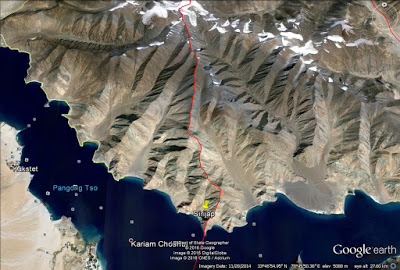
China can’t do much at the trijunction between Sikkim, Tibet and Bhutan, but Beijing has now started retaliating in other areas; while the confrontation continues near Doka La in Bhutan, some Chinese troops tried to occupy an area in Ladakh on the shores of the Pangong Tso.
According to India Today, the incident took place on Tuesday morning and lasted for about half-an-hour; later both sides pulled back: “Indian and Chinese forces had a brief face-off in the north bank of Pangong lake in Ladakh.”
A military source told the publication: “The Chinese patrols lost their way due to bad weather conditions but it ended up with heated exchanges between the two sides resulting in stone pelting as well that caused minor injuries to people on both sides.”
It shows the mounting tension following the Doklam confrontation.
Apparently the incident took place between Finger Four and Finger Five on the Pangong Tso (lake): “India claims the area till Finger Eight but controls and dominates up to Finger Four. The situation was brought under control after thirty minutes of face-off, when both sides held their banners indicating either side to pull back to their respective positions,” says the HT.
The South China Morning Post reported from Hong Kong: “Indian and Chinese soldiers were involved in an altercation in the western Himalayas …further raising tensions between the two countries which are already locked in a two-month stand-off in another part of the disputed border. …The two sides have frequently accused each other of intrusions into each other’s territories, but clashes are rare.”
Some reports say that the Chinese soldiers carried iron rods and stones, and in the melee there were minor injuries on both sides.

Cancellation of the Border Personnel Meetings
Another sign that the tension is mounting: Border Personnel Meetings (BPM) were to be held like every August 15 at five places along the border. This year they did not take place.
India and China hold BPM at five points: Daulat Beg Oldie and Chusul in Ladakh, Kibithoo and Bumla in Arunachal Pradesh and Nathu La in Sikkim.
Though invited the Chinese officials did not turn up. It shows that Beijing has not digested as yet the Doklam incident and the fact that India stopped them building a road.
Some Indian media reported that the meetings could not be held as China’s PLA officials did not respond to communications from the Indian Army.

The Hand-in-Hand joint military exercises
The fate of the annual India-China Hand-in-Hand joint military drill hangs also in balance as India has not received any word from the Chinese side, which is supposed to host the exercise this year.
Since 2007, when it was first held, an Initial Planning Conference (IPC) is held in the host country in June-July but so far there has been a ‘studied silence’ from Beijing, says The Economic Times which cites a source in the Army: “The IPC takes place in the country where the exercise would be held. We sent a message to the Chinese side but there was no response. It should have happened latest but July end, but the IPC never took place.”
They will probably no joint exercises this year.

No Rivers’ flow data
Perhaps more serious, it appears that China had stopped sending the routine information on river water flow of the Sutlej and Brahamaputra.
According to The Hindustan Times: “At a time when major rivers in Himachal Pradesh are in spate due to heavy rain, lack of information from China on water inflow from Pareechu rivulet that meanders through the Tibetan Autonomous Region (TAR) has prompted the Central Water Commission (CWC) to seek intervention of the ministry of water resources.”
It had been agreed that India and China would annually renew the protocol on sharing information on two major rivers — Brahmaputra and Sutlej: “But China has reportedly stopped sharing information with India on water inflow in Pareechu. The lake across the Pareechu river, which was measured the size of 20 football grounds, burst in 2005 causing major flooding in the Sutlej. Gushing waters had washed away the strategic Hindustan-Tibet road, National Highway-22 at a number of places, 10 bridges and 11 ropeways. About 15 motorable bridges and 8 jeepable roads and footbridges were damaged on the 10-km stretch of NH-22 between Wangtoo in Kinnaur and Samdoh in Lahaul Spiti districts.”
The HT’s report continues: “No loss of life was reported as the army and civil authorities anticipating the breach in glacial lake in Pareechu had evacuated 5,000 people along the Sutlej. Total losses caused due to flooding had been pegged at Rs 800 crore.”
The Pareechu river originates in India, then it meanders into Tibet and then merges into the Sutlej near Sumdoh (a border post in India). A glacial lake on Pareechu formed behind a landslide dam in 2004; on June 26, 2005, it busted provoking Glacial Lake Outburst Floods (GLOF). After the 2005 GLOF, India and China signed a protocol for sharing information on the water level from Pareechu and the Sutlej.
China has apparently stop sharing information about the water inflow, which makes it dangerous for the local population in Kinnaur.
Senior scientific officer, SS Randhawa told the HT: “The Himachal government constantly monitors the water flow in Pareechu through its department of science technology. But so far the department has been unable to get clear satellite images. Last time, we checked images on July 8 and there was no danger at that time. We use remote sensing technology to monitor the water bodies in the river catchment. But we have been unable to get clear images in the last one week as there are thick clouds over the catchment area.”
I have earlier mentioned the long article in The Global Times about the diversion of the Yarlung Tsangpo/Brahmaputra.
Another warning that Beijing has started retaliating for to the ‘loss’ of its road in Bhutan?
China is indeed playing a dangerous game.

Tuesday, August 1, 2017

Be prepared for China's Electronic Warfare


My article Be prepared for China's Electronic Warfare appeared last month in Rediff.com
However on the occasion of the 90th Anniversary of the People's Liberation Army, I am posting it today.

Here is the link...

'In India, China's capacities to conduct new types of warfare is critically underestimated,' says Claude Arpi.
China's People's Liberation Army is ready with extensive plans for Electronic Warfare

General Bipin Rawat, the chief of the army staff, recently mentioned the future of the defence forces in India; the general spoke of a long-awaited integrated command.
While dismissing apprehensions about shortage of funds, he asserted: 'If we are going to fight a war someday, the war is going to be fought by the three forces together. Integration has to be in a holistic manner. Can we have a joint forces mechanism? Is it better or not? We have to look at the option.'
'You also economise by integration of logistics. The integration has to be in the form of all services utilising their resources in a harmonised manner, the amy chief said.
Though often expounded upon, little has been concretely done to make the integrated command a concrete reality.
At the same time the Chinese People's Liberation Army under President Xi Jinping is taking giant steps towards the future.
Despite (or perhaps thanks to) its rigid system of governance, at the beginning of 2016 China has undertaken in-depth reforms of its defence forces, which aim at a far wider 'integration' than that of the three services mentioned by General Rawat.

The PLA's reforms
Instead of three, China has five 'services'; added to the PLA's army, navy and air force, the PLA has now a Rocket Force (formerly, the second artillery) and a Strategic Support Force. The SSF could be a game changer.
'While the Chinese PLA's new SSF is a critical force for dominance in the space, cyber, and electromagnetic domains,' The Diplomat noted, 'the SSF's function of "strategic support", namely information support, will be equally vital to the PLA's capabilities to fight and win wars.' It is certainly the force to watch.

Towards an e-China?

Clay Chandler in Fortune mentions the experience of Thomas J Friedman, the New York Times columnist, who 'has emerged from a recent foray to China newly astonished by the breakneck pace of innovation here. In his latest column Friedman marvels that the Middle Kingdom has become a cashless society in which "everyone pays for everything with a mobile phone’ and even beggars use QR codes".'
In the Middle Kingdom, the dependence on the cyber world is, of course, not restricted to the defence sector only; the entire Chinese society seems to have entered the cyber area, Friedman commented, 'in an age when raw data from the Internet of people and the Internet of things is the new oil.'
The columnist’s conclusion is that Americans 'underestimate China -- and attribute all of its surge in growth to unfair trade practices -- at our peril.'
This is true for the defence domain too and not only applicable to the US.
In India, China's capacities to conduct new types of warfare is critically underestimated.
In the future, India may have to face not 'one', but several 'asymmetric' attacks.

New types of War?

In 2003, the Chinese Communist party's Central Military Commission approved a 'guiding conceptual umbrella' for information of the PLA's operations -- the 'Three Warfares'.
It was based on three strategies or ‘Warfares’, each mutually reinforcing the others:
  • Coordinated use of strategic psychological operations;
  • Overt and covert media manipulation;
  • Legal warfare designed to manipulate strategies, defence policies, and perceptions of target audiences abroad.
Has India thought of countering China in these fields? Probably not, though the fact that the army chief often speaks to the media tends to show that there is perhaps a change in the right direction.

China is looking into the future
In testimony before the US-China Economic and Security Review Commission on 'China's Advanced Weapon', David D Chen, an independent analyst, spoke to a panel about 'Directed Energy and Electromagnetic Weapons Programmes'.
This is cutting-edge research, like quantum communication (which will make communications un-hackable), undertaken by Chinese scientists.
Chen quoted from The Academy of Military Sciences who 'explicitly' asserted: 'Space and cyberspace increasingly constitute important battlefields. A new type of five-dimensional battle-space of land, sea, air, space, and cyber is currently taking shape, which is wide in scope, hyper-dimensional, and combines the tangible and intangible.'
'Battlefield control is moving from control of the land, sea, and air toward control of space and cyber.'
Chen gave an example.
In December 2016, a Chinese publication National Defence Reference remarked China could defeat the US' 'network-centric warfare' with 'energy-centric warfare'.
National Defence Reference explained that 'energy-centric warfare' vouches for increasing the speed of 'attack'.
'The specific way to do so is to develop new concept weapons such as near space hypersonic weapons, electromagnetic rail guns, and directed energy weapons, shortening the time between detection and destruction of a target.'
It moves toward a hyper-dimensional battle-space 'emphasising space and cyber and energy-based weapons faster than an adversary can react,' Chen explained.
Taking the example of a high power output microwave transmitter, Chen oted: 'Its structure is similar to that of a radar transmission system, but its radiated energy is hundreds or even 10,000 times greater than a radar.'
While the Indian media extensively quoted the recently released annual report to the United States Congress, it merely mentioned the fact that China could open military bases in Pakistan and other locations.
But there is more in the report, which affirms: 'China is advancing a comprehensive military modernisation program. It also continues to develop capabilities for what PLA writings call 'non-war' missions, as well as operations in emerging domains such as cyberspace, space, and the electromagnetic spectrum.'

Electronic Warfare will have a special place in a conflict of tomorrow.

China's military modernisation, according to the report, will include 'capabilities to attack, at long ranges, adversary forces that might deploy or operate within the Western Pacific Ocean in the air, maritime, space, electromagnetic, and information domains.'
It cites an array of weapons such as different types of missiles, but also a Ballistic Missile Defence. 'China is taking steps to develop a BMD capability. It is developing a missile defence umbrella consisting of kinetic-energy intercept at exo-atmospheric altitudes (greater than 80 km), as well as intercepts of ballistic missiles and other aerospace vehicles within the upper atmosphere.'
The new HQ-19 missile will be specifically used for intercepting ballistic missiles at mid-course.
'The HQ-19 is still undergoing PLAAF-organized testing; as of May 2016, China was focused mainly on testing the HQ-19's capability to intercept 3,000 km-ranged ballistic missiles.'

The list of new fields of research is long; it is presented in different categories:
  •  Surface and Undersea Operations: 'China continues to build a variety of offensive and defensive capabilities that could permit the PLA to achieve sea control within what the PLA Navy calls the 'near seas', as well as to project limited combat power into the 'far seas'.
  • Information Operations: 'China's ability to counter third-party intervention is the ability to control the information spectrum in the modern battlespace.'
  • PLA authors speak of 'information blockade' or 'information dominance' as necessary to seize the initiative, employing military and non-military instruments of State power across the battlespace.
  • Long-range unmanned aerial vehicles: 'In 2015, media reported the development of the Shendiao (Sacred Eagle or Divine Eagle) as the PLA's newest high-altitude, long-endurance UAV for a variety of missions such as early warning, targeting, EW, and satellite communications.'
China is also working on an unmanned combat aerial vehicle named the 'Black Sword', which could compete with the best US drones one day.
Beijing has a medium and long term programme which aims at transforming China into an 'innovation-oriented society' by 2020.

The plan defines China's leading-edge technologies.
'China has identified certain industries and technology groups with the potential to provide technological breakthroughs, to remove technical obstacles across industries, and to improve international competitiveness.'
The US report lists other fields such as 'intelligent perception technologies' or 'virtual reality technologies', but also 'new materials' such as smart materials and structures, high-temperature superconducting technologies, and highly efficient energy materials technologies; and, of course, AI (Artificial Intelligence).

The Role of the Strategic Support Force

Undoubtedly, the SSF will play a primordial role in a future conflict.
The SSF ]appears to link space, cyber and EW missions,' the report points out adding that the SSF 'may represent the PLA's first step in developing a cyber force that combines cyber reconnaissance, attack and defence capabilities under one hat.'
Moreover the report asserts, 'the PLA may seek to use its cyberwarfare capabilities to collect data for intelligence and cyberattack purposes.'
The Australians recently bitterly complained about Chinese cyberespionage; it is probably just a beginning.
The time has come for India to wake up and realise that India's defence needs to look beyond the present three services, even if the latter are soon able to work in a more coordinated manner.

Thursday, July 13, 2017

China is on a sticky wicket in Bhutan

Most of the maps show Batang-la as the trijunction Sikkim-Tibet-Bhutan
My article China is on a sticky wicket in Bhutan appeared last week in the Mail Daily/Mail Online (UK)


Here is the link...

Has China lost its gamble on a Himalayan ridge in Sikkim? It is too early to say, but some lessons can already be drawn from the scuffle between the Indian Army and the People's Liberation Army in Doka La, near the trijunction between Tibet (China), India and Bhutan.
The episode started when China began building a road on Bhutanese territory without informing Thimphu.
Beijing was certainly not expecting that India would come to the rescue and defend the small kingdom.
China, which dreams of becoming a 'Big Power', attempted to change the status quo south of the Doklam plateau on the Bhutan-Tibet border.

Statement

On June 29, the Royal Government of Bhutan, which had held 24 rounds of talks on the issue with China so far, explained the situation in a statement: 'On 16th June 2017, the Chinese Army started constructing a motorable road from Doka La in the Doklam area towards the Bhutan Army camp at Zompelri.
'Boundary talks are ongoing between Bhutan and China and we have written agreements of 1988 and 1998 stating that the two sides agree to maintain peace and tranquillity in their border areas pending a final settlement on the boundary question...
'The agreements also state that the two sides will refrain from taking unilateral action, or use of force, to change the status quo of the boundary.'
Bhutan conveyed to Beijing that the construction of the road inside Bhutanese territory was a direct violation of the agreements and that it would affect the ongoing demarcation process.
On June 30, 2017, the MEA too issued a press communiqué underlining that 'the two governments had in 2012 reached agreement that the trijunction boundary points between India, China and third countries will be finalised in consultation with the concerned countries.
'Any attempt, therefore, to unilaterally determine tri-junction points is in violation of this understanding.'
Beijing was well aware that the area has been under dispute for several decades; already some 50 years ago, nasty letters were exchanged between Delhi and Beijing on the issue.
The first lesson of the present episode is that India is eons behind China in terms of communication.
Though Beijing broke its pledge to Bhutan and India, the constant threatening statements by their spokesperson made it sound as if Beijing was the aggrieved party.
In 2003, China's Central Military Commission approved the concept of 'Three Warfares', namely: (1) the coordinated use of strategic psychological operations; (2) overt and covert media manipulation; and (3) legal warfare designed to manipulate strategies, defence policies, and perceptions of target audiences abroad.
The Chinese spokespersons efficiently demonstrated how, even when wrong, you can make it appear that it is the other parties, Bhutan and India in this case, who are the culprits.

History
Take the case of the 1890 Convention between Great Britain and China relating to Sikkim and Tibet.
The Chinese Ministry of Foreign Affairs' spokesperson managed to convince most of the Indian and foreign media of the importance of the treaty.
Beijing, however, forgot to mention that the two main stakeholders, Tibet and Sikkim, had not even been consulted by the then 'Great Imperial Powers'.
Tsepon WD Shakabpa, the famous historian, in his Tibet: a Political History, explained that in 1890, a convention was drawn up without consulting the government of Tibet: '…six articles related to Tibet, and since (Tibet) was not represented at the Convention, those articles were not allowed to be put into practice by the Tibetans.'
Shakabpa added: 'The British were aware that China exercised no real power in Tibet at that time; but it suited their interests to deal with the Manchus, because of the advantages they gained from the Convention.'
An unequal treaty in Chinese parlance! The Manchus agreed to 'offer' Sikkim to the British as they were afraid that Tibet and Britain might enter into direct negotiations with London; therefore, they signed the treaty to forestall such a possibility.
In 1904, Capt Francis Younghusband anyway mounted a military expedition to Tibet to make the recalcitrant Tibetans sign their first agreement with the Crown.
 
Wedge
China has always been interested to create a wedge between India and Bhutan.
In 1966, in similar circumstances, for the same disputed place, the Dokham plateau, the Chinese government attempted to convince Delhi that Bhutan did not require India's support 'as it was an independent country'.
The Communists did not accept that Delhi could advise Bhutan; they crudely wrote: 'inheriting the mantle of British imperialism, the Indian Government has all along been pursuing an expansionist policy and bullying its neighbouring countries.'
Chinese President Xi Jinping (right) shakes hands with Indian Prime Minister Narendra Modi to the G20 Summit on September 4, 2016 in Hangzhou, China (stock photo)
As at present, the Bhutanese Government had issued a press statement on October 3, 1966: 'The Government of Bhutan have, for some time, been concerned with reports received from its patrols of a number of intrusions by Tibetan grazers and Chinese troops in the Doklam pastures which are adjacent to the southern part of the Chumbi Valley.'
It concluded that the area has been traditionally part of Bhutan, and China had never disputed 'the traditional frontier which runs along recognisable natural features.'
However, later, China started claiming large strategic chunks of Bhutan's territory.
Incidentally, Article 1 of the much quoted 1890 Convention placed the trijunction at Gipmochi: 'The line commences at Mount Gipmochi on the Bhutan frontier, and follows the above-mentioned water-parting to the point where it meets Nepal territory.'
According to Sikkimese records, Gipmochi is in Batang La, 5 km north of Doka La.
It means the territory south of Batang La is indeed Bhutanese, and therefore India did not 'trespass' into Tibet.
So, why all this fuss?

Thursday, January 7, 2016

China’s PLA sings Jai Ho as India goes for Border Defence

My article China’s PLA sings Jai Ho as India goes for Border Defence appeared in NitiCentral.

Here is the link...

On New Year day, a Border Personnel Meeting (BPM) between India and China was held in a Chinese hut near a place called Damai, north of the Lohit sector of Arunachal Pradesh. The Indian delegation was led by Brigadier S.S. Bhogal, who commands a brigade in the area, while China was represented by Senior Colonel (equivalent to a brigadier) Hu Xiao Bao, commanding the Zayul Garrison of the Chengdu Military Area Command.
The Times of India reported: “This year there was something new and exciting about the meeting. After paying respects to the national flags and playing of the national anthems, the Chinese soldiers sprang a surprise and enthralled the audience by their performance on Hindi Bollywood songs 'Jai Ho' and 'Ankhe Khuli Ho Ya Ho Bandh'.”
Then, Chinese women performed some ‘scintillating dances’, while male soldiers of the People’s Liberation Army (PLA) gave a feel of their voices.
The report speaks of growing bonhomie and brotherhood between the armies of the two nations. But in view of past history, one should remain guarded, especially when Indian newspapers get carried away with too much ‘brotherhood’. Remember the Bhai-Bhai days?
However there is probably no harm in hoping for the best at the beginning of the New Year! The Indian Army’s spokesman also spoke of “fostering the feelings of friendship and commitment towards enhancing the existing cordial relations and maintenance of peace along the LAC.”
It is certainly better to dance and sing together, than to sponsor terrorism across the border, like another of India’s neighbours does.
Far away from the Lohit valley, Indian and Chinese border officials also met in Ladakh ‘to improve ties at the functional level’.
The Moldi Garrison in Chushul sector of Ladakh witnessed a BPM in a ‘free, congenial and cordial’ atmosphere; Brigadier Vijyant Yadav was seen shaking hands with PLA’s Senior Colonel Fan Jun.
The Northern Command’s spokesman Colonel S.D. Goswami told the Srinagar-based Daily Excelsior that this reflected the mutual desire of the 2 countries “to maintain and improve relations on the borders at functional level”.
Another encounter was held at what is called the world's highest BPM’s post; both delegations met in the vicinity of Daulat Beg Oldie (DBO) and Tianwendian (TWD). While the Indian delegation was led by Colonel Rinchen Dorje, the Chinese were commanded by Colonel Song Zang Li.
What is interesting is that a local Ladakhi represented the Indian Army. This is what makes India’s strength; China is today unable to incorporate Tibetans or Uyghurs in its defence forces, as they can’t be trusted by Beijing.
The CBMs come soon after the visit of Northern Army Commander, Lt Gen D.S. Hooda to Lanzhou Military Region, which is responsible for the Ladakh sector (this may change with the ongoing reforms in the PLA).
Does all this mean that like in the early 1960s, India is slowly being put to sleep by China?
No! In fact, Delhi has decided to go ahead with its border defenses.
Take the installation of latest gadgetry along the LAC to monitor movement of the Chinese troops near the LAC. A few months ago, The Excelsior had reported that the MHA and MoD had decided to install high resolution sophisticated cameras to keep surveillance on the PLA activities on the Indian side.
Army sources told the J&K daily that the new surveillance cameras would be first installed about 20 kilometers inside the Indian territory to ensure that the system doesn’t fail like the previous ones. And roads and advanced landing grounds are also built on a war-footing.

China’s Military Reforms
On the other side of the mountains, the PLA is fully involved in military reforms. In a commentary on January 1, The Global Times said: “With a strong army, China can be more politically appealing, influential and persuasive, and will make it easier to network. The army will be more capable of using the equipment and soldiers’ morale will be boosted.”
But the question on every defense analyst’s lips is: will the new reforms proceed smoothly?
On December 31, President Xi Jinping, who is also the Chairman of the Central Military Commission, inaugurated three new PLA ‘units’ or ‘services’, namely, the PLA Land Army, the PLA Rocket Force and the PLA Strategic Support Force.
President Xi said that it was “an important decision to realize the Chinese Dream and the Dream of a Strong Military, and a strategic initiative to build a modern military power system with Chinese characteristics.”
While the PLA Rocket Force will take over from the Second Artillery Force to “strengthen the trustworthy and reliable nuclear deterrence and nuclear counter-attack capabilities”, the PLA Strategic Support Force will deal with hi-tech warfare in space and cyberwar.
The seven Military Area Commands will soon be replaced by five battle zone commands, focusing on combat. The new Western Combat Zone will replace the two Military Area Commands today facing India in the High Himalaya.
The Global Times warned: “The latest military reform will meet many challenges and difficulties in the process.”
The mega reforms maybe complicated by another issue: the morale of the PLA. Indeed, the spirit of PLA officers and troops does not seem very high on the plateau.
On December 28, China Tibet Online published photos of a group of new recruits ‘releasing inner discomforts’ in Central Tibet. They were playing a psychological counseling game under the guidance of psychologists.
A detachment of Tibet’s border defense troops participated in group training activities in Shigatse; it was themed ‘releasing inner discomforts and welcoming new challenges’.
The exercise was meant for the new recruits, who experience inner and outer discomforts, while being posted on the Tibetan plateau.
The website explained that the course was designed “to help alleviate psychological pressure and ensure they pass the ‘second adaptation period’ smoothly.”
Already in May 2013, the Tibetan Centre for Human Rights and Democracy in Dharamsala had got hold of a fascinating manual exposing the psychological trauma faced by the People's Armed Police (PAPF) in Tibet.
During the recent Shigatse ‘counseling’, the detachment’s counselors, Zhang Yan and Li Linfu, “fully played to their strengths by using plain language to explain to the new recruits how to alleviate their own psychological pressure. The new recruits participated actively and were enthusiastic, coordinated and willing to try,” said China Tibet Online.
The article concluded: “This activity not only helped recruits relieve psychological pressure and relax their minds, but also strengthened their team spirit and collective consciousness.”
This means that several decades after the so-called ‘Liberation of Tibet’, the Chinese soldiers are still not at home on the Roof of the World.
India definitively has an advantage in the field of human resource, even if it does not have it in infrastructure and equipment.
During his last press briefing Senior Colonel Yang Yujun, the spokesman for the Ministry of National Defense, commented on the situation on the China-India border; he said: “The Chinese side is ready to work with the Indian side …to jointly maintain peace and stability in the border region.”
In the coming year, China will try to keep the situation on the border ‘peaceful’ in order to implement its reforms, but Delhi should realize that in the long term, the Chinese defence forces will become fitter, better prepared and far better coordinated.
While welcoming the CBMs, India’s leadership should not miss the opportunity to further strengthen its defenses in the Himalayas.

Tuesday, August 25, 2015

PLA: new radars on the Roof of the World

On August 24, The People's Daily Online reported that three more unattended radars were soon to be installed in Tibet.
The mouthpiece of the Chinese Communist Party reminds us that China’s “first unattended radar station has stood eight years on the top of Ganbala Mountain, with a height of 5,374 meters above the sea level on Qinghai-Tibet Plateau.”
Now, the website affirms that “another three unattended radars were going to be installed in order to form a radar network with the previous one.”
As mentioned on this blog in 2012, Kampa-la (Ganbala in Chinese) is located in Nagartse County of Lhoka/Shannan Prefecture.
At that time, we were told that a very good road had been built to serve the highest radar station in Tibet (and the world).
Kampa-la is the last pass in Nagartse county, before the road reaches Lhasa valley. Nearby is the stunningly beautiful 72 km-long Yamdrok Yumtso Lake, one of the three largest sacred lakes in Tibet. The lake is surrounded by many snow-capped mountains. It has become a tourist attraction and literally millions of Han visitors come every year to click a selfie on its shores.
The news of a radar station in this area, first appeared in 2008, when some soldiers were demobilized from the radar regiment of the PLA Air Force. The Chinese media then commented: “The percentage of oxygen in the air on the Ganbala Mountain is only 48 % of which at the sea level. That is why the mountain is viewed as the ‘life forbidding zone’.”
Today, The People’s Daily admits that in October 1965, China had already completed the construction of Kampa-la radar station: “then the highest manned radar station in the world.”
The radar station is today unmanned.
The People’s Daily now adds: “For over 40 years, this radar station is used to secure surveillance and provide civilian air navigation services in Tibet.”

Night Military Exercises in Tibet
Incidentally, on August 11, China Military Online published photos with this comment: ‘Air force J-11 regiment boosts night combat power’.
It explained that a J-11 regiment of the PLA Air Force conducted night combat training in Tibet on August 9.
The pictures show a high plateau military airfield (Lhasa Gongkar?) surrounded by snow-clad mountains and a group of J-11 heavy fighters taking off amid twilight.
The captions said:
They were to engage in a confrontation drill in the black sky. The regiment pays much attention to the training of air battle at night, which has become a routine training program in its annual training plan. To enhance the combat capability of the air force, China began to make J-11 heavy fighters by introducing from Russia the production line of Su-27 heavy fighter in 1990s. Since 2002, the China-made J-11 heavy fighters have been among the arrays of warplanes of the PLA Air Force. The J-11 and J-11A heavy fighters are now widely serving in the aviation troop units of the Air Force and the Navy of the PLA.
Also incidentally, on August 18, The PLA Daily published an editorial, “Be Ready to Fight at All Times”.
It re-emphasized the importance of building a strong army which should be ready to fight 'at all times'.
The article was later posted on all the major state media and military websites (in Chinese only).
It stated:
Today, although the smoke of war has dispersed, the ghosts of militarism still linger. Some Japanese political organizations and politicians go against the tide of history and against peace and justice; they selectively forget the disaster they brought to another country but they always remember their own ‘misfortunate.’ They resolutely deny the barbaric crimes of the Japanese invasion, insist on paying tribute to their war criminals, forcibly lift the ban on collective self-defense, openly distort historical facts, trample on the human conscience, and undermine the post-war international order.”
It was emphasized in bold font:
Through these phenomena, we can easily see that Japanese militarism’s desire to eliminate China has never died, that is has refused to recognize the defeat in that war, and that it has secretly been gathering strength in an attempt to stage a comeback. Without vigilance and precautionary measures, there is still the risk of a repeat of this tragedy of history.
The Editorial concluded:
At present, China is at the critical juncture of becoming big and strong. Some Western countries are unwilling to see the rise of China, doing everything possible to contain and suppress China, repeatedly squeezing China's strategy for development, and bringing the focus of international strategic competition toward the Asia-Pacific region. Thus the likelihood of disturbances and war taking place on our doorstep has increased.
‘Tibet’, in other word ‘the borders with India’ needs too, to be ready for any eventuality. The radars and the night exercises are the best proof of the intensive 'preparations' which are going on.
But about China becoming 'big and strong', but it is not what the Shanghai and other Chinese stock exchanges have shown the recent days.
But a weaker China could become more aggressive.


Wednesday, August 12, 2015

China is a peaceful country, but…

China is a peaceful country: it is at least what Beijing likes to say.
In June, Beijing reiterated its ‘peaceful’ doctrine in a White Paper (WP) on ‘China's military strategy’, which affirmed that the country generally enjoys a favourable environment for development, though external challenges are increasing.
Of course, in Beijing’s eyes, the main villain is Washington; Beijing does not appreciate the US ‘rebalancing’ strategy’ and its enhanced military presence in the region. Then, there is Japan. Mao would have probably called Tokyo a US lackey; the WP affirms that Japan is “sparing no effort to dodge the post-war mechanism, overhauling its military and security policies.”
Although China is a peaceful nation, Beijing is getting ready for any eventuality.
On August 10, the Chinese media, led by Xinhua announced: “China ramps up joint military exercises; it further reported: “A joint military drill that started in late July, entered a live fire stage in a plateau area in southwest China's Sichuan Province.”
‘Plateau area’ is another word for Tibet, i.e. India’s northern borders.
The drill, coded ‘Joint Action-2015D’, is organized by the Chengdu Military Area Command (MAC) of the People's Liberation Army (PLA). It is the first of five such drills, to be held during the current year in different MACs.
Xinhua further pointed out: “It will involve a total of more than 140,000 soldiers from over 140 PLA regiments of various types.”
That is not a joke, nearly one and half lakh of soldiers for a ‘joint operation system’ which includes the ground forces (PLA) as well as the PLA Air Force (PLAAF), the PLA Navy (PLAN), the Second Artillery Forces (missiles), the People’s Armed Police (PAPF), but also intelligence, reconnaissance and electronic warfare units. This is what He Qimao, head of the joint drill bureau of the PLA General Staff's training department, announced.
It was further reported that the PLA plans to complete more than 100 such joint exercises, which should involve over 50 army corps.
Xinhua adds: “Military experts consider joint exercises the most demanding training, as they require a high degree of coordination.”
In March 2014, the Central Military Commission (CMC) which overlooks the activities of the PLA had set up a Leading Group ‘on joint military exercises’.
These Leading Groups are important structures for the coordination between the different ministries, departments and units to achieve a declared objective in any field of governance in China.
On the ‘peaceful side’, the PLA will participate to several joint military exercises scheduled with more than 20 countries including Pakistan, Colombia, Thailand and Turkey in 2015 (the exercises with Russia and Thailand have already been completed).
The South China Morning Post commented: “The 2.3 million-member People’s Liberation Army has stepped-up both the rigour and frequency of training as it emphasises more realistic scenarios for fighting and winning battles around China’s periphery. New stress has been placed on exercises integrating different branches of the armed forces, with a special command on joint exercises.”
One of the PLA’s exercises recently made the news, when pictures appeared on the Internet showing a military assault on a mock-up of the presidential palace in Taiwan. It was obviously not appreciated in Taipei. Taiwan’s Defence Ministry officially protested against the ‘exercise’. Later a Chinese military spokesman denied that the drill targeted any specific parties, on the PLA’s television channel.
Of course, China is a peaceful country.
At the same time, pictures of soldiers carrying out bedding and clothing during a supply drill appeared in the Chinese media. The caption says “on August 8, 2015, the PLA General Logistics Department (GLD) started its materials and POL (Petroleum, Oil, and Lubricants) supply drill codenamed ‘Supply Action-2015’ in the Tibet Autonomous Region.
Another picture shows troops receiving ‘vital supplies by way of vertical replenishment’, while another unit sets up pipelines for POLs supply; also seen a group of armored vehicles refueling during the same 'supply drill' as soldiers are moving military materials and drinking water during a replenishing operation.
Probably part of the same drill, on August 11, China Military Online displayed a J-11 regiment of fighter planes, belonging to the PLAAF which was ‘kicking off its night combat training’ in Tibet on August 9.
The PLA website explains: “At a high plateau military airfield surrounded by snow-clad mountains, groups of J-11 heavy fighters were seen taking off amid twilight. They were to engage in a confrontation drill in the black sky.”
It further comments: “The regiment pays much attention to the training of air battle at night, which has become a routine training program in its annual training plan,” and gives some technical details: “To enhance the combat capability of the air force, China began to make J-11 heavy fighters by introducing from Russia the production line of Su-27 heavy fighter in 1990s. Since 2002, the China-made J-11 heavy fighters have been among the arrays of warplanes of the PLA Air Force. The J-11 and J-11A heavy fighters are now widely serving in the aviation troop units of the PLAAF and the PLAN.”
In the meantime, the Chinese press praised ‘the development of transportation in Tibet over past 5 decades’.
Xinhua published photos taken on October 30, 2010 showing an A319 plane landing in the Shigatse airport. The caption says: “People witnessed amazing progress of the transportation in Tibet over the past five decades. A total of 75,000 kilometers road have made the transportation in Tibet much easier than 50 years ago. The Qinghai-Tibet railway, running from Northwest China's Qinghai province to Lhasa, was opened in 2006. …Above the railways and highways, the air transportation in Tibet also embraced a huge leap-forward. In the half-century development, over 24.71 million passenger trips were made and the total volume of goods reached nearly 329,900 tons.”
As mentioned in an earlier post, the entire infrastructure in Tibet is meant for dual use (civilian and military).
Not so peaceful is the interview of General Zhu Wenquan, a former commander of the Nanjing MAC on China Military Online.
The retired General speaks of his latest book On Island War and offers his advices on global island and reef disputes. The military website adds: “[Zhu’s] comment also holds water for the current tension in the East China Sea and South China Sea.”
Zhu argues: "According to incomplete statistics, 85 countries in the world have disputes over more than 410 islands (peninsulas and reefs) in 83 places. They all indicate a stern fact that the island war is in progress."
Answering why did he wrote the book, General Zhu Wenquan explains: “Comrade Deng Xiaoping once said that the three major tasks for China in the 1980s were fight against hegemony, economic development and the resolution of the Taiwan issue, but when I started this book in 2007, the Taiwan issue was still unsolved, not even today. As a military leader, I wrote this book to provide theoretical support for winning large and medium scale island wars and make my contribution to solving the Taiwan issue one day.”
When Zhu Wenquan is asked how to break the island chain blockade, he answers: “The strait is flat, so if we cannot pass it, we can always fly over it. Some countries have deployed underwater submarines and monitoring systems on the islands, but we are fully able to destroy them with firepower if there is really a blockade. So strategically speaking, there is no need to overemphasize the island chain blockade. We should play it down.”
His conclusions are clear (even if not peaceful): “Developing China's armed forces in the sea, air and space at a faster pace is the fundamental solution to all problems. If we have a powerful navy, air force and space troop, what are we afraid of? At that time, the first island chain will be like a straw rope that breaks at the first touch. Therefore, developing military forces in the sea, air and space is the only way to solve the island chain blockade.”
China is a peaceful country …but always ready for war.


Thursday, May 14, 2015

Mr Modi, be wary of the Chinese!

Chinese and Russian navies leaving for joint drills in the Mediterranean Sea
My article on Prime Minister Narendra Modi's visit to China, entitled Mr Modi, be wary of the Chinese! appeared in Rediff.com

Here is the link...

'Chinese leaders rarely receive their foreign guests in cities other than Beijing. Such respect for India!' 
'Does it mean that Modi could replicate "the warmth and unconventional way" by sending Indian troops into Tibet, as Xi did in Chumur (Ladakh) when he arrived in India? Of course, Indians are far too polite to do so,' says Claude Arpi.

‘Hello China’, Prime Minister Narendra Modi tweeted in Chinese as his first message on the Chinese microblog Weibo: “Looking forward to interacting with Chinese friends through Weibo.”
Will a few tweets help Modi, the third-most followed world leader on Twitter to tackle the issues facing the Sino-Indian relations? The answer is ‘no”.
Immediately after Modi’s ‘hello’, a Chinese Weibo shot back: “The southern part of Tibet belongs to China, and Kashmir belongs to Pakistan. Mr PM please return the lands of other countries first before we start talking about how to get along well”
The relations between Delhi and Beijing are too complicated for a few slogans to make the difference, while at every level, the balance of power tilts in favour of China.
In fact, all bilateral issues, whether it is the border dispute, the trade imbalance, the stapled visas for Kashmiris and Arunachalis, the opening of new consulates, the Tibet issue; none of these problems can be solved easily due to the economic imbalance, as well the difference in border infrastructure and military power.
But there is an imbalance of ‘vision’ too.
A few weeks ago, a PIB communique announced that the Prime Minister “will visit Xian, Beijing and Shanghai from May 14 – 16, 2015.” That was the ‘normal’ pattern for the Prime Minister’s visit; the problem is that China is not a normal country.
The Middle Kingdom dreams of dominating Asia and the World; India is only incidental to the Chinese Dream.
Further, India and China live in different worlds, with often-opposite mindsets and while adhocism is the hallmark of the Elephant, the Dragon thinks far, far ahead.
China watcher, Francesco Sisci recently wrote in The Asia Times: “China works with long terms plans, its way of thinking and its political organization is all geared for long term — and of course they do not have elections every two or four years to press politicians into daily routines.”
Sisci cites China’s New Silk Road, an extremely long term scheme: “China now wants to make some progress on the development of the Silk Road and it can do it with Russia and Pakistan, the safest bets.”
And Beijing acts fast, China and Russia have just conducted a joint naval drill in the Mediterranean; a move which extends greatly the Middle Kingdom’s sphere of influence. Though the Chinese defense ministry spokesperson Geng Yansheng said: “The aim of the drills is to deepen both countries' friendly and practical cooperation and increase our navies' ability to jointly deal with maritime security threats," Sina Military Network explained the rationale: “there is no doubt that joint military drills will always send a signal,” further admitting: “the target of the maritime exercise is obviously the US, which China feels has been interfering in China's expansion activities in the East and South China seas by strengthening ties with Japan and the Philippines.” It also mentions the economic sanctions against the Russian Federation for annexing Crimea from Ukraine.
It is clear that China will first defend its interests.
Now the question comes: how should India deal with China?
There are no simple answers, though it would be useful if the Prime Minister team starts thinking ahead (a few years to start with) and find schemes on which India’s friends and partners can rely.
In this perspective, the recently-held Varuna Indo-French naval exercises, which saw the Indian and French Carrier Strike Groups (CSG) interact in the most sophisticated naval training so far, were interesting. It is vital for Delhi to engage with ‘friendly’ navies and learn from those who have the required experience, ships and armament and there are very few!
This too will not stop China’s rise.

China wants to dominate the World
While several American ‘experts’ have started talking of the ‘cracking up’ of the Middle Kingdom, Beijing does not bother much and continues with its initiative to build a ‘parallel’ new world order, centered on China and Asia.
WantChinaTimes, a Taiwanese publication mentions “new political, economic and security systems that China is setting up around the world in an attempt to realign the established international order dominated by the United States.”
During the Boao Forum for Asia (BFA), the Asian ‘Davos’, President Xi Jinping went on about his favorite topic, the ‘One Belt, One Road’ initiative. Xi asserted that the scheme would ultimately benefit 'all nations'.
The scheme has different rationales, though the main objectives are clearly for China to take the leadership of Asia and reenergize its economy.
The Silk Road Economic Belt will eventually link China, Central Asia, Russia and Europe, while the 21st-Century Maritime Silk Road, will stretch China’s influence to Europe through the South China Sea and the Indian Ocean in the West and to the South Pacific in the East.
The Silk Road projects would add more than 60,000 kilometres of road, including 4,070 km expressways, and improve the connectivity of the existing transportation network.
Both new ‘silk roads’ would involve 65 countries from three continents and 4.4 billion people. Xi spoke of an annual trade volume exceeding US $ 2.5 trillion in a decade: “cooperation and coordination of policies will be win-win for all involved”, he affirmed.
Another much-talked about initiative is the Asian Infrastructure Investment Bank (AIIB). Beijing no longer wants to be subjected to US financial controlling or monitoring.
The Chinese initiative is already considered as a success if one looks at the number of countries and territories from five continents who have applied to join the Beijing-led Bank as founding members.
Though Japan will not be immediately joining, many Western capitals, including London have declared their intention to jump into the boat. Washington, completely taken on the wrong foot, seemed to have lost a battle. In the US, former US Secretary of State Madeleine Albright noted that the United State has ‘screwed up’ on the way it dealt with the AIIB.
Now take Xi Jinping’s trip to Islamabad. The enormity of the ‘gifts’ that Chinese President brought in his luggage as he landed in Pakistan, is flabbergasting.
The Washington Post remarked: “Xi arrived in Islamabad bearing real gifts: an eye-popping $46 billion worth of planned energy and infrastructure investment to boost Pakistan's flagging economy.”
It sounds like a Chinese Dream for Islamabad!
Beijing has decided to help Pakistan to develop a China-Pakistan Economic Corridor which will eventually link up the One Belt and One Road.
In other words, the Chinese-sponsored port of Gwadar on the Arabian Sea will be connected through the Karakoram Highway, to the Xinjiang province in China’s Far West and Central Asia …and later Middle East, Africa and Europe.
The ‘corridor’ will have railways, roads, optical fiber cables, dams (to produce the necessary electricity), pipelines, etc!
Observers marveled at Beijing’s kindness (and wealth), but one should not be fooled by Chinese generosity: Beijing is investing for China!
With the country facing financial difficulties at home, with a slowdown of the economic engine, the leadership has devised the double Roads scheme to rebalance its own economy and perhaps more importantly, to become the sole leader of Asia.
Where is India in this scheme? Nowhere!
Does Delhi have such a ‘Grand Project’? The answer is ‘No’.

Modi’s visit to China
It was announced (in India) that Xi Jinping and his wife Peng Liyuan wanted to replicate “the warm and unconventional welcome extended to him [Xi] by Indian Prime Minister on his visit to India” by taking Modi for a trip to the ancient city of Xian, the capital of Xi's home province Shaanxi.
It will probably be enough to melt the soft hearts of the Indian delegation; the Chinese leaders rarely receive their foreign guests in cities other than Beijing. Such respect for India!
Does it mean that Modi could replicate ‘the warmth and unconventional way’ by sending Indian troops into Tibet, as Xi did in Chumur (Ladakh) when he arrived in India? Of course, Indians are far too polite to do so. Once again, the gap in mindsets is too wide.
Analyst Brahma Chellaney believes: “Indian diplomacy has long been shaped by personalities at the helm. Their propensity to act in haste and repent at leisure has been legendary, as India has ignored the sound advice of Talleyrand, Napoleon’s famous foreign minister: ‘By no means show too much zeal’.”
Without showing too much ‘zeal’, Modi could perhaps:
• Ask Xi Jinping if he knows that once upon a time, Tibetans kings ruled over China from Xi’an.
• Ask to meet the Panchen Lama recognized by the Dalai Lama and kept ‘somewhere in China’ for the past 20 years.
• Ask China to reopen the Himalayan passes which were closed in 1962, namely, Demchok (Ladakh), Mana and Niti pass (Uttarakhand) , Jelep-la (West Bengal), and a few others routes in Arunachal Pradesh like Kibithu (Anjaw district), Bumla (Tawang district), Gelling-Tuting (Upper Siang district)
• Reopen the Indian Consulate in Lhasa in exchange of a Chinese consulate in Chennai or elsewhere in India.
• What has happened of the Indian Trade Agency’s building in Yatung in the Chumbi Valley adjacent to Sikkim.
• Have a frank discussion on the Tibet issue.
It is however doubtful if the guest wants to embarrass the host.
In which case, India will have to wait for the ‘cracking up’ of the Communist Dynasty. It may take some time.

Friday, March 13, 2015

Fighting with hands tied behind the back

Chairman Xi meets PLA delegates during NPC meet
My article Fighting with hands tied behind the back  appeared yesterday in the Edit Page of The Pioneer.

Here is the link...

It is routine to compare India’s defence capabilities with those of China, given that the two countries are engaged in resolving border disputes. But also look at the difference in their defence budgets

The 2015 Chinese defense budget has been the focus of attention during the annual Two Meetings of the National People's Congress (NPC) and the Chinese People's Political Consultative Conference (CPPCC) which opened in Beijing on March 3 and 5 respectively.
A few days before the event, the Taiwanese website WantChinaTimes quoted Jin Canrong, a professor at the School of International Studies at Renmin University of China, saying: “a sustained double-digit growth of China's defense budget would most likely be based on its strategies for coping with any changes in its relations with the United States.” The Defence expert added: “If China increases its military budget by double-digits this year, it would signal that the country is boosting its combat preparedness in response to perceived potential challenges.”
Last year, China’s ‘official’ budget was 808.2 billion yuan (US$129 billion), an annual increase of 12.2% compared to the previous year.
On March 4, 2014, during a news conference, the NPC’s spokeswoman, Fu Ying announced that this year’s defense budget would be increased by about 10 percent.
Fu further explained: “Compared with great powers, the road of China's defence modernisation is more difficult. We have to rely on ourselves for most of our military equipment and research and development.” She added that China's defence policy is defensive in nature.
A battery of Chinese experts justified Beijing’s decision to go again for a double-digit raise. Major General Xu Guangyu, senior consultant to the China Arms Control and Disarmament Association commented that the present increase in military spending is ‘basically reasonable’, adding that the $145 billion budget ‘only’ represents 1.4 percent of the country’s GDP, far below world average.
General Xu also argued that China's per capita military spending remains low, about US $ 57,000/soldier (divided among the 2.3 million officers and soldiers). He did not miss the opportunity to compare with the figure of the Japanese ($ 210,000) or American troops ($ 430,000). His conclusion was: “[China’s] current military spending is still very insufficient and cannot fully meet the needs of China's national defense.”
Though Xi Jinping introduced a new theory, the 'Four Comprehensives', which promotes ‘building a moderately prosperous society, deepening reform, governing the country according to rule by law, and enforcing strict party discipline’, the budget of the People's Liberation Army (PLA) is not caught in rhetoric as China remains pragmatic (and secretive) about its defence spending.
While Xi’s proclaimed objective is to make the troops able to ‘fight and win wars’, the PLA’s main battle is today against rampant corruption. As the annual Meetings started in Beijing, a group of 14 officials of Major General rank were placed under investigation. The most prominent is Guo Zhenggang, former deputy political commissar of the Zhejiang Military Command and son of a former CMC Vice-Chairman.
The resolute fight against corruption, at all the levels of the PLA, has one ‘budgetary’ collateral, as all military officials should only rely on their salaries. If the ‘customary’ sources of income are cut, how will Xi control the generals and built a ‘Chinese Dream Army’?
The PLA Daily quoted President Xi saying that “military officers can only rely on their salaries for income. Any unapproved income or illegal gains will be investigated and punished.” Easier said than done, though as a result, the CMC will probably have to increase PLA’s salaries (a third of the military budget is for the salaries of the PLA's 2.3 million personnel).
One of the reasons for this year slightly lower budgetary increase is that China faces serious economic problems, with an annual growth of 7.4%, the slowest in 24 years; a further slowdown to around 7% being around the corner. It may seriously hamper larger defence spending.
Moreover, a report prepared by the Rand Corporation for a US congressional committee argued that China’s military is not ready to win wars despite spending heavily.
The report says: “The PLA suffers from potentially serious weaknesses that could limit its ability to conduct operations required to fight and win future conflicts. …Although the PLA’s capabilities have increased dramatically, its remaining weaknesses increase the risk of failure to successfully perform the missions the Chinese Communist Party leaders may task it to perform.”
The PLA is said to have an outdated command structure, poor quality personnel, to lack professionalism and be held back by corruption, the report added.
The main question remains: does the budget announced by Beijing reflect the reality? It certainly does not!
Take an example, The Global Times reported that China has begun upgrading its Type 094 nuclear-powered ballistic missile submarine. The Chinese Navy may need five or six of the submarines, capable of carrying 16 ballistic missiles, a great improvement on the original model which could only carry 12 missiles which can be fitted with JL-2 intercontinental-range ballistic missiles with a range of 8000 km.
Is the amount of R&D required for this ‘improvement’, taken into account the defence budget? It is anybody’s guess.
What about the construction of a second aircraft carrier?
The US-based Duowei News, quoted Ding Haichun, a deputy political commissar of the PLA Navy, who acknowledged that China's second aircraft carrier is currently under construction and will be more advanced than the country's first carrier, the Liaoning.
When asked how many carriers China plans to have, Liu Xiaojiang, a former PLA Navy political commissar said that it would ultimately depend on how much research and development funding is available.
In India, the 2015-16 Defence Budget disappointed many. Finance Minister Arun Jaitley has ‘only’ announced a raise of about 10 percent to Rs 2,46,727 crore (40 billion US $), which is Rs 23,357 crore more than the revised estimates for the current financial year (Rs 2,22,370 crore).
Defence experts have unanimously argued that this inadequate allocation will not provide the necessary boost for the country’s military modernization, particularly if it wants to catch up with China.
Though Jaitley affirmed in the Parliament: “Modernisation of the armed forces is critical to enable them to play their role effectively”, Brig Gurmeet Kanwal, former Director of the Centre for Land Warfare Studies wrote in The Indian Defence Review that it is not enough considering “the Army has begun the raising of 17 Corps, designated as a mountain strike corps, which is expected to cost Rs 64,000 crore over seven years.”
One has to add initial payments for 126 MMRCA planes, 197 light helicopters, 145 Ultra-light Howitzers, 15 Apache attack helicopters and 22 CH-47F Chinook medium lift helicopters, C-17 heavy-lift aircraft, etc. It is mathematically impossible to cover these urgent requirements.
One can always argue that despite the shortcomings of the Indian defence budget, a stable and democratic India is perhaps not so badly off compared to China, however there is no question of catching up with the Middle Kingdom in the years to come.

Wednesday, July 23, 2014

Missiles permanently stationed in Tibet

Medium range surface-to-air missiles (SAM) have been in the news after the Ukrainian tragedy.
A few months ago, I mentioned their arrival on the Roof of the World: "Recently China tested again its HQ-16/LY-80 Surface-to-Air Missile (SAM) Air Defense System  on the plateau and posted pictures of the exercise on its official websites."
I had also mentioned that on July 20, 2012, the PLA had staged a live-fire test of a new high altitude surface-to-air missile (SAM) somewhere in the Tibetan plateau  "in a move intended to prepare for potential US strikes against Chinese interests in the region."
Read my posting of the subject...
Today the China Defence Blog reported: "Back in May 2014, it was reported that the new HQ-16 has been deployed to Tibet for the first time during an anti-air drill, unfortunately the participating military unit was not spelled out...   Fast forward three months and now it is confirmed that the hosting unit was the 651st Independent Air Defense Brigade, organic to the Tibet MD. Yup, that means the HQ-16 is here to stay."
This is not good news!
Though it is not directly related, another news about China's military preparedness appeared today in The South China Morning Post (SMCP).
It says: "Twelve mainland airports, many of them among the busiest, will be hit by widespread delays until the middle of next month because of what are believed to be PLA military exercises."
Can you believe it?
The Hong Kong daily adds: "The mainland's civil aviation regulator yesterday told state radio that flights in and out of airports in the country's east - including Shanghai, Nanjing and Wuhan - would be affected until August 15 by the 'high-frequency drills of another user' [read ...the PLAAF]".
Other affected airports are in Hangzhou, Hefei, Jinan, Wuxi, Ningbo, Qingdao, Lianyungang and Zhengzhou.
The Shanghai-based China Eastern Airlines alone is said to have cancelled 22 flights in and out of the affected airports. In 36 hours, more than 290 flights at Shanghai's two airports were delayed or cancelled.
And of course,  the State-run media was mum. Though 'it is widely assumed to be the PLA' says the SCMP which affirms: "Repeated calls made to the Ministry of National Defence and the Civil Aviation Administration of China were not answered."
Can you imagine this happening in India?


Saturday, July 5, 2014

Maps now and then

Recently published Chinese Map
Large tracks of Indian territory are shown as Chinese

My article Map Now and Then appeared today in The Statesman.

Here is the link...
 
Why is Delhi so quiet? Probably because ‘China and India are friends’! Friends like in 1954? It is very ominous.  It is perhaps time for Delhi to distribute the maps of India's borders. It will be useful for the general public, the press and for the Indian officials 

Last week, Beijing published its first official vertical national map of China, incorporating vast areas of the South China Sea. The South China Morning Post (SMCP) commented that the new map gave “equal weight to both land and sea, in [Beijing’s] latest move emphasising its claims of sovereignty over the disputed waters.”
Earlier maps showed the islands in the South China Sea on a smaller scale, in a separate box-out in a bottom corner of the map. Mainly due to the prominence given to the South China Sea on the new map, during several days, most commentators concentrated on the South China Sea; finally, the MEA decide to take note of the new map.
Why? Probably because the Indian media had discovered that the new map showed Arunachal Pradesh as part of China. South Block could not keep quiet anymore, especially at a time the Indian Vice-President was visiting China …to celebrate 60 years of “peaceful co-existence”.
The MEA was, however, quick to dismiss the new map by saying that “cartographic depiction did not change the reality that Arunachal was part of India.” The MEA spokesman further elaborated: “The fact that Arunachal Pradesh is an integral and inalienable part of India has been conveyed to the Chinese authority on several occasions including at the very highest level.”
What is more shocking is the fact that the spokesperson forgot to mention the central sector (Uttarakhand and Himachal) where large chunks of Indian territory (such as Barahoti and Nilang) appear on the Chinese map also …and similarly not a word for the Aksai Chin and areas around the Pangong Tso in Ladakh!
Why has the MEA nothing to say about these vast areas of India’s territory? It is all the more difficult to understand after the Indian press had reported: “On June 24, four Chinese high-speed interceptor boats were spotted moving from Srijap I posts around 8.25 am to Srijap VIII, VI and V detachments on the northern banks of the [Pangong] lake. Twenty minutes later, Indian troops on the four American-made boats moved from Thukang base and intercepted Chinese vessels. The two sides first were locked in a face-off and then conducted a so-called banner drill to remind the other side of the Line.”
According to South Block sources, the Chinese People’s Liberation Army (PLA) boats came 5.5 kilometres into the Indian side of the Pangong Lake (Tso) on 24 June. The incursion lasted over two hours, involving four high-speed Chinese interceptor boats that were pushed back by Indian troops, on their US-built interceptor vessels.
The Hindustan Times quoted government sources to affirm that the lake has seen 12 face-offs between Indian and Chinese troops this year alone: “In 2013, there were no less than 18 face-offs between Indian and Chinese troops in Pangong Tso due to serious difference in perception on the LAC and also due to massive Chinese infrastructure build-up close to the line.”
The non-reaction of the MEA is particularly surprising when one looks at the new Chinese map which shows large parts of Ladakh as belonging to China. China is a regular offender. A few months after the signature of the infamous Panchsheel Agreement, Nehru visited China. On his return, he wrote a note entitled ‘Implications of China Visit’; it was an internal note intended for the MEA officials. He described in detail his visit to Beijing (in October 1954): “During my visit to China, I had a number of talks with the Chinese leaders. I had long talks with Premier Zhou Enlai separately. I also had joint talks with Chairman Mao Zedong and his principal colleagues, Vice Chairman Zhu De, Chairman of the Standing Committee of the Peoples’ Congress Liu Shaoqi; Premier Zhou Enlai...”
The Prime Minister was accompanied by the Secretary General of the MEA, NR Pillai, and India’s Ambassador in Peking, N. Raghavan.
In other words, it was a Sino-Indian Summit.
The maps of China were discussed. Like today, they showed several parts of India’s territory as belonging to China. Nehru writes: “I referred to Chinese maps which still showed portions of Burma and even of India as if they were within Chinese territory. So far as India was concerned, I added, we were not much concerned about this matter because our boundaries were quite clear and were not a matter for argument. But many people took advantage of these old maps and argued that China had an aggressive intent, or else why continue to use these maps. In Burma also this caused apprehension.”
Zhou Enlai cleverly replied that “these maps were old ones and China had not done any surveying to draw new maps. Their boundaries even with Mongolia and the Soviet Union were still not clearly demarcated and there were discrepancies. I [Nehru] pointed out that this might be so. So far as India was concerned, I repeated, there was no doubt about our boundaries and I was not worried about them. But I wondered how China would feel if a part of Tibet had been shown as part of India in our maps.”
Amazing (and sad), while Beijing still speaks about the Five Principles, 60 years later, the situation on the ground is repeating itself. Let us not forget that China’s Survey and Mapping Administration has approved the controversial map published by Hunan Map Press, which in its announcement said the map was of “great significance in safeguarding the nation’s water sovereignty and territorial integrity”.
Why is Delhi so quiet? Probably because ‘China and India are friends’! Friends like in 1954? It is very ominous.
Another similarity with 1954:  60 years ago too, Beijing had ‘no problem’ with India; China’s problem was with the American imperialists.
During the Panchsheel commemoration, President Xi Jinping vowed that no violations of territorial integrity would be tolerated, adding though that no nation (read the US) should be allowed to monopolise global affairs. Xi however made it clear: “Sovereignty is the reliable safeguard and fundamental element of national interest. Sovereignty and territorial integrity should not be infringed upon. This is the hard principle that should not be cast aside at any time”.
And then, he started indirectly bashing the US: “All nations should be given equal footing in the global security framework, and share equal rights.”
Su Hao, a professor with China Foreign Affairs University, told SCMP: “The message is that China is not the source of the problem, and it is some external force violating principles of international relations and making chaos in the region.”
One more ‘detail’, but which is vital for India; on the new Chinese map, the size of the Chumbi Valley, located between Sikkim and Bhutan, is really bloated. Does China plan to grab more territory from Bhutan?
A few months before his 1954 visit to Beijing, Nehru had taken up the issue of Indian maps with the MEA Secretary-General. At that time, India was foolishly showing most of the Ladakh border as ‘undefined’. Nehru wrote: “All our old maps dealing with this frontier should be carefully examined and, where necessary, withdrawn. New maps should be printed showing our Northern and North-Eastern frontier without any reference to any ‘line’. These new maps should also not state that there is any un-demarcated territory. The new maps should be sent to our embassies abroad and should be introduced to the public generally and be used in our schools, colleges etc.”
It is perhaps time for Delhi to distribute the maps of India’s borders. It will be useful for the general public, the press and for the Indian officials.

Sunday, April 27, 2014

Tibetan soldiers in the PLA

Training in Tibet: how many Tibetan soldiers?
I post below an article published in China Daily about the participation of Tibetan soldiers in the People's Liberation Army (PLA).
Without going into the details of the article, it appears that the PLA is using more and more 'local' Tibetans in border areas (with India), not just in Yunnan.
For China, it makes sense as these recruits are able to speak the local language (one can seriously doubt the assertion of the reporter that someone from Chamdo can't understand someone from Shigatse and therefore both have to communicate in Mandarin).
The induction of Tibetans into the PLA however raises a larger question: does the PLA 'trust' Tibetans to defend China's borders?
It is clear that the Tibetans mentioned in the China Daily's article serve at a lower level. 
How many senior officers belonging to the so-called minorities serve in the PLA?
Still very few.
Let us not forget that ALL the 67 senior PLA officers who are member of the CCP's Central Committee are Han Chinese.
Another issue, what will happen if a solution is one day found between Dharamsala and Beijing?
Presume that Beijing agrees to something like the Middle Path advocated by the Dalai Lama.
In 2003, I questioned the Dalai Lama on this issue.
I asked  "What do you mean by 'genuine autonomy' for Tibetans within the People’s Republic of China?"
The Dalai Lama answered:
Foreign Affairs and defense will be carried by the Central government [Beijing]. In other words, Tibetans should have the final authority in all the matters that they can handle better. For example, for large scale factories, we might not be able to manage, so we will take Chinese expertise and help. Of course, for Foreign and Defense, which are themselves large subjects, we need the help of the Chinese.
I further asked: "Suppose tomorrow, the Chinese accept your formula and you leave with them defense matters. The next day, they plan a war against India. What will you do in such a case?"
After seriously thinking, the Tibetan leader answered:
As a Tibetan, it is impossible to think of shooting an Indian. In fact, once a few Indian journalists came here, they were seating where you are today and I explained to them the concept of
'genuine autonomy'. I told them jokingly “it is unthinkable for a Tibetan to open fire towards India, so let the Chinese do that”.
It was a joke (laughing).
But in case such a serious situation develops, of course, I will try my best to cool down the conflict, first as a person devoted to peace and against violence, I will express myself and try [to solve the conflict].
Then the best part of my life has been spent in India. India is also the home of our spirituality, the home of Buddhadharma. For me, the Sino-Indian relations are so important; conflict should be avoided at any cost. It is what I think.
It is one of the issues that Tibetans in exile should think about.
Today, many of the refugees in India serve in outfits associated with the Indian Army. If one day, the Dalai Lama's 'Middle Path' is acceptable to China, will these jawans return to Tibet and serve under the PLA?
It is of course a hypothetical question.
Senior Colonel Abdul Rehman Habimulati

An Uyghur Officer in Ngari
Another interesting development: the South Xinjiang Military District (opposite India in Ladakh) has a new Deputy Commander.
The name of this Senior Colonel (corresponding to a Brigade Commander) is 哈里木拉提 · 阿不都热合满 (Habimulati Abdul Rehman?).
Habimulati Abdul Rehman is an ethnic Uighur, born in Urumqi, Xinjiang in 1961.
According to his bio, he got a bachelor degree in military high-tech applications and management from the prestigious Shijiazhuang Army Command College.
He also served as head of the South Xinjiang Military District’s Political Department.
No Tibetans seems to have reach this level so far.


Here is the China Daily's article: 

Tibetan soldiers strengthen top regiment
April 26, 2014
China Daily

Seven years of operating cannons and hauling self-carried missiles in the People's Liberation Army have left calluses on Tashi Phuntsog's palms and fingers.
His arms show scars from numerous military exercises.
Born and raised in a farmer's family in Shigatze, the second-largest city in the Tibet autonomous region, Tashi Phuntsog, 25, a member of the Tibetan ethnic group, never had a chance to attend high school because of financial difficulties at home.
At 15, after graduating from a rural middle school, he began studying traditional Tibetan painting to decorate houses. He managed to excel in the technique after three years and became known for his craft in nearby neighborhoods.
"I could earn about 200 yuan ($32) a day painting exterior walls," he said. "It was a relatively decent income for local Tibetans. But I knew my body would not be able to sustain the labor when I hit 35."
Curious about the thousands of businessmen from the Han ethnic group in Tibet, he also wanted to know what was happening in the outside world.
In 2007, Tashi Phuntsog got an opportunity to change his life, and he took it. He enlisted in the army.
In the seven years since, he has cultivated his literacy and become an outstanding soldier. He was deployed to an artillery regiment of the Chengdu Military Command and stationed in eastern Yunnan province.
Among the 1,500 soldiers in his unit are members of at least six ethnic groups - including Tibetan, as well as Yi and Miao from Yunnan, Sichuan and Guizhou provinces, said Zhu Jiang, the regiment's political instructor.
The regiment was named a role model for the army, with soldiers from several ethnic groups excelling as they fulfill their duty of safeguarding the 4,000-kilometer stretch of China's national border in Yunnan.

Learning Mandarin
In 1998, the regiment was singled out by Jiang Zemin, then chairman of the Central Military Commission and Chinese president, as an example of how to improve military training and combat effectiveness.
But many ethnic minority soldiers must first learn Mandarin, an infrequently used language in some minority areas. Overcoming language barriers allows them to spend more time in military training.
When Tashi Phuntsog first arrived at the regiment's camp, he was usually quiet. His commander, Xu Guiping, noticed and presented him with a Tibetan-Mandarin dictionary. He had to start from the basic pinyin system based on faint memories from his middle school days.
Xu would inquire every time they met whether Tashi Phuntsog had completed his homework of copying pinyin and Chinese characters.
Chime Drolgar [Dolkar], a 22-year-old female Tibetan in the regiment, said she studied Mandarin on her own at night after fellow soldiers fell asleep. "You have to go faster when left behind," she said.
As they spoke different dialects, Chime Drolgar could not understand another Tibetan woman, Gondro Drolma, who is from Qamdo [Chamdo] in eastern Tibet. They turned to Mandarin to communicate.
Sometimes, Chime Drolgar would invite other Tibetan soldiers, including Gondro Drolma and Galsang Lhamo, to learn their new language at the library, staying up until the lights were switched off at 11 pm.
Tashi Phuntsog and others had mastered the basics of their new language after a year, and even started to joke with other soldiers.
Lhagpa Dondrub, a 25-year-old from Tibet, was promoted to company commander based on his excellent year-end performance and sent to a military school to further his studies.

Dreams and reality
Last year, 15 women were enlisted from Xigaze, along with another 55 men, said Chime Drolgar. She is now in her second year and training to launch anti-tank missiles.
She said many of her friends dream of joining the army to broaden their horizons and change their destiny. Many might otherwise become herdswomen. A popular drama about young Chinese female soldiers inspired her to try for the army, she said.
Believing that her family would not support her decision, Chime Drolgar filled out a military application form in secret and took the test. But she miswrote her name on the answer sheet and worried about being disqualified.
The local soldier recruitment office suggested that her family drive to catch up with the examiners on their way to Lhasa, capital of the autonomous region, to make the correction.
With little choice, Chime Drolgar called her oldest brother for help, and her sheet was intercepted and revised at the last minute. That night, Chime Drolgar talked to her parents to convince them.
Life in the regiment was nothing like home for Chime Drolgar, the youngest of eight siblings who was frequently excused from housework. She now has to do everything on her own, including making her bed in strict accordance with regimental requirements.

Useful attributes
Ethnic minority soldiers seem to naturally possess physical advantages that an artillery regiment requires, Zhu said.
"For example, Tibetan soldiers have wonderful endurance for tough running and carrying missiles. Kids in Yi ethnic villages throw rocks to direct sheep, and as soldiers are particularly good at throwing hand grenades, pretty far and accurately. Those are desirable capabilities because an artilleryman needs to take aim at flying targets," Zhu said.
In his first year, Tashi Phuntsog was tasked with loading cartridges into cannons because of his muscular arms. He also attracted his commanders' attention when he won first prize in a 5,000-meter foot race the next year.
He was transferred to a self-carried missile company and trained to use a more complicated weapon that can hit a flying object at 5,000 meters.
The once-shy soldier started to ask questions of commanders and fellow soldiers to figure out solutions to technical problems. While other soldiers were playing basketball, he could be seen studying a book.
Based on his excellent performance in tests last year, Tashi Phuntsog was given a top noncommissioned-officer award by the Central Military Commission. He is confident of further promotions.
"My goal is to serve in national defense. I must impress the regimental leadership," Tashi Phuntsog said. "Two of my fellow soldiers have been promoted. I cannot be left behind."

Some of the pictures accompanying the article of the China Daily