Showing posts with label Border Agreement. Show all posts

Tuesday, October 15, 2019

What went unsaid between Modi and Xi

My article What went unsaid between Modi and Xi appeared in Mail Today and DailyO

Here is the link...

Everything that happened at Mamallapuram remains 'informal', including the decisions taken (if any).

When nations start speaking about their past, it is often because they prefer to avoid talking about the present. It could be the case with India and China in Mamallapuram, where Prime Minister Narendra Modi and Chinese President Xi Jinping "in a friendly and relaxed atmosphere, held a candid and in-depth exchange of views on bilateral relations and major international and regional issues of common concern," according to Xinhua News Agency.

Nothing contentious

Incidentally, a Chinese report speaks of a 'relatively' relaxed atmosphere only. "Maintaining and developing good relations between the two countries is China's unwavering policy. Under the current international circumstances, the two countries shoulder increasingly important responsibilities in safeguarding global stability and promoting development," observed President Xi. This was probably an indirect jibe at the US President.
Interestingly, Xi spoke of 'national rejuvenation' for India and China, a term usually linked to the 'Chinese dream' to see the Middle Kingdom become the most powerful nation in the world. After the cultural tour given by PM Modi on the first day, China has perhaps realised that India too has a glorious past. Can the age-old "commercial linkages and people-to-people contacts in the past two millennia," solve the current contentious issues? Probably not; though it may help relax the atmosphere vitiated by the Pakistan Prime Minister's visit to China a few days earlier.
The Indian communiqué from the PMO said that the two leaders "evaluated the direction of bilateral relations in a positive light and discussed how India-China... interaction can be deepened to reflect the growing role of both countries on the global stage."
'XiMo', as observers termed the two leaders, agreed that the international situation is witnessing significant readjustment: "India and China share the common objective of working for a peaceful, secure and prosperous world in which all countries can pursue their development within a rules-based international order." Whether China always follows a 'rules-based' order in the South China Sea, trade or cyberspace is another issue.
The alphabets T, X, HK or even K or L (Tibet, Xinjiang, Hong Kong, Kashmir, Ladakh) were apparently not on the table, though scores of Tibetans were 'preventively' arrested outside, as they planned to protest against the way China treats their countrymen.

Bilateral ties
The problem with 'unofficial' meets is that the talks are not minuted (hopefully they are recorded), no joint statement is issued, no joint press conference held and no memorandum of understanding signed. Everything remains 'informal', including the decisions taken (if any). The parties are not really bound by their words. This is the drawback.
The advantage is that things which could normally not be said during a state visit can be frankly stated, though without an official trace. How will historians be able to reconstitute the 'Chennai Connect' as the meet was termed, in 30 years? President Xi made some proposals, according to Xinhua. First, "China and India should be good neighbours who live in harmony and work together as good partners;" for him, the dragon and the elephant dancing together is "the only correct choice for the two countries". Then the two countries should "correctly view their differences, and never let the differences dim the overall situation of bilateral cooperation". China and India need to have a timely and effective strategic communication, enhance mutual understanding and cooperation. Xi also proposed that the two countries should improve their cultural and people-to-people exchanges and finally both nations should strengthen cooperation in international and regional affairs.
But while Xi speaks of the international system "with the United Nations as its core", Beijing still opposes India's entry in the UN Security Council. At the end, it was said, "The relevant departments of both sides [should] implement the results of the meeting so as to open up new prospects of China-India cooperation."

Delicate balance

Of course, both sides agreed that terrorism continues to pose a common threat to humanity, but this at a time the Chinese press praised Pakistan Army Chief General Qamar Javed Bajwa, whose only objective in life is to 'retake' Kashmir from India.
One positive outcome is the decision to establish a high-level economic and trade dialogue mechanism "with the objective of achieving enhanced trade and commercial relations, as well as to better balance the trade between the two countries". This could hopefully help rebalance the trade deficit, today in India's disfavour; a manufacturing partnership was even suggested.
Regarding the border dispute, both parties reiterated that efforts should be made to arrive at a mutually agreed framework for a fair, reasonable and mutually acceptable settlement; nothing new. However, the Indian communiqué speaks of the Political Parameters and Guiding Principles agreed by the two counties in 2005 and later rejected by China. Article VII stated that in reaching a boundary settlement, the two sides shall safeguard due interests of their settled populations in the border areas, which meant that areas like Tawang would no longer be claimed by China. Did Xi really agree to that?
The future only will tell us.

Wednesday, August 16, 2017

The First Chinese Retaliations

The Fingers
It looks like China has started retaliating against India.
Apart from the cancellation of the Kailash Yatra, China has taken some new measures to show 'how upset they are' with India's reaction to the construction of a road on Bhutanese territory.


The Pangong Tso Clash
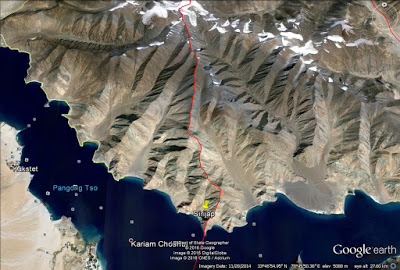
China can’t do much at the trijunction between Sikkim, Tibet and Bhutan, but Beijing has now started retaliating in other areas; while the confrontation continues near Doka La in Bhutan, some Chinese troops tried to occupy an area in Ladakh on the shores of the Pangong Tso.
According to India Today, the incident took place on Tuesday morning and lasted for about half-an-hour; later both sides pulled back: “Indian and Chinese forces had a brief face-off in the north bank of Pangong lake in Ladakh.”
A military source told the publication: “The Chinese patrols lost their way due to bad weather conditions but it ended up with heated exchanges between the two sides resulting in stone pelting as well that caused minor injuries to people on both sides.”
It shows the mounting tension following the Doklam confrontation.
Apparently the incident took place between Finger Four and Finger Five on the Pangong Tso (lake): “India claims the area till Finger Eight but controls and dominates up to Finger Four. The situation was brought under control after thirty minutes of face-off, when both sides held their banners indicating either side to pull back to their respective positions,” says the HT.
The South China Morning Post reported from Hong Kong: “Indian and Chinese soldiers were involved in an altercation in the western Himalayas …further raising tensions between the two countries which are already locked in a two-month stand-off in another part of the disputed border. …The two sides have frequently accused each other of intrusions into each other’s territories, but clashes are rare.”
Some reports say that the Chinese soldiers carried iron rods and stones, and in the melee there were minor injuries on both sides.

Cancellation of the Border Personnel Meetings
Another sign that the tension is mounting: Border Personnel Meetings (BPM) were to be held like every August 15 at five places along the border. This year they did not take place.
India and China hold BPM at five points: Daulat Beg Oldie and Chusul in Ladakh, Kibithoo and Bumla in Arunachal Pradesh and Nathu La in Sikkim.
Though invited the Chinese officials did not turn up. It shows that Beijing has not digested as yet the Doklam incident and the fact that India stopped them building a road.
Some Indian media reported that the meetings could not be held as China’s PLA officials did not respond to communications from the Indian Army.

The Hand-in-Hand joint military exercises
The fate of the annual India-China Hand-in-Hand joint military drill hangs also in balance as India has not received any word from the Chinese side, which is supposed to host the exercise this year.
Since 2007, when it was first held, an Initial Planning Conference (IPC) is held in the host country in June-July but so far there has been a ‘studied silence’ from Beijing, says The Economic Times which cites a source in the Army: “The IPC takes place in the country where the exercise would be held. We sent a message to the Chinese side but there was no response. It should have happened latest but July end, but the IPC never took place.”
They will probably no joint exercises this year.

No Rivers’ flow data
Perhaps more serious, it appears that China had stopped sending the routine information on river water flow of the Sutlej and Brahamaputra.
According to The Hindustan Times: “At a time when major rivers in Himachal Pradesh are in spate due to heavy rain, lack of information from China on water inflow from Pareechu rivulet that meanders through the Tibetan Autonomous Region (TAR) has prompted the Central Water Commission (CWC) to seek intervention of the ministry of water resources.”
It had been agreed that India and China would annually renew the protocol on sharing information on two major rivers — Brahmaputra and Sutlej: “But China has reportedly stopped sharing information with India on water inflow in Pareechu. The lake across the Pareechu river, which was measured the size of 20 football grounds, burst in 2005 causing major flooding in the Sutlej. Gushing waters had washed away the strategic Hindustan-Tibet road, National Highway-22 at a number of places, 10 bridges and 11 ropeways. About 15 motorable bridges and 8 jeepable roads and footbridges were damaged on the 10-km stretch of NH-22 between Wangtoo in Kinnaur and Samdoh in Lahaul Spiti districts.”
The HT’s report continues: “No loss of life was reported as the army and civil authorities anticipating the breach in glacial lake in Pareechu had evacuated 5,000 people along the Sutlej. Total losses caused due to flooding had been pegged at Rs 800 crore.”
The Pareechu river originates in India, then it meanders into Tibet and then merges into the Sutlej near Sumdoh (a border post in India). A glacial lake on Pareechu formed behind a landslide dam in 2004; on June 26, 2005, it busted provoking Glacial Lake Outburst Floods (GLOF). After the 2005 GLOF, India and China signed a protocol for sharing information on the water level from Pareechu and the Sutlej.
China has apparently stop sharing information about the water inflow, which makes it dangerous for the local population in Kinnaur.
Senior scientific officer, SS Randhawa told the HT: “The Himachal government constantly monitors the water flow in Pareechu through its department of science technology. But so far the department has been unable to get clear satellite images. Last time, we checked images on July 8 and there was no danger at that time. We use remote sensing technology to monitor the water bodies in the river catchment. But we have been unable to get clear images in the last one week as there are thick clouds over the catchment area.”
I have earlier mentioned the long article in The Global Times about the diversion of the Yarlung Tsangpo/Brahmaputra.
Another warning that Beijing has started retaliating for to the ‘loss’ of its road in Bhutan?
China is indeed playing a dangerous game.

Tuesday, July 4, 2017

When China refuses to talk about Bhutan and Sikkim boundaries.

Yesterday, the Chinese Foreign Ministry's spokesperson Geng Shuang stated that the border in Sikkim was well demarcated, according to the 1890 Convention between Great Britain and China and Doka La, the area of contention ‘belongs to China’.
He added that Indian Prime Minister Jawaharlal Nehru endorsed the 1890 Sino-British Treaty on Sikkim in a letter to Zhou Enlai in 1959.
Geng also said that successive Indian governments have also endorsed this.
This far from the truth.
In the Notes, Memoranda and letters Exchanged and Agreements signed between The Governments of India and China (White Paper IV for the period between September 1959 - March 1960), published by the Ministry of External Affairs, Government of India, Nehru’s letter to Zhou Enlai is reproduced (Letter from the Prime Minister of India to the Prime Minister of China, 26 September 1959)The issue of the 1890 Agreement is mentioned in para 17 of the letter.
The Indian Prime Minister makes 2 points:
One, Sikkim and Bhutan borders need to be included in any talk on the boundary; two, India stands by the 1890 agreement as far as Northern Sikkim is concerned.
Nehru writes:
It is not clear to us what exactly is the implication of your statement that the boundaries of Sikkim and Bhutan do not fall within the scope of the present discussion. In fact, Chinese maps show sizeable areas of Bhutan as part of Tibet. Under treaty relationships with Bhutan the Government of India are the only competent authority to take up with other Governments matters concerning Bhutan's external relations, and in fact we have taken up with your Government a number of matters on behalf of the Bhutan Government.
The Indian Prime Minister remarks that
The rectification of errors in Chinese maps regarding the boundary of Bhutan with Tibet is therefore a matter which has to be discussed along with the boundary of India with the Tibet region of China in the same sector.
It is exactly what is the problem today.
The para concludes:
As regards Sikkim, the Chinese Government recognised as far back as 1890 that the Government of India 'has direct and exclusive control over the internal administration and foreign relations of that State'.
This Convention of 1890 also defined the boundary between Sikkim and Tibet; and the boundary was later, in 1895, demarcated. There is thus no dispute regarding the boundary of Sikkim with the Tibet region.
This clearly refers to northern Sikkim and not to the trijunction which needed to be discussed with Bhutan and Sikkim and which is today the contentious area.
And once more, let us not forget that the 1890 Treaty was an unequal treaty as Tibet, Sikkim and Bhutan were not involved.

The 1960 Negotiations

In the Report of the Officials of the Governments of India and the Peoples’ Republic of China on the Boundary Question, India mentioned time and again that Sikkim and Bhutan (and therefore the trijunction) should be included in the agenda of the talks.
In a Statement Leading to The Adoption of The Agenda (summarized by the Indian side), the Indian Officials stated in Para 2:
The Chinese side in commenting on the Indian suggestion showed that they had a radically different conception of the procedure to be adopted for the meetings of the officials. For one thing, the Chinese side did not consider it necessary to exchange maps and descriptions for the fulfillment of the assignment given to the officials.
Further, the Chinese side stated that the question of the boundaries of Bhutan and Sikkim fell outside the purview of these meetings. According to them, the task envisaged in the Joint Communique could best be taken up by both sides making preliminary general statements of their viewpoints on the Sino-Indian boundary question and from the text of these statements a list of questions could, be drawn up and such a list could serve as the Agenda for the meetings.
This was not acceptable to India, as to reach a comprehensive solution for the dispute all the aspects/parts of the boundary had to be included.
In Para 17, the Indian side further also pointed out
that since the terms of reference for the meetings of the officials were to examine factual material on the differences which had arisen between the Indian and the Chinese Governments regarding the border areas, it was not justified to exclude from consideration the boundaries of Bhutan and Sikkim.
Indeed, references to these boundaries had already been made in the correspondence between the two Governments. For example, the Chinese Government's note of the 26th December, 1959, in reply to the Indian Prime Minister's letter of the 26th September, had dealt with the question of Bhutan and Sikkim. By the terms of the Treaties between these States and India, the latter clearly had responsibility for the external relations of Bhutan and Sikkim and at Bhutan's request the Government of India had already represented to the Chinese Government on matters pertaining to her interests in Tibet.
The question was important because there existed a discrepancy between the correct delineation of the boundaries of Bhutan and that shown on Chinese maps. Moreover, the relevance of these questions to the present dispute had been clearly affirmed by the Prime Minister of India in his talks with Premier Chou En-lai.
China stubbornly refused to discuss the issue. As a result, Beijing can today pretend that the boundary was fixed in 1890.


The Special Representatives take over
More recently, the issue has been taken on by the Special Representatives (SRs) and as mentioned in the June 30’s Statement of the Ministry of External Affairs,
the Indian side has underlined that the two Governments had in 2012 reached agreement that the tri-junction boundary points between India, China and third countries will be finalized in consultation with the concerned countries. Any attempt, therefore, to unilaterally determine tri-junction points is in violation of this understanding.
It also asserted:
Where the boundary in the Sikkim sector is concerned, India and China had reached an understanding also in 2012 reconfirming their mutual agreement on the 'basis of the alignment'. Further discussions regarding finalization of the boundary have been taking place under the Special Representatives framework.
During the 2012's talks between the SRs, the two Governments had reached an agreement that the tri-junction boundary points between India, China and a third countries would be finalized in consultation with the concerned countries. It was agreed that any attempt to unilaterally determine tri-junction points would be a violation of this understanding.
As far as the boundary in the Sikkim sector was concerned, India and China had reached reconfirmed their mutual agreement on the 'basis of the alignment' and that further discussions regarding finalization of the boundary would take place under the Special Representatives framework.
It was also pointed out that it was essential that all parties concerned display utmost restraint and abide by their respective bilateral understandings not to change the status quo unilaterally. The consensus reached between India and China through the Special Representatives process was to be scrupulously respected by both sides.
A few weeks ago, China unilaterally started building a road in the contentious area; they have therefore broken the 2012 agreement.

The 1890 treaty is clearly a diversion from the historical facts.
It is however regrettable that the MEA is unable to explain better these facts.

Tuesday, November 8, 2016

Some good news on the border front

C-17 lands in Menchuka
First the Indian Air Force successfully carried out a test landing and take-off of C-17 Globemaster-III at Mechuka’s Advanced Landing Ground (ALG).
A couple of years ago, I visited Mechuka which is strategically located in Arunachal Pradesh just 29 km from the border. (See The last village in 'our' Arunachal)
After the upgradation of Mechuka's ALG, the giant Boeing C-17 could land. It should eventually ensure transport of men and material in the remote border village of West Siang district of Arunachal, which was invaded by the Chinese in 1962.
Let us not forget that Dibrugarh the nearest air/rail head is located some 500 km away (practically 2 days drive).
India Today reported: “The aircraft was received by the Detachment Commander Fight Lieutenant S. Dixit on its maiden landing in Mechuka. The aircrew who, were part of this historic landing, included Group Capt TR Ravi, Wing Commander P Sisodia, Wing Commander AK Patnaik, MWO Tripathi and WO Nirana Ram. In the event of a disaster in the region, C-17 operations to the remote ALG can enhance the speed and quantum of national relief effort.”
This is a great step for the defence of the border in Arunachal and for the welfare of the local population.

The other good news
India did not back out when confronted to the People’s Liberation Army (PLA) is Demchok village in South-East Ladakh.
The national press reported that the Indo-Tibetan Border Police (ITBP) and the Indian Army were caught in an eyeball to eyeball situation with PLA on the Line of Actual Control (LAC) in Demchok.
As mentioned on this block, in April, the residents of Demchok had appealed to the Deputy Commissioner in Leh for their resettlement elsewhere in the district because of continuous obstructions to any developmental work in the area by the Chinese troops.
Quoting some Army sources, Scoops.news, a Ladakhi website says that “nearly two platoons of PLA came close to Indian territories in Demchok village and objected to laying of a water pipe for use irrigation and drinking purpose, a project being carried out by the state Rural Development Department (RDD) in the area.”
The same source explained: “Both sides have been holding their respective positions. On Wednesday [November 2], PLA personnel appeared on the scene and raised objection to ongoing civilian construction work and stayed there for whole day and returned in the late evening. Surprisingly, they appeared once again next day morning.”
The PLA asked the local people to immediately stopped the work; the Chinese quoted the agreement between India and China, which says that either side needs prior permission before undertaking any construction work.
This argument did not fool the Indian Army who pointed out to the Chinese that the Indo-Sino border agreement specifically says that information about the construction needs to be shared only in case the development was meant for defence purpose and not otherwise, particularly NOT for civilian works.
While both sides denied incursions or transgressions, the Indian side clarified that issues, if any, can be resolved at a local level with the Chinese officials at Border Meeting Point (Chushul in this case).
Meetings are regularly held to sort out of contentious issues between the two sides.
The interesting point is that despite the Chinese presence, the local population continued to work on the irrigation channels.

The work is completed
Finally on the third day, local engineers could finish laying a water pipeline for irrigation of the remote Indian village. The pipeline is nearly a kilometre long. The stalemate ended on November 5 in the evening.
India Today says that “the formula of 'active patrolling' adopted by the ITBP and the Army ever since 2013's fortnight-long stand-off near Daulat Beig Oldie [DBO] has been reaping rich dividends and Chinese have been cautious in carrying out incursion especially in Ladakh sector.”
The Army and the ITBP personnel did not allow the PLA guards to erect a hut and the Chinese ultimately had to take the material back to their base camp in Tibet.
The scene witnessed the holding of 'ritual' banners: “It is my territory, Go back”.
Construction was completed in the Indian side of the nalla
The fact remains that the work was done.

Some History
Historically Demchok has always belonged to Ladakh and has never been part of Tibet. I am quoting here from one on my articles on the subject.

On August 14, 1939, as he camped near Gartok, one of the three British (Indian) Trade Agencies in Tibet, Rai Bahadur Dr Kanshi Ram, the British Trade Agent (BTA) in Western Tibet, found finally time to write to the Political Agent of the Punjab Hill States in Simla: “I have the honour to submit herewith the following report of my journey from Simla to Gartok via Srinagar and Leh, Kashmir,” Ram started.
He had left Simla on May 20 to reach Srinagar on May 27; after a week-long stay in the Valley, he began his journey to the Tibetan border. He was accompanied by the Wazir Wazarat of Ladakh; both were to meet the Garpon or Governor of Western Tibet for a tripartite inquiry into the alleged murder of a Tibetan, Champa Skaldan by Zaildar, a Ladakhi of Rupchu. The crime had been committed in Ladakh a few years earlier.
After a week-halt in Leh, they started for Demchok, the last Ladakhi village before the Tibetan border. They reached Demchok on July 17, 1939, where they were to meet the Senior and Junior Garpons; the inquiry started three days later.
Dr Kanshi Ram, in his report to Simla, notes: “On the night of July 21 the stream by the side of which we were camping suddenly rose to higher level and began to flow over our camping ground at midnight. We were abed as alarm was raised and we then got up and took our luggage and other belongings to a place of safety, and had to keep awake throughout the night. The rain which began to pour down since morning was still continuing. The next morning we crossed the stream and camped on the Tibetan border at a place of safety. The Wazir also renewed his camp some yards away from the stream amongst the boulders. This stream forms a natural boundary between Tibet and Kashmir at Demchok.”
This is interesting because it shows that before Independence, the Indo-Tibet border in Ladakh was well defined and agreed upon by the government of British India (represented by the BTA), the State of J&K (the Wazir) and the Tibetan Government (the Garpons).
It is not true anymore; since the end of the 1950s, a very large area around Demchok is claimed by Beijing though no Chinese had ever been seen in the area. The fact is that soon after invading the Tibetan plateau, the Communist regime in Beijing started claiming more and more of India’s territory in the Himalaya.
Demchok is in fact a case study of Chinese ‘advances’ which resulted in what today is called a ‘difference of perceptions’ on the LAC.

The building of the Aksai Chin road
The Chinese ‘advances’ in the Demchok sector began with the objective to protect a new road linking Tibet to Xinjiang in the Aksai Chin area.
Though the issue would only become public through a debate in the Lok Sabha in August 1959, in the early 1950s already, Delhi was aware that China was building a road, but South Block was not ready to acknowledge it.
The Official Report of the 1962 War published by the MoD states: “The preliminary survey work on the planned Tibet-Sinkiang road having been completed by the mid-1950’s, China started constructing motorable road in summer 1955. The highway ran over 160 km across the Aksai Chin region of north-east Ladakh. It was completed in the second half of 1957. Arterial roads connecting the highway with Tibet were also laid. On 6 October 1957, the Sinkiang-Tibet road was formally opened with a ceremony in Gartok and twelve trucks on a trial run from Yarkand reached Gartok. In January 1958, the China News Agency reported that the Sinkiang-Tibet highway had been opened two months earlier and the road was being fully utilised.”
In his book The Saga of Ladakh, Maj Gen Jagjit Singh mentions that in 1956, the Indian Military Attaché in Beijing, Brig Mallik received information that China had started building a highway through Indian territory in the Aksai Chin area. Mallik had reported the matter to Army Headquarters in New Delhi which passed the report to South Block.
Other examples could be given, but the fact that the road lies close to Demchok, triggered the Chinese claims on the area.

Tuesday, November 3, 2015

Fan Changlong is coming to India

J-20s taking off from Shigatse
My article  Fan Changlong is coming to India appeared in NitiCentral.

Here is the link...

During the month of November, India will receive two important visitors from China; both are members of the Politburo of the Central Committee of the Chinese Communist Party.
First, Chinese Vice-President Li Yuanchao is scheduled to arrive in India on November 3. Lu Kang, one of the spokespersons of the Chinese Foreign Ministry announced that Li is coming at the invitation of Vice-President Hamid Ansari: “it is another major interaction between the two sides, which will help inject new momentum to bilateral ties,” said Lu.
The spokesperson added: "With concerted efforts strategic partnership of cooperation between China and India for peace and prosperity has seen sound and stable development. The two sides have deeper exchanges of cooperation and maintained sound coordination on regional and international affairs.”
Lu also said that the leaders of both countries have agreed to deepen their cooperation and have even closer partnership for development.
Does it mean a common position at the 2015 United Nations Climate Change Conference, known as COP 21, in Paris later this month?
It won’t probably go that far, though the issues to be discussed at the Conference will certainly be on the agenda of the Chinese Vice-President when he meets Indian leaders.
Perhaps more importantly, General Fan Changlong, the senior vice-chairman of the Central Military Commission (CMC), the highest uniformed official in the Middle Kingdom, is due to visit Delhi later this month.
Xinhua published a terse statement on October 29: “Fan Changlong, vice chairman of China's CMC, will visit Pakistan and India in mid-November.”
During his monthly Press Conference, Senior Colonel Yang Yujun, spokesman for the Ministry of National Defense (MND), answered three questions related to India.
Yang was first asked about the Line of Actual Control (LAC).
The questioner noted: “The Indian and Chinese military officials held talks on the Working Mechanisms for Cooperation and Coordination (WMCC), especially relating to the border issues early this month. [During] the last press conference, the PLA spokesman had stated that the Indian military had actually violated the consensus reached as far as certain border stand-offs are concerned. Has this issue been discussed at that WMCC meeting?”
The Senior Colonel spoke about the discreetly-held WMCC meeting in Beijing on October 8 and 9; he said: “both sides gave a review of the border situation between China and India and the promotion of mutual trust in the past year; they also had an in-depth exchange of views on issues concerning the peace and stability along the border.”
Nothing offensive for a change!
He did not want to comment further on the unpleasant Burtse incident in Ladakh which witnessed a confrontation between the 2 Armies. At that time, The Global Times, quoting Jiang Jingkui, director of the Department of South Asian Languages at Peking University had affirmed: “this is not the first time that Indian media has reported 'confrontations' that do not exist in the Sino-Indian border area. These [type of] news are often untrue, negative, misleading and aimed at provoking public opinion."
Only the future will tell us if the WMCC fine-tuning can help avoid such incidents in the future. However, as General Fan will be in India, it will certainly be a good occasion to question him on the regular PLA incursions across the high-altitude border and his views on the LAC.
It may also be a good occasion to ask the powerful general to show the Chinese ‘perceptions’ on a map.
The second question related to the recently concluded counterterrorism exercises (‘Hand-in-Hand’) by China and India in Kunming in Yunnan province: “what are the prospects for any joint anti-terrorism operation in the neighborhood if and when it is required?”
The answer was rather vague, but indicative of the seriousness of the ‘terrorist’ threat for Beijing, even if it is sometimes mixed up with the aspirations of the Tibetan and Uyghur minorities for more freedom from the Han domination.
Yang Yujun said: “terrorism is the common enemy of the international community and the Chinese side is against all forms of terrorism. We are committed to the international cooperation against terrorism. The PLA shoulders the responsibility of counter-terrorism and we will do our work according to the arrangement of the Chinese government.”
The last question on India was about General Fan’s visit.
The Senior Colonel explained that according to this year's plan for foreign military exchange, General Fan should pay an official visit to Pakistan and India: “The purpose of this visit is to implement the consensus reached by the state leaders of both sides, enhance friendly exchanges between the Chinese military and its foreign counterparts, and to jointly maintain regional peace and stability.”
Let us not that forgot that over 50 PLA officers with rank of major general and above, were shown the door (of the prison) during the last 2 years and Fan has not only been President Xi Jinping’s reliable ally in his fight against corruption, but a fire fighter, when things are getting too hot.
In June, Fan was sent to Washington to meet US Defence Secretary Ash Carter to prepare Xi Jinping’s trip to the US. At a time when the US called for a halt to land reclamation in the South China Sea, General Fan declared that China was committed to developing “a sustained and substantive US-China military-to-military relationship”.
It eventually helped the Xi-Obama Summit to reach a consensus on a memorandum of understanding to reduce the risk of accidents when the two navies operate in close proximity.
According to Sina.com, an official Chinese web portal, Fan Changlong recently stated that China has always advocated handling disputes through peaceful means; Beijing will not use force recklessly, even for issues related to territory and sovereignty. China’s neighbours were probably happy to hear this, even if they are not fully convinced.
While addressing the sixth Xiangshan Forum, a bi-yearly defense experts’ exchange in Beijing, Fan asserted that China always insists on sorting out disputes through friendly negotiations with parties directly involved; Beijing “will try its best to avoid unexpected conflicts,” he said.
The article, republished in The Global Times, quotes the CMC’s vice-chairman noting: “China has settled land and border issues with a majority of neighboring countries through consultation.”
Of course not with India, through the ‘consultations’ are on for the past 55 years.
Regarding growing concerns over the construction on reefs in the South China Sea, Fan affirmed “the construction, mostly for civilian purposes, would improve marine navigation and provide public services.”
Nobody may have believed this in Washington, but in the meantime, the Permanent Court of Arbitration ruled that it had jurisdiction over 15 submissions by Manila, including one that calls into question the validity of China's claims based on the nine-dash line under international maritime law as defined by the United Nations Convention on the Law of the Sea (UNCLOS), a Convention ratified by China.
The South China Morning Post said: “The decision came as China's navy chief warned his US counterpart encounters between their forces could spiral into conflict, two days after a US destroyer sailed close to Beijing's artificial South China Sea islands.”
This clearly shows the contradiction between what General Fan says and Beijing’s actions on the South China Sea where the Chinese Navy increases its control over territories claimed by The Philippines, Vietnam, Malaysia, Indonesia and Brunei.
For India, it is a sign that as long as Delhi does not dispute Beijing’s stand in Ladakh or Arunachal, China is ready ‘to settle land and border issues through consultation’.
But as India does not accept China’s claims, can the border remain peaceful?
Fan should be asked to give some assurance.

Sunday, May 31, 2015

How the Chinese fooled Nehru in Tibet

General Zhang Jingwu near Lhasa (August 1951)
While the Indian archives are still jealously kept by the Ministry of External Affairs (and other Indian ministries), the Chinese are slowly (and selectively) declassifying their archives.
A cable from General Zhang Jingwu, 'On Issues of Relations between China and India in Tibet' dating October 21, 1953, is one example.
A translation was recently released by Digital Archive of the Wilson Centre (International History Declassified). It belongs to the History and Public Policy Program Digital Archive, Ministry of Foreign Affairs of the People’s Republic of China.
Zhang Jingwu was one of the signatories of the infamous Seventeen-Point Agreement between the People's Republic of China and a Tibetan delegation (the so-called local government of Tibet).
Later, General Zhang became the representative in Tibet of the Central Committee of the Community Party of China; in July 1951, Zhang went to Yatung (via Hong Kong) to persuade the Fourteenth Dalai Lama to return to Lhasa. During the following years, he acted as Beijing’s representative in Tibet and was designated as Secretary of the Tibet Work Committee.
A few words about the background of General Zhang’s cable to the Ministry of Foreign Affairs in Beijing: Nehru wanted to re-negotiate the Simla Convention (of 1914) with China, taking into accounts the new situation: Tibet was an independent nation anymore after the PLA invaded the Roof of the World in October 1950
In September 1952, before his transfer to Cairo, K.M. Panikkar, who had been ‘ambassador in Two Chinas’, had several meetings with Zhou Enlai, the Chinese Premier. The latter told the gullible Indian ambassador that the downgrading of the Lhasa Mission was only the first step to pave the way for negotiations on ‘all outstanding problems’. The conversion of the Indian Mission into a Consulate General in Lhasa was a tragedy in itself; unfortunately Nehru had readily agreed to the Chinese ‘proposal’.
I quote here from my book: Born in Sin, the Panchsheel Agreement.

During the first months of 1953, Nehru may have felt that the situation was settling down in Tibet and slowly the Tibetans were accepting the invasion of their country by the Liberation Army as a fait accompli.
In September 1953, Nehru wrote to his Chinese counterpart that India was anxious to come to a final settlement about “pending matters so as to avoid any misunderstanding and friction at any time”. Quoting a letter sent one year earlier, he said that “No further steps have been taken since then to negotiate a settlement”.
It appears that different visitors and informants were briefing Nehru about the situation inside Tibet. It was reported that everything was quiet on the Roof of the World. In early December 1953, Nehru mentions that, he had received a letter from George Roerich, the Russian painter and scholar living in Kulu giving him more information. After admitting that “our Intelligence has looked upon them [the Roerich] with some slight suspicion although they have never had anything to get hold of,” Nehru told T.N. Kaul, the Joint Secretary in the China Desk in the Ministry of External Affairs: “His [Roerich] general report to me has been that things are very calm in Tibet and both the people and the Lama hierarchy have adjusted themselves to the new order. This is chiefly so because the Chinese have refrained from interfering in anything. The Tibetans are, therefore, not so apprehensive as they used to be.”
As we have seen in the case of food supply to the Chinese troops and the sacking of the Tibetan Prime Ministers, the report was not completely true. The Chinese had begun interfering actively in the life of the Tibetans. In fact, they started meddling in the internal affairs of Tibet almost immediately after the signature of the 17-Point Agreement.
Nehru considered that the time had come to renegotiate the old Simla Convention signed in 1914 between the British and the Tibetans. He therefore decided to take the initiative and propose negotiations to resolve ‘all outstanding issues’. The talks were to begin in December 1953 in Beijing and were scheduled to last a maximum of six weeks. Unfortunately, they would take four months to reach a conclusion. Kaul, one of the main negotiators in Beijing described the preparations for the Conference thus: “Many meetings and discussions were held and it was decided to sound the Chinese. Not unexpectedly they welcomed the idea. It was decided to send a small delegation to Peking to discuss the matter and reach an agreement, if possible. The spade work had already been done by Panikkar, [N.] Raghavan and me in Peking. The new Indian Ambassador to China, N. Raghavan, was appointed the leader and I the deputy-leader of the Indian delegation. Director, Historical Division, External Affairs Ministry, the late Dr. Gopalachari, was a member. His knowledge of history and facts of the Sino-Indian border was an asset. We were authorised to co-opt such other members of the Embassy as we found necessary. It was a small delegation, as delegations go, but convenient and closely knit.”
Most of the correspondence or instructions during the following months was routed through Kaul, one of Nehru’s Kashmiri blue-eyed boys.

The Instructions
In early December, the Secretary General put up a Note in which he defined the main points for discussions at what became known as the Beijing Conference. The points were:
  1. The question of India’s frontier with Tibet,
  2. Indo-Tibetan trade and trade agencies,
  3. Freedom of movement of Indian and Tibetan traders and pilgrims,
  4. Passports and visas,
  5. Telegraph, post office and hospitals
  6. Security guards and escorts and
  7. Special position of Bhutan.
On 3 December 1953, Nehru replied to this Note giving the framework for negotiations to be held in Beijing regarding the relations between India and China and India’s interests in Tibet. He clarified the position to be adopted by the Indian delegation during the Beijing Conference. More particularly on the border question, though he generally agreed with the points made by the Secretary General, he chose to remain faithful to the Panikkar doctrine, which says ‘remain silent about the border’. Nehru wrote: “We should not raise this question. If the Chinese raise it, we should express our surprise and point out that this is a settled issue. Further, during the last two years or so, when reference was frequently made about Indo-Chinese or Indo-Tibetan problems, there has never been any reference to this frontier issue and it is surprising that this should be brought up now. Our delegation cannot discuss it.”
Though Panikkar had been transferred more than a year earlier to Cairo, Nehru was still keen to consult him on China’s affairs. The former Ambassador had suggested a step further, he had written: “if China insisted on reopening the whole issues of the frontier, the Indian delegation could walk out of the conference and break off the negotiations.” Nehru was not as extreme as Panikkar, he did not recommend walking out of the Conference, his instructions were: “We should avoid walking out unless the Chinese insist on taking up this question. If such an eventuality occurs, the matter will no doubt be referred to us.”
To agree to discuss the border issue was for Panikkar an admission that there was a problem. But can wishful thinking take away an issue?
Nehru also believed that it was important to keep the trade marts alive as he envisioned an increase in the commercial exchanges with Tibet in the future. He wrote: “Tibet is our natural market and we should develop it normally.” He was in favour of keeping the trade agencies functional: “Gartok is important. Yatung especially, and, to some extent, Gyantse are likely to become more important as trade between India and Tibet increases. They are on the main route. Therefore, it is eminently reasonable that we should have some trade agents there or at least at Yatung.”

In October 1953, General Zhang sent his perceptions on these questions to the Ministry of Foreign Affairs in Beijing. At that time, China was getting ready to seat for new negotiations with India.

Some points have to be noted:
•    In 1953, China still needs India, not only ‘for some international’ issues, but to supply the PLA in Tibet [see my post on the supply of Indian rice to the PLA]. It is only a year later that the Qinghai-Tibet and the Sichuan-Tibet roads will be opened rendering the PLA in Tibet non-dependent on the trade with India.
•    General Zhang speaks of China’s “insufficient understanding of imperialist privileges in Tibet”, but during the following months and years, Beijing will learn very fast; at the same time, India will be fooled in abandoning all its ‘privileges’ accrued from the Simla Convention. This is a great tragedy.
•    Zhang understood that the time was ripe to make China’s occupation ‘official’: “delaying the settlement of these issues is not good”. Beijing need to officialize its presence on the Roof of the World through a Treaty/Agreement. A few months later, the Panchsheel Agreement would be sign.
•    Zhang then brings Tawang “which is Indian according to the 1914 Simla Accord”. He says that if Beijing agrees to “the absence of territorial disputes”, China would “implicitly acknowledge and legitimize India’s occupation.” It is a fact that earlier, China has never complained about the Indian administration of Tawang and Kameng Frontier Division. It is probably in 1953 only that Beijing realized the Indian move by Major Bob Khathing and his men.
•    Zhang mentions that in July 1948 (in fact it was in July 1947] India notified the Tibetan government “that it would succeed the privileges of Britain in Tibet”. According to Zhang: “Tibet replied in October [1948] that signing a new treaty was acceptable but India must first return the lands occupied by Britain, e.g. Tawang, Bhutan, and Sikkim.” This obnoxious ‘offer’ is unfortunately true. In fact, Lhasa added Ladakh to the list. The Tibetans were living in another world.
•    Zhang states that “according to the discussions with Ngapoi [Ngapo Ngawang Jigme] and Liushar, such treaties were secretly signed and the Kashag, the Tibetan Cabinet did not know about the maps, when Tibet was forced to sign them”. This is obviously not correct because Lochen Shatra, the Tibetan Plenipotentiary in Simla, had informed Sir Henry McMahon that he had received his instructions from Lhasa to sign the maps. It is however possible that the Kashag in the 1940s was unaware of the details of the Simla Agreement, particularly the pilgrimage area south of the Line. I had dealt with this in detail in my book, 1962, the McMahon Line Saga.
•    Zhang makes 3 propositions to settle the border: abolish the Simla Accord, India’s withdrawal from Tawang and Lower Luoyu [Loyul, i.e. Siang Frontier Division] and China and India must discuss the dividing lines between both countries. Zhang concludes “It is in our interest to delay the settlement of these issues.”
•    Zhang admits that discussions have been held with Ngabo and Liushar, with both expressing their agreement. There is no doubt that, as the Chinese established their presence in Tibet, several Tibetan officials were on the Chinese side against India …and against Tibet. But this is another story.
•    Zhang’s suggestions are that India should drop all its so-called privileges in Tibet and in counterpart China should gain new privileges in India. It is what Nehru agreed to during the following months. It is called ‘negotiations with Chinese characteristics’, 'you lose everything and China wins everything'.

 
The Dalai Lama with General Zhang Jingwu in the 1950s

Here is General Zhang Jingwu’s cable dated October 21, 1953.

To the Ministry of Foreign Affairs:
Your correspondence dated 7 October [1953] and the two types of Indian documents have been received. Research shows that the assumption that “India intends to capitalize this opportunity to have some benefit in Tibet,” as mentioned in your correspondence, is very accurate. Based on the information that we have at hand about Tibet, we still need Indian cooperation in some international issues. However, India is capitalizing on our temporary difficulties in Tibet, particularly our insufficient understanding of imperialist privileges in Tibet and the ideal solution to border disputes, as well as our need for India’s cooperation in various areas, to gain benefits by offering a general solution to the Tibet issue.
As a matter of fact, there have always been disputes on some issues, e.g. commercial exchanges and representative offices, because we have always claimed our sovereignty over Tibet. Delaying the settlement of these issues is not good and therefore a solution to them is applauded. If such disputes continue to occur in the years to come, our relations with India may be aggravated with the instigations of some bad-willed nations. Therefore, it is correct to engage in negotiations with India as mentioned in your correspondence.
According to the Indian documents, they emphasize that “India and China have no territorial disputes” (Nehru, the Indian politician, also stated so during his speech in the Upper House of the Parliament). This is where the plot of India lies. Today, India occupies the Dawang [Tawang] Region according to the 1914 Simla Accord. However, it claimed the absence of territorial disputes just to force us into implicitly acknowledging and legitimizing their occupation. We must stay alert in this regard.
According to the information at hand and the results of negotiations with Ngapoi [Ngawang Jigme] and [Thupten Tharpa] Liushar, they reiterated that there were no public or secret treaties with foreign countries except for the Simla Accord. We assumed the Dalai [Lama] might have purchased arms from Britain and India but it is hard to make sure if they have signed any formal treaty. After its independence, India notified Tibet in July 1948 that it would succeed the privileges of Britain in Tibet. Tibet replied in October that signing a new treaty was acceptable but India must first return the lands occupied by Britain, e.g. Tawang, Bhutan, and Sikkim. In December, India replied and asked Tibet to promise to maintain the status quo then regarding India-Tibet relations before a new treaty was established (i.e. the old treaties should remain effective). Otherwise, trade between Tibet and India would be out of the question (the document has been delivered to me). This is the base of Tibet-India relations.
Other than some conventional practices, the so-called ‘status quo’ is based on the Simla Accord among Britain, India, and China, the Tibet-Britain commercial treaties, and the Tibet-Britain declaration and attached maps (these documents have been delivered to me. Please refer to the correspondences dated 16 September for details). The accord includes eleven articles. It recognizes the effectiveness of the treaties established on 1809 [probably meaning 1890], 1904, and 1906 and repeals the two commercial treaties signed in 1893 and 1908. According to the discussions with Ngapoi and Liushar, such treaties were secretly signed and Xiazha (the signatory [the Kashag, the Tibetan Cabinet] did not know about the maps) when Tibet was forced to sign them. It is also said that “such treaties shall be abolished if India recognizes that Tibet is part of China.” The so-called McMahon Line was established in the Simla Accord. However, Tibet later found that two holy mountains were located in the Indian territory land and raised its demurral. Britain then agreed to shift the line southward and have Sera [Sela?] as the border (some of the documents have been delivered to me). However, this line is already over Sera [Sela?] and reaches Tawang now.
According to the foregoing information, one of the main Tibet issues facing India involves these treaties and the bilateral borders, i.e. the Simla Accord and the so-called McMahon Line. We are of the opinion that:
  1. We must declare abolishment of the old accord, i.e. the Simla Accord, which was not recognized by the former Chinese Government;
  2. India must withdraw from Chinese Tawang and Lower Luoyu [Loyul] which it currently occupies;
  3. China and India may discuss the dividing lines between both countries. It is impossible to fundamentally settle the issues regarding the accord and the border. It is in our interest to delay the settlement of these issues. However, we have to make further declarations. Otherwise, we would be deemed to have implicitly acknowledged the status quo and hence be put in a rather disadvantaged position.
Other than the issues of the accord and the border, we should negotiate with India to settle other issues as mentioned in the correspondences, e.g. trade, troops, pilgrimage (border entry and exit), and commercial representative facilities. These issues can and must be settled. According to the correspondences received from India last February, the two types of documents received recently, and the Indian propaganda in the newspapers, India intends to capitalize on the current situation to gain certain benefits, e.g. legitimization of three representative offices in Gyantse, free entry for pilgrimage, expansion of trade territories, withdrawal of Indian troops, and other issues. In addition to the proposals made on 24 March 1952, we have also come up with the following supplementary solutions according to the present conditions:
  1. Indian troops and officials should be withdrawn.
  2. Postal facilities shall be taken back. The local postal administration of the Tibetan Government has reached Pali [Phari Dzong]. With our assistance, the postal services will not be a problem even after the Indian postal facilities are withdrawn.
  3. Indian radio facilities shall also be withdrawn or transferred to us (at a reasonable price). Cabled facilities shall be transferred to us at a reasonable price. We have established our telecommunication facilities at Yadong [Yatung] , Gyantse, and Lhasa and international telecommunication services may also be established there. The telephones may be withdrawn by India or transferred to us.
  4. All posthouses [Dak Bungalows] relating to posts and telecommunications shall be withdrawn.
  5. The Xiasima [?] administration shall also be withdrawn.
  6. Commerce in Gartok [Western Tibet] cannot be stopped right now and shall be continued. The Indian commercial representative may acknowledge the conventional practice, i.e. conducting trade where designated during a certain period in the year. However, we must dispatch our commercial representative to Simla or Kalimpong in exchange.
  7. As a consulate general already exists in Lhasa, the Indian commercial representatives in Yadong and Gyantse shall be cancelled. If India still asks to maintain them, they may be converted into consulates although only Yadong may be allowed to accommodate them and we must have a consulate or formal commercial representative in Kalimpong in exchange. We believe having one representative facility in Kalimpong is to our benefit.
  8. Regarding the radio stations that the Consulate General of India has in Lhasa and the possible establishment of radio stations by India’s representative facilities at Yadong and Gartok in the future, we believe that our representative facilities in India must also set up radio stations in exchange. Otherwise, neither side shall set up radio facilities. We have a telecommunication bureau (Ngari Prefecture Government has dispatched personnel to the radio station) and we can send the telegraphs.
  9. Trade locations: trade shall be conducted at Gartok and Puguanzong [Purang Dzong] in Ngari Prefecture and in Yadong, Gyantse, or Lhasa. India proposes Kalimpong, Calcutta, Simla, Gandu [Gangtok?], or Siliguri as its trading places.
  10. Regarding frontier entry and exit for trading purposes, we are of the opinion that free entry and exit may be allowed on a mutually beneficial basis, without the need for any passport or visa. However, both countries shall issue a license to their respective merchants as evidence. When it becomes mature one or two years later, relevant rules on entry and exit visas may be established.
  11. Taxation issue: we recommend following conventional practices one to two years before the Customs is established, i.e. no import and export taxes shall be levied.
  12. Locations shall be designated for pilgrimage purpose: we designate Mt. Kailas and Lake Manasarovar in Ngari and India designates Lumbini (where Sakyamuni died) and Varanasi (where Sakyamuni recited sermons for the first time) for pilgrimage purposes. Both countries may further designate the routes of pilgrimage.
  13. It is recommended that both countries establish relevant articles or agreements to replace historical treaties and accords regarding the foregoing issues.
Discussions have been held with Ngapoi and Liushar on the foregoing issues and they both expressed their agreement. In addition, the Foreign Office has collected some materials on Tibet’s foreign relations, imperialist privileges in Tibet, and India’s conditions in Yadong and Gyantse. The Tibetan government has submitted the Simla Accord and other documents as reference materials in the negotiations. We recommend that Yang Gongsu [head of the Foreign Bureau in Lhasa] should take various types of materials and accords to Beijing for negotiations. After any new agreement is reached, he can also return to Tibet and make preparations according to the spirit and provisions of the agreement. It is expected to benefit the foreign affairs work of Tibet.
Please consider the abovementioned proposals and provide your feedback as soon as possible.
[General] Zhang Jingwu
21 October 1953

Tuesday, May 26, 2015

1960: The views of the two Governments remain as far apart as before

Nehru, Zhou Enlai, Chen Yi, Swaran Singh (April 1960)
During the annual K.F. Rustamji lecture, National Security Advisor Ajit Doval, (who is also Special Representative for the border talks with China), affirmed that while India's relations with China ‘were looking up’, but there was a need to remain at a ‘very very high alert’.
Speaking on 'Challenges of Securing India’s Borders: Strategising the Response’, Doval admitted: "We might have to see China border in a different way once the boundary is settled.”
According to PTI, he explained: “We have got a very long border, we have got 3,488-km [?] long border, a very difficult and mountainous terrain snow-clad... now for the bilateral relations with China, border is the critical and vital issue.”
After he affirmed that ‘advancement made in the relationship with China are centred around the settlement of the border’, he touched upon Arunachal Pradesh: “We are particularly concerned about the Eastern sector where the claims have been made on Tawang (in Arunachal Pradesh) which is totally in contravention of accepted principles."
Doval refers here to ‘Agreement between the Government of the Republic of India and the Government of the People's Republic of China on the Political Parameters and Guiding Principles for the Settlement of the India-China Boundary Question’ signed on April 11, 2005.
Article VI says: “The boundary should be along well-defined and easily identifiable natural geographical features to be mutually agreed upon between the two sides.”
And even more importantly, Article VII speaks of the ‘settled population’: “In reaching a boundary settlement, the two sides shall safeguard due interests of their settled populations in the border areas.”
Doval rightly said: “The fact is there is settled population in these areas particularly in Tawang and other areas which have been participating in the national mainstream all through.”
Apparently, Beijing has forgotten about the 2005 Guidelines!
It is a serious issue, because if an agreement is reached after a lot of efforts and time and soon after, Beijing become affected by Alzheimer disease, it is a problem.
Doval mentioned another point: he was surprised that while McMahon line was agreed till Burma by China (in 1960), the same principle was not accepted in the case of India.
He concluded: “So, these are the ticklish issues. But these ticklish issues have to be talked about, deliberated and worked out …there was a need for working out a larger plan for tackling China.”
He also admitted that the Special Representative talks between India and China on the boundary issue had not made any headway so far: “There have been a series of Special Representative level talks, about 17 rounds and they haven't reached anywhere. But it is also true that for last 30 years we have not exchanged a single bullet. But, it is also true that the number of intrusions have gone up and down. Fortunately, in the last one year the intrusions have become much less and some of the intrusions which have been made were controlled."
Beijing was quick to react.
Foreign ministry spokesperson Hua Chunying declared:  “The Chinese side holds a consistent and clear position on the eastern section of the China-India boundary: Aunachal Pradesh is a part of Southern Tibet.”
She explained: “The Chinese government does not recognise the McMahon Line, which is illegal,” adding: “The Chinese side is ready to work with the Indian side to resolve the boundary question through friendly consultation at an early date and create more favourable conditions for the development of the bilateral relations."
Hua did not mentioned directly the McMahon Line and Burma, she just said: “it is not easy to resolve the China-India boundary question, as it is an issue left over from history. …During Indian Prime Minister Narendra Modi's recent visit to China, the two sides reaffirmed their commitment to a fair, reasonable and mutually acceptable solution to the boundary question by pressing ahead with the process of the special representatives' meeting."
Minus the 2005 Guidelines!!!
It is interesting to look at China’s position 55 years ago, when Premier Zhou Enlai came to India with a large delegation to try to resolve the dispute.
As Subimal Dutt, the then Foreign Secretary wrote to the Indian Missions abroad: “The views of the two Governments remain as far apart as before.”
That was in April 1960.
The Foreign Secretary’s note makes interesting reading.
Nothing has changed 55 years later.
Will it change one day?
Subimal Dutt to Heads of Missions
Premier Chou En-lai and his party left Delhi 26th morning. The Premier had seven long talks with the Prime Minister. He and Foreign Minister Chen Yi had also separate talks with Vice-President and several senior Ministers. The views of the two Governments remain as far apart as before.

The Chinese took the following stand.

(1) The Sino-Indian boundary is not delimited and has to be settled by discussion between the two Governments.

(2) The Chinese will never accept the McMahon Line as a valid boundary. The NEFA area was traditionally part of Tibet and in many parts the Tibetans had been exercising jurisdiction. Indian control has extended there during the last 20 or 30 years. The Chinese however recognise that the area is now under full Indian control. This area has always been disputed between China and India.

(3) The Ladakh area has been historically and traditionally part of Sinkiang in China and western Tibet, and has never been disputed until India tried to extend her control during the last one or two years. The dispute in this area has therefore arisen because of attempted penetration by India. Chinese have always been in control of this area which has been shown as part of China in Chinese maps.

(4) Neither side should make a territorial claim as a precondition. China is not making any such claim to the NEFA and undertakes not to cross the line upto which Indian control has extended. Similarly, India should recognise that Chinese control extends upto the line shown in the Chinese maps and should not try to cross that line. The position in Ladakh and NEFA is exactly similar in that there is a line upto which Indian control extends in NEFA and there is a line upto which Chinese control extends in Ladakh. The Indian claim to Ladakh must be treated in exactly the same basis as the Chinese claim to the NEFA.

(5) A joint committee of officials should meet, examine the material in the possession of both sides and make recommendations for border adjustments.

2. We have disagreed with the Chinese stand on every single point. In regard to point (2) we have reiterated that the NEFA area south of the McMahon Line has always been part of India by custom, tradition and exercise of jurisdiction and there is no similarity between the Indian stand in respect of NEFA and the supposed Chinese stand in respect of Ladakh. We have also made it quite clear that officials cannot be entrusted with the task of making proposals involving the sovereignty of a country.
Top Secret
3. It is quite obvious that the Chinese aim is to make us accept their claim in Ladakh as a price for their recognition of our position in NEFA. Throughout the discussions they have invariably connected Ladakh with NEFA and stressed that the same principles of settling the boundary must govern both these areas. It was also obvious that if we accepted the line claimed by China in Ladakh they would accept the McMahon Line. There might be need for minor frontier rectifications, but that would not create much practical difficulty.

4. The only substantive agreement in the joint communique is that officers of both sides should examine the maps, documents etc. in each other's possession and send a joint report to the two Governments listing the points on which they agree and the points on which they either disagree or which, in their view, need further clarification. It is not known whether the Chinese will implement this agreement sincerely. Whatever be it, it leaves the way open for further consideration of the border problem by the two Prime Ministers. It would however be entirely incorrect to give the impression, that each side appreciates the other's point of view better or that prospect of reasonable settlement is even remotely in sight. The Chinese might try to give that impression to the world.

5. You should use the information contained in this telegram discreetly for rebutting any misleading Chinese propaganda and to give a correct appraisal of the Delhi talks. 

Saturday, May 3, 2014

News Passes to open for CBMs with China

Colombo Conference Map (1963)
The 6 passes named in the 1954 Agreement are shown
The Indian media recently reported that some major steps were taken by India and China to prevent border skirmishes.
Apparently concrete steps were agreed after an Indian delegation headed by the Joint Secretary (East Asia) visited Beijing earlier this week.
A few days before,  Lieutenant General Qi Jianguo, the Chinese deputy chief of general staff (Operations) headed a PLA delegation to India, where he met his Indian counterpart, the Director General of Military Operations (DGMO).
New CBMs were agreed during the visit.

Last October already, when the Indian Prime Minister went to Beijing, India and China signed a Border Defence Cooperation Agreement to avoid dangerous face-offs along the LAC between the troops of the two countries. It included mechanisms to maintain peace and tranquility along the 'actual' boundary.
At the DGMO level, new CBMs have now been added.
The Indian DGMO will be connected to his Chinese counterpart through a hotline in order to tackle immediate, 'hot' issues and resolve 'misunderstands' at an early stage, before the situation could escalate into a serious conflict.
Further, it was decided to have four new locations for flag meetings in Ladakh - Track Junction, Panggong Tso (lake), Demchock and Chumur.
In recent month, these places have witnessed several intrusions/incursions by Chinese troops, leading to an increased tension on the 4,000-km long LAC.

During the Joint-Secretary level in Beijing, the number of locations for scheduled annual meetings between senior field officers, called Border Personnel Meetings, was increased from two to four.
Kibithoo in Anjaw district of Arunachal Pradesh and Mana Pass in Uttarakhand are the 2 new locations.
Earlier Nathu-la in Sikkim and Bum-la in Arunachal (Tawang district) were the only meeting points.
During these Border Personnel Meetings, the troops of both countries meet at least four times a year to mark the national days of their respective countries and celebrate other national festivals; on these occasions, Indian and Chinese soldiers play games together (volley-ball, tug-of-war, for example) and socialize. The Chinese troops are said to be very fond of Gold Flakes cigarettes.
All this does not stop India to strengthen its defences in Ladakh.
Since lats year's stand-off in Depsang, India has moved an additional infantry brigade of 3,000 troops into Ladakh to secure the Sub-Sector North, which includes the Depsang plains. India has also, for the first time, moved a regiment of tanks to support the existing deployment.
What is interesting is that are  very few places along the LAC where these Border Personnel Meetings can take place.
A location needs to be deserved by a proper road (from both sides) and the border pass or location should not be 'disputed', which is not the case of Demchok or Shipki-la, where China claims areas which have never been hers (or even part of Tibet) in the past.
Historically, India was fooled by China in 1953-54, when the (in)famous Panchsheel was negotiated.
I am posting here, the Indian version of the facts.
The Chinese version is different.
By designating 6 passes in the Middle Sector, P.N. Kaul (another Nehru's blue-eyed Kashmiri Pandit), thought he was cleverly 'fixing' the border.
It was not so, said the Chinese; it is merely 6 passes through which traders or pilgrims of both countries can transit.
The Indian delegation was surprised by this interpretation, but the Chinese reiterated their position again and again.
Though they were right the 1954 Agreement was not about fixing borders, but designating trade 'routes', they shamelessly fooled the Indians who could have used the occasion to bring the border issue on the negotiating table. It was not done; the Indian diplomacy was too enamoured of the lofty Principles.
Soon after the signature of the 1954 Agreement, Shipki-la, one of the designated pass, was claimed by China. It is still so today.
The case of Demchok too, was not taken seriously by T.N. Kaul, though for centuries, DEmchok had been the first village in Ladakh for the Tibetan traders and pilgrims traveling from Western Tibet (Tashigang village was the last village in Tibet).
Now, China says that Demchok is Chinese.
Once again, a sad tale of poor Indian diplomacy.


Extracts from the Report of the Officials of the Governments of India and the Peoples’ Republic of China on the Boundary Question  (1961)

...On none of these occasions did the Tibetan Government object to the alignment as described, and shown on maps, by the Indian Government.
So they all constituted formal acceptances of the Indian alignment.
On 21 August 1950, the Foreign Minister of China handed a note to the Indian Ambassador in which it was stated, among other things that the Chinese Government "is happy to hear the desire of the Government of India to stabilise the Chinese Indian border". This assumed that the boundary was well-known and recognised by both sides, because only such a fixed boundary can be stabilised. The Government of India made this even clearer in their reply, handed to the Foreign Minister of China by the Indian Ambassador on 24 August 1950. For there the Government of India stated clearly "that the recognised boundary between India and Tibet should remain inviolate."
The traditional boundary from Shipki pass to the tri-junction of India, Nepal and Tibet was also confirmed in the Agreement on Trade and Intercourse between India and the Tibet Region of China signed in April 1954 Article IV of the Agreement stated:
"Traders and pilgrims of both countries may travel by the following passes. (1) Shipki La Pass, (2) Mana Pass, (3 Niti Pass, (4) Kungribingri Pass, (5) Darma Pass and (6) Lipu Lekh Pass."
Shipki Pass lies on the Zanskar Range which forms the watershed between the eastern and western tributaries of the Sutlej; and the other five passes lie on the watershed dividing the Sutlej and Ganges basins. In the original Chinese draft presented on 1 March 1954, Article IV read:
"The Chinese Government agrees to open the following mountain passes in the Ari District of the Tibet Region of China for entry by traders and pilgrims of both parties:
(1) Shipki, (2) Mana, (3) Niti, (4) Kungribingri (5) Darma and (6) Lipu Lekh.''
The Indian delegate, Mr. T.N. Kaul, contended that these were Indian passes. At the plenary meeting held on 22 April, 1954, the leader of the Chinese delegation described these discussions and the results which followed:
"With regard to Article IV of the original Chinese Draft Agreement, it was stated that "the Chinese Government agrees to open the following passes".
Mr. Kaul expressed the difference of opinion with regard to this point. Now we have changed it to read that 'Traders and pilgrims of both countries may travel by the following passes.' This was the fifth concession on our part."

This was an acceptance by the leader of the Chinese Delegation that the Chinese Government had agreed to re-draft this article in such a manner as to make clear that they were border passes. The use of these six passes did not involve ownership because they were border passes.
At the 17th meeting at Peking, the Chinese side stated that the negotiations and Agreement of 1954 did not involve at all the question of delimiting the boundary between the two countries. This was a correct statement of the facts. Certainly the Indian side had no intention of seeking fresh definition of a boundary which had already been delimited by historic process, and was a natural, traditional and customary boundary, well-recognized for centuries; by both sides. But this did not mean that the negotiations and Agreement had no bearing on the boundary question. If the Chinese Government were at all serious about their claims to what have always been parts of Indian territory, and shown as parts of India on Indian maps, they would have, during the negotiations, at least made references to these claims, if not discussed them. When at the first meeting of the delegations Premier Chou En-lai said that the relations between China and India were becoming closer every day and that from among the outstanding questions, the two sides could settle questions which were ripe for settlement, the Indian Ambassador immediately pointed out that there were only small questions pending between India and China, and he wished to see nothing big or small remaining outstanding between the two countries.
Premier Chou En-lai replied that two large countries like India and China with a long common frontier were bound to have some questions, but all questions could be settled smoothly. In the context in which Premier Chou En-lai made this last statement it could not be inferred that he had in mind Chinese claims to large areas of Indian territory which had been shown as parts of India in official Indian maps and had been administered for centuries by the Government of India. Throughout the negotiations the Indian delegation took the line that all questions at issue between the two countries were being considered and that once this settlement had been concluded, no question remained.
In his speech of April 29, 1954, after the signing of the Agreement, the leader of the Indian delegation stated:
"We have gone through fully the questions that existed between our two countries in this Tibetan Region", 
thus indicating that according to India no dispute or question was left over.
At the meeting of 8 January 1954, the Vice-Foreign Minister of China, who was the leader of the Chinese delegation, stated:
"I recall that Premier Chou En-lai when he received the Indian Delegation on 31st December 1953, stated that the principles governing the relations between India and China should be to seek a peaceful co-existence under the principles of mutual respect for each other's territorial integrity and sovereignty, mutual non-aggression, mutual non-interference in each other's internal affairs, equality and mutual benefit and peaceful co-existence."
The leader of the Indian Delegation, after securing a repetition of the Five Principles by the leader of the Chinese Delegation, replied:
"These were the principles which our Prime Minister had also advocated. As far as I can see these are common ground."
These Five Principles were incorporated in the Preamble of the Agreement. Mutual respect for each other's territorial integrity assumed clear and precise knowledge of the extent of each other's territory. Two states with a common boundary could promise such respect for territorial integrity and mutual non-aggression only if they had a well-recognized boundary. The Government of India had been showing the traditional alignment on their official maps, and stated authoritatively on many occasions that that was their boundary.
The Chinese Government had also been informed that this boundary should remain inviolate. In these circumstances; the Government of China could not have affirmed their respect for the territorial integrity of India if they did not recognize the Indian alignment and had in mind claims to large areas of Indian territory.
It was, therefore, clear that the Agreement of 1954 recognised that the six passes were border passes, that during the negotiations the Chinese made no reservations regarding this point, and that by accepting the Five Principles without any qualifications the Chinese Government had accepted that there was no dispute regarding the traditional and well-recognised Indian boundary alignment. It might be added that as the Chinese Government did not raise this issue when they had a clear opportunity and occasion to do so, under international law they were now estopped from raising such claims.

From the same report, Chinese claims

(2) The Area West of Shipki Pass
In the vicinity of Shipki Pass, the traditional customary line is at the Hupsang Khud which is west of this pass. The pastures between the Hupsang Khud and the pass have always belonged to China's Shipki village and had been places where the villagers of Shipki village had constantly pastured and mowed grass, before being occupied by India in 1957.
In the part relevant to Shipki village in the avowal of 1930 of the various districts of Tsaparang Dzong concerning the boundary, it is stated: "The boundary between the people of Shipki and the frontier people of the Kulu in the west follows the crest of the Kularatsi beyond Shipki from the north up to Tso Kam (dried lake), then along the ridge from the crest of Pashagangri to Dongtogtog; the area between the Hupsang Khud and the Siangchuan River indisputably belongs to the (Tibetan) Government."

Tuesday, April 29, 2014

Panchsheel, 60 years after

April 29, not 28!!!
Sixty years ago, on April 29, 1954, the (in)famous Panchsheel Agreement was signed in Beijing.
On the occasion, I post an article I had written 10 years ago for Rediff.com.
It is probably a coincidence, but India and China have today scheduled a crucial meeting of the border management group.
The objective is to  reinforce patrolling protocols on the Line of Actual Control (LAC).
The Times of India reported: "An Indian team from foreign and defence ministries will be in Beijing to hold the sixth meeting of the working mechanism on border affairs. Although the previous meeting was held just a couple of months ago in February, Indian government wanted another meeting. The Chinese team will be led by Ouyang Yujing, director general, Department of Boundary and Oceanic Affairs, while the Indian team will be led by Gautam Bambawale."
The reporter adds: "With the advent of summer, and the opening of Himalayan passes, both Indian and Chinese sides are getting ready to intensify patrols on the LAC. With India is in the middle of general elections, the current government does not want to take any chances with potential misadventures on the LAC. Any untoward incident could have potentially destabilizing effect on domestic politics in India."
A few days ago, the Indian Director General of Military Operations met with China's deputy army chief, Lt Gen Qi Jianguo and discussed the "maintenance of peace and tranquility" along the LAC and enhance bilateral military engagements.

Peaceful Coexistence again?

Xi Jinping with Yu Zhengsheng and Fan Changlong
Zhang Chunxian is behind
By the way, do you know where President Xi Jinping is these days?
On April 27 and 28, he visited the paramilitary commandos in Kashgar and the troops of the Xinjiang Military Region, facing India in Ladakh. 
Xi was accompanied by 5 other members of the Politburo, Yu Zhengsheng, member of the Standing Committee of the Politburo and Chairman of the Small Group on Xinjiang (Central Working Coordination Small Group on Xinjiang), General Fan Changlong, senior vice-chairman of the Central Military Commission and of course, Zhang Chunxian, Party Secretary in Xinjiang Uyghur Autonomous Region; Li Zangshu, Director of the General Office of the CPC Central Committee and Wang Huning, Xi Jinping's close confident and speech-writer.
While in Kashgar, Xi told the soldiers: "I hope that you care about each other, help each other, learn from each other, safeguard national unity and defend the motherland frontier."
He also told the commandos (SWAT): "The more you sweat in peacetime, the less you bleed in wartime." 
In other words, practice and be ready to deal with 'terrorists'.
On April 28, Xi Jinping visited the Kashi [Kashgar] City's Public Security Bureau (police station). He inspected video surveillance cameras, equipment for anti-terrorism riot drills, etc.
The Party General Secretary said: "I am very concerned about your equipment and training to deal with violent terrorist criminals. You must have the effective means. You must train in real combat environment."
It was indeed an important visit!


My Rediff article on Panchsheel published on April 29, 2004

Today, India and China 'celebrate' the 50th anniversary of  the 'Agreement on Trade and Intercourse between the Tibet region of China and India,' better known as the 'Panchsheel Agreement.'
Is there something to celebrate? While this can certainly be questioned, nobody can dispute that the events of 1954 marked an epoch for India and Tibet.
The time has perhaps come to look into the history of these troubled years and introspect to see if new opportunities can be found to sort out the old knots of the past.
The ball started rolling a hundred years ago (in July 1904) when a young British colonel, Francis Younghusband, forced his way into the holy city of Lhasa. Today it is fashionable to speak of the 'clash of civilisations' but in this particular case, it was truly two different worlds meeting for the first time.
At the end of his stay in the Tibetan capital, Younghusband forced upon the Tibetans their first agreement with the mighty British empire. By signing this treaty with the crown representative, Tibet was 'acknowledged' by London as a separate nation. However political deals are never simple; Tibet's Western neighbour, China, whose suzerainty over Tibet in Lord Curzon's words was a 'constitutional fiction', was extremely unhappy not to be a party to the accord.
Ten years later (March 1914), wanting to show fairness, London called for a tripartite conference in Simla to settle the issue: the three main protagonists sat together at a negotiation table for the first time. The result was not fully satisfactory as the Chinese only initialized the main document and did not ratify it. The British and Tibetans however agreed on a common border demarcated on a map: the famous McMahon Line was born.
This treaty was still in force when India became independent in August 1947.
But in October 1950, an event changed the destiny of the Himalayan region: Mao's troops marched into Tibet.
Lhasa appealed to the United Nations against China's invasion of Tibet. India, though recognising Tibet's autonomy ('verging on independence' as per Nehru's words), began to vacillate and was unable to stand up in favour of their peaceful neighbour against the might of Red China.
In May 1951, some of the Dalai Lama's representatives signed --  'under duress' --  a 17-Point Agreement with Communist China. For the first time in its 2,000-year history, Lhasa officially 'accepted' Tibet as a part of China. However, the incorporation of the Tibetan nation into China was not immediately acknowledged by Delhi which continued for a couple of years to maintain a full-fledged mission in Lhasa.

The signature of the Panchsheel Agreement between India and China on April 29, 1954 marked the tail-end of events set in motion by the entry of Younghusband into Tibet. While the British expedition accepted Tibet as a separate entity, the signatures on the Agreement put an end to its existence as a distinct nation. The Land of Snows merely became 'Tibet's Region of China.' The circle was closed with incalculable consequences for India and the entire Himalayan region. One of the most ironic aspects is that the Tibetans themselves were not even informed of the negotiations.
The preamble of the Agreement contains the Five Principles which formed the main pillar of India's foreign policy for the next five years. They heralded the beginning of the Hindi-Chini Bhai-Bhai policy and the 'non-aligned' position of India.
A great tragedy is that the Agreement is remembered not for its content, which concerns the trade relations between India and Tibet, but for its preamble which directly caused the destruction of an ancient, spiritual 'way of life' (backward in one sense though much more advanced at an inner level).
Another misfortune is that the idealistic Five Principles have never been followed either in letter or in spirit by China. Non-interference in the other's affairs and respect for the neighbour's territorial integrity are two of the Five Principles, but Chinese intrusions into Indian territory began hardly 3 months after the signature of the accord.
The Agreement opened the door to China's military control of the Roof of the World by the People's Liberation Army. This translated into building a network of roads and airstrips heading towards the Indian frontiers in NEFA and Ladakh.
Nehru and his advisors had progressively fallen in love with a 'revolutionary' China and sacrificed Tibet for the sake of the new-found brotherhood. India did not obtain any benefit out of her 'generosity.' On the contrary, she lost a peaceful and friendly neighbour.
Eight years later, the Principles had evaporated so much that the two Asian giants fought a war in the Himalayas.
The Panchsheel Agreement is composed of two parts: the Preamble (the Five Principles) and the content (regarding trade between India and Tibet and pilgrimage rights for Indians and Tibetans). However it was the title itself, 'Agreement on Trade and Intercourse between the Tibet region of China and India' which was the most important victory for Beijing. For the first time since Younghusband had entered Lhasa, India acknowledged Tibet as only a 'Region of China.'
India had to pay dearly, and is still paying 50 years after an agreement (which in any case lapsed in June 1962) for the idealist policy of her first prime minister.
Nehru wanted to be a modern Asoka, renouncing violence and force to solve the problems of the world. In his admiration for the noble emperor, he did not remember that the Mauryan empire did not survive the Asokan edicts. The greatest empire of ancient India crumbled less than 70 years after Asoka's death.
It is perhaps unfortunate, but still a fact of life that strength and power are necessary to defend some eternal values. Sardar Patel knew this, but he passed away in 1950. Had he been alive, no Panchsheel Agreement, finishing off the Tibetan nation, would have ever been signed.
Today, fifty years after the signing of the Pancheel Agreement, one can only hope that a new generation of Indian leaders will be able to live by the Principles as enunciated in the agreement, but will also have a more insightful vision to take firm actions to make India truly strong and self-reliant.
The agreement had many tragic consequences. We recently wrote about the proposed damming and diversion of the Brahmaputra which can only happen because the people of Tibet have no say in what is happening in their country. Though neither the Preamble (the Five Principles) nor the provisions of the agreement are in force today, the acceptance of Tibet as a part of the People's Republic of China remains a fact.
Another disastrous outcome of the signing of the agreement is the refusal of some of Nehru's advisors to bargain for a proper delimitation of the border between Tibet and India, against the relinquishment of India's rights in Tibet (accrued from the Simla Convention). These officials considered these advantages an imperialist heritage to be spurned by a newly independent India.
During the talks with Beijing between 1951 and 1954, K M Panikkar, the Indian ambassador to China and his colleagues 'cleverly' tried to avoid bringing the border question to the table. Their reasoning was that if the Chinese did not consider the border to be an agreed issue, they would themselves bring it up for discussion. The Indian cleverness backfired, ending in a disaster for India. In his speech after the signature of the agreement, Zhou Enlai congratulated the negotiators for having solved all the matters 'ripe for settlement.'
Fifty years later, the folly of this policy still haunts an India unable to sort out her border tangle. In June 2003, Prime Minister Vajpayee expressed the wish to start 'fast track' parleys on the issue with Beijing.
Does it mean that today the border tangle is 'ripe for settlement'?
Will the 50th anniversary of Panchsheel finally witness a breakthrough?
We shall have a look at the different options in the second part of this article.