Showing posts with label Shigatse. Show all posts

Wednesday, April 18, 2018

One more airport in Tibet: govern the borders by first stabilizing Tibet

Radio Free Asia (RFA) has reported that the Chinese authorities have seized some farmland near Lhatse in Central Tibet to build a new airport. The displaced Tibetan villagers would have been offered far less in compensation than the land is worth.
According to a plan announced by officials in the Shigatse prefecture and the regional authorities of the Tibet Autonomous Region (TAR), the airport will be built on land belonging to the Yushang village of Chusha municipality (Lhatse county of Shigatse Prefecture).
A source told RFA’s Tibetan Service: “For Tibetans in Chusha, farming has been their main source of livelihood for many years, and is a tradition handed down to them by their ancestors. The loss of so much land to Chinese development projects is having a negative impact on the daily life of the local people.”
He source added: “Now Chinese authorities are planning to build an airport on Chusha’s farmland, and local Tibetans are being compensated at rates less than the land’s market value.”
The Tibetans also complained that with “new airports and railway stations in all these areas, this will form a hub of activities for tourists and transportation links in all directions.”
But for Beijing, tourist development appears to be the main tool to get Tibet out of poverty.

Wu Yingjie’s interview
In a recent interview with China Tibet Online, Wu Yingjie, the TAR Party secretary was asked how he intended to solve the problem of poverty in Tibet, “alleviating poverty is an arduous task. How can Tibet overcome difficulties and help people of all ethnic groups get out of poverty?” was the question.
The Party Secretary answered: “Over the past two years, Tibet has brought 280,000 people out of poverty. Five counties and districts have been cleared out of poverty, and 25 counties and districts have reached the poverty-off line. The poverty rate has dropped to 7.9 percent. We will continue to focus on impoverished districts and concentrate on targeted-poverty alleviation. First, we must implement differentiated policies. Poverty alleviation for 10 deeply impoverished counties in Lhasa, Lhoka, Nyingchi, and Ngari prefectures should be the responsibility of their respective prefecture or municipality. Poverty alleviation for 34 deeply impoverished counties in Chamdo, Nagchu, and western Shigatse prefectures should be undertaken by the autonomous region via a concentration of resources.”
Lhatse falls under the last area.
If the TAR administration has to intervene, it means that there might be security issues and that the poverty is real a big issue in and around Lhatse.
Wu Yingjie explained his plans: “Second, we must strengthen our support of industry and employment to bring 323,000 people out of poverty. Third, on the basis of respecting the will of the people, we would steadily advance with relocation efforts.”
Whether the population is Lhatse has the power to impose their will is another issue.
Apparently not.
The tirade of the Party Secretary continued: “Fourth, we must increase aid and assistance for Tibet to ensure that 80 percent of Aid Tibet funds goes towards impoverished districts. Fifth, we must implement ecological poverty alleviation measures and integrate ecological funds so that impoverished people who are able to work can have stable jobs and salaries. Sixth, poverty alleviation should be promoted through Party building, with a focus on helping deeply impoverished counties and populations.”
This means that ‘poverty’ is really a problem in Tibet today.

The issue of defense
To bring the other issue, security and defense, the reporter quoted Xi Jinping’s doctrine for Tibet, "govern the nation by governing the borders, govern the borders by first stabilizing Tibet, ensure social harmony and stability in Tibet, and strengthen the development of border regions.”
The Party Secretary admitted that Tibet was an important border area and ethnic region of China “with its border more than 4,000 kilometers long. It is the front line in the struggle against separatism and has the glorious mission to safeguard stability and promote harmony, which must always be our top priority.”
The new airport in Lhatse, apart from creating resentment among the Tibetans, has clearly two purposes. One is to defend China’s border, the other one is to bring tourism in the area to further develop this area and Western Tibet (Ngari region).
The trade with Nepal, south of Lhatse will be an important bonus.
Incidentally, the railway line on its way to Kyirong (and the Nepal border) should soon be arriving in Lhastse.
By bringing more Han tourists in the area, can China increase the happiness to the local population?
It is not sure at all.

PS: The new airport will also give a boost to the campaign “Winter tours in Tibet-enjoy the world's third pole”.
A Tibetan website asserted that Tibet has recently started promoting an initiative called "Winter tours in Tibet-Enjoy the world's third pole”. It affirmed that some preferential policies will "cover administration, transportation and tourist attractions."
As a result, an increasing number of tourists travel to Tibet even in off-peak season.”

Wednesday, September 27, 2017

Tibet: China moving the West ...and the South

In the recent months, rapid developments have taken place in Western Tibet.
This will be the object of several posts.


Banning Foreign Tourists 
As the 19th Congress approaches, China is nervous.
The Chinese authorities have banned foreigners to travel to Tibet from October 18 to 28.
During this period, the crucial Congress will be held in Beijing.
On September 22, Radio Free Asia (RFA) asserted: “The ban was announced by telephone about ten days ago”.
A Tibetan working in a travel agency in Xining (in Qinghai province) told the radio’s Tibetan Service: “During this period, it is not just foreigners but also Tibetans living in the Amdo region of Qinghai who are not allowed to travel in the Tibet Autonomous Region (TAR).”
Agence France Presse confirmed: “During the sensitive, high-level talks, Tibet will close its borders to foreigners, while visitors traveling the country during that period will likewise be required to leave by October 17.”
Usually, foreign visitors and Tibetans living in the Chinese western provinces are not allowed to visit Tibet in March, at the time of the Two Meetings and the anniversary of the Tibetan uprising on March 10.

Demonstration of Force
Incidentally, on September 26, the TAR held the Ninth Regional Congress in Lhasa.
According to the Chinese media: "Police officers and civilians, armed police and soldiers and other involved in the keeping the stability of the region participated. There was a parade ‘to inspire the people’, during which the police vowed to keep a fearless fighting spirit and dare ‘to win the powerful momentum’".
The slogans were: “Loyal to the party, keep in mind the mission, fight terrorist violence, governance for stability, strong base solid, cohesion, advocate honor, dare to win.”
The participants pledged to the Party to maintain the security during the Congress. “Raise right fist, take collective oath.”

A New Highway in Shigatse
In the meantime, a new 40-km highway was opened which should shorten the journey from an hour to 30 minutes between Shigatse airport and the city centre.
According to The Global Times: “Experts believe the development will enable China to forge a route into South Asia in both economic and defence terms.”
It is not clear how 40-km of road could 'link' the plateau to South Asia; it looks more as a propaganda exercise to ‘scare’ India.
The Chinese tabloid says: “The road runs parallel with the Shigatse-Lhasa railway line linking the 5,476 kilometre G318 highway from Shanghai to Zhangmu on the Nepal border.”
Zhao Gancheng, a so-called expert and director of the Centre for Asia-Pacific Studies at the Shanghai Institute for International Studies, who was one of the Chinese hardliners during the Doklam incident, told The Global Times: “It can link with the future cross-border Sino-Nepali railway. …The Sino-Nepali railway, which passes through the Chinese border town of Zhangmu and connects with routes in Nepal, will be the first railway by which China enters South Asia.”
Zhao has it probably wrong: the only railway ever mentioned is crossing to Nepal near the landport of Kyirong.
The new railway is apparently part a deal signed when Nepal Deputy Prime Minister Krishna Bahadur Mahara visited China in early September.
The People’s Daily wrote: “The railway includes two lines: one connecting three of Nepal’s most important cities and two crossing the border.”

A New Road?
RFA also mentioned the project of a new road affirming that Chinese soldiers and civilians who are building a road linking Southern Tibet to Nepal, set up a banner at the border, inviting Nepalese citizens on the other side to help them extend the road farther into Nepal.
Apparently the troops arrived at Nepal’s border near Kyirong on September 1: “they distributed food and clothing to the Nepalese, promising to help them with the roadwork and other construction projects in Nepal if permission can be obtained from government authorities in Kathmandu.”
It is rather strange that Chinese soldiers have started pressurizing Nepali local villagers to get the permission to continue the railway to Kathmandu.
RFA’s source said: “The Chinese began building a road from the Tibetan side of the border up to the Nepalese side about two years ago, and they have now finally finished that work. …Now, a group of Chinese military and civilian officials have appeared at the border, raising a banner and the Chinese national flag to win the hearts and minds of the people on the border.”
The fact is the road was greatly delayed due to the earthquake epicentered in Kyirong.
The railway line will probably follow the same route as the highway.
I have often mentioned on this blog, the new road (as well as the railway) which will link Nepal and Tibet.
The PLA soldiers carried a banner urging ‘loyalty to the Chinese motherland’ and calling for ‘harmonious living’: “This is a new development, and the local Nepali residents are concerned and have mixed feelings about China’s distribution to them of free goods,” said RFA.
The entire episode is strange but it denotes the Chinese authorities’ will to develop Western Tibet (Ngari Khorsum for the Tibetans) on a grand scale and open up on Nepal. It could be the beginning of a flood of goods and people onto the erstwhile kingdom.

Thre railway lines in Nepal?
Last year The Kathmandu Post had reported that four Chinese companies had shown interest to conduct feasibility study for Kathmandu-Rasuwagadhi railway line.
Kathmandu had asked China to conduct a survey and a detailed project report (DPR).
The Nepali newspaper noted: “Once the proposed railway is constructed, it will establish direct railway connectivity with Chinese railway which is expected to arrive in Kyirong, a bordering town of China across Rasuwagadhi, within a few years.” It was said that Sinohydro, China Railway Fist Survey and Design Institute Group, China Engineering Oversees Group (COVEC) and China Railway Construction Corporation Limited (CRCC) applied for conducting the survey.
The Post added: “The Chinese proposals follow Nepal’s request to China to provide financial and technical support for the feasibility study and the preparation of the DPR of the proposed Rasuwagadhi-Kathmandu and Kathmandu-Pokhara-Lumbini Railway Project. The request was made during former prime minister KP Sharma Oli’s visit to China in March. During the visit, it was agreed that the relevant authorities of both sides would exchange ideas and proposals on constructing cross-border railways and rail network in Nepal, and support enterprises to start related preparatory work as soon as possible.”
This was during Oli’s times; it is clear that Beijing is putting pressure on the new government in Kathmandu to continue with the project.


Photo taken in 2012
The Strategic Importance of Shigatse
During the Doklam episode, Chris Biggers mentions in Bellingcat the strategic importance of Shigatse: “Commercial imagery acquired during July and August has shown up to eight PLAAF J-10 multi-role fighters parked on the apron [of Shigatse]. They likely arrived between March and April after at least five Shenyang J-11, a modified and locally produced variant of the Russian Su-27SK, departed the airfield.”
There is usually a rotation of the war planes between Shigatse ‘Peace’ and Lhasa Gongkar airports.
The article continues: “Similar to Gongkar, the fourth generation aircraft were also joined in late June by a rotation of MI-17 or MI-171 HIP, the latter an improved variant. At least two of the four HIP [NATO code name] had weapons racks or winglets attached suggesting they could perform combat or transport roles. The People’s Liberation Army (PLA) Air Force and the PLA Aviation Corp operate the platform.”
Further on August 6 says “we saw the first known deployment of a drone to the airbase. A single CH-4 medium altitude long endurance UAV, joined the HIP on the western parking apron. A primary satellite link was also located at a leveled support area north of the runway. The presence of the satellite link suggests the UAV is piloted from the airbase. This is the first drone deployment at a forward airbase observed since the Doka La crisis was triggered.”
The author concludes: “Bottom Line – Despite SAM [Surface-Air Missile] assets on alert throughout July, fighters deployed to Shigatse remained within baseline for the airbase. However, additional platforms deploying to this location should be watched closely as the PLA operationalizes its new theater commands and tensions remain with India.”

A crucial hub
There is no doubt that in the future the Shigatse airport will become a crucial hub.
This seen with the rapid development of the infrastructure (highway, railway line, ‘oil’ road) in Western Tibet, it is something that India should take into consideration.
I shall come back to this in forthcoming posts.

Photos of the Parade in Lhasa on September 26


Sunday, January 3, 2016

Take a deep breath: councelling in Tibet required

Councelling in Shigatse
At the beginning of the year, The Global Times wrote a commentary on the recent reforms in the People’s Liberation Army (PLA): “With a strong army, China can be more politically appealing, influential and persuasive, and will make it easier to network. As we gain more trust from other countries, many of them will no longer be dependent on the US for security.”
The article further asserted: “The army will be more capable of using the equipment and soldiers’ morale will be boosted.”
However, the morale of PLA officers and troops does not seem very high right these days.
The Global Times concluded: “The latest military reform sets a lofty target and involves a wide range of aspects, it will meet many challenges and difficulties in the process.”
One of the problems is about ‘releasing inner discomforts and welcoming new challenges.’
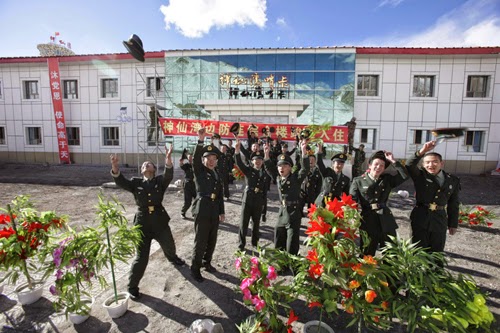
A few days ago, China Tibet Online published photos, taken in Central Tibet, of a group of new recruits playing “a group psychological counseling game under the guidance from psychological counselors”.
The mouthpiece of the Communist Party in Tibet reported that on December 28, a detachment of Tibet’s border defense troops in Shigatse organized a group training activity, themed around ‘releasing inner discomforts and welcoming new challenges’.
The exercise was meant for the new recruits, who experience inner and outer discomforts, while being posted on the Tibetan plateau.
The website explained that the course was designed “to help new recruits alleviate psychological pressure, improve self-regulation ability and ensure they pass the ‘second adaptation period’ smoothly.”
In May 2013, I mentioned on this blog that the Tibetan Centre for Human Rights and Democracy (TCHRD) in Dharamsala had got hold of a fascinating manual exposing the psychological trauma faced by the People's Armed Police (PAPF) in Tibet.
At that time, I spoke of the case of young Han soldiers posted on the border with India: “Though not confronted with violence like the PAP in Sichuan or Gansu, the young Han soldiers must have a traumatic psychological life, just because their political bosses in Beijing insist on grabbing a few sq. kilometers more of Indian land.”
I then commented on the Tibetans, who too are suffering: “It is easy to redo the world with 'ifs', but 'if' China was a normal country, 'if' China was a normal neighbour, its leaders would allow others to dream, like President Xi is now exhorting his countrymen to do. Today in Tibet, Tibetans can't dream.”
If China was a normal country, it would be great for the poor PAP's soldiers who do not understand what they are doing in Tibet. It would also be good for China's finances (let us not forget that Beijing's budget for 'internal security' is higher than the Chinese Defence budget). It would be good too for China's image and good for the Tibetans who only aspire to some 'normal' basic freedoms.

Take a deep breath
During the recent Shigatse ‘counseling’, the detachment’s counselors, Zhang Yan and Li Linfu, “fully played to their strengths by using plain language to explain to the new recruits how to alleviate their own psychological pressure. They also organized group psychological behavioral training in a relaxed, heuristic and cooperative manner. The new recruits participated actively and were enthusiastic, coordinated and willing to try,” said China Tibet Online.
The article concluded: “This activity not only helped recruits relieve psychological pressure and relax their minds, but also strengthened their team spirit and collective consciousness. It increased troop cohesion, solidarity and fighting capacity and laid a solid foundation for new recruits in their new jobs.”
This also means that so many years after the ‘Liberation’ of Tibet in the early 1950s, the Chinese soldiers are still not at home on the Roof of the World.
But with the ambitious extent of the new ‘reforms’, it is not only on the Plateau that officers and troops are experiencing discomfort.

The 'discomfort' of the reforms
Many generals and senior officers, who will soon lose their jobs, need ‘to release their discomfort’.
This probably explains why the youngest serving PLA Corps Commander was recently dismissed, after he went out for a binge drinking party with some officers who had served under him.
China News Service reported that Zhang Yan, Commander of the Shandong-based 26th Group Army (Corps), went for a drinking party with two former subordinates and one died soon after.
The report says that the two lower ranking officers belonged to the 39th Group Army based in Shenyang, where Zhang was earlier posted.
There is no information about when and where the binge drinking took place.
In April 2014 (well before the ‘reforms’), The China Youth Daily had affirmed that nine government officials in China had died from excessive drinking between January 2013 and April 2014.
With the tempo of the reforms accelerating, counseling for retiring generals (and troops) will probably be required on a larger scale.
And these officers should not be sent to Tibet, life is too uncomfortable on the Plateau. It could only aggravate their case.

Friday, March 20, 2015

'Comprehensive' infrastructure development on the Roof of the World

The Mainling Airport, north of the LAC
While the Tibetan Diaspora continues to debate which paths to take for future Tibet (Independence or the Middle Path), China is building up at mad pace its infrastructure on the Roof of the World: whether it is expansion of existing airports, new highways or railway lines.
And there is no question of debate or discussions for China, Beijing is just forging ahead rapidly.
I have already mentioned the roads to the border in a recent post.

Expansion of airports
China Tibet Online announced a few days ago that, on March 15, the construction of an expansion project for Mainling County Airport in Nyingchi (Nyingtri) Prefecture, north of the Indian border of Arunachal, has started.
That is not all, the Lhasa Gongkar Airport and Chamdo Bangda Airport are also being expended “to ease the pressure of increasing passenger traffic coming in and out of Tibet.”
Let us remember that 15 million Chinese tourists visited the Roof of the World (TAR only) in 2014.
The reports says that Mainling/Nyingchi Airport is located in the Yarlung Tsangpo (Brahmaputra) valley at an attitude of 2,900 meters (it is the ‘lowest’ airport in Tibet).
China Tibet Online adds that this is part of China's “efforts to raise Tibet’s civil aviation capacity and safety standards, while also supporting Tibet’s economic and social development.”
In other words, the policy to ‘invade’ Tibet with tourism will continue.
The website states that “At the start of the second half of 2014, 800 million yuan (US$ 130 million) were invested in ‘airport expansion projects’ in Lhasa, Chamdo, and Nyingchi.
Wang Dasong, director of the Mainling Airport explained that the project had been officially sanctioned in June 2014: “[it] was based on the need to meet estimated passenger traffic of 750,000 people and a targeted cargo handling capacity of 3,000 tons by the year 2020.”
It will include a new 10,360-square-meter terminal, a 3,000-square-meter 'comprehensive' [everything is 'comprehensive these days in China] safe house, a new fire station and some pump stations; the restoration of the old terminal will cost 270 million yuan (US$ 45 million).
This airport is the most strategic airport vis-a-vis the Indian border in Arunachal as it is located a few kilometers north of the McMahon line (LAC) only.
Lhasa Gongkar Terminal

For the Lhasa airport, the 12th Five-Year Plan  allotted 170 million yuan for the relocation of the Gongkar Airport air traffic control tower. The work started in March 2015.
While in Chamdo, the construction of a second runway has begun in November 2014.
A Chinese official website explains: “In recent years, the growth rate of tourists entering Tibet has been comparatively large, especially during the peak tourism season, due to the rapid development of tourism in Tibet as well as increasingly strong international ties. So much so, that it is often the case that ‘one plane ticket is hard to get’, which prompted a need for Tibet Airlines to increase their transportation capacity.”
For Beijing, this is always good as these airports can also be used for military purposes, if need be.
The number of flights is also expanding. On March 19, Xinhua announced the opening of a new flight between Guangzhou Baiyun Airport and Nyingchi Mainling Airport.
China Southern Airline will now fly non-stop between Guangzhou and Nyingchi on every Tuesday, Thursday and Saturday. The flight time is about three and a half hours. Comparatively, it used to take a night and two days for the same travel. "The new line is more convenient and efficient", says Xinhua.

Railway lines
An indication of what is coming in terms of railways could be heard during the Two Sessions recently held in Beijing.
The same China Tibet Online reported: “During the ongoing national ‘Two Sessions', a proposal submitted by Losang [Lobsang?] Sherdun, a CPPCC member from western Tibet's Ngari Prefecture, highlighted how the locals in his region have expectations for a railway.”
Lhasa Railway Station
Losang said: “Though a number of projects have consistently lead to a higher quality of life, where the people of Ngari lag behind is in transportation infrastructure, which has had an impact on the regional economic and social development.”
Losang/Lobsang is said to be Vice Chairman of the regional CPPCC of Ngari Prefecture.
For Beijing, it is an indirect way to announce the forthcoming railway line: one ‘deputy’ requesting the Central Government to help the masses.
In turn, it will help the masses  ...of Chinese tourists and ...the PLA posted near the Ladakh border.
The Tibetan deputy affirmed: “with the rapid development of tourism in Ngari and the progress of China's Western Development plans, passenger and freight volume in and out Ngari have been rising annually by an average of 45 percent. But the major means of transportation in the region remains road transportation, with support from air transportation [Ngari airport], which in itself is very limited and hinders the exports of locally produced goods.”
Losang’s 'proposal' is likely to be 'accepted' by the Central Government in Beijing: extension of the Southern Xinjiang Railway and Lhasa-Shigatse Railway to Ngari will ‘provide a rare opportunity for Ngari’, commented the website.
But that is not all. The Sichuan delegation at the National People's Congress made a similar request: “thee Sichuan-Tibet railway [lines] should be incorporated into the country's next five-year plan.”
The delegation requested Beijing for a special fund allotted for the 1,800-kilometer line which will connect Chengdu, the capital of Sichuan province, to Lhasa, the capital of the Tibet Autonomous Region. It will cost some 200 billion yuan (US $32 billion).
As mentioned earlier, the construction of Lhasa to Nyingchi and the Chengdu to Ya'an lines started last year.
The delegation was particularity keen on 2 sections, i.e. Ya'an to Kangding and from Kangding to Nyingchi. It should start during the current year, they requested.
The Chinese website concluded: “After completion, the railway will form a ring with the Qinghai-Tibet line, which began operation in 2006. …The 13th Five-Year Plan will cover 2016 to 2020. By the time it gets underway, Sichuan will have nearly 7,000 kilometers of railway.”
Wei Hong, Sichuan's Governor affirmed during the Beijing Meet that the railway will improve regional transportation capacity and integrate Tibet more closely with other parts of China and …it will play an important role for the proposed Silk Road Economic Belt and the 21st Century Maritime Silk Road, ‘promoting ethnic unity and stability.’
How the railway lines in the landlocked Sichuan will help the Maritime Silk Road is however not clear?
Any excuse is probably good to get funds in China.

Developments of Roads and Highways
Same tactic for the roads and highways: Beijing asked the ethnic faces to make a ‘request’ for the masses.
Gyare Lozang Tenzin, a Vice Chairman of the Tibet Autonomous Region declared in Beijing: "The length of highways opened to traffic in Tibet reaches 70,591 kilometers, but there is still no expressway in the real sense in Tibet."
China Tibet Online commented: “In July 2014, China's Ministry of Transport reported that China aims to extend highways in the Tibet Autonomous Region to 110,000 kilometers, expand railways to 1,300 kilometers, and increase travel by civil aviation to seven million passenger journeys by 2020.”
Xinhua reported that Tibet had invested 16.1 billion yuan (3 billion US $) into road construction in 2014, opening 4,332-kilometer new roads to traffic.
This is in addition to the Lhasa-Shigatse railway which was inaugurated in August 2104.
Xinhua admited: “Even though Tibet's transportation has seen leapfrog development in recent years, the conditions and networks in remote agricultural and pastoral areas still need further improvement.”
And as mentioned earlier on this blog, more and more roads leading to the Indian border are being built: “In recent years, road traffic rapidly develops in Nyingchi prefecture, especially in rural areas. Data shows that the total length of road up to 5,351 kilometers in Nyingchi Prefecture, and the rate of road access in towns and villages respectively occupy 96.3 pct. and 95.7 pct."
On the Indian side, the Border Road Organisation (BRO) is still struggling against inertia, bureaucracy, corruption, difficult terrain and other difficulties.

A consoling news?
The Chinese Defence Ministry recently affirmed that a road linking a village on border with Vietnam to Chinese city 100 km away would 'definitely be serious threat to national defence and security'.
The South China Morning Post reported: "China’s People’s Liberation Army halted a city government’s road construction project on the border with Vietnam last month because of fears it could be used as a shortcut for a 'Vietnamese invasion'."
A PLA officer in charge of border affairs in Fangchenggang city, in Guangxi Zhuang Autonomous Region said that if finished, the road would “definitely become a serious threat to national defence and security”.
The two-lane road would have linked the village of Tansan, on the border with Vietnam, to the centre of Fangchenggang city, about 100 km away.
The PLA warned the residents of Tansan about the rationale of the move: "If war broke out between the nations, Vietnamese troops could use the road to launch an attack on the Chinese army."
Well, I always thought that it is an old Indian theory, held in the 1950s by the Indian ministry of Defence and External Affairs: "let us not built roads in NEFA, the Chinese can use them!!".
China even steals India's War Theories now!

Friday, July 25, 2014

A Chinese Train to Sikkim? For what?

On July 24, The Global Times run a story "Sky rail to run from Lhasa to south Tibet; further railway expansion to connect Nepal, Bhutan, India by 2020."
It announced that the railway linking Lhasa and Shigatse (poetically called by China as the 'closest stretch of railway to the sky') will be open to traffic in August.
In my yesterday's posting, I mentioned that the construction of the 254 kilometers line began in September 2010.
The new  extension of the Qinghai-Tibet Railway will have 13 stations between Lhasa and Shigatse,
According to Yang Yulin, deputy director of the railway office of the Tibet Autonomous Region (TAR) government, it is the largest infrastructure project (in Tibet) during the 12th Five-Year Plan (2011-2015) with an investment of more than $1.7 billion.
Zhu Bin, a manager with a mineral company based in Lhasa told The People's Daily that "It will accelerate transportation of the mineral products, which could only be transmitted through highways that often risk being cut off during rainy seasons or see vehicle turnovers."
That is certainly one of the objectives of the train.
A Tibetan writer based in Lhasa, told the Communist newspaper that the railway will help local Tibetans to 'exchange with the outside world' and ...'tourists will be attracted to the area'.
It is clear that China is not investing 1.7 billion US $ for the Tibetans to 'see the outside world'.
The train to Shigatse has 3 basic purposes, one, to bring more tourists, the TAR's main source of revenue; two, to take away minerals to the mainland to feed the economic machine and three, to 'strengthen' the borders with India by allowing quick movement of troops and armament.
Now, more surprising, Yang announced that during the 13th Five-Year Plan (2016-2020) period, the construction of a railway connecting Shigatse with Gyirong (Kyirong) in northern Nepal and with Yatung, in the Chumbi Valley between India and Bhutan, will start.
Kyirong is a logical extension of the line as China has extensively invested in this landport to make it the main link between Tibet and Nepal, but why Yatung?
The border trade between India and Tibet is minimal as I showed in a research paper last year.
Wang Chunhuan, professor at the Tibetan Academy of Social Sciences in Lhasa told The Global Times that the railway network in Tibet will play the role of continental bridge in South Asia and promote economic and cultural exchanges.
Does it mean that China woud like to open the Yatung-Nathula-Gangtok route in a big way?
Has Beijing consulted Delhi on this or is it a unilateral decision? 
The Global Times quotes Liu Zongyi, an 'expert' on India, working for the Shanghai Institutes for International Studies, saying that the "Indian authorities would certainly care about the operation of the Lhasa-Shigatse Railway that is very close to the disputed area [Arunachal?]. The Indians have lately been working on adding infrastructure in the South Tibet region, in order to strengthen control."
'Southern Tibet' is the Chinese name for 'Arunachal'!!
Liu explains that it is a bargaining chip.
If people on the Chinese side of South Tibet region (Arunachal) see better economic development in southwestern Tibet (Shigatse and Ngari) they will be tempted to join the People's Republic.
This is of course a Chinese Dream.
But the move towards Yatung is indeed a bargaining chip at another level.
Liu admits: "The growing railway network will increase Chinese activities in this area, balancing Indian moves."
China is nervous about the raising a 'mountain strike corps', XVII Corps, with its headquarters at Panagarh in West Bengal, not too far from Sikkim (and Yatung).
When fully operational (by 2018-2019), the Corps, costing some Rs 64,678 crore to the Indian tax-payers, will have 90,274 troops.
The Corps which will be spread on the 4,057-km Line of Actual Control (LAC) from Ladakh to Arunachal Pradesh; it will have two high-altitude infantry divisions (59 Div at Panagarh and 72 Div at Pathankot) with their integral units, two independent infantry brigades, two armoured brigades.
It will also include 30 new infantry battalions and two Para-Special Forces battalions.
Incidentally, the projected railway line to Yatung perhaps explains the inflated size of the Chumbi Valley in the newly published Chinese maps. Huge chunks of Bhutanese territory have been engulfed in the Chumbi Valley. 

It is a fact that XVII Corps makes China nervous.
China will not certainly not invest billions of dollars to built "a continental bridge in South Asia and promote economic and cultural exchanges", but balancing the developments on the Indian side, is worth a few billions dollars.
On the Indian side, the government is said to have cleared the construction of four militarily strategic railway lines in the Himalayas; 3 of them are in Arunachal Pradesh and one, to Leh in Jammu and Kashmir.
According to the Free Press Journal, the new rail lines will enable rapid deployment and movement of forces across the rugged, inhospitable and mostly snow-bound terrains. This is India’s first foray in the upper Himalayas to match the railway lines built by China connecting almost all areas on its side of the LAC.
The construction is expected to begin next year, though land acquisition and preparation of the detail project reports will be done during this financial year.
Also important to India, the railway linking Lhasa to Nyingchi Prefecture, located north of the McMahon Line, which is expected to start in a few months. It is also part of the 13th Five-Year Plan (2016-2020).
India should watch and act fast.

Thursday, July 24, 2014

General Xu visits the Indian Border

The recent heavy traffic of VIPs/VVIPs in Ngari (Western Tibet)  was not only due to the presence of the Dalai Lama in Ladakh.
It has also to do with Beijing's decision to consolidate its borders, whether there are sea borders in the South China Sea or land borders with India (mainly in Aksai Chin region).
Yesterday, China Military Online reported that Xu Qiliang, a member of the Politburo of the CCP's Central Committee and also one of the 2 vice chairmen of the  Central Military Commission (CMC) inspected Xinjiang and Tibet garrisons.
According to the official website: "Xu Qiliang recently [when is not disclosed] inspected the troops of the People’s Liberation Army (PLA) and the People’s Armed Police Force (PAPF) garrisoning Xinjiang and Tibet."
The article adds: "During the inspection, General Xu Qiliang visited the officers and men in frontier areas, and held talks with the leaders of the troop units garrisoning in Hotan [Xinjiang, near the Aksai Chin], Ali [Ngari or Gar] and Lhasa [in the Tibetan Autonomous Region or TAR] areas to discuss the development and reform of frontier troop units.
This means that General Xu inspected troops belonging to 2 separate Military Area Commands (Lanzhou and Changdu).
Xu Qiliang also visited sentries of the Shenxianwan (just north of the Karakoram Pass and the Depsang Plains) frontier defense company who were performing duties at the altitude of 5,380 meters.
Xu Qiliang went to the barracks of the Khurnak Fort frontier (opposite the Indian troops in Ladakh, north of the Panggong tso) defense company and Banmozhang (near Sirijp on the Panggong Lake where many incursions have taken place) to inspect a water [speed-boats] squadron and inquire about the soldiers’ work, study and life.
According to the same source: "Xu Qiliang also inspected weaponry and equipment and observed training and drills in a training base of a 'Red Army' regiment of the Xinjiang Military Area Command (MAC), an infantry brigade of the Tibet Military Command (TMC) and the First Detachment of the Tibet Contingent of the People's Armed Police Force (PAPF)."
He was accompanied by a battery of generals, amongst them, Gen. Sun Jianguo, deputy chief of general staff of the PLA, Gen. Miao Hua, political commissar of the Lanzhou MAC and Gen. Zhu Fuxi, political commissar of the Chengdu MAC.
This visit is also probably linked to the arrival of the railway line in Shigatse.
Another official Chinese site announced a few days ago that the completion of an extension of the world's highest Qinghai-Tibet railway, Lhasa-Shigatse railway. The construction started on September 26, 2010 will be officially opened in August.
Test trains are already running on the newly-built line, which will have an overall length of 253 km; trains will be able to run at a speed of 120 km per hour. It will take only 2 hours from Lhasa to Shigatse, the seat of the Panchen Lamas' and the TAR's second largest city.
China Tibet Online says that the city already attracts thousands of pilgrims and visitors each year: "In recent years, Panchen Lama's palace, Tashihunpo Monastery in Shigatse has received over 200,000 visitors from home and abroad annually. The opening of Lhasa-Shigatse railway will surely make the journey of worshippers to Tashihunpo Monastery safer and easier."
The first train reached Lhasa in July 2006, and though Beijing says: "it has positively impacted on Tibet's tourism, hospitality and manufacturing sectors", the main beneficiary has been the PLA.
The new line will be another progress for the PLA and PAPF stationed on Western Tibet.
To come back to General Xu's visit, did he come to distribute new accurate maps to the troops?
A Chinese military site recently reported: "A batch of new-version paper-made battle maps with a scale of 1:50,000 obtained by a motorized infantry brigade under the Lanzhou Military Area Command (MAC) of the Chinese People’s Liberation Army (PLA) from a measuring and mapping information center under the PLA Lanzhou MAC were quickly transferred to the frontline troop units participating in the trans-regional base training on the morning of July 9, 2014, marking that the distribution of a total of over 15 million new-version paper-made battle maps to the troop units under the Lanzhou MAC has been completed."
The website added: "This is the first time for the PLA to completely update a single type of map in the past 30 years."
Now the time is ready for Beijing to exchange maps of its 'perceived borders' with Delhi, something it has refused to do till today.
Shenxianwan Frontier Sentry Post
Shenxianwan Frontier Sentry Post 

Friday, July 11, 2014

Dharamsala Interlocutor visits Western Tibet

Zhong Yijiong visiting a Tibetan family
when he was posted in Jiangxi
The craze for Ngari continues.
Zhang Yijiong, Deputy Director of the Central United Front Work Department, who is also the interlocutor-designate for eventual negotiations with Dharamsala followed the footsteps of Deng Xiaogang, the Tibetan Autonomous Region’s (TAR) Deputy Secretary who has been spending weeks in the border areas of Western Tibet (Ngari).
Zhang, a member of the all-powerful Central Committee of the Communist Party came to give some guidance to the local cadres on terror issues, counter-terrorism and of course ‘stability' and also to 'encourage cadres and masses of all ethnic groups'.
I also wonder how many ethnic groups, apart from the Tibetans (and the Han soldiers) live in Western Tibet.
Zhang, who was posted in Tibet between 2006 and 2010, was accompanied by a high-level delegation.
Wu Yingjie, Deputy Secretary of the TAR, Deng Xiaogang, in-charge of the Politics and Law Committee (read law and order and security) and Dong Mingjun, one of the TAR’s vice-chairmen were on Zhang’s side.
Before leaving Lhasa, Zhang Yijiong called on Pagbalha Namgyal Rinpoche, the National Vice-Chairman of CPPCC and …oh surprise, on the Panchen Gyalsten Norbu.
It is surprising, because the Lama was supposed to have gone back to Beijing, at least according to The Tibet Daily.
Did he miss the plane?
Or did he decide to experience the blue sky of Western Tibet (or simply visit  'his' Tashilhunpo monastery monastery?) before returning to the polluted Chinese capital?
Or did he take a ride on the Lhasa-Shigatse railway which is expected to be officially inaugurated in August (a month earlier than earlier planned!).
It is not clear from the reports published so far.
Though Zhang Jiong visited Purang County at the trijunction India-Nepal-Tibet, near Mt Kailash, his trip was not spiritual in nature.
He met all the police officers, the firefighters (for preventing immolations?), the officers and troops manning the border with India, the SWAT (commandos) and lectured them on the different aspects of counter-terrorism and ‘stabilization’.
He praised the troops for remaining ‘steady’ despite the cold and lack of oxygen, the harsh environmental conditions and for fulfilling their duties conscientiously without being overtaken by fatigue.
He asked them to continuous remain in fighting spirit "to insure orderly activities, maintain a sustained harmony and stability of Ngari area and work for the development and stability of Tibet".
He thanked them for their important contribution for the nation: “On behalf of the Central United Front Work Department, my heartfelt gratitude and highest respect [to you], I hope you will continue to make persistent efforts, do a solid job for the long-term stability and the overall stability of Tibet”, he told the soldiers.
The caring party leader asked the troops to take care of themselves and pay attention to their health.
Zhang Jiong visited other border posts, always telling the soldiers on duty to fully understand the complexity of the current grim situation (does he refer to the presence of the Dalai Lama in Ladakh?); he asked the border guards to increase their sense of responsibility and their sense of mission.
He also visited some temple (Ke Jia?) and harangued the monks; he also asked about their living conditions and noted that the majority of monks devote themselves to Buddhist practices to improve their religious skills; they are patriotic and unswervingly oppose “the Dalai clique's separatist and sabotage activities” in order to resolutely safeguard the national unification and ethnic unity.
The Party cadres were told that they should make friends with the monks, fully mobilize the enthusiasm of the patriotic and law-abiding monks and nuns and actively help Tibetan Buddhism to adapt to a socialist society; this will be for the common good and create a safe and harmonious environment, he said. All the departments should attach a great importance to the conservation work of the temples in order to protect and promote the cultural heritage of the nation.
This obsession with 'stability' shows that Beijing is quite nervous about the 'stability' of its borders with India.
Later, Zhang Yijiong went to Ngari (Ali in Chinese) where he met the United Front local cadres and other Party workers. He asked them to conscientiously implement the Party's ethnic and religious policies, and comprehensively improve the level of ethnic and religious affairs.
In other words, be nice with the local Tibetans.
Why so much focus on Ngari?
One factor is of course the presence of the Dalai Lama in Ladakh.
Ngari and Ladakh were once upon a time, part of the same kingdom.
Another reason the arrival of Narendra Modi in power in Delhi. The 'Tibet Policy' of the new Government might be different from the one followed by the Congress.
The arrival of the train in Shigatse will also be a game-changer for Western Tibet. According to Chinatibetnews.com, with a total length of 253 kilometers, the Lhasa-Shigatse railway was completed in March 2014, after 4 years of construction, with the tunnels covering 115.7 kilometers, accounting for 45.7 percent of the line length. It will be inaugurated in August.
It means that millions of Chinese tourists will have an easier access to the beautiful 'heritage' sites of Western Tibet.
By the way, I mentioned on this blog that General Wang Jianping, the People's Armed Police Commander visited Lhasa a couple of weeks back. After 'leaving' Lhasa, he reappeared in Urumqi in Xinjiang a few days later. Where did he go in between?
Did he also take a ride on the new train or visit his troops on the border with Ladakh? Nobody knows.
The new Shigatse Railway Station


Monday, April 14, 2014

Kyirong: A New Gate to Nepal

A 'Nepali' Festival at Kyierong
Last week, The Sunday Review of the The New York Times published an Editorial on Nepal entitled 'Doing China’s Bidding in Nepal'.
It quotes the Human Rights Watch (HRW) report which "shows how far Nepal has gone in capitulating to Chinese pressure in cracking down on Tibetan residents and refugees. "
The report gives 'a long list of shameful actions against Tibetans in Nepal, including restrictions on their activities and movements, surveillance and intimidation, arbitrary detention and forcible return to China."
The New York Times asserts: "In effect, Nepal has turned itself into a partner of China’s anti-Tibetan policies."
To quote from a section of the HRW Report, entitled 'Chinese Pressure on Nepal':
It is no surprise that China would pressure Nepal to push back Tibetans or to crackdown on their political activities in Nepal. Beijing continues to assert that the 14th Dalai Lama and supporters of the Tibetan cause in exile or abroad play a major role in seeding discontent among ethnic Tibetans in China. It also continues to see this purported negative influence as a substantial hurdle to inculcating the kind of undivided political loyalty to the Communist Party and the state that it would like to see among Tibetans in China. For these reasons, measures to limit foreign and cross-border influence have featured prominently in the policies that Beijing has meticulously deployed since the 2008 protests.
The Report gives further details: 
These policies have included militarily sealing off Tibet’s international borders to end the constant trickle of Tibetans fleeing the region. The approach seems to be working: the number of Tibetans crossing the border has dropped from an average of 2,200 per year before the 2008 protests, to under a thousand between 2009 and 2012, to 171 in 2013. The available evidence suggests that Tibetans detained by Chinese authorities for crossing the border irregularly from Nepal are routinely imprisoned and physically abused in China.
But that is not all:
Chinese authorities have confiscated the passports of many Tibetans and require that all Tibetans submit to pre- and post-trip debriefings with police as a condition of international travel. They maintain registers of Tibetans who have family members abroad. Tibetans within Tibet must now also endure rigorous scrutiny before obtaining domestic travel permits. In recent years Tibetans have been arrested and sentenced for passing, receiving, or simply consuming information critical of China’s policies in Tibet.
The Chinese are now present everywhere in Nepal. The Report says:
There is now substantial evidence of increased Chinese government onitoring and censoring of telecommunications, Internet activity and messaging, and increased limitations on access to foreign Tibetan language broadcasts through the jamming and confiscation of satellite reception dishes. Chinese authorities have also stepped up efforts to prevent Tibetan communities in neighboring countries from assisting, documenting, or protesting conditions in the Tibetan Autonomous Region (TAR) and adjoining provinces with significant Tibetan populations. As detailed below, China frequently imprisons, and tortures or otherwise mistreats Tibetans who leave China without permission.
And of course the Chinese government's main goal is to suppress the influence of the Dalai Lama.
The human rights group affirms that Beijing has had three primary objectives:
1. Ensuring Nepal’s effective cooperation with China’s efforts to put an end to clandestine border-crossing by Tibetan asylum seekers and migrants, including children sent to study in Tibetan schools in India by their families;
2. Enforcing a de-facto ban on pro-Tibetan political mobilization in Nepal, including demonstrations and all activities linked to the Dalai Lama or Central Tibetan Administration (the Tibetan government-in-exile);
3. Enrolling Nepal’s intelligence and law-enforcement apparatus to monitor and infiltrate Tibetan communities living in Nepal, as to provide up-to-the-minute intelligence for China.
The Human World Seaven?
The New York Times comments: "Tibetans in Nepal know that wherever they gather to socialize or worship, they are likely to be spied on by Nepalese security forces who make no secret of their close links with Chinese authorities. Non-governmental organizations that seek to monitor the situation or are engaged in humanitarian work with Tibetans in Nepal are also under surveillance and have been accused of disloyalty."
Even after the democratic election of Sushil Koirala as prime minister, harassment of the Tibetan refugee population continues.
The New York Times concludes: "The government of Nepal has every right to seek positive trade and diplomatic relations with China. But it must stop allowing China to dictate policy regarding Tibetans in Nepal. Mr. Koirala and Nepal’s Constituent Assembly should move quickly to guarantee resident Tibetans legal status that respects their basic rights, and to treat Tibetan refugees in accordance with Nepalese and international law."

Wishful Thinking?
It appears wishful thinking because Nepal's all-important economic relations with the giant northern neighbour will soon get a tremendous boost when the Kyierong (Chinese: Gyirong) land port opens.
A few days ago, the official China Tibet Online reported: "The Gyirong Port in southwest China’s Tibet bordered with Nepal will be formally opened in October this year. The opening of the Gyirong Port has been listed in the key work plan of national ports in 2014."
The website also announces that a cross-border China-Nepal Gyirong Port Economic Cooperation Zone will soon be established; further the Gyirong Port will be built into a tourist destination.
The website affiliated with Xinhua continues: "The Gyirong Port enjoys a long history of being the largest land trading port between Tibet and Nepal. Many shop owners have expressed their hope that the opening of the port can help them get more involved in the border trade. From May 2007, the Shigatse Customs House will dispatch four officials to station at the Gyirong Port. A regular coordination system had been set up in order to seek support from the Gyirong county government, the Gyirong Customs and the Risur Customs of Nepal. Besides, the officials have been trying to promote preferential trade policies to encourage the local people to participate in the border trade. And some training have been provided to the port officials in Zham Customs House, another Class A port next to Gyirong in south Tibet’s Shigatse Prefecture."
Kyirong Town
What will be the consequences of the opening of a new port between Tibet and Nepal?
First and foremost, it means new infrastructure on both side of the border.
Dong Mingjun, a vice president of the Tibet Autonomous Region told the press: "By the end of July this year, construction of roads, energy and medical appliances will be completed at the port. The Gyirong Port will be equipped with special facilities for supervision and smuggling suppressing in preparation for the opening of the port."
But more importantly, a month earlier (in September)  the Lhasa-Shigatse Railway will be inaugurated.
China affirms that "the Gyirong Port will serve as a link between China and the South Asian countries. It is expected to bring a big number of visitors into Tibet and boost its tourism, which will help enhance the port’s popularity home and abroad."
The Party boss of the Gyirong County told the press: "The opening of the Gyirong Port will become a key trading port next to Zham Port in Shigatse, and an important destination for international trekking, folk activities and visitors’ driving tours."
The Strategic G219 National Highway
In other words, Chinese tourists and goods will be poured into Nepal through the Lhasa-Shigatse railway line and then a highway between Shigatse and Gyirong (a branch of the highly-strategic  G219 highway linking Tibet to Xinjiang, i.e. the Aksai Chin Road).
The Chinese officials believe that "the Gyirong Port will be opened wider to the outside world with improved operation capacity in order to promote trade with South Asia and become a cross-border economic cooperation zone between China and Nepal."

As I mentioned in an earlier post, the message is clear, even if there is nobody to hear it in Delhi: Kathmandu, once the secluded ex-Kingdom is connected by rail to the Tibetan Autonomous Region, is interested to import petroleum products from China.
Nepal still remembers the unwise economic blockade put in place Rajiv Gandhi.
More interesting, a couple of years ago, a Nepali government statement mentioned that “an expanded and enhanced connectivity between the two countries [will] also open the avenues for Nepal being a transit country between the two giant economies, China and India."
Has India been asked?
China boasted that as early as 789 AD, Gyirong served as a hub for commercial and cultural exchanges between Tibet and Nepal (it might be true, though China was not around at that time).
However in 1961, the Gyirong Port of Entry obtained from Beijing the approval to open to the outside world; Gyirong was upgraded to a national first-class (A Grade) land port of entry in 1987.
By the end of 2008, Gyirong's imports and exports of had reached 0.67 million U.S. dollars.
In 2013, the volume of border trade between Tibet and Nepal reached 114.1 US dollars, an increase of 10.8 percent over the previous year.
Till now, the transactions in Gyirong represented only a small percentage of it; this will change with the opening of the new land port.
The strategic relations are also improving fast.
China Military Online reported  that on February 21, 2014, Girija Prasad Koirala (it meant Shushil Koirala!!!), prime minister of the Federal Democratic Republic of Nepal met with General Wang Guanzhong, the deputy chief of general staff of the Chinese People’s Liberation Army (PLA) in Kathmandu.
According to the Chinese agency, Koirala said that "Nepal and China have long been maintaining good neighborly relations, and Nepal regards China as a reliable friend and partner, and thanks China for providing long-term selfless help and assistance in economic and social development of Nepal".
It is not necessary to comment of the 'selflessness' of Beijing.
Koirala added that "The new government of Nepal will always develop its relations with China on the basis of the Five Principles of Peaceful Coexistence as before, continue to firmly pursue the one-China policy and not allow any force to engage in anti-China activities by using the territory of Nepal."
It is what General Wang Guanzhong wanted to hear.
He profusely thanked Kathmandu "for Nepal’s long-term and firm support on issues concerning China’s core interests such as that on Tibet."
He assured the new Nepali Prime Minister: "The Chinese military is willing to strengthen the pragmatic cooperation with the Nepalese military in the new historical period so as to make contributions to the development of the relations between the two countries."
This is quite ominous for the Tibetan refugees.


By the way, during the 1792 Tibet-Nepal War (in Chinese: 平定廓爾喀, 'pacification of Gorkha') , the Manchus troops called by Tibet to defeat the Gorkhas used Kyierong route to invade Nepal.
There is of course no connection with today's situation!
 

Tuesday, March 18, 2014

The Train on its way to Southern Tibet

While the Indian press says that AK Antony has been the worst ever Indian Defence Minister (read India Today's article) and the Minister himself says he has done so much for Indian defense preparedness, China is laying railway lines in Tibet at a frantic pace.
The latest section to be started in September will link Nyingchi (or Nyingtri in Tibetan), north of the McMahon Line to Lhasa (and the mainland). China Tibet Online yesterday reported 'Lhasa-Nyingchi Railway to be launched within the year'.
According to another website, ChinaTibetnews.com: "Lhasa-Nyingchi Railway is expected to start construction within 2014 soon after the completion of Lhasa-Shigatse Railway construction that is scheduled in September."
For the first time, details are given about the strategic line: "Running 433 kilometers and covering 34 stations including nine major ones, Lhasa-Nyingchi Railway will build 402-kilometer new lines, which is designed to have a speed of 160 kilometer per hour with a declared investment of 5.4 billion US dollars."
Yang Yulin, a deputy director of railway office of Tibet explained that the Lhasa-Nyingchi Railway will start from the Shelrong Station on the Lhasa-Shigatse Railway (to be completed in September); it will then cross the Yarlung Tsangpo River (Brahmaputra) and heads towards the Lhoka Prefecture to finally arrive in Nyingchi.
The article admits that today, the communication and traffic with Nyingchi and the Lhoka Prefecture depends only the highway and an airport, near Bayi town (the main PLA cantonment in Southern Tibet) in Nyingchi Prefecture.
China Tibet Online asserts that this line of communication suffers from a number of disruptions as "special weather conditions may break down the land and air routes occasionally".
More interestingly, it adds: "the abundant natural resources also call for a stronger transportation support of the area."
'The abundant natural resources' probably refers to the rich mineral resources of Tibet which are wildly exploited, but also to the power generation potential of the Great Bend of the Yarlung Tsangpo/Brahmaputra. See my article on the diversion of the river. 
It means that everything is slowly coming into place to make the mega project feasible.
The rest of the article is more obscure. It says: "Furthermore, a world-class landscape gallery would be formed after the construction of Lhasa-Nyingchi Railway, which will connect not only the tourism resources along the line, but also famous scenic areas such as Jiuzhaigou Valley [Valley of Nine Villages, a nature reserve in northern Sichuan], Yellow Dragon Scenic Area [Huanglong, a scenic area of and historic interest in northwest Sichuan], the Qinghai Lake [Kokonor lake], as well as tourist cities including Chengdu, Dali and Lijiang [both Yunnan], through a railway network covering Chengdu-Nyingchi Railway, Yunnan-Tibet Railway, Qinghai-Tibet Railway and Lhasa-Shigatse Railway."
It probably signifies that China is planning to complete the loop, Xining-Lhasa-Shigatse-Nyingchi-Chengdu-Kunming, to promote tourism and harness Tibet's rich natural resources.

Tuesday, January 21, 2014

India’s nightmares over Chinese bridge on Yarlung Tsangpo river

My article on the extension of the Lhasa railway line to the Indian border, India’s nightmares over Chinese bridge on Yarlung Tsangpo river appeared in NitiCentral.

Here is the link...

It is the most strategic breaking news of the year.
China has officially announced that the construction of the Lhasa-Nyingtri railway line will start in 2014.
For India, it is an extremely serious (though expected) development.
Indian Army Chief Bikram Singh has just admitted some 'inadequacy' in the road and rail infrastructure along the borders with China, while assuring the Indian public that "the government is working to build the facilities there and has identified projects".
During his press conference, General Singh stated: "Only last year, the Centre had allocated Rs 9,200 crore for infrastructure along the borders with China and a Cabinet Committee on Security note had been prepared for another Rs 28,000-crore worth of projects for the 12th and the 13th Five-year Plans".
Too little, too late, to counter China: the Chinese train will soon reach India’s north-eastern border, close to the McMahon line.
On January 10, 2014, Lobsang Gyaltsen, the Chairman of the Tibet Autonomous Region (TAR) announced the forthcoming laying of the railway connecting Lhasa and Nyingtri Prefecture.
Gyaltsen made the announcement while presenting his government ‘work report’ to the Tibet Committee of the Chinese People's Political Consultative Conference in Lhasa.
He asserted that the Lhasa-Nyingtri railway was right now at the feasibility study stage, with two designs leading southward and northward being under consideration; he explained that the new line will be the second extension of the Qinghai-Tibet Railway. The first one is the line from Lhasa to Shigatse, the second largest Tibetan city; it is scheduled to be opened before the end of the year. And in China, a ‘few months’ means a ‘few months’ and not a ‘few years or decades’ like in India.
In September already, the same official promised a Nepali delegation visiting Tibet that Beijing would extend a rail service to Nepal, once Shigatse line is operational.
The Nepali delegation had also requested China's help for the construction of a line from Kathmandu to Lumbini, the birthplace of the Buddha near the Indian border. The Tibetan leader kept mum on the latter; the decision being probably out of his limited jurisdiction.
The last hurdle to Shigatse was cleared by crossing the Yarlung Tsangpo (Brahmaputra), near Shigatse: “The track-laying of the Lhasa-Shigatse railway has spanned the Yarlung Tsangpo River for the first time on September 24, 2013,” had announced Xinhua.
Beijing prided itself for this ‘iconic’ achievement: “…with a total length of 875 meters, the grand bridge strides across the river, marking the completion of an iconic difficult project of the railway.”
The Lhasa-Shigatse 253 km long railway started in 2010. The railway passed through one of the canyons of the Yarlung Tsangpo which is nearly 90 km long. With its 13 stations, the train which will be moving at 120 km an hour and will be able to carry an annual freight of 8.3 million tons.
The next stages on the drawing boards are Nepal and Nyingtri. Then Nepal will no longer be an enclaved country, depending on India to survive and the border of the sensitive Arunachal Pradesh (claimed by China) will be reached.
While delivering his ‘work report’, Lobsang Gyatsen mentioned the Party's four 'achievements' for 2013. He listed Beijing’s financial support in agriculture which reached 2.5 billion U.S. dollars and a 15% increase in education subsidy. However, the most important work was undoubtedly the 117-km highway linking Metok, ‘the last roadless County in China’; it was formally opened to traffic on October 31, 2013. Though it cost a whopping 155 million U.S. dollars to the Chinese exchequer, for the People’s Liberation Army (PLA), it was strategically worth opening up this remote border area.
This infrastructure development is in fact a smart investment. Gyaltsen admitted that Tibet received 13 million tourists in 2013 (400,000 more than the objective set by the Chinese Government) and 20 % more than in 2012. This last achievement earned 2.5 billion U.S. dollars in revenue. Selling the Land of Snows to the Han tourists is good business.
In a not-distant future, when the train reaches Nyingtri Prefecture, the area will become one of the two main tourist 'hubs' on the plateau (with Lhasa).
You will not believe it, but mass weddings of Han Chinese are already celebrated there; tourists come from the Mainland to party in this 'paradise on earth' for Valentine Day and the Brahmaputra gorges attract tens of thousands of Chinese tourists. Xi Jinping, then Vice-President, himself visited the ‘paradise’ in July 2011.
His visit was important because Xi is also the Chairman of the Central Military Commission and in the past, he advocated following Chairman Mao’s theory known as “the synthesis between the requirements of peacetime and war.” In other words, civilian infrastructure projects such as roads, airports and railways should be designed to also serve war-time needs (with India, in this particular case).
The main technical hurdle was solved when a tunnel to Metok was opened in December 2010 (at the time of Premier Wen Jiabao's visit to India).
Another bird may be killed with the same stones (the road to Metok and the train to near Nyingtri), the new developments may allow the Chinese engineers to draw the plans for a mega power plant in the Great Bend.
And let us not forget that Bayi, located nearby in Nyingtri prefecture, (not far from by the Airport too), is the PLA’s main military 'hub' in Tibet. It is an ideal place for the People's Liberation Army (PLA), just a few kilometers north of the McMahon Line. It will soon be served by a railway line.
Bayi is a PLA town; ‘Bayi’ means 'Eight-one" or 'August 1' referring to the anniversary of the Nanchang Uprising, considered to be the founding date of the People's Liberation Army.
The name of 'Bayi' is 'copyrighted' by the PLA which is alone entitled to use it for important militarily projects/bases. The town of Bayi in Nyingtri Prefecture was established soon after the invasion of Tibet by the 18th Army (part of the Second Field Army based in Sichuan) in the early 1950s.
It is today one of the two main PLA bases in Tibet, coming under Chengdu Military Region.
A few days ago, Lt Gen Sanjiv Chachra, the new GOC-in-C, Northern Command told reporters after his investiture at Akhnoor, near Jammu: “our aim for the next year is to ensure that our infrastructure and capability building, including construction of road network and habitats come up so that we have a reasonable position."
What is a ‘reasonable’ position when China is decades in advance?
Deterrence perhaps.

Friday, January 3, 2014

New Roads to Tibet for 2014?

Ladakhi Traders in Gartok in the early 1900s
As the New Year starts, The People's Daily reports that during a recent Economic Working Conference of Tibet Autonomous Region, it was announced that the track-laying process for the Lhasa-Shigatse railway had been completed and the line will be opened to traffic in 2014.
The Chinese newspaper asserts: "The Lhasa-Shigatse Railway is the extension line of Qinghai-Tibet Railway which is the world's highest railway. Its construction was started in 2010 and the total length of the railway is 253 km. It is planed that the railway starts from Lhasa in the east and ends up in Shigatse, by way of several stations including Tohlung Dechen, Chushur, Nyemo, Rinbung and Panam."
The People's Daily draws a parallel with the construction of Metok highway which ended "the history of China's last [county] inaccessible by roads". The Communist mouthpiece adds: "the high-level [sic] highway connecting Lhasa and Nyingchi has been under construction." Further, the number of cities linked by air has increased from 9 to 48.
After reading this, I came across a report written in the wake of the Younghusband expedition to Tibet in 1904. The British Colonel had sent a fact-finding mission, led by Capt. C.G. Rawling, to Western Tibet, (north of today's Uttarakhand and Himachal) to explore the possibility to open 'trade routes' between British India and Tibet.
In his report, (The Gartok Expedition including the Brahmaputra, the Sutlej and Indus Valleys and that portion of Tibet which lies tot the West of Gyantse), Captain Rawling of the Somersetshire Light Infantry, describes what needs to be done by the Government of India to open up (and secure) its borders with Tibet.
Trade routes into Western Tibet from India with comparison and suggestions.
Western Tibet is by no means a closed country to the natives of the southern slopes of the Himalayas, and these people pass in and out by many paths and many passes.
The principal roads are:-
(1) From Srinagar (Kashmir) through Leh, Ladak, up the Indus Valley to Gartok, and so to Lhasa by the chief road in Tibet. This road is mainly patronised by Ladakis, Kashmiris, and men from Chinese Turkistan.
(2) From Kulu over the Shangrang La, into the Chumurti country, and from thence to Gartok.
(3) From Simla, up the Sutlej valley to Shipki, through the Chumurti country or up the Sutlej, to Gartok.
(4) From Badrinath over the Mana Pass (17,890) to Toling.
(5) From Almora through Jashinath and Niti, over the Niti Pass (17,000) to Gartok.
(6) From Almora through Milam, over the Untadhaura Pass (17,590 feet), to Gartok.
(7) From Almora. up the Kali river valley, over the Lipu Lekh 16,750. to Pu-Rang and Gartok.
As it is absolutely necessary that one or more good roads be constructed alone trade routes from India into Tibet, a comparison between each of these roads is here made in order that the best may be chosen...
Today, 110 years later, most of these roads are closed (except no 3 and 7)which have been reopened in a small way in the 1990s).
After giving more details on the trade opportunities and the length and difficulties of each route, Rawling concludes:
To sum up therefore I recommend the following:
The immediate completion of the Simla-Shipki road. This should be taken in hand at once, and should be completed before the Tibetans have time to change their minds as to the reading of the Lhasa Treaty [signed by Younghusband in Lhasa in 1904 to open up Tibet to Trade].
Crossing the Sutlej near Shipki (Sven Hedin)

II. The construction of the Almora Lipu-Lekh road. This is most important, as it strikes directly at the main road of Tibet, that between Lhasa and Gartok; besides leading straight to Manasarowar and Kailas Parbat. [the Indian pilgrims going on the Kailash Yatra will suffer again in 2014 on this road, if the  Yatra is not canceled like in 2013]
III. As soon as the two roads mentioned above are finished, the Niti Pass road should be made, and as it can be done at a small cost, it will well repay the expense. The completion of this road will enable the traders and pilgrims to enter Tibet by one route. and return to India by another.
A glance at the map will show how every district of Western Tibet will be reached with ease by traders from India if these paths are turned into roads suitable for mule transport.
The Leh road from Kashmir taps the Rudok district and the Indus valley.
The Shipki road passes into the heart of the Chumurti country.
The Lipu Lekh road runs into the Purang valley, the Manasarowar Lake basin and the head waters of the Brahmaputra.
Both for political and commercial reasons, I consider that advisable to construct these roads with as little delay as possible. for the Tibetans, since the defeat of the Kashmir General, Zorawar Singh, in 1842, have always believed themselves invincible, and though they have probably changed their opinion since the entry of the Tibet Mission into Lhasa, yet it is certain that, if there are no good communications into the country from India, the priests will attempt to shut up the country again. These roads could never be of any value to the enemies of the Empire, for the land to the north forms a far more serious obstacle to cross than any part of the Himalayas.
Post and telegraph distances to Gartok from Simla by different routes.
Simla to Gartok via the Sutlej valley and Shipki.
Simla to Poo [Kinnaur district], 18 marches. At Poo, there is a British post office with a weekly post. From Poo to Shipki, 2 marches.
From Shipki to Gartok, 12 marches. Total number of marches from Simla to Gartok, 32 marches or about 350 miles. Time for a letter to reach Gartok from Simla. about 15 days.
Srinagar to Gartok via Leh.
Srinagar to Leh 18 marches or 250 miles;
Leh to Gartok, 18 marches or about 200 miles. Total from Srinllgar, 36 marches or 450 miles.
From Simla, the post takes three days to Srinagar and five to Leh, and from Leh if a dak was arranged eight days; total from Simla 16 days. Leh, however, has a telegraph office, so with changes of ponies, a telegram would reach Gartok in seven or eight days by this route.
Gyantse to Gartok 51 marches, or a total distance of 697 miles.
This distance is covered by the Lhasa. Government's messengers in 19 days.
Gyantse, however. is distant from Simla about nine days by post, therefore a letter will take from Simla 28 days. At Gyantse, however, there is 91 telegraph office, consequently a telegram to Gartok by the route should only take 19 days.
The Gartok-Simla line via Shipki is, however, the safest of these routes for the present, but delays are likely to occur in winter on account of the passes being deep in snow. Should Thakur Jai Chand, Trade Agent at Gartok, require to forward an important communication to the Indian Government, it would be advisable to send a. duplicate letter via Gyantse. This, however, should be well sealed, for if it contains news regarding the Lhasa. Government, it will probably be tampered with on the road.
A great program!
Of course today, trade with Tibet is not the first preoccupation of Government of India, but if, for defense purpose, some of these 110-year projects could be taken up by the Border Road Organization, India would have made a Great Leap Forward to defend its border ... and eventually to reopen the old trade and pilgrimage route in Tibet.
It should not be so difficult. India and China are friends: aren't they?
In the meantime, China continues to rapidly develop the infrastructure on its side of the Himalayas.