Showing posts with label Lhasa Airport. Show all posts

Tuesday, December 6, 2016

New Terminal for Lhasa Airport

Recently, the design of Terminal 3 of the Lhasa Gongkar has been made public.
It is said that the design was inspired by “traditional Tibetan culture in the pursuit of  the heart of the sun and the moon - the eternal Shambhala". 
What does this mean? Is not clear.
China Tibet Net added that this project will “not only meet its functional purpose, but also perfectly combine architectural style and regional culture".
I leave it to the readers to decide if the culture of Tibet is represented in the model.

Importance of Gongkar Airport
On July 1, China Military Online had reported that new steps had been taken to “help PLA Air Force (PLAAF) cope with emergencies.”
A joint meeting on the development of military-civilian integration of dual-use airports of the PLAAF had been held in Beijing on June 17.
On the agenda was the "Interim Provisions of Operation Security at Dual-use Airports of the PLA Air Force." The PLA website said that it is based on win-win principles for both the military and civilian sides.
The new arrangement, to integrate the development of military-civilian airport resources between the PLAAF and civil aviation is being implemented, noted the website, which further explained: “Its main purpose was to establish a complementary management mechanism with smooth coordination and shared resources to gradually form a support capability that guarantees flight safety at peace times and meets combat needs at wartimes.”
Beijing believed that “two [first] airports [Lhasa and Sunan Shuofang] are good examples of dual-use airports.”

Why Lhasa Gonggar Airport?
As it provided “important support for Tibet's economic development and national security in China’s Southwestern region.”
Lhasa Airport has always been the hub to ‘defend' China’s borders …against India.
China Military Online remarks: “On the one hand, as an important force in Tibet’s transportation, the airport has made great contributions to Tibet's economic construction. It has safely transported more than six million passengers in total since it was put into use. The cargo throughput also surpassed 140,000 tons.”
It adds: “On the other hand, the airport is an important channel to transport the PLA's new recruits and strategic materials to Tibet. The airport is also a major ‘airborne bridgehead’ in Southwest China.”

Today, Xinhua announced that the number of passengers 'handled' by Lhasa Gonggar Airport will exceed 3 million in 2016: "it shows the rapid development of its civil aviation industry," says the agency.
For the first time in 2006, the Lhasa airport saw the number of passengers crossed 1 million and in 2013, it reached 2 million.
A senior regional civil aviation official told Xinhua: "The rapid growth in passenger numbers at Lhasa airport shows people's confidence in Tibet's social stability, and is a symbol of the rapid economic development of Tibet."
For the Chinese authorities, the so-called stability of the plateau is clearly linked to the number of passengers using the 71 routes from the Mainland to Lhasa.

Incidentally,  on November 25, China Daily announced that more than 20 new highways will be built in the TAR in 2017 (with a total investment of more than 33 billion yuan or 5 billion US dollar).
Among them, a highway between Lhasa and Shigatse Airport and the one between Gongkar Airport to Tsethang.

Thursday, July 7, 2016

Dual-use airport is a win-win move, says China

As the Dalai Lama, the apostle of peace, celebrates his 81st birthday in Karnataka, China is reinforcing its war preparation on the Tibetan plateau.
It does not mean that a conflict is imminent, but in case China has 'to face India', Beijing wants to be ready.
A year ago, I mentioned on this blog the dual-use of airports in China.
Xinhua had just announced the possible integration of civil-military airports to "strengthen aviation safety and combat support capabilities."
A joint statement from the People Liberation Army Air Force (PLAAF) and General Administration of Civil Aviation (CAAC) had announced that the integration will include joint maintenance of airport support facilities, joint flight safety support and joint airport management.
Interestingly the Lhasa Gongkar Airport in Tibet was one of two first pilot airports to implement the 'integration'.
The other one was the Sunan Shuofang International Airport in Wuxi in Jiangsu province.

A new law for dual use integration
On July 1, China Military Online reported that new steps have been taken to “help PLA Air Force (PLAAF) cope with emergencies.”
A joint meeting on the development of military-civilian integration of dual-use airports of the PLAAF was held in Beijing on June 17.
On the agenda was the "Interim Provisions of Operation Security at Dual-use Airports of the PLA Air Force."
The PLA website said that it is based on win-win principles for both the military and civilian sides.
The new arrangement to integrate the development of military-civilian airport resources between the PLAAF and civil aviation is now being implemented, says the website, which further explains: “Its main purpose was to establish a complementary management mechanism with smooth coordination and shared resources to gradually form a support capability that guarantees flight safety at peace times and meets combat needs at wartimes.”
Beijing believes that “two [first] airports [Lhasa and Sunan Shuofang] are good examples of dual-use airports.”

Why Lhasa Gonggar Airport? 
Because it provides “important support for Tibet's economic development and national security in China’s Southwestern region.”
Lhasa Airport has always been the hub to ‘defend' China’s borders …against India.
The China Military Online site remarks: “On the one hand, as an important force in Tibet’s transportation, the airport has made great contributions to Tibet's economic construction. It has safely transported more than six million passengers in total since it was put into use. The cargo throughput also surpassed 140,000 tons.”
It adds: “On the other hand, the airport is an important channel to transport the PLA's new recruits and strategic materials to Tibet. The airport is also a major ‘airborne bridgehead’ in Southwest China.”
As mentioned last month, the 15th Airborne Corps exercised in Tibet recently. Photos appeared with the following caption: “a mechanized regiment of 15th Airborne Corps, conducted a battalion size rapid deployment into the Tibetan Plateau. Pictures from this ‘independent action’ exercise.”

To wait for the reinforcements
A specialized blog (China Defense Blog) commented:
Tibet is one of China's largest regions but with only three line brigades protecting it (52nd, 53rd and 54th mountain Brigades), clearly it's ORBAT [order of battle] is not geared for large scale military operations, especially in defense against a foreign power's [i.e. India] new mountain strike corps. To beef up, the PLA high command is shifting its 15th Airborne Corps for rapid reinforcement from Wuhan in time of crisis, hopeful this buy time until REGFORCE [regular forces] reinforcements arrive.
The article in the  PLA website mentioned above observes: “It has been found that the development of military-civilian integration of dual-use airports has very important practical significance and strategic benefits. First, the dual-use airports greatly save the cost of airport construction. Second, such airports bring great benefits to both the military and civilian sides.”
Does it means that the up-gradation of the Lhasa Airport goes on the civilian budget? Probably!
The China Military Online to conclude: “For the PLAAF, dual-use airports can significantly improve the support capability of military airports. Such dual use can provide more footholds for the Air Force to deal with emergencies and future operations. …Practice has proved that the construction of dual-use airport is a win-win move.”
All this is not really new, but it has now been formalized and the new arrangements come under a law.
In the future it will be officially extended to all infrastructure development, including roads, railway lines, etc..
When will the Tibetan plateau become a Zone of Ahimsa as the Dalai Lama once wished. Not soon!

Airbus A330 lands in Tibet
Incidentally, on July 1, the 1st Airbus A330 'wide-body' jet of Tibet Airlines 'smoothly' landed at Lhasa airport.
"It marked that Tibet airlines formally entering the era of 'wide-body jet', reported Xinhua which added: "The maximum take-off weight of the Airbus A330 wide-body jet is 242 tons, which is the first of its kind in China. What's more, it is also the first kind of wide-body jet that possesses advanced navigation ability in the world. The wide-body jet has many advantages on seats, cruding range, and plateau operation, which is conductive to the development of Tibet airlines and has landmark significant meanings."
It can certainly be dual-used in times of 'difficulties'.
Golok Airport

Golok Airport opened
Another piece of news: the China Eastern Airlines Flight A319 smoothly landed in the Qinghai Golok Airport at 2:20 p.m. on July 1. It marked the formal opening of the Golok Airport, according to chinanews.com.
The Golok Airport is located 5.5 kilometers southeast of Dawu Township, Maqen County of Golok Tibetan Autonomous Prefecture.
Some 170 million US dollars were invested into the 3,788-meter-high runway and airport facilities.
It is the 6th highest airport in China and the 8th highest in the world.
The airport was designed for a future capacity transporting about 80,000 passengers by 2020, carrying over 200 tons of cargo and accommodating 940 planes landing and taking off.
The construction project started from August 29, 2013.
The use of this airport will be two-fold: "push forward the economic development powerfully and speed up construction of the Sanjiangyuan National Park" and bring reinforcement of troops of the People's Armed Police Force in case of need.
Golok in the most restive county in Tibet.

Tail End
A Chinese website has announced that in order to provide better service, the Yatung's border station, near the Sikkim border "has set up a cultural exchange platform for its police officers, using cultural exchange lectures, classroom instruction, discussions, and other methods to enhance the operational capacity of the officers on duty, increase officers' foreign language level, and create a good living environment for the police officers."
PLA officers are learning Hindi!
Some more photos of the 15 Airborne Corps


Friday, March 20, 2015

'Comprehensive' infrastructure development on the Roof of the World

The Mainling Airport, north of the LAC
While the Tibetan Diaspora continues to debate which paths to take for future Tibet (Independence or the Middle Path), China is building up at mad pace its infrastructure on the Roof of the World: whether it is expansion of existing airports, new highways or railway lines.
And there is no question of debate or discussions for China, Beijing is just forging ahead rapidly.
I have already mentioned the roads to the border in a recent post.

Expansion of airports
China Tibet Online announced a few days ago that, on March 15, the construction of an expansion project for Mainling County Airport in Nyingchi (Nyingtri) Prefecture, north of the Indian border of Arunachal, has started.
That is not all, the Lhasa Gongkar Airport and Chamdo Bangda Airport are also being expended “to ease the pressure of increasing passenger traffic coming in and out of Tibet.”
Let us remember that 15 million Chinese tourists visited the Roof of the World (TAR only) in 2014.
The reports says that Mainling/Nyingchi Airport is located in the Yarlung Tsangpo (Brahmaputra) valley at an attitude of 2,900 meters (it is the ‘lowest’ airport in Tibet).
China Tibet Online adds that this is part of China's “efforts to raise Tibet’s civil aviation capacity and safety standards, while also supporting Tibet’s economic and social development.”
In other words, the policy to ‘invade’ Tibet with tourism will continue.
The website states that “At the start of the second half of 2014, 800 million yuan (US$ 130 million) were invested in ‘airport expansion projects’ in Lhasa, Chamdo, and Nyingchi.
Wang Dasong, director of the Mainling Airport explained that the project had been officially sanctioned in June 2014: “[it] was based on the need to meet estimated passenger traffic of 750,000 people and a targeted cargo handling capacity of 3,000 tons by the year 2020.”
It will include a new 10,360-square-meter terminal, a 3,000-square-meter 'comprehensive' [everything is 'comprehensive these days in China] safe house, a new fire station and some pump stations; the restoration of the old terminal will cost 270 million yuan (US$ 45 million).
This airport is the most strategic airport vis-a-vis the Indian border in Arunachal as it is located a few kilometers north of the McMahon line (LAC) only.
Lhasa Gongkar Terminal

For the Lhasa airport, the 12th Five-Year Plan  allotted 170 million yuan for the relocation of the Gongkar Airport air traffic control tower. The work started in March 2015.
While in Chamdo, the construction of a second runway has begun in November 2014.
A Chinese official website explains: “In recent years, the growth rate of tourists entering Tibet has been comparatively large, especially during the peak tourism season, due to the rapid development of tourism in Tibet as well as increasingly strong international ties. So much so, that it is often the case that ‘one plane ticket is hard to get’, which prompted a need for Tibet Airlines to increase their transportation capacity.”
For Beijing, this is always good as these airports can also be used for military purposes, if need be.
The number of flights is also expanding. On March 19, Xinhua announced the opening of a new flight between Guangzhou Baiyun Airport and Nyingchi Mainling Airport.
China Southern Airline will now fly non-stop between Guangzhou and Nyingchi on every Tuesday, Thursday and Saturday. The flight time is about three and a half hours. Comparatively, it used to take a night and two days for the same travel. "The new line is more convenient and efficient", says Xinhua.

Railway lines
An indication of what is coming in terms of railways could be heard during the Two Sessions recently held in Beijing.
The same China Tibet Online reported: “During the ongoing national ‘Two Sessions', a proposal submitted by Losang [Lobsang?] Sherdun, a CPPCC member from western Tibet's Ngari Prefecture, highlighted how the locals in his region have expectations for a railway.”
Lhasa Railway Station
Losang said: “Though a number of projects have consistently lead to a higher quality of life, where the people of Ngari lag behind is in transportation infrastructure, which has had an impact on the regional economic and social development.”
Losang/Lobsang is said to be Vice Chairman of the regional CPPCC of Ngari Prefecture.
For Beijing, it is an indirect way to announce the forthcoming railway line: one ‘deputy’ requesting the Central Government to help the masses.
In turn, it will help the masses  ...of Chinese tourists and ...the PLA posted near the Ladakh border.
The Tibetan deputy affirmed: “with the rapid development of tourism in Ngari and the progress of China's Western Development plans, passenger and freight volume in and out Ngari have been rising annually by an average of 45 percent. But the major means of transportation in the region remains road transportation, with support from air transportation [Ngari airport], which in itself is very limited and hinders the exports of locally produced goods.”
Losang’s 'proposal' is likely to be 'accepted' by the Central Government in Beijing: extension of the Southern Xinjiang Railway and Lhasa-Shigatse Railway to Ngari will ‘provide a rare opportunity for Ngari’, commented the website.
But that is not all. The Sichuan delegation at the National People's Congress made a similar request: “thee Sichuan-Tibet railway [lines] should be incorporated into the country's next five-year plan.”
The delegation requested Beijing for a special fund allotted for the 1,800-kilometer line which will connect Chengdu, the capital of Sichuan province, to Lhasa, the capital of the Tibet Autonomous Region. It will cost some 200 billion yuan (US $32 billion).
As mentioned earlier, the construction of Lhasa to Nyingchi and the Chengdu to Ya'an lines started last year.
The delegation was particularity keen on 2 sections, i.e. Ya'an to Kangding and from Kangding to Nyingchi. It should start during the current year, they requested.
The Chinese website concluded: “After completion, the railway will form a ring with the Qinghai-Tibet line, which began operation in 2006. …The 13th Five-Year Plan will cover 2016 to 2020. By the time it gets underway, Sichuan will have nearly 7,000 kilometers of railway.”
Wei Hong, Sichuan's Governor affirmed during the Beijing Meet that the railway will improve regional transportation capacity and integrate Tibet more closely with other parts of China and …it will play an important role for the proposed Silk Road Economic Belt and the 21st Century Maritime Silk Road, ‘promoting ethnic unity and stability.’
How the railway lines in the landlocked Sichuan will help the Maritime Silk Road is however not clear?
Any excuse is probably good to get funds in China.

Developments of Roads and Highways
Same tactic for the roads and highways: Beijing asked the ethnic faces to make a ‘request’ for the masses.
Gyare Lozang Tenzin, a Vice Chairman of the Tibet Autonomous Region declared in Beijing: "The length of highways opened to traffic in Tibet reaches 70,591 kilometers, but there is still no expressway in the real sense in Tibet."
China Tibet Online commented: “In July 2014, China's Ministry of Transport reported that China aims to extend highways in the Tibet Autonomous Region to 110,000 kilometers, expand railways to 1,300 kilometers, and increase travel by civil aviation to seven million passenger journeys by 2020.”
Xinhua reported that Tibet had invested 16.1 billion yuan (3 billion US $) into road construction in 2014, opening 4,332-kilometer new roads to traffic.
This is in addition to the Lhasa-Shigatse railway which was inaugurated in August 2104.
Xinhua admited: “Even though Tibet's transportation has seen leapfrog development in recent years, the conditions and networks in remote agricultural and pastoral areas still need further improvement.”
And as mentioned earlier on this blog, more and more roads leading to the Indian border are being built: “In recent years, road traffic rapidly develops in Nyingchi prefecture, especially in rural areas. Data shows that the total length of road up to 5,351 kilometers in Nyingchi Prefecture, and the rate of road access in towns and villages respectively occupy 96.3 pct. and 95.7 pct."
On the Indian side, the Border Road Organisation (BRO) is still struggling against inertia, bureaucracy, corruption, difficult terrain and other difficulties.

A consoling news?
The Chinese Defence Ministry recently affirmed that a road linking a village on border with Vietnam to Chinese city 100 km away would 'definitely be serious threat to national defence and security'.
The South China Morning Post reported: "China’s People’s Liberation Army halted a city government’s road construction project on the border with Vietnam last month because of fears it could be used as a shortcut for a 'Vietnamese invasion'."
A PLA officer in charge of border affairs in Fangchenggang city, in Guangxi Zhuang Autonomous Region said that if finished, the road would “definitely become a serious threat to national defence and security”.
The two-lane road would have linked the village of Tansan, on the border with Vietnam, to the centre of Fangchenggang city, about 100 km away.
The PLA warned the residents of Tansan about the rationale of the move: "If war broke out between the nations, Vietnamese troops could use the road to launch an attack on the Chinese army."
Well, I always thought that it is an old Indian theory, held in the 1950s by the Indian ministry of Defence and External Affairs: "let us not built roads in NEFA, the Chinese can use them!!".
China even steals India's War Theories now!

Wednesday, September 17, 2014

A New Airport In Lhasa ...and one in Amdo

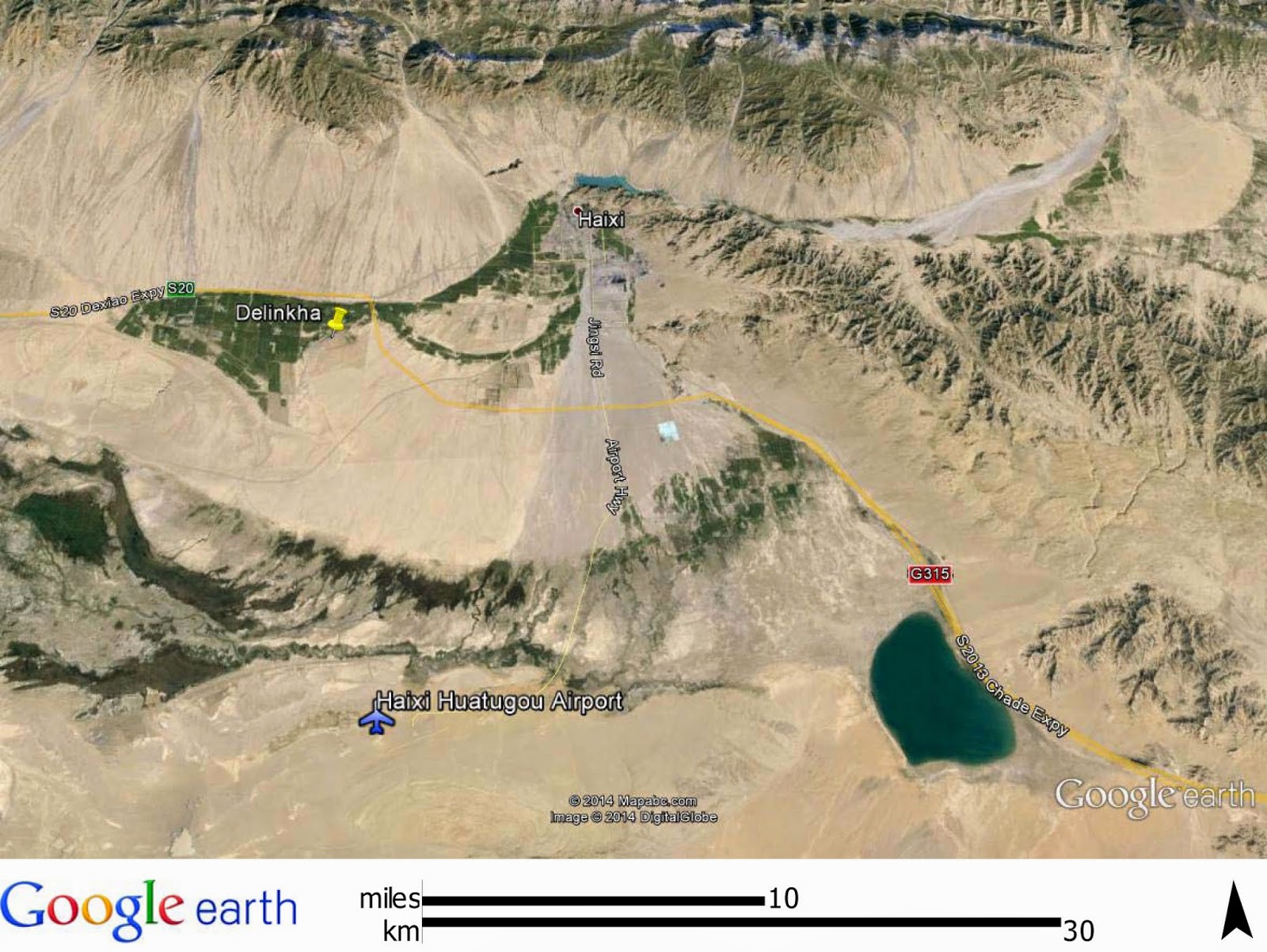
Haixi Huatugou Airport in Amdo (Qinghai)
On August 30, I quoted Xinhua, announcing that Sichuan Province will soon have its fourth high-altitude airfield, “which local officials hope will boost tourism in the heavily Tibetan-populated region.”
The new Hongyuan Airport is located in Ngaba Tibetan and Qiang Autonomous Prefecture at an altitude of 3,535 meters. The Prefecture is situated in northwestern Sichuan, at the border of Gansu and Qinghai provinces.
Less than two weeks later, Xinhua now reports that Qinghai Province 'located on the Qinghai-Tibet plateau' will be home to another airport.
The Huatugou aviation airport, presently under-construction, is being built in the Mongolian-Tibetan Autonomous Prefecture of Haixi.
The Qinghai Airport Company said the airport will cover an area of 180 hectares and it will cost 114 million U.S. dollars.
It is a big investment for a Prefecture which, according the 2010 census, has 489,338 inhabitants only.
The airport will have a 3,600 meters runway and a terminal covering an area of some 3,000 square meters, which is relatively small.
The airport is expected to be completed within a year.
Why an airport in this area?
Xinhua gives one of rationales: "the airport is located in China's major production base for petroleum and potash fertilizer. It is expected to support local development."
Probably, the ‘local development’ with Chinese characteristics, in other words, 'Chinese economy at large'!
In 2011, a Chinese article gave a hint of the Chinese intentions: "The region is an important base for the production of crude oil; the surrounding is rich in oil, asbestos, potash and other scarce resources. The asbestos reserves rank first in the country; reserves of petroleum prospects are estimated at 1.1 billion tons. Though Qinghai is an important base for the production of crude oil, due to the remoteness, the limited transport conditions, the growth of the local economic and social development is restricted."
With connections to Xining, Delinkha, Golmud, Dunhuang, Gansu and Xinjiang, the new airport is expected to have an annual turn-over of 90,000 passengers and 100 tons of goods by 2020.
One understands better why it is a worthwhile investment.
Hongyuan Airport under construction

Further, the new airport is located close to the Xining-Golmund-Lhasa railway line and the China National Highway 315 (G315) which runs from Xining, the capital of Qinghai to Kashgar in Xinjiang. The 3,063 kilometres long highway passed in Delinkha. The new infrastructure will be used to link the restive province of Xinjiang with the Tibetan plateau. It can be useful in case of ‘disturbances’.
But there is more.
In 2010, I mentioned on this blog that DF-21C missiles were deployed in the same area. After The Times of India had ‘broken the news’ that Chinese missiles were deployed near the Indian border, Hans M. Kristensen of the FAS Strategic Security Blog had clarified: “The latest Pentagon report on Chinese military forces recently triggered sensational headlines in the Indian news media that China had deployed new nuclear missiles close to the Indian border. The news reports got it wrong, but new commercial satellite images reveal that launch units for the new DF-21C missile have deployed to central-western China.”
The area mentioned by the US report is not far from the new Hongyuan ‘civil’ airport.
In the meantime, in the Tibetan Autonomous Region, the authorities are actively planning to open a second airport for Lhasa.
On September 7, it was reported that the Lhasa Party’s Secretary Qizha La (or Choedrak in Tibetan) went for an inspection tour on the site of the new airport.
The Tibet Daily said that preliminary planning and design work were carried out. Choedrak asked the people to fully understand the practical significance of the construction of this new airport.
The Township of Lhasa attaches “great importance to further strengthening the organization by building a first-class international airport,” he said.
The objective of his visit was to accelerate the planning, design and other preparatory work for the project which should be implemented as soon as possible, according to the mouthpiece of the Party.

Choedrak, mayor of Lhasa on the site
Choedrak gave the usual speech: “the construction of the new airport in Lhasa will promote leapfrog development and long-term stability; it will strengthen national defense modernization; and will give full play to the role of Lhasa, the capital city [of Tibet]”.
It will also accelerate the overall well-being of the society: “All relevant departments should fully understand the important practical significance and far-reaching historical significance of the construction of a new airport in Lhasa; they should unify their thinking, attention, and effectively do all the pre-planning study for the new airport.”
On the long-term, the authorities want to "build a first-class international airport". For the purpose, “it is necessary to scientifically research, to keep high standards in the construction for this first-class airport in Tibet”, said Choedrak, a Tibetan cadre who added that builders should focus on all aspects of the construction of the new airport, i.e. water, electricity, road networks and other works in order to promote economic and social development.
Though Choedrak used the usual Communist jargon, the fact remains that Lhasa will have soon a second ‘first-class international’.
What does it mean for the Tibetan culture?
Probably something like the Reservations in the West of the United States!