Showing posts with label Deng Xiaogang. Show all posts

Wednesday, October 8, 2014

Tibet: why is China so nervous?

China is slowly but surely tightening its grip on Tibet.
The latest sign is the 'upgradation' of the status of the Tibet Armed Police's Political Commissar.
The Global Times yesterday announced : "China's Central Military Commission upgraded the political status of the political commissar of the Armed Police Corps of the Tibet Autonomous Region, indicating the central government's determination to safeguard regional stability".
The Communist mouthpiece quotes 'experts'.
Major General Tang Xiao, the Political Commissar of the Tibet Armed Police Corps, under the People's Armed Police, will now enjoy a new 'treatment'. He will be treated at par with the head of a corps-sized military body, (equal to that of officials at a provincial or ministerial level, according to The Global Times). However, the Tibet Corps itself has not been upgraded.
The Global Times explains to its readers: "Under the dual leadership of the State Council and the Central Military Commission, the Chinese People's Armed Police is composed of internal security forces and various police forces, including border security, firefighting and security guard units."
Niu Zhizhong, Chief of Staff of the PAP announced Tang's promotion at a press conference on October 3.
Niu said that 'better treatment' for the head of Armed Police in Tibet "is a major decision made by Central Military Commission based on the special environment and strategic position of the Tibet Armed Police."
The objective of Tang's promotion is to better safeguard regional stability.
Song Zhongping, a Beijing-based military expert told The Global Times that: "It is not unusual that heads of certain military bodies, which are usually located in strategically important areas or suffer from harsh living conditions, are given certain benefits through their 'treatment' being improved."
One online commentator said that it is an official announcement of the militarization of the People’s Armed Police in Tibet.
Lt. Gen. Tang Xiao
The commentator explained: "Tang Xiao took over as political commissar of the Armed Police force in the Tibetan autonomous region in September 2013 after being promoted to the police rank of major general of the Armed Police in Tibet in July, 2010. With the October 3, 2014, announcement, Tao Xiao now has official military rank and receives regular military salary. "
Nothing has been said about the PAP Commander in Tibet, Maj. Gen. Song Baoshan. Why to promote the Political Commissar only?
This is an unanswered question.
Let us also not forget that General Wang Jianping, the PAP's Commander is an old Tibet-hand.

Earlier Promotions
Already in July, The PLA Daily had announced that People’s Liberation Army (PLA) had made intensive human resources (HR) adjustment. It was said that the emphasis was laid on the capability demonstrated by the officers: "it indicated the great importance attached by Xi Jinping to practical capabilities of military officers."
China Military Online then reported: "At least 3 of the newly promoted officers have received relevant training in Russia after China and Russia resumed military exchange in 1996, and some of them obtained real war experiences in the China-Vietnam border war at the end of 1970s. This fully demonstrates Xi Jinping’s style of promoting people “who can fight and win battles”.
Two of the Major Generals promoted Lieutenant Generals on July 15 were Xu Yong and Diao Guoxin, respectively Commander and Political Commissar of the Tibet Military District; both participated in the China-Vietnam border war.
Though that was long ago, the Chinese insist on the experience 'acquired' (they must have been 2nd Lieutenant then)!
The PLA website added: "The 55-year-old Xu Yong is quite young among the newly promoted military officers this time. During the Wenchuan earthquake in Sichuan in 2008, which caused the death of 87,000 people, Xu Yong was the first PLA major general that led his troops to participate in the earthquake relief."
This has already been mentioned on this blog.
In the meantime, the civil administration also works hard to ‘stabilize’ Tibet. Deng Xiaogang, the Deputy Secretary in charge of security went on an inspection tour in Lhasa to "check security measures taken during the holiday season and the implementation of the anti-terrorism plan”.
He met ‘festival staff’, representatives of the regional party committee, government officials, and on behalf of Chen Quanguo, the Party boss, he lectured them all about the importance to work hard for maintaining stability of Tibet. Deng, who was accompanied by Lhasa Party Secretary Choedrak and other Party officials, went to Lhasa railway station, to the bus station, where he checked that the Party Standing Committee’s stability maintenance measures have fully been implemented.  He talked to police officers, staff on duty, security personnel and ask them to strictly and meticulously follow the security procedures in order to assure smooth and orderly passenger's transport, stability and harmony. It seems that Deng Xiaogang very pleased but what he saw; he told the security officials that the current social situation in Tibet is generally stable, but the situation is still complicated. Tough anti-terrorism, stability maintenance measures are still required. The forces must remain vigilant and 'tighten the string of measures to maintain stability'. Deng added that everyone should continue to carry forward his duties without fear or fatigue, always remaining on high alert, taking strict precautions according to the regulation to crack down on various criminal activities.  Security staff must consolidate the harmony and stability in the Tibet region. Why is China so nervous? Do they fear the contagion of Hong Kong?

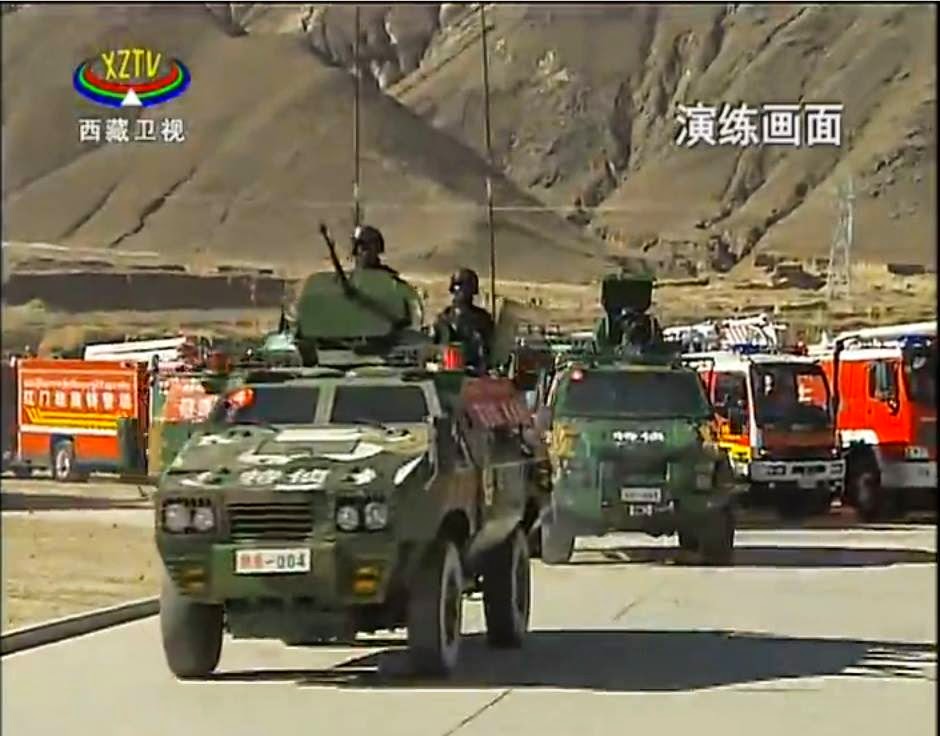
Show of force of the PAP a few months back in Lhasa.


Deng Xiaogang addressing the PAP

Friday, August 8, 2014

China’s ominous development projects along Indian borders

Zhang Yijiong in Tibet
Here is my article published in NitiCentral. It is titled China’s ominous development projects along Indian borders.


Very few in India are bothered by what is happening on the other side of the great Himalayan range. It is too far away, though in the months and years to come, it may influence our lives in a way we can’t imagine today.
What is going on in western Tibet?


Very few in India are bothered by what is happening on the other side of the great Himalayan range. It is too far away, though in the months and years to come, it may influence our lives in a way we can’t imagine today.
The Chinese Press has already hinted that something was cooking on a grand scale.
The Global Times ran a story “Sky rail to run from Lhasa to south Tibet; further railway expansion to connect Nepal, Bhutan, India by 2020.”
It announced that the railway linking Lhasa and Shigatse (poetically termed by China as the ‘closest stretch of railway to the sky’) will be open to traffic in August.
The construction of the extension of the Qinghai-Tibet Railway, which started in September 2010, will be 254 km long and have 13 stations. Trains will be able to run at a speed of 120 kmph and it will take only 2 hours from Lhasa to Shigatse, the seat of the Panchen Lamas’ and the TAR’s second largest city.
It is the largest infrastructure project in Tibet during the twelfth 5-Year Plan (2011-2015), with an investment of more than $1.7 billion.
Zhu Bin, manager of a mineral company based in Lhasa, frankly admitted to The People’s Daily: “It will accelerate transportation of the mineral products, which could only be transmitted through highways that often risk being cut off during rainy seasons or see vehicle turnovers.”
Another raison d’ĂȘtre of the train is to bring more tourists, Tibet’s main source of revenue (15 million Chinese will visit Tibet in 2014) and to ‘strengthen’ the borders with India by allowing quick movement of troops and armament.
The Global Times also announced that during the 13th Five-Year Plan, the construction of a railway connecting Shigatse with Kyirong in northern Nepal and with Yatung, in the Chumbi Valley set between Sikkim and Bhutan, will start.
Yatung may be a distant dream, but Kyirong is a logical extension of the line as China has extensively invested in this landport to make it the main link between Tibet and Kathmandu, (and economically invade Nepal).But there is more happening in Tibet, particularly in the wilderness of Ngari, the prefecture located west of Ladakh and north of Himachal and Uttarakhand.
First, the unusually-long stay in the Prefecture of Deng Xiaogang, Deputy Party Secretary of the Tibetan Autonomous Region, responsible for the law and order, security and police, “to inspect the border security and the People’s Liberation Army bases”.
During the past two months, he spent most of his time in Western Tibet. On June 20, an article in The Tibet Daily mentions: “Deng Xiaogang inspected Rutok, the border county”. Rudok is located near the Pangong Lake (tso) stretching between India and China; it is where Chinese ‘water’ incursions often occur.
Addressing the border guards, Deng Xiaogang stressed: “Tibet is very special strategic location; it is an important barrier for the national security; development and stability in these border areas is an important part of the region’s overall situation.”
Why is China so nervous about these borders areas?
One reason is probably that China wants to reinforce its border with India, especially after the Modi Sarkar declared that one of its priorities was the development of infrastructure along the borders.
Deng has not been the only Chinese official to visit the beautiful (and strategic) Ngari.
Zhang Yijiong, Deputy Minister of the Central United Front Work Department, who is also the interlocutor-designate for eventual negotiations with the Dalai Lama’s envoys, followed the footsteps of Deng Xiaogang.
Zhang Yijiong visited Purang County, at the trijunction India-Nepal-Tibet, near Mt Kailash. One can be sure that his trip was not a spiritual one. He met policemen, firefighters (for preventing immolations?), officers and troops manning the border with India, the SWAT (commandos) and lectured them on the different aspects of ‘counter-terrorism’ and ‘stabilisation’.
Even more importantly, General Xu Qiliang, a member of the Politburo of the CCP’s Central Committee and one of the two vice-chairmen of the Central Military Commission (CMC) spent time ‘inspecting’ the Xinjiang and Tibet garrisons.
According to a Chinese military website: “Xu Qiliang recently [it is not disclosed when] inspected the troops of the People’s Liberation Army (PLA) and the People’s Armed Police Force (PAPF) garrisoning Xinjiang and Tibet.”
Was the recrudescence of ‘intrusions’ into the Indian territorial waters on the Pangong lake and on the ground (near Demchok), which occurred around that time, a mere coincidence?
On June 24 and 25, the powerful Commander of PAPF, Wang Jianping had visited Lhasa and Ngari prefecture ‘to carry out investigations’. The boss of all paramilitary forces in China, an old Tibet hand (he was posted in Tibet between 1996 and 2000), emphasised that the troops should “resolutely work for the long term peace and stability of Tibet.”
General Wang Jianping’s visit was followed by the arrival in Lhasa of Meng Jianzhu, Politburo member and head of the Commission for Political and Legal Affairs of the Central Committee. Meng spent five days in Lhasa and Southern Tibet. It is not known if Meng had time to drop by Ngari.
That is not all, Shaanxi Party Secretary Zhao Zhengyong also travelled to Western Tibet. Shaanxi is one of two provinces that have ‘adopted’ Ngari Prefecture by sending hundreds of cadre to carry out infrastructure and developmental projects.
Zhao said that Shaanxi province will incorporate Ngari’s development into its own overall plan, ‘to give impetus to Ngari Prefecture’s new developmental’.
Shaanxi has already donated funds to make Demchok, the border town with India into a ‘model village’ (the traditional Demchok village is in Ladakh, but the Chinese have built/renovated their own Demchok on their side of the LAC).
While CCTV showed new homes, a beautiful guest house (for visiting Chinese VIPS?), a Chinese website explained: “The border line [with India] passes through Dian-jiao [Demchok] village of Tashigang township .On Aug 2011, the Shaanxi donated 4 million US $ to Demchok village for making it a model border village by promoting economic development and consolidation of the border.”
All this is ominous. What to conclude?
These high-profile visits are linked with the railway line soon reaching Shigatse. This will bring a tremendous economic and strategic boost to the region, first around Shigatse and to the new landport in Kyirong which will become the most important link between Tibet and Nepal, but also in Ngari prefecture.
Beijing is keen to open these areas to large-scale tourism like it was earlier done in Lhasa and Nyingchi.
Is the construction of a new guest house in Demchok a sign that China may agree to open the traditional border between Tibet and India? Some voices in Tibet seem in favour, on a small scale at least.
From the Indian side, the situation should be watched vigilantly.

Wednesday, July 30, 2014

Developing Western Tibet, China secures its border with India

The two parts of Demchok
I have often mentioned on this blog, the unusually-long stay of Deng Xiaogang, Deputy Party Secretary of the Tibetan Autonomous Region (TAR) and Secretary of TAR’s Politics and Law Committee (in other words, responsible for the law and order, security and police in Tibet) in Ngari Prefecture “to inspect the border security and the People’s Liberation Army bases”.
During the past 2 months, he spent most of his time in Western Tibet, except for one or two times he had to rush to Lhasa to receive VVIPs.
On June 20, an article in The Tibet Daily mentions: "Deng Xiaogang comforts the rank and file of the police in border County", adding that Deng “inspected Rutok, the border county in Ngari Prefecture and conveyed to the rank and file of the border policemen, the Party’s cordial greetings. He cordially shook hands with the soldiers and comforted them.”
Rudok is located near the Pangong Lake (tso) stretching between India and China; it is where Chinese ‘water’ incursions often occur.
Addressing the border guards, Deng Xiaogang stressed: "Tibet is very special strategic location; it is an important barrier for the national security; development and stability in these border areas is an important part of the region's overall situation. In recent years, under the strong leadership of the CPC’s Central Committee, the regional Party committee [of the TAR] and the [local] government firmly requested people to unite and take a lead in the development of the region; they went all out to maintain stability, and improve people's livelihood as much as possible; to build prosperity, harmony, happiness, a place ruled by law, a beautiful new socialist Tibet and [finally] to work hard."
Apart from the usual Communist jargon, the question remains why should a senior, powerful leader like Deng spend weeks in such remote places.
One possibility is that China wants to reinforce its border with India, especially after the Modi Sarkar declared that one of its priorities was the development of infrastructure along the borders (see my interview with Kiren Rijiju).
Deng has not been the only Chinese official to visit the beautiful (and strategic) province of Ngari.
Zhang Yijiong, Deputy Director of the Central United Front Work Department, who is also the interlocutor-designate for eventual negotiations with Dharamsala, followed the footsteps of Deng Xiaogang.
Wu Yingjie, Deputy Secretary of the TAR, Deng Xiaogang and Dong Mingjun, one of the TAR’s vice-chairmen were on Zhang’s side.
When Zhang Yijiong particularly visited Purang County, at the trijunction India-Nepal-Tibet, near Mt Kailash, his trip was of course, not a spiritual one.
He met policemen, firefighters (for preventing immolations?), officers and troops manning the border with India, the SWAT (commandos) and lectured them on the different aspects of ‘counter-terrorism’ and ‘stabilization’.
He praised the troops for remaining ‘steady’ despite the cold and the lack of oxygen, the harsh environmental conditions and complimented them for fulfilling their duties conscientiously without being overtaken by fatigue.
He asked them to continuous keep their fighting spirit "to maintain a sustained harmony and stability of Ngari area and to work for the development and stability of Tibet".
He thanked the soldiers for their important contribution to the Chinese nation: “On behalf of the Central United Front Work Department, my heartfelt gratitude and highest respect for you, I hope you will continue to make persistent efforts, do a solid job for the long-term stability and the overall stability of Tibet”, he told the border troops.
The caring party leader asked the soldiers to look after themselves and pay attention to their health.
More importantly, General Xu Qiliang, a member of the Politburo of the CCP's Central Committee and one of the two vice chairmen of the Central Military Commission (CMC) ‘inspected’ the Xinjiang and Tibet garrisons.
According to a military website: "Xu Qiliang recently [when is not disclosed] inspected the troops of the People’s Liberation Army (PLA) and the People’s Armed Police Force (PAPF) garrisoning Xinjiang and Tibet."
General Xu visited the soldiers and officers stationed in the Aksai Chin and Ngari opposite the Indian troops.
Note that there was a recrudescence of ‘intrusions’ into the Indian territorial waters on the Pangong lake and on the ground (Demchok) around the time of his visit.
No doubt just a coincidence!
On June 24 and 25, the powerful Commander of People’s Armed Police Force (PAPF), Wang Jianping had visited Lhasa and Ngari prefecture ‘to carry out investigations’. The boss of all paramilitary forces in China, an old Tibet hand (he was posted in Tibet between 1996 and 2000), emphasized that the troops should “resolutely complete every task keeping in mind the tasks that are more urgent, working hard to start the new phase of establishing the police team for a new achievement for the developmental breakthrough and long term peace and stability of Tibet.”
In Lhasa, he was accompanied by the TAR Secretary Chen Quanguo, Deng Xiaogang, Choedak (Qizha La), Wang Ruilian, Kelsang Tsering, Dorjee Tsedrub, Lobsang Gyurmey and others.
General Wang Jianping’s visit was followed by the arrival in Lhasa of Meng Jianzhu, Politburo Member and head of the Commission for Political and Legal Affairs of the Central Committee. Meng spent five days in Lhasa and Lhoka. While in Tibet, he asserted that “local officials should have a profound understanding of the long lasting nature of the anti-secession efforts, and always take them as the primary political task, he said, vowing a harsh crackdown on separatist activities or terror attacks.”
It is not known if Meng had time to drop by Ngari.
Now, on the development side, Shaanxi Party Secretary Zhao Zhengyong also visited Ngari. Shaanxi is one of two provinces that have ‘adopted’ Ngari Prefecture by sending hundreds of cadres to carry out infrastructure and developmental projects.
On July 16, a Chinese website reported: “Zhao Zhengyong [downgraded by the website as Deputy Secretary of Shaanxi] led the team of the party government delegates to Gar [Gartok] county of Ngari prefecture to investigate the project of Shaanxi’s aid to Tibet. They visited and greeted the cadres aiding Tibet. He emphasised that Shaanxi will sincerely implement the orders of the Central Party, regarding the work of giving aid to Tibet. He said that they will incorporate Ngari’s development into the overall plan of the Shaanxi province, start formulating the 13th five-year plan of Shaanxi at the earliest and give impetus to Ngari Prefecture’s new developmental breakthrough.”
Zhao was accompanied by Padma Choling (Chairman of TAR people’s Congress and only Tibetan in the Central Committee) and Jiang Zelin (Standing committee member of CPC Shaanxi Provincial Committee and Vice Governor of Shaanxi Provincial People’s Government).
Lhasa TV showed Zhao’s visit in Ngari.
At the end of 2012, Shaanxi had allocated 4 million US $ to make Demchok, the border town with India [note the traditional Demchok village is in Ladakh, but the Chinese have built/renovated their own Demchok on their side of the LAC] into a ‘model village’.
CCTV showed new homes, a guest house (for future Indian visitors?) and a map of the nearby historical spots.
The TAR website explains: “The border line [with India] passes through Dian-jiao [Demchok] village of Tashigang township, Gar County .On Aug 2011, the Shaanxi Province fund for aiding Tibet donated 21million Yuan to Dian-jiao [Demchok] village for making it a model border village by promoting economic development of the border area, unity among the ethnic groups and consolidation of the border.”
The article continues: “Waking into the Dian-jiao [Demchok] model border village, one can see an irregular arrangement with charming effect which is filled with Tibetan characteristics. There are good water, electricity, road and communication facilities. Facilities like Solar energy street lights and gymnasium equipments are also available. Zhao Zhengyuan had close interaction with the village cadres, members of the working group stationed at the village, the security personnel responsible for guarding the border, to get a detailed understanding of the situation of building of the model village, the situation of the Party branch of the village and the village [Party] Committee. He pointed out that TAR party committee and the government is sincerely implementing every policy that is beneficial to the people and that will bring prosperity to the border areas.”
What to conclude from all this?
These high-profile visits are linked with the railway line soon reaching Shigatse. This will bring a tremendous boost to the region, first around Shigatse and particularly to the new landport in Kyirong which will become the most important link between Tibet and Nepal, but also to Western Tibet (Ngari prefecture).
Beijing seems keen to open the area to large-scale tourism like it was earlier done in Lhasa and Nyingchi.
It will be one way to get more revenues for the region; they can be reinvest later in the ‘development’ of the area.
This, of course, poses serious security problems to China, mainly due to the proximity of the border with India. This explains the visit of General Xu Qiliang [originally, an Air Force officer] and General Wang Jianping, responsible of the paramilitary forces on the border.
The last two visits mean that China remains in a state of alertness and preparedness on its frontier with India. Regular incursions (in the Western and Eastern Sectors, but in the Central Sector too - in Uttarakhand) will probably continue; it is one way for Beijing to test the Indian waters (and the Modi Sarkar).
The visit of Zhao Zhengyong demonstrates that China is keen to invest in the rapid development of the area with the help of other Chinese provinces.
The construction of a new guest house in Demchok is perhaps a sign that China may agree to open the traditional border between Tibet and India; on a very small scale in a first stage, but security issues have to be tackled first.
That is probably what Deng Xiaogang was inspecting.
From the Indian side, the situation is worth watching.

Friday, July 11, 2014

Dharamsala Interlocutor visits Western Tibet

Zhong Yijiong visiting a Tibetan family
when he was posted in Jiangxi
The craze for Ngari continues.
Zhang Yijiong, Deputy Director of the Central United Front Work Department, who is also the interlocutor-designate for eventual negotiations with Dharamsala followed the footsteps of Deng Xiaogang, the Tibetan Autonomous Region’s (TAR) Deputy Secretary who has been spending weeks in the border areas of Western Tibet (Ngari).
Zhang, a member of the all-powerful Central Committee of the Communist Party came to give some guidance to the local cadres on terror issues, counter-terrorism and of course ‘stability' and also to 'encourage cadres and masses of all ethnic groups'.
I also wonder how many ethnic groups, apart from the Tibetans (and the Han soldiers) live in Western Tibet.
Zhang, who was posted in Tibet between 2006 and 2010, was accompanied by a high-level delegation.
Wu Yingjie, Deputy Secretary of the TAR, Deng Xiaogang, in-charge of the Politics and Law Committee (read law and order and security) and Dong Mingjun, one of the TAR’s vice-chairmen were on Zhang’s side.
Before leaving Lhasa, Zhang Yijiong called on Pagbalha Namgyal Rinpoche, the National Vice-Chairman of CPPCC and …oh surprise, on the Panchen Gyalsten Norbu.
It is surprising, because the Lama was supposed to have gone back to Beijing, at least according to The Tibet Daily.
Did he miss the plane?
Or did he decide to experience the blue sky of Western Tibet (or simply visit  'his' Tashilhunpo monastery monastery?) before returning to the polluted Chinese capital?
Or did he take a ride on the Lhasa-Shigatse railway which is expected to be officially inaugurated in August (a month earlier than earlier planned!).
It is not clear from the reports published so far.
Though Zhang Jiong visited Purang County at the trijunction India-Nepal-Tibet, near Mt Kailash, his trip was not spiritual in nature.
He met all the police officers, the firefighters (for preventing immolations?), the officers and troops manning the border with India, the SWAT (commandos) and lectured them on the different aspects of counter-terrorism and ‘stabilization’.
He praised the troops for remaining ‘steady’ despite the cold and lack of oxygen, the harsh environmental conditions and for fulfilling their duties conscientiously without being overtaken by fatigue.
He asked them to continuous remain in fighting spirit "to insure orderly activities, maintain a sustained harmony and stability of Ngari area and work for the development and stability of Tibet".
He thanked them for their important contribution for the nation: “On behalf of the Central United Front Work Department, my heartfelt gratitude and highest respect [to you], I hope you will continue to make persistent efforts, do a solid job for the long-term stability and the overall stability of Tibet”, he told the soldiers.
The caring party leader asked the troops to take care of themselves and pay attention to their health.
Zhang Jiong visited other border posts, always telling the soldiers on duty to fully understand the complexity of the current grim situation (does he refer to the presence of the Dalai Lama in Ladakh?); he asked the border guards to increase their sense of responsibility and their sense of mission.
He also visited some temple (Ke Jia?) and harangued the monks; he also asked about their living conditions and noted that the majority of monks devote themselves to Buddhist practices to improve their religious skills; they are patriotic and unswervingly oppose “the Dalai clique's separatist and sabotage activities” in order to resolutely safeguard the national unification and ethnic unity.
The Party cadres were told that they should make friends with the monks, fully mobilize the enthusiasm of the patriotic and law-abiding monks and nuns and actively help Tibetan Buddhism to adapt to a socialist society; this will be for the common good and create a safe and harmonious environment, he said. All the departments should attach a great importance to the conservation work of the temples in order to protect and promote the cultural heritage of the nation.
This obsession with 'stability' shows that Beijing is quite nervous about the 'stability' of its borders with India.
Later, Zhang Yijiong went to Ngari (Ali in Chinese) where he met the United Front local cadres and other Party workers. He asked them to conscientiously implement the Party's ethnic and religious policies, and comprehensively improve the level of ethnic and religious affairs.
In other words, be nice with the local Tibetans.
Why so much focus on Ngari?
One factor is of course the presence of the Dalai Lama in Ladakh.
Ngari and Ladakh were once upon a time, part of the same kingdom.
Another reason the arrival of Narendra Modi in power in Delhi. The 'Tibet Policy' of the new Government might be different from the one followed by the Congress.
The arrival of the train in Shigatse will also be a game-changer for Western Tibet. According to Chinatibetnews.com, with a total length of 253 kilometers, the Lhasa-Shigatse railway was completed in March 2014, after 4 years of construction, with the tunnels covering 115.7 kilometers, accounting for 45.7 percent of the line length. It will be inaugurated in August.
It means that millions of Chinese tourists will have an easier access to the beautiful 'heritage' sites of Western Tibet.
By the way, I mentioned on this blog that General Wang Jianping, the People's Armed Police Commander visited Lhasa a couple of weeks back. After 'leaving' Lhasa, he reappeared in Urumqi in Xinjiang a few days later. Where did he go in between?
Did he also take a ride on the new train or visit his troops on the border with Ladakh? Nobody knows.
The new Shigatse Railway Station


Sunday, July 6, 2014

The Dalai Lama's Birthday and Beijing's dilemma

Huge crowds welcomed the Dalai Lama in Zanskar and Ladakh
The Dalai Lama is 79 years old today.
Surprisingly, China Tibet Online, the mouthpiece of the Communist Party in Tibet, remembered the date by publishing an appeal calling for his return ...to China.
The language is relatively more moderate than usual (it does not speak of the 'Dalai Lama's clique', for example) though Beijing sticks to its old position, the Dalai Lama is welcome back ...if he gives up is 'separatist' stance ...and lives in Beijing.
Time and again, the Dalai Lama declared that he is not interested in his personal 'position'; he wants a solution for 6 million Tibetans.
The China Tibet Online article asserts that: "all successive Chinese leaders have stated very clear[ly] the consistent stance and policy towards the Dalai Lama and the contact and talk with his representatives, and even the future plan for his followers around him can be negotiated."
Beijing's conclusions is "Therefore, the way back home is clear. But how to come back and whether he wanted to come back could only depend on the 14th Dalai Lama himself."
The leadership in China probably realizes the immense popularity of the Tibetan leader on the south of the Himalayan range; it seems unable to deal with this phenomenon. 
Plain insults (like during the tenure of Zhang Qingli, the previous Party Chief in Tibet) did not work; repression is not working too; so, why not an invitation to come back 'home'?
However, it is not what the Dalai Lama is asking for.
He wants a 'genuine' autonomy for his people.
This is clearly unacceptable to Beijing; it would have serious implications for the Middle Kingdom. You just need to look at the neighbouring Xinjiang, to understand!
The fact that Deng Xiaogang has been roaming around Ngari for weeks, is a sign of Beijing's dilemma.
Where is the solution? 

Looking into Dalai Lama's way home upon his birthday
2014-07-04
Lethe Guo
China Tibet Online
Born in 1935, the 14th Dalai Lama is celebrating his 79th birthday on July 6, 2014. The old monk has lived in a small town of Dharamsala in northern India for more than half a century since he fled from China's Tibet in 1959.
"Falling leaves return to their roots", as a Chinese saying goes. As a man gets older, he or she would inevitably think about returning home. On this occasion, it might be interesting to ask if the Dalai Lama has some genuine reminiscence and expectations on returning home besides using it as a political wager.
For the past 54 years, this homesickness, if any, could be fathomed from the name of Daramsala meaning "little Lhasa" since Lhasa is not only the capital of the current Tibet Autonomous Region but also the place where his Potala Palace stood in old Tibet.
The geographical distance between Dharamsala and Lhasa is 1,443 km. Yet, how long is the journey for Dalai Lama to cross the snow-capped Himalayas and return to China's Tibet?
The answer is clear in Chinese government's stance. For a long time, the Chinese central government has made it clear how the 14th Dalai Lama could return to his homeland, which can be noted in many top leaders' remarks.
In October 1959, seven months after the 14th Dalai Lama's flee from Tibet, Mao Zedong stated: "He (the 14th Dalai Lama) could come back as long as he admitted that Tibet is part of China and agreed democratic reform to be carried out in Tibet."
In December 1978, Deng Xiaoping said during an interview with the US Associated Press (AP) that the 14th Dalai Lama could return as a Chinese citizen, which meant he should behave like a Chinese citizen and stop persisting on a separatist idea or doing any such activities.
In 1998, Jiang Zemin made it clear in expounding China's principles and stance towards the contact and talk with the 14th Dalai Lama that, "As long as Dalai Lama drops his 'Tibet independence' position, stops any separatist activity, acknowledges officially that Tibet is an indispensible part of China…and recognizes the government of People's Republic of China as the sole legitimate government to represent China, the door is open for talk."
In May 2005, Hu Jintao also pointed out that the leadership of the Chinese Communist Party in Tibet, socialist system, and the system of regional autonomy for ethnic groups in Tibet must be kept.
Therefore, what is common in all of these Chinese leaders' statements is that the idea of democracy, autonomy and national integrity can't be challenged by the Dalai Lama.
Recently, the Dalai Lama and his group managed to send radical representatives to spread such words and fan the flame of separatism to orchestrate self-immolations, according to the previous reports by Xinhua on the crackdown of such cases in Sichuan and Gansu provinces. Besides, what else has the 14th Dalai Lama done?
His calls for contact and talk always land on the proposal of the "Middle Way Approach" including the idea of "Greater Tibet" that schemes all Tibetan-inhabited areas as "Tibet" and asks to drive out people of all other ethnic groups from these areas, and the proposal of "high-degree autonomy" preceded by the "genuine autonomy".
The first is by no means practical or lenient, and to some degree undermines the wisdom of a religious personage. Above all, different ethnic peoples live in Tibetan-inhabited areas in the surrounding provinces such as Qinghai and Gansu historically. These places are as much rooting homeland for Tibetans as for other ethnic peoples. Besides, in an era of the "Earth Village", migration and national integration is the trend, which is inevitable throughout the human history if any global development is made. After all, historically speaking, the "Greater Tibet" has never existed in ancient China. Thus, it's not the "Middle Way" but rather an innovative and hegemonic way that against history and practice.
Second, the idea of "high-degree autonomy" proceeded by the "genuine autonomy" stands out rather as much ironic. The administration in Tibet is a regional ethnic autonomous one led and funded directly by the central government. Tibetan cadres and all civil servants in the administration account for 70 percent to make decisions for the Tibetan people's well-being and speak for them in attending the central government's conferences. Interestingly, the Dalai group did explain at times what they wanted, in particular the Tibetan army, the right to establish diplomatic relations with some international organizations or foreign countries. To what extent, are these rights not the rights of an independent country?
A little serious look at the two proposals as the wager bid for "promoting contact and talk with the central government of the PRC" could come to this conclusion of his insincer political motive.
Moreover, the mostly acknowledged and respected identity of the 14th Dalai Lama lies in his religious position as one of the two most influential rinpoches enjoying highest positions in the Gelug Sect of Tibetan Buddhism with the other one being Panchen Lama. However, the 14th Dalai Lama doesn't seem to value his holy title so much as to often wear the crimson robe to show around his religious identity for pitiful donations and publicity like a pop star.
He could hold four times the "Kalachacra (one of the most well-known meditational deities in Tantrism, or the wheel of time) Consecration Great Assembly" in one year. Buddhists all know that the "Kalachacra Consecration Great Assembly" is so divine that it could only be organized once a year or even once in several years for exceptionally special events. For example, Jamyang Gyatso, the sutra teacher of the 11th Panchen Lama, held a "Kalachacra Consecration Great Assembly" in the Labrang area in the Gannan Tibetan Autonomous Prefecture of Gansu last summer, when nerly 100,000 people assembled to hear the highly esteemed lama Jamyang Gyatso chanted sutra and prayed for Buddha's blessings for people. Compared with Jamyang Gyatso, the 14th Dalai Lama indeed has a higher religious position, but does it mean he could do everything to his desire? Even his teacher, Tsongkhapa, the founder of the Gelug sect, could simply conduct such great grand assembly once in his lifetime, which was in the Jokhang Temple in 1409 wen China was the Ming Dynasty (1368-1644) with more than one year's preparation, how could the 14th Dalai Lama play himself and Tibetan Buddhism like that to woo innocent westerners?
Likewise, he tended to play with his reincarnation issue as well. That might be why he could talk about incarnating into a woman, a foreigner, or a "bee" and even appointing a reincarnated soul boy while he is still alive. Words are indeed ironic, especially for "experts" to address "ignorance", aren't they? Yet, can the Tibetan Buddhism followers expect more respect towards Dharma from the 14th Dalai Lama?
According to Xinhua's recent report, the Chinese government invested 2.5 million yuan (some 410,000 US dollars) in October 2012 to restore the 14th Dalai Lama's old residency in Hongya Village of Shihuiyao Township in Pin'an County, Haidong Prefecture of Qinghai. In the family prayer room, statues of Shakyamuny the Buddha, Thousand-hand Avalokitesvara and the 14th Dalai Lama are consecrated.
The 14th Dalai Lama, or Tenzin Gyatso, was born into a farmer's family in Huangzhong County of Qinghai Province in 1934. After being confirmed as the 14th Dalai Lama, he became the top leader of old Tibet. After the founding of the People's Republic of China in 1949, he sent representatives to Beijing to talk with the central government's representatives and signed the "17-Article Agreement" to liberate Tibet peacefully under the leadership of the central government. In 1959, some Tibetan serf owners, the noble ruling class, launched armed rebellion, and then the 14th Dalai Lama flew to India.
As mentioned above, all successive Chinese leaders have stated very clear the consistent stance and policy towards the Dalai Lama and the contact and talk with his representatives, and even the future plan for his followers around him can be negotiated.
"If the Dalai Lama is to improve his relations with China's government, he must give up his separatist position…and stop making statements which disrupts the peaceful development of Tibet," said a China's top religious official on June 29, according to AFP.
Therefore, the way back home is clear. But how to come back and whether he wanted to come back could only depend on the 14th Dalai Lama himself.

Thursday, July 3, 2014

A cunning dragon lurks behind the diplomatese

After Tibet, General Wang Jianping visited Xinjiang
My article A cunning dragon lurks behind the diplomatese appeared in the Edit Page of The Pioneer today.

Here is the link...

Even as the Vice President of India travelled to China to celebrate 60 years of Panchsheel, Beijing published a map that showed large parts of Indian territory as its own, while its troops sailed into Indian waters at Ladakh

Is China taking India for a ride? On the surface, everything seems good. The Vice President of India, Mr Hamid Ansari, accompanied by the Foreign Secretary, visited China to celebrate 60 years of Panchsheel. Mr Ansari estimated that the visit was “good, productive gestures of friendship were made by the host.” He added: “Chinese President Xi Jingping said he is looking forward to meeting Prime Minister Narendra Modi during the BRICS summit… I was told that the Chinese leadership regards a vibrant relationship with India as a critical element of their policy.”
Around the same time, Beijing published its first official vertical national map of China, incorporating vast areas of the South China Sea… and India’s northern borders.  Embarrassed, the Ministry of External Affairs decided to take note of the new map which showed Arunachal Pradesh as part of China. The spokesperson was, however, quick to dismiss the new depiction of China’s borders by stating that “cartographic depiction did not change the reality that Arunachal was part of India.”
What is more shocking is the fact that the spokesperson omitted to mention that the Central Sector (parts of Uttarakhand and Himachal Pradesh) where large chunks of Indian territory (such as Barahoti and Nilang) appear on the Chinese map too. Similarly, there was not a word for the Aksai Chin and areas around the Pangong Lake in Ladakh! Why has the MEA nothing to say about these vast areas of India’s territory? There is one more ‘detail’, which is vital for India’s defence: On the new Chinese map, the size of the Chumbi Valley, located between Sikkim and Bhutan, is extremely bloated. Does China plans to grab more territory from Bhutan?
It is all the more difficult to understand after the Indian Press had reported that on June 24, Chinese People’s Liberation Army boats came 5.5km into Indian waters on the Pangong tso (lake). The Chinese incursion lasted over two hours, involving four high-speed interceptor boats that were pushed back by Indian troops, using US-built boats. The Hindustan Times quoted Government sources to affirm that the lake has seen 12 face-offs between Indian and Chinese troops this year alone: “In 2013, there were no less than 18 face-offs between Indian and Chinese troops in Pangong tso due to serious difference in perception on the Line of Actual Control and also due to massive Chinese infrastructure build-up close to the line.” The low-key reaction of the MEA is particularly surprising when one looks at the newly-published Chinese map.
China has been a regular offender. A few months after the signature of the infamous Panchsheel Agreement in October 1954, Jawaharlal Nehru visited China. On his return, he wrote an internal note entitled ‘Implications of China Visit’. The maps of China showing large parts of India’s territory as belonging to China were discussed with the top Communist top leadership. Nehru writes: “I referred to Chinese maps which still showed portions of Burma and even of India as if they were within Chinese territory.”
Zhou Enlai cleverly replied that, “These maps were old ones and China had not done any surveying to draw new maps. Their boundaries even with Mongolia and the Soviet Union were still not clearly demarcated and there were discrepancies.” Nehru concluded: “I wondered how China would feel if a part of Tibet had been shown as part of India in our maps.” Of course, he did not have the guts to actually test this.
Today, though Beijing still promotes the Five Principles, the situation on the ground is on the way to repeat itself. Let us not forget that China’s Survey and Mapping Administration has approved the controversial map published by Hunan Map Press, which in its announcement said the map was of “great significance in safeguarding the nation’s water sovereignty and territorial integrity”.
But there is more than the maps. When one closely looks at the situation in Tibet, one realises that the leadership in Beijing has started to work hard to reinforce its borders with India. During the last few weeks, Mr Deng Xiaogang, Deputy Party Secretary of the Tibetan Autonomous Region has been ‘inspecting’ Western Tibet (known as Ngari), adjoining Uttarakhand, Himachal Pradesh and Ladakh. Is China trembling just because the Dalai Lama is going to give the Kalachakra initiation to tens of thousands of devotees in Leh? It is doubtful. China is just keen to strengthen her borders. During his long tour of Ngari, Mr Deng visited Rutok, the main town on the vicinity of the Pangong lake; the day when the lake-intrusions took place, he was ‘inspecting’ the nearby Gar country (and incidentally planning to dam the Indus).
Perhaps even more importantly, General Wang Jianping, the commander of the People’s Armed Police Force (paramilitary force manning the border)visited Lhasa on June 26. The powerful officer, with a larger budget than the PLA, inspected the TAR’s People’s Armed Police training base in Lhasa, a traffic police detachment, Tibet’s Forest Armed Police Corps and a detachment of Ngari Police. According to The Tibet Daily, he wanted to get “a detailed understanding of the situation” (on the borders).
The Chinese newspapers reported that Gen Wang acknowledged the success achieved by the Armed Police’s Tibet Corps and the PAPF in every work and asked all the police officers and men to understand the seriousness of “the complicated situation” faced by China. While asking the PAPF to continue to do its job well, Gen Wang spoke of strengthening the the force “for war preparation”. He also said a good chess player takes the initiative. According to The Tibet Daily, Gen Wang asked the PAPF to give first priority to the tasks that need to be dealt with urgently, providing a strong support for “Tibet’s continuous stability, long term stability and comprehensive stability”. ‘Stability’ has been the motto of each and every Chinese leader coming to Tibet in the recent months.
It remains to be seen if the visit of Gen Wang and Mr Deng’s tour of the border areas in Western Tibet is linked to the new aggressiveness on the Pangong tso. In view of the high level delegation accompanying Mr Deng in Ngari, it is probably the case.
The Indian media accompanying the Vice-President in his Panchsheel trip missed another thing: On June 27, President Xi, during a meeting with defense personnel, bid them “to build a strong and solid frontier defense network for both territorial land and water”.  Xinhua reported that President Xi stated: “Upon mentioning frontier defense, one cannot help thinking of China’s modern history when the country was so weak and destitute that it was for everyone to bully.” He asked the Chinese people “not to forget the history of humiliation and to build a strong frontier.” It sounds ominous, though India continues to wishfully dream of the Five Principles of Co-Existence.

Sunday, June 29, 2014

China lacks human infrastructure, is weakest state in the world

Deng Xiaogang visited Rutok County
My article China lacks human infrastructure, is weakest state in the world appears in NitiCentral.

Here is the link...

Tsering Woeser, a Tibetan blogger living in Beijing, says on her blog that she knew a Chinese traveller who had been told by a travel agency that Tibetans were no longer able to obtain permission to travel in border areas of Tibet such as Purang.


China often says one thing and does another.
In Athens, the visiting Chinese Premier Li Keqiang declared that China is committed to settling maritime disputes through dialogue and negotiation on the basis of respecting historical facts and international law.
Of course, ‘historical facts’ for Beijing mean its own interpretation of history; ditto for international law.
Li also spoke about Beijing’s views on a ‘sea of peace’ with other countries.
After China installed an oil rig in the South China Sea in what Vietnam considers its territorial waters in May, Chinese State Councilor Yang Jiechi met with the Vietnamese Deputy Prime Minister and Foreign Minister Pham Binh Minh in Hanoi on June 18, 2014. Though China and Vietnam pledged ‘to rein in maritime tensions’, little has changed after the high level discussions, on the contrary another Chinese oil rig is being set up.
Beijing wants to make clear that China is the most powerful State around and it can send diktats according to its interpretation of ‘history’ to every ‘smaller’ nation, whether it is Japan, Vietnam, the Philippines or India.
It is called the Law of the Bully; and often, it works.
When Li was in London last week, he told David Cameron that if London wanted to do business with China, it should keep quiet on Tibet and human rights issues; the British Prime Minister obeyed.

But is The Bully truly that powerful?
There is no doubt that an aging Europe often has to listen to orders from a still economically strong Middle Kingdom, which however suffers from acute problems — it has miserably failed to pacify its own ‘masses’.
In 1950, Mao sent its First and Second Field Armies to ‘liberate’ Tibet. Nehru’s India acquiesced, Tibet needed to be liberated (though Nehru had doubts, he asked in the Lok Sabha, ‘liberated from what?’).
More than 60 years later, whether it is in Xinjiang or Tibet, the masses are revolting against the ‘liberators’.
While President Xi Jinping speaks to the ‘masses’ about his Chinese Dream, anyone questioning his dream is immediately imprisoned, often without trial.
A recent two-day Xinjiang Work Forum attended by all the members of the Politburo devised new schemes to bring the Party closer to the masses:
  • Boosting employment and income levels.
  • Encouraging urbanisation and interregional migration aimed at expanding the contact and cooperation between different ethnic groups.
  • Strengthening Party organs at the grassroots level in order to eliminate the ‘three evil forces’ —  splittism, extremism and terrorism.
  • Bilingual instruction to make all minority youth conversant in the national language and culture.
This type of policy has not worked in the past and will not work in the future, for the simple reason that the Party says something and does something else, like for foreign affairs issues.
Just for Xinjiang, authorities last week claimed that they had broken up 32 terrorist groups and arrested more than 380 suspects. In the first month of a ‘security campaign’ … and 13 had been executed.
The outspoken Uygur economist and respected university professor, Ilham Tohti, has been detained since January. He would have been charged with spreading separatist ideas, i.e. promoting the Uyghur language. Is that a crime?
When one closely looks at the situation in China, one realises that the leadership lives in fear.
Take Tibet again. A few days ago, it was reported that Deng Xiaogang, Deputy Party Secretary of the Tibetan Autonomous Region (TAR) has been in Purang County, located near Mount Kailash at the tri-junction of India-Tibet-Nepal. He was said to be inspecting security issues faced by the border guards on India’s border.
The International Campaign for Tibet, based in Washington, deduced: “Deng’s visit was likely to be intended to send a signal of vigilance by the Party authorities in the build-up to the Kalachakra in Ladakh. Deng … was cited by the state media as saying that border security checkpoints are key to maintaining social stability in the TAR.”
Is China trembling just because the Dalai Lama is going to give the Kalachakra initiation to tens of thousands of devotees in Leh?

Is it the sign of a great power?
Tsering Woeser, a Tibetan blogger living in Beijing, says on her blog that she knew a Chinese traveller who had been told by a travel agency that Tibetans were no longer able to obtain permission to travel in border areas of Tibet such as Purang.
It is rather surprising, considering the promotion (not to say propaganda), made by Beijing a few months ago about the Mount Kailash.
In February, The China Daily wrote: “2014, the ‘Year of the Wooden Horse’ is the ‘recurrent birth year’ of Kang Rinpoche (Mount Kailash), a holy mountain in west Tibet. Since circling Kang Rinpoche in the Year of the Horse is a sacred tradition among Tibetan Buddhists, this year has seen an endless stream of people flocking to the region to perform pilgrimage.”
What has happened between the Tibetan New Year in February and today?
Just the Kalachakra? The arrival of the Modi government in Delhi?
The powerful Deng Xiaogang has been roaming around the Ngari (Western Tibet) region for the last few weeks. Why?
On June 20, an article in The Tibet Daily asserted: “The TAR Deputy Chairman, Deng Xiaogang inspected the border county of Rutok in Ngari Prefecture and conveyed to the rank and file of the border policemen, the Party’s cordial greetings”. Rudok is a border town close to Ladakh.
Apparently Deng Xiaogang told the local people that the party has “a great trust in those who are stationed at borders, facing cold and lack of oxygen; facing harsh environmental conditions, fulfilling conscientiously their duties, sacrificing without fear or fatigue, in order to defend the national sovereignty and the territorial integrity of the southwest border of the motherland.”
Does China fear some Indian infiltrations or local Tibetans taking refuge in India?
Deng Xiaogang ordered the border guards to “crack down on all criminal activities that endanger national security and social stability, and never let separatism, terrorism and other violent criminals undermine the excellent situation of stability and unity in our region.”
Why should such a senior officer spend weeks on the border?
China is probably nervous about possible infiltrations of Uyghur militants through the Aksai Chin road which enters Tibet via Rutok.
The point is that while China has built a tremendous infrastructure — roads, telecommunications, airports, etc, in border areas in Tibet — the ‘human infrastructure’, so important in case of conflict, is entirely lacking. This is the condition 60 years after the ‘liberation’.
In this field, China is one of the weakest States of the world.

Saturday, June 28, 2014

A good chess player takes the initiative?

The Hindustan Times reported today: “On June 24, four Chinese high-speed interceptor boats were spotted moving from Sirijap I posts around 8.25 am to Sirijap VIII, VI and V detachments on northern banks of the [Panggong] lake. Twenty minutes later, Indian troops on the four American - made boats moved from Thukang base and intercepted Chinese vessels. The two sides first were locked in a face-off and then conducted a so-called banner drill to remind the other side of the Line.”
Is this lake-intrusion related to the visit of Deng Xiaogang to Ngari and General Wang Jianping’s (see yesterday’s posting) to Lhasa?
Deng, the Tibetan Autonomous Region's security tsar has been touring border areas of Western Tibet for days and weeks accompanied by Maj. Gen. Gao Wanhai, the Commander of the Public Security Bureau at the Border Defence General Headquarters.
On June 24, when the intrusion occurred, Deng was in Ali, the capital of Gar Country of Ngari Prefecture. A few days earlier, he was in Rutok, in the vicinity of the Lake.
Just a coincidence?
According to South Block sources, on June 24, the Chinese People’s Liberation Army (PLA) boats came 5.5 kilometres into the Indian territorial waters on the Pangong Lake (tso).
Some parts of the lake are under Chinese control in the Tibetan Autonomous Region (TAR), while others are under Ladakh (J&K State).
The incursion lasted over two hours, involving four high-speed Chinese interceptor boats that were pushed back by Indian troops, wit their US-built interceptor vessels.
The Hindustan Times says that the picturesque lake, 134 km long and at a height of 4,350 metres above sea level, has seen 12 face-offs between Indian and Chinese troops this year alone: “In 2013, there were no less than 18 face-offs between Indian and Chinese troops in Panggong Tso due to serious difference in perception on the LAC and also due to massive Chinese infrastructure build-up close to the line,” a government official told the Indian newspaper.
Sirijap area on the Panggong tso

Moreover, let us not forget that General Wang Jianping, the Commander of the People’s Armed Police (PAPF) visited Lhasa on June 26.
He inspected the TAR’s People’s Armed Police training base, a Traffic police detachment, Tibet’s Forest Armed Police Corps, the 117 Police Division, a detachment of Ngari Police.
According to The Tibet Daily, he wanted to get a detailed understanding of the situation.
For the purpose, he called on officers and men of the People’s Armed Police.
The Chinese newspapers reported that Wang Jianping acknowledged the success achieved by the Armed Police's Tibet Corps and the Armed Police Forces in every work and asked all the armed police officers and men to understand the serious and complicated situation that they are facing at present. He told them to strengthen the police force for war preparation and continue the good job of building up (the police forces).
He said a good chess player takes the initiative.
He asked the Force to ensure the completion of every task, giving first priority to the tasks that need to be dealt with urgently, providing a strong support for Tibet’s continuous stability, long term stability and comprehensive stability.
‘Stability’ has been the motto of each and every leader coming to Tibet in the recent months.
While on the Potala Palace Square, Wang Jianping “cordially greeted and expressed sympathy to the officers and men on duty, encouraged everybody to stand guard for the Party and the people and to be on alert.”
Walking to the Potala Palace Square’s Police Station, Wang Jianping said that the police should understand in detail the work [in Tibet]; for example, the duty of the Police Station, the range of service, the promotion the urban grid management.
The Police has to strongly protect the stability of vast areas, protect people of every ethnic minority, as well as Chinese tourists and visitors from abroad. Wang spoke of the important measures taken by the Tibet Communist Party’s Standing Committee and the TAR government’s to implement the Central Government’s policies for governing Tibet.
He mentioned the unprecedented measures to strengthen [the Party] and the innovative social management introduced. He spoke of the "effective steps which promote China’s administrative system and the modernization of the administrative capability as well as the need to seriously gain experience to continuously improve the quality of [police] work in order to become a strong pillar for Tibet’s developmental breakthrough and long term peace and stability.”
Behind this Communist jargon, published by The Tibet Daily, lies the firm resolve to control Tibet (and particularly the TAR) in an always firmer hand.
This is not good omen for Tibet; the Middle Path promoted by the Tibetans in exile seems far, far away.
It remains to be seen if the visit of General Wang and Deng Xiaogang’s tour of the border areas in Western Tibet, is linked to the new aggressiveness on the Panggong tso. It is probably the case in view of the high lever delegation accompanying Deng Xiaogang in Ngari.
A few pictures of Panggong tso from the Tibet's side:


Sunday, June 22, 2014

Why is Deng watching the Seagulls?

A few days ago, International Campaign for Tibet, reported that last month, Deng Xiaogang, Deputy Party Secretary of the TAR visited Purang County in Ngari Prefecture to inspect the border security and the People’s Liberation Army bases. Purang is located near Mt. Kailash and not far from Dram, the border town with Nepal.
The ICT deducted: "Deng’s visit was likely to be intended to send a signal of vigilance by the Party authorities in the buildup to the Kalachakra in Ladakh. Deng, who is also secretary of the Party Committee on Politics and Law in the TAR, was cited by the state media as saying that border security checkpoints are key to maintaining social stability in the Tibet Autonomous Region."
ICT further added: "Woeser, a noted Tibetan writer who lives in Beijing, cited a Chinese traveller who had been told by a travel agency that Tibetans were no longer able to obtain permission to travel in border areas of Tibet such as Purang where Mount Kailash is located."
It is rather surprising, considering the promotion (not to say propaganda) made by Beijing a few months ago about the Mt. Kailash.
The China Daily wrote: "The year 2014 marks the beginning of the Year of the Horse in China and the 'Year of the Wooden Horse' in the lunar calendar of Tibetan people. The Year of the Horse is also the 'recurrent birth year' of Gang [Kang] Rinpoche (or Mount Kailash), a holy mountain in west Tibet. Since circling Gang Rinpoche in the Year of the Horse is a scared tradition among Tibetan Buddhists, this year has seen an endless stream of people flocking to the region to perform pilgrimage,"
The Chinese newspaper added: "The Tibetan people's freedom of worship has been respected and protected in the Tibet autonomous region and other areas inhabited by Tibetan people since the region's peaceful liberation, especially since the adoption of reform and opening-up. ...Monks and nuns from different Buddhist sects now enjoy a full freedom to preach and conduct religious activities. Believers are also free to visit monasteries and holy mountains to worship and perform religious rituals. They can circle the holy mountains, recite Buddhist scripture and spread Buddhist teachings, and take part in all kinds of religious activities."
What has happened between the Tibetan New Year in February and today?
Just the Kalachakra? The arrival of the Modi government in Delhi?
What is more surprising is that the powerful Deng Xiaoping still roams around
the Ngari region.
Remember Wu Yingjie, another Deputy Party Secretary of the TAR who camped for weeks in Nagchu last year.
This exercise was part of the 'massline' campaign initiated by Xi Jinping, the Party's General Secretary. 
Is Deng going to replay the Wu episode?
On June 20, an article in The Tibet Daily mentions: "Deng Xiaogang comforts the rank and file of the police in border County".
It reports that "the Deputy Chairman of the Tibetan Autonomous Region, the Party Secretary of the Politics and Law Committee, Deng Xiaogang inspected [Rutok], the border county in Ngari [Prefecture] and conveyed to the rank and file of the border policemen, [the Party’s] cordial greetings.
The article explains that troops stationed on the border, in this county, live at the highest elevation of the country [read China].
The Tibet Daily continues:
Deng Xiaogang traveled to inspect and provide guidance to the [Rudok] county. He cordially shook hands with the soldiers and comforted them.
Deng Xiaogang pointed out that since long time, the party and the people have a great trust in those who are stationed at borders, facing cold and lacking of oxygen; facing harsh environmental conditions, while always sticking to their positions, fulfilling conscientiously their duties, carrying forward the sacrifice, without fear of fatigue, fighting tenaciously and continuously to overcome the difficulties and challenges, in order to defend the national sovereignty and the territorial integrity and maintain the stability of the southwest border of the motherland, to maintain harmony, peace, economic development and stability for the region, promote national unity, border stability while improving people's livelihood, promoting religious harmony.
Further, Deng Xiaogang stressed that: "Tibet is very special strategic location, is an important barrier for the national security, development and stability in the border areas is an important part of the region's overall situation. In recent years, under the strong leadership of the CPC Central Committee, the regional party committee, the government is firmly asking the people to unite and lead the development of the region, go all out to maintain stability, and improve people's livelihood as much as possible, to build prosperity, harmony, happiness, rule of law, a beautiful new socialist Tibet and work hard."
He further hoped that the officers serving on the border keep this strategic and overall perspective in view and fully realize the extreme importance of doing the [Party's] work on the border, increasing the sense of responsibility and sense of mission and urgency, establishing a long-term battle plan, [and that they] are determined for a continuous fighting, conscientiously implement the General Secretary Xi Jinping series of important speech, etc. etc. etc.
White seagulls flying from India to Tibet
Apparently Deng Xiaogang was very satisfied: he ordered the policemen [border guards]: "...according to the law to crack down on all criminal activities that endanger national security and social stability, and never let separatism and terrorism and other violent criminals undermine the excellent situation of stability and unity in our region. 
He was accompanied by a high level delegation.
Apart from th Communist usual jargon, the question remains why should a senior, powerful leader like Deng spend weeks in such a remote places.
Just to watch the seagulls fly over the Panggong lake or to circumbulate the Kailash?
There is another possibility, Deng may be nervous about possible infiltrations of Uyghur militants through the Aksai Chin road which enters Tibet in Rutok.
That would be a more serious issue for China!

Friday, November 8, 2013

Security: Learn from Tibet

According to The China Daily, a delegation from Xinjiang's capital Urumqi visited Lhasa to learn the tricks about 'security' and 'stability'.
The delegation was taken around by Tibet's Security Czar, Deng Xiaogang who is also the Party's Deputy Secretary of the Tibet Autonomous Region.
You can be sure that the delegation had not come for sight-seeing.
According to The China Daily, the Party cadres from Urumqi were very impressed by the "effective grid management system, which arranges every five or 10 households into a group. They concluded that the Urumqi government should put more effort into improving community facilities and service, enhancing the management of its floating population, and maintaining community stability."
Will an 'effective' grid system be able to stop cars ramming into tourists on the Tiananmen Square? Not sure!
Anyway, the leadership from Xinjiang believes that it can learn from Tibet.
In an earlier post, Tibet: nets in the sky and traps on the ground, I mentioned the Orwellian monitoring system put in place in Lhasa (probably by Deng Xiaogang).
One understands that other provinces are interested.
 
Deng Xiaogang

Urumqi delegation visits Lhasa
November 11, 2013
China Daily           
A delegation led by Zhu Hailun, Urumqi Party committee secretary, paid a first-time visit to the city of Lhasa in the Tibet autonomous region from Oct 26 to 27. The delegation discussed economic and livelihood development with local officials.
The delegation – including Zhang Huaguo, Yuan Baoxin, Qiu Shuhua and other directors from the Urumqi government – visited a number of sites, such as the Potala Palace, Lhasa Train Station, Lhasa City Planning Exhibition Hall and Lhasa Lugu community. They were accompanied by Deng Xiaogang, deputy secretary of the Tibet autonomous region Party committee, and Zhang Yanqing, mayor of Lhasa.
The delegation was impressed by Lugu community’s effective grid management system, which arranges every five or 10 households into a group. They concluded that the Urumqi government should put more effort into improving community facilities and service, enhancing the management of its floating population, and maintaining community stability.
Zhu Hailun also shared experiences regarding promoting cultural tourism and building city brands with local officials.
At the Lhasa Train Station, the staff explained the station’s architectural style, management system and eco-friendly technology to the delegation.
Lhasa Train Station, founded in 2006, is a main part of the Qinghai-Tibet Railway project. It lies in Liuwu New Area, 1 kilometer to the south of the main river and 5 kilometers southwest of the Potala Palace.
Lhasa is the administrative capital of Tibet. It is one of the highest cities in the world, located at an altitude of 3,490 meters. The city contains many culturally significant Tibetan Buddhist sites such as the Potala Palace, Jokhang temple and the Norbulingka palaces, many of which are located in Chengguan district.