Showing posts with label Security. Show all posts

Wednesday, October 8, 2014

Tibet: why is China so nervous?

China is slowly but surely tightening its grip on Tibet.
The latest sign is the 'upgradation' of the status of the Tibet Armed Police's Political Commissar.
The Global Times yesterday announced : "China's Central Military Commission upgraded the political status of the political commissar of the Armed Police Corps of the Tibet Autonomous Region, indicating the central government's determination to safeguard regional stability".
The Communist mouthpiece quotes 'experts'.
Major General Tang Xiao, the Political Commissar of the Tibet Armed Police Corps, under the People's Armed Police, will now enjoy a new 'treatment'. He will be treated at par with the head of a corps-sized military body, (equal to that of officials at a provincial or ministerial level, according to The Global Times). However, the Tibet Corps itself has not been upgraded.
The Global Times explains to its readers: "Under the dual leadership of the State Council and the Central Military Commission, the Chinese People's Armed Police is composed of internal security forces and various police forces, including border security, firefighting and security guard units."
Niu Zhizhong, Chief of Staff of the PAP announced Tang's promotion at a press conference on October 3.
Niu said that 'better treatment' for the head of Armed Police in Tibet "is a major decision made by Central Military Commission based on the special environment and strategic position of the Tibet Armed Police."
The objective of Tang's promotion is to better safeguard regional stability.
Song Zhongping, a Beijing-based military expert told The Global Times that: "It is not unusual that heads of certain military bodies, which are usually located in strategically important areas or suffer from harsh living conditions, are given certain benefits through their 'treatment' being improved."
One online commentator said that it is an official announcement of the militarization of the People’s Armed Police in Tibet.
Lt. Gen. Tang Xiao
The commentator explained: "Tang Xiao took over as political commissar of the Armed Police force in the Tibetan autonomous region in September 2013 after being promoted to the police rank of major general of the Armed Police in Tibet in July, 2010. With the October 3, 2014, announcement, Tao Xiao now has official military rank and receives regular military salary. "
Nothing has been said about the PAP Commander in Tibet, Maj. Gen. Song Baoshan. Why to promote the Political Commissar only?
This is an unanswered question.
Let us also not forget that General Wang Jianping, the PAP's Commander is an old Tibet-hand.

Earlier Promotions
Already in July, The PLA Daily had announced that People’s Liberation Army (PLA) had made intensive human resources (HR) adjustment. It was said that the emphasis was laid on the capability demonstrated by the officers: "it indicated the great importance attached by Xi Jinping to practical capabilities of military officers."
China Military Online then reported: "At least 3 of the newly promoted officers have received relevant training in Russia after China and Russia resumed military exchange in 1996, and some of them obtained real war experiences in the China-Vietnam border war at the end of 1970s. This fully demonstrates Xi Jinping’s style of promoting people “who can fight and win battles”.
Two of the Major Generals promoted Lieutenant Generals on July 15 were Xu Yong and Diao Guoxin, respectively Commander and Political Commissar of the Tibet Military District; both participated in the China-Vietnam border war.
Though that was long ago, the Chinese insist on the experience 'acquired' (they must have been 2nd Lieutenant then)!
The PLA website added: "The 55-year-old Xu Yong is quite young among the newly promoted military officers this time. During the Wenchuan earthquake in Sichuan in 2008, which caused the death of 87,000 people, Xu Yong was the first PLA major general that led his troops to participate in the earthquake relief."
This has already been mentioned on this blog.
In the meantime, the civil administration also works hard to ‘stabilize’ Tibet. Deng Xiaogang, the Deputy Secretary in charge of security went on an inspection tour in Lhasa to "check security measures taken during the holiday season and the implementation of the anti-terrorism plan”.
He met ‘festival staff’, representatives of the regional party committee, government officials, and on behalf of Chen Quanguo, the Party boss, he lectured them all about the importance to work hard for maintaining stability of Tibet. Deng, who was accompanied by Lhasa Party Secretary Choedrak and other Party officials, went to Lhasa railway station, to the bus station, where he checked that the Party Standing Committee’s stability maintenance measures have fully been implemented.  He talked to police officers, staff on duty, security personnel and ask them to strictly and meticulously follow the security procedures in order to assure smooth and orderly passenger's transport, stability and harmony. It seems that Deng Xiaogang very pleased but what he saw; he told the security officials that the current social situation in Tibet is generally stable, but the situation is still complicated. Tough anti-terrorism, stability maintenance measures are still required. The forces must remain vigilant and 'tighten the string of measures to maintain stability'. Deng added that everyone should continue to carry forward his duties without fear or fatigue, always remaining on high alert, taking strict precautions according to the regulation to crack down on various criminal activities.  Security staff must consolidate the harmony and stability in the Tibet region. Why is China so nervous? Do they fear the contagion of Hong Kong?

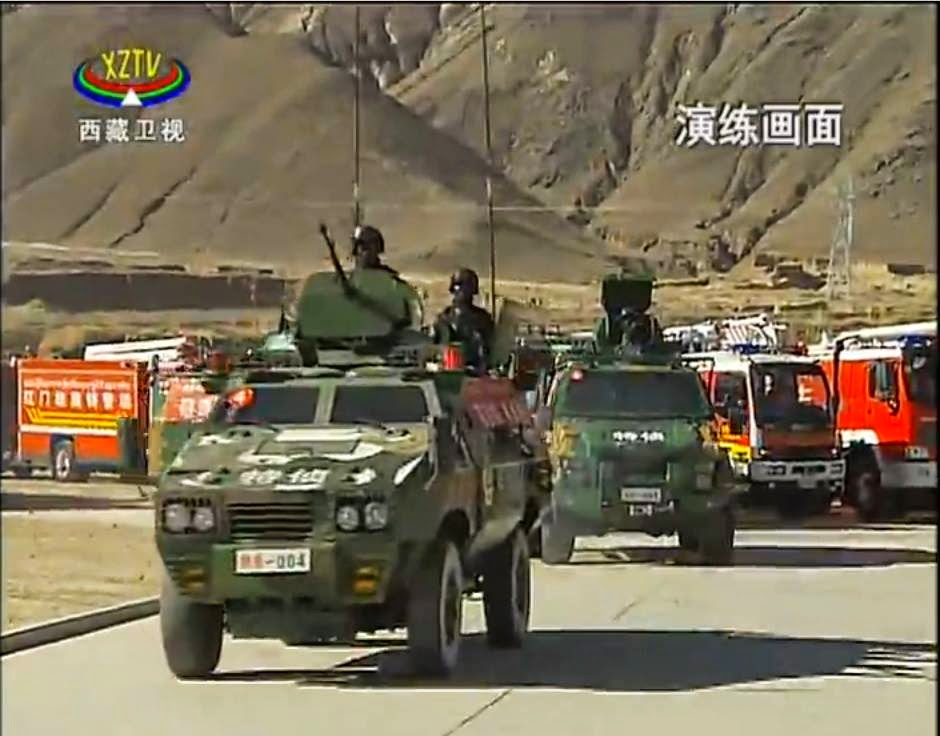
Show of force of the PAP a few months back in Lhasa.


Deng Xiaogang addressing the PAP

Sunday, June 1, 2014

The Little Book of President Xi

Does this remind you of something?
On May 30, 2014, the China Youth Daily reported that Beijing has increased the level of its security by deploying over 850,000 'security volunteers' throughout the city to assist the police.
These 'security volunteers' are supposed to patrol the streets and monitor the activities of their neighbors.
A 'community' intelligence network has also been activated; it includes nearly 100,000 'security informants'  (i.e. spies); the network covers the entire city of Beijing.
In June, some 1,000 safety officers will be deployed on buses and 866 security officers and guards at bus terminals. 4,000 buses will be equipped with monitoring cameras on board.
Residents who provide important leads about security risks may be rewarded a minimum of 40,000 yuan (about $6,413).
The same day, this article was reprinted by Xinhua, thereby giving it a larger publicity.
On May 30 too, President Xi Jinping visited a primary school in Haidian district in northern Beijing. He called for fostering socialist values among children: "All sectors of society should work together to nurture the seeds of socialist values in their heart so that the values can take root and germinate."
To give you one more hint!
A collection of 274 quotes from President Xi Jinping has just been published in a book form.
The South China Morning Post sees it as "an attempt to trumpet the success of China's policies and raise the president's profile".
It is titled  'Excerpts of Xi Jinping’s Remarks on Overall Deepening Reforms'  (not political of course) and it contains Xi's thoughts such as, “If you can contribute to ease air pollution and solve the problem of smog, you will be given honour and be a hero."
Or "We have to beware not to fall into the snare of division or Westernisation. We cannot… use the excuse of reform for our own interests.”
The book, edited by the Party Literature Office and published by the Central Party Literature Publishing House. is to provide 'guidelines' to the Chinese nation. 


Friday, February 7, 2014

The New Emperors' dilemmas

A supporter of the New Citizen Movement
Reading the Chinese official press every day, one has the impression that China is the most powerful nation of the planet (after the United States of course); its leadership can dictate the agenda to its neighbours, friends (very few) and foes alike.
The last Obama-Xi Jinping encounter was symptomatic. The meeting of the Big Two was to be ‘relaxed’: no stiff protocol, no long speeches, no ties, not even a formal agenda. But Obama had in mind the Chinese hackers visiting the Pentagon’s and other US government Internet servers and stealing American military secrets. He had decided to corner Xi on the subject.
Xi obviously denied any wrong doing from China. The cybersecurity issue needed to be resolved in a ‘pragmatic way’, he said, China too was victim of cyber attacks.
The previous night, Edward Snowden had appeared on the world stage. Suddenly, it was the pot calling the kettle black, especially as Snowden suddenly emerged in Hong Kong, the Special Administrative Region of China! China can’t be put on the mat so easily. There is however another side to the coin, because China is today caught in a dilemma.
Whether it is pollution, dissidence or corruption, the Middle Kingdom faces massive problems and has only the Party to solve these thorny issues.
For the leadership, the question is therefore: should repression (like in the bad old days of Mao) be used or new ways explored?
Beijing is vacillating between reforms and repression.
During the recent Spring Festival, the Chinese New Year, this dance of uncertainty appeared up front. China unveiled new rules asking Party officials not to cover up what should be publicly available information. The Communist cadres often use the excuse of ‘state secrecy’ to scuttle open discussions on the political future of the nation.
The latest move is seen as a step towards greater transparency.
Reuters explained: “China has notoriously vague state secret laws, covering everything from the number of people executed every year to industry databases and even pollution figures, and information can be retroactively labelled a state secret.”
The news agency quotes the detention of an Australian citizen and three Chinese colleagues working for the mining giant Rio Tinto ‘for stealing state secrets’ during the course of tense iron ore negotiations’ in 2009.
Xinhua now says that government departments “must not define as a state secret information which by law ought to be public”, affirming, that ‘it is an effort to boost government transparency’.
The new rules state that “the scope of what is secret should be adjusted in a timely manner according to changes in the situation”. Adjustable criteria!
In the meantime, Xu Zhiyong, a law lecturer at Beijing University of Post and Telecommunications has been sentenced to 4 years in jail. In early 2012, the pro-democracy activist dared posting on his blog an open letter to CCP’s General Secretary Xi Jinping condemning corruption and injustice.
In May 2012, Xu had founded the New Citizen Movement to promote social equality and a fair legal system; he also demanded that Party officials should disclose their financial dealings. The Communist authorities immediately saw this as a threat.
Xu is not a Chinese Kejrival, no gimmicks, but his organization collected 7,000 signatures which were officially submitted to the National People's Congress; it requested members of the powerful Central Committee to disclose their assets. Xi Jinping and his colleagues, though they pretend to fight corruption, did not like it.
Xu Zhiyong knew about the consequence of his fight; in November 2012, he declared: “For the world to become a better place, someone has to pay a price." Now, he will have to fight from jail.
Not only is the country in mutation, but the leadership is not sure which direction to take.
An article, recently published in Qiushi, a theoretical publication of the Party School of the CCP, speaks of three major risks affecting China’s political stability. The 'Three Risks' are worth pondering upon. The first is decentralization of power. The article argues that democratic political reform carries the risk of polarizing the power of the central government. It cites Vietnam as an example.
Practically, it means that there is no question of 'regional aspirations' or even a sort of federal system, like in India for example. It is far too dangerous for the Party which could explode (or implode).
The second 'risk' is an economic one: "Fluctuations in the economy. Sustainable economic development and maintaining social mobility are fundamental guarantees of social stability in countries going through industrialization and modernization. Over the next 10 to 20 years, maintaining sustainable economic development and social mobility will be vital for China's social stability."
The main objective of the recently-created Central Leading Group for Comprehensively Deepening Reforms (with Xi Jinping at the helm) is to introduce just enough 'economic' reforms to be able to maintain 'social stability' and save the Party from a Soviet-type collapse. Of course, there is no question of ‘democratization’ I the Middle Kingdom, just a minimum of reforms to avoid the feared Chaos.
The third risk is 'losing control of the media'. Qiushi elaborates: "Guiding social ideology, controlling public opinion, and managing social emotions are an important part of national governance and important ideological conditions for maintaining social stability. From the experience of other countries and the new situations China has encountered in recent years, the challenges and risks from the impact of social media and from the management of society's emotional impact are increasing." This explains the severe sentence inflicted on Xu Zhiyong.
Voice of America (VOA) recently quoted the results of a survey published by The Daily Telegraph: the number of postings on microblogs dropped 70 % from 2011 to 2013. VOA stated that the Information Technology Institute of East China Normal University conducted the research for The Daily Telegraph. The usage of 1.6 million microblog users from 2011 to 2013 was analyzed. It showed that, before March 2012, users posted an average of 83 million blogs every day. But since a ‘real name registration system’ was introduced, the number of postings dropped by some 50 %. It further dropped after some well known bloggers were arrested.
This is China today. It speaks of ‘reforms’ and at the same time restricts further the freedom of ordinary people.
Xi Jinping, the Secretary General of the Party is the boss of both the Leading Groups, the one on Reforms and the National Security Committee.
According to another article in the Qiushi the two new Small Groups will yield more authority than the government and will have more means ‘to crack down on special interests’, That is worrying as it means more repression against the Tibetans, the Ugyurs, the 'democrats' and others.
The Horse Year starts on an ominous note. But can repression, always more repression, help China to grow? Certainly not, though the apparatchiks believe that it could.
In the meantime, atheist China is burning incense; China News reported that on the eve of the Chinese New Year, tens of thousands of people lined up outside Buddhist temples overnight to have the opportunity to burn the first incense of the Year; the down-to-earth temples managers did not miss the opportunity to raise their prices. One temple in Zhejiang Province is said to have priced the first incense at US $ 20,000. The article admits that people have ‘misconceptions’ and are misled by the belief that the first incense will make their New Year wishes come true.
I wonder if Xi Jinping also burnt incense and what his wishes for the Horse Year were?

Thursday, November 21, 2013

China’s 2013 yin-yang: Reforms and Security

My article China’s 2013 yin-yang: Reforms and Security appeared in the Edit Page of The Pioneer today.

Here is the link...

At the Third Plenum of the 18th Communist Party of China Central Committee, the new regime in Beijing decided that social reform and national security will be its priority for the next nine years

For millennia, Chinese philosophy has believed in the concept of yin and yang; seemingly opposite forces are interconnected and give rise to each other; yang is white with the black dot, while the yin is the reverse, black with the white dot. Wikipedia says: “Many natural dualities are thought of as physical manifestations of the yin-yang.”
The new leadership in Beijing seems to have adapted the concept to political philosophy; after 4 days of discussions (from November 9 to 12), the Third Plenum of the 18th CPC Central Committee has, amongst other things, delivered 2 new Leading Groups: one on reforms (it was expected) and more surprisingly, a National Security Committee (NSC).
The statement issued at the end of the conclave explains: “The general objective of the approved reforms is to improve and develop socialism with Chinese characteristics …development is still the key to solving all problems in China.”
That is the ‘yang’, but for the ‘yin’, Xi Jinping and his colleagues believe that the doom of the former Soviet Union (where internal security apparatus had become weak, corrupt and ineffective) needs to be avoided at all cost. The present regime thinks that if effective reforms are not introduced, the days of the Communist Party are counted. They may be right.
Referring to the Third Plenum of 1978 which saw Deng Xiaoping implementing large-scale economic reforms, the Party said that the then ‘reform and opening-up’ led the CPC into a ‘new era’, adding that the present reforms would decide the destiny of modern China.
The statement concluded with “the need to deepen reforms in order to build a moderately prosperous society, and a strong and democratic country, as well as realize the Chinese dream of national rejuvenation.” It might just be a dream, though Sinocism, an excellent newsletter, which analyses the current events in China, commented: “The decision is impressive and shows that the leadership is both aware of and committed to deep reforms. …the truly hard part is not the drafting but the implementation of changes that will affect interests throughout society. But at least Xi has clearly articulated [his] resolve and vision for reform.”
Amongst the sectors to be reformed, the Plenum mentioned building a more impartial and sustainable social security system; encompassing an improved housing guarantee; strengthening the protection of intellectual property rights; encouraging innovation, etc.
The 204-member Central Committee has further decided to allow more non-state-owned capital into the market to develop a ‘mixed-ownership economy’; to accelerate the reform of the ‘hukou’ system (household registration) in order to help farmers become urban residents and to promote market-oriented reform in state-owned enterprises by breaking monopolies and introducing competition. An immense programme!
The Chinese ‘masses’ will particularly welcome the loosening of the one-child population policy, which will allow in some cases couples to have two children.
Though the decision to move forward is certainly a positive step, the implementation of the reforms won’t be easy.
Another welcome decision is that economic growth regardless of environment will not be permitted in regions located in ecologically fragile areas. Does it mean that China will drop its plan to divert the Yarlung Tsangpo (Brahmaputra) or other rivers originating from ‘fragile’ Tibet? Let us hope that common sense will prevail and the nefarious plans will be shelved.
A measure to be watched is the abolishing the infamous ‘reeducation through labor’ system. But what will replace it, already question many Western Human rights organizations? Beijing has also announced that it will ‘step by step’ reduce the number of crimes subject to death penalty. Once again, it is easier said than done.
A host of other measures have been taken ‘to ensure that the authority of the constitution and laws is upheld’. Only the future (the 9 coming years) will tell us if the Communist system is reformable, or if it is condemned to follow the Soviet Union’s model.
But there is a more important side (yin?) to the ‘yang’ coin, the ‘stability’ factor. According to Beijing all these new open-policies are possible only if China is stable: "State security and social stability are preconditions for reform and development", said Xi adding that only when the nation is safe and society is stable, could reform and development constantly advance.
This seems the justification for the creation of the NSC; as Xi put it: “The main responsibilities of the national security commission will include construction of the rule of law system concerning state security, research, resolving major issues of national security, setting principles and policies, as well as stipulating and implementing strategies.”
The NSC will deal with internal as well external issues: “China is facing two pressures: internationally, the country needs to safeguard its sovereignty, security and development interests; domestically, political security and social stability should be ensured”, explained Xi, adding: “The variety of predictable and unpredictable risks has been increasing remarkably, and the system has not yet met the needs of safeguarding state security.”
Reuters said that it “will enable the government to speak with a single voice when it comes to dealing with crises at home and abroad.”
‘Internal’ security has traditionally meant muzzling the opposition to the regime. It will continue to be the case. While actively popularizing the Internet, the Plenum decided to ‘reinforce its overall administration over cyberspace in accordance with the law and accelerate formation of a sound Internet management system”. It is quite ominous.
Though analysts believe that the NSC is based on the National Security Council of the United States, it will have snooping facilities like the US notorious National Security Agency. Reuters says that the NSC “would increase coordination among the various wings of China's security bureaucracy, split now among the police, military, intelligence and diplomatic services”.
Tibet and Xinjiang are two of the ‘internal’ threats which will be dealt by the new body. Recently, the repression has increased in both restive regions with the State tightly monitoring the lives of the Tibetans and the Uyghurs. The self-immolations in Tibet have been the most visible consequence of the stiffening of the security apparatus.
The New York Times’ concludes: “One year after taking leadership of the party, Mr. Xi is looking like an assertive, even imperial president, who sits well above his six colleagues on the Politburo Standing Committee.”
Will the new Emperor ‘reform’ the Middle Kingdom? We shall have to wait a few years to know. In the meantime Delhi should definitely be alert as the NSC will also be responsible for the Sino-Indian border issue.
The ‘lack of coordination’ during the Depsang Plain incident in Ladakh in April is probably one of the many reasons which led to having a NSC.
Delhi should also take a few pages from China’s reforms program, but presently the government is too busy distributing Bharat Ratnas.

Friday, May 25, 2012

Threats from China

This type of photo irritates Beijing. 
Though the recent statement of the Kashag (Tibetan Cabinet of Ministers) concentrates on the threat on the Dalai Lama's life originating from Tibet, there are other threats to the Tibetan leader. 
The Kashag mainly speaks of the danger coming from the Party bosses in Lhasa and violent groups, like the Shukden's practitioners, but this is probably not all.
Regarding the Kashag's statement, it is first doubtful if such an operation could be decided and executed by local authorities of the Tibetan Autonomous Region only.
The Standing Committee of the Politburo could not be kept in the dark, though as we have seen with the Bo/Zhou Yongkang episode, it is clear that the security apparatus is a State within the State, with a larger budget than the PLA. 
Would there be such a plan to poison the Dalai Lama, it is bound to be a Central Government's initiative. Of course, the plans could be executed by the Special Services at Beijing's disposal, while help and logistical support could  be arranged from the 'local' authorities .
The statement of the Kashag did not touch another threat: the danger encountered when the Dalai Lama travels to Europe or America where the Dalai Lama's security officials have to depend on 'local' intelligence and police.  It is more tricky, though in countries like the US, the UK or France, there should be a good collaboration between the two. 
What about smaller countries where China has a lot of influence?
Two years ago, a French think-tank (Asie 21) published in their Newsletter a short, but interesting piece. Here is a rough translation.
It is entitled Rumour 
Rumour is not a fact but can create the event
More and more preoccupied by what they denounced as “the diplomatic activities” of the Dalai and more particularly with regard to two countries, the United States and France, the military Chinese Secret Service would have started to dispatch ‘operational’ agents in the countries to be visited by the religious leader in order to study the conditions which could be used as a structure for his physical elimination and in a first stage, find out the country which will present the best facilities. The coordination of the preliminary actions would have been given to services attached to the [Chinese] Prime Minister. In January in Denver, the Taiwanese would have warned the Dalai Lama. The US authorities would also be aware of the danger.
Chinese leaders fear that the Western chancelleries would take the issue of Tibet before the United Nations, which could lead them to propose to recognize the province as a country invaded and occupied by China.
Comments
The location of the ‘action’ would be neither the U.S. nor France, because they have, according to Beijing, sufficient capacity to internationally to develop and support charges against China. The choice is oriented towards a smaller country, one of the European Union is not excluded.
The method may be selected is a poisoning appearing as a natural death. It involves an approach by touching the victim or through access to his food or the capacity to make an injection. Like Mossad, the Chinese have an experience with number opponents.
For example, in 2006, General Lang Tao, a former military commander of Shanghai died. He was suspected of having communicated to Americans plans for coastal defense of China.
Likewise a tea made was made deadly when the party official Wa Yong who, after serving in the embassy in Washington and Paris, was suspected of treason in favor of his former contacts in foreign special services. He was having tea with a family member in 2009 in Frankfurt. The product usually used is the sap of makayo, a plant in Northern China, which within 24 to 48 hours provoke the symptoms of a cardiac arrest.
I mentioned briefly on the blog the death of the 10th Panchen Lama, he was obviously poisoned. In his case, it must have been relatively easy for the Chinese intelligence to organize the 'heart attack' as a large proportion of the Tashi Lhunpo's monks were on Beijing's payroll.
For the Dalai Lama, we can only pray that all people concerned will keep doing their job at the best of their capacities and that they will get the necessary collaboration from all in India and abroad.
The Dalai Lama in 1972 in Dharamsala
The departure of the Dalai Lama would be a tragedy for Tibet, a tragedy for the world, but also a tragedy for China. 
The Middle Kingdom needs the Tibetan leader more than ever. The problem is that some senior officials have not realize this as yet.
I found this old photo taken 40 years ago in Dharamsala. In a way, life was simpler, but the Dalai Lama had not begun delivering his message to the world.


Kashag’s Statement on the Security of His Holiness the Dalai Lama
May 20, 2012 11:21 am
In the recent days, there has been considerable media attention concerning reports of a possible security threat to His Holiness the Dalai Lama. The security of His Holiness the Dalai Lama is a matter of great concern.
On 8 May 2012, His Holiness the Dalai Lama gave an interview to the Sunday Telegraph in Dharamsala, India, during which the interviewer commented on the security surrounding His Holiness. In response, His Holiness remarked that the concerned security agencies have taken his security very seriously ever since his first arrival in India. He mentioned that some time ago the officials responsible for his security received reports from a Tibetan working for the Chinese security establishment inside Tibet that Tibetan women were being trained to poison him by applying poison to their hair and to traditional greeting scarves. When His Holiness meets with Tibetans, they often present him with such scarves and bow their heads to receive his blessing. However, His Holiness also made it quite clear to the interviewer that there is no way to verify such reports. Although His Holiness takes security threat to his person lightly, there are a variety of threats to his well-being that the security agencies are obliged to take it seriously.
According to reports received from Tibet in June 2010, Chinese intelligence agencies are making concrete plans to harm His Holiness by employing well-trained agents, particularly females. It is also learnt that they are exploring the possibility of harming him by using ultra-modern and highly sophisticated drugs and poisonous chemicals. In another report received in October 2011, it is also learnt that Chinese intelligence agencies have stepped up their clandestine efforts to collect intelligence on the status of His Holiness’s health, as well as collecting physical samples of his blood, urine and hair. They are reportedly co-opting Tibetans inside Tibet to visit India with the intention of seeking an audience with him to this end.
In early April 2008, Zhang Qingli, the then Party Secretary of the Tibet Autonomous Region (TAR) held a meeting of all top officials in the government. During that meeting, he quoted as saying, “those who must be killed should be killed and those must be imprisoned must be imprisoned.” Recently in February 2012, Chen Quanguo, the current Party Secretary of TAR, called for “a war against secessionist sabotage”.
In recent years, Chinese government has launched an unprecedented offensive campaign against His Holiness inside Tibet and has also issued instructions to its concerned officials to organise protests by overseas Chinese communities against the Dalai Lama during his visits outside India. A number of such protests have since been organised in the United States, Europe and Japan.
His Holiness’s efforts to reform and democratise Tibetan society have also emboldened certain fundamentalists within the Tibetan community. This relates to differences arising from the worship of the Shugden spirit, which His Holiness had advised the Tibetan people from worshipping against. The primary group among these fundamentalists is the Dorje Shugden Devotees Charitable and Religious Society (DSDCRS), founded in May 1996 with its headquarters in Delhi, India. The supporters of DSDCRS are perhaps the most violent group. The Indian police have identified and charged DSDCRS of murdering three monks close to His Holiness, including his Chinese translator. This triple murder occurred in Dharamsala, India, very close to His Holiness’s personal residence in February 1997. A Red Corner Notice was issued by Interpol in June 2007 for the arrest of two of the accused in this case. Various reports also point to the fact that the Chinese government is also covertly backing the Shugden fundamentalist groups. The leaders of an association called “North America Gelug Association”, which was established in March 2011 in United States, met Chinese officials in New York several times and have also visited China on a regular basis.
The Central Tibetan Administration is grateful to Government of India for the efficient security arrangements provided to His Holiness the Dalai Lama. The Central Tibetan Administration cautions all concerned to remain vigilant and alert in this regard.
The KASHAG
May 20, 2012

Monday, May 14, 2012

China: the Domino Effect

This article in The  Epoch Times (published in Hong Kong by the Falun Gong group), about the fall of Zhou Yongkang might be speculative, but it nevertheless shows the end-of-dynasty atmosphere  prevailing in China today.
The fact that Zhou,China's  Security Tzar is under "renewed pressure from the incumbent leadership" is certain.
What would be interesting to follow is the domino effect that the fall of Zhou could trigger. 
Let us not forget that the 'public security' budget managed by Zhou is higher than the Defence budget.
The China Brief of the Jamestown Foundation wrote in March 2012:
Beijing’s preoccupation with maintaining domestic stability has been reflected in reports over the past two years that China’s “public security” budget is larger and growing faster than defense spending. As reported by Reuters, “For 2012, China set combined central and local government spending on "public security" to 701.8 billion yuan ($111.4 billion), compared with 629.3 billion yuan in 2011, when it grew by nearly 13.8 percent” (Reuters, March 5). Meanwhile the defense budget rose by 11.2 percent to 670.3 billion yuan ($106.4 billion).
The “public security” budget includes funding for the police, “state security,” PAP, courts and prison system at the national and local levels of government throughout China. The number of people involved (1.9 million police, up to 1 million PAP and unknown numbers of “state security,” courts and prison system personnel) is greater than the number of active duty PLA (2.3 million) and reserves (over 500,000).
The “public security” budget however complicates part of reasoning behind estimates of “actual” defense spending that conclude it to be significantly higher than the announced figure. Most organizations that attempt to estimate China’s “actual” defense spending usually include the PAP budget in whatever larger amount they finally arrive at, despite the 2006 White Paper’s statement “The [PAP] has an independent budgetary status in the financial expenditure of the state” (China’s National Defense in 2006). If the PAP budget is included as part of “public security,” then it should not be double-counted as part of “actual” defense spending. These budget classifications also suggest the growing distance between the PLA and its direct support to maintaining internal stability.
All the 'public security' is under Zhou Yongkang, till now at least.
About the 'domino effect', I wonder if  the appointed of Hu Chang Shen as the new party secretary replacing Li Dao Ping in Kardze Tibetan Autonomous Prefecture (Sichuan Province) is one of the first visible effect of Zhou's fall.
The Tibetan Centre for Human Rights and Democracy reported:
The appointment of Hu Chang Shen was announced on 27 April 2012 by Liu Chuan Chang, the vice party secretary of Sichuan Province at a high-level meeting attended by officials and cadres of the Kardze Prefecture in Kardze, reported the official Chinese news agency Xinhua on 28 April 2012.
At the high-level meeting in Kardze, the vice provincial party secretary Liu Chuan Chang spoke highly of Li Dao Ping saying the outgoing Kardze party secretary had "worked in Tibetan areas for 13 years with strong party spirit and selfless dedication to implement the policies of the central and provincial governments in their struggle against separatist forces of the Dalai clique". Li, according to the provincial vice party secretary, had made significant contributions for the stable development of the Tibetan areas in Ganzi Prefecture.
Li Dao Ping had worked as party secretary of Kardze Prefecture for two terms from 2003 to 2006 and then 2007 to April 2012. Li has also worked as the vice party secretary of Kardze Prefecture from 2000 to 2003. From May 1998 to September 2000, he was the vice party secretary of Chamdo (Chinese: Changdu) Prefecture in Tibet Autonomous Region.
The newly-appointed party secretary Hu Chang Shen has worked for a long time in various governmental positions in Sichuan Province. He was the party secretary of Suining City before his appointment as Kardze party secretary.
It is too early to speculate, but things are for sure moving fast in China.

With Abuse of Blind Man, Chinese Security Czar May Have Hastened Fate
Matthew Robertson
The Epoch Times
May 8, 2012
The announcement that the abuse of Chen Guangcheng will be investigated could be a threat to Zhou Yongkang, the security boss.
 
News Analysis

The announcement from human rights advocate Chen Guangcheng that an investigation will be conducted into the abuses he suffered at the hands of local security officials has political significance at the highest levels of the Communist Party.
Chen said in an interview with The Associated Press on Monday that he had been visited four times by an official, who took a statement from him last Thursday. AP said the official was from “a central government bureau that handles citizens’ complaints,” indicating that he is not part of Zhou Yongkang’s security apparatus, and would be acting under the ultimate orders of Party leader Hu Jintao.
“After he took my statement, he said they would launch an investigation as long as there are facts,” Chen said in an interview with AP. “If there are facts about the illegal actions, then the issue definitely would be openly addressed,” Chen said the official told him.
While the hint of an investigation ostensibly shows the unprecedented occurrence of the communist leadership responding to the demands of a persecuted activist, the timing also aligns with insider leaks to The Epoch Times that Zhou Yongkang, the security czar who ultimately oversaw the treatment of Chen, is under renewed pressure from the incumbent leadership.
A source said that Hu Jintao has ordered the Central Commission for Discipline Inspection to speed up and place importance on its investigation of Zhou Yongkang, for improper use of state funds and violations of Chinese law.
Zhou is being “internally controlled” and his movements are being restricted, the source in Beijing told The Epoch Times.
Rumors have persisted since March—published by Western press and shared among those close to the circles of power in Beijing—that Zhou is under some form of control. He no longer has power over the 1.5 million strong People’s Armed Police (PAP), the source said.
Zhou is a member of the nine-member Standing Committee of the Politburo, the highest organ of power in the regime, and he controls all of China’s internal security forces. Rumors emerged in March that he had, along with the recently disgraced and ousted Bo Xilai, plotted a coup to thwart the rise of Xi Jinping and install Bo to the heart of power in China.

Currently, central Party leaders have made a point of ensuring that Zhou keeps up a relatively regular schedule of public appearances, mirroring Bo Xilai’s treatment before he was suddenly and swiftly dispatched from his Party posts.
Recent events indicate that Zhou Yongkang still has the mettle to turn events in his favor, however, which may have given renewed impetus to Hu Jintao and Wen Jiabao’s attempts to deal with him.
As head of the Political and Legislative Affairs Committee (PLAC), Zhou Yongkang oversees the vast security apparatus that coordinated the persecution of Chen Guangcheng, who is blind. Chen was first sent to jail for four years after he exposed the violence associated with the implementation of the one-child policy in Linyi, Shandong Province.
After he was released from jail in 2010, he was put under strict house arrest. During this time he and his family were also sometimes harassed and violently beaten by people they described as thugs, but who were actually local security officials.
After Chen’s improbable escape on April 20, Zhou did not make things easy for leaders Hu Jintao and Wen Jiabao, nor for the Foreign Ministry officials involved in the negotiations with U.S. diplomats. Advocates and friends of Chen were seized, threatened, beaten, and put under house arrest in Beijing and elsewhere. Locally, security enforcers raided the houses of Chen’s relatives, demanding information about how he escaped.
Chen was also given an ultimatum on May 2, when he first emerged from U.S. care: either he would come out that very day, or his wife would be sent back to their home in Shandong. Chen had already learned from his wife that local toughs had set up shop in his home, putting up an electric fence, installing seven cameras, and eating at his kitchen table.
After being released during the daytime, Chen reported at 9 p.m. from his hospital bed that he still had not received food. This was interpreted as another subtle form of intimidation directed by Zhou. American officials were later denied access to Chen. It all appeared to be a design by the security chief and his cohorts to strike fear into Chen and demonstrate who was in charge. U.S. officials were ultimately criticized for letting Chen go back to the Chinese, and criticism against the Chinese side often fell implicitly on Hu Jintao and Wen Jiabao.
With the reported investigation into Zhou, the situation could change quickly yet again.
“Zhou Yongkang is already a snapping turtle in a pot,” the source said, using a Chinese idiom to indicate that Zhou is trapped. “We won’t have to wait long for an official investigation to be announced.”