Showing posts with label Central Committee. Show all posts

Monday, December 28, 2020

Where is Lobsang Gyaltsen?

Lobsang Gyaltsen (right) with Che Dalha

The Ninth Plenary Session of the Ninth Committee of the Tibet Autonomous Region (TAR) of the Communist Party of China and the Economic Work Conference of the District Party Committee were held in Lhasa from December 25th to 27th.
The Chinese media mentioned the importance of the conference held ‘at a historic moment’ when the 13th Five-Year Plan ended ‘successfully’ (with hundreds of new villages on India’s borders, among other achievements!!).
Xinhua added: “The building of a moderately prosperous society in all respects was achieved, and the new journey for the comprehensive construction of a socialist modern Tibet, which is about to begin, is self-evident.”
A communiqué spoke of 2020 as ‘extraordinary year’ for the TAR which made “every effort to control the epidemic and resume work and production. It is expected that the annual growth rate of regional GDP will remain the first in the country [read China]. In the post-epidemic era, [the question is] how should Tibet’s economic work will coordinate epidemic prevention and control and economic and social development?”
Some official websites recently spoke of 30 or 40 million tourists on the plateau in 2020 when the rest of the planet remains confined or semi-confined!
During the meeting, Wu Yingjie, secretary of the TAR Party Committee, said that “after careful consideration and careful research, the main expected goals for the economic and social development of the TAR in 2020 are: economic growth at more than 9%, per capita disposable income for urban and rural residents at 10% and 13% respectively. And the urban survey unemployment rate remains at 5.5%, while the consumer price rises at around 3%.”

Happiness Index?
Wu concluded that “Tibet needs to build a new development pattern and expand the industries needed in the Region, so as to provide strong support for farmers and herdsmen to continue to increase their income and improve their happiness index.”
Yes, happiness index!

Remarks of Che Dalha
Che Dalha, deputy secretary of the Party Committee and Chairman of the TAR government, noted that “the expected economic growth target of 2021 is over 9%. The main consideration is the GDP growth rate of Tibet in the first four years of the 13th Five-Year Plan reached 9.3%, which is 2.6 higher than the national average.”
Che pointed out that the fixed asset investment of the entire society will increase by more than 5% while investment will be more than 60 billion yuan: “The TAR has set-up a strong epidemic prevention and control, and tourism is expected to rebound significantly in 2021; the current consumption rebound is obvious... Many factors cooperate with each other to form a strong impetus and drive at a 9% economic growth rate.”
The Head of the Government concluded that that the TAR “must do a good job in innovative development, coordinated development, green development, open development, shared development, and safe development."
He stated: "It is therefore necessary to continue building the seven major industries of plateau: biology, cultural tourism, clean energy, green industry, modern services, high-tech digital, border trade and logistics, and ensure that the output of highland barley is stable at 800,000 tons, and the output of meat, eggs, milk, and vegetables are also stable.”
Incidentally, he spoke about the upgrade the G219 highway cutting across the Aksai Chin in Northern Ladakh (of course, he did not mention this); but he said that it will be a channel to promote the development of rural tourism (in Western Tibet and Xinjiang!).
He finally mentioned the implementation of the ‘two-mountain theory’, i.e. strengthening ecological environment protection, and ensuring that the percentage of days with good ambient air quality remains above 98%. 

Lt Gen Zhang Xuejie

Incidentally, the gathering was attended by Lt gen Zhang Xuejie, the Political Commissar of the Tibet Military District (and member of the TAR Party Committee) and Lt Gen Wang Haijiang, Commander of the Tibet Military Region. 


Where was Lobsang Gyaltsen?
This was indeed an important gathering, but the real news was not about the Happiness Index, it was about the absence of Lobsang Gyaltsen, the Chairman/Director of the TAR Regional Congress and senior most Tibetan cadre (he is a full member of the all-powerful Central Committee). 

Gyasltsen was nowhere to be seen.
It is too early to speculate, but that there not many explanations as of now; either he caught a bad cold or more (the delegates were seen respecting social distancing during the Plenum, with only alternate chairs occupied by the participants) or Lobsang Gyaltsen is under ‘investigation’.
It would be the senior most Tibetan to go through this discipline process.
In 2015, it was reported that Le Dake, a former top Chinese security official in Tibet had being investigated ‘for suspected graft’. It was announced by the Central Commission for Discipline Inspection, the Communist Party’s anti-graft watchdog, then headed by Wang Qishan. Reuters commented that it is “a rare example of corruption busters going into the restive and remote region.”

Nur Bekri, former Governor of Xinjiang
In December 2019, a Chinese court sentenced one of China’s most senior Uygur officials to life in prison for taking bribes. Shenyang Intermediate People’s Court in the northeastern province of Liaoning handed down the sentence to Nur Bekri, a former director of the National Energy Administration and ordered the confiscation of all of his personal properties. According to Xinhua, Bekri admitted accepting more than 79 million yuan (US$ 11.2 million) in bribes between 1998 and 2018. He earlier served as Governor of the Xinjiang Uyghur Autonomous Region. 

 Who is Lobsang Gyaltsen?
Lobsang Gyaltsen is a Tibetan born in Drayab in Chamdo City in July 1957.
He joined the Communist Party of China in December 1978 and later graduated from the Central Party School.
He is currently a member of the 19th Central Committee, deputy chairman of the Nationality Committee of the 13th National People's Congress, deputy secretary of the Party Committee of the Tibet Autonomous Region, and secretary and director of the Standing Committee of the District People's Congress.

Career resume

•    1976.02-1979.06, teacher of the Department of Medical Affairs and Marxist-Leninist Teaching and Research Section of Tibet Nationalities Institute (TNI)
•    1979.06-1984.05, Deputy Secretary of the Youth League Committee of the TNI
•    1984.05-1986.12, Secretary of the Youth League Committee of the TNI
•    1986.12-1992.11, Secretary of the Tibet Autonomous Region (TAR) Committee of the Communist Youth League
•    1992.11—1995.06, Deputy Secretary and Administrative Commissioner of the Nagchu District Committee
•    1995.06-1995.09, Deputy Secretary of the Lhasa Municipal Party Committee
•    1995.09-1996.05, Deputy Secretary and Acting Mayor of Lhasa Municipal Committee
•    1996.05-2003.01, Deputy Secretary and Mayor of Lhasa Municipal Party Committee
•    During this period: 2001.03-2002.02, followed a one-year training course for young and middle-aged cadres at the Central Party School
•    2003.01-2006.10, Vice Chairman of the TAR Government
•    2006.10-2007.01, Member of the Standing Committee of the Party Committee of TAR, Minister of the United Front Work Department, Vice Chairman of the District Government
•    2007.01—2010.05, Member of the Standing Committee of the Party Committee of the TAR and Vice Chairman of the District CPPCC Party Group
•    2010.09-2011.11, Deputy Secretary of the Political and Legal Committee of the TAR
•    2011.11—2012.04, Executive Deputy Secretary of the Political and Legal Committee
•    2013.01-2016.12, Secretary and Chairman of the Party Leadership Group of the District Government
•    2016.12—2017.01 - Chairman of the District Government
•    2017.01—2018.03 - Secretary and Director of the Standing Committee of the District People’s Congress
•    On January 30, 2018, the TAR Eleventh People's Congress elected Lobsang Gyaltsen as the chairman of the Standing Committee of the TAR People's Congress.
•    Alternate members of the 18th Central Committee, members of the Seventh Plenary Session of the 18th Central Committee, and member of the 19th Central Committee.
•    Member of the 11th CPPCC National Committee.


Sunday, October 29, 2017

Is Mr Xi the winner?

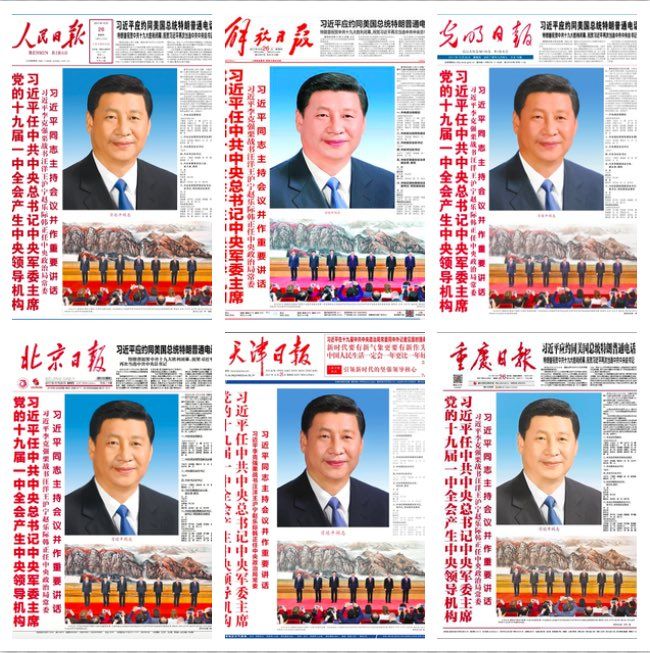
Front-page of 6 different newspapers in China
My article Is Mr Xi the winner? appeared in The Statesman.

Here is the link...

At the end of the 19th Congress, most of the Western media have declared President Xi Jinping, the winner. He is the most powerful leader since Mao, say the China watchers. But is it true? A great difference between Mao and Xi is that the Great Helmsman controlled the Communist apparatus without intervening much in the day-to-day affairs.
He often travelled the countryside in luxurious trains for weeks, with just a few secretaries and several of his favourite ‘nurses’. He had no encrypted way of communicating with his colleagues (or ‘lackeys’ in Maoist parlance) in Beijing. He was not bothered. This is not the case of Xi Jinping who heads a large number of Leading Small Groups on many topics under the Middle Kingdom’s sky, but he is also General Secretary of the Communist Party of China, the President of the People’s Republic of China, the Chairman of the Central Military Commission and the Commander-in-Chief of the Joint Battle Command.
Xi has however undoubtedly emerged as the winner on several fronts in recent months. First and foremost, the 19th Congress approved an amendment to the Party Constitution enshrining Xi Jinping Thought on Socialism with Chinese Characteristics for a New Era.
Though the new Central Committee and Central Commission for Discipline Inspection are more or less along the expected lines, the Politburo and the Standing Committee brought some surprises. The new Politburo’s Standing Committee now comprises President Xi, Premier Li Keqiang, Li Zhanshu, Wang Yang, Wang Huning, Zhao Leji and Han Zheng.
The presence of Li Zhanshu, Xi’s chief of staff, who is to take over the chairmanship of the National People’s Congress, is a proof of Xi’s control over the appointments. Ditto for Wang Huning, the party theorist who will take the charge of ideology, propaganda and party organization, while Zhao Leji will replace Wang Qishan, as the new antigraft tsar. Wang Yang will take the seat of Yu Zhengsheng as chairman of the Chinese People’s Political Consultative Conference; as for Han Zheng, he will probably be drafted as Executive Vice-Premier in March.
But where are Xi’s presumed successors, Hu Chunhua and Chen Miner? Where is Wang Qishan, Xi’s right-hand man who, for five years, arrested the ‘tigers and the flies’? The absence in the Standing Committee of Chen Miner, the Party Secretary of Chongqing, who was expected to be anointed ‘heir apparent’ has been noticeable. Apparently Xi does not want a ‘successor’ as yet. Same for Hu Chunhua, Guangdong Party Secretary, who for several years was said to be a future new General Secretary.
Just before the Congress, the South China Morning Post (SCMP) which has been by far the bestinformed, noted: “Hu Chunhua ~ the widely tipped successor ~ and the president’s protégé, Chongqing party chief Chen Miner, are both likely to be missing from the Politburo Standing Committee. Instead, they will join the Politburo, which is one rank lower.” It is what happened. SCMP had good tips, despite the opacity of the party proceedings. The great surprise was that Wang Qishan, who is responsible for making thousands of party heads roll, has stepped down from the Standing Committee, due the age-limit norm.
It was confirmed when his name did not appear in the list of the new Central Committee members. Many ‘watchers’ were expecting Xi to break an unwritten retirement-age rule to keep his friend Wang in the Standing Committee. Two members of the powerful Central Military Commission (CMC) made it to the Politburo. Apart from Air Force General Xu Qiliang, presently CMC ViceChairman, General Zhang Youxia, a family friend of Xi, was selected as the second vicechairman.
Contrary to what many have written, Xi might not be all-powerful; he still has to deal with party norms and traditions: “He is careful not to break the age rule and to follow the order of seniority. These political norms are critical for the 89-million member Communist Party to have consensus at the top and maintain stability,” wrote the SCMP which also noted: “Xi is also not blindly following the established path.” Another sign that Xi may not have full control, is the reduced size of the CMC which has only 7 members (apart from the two Vice-Chairmen: Xu Qiliang, Zhang Youxia, others are Wei Fenghe, Li Zuocheng, Miao Hua, Zhang Shengmin) compared to 11 during the previous Congress. The day after the announcement of the new CMC, Xi met the PLA delegation and urged them to “follow the road maps set for it at the Congress.”
It is easier to agree on 7 than 11. Xi said socialism with Chinese characteristics has entered a new era, and the military should make all-out efforts to become a world-class force by 2050 while striving for the realization of the ‘great rejuvenation of the Chinese nation’. Xi ordered the PLA to be absolutely loyal to the party, to focus on how to win in wars, to pioneer reforms and innovation, to scientifically manage commanding a unit and to lead troops in accordance with the strictest standards. Strangely, there was no photo with the new CMC.
Another odd happening: General Song Puxuan, one of the rising star’s in the PLA and the newly appointed head of the CMC’s Logistics Support Department did not make it to the list of the Central Committee’ members. In 2014, Song was promoted to the rank of full general, taking the charge of the Northern Theatre Command, overseeing the defence of the capital and China’s border with North Korea. His failure to make it to the Central Committee is still unexplained. When the list of the delegates to the Congress was first released in July, many watchers thought that it would mark a new area for women, who made up 24.1 per cent of the 2,287 delegates. The official media pointed out that it reflected the efforts made by the party “to give women members a bigger say and improve gender equality and social stability.”
But Chinese women leaders are still practically excluded from the top of the hierarchy. Of the 204 members of the Central Committee, just 10 are women; the same figure as that for the 18th congress of 2012. And only one lady, Sun Chunlan made it in the Politburo. She will probably retain her job as Chief of the United Front Work Department.
That is disappointing. As for the ethnic minorities, they have got a slightly better deal in the Central Committee, with 16 members from ethnic origins compared to 10, five years ago. Incidentally, the Tibetans have four representatives who have been selected as members of the Central Committee (Lobsang Gyaltsen and Che Dalha) and Alternate members (Norbu Thondup and Yan Jinhai, a Tibetan from Qinghai); it is a first. Further, Wang Huning, the newly-appointed member of the Politburo’s Standing Committee will probably represent Tibet at the National People’s Congress in March. The question is why should a Han leader represent Tibet?
Han chauvinism will continue for some time more. In any case, Wang’s presence does not mean that life will become easier for the Tibetans or the Uyghurs. Chen Quanguo, the former Party Tibet Secretary presently posted in Xinjiang, has been rewarded with a seat in the Politburo for the repressive measures he introduced in the restive Muslim region.
What does all this mean for India? One will have to wait and see. As Deng Xiaoping liked to say, ‘Let us seek truth from facts’.

Thursday, October 26, 2017

Xi may not be all powerful

My article Xi may not be all powerful appeared in Rediff.com.

Here is the link...

'He still has to deal with party norms and traditions and has been careful to follow the order of seniority,' points out Claude Arpi.

Nearly thirty years ago, one of the best China watchers, Belgium-born Simon Leys wrote about the ‘Art of Communist China watching’ in the New Times Book Review: “Without an ability to decipher non-existent inscriptions written in invisible ink on blank pages, no one should ever dream of analyzing the nature and reality of Chinese communism. Very few people have mastered this demanding discipline.”
Leys was reviewing a book written by Father Laszlo Ladany, a Jesuit priest living in Hong Kong, who ‘with good reason’ was acknowledged as the doyen of the ‘watchers’.
For many years, Father Ladany published a weekly China News Analysis. Leys said: “all China watchers used to read his newsletter with avidity; many stole from it—but generally they took great pains never to acknowledge their indebtedness or to mention his name. Father Ladany watched this charade with sardonic detachment.”
I could not help thinking of these words while watching the unfolding of the 19th Congress of the Chinese Communist Party.
Till the last minute, it was difficult to make out what would happen next.

Xi Jinping the Winner

Xi Jinping undoubtedly emerged the winner on most of the fronts.
First and foremost, the 19th Congress approved an amendment to the Party Constitution enshrining ‘Xi Jinping Thought on Socialism with Chinese Characteristics for a New Era’.
Though the new Central Committee and Central Commission for Discipline Inspection are more of less along the expected lines, the Politburo and the Standing Committee brought some surprises.

The new lineup
The new Politburo’s Standing Committee now comprises of President Xi Jinping, Premier Li Keqiang, Li Zhanshu, Wang Yang, Wang Huning, Zhao Leji and Han Zheng.
The South China Morning Post commented: “The unveiling of the new lineup of Chinese leadership marks the climax of the twice-a-decade leadership reshuffle after months-long intense horse trading and power struggles in the lead-up to the 19th party congress.”
The presence of Li Zhanshu, Xi’s chief of staff, who is to take over the chairmanship of the National People’s Congress is a proof of Xi’s control over the appointments. Ditto for Wang Huning, the party theorist who should take the charge of ideology, propaganda and party organization, while Zhao Leji will replace Wang Qishan, as the new anti-graft tsar.
Wang Yang will take the seat of Yu Zhengsheng as chairman of the Chinese People’s Political Consultative Conference.

The Surprises

A noticeable absence is Chen Miner, the Party Secretary of Chongqing, who in many quarters, was expected to be anointed ‘heir apparent’. Apparently Xi did not want a ‘successor’ as yet.
A few days ago, The South China Morning Post (SCMP), belonging to Xi’s friend, Jack Ma, the owner of Alibaba, and which has been by far the best-informed during the entire Congress, noted: “Guangdong party chief Hu Chunhua – the widely tipped successor – and the president’s protégé, Chongqing party chief Chen Miner, are both likely to be missing from the Politburo Standing Committee. Instead, they will join the Politburo, which is one rank lower.”
It is what happened. Does it mean that China watching is easier today than in the days of Father Ladany?
Not really as the opacity of the Party proceedings has not changed much.
The great surprise was that Wang Qishan, who is responsible for making thousands of heads on the Party roll, has stepped down from the Standing Committee, due the age-limit norm. It was confirmed when his name did not appear in the list of the new Central Committee members. Many ‘watchers’ were expecting Xi to break an unwritten retirement-age rule to keep his friend and colleague Wang in the Standing Committee.
Two members of the powerful Central Military Commission (CMC) made it to the Politburo. Apart from Air Force General Xu Qiliang, presently CMC Vice-Chairman, General Zhang Youxia, a family friend of Xi, was selected as the second vice-chairman.

Constitutional Changes
Adding Xi’s name in the Party constitution brings him at par with Mao Zedong and Deng Xiaoping. Xi now dreams to make China into a great Socialist power by 2050
Xi promised that China, under his leadership, will be an upholder of world peace and stability; his announcement that the Middle Kingdom was ready to play a greater role in building ‘a common destiny for mankind’, is taken by many with a pinch of salt. Only the future will tell.

Other changes worth noting:
•    Party's 'absolute' leadership over the Army
In a resolution approved by the Congress, Xi Jinping's military thinking and the Party's ‘absolute’ leadership over the armed forces have been included in the Constitution.

•    'Belt and Road' named in the Constitution
The Belt and Road Initiative, also known as One Belt One Road (OBOR) is now mentioned in the Constitution. The Congress agreed that "following the principle of achieving shared growth through discussion and collaboration,” the Belt and Road Initiative should be named.
The China Daily explains: “proposed by Xi Jinping in 2013, the Belt and Road Initiative aims to build a trade and infrastructure network connecting Asia with Europe and Africa along and beyond the ancient Silk Road trade routes.”
India has objected to the fact that a segment of the scheme goes through the Pakistan-occupied Kashmir. The inclusion of OBOR will not solve this issue, on the contrary, it could be further exacerbated.

•    Fight against corruption should go on
The revised Constitution says that the Party must make comprehensive efforts to ensure that ‘the fight against corruption keeps going’.
On October 18, Xi Jinping called corruption ‘the greatest threat’ that the Party faces. The Party will soon adopt a national anti-corruption legislation and create a corruption reporting platform which will cover both disciplinary inspection commissions and supervision agencies, said Xi.

Not all-powerful

Contrary to what many have written, Xi might not be all-powerful; he still has to deal with Party norms and traditions: “he is careful not to break the age rule and to follow the order of seniority. These political norms are critical for the 89-million member Communist Party to have consensus at the top and maintain stability,” wrote the SCMP which also noted: “Xi is also not blindly following the established path. He has made a decision with far-reaching consequences in not naming a clear-cut successor and promoting his choice to the Politburo Standing Committee.”
Another sign that Xi may not have full control, is the reduced size of the CMC which has only 7 members (apart from the two Vice Chairmen: Xu Qiliang, Zhang Youxia, others are Wei Fenghe, Li Zuocheng, Miao Hua, Zhang Shengmin) compared to 11 during the previous Congress.

The role of women
When the list of the delegates to the Congress was first released in July, many watchers thought that it would mark a new area for women, who made up 24.1 per cent of the 2,287 delegates.
The official media pointed out that it reflected the efforts made by the Party “to give women members a bigger say and improve gender equality and social stability.”
But Chinese women leaders are still practically excluded from the top of the hierarchy. Of the 204 members of the Central Committee, just 10 are women; the same figure that for the 18th congress of 2012. And only one lady, Sun Chunlan made it in the Politburo. She will probably retain her job as Chief of the United Front Work Department. That is disappointing.

The ‘ethnic minorities’
As for the ethnic minorities, they have got a slightly better deal in the Central Committee, with 16 members from ethnic origin compared to 10 only, five years ago.
Incidentally, the Tibetans have four representatives have been selected as members of the Central Committee (Lobsang Gyaltsen and Che Dalha) and Alternate members (Norbu Thondup and Yan Jinhai, a Tibetan from Qinghai); it is a first.
Further, Wang Huning, the newly-appointed member of the Politburo’s Standing Committee will probably represent Tibet at the National People’s Congress in March. The question is why a Han leader should represent Tibet; Han chauvinism will continue for some time more.
In any case, Wang’s presence does not mean that life will become easier for the Tibetans or the Uyghurs. Chen Quanguo, the former Party Tibet Secretary, presently posted in Xinjiang has been rewarded with a seat in the Politburo for the repressive measures that he introduced in the restive Muslim region.

What does this mean for India?
One will have to wait and see.
As Deng Xiaoping liked to say, ‘let us seek truth from facts’.
Thirty years ago or today, it is still not easy to read the future of the Middle Kingdom in tea leaves.


Monday, September 25, 2017

Tibet's Representation at the 19th Congress

Can Cui make it to the Central Committee
China has ‘elected’ 1,909 civilian delegates for the 19th Party Congress to be held in October.
They are representing Central Departments working under the CCP Central Committee (CC), Central State organs, Central Enterprises and China’s provinces and centrally-administered Municipalities.
How they were ‘elected’ is not clear.

Jayadev Ranade of the Center for China Studies and Analysis explains: “The Politburo Standing Committee (PBSC) members are, as per practice, all Delegates to the 19th Party Congress. Pertinently and possibly because of the focus this year on poverty alleviation, all PBSC members represent the poorer provinces. Xi Jinping is the Delegate from Guizhou, Li Keqiang from Guangxi, Zhang Dejiang from Inner Mongolia, Yu Zhengsheng from Xinjiang, Liu Yunshan represents Yunnan, Wang Qishan is the Delegate from Hunan and Zhang Gaoli from Shaanxi.”
Ranade quotes the Hongkong media: “at least eight prominent omissions from the list of Delegates to the upcoming Congress. All are either Full or Alternate members of the 18th CCP Central Committee and all are, interestingly, past members of the Communist Youth League (CYL). They are also eligible in terms of age."
The eight losers are:
  • Qin Yizhi - Head of the CYL; CC Member; 51 years.
  • Zhao Yang - Deputy Director of General Administration of Sports; Alt Member CC; 54 years.,
  • Deng Kai – Deputy Party Chief of the All China Federation of Trade Unions (ACFTU); Alt Member CC; 57 years.
  • Liu Jian – Chairman, State Development and Investment Corporation; Alt Member CC; 47 years.
  • Zhang Zhijun – Director Taiwan Affairs Office; CC Member; 64 years.
  • Nur Bekri – Director, National Energy Administration; CC Member; 55 years. Yang Yue – Vice Governor, Jiangsu Province; Alt CC Member; 49 years.
  • Wang Anshun - Head, State Council Development Research Centre; CC Member; 59 years.
The PLA list
More interesting perhaps are the changes in the People’s Liberation Army (PLA).
The list of representatives of the PLA and People’s Armed Police Force (PAP) has also come out. The PLA has a total of 253 delegates, while the PAP has 50 representatives.
A massive reshuffle of the PLA’s generals, not only at the Group Army (Corps) level, but at the top of the hierarchy too, is taking place and two top generals got the sack hardly a month before retiring.
Gen Fang Fenghui, the equivalent of the US Chief of Defence Staff, was replaced as Chief of the PLA’s Joint Staff Department by Gen Li Zuocheng, a Xi protégé and former Commander of the Chengdu Military Region (under which Tibet used to come).
Fang and Gen Zhang Yang, another CMC member will not even participate in the forthcoming Congress. The rumour mill said that they were being ‘investigated’, a term not usually auguring well for the targeted person. This may indicate bad days ahead for the generals.

The Lessons of Impermanence
Reading these lists is a teaching about impermanence.
Remember the case of Lt Gen Yang Jinshan, a former Deputy Commander of the former Chengdu Military Region (MR), who served several years in Tibet. He was a rising star of the PLA; in 2012, he was even promoted to Central Committee, the Party's top heaven; at that time, he was senior to his direct boss, Li Zuocheng, who then commanded the MR.
Today, Yang Jinshan is languishing jail, being 'investigated' while Li Zuocheng is the powerful Chief of the Joint Staff Department.
But in this game, connections are important, not to say vital.
On September 1, Gen Han Weiguo, only 61, was appointed commander of the PLA Army and Gen Ding Laihang, 60, commander of the PLA Air Force (PLAAF). Gen Han served in Fujian in the 1980s at the time Xi was Deputy Mayor of Xiamen, while Gen Ding’s career also overlapped when the latter was Governor of Fujian Province.

Other Surprises
The list of PLA’s delegates has some other surprises. The 303 ‘elected’ members belong to 31 different units, compared with 19 in 2012; one example, the new PLA Rocket Force is now represented.
More than 90 per cent of those ‘elected’ will be first time attendees, representing a new generation of officers who will owe their rise to Chairman Xi only.

Ethic Representations

Though there is a slight rise in the number of ‘ethnic’ delegates (6% of the delegates are ethnic minority officers, from 4.6% in 2012), their number is relatively small and they don’t occupy important posts, except for one Tibetan who is said to be a Major General.
Asia Times noted: “The Manchus and Tibetans will each send three delegates, while the Uyghur, Hui and Tujia will each put forward two. The Zhuang, Xibe, Korean, Qiang, Bai and Naxi ethnicities will each send one delegate to the Congress.”
Tibet is represented by a senior officer, Thupten Trinley alias Tidan Dan (土旦赤列), a Deputy Commander of the Tibet Military Region and two ladies, Kaslang, alias Gesangba and Sonam Dolma. Their qualification or designation is not mentioned.
Lt Gen Xu Yong (许 勇), the Commander of the PLA Tibet Military Region is also present in the list.
A Chinese lady, Zhang Aiying (张爱英), a communication officer and instructor posted in the Tibet Military Region has also been ‘elected’.
That is not much.
One can also note the absence in the list of Lt Gen Diao Guoxin (Political Commissar, Tibetan Military District), Maj Gen Song Baoshan (Commander, People's Armed Police, TAR) and Lt Gen Xiao Tang (Political Commissar, People's Armed Police, TAR).
Lt Gen Peng Yong (Commander of the Xinjiang Military District) has also disappeared from the radars.
[Please read the corrections sent by a reader, posted below]

The civilian list
The civilian list is posted below.
Noticeable is the absence of the most senior Tibetan official, namely Pema Thinley, alias Padma Choeling, an out-going member of the CC (and the only Tibetan in the CC).
Is Choeden La a wrong spelling for Che Dralha, the head of the TAR Government.
[Please read the corrections sent by a reader posted below. Some of the errors are due to the spelling mistakes in the list available to me.]
Lobsang Gyaltsen, the Governor of the Tibetan Autonomous Region (TAR) and an Alternate Member of the CC is in the list, making illegible for a seat in the CC.
In the list of 29 delegates, one finds six out of 13 or 14 members of the Standing Committee of the Regional Communist Party (Wu Yingjie, the TAR Party Secretary, Lobsang Gyaltsen, Ding Yexian, one of the TAR Party Deputy Secretary, Wang Yongjun and two relatively junior Tibetan cadres, Pema Wangdue and Penpa Tashi).

Will Cui represent Tibet?
Apart from Lobsang Gyaltsen, a possibility is that Cui Yuying, one of the few ‘ethnic’ Tibetans who today serves in a senior position in the Central government in Beijing, could become the ‘Tibetan representative’ in the CC.
Born in 1958 in Changle County of Shandong Province, she joined the Communist Party in 1980, and graduated from Tibet Agricultural and Animal Husbandry College with a Bachelor Degree in 1982. After occupying different junior posts in Tibet, she served as the Director in the Publicity Department of CPC’s TAR Regional Committee from 2006 to 2011.
In December 2011, she was transferred as Deputy Director of the Central Office for Overseas Publicity in Beijing; from 2012 to 2015, she became Deputy Director of the Information Office of the State Council.
In February 2015, she became Deputy Director of the Publicity Department of the CPC Central Committee, a ministerial level post.
Will she make in the CC? The bets are opened!
I will mention in a separate post the Tibetans ‘elected’ in the Qinghai, Yunnan and Sichuan delegations.

The list of the delegates to the 19th Congress has been published.

In red, members of the Standing Committee of the TAR Regional Party

1 Ding Yexian Han TAR SC
2 Ma Shengchang Han
3 Wang Yongjun Han TAR SC
4 Ba Zhen  Tibetan Female
5 Pema Yangchen Memba Female
6 Pema Wangdue Tibetan TAR SC
7 Nyima Dangqu  Tibetan
8 Penpa Tashi  Tibetan TAR SC
9 Penpa Tashi  Tibetan ChaThongMon
10 Da Boer Lhoba
11 Zhu Zhongkui Han
12 Ren Houmin Han
13 Xiang Batashi  Tibetan
14 Xiangba Pincao  Tibetan Jampa Phuntsok?
15 Choedon la  Tibetan Could it be Che Dralha?
16 Tsering Paldon  Tibetan Female
17 Tsering Yangchen  Tibetan
18 Xu Chengcang  Han
19 Wu Yingjie Han TAR SC
20 Zhang Yanqing Tibetan
21 Abu  Han
22 Lhatso  Tibetan Female
23 Sonji Tashi  Tibetan
24 Lhopon Dhondup Tibetan Is it Norbu Thondup, TAR SC?
25 Lobsang Gyaltsen Tibetan TAR SC
26 Yao Chi  Tibetan Female
27 Tan Haiyu  Han Female
28 Ceng Wanming Han Probably Zeng Wanming, TAR SC
29 Jampa Dolma Tibetan Female

Thursday, December 31, 2015

The Fate of PLA Generals

General Li Zuocheng, new Chief of the Land Force Command
Fate is strange.
It is especially true in Communist China.
Two years ago, Lt Gen Yang Jinshan, a former Commander of the Tibet Military District of the Chengdu Military Region (MR) was a rising star in the PLA and the CPC.
He had been promoted as a member of the Party's Central Committee, which was not the case of his direct boss, General Li Zuocheng, the commander of the Chengdu Military Region.
Yang was therefore 'senior' to his boss, Li Zuocheng, in the Party hierarchy.
Today, Yang Jinshan is languishing jail, being 'investigated' and his boss Gen Li Zuocheng is tipped to become the first chief of a newly-formed land force command.
What a reversal of fate!
Li was born in Anhua, Hunan province. He joined the PLA in 1970. Li was named a 'War Hero' for his actions during the Sino-Vietnamese War as a company commander in 1979. He was also the Commander of the 41st Army in the relief effort in the 1998 great Yangtze flood. Li was promoted to deputy Chief of Staff of the Guangzhou Military Region in 2002, and moved to Chengdu in 2007 as deputy Commander. In 2013, he took the Command of the Chengdu MR and became full general in July 2015.

Lt Gen Yang Jinshan
That was a year ago...
I reproduce here what I wrote about Lt Gen Yang Jinshan  a year ago

It is the end of the road for Lt Gen Yang Jinshan, a former Commander of the Tibet Military District of the Chengdu Military Region (MR).
He lost his membership of the Central Committee of the CCP.
Lt Gen Yang Jinshan (Han nationality) is born in August 1954. He joined the Communist Party of China in May 1972. In December 2005, he was promoted to the rank of major general and in July 2011, he became a lieutenant general.
From 2007 to 2009, he served as the Head of Armament Department of Chengdu MR.
In 2009, he became Commander of Tibet Military District.
In November 2012, he was elected as Member of 18th CPC's powerful Central Committee.
Lt Gen Yang Jinshan had an Air Force background; this may explain the repeated 'air exercises' in the Tibet District, facing Arunachal Pradesh and Sikkim  during the last few years.
In June 2013, General Yang was transferred to Chengdu as a Deputy Commander of the Chengdu MR.
Yesterday, he was formally expelled from the Central Committee of the Communist Party of China 'for serious disciplinary violations'.

Lt Gen Yang, as one of 41 members of the PLA in the Central Committee, was 'senior' in the Party to his direct boss, Lt Gen Li Zuocheng, the Commander of Chengdu MR.
In July 2014, The South China Morning Post (SCMP) had reported "One of the top PLA officers leading the Chengdu military area command has been detained amid graft allegations making him the latest high-ranking officer to fall in a sweeping effort to clean up the image of the world's largest fighting force."
The Hong Kong newspaper quoting four different sources said: "Investigators took Yang Jinshan, a lieutenant general, to Beijing last week as part of a corruption investigation. His family members and secretary were also detained."
Apparently, the arrest of General Yang, 59 was part of the wider inquiry into Xu Caihou, the former Central Military Commission (CMC) vice-chairman.
Xu has been accused of accepting very large bribes.
In June, Xu was himself expelled from the Communist Party. Yang has now walked into his mentor's steps.
Further, Yang was probably connected with the disgraced Politburo leader, Bo Xilai, as Yang served in the 14th Group Army, based in Kunming, Yunnan province (under the Chengdu MR). One of the founders of the Group Army was Bo Yibo , Bo Xilai's father.
The SCMP suspects: "Bo Xilai visited Yunnan not long after his right-hand man Wang Lijun sought refuge in the US consulate in Chengdu in February 2012. Since that visit, some of the senior officers of the corps have been replaced, prompting speculation about whether the reshuffle was linked to Bo."
Again according to the SCMP: "Two PLA major generals with backgrounds that overlap Yang's were detained previously". It names Ye Wanyong , retired commissar of the Sichuan provincial military area, and Wei Jin, a deputy commissar of the Tibet military area."
Ye would have offered large amount of gold to Xu Caihou.

Acute Ideological Struggle
In the meantime, the Central Military Commission (CMC) warned that ideological struggles within the PLA were 'acute and complicated', and called for the military to remain loyal to the Party's leadership.
According to The Global Times, the CMC published an article in The PLA Daily which says that the PLA should be run according to rules and regulations of the Party.
It was the main theme of the Fourth Plenum of the Central Committee of the 18th National Congress, which focused on strengthening the nation's governance through the rule of law.
The Global Times asserts: "Military reform has entered 'uncharted waters' with concerns growing that reform could be impeded by 'structural problems'."
The CMC admits that among the problems facing the army, "the struggle over ideology has been exceptionally acute and complicated."
Apparently, "different ideologies and new ideas that have emerged in Chinese society have penetrated the military, and will have a disruptive impact", says the CMC.
It quotes Maj. Gen. Luo Yuan: "There have been some public intellectuals advocating the nationalization of the army through disaffiliating it from the Party's leadership."
Xu Guangyu, another military expert and senior consultant at the Chinese Military Disarmament Control Council explained that "some young military leaders may have been influenced by these ideas, and warned that they could cause a split within the army."
The CMC asked the PLA to be 'steadfast in their actions' and submit to the Party's authority and to the CMC.
It clearly means that they not always do.
Quite worrying!
Probably new Chumar episodes in the pipeline!

Monday, March 3, 2014

The People’s Liberation Army: Post Plenum III

CMC's Chairman Xi Jinping visiting troops in Inner Mongolia
My article on the People's Liberation Army after the Third Plenum of the 18th Chinese Communist Party's Central Committee (held from November 09 to 12, 2013) appeared in the Indian Defense Review (Issue Vol. 29.1 Jan-Mar 2014).
It is also posted on the Review's website.

The new leadership in Beijing had decided to bet on development and reforms…

The Central Committee’s Third Plenum
“China’s People’s Liberation Army (PLA) is striving to maintain its glorious wartime reputation by advancing military reform and putting paid to the ethos of decadence,” said an editorial of The PLA Daily, the day after the Third Plenum of the 18th Chinese Communist Party (CCP) Central Committee (a four day-conclave held from November 09 to 12, 2013). The Party had just delivered two new Leading Groups: one on reforms (it was expected) and more surprisingly, a National Security Committee (NSC).
The new leadership in Beijing had decided to bet on development and reforms, “The general objective of the approved reforms is to improve and develop socialism with Chinese characteristics …development is still the key to solving all problems in China,” affirmed a statement of the Central Committee. Xi Jinping and his colleagues seem to have seen the clouds gathering in the Middle Kingdom’s sky; for the present Emperors, the only way to avoid the fate of former Soviet Union (where the internal security apparatus had become weak, corrupt and ineffective), was to act fast; reforms needed to be introduced at once, or else the Communist Party’s days would be counted.
The Third Plenum admitted that the forthcoming reforms would decide the destiny of modern China. The statement concluded with “the need to deepen reforms in order to build a moderately prosperous society, and a strong and democratic country, as well as realize the Chinese dream of national rejuvenation.”
Xi Jinping’s reforms may remain a dream; Sinocism, an excellent newsletter which analyzes the current events in China, commented: “The decision is impressive and shows that the leadership is both aware of and committed to deep reforms. …the truly hard part is not the drafting but the implementation of changes that will affect interests throughout society. But at least Xi has clearly articulated [his] resolve and vision for reform.”
Is it enough?

Click here to continue reading...

Monday, February 10, 2014

A Great Chinese Contraction in Tibet?

The Dalai Lama with Chinese officials in the early 1950s
A remarkable historical document appears in the latest book of Melvyn Goldstein's History of Modern Tibet (Volume 3).
On May 14, 1957, the Chinese Communist Party's Central Committee decided to downsize the Chinese presence in Tibet and postpone the so-called democratic reforms in Central Tibet.
A few months earlier, 'reforms' had started being implemented in Eastern Tibet (in Kham province particularly); it provoked violent reactions from the 'masses' and so-called 'elite'. (The Communist Party speaks of other 'elites' as if the Party itself had not its own 'elite').
The Partys' decision followed the visit of the Dalai Lama to India and the possibility (already in 1956-57) for the Dalai Lama to take refuge in India.
The document published by Goldstein is interesting because it is probably the first time that the Central Committee, the highest authority in the Party under Mao's leadership, admits that "although Tibet became an inseparable part of China a long time ago, it has maintained an independent or semi-independent status in its relations with the motherland."
Though it mentions an imaginary "nominal subordination to the Beiyang government [from 1912 to 1928] and the Guomindang administration [from 1928 to 1949]", it asserts that between the Xinhai Revolution (the 1911 Revolution) and the so-called Peaceful Liberation of Tibet in 1951, "Tibet once again restored its semi-independent status".
Though couched in Communist jargon, it also says: "If we use force, it is very likely that it will create a situation in which not only the majority of the elite will oppose us but also the separatists' conspiracies will succeed, the leftists will be isolated, and a considerable portion of the working class will follow the elite to oppose us under their [the upper classes] influence and control. Therefore, peaceful reforms will be impossible to achieve."
The conclusion was "to not carry out reforms for six years is a compromise with the elite in Tibet This compromise-is necessary because the elite still holds the nationality banner and the religion banner which could still influence the masses as mentioned above."
President Xi Jinping should perhaps read and read again this decision of the Central Committee (his father Xi Zhongxun was an active party to it), and implement today a similar a policy  then known as 'The Great Retraction' on the Tibetan plateau.
Would he decide to transfer 50% or 60% of the Communist Han cadres and a similar percentage of the People's Armed Police, to the mainland, the situation would undoubtedly improve in Tibet.
Xi would also discover that it is not so difficult to fulfill the Dalai Lama's demands for genuine autonomy of Tibet.
But perhaps Beijing does not want the situation to improve.

Tibet Work Committee's Decisions on Our Future Work in Tibet
May 14, 1957
The CCP’s Central Committee
The Central Committee basically approves the ‘Decisions on the Future Work in Tibet’ and ‘the Plan for Downsizing the Institutions and Reducing Expenses’ proposed by the TWC [Tibet Work Committee] on 19 March 1957.
Democratic reforms in Tibet are one of the most important items in the Agreement for the Peaceful Liberation of Tibet and have to be carried out sooner or later. Only through democratic reforms can Tibetans achieve political and economic liberation, and acquire the prerequisites to transit to a socialist [society]. However, since the time when this issue [of democratic reforms] was raised at the inaugural meeting of the PCTAR [Preparatory Committee for the Tibetan Autonomous Region] last year, the opinions generated by this among people from all walks of life have demonstrated that it is not the right time for carrying out democratic reforms in Tibet. Not only does it [reforms] lack true consent from the leaders of the elite, but it also lacks support from the masses. After democratic reforms started in the Tibetan areas in Sichuan, a portion of the elite in Tibet openly or privately supported the rebels in Ganzi [Kartze] using the excuse of 'errors made doing the reforms in Ganzi'; and launched or expanded armed rebellions in Chamdo. During the Dalai Lama’s visit to India, separatists carried out the so-called ‘Tibet Independence’ campaign instigated by imperialists, which has garnered sympathy and approval among a relatively large number of aristocrats and upper-class lamas. In today's Tibet, the separatists are still quite popular and can still stir up troubles on the issue of reforms.
This is not accidental. Rather it has its historical and social causes. Although Tibet became an inseparable part of China a long time ago, it has maintained an independent or semi-independent status in its relations with the motherland. The unification of Tibet was achieved during Qianlong's reign [1736-1795] in the Qing dynasty. Nevertheless, during the forty years between the Xinhai Revolution [The Chinese Revolution of 1911 which overthrew the Manchu dynasty] and the [so-called] peaceful liberation of Tibet [in 1951], Tibet once again restored its semi-independent status while maintaining a nominal subordination to the Beiyang government [from 1912 to 1928] and the Guomindang administration [from 1928 to 1949] as local to central administrations.
The fact that it had achieved long-term independence and semi-independence historically distinguishes Tibet from other minority nationality areas in China. First of all, this fact is reflected in Tibetans' centrifugal tendencies away from China and their distrust of Han Chinese. Not only does this exist widely among the upper classes, but it also has a considerable influence among the masses. When the imperialist forces penetrated into Tibet toward the end of nineteenth century, they instigated distrust between Tibet and China, nurtured pro-independence forces and created an impetus for separation, all of which exacerbated the Tibetans' centrifugal tendencies away from the motherland. These imperialist conspiratorial activities have continued until today, even after the peaceful liberation of Tibet Historically, the tendency to separation among Tibetans has to do with the oppression of a minority nationality, but generally speaking, the tendency more importantly reflects the independent or semi-independent status of Tibet that existed for a long period of time in history. Religion has a long and great influence among the Tibetan people, and the elite Tibetans use religion to maintain the serf system and the feudal governing system.
Serfdom and feudal rule in Tibet have remained intact until now. The upper classes still retain the ethnic banner and the religious banner, and they can still use these banners to influence the masses in order to maintain the old system and rule, which are harmful for the development of Tibetans. This is the reality we are facing. Besides the issues with the upper classes, we also have the issues with the masses.
When we do work in Tibet, this reality is the first thing we need to consider regarding doing our work. The Tibetans will not make progress without social reforms; but due to the reality we are faced with, we must carry out peaceful reforms and apply the policy of peaceful reforms to our decisions regarding the timing, the sequential steps, and the methods of the reforms. The democratic reforms that we advocate, no matter how peaceful they are, will inevitably touch the foundation of feudalism, because the main goal [of democratic reform] is to transform the system of Tibetan serfdom into a people's democratic Tibet.
If we do reforms without the genuine consent of the elite leaders and the necessary support of the masses, [the reforms] will become imposed, and carrying out the reforms will depend only on us. This is contrary to the principle of "Allow sufficient time for the masses of all nationalities and the public leaders who are connected to the masses of all nationalities to consider things and make a decision based on their own wishes" (from the report regarding the draft constitution of the PRC). It is also contrary to point 11 of the Agreement for the Peaceful Liberation of Tibet. [In matters related to various reforms in Tibet, there will be no compulsion on the part of the Central Authorities. The local government of Tibet should carry out reforms of its own accord, and when the people raise demands for reform, they must be settled through consultation with the leading personnel of Tibet.]
If we use force, it is very likely that it will create a situation in which not only the majority of the elite will oppose us but also the separatists' conspiracies will succeed, the leftists will be isolated, and a considerable portion of the working class will follow the elite to oppose us under their [the upper classes] influence and control. Therefore, peaceful reforms will be impossible to achieve. If this situation occurs, either it will force us to stop reforms and place us in a passive political situation, or we will need to start a war to mobilize the masses and thus implement reforms. This [going to war] is the last resort in nationality areas.
In Tibet, because of the above-mentioned historical and practical reasons, together with its geographical isolation from inland China and the  inconvenience of transportation, carrying out reforms in this way [without the consent and support of the elite and masses] is politically passive and militarily not worthwhile in the long-term. Therefore, we should avoid adopting this way [of doing things].
[However,] if imperialists and traitors start an armed rebellion, that is something different; and then we have to use armed force to suppress the rebellion. The Central Committee had made repeated instructions about this.
Having reconsidered the historical and current situations in Tibet, the Central Committee has decided that we will not carry out democratic reforms in Tibet for at least six years, or even longer. Whether or not to carry out reforms after six years pass will be decided by us based on the actual situation at that time.
To not carry out reforms for six years is a compromise with the elite in Tibet This compromise-is necessary because the elite still holds the nationality banner and the religion banner which could still influence the masses as mentioned above. This compromise is not to reduce the whole work nor to give up our positive goals. On the contrary, the reason to compromise [now] is exactly in order to create advantageous conditions to achieve positive goals in the future.
In Tibet, we will not carry out reforms for at least six years, but the peaceful reforms in Sichuan and Yunnan should be continued and completed. These are the policies of the Central Committee...

Thursday, November 21, 2013

China’s 2013 yin-yang: Reforms and Security

My article China’s 2013 yin-yang: Reforms and Security appeared in the Edit Page of The Pioneer today.

Here is the link...

At the Third Plenum of the 18th Communist Party of China Central Committee, the new regime in Beijing decided that social reform and national security will be its priority for the next nine years

For millennia, Chinese philosophy has believed in the concept of yin and yang; seemingly opposite forces are interconnected and give rise to each other; yang is white with the black dot, while the yin is the reverse, black with the white dot. Wikipedia says: “Many natural dualities are thought of as physical manifestations of the yin-yang.”
The new leadership in Beijing seems to have adapted the concept to political philosophy; after 4 days of discussions (from November 9 to 12), the Third Plenum of the 18th CPC Central Committee has, amongst other things, delivered 2 new Leading Groups: one on reforms (it was expected) and more surprisingly, a National Security Committee (NSC).
The statement issued at the end of the conclave explains: “The general objective of the approved reforms is to improve and develop socialism with Chinese characteristics …development is still the key to solving all problems in China.”
That is the ‘yang’, but for the ‘yin’, Xi Jinping and his colleagues believe that the doom of the former Soviet Union (where internal security apparatus had become weak, corrupt and ineffective) needs to be avoided at all cost. The present regime thinks that if effective reforms are not introduced, the days of the Communist Party are counted. They may be right.
Referring to the Third Plenum of 1978 which saw Deng Xiaoping implementing large-scale economic reforms, the Party said that the then ‘reform and opening-up’ led the CPC into a ‘new era’, adding that the present reforms would decide the destiny of modern China.
The statement concluded with “the need to deepen reforms in order to build a moderately prosperous society, and a strong and democratic country, as well as realize the Chinese dream of national rejuvenation.” It might just be a dream, though Sinocism, an excellent newsletter, which analyses the current events in China, commented: “The decision is impressive and shows that the leadership is both aware of and committed to deep reforms. …the truly hard part is not the drafting but the implementation of changes that will affect interests throughout society. But at least Xi has clearly articulated [his] resolve and vision for reform.”
Amongst the sectors to be reformed, the Plenum mentioned building a more impartial and sustainable social security system; encompassing an improved housing guarantee; strengthening the protection of intellectual property rights; encouraging innovation, etc.
The 204-member Central Committee has further decided to allow more non-state-owned capital into the market to develop a ‘mixed-ownership economy’; to accelerate the reform of the ‘hukou’ system (household registration) in order to help farmers become urban residents and to promote market-oriented reform in state-owned enterprises by breaking monopolies and introducing competition. An immense programme!
The Chinese ‘masses’ will particularly welcome the loosening of the one-child population policy, which will allow in some cases couples to have two children.
Though the decision to move forward is certainly a positive step, the implementation of the reforms won’t be easy.
Another welcome decision is that economic growth regardless of environment will not be permitted in regions located in ecologically fragile areas. Does it mean that China will drop its plan to divert the Yarlung Tsangpo (Brahmaputra) or other rivers originating from ‘fragile’ Tibet? Let us hope that common sense will prevail and the nefarious plans will be shelved.
A measure to be watched is the abolishing the infamous ‘reeducation through labor’ system. But what will replace it, already question many Western Human rights organizations? Beijing has also announced that it will ‘step by step’ reduce the number of crimes subject to death penalty. Once again, it is easier said than done.
A host of other measures have been taken ‘to ensure that the authority of the constitution and laws is upheld’. Only the future (the 9 coming years) will tell us if the Communist system is reformable, or if it is condemned to follow the Soviet Union’s model.
But there is a more important side (yin?) to the ‘yang’ coin, the ‘stability’ factor. According to Beijing all these new open-policies are possible only if China is stable: "State security and social stability are preconditions for reform and development", said Xi adding that only when the nation is safe and society is stable, could reform and development constantly advance.
This seems the justification for the creation of the NSC; as Xi put it: “The main responsibilities of the national security commission will include construction of the rule of law system concerning state security, research, resolving major issues of national security, setting principles and policies, as well as stipulating and implementing strategies.”
The NSC will deal with internal as well external issues: “China is facing two pressures: internationally, the country needs to safeguard its sovereignty, security and development interests; domestically, political security and social stability should be ensured”, explained Xi, adding: “The variety of predictable and unpredictable risks has been increasing remarkably, and the system has not yet met the needs of safeguarding state security.”
Reuters said that it “will enable the government to speak with a single voice when it comes to dealing with crises at home and abroad.”
‘Internal’ security has traditionally meant muzzling the opposition to the regime. It will continue to be the case. While actively popularizing the Internet, the Plenum decided to ‘reinforce its overall administration over cyberspace in accordance with the law and accelerate formation of a sound Internet management system”. It is quite ominous.
Though analysts believe that the NSC is based on the National Security Council of the United States, it will have snooping facilities like the US notorious National Security Agency. Reuters says that the NSC “would increase coordination among the various wings of China's security bureaucracy, split now among the police, military, intelligence and diplomatic services”.
Tibet and Xinjiang are two of the ‘internal’ threats which will be dealt by the new body. Recently, the repression has increased in both restive regions with the State tightly monitoring the lives of the Tibetans and the Uyghurs. The self-immolations in Tibet have been the most visible consequence of the stiffening of the security apparatus.
The New York Times’ concludes: “One year after taking leadership of the party, Mr. Xi is looking like an assertive, even imperial president, who sits well above his six colleagues on the Politburo Standing Committee.”
Will the new Emperor ‘reform’ the Middle Kingdom? We shall have to wait a few years to know. In the meantime Delhi should definitely be alert as the NSC will also be responsible for the Sino-Indian border issue.
The ‘lack of coordination’ during the Depsang Plain incident in Ladakh in April is probably one of the many reasons which led to having a NSC.
Delhi should also take a few pages from China’s reforms program, but presently the government is too busy distributing Bharat Ratnas.

Saturday, December 8, 2012

Tibet: A Story of Discrimination

Hong Lei, the Chinese Foreign Ministry recently stated that the remarks of Maria Otero, the U.S. Undersecretary of State,  expressing concern about the self-immolations were 'disgusting'. 
He added that the Tibet issue has nothing to do with human rights, ethnicity or religion.
Well, Mr. He has a problem if he seriously believes that the immolations in Tibet have nothing to do with human rights, ethnicity or religion.
This is a typical of the Han Chauvinism prevalent in the Miuddle Kingdom today. 
Just take a small example, out of 376 members (205 full members and 171 alternate members) of the CCP's Central Committee (CC), some 67 have a military background (41 are full members of the CC and the rest are alternate members).
The entire military contingent in the CC, in other words 100% of 67, are Han Chinese. 
Where is the 'equality' amongst nationalities inscribed in the Chinese Constitution?
The present situation is discriminatory. There is a reason for that: the Hans have never trusted the 'minorities'.
As a result there is no 'minority' military officer on the Central Committee. Incidentally, a 'woman' officer has been rewarded with one seat (Dr Chen Zuoning working for the Research Institute of the PLA General Logistics Department).
Amongst the delegates to  the 18th Party Congress, some 300 delegates were associated with the People's Liberation Army or the People's Armed Police (para-military forces). 
The delegation had some 21 women (2 Manchus) and 14 'minority' officers, but none of them could make it to the CC.
Now, the People's Daily informs us that "China has launched a new regulation to curb self-immolation after several Tibetans burned themselves to death over the past months".
The new regulation has been prepared by the Ministry of Public Security, the Supreme People's Court and the Supreme People's Procuratorate. 

It states that "people who in any form plan, organize, incite or help others perform self-immolation will be tried for intentional homicide".
Further, it stipulates that "people who burn themselves in public places will be charged with a public security offense and those who parade a corpse through the streets or gather to watch the immolation without actively stopping the suicide will also be subject to criminal prosecution."
Xu Zhitao, one of the Director of the United Front Work Department affirmed that many of the people who perform self immolation have been brainwashed: "It is just not in their religion to end their own lives in such an unnatural and abrupt way. The Tibetan Buddhism is long known for its advocacy of sympathy and leniency. They respect life more than anything and this new wave of self-immolation, sponsored by the Dalai Lama or not, is against the fundamental teachings of Buddhism and a severe violation of the law."
In any case, Mr. He says it has nothing to do human rights, ethnicity or religion.
The fact remains that the so-called minorities are discriminated in the so-called People's Republic, otherwise why can't a Tibetan, a Mongol or an Uyghur make it to the Central Military Commission or the Politburo.
Today out of the 205 full CC members, Tibet has only one representative, Pema Thinley, the Chairman of the Tibetan Autonomous Region. 
Interestingly, Ling Jihua has become the new United Front Chief after his son Ling Gu died in a car accident in Beijing on March 18. 
Ling, a friend of President Hu Jintao was 'sacked' from his powerful job in the General Office of the CCP.
The New York Times reported: "Before dawn on March 18, a black Ferrari Spider speeding along Fourth Ring Road in Beijing ricocheted off a wall, struck a railing and cracked in two. Mr. Ling was killed instantly, and the two young Tibetan women with him were hospitalized with severe injuries. One died months later, and the other is recovering, party insiders said."
Ling tried his best to cover his son's accident. 
The families of the two women in the car are said to have received money from China’s largest state oil company to keep quiet. According to a top executive of a major foreign multinational, large sums had been paid “to make sure they shut up.” 

The posting of a tainted official in this sensitive seat (The United Front oversees 'minorities' issues, including the so-called negotiations with the Dalai Lama's envoys) also shows the disregard that the Central leaders have for the 'minorities'.

China Rejects US View on Rights in Tibet

VOA News
December 07, 2012
 China has lashed out at the United States for remarks by a U.S. official blaming China's restrictive policies in Tibet for a rise in self-immolation protests.
Chinese Foreign Ministry spokesman Hong Lei on Friday called the remarks "disgusting" and said the Tibet issue has nothing to do with human rights, ethnicity or religion.
Hong repeated China's position that Tibet's spiritual leader, the Dalai Lama, and his supporters are inciting the immolations allegedly to press for lifting China's control over Tibet.
Earlier this week, U.S. Undersecretary of State Maria Otero expressed concern about the self-immolations and urged China to let Tibetans express their grievances freely.  She said China has responded to the protests with measures that tighten strict controls on Tibetans on freedoms of religion, expression and assembly.
In other news, a Chinese Communist Party newspaper is reporting that China is enforcing a new law aimed at curbing self-immolation by prosecuting those who burn themselves in public places.
The Global Times says authorities also will arrest people who gather to watch the immolations without trying to stop them, or who parade a corpse through the streets.
According to the newspaper, the law stipulates that "to incite and help others commit self-immolation" is a criminal act "depriving people of their lives."
There has been a recent spike in immolations in Tibetan areas of China.
At least 92 Tibetans have set themselves on fire in western China since 2009, with 28 cases reported in November alone.  The acceleration has coincided with several anti-China rallies and a corresponding security crackdown.
From his exile home in India, the Dalai Lama has denied any involvement in the immolations.  He has said repeatedly he is not pushing for Tibetan independence, but for greater autonomy.
China views Tibet as a non-negotiable part of its territory.