Showing posts with label Upper Subansiri. Show all posts

Wednesday, August 28, 2019

China: Changing the demography of the Indian border

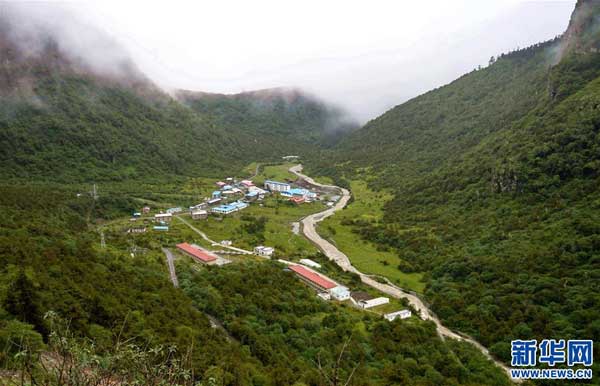
The French edition of China Tibet Online recently published a photo feature of Yume village which, over the years, has often been mentioned on the blog.
Yume (or Yumed or also Yumai) is located north of the Upper Subansiri district of Arunachal Pradesh.
The main characteristic of the village is that it has been adopted by President Xi Jinping, and as such it is the Model Township for the 200 or so other 'Xiaogang' (moderately well-off) villages near the Indian border.
The French article speaks of “Renaissance of the least populated township in China”.
During the last couple of years, Yume has witnessed a lot of development, some worrying for India.

Least Populated Village?
The article explained: “Yumai County, under the jurisdiction of Lhunze County in the Tibet Autonomous Region, is the least populated municipality in China.”
Incidentally, Lhuntse Dzong (county) will have the first airport in the area in 2021; it not far away.
China Tibet Online continues: ‘At present, the upgrading of the canton's infrastructure is underway. For example, the nine original households and the 47 relocated households moved into their new apartment, one room of which is reserved for private housing or a store.”
Nine ‘original' households correspond to the population of the village announced a few years ago (32 or 37 inhabitants), but we are now told that there are 47 ‘relocated’ households.
It means that Yume has already 5 times more migrant families than local villagers.
It is a serious issue as it signifies that China is changing the demography of its borders with India.
If you look at it at level of the entire Sino-Indian border, it probably means that China will have a new population of ‘migrants’ selected for their good deals on the Indian border.
It is still not clear if these ‘migrants’ are Tibetans or Hans; there are probably a blend.
The French article continues: “In addition, a road leading to the exterior is under construction which will be put into operation at the end of this year. This new road will end the blocking season due to snowfall.”
No mention is made of the airport, not too far away.
In 2021, hordes of mainland tourists will probably descend on Yume ...in opposition, Takshing, the Indian village does not have a road in working condition as yet.
In Yume, the website say that the construction of a primary school will be completed soon and will welcome more than 30 children in September.
It means that there is alreday as many children in the 'model' village than there were inhabitants two years ago.
Another objective of the Chinese is to show the rural population that they are looking better on their own people than the Indian Government. 


Choekar (on the right) and Yangzong (on the left), China's 'Models of Our Era'

Choekar's apartment

Yangzong's family business.


The construction of Yumai Primary School

The Road to Yume

Thursday, October 18, 2018

Good life in the smallest Tibetan village?

China Tibet News yesterday reported about the "Villagers’ good life in Yulmed".
Yulmed is Yume, the small village adopted by Emperor Xi, north of Upper Subansiri district of Arunachal Pradesh,
This village has often been mentioned on this blog.
It was said to be the smallest village in Tibet.
According to yesterday's article, it is still "China’s smallest township, located in the foothills of the Himalayas near the border of China and India," but, Oh Miracle, the population has grown from 32 inhabitants to 197.
How? The Chinese media does not explain this detail.
The article just affirms that Yume, located about 200 kilometers from the county seat of Luntse (which incidentally will soon have an airport) is 'happy': "with the development of economy and the improvement of environment of Yume Township [yes, it has become a township!!], it has built numerous new houses for local villagers."
Villagers and obviously outsiders.
It was said that later this month, "197 villagers of the township will be moved into their new houses, and their living environment will be greatly improved."
What does it mean?
There is a definitive plan to repopulate the borders with India by creating new model 'townships'.
This should be a serious issue for Delhi.
Some two years ago, long before anybody had heard of the hamlet, Wu Yingjie the Party Secretary of the Tibet Autonomous Region,  had visited the area.
Probably based on his report, Chairman Xi adopted the tiny village.
For India, whether the villagers have a good life or not, is not the question; this new development is bound to put pressure on the border, at a time, when Indian villagers are migrating in large number from the border areas toward the cities (in Uttarakhand for example, it is an extremely serious issue).
Why can't India open its border villages to eco-tourism?


Tuesday, May 29, 2018

A Better but Bumpy Border Road Lies Ahead

My article A Better but Bumpy Border Road Lies Ahead appeared in Mail Today/DailyO


The Indian media likes to publish ‘scoopy’ news. It was recently the case with an article in The South China Morning Post which spoke of “large-scale mining operations on the Chinese side of the border with India;” it argued that it “may create a new military flashpoint with India.”
Though it sounded like fake news, it got large coverage, while one of the greatest achievements for India’s defence preparedness went practically unnoticed.
On May 9, the Border Roads Organization (BRO) created history by establishing a road link beyond Limeking in Upper Subansiri district of Arunachal Pradesh, between Tama Chung Chung (TCC) to Takshing, the last Indian village before the border with China. The road covers a distance of some 80 kilometers before reaching the small village.
The BRO's 23 BRTF commander Col Tanish Kumar asserted that with his team, he drove from Limeking to Takshing ‘for spot verification.’
Long time frustrated villagers of Takshing have for years been lamenting that “the road will never happen, we will always remain isolated and at the mercy of Chinese intruding patrols.”
The conditions, the terrain, the hardness of the rock seemed insurmountable obstacles. The work on the TCC-Taksing link began in 2009, the BRO explained, “it continued unabated despite number of challenges and hindrances, including inhospitable terrain, inclement weather conditions with rains for almost nine months in a year, no access to this stretch of uncut road having dense foliage, undergrowth, rugged and steep mountains, while ferocious river Subansiri flowing nearby posed greatest challenge for transportation of men and materials.”.
Interestingly, the Chinese noticed the feat and several bloggers commented on this major strategic development; one commented: “The low altitude also has a negative side - it is rainy, and it often destroys roads. This is how our Metok’s road (in Tibet) road has been constructed.” Another even said: “Have to admire the spirit of the Indian perseverance!”
Another news which, like the Takshing road, will greatly improve India’s defence preparedness, got better coverage; the Prime Minister inaugurated the Zojila project; the 14.2 km tunnel will provide an all-weather connectivity between Srinagar and Leh. It will eventually cut down the time to cross the Zojila pass, situated at an altitude of 11,578 ft on the Srinagar-Kargil-Leh National Highway, from the present 3.5 hours to 15 minutes.
The construction of Asia’s longest bi-directional tunnel will cost some 6,809 crore to the exchequer and is expected to be completed in five years. After unveiling a plaque, the Prime Minister asserted: “The Centre and the state government are working together to take the development work forward.”
The state-of-art tunnel will have a transverse ventilation system, uninterrupted power supply, tunnel emergency lighting, CCTV monitoring, pedestrian cross passages at every 250 metres, as well as emergency telephones and fire-fighting cabinets. The construction will also provide employment for local people for the years to come.
Ambassador P. Stobdan, a Ladakhi, wrote in The Quint: “A tunnel through Zoji La has remained a constant dream for the last several decades. The initial survey for the tunnel was carried out in 1997, but the actual planning had started only after the Kargil war in 1999. …With the completion of this strategic tunnel, …[it] will enable traffic to move swiftly and safely between Kashmir and Ladakh.”
This may open the way to an even more strategic project: a railway line to Ladakh, which is scheduled as one of the 14 strategic connectivity projects initiated by the Ministry of Defence to protect India’s border areas.
Stobdan commented: “Leh rail network will have enormous strategic significance for boosting India’s defence capabilities and preparedness, enhancing the communication network both along the China border and the border with Pakistan occupied Kashmir (PoK).”
Already in November 2017, the BRO constructed the world's highest motorable road in Ladakh, passing through Umlingla Top at a height of over 19,300 feet. Starting near Hanle in East Ladakh, the 86 km long strategic road runs close to the Line of Actual Control (LAC); it connects Chisumle to Demchok village.
All this could be a first step towards another historic development.
The Daily Excelsior reported a press conference of the Himalayan Buddhist Cultural Association (HBCA) which urged the Prime Minister to fulfill the long pending demands of Ladakhi people; namely the inclusion of Bhoti language in 8th Scheduled of Indian Constitution and the opening of the Kailash Mansarovar road from Ladakh via Demchok.
HBCA President Tashi Targais said that the Kailash Mansarovar route via Demchok is not only the shortest route but it will also boost the economy of Ladakh region.
Reopening the Demchok landport could be a great benefit for Ladakh, but also for Western Tibet and China; it would not only give a tremendous boost to trade and pilgrimage, but it also could have a ‘Nathu-la’ effect: remember the skirmishes in Sikkim before the pass officially reopened in July 2006. The opening for trade had the effect to fix the border, drastically reducing the tensions in the area; since then the pass has become an important Border Personnel Meeting point between India and China.
For years, the people of Ladakh have asked for the reopening of the ancient route via Demchok; if it happens, it could become part of the New Silk Road project, dear to President Xi Jinping.
Beijing should let people and goods flow again over the Himalaya. China should allow the devotees wanting to visit Kailash-Manasarovar to use the Demchok route again.
It would have an additional benefit; it would stop the smuggling between China and Ladakh, which poses serious security risks of infiltration for India.
The Prime Minister should definitely raise this question with his Chinese counterpart when they meet next month.
In the meantime, kudos to the BRO.


Saturday, April 21, 2018

China develops the Indian border

War Memorial for the Chinese soldiers who dies=d during the Battle of Walong
Che Dalha (alias Qizhala), the head of the Tibetan Autonomous Region’s (TAR) Government (and TAR’s Senior Deputy Secretary) visited Zhayul, north of the McMahon line in the Lohit Valley.
Walong, which witnessed the famous battle in November 1962 is located some 50 km south in the same valley.
It is in Walong that the 11th Infantry Brigade and in particular the 6 Kumaon of the Indian Army managed to stop the Chinese advances and paid a high price for it.
The Chinese too suffered heavy casualties.
There is an excellent account on Bharat Rakshak website. 
The end of the battle is thus described.
From three sides, the Chinese poured in artillery and MG fire. But the Kumaonis held till 11 a.m. till the situation became militarily futile and orders were given to withdraw. As Lt. Bikram Singh started extricating his men he was cut down. The Chinese suffered terrible casualties (almost 5 times). By midday all troops were asked to withdraw. Some managed to get back through the treacherous terrain. But many NEVER GOT THE ORDERS. They slugged it out to the last man, to the last bullet. As Brigadier N.C. Rawlley said, "6th Kumaon at Tri Junction fought and fought and fought till there was nothing left. After this there was eerie silence." Sikhs, Kumaonis, Gorkhas and Dogras fought shoulder-to-shoulder to the bitter end. Two months after the cease-fire when the Indians returned they found that the Chinese had marked the positions of the dead. Many of the bunkers showed the dead where they had last manned their weapons.

CheDalha's vist
Che, who is also director of the district border defense committee, inspected a Hero Memorial Park in Zhayul area. He told the villagers that the masses should deeply cherish the memory of the revolutionary martyrs.
He laid a wreath for 447 Revolutionary Martyrs' War Memorial.
The memorial is in the honour of the Chinese soldiers who died during the Walong battle as well as the 'heroes' who fought the Tibetan resistance in the late 1950s.
Che, a Tibetan from Yunnan province, is a member of the all-powerful Central Committee of the Communist Party of China.
According to The China Daily the memorial consists of a mausoleum, a monument, a memorial hall and a hero wall. It is said the memorial for the 447-revolutionary martyrs' memorial is nestled in a forest of pines and cypresses. There is an engraved plate reading ‘The Revolutionary Martyrs are immortal’.
According to the Daily, Che slowly walked around the mausoleum, visited the memorial hall, and paid homage to ‘loyal souls’.
With ‘emotion’, he is said to have declared: “a hopeful nation cannot be without a hero, and a nation that does not remember his heroes has no way out (future).”
He expressed the Party’s high respect for the martyrs, who will be remembered forever. It is necessary, he said, to keep them in mind, learn from them, and receive ideological education and spiritual baptism from them.
He concluded by saying that everyone should firmly consolidate the dream of the future, inherit the good Red genes, and not forget the martyrs.
He urged the villagers in Zhayul to watch for strangers or suspicious persons, whether men, women or children; they would have to cross-examine them and send a report to the PLA manning the Indian border.
Che then quoted President Xi “ideals and beliefs are the spiritual ‘bones’ of the party members. We must always strengthen our ideals and beliefs, and more and more closely unite around the party Central Committee with Comrade Xi Jinping as its core.”
And then he said: "we must stick to the Party’s spiritual ideals; have a firm position and convictions in the depths of our hearts. Strive for a bright future and use faith to create a bright future."
Nothing very new, except for the fact that this took place near the Indian border.

The border defense forces

Che also addressed the border defense forces.
He urged them to hold high the banner of socialism with Chinese characteristics in Xi Jinping’s new era; implement Xi Jinping’s strong military ideology and resolutely safeguard and implement the chairmanship responsibility system of the Central Military Commission.
The usual State’s propaganda.
He added that all actions must of the society resolutely follow Xi’s command and stand on the side of the Chinese motherland while strengthening the national defense education, supporting the PLA and the masses, promoting the deep integration of military and civilian and educating and guiding the cadres and masses of all ethnic groups to bloom like a Kalsang flower in the snow-covered lands, while conscientiously be a guardian of the sacred homeland and a builder of happiness at home.


Phurbu Dhondup
It is not only Che Dalha who visited the border areas.
Phurbu Dhondup, the Governor of Lhoka (Shannan), in other words the head the prefectural government, recently ‘inspected’ some border counties of Southern Tibet, particularly in Tsona area, north of Tawang district of Arunachal Pradesh.
While on ‘inspection tour’, he asked the three counties of Nagartse, Lhobrag and Lhuntse to seriously study and learn from their mistakes and “adhere to the government’s policies; adhere to the Party’s planning and guidance, highlighted decisions; adhere to an exemplary life; adhere to the Party’s policies and systematically promote these policies.”
What does it mean?
Some local leaders are not adhering to the Party line?
Probably.
During the recently-concluded National People’s Congress (NPC), Phurbu Dhondup had affirmed that there were 96 border villages under the poverty line in Lhoka Prefecture alone; the prefecture is located north of Bhutan and Tawang district.
Dhondup asserted that the Provinces of Hunan, Hubei and Anhui would help Lhoka “make the dramatic transition” from poor border villages to prosperous ones with electricity, first rate access roads, irrigation systems and potable water. The participation of the ‘rich’ Provinces of China in the scheme is an important factor.
Inspecting the construction of a new village near the Indian border (Xiaokang Village), Phurbu Dhondup emphasized that everyone must adhere to the 'two directions': the protection of China’s sacred territory and the construction of a happy homeland.
Same words than Che Dalha.
Phurbu mentioned about the fight for poverty alleviation which should include scientific planning and the respect for the will of the masses; it should a combination of government support and self-reliance.
This village, like many others, is a border village, being developed with tourism in mind.
The question remains: why so much interest for the Indian borders?
Post-Doklam, Beijing has probably realized the importance of the border populations in case of a conflict with India. And more than 60 years after the ‘liberation’, many of these areas still live in poverty.
The Communist leadership is banking on mass tourism to change this.
And roads will come to the Indian border...

Phurbu Dhondup


Tuesday, March 13, 2018

How to be elected to the People's National Congress

Xi Jinping made it.
He can remain in his seat for life.
The voting process was completed in record time and the constitutional revisions got the highest approval since 1999.
The South China Morning Post (SCMP) reported: “Under the watch of a confident and relaxed President Xi Jinping, nearly 3,000 Chinese lawmakers were nearly unanimous in their approval of changes to the state constitution that included removing the term limit on the presidency.”
The Hong Kong newspaper said that Xi, who had maintained a poker face throughout the opening day of People’s National Congress (NPC), appeared much more at ease after the vote: “He even smiled when Wang Cheng, the vice-chairman of the National People’s Congress, announced the final result of the voting. Only two of the 2,964 deputies voted against the constitutional revisions, three others abstained and one ballot was declared invalid.”
That is not much opposition for a so-called democratic process.
In 2004, when China's constitution was last amended, it had taken two hours.
This time the process was over in just one hour: no debate took place, no discussion and not even canvassing.
SCMP remarked: “The whole event was meticulously managed to the last detail. All the deputies gathered at the Great Hall of the People in Beijing at 3pm sharp. Each received a pink ballot paper the size of an A4 sheet. They were given a short briefing on how to use a specially designed pen to tick the box of their choice before putting the completed ballot papers in 28 red, electronic ballot boxes designed to immediately scan and record the results.”
Done!
Xi can remain as long as he wants ...or as long as his health permits.

Data on the NPC
Before the vote, a website npcobserver.com published data about the NPC; the figures are derived from the raw data provided on the NPC’s site: "The 2,980 delegates—roughly three-quarters of whom have never held such a position—are set to vote on the draft constitutional amendment in just a few hours. … But who exactly are these delegates, allegedly ‘hand-picked’ by President Xi Jinping and poised to reward him with indefinite tenure? "
Three quarters at least owe their jobs to Xi.
The analysis about the NPC's ethnicity is particularly interesting : « There are 55 officially recognized ethnic minorities in China. Collectively, they are apportioned 14.7% of the seats in the 13th NPC—a percentage both higher than their proportion in the Chinese population and than the guideline value set by the 12th NPC a year ago ('approximately 12%').  The figure shows the ten ethnic minorities with the most seats in the 13th NPC. Except the Manchu, they are also the ten largest minorities in China, according to the 2010 national census (though the order is different). While all 56 ethnic groups are represented in the 13th NPC, half (28) are each represented by only one delegate. Han delegates are on average almost five years older than non-Han delegates, more likely to be CPC members, and significantly (not in the statistical sense) likely to be male."
from npcobserver.com

How are these delegates elected?
Take the case of a Tibetan delegate Choekar (or Dolkar).
Choekar (left)
As mentioned in this blog in November, soon after the conclusion of the 19th Congress, President Xi Jinping wrote a letter to two young Tibetan herders who had written to him introducing their village, Yume, north of Upper Subansiri district of Arunachal Pradesh.
Xinhua then reported that Xi “encouraged a herding family in Lhunze [Lhuntse] County, near the Himalayas in southwest China's Tibet Autonomous Region, to set down roots in the border area, safeguard the Chinese territory and develop their hometown.”
Xi acknowledged “the family's efforts to safeguard the territory and thanked them for the loyalty and contributions they have made in the border area. Without the peace in the territory, there will be no peaceful lives for the millions of families," he wrote.
The two Tibetan girls, Choekar and Yangzom had told Xi about their “experiences in safeguarding the border area and the development of their township over the years.”
Choekar's village, Yume (or Yumai or Yulmed) is located a few kilometers north of the McMahon Line, not far from the remote Indian village of Takshing.
Choekar (center)
It was enough for getting appointed a NPC delegate
It appears that many Tibetans from the nearby villages now want to move their homes to Yume. Choekar's sudden celebrity will certainly help  her village to grow exponentially ...and the border to be better protected.
Han tourists have already started pouring.
Villagers will build new guest accommodations and the border village will become wealthier  ...and the border will become more stable.
That is the Emperor's plan.
Of course, the Government of India is unable to think in this manner (in fact, can the Government think?)
Should a local girl from Takshing village on the Indian side of the border, write a letter to Delhi, it would go unnoticed by the authorities; it may not even be delivered.
Choekar had written about the importance for the border population to protect the sovereignty of the Motherland: by developing the border economy, poverty could be reduced.
Choekar, before her elevation was officially Village Affairs Oversight Committee Director, but now she is more, she is one of the 2,964 Chinese who took part in the historic vote; they ‘elected’ the new emperor.
The story does not say what has happened to the two who voted against the amendment of the Constitution.
Probably, the lenient ruler can allow this much dissidence.
It does not mean that the task will be easy for Chairman Xi; his new promotion may not help him to solve the immense problems facing the Middle Kingdom.
But this is another story.

Thursday, November 9, 2017

China is reinforcing its border with India

Choekar and Yangzom wrote to Xi Jinping
My article China is reinforcing its border with India appeared in the Edit Page of The Pioneer.


Here is the link...

The Middle Kingdom is winning the trust of the locals to safeguard its border. This must worry India. But can China win over the Tibetans who have largely been sympathetic towards India?

At the end of the 19th Congress, Chinese President Xi Jinping appears to emerge the winner on most fronts. First and foremost, the 19th Congress approved an amendment to the Party Constitution, enshrining ‘Xi Jinping Thought on Socialism with Chinese Characteristics for a New Er’.
Though the new Central Committee and Central Commission for Discipline Inspection were more or less along the expected lines, the Politburo and the Standing Committee brought some surprises. Apart from these party issues, in his three and half hour speech, President Xi mentioned several times “border” and “minorities” areas.
Xi particularly asserted: “We will devote more energy to speeding up the development of old revolutionary base areas, areas with large ethnic minority populations, border areas, and poor areas. We will strengthen measures to reach a new stage in the large-scale development of the western region [ie  Tibet and Xinjiang].”
To start implementing his policy, the Chinese President sent a personal letter to two young Tibetan herders soon after the conclusion of the Congress. They had written to him introducing their village, north of Indian border.
According to Xinhua, Xi “encouraged a herding family in Lhuntse County, near the Himalayas in southwest China’s Tibet Autonomous Region, to set down roots in the border area, safeguard the Chinese territory and develop their hometown.”
Safeguarding China’s territory against whom? India obviously!
Xi acknowledged “the family’s efforts to safeguard the territory, and thanked them for the loyalty and contributions they have made in the border area. Without the peace in the territory, there will be no peaceful lives for the millions of families,” he wrote.
The two Tibetan girls, Choekar and Yangzom, had told the Communist Party of China’s (CCP) Secretary General about their “experiences in safeguarding the border area and the development of their township over the years.”
Interestingly, the girls’ village, Yume, is located a few kilometers north of the McMahon Line, not far from the remote Indian village of Taksing.
Xi also hoped that the girls’ family could “motivate more herders to set down roots in the border area ‘like kalsang flowers’, and become guardians of the Chinese territory and constructors of a happy hometown.”
Yume is said to be China’s smallest town in terms of population. In the years to come, Beijing will undoubtedly put pressure on India not only by using Tibetan populations living north of the McMahon Line, but also by influencing the Indian tribes south of the Line, enticing them with a better life on the Chinese side.
Can this letter from Xi Jinping be considered as an acknowledgment of the McMahon Line, as the Indo-Tibet border? From the reporting of Xinhua, it seems so. Xi clearly thanks the two herders for ‘guarding’ the border?
Already in November 2016, China Tibet Online had mentioned Yume ‘town’ on the southern slope of the Himalayas as the border area of China and India: “If driving, you had to go south 400 km from Lhasa to Lhuntse in Shannan (‘Lhoka’ for the Tibetans) City, then there was another 200 km of muddy mountain roads before you reached Yume.”
The official website asserted that “It is the least populous administrative town in China. With an area of 1976 square km, Yume has one subsidiary village, and only nine households with a total of 32 people. Yume has very few residents, but it is not impoverished, nor backward.”
The article concluded: “For a long time, there was only one family in Yume. After the Tibet Autonomous Region Government dispatched officials and doctors, built the roads, and added a power station and a medical clinic, Yume became more and more lively. In 2015, the annual average per capita disposable income in Yume was 26,000 yuan.”
On October 12, 2016, the powerful Tibetan Autonomous Party Secretary, Wu Yingjie, surprisingly landed in the area. According to The China Daily, Wu met frontier troops posted in this remote area: “[Wu] conducted a field survey on how to promote development and stabilisation of the border region, people’s livelihood, grass-root-level Party building and poverty alleviation.”
Wu told the local residents: “You defend the border areas of our country and protect our country from being nibbled or divided. I salute you.” A flag raising ceremony was held in Yume on the occasion of the party boss’ visit.
Why so much interest in this tiny border community? Just to protect the border against India?
The China Daily notes: “Frontier soldiers and local residents patrol in the township. Every resident of the township has a strong awareness of border defense and make it part of their life.”
On the other side of the McMahon line is Taksing; it is the last village in Upper Subansiri district of Arunachal Pradesh and …certainly the first place susceptible to be invaded in case the People’s Liberation Army (PLA) decides to retaliate after the recent confrontation in Doklam.
The problem is that the village still has no access road and the local inhabitants believe that it will take at least five to 10 years to see a road reaching Taksing.
It is not that nothing is happening. On April 6, 2017, the Border Roads Organisation (BRO) managed to open a new section connecting Tame Chung Chung (known as TCC) and Nacho. The inhabitants living in the TTC' vicinity had dreamed of seeing this road for decades, but like many other things for the border population, it had remained a dream.
A BRO’s communiqué explained: “The area is located in an extremely remote area with rugged terrains, thick vegetation and inhospitable weather. The place has remained inaccessible since 2009.” The road was to be opened in 2009.
As an aftershock of the Doklam incident and the subsequent ‘speeding’ up of the border projects, the TTC-Taksing road may hopefully be opened in two years.
In October 2014, The Deccan Chronicle reported that the Chinese People’s Liberation Army (PLA) had been focusing on the Taksing area: “After the recent Ladakh incursions, frequent intrusions by China’s PLA in Arunachal Pradesh’s Taksing region have come to the notice of the security agencies.”
At that time, some local villagers had managed to shoot a short video on their phones of the PLA ‘visiting’ their village.
In the meantime, China is building up pressure by enticing and cajoling the Tibetan population on their side of the McMahon Line.
In several places, China has started developing ‘border’ infrastructure on fast track, bringing large number of Chinese tourists; not only to Yume, but also in Metok County, north of Upper Siang district or Lepo village, near Khenzimane on the McMahon Line.
Xi’s letter tends to show that Beijing has decided to use more and more the local Tibetan populations in border areas to ‘defend’ the Middle Kingdom’s borders. This should deeply worry Delhi; so far the Tibetan population has been sympathetic towards India, can China manage to change this?

Wednesday, July 26, 2017

Does India need to be invaded by China to wake up?

My article Does India need to be invaded by China to wake up? appeared today in Rediff.com.

Here is the link...

Very few in India have heard of Taksing.
It is the last village on the Tibet (China)-Arunachal Pradesh border, and the first village likely to be invaded if Beijing retaliates.
Scarily, it takes jawans THREE days of walking to reach Taksing.
In all the noise surrounding the Doklam confrontation, Claude Arpi focuses on a crucial issue that has hardly been covered -- the construction of roads for the armed forces and the local population to reach the most remote border posts.


Very few incidents have triggered so many comments as the confrontation at the trijunction between Tibet, Bhutan and Sikkim.
On June 16, 2017, Chinese troops entered a stretch of land at the southern tip of the Chumbi Valley to build a road …on Bhutanese territory.
They were stopped by the Indian Army.
Beijing’s response was sharp, probably due to the surprise; China did not expect Delhi to militarily defend Thimphu. It is also true that the trijunction is a strategic hotspot for Delhi, and by occupying it, the Chinese would have a ‘view’ not only on the Chumbi Valley but also on the Siliguri corridor, which is India’s main strategic weakness in case of a military conflict.

Trying to change the historical posts
On June 30, 2017, the Ministry of External Affairs in Delhi affirmed that in 2012, it had been agreed with China that the status quo would be maintained in this area: “The two Governments had in 2012 reached an agreement that the tri-junction boundary points between India, China and third countries will be finalised in consultation with the concerned countries.”
Probably getting upset with the delay in finding a solution, Beijing decided to take the matter in its own hand, as it had done earlier in the South China Sea. Beijing has a tendency to believe in the principle that it is better to first take ‘possession’ and then start talking.

The Infrastructure to the Frontiers
One issue has hardly been covered by the Indian media, though crucial for the defence of the borders: it is the construction of a decent infrastructure for the Indo-Tibet Border Police Force (ITBP), Army and the local population to reach the most remote border posts.
On July 18, it was announced in Parliament that some 73 roads were being built along the Sino-India border. According to PTI, Minister of State for Home, Kiren Rijiju told the Lok Sabha: “The government has decided to undertake construction of 73 roads of operational significance along Indo-China border. Out of these, 73 roads, 46 are being constructed by the Ministry of Defence and 27 by the Ministry of Home Affairs.”
The minister said 30 roads had been completed so far though all the roads had been scheduled to be completed by 2012-13. According to the government, the main reasons for the delay are: limited working season, logistical issues due to high altitude, rugged and difficult terrain, natural calamities, delay in land acquisition and forest/wildlife clearances.
The last justification is surprising as the Modi government had decided in 2014 to do away with the environmental clearance for road projects located within 100 km of the Line of Actual Control (LAC).
This raises another issue: why cannot the private sector be involved, especially at a time when the Modi Sarkar tries its best to invite private players into the defense sector?

The Most Difficult Road of all
Very few in India have heard of Taksing.
It is the last village on the border with Tibet (China) in Upper Subansiri of Arunachal Pradesh. It is certainly the first village susceptible to be invaded in case the People’s Liberation Army (PLA) decides to retaliate after the confrontation in Sikkim. Here the villagers believe that it will take at least five to ten years to see a road.
It is not that nothing is happening.
On April 6, 2017, the Border Roads Organisation (BRO) managed to open a new section connecting Tame Chung Chung (TCC) and Nacho. The inhabitants living in the vicinity of Tame Chung Chung (locally known as ‘The Land of Snakes’) had dreamed of seeing this road for decades, but like many other things for the border population, it had remained a dream.
A BRO’s communiqué explained: “The area is located in an extremely remote area with rugged terrains, thick vegetation and inhospitable weather. The place has remained inaccessible since 2009.”
In fact, the road was to be opened in 2009.
The same report noted: “The persistent efforts of BRO engineers have finally changed the scenario. The road comes under Project Arunank, run by the Indian Army in five districts of Arunachal Pradesh. The Nacho-TCC section of the road is strategically vital due to the Chinese presence nearby. The road does not reach the LAC as yet, but the completion of this portion marks a major step towards Taksing, the last border village in Arunachal.”
In October 2014, The Deccan Chronicle reported that the Chinese PLA had been focusing on the Taksing area: “After the recent Ladakh incursions, frequent intrusions by China’s PLA in Arunachal Pradesh’s Taksing region have come to the notice of the security agencies… Security sources also confirmed this incursion had come to their notice about a month back, but the PLA had gone back after a brief stay.”
Around the same time, the Times of India noted: “Both armies undertake regular patrols to lay claim to 8-10 disputed areas like Asaphila, a remote 100 sq km.” PLA’s “heightened activity” had been witnessed in Asaphila area for months. “The PLA troops, with vehicles and other equipment, then tried to build a road till Point 2445. They were then stopped from doing so by our soldiers,” a source told the newspaper.
At that time, some local villagers had managed to shoot a short video on their phones of the PLA ‘visiting’ their village. The last Indian military outpost before the border is still some 35 km away from the newly-opened section, but the construction will hopefully be easier: “Due to the exceptionally hard rock and treacherous terrain, this portion of the road took many more years than expected,” said the BRO statement, adding that TCC is situated near the confluence of Subansiri and Tsari Chu river valleys: “(it) acts as a gateway to both the valleys and its connectivity was essential for further development of the area.” The Army organization admitted that a large number of personnel suffered severe injuries during the construction work and equipment worth crores of rupees was lost in landslides.
The question remains: have the Central and Arunachal authorities finally decided to undertake the construction of roads in border areas on a ‘war-footing’?
It is not sure. The work is frightening slow.

Already in the fifties
Already in the 1950s, there was a crying need for a road.
In 1957, Capt. LR Sailo, then assistant political officer in Taliha of Subansiri Frontier Division (NEFA), reached the administrative camp in Limeking and wrote in a superb account titled, “Report on an Exploratory Tour Undertaken in the Upper Subansiri Area and the Tsari Chu Valley”, “The location of Limeking vis-a-vis the international border has been determined; the exploration of the Subansiri westwards of Limeking upto the international border has been completed and the confluence of the Subansiri and the Yume Chu has also been ascertained (Taksing); the determination of the precise location of the confluence of the Subansiri and the Tsari Chu; the Tsari Chu valley has been explored upto the international border with Migyitun settlements (in Tibet); a sketch map of the area has been prepared with estimate of the locations of villages or settlements, the courses of rivers, mountains, and important routes.”
Capt. Sailo’s conclusions were clear: “The urgency and importance of constructing roads from Daporijo to the border settlements of Lower Na (Taksing) and Migytun (Maja) cannot be over-emphasised.”
Of course, since 60 years, babus from the MHA or the State Government have never set a foot in these areas.

The Present Situation
Unfortunately not much has been done during the following 50 years — a real tragedy for the defence of India and the border populations.
A few months ago, I received a message from Hiwak Chader, who lives in Taksing; he explained the difficult situation for the local population. After saying that he felt extremely proud to be an Indian, he noted: “During these 69 years our country has made tremendous progress in the field of science and technologies; we also joined the elite club of few selected country to have achieved a fate of sending the mission to Mars which raise our stature in international level. On the other hand, people of Taksing Village are deprived of all those developmental activities; still local peoples have to resort tiresome and risky three-day trek to reach nearest motorable road.”
He continued: “We have been sentinel of the country since time immortal but in return what we are get, underdevelopment and apathy attitude of the government.”
He blamed both the Central and State governments: “Taksing is a frontier village located at an advance position for the defence agencies near Indo-China border. When there is disruption in transportation, electricity and communication in capital complex for a single day, the people get irritate like anything, just think about the magnitude of hardship which dwellers of Taksing renders in a so called 21st century.”
Chader concluded that Taksing, which is naturally richly endowed in varieties of vegetable and fruits: “can easily feed entire population of Upper Subansiri district at least for one session. However in absence of road product perishes.”
He does not mention the hardship of the CRPF jawans and the Army who have to man the frontier. Though there is a helipad for emergency, it takes some three days for a jawan to walk from TTC to Taksing (while a local porter can make it in two days).
It is extremely doubtful that Takshing will see a road in the next 5 years; let us hope that it won’t be too late.
It is not that there is no solution: one would be to involve the private sector, or even ‘friendly’ foreign countries such as Japan in the road construction; also the BRO or any other contractor should give better salaries to the local workers to insure continuity in the laying of the road; more camps for road workers could be created en route between TCC and Taksing, etc.
But the main issue remains: is there the will to reach the frontier at any cost? Does India need to be invaded to wake up?
Let us pray not.