Showing posts with label Param Vir Chakra. Show all posts

Wednesday, July 26, 2023

Son, roll down this nalla

On the occasion of the Kargil Vijay Day, I re-post my  interview with Param Vir Chakra, Jogender Singh Yadav entitled, Independence Day Special: The Hero of Tiger Hill is posted on Rediff.com.

Click here to read...

Yogender Singh Yadav survived 15 bullets while capturing Tiger Hill in the Kargil War and was awarded the Param Vir Chakra, India's highest award for gallantry.
On the eve of Independence Day, the 32-year-old soldier relives that night when he and his fellow commandos won one of India's most historic military victories.
Yogender Singh Yadav of the 18 Grenadiers believes that every deadly bullet has a name engraved on it. Yadav knows what he speaks about; after all he survived some 15 bullets while capturing Tiger Hill during the Kargil conflict and was awarded the highest award for gallantry: The Param Vir Chakra.
Yadav was a member of the 'ghatak' (assault) commando platoon which captured three strategic bunkers on Tiger Hill overlooking the Drass-Kargil road on the night of July 3-4, 1999.
Twenty-two highly-trained men approached the Pakistan-occupied peak via a vertical cliff at an altitude of 16,500 feet.
The Param Vir Chakra citation said Yadav 'Unmindful of the danger involved, volunteered to lead and fix the rope for his team to climb up. On seeing the team, the enemy opened intense automatic, grenade, rocket and artillery fire, killing the commander and two of his colleagues and the platoon was stalled. Realising the gravity of the situation, Grenadier Yogender Singh Yadav crawled up to the enemy position to silence it and in the process sustained multiple bullet injuries. Unmindful of his injuries and in the hail of enemy bullets, Grenadier Yogender Singh Yadav continued climbing towards the enemy positions, lobbed grenades, continued firing from his weapons and killed four enemy soldiers in close combat and silenced the automatic fire.'
Claude Arpi met the hero recently. Interestingly, the long list of prepared questions was soon set aside as the commando, now 32 years old, started to 're-live' his experience. It is only towards the end of the encounter that Claude could ask him a few clarifications.


Claude Arpi (CA): Some thirteen years ago, on July 3, you and your team was given the task of capturing Tiger Hill. What do you remember of these difficult days?
What were your feelings then? How do you recall the events today?


Yogender Singh Yadav (YSY): Even though 13 years have passed, I still feel that the Kargil war happened just yesterday. I will never be able to forget through my whole life the memories of Kargil.
During this war, I do not know how many comrades I lost; comrades who were even dearer than my own brothers.
Inside me live their memories and it will thus continue to be.
I do not know how many hundreds of my comrades were injured; today some among them cannot even walk or move.
Those are 13 years of memories... it is still as if it all just happened to me yesterday.
I remember, 13 years ago, on the night of July 3-4, my battalion was ordered to capture Tiger Hill top.
Tiger Hill was the highest peak in the Drass sector. To take control of it was very difficult; a height of 16,500 feet, with sheer, precipitous sides of ice and snow.
Before that we had won mastery over many hills (particularly Tololing), but our success could turn into failure, if the dominating feature of Tiger Hill was not won, all other victories could be nullified.
The senior commanders concluded that only after Tiger Hill is captured would our other gains bring a complete success.
Our battalion was then ordered to capture the top of Tiger Hill; attack plans were made. A 'ghatak' (assault) platoon was formed, with Lieutenant Balwan Singh as commander.
This 'ghatak' platoon, under the battalion, was to attack the top of Tiger Hill first. The path that we decided to take was such that the Pakistani forces could not envisage that the Indian Army would be using this path to reach the top.
The path to the Pakistani positions had sheer, vertical peaks.
We made plans on how to accomplish our task and finally on July 2, we set out to accomplish our goal. The whole battalion moved together. The attack could only happen at night as the enemy, from their heights, could observe us from afar.
If we had attacked during the day, they would have shot down our jawans; hence we could only attack in the dead of night, that too, when the moon was hidden.
After an arduous climb for two days, during the night of July 3-4, we went through a tremendously difficult path, a very small path. But hearing the stones sliding under our feet, the enemy surmised that the Indian Army has reached this area. They opened fire on us.
When the firing started, there were only seven jawans who were ahead; the others were slowly reaching up from below in a line. A bit of path was blocked and only those seven jawans had been able to reach this higher spot.
We reached up to a 8 to 10 feet level with Pakistani bunkers; 4 to 5 soldiers opened fire at us. All seven of us went on firing and sent several Pakistani soldiers into the valley of death.
We obtained victory on that ledge. But the top of Tiger Hill was still 30 to 35 metres higher. From there the enemy could see where the Indian soldiers had reached. They started firing at us so heavily that neither were we able to move higher, nor could we could come out from behind the rocks.

For five hours, the exchange of fire continued, however they were unable to estimate how many jawans were present below them.
At about 10.30 am, the Pakistanis sent some 10, 12 soldiers to check. When the enemy came close to us, we fired at them and killed them all, excepting one or two.
But by then our positions had been marked by the Pakistanis and they knew how many we were; they returned to the top to report to their commanders that there were only 8, 10 Indian soldiers below.
Within 30 minutes of getting this information, the Pakistani troops launched a counter attack on us; such a powerful attack, using several supporting weapons, throwing big boulders down on us.
As they slowly came closer and closer, they managed to damage our LMG (Light Machine Gun), our supporting weapon.
Then they got still closer and launched a hand to hand battle, during which six of my companions were martyred.
I still remember that moment, those preceding instants when we seven mates were discussing and talking together about what to do next and what was going to happen, and the instant later when all my comrades had been martyred.
I was bereft by this loss, but also glad that before losing their lives they had killed 10, 12 enemy soldiers. I too was severely wounded and was taken for dead by the enemy.
Two, three times, they returned to shoot some bullets into all the dead bodies and checked that no one was alive.
The enemy also shot bullets into my body, I was shot in the arm and leg, but had firmly resolved that unless I got a bullet in my heart or head, I would remain alive, even if they cut off my arms and legs.
It is due to that resolve and will that I am alive today.
Some 500 metres below was our MMG (Medium Machine Gun) post, the enemy then made plans to destroy it. Next to Tiger Hill was the Mushkoh valley, where their base camp was located. It is from there that the orders to destroy the MMG post came.
I heard this order; I knew that some 10, 12 of my fellow soldiers were manning the MMG post.
In my heart, a voice spoke to me and said that I must save my companions. It is true that if one remembers Ishwar (the Lord) with full faith, then Ishwar-shakti (the Lord's power) aids you. It can even appear before you.I prayed to Ishwar to keep me alive long enough to save my comrades.
Perhaps He heard my prayer.

When the Pakistani soldiers again shot at us and tried to take our weapons, I attacked them with a grenade. One of their soldiers was killed.
Another turned his muzzle at me and fired at my chest. In my breast pocket was my purse which contained some five rupee coins. The bullet hit the coins and ricocheted away; I felt that I had died.
But the next instant, when he bent to take my weapon, my eyes opened and I realised that I was still alive. Within a moment, I turned and grabbing a rifle, opened fire on them.
During the firing, four Pakistani soldiers were killed. I fired from one boulder, then rolled behind another to fire again and then a third.
They thought that some Indian reinforcements had reached from below and they ran away. I returned to my companions to check if any of them were alive, but to my deep sorrow, no one was.
I tried to see how to descend, when Devi-shakti appeared before me and told me how to go down.
My broken arm was useless at my side, I tried to tie it, I even tried to break it off with a jerk, but I could not manage. Finally, I fixed it into my belt behind my back and rolled downhill towards my companions.
I gave my mates the warning about the impending attack and told my team commander, Lieutenant Balwan Sahib the entire story.
He, in turn reported to our battalion commander that our leading section had been entirely destroyed, only one jawan had returned (Yogender Singh Yadav) and he is giving this information.
Battalion Commanding Officer Colonel Khushal Chand Thakur told them to get this jawan down to him as quickly as possible so that he could hear the information first hand.
At that time it must have been 1:30, 2 in the afternoon (of July 4). Blood was flowing from my wounds like water. Though my comrades gave me first aid, the bleeding would not stop. They brought me back to the CO and by the time we reached, it was completely dark, and I was unable to see.
The CO asked, "Son, do you recognise me?" but I could see nothing. He had me laid in his personal tent, and had 2, 3 stoves lit around me. When my body gradually got warmer, the RMO (Regiment Medical Officer) Sahib came and gave me again some first aid and made me drink some glucose.
I got some sort of energy back in my body and then the CO asked again, "Tell me now, son, what happened with you all?"
I told him the whole story and concluded that "Now Sir, they are going to attack the MMG post. Sir, you see, beyond this helipad there are stones, behind which are the living tents of the enemy, they have support weapons deployed there, and ammunition has been dumped there."
After I gave this information, RMO Sahib gave me an injection to put me to sleep.

When I woke up three days later, I was at the Srinagar base hospital. I learned that the same night, our reserve company had attacked the top of Tiger Hill, and without any casualties, had succeeded in capturing the top.
I was then shifted to the army hospital, New Delhi, and after 16 months of treatment, I could serve the army again.
It is the dream of every soldier to fight for his country and with his own blood to anoint this motherland. To be able to do this is his great fortune.
I consider myself fortunate to have taken birth on Mother India's soil and to be part of this great Indian Army, which is today considered to be one of the best in the world.
I am proud of my country and of our army and I would tell the youth of this country that we can be devoted to our nation from anywhere, but the real progress, the inner and outer protection only comes when we all come together, when we try to progress in every realm and each one tries to grow in our own sphere.
I would appeal to our youth that no matter which area you chose, you should work with honesty, straightforwardness and work hard and you should keep their devotion to their country awake, alive. Jai Hind!
You said that the Devi Ma's Shakti came to you. You had earlier already had a vision, telling you that you would be injured, but would not die. Please can you elaborate?
When, with full faith, a man surrenders everything he has to accomplish a certain task, and this, without reserve, (ulterior) motive or calculation, certainly then, an inner strength, a shakti, arises in him.
He becomes conscious of what is going to happen to him today or tomorrow or whenever.
This happened to me, I was given the awareness that I would be injured; my arms and legs would become useless, but that I would remain alive.
It is a fact that in Kargil we had surrendered ourselves fully to our task (to recover Tiger Hill from the Pakistanis), we were fully aware that we could lose our lives, but we still surrendered ourselves to the task ahead with complete faith in the Lord... then there is no question of thinking that one could fail in one's work.
The task has to be completed -- the Lord himself tests man, He tests how much a person can take, how much pain he can bear; only when one can bear the most intolerable pain does the divine strength comes (to accomplish the task).

CA: You had the certitude that you would not die, tell us more about this vision of 'Devi Ma' who showed you the way down to the MMG post?

YSY: At that time, I knew that I had to reach my comrades; it was a selfless wish, to try to save the lives of my mates, my brothers.
I had no desire to try to save my own life, in fact having witnessed my six companions sacrifice their lives, I was proud that I was now being given another opportunity to serve my motherland and follow in their footsteps.
This is the dream of every soldier, his glorious journey to fulfil the prime duty of his life.
When he returns home wrapped in the national Tricolour, his family, his country and even the whole world rejoices with tears at his self-sacrifice.
I was given that strength and She showed me the way down.

CA: The 'vision' told you which way you must take?

YSY: Yes, absolutely, in front was a being in white who said, "Son, roll down this nalla (gully)."

CA: Have you seen LOC Kargil, the Hindi movie made about your action?
They did not interview me for that. But the movie, LOC Kargil has my role played by Manoj Bajpai.
Did you see the movie? How did you find it?


YSY: I liked it. They have highlighted the task that I and my companions performed; our sacrifice for the good. The world could see this. It made the general public aware of the difficulties a soldier has to endure to do his duty successfully. I liked it very much.

CA: Thirteen years later, would you do it again?

YSY: Yes. Many citizens wants to join the army, (not all are selected), but those who are, feel they are blessed that out of so many aspirants they are the chosen few who will serve to protect their country.
A soldier's ultimate wish is that he should be allowed to do this job of protecting his country, and even if he has to lay down his life to do it, that is not too big a sacrifice.
I have merely shed some of my blood for my motherland, only put a tilak with my blood on her land, but I am still alive. But if I were given the chance, I would put down this life for her.

CA: Since that time, there have been a lot of changes in the army?

YSY: The Army is the Army.
At that time, there were many shortages in the army, lack of equipment, ammunitions, adequate clothing, etc. Has the situation improved?
At that time (in 1999), the war was declared all of a sudden. In those areas (Kargil-Drass sectors), there was little army deployment. The units which had to be called in from other parts of India, from the plains and they did not have the right clothing.
But the main need of the hour (during the war(, was neither adequate clothing nor right equipment available, but to accomplish the task at hand, and this, with whatever means we had.
It is a matter of pride that the Indian Army jawan has a dedication, a patriotism not present in any other army of the world.
It is only because of this that we were able to vanquish the enemy at those impenetrable mountain heights.

CA: It is said that a soldier believes that every bullet carries someone's name on it. Do you believe that too?

YSY: Of course. See, I am a soldier, and so is the man fighting against me, we are not bothered by which bullet carries whose name.
Definitely each bullet carries a name, just as we say that every morsel of food bears the name of the person who must eat it.
Similarly, for a soldier, he has a bullet with his name on it, the one which will kill him; perhaps the bullet with my name was not made and as a result, I am still alive.

Though not mentioned in this interview, one of the motivations of the jawans and officers during the Kargil conflict was the barbarian behaviour of the Pakistanis.
On May 15, 1999, India sent a patrol to ascertain if some parts of her territory were occupied by intruders.
The patrol was ambushed on the Indian side of the LoC and the patrol leader, Lieutenant Saurabh Kalia and five of his jawans were captured and tortured.
Their mutilated bodies were returned on June 9. Yogender and his companions knew this. It motivated them further to recapture Tiger Hill.
Before the attack on Tiger Hill, Yogender Singh Yadav's battalion had been involved in the battle for Tololing, another peak occupied by Pakistan. They fought for 22 days.
Many Indian jawans and officers lost their lives in the battle. Yogender who was just married and could only reach his battalion a few days after the battle had started was given the task of supplying ammunition to the forward troops.
The 19-year-old Grenadier managed to climb the peak twice a day to supply his companions.
In a booklet on his life, he stated: 'It was gruelling and back-breaking work. My officers noted that I had tremendous stamina and could climb these treacherous steep and snow-covered slippery slopes almost constantly for 2 days carrying heavy loads. Please see: Our Heroes: Param Vir Chakra, Grenadier Yogender Singh Yadav, Shyam Kumari, Vraja Trust, Pondicherry, 2011.
It is why he was selected to lead the final assault on Tiger Hill.


Claude Arpi gratefully acknowledges the help of Mrs Shyam Kumari, Lieutenant Colonel Uma Tewari (AMC, Retd) and Abha. The interview was conducted in Hindi.

Friday, November 18, 2022

The Heroes Who Saved Ladakh For India

My article The Heroes Who Saved Ladakh For India appeared in Rediff.com.

Here is the link...

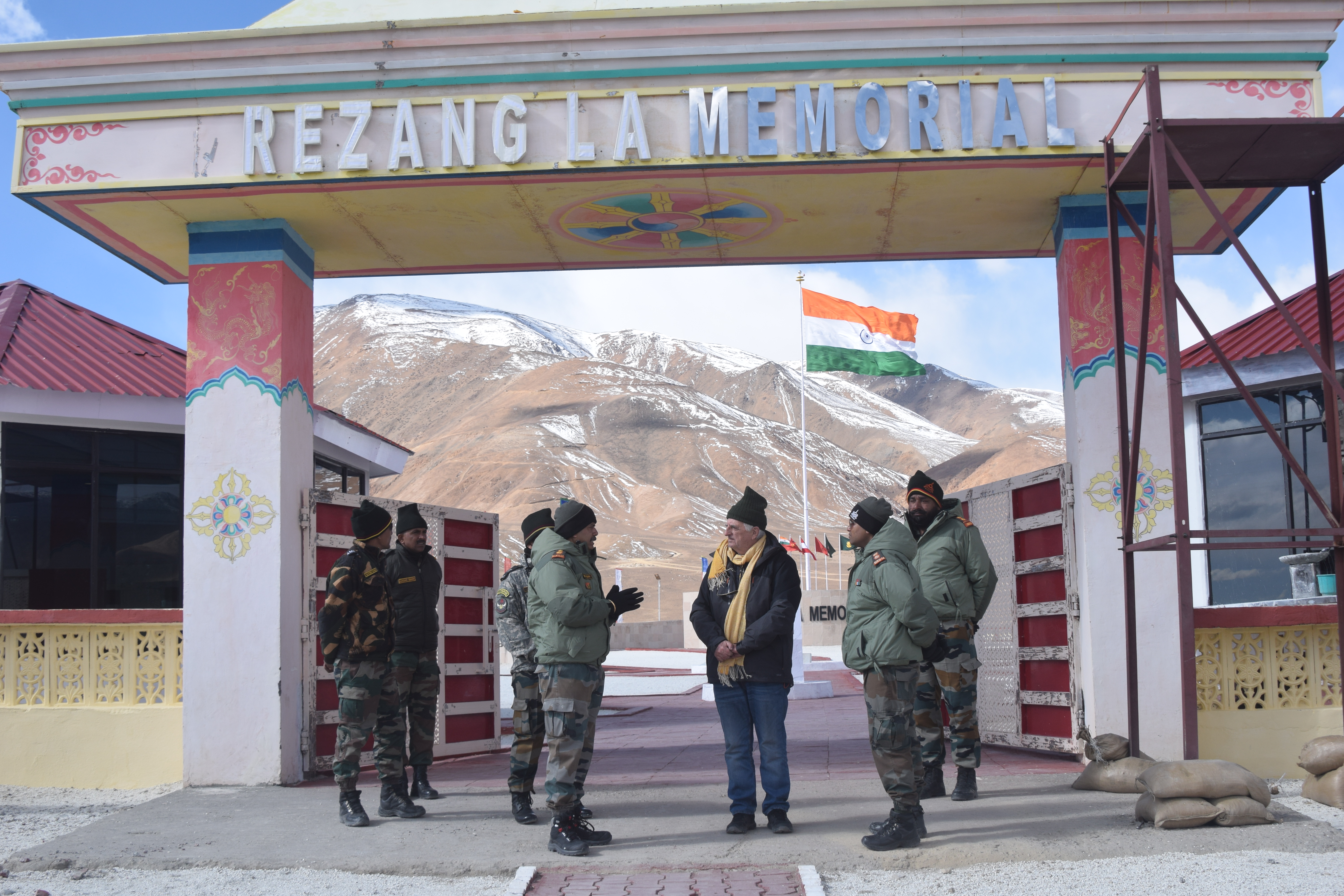
Visiting the Rezang La Memorial, one has a feeling of super-humans defending Indian territory against the Chinese onslaught, says Claude Arpi on the 60th anniversary of the heroic battle of the 1962 War.

Several years ago, I had the opportunity to interview one of the most renowned Indian mountaineers, who had chosen to live like local folks in the Himalaya. She recounted an anecdote which took place during the All-Women Himalayan Traverse expedition; one day the expedition arrived in a small mountain village; speaking about the majestic surroundings, the mountaineer told one of the villagers: ‘Kitne sundar!’ (How beautiful they are!), the local pahari’s immediate reply was, ‘Kitna dukh!’ (So much suffering!).
Somehow, the pithy phrase summarized the hard life in these high mountainous areas.
These words came back to mind when I recently visited the site of the the Battle of Rezang La, near Chushul village in Ladakh at more than 15,000 feet.
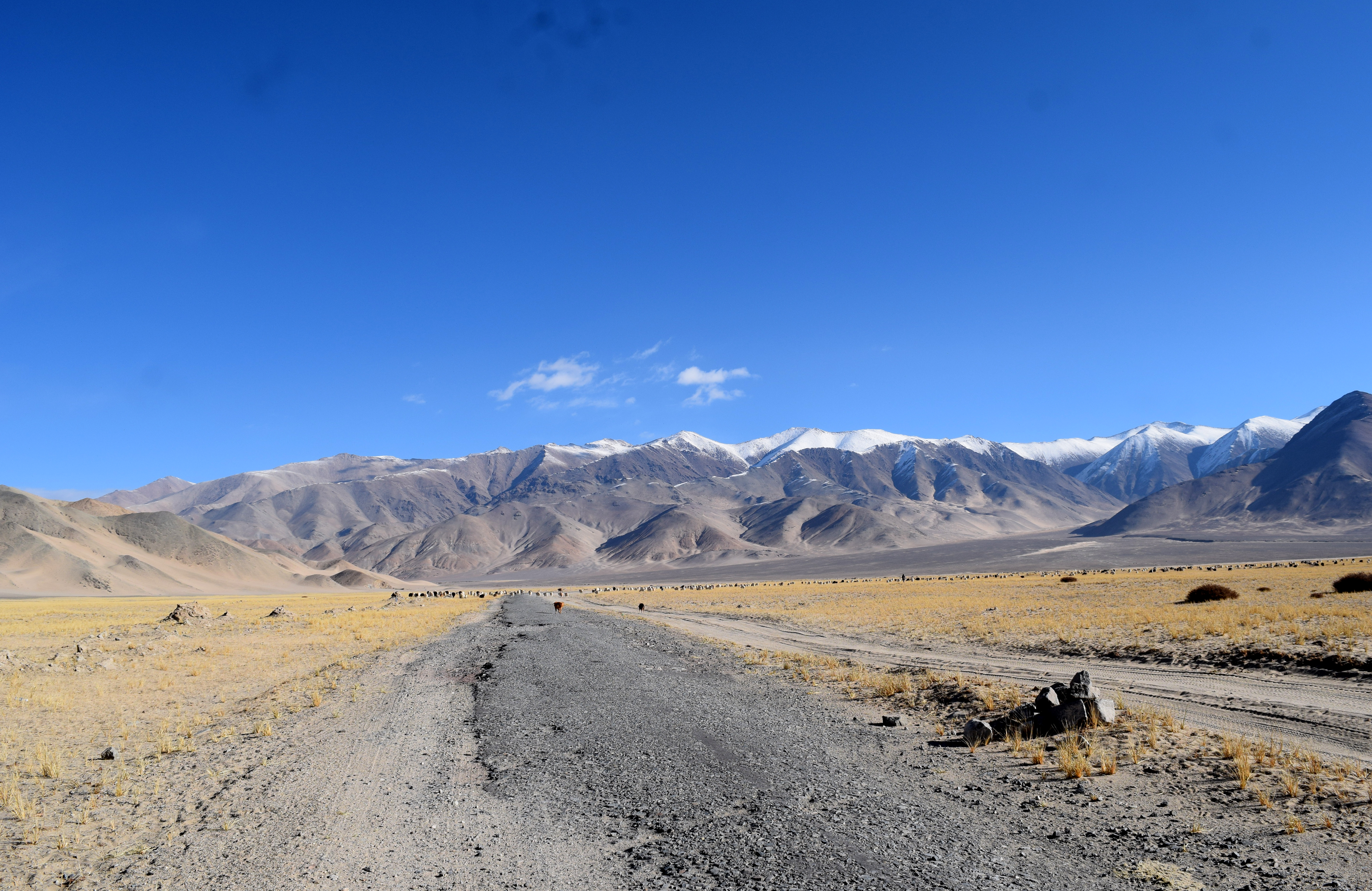
As one arrives by car from Nyoma, the track follows the imposing Kailash range, covered with snow. Immediately, one is confronted by this paradox faced by one of the most peaceful and magnificent spots on earth, which has however witnessed some of the bloodiest battles since independence.
After crossing the Tsaga La (pass) and a few kilometers before arriving at the site of the newly-renovated War Memorial in honour of the ‘Charlie’ Company of the 13th Battalion of the Kumaon Regiment, one can have the magnificent sight of a tri-colour flag floating in the blue sky.

 The ‘dukh’ side
On 18 November 1962, a battle was fought at Rezang La (pass) at the incredible height of 16,000 feet, one of the greatest battles in history; 114 soldiers of the 124-strong company led by Maj Shaitan Singh, PVC, lost their lives heroically defending the nearby Chushul airstrip, the last defence before Leh, Ladakh’s capital.
Maj Shaitan Singh was posthumously awarded the Param Vir Chakra (PVC), the highest military decoration; his battalion received eight VCs (Vir Chakras), four SMs (Sena Medals) and one Mention-in-Dispatches, making it one of the highest decorated companies of the Indian Army.
The citation which appeared in the gazette, said: “Major Shaitan Singh was commanding a company of an Ahir infantry battalion deployed at Rezang La in the Chusul sector at a height of about 16,000 feet. The locality was isolated from the main defended sector and consisted of five platoon-defended positions. On 18 November 1962, the Chinese forces subjected the company position to heavy artillery, mortar and small arms fire and attacked it in overwhelming strength in several successive waves. Against heavy odds, our troops beat back successive waves of enemy attack.”
It is further mentioned that “Major Shaitan Singh dominated the scene of operations and moved at great personal risk from one platoon post to another sustaining the morale of his hard-pressed platoon posts. While doing so he was seriously wounded but continued to encourage and lead his men, who, following his brave example fought gallantly and inflicted heavy casualties on the enemy. For every man lost to us, the enemy lost four or five. When Major Shaitan Singh fell disabled by wounds in his arms and abdomen, his men tried to evacuate him but they came under heavy machine-gun fire. Major Shaitan Singh then ordered his men to leave him to his fate in order to save their lives. Major Shaitan Singh's supreme courage, leadership and exemplary devotion to duty inspired his company to fight almost to the last man.”
Visiting the War Memorial, one has a feeling of super-humans defending the Indian territory against the Chinese onslaught; it is deeply touching; remember that most of the soldiers of the Charlie Company who fought the battle at this altitude had come from the plains of Haryana.
The Ladakh Range and particularly Rezang La and the nearly peaks/passes have an extraordinary strategic importance as they dominates the Spangur Tso (lake), the Spangur Gap (the narrow area between the Pangong Tso and the Spangur Tso) as well as the strategic road to Rutok, the main garrison in Western Tibet and the route to Leh.
By controlling these ridges, the Indian Army stopped the Chinese advance on Leh and probably saved Ladakh. Incidentally, the cease-fire was declared by China four days later. Was it a coincidence?
Though still classified, parts of the Henderson-Brooks-Bhagat Report (hereafter the Report) on the 1962 conflict have found their way to the Internet. It is worth quoting some extracts.
In November 1961, a ‘Forward Policy’ was ordered by the Government; the Report commented: “the ‘Forward Policy’ was primarily introduced to bunk the Chinese claims in Ladakh. Had the developments stemming out of it been correctly apprised by the General Staff at Army Headquarters and correlated to NEFA [North East Frontier Agency], it is possible that we would NOT have precipitated matters till we were better prepared in both theatres.” This sentence has been used by anti-India elements like Neville Maxwell to put the blame on Delhi.
The General Staff of the Army Headquarters knew that any move in NEFA would have consequences in Ladakh, here the level of preparations was minimal; according to the Report: “we acted on a militarily unsound basis of not relying on our own strength but rather on believed lack of reaction from the Chinese. We forgot the age old dictum of the ‘Art of War summed up so aptly by Field Marshal Lord Roberts.”
The latter had said “The art of war teaches us to rely not on the likelihood of the enemy NOT coming, but on our own readiness to receive on the fact that we have made our position unassailable.”
But till the last minute, the government (primarily the Defence Minister Krishna Menon) believed that “The Chinese will not dare”.
The Report continued: “Militarily, it is unthinkable that the General Staff did not advise the Government on our weakness and inability to implement the ‘Forwards Policy’. General [BM] Kaul [Chief of General Staff] on his report has brought out that, on a number of occasions in 1961-62, the Government were advised of our deficiencies in equipment, manpower, and logistic support, which would seriously prejudice our position in the event of a Chinese attack on us.”
At the same time: “orders were given by the General Staff in December 1961 for the implementation of the ‘Forwards Policy’ without the prerequisite of ‘Major Bases’ for restoring a military situation, as laid down by Government. Indeed General KAUL as CGS and the DMO [Director of Military Operations, Maj Gen DK Palit], time and again, ordered in furtherance of the ‘Forward Policy’ the establishment of individual posts, overruling protests made by Western Command.”
Winds of folly were blowing over the Army Headquarters in Delhi; we know what happened a few months later, in October/November 1962.
Maj Shaitan Singh and hundreds of his comrades sacrificed their lives to undo the foolishness of the politicians; the Report added: “There might have been pressure put on by the Defence Ministry, but it was the duty of the General Staff to have pointed out the unsoundness of the ‘Forwards Policy’ without the means to implement it.”
Further, Gen Henderson pointed out: “It is apparent that none of this planning took place and NO operation orders or instructions were issued by the General Staff. It was therefore NOT possible for Command or lower formations to issue any comprehensive order without a directive from the General staff.”
Is it the reason why the Report is still classified 60 years after the event?
One of the conclusions of the Report was: “It was a junior leaders and jawans battle and there is no doubt that they acquitted themselves well. They fought under grave handicaps and in face of defeat; yet there was no sign of undue panic and never a rout. The main reason for this was that troops fought under commanders they knew and trusted. There was no interference or short-circuiting in the chain of command and commanders on the spot were given freedom of action. The good name of our Army was NOT completely marred in LADAKH and the grave errors committed by the General Staff to an extent mitigated, thanks to the fighting ability of our troops.”
Indeed the 13 Kumaon and other units fought like lions. It is said that some 3,000 Chinese lost their lives in a couple of days in this sector.
Leh was probably saved by their act of heroism.
Ironically, the 58 years later, the Tibetan commandos captured the same peaks to have a strategic peep on the Rutok road.
In the process of the negotiations in Chushul and Moldo in the nearby Spangur Gap, the area was demilitarized in exchange of an agreement in the Fingers area on the Pangong Lake. Without commenting on the wisdom of this political move, one can only say Kitna dukh these stunning mountains have witnessed.
While on the spot, an idea came to me, when Chinese officers come to Chushul/Moldo for LAC talks, they should be invited to visit the Memorial to understand what the Indian soldiers are made of. 


Sunday, February 7, 2016

Siachen Glacier: A Warrior's Tale

On the glacier (Photo Col Ashok Choudary)
Last week, 10 Indian soldiers lost their lives in an avalanche in a new tragedy on the Siachen glacier.
The Times of India gave some figures about the 'highest battle in the world':
  • Temperatures: Can dip to -50°C in winter
  • The average winter snowfall is more than 1,000 cm
  • The glacier's melting waters are the main source of the Nubra River in Ladakh
  • India is estimated to be spending $1 million ( Rs 6.8 crore) a day to keep Siachen supplied, which comes to Rs 18,000/sec
  • A roti that costs Rs 2 to make, reportedly costs India Rs 200 to transport to Siachen
  • 879 Indian soldiers have died in Siachen since 1984, including 33 officers
  • The vast majority of troop deaths have not been due to combat but avalanches, exposure and altitude sickness caused by the thin, oxygen depleted air
  • The human body continuously deteriorates above 18,000 feet
  • Toothpaste freezes in its tube
  • Speech can be blurred
  • Frostbite and chilblains are common
  • Many soldiers suffer from high-altitude pulmonary and cerebral edema, headaches and hypertension
  • Troops live in igloos clothed in high altitude gear
  • Troops are supplied by helicopter (ALH Dhruv)
  • The world's highest helipad is here at Sonam, at a height of 21,000 feet
  • Officers get a Siachen allowance of 21,000 per month while soldiers get 14,000 a month
In 2007, I interviewed the hero of the Siachen, Capt Bana Singh, Param Vir Chakra for Rediff.com.
Capt Bana Singh, PVC
I repost here Bana Singh's tale of courage.


A warrior's tale: How it all began
Rediff.com
June 26, 2007

Mohammad Ali Jinnah was an impatient man. Hardly two months after he obtained a separate homeland for Muslims, he decided to grab Kashmir by force and sent tribal raiders to the valley.
Unfortunately for Pakistan, the marauders did not have the same motivation as Jinnah; they did not care for the 'Two Nation' theory, they just wanted to loot and rape. While they mauraded around Baramulla, Maharaja Hari Singh signed the Instrument of Accession; the next morning Indian troops were airlifted to Srinagar. Kashmir had legally become a part of India. The hostilities that began then continue to this day.
On January 1, 1949, India and Pakistan agreed to a Cease Fire under the United Nations' auspices. A Cease Fire Line, CFL, remained to be demarcated. In July, a UN conference attended by Indian and Pakistan representatives signed an agreement defining this line, but unfortunately the CFL stopped in Ladakh at a point named NJ9842; at that time no one thought about the possibility of a war on the glaciers.
The agreement mentioned that the line continued 'thence north to the glaciers'. The demarcation was done on a clear principle: If a territory was no man's land and not occupied by any of the two armies, it was deemed to be part of India. This was implicitly accepted by the UN Commission for India and Pakistan in the August 1948 UN resolutions, which acknowledged that the state of Jammu and Kashmir had legally acceded to India through the Instrument of Accession.
To India's surprise, in 1984 Pakistan began sponsoring mountaineering expeditions in the Siachen area and showing the glacier as its territory. The situation worsened in early 1987 when the Pakistanis established a post on a feature overlooking Indian defences located near the Bilafond Pass on the Saltoro ridge.
The post was so important for Islamabad that it was named the 'Quaid' Post, after its first Quaid-e-Azam, Jinnah. When the Pakistanis started sniping at Indian helicopters, some Indian posts maintained by air suddenly became untenable.
The Indian Army then planned a daring, secret, operation to evict the Pakistanis from the post.
At a time when the de-militarisation of the Siachen glacier is in the news, Claude Arpi spoke to retired Captain Bana Singh, one of only three living recipients of the Param Vir Chakra, India's highest award for gallantry, who captured the 'Quaid' Post, 20 years ago this day, June 26, 1987.


Tell us about yourself: Where were you born, when did you join the army?

I was born in 1949 in Kadyal district of Jammu province. My father was a farmer, though many of my uncles had joined the army. My father used to tell me that army life is very prestigious. He wanted me to join the army because a farmer's life is very harsh.
I remember when I was a kid, I used to be so happy each time I saw off-duty army officers or jawans visit our village.

What was your motivation to join the army?

I wanted to do something for my country. That is why I joined the army.
Why did you join the Jammu & Kashmir Light Infantry (JAKLI)?
It was the state force of Jammu and Kashmir, so being a Kashmiri I naturally joined the J&K forces.

When were you first posted on the Siachen glacier? Did you practice mountain climbing before being posted in Siachen?

I was trained at the High Altitude Warfare School in Gulmarg and also at another school at Sonamarg. My battalion was trained there.
Though the altitude is not as high as in the Siachen area, we learnt mountain warfare, how to climb, how to fight in the snows, how to move on a glacier.
When I was in Gulmarg, there were three battalions - 10 Dogras, 8 JAK Light Infantry and 5 Guard. Mountain training is imparted to formations from all over India, but more particularly to this Mountain Brigade which was specially established by the Government of India to look after the Siachen glacier. It is not only an opportunity for the battalions to be trained, but also to acclimatise at relative high altitudes.
Then we moved to the base camp of the glacier which is located at 18,000 feet. It takes seven days to be fully acclimatised. During this period we move to the base camp for the day and come back the next day. This is No 1 camp.

When you were posted to Siachen in April 1987, was the 'Quaid' Post already occupied by the Pakistanis?

Yes, they had occupied it earlier. Around that time, the Pakistanis started firing on our patrols and helicopters from the post. My commanding officer and the brigade commander decided to send a patrol to locate the position of the Pakistanis and how many of them were manning the post.
On May 29, 1987, a 8 JAKLI patrol was sent for a reconnaissance of the possible approaches to the 'Quaid' Post. The patrol leader was Lieutenant Rajiv Pande. He had 10 men with him. Unfortunately, they were sighted by the Pakistanis commandos. Most of them, including Lieutenant Pande, were killed.


On the glacier (Photo Col Ashok Choudary)
The Siachen glacier

Why was this post was called the 'Quaid' Post?


This is the name of Mohammad Ali Jinnah, the father of Pakistan. This is the most important and highest post in the area. From the top you can see 80 km around. You can see the entire Saltoro range, all the other posts like the Amar and Sonam Posts which can only be supplied by choppers.
If you control this post, you can prevent the supply of these posts located on the Saltoro range. That is why it had such an importance for Pakistan and why they named it after Jinnah.
My commanding officer therefore had to prepare a secret plan to recapture the post, since otherwise we would not be able to hold the other posts in the area.

How did the Pakistanis capture the post?

I do not know. It must have been captured long ago. The Pakistanis started occupying the glacier in 1984. When I arrived in 1987, it was already occupied.

How many people were killed on May 29, 1987?


Lieutenant Pande, a JCO (junior commissioned officer) and 8 jawans. Total 10 people, three survived.

What was then decided by your CO and the army HQ in Delhi?

Before Lieutenant Pande's reconnaissance patrol, a very secret operation had been planned. We had to find the different accesses and the one which would be the easiest to get to the post.
The first patrol was sent for this purpose. With this information, my CO and the army commander were able to decide the next step.

When was the second patrol sent?

It was not a patrol. They were troops sent for fighting purposes, to capture the post. It was in June.
How was the approach route to the post at 21,000 feet?
There was a 90 degree climb for a distance of 1,500 metres, and ice walls. Lieutenant Pande had managed to fix ropes, but due to heavy snowfall, the ropes were lost when the troops tried to reach the post in June. Ropes had to be fixed again.
In the meantime, to divert the attention of the Pakistanis, Indian troops had been firing at the post. There was no artillery fire, only machine guns. It is only when the attack began that artillery was used from the base camp.
Was artillery not dangerous for the climbing troops?
It was at the beginning. We were climbing from the other side when the post was fired at.

Tell us about your operation, which was the third attempt to capture the post?

A total of 62 people participated in the final operation. Two officers, 3 JCOs and 57 jawans were selected.
The operation was conducted in three phases on June 23, June 25 and June 26, 1987.
A first platoon was sent under Major Varinder Singh on the 23rd, but unfortunately they had to come back. Two soldiers were killed.
The second platoon led by Subedar Harnam Singh with 10 jawans made an attempt on June 25. At that time, there was no problem with the ropes, but due to some communication gap with us, the mission had to be aborted.
The next day, on the 26th, I started early and was told that we would try another attack and capture the post from the enemy today itself. A message was passed from the major general, who was the task force commander, and we got the green light.
Allouette on the glacier (Photo Col Ashok Choudary)


All the 62 were volunteers?

We had been selected by our CO.

Could you refuse to go?

Yes, of course! But we all said that we were ready.

'When you face death, you don't feel cold, you don't feel fear'
Tell us now about your assault? What did you feel?


It was at day time, but because of the snowfall, you could not say if it was day or night. It was snowing so heavily.

Couldn't the Pakistani commandos see you?

No, but they must have known that something was going on because of the firing from the base camp to divert their attention. We had been trained for such a fight and how to lob grenades.
There was a single bunker on the top. I threw a grenade inside and closed the door. At the end, six Pakistanis were killed. We brought back their bodies which were later handed over to the Pakistani authorities during a flag meeting in Kargil.
Some sources say there were 17 persons manning the post.
Some must have escaped towards the Pakistani side, perhaps over the cliff. But only six were killed. I think, we bayoneted three or four persons, I don't remember now.
When you are fighting for your life, you cannot say...

How long did the operation last?

We left by noon. The entire operation was completed by 5 pm, so five hours including the climb.

Were you cold or tired?

In these conditions, when you face death, you don't feel cold, you don't feel fear.
You don't think you are going to die or fail.

Did you think of your wife or your dear ones?
No, never. But I prayed to the Gurus before and after the operation.
After having been successful, I considered myself a lucky man.
I must tell you, a strange thing happened one day before the assault.
As I was feeling depressed, I heard the voice of Guru Gobind Singh who said: 'I was only testing you.' Then my depression disappeared. It is the only time I have had such an experience.
On the glacier (Photo Col Ashok Choudary)

'Musharraf was very upset when I captured the Post'
When silence finally fell on the post, what happened?


All the officers started to congratulate me: "You have done very well, Bana, Congratulations". All this through wireless.
Three months later there was a major Pakistani attack on the Bilafond Pass; they had apparently been very upset to lose the 'Quaid' post. Did you participate in the defence of the Bilafond Pass?
Yes, it was in September 1987. I did not participate because I was not posted in this area. But about 1,000 Pakistani men must have died. General Musharraf was then the brigade commander of the Special Security Group. He planned the operation.
In one way, he is a loser. He lost the 'Quaid' Post, in September 1987 the Bilafond Pass, then in 1999 Kargil.

Do you think there is a link between these three events?

No, but Musharraf was very upset when I captured the post.
There are rumours that an agreement will be signed between India and Pakistan on Siachen and that the glacier and the Saltoro range will be demilitarised.
I feel it is not good, but I do not want to comment further because in the past my words have been distorted.
The point is that so many people died for this glacier, it would not be good to give it to Pakistan.
I have told this so many times to the media. Politicians do not know the value of the lives of the jawans. If they knew what has happened to the glacier, if they knew everything...
If tomorrow India withdraws from the Siachen glacier, the Pakistanis make take the post again.
Everyone knows that in Kargil it was the decision of Musharraf and the military to start the conflict, but he says it was Nawaz Sharif and the politicians who gave the order. Everyone knows it is a lie.
Tomorrow, if India withdraws, the Pakistanis will take Siachen, Pakistan will take it over, because they will always tell lies to the Indian government.
Sometimes I receive threats from the Pakistani side. Since I am retired, I attend some functions, but I still need permission from army HQ. Unless I get permission, I cannot attend official functions. I have two personal security officers protecting me.

But you are stronger than your PSOs.

Yes, and I am not worried about my life (laughs).
I understand you had a good offer from the Punjab government?
The Punjab government has a deep respect for the Indian Army. They have offered me Rs 25 lakhs, a monthly allowance of Rs 15,000 and a 25 acre plot if I move to Punjab. But I refused.

Why?

Because I consider myself a subject of Jammu and Kashmir. My own state gives me Rs 160 a month as allowance for having won the Param Vir Chakra, the highest bravery award. It is the way we are treated in Jammu and Kashmir.