Showing posts with label Indira Gandhi. Show all posts

Thursday, December 16, 2021

1971 war: When world woke up to Pakistani terror and India’s endeavour to save humanity in Bangladesh

My article  1971 war: When world woke up to Pakistani terror and India’s endeavour to save humanity in Bangladesh appeared in Firstpost

Here is the link...

The Bangladesh liberation war united the multitudinous progressive forces in all continents in an aspiration for a better world
1971 war: When world woke up to Pakistani terror and India’s endeavour to save humanity in Bangladesh


“Bangladesh Bangladesh, When the Sun Sinks in the West…” my generation still remembers the crystal-clear voice of Joan Baez, the youth icon of the ‘flower generation’, supporting an action to save the millions of Bengalis fleeing their homeland after Pakistan’s generals unleashed terror on the populace of the land which would soon become Bangladesh.

The birth of this new country was to become an event observed by the entire planet; the months which preceded the ‘birth’ are engraved into world history.

50 Years Later
Joan Baez had written ‘The Story of Bangladesh’ in March 1971, soon after the Pakistani Army crackdown on sleeping unarmed Bengali students at Dhaka University on 25 March 1971, an event which triggered the Bangladesh Liberation War eight months later.
This month, the planet celebrates the 50th anniversary of the liberation of Bangladesh by the Indian Army. For many, the events of December 1971 symbolise an awakening of the world consciousness to the injustice and cruelty of Pakistan’s state politics towards the people of East Pakistan.
It also remains an episode that united the multitudinous progressive forces in all continents in an aspiration for a better world. Many nations played an extremely negative role, first and foremost being the United States of America and China.

Many sides to birth of Bangladesh
In this context, it is unfortunate that in 1971, the United States, for its own petty political interests (primarily to become friends with Mao’s China) gave its support to the Pakistani dictator and this despite the ‘Blood Telegrams’ sent by Archer Blood, the US Consul General in Dacca, informing Washington of the atrocious massacres being committed by the Pakistani Army.
There are a number of other aspects to the Bangladesh liberation, some of which have been neglected by historians. Obviously, for India and prime minister Indira Gandhi, it was a war that became a resounding victory for the Indian Army and its chief, Field Marshal Sam Manekshaw.
In many ways, it washed away the scars of the crushing defeat of 1962 against the People’s Liberation Army (PLA) of China. For the Indian defence forces, it was proof that with good, sound, down-to-earth and at the same time decisive political and military leadership and coordinated cooperation between the three Services (Army, Air Force and Navy), “India can do it”. The ‘job’ was done in 13 days (3-16 December 1971). It was an immense psychological boost for India.

The end of Panchsheel policy
One issue which is not often highlighted is that the liberation of Bangladesh saw the end of the sacrosanct Panchsheel policy. By intervening inside Pakistan’s territory, India showed that the right to self-determination can prevail over other principles.
The mandarins of South Block have always preferred ‘not to rock the boat’ and the Five Principles (primarily ‘non-interference’ in other’s affairs) have been the best way to avoid looking at crimes committed in the neighbourhood (remember the invasion of Tibet in 1950?).
This time the diplomats did only intervene after the war was over (to botch up the military successes and give Zulfikar Ali Bhutto whatever he wanted).

The Tibetan participation
The Indian intervention in East Pakistan explained the nervousness of communist China which had just been admitted to the UN: Would India one day ‘liberate’ Tibet, like it was in the process of doing for Bangladesh? This was certainly an issue for the leadership in Beijing that violently opposed India’s military actions. It was compounded by the participation of the Tibetan commandos in military operations.
The participation of the Special Frontier Force (SFF), a unit composed of Tibetans, which had been created in November 1962 and was under the responsibility of Brig (later Maj Gen) Sujan Singh Uban, an officer specialised in guerilla warfare, is not well known. This force played a crucial role in cutting off the retreat of the Pakistani troops toward Burma (today Myanmar) and neutralising the Mizo insurgents supporting Pakistan.
The Tibetan operations in the Chittagong Hills are important for different reasons: It had the spiritual backing of the Dalai Lama, the temporal and spiritual leader of Tibet, and also because China, an ally of Pakistan, realised for the first time that the SFF was a force to reckon with and that one day, the SFF might be used by India for operations inside Tibet.
The records of the actions of the Mukti Bahini, the Bangladesh Liberation Force, also trained by Gen Uban, are still difficult to find (even after 50 years), but their actions are worth remembering.

Intellectual and spiritual aspects
But there is more to the liberation of Bangladesh. Many intellectuals, thinkers and well-known personalities joined in their condemnation of the crimes by the Pakistani generals, who were supported by the US and Chinese leadership. The collusion of these two governments against basic human values is well documented.
The example of André Malraux, the Culture Minister of General Charles de Gaulle, who was extremely active in the intellectual and political sphere in support of the new state of Bangladesh, is worth mentioning. At an advanced age, he was keen to join the Mukti Bahini to help Mujibur Rehman, the Bengali leader who had won the Pakistani elections held earlier in the year, to ‘liberate’ his nation from the tyrannical Pakistani rule.
It is interesting to note that in 1971, the Indian Army was commanded by a General of the Parsi faith (Field Marshal Sam Manekshaw), the Army Commander in Eastern Command (Gen JS Aurora) was a Sikh, while the Chief of Staff (Gen JFR Jacob) was of the Jewish faith; and of course, several senior officers were Hindus. Apart from the fact that this blend is a unique trait of the Indian Army, all these representatives of different faiths defended their Muslim brothers of Bangladesh. The liberation of Bangladesh also meant the survival of a pluralistic world, where freedom of faith, speech and democracy can thrive.

Sri Aurobindo’s vision
In this context, it is worth mentioning the spiritual angle, particularly the deep spiritual involvement of the Mother of the Sri Aurobindo Ashram in the Liberation War.
During his entire life (including after his so-called ‘retirement’ in Pondicherry), the Rishi of Pondicherry felt extremely concerned about the happenings in Bengal (in both its western and eastern parts) and until his passing away, he would regularly be briefed about the ‘politics’ of Bengal.
Already at the start of World War II, the sage had beautifully commented upon the struggle between two worlds, one based on violence and authoritarianism (or fascism) and the other on a more human approach. He argued that it was of utmost importance to support the latter.
In 1940, Sri Aurobindo wrote: “The struggle that is going on is not fundamentally a conflict between two imperialisms — German and English… It is in fact a clash between two world forces that are contending for the control of the whole future of humanity. One force seeks to destroy the past civilisation and substitute a new one; but this new civilisation is in substance a reversion to the old principles of dominant force and a rigid external order and denies the established values, social, political, ethical, spiritual, altogether. Among these values are those which were hitherto held to be the most precious, the liberty of the individual, the right to national liberty, freedom of thought; even religious liberty is to be crushed and replaced by the subjection of religion to state control.”
In many ways, the fact that the cause célèbre for the liberation of Bangladesh attracted so many diverse voices the world over, is a reminder that if India and the world had accepted the diktats from Pakistan (and their friends in Washington and Beijing), a more barbaric world would have flourished, at least in this part of the world. The Indian armed forces should be proud to have been the main might behind this victorious multifaceted endeavour.

Tuesday, June 30, 2015

Nathu La to Kailash – Trip down the memory lane

Nehru in front of the Indian Trade Agency in Yatung (1958)
My article Nathu La to Kailash – Trip down the memory lane is posted on NitiCentral

Here is the link...

Once upon a time, not far from Nathu-la, the pass situated at 4,310 metres above sea level between Sikkim and Tibet, India had a stunning Trade Agency in Yatung in Tibet. This came back to mind when I saw some photos of the launch of the second pilgrims’ route to Mount Kailash.
When Chinese President Xi Jinping visited India in September 2014, he agreed to open this ‘easier’ route. The present route, via Lipulekh Pass in Pithoragarh’s district of Uttarakhand (and Purang in Tibet), is dangerous and often badly damaged by landslides.
Prime Minister Modi was keen to have an alternate route; Xi Jinping offered the Sikkim one, though it is a much longer route compared to Shipki-la in Himachal or Demchok in Ladakh, which had been requested by India.
Anyhow, the deal was signed and the details worked out when PM Modi went to China in May.
As the first pilgrims crossed over to Tibet earlier this week, PTI reported: “The pilgrims belonging to different age-groups and hailing from various parts of India made their way to the Nathu-la pass, acclimatizing themselves for the high-altitude journey to Kailash which stands at an altitude of about 6,500 metres in Tibet.”
The first batch of 250 people has been allowed to take part in the yatra, via the new route. The pilgrims, many middle-aged or retired citizens all were delighted; they had been looking for such an opportunity for years.
The Chinese Ambassador to India Le Yucheng was present for the occasion. With the Councillor in the Indian Embassy in Beijing, Shrila Dutta Kumar and some Chinese officials from Tibet, he welcomed the pilgrims.
Le Yucheng said: “Instead of travelling through rough terrain facing high risks, you can reach the sacred place in bus while enjoying the heavenly beauty along the way. I am sure the Indian friends can feel the warm hospitality and profound friendship of Chinese people,” adding that the Indian pilgrims will not only gain spiritual strength but also develop better understanding of China. One could of course ask: and what about Tibet, Mr. Le?
Soon after they crossed the pass, the yatris descended in the luxuriant Chumbi valley; for centuries, countless Tibetan traders, lamas, pilgrims and officials used this route on their way to the hot plains of India. The first large town crossed by the yatris was Yatung.
The Chinese vehicles must have sped up, to not bring old memories back; less than 60 years ago, most of the shops in Yatung were run by Indian traders. In 1958, Jawaharlal Nehru visited the place on his way to Bhutan.
Apparently, the building belonging to the Government of India has been destroyed by China. When? Nobody is able to tell me.
In the 1960s already, the Chinese were keen to erase the trace of the Indian presence in the Chumbi Valley and Yatung.
On October 31, 1962, the Ministry of External Affairs sent a memorandum to the Embassy of China in Delhi, it states: “The building of the Indian Trade Agency at Yatung has been the property of the Government of India for several decades. When the Trade Agency was withdrawn in 1962, the Chinese Embassy had been clearly informed of the Government of India’s intention to retain their property and buildings at Yatung under the charge of the Indian Consul General at Lhasa.”
New Delhi intended to use the heritage building as a resting place for Indian officials proceeding to Lhasa or returning to India: “The Indian Government’s request is fully in keeping with international custom and practice,” said the memorandum.
In June 1962, the Chinese Government had agreed that the buildings could remain under the charge of the Indian mission in Lhasa and be used as a rest house.
A few months later, when Chinese miscreants destroyed some parts of the heritage building, the Chinese put the blame on Arvind Deo, the Indian Consul General in Lhasa, who had passed through Yatung on his way to India.
On December 29, Beijing informed the Indian Embassy in China: “According to reports from China’s Tibet local authorities, when the former Indian Consul-General in Lhasa AR Deo and his staff withdrew from Lhasa and were passing through Yatung, they seriously damaged property within the premises of the former Indian Trade Agency in Yatung in the afternoon of December 15, 1962. …they demolished several motor-cars, broke up a diesel generator, cut open several dozen barrels of gasoline, diesel oil and machine grease with hatchets, broke down doors and windows, etc.”
One can hardly see the mild diplomat ‘smashing’ a building belonging to his own government.
South Block immediately denied any wrong doing from its personnel, and stated the facts: ‘miscreants’ paid by China attacked the beautiful building: “Even in July 1962, it had come to the notice of the former Indian Consul General at Lhasa that the former Trade Agency buildings at Yatung had been forced open, glass panes on the doors and windows broken and all the valuable properties removed.”
This was several months before the Sino-Indian War.
The attack against the Agency was also reported by the Indian Consul General in Lhasa to the Chinese ‘local’ authorities in Tibet, particularly an officer called Hang, the Vice-Director of the Foreign Bureau. Hang told the Arvind Deo that the local authorities in Yatung were neither responsible for the safety of the Indian properties in Yatung nor were they interested in what happened.
On March 11, 1963, the Ministry of Foreign Affairs in Beijing sent another memorandum to the Indian Embassy again accused the Indian diplomats: “On December 15, when they stopped at Yatung on their way back to India, the Indian officials …destroyed with axes, steels rods and other things the auto-vehicles, electric-generators and scores of drums of gasoline and diesel oil kept in the courtyard of the then Indian Trade Agency, glass panes of the doors and windows…”
The Indian ministry immediately denounced the Chinese Government for the slanderous attack on the Indian officials “…with the sole idea of deceiving others.”
Today, the fact remains that the building of the Indian Trade Agency in Yatung has ‘disappeared’. Mr. Le Yucheng should be asked to explain what has happened to this property of the Indian government in Tibet; it would be useful to have a rest house in Tibet for the yatris on their way to Mount Kailash.

Friday, June 14, 2013

Indira's Time Capsule

India does not like History.
More correctly, I should say “The Indian babus do not like History”.
They believe that by hiding the history of Modern India from the eyes of the public, they will enhanced their power.
We know the fate of the Henderson-Brooks Report (HBR) on 1962 Sino-Indian conflict. I have often written about it.
I have also mentioned on this blog another report, 12 years older than the HBR which is also missing in action. This is the Himmatsinghji Report, prepared soon after China’s invasion of Tibet in October 1950. It seems to have been ‘misplaced’ in some South Block almirah.
In November 2011, under the Right to Information Act, a petitioner applied to have a look at the Himmasinghji Report (as well as 5 other historic reports prepared by the MoD).
The Central Information Commission (CIC) noted that on October 12, 2011, the Director (Vigilance) in the Ministry of Defence had informed the CIC that only one report could be found: “none of the remaining five,
  1. PMS Blackett Report 1948;
  2. Himmatsinghji Committee Report, 1951;
  3. HM Patel Committee report on functioning of the Ministry of Defence(MOD), 1952;
  4. Sharda Mukherjee Committee report on restructuring of MoD, 1967 and
  5. Committee on Defence expenditure report, 1990 are available in the MoD
The Defence Secretary stated: “the reports … are not available with the MoD and the question of supplying them to the appellant does not arise.”
Does it mean that the Ministry of Defence had lost them?
Now, another issue has come up for hearing with the CIC: Indira Gandhi's Time Capsule.
On February 9, 2012, Madhu Purnima Kishwar, a writer and activist filed an RTI application asking some information about Indira Gandhi’s Time Capsule, from the Central Public Information Commissioner (CPIO) in the Prime Minister’s Office (PMO). She wanted to know:
  • The exact date and location at which a Time Capsule was buried by the former Prime Minister Mrs. Indira Gandhi during the Emergency;
  • Detailed contents of the Time Capsule;
  • The name and official status of the person who decided what information, objects were to be assigned to the Time Capsule;
  • The official justification offered for creating such a Time Capsule.
The PMO gave its usual answer: “As per records, no such information is available. This has the approval of the competent authority”.
A month later, Kishwar filed another RTI application, this time addressed to the Public Relations Officer, Ministry of Human Resource Development. As could have been expected, the babu in the HRD Ministry replied: “Since the requested information does not fall within the jurisdiction of MHA, the application is, therefore, being transferred to the PMO and the Ministry of Science and Technology.”
He was probably right. Similarly, the Ministry of Science and Technology said they do not have the information.
Then Kishwar wrote the Ministry of Information and Broadcasting asking the same questions, no reply.
A few months later, the PMO notorious to loosing files gave the same old answer: “As per records no such information is available.”
But Kishwar was tenacious; she filed an appeal in April 2012. The First Appellant Authority dismissed her appeal: “An Information seeker under the Act can only seek information that is held in the records available with the public authority.”
Where are the records then?
The next appeal was filed in August 2012 with the Central Vigilance Commissioner. On January 2013, the petitioner was summoned for a hearing of the case by the CIC on February 26.
In his order given the same day, the Central Information Commissioner wrote: “…It is indeed very strange that there should be no information about this in the PMO or elsewhere in the government. During those days, the newspapers had very widely publicised this fact. It had been reported that the Time Capsule had been conceptualised by the then PMO and it had been buried in the Red Fort. If any of this report is right, then not only the PMO but also the Archaeological Survey of India should have some information about this matter.”
After suggesting to approach the National Archives of India and the Archaeological Survey of India (which is supposed to have buried the precious capsule), the CIC noted: “The PMO should make a renewed search for any available records on this subject. Even if this entire exercise takes some time, it would be worthwhile. Complete denial of any knowledge about the Time Capsule by all public authorities within the government including the PMO would be very hard for the public to accept.”
Kishwar wrote on her blog: “It is bizarre that a Time Capsule buried by the Prime Minister’s Office at a premier national monument like Red Fort protected by the Archaeological Survey of India should vanish without leaving any trace whatsoever.”
Even the date that the capsule was buried is in doubt, though it certainly predates the Emergency.
Some commentators said it was buried on August 15, 1973 on the occasion of the 26th anniversary of India’s Independence.
I found a newspaper clipping dated May 27, 1972 saying: “Prime Ministry Indira Gandhi today lowered into the earth a time capsule to last 1000 years and preserve the memory of her father Jawaharlal Nehru who as Prime Minister guided India’s destiny for 17 years. …The copper contained some of Nehru’s most famous writings and his address to the nation on the occasion of India’s independence from Britain [on] August 15, 1947].”
This made more sense. Indira wanted to preserve the memoir of her father whose death anniversary was on May 27.
The saga of the ‘lost’ capsule continued for a few years after the Emergency. In 1977, the Janata Dal came to power and Morarji Desai took over as Prime Minister. On December 8, 1977, apparently at his request, the capsule was lifted. A BJP Member of Parliament (later Governor of Odisha) Yagya Datta Sharma, so-called Chairman of the Time Capsule Committee announced on 20 December 1977 that the ‘encapsulated’ history would be submitted to the Parliament, but nothing was later made public.
I happened to know of a document which is buried in the Time Capsule.
A few years back, I was told by a doctor from Bengal, that the diaries of Surendra Mohan Ghosh had been kept in the capsule.
The person who spoke to me was a very close friend of the former MP from West Bengal, himself a disciple of Sri Aurobindo, who during his seclusion in Pondichery had kept in touch with Indian (and the world) politics mainly through Surendra Mohan Ghosh.
The MP was then President of the West Bengal Congress Pradesh Committee. Ghosh used to regularly visit Pondicherry; he usually had four sessions with Sri Aurobindo. During the first one, they spoke about international affairs, during the next one, they discussed national politics, then, the situation in West Bengal and the last was consecrated to Ghose’s personal sadhana.
The only persons that Sri Aurobindo received between 1926, when he retired in his room and 1950, when he passed away, were: Rabindranath Tagore in May 1929, Dr. K.M. Munshi, a former student of the Master in Baroda at the end of the 19th century and Maurice Schuman, a French politician who was sent by the French Minister to study a solution for the French Establishments in India in September 1947.
One can imagine the value of these diaries.
It is does not change the fact that it is rather strange that the government is unable to trace the content of the Time Capsule.
What was the point to bury these documents if nobody knows where it is and what is inside?

Sunday, December 11, 2011

Forty Years ago: the US role in the Bangladesh War

Five years ago, I wrote this article '1971 War: How the US tried to corner India'. It appeared in Rediff.com on December 26, 2006.

"India won a glorious victory against Pakistan in the 1971 war. It was the first decisive victory in a major war in centuries. And it was won singlehandedly, in the face of opposition and threats from a majority of the UN member-States, including a superpower. Every Indian patriot felt proud of this glittering chapter in the nation's history.'
(Dr S N Prasad in his introduction to the Indian government's Official History of the 1971 War).


I am not usually a great defender of United States policies, but I have to admit that in the field of right to information, the US is far ahead of the Indian babus who obstinately block access to Indian archives under the lame pretext that this could 'endanger national security'.
A few months ago, the Office of the Historian at the US State Department released Volume XI of the Foreign Relations of the United States devoted to the 'South Asia Crisis, 1971': in other words, the Bangladesh War.
This 929-page publication groups together documents which were already known like the minutes of Henry Kissinger's secret visit to China in July 1971 as well as scores of freshly declassified material available for the first time to the public.
It throws light on a less known angle of the India-Pakistan conflict: The role of the nascent friendship between the United States and China. This is a welcome new piece in the puzzle of the history of the 1971 War.
Another piece is the Hamidur Rahman Report, ordered by the government of Pakistan after the war, which analyses the Pakistani defeat. 'Due to corruption... lust for wine and women and greed for land and houses, a large number of senior army officers, particularly those occupying the highest positions, had not only lost the will to fight but also the professional competence necessary for taking the vital and critical decisions demanded of them for the successful prosecution of the war.'
The US administration saw the unfurling events differently.
According to Kissinger, then American President Richard M Nixon's national security adviser, 'When the Nixon administration took office, our policy objective on the subcontinent was, quite simply, to avoid adding another complication to our agenda.'
But events in the subcontinent and the Chinese factor forced Nixon to change his stand. The new closeness between Washington, DC and Beijing and the involvement of the Pakistan president as a secret go-between greatly influenced US policy.
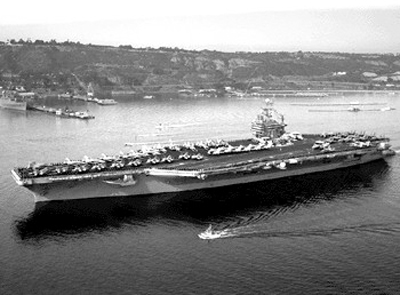
Then US President Richard Nixon According to the State Department historian, 'When the fighting developed, the Nixon administration tilted toward Pakistan. The tilt involved the dispatch of the aircraft carrier USS Enterprise to the Bay of Bengal to try to intimidate the Indian government. It also involved encouraging China to make military moves to achieve the same end, and an assurance to China that if China menaced India and the Soviet Union moved against China in support of India, the United States would protect China from the Soviet Union. China chose not to menace India, and the crisis on the subcontinent ended without a confrontation between the United States and the Soviet Union.'
The first US documents deal with the background of the conflict. Nixon's position was clear: 'We should just stay out -- like in Biafra, what the hell can we do?'
But everybody did not agree with him. In a telegram sent on March 28, 1971, the staff at the US consulate in Dhaka complained, 'Our government has failed to denounce the suppression of democracy. Our government has failed to denounce atrocities. Our government has failed to take forceful measures to protect its citizens while at the same time bending over backwards to placate the West Pak dominated government... We, as professional public servants express our dissent with current policy and fervently hope that our true and lasting interests here can be defined and our policies redirected in order to salvage our nation's position as a moral leader of the free world.'
When US Secretary of State Will Rogers received this 'miserable' cable, he informed President Nixon that the 'Dacca consulate is in open rebellion.' This did not change Nixon's opinion: 'The people who bitch about Vietnam bitch about it because we intervened in what they say is a civil war. Now some of the same bastards...want us to intervene here -- both civil wars.'
From the start, the Nixon administration knew 'the prospects were "poor"... the Pakistani army would not be able to exert effective control over East Pakistan.' Washington believed India was bound to support Mujibur Rahman. The CIA had reported that 'India would foster and support Bengali insurgency and contribute to the likelihood that an independent Bangladesh would emerge from the developing conflict.'
It is here that the Chinese saga began. In a tightly guarded secret, Nixon had started contacts with Beijing. The postman was Pakistani dictator Field Marshal Yahya Khan.
When on April 28 1971, Kissinger sent a note defining the future policy option towards Pakistan, Nixon replied in a handwritten note: 'Don't squeeze Yahya at this time.' The Pakistan president was not to be squeezed because he was in the process of arranging Kissinger's first secret meeting to China. The events of the following months and the US position should be seen in this perspective.
In May, Indira Gandhi wrote to Nixon about the 'carnage in East Bengal' and the flood of refugees burdening India. After L K Jha, then the Indian ambassador to US, had warned Kissinger that India might have to send back some of the refugees as guerillas, Nixon commented, 'By God we will cut off economic aid (to India).'
A few days later when the US president said 'the goddamn Indians' were preparing for another war, Kissinger retorted 'they are the most aggressive goddamn people around.'
During the second week of July, Kissinger went to Beijing where he was told by then Chinese prime minister Zhou Enlai: 'In our opinion, if India continues on its present course in disregard of world opinion, it will continue to go on recklessly. We, however, support the stand of Pakistan. This is known to the world. If they (the Indians) are bent on provoking such a situation, then we cannot sit idly by.' Kissinger answered that Zhou should know that the US sympathies also lay with Pakistan.
On his return, during a meeting of the National Security Council, Nixon continued his India bashing. The Indians, he noted, are 'a slippery, treacherous people.'
The State Department historian says, 'in the perspective of Washington, the crisis ratcheted up a dangerous notch on August 9 when India and the Soviet Union signed a treaty of peace, friendship and cooperation.' It was a shock for Washington as they saw a deliberate collusion between Delhi and Moscow.
During the following months, the situation deteriorated and many more refugees came to India. The Indian prime minister decided to tour Western capitals to explain the Indian stand. On November 4 and 5, she met Nixon in Washington, who told her that a new war in the subcontinent was out of the question.
The next day, Nixon and Kissinger assessed the situation. Kissinger told Nixon: 'The Indians are bastards anyway. They are plotting a war.'
To divert the pressure applied by the Mukti Bahini on the eastern front, the Pakistan air force launched an attack on six Indian airfields in Kashmir and Punjab on December 3. It was the beginning of the war.
The next day, then US ambassador to the United Nations George H W Bush -- later 41st president of the United States and father of the current American president -- introduced a resolution in the UN Security Council calling for a cease-fire and the withdrawal of armed forces by India and Pakistan. It was vetoed by the Soviet Union. The following days witnessed a great pressure on the Soviets from the Nixon-Kissinger duo to get India to withdraw, but to no avail.
The CIA reported to the President: 'She (Indira Gandhi) hopes the Chinese (will) not intervene physically in the North; however, the Soviets have warned her that the Chinese are still able to "rattle the sword" in Ladakh and Chumbi areas.'
For Kissinger it was clear that Indira Gandhi wanted the dismemberment of Pakistan.
On December 9, when the CIA director warned Nixon that 'East Pakistan was crumbling', Nixon decided to send the aircraft carrier USS Enterprise into the Bay of Bengal to threaten India.
Let me recount an anecdote related to me by Major General K K Tewari (retd), Chief Signal Officer, Eastern Command, during the 1971 War.
General Tewari was present at a briefing the three defence services held for Indira Gandhi. She was seated at a large table. On one side was General S H F J Manekshaw, the army chief, and on the other Admiral S M Nanda, the navy chief.
During the course of the presentation, the admiral intervened and said: 'Madam, the US 8th Fleet is sailing into the Bay of Bengal.' Nothing happened; the briefing continued. After sometime, the admiral repeated, 'Madam, I have to inform you that the 8th Fleet is sailing into the Bay of Bengal.' She cut him off immediately: 'Admiral, I heard you the first time, let us go on with the briefing.'
All the officers present were stunned. Ultimately, their morale was tremendously boosted by the prime minister's attitude. She had demonstrated her utter contempt for the American bluff.
On November 10, Nixon instructed Kissinger to ask the Chinese to move some troops toward the Indian frontier. 'Threaten to move forces or move them, Henry, that's what they must do now.'
This was conveyed to Huang Hua, China's envoy to the United Nations. Kissinger told Huang the US would be prepared for a military confrontation with the Soviet Union if the Soviet Union attacked China.
On December 12, the White House received an urgent message. The Chinese wanted to meet in New York. General Alexander Haig, then Kissinger's deputy, rushed to the venue, but was disappointed. Huang just wanted to convey his government's stand in the UN, no words of an attack in Sikkim or in the then North East Frontier Agency (now, the northeastern states).
The myth of the Chinese intervention is also visible in the secret Pakistani dispatches. Lieutenant General A A K Niazi, the Pakistani army commander in Dhaka, was informed: 'NEFA front has been activated by Chinese although the Indians for obvious reasons have not announced it.'
Until the last day of the war, Pakistan expected its Chinese saviour to strike, but Beijing never did.
In Washington, Nixon analysed the situation thus: 'If the Russians get away with facing down the Chinese and the Indians get away with licking the Pakistanis...we may be looking down the gun barrel.' Nixon was not sure about China. Did they really intend to start a military action against India?
Finally, on December 16, Niazi surrendered to Lieutenant General Jagjit Singh Aurora. Nixon and Kissinger congratulated themselves for achieving their fundamental goal -- the preservation of West Pakistan. They were also happy for having 'scared the pants off the Russians.'
Kissinger's South Asia policy upset many in the US, not only the American public, the press but also the State Department, and more particularly, Secretary of State Rogers who was kept in the dark most of the time.
It is worth mentioning an episode which, of course, does not appear in the American archives -- The Tibetan participation in the conflict. After the debacle of 1962, the Government of India had recruited some Tibetans youth in the eventuality of another conflict with China. The Special Frontier Force was trained in Chakrata in Uttar Pradesh [ Images ] under the command of an Indian general.
In 1971, nine years after its creation, the SFF was sent to East Pakistan to prepare for the arrival of regular Indian troops. Their saga is one of the least known parts of the Bangladesh war.
Late October 1971, an AN-12 airlifted nearly 3,000 Tibetans who later assembled at Demagiri close to the India-East Pakistan border. On the other side of the border were the Chittagong Hill Tracts. Armed with Bulgarian-made assault rifles, the SFF was given the task of organising guerrilla raids across the Chittagong Hill Tracts. Opposite the SSF, in thick jungles and leech-infested marshes, was stationed a Pakistan brigade, including a battalion of its elite Special Services Group.
The Indian army knew this brigade was a threat to one of its corps preparing to advance on Dhaka.
During the second week of November, Operation Eagle began. Leaving Demagiri in canoes, the Tibetans commandos entered East Pakistan. The SFF then started overrunning one Pakistani post after another.
By the time the war was officially declared, the Tibetans had already been inside East Pakistan for more than three weeks. Using both their Bulgarian rifles and native knives, they advanced swiftly. Their Indian commandaner, Major General S S Uban later said, 'They were unstoppable.'
On December 16, the SSF was 40 kilometers away from Chittagong port, having successfully managed to neutralise the Pakistani brigade.
After Pakistan's surrender, they paraded through Chittagong. Unfortunately, 49 Tibetans lost their lives for a nation which was not theirs.
The release of the State Department volume on the 1971 conflict is a posthumous homage to the courage of the Indian Army which despite heavy odds and the might of the United States freed Bangladesh from Pakistani clutches.
Some aspects are still missing to make the puzzle complete.
First, the Indian history from the Ministry of Defence does not detail the political compulsions of Indira Gandhi's government. Second, the secret operation involving the Tibetan Special Frontier Forces in the Chittagong Hill Tracts is virtually unknown. Lastly, the Chinese involvement from the Chinese point of view remains unexamined.

Like the Henderson Brooks' report on the 1962 border war with China, it may take a few decades more to be revealed.

Claude Arpi

Friday, December 9, 2011

Mrs Gandhi’s triumph

My article on the first Indian nuclear test appeared in today's edition of The Pioneer.


Recently declassified American documents explain how India caught the US by surprise on May 18, 1974 when it conducted its first nuclear test.

It is perhaps a coincidence, but as India celebrates the 40th anniversary of the most resounding victory of its Armed Forces, America’s National Security Archive has declassified a series of secret documents entitled “The Nixon Administration and the Indian Nuclear Programme, 1972-1974”, analysing why the US Intelligence agencies failed to predict the first Indian nuclear test in May 1974.
In India, triumph was soon followed by the worst diplomatic debacle. Mrs Indira Gandhi, who had led Indian troops to victory, lost everything on the negotiating table at Simla. The Simla Agreement, signed on July 2, 1972 by Mrs Gandhi and her Pakistani counterpart, Zulfiqar Ali Bhutto, should have provided opportunities for both countries to start over in a new direction.
That was not to be the case, though Mrs Gandhi had all the cards in her hand, in particular 93,000 Pakistani prisoners of war. Although the Simla Agreement was to put in place some basic concepts such as the normalisation of relations between the two countries, the opening of posts, telegraph, road, air or sea communications, or border crossings, it did not do so.
Mrs Gandhi probably believed that the Jammu & Kashmir issue could soon be resolved (it is said that Bhutto had agreed to a solution in a secret deal), but many in Pakistan felt that Bhutto had made too many concessions to “that woman” as Gen Yahya Khan used to call India’s Prime Minister. Soon after the Simla summit, Mrs Gandhi realised that she had been taken for a ride. This is probably the reason why on September 7, 1972, she authorised scientists of the Bhabha Atomic Research Centre to work on a nuclear device. As Bhutto’s political position gradually weakened, he could not afford anymore ‘compromises’ on Jammu & Kashmir and the possibility of fresh conflict reappeared. It was then that Mrs Gandhi decided to go ahead with the ‘peaceful’ nuclear test at Pokhran in Rajasthan.
The newly declassified papers cover the period starting just after the Bangladesh liberation war till the ‘post-mortem’ assessment in 1976. On January 14, 1972, the US State Department’s Bureau of Intelligence and Research Intelligence prepared a top secret note: “India to Go Nuclear?” The memo pointed out: “There are continuing reports that the Indians are preparing to detonate a nuclear device during the next several weeks. While the exact timing described in these reports varies, the date chosen may prove to be January 26, the day on which India celebrates the promulgation of its post-colonial Constitution and the end of dominion status.” It added, “The purpose of the planned detonation is unclear in the reports.”
The documents demonstrate that the CIA knew India had the capability to produce 20 to 30 weapons and “could easily test a device in an underground site, such as an abandoned mine”. However, Washington, DC did not show great interest in “the concerted effort by India to conceal such preparations … which may well succeed”. The first lot of documents deal with the period before the Simla summit.
For American analysts, India’s motivation to test a nuclear device would be “domestic political pressures and concerns about China and Pakistan”. The intelligence analysts believed that an eventual test would be more “a demonstration of scientific and technological prowess”; the strategic significance was negligible for the US. Hence, the scrutiny of India’s nuclear preparations did not go further due to “a relatively modest priority has been attached to relevant intelligence collection activities”.
In other words, the US did not consider it worth its effort to keep a watch on India. Greater resources and more personnel were deployed to keep a watch on China which had exploded a nuclear device at Lop Nor in Xinjiang eight years ago. US President Richard Nixon was more interested to change the dynamics of the Cold War by visiting the Forbidden City to Chairman meet Mao Tse-tung.
Britain had passed intelligence inputs to the US in April 1972 which concluded that India was not going to conduct a nuclear test. “HMG (Her Majesty’s Government) had taken new preliminary look at Indian nuclear intentions. The UK had concluded that India had the capacity of proceeding to nuclear explosion, but that it had detected no indication that GoI (Government of India) had in fact decided to do so,” the documents say.
But some thought differently. Japanese diplomat Ryohei Murata believed that India had decided to go ahead with conducting a nuclear test and detonation could take place any time. Murata also accurately predicted that the Thar desert in Rajasthan would be the test site. The Japanese believed that the ‘forces’ wanting to go nuclear within the Government of India were prevalent. The Americans described the Japanese information as “scanty”.
Around that time, Mr Henry Kissinger ordered a National Security Study Memorandum on the implications of an Indian nuclear test for the US. In August 1972, a Special National Intelligence Estimate concluded that the chances of India deciding to conduct a nuclear test were “roughly even”. The SNIE’s assessments on this issue were later criticised in a post-Pokhran report as “marred by waffled judgdments”. The conclusions should have been 60-40 in favour of a decision to test.
The SNIE had suggested that the factor “impelling India to set off a test was the belief that it would build up its international prestige and demonstrate India’s importance as an Asian power and overawe Pakistan”. In early-1973, John Pinajian, the IAEA’s representative in India, became suspicious that New Delhi was preparing for a nuclear test after Mr Raja Rammana, the BARC director, did not allow him to access the facility to conduct an experiment which had been approved by India’s Atomic Energy Commission.
The US Embassy in Delhi sent a cable to the State Department in early 1974 about “India’s Nuclear Intentions”. The conclusions were: “Deeper economic problems, among other considerations, militated against a nuclear test in the near future, even though the Indian Government had the capabilities to produce and test a device.” The Embassy, however, admitted that “we know little about relevant internal Government debate”.
India’s ‘peaceful’ nuclear explosion on May 18, 1974 caught the US by surprise. The post-explosion analysis shows that the American intelligence agencies had not been searching for signs that a test was on the cards. The day after the explosion, the US Embassy in Delhi tried to justify its failure. As Ambassador Moynihan was in London, Deputy Chief of Mission David Schneider sent a report to the State Department, “India’s Nuclear Explosion: Why Now?” The Embassy, which had no clue of the “Indian decision-making”, put the blame on domestic politics and psychological reasons. It rationalised the test by “the need to offset domestic gloom and the need for India to be taken seriously. The decision will appeal to nationalist feeling and will be widely welcomed by the Indian populace”.
We now anxiously wait for New Delhi to declassify documents for an Indian view in the matter. Whether we will see that happen in our lifetime is another matter.