Showing posts with label 1971 War. Show all posts

Wednesday, February 10, 2016

A War which was not theirs

Dapon Ratuk Ngawang
Dapon Ratuk Ngawang, one of the greatest Tibetan freedom fighters, passed away on February 7. 
On this occasion I republish an interview conducted for Rediff.com on the Tibetan participation in the 1971 Operations.
The interview dates from January 2012.  

According to a press release by Ratuk Ngawang's family:

Ratuk Ngawang was born in Kham Lithang in 1926. He was one of the founding members of the Tibetan Resistance group Chushi Gangdruk and was a close confidant of Andruk Gonpo Tashi. In 1959, he also served as one of the body guards of His Holiness the Dalai Lama on his flight from Lhasa to India. In 1963 Ratu Ngawang was called on by Gyalo Thondup , brother of His Holiness, to serve and lead in the newly formed Tibetan regiment of the Indian Army, which we know as Establishment 22 or Special Frontier Force (SFF). He also served as a commander during the Bangladesh war in 1971. He was appointed to the rank of Dapon / Political Leader. He retired from SFF in 1977. After retirement from SFF he served as chairman of Chushi Gangdruk for many years.
Ratuk Ngawang la has written a four volume autobiography / memoir in Tibetan. Over the course of his life he has given numerous interviews to journalists and writers and has appeared on many documentary films on Tibet and its struggle for freedom.
Ratuk Ngawang la is survived by his wife Dechen Wangmo, daughters Sonam Yangzom, Tseten Dolma, Tsering Deckyi and son Tenzin Gawa.


Here is my interview

Dapon Ratuk Ngawang was one of the senior leaders of the Voluntary Freedom Fighter Force in Tibet, a Tibetan guerrilla outfit which fought against Chinese rule and played a key role in the Dalai Lama’s escape to India in March 1959.
After the 1962 Sino-Indian border war, Ratuk Ngawang commanded the Tibetan secret regiment, known as the Special Frontier Forces (SSF) or Establishment 22, based near Dehra Dun in Uttar Pradesh.
Now 84 old, Ratuk Ngawag lives in the Tibetan colony of Majnu Ka Tilla in Delhi. He recently published his memoirs (in Tibetan) in which he recounts his early life in Kham province of Eastern Tibet and the escape to India as well as the Tibetan participation to the 1971 Operations.
In an exclusive interview, he speaks to Claude Arpi about the role of the SSF during the Bangladesh Liberation War.
In 1971, Ratuk Ngawang was a ‘Dapon’, often translated by ‘Brigadier’, they were also known as ‘Political Leaders’.


CA: We are celebrating the 40th Anniversary of the Bangladesh Liberation War. One of the aspects which has never been publicized is the participation of the Tibetan troops in the Operations.
The Official History of the War mentions all the victorious battles but the Tibetan regiment is not mentioned. Today we have no document proving the Tibetan soldiers' participation.
We will be interested to hear from you more about the Tibetan Forces’ involvement in the war and about the role the Tibetan soldiers played before and during the Bangladesh Operations. We are also curious to find out about the directives (if any) from the Central Tibetan Administration (the Dalai Lama’s government-in-exile) towards the Tibetan soldiers?


Ratuk Ngawang: I have covered all these issues in my Memoirs (published in Tibetan by Amnye Machen Insitute, Dharamsala). The Tibetan Regiment known as Special Frontier Forces (SFF) or Establishment 22 has never officially been under the Indian Army. It was established in 1962, after the Indo-China War. The main objective of the regiment was to fight the Chinese Army with the help of the Indian Army. At the time of the creation of the Force, we thought that the operations could be based at Lhuntse Dzong in Tibet (near the Indian border). The plan was to engage the Chinese Army in a military conflict within 5-6 months of the Force’s creation. But the Indo-China war came to an abrupt end (on November 22), and due to severe international pressure to maintain peace, no further military engagements occurred with China. Therefore, the services of Establishment 22 regiment were not used as planned.

CA: Tell us more about the Establishment 22?

Ratuk Ngawang: The Chinese took over the entire Tibet in 1959. In 1960, the Government of India established a Force known as the Indo-Tibetan Border Force. Tibetan Establishment 22 was established in November 1962. But if you want to know about the Tibetan regiment's involvement in Bangladesh War, I will tell you.

RN Kao (center)
CA: Who ordered the SFF to take part in the war?

Ratuk Ngawang: A senior Indian Army officer, Maj. Gen. Sujan Singh Uban [The SSF became known as ‘Establishment 22’ or simply ‘Two-twos’ because General Uban earlier served as Commander of the 22 Mountain Brigade]. At that time, he was the Commander of the Tibetan Force. A special Army meeting was held in New Delhi; later we heard that General S.S. Uban had volunteered to lead the Establishment 22 regiment in the Bangladesh war. It was S.S. Uban Singh and my colleague Dapon Jampa Kalden who voluntarily decided to take part in the War.
Later they told me about their plans. First, I refused to join them, because to voluntarily go to war was for me ‘illegal’. I told them that only if we got an order from the Government of India or from the Central Tibetan Administration, could we join the Operations. Moreover, I told them that the Establishment 22 had not been created to fight ‘for India’; rather it was established with the sole aim to fight the Chinese. In fact, it is the reason why we get less salary as compared to Indian soldiers (we are not part of the regular Indian Army). When the regiment was established, there was a mutual agreement that we will fight the Chinese (this did not happen).
However, I told General Uban and Dapon Jampa Kalden that if we were to get a formal order from the Indian government, then we could join the Operations.
Gyalo Thondup at Chakrata

CA: Did Gyalo Thondup, the Dalai Lama’s elder brother gave the directives to the Tibetan soldiers to join the Bangladesh War or was it someone else?

Ratuk Ngawang: The directive came from the Department of Security of the Central Tibetan Administration in Dharamsala.
The Department had called us for a meeting. They told us that there was no alternative but to go to war ‘for India’. Moreover, they told us that the Indian government was in a very critical situation at that time and our participation in the war could help saving a lot of Indian lives.

CA: Did you have any contact with Mr. R.N. Kao who was responsible for External Intelligence in the Cabinet Secretariat?


Ratuk Ngawang: Yes. Mr. Kao was a high level officer of the Indian government and Indira Gandhi's close associate. But our commander was General S.S. Uban. He had visited New Delhi and also informed the Central Tibetan Administration about his plans to lead the SFF in the Bangladesh War. After he came back to our base (in Uttar Pradesh), he sent Jampa Kalden and me to meet the officials of the Central Tibetan Administration in Dharamsala.
We told the Administration about our initial reluctance to join the war. But since the Central Tibetan Administration had already decided about sending the Establishment 22 to the war, we would go for it.

CA: Was R.N. Kao involved in the war?


Ratuk Ngawang: As I told you before, Mr Kao was a high level official of the Indian government and not a military man. So he was not directly involved in the Operations. But he instructed us and advised us to prepare ourselves and fight well. (It was important for) Establishment 22, a small unit of Tibetan soldiers.

CA: Was Mr. Kao giving orders to General Uban?


Ratuk Ngawang: General Uban was a military officer. Mr. Kao was a high ranking official of the Indian government, therefore he had greater authority.
When we captured Chittagong, Mr. Kao came to visit Establishment 22 and gave awards and speeches in praise of the Tibetan unit's heroic battles. Mr. Kao was a very patriotic person.
After the decision to participate in the Operations was taken, Dapon Dhondup Gyatotsang [who lost his life during the 1971 Operations], Dapon Pekar Thinley and myself divided the regiment into three units. We decided that each one of us would lead one unit in the war.
Due to his age and despite his military experience, Dapon Jampa Kalden couldn't take part in the war. He remained the administrative link between the Indian government and Establishment 22.
Mr. Gyalo Thondup was the chief strategist of Dehra Dun’s SFF, but he was not involved in the decision to send the Tibetan soldiers to the Bangladesh War.
When the Tibetan refugees first came to India, the Indian government had categorically urged the Tibetans not to participate in any political activities. Much before the Bangladesh War, Mr. Gyalo Thondup and Andrug Gonpo Tashi (the Founder of the Tibetan Volunteer Force in Tibet) had already resigned from their military posts.

CA: How many Mukti Bahinis were trained at Uttar Pradesh by General Uban?


Ratuk Ngawang: After Sheikh Mujibur Rahman had been imprisoned in West Pakistan, more than 1000 of his supporters escaped to India. Many of them were stationed near by the SSF camp. We trained them in military combat. They were known as the Mukti Bahinis. Some of them were related to Mujibur Rahman. They later acted as our guides and contact persons during the war though they did not actually fight with us.
Though it us who fought the real war and suffered the casualties, all the credit has later been given to the Mukti Bahinis [because the Tibetan Force was involved under the guise of the Mukti Bahinis].

CA: Were the 1000 Mukti Bahinis also under the command of General Uban?

Ratuk Ngawang: Yes. That's right. General Uban provided the training to the Mukti Bahinis.

CA:  When did you and the other two Dapons (Tibetan Commanders) reach Bangladesh?

Ratuk Ngawang: It was in November 1971. I was 39 years old at that time.

CA: Did you go to Bangladesh before the beginning of the War or during the War?


Ratuk Ngawang: We went before the Bangladesh war started. Though we were meant to fight the Chinese in a guerrilla warfare, during the Bangladesh war, our main enemy was the Mizo insurgents. Just as the Tibetans were trained by the Indian army, the Mizo soldiers were trained by Pakistan.

CA: When and how did you go?

Ratuk Ngawang: We went from the base of Establishment 22 in Uttar Pradesh to Dum Dum airport (Kolkata) by plane. From Dum Dum we went to Demagiri in Mizoram by motor vehicles. It took us 3 days. After reaching the Bangladesh border (the Chittagong Hill Tracks), we had a meeting and went straight into the battle. We left for the war on November 12 and fought for 28 days after which we came out victorious. Many soldiers from the Pakistani side were killed and many surrendered.

CA: What was General Uban's military objective in the war?

Ratuk Ngawang: We were thoroughly trained in commando warfare to fight the Chinese; we were requested to use these skills to fight in the Bangladesh War. The Indian authorities had assured us that the Indian Army will fight with the Tibetans for the cause of Tibet. Their reasoning was that the Tibetan soldiers alone could not defeat the Chinese Army. That's why we decided to join the Bangladesh War. It was in the hope that the Indian Army will help us militarily one day to fight the Chinese.

CA: Before going to the war, did General Uban gave you any instructions to capture specific places or specific Pakistani military bases?

Ratuk Ngawang: We had a map of the area (Chittagong Hills). Each of the three units (battalions) with a little more than 1000 soldiers each included the Tibetan soldiers and some Mukti Bahinis partisans.
Since General Uban was the Commander of the Tibetan Special Frontier Forces, he gave us instructions in Hindi (we had Tibetan translators). He told us where to go and later through walkie-talkies we could inform him where we had reached and he would then tell us what we had to do.
The three Tibetan battalions had three Tibetan Dapons and three Indian Colonels. The three Dapons and the three Colonels always discussed the strategies, but the decisions we were taken by General Uban after we had informed him.

CA: Other than Demagiri, in which other places did the Tibetan soldiers fight?

Ratuk Ngawang: Demagiri was the main military base. About 100 Tibetan soldiers and 100 Mukti Bahinis were posted to guard the base. Apart from senior military officials stationed at Demagiri, the base also had a hospital, where those who got injured in the battle could be treated. Most of the doctors were majors and captains of the (Indian Armed Medical Corps). The preparation for this had been done much before the beginning of the war.
The severely injured soldiers were taken by helicopters to other hospitals but since the war was going on in the jungle of the Chittagong Hills, it was difficult for the helicopters to land; that's why many of the injured had to be sent by boats through the river.

CA: When the Indian Army came to Demagiri at the beginning of the actual war, were the Indian soldiers able to help the Tibetan soldiers?


Ratuk Ngawang: No. The Indian soldiers were not able to help us. Similarly, the Tibetan soldiers were also not able to help the Indian soldiers since both have been trained in different types of military warfare. The Tibetan commandos were trained in guerrilla warfare whereas the Indian soldiers were trained in urban warfare.
CA: Were your military objectives been fulfilled?

Ratuk Ngawang: Within 10 days, we captured almost all the enemy bases except for two. Most of the enemy bases had only 50 soldiers or so and when we attacked them, they were hugely outnumbered and surrendered within an hour of fighting.
On December 16, when news of the Indian army's conquest of Dhaka became known, most of the remaining smaller units surrendered.

CA: After the victory of the Bangladesh war, did you go to Chittagong for the official victory parade?

Ratuk Ngawang: General Uban did organize a trip for us to go to Chittagong for the official victory ceremony. But we couldn't go as the Tibetan soldiers had been scattered in many different places. Therefore, General Uban and Mr RN Kao went to Chittagong to attend the official ceremony and discuss the perks and rewards for the Tibetan soldier's contribution in the war. Meanwhile, we stayed back and celebrated the victory at our bases.
It is said that Maj Gen S. S. Uban’s plan was to use the Tibetan Force to capture Chittagong, but the SFF did not have the artillery and the airlift support to conduct such a type of mission.
However, they conducted smaller missions in the Chittagong Hill Tracks including the operation at the Kalurghat radio station, attacks on bridges and on the Kaptai Dam on the Karnaphuli River, 65 km upstream from Chittagong in the Rangamati District.
They managed to stop the Pakistani 97 Independent Brigade and the 2nd Commando Battalion for retreating into Burma by cutting off their rear defenses.
Establishment 22 lost 56 men and 190 were wounded in the 1971 Operations. The Indian government gave cash awards to 580 soldiers for their valourous conduct, but no bravery awards as the Tibetan soldiers were only ‘The Phantoms of Chittagong’, fighting a War which was not theirs under the guise of the Mukti Bahinis,.
I am indebted to Jamphel Shunu and Tenzin Lekshay for the translation (Claude Arpi)

Thursday, December 22, 2011

Have you heard about this Indian Hero?

Receiving his MVC from the President of India
My article on Colonel Chewang Rinchen is posted on Rediff.com.

Major Chewang Rinchen became the youngest recipient of the Maha Vir Chakra (MVC). He not only seized the highest post ever captured, but also liberated an area of 800 sq km from Pak occupied Kashmir, the largest area captured in the 1971 war with hardly any supplies and no artillery support.
Claude Arpi salutes this brave Indian soldier.


Have you heard of Colonel Chewang Rinchen?

In 1948, at the age of 17, Rinchen enrolled in the Indian Army; the same year, he won his first Maha Vir Chakra, becoming the youngest recipient of the prestigious decoration.
Born in 1931, Chewang could have spent his entire life in the remote village of Sumur, at the confluence of the Shyok and Nubra rivers. But the visit of the Kalon (minister) of Ladakh changed the course of his life.
The official spotted the spark in the 13-year boy and after gaining the approval of his parents, decided to take him to the Leh to educate him.
Four years later, in one of the most daring operations of the 1947-1948 War, Captain Prithi Chand and a few of his Lahauli companions saved Leh by reaching the Ladakhi capital before the Pakistani raiders: They had done the impossible, cross the Zojila pass in winter.
The captain soon became the mentor of the young Rinchen, who underwent a short military training under him. Rinchen then recruited 28 of his friends from the Nubra Valley and created the Nubra Volunteer Force. They were to play a crucial role in 1947-1948 War.
In April 1969, Major Chewang Rinchen was finally given a regular commission in the Indian Army and was posted with the 14 J&K Rifles. His battalion was soon transferred to Firozpur in Punjab.
But when the heat of the summer became too unbearable for the young Nunnu (name given to the natives of the Nubra Valley), he applied for a transfer back to the Ladakh Scouts. This was granted.
In August 1971, as the clouds were gathering over the Indo-Pakistan border, Rinchen joined his old regiment; he was sent again to his beloved Nubra Valley.

A month later, Rinchen started reorganising the Nubra Guards, giving them a special training in firing small arms. He enrolled 550 young local volunteers and organised them into four companies (called by the names of the nearby ranges Karakoram, Saser, Remo and Saltoro). Their training lasted two weeks from November 1 to 15.
Major General S P Malhotra, the General Officer Commanding of 3 Infantry Division responsible for the defence of Ladakh, then asked Rinchen and Colonel Udai Singh, his commanding officer, if they could look after the Nubra/Shyok sector of the border.
Rinchen confidently told his GOC that the Ladakhi Scouts and the Nubra Guards did not need any additional forces; they would do it.
Situated 140 km north of Leh, the Nubra Valley was linked to the capital of Ladakh via the Khardung La, the highest motorable pass of the planet at 5,602 metres.
The army base for the sector was located at Partapur in the Valley and since 1960 an airfield had been opened at Thoise (still today the base camp for the operations on the Siachen Glacier)

Click here to continue...

Sunday, December 11, 2011

Forty year ago: the People's War

Forty years ago, the Indian Army, Air Force and Navy liberated Bangladesh.
But the Liberation War was not just a military operation, it was truly a People's War.
Number of artists, intellectuals, politicians and others participated in their own way in the liberation of East Pakistan from the joke of the Pakistani tyrants.

George Harrison organized the famous Concert for Bangladesh with the help of Ravi Shankar, Bob Dylan and Joan Baez.
This great fund raising event was held on August 1, 1971 in Madison Square Garden, New York.
Some 40,000 fans attended the Concert and $250,000 was collected and later presented to UNICEF for the war-affected children of Bangladesh.
An album was later produced with the artists who participated in the concert (Bob Dylan, George Harrison, Ravi Shankar, Ustad Allarakha, Ringo Star, Eric Clapton,Don Preston, Leon Russell, etc.).
Let us not forget that at the same time, the Nixon Administration, as allies of Pakistan, was dead against a Bangladesh’s liberation war (tomorrow, I will post on this blog a note on the role of the Nixon administration).

Now, listen to George Harrison


My friend came to me, with sadness in his eyes
He told me that he wanted help
Before his country dies
Although I couldn’t feel the pain, I knew I had to try
Now I’m asking all of you
To help us save some lives
Bangla Desh, Bangla Desh
Where so many people are dying fast
And it sure looks like a mess
I’ve never seen such distress
Now won’t you lend your hand and understand
Relieve the people of Bangla Desh.Bangla Desh, Bangla Desh
Now it may seem so far from where we all are
It’s something we can’t neglect
It’s something I can’t neglect
Now won’t you give some bread to get the starving fed
We’ve got to relieve Bangla Desh
Relieve the people of Bangla Desh

And to Joan Baez (she did not participate to the Madison Square Concert)


Bangladesh, Bangladesh
When the sun sinks in the west
Die a million people of Bangladesh, Bangladesh
Bangladesh, Bangladesh
When the sun sinks in the west
Die a million people of the Bangladesh

And the students at the university
Asleep at night quite peacefully
The soldiers came and shot them in their beds
And terror took the dorm awakening shrieks of dread
And silent frozen forms and pillows drenched in red..

The story of Bangladesh
Is an ancient one again made fresh
By blind men who carry out commands
Which flow out of the laws upon which nation stands
Which is to sacrifice a people for a land … f the Bangladesh

And the students at the university
Asleep at night quite peacefully
The soldiers came and shot them in their beds
And terror took the dorm awakening shrieks of dread
And silent frozen forms and pillows drenched in red..

The story of Bangladesh
Is an ancient one again made fresh
By blind men who carry out commands
Which flow out of the laws upon which nation stands
Which is to sacrifice a people for a land …

Allen Ginsberg wrote his famous poem September on Jessore Road.


Millions of souls nineteen-seventy-one
homeless on Jessore road under grey sun
A million are dead, the million who can
Walk toward Calcutta from East Pakistan

Where are our tears? Who weeps for the pain?
Where can these families go in the rain?
Jessore Road’s children close their big eyes
Where will we sleep when Our Father dies?

Ring o ye tongues of the world for their woe
Ring out ye voices for Love we don’t know
Ring out ye bells of electrical pain
Ring in the conscious of America brain

How many millions of children die more
before our Good Mothers perceive the Great Lord?
How many good fathers pay tax to rebuild
Armed forces that boast the children they’ve killed?

Millions of babies in pain
Millions of mothers in rain
Millions of brothers in woe
Millions of children nowhere to go


Early 1971, André Malraux, General de Gaulle companion, declared that he was ready to go and fight on the side of Mujibur Rehman's people.
It was the last battle of the author of L'Espoir (Hope).
His participation on the battle field did not materialize, but Malraux visited Dacca in April 1973.
On his arrival he declared: “I kiss poverty on a single face. Since I cannot kiss everybody, I kiss Bangladesh on a single face.”
Addressing the students of Dacca University, Malraux forcefully asserted: “Students of Dacca, I am speaking today, for the first time, in the only university in the world, which has more dead than living students ...All your dead ones had a rendezvous with destiny, but now, it is for you to build the nation.”
He later wrote:
Salutations to you, O dead ones of the forests that surround us!
You have shown the world that an enemy can never assassinate enough to kill the soul of a people which does not surrender!
One biographer wrote: "André Malraux's fight for Bangladesh was an example and symbol, a symbol of his compassion, his love of India, his concern for the human soul."

Thursday, December 8, 2011

'I cut my leg off and ordered: 'Go and bury it'

Here is the second part of my interview with Major General Ian Cardozo who was a young major in the 5 Gorkha Rifles in the 1971 war with Pakistan.
In a swift military offensive, India defeated Pakistan within 13 days, liberated a region and led to the creation of Bangladesh.
In the war, the then Major Cardozo stepped on a landmine and had to cut off his badly wounded leg with his own khukri.
Yet, through sheer will power and determination, he did not let his disability come in the way of his duty as a soldier and went on to become the first disabled officer in the Indian Army to command an infantry battalion and a brigade.

Click here to read.

Forty Years After: General Cardozo's incredible story


My interview of Maj Gen Ian Cardozo is posted in Rediff.com under the title 1971, A War Hero Remembers.
In the second part of the interview, General Cardozo will tell us how after he walked on a mine, he amputated himself with his khukri.

On December 3, 1971, Pakistan attacked several Indian Air Force stations in the West. At midnight, Indian Prime Minister Indira Gandhi in a broadcast to the nation declared that India was at war with Pakistan. Inset: Major General Ian Cardozo
War Hero Major General Ian Cardozo (retd)was wounded in the battle of Sylhet in Bangladesh in the 1971 war with Pakistan.
He lost his leg in a landmine blast, but conquered his disability and became the first disabled officer in the Indian Army to command an infantry battalion and then a brigade.
Awarded a Sena Medal for gallantry, General Cardozo is presently Chairman of the Rehabilitation Council of India and has authored The Sinking of INS Khukri -- Survivors Stories and Param Vir -- Our Heroes In Battle.
In conversation with Claude Arpi, the general looks back at the war where more than 93,000 Pakistani prisoners were taken, a region was liberated and a new nation born.
 
A young major 40 years ago, he recounts the heroic battles fought by the Fifth Gorkha Rifles in the Eastern theatre, where he and a brave band of men played a pivotal role in the defeat of Pakistan.


We are celebrating 40 years of the most resounding victory of the Indian armed forces, tell us about your involvement in the 1971 Operations and the role of your battalion, the Fifth Gorkha Rifles.
I was in the Staff College doing a course. My battalion was already on the front. The second-in-command (known as '2IC') of the battalion had been killed; the army had to replace him.
They looked around and found this guy (then Major Cardozo) in the Staff College. My posting was cancelled and I was sent to the front.
I was permitted to drop my family back home (my wife and three sons). I returned to Delhi by train on December 3.
The war had already started, but we did not know, though we heard aircraft flying above us. In Delhi there was a blackout. Next morning, I went to Palam airport to catch the plane to Assam, but it was cancelled: it would have been a lovely target.
I jumped into a taxi, rushed to the railway station. The train was moving out of the platform, I managed to pull the chain and board it. The next night we reached a place called Dharmanagar. We have a wonderful system in the army of contractors. Over 150 years the same family of banias have served particular units in the army. One of them was there to meet me.
He said: 'Sahib, the hospital train is coming. Wounded officers from our unit are on that train, you should meet them.' I met four young badly wounded officers and then jumped into a jeep and drove night and day to reach my battalion.


Click here to read the entire interview.

Tuesday, December 6, 2011

1971 and the Indian Nuclear Test

Site of India's first atomic reactor in Trombay
This series of documents on the 1974 Nuclear Test in Rajasthan published by the National Security Archive comes at the time when India is celebrating the 40th anniversary of the Bangladesh Liberation War.
As briefly mentioned in the introduction to the documents, the two events are deeply linked.
It is after Indira Gandhi realized that she was made a fool by the clever Bhutto at Simla that she decided to go for a test.
Let us hope that the Indian archives will one day be declassified so that the decision process for testing a nuclear device can be better understood.

The Nixon Administration and the Indian Nuclear Program, 1972-1974
U.S. Post-Mortem on 1974 Indian Test Criticized Intelligence Community Performance for "Waffling Judgments" and Not Following Up Leads

National Security Archive Electronic Briefing Book No. 367
December 5, 2011

India's "peaceful nuclear explosion" on 18 May 1974 caught the United States by surprise in part because the intelligence community had not been looking for signs that a test was in the works. According to a recently declassified Intelligence Community Staff post-mortem posted today by the National Security Archive and the Nuclear Proliferation International History Project, Nixon administration policymakers had given a relatively low priority to the Indian program and there was "no sense of urgency" to determine whether New Delhi was preparing to test a nuclear device. Intelligence "production" (analysis and reporting) on the topic "fell off" during the 20 months before the test, the analysis concluded.
In early 1972, however—two years before the test—the State Department's Bureau of Intelligence and Research (INR) had predicted that India could make preparations for an underground test without detection by U.S. intelligence. Published for the first time today, the INR report warned that the U.S. government had given a "relatively modest priority to … relevant intelligence collection activities" which meant that a "concerted effort by India to conceal such preparations … may well succeed."
The post-mortem, the INR report and other new materials illustrate how intelligence priorities generally reflect the interests and priorities of top policymakers. The Nixon White House was focused on the Vietnam War and grand strategy toward Beijing and Moscow; intelligence on nuclear proliferation was a low priority. Compare, for example, the India case with that of Iraq during 2002-2003, when White House concerns encouraged—some say even compelled—intelligence producers to cherry pick raw information to demonstrate the development of WMD by the Saddam Hussein regime.
INR prepared its India report at a time when secret sources were telling U.S. intelligence that New Delhi was about to test a nuclear device. The "small spate" of reports about a test had such "congruity, apparent reliability, and seeming credibility" that they prompted a review of India's nuclear intentions by INR and other government offices. In the end, government officials could not decide whether India had made a decision to test although a subsequent lead suggested otherwise.
According to the intelligence community's post-mortem, obtained through a mandatory review appeal to the Interagency Security Classification Appeals Panel (ISCAP), one of the problems was that intelligence producers were not communicating with each other, so the "other guy" assumed that someone else was "primarily responsible for producing hard evidence of Indian intentions." The analysis was especially critical of an August 1972 Special National Intelligence Estimate for its "waffling judgments" on Indian nuclear intentions.
Other declassified documents reproduced here from 1972 through 1974 illustrate the range of thinking on this sensitive topic:

  • An INR report in February 1972 concluded that it could not "rule out a test" in the near future and it was "entirely possible that one or more nuclear devices have actually been fabricated and assembled."  All the same, "it our judgment that a decision to authorize a test is unlikely in the next few months and may well be deferred for several years."
  • During March and April 1972, Canadian and British intelligence concluded that they had no evidence that India had made a decision to test a nuclear device. Nevertheless, the Canadians believed that New Delhi could produce a device in less than a year.
  • In June 1972, Japanese diplomat Ryohei Murata argued that the "Indians have decided to go ahead with a nuclear test" and that the Thar Desert in Rajasthan would be the test site. While basically correct, Murata's estimate was discounted because it did not represent an official Foreign Ministry view.
  • Special National Intelligence Estimate (SNIE) 31-72 published in August 1972 also held that the Indians could produce a device "within a few days to a year of a decision to do so," but concluded that the chances that India had made a decision to test were "roughly even."
  • In 1973, the Atomic Energy Commission's scientific representative in India  told the U.S. consul in Bombay (Mumbai) that several "indications" suggested that India "may well have decided" to test a nuclear device.
  • Five months before the test, the U.S. Embassy in New Delhi reported that the probability of an "early test" was at a "lower level than previous years."

The rumors that India was going to test emerged in the wake of the South Asian crisis, when the Nixon White House tilted toward Pakistan, India's archrival. Relations between New Delhi and Washington were already cool during the Nixon administration which treated India as a relatively low priority.  Henry Kissinger's secret trip to China underlined India's low priority by suggesting that if New Delhi ever faced a crisis with Beijing it could not count on Washington for help.  Relations became truly frosty during the balance of 1971 when New Delhi signed a friendship treaty with Moscow and India and Pakistan went to war. Later Nixon and Kissinger wanted to improve the relationship, but India's nuclear intentions were not on their agenda. That India had refused to sign the Nuclear Nonproliferation Treaty was a non-issue for Nixon and Kissinger, who had little use for the NPT and treated nuclear proliferation as less than secondary. While the State Department cautioned India against nuclear tests in late 1970, concern did not rise to the top of policy hill.
Whatever impact the events of 1971 may have had on India's decision to test a nuclear device that decision was soon to be made. According to George Perkovich, an authority on the Indian nuclear program at the Carnegie Endowment for International Peace, "it may be conjectured that support in principle for developing a nuclear explosive device was solidified by late 1971, that concentrated work on building the vital components began in spring 1972, and that formal prime ministerial approval to make final preparations for a PNE occurred in September 1972." In this context, the reports collected by U.S. intelligence in late 1971 and early 1972 about a possible test may have been good examples of the old chestnut that "where there's smoke, there's fire."
Yet, the analysts who wrote SNIE 31-72 decided that the smoke had no significance because they saw only a 50-50 chance that New Delhi had made a decision to test (even though New Delhi was closing in on a decision).

To read the documents, visit  National Security Archive's website.

Saturday, December 3, 2011

Forty Years after: Reflections on the Bangladesh War

Field Marshal Sam Manekshaw talking to the troops

Swift and Secure
 

Reflections on the Bangladesh war by the Chief Signal Officer (Eastern Command)

The advent of the telegraph has been a major evolutionary step in communication which greatly changes the perspectives and possibilities of the Defence Forces.
A hundred years ago, on 15 February 1911, the Corps of Signals was formed as a separate arm. Since then, the world of communication has tremendously changed.
Keeping in mind its motto — Teevra Chaukas (Swift and Secure), the Corps of Signals has followed this evolution,
As we are celebrating the 40th Anniversary of the War for the Liberation of Bangladesh, the only War India took victorious to its end, we are presenting some excerpts of the memoirs of Maj. Gen. K.K. Tewari (‘A Soldier’s Voyage of Self Discovery’), who was the Chief Signals Officer on the Eastern front in 1971. The author’s reflections on the set-up in the Eastern theater before the 1971 War, are unfortunately still valid today.


When one does not have adequate resources for various tasks, one is forced to make various contingency plans. What is amazing, on reflection now, is how one was able to push through some of these plans against all odds and resistance at the time.
The resistance was at times even in the form of accusations that one was being unrealistic and too ambitious in hoping that the plans would work out. We were preparing for operations which could start any day at short notice; yet, one could not put things/resources on the ground where they would actually be required in war, for security reasons. All planning was still shrouded in the utmost secrecy and preparations had to be made in a clandestine way or as part of an overall deception plan. While the date of operations was not known, planning had perforce to cater for sudden short-term contingencies, even though one could go on with preparations for long-term contingencies.
On my staff in the CSO's [Chief Signal officer] branch, among others I had a very bright and capable Staff Officer Grade 2, who was a great support and strength to me, Major AJS Gill. One of my regrets in the service at that stage had been the failure of all my efforts to get his worth recognized through a suitable award.
Just one example for the planning and development of telecommunications would be worth quoting. For the launching of operations from Tripura as the nearest route to Dacca, we had first to establish a static civil multi-channel telecommunication station in Tripura to link it to the national network on Microwave, which terminated at Shillong. Long arguments ensued on this crucial issue because of numerous technical and other objections.
But we insisted that this had to be done and the P&T Department [later Department of Telecommunications] was persuaded to establish a VHF station at Teliamura in Tripura to give us multi-channel links from Calcutta via Shillong. After this proposal was approved, a bright P&T officer who had just returned from a course in the United States and who had been put in charge, stated categorically that this was not technically feasible.
There were three main objections raised by this officer which are worth listing. This has relevance to the question of executing projects in peace time without the overall emergency powers available during active war. One was, that this hook-up would not provide the reliable long-distance communications needed in spite of heavy expenditure. To counter this objection, we demonstrated its viability practically by using field type of portable army VHF radio relay equipment, proving that communications could be established satisfactorily from the height of Shillong, the long range notwithstanding.
The second objection was the non-availability of the required spare equipment in the country. We were told that orders for the new equipment from abroad would take many months to materialise. We could not wait. Therefore, we got a set of this equipment lifted from Nagaland area, which was under Eastern Command army control for counter-insurgency operations. We replaced that with our own army field type of radio relay equipment.
The third was the most serious objection from the security point of view. This link would be operating right across East Pakistan territory (Sylhet area) and would, therefore, be liable to interception by Pakistan. It was said that this might jeopardise operations due to premature leaks. This could not be answered easily. Our main argument was that it was better to have communications which could be 'protected' by other means such as codes and ciphers, rather than no communications at all which would result in operations not taking off properly.
This was not the end of the story. After all the clearances had been obtained, the same P&T officer insisted that a proper building be provided for the installation of their equipment. This was also done by a crash programme through the courtesy of Army Engineers. But when it was all ready, our U.S. trained friend came to 'inspect' the building. He summarily disapproved of it, saying that the roof of the building was not high enough for the racks to be fitted.
One can visualise the patience one needed at that time with so many other things happening at once. To cut a long story short, the Engineers were persuaded to raise the roof by two feet. Our troubles did not end there. We had to have the equipment moved from where it was, together with a 200-line switchboard. While all this was being moved in a ferry across a river, the boat capsized resulting in the switchboard getting 'drowned' and lost. But fortunately the other equipment was saved.
The entire incident has been described at length because it is just one example of the type of problems we faced in Eastern Command even when decisions had been painstakingly arrived at.
The point is that whatever the difficulties were and however daunting they appeared at each stage, ultimately they got resolved and I do believe it was due to another 'force' which had come into play.
Immediately after the surrender of the Pakistani Army in Bangladesh in December 1971, a Military Study Team under a senior army officer (Lt Gen Eric Vaz, later an Army Commander) was appointed to study and record various aspects of the just concluded operations, for lessons.
On the telecommunications aspects, I was asked to give one example each of the most important/momentous ‘Decisions, Achievements and Mistakes’ in my sphere of responsibilities.
My reply went as follows: Decision: the establishment of the VHF station by the P&T Department in Tripura before the launching of operations; Achievement: the judicious distribution of available meagre communication resources (men and material) in spite of a great deal of opposition from different sources including some of the formation commanders; Mistake: not to have thumped the table hard enough for more resources which were deserved by us.
Of the last, a live example can be quoted.
A source of equipment which we tapped successfully was the Ordnance Depot at Agra. As the Staff Officer Grade I (Signals) at Lucknow between the years 1957 and 1959, I had occasion to visit this Depot. It was found that a lot of World War II vintage signal equipment was lying unrecognised and unmarked in the huge sheds at this Depot. These sheds were given the name of 'LAN', standing for Local Agra Number, as they were not in the inventory of current equipment. In the middle of 1971, we had obtained permission from the Army HQ at Delhi to organise a team of technical personnel to go to the Central Ordnance Depot at Agra and recognise and pick out such equipment as could be of use to us, even though obsolete. This was done and some of this equipment proved to be of immense help during operations.
…Mention has also been made earlier about my conscientious approach to the work. In the past, during war situations or other times, and it happened on numerous occasions that difficulties would arise, I would adopt an attitude of 'fatalism'. But this time, I had a strange but powerful experience of peace in the midst of extreme uncertainty, confusion and tension and many a time amidst frayed tempers and frustration. A marked determination and self-confidence had developed in me. It is difficult to describe it in words but it can be said that it was unlike my normal self. There was a feeling and a conviction that whatever was being done was all right and that my efforts and plans would not be wasted nor fail.
The pace of work was fast and whatever resistance there was at various levels to anything we wanted to do would crumble, and smooth solutions follow all the initial turbulence. For months, the schedule was more than 15 to 16 hours of work a day with no holidays and frequent disturbances even during the rest periods. This did not consist of just sitting at an office table in air-conditioned comfort, but of travelling almost constantly to see results after instructions had been issued and making modifications on the spot where necessary.
I have always practiced a maxim learned early on in the service, namely, giving of orders is five per cent, seeing that the orders are carried out is the other ninety-five per cent. An unaccountable energy helped me to keep this frantic pace day after day without a break.
After the Bangladesh war was over, the Army Commander, Lt Gen Aurora, while talking informally at the Corps of Signals birthday dinner party at which he was the Chief Guest on 15 February 1972, remarked as follows: "What has been achieved by Signals is really a miracle. But I do not believe miracles happen. It is the hard work and devotion to duty of all ranks. Resources were extremely meagre yet excellent results were produced…"

Monday, January 3, 2011

The Phantoms of Chittagong


A few years ago, I wrote an article for Rediff.com on The Phantoms of Chittagong.
Very little is still known of the Tibetan participation during the 1971 operations. One of the Tibetan leaders, Ratu Ngawang has written his Memoirs, unfortunately it is in Tibetan language.
According to Lt. Gen. JFR Jacob, who was posted as Chief of Staff, Eastern Command during the War and was therefore responsible for the military operations, the Tibetan contribution to the over-all victory was minimal.
The fact remains that the Tibetans participated to a War which was not theirs and many of them lost their lives.

Phantom Warriors of 1971
Unsung Tibetan Guerrillas
By Manas Paul
First published in TripuraInfo.in
13 Dec, 2010
Forty years ago in 1971 on a cool and scary November 14 night in Chittagong a Pakistani sniper of Special Service Group perched silently on his hidden location near his camp felt he saw a ‘phantom’. The days were then uncertain and nights were too risky. So, the Pakistani soldier did not take any chance and opened fire. And the shadowy creatures just melted away in the darkness. One among them was, however, dying. He was shot at fatally. The Pakistani soldier did not know that he had just killed one of the toughest and CIA trained Tibetan guerrilla leaders — Dhondup Gyatotsang. As Gyatotsang — a Dapon or Brigadier in Tibetan language — died his comrades, all armed simply with a Bulgarian AK 47 and their Tibetan knives, made radio contact with a turbaned Sikh some kilometres away and across the border. The Sikh barked at them the order: carry on with the task you are assigned to. As the order came the Tibetan guerrillas once again spread in the darkness and coiled up behind the Pakistani barracks and posts. They remained as shadows as long as they wanted and when the right time came they just struck with lightning speed raiding the Pak positions. One after another Pakistani posts fell as the Tibetans, who by this gained the title ‘Phantoms of Chittagong’, swept the hills and valleys of the hilly district of East Pakistan and restrained the Pakistani military movement to only small pockets. Weeks before the real war actually broke out on December 3rd, the Tibetan guerrillas turned Chittagong into a virtually a free zone with pre-emptive strikes for Indian army movement. On December 16, 1971 when the Pakistani army surrendered, the Tibetan commandos were only 40 km from the Chittagong Port. By this time they had successfully accomplished the task that their chief, General Sujan Singh Uban had assigned to them: The Operation Mountain Eagle. They had, however, lost 49 of their comrades and had 190 injured.   
‘Operation Mountain Eagle’ launched in East Pakistan during 1971 Indo-Pak War was, perhaps, till date the most closely guarded and top most secret operation of Indian authorities in the eastern flank of the war areas. Officially the operation could not be recognized as the Tibetan guerrilla force — known as Special Frontier Force (SFF) or Establishment 22 or simply called ‘two-two’ — does not officially exists. The name it got from the fact that their first commander (at the rank of Inspector General) Maj. Gen. Sujan Singh Uban had once commanded 22 Mountain brigade. Since their inception in November 1962, the Establishment 22’s direct engagement in Indo-Pak war is also significant for the mere fact that it was not their ‘war’ at all. They were fighting for the cause of their host country and for liberation of another country — not for Tibet. Their sacrifice was never officially or publicly recognized — neither by India nor by Bangladesh till today.
The Dalai Lama visited Chakrata in 1972


Formation of top secret force, Two-Two
At the end of the 1962 Indo-China war the then Intelligence Bureau chief Bhola Nath Mullick took the initiative to form a special guerrilla force from the Tibetan youths who had been sheltered in India. Some documents indicate that former Chief Minister of Orissa Biju Patnaik had first come up with the idea while he was closely working with the CIA at the behest of Indian authorities in setting up of air surveillance ARC in Charbatia in his home state. Patnaik, a daredevil pilot with experience in several covert operations, according to Kenneth Conboy who authored an authoritative book on CIA operations relating to Tibet, wanted to raise a resistance force of Tibetans in Assam. However, the IB continued with the plan which ultimately materialized with the help of Chushi Gandruk, the main organization of the Khampa resistance and the CIA.
Following the green signal from the Cabinet secretariat the Special Frontier Force or Establishment 22 or was formed on November 14, 1962.
According to the plan the force would formed with Khampa fighters from Chushi Gandruk — and most of them would be brought from CIA run Mustang base in Nepal that housed as many as 2032 members. The force would be handled and trained by the IB at their Chakrata base near Dehra Dun. The CIA would provide all other supports for their training and related matters.
The CIA had first trained the Khampa fighters at Saipan in March 1957 and then Camp Hale in Colorado for guerrilla warfare so that they could be dropped inside Tibet for sabotage against the Chinese. The operation under the code name of ‘ST Circus’ was first headed by a US marine, Roger McCarthy. They trained in several batches about 259 Tibetan guerrillas. The CIA had also dropped some of them inside Tibet for sabotage and intelligence gathering.
“A formation agreement was signed in 1962. The parties to this formation agreement were the Indian Intelligence Service, the CIA and Chushi Gangdruk. General Gonpo Tashi Andrutsang and Jago Namgyal Dorjee, signed this three-party joint formation agreement on behalf of Chushi Gangdruk. Our organization took main responsibility for recruiting, and an initial strength of 12,000 men, mostly Khampas, were recruited at Chakrata, Dehra Dun, UP. Chushi Gangdruk sent two of the commanders to this new outfit to be political leaders in the initial stage”, said Dokham Chushi Gangdruk, the Tibetan organization fighting for the Tibetan cause.
Gyalo Thondup, elder brother of the Dalai Lama met the Khampas in Mustang. Conboy said, ‘Gyalo also sought four political leaders who could act as the force’s indigenous officer cadre….an initial contingent of Tibetans, led by Jamba Kalden, was dispatched to the hill town of Dehra Dun’.
Soon, the CIA, sent eight of its advisers on a six-month temporary duty assignment. The team was led by a veteran CIA operative in several covert and deadly campaigns Wayne Sanford who was recipient of two Purple Hearts. “He was acting undercover from US Embassy as special assistant to Ambassador John Kenneth Galbraith”, wrote Conboy.

The USA provided all the weaponry to them mostly M-1, M-2 and M-3 automatic rifles. As the covert guerrilla force was raised, Major General Sujan Singh Uban was assigned the task to command them as their Inspector General. The SFF ultimately came to be known as ‘Establishment 22′ or simply ‘Two-two’. Interestingly, the guerrilla forces cap insignia was designed as if it was ‘12th Gorkha’ regiment-crossed khukri with ‘12′ on top. This was a deception tactics as at that time there were only 11 Gorkha regiments, seven regiments were with Indian army and four with the British after independence. It was so decided to confuse common people, in case of meeting the guerrillas, with Gorkhas as the facial features were same.
For next several years both Indian army, MARCOS, IB and CIA trained the guerrillas with special focus on para-trooping and sabotage as well as intelligence collection it was kept in mind that in case of another war with China they would be pressed into service. Some of the Camp Hale trained Tibetans were also included in the Establishment 22 and they held senior positions. They ultimately became one of best ever guerrilla forces in the world, efficient in land, air and water campaigns. While the ‘Establishment 22′ was commanded by Maj. Gen. Uban, the guerrillas had their own political representatives and Dapon — a position equivalent to ‘Brigadier’ — mostly held by first generation Camp Hale trained guerrillas.
The Dalai Lama was aware of the formation of the guerrilla force since the beginning but he and his Dharamshala officials always maintained a distance from them neither supporting nor opposing the Indian initiative. According to some, Jawaharlal Nehru once visited the guerrillas in Chakrata and was impressed by their training and discipline. The Dalai lama also visited them once but it was much later.
Until late 1960 the CIA officials had kept relations with the Establishment 22 on numerous levels, but since 1968 their connections with the Tibetan guerrillas both in Mustang and Chakrata started thinning. CIA link with Chakrata completely died out in 1970s. The USA under Richard Nixon tilted towards Pakistan and also developed secret negotiations with China as Indo-Pakistan war seemed imminent.

Operation Mountain Eagle
Dapon Dhondup Gyatotsang (left) and Dapon Ratu Ngawang (right). 

Since the RAW headed by R. N. Kau was created on 21 September, 1968 the responsibility of the Establishment 22 also went to the agency. But their chief Maj. Gen. Uban had been worried at the way the trained commandos — as many as 64 companies, divided into eight battalions having six companies each and including other support units — were gathering moss in their Chakrata camps. They were not used against China or Pakistan for any real armed combat and the IG was worried that inaction and absence of field operations might reduce the morale and capabilities.
It was at that time the East Pakistan went up in flames with Pakistan army resorting to large scale massacres and rape on March 25, 1971 as ‘Operation Searchlight’. Two days later Major Zia Ur Rehman — a Bengali military officer with the Pakistan army announced ‘independence’ in Chittagong radio and attacked the Pakistani army cantonment. Within a day, many more military officers followed and millions of refugees poured into India to flee the Pakistani Army’s massacres and rapes. India was playing the card well and Prime Minister Indira Gandhi was successful in garnering massive international support, barring USA and China of course, for the brutalized East Pakistani Bengali population. By this time Mukti Bahini was formed from the refugee youths sheltered in Indian states for launching guerrilla wars and intelligence collections inside East Pakistan against the Pakistani forces. The idea was to create a pre-emptive strike force before the Indian regular army moved in after the rainy season was over.

Incidentally, Maj. Gen. Uban was entrusted with the overall task for training of the Bengali forces like Mukti Bahini and Mujib Bahini.
Maj. Gen. Uban did not miss the chance and moved New Delhi to send his Tibetan forces to East Pakistan who, according to him were already better trained and itching for an operation. After initial hesitation Indira Gandhi agreed to use the Tibetans, but sent the ball to the court of the Tibetans.
Writes Tashi Dhundup, in article titled ‘Not their own Wars‘, “Indira Gandhi in the lead-up to the SFF’s deployment, Indira Gandhi wired a message to the Tibetan fighters, conveyed through their Indian commander: ‘We cannot compel you to fight a war for us,’ Gandhi wrote, “but the fact is that General A. A. K. Niazi (the Pakistan Army commander in East Pakistan) is treating the people of East Pakistan very badly. India has to do something about it. In a way, it is similar to the way the Chinese are treating the Tibetans in Tibet, we are facing a similar situation. It would be appreciated if you could help us fight the war for liberating the people of Bangladesh.”
Following the letter the senior commanders of the Establishment 22 guerrillas discussed and agreed to help the Bengalis of East Pakistan to achieve their new nation Bangladesh.
The Operation Mountain Eagle was launched in a second cool November night, apparently avoiding the Eastern Command directly by the RAW.
It was sometime in third week of October 1971 that one of the most top secret armed campaigns against the Pakistan army in East Pakistan, the Operation Mountain Eagle, was quietly launched. More than 3000 Tibetan commandos from Establishment 22 were dropped at an obscure and extreme border village Demagiri in Mizoram. The Indian secret services used AN 12 plane from the ARC to bring the guerrillas by night sorties. Demagiri which was located across the river Karnafulli and Chittagong Hill Tracts in East Pakistan was by that time was crowded with refugees. The Tibetan stayed incognito with the refugees for sometimes and then began small hit-and-run raids into East Pakistan. They would cross the river and, strike a Pakistani force and return to Dimagiri. In the second week of November, 1971, the Tibetan guerrillas led by Dapon Dhondup Gyatotsang crossed the river using nine canoes and went inside East Pakistan to launch a decisive guerrilla campaign. Since the Establishment 22 or SFF did not officially exist, Indian authorities could deny any complicity in any eventuality. The fighters were armed with them Bulgarian AK 47s instead of Russian ones. On the very first night they ran over a Pakistani post. Within hours next morning they captured one more post and they kept on sweeping and then stopped — for sometime — when their Dapon was shot dead. But again, they swung into action.


The task to Establishment 22 was clear: blow up Kaptai dam, damage the Pakistani military positions and kill as many Pak soldiers — at that time nicknamed ‘Khan Sena’– as possible, destroy the bridges, military infrastructures, and restrain the Pakistani military movement. Divided in three columns their hit and run modus operandi and the task specified were to create a situation that when the Indian army would move, they could march through the Chittagong hills and plains without much resistance from the Pakistanis.
According to specialists on the subject the Establishment 22 guerrillas were extremely successful in their campaign. At that time the Pakistani 97th Independent Brigade and their 2nd commando battalion of SSG were positioned strategically in Chittagong. The guerrillas successfully restrained them in their respective positions and also cut off all the routes that the Pakistani soldiers thought of opening towards Burma. In fact the Pakistani soldiers were seeing ghosts in all the shadows and they were fighting against merciless ghosts who were always on the prowl, would swoop down from nowhere and mercilessly eliminate them and destroy the posts and would immediately vanish for their next target. Within one month of their operations, the Tibetan guerrillas virtually cleaned up the Chittagong area and when the Indian army moved in they did not face much resistance at all.
“About one-third of its full strength was developed adjacent to the Chittagong Hill Tracts as Mukti Bahini. They captured many towns and garrisons in the Chittagong Hill Tracts in continuous fighting of about one month”, according to Dokham Chushi Gangdruk.
In fact Maj. Gen. Uban and his guerrillas were keen to capture the Chittagong Port. They were very close and Pakistan army were not at all in a position to stop them. But Indian military and other authorities were not ready to assign them with the task as, though it would have been easier for the guerrillas to capture the Port, to keep it under their control they would have needed heavy artillery weapons — which they did not have with them.
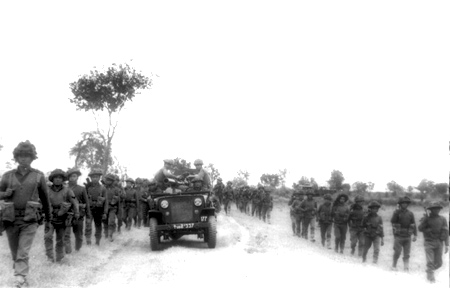
Tibetan troops of SFF after victory in Chittagong where they conducted clandestine operations during 1971 war. They are equipped with Bulgarian variants of AK-47 and M-1 Garand rifles supplied by the USA. (© Elite Forces of India and Pakistan)
According to a document, when the Chittagong Port was captured by Indian military, the guerrillas were then asked to sit quiet about 40 kms away. However, on December 16 when the Pakistan army surrendered at Dhaka, the Phantoms of Establishment 22, for the first time in their history, came out in the open on the Chittagong road, rejoicing the victory of India over Pakistan. The common people were stunned by their sudden appearance — happy and rejoicing — virtually from nowhere, Even many Indian soldiers, who were also not aware of their presence in the vicinity were taken by surprise. But soon Maj. Gen. Uban was informed about the public appearance of the Tibetans on the Chittagong streets and he ordered them back to the shadows. They were never seen again. Their happy moment in public was only for some hours.
Though the Tibetan guerrillas were arguably the main force that played the key role in Chittagong in the 1971 war, — sacrificing 49 (according to Tibetans’ estimate 56) including one of their top leader and 190 injured, they could not be officially recognized.
“The Indian government gave awards to 580 members of the force for their active involvement and bravery in the battles. The contribution made by Establishment 22 in liberating East Pakistan was great and the price paid by the force was also high”, said Dokham Chusi Gandruk, the New York based organization.
It then added: “(The fight and sacrifice) would have been of great value had it been used against communist China, the intended enemy….The SFF never had a chance of being used in operations against its intended enemy, Red China, but it was used against East Pakistan with the consent of His Holiness the Dalai Lama in 1971″.
It is, however, a different story that the Establishment 22 was later used in many Indian operations including in Operation Blue Star, Siachen, Kargil. They are also being used as a main anti-terrorist force in many parts of the country. According to a report, in between Indira Gandhi’s assassination and the formation of SPG, it was these Establishment 22 commandos who were in charge of the protection of the Gandhi family. But in all the cases down the decades they remained unsung heroes — the ‘unknown’ warriors from a different country who fought and sacrificed for others.
First published in TripuraInfo.in, 13 Dec, 2010
* * *
Sources: Tibetan sources and blogs, Kenneth Conboy and Jim Morrison, Claude Arpi.
* * *
Post Script: Phantom Warriors of 1971: Unsung Tibetan Guerrillas is virtually an untold story of a top secret mission. A very handful of people including some foreign journalists who were in touch with Tibetans are aware of the operations. Many of the military generals including Gen. JFR Jacob or Maj. Gen. SS Uban who commanded the force did not dwell extensively on them but obliquely referred. So it is virtually revisiting a mission that was intended to be kept top secret.