Showing posts with label MMRCA. Show all posts

Tuesday, April 14, 2015

The benefits of having a Gujarati prime minister

My article The benefits of having a Gujarati prime minister is posted in Rediff.com.

Click here to read...

Narendra Modi knows how to calculate and remain pragmatic.
Take the unexpected Rafale deal -- perhaps the first time a PM has considered the country's defence procurement as a priority, over the considerations of the babus' and over his own 'Make in India' project,' says Claude Arpi.


The advantage of having a Gujarati prime minister is that he knows how to calculate and he remains pragmatic.
Take the unexpected Rafale deal agreed in Paris during Narendra Modi's visit. It is perhaps the first time that a prime minister has considered the country's defence procurement a priority, over the considerations of babus' and over his own pet project 'Make in India', which will now be delayed for years, as far as the technology transfer for the Rafale is concerned.
The move was particularly pragmatic because it will cost less to India's exchequer. Buying 36 Rafales 'off-the-shelf' will cost some 4 billion Euros, which means one-fourth or one fifth the original plan to 'Make in India' 108 planes with Hindustan Aeronautics Ltd, a government undertaking always prone to delays and over-costs.
Further, it will bring the required 'oxygen' for the Indian Air Force which faces two rather aggressive neighbours with a rapid depletion of its fleet.
Defence Minister Manohar Parrikar, who did not accompany the prime minister on his trip (Modi travelled without a single minister, the senior-most member of his delegation being Ajit Doval, the national security advisor), said that it is a 'great decision.'
He hoped that the Rafale will be inducted into the IAF in two years time, adding that: 'India has finally broken the ice over the deal which has been pending for the last 17 years.'
Parrikar had it wrong, it is 14 years, but that is a detail.

To continue reading, click here...

Saturday, April 11, 2015

Rafales and Sri Aurobindo

Prime Minister Narendra Modi paying homage to Sri Aurobindo at UNESCO
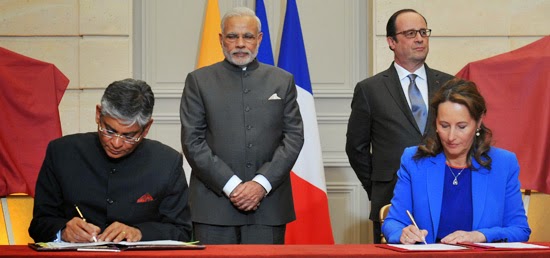
The highlight of yesterday's Hollande-Modi encounter at the Elysee Palace has been the ‘purchase’ of 36 Rafales for the Indian Air Force.
I write ‘purchase’ because the deal is not signed as yet.
There is nothing about the multi-role combat aircraft in the 20-point ‘List of agreements/initiatives/announcements signed/agreed during visit of Indian Prime Minister to France’, published by the Ministry of External Affairs.
Only the Joint Statement issued at the end of the meeting between the French President and Indian Prime Minister mentioned the Rafales.
Point 14 says: “Government of India conveyed to the Government of France that in view of the critical operational necessity for Multirole Combat Aircraft for Indian Air Force, Government of India would like to acquire [36] Rafale jets in fly-away condition as quickly as possible. The two leaders agreed to conclude an Inter-Governmental Agreement for supply of the aircraft on terms that would be better than conveyed by Dassault Aviation as part of a separate process underway; the delivery would be in time-frame that would be compatible with the operational requirement of IAF; and that the aircraft and associated systems and weapons would be delivered on the same configuration as had been tested and approved by Indian Air Force, and with a longer maintenance responsibility by France.”
In other words, a contract still needs to be negotiated ...and signed.
Let us not forget that in December 1981, the purchase of 150 Mirages 2000 was announced to counter the American F 16 ordered by Pakistan, but the final agreement was for 40 planes only, although a preferential credit rate of 9,25 % was then offered to India.
At that time too, the Indian Air Force needed the fighter aircraft quickly; it was therefore decided to ship an initial batch of 26 single-seaters and 4 two-seaters in 1985. The second part of this initial batch consisted of 10 more single-seater with the M53-P2 engine, with these aircraft designated Mirage 2000H.
A second consignment of six Mirage 2000H single-seater and three Mirage 2000TH two-seater was shipped in 1987-1988. Nine more planes were ordered in 1986. At that time, as a ‘bonus’, Indian engineers received a six-month training in France with Dassault and Dassault-Systems.
Further in 1984, a core group started the Aeronautical Development Agency (ADA) in Bangalore. The ADA was to oversee the development of India's Light Combat Aircraft (LCA) program. For a short time, French engineers worked on the Tejas program.
The tragedy is that India has lost 14 years to reach yesterday’s decision.
Can you imagine that the initial Request for Information had been issued in 2001, 14 years ago!
It is only 6 years later that the Request for Proposal (RFP) was published, as the then minister, AK Antony wanted to add new clauses, such as the Total Life-cycle Costs, in the Indian defence procurement policy. This is where the ‘complications’ started.
Five years later, in January 2012, Dassault Aviation was selected for supplying 126 Medium Multi-Role Combat Aircrafts (MMRCA) to the IAF after a long competitive process which lasted five years, with the American F/A-18 and F-16, Russian MiG 35, European Eurofighter and Swedish Saab Gripen in the race.
Why so many years from nothing?
The answer is mainly because of the complicated and tortuous Defence Procurement Policy drafted by the former ‘honest’ Defence Minister. 
If one believes yesterday’s Joint Statement, an Inter-Governmental Agreement will now be signed, putting the last nail into the MMRCA deal.
As soon as a new Defense Procurement Policy is published, negotiations for a transfer of technology to HAL or any other Indian firm involved in defense production, can start.
It may take some time.
It is worth noting that the Indian Prime Minister gave priority to the requirement of the Indian defense forces versus his pet project 'Make in India', which will be delayed for a few years, as far as the Rafale transfer of technology is concerned.

With Madam Bokova
Visit to UNESCO
Another highlight of Modi’s first day in Paris (he arrived late in the evening of the previous day) was the visit to UNESCO and his speech on Indian and Universal values.
Before reaching the main auditorium, he was received by Madam Irena Bokova (read my interview with the UNESCO's Director General) in front of Sri Aurobindo statue outside the building.
The Indian Prime Minister paid floral tribute to the Indian rishi.
Always well-informed, an Indian agency said that he paid tribute to Rabindranath Tagore.
It is true that the great Poet had a great admiration for the integral yogi. After visiting Pondicherry in 1928, Tagore wrote: ‘Rabindranath, O Aurobindo, bows to thee! O friend, my country's friend, O Voice incarnate, free, Of India's soul.’ The poet added ‘You have the Word and we are waiting to accept it from you. India will speak through your voice to the world. Hearken to me!’
Tagore’s prophesy is slowly coming through; in his speech, Mr. Modi spoke about the unity of human race and Sri Aurobindo’s vision.
The 'vegetarian' menu at the Elysee Palace (and the list of snacks on the péniche on River Seine) are not yet known.
Today, the Indian Prime Minister will be landing on the ‘Chinese’ airport in Toulouse-Blagnac (China recently bought 49% of the shares of Toulouse airport) and visit the Airbus and CNES headquarters.
In the evening, he will perform a mini 'Madison Square Show' and addressed the French PIOs living in France and overseas.
A few photos courtesy the French MFA.
Arrival at the Airport
French PIOs at the airport
  
French PIOs at the airport


With President of the French National Assembly
Guard of Honour in the Invalides

With Laurent Fabius, MFA


Indo-French CEOs Forum
Relaxing on the Seine River


Friday, February 13, 2015

Dassault can also sign contracts

A Rafale during the Garuda exercises in Jodhpur in 2014
A few weeks ago, I mentioned on this blog, the long, very long negotiation process between Dassault Aviation and the Government of India to purchase 18 Rafales Multi Role Combat Aircrafts (MMRCA) and later built 108 Rafales in India in collaboration with Hindustan Aeronautics Ltd. (HAL).
Last week, a rather surprising development occurred.
A senior official of the Armament Procurement Agency (Direction générale de l’armement or DGA) of the French Ministry of Defence asserted that a 2012 agreement to provide Rafales to India never committed Dassault Aviation to guarantee aircraft manufactured in India.
For the first time, Paris openly sided with Dassault, a French family concern, in its talks with Delhi, the latter arguing that liabilities during the process of manufacturing 108 aircrafts in India, should be the French supplier's responsibility. For months now, this has been the main bone of contention between the 2 parties.
Laurent Collet-Billon, the DGA’s boss affirmed: “Dassault will not be responsible for the whole contract. It is a co-management setup.”
He also ‘clarified’ that France will not assume full liability for the HAL-built aircrafts: “It cannot be a problem, because it was not in the request for proposals (RFP),” he added. It is not what the Indian Ministry of Defence says.
Speaking to reporters on February 9, Collet-Billion also admitted: “A lot of progress has been made since 2012.” The French official however latter agreed that the negotiations should "give way to a contract for the 126 fighters plus 63 options".
After several failed attempts to export the French plane, the DGA has learned patience: “India has its own pace. ...It’s not useful to put pressure on the client. We have to live with our differences."
As far as Dassault is concerned, the French Air Force should be ordering 11 Rafales in 2015, but just four in 2016, and have a break of near 2 years due to budget constraint. Collet-Billon admitted that “Problems will [then] occur, if we don't export Rafales."
During the same press conference, the DGA's official mentioned a possible deal with Egypt for 24 Rafale fighters, a FREMM frigate and a number of missiles.
Nobody really took note of this.

Dwindling number of squadrons
In a meantime in India, the Parliamentary Standing Committee on Defence expressed some concern “over the dwindling number of fighter squadrons in the Indian Air Force. The squadron strength has come down to 25 from the sanctioned 42.” The Committee’s report which was tabled in the Parliament, stated that the Indian Air Force (IAF) required at least 45 fighter squadrons to counter a ‘two-front collusive threat’, while the government has sanctioned  42 squadrons only: “The revelation is astonishing, and the committee feels that the paradox in the required and sanctioned strength needs to be rectified at the earliest,” commented the Committee.
The IAF should maintain 32 squadrons of 18 aircrafts each. The committee noted: “Moreover, 14 of these squadrons are equipped with MiG-21s and MiG-27s, which will retire between 2015 and 2024. Thus the strength will be reduced to just 11 squadrons by 2024. Our capability has already come down.”
The Committee added that though the IAF has inducted several ‘force multipliers’, such as airborne early warning systems (AWACS), mid-air re-fuellers and tactical airlift aircraft, the dwindling fighter strength operationally means that the supremacy that India has enjoyed over its neighbours is fast eroding.
The Parliamentary Committee particular expressed its concern about the ‘laxity’ of the Government which, according to the members, ‘compromises national security’. The government has been requested to take concrete steps expeditiously to address this.

The Rafale Mirage
On February 9, nobody had taken Collet-Billion’s declaration about the talks with Egypt seriously.
A few days later, an article in the daily, Le Monde compared the Rafale to a ‘mirage’ (also the name of the Rafale's illustrious predecessor). The writer asked “can the sale to Egypt change the tide”. He cited a ‘litany of disappointments’, i.e. Brazil (2103), Arab Emirates (2011), Switzerland (2011), Korea, Nederland (2002) or Saudi Arabia.
About Egypt, the journalist concludes « Nothing can be taken for granted; one of the specialties of the Rafale is to provoke ‘mirages of sale’: “first the tension mounts, then the negotiators get excited, the politicians are enthusiasts, the signature is programmed, 3, 2, 1 …” and plouf, nothing happens.
He quotes one of the characters of Gaston Lagaffe comic, Monsieur Aimé De Mesmaeker, a business man who always announces that he will soon sign an all-important contract with the comic publication Journal de Spirou ...and episodes after episodes, the contract is never signed.

This time Mesmaeker-Dassault has done it
A contract between Dassault and Egypt has been signed for 24 Rafales. French President François Hollande yesterday announced that Egypt will buy 24 planes and a frigate for an amount of Euro 5 billion ($5.7 billion).
Speaking at a news conference after a European summit in Brussels, the French president said the contract is 'a triumph for French industrial policy and the action of the state', which has intervened to guarantee part of the financial deal: “We’ve missed out on contracts several times over the last 10 years, probably because there wasn’t the will to accompany the talks, to finance and conclude a deal,” he added.
Mr. Hollande explained: “Egypt wanted this plane quickly because of the threats surrounding the country.” He also mentioned that France is also expecting an order from Qatar.
Interestingly, an extremely tired French President (after overnight marathon talks for Ukraine at Minsk and the EU summit in Brussels), first confused Egypt and India, announcing the contract for 24 jets was …with India.
He later rectified: “It’s confusion perhaps from tiredness, but also maybe from hope,” he commented on his own lapsus.
Regarding the differences between India and Dassault mentioned by the DGA’s boss, it is clear that if there is 'the will to conclude a deal' from both sides is present, a compromise can be found, as it was done in the case of the nuclear liabilities with the United States just before the visit of President Obama to India.
After all, it would in the interest of both, India and France to have the contract signed at the earliest (for example, during the visit of Mr. Modi to France in April, ).
The contract with Egypt is also interesting in the sense that one of the main arguments of the anti-Rafale lobby has been that Dassault has not exported any plane so far. Now, this argument is not valid anymore.
It perhaps explains that the deal was negotiated and signed in a record time (hardly 3 months); Dassault wanting probably to prove that it can also sign contracts.

Wednesday, January 7, 2015

The Rafale Saga

Very few in India know the meaning of the French word ‘Rafale’, which is now associated with the supply of 126 Medium Multi-Role Combat Aircraft (MMRCA) to the Indian Air Force (IAF); ‘rafale' means a 'gust of wind'.
When the 'rafales' prevailed in the MMRCA competition, many thought that the Big Deal would soon be signed; three years later, it is still going through tough procedural ‘gusts of wind’. The reasons are not the qualities of the combat aircraft, but other complications.
Out of the 126 aircrafts to be supplied to the IAF, 18 planes are to be manufactured by the French supplier, Dassault Aviation, from its facilities in France, while the remaining 108 planes have to be built in India, under a large Transfer of Technology agreement, by Hindustan Aeronitical Ltd. (HAL).
Till recently the French side seemed very optimistic. In November, Eric Trappier, Dassault’s Chairman declared that his firm expected to conclude a deal by March: “The final phase of exclusive negotiations on the contract should conclude within India's current budget year ending in March 2015.”
He added that this date was a ‘reasonable goal’.
On December 2, when this writer interviewed the French Defence Minister and asked about the pace of the negotiations, Mr. Le Drian said: “The negotiations are proceeding well. For a project of this scale and such complexity, which brings the transfer of numerous know-hows to several industrial stakeholders of India, the pace is comparable to that of other negotiations. Both our Governments share the will to conclude it and this is, of course, essential.”
In January 2012, the French firm Dassault Aviation had been selected for supplying 126 MMRCAs to the IAF. The Rafale fighter had gone through a long competitive process which lasted five years, with the American F/A-18 and F-16, Russian MiG 35, European Eurofighter and Swedish Saab Gripen in the race.
While the initial Request for Information had been issued in 2001, the Request for Proposal (RFP) was only issued in 2007, as the then minister, AK Antony wanted to add new clauses, such as the Total Life-cycle Costs, in the Indian defence procurement policy. This is where the ‘complications’ started.
It is not always easy to follow the intricacies of the Rafale saga, since Dassault is, as the French say ‘muet comme une carpe’ (‘silent as a carp fish’ which makes bubbles with no sound); and the Indian Ministry of Defence and the Indian Air Force are not very loquacious too; it is understandable in view of the high stakes.
One can however gather from the Indian press that the main disagreement raised by the French is that Dassault is not ready to take the ‘full responsibility’ for the 108 fighters to be manufactured in India by HAL, while there is apparently no issue with the 18 fighter planes to be manufactured in France by Dassault.
An Indian defence ministry official told some Indian journalists (on the condition of anonymity, as usual): “The ministry is in no hurry to conclude the negotiations despite what people may say. Dassault has to accept commitment mentioned in the RFP.”
Another ministry insider said that Dassault was not agreeing to HAL’s demand to take responsibility for the manufacturing process in India, “regardless of French government’s pressure, [Dassault finds that] it is too risky”.
The same senior Indian MoD official added: “accepting terms and conditions of the original tender have emerged as the key issue to be resolved. The RFP clearly stated that under the transfer of technology agreement, the French will have to …take full responsibility of Indian manufactured fighter jets.”
The negotiations seem stuck on the imposition of penalties in case any delay occurs in the supply of the aircraft manufactured by HAL.
The question is: can Delhi ‘legally’ impose liabilities on something over which Dassault has no control? This sounds like one of these clauses drafted during the Antony Raj, where the ‘foreign’ supplier has to pay’.
This is also true for the Civil Liability for Nuclear Damage Act, which will be discussed during Obama’s visit later this month. The Economic Times recently editorialized: “India should bring its liability law in line with international norms. It makes little sense to keep nuclear suppliers’ liability open-ended and unlimited. This is what has held back vendors from the US, Japan and elsewhere from concretising their India plans.”
This does not solve the Rafale issue.
Ajia Shukla writes in The Business Standard: “For the first time since January 31, 2012, …a top Indian official has admitted serious problems in negotiating the purchase with French vendor, Dassault.”
Defence Minister Manohar Parrikar indeed spoke of ‘complications’ in the negotiations “with the French side reluctant to meet commitments that the IAF had specified in the tender”. Parrikar announced India’s Plan B: “The Su-30MKI is an adequate aircraft for meeting the air force’s needs”.
It is only a bluff or is the IAF serious?
Earlier this month, the Indian minister had assured his French counterpart that the Rafale negotiations would be placed on a ‘fast track’. More recently, he asserted that Le Drian “had committed to send an empowered person to negotiate after New Year.”
Now it appears that a French ‘empowered’ delegation is likely to visit India to take forward the negotiations. One could however ask: empowered' by whom?
Dassault Aviations is a private limited company, the last aviation group in the world still owned by its founding family, who owns 51% of the group’s shares (while EADS France – Airbus Group has 46%).
Could someone outside Dassault Aviation be ‘empowered’?
Would Delhi like to deal with an official of the French Ministry of Defence?
In which capacity would that person negotiate? Can the French State guarantee the liabilities of a private limited firm? All this seems rather complicated.
Since 1999, Dassault’s main activity has been the export of business jets (Falcons). In 2012, 71% of the revenues came from the sales of the Falcons, while the Defence sector (export) is less than 5%. Is Dassault ready to take the risk to spoil its ‘civilian’ branch by guaranteeing the Rafale deal? Of course, it is up to the familial firm to decide.
When Mr. Parrikar recently declared, ‘we are in a mess that I can't spell out’, was he thinking of this Deal?
There is no doubt that Dassault’s defence branch badly needs the Rafale order to survive, while the Indian Air Force desperately has to replace its ageing MiG-21s with a modern fighter. The IAF is aware that HAL’s LCA, the Tejas does not fit the bill; further the IAF which has today a sanctioned strength of 45 fighter jet squadrons, has only 25 operational squadrons.
The ‘Rafale Deal’ would be indeed a win-win for both India and France …if signed. Let us hope for the best.