Showing posts with label UNESCO. Show all posts

Friday, April 17, 2015

Modi’s ‘Yugantar’ moment

My article Modi’s ‘Yugantar’ moment appeared in The Asian Age and The Deccan Chronicle.

Here is the link...

It was perhaps the first time that a PM considered the defence procurement priority of the country over the babus’ and other considerations... and over his own pet project ‘Make in India’, which will now be delayed for years

It was perhaps the first time that a PM considered the defence procurement priority of the country over the babus’ and other considerations... and over his own pet project ‘Make in India’, which will now be delayed for years
Official visits by heads of state or government are like vital surgical operations — if you come out of the operation theatre alive and are back in your room, it is deemed a success. However, it is only with the passing months or years that the quantum of success can really be determined.
At the end of the second day of Prime Minister Narendra Modi’s visit to France, the suave ministry of external affairs spokesperson Syed Akbaruddin said, “…the visit was extremely successful. It met all the key goals that were targeted and we hope this will enhance our ties with France and take them to the next level.”
Mr Akbaruddin mentioned the nuclear front, “a wide variety of issues including defence”, the railways, the “Make in India” programme and visas “within 48 hours” for Indian tourists wanting to go to France. All this is good, but not special.
The spokesman also spoke of “smart cities”. It is true that in India, very few (apart from the Prime Minister) care about smart cities; we know too well that local politicians would first have to become “smart” themselves: a difficult proposition.
But what was “smart” was the unexpected Rafale deal.
It was perhaps the first time that a Prime Minister considered the defence procurement priority of the country over the babus’ and other considerations… and over his own pet project “Make in India”, which will now be delayed for years, at least as far as the technology transfer for the Rafale is concerned.
The move was particularly smart as it will cost India much less. To buy 36 “off-the-shelf” Rafales will come to some $4 billion, which means one-fourth or one-fifth the original plan to “Make in India” 108 planes with Hindustan Aeronautics Ltd (HAL), a government undertaking always prone to delays and over-costs.
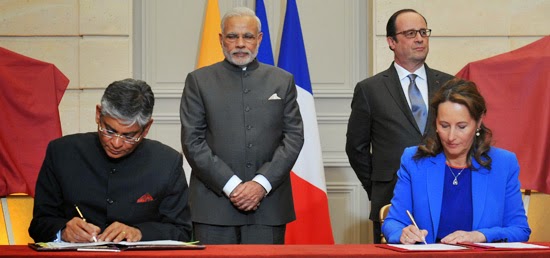
Though there is nothing about the multi-role combat aircraft in the 20-point “list of agreements/initiatives/announcements” inked during Mr Modi’s visit in Paris, the French and Indian media were unanimous in saying that the main outcome of the Hollande-Modi encounter was the “purchase” of 36 Rafales for the Indian Air Force (IAF).
Only the joint statement issued at the end of the meeting between the French President and Indian Prime Minister mentioned the Rafales. Point 14 says: “The Government of India conveyed to the Government of France that in view of the critical operational necessity for multi-role combat aircraft for Indian Air Force, Government of India would like to acquire (36) Rafale jets in fly-away condition as quickly as possible.”
The fact that (36) is in bracket shows that the agreement about the number was arrived at the very last minute.
The interesting point is that “the two leaders agreed to conclude an inter-governmental agreement for supply of the aircraft… the delivery would be in time-frame that would be compatible with the operational requirement of IAF,” and the plane will be in the same configuration “as had been tested and approved by Indian Air Force.”
In other words, a separate “inter-government” contract will be signed. So is the Rafale deal really done? Probably. In December 1981, the purchase of 150 Mirage 2000s was announced to counter the American F-16 ordered by Pakistan, but the final agreement was for 40 planes only, although a preferential credit rate of 9.25 per cent was then offered to India. At that time too, the IAF needed the fighter aircraft quickly. Defence minister Manohar Parrikar later clarified that India took the government to government (G2G) route because three years’ negotiations for the transfer of technology produced no results. His hope is that the Rafales would be inducted in the IAF in two years’ time.
The 126 medium multi-role combat aircraft (MMRCA) scheme is clearly defunct. The tragedy is that India has lost years to reach the decision to buy “off-the-shelf”. The initial request for information had been issued in 2001, 14 years ago! It was only six years later that the request for proposal (RFP) was published, as the then defence minister, A.K. Antony, wanted to add new clauses, such as the total life-cycle costs, in the Indian defence procurement policy.
Five years later, in January 2012, Dassault Aviation was selected for supplying to the IAF after a long competitive process, which lasted five years with the American F/A-18 and F-16, Russian MiG-35, European Eurofighter and Swedish Saab Gripen in the race. Why so many years to come back to the starting blocks?
Because of the complicated and tortuous defence procurement policy drafted by the former “honest” defence minister. The inter-governmental agreement will put the last nail into the MMRCA deal. Considering that until the time the Indian delegation arrived on Thursday ahead of the Prime Minister, tough discussions were still on for the 126 planes (the bone of contention being the 108 to be manufactured in Bengaluru), it was a quick, pragmatic, “out of the box” and smart move to bring the “critical operational necessity” of the IAF on the negotiating table and dropping the MMRCA framework.
The modalities, number and delivery framework could not be completed in time to be included in the joint statement, but the French were relieved when the Indian Prime Minster confirmed the “deal” during his joint press conference with Mr Hollande. The IAF and the Indian finance minister, Arun Jaitley, must be relieved too.
A French defence blog wrote that till the time Mr Modi spoke, the French had been like Saint Thomas wanting to “see” before believing. The rest is history.
When Mr Modi visited the Airbus headquarters, he was told that the European company is ready to increase their sourcing from India by 500 per cent during the next five years (from $400 million today to $2 billion in 2020). It was a cherry on Mr Modi’s “Make in India” programme.
A touching moment was the visit to a World War I memorial in Neuve Chapelle, near Lille in northern France. Mr Modi spoke about the 10,000 Indians who lost their lives while fighting alongside France: “India is known as the land of sacrifice and devotion.” He reiterated that Indians never fought to expand their territorial boundaries, but for justice: “India is a nation that has always believed in world peace.”
The French persons of Indian origin, assembled in the Carrousel du Louvre, Paris, were delighted to hear the Prime Minister say: “From my experience I can say that India has no reason to remain poor.”
A special event was the visit to the United Nations Educational, Scientific and Cultural Organisation where Mr Modi spoke on Indian and universal values. Before reaching the main auditorium, he bowed in front of Sri Aurobindo’s statue installed outside the building.
An Indian agency said that he paid tribute to Rabindranath Tagore. Despite the lapsus, the great poet had an immense admiration for the rishi. After visiting Puducherry in 1928, Tagore wrote: “Rabindranath, O Aurobindo, bows to thee! O friend, my country’s friend, O voice incarnate, free, of India’s soul.” The poet added, “You have the word and we are waiting to accept it from you. India will speak through your voice to the world. Hearken to me!”
The message of India not only as a great economic, but also civilisational nation is slowly percolating to foreign countries.
This also helped to make the visit a success.

Saturday, April 11, 2015

Rafales and Sri Aurobindo

Prime Minister Narendra Modi paying homage to Sri Aurobindo at UNESCO
The highlight of yesterday's Hollande-Modi encounter at the Elysee Palace has been the ‘purchase’ of 36 Rafales for the Indian Air Force.
I write ‘purchase’ because the deal is not signed as yet.
There is nothing about the multi-role combat aircraft in the 20-point ‘List of agreements/initiatives/announcements signed/agreed during visit of Indian Prime Minister to France’, published by the Ministry of External Affairs.
Only the Joint Statement issued at the end of the meeting between the French President and Indian Prime Minister mentioned the Rafales.
Point 14 says: “Government of India conveyed to the Government of France that in view of the critical operational necessity for Multirole Combat Aircraft for Indian Air Force, Government of India would like to acquire [36] Rafale jets in fly-away condition as quickly as possible. The two leaders agreed to conclude an Inter-Governmental Agreement for supply of the aircraft on terms that would be better than conveyed by Dassault Aviation as part of a separate process underway; the delivery would be in time-frame that would be compatible with the operational requirement of IAF; and that the aircraft and associated systems and weapons would be delivered on the same configuration as had been tested and approved by Indian Air Force, and with a longer maintenance responsibility by France.”
In other words, a contract still needs to be negotiated ...and signed.
Let us not forget that in December 1981, the purchase of 150 Mirages 2000 was announced to counter the American F 16 ordered by Pakistan, but the final agreement was for 40 planes only, although a preferential credit rate of 9,25 % was then offered to India.
At that time too, the Indian Air Force needed the fighter aircraft quickly; it was therefore decided to ship an initial batch of 26 single-seaters and 4 two-seaters in 1985. The second part of this initial batch consisted of 10 more single-seater with the M53-P2 engine, with these aircraft designated Mirage 2000H.
A second consignment of six Mirage 2000H single-seater and three Mirage 2000TH two-seater was shipped in 1987-1988. Nine more planes were ordered in 1986. At that time, as a ‘bonus’, Indian engineers received a six-month training in France with Dassault and Dassault-Systems.
Further in 1984, a core group started the Aeronautical Development Agency (ADA) in Bangalore. The ADA was to oversee the development of India's Light Combat Aircraft (LCA) program. For a short time, French engineers worked on the Tejas program.
The tragedy is that India has lost 14 years to reach yesterday’s decision.
Can you imagine that the initial Request for Information had been issued in 2001, 14 years ago!
It is only 6 years later that the Request for Proposal (RFP) was published, as the then minister, AK Antony wanted to add new clauses, such as the Total Life-cycle Costs, in the Indian defence procurement policy. This is where the ‘complications’ started.
Five years later, in January 2012, Dassault Aviation was selected for supplying 126 Medium Multi-Role Combat Aircrafts (MMRCA) to the IAF after a long competitive process which lasted five years, with the American F/A-18 and F-16, Russian MiG 35, European Eurofighter and Swedish Saab Gripen in the race.
Why so many years from nothing?
The answer is mainly because of the complicated and tortuous Defence Procurement Policy drafted by the former ‘honest’ Defence Minister. 
If one believes yesterday’s Joint Statement, an Inter-Governmental Agreement will now be signed, putting the last nail into the MMRCA deal.
As soon as a new Defense Procurement Policy is published, negotiations for a transfer of technology to HAL or any other Indian firm involved in defense production, can start.
It may take some time.
It is worth noting that the Indian Prime Minister gave priority to the requirement of the Indian defense forces versus his pet project 'Make in India', which will be delayed for a few years, as far as the Rafale transfer of technology is concerned.

With Madam Bokova
Visit to UNESCO
Another highlight of Modi’s first day in Paris (he arrived late in the evening of the previous day) was the visit to UNESCO and his speech on Indian and Universal values.
Before reaching the main auditorium, he was received by Madam Irena Bokova (read my interview with the UNESCO's Director General) in front of Sri Aurobindo statue outside the building.
The Indian Prime Minister paid floral tribute to the Indian rishi.
Always well-informed, an Indian agency said that he paid tribute to Rabindranath Tagore.
It is true that the great Poet had a great admiration for the integral yogi. After visiting Pondicherry in 1928, Tagore wrote: ‘Rabindranath, O Aurobindo, bows to thee! O friend, my country's friend, O Voice incarnate, free, Of India's soul.’ The poet added ‘You have the Word and we are waiting to accept it from you. India will speak through your voice to the world. Hearken to me!’
Tagore’s prophesy is slowly coming through; in his speech, Mr. Modi spoke about the unity of human race and Sri Aurobindo’s vision.
The 'vegetarian' menu at the Elysee Palace (and the list of snacks on the péniche on River Seine) are not yet known.
Today, the Indian Prime Minister will be landing on the ‘Chinese’ airport in Toulouse-Blagnac (China recently bought 49% of the shares of Toulouse airport) and visit the Airbus and CNES headquarters.
In the evening, he will perform a mini 'Madison Square Show' and addressed the French PIOs living in France and overseas.
A few photos courtesy the French MFA.
Arrival at the Airport
French PIOs at the airport
  
French PIOs at the airport


With President of the French National Assembly
Guard of Honour in the Invalides

With Laurent Fabius, MFA


Indo-French CEOs Forum
Relaxing on the Seine River


Wednesday, November 2, 2011

And what about Tibet?


UNESCO was given full Membership to the Palestinians. 
But what about the Tibetans?
Don't they have a separate culture? A separate language? A script? A unique religion? A long history with ups and downs?
I remember my old friend Claude Levenson telling me: "We should do something to get Tibet as a Member of UNESCO". I think it was the last time that we met. 
What can be done? I don't know.


Canada stops funding for UNESCO over Palestinians
AP
2 Nov, 2011
TORONTO: Canada joined the US on Tuesday in cutting off funding for the U.N. cultural agency UNESCO because it approved a Palestinian bid for full membership.
Foreign Affairs Minister John Baird said Monday's decision by UNESCO is not in the best interests of peace in the Middle East, so Canada is freezing all future voluntary contributions to the agency. Canada contributes about $10 million a year.
``We're just deeply concerned with the decision that UNESCO has taken,'' Baird said. ``This issue should be negotiated between the two parties. It is not in the best interests of peace in the Middle East and we're, you know, tremendously disappointed.''
The United States also has announced it will pull its $60 million in funding from UNESCO, which depends heavily on U.S. funding.
The UNESCO vote was a fallback plan for the Palestinian leadership after its bid for UN recognition as a state and full membership in the global body failed in September. UNESCO is funded by both legally binding and voluntary contributions from member states.
A spending plan for the Foreign Affairs Department tabled in Parliament shows Canada plans to give UNESCO about $12 million a year until 2014 as part of its legally binding obligation. Those payments will continue. UNESCO admitted Palestine as a full member state Monday by a vote of 107 to 14, with 52 abstentions.
Canada and the United States, both staunch allies of Israel, were among the 14 countries in opposition.