|
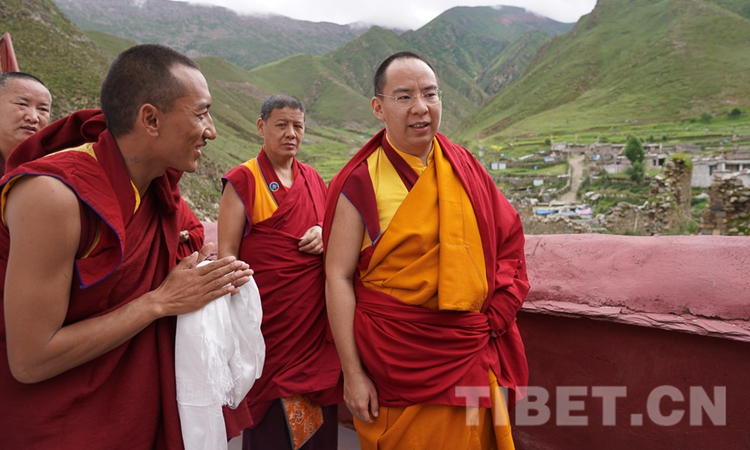
| Wang Yang in Tibetan areas in Qinghai |
One was of these visits was by Hu Chunhua, a member of the Politburo, a Vice-Premier of the State Council and head of the National Leading Group on Poverty Alleviation.
Last year in August, he had already 'inspected' many sites in Tibet.
Let us remember that at one point, Hu was Xi Jinping’s heir apparent.
In July 2021, Hu, who served several years ago in Tibet, “went deep into the eastern part of Ngari Prefecture, western Nagchu City and other extremely high altitude areas to investigate poverty alleviation and animal husbandry development.”
He had then to give a feedback to the leadership assembled in the seaside resort of Beidaihe for the annual ultra secret conclave.
At that time, it was reported that Hu Chunhua went to the home of herders in the remote Dawa village in Tsochen county in Ngari Prefecture to check the production and conditions of farmers and nomads living in high altitude areas.
It was probably the first time that these neglected populations met a politburo member.
The Chinese media had reported that Hu had 'successively' walked into the most remote counties of Ngari Prefecture; deep into villages while visiting enterprises and grassroots organizations (incidentally, Hu speaks good Tibetan).
Hu's 2022 Visit
According to Xinhua, Hu Chunhua was again on the ground in Tibet Autonomous Region (TAR) from July 1 to 4 “to supervise the work of consolidating and expanding the results of poverty eradication and revitalizing the countryside.”
Hu is said to have stressed the need “to thoroughly implement the spirit of General Secretary Xi Jinping's series of important speeches and important instructions, resolutely and forcefully consolidate and expand the results of poverty eradication, accelerate the comprehensive promotion of rural revitalization, ensure that there is no return to poverty on large scale, and strive to take the people out of poverty at even higher level.”
The ‘important’ speeches of Xi Jinping are leitmotivs in the Chinese official reports. Every officials, high or low has to pay homage to the Emperor.
The report of the news agency continues: “Tibet combines ethnic areas, border areas, high altitude areas in one, the development foundation is relatively weak, the task of consolidating and expanding the results of poverty eradication is very heavy. Hu Chunhua has come to Chamdo City, Biru County, Lhorong County, Pelbar County, Nagchu City, Lhari County, Lhasa City, Meldro Gungkar County.”
It was an in-depth field inspection for studying “poor village households, relocation community, agricultural products processing enterprises, schools and hospitals, etc.”
Hu Chunhua’s objective was to get a detailed understanding “of the employment of the masses out of poverty to increase income, the development of special agricultural and animal husbandry, the rural infrastructure construction and the public service development.”
The Vice Premier stated that “the areas out of poverty should continue to consolidate and expand the results of poverty eradication in the first place, so that the foundation of poverty eradication obtains more solid, more sustainable results.”
He encouraged the local leaders to rely on the plateau characteristic advantageous resources, “for better and stronger modern agriculture and animal husbandry, to speed up the development of agricultural products processing, the rural tourism and in order to realize the integration of the industries and the growth of the county rich people's industry, and promote the sustained income of people out of poverty.”
Hu has probably visited the area of Nagchu City (prefecture) from where large percentage of the population has been removed in order to be relocated South of Lhasa, near Gongkar airport (see our post last week).
The objective of the Chinese government is said to “successively promote the development of ethnic areas, and promote the common unity and struggle of all ethnic groups, common prosperity and development.”
It is what Beijing says…
 |
| Wang Yang speaking to the children |
Wang Yang Visit to Qinghai
A few days earlier, Wang Yang, a member of the Standing Committee of the Politburo and chairman of the National Committee of the Chinese People's Political Consultative Conference (CPPCC), visited several Tibetan areas in Qinghai Province “to research counterpart aid work for youth.”
During his tour, Wang, No 4 in the Party, stressed the need “to deeply understand the Communist Party's strategy for governing Tibet in the new era, adhere to the main line of casting a firm sense of Chinese national community, to bring innovative ideas for the youth-aid work, to enhance the comprehensive benefits of youth-aid, to help Tibet-related states and counties in their high-quality development, and not fall behind in the overall modernization process of the Chinese nation.”
From June 27 to 28, Wang went to Xining City (which had just come out a severe lockdown), Huangnan Tibetan Autonomous Prefecture; he also visited Shanghai-supported Xining Golok High School, Tianjin-helped Tsim Sha Tsui County Deji Village and other places. He wanted to understand the situation in detail, says the official report.
Wang asserted that since the 18th Party Congress (2012), provinces and cities as well as central state organs and central enterprises have implemented the directives of the Central Committee to support Qinghai: “to build a moderately prosperous society. …In the new journey, more attention should be helping the recipient to develop industries with special advantages as well as develop markets.”
Wang Yang urged the local cadres to make efforts to explore new approaches for ethnic minority areas and march towards modernization and common prosperity.
Learn Chinese and Blend
He also mentioned ‘intellectual support’ and the consolidation of the results of education assistance to Qinghai, i.e. helping people in ethnic areas to master the common language (read Mandarin): “More attention should be paid to encouraging ethnic minority people to go out, providing assistance for them to study, work and start businesses in the central and eastern regions, broadening the channels of income and wealth, and promoting exchanges and blending of ethnic groups.”
Wang Yang visited the Qinghai Tibetan Culture Museum, the Dragon Tree Painting Garden and ancient temples to understand the historical and cultural protection heritage.
The next day, Wang presided over a meeting on supervision and consultation over some key proposals concerning protecting and keeping alive the historical and cultural heritage in the course of planning and construction in urban and rural areas.
On June 29, Wang presided over a meeting for the supervision and consultation of some key proposals concerning protecting and keeping alive the historical and cultural heritage in the course of planning and construction in urban and rural areas.
He wanted that the CPPCC play its role in implementing related decisions and plans of the Central Committee. Wang further stressed that “from the height of enhancing historical consciousness, firm cultural confidence, in-depth understanding of General Secretary Xi Jinping on the protection of historical and cultural heritage heritage and effectively implement the relevant decisions of the Party’s Central Committee.”
Wang recommended that the revision of the Law on the Protection of Cultural Relics and the Law on Intangible Cultural Heritage should be accelerated, and local regulations be formulated to reasonably define the scope of protection and inheritance of cultural objects.
A census of historical and cultural heritage should be carried out and a database of immovable cultural relics should be established, he said and in order to strengthen the study of historical and cultural heritage, “excavate the historical stories, cultural values and spiritual connotations contained therein, to avoid the loss of its form and its essence.”
The Sinicization of Tibetan Buddhism, dear to Xi Jinping, was not mentioned.
 |
| Li Zhangshu inspecting an afforestation project |
Visit of Li Zhanshu
Two more members of the Standing Committee of the Politburo visited Tibet around the same time that Xi Jinping was in Xinjiang.
First, Li Zhanshu, member of the Standing Committee of the Politburo and Chairman of the Standing Committee of the National People's Congress was in Tibet from July 12 to 15 “for research on ecological protection legislation on the Qinghai-Tibet Plateau.”
During his visit, he stressed the need to have a legislation to protect the ecology of the Qinghai-Tibet Plateau; his objective is “with Xi Jinping's thought of ecological civilization, to adhere to systematic protection, coordinated protection and special protection, and develop a good law that can stand the test of history and the people in the spirit of science.”
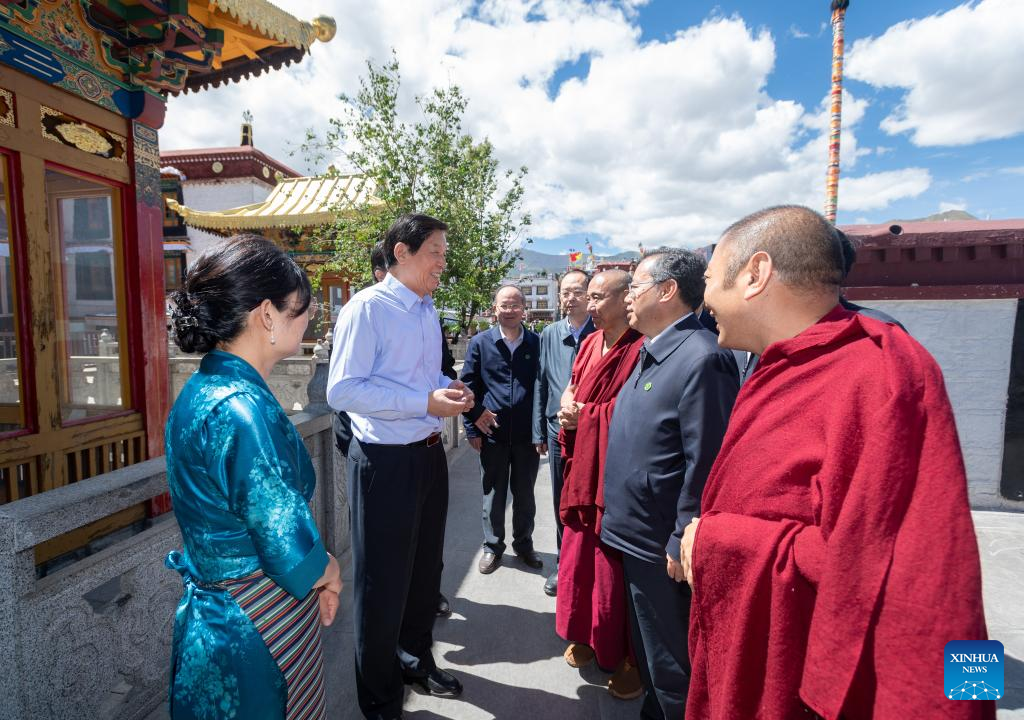 |
| Li Zhanshu in the Tashilhunpo monastery |
On July 13, Li Zhanshu went to Shigatse and visited the north bank of the South Woodland Ecological Demonstration Area of the Yarlung Tsangpo to investigate the planting of trees. He was accompanied by Wang Junzheng, the TAR Party Secretary.
Li Zhanshu inspected the protection of wetlands, river mudflats, reforestation projects, water resources protection, mine restoration among other things; during a forum, he listened to the views and suggestions of the stakeholders. He spoke of the great achievements made in ecological environmental protection on the Qinghai-Tibet Plateau, and discussed with everyone the key issues involved in the development of the new law.
Li Zhanshu noted that the Qinghai-Tibet Plateau Ecological Protection Law is a major initiative “to implement the important instructions of General Secretary Xi Jinping on the ecological protection of the Qinghai-Tibet Plateau: "The Qinghai-Tibet Plateau has a special ecological status and value, and plays an extremely important role in the national and even global ecological security."
 |
| Li Zhangshu In Tibet |
For Li, the Qinghai-Tibet Plateau Ecological Protection Law will be a special regional protection law, but its significance and impact will reach far beyond the plateau to which the law will apply; he said while drafting this law, it was necessary “to have a big picture of the overall situation and the very high altitude; the idea of the legislation is to support ecological protection policy initiatives and also reflect Tibet’s own characteristics.”
Li Zhanshu noted that to implement the new development concept, one should adhere to systemic thinking, in a scientific attitude and problem-solving spirit, in order to strengthen the protection, governance, restoration and risk prevention and control of each important ecosystem, and provide a strong rule of law protection for the ecological protection of the Qinghai-Tibet Plateau.”
Once again it sounds good (despite the verbiage), but what about the high speed development (roads, railway lines, airports) already started.
Li Zhanshu visited the Potala Palace, Jokhang Temple in Lhasa and the Tashilunpo monastery in Shigatse.
He said that “the most fundamental issue lies in the strong leadership of the Party Central Committee with Comrade Xi Jinping as the core, in the scientific guidance of Xi Jinping thought of socialism with Chinese characteristics in the new era, uncompromisingly put into practice the important statements of General Secretary Xi Jinping on the work of Tibet and the party's strategy for governing Tibet in the new era. It is necessary to further implement the strategic thought of "ruling the country must be ruling the border, and ruling the border must first stabilize Tibet", implement the Party's guidelines and policies on ethnic and religious work, make safeguarding the unity of the motherland and strengthening ethnic unity the focus and point of emphasis, achieve long-term peace and stability, and promote high-quality development.”
Li is clearly on Xi Jinping’s side in the power struggle ahead to the 20th Congress in November.
In Beidaihe, he will present a report on the ecological achievements of the General Secretary on the Plateau. The reality might be different.
 |
| Vice-Premier Han Zheng in Tibet |
Han Zheng’s Visit
Xinhua also reported that Han Zheng, a member of the Politburo’s Standing Committee and Vice Premier of the State Council visited Nyingchi and Yushu in Qinghai province from July 14 to 15.
He stressed to unswervingly take the road of ecological green development and constantly promote high-quality development to achieve new results.
As usual, Han Zheng stressed the need to adhere “to the Xi Jinping thought of socialism with Chinese characteristics in the new era as a guide, in-depth implementation of the new development concept, unswervingly take the ecological priority, green development and solidly promote the construction of major projects and ecological protection, and constantly promote high-quality development to achieve new results.”
On July 14, Han inspection the Sichuan-Tibet Railway presently under construction (only the section between Nyinchi and Lhasa is completed).
Han Zheng went to the Serkhyem La pass at an elevation of 4.567m (14,983ft) above the sea level. The new railway line will go through a tunnel and the line will apparently run parallel China’s National Highway 318 (G318), also known as China-Nepal Highway and the Friendship Highway.
According to a website for tourists: “The road is asphalted. Usually impassable from October to June. The summit offers a breathtaking scenery. The road is long and arduous and crosses several mountain passes through remote areas, so you need to be prepared. Do not take this drive if you have respiratory problems or any type of heart condition. Notorious lack of oxygen that tests the organisms and a high degree of steepness. A major hazard of altitude is the sickness that can indiscriminately affect anyone regardless of age or fitness. The zone is prone to heavy mist and can be dangerous in low visibility conditions.”
This pass links Bayi and Bomi counties; on top of the pass, one gets the incredible view of Namcha Barwa (7756m) …when the weather is clear.
Han Zheng was shown an exhibition explaining the overall situation of the construction of the railway; he conducted a field inspection of the construction of the energy-saving and environmental protection features of the tunnel.
Han said that “the construction of the Sichuan-Tibet Railway will implement the new era of the party's strategy for the governance of Tibet a major initiative to promote the western region, especially the economic and social development of Sichuan and Tibet provinces.”
He added that during the construction of the project, everyone should adhere to the time and quality and to ensure the safety of the project.
 |
| Han Zheng inspects the new railway line between Tibet and Sichuan |
Probably more Worrying for India
Han Zheng first came to Milin County in Nyingchi City to “listen to the development of clean energy on the Yarlung Tsangpo River and he was briefed about the construction of the major hydropower development project.
Apparently, this refers to the mega HPP on the Yarlung Tsangpo, which has often been mentioned on this blog.
Han pointed out that “it is necessary to coordinate the rational development and utilization of water resources and protection, and build a national clean energy base. The construction of major projects should adhere to scientific evidence, comprehensive consideration of geological conditions, ecological environment and other multiple factors, and do a solid job in the preliminary work of the project.”
Han clearly bats for the giga project on the Yarlung Tsangpo, which will bring destruction in the Great Bent area ...and in India.
It means that China will go ahead with the project on the transnational river, which becomes the Siang in India and later the Brahmaputra.

The Sanjiangyuan (Chinese: Source of Three Rivers) is an area of the Tibetan Plateau in today’s Qinghai province; it is the headwaters of the Yellow, the Yangtze, and the Mekong which originate from this area. They come under the Sanjiangyuan National Nature Reserve (SNNR), or Three Rivers Nature Reserve.
According to Wikipedia: “The reserve consisted of 18 subareas, and each contained three zones which were managed with differing degrees of strictness. In 2015, the Chinese government decided to implement a new national park system, and created Sanjiangyuan National Park, which is set to open officially in 2020.”
To protect the grasslands, pastoralists are not permitted to graze their animals in designated called ‘core zones’ and grazing is supervised in the SNNR. In addition, residents have been resettled from these core zones and other grassland areas of the SNNR, and the rangelands have been fenced; they are in the process of being privatized throughout the Sanjiangyuan Area.
After his visit of the Yarlung Tsangpo, Han Zheng inspected the Yushu Ecological Environment Monitoring Center and was briefed on the ecological protection in Qinghai Province.
Han got a report on the construction of Sanjiangyuan National Park through the remote video monitoring system; he virtually visited the Sanjiangyuan projects, met grassroots cadres, he had a field inspection of the waters of the Tongtian River. He later went to the site of the Sanjiangyuan Nature Conservation Monument.
The Shi Chu (Tibetan) or Tongtian River is 1,012 km long; it flows within Qinghai Province. It is begins at the confluence of Togtog (or Mar chu) River and Dang chu River and flows towards southeast and becomes a Jinsha River near the border of Qinghai and Sichuan. The Jinsha River is a primary and westernmost tributary of the Yangtze River (‘Chang Jiang’).
Han Zheng noted the achievements of the construction of the Sanjiangyuan National Park; he mentioned the benefits of the project for the whole country, as well as for future generations.
He said that “to protect the Sanjiangyuan as the top priority of the construction of ecological civilization in Qinghai, to guard the natural ecology, conservation of natural resources, to protect the Chinese water tower.”
Han Zheng later went to the Qinghai Longbao (National) Nature Reserve where he interacted with the staff of the station.
The Longbao National Nature Reserve was established in 1986 and has an area of about 100 km2 covering wetlands and meadows. The reserve is located about 50 km northwest of Jyekundo, the Yushu County seat, lying just south of the highway connecting Yushu and Ritoe Counties. The reserve’s primary area of ecological importance is a wetland that is approximately 14 km long with a maximum width of about 3.5 km. The maximum depth of the wetland is reported to be about 4 m, but most of the wetland is generally much shallower. This wetland lies at an elevation of about 4,200 m in a broad mountain valley flanked by ridges that typically rise up to 750 m above the wetland. The wetland is fed by groundwater, streams, precipitation, and snow-melt, and it drains into the Yi Chu River to the northwest, a short tributary of the nearby Tongtian River.
Han Zheng stressed again the need “to actively promote the construction of wetlands, strengthen biodiversity protection, reduce human activity interference, promote the harmonious coexistence of man and nature, and continue to build a solid national ecological security barrier.”
The visit of the site of the mega HPP on the Yarlung Tsangpo should worry India.
In the meantime, a lot to discuss in Beidaihe next month...
 |
| HPPs on the Yarlung Tsangpo |