Showing posts with label Indian Army. Show all posts

Saturday, March 16, 2019

Know your history

My article Know your history appeared in the Edit Page of The Pioneer


Here is the link...

If we want to win the battle of information or perception like China, then we need to restore the Historical Division in the MEA or let MOD set up a comparative cell

With the country approaching the General Elections, one rarely comes across good news. However, the “transformative” reforms, soon to be undertaken by the Ministry of Defence, are an encouraging sign that a few things in India are changing. According to PTI, the idea is “to make the 1.3 million-strong force leaner and meaner as well as  enhance its combat capabilities.”
Defence Minister Nirmala Sitharaman has approved the first batch of reforms, which include relocation of 229 officers from the Army headquarters to operational postings, reorganisation of the Army Headquarters and the setting up of new wings for vigilance and human rights issues. Particularly interesting is the creation of a post of Deputy Chief of the Army Staff (Strategy) or DCOAS, which will deal with military operations, military intelligence and operational logistics. Then there will be a new information warfare wing “in keeping with the needs of the future battlefield, hybrid warfare and social media reality.”
The Modi sarkar finally realised that the war of tomorrow will be “hybrid”— “unrestricted warfare” in Chinese terminology — and primarily needs a change of mindset. The Chinese understood this long back. In 2003, China’s Central Military Commission approved the concept of “Three Warfares” — one, the coordinated use of strategic psychological operations; two, overt and covert media manipulation; and three, legal warfare designed to manipulate strategies, defence policies and perceptions of the target audience abroad.
Further, on November 23, 2015, Chinese President Xi Jinping announced a new plan to completely change the face of the People’s Liberation Army (PLA). Apart from the three traditional Services (Ground Forces, Air Force and Navy), a Rocket Force and more importantly a Strategic Support Force were set up.
Remember the Doklam incident of 2017, where India won a battle on the ridge in western Bhutan by not allowing China to change the status quo and build a strategic road near the trijunction between Sikkim, Tibet and Bhutan? But Delhi lost another battle. That of the legitimacy of its claim. While everyone in India applauded the forces, which prevented the construction of the road, Delhi was unable to articulate the background of the standoff although it had strong legal and historical arguments. At the same time, the Chinese repeatedly quoted a 1890 Convention between Great Britain and the Manchus. The spokesperson of the Chinese Ministry of Foreign Affairs in Beijing vociferously managed to convince the Indian media posted in Beijing that it was a valid basis for the Chinese action at the trijunction.
The fact that in 1890, the main stakeholders, Tibet and Sikkim and Bhutan, were not even consulted, made it an “unequal” treaty without validity (in any case, the survey of the trijunction was done only several decades after the agreement was signed).
The Convention of 1890 proved to be of no use to the British as Tibet never recognised it; this eventually led London to directly “deal” with Lhasa, send the Younghusband expedition there in 1904 and open the doors to the tripartite Simla Convention between British India, Tibet and China sitting on an equal footing in 1914. Since India did not object to the argument behind the 1890 Convention, it meant that the subsequent treaties signed with the Tibetans, particularly the Simla Convention and the border agreement (defining the McMahon Line) in 1914 would have no validity; as a result India would lose its defined border in the Northeast.
The main factor which has led to losing the battle of information is the lack of a Historical Division in the Ministry of External Affairs (MEA). While the Ministry of Defence gets ready to undertake bold reforms, the MEA seems lethargic (at least for an external eye). It is difficult indeed to imagine today the MEA looking at its failure and taking initiative to reform its functioning; it seems beyond the capacity of the mandarins of South Block.
In May 2016, a parliamentary committee on foreign affairs had suggested expanding the manpower in the Indian Foreign Service (IFS), providing lateral entry into the IFS and organising a separate exam for the service. All this is fine, but what about reviving the defunct Historical Division?
How can a modern State,  which wants to be a “Great Power,” function without a Historical Division to which these types of issues (such as the historical background of the trijunction) can be referred for clarifications and advice, is beyond comprehension.
In the early years after Independence, the Nehru government established a Historical Division with S. Gopal (President Sarvapalli Radhakrishnan’s son) as its first head. Shivshankar Menon, a former foreign secretary and national security advisor, in a book review of Gopal’s Collected Essays explained: “For reasons I find incredible and incomprehensible, the Historical Division was wound up by the MEA in the nineties … some of our present difficulties may indeed be due to a lack of memory.” Today, the MEA has just a Boundary Cell headed by a Lieutenant Colonel, while it should be looked by a Joint Secretary-rank officer (or may be a Major General with intimate ground knowledge of the boundary).
Why was the Historical Division closed in the first place? It seems that in the 1990s, an all-knowing diplomat believed that it was not necessary. Is there a resource base  today with the will and the capacity to tackle such a thorny issue today?
For the Ministry of Defence, the best would be to forget about the MEA and reorganise itself to bring together all historical records in a well-organised manner (a place where documents would be available when required for operations, public information or other purposes), while keeping a strict classification process.
To keep these records, the Ministry would have to employ a team of professional historians, recruited through lateral entry and who would be given the necessary security clearance (with the punishment it entails if the rules are bent …for illicit photocopies for journalists “seeking the truth”). This move would allow a centralisation of all the historical records kept in different MOD departments. The Directorate of History and Records (or whatever name the Office is given) would make historical documents or notes available to the DCOAS (Strategy) or any other officer requiring them.
It would have an added advantage, the MEA may be able to wake up and decide to recreate its Historical Division.  This “reform” could greatly enhance the capacity of the defence forces to fight the hybrid war of tomorrow.

Sunday, February 15, 2015

1949: Tibet before the invasion

Soon after Zoru Bakshi's visit, Apa Pant also went to Lhasa (photo courtesy: A. Pant)
A few weeks ago, I posted on this blog a report of the covert mission of Maj. (later Lt. Gen.) Z.C. 'Zoru' Bakshi (5th Gurkha Rifles) to Tibet, in the summer of 1949.
(By the way, Maj, Bakshi was later awarded the MacGregor Medal 'for valuable military reconnaissance'; it is a medal instituted in 1888 in honour of the United Service Institution of India's founder, Maj Gen Sir Charles MacGregor).
I then commented: "the Government of India was still keeping all its options open."
I am posting today a complementary report of Maj. Bakshi on the situation in Tibet, a year before the Chinese invasion.
Particularly interesting are the recommendations.
Maj. Bakshi said: "The occupation or domination of TIBET by a potentially hostile power constitutes a grave threat to the security of INDIA. It is, therefore, important that we must watch the events closely and keep ourselves fully informed about the latest situation in TIBET."
He suggested that an intelligence officer from the Indian Army from should be posted in Lhasa.
The Indian Foreign Service was probably not keen to see the Army walking on its turf, but it would indirectly happen in the following years. 
Both S.L. Chhiber (Jat regiment) and P.N. Kaul (Rajput regiment), officers from the Indian Frontier Administrative Service, who served as Consul General of India in Lhasa between 1957-1959 and 1959-1961 respectively, had earlier served in the Indian Army.
They dutifully reported about the evolution (worsening) of the military situation on the Roof of the World during the years before the 1962 Chinese attack.
The fact that nobody in Delhi (including the 'illustrious' Intelligence Bureau Director, B.N. Mullick) was interested to listen is a different issue.
The Political Officer in Sikkim, Apa B. Pant visited Lhasa a few months after Maj. Bakshi. He is seen on the picture in Lhasa with Maj. S.L. Chhiber (with the cap on the right).
Lt. Gen. Zoru Bakshi

SECOND REPORT - TIBET

1. Political situation
The late Dalai Lama (Thirteenth) was a man of progressive ideas. This may have been due to the fact that he had lived in INDIA for a few years. For the first time in TIBET’s history he took 3 cars (carried in parts) to LHASA from INDIA. He built a special road between the POTALA and NORBULINGKA for these cars. He encouraged the officials to buy motor cycles. He electrified his palaces and LHASA city. He arranged to send some army officers to QUETTA and SHILLONG for training. He sent 4 boys to England for higher education. The other lamas were opposed to all this. But the late Dalai Lama was a very strong man who did not take much notice of opposition. When he died, a very young lama became the Regent and although he was also a man of progressive ideas, he found himself helpless against the other lamas. The cars and the motor cycles were locked up and the owners ordered not to use them. The trained army officers were removed from the army and given civil appointments. A general reaction started. All the favourites of the late Dalai Lama were removed from their appointments and demoted. But as time went on the young Regent gained more and more experience and became quite strong. The other influential lamas were very suspicious of his progressive ideas. They, therefore, advised him to go into seclusion for three years as otherwise great misfortune was likely to fall on him. The Regent decided to go and he thought that the best man who could officiate in his temporary absence was his own Guru. So after handing over the Government to his Guru he went to some secluded place for praying and meditation. At the end of three years he returned to LHASA. But when he asked his Guru to hand him back the Government, he was locked up in the POTALA by the Guru. All his favourites were demoted and disgraced. He died in prison under mysterious circumstances. The Guru is still the Regent. He is very old and is opposed to any type of reform. He is very unpopular and is dreaded by other officials. But he is firmly established. He will remain Regent till he dies. The cabinet consists of KALING [Kalon?] LAMA, SURKANG SHAPPE and RAGASHAR. KALING LAMA has been a ministry for a very long time. He is NOT very intelligent and is against all reforms. The next senior is SURKHANG SHAPPE, the son of SURKHANG DZASA, the Foreign Secretary. He is the most intelligent minister and has progressive ideas. He became a minister about four years ago by heavily bribing the Regent. His chief aim in becoming a minister was to make money. He is clever enough to realize that he must never come out in the open with his progressive ideas. RAGASHAR became a minister last month. He was C-in-C [Commander-in-Chief] before this. He is not so intelligent and looks very unimpressive. He is a quiet member of the cabinet. The lamas and all the officials from the lowest to the senior most minister seem to be worried about the recent success of the Communists in CHINA. Everywhere we went and every official and lama we met, asked us the same question “What news about the Communists”. I was told by the C-in-C that the Chinese Communists were building reads and aerodromes in SINKIANG. But this fear of Chinese Communists does not spur them to much action. A religious ceremony was being performed by the lamas in LHASA to ward off the evils. The abbots of DREPHUNG monastery said that the best they could do to keep the Chinese Communists away was to perform this religious ceremony!

2. Political Parties
There are no political parties as such in TIBET. Neither is there any likelihood of the formation of such parties in the near future- as such a move will be considered nothing less than an open rebellion against the Government. In TIBET no person can oppose those who are in authority. Even those who differ are severely punished.

3. Is the Government firmly established
It is difficult to say whether the Government is firmly established and has absolute support of the people. To understand this one has to study the structure of the Tibetan Society and also the system of the Government.
The Society can be broadly divided in three classes; lamas, ruling class and the poor. Lamas from 1/3 of the total population. It is generally believed that one can enter heaven only through a lama. For this reason lamas have got a strong hold on the population. The interests of the ruling classes are identical to those of the lamas. All the officials are either lamas or from the ruling class. The land, nearly the whole of which belongs to the Government, is given only to these two classes.
The poor are not at all associated with the Government. They can neither hold any official position in the Government nor do they possess any land. They work for their land-lords and are completely dependent on them. They are badly exploited by the lamas as well as the ruling classes.
The Dalai Lama is the spiritual head as well as the King. When he is a minor, the Government is in the hands of a Regent who is also a lama. There is a cabinet of three to four ministers who are appointed by the Dalai Lama. The ministers do not hold separate portfolios. They all sit together and give their decisions on questions brought up before them.
There is no written law. The officials can award any punishment they like to the accused. The most common punishment is to clip off the ears of the accused. It is, therefore, not surprising that the poor people dread the officials and always obey them. A Government which is in the hands of a certain class and which has got absolute powers over it the people should normally be difficult to disrupt. But/is certain that when such a structure is shaken at the top by any outside power, the people will rise against the Government. The intelligent Tibetan officials are afraid that the masses will join the Communists and rise against them if they feel that the Communists are strong enough to throw away the present Government.

4. Chinese influence
For years the Chinese officials in LHASA have looked down upon the Tibetan officials and civilians and have openly said that the Tibetans were barbarious. The Tibetans strongly resented this and hated the Chinese. There is no influential Tibetan official who is pre-Chinese especially now when CHINA has turned Communists. All the Chinese except a few business men in LHASA, have been turned out of TIBET. Even the use of some of the favourite Chinese dishes like sea slugs has been banned.

5. Attitude towards INDIA
The members of the INDIAN Mission at LHASA have always treated the Tibetan officials with respect and maintained very friendly relations with them. As a result the Tibetans have developed a special regard for Indians. In my opinion the Tibetans were a bit suspicious of the British and other Europeans. But with Indians they are quite frank. There is, however, one important question which has created some doubt in the minds of some of the Tibetan officials. Our failure to supply all the arms and ammunition which the Tibetan Government had asked for is being viewed with suspicion.

6. Economic and industrial resources

TIBET is an agriculturist country. Sufficient barley to feed the whole population is grown in the country. Rice and peas are also grown, though in very small quantities, in certain parts of the country. The Government maintain reserve stocks of barley in LHASA, GYANTSE, SHIGATSE and eastern TIBET. Wool is the main export. Most of it is sent to KALIMPONG and GANGTOK. Some wool is used in making carpets. These are also exported to INDIA.
    Gold is extracted in eastern TIBET but not in considerable quantity. It is believed that a large number of other minerals can also be extracted. But there is a religious belief against extracting minerals from the earth.

7. Population
Though no exact figures are available, it is estimated that the population numbers between one and three millions inhabiting an area not far short of one million square miles. 1/3 of the total male population consists of lamas. There is wide spread polyandry and usually all the brothers in a family share one wife. The lamas do not marry. Most of the girls therefore cannot get married and are forced to become nuns. This is the cause of a low rate of birth in TIBET.
Nearly two-thirds of Northern and Western TIBET consists of high mountains and plateau country at an altitude of well over 11000 ft. this area is very sparsely populated by a people who live a primitive and nomadic life. The remainder of TIBET can be divided in two natural divisions. First, the tracts containing the upper valley of the INDUS, SUTLEJ and BRAHMAPUTRA. This area slopes gradually from West to East, and the lower parts are more populous. The valley of the Brahmaputra and its tributaries contains the three largest town of TIBET: LHASA (about 50,000), SHIGATSE (about 20,000) and GYANTSE (about 10,000).
The second division is the system of mountains and rivers of East TIBET. The southern parts of this division get greater rain fall and are wooded. This is the most thickly populated area of TIBET.
The desert and mountain barriers which isolate TIBET from its neighbours have preserved their unique way of life. The Tibetans are strong hardy people who look cheerful even amidst so many hardships. They are very hardworking and have a tremendous stamina. They have natural love for arms.

8. Personalities in the Army
  1. DZASA KESANG TSULTRIM
    A small, unimpressive but cheerful man who has been Monk C-in-C for nearly nine years now. He seems to have great confidence in the fighting qualities of the Tibetan soldiers and is of the opinion that man to man the Tibetan soldier will always beat the Chinese soldier.
  2. DZASA KUNSANG-TSE
    A tough and aggressive looking man who was appointed lay C-in-C in October 1949. He was a salt tea tax officer before becoming C-in-C. He has also been a Depien (Bn Comd) [Depon or Brigade Commander] for some time in Eastern TIBET. Intelligence persons regretted his appointment as C-in-C at this critical moment due to his lack of influence in the army. He succeeded RAGASHAR who has been appointed a minister now.
  3. YUTHOK DZASA
    A strong, well built and intelligent man who is very influential in LHASA. He received training in QUETTA and SHILLONG. A man of progressive ideas who wants the army to be well equipped and well trained. He is himself a good gunner. He is NOT in the Army now and is holding a civil appointment in LHASA. He has refused repeated offers to become a minister as he wants to keep out of the intrigues of the other cabinet ministers. He can speak Hindustani.
  4. TERRING LACHAG [Jigme Taring]
    Educated at St. Paul School, DARJEELING. He was trained by Indian Army instructors at GYANTSE. He is believed to be the best gunner in TIBET. Speaks good English and Hindustani. Is now holding a civil appointment. I could NOT meet him as he was NOT in LHASA.
  5. TSARONG SHAPE
    A strong, well built intelligent man who joined the Army as a sepoy. He fought well against the Chinese and became a favourite of the late Dalai Lama who later appointed him C-in-C. The Dalai Lama married him to a very rich heiress. He became very influential and was appointed a cabinet minister. His popularity and influence increased so much that the Dalai Lama himself became jealous of him and demoted him to second rank (DZASA). TSARONG SHAPPE now is the Mint Officer. He has been offered cabinet post repeatedly by the present regime. But he has always refused such offers. He has been to MONGOLIA, CHINA, JAPAN and INDIA. He is a man of the most progressive ideas in TIBET. He controls most of the trade with INDIA and is the richest man in TIBET (excluding Dalai Lama who is not a man but the incarnation of GOD). He wants TIBET to establish trade with America and European countries. It is believed that he had asked LOWEL THOMAS, the American radio commentator to bring to the notice of American businessmen the tremendous opportunities for trade in TIBET.
9. Communist propaganda and infiltration
As I have said before, in TIBET no one can utter a word against the Government. I do NOT think that there are many people in TIBET who know what Communism is. And these who know a little about it are the Lamas and the ruling class. These people are strictly against Communism. As long as the present system of government remains, there can be no possibility of any Communist propaganda. So far the Communists have not succeeded in infiltrating anywhere in TIBET.

15. Recommendation:
With the establishment of a Communist Government in CHINA, the security of TIBET has been gravely endangered. There seems little doubt that sooner or later the Chinese Communists will invade TIBET. In fact their leaders have already declared that they intend to liberate TIBET which according to them belongs to CHINA. INDIA has got nearly 600 miles of common frontier with TIBET. The occupation or domination of TIBET by a potentially hostile power constitutes a grave threat to the security of INDIA. It is, therefore, important that we must watch the events closely and keep ourselves fully informed about the latest situation in TIBET. But at present we have got no source which can give our Defence Services infm [information] which may be of vital interest to them. There can be two methods by which we can establish such a source.
First, by keeping an army officer in LHASA. As things are at present this can be ruled out as the Tibetan Government will NOT agree to it.
Second, by transferring a suitable army officer to the Foreign Service and posting him to the INDIAN Mission in LHASA.
Even if we remain neutral and the Chinese Communists occupy LHASA, this officer can keep us informed of the latest op situation. He can report tp conc [troop concentration] and move, constr of rds [construction of roads] and air fds [air fields], reported intentions of the Communists and a lot of other infm of a military nature. I do NOT think that the Chinese will turn him out of LHASA. The INDIAN Mission has been functioning in LHASA for the past 10 years side by side with the Chinese Mission. If this proposal is accepted, the matter should be taken up with the Foreign Affairs Ministry at a high level as soon as possible as Mr. [Hugh] RICHARDSON who is at present the head of the Mission is due to retire next year.

Thursday, August 14, 2014

Indian soldiers in the service of the Empire

My article Indian soldiers in the service of the Empire appeared today in The Edit page of The Pioneer

Over one million Indians fought on different European fronts during World War I.
A 100 years later, their contribution is being recognised by some foreign Governments. In India, they are a forgotten lot


Here is the link...

Decoration season is in full bloom. The Indian media is distributing Bharat Ratnas to political personalities, though Government sources say that there is no move yet to confer the country’s highest civilian honour before the next Republic Day. Many important political names have been doing the rounds in the buzzing capital of India. Instead of politicising Indian decorations, the media should look at India’s participation in World War I, whose centenary is celebrated this year. It is far more inspiring.
The ‘Great War’ (I have never understood how a war which left millions of dead can be ‘great’) officially started on August 3, 1914, the day Germany declared war on France. More than 1,30,000 Indian troops, including the Sikhs and Gorkhas regiments, fought in France and Belgium during the bloody conflict in which more than nine million people died.
Can you imagine that a quarter of the Indian contingent never returned to their native Provinces? It is said that during the battle of Neuve-Chapelle in France in March 1915, the Sikh regiments lost 80 per cent of their men. These jawans were part of over one million Indian soldiers who served on the different fronts during the War; between 1914 and 1918, 74,187 of them died.
Some of the French battlefields where Indian soldiers showed their bravery and dedication to a cause which was not theirs, are today part of the history of France. It is good that a 100 years after the so-called ‘Great War’, the French Government has decided to pay homage to those who fought and lost their lives in the cold and cruel trenches of the Somme and other battlefields.
For example, a documentary film titled 100 Years shows the sacrifice of Subedar Manta Singh who saved the life of his British companion before losing his own. Born in Jalandhar district in 1870, Manta Singh belonged to 2 Sikh Royal Infantry. One day, crawling through no man’s land, his friend Henderson and he came under German fire. Manta  Singh somehow managed to push his companion under a wheelbarrow, saving the Brit’s life; unfortunately, fatally wounded in the process, he died soon after.
The film, written and directed by Paris-based Punjabi writer Vijay Singh, uses rare photographs, film footage, and Press clippings to show that many Indian soldiers won the appreciation of the French.
Retrospectively, it is interesting to note that the empire knew how indispensible Indian troops were to fight its battles. In 1999, Mr David Omissi, a military historian published Indian Voices of the Great War: Soldier’s Letters, 1914-18. This edited collection of letters sent by Indian soldiers to their family in India (and their replies) is deeply touching.
Places such as Ypres, La Bassée, Neuve Chapelle, Festubert, Loos and Givenchy will remain engraved forever in the military history of India and France. So many jawans of the 9 Bhopal Infantry, 15 Ludhiana Sikhs, 47 Sikhs, 57 Frontier Force, 58 Frontier Force, 59 Frontier Force, 89 Punjabis, 107 Pioneers, to quote a few, valiantly fought for a country that they did not know; they could not even speak the language.
For most of the Indian soldiers in the Allied forces, it was their first trip to Europe (and for many, their last, as they ended being buried on the front). As he arrived in France, an Indian soldier wrote to his family: “What is Paris? It is heaven!” He soon discovered that the trenches were Hell. Another bewildered jawan described Paris: “To-day I saw a museum in which all the living fishes of the world were kept in boxes of water and a magnificent palace which cost millions of pounds.” He must have visited Versailles Palace. Another one in transit in London explained: “In the train that goes under the earth… a strange and wonderful experience — they call it the underground.” Nobody had ever heard of the ‘Tube’ in his native Punjab.
Though some of the Indian soldiers could not read or write, they dictated letters to their families and the answers were read out to them. On September 19, 1916, one Farrier Major Khan wrote from Punjab to Wali Mahomed Khan of the 18 Lancers who was on the front: “I have heard all about your amours with the French women and how the officers forbid it. I can quite imagine how, if you know enough of the language, you have a great time and try to make yourself out a trustworthy person.”
They did not have a ‘great time’; in any case their missives were heavily censored. Today, the censored mails provide vivid testimonies of the bravery of the Indian jawans who were aware that the letters were opened. One Farrier Major Khan ‘wisely’ advised his relative: “No doubt your officers read the letters. But cannot you devise any way of dodging them? I will tell you what to do. When you write a letter, on one page write in invisible ink made out of lemon juice. If you cannot get this, take some lime which has not been wetted and grind it up and mix it with water and write, and I shall be able to read it all.” The story does not tell us if Wali Mahomed tried the trick.
One Jemadar Indar Singh explained to his relative Chattar Singh who lived in Ludhiana district: “It is quite impossible that I should return alive because a cavalry charge is a very terrible affair, and, therefore, I want to clear up several things… Don’t be grieved at my death because I shall die arms in hand, wearing the warrior’s clothes. This is the most happy death that anyone can die.”
This is perhaps what made the Indian soldier so special to the Empire. For which cause, the Punjabis, the Balochs or the Gorkhas bravely fought, nobody really knew; and they did not know themselves. And in an irony of history, the Germans and the French are today great pals trying to build Europe together. It is undoubtedly better that way.
From the British point of view, to have the Indian jawans on their side was a great boon. They realised this when a strike was called by Indian sailors of the Royal Indian Navy on board a ship at Bombay harbour on February 18, 1946. As the revolt rapidly spread and found support throughout British India, and as 78 ships, 20 shore establishments and 20,000 sailors got involved, the Empire started trembling.
The day these ‘local’ naval officers and men began calling themselves the ‘Indian National Navy’, and offered left-handed salutes to British officers, London realised the importance of being on India’s side. We should not forget these jawans who died for the Empire 100 years ago.

Saturday, August 9, 2014

When Indians fought for France

La Somme
Here is an article which I published in Geopolitics last month.

2014 is a special year. It will not only mark the 60 years of the infamous Panchsheel Agreement with China, which in many ways precipitated the war with China 8 years later, but also the centenary of World War I which started in July 1914.
It is an important date for India too.
More than 130,000 Indian troops, including many Sikhs and Gorkhas fought in France and Belgium during the bloody conflict during which more than 9 million people died; a quarter of the Indian contingent never returned to their native provinces. It is even recorded that during the battle of Neuve-Chapelle in France in March 1915, the Sikhs regiments lost 80% of their men.
Some of the French battlefields where Indian soldiers showed their bravery and dedication to a cause which was not theirs, are still part of the History of France.
A hundred years later, the French government has decided to pay homage to all those who fought and lost their lives in the cold and cruel trenches of the Somme and other battlefields of the Great War; a documentary film titled ‘100 Years’ will show the sacrifice of Subedar Manta Singh who saved the life of his British companion before losing his own life. Born in Jalandhar district in 1870, Manta Singh belonged to 2 Sikh Royal Infantry. One day, crawling through a no man’s land, he and his friend Henderson came under German fire. Manta somehow managed to push his companion under a wheelbarrow, saving the Brit’s life; unfortunately, fatally wounded in the process, he died soon after.
The film written and directed by Paris-based Punjabi writer Vijay Singh, is sponsored by France Television and the French Embassy in India. It uses rare photographs, film footages, and press clippings to show that many Indian soldiers won the appreciation of the French.
More than 1,000 such initiatives should mark the commemorations of the Great War, during which France will try to pay back a small portion of its debt to the Indian jawans.
A few years ago, David Omissi, a military historian wrote Indian Voices of the Great War: Soldier’s Letters, 1914-18 (Palgrave, 1999). This edited collection of letters sent by Indian soldiers to their family in India (and their replies) is deeply touching.
Places such as Ypres, La Bassée, Neuve Chapelle, Festubert, Loos and Givenchy will remain engraved forever in the military history of India and France. So many jawans of the 9 Bhopal Infantry, 15 Ludhiana Sikhs, 47 Sikhs, 57 Frontier Force, 58 Frontier Force, 59 Frontier Force, 89 Punjabis, 107 Pioneers, to quote a few, valiantly fought for a country that they did not know; they could not even speak the language.
For most of the Indian soldiers in the Allied forces, it was their first trip to Europe (and for many, their last as they ended being buried on the front).
As he arrived in France, an Indian soldier wrote to his family: “What is Paris? It is heaven!” He soon discovered that the trenches were Hell.
Another bewildered jawan described Paris: “To-day I saw a museum in which all the living fishes of the world were kept in boxes of water and a magnificent palace which cost millions of pounds.” He must have visited Versailles Palace.
Another one in transit in London explained: “in the train that goes under the earth … a strange and wonderful experience — they call it the underground.”
Nobody had even heard of a ‘Tube’ in his native Punjab.
Though some of the Indian soldiers could not read or write, they were allowed to dictate letters to their families and the answers were read out to them.
On September 19, 1916, one Farrier Major Khan wrote from Punjab to Wali Mahomed Khan of the 18 Lancers who was on the front: “I have heard all about your amours with the French women and how the officers forbid it. I can quite imagine how, if you know enough of the language, you have a great time and try to make yourself out a trustworthy person. I have no doubt you are always meeting the French people. It is a great pity that you never write any real account of the war in France.”
They did not have a ‘great time’; further their missives were heavily censured. Interestingly, it is why one can still see them at the India Office Record (IOR) in London. The website of the British Archives explains: “At the beginning of the War, in response to an Indian 'revolutionary' distributing 'subversive' literature, a Censors office, under Captain E.B. Howell, was set up in Boulogne [near Paris] to censor Indian out-going as well as in-coming letters, both from the front and from the hospitals in England.”
The 'tranchées'
he IOR is right when it affirms that the ‘Censored Mails’ are of great sociological importance and provide vivid testimonies of how Indian soldiers and civilian personnel saw the War, France, and Britain.
The Indian jawans knew that the letters would be checked: “We are not allowed to write about the war. What they put in their papers is all lies; we have only captured 400 yards of trenches. The war is very hard”, one soldier said.
Farrier Major Khan ‘wisely’ advised his relative: “No doubt your officers read the letters. But cannot you devise any way of dodging them? I will tell you what to do. When you write a letter, on one page write in invisible ink made out of lemon juice and I will read everything. If you cannot get this, take some lime which has not been wetted and grind it up and mix it with water and write and I shall be able to read it all.”
The story does not tell us if Wali Mahomed tried the trick.
In a rare description of the operation in September 1916, one Daya Ram of the Jat Regiment told Kalu Ram in Ambala: “I went into the trenches on August 7 and returned on August 28. Some of our men were wounded. I am not permitted to give any fuller details. The battle is raging violently, and various new ways of fighting have been introduced. The ground is honeycombed, as a field with rat holes. No one can advance beyond the trenches. If he does so, he is blown away. Mines are ready charged with explosives.”
Daya Ram continues his vivid account: “Shells and machine guns and bombs are mostly employed. No one considers rifles nowadays, and serviceable rifle ammunition is lying about as plentifully as pebbles. At the trenches, thousands of maunds of iron, representing exploded shells, lie on the ground. At some places corpses are found of men killed in 1914, with uniform and accoutrements still on. Large flies, which have become poisonous through feasting on dead bodies, infest the trenches, and huge fat rats run about there.”
By that time, most of the surviving Indian troops had been sent to a more clement climate in Turkey, only a few Indian cavalry regiments were still on the front.
1 Gurkha
Jemadar Indar Singh belonged to one of them. He explained to Chattar Singh who lived in Ludhiana district: “I am off for a cavalry attack on the September 15 [1916]. It is quite impossible that I should return alive because a cavalry charge is a very terrible affair, and therefore I want to clear up several things which are weighing on my heart at present. Firstly, the sharp things you have written to me have not annoyed me. Don’t be grieved at my death because I shall die arms in hand, wearing the warrior’s clothes. This is the most happy death that anyone can die.”
This is perhaps what made the Indian soldier so special to the Empire.
On October 7, 1927 France officially acknowledged India’s participation in the World War and expressed its deep gratitude. A memorial in Neuve-Chapelle was inaugurated by Ferdinand Foch, Maréchal de France and Commander-in-Chief of the Allied Armies who paid a vibrant homage to the Indian soldiers. The old Marshal told Indian representatives: “Return to your faraway Oriental country, bathed in sun, and make the entire world know how your countrymen have soaked the cold soil of northern France and the Flanders with their blood; and how with an exemplary courage, they have delivered France. They fought hand-in-hand with a redoubtable enemy, also, tell everybody in India that we shall look after the tombs of your soldiers with the same devotion that merits our own dead.”
During the centenary celebrations, France and Britain should express their deepest appreciation for the role of Indian soldiers, though it is not clear for which cause, the Punjabis, the Baluchs or the Gorkhas fought so bravely. This is often the cases in wars; years later, the reasons for conflict becomes blurred.
And as an irony of history, the Germans and the French are today great pals trying to build Europe together. It is undoubtedly better that way.

On the occasion of the 100 years, most of these letters have become available online on the site of the British Library and the EU’s archive project, Europeana. It is worth having a look.

Wednesday, November 6, 2013

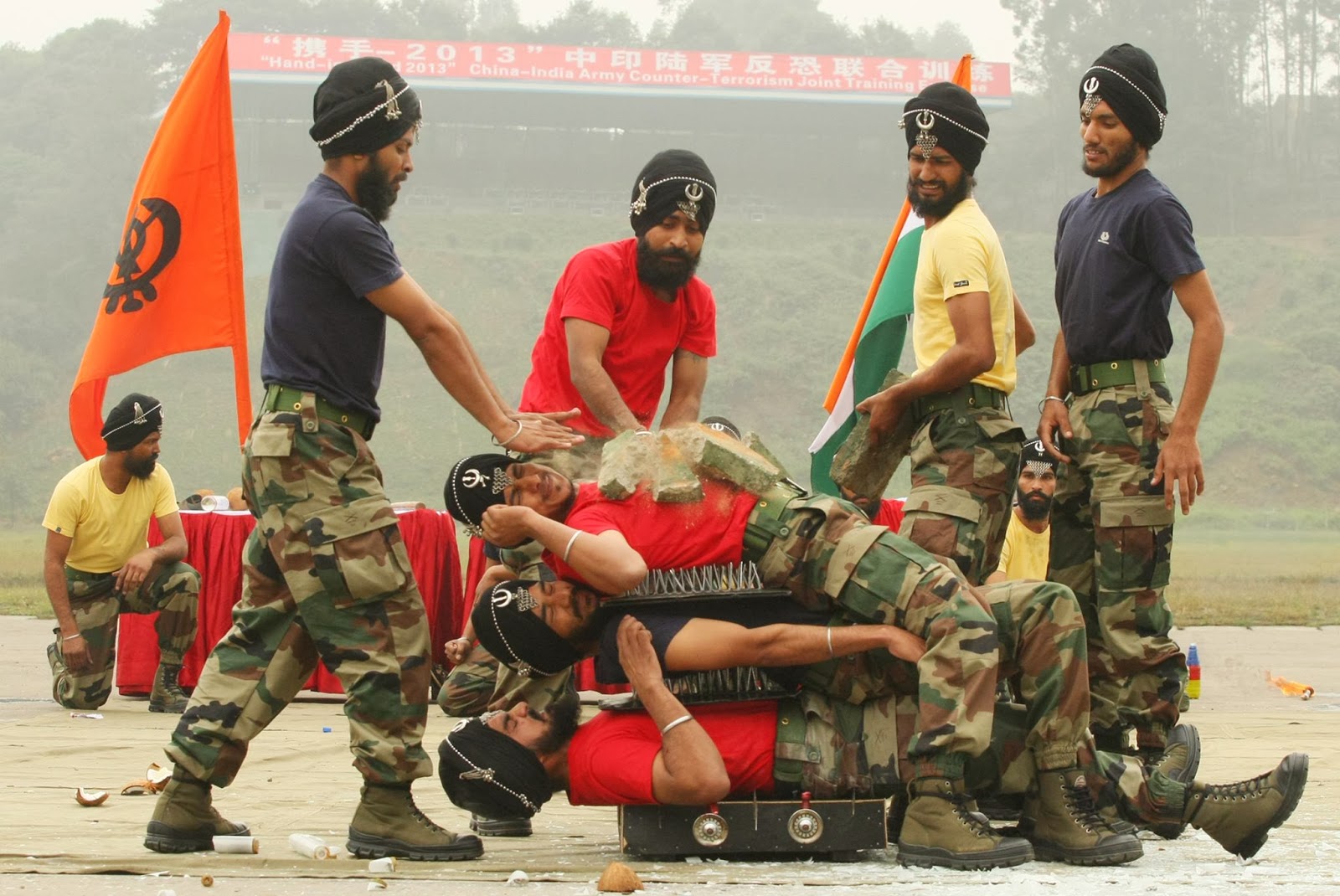
Who are the Joint India-China anti-terror exercices targetting?

The Indian press as well as Xinhua and The Global Times have reported the joint military exchanges betwen India and China.
Xinhua wrote: "The Chinese and Indian armies started a joint anti-terrorism military training drill in Southwest China's Sichuan Province. During the training, code-named 'Hand-in-Hand 2013', participating soldiers will conduct drills in tactical hand signals, arrest and escort, hostage rescue and joint attack, as well as a comprehensive anti-terror combat drill. China and India each sent one company of 144 soldiers to participate in the drill."
This is third edition of the exercises between the two countries. The previous drills, under the same code-name 'Hand-in-Hand' were held in Kunming in China in 2007 and Belgaum in Karnataka in 2008.
This time, the 16 Sikh Light Infantry of India and 1st Battalion Infantry Division of 13 group PLA participated.
Chinese troops from the 1st Company of Infantry Battalion of Chengdu Military Area Command and the Indian Army troops from 8 Maratha Light Infantry Battalion took part in 'Hand-in-Hand 2008'.
The 'Hand-in-Hand 2007' involved 103 ground troops from the PLA and an equivalent number from the Indian Army belonging to 15 Jammu and Kashmir Light Infantry (JAK LI). It was held at the PLA's Kunming Military Academy in Yunnan Province.
There is a disturbing question: these anti-terror exercises are directed at who? At the Tibetans? At the Uigyurs who have been branded 'terrorists' after the recent Tiananmen incident?
Obviously, the official communique does not tells us.
Xinhua however mentions: "Yang Jinshan, head of a Chinese military observer delegation and deputy commander of the Chengdu Military Area Command of the People's Liberation Army of China, said the training is intended to exchange anti-terror experiences, enhance mutual understanding and trust, and boost cooperation between the Chinese and Indian armies."
Who is Lt. Gen. Yang Jinshan?
Lt. Gen. Yang Jinshan is a member of the all-powerful 18th CPC Central Committee
He is born in 1954 in Xi County of Henan Province. He joined the Communist Party in 1972. He headed the PLA’s Armament Department of Chengdu Military Region from 2007 to 2009. He later became Commander-in-Chief of Tibet Military District under Chengdu Military Area Command.
In November 2012, he was elected member of the Central Committee of China's Communist Party (CCP).
General Yang had become a major general in 2005 and a lieutenant general in 2011. He served most of his career in Chengdu (Sichuan) and Tibet.
He was (is) probably the PLA representative in the Central Tibet Work Coordination Working Group, the group which decides the Party's policies for Tibet and their implementations on the ground.
Today, General Yang is one of the 5 or 6 Deputy Commanders of Chengdu Military Area Command. He probably continues to look after Tibet affairs, which means all military/security issues as well as borders with India and Nepal. He also liaises with the People's Armed Police Forces as well as the Public Security Bureau and the Peoples' Liberation Army Air Force.
Here are some pictures of the successive 'Hand-in-Hand' exercises:


Pictures of the recent joint exercises 


Sunday, April 28, 2013

China’s dream is India’s nightmare

My article China's Deeam is India's Nightmare appeared in NitiCentral.com
 
Whatever will happen in future in Ladakh, India has already lost the battle. Even if the Chinese agree to withdraw, they will still claim that particular area near the Karakoram pass as theirs and this, forever.
Though the Chinese incursions or transgressions, as it is poetically termed by the MEA, occur regularly, this time it was much deeper than usual and while during ‘routine visits’, Chinese troops come and go (after leaving some ‘souvenirs’ of their visit, such as rock paintings in red colour), this time, they came with their tents and provisions. It is a big difference.
Postponing Premier Li Keqiang's visit to India next month could have been an option for India to show its displeasure. Unfortunately, the present leaders do not have the political will.


Click here to continue...