Showing posts with label Hu Yaobang. Show all posts

Friday, July 23, 2021

The Return of Hu Yaobang ...and Xi Jinping

Yesterday, Xi Jinping visited Nyingchi near the Indian border of Arunachal Pradesh and Lhasa.
I will come back later on the visit, but this reminded me the visit of CPP's General Secretary Hu Yaobang in May 1980.
It was truly important visit to Tibet, not for the show, like yesterday.
 
 
This article in the Epoch Times (affiliated with the Falun Gong group) says that a number of Chinese publications have commemorated the death anniversary of Hu Yaobang, the former CCP's General Secretary. 
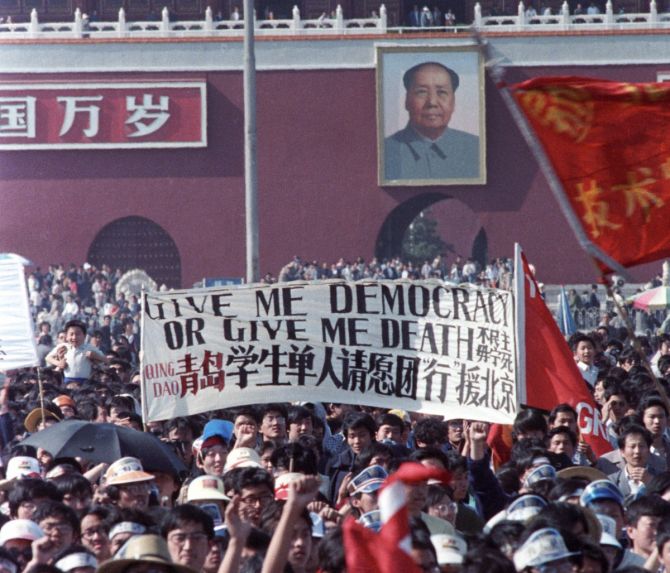
Hu has been a great reformer and it is his death which triggered the Tiananmen events in 1989.
For Tibet also, the tenure of Hu Yaobang brought positive changes on the ground, especially after his visit to Lhasa in May 1980.
I am posting here the report of his visit written by one of his close collaborator, Wang Yao.
This shows that with a more open leadership, many things could change on the Roof of the World (and in China). 

File photo dated April 14, 199
Report of the visit of Comrade Hu to Tibet
During the week from May 22 to May 31, 1980, Hu Yaobang led a Working Group of the Party Central Committee (PCC) to visit and inspect Tibet. This event was watched with great interest by those, both at home and abroad, who were concerned with Tibetan society, and it can be said that this event marked the beginning of a new era for the PCC's Tibet policy. In the ten years that followed that visit history marched on with its strong steps, leaving behind impressive footprints: amongst them, indisputably, the open door, a revitalised economy, changes in the social structure and an improvement in people's lives. As for Hu Yaobang himself, he experienced his ups and downs with officialdom and left the world with his ambitions unfulfilled on April 15, 1989. The great honours that were paid to him at his funeral could not make up for the regrets during his life. But the past has passed. According to Chinese custom, final judgment can only be passed on Hu when the lid is placed on his coffin, and this note is a reflection on the historical significance of Hu's visit to Tibet, as a mark of respect to him and as a way of cherishing the memory of a great man. 
The Composition and Timing of the Working Group The importance of the Central Committee's Working Group can be judged from Wan Li's description of it: “This is the first working group to be formed since Comrade Hu Yaobang became the General Secretary after the new secretariat was formed at the Fifth Plenary Session of the Eleventh Central Committee.” The Working Group was composed principally of five people:
Hu Yaobang, the General Secretary of the Central Committee and a member of the Standing Committee of the Politburo of the Central Committee; Wan Li, member of the Central Committee and Vice-Premier of the State Council; Ngapo Ngawang Jigme, the Vice-Chairman of the National People's Congress; Yang Jingren, member of the Central Committee and the Head of the State Commission of Nationalities Affairs, and Zhao Zhengqing, Vice-Minister of the Organisation Department of the PCC. There were several other staff members, amongst whom I was the only one who was not a government official. Edgar Snow, as an old friend of the Party leadership who knew their working style quite well, once said, 'Nothing carried out in public by the leaders of the Central Committee is ever casual or without significance.' This was true of the date chosen for the visit, and there were at least three reasons which led the Working Group to select May 22 as the date when it should arrive in Lhasa. First, the date indicated that the Central Government's policy on Tibet was based on the 'Seventeen-Point Agreement'. This was the agreement (entitled in full, 'Seventeen Points for the Peaceful Liberation of Tibet') signed in the Qinzheng Hall in Zhongnanhai, Beijing, on May 23, 1951, after a long period of discussion and consultation, by the delegation of the Central People's Government, headed by its plenipotentiary Li Weihan, and the delegation of the Tibetan Regional Government, headed by plenipotentiary Ngapo. That agreement marked the first time since its victory in the domestic revolution that the Chinese Communist Party had found a point of convergence with the Tibetan regional government; it was also the first agreement, based on compromise and harmony, which was acceptable to all the political forces in Tibet. It thus became the governing principle in Tibetan work and policy for a long period. Secondly, the choice of date pointed out that the Central Government was willing to settle matters through consultation with the local people. Thirdly, it aimed to show the
Central Government's wish to restore the harmonious atmosphere of cooperation which had prevailed in the early 1950s. The Working Group arrived at Gongkar airport near Lhasa at 10 a.m. on May 22, and two hours later had reached Lhasa and begun its meetings with the Tibetan leaders. Hu Yaobang came straight to the point by asking Paba-la [Phagpa-la Gelek Namgyal] a question:”Comrade Paba-la, what is tomorrow?” This summed up the feelings and intentions of the Group. At the cocktail party held on May 23 to celebrate the 39th anniversary of the Seventeen-Point Agreement, Wan Li held the hands of Sampho Tenzin Dundhup and said: 'You have rendered an outstanding service to history! Thank you!' Apart from Ngapo, Sampho was the only surviving member of the delegation sent by the Tibetan government who had signed the Agreement. He had just been released after nearly twenty years in labour camps. 

Hu Yaobang's Speech 
On May 29 Hu Yaobang made a very sincere and passionate political speech at a gathering of 5,000 cadres in Lhasa. The slogan put forward in the speech was 'Strive to build a united, prosperous and civilised new Tibet' ('Wei jianshe tuanjie fuyu wenmingde, xin Xizang xiang nuli douzheng'). In the speech Hu listed six tasks facing Tibet:

1. To exercise nationality autonomy in the region fully - that is to say, to let Tibetans really be the masters of their own lives. 
2. A commitment by the Central Government to relieve and reduce burdens of the people, exempting the from agricultural and animal husbandry tax over the next three to five years in order to allow the Tibetan people a chance to recover.
3. To adopt a special policy to revive the Tibetan economy, including the adoption or a system of private economy in line with Tibetan circumstances. Nationwide this initiative was developed into the economic (household) responsibility system. 
4. To make great efforts to develop agriculture and animal husbandry as well as the manufacture of consumer goods, in order to promote economic prosperity and enrich people's lives. 
5. To make efforts to develop Tibetan science, culture and education, and to prepare for the establishing of the University of Tibet. 
6. To implement the policy on minority nationality cadres correctly, to strengthen the unity between the Han and Tibetan cadres, and to transfer a large quantity of Chinese cadres who had worked in Tibet for many years back to the interior. 

Naturally, these six tasks were endorsed and supported by the Tibetan people. The atmosphere was very lively both inside and outside the meeting. Hu Yaobang was an excellent orator and his address was received with waves of warm applause, especially when he admitted very frankly:  'Our present situation is less than wonderful because the Tibetan people's lives have not been much improved. There are some improvements in some parts, but in general, Tibetans still live in relative poverty. In some areas the living standards have even gone down. We comrades in the Central Committee, Chairman Hua as well as several vice-chairmen, were very upset when we heard about this situation. We feel that our party has let the Tibetan people down. We feel very bad! The sole purpose of our Communist Party is to work for the happiness of people, to do good things for them. We have worked nearly thirty years, but the life of the Tibetan people has not been notably improved. Are we not to blame? If we don't make this
clear, people won't let us oft the hook; party members won't let us get away with it!' What he said touched people's hearts. They admired him for his statesmanship and his broad-mindedness as a true Communist. It was open and honest, dared to act, dared to face reality and dared to bear responsibility. Ten years later Hu Yaobang's words still ring out forcefully. To this day, the Tibetan people still keep his likeness in their hearts, referring to him affectionately as 'sku-zhabs Hu' [Gentleman Hu].  The Two Cordial Conversations  In the first of the Two Cordial Conversations, Hu Yaobang invited three leading Tibetan cadres, Dorje Tseten, Lobsang Tsultrim, and Phuntsog Tashi, to the hotel in which he was staying in Lhasa. Hu, in his sitting room, opened his hearts to them and said: 'You are all exemplary Tibetans. You are leaders as well as communists; the Tibetan cause relies on you. I hope that you will make further contributions towards the construction of a united, prosperous and civilised new Tibet. I did not know you before, but now we have become friends. Tibetan affairs will rely on you. You can directly come to see me if there are any problems.' These three men were later appointed to important Positions. Dorje Tseten became Director of the TAR Department of Education, First Secretary of the Lhasa Party Committee, and Chairman of the TAR People's Government. Now he is the Director of the China Tibetology Center in Beijing. Lobsang Tsultrim was appointed as the Director of the TAR Party Committee's Department of Organisation, and as the vice-Chairman of the Standing Committee of the Tibetan People's Congress. Unfortunately, he died of a heart attack shortly afterwards. Phuntsog Tashi became at various times in his career the Director of Publications for the Tibetan
Administration, the vice-Chairman of the Tibetan People's Congress and the vice-Chairman of the Social Science Academy. Now he is the vice-Director of the China Tibetology Center. In the second of the Two Cordial Conversations, Hu invited two leading figures of the Old Tibet to talk with him. Sholkhang Thubten Nyima and Chapei Kelsang Wangdu were old acquaintances of Hu, who as members of the Chinese Youth Delegation had been to visit Moscow and Bucharest with him in the 1950s. Hu did not forget his old friends although thirty years had passed. Hu held their hands and chatted delightedly. He looked back over their past friendship and hoped that they would guide the patriotic leading figures of the old Tibet to strive together to construct a new Tibet. Before long, Sholkhang Thubten Nyima was appointed as the vice-Director of the Tibetan Cultural Department and the vice-Chairman of the People's Political Consultative Conference of the TAR, and Chapei Kelsang Wangdu later became the Director of the People's Bank of the TAR.
Beijing Leadership Dares to Reawaken June 4 Memories
Hu Yaobang, leader memorialized in 1989 by the Tiananmen students, is commemorated
Epoch Times
Matthew Robertson
April 5, 2012

In a sign that Chinese Communist Party head Hu Jintao and Premier Wen Jiabao are willing to inflame the Chinese people’s long-suppressed hopes for political reform, dozens of Chinese newspapers have recently run articles commemorating former Chinese leader Hu Yaobang, Wen’s mentor and the epitome of a reformist cadre.
Hu Yaobang’s death on April 15, 1989, and the commemoration of it, was the main fuse for the massive outpouring of protests that were violently suppressed in Beijing on June 4 that year. His name has always been associated with the Tiananmen Square massacre, and thus has been mostly ignored or suppressed in official media.
The occasion for the recent news is China’s Qingming festival, usually falling on April 4 or 5, a time when Chinese pay tribute to their deceased family members, including visiting and cleaning their graves.
An article in China News Service, the Communist Party’s Chinese-language mouthpiece outside China, celebrated the man.
Titled “Hu Yaobang Tomb’s During Qingming Festival: He is long dead but masses remember him,” the article appeared in other official Chinese media outlets and was forwarded widely on major news portals.
Hu was responsible for politically rehabilitating hundreds of thousands of people who had been persecuted or given class labels by Mao, and he energetically sought political and economic reforms before being ousted for “laxness” in fighting against “bourgeois” elements in 1987.
Qingming, also known as the grave sweeping festival, has serious political connotations in China. The April 5 movement of 1976, where hundreds of thousands gathered in Tiananmen Square mourning Zhou Enlai and attacking the Gang of Four, and the June 4 democracy protests, were both connected with the traditional Chinese celebration.
The article says that near to the 23rd anniversary of Hu’s death, over 80 CCP leaders and 200 provincial and ministerial-level cadres have paid respects at his tomb.
“This large-scale commemoration activity is a way for Hu Jintao and Wen Jiabao to strike out at Bo Xilai’s Cultural Revolution-style politics,” said Zhang Tianliang, a commentator on Chinese politics, in an interview. Zhang said that Zhou Yongkang, the security czar and supporter of ousted Chongqing Party chief Bo Xilai, will also take notice.
Seen through the prism of the current political struggle, Hu Yaobang is a paragon of the reformist camp. He is also Wen Jiabao mentor, who seeks to emulate the late leader. The high-profile coverage brings to greater prominence these reformist themes—but whether it will manifest in concrete actions, like freedom of the press, the ceasing of religious persecutions, and the dismantling of labor camps, has yet to be seen, Zhang said.
“Hu and Wen’s priorities are to gain the confidence of the international community, and put pressure on the hard-line elements in the Chinese Communist Party,” says Wen Zhao, a current affairs commentator for the New York-based NTD Television. “They want to make sure that hard-liners such as Bo and Zhou Yongkang don’t act rashly,” he said.
One widely forwarded microblog post referred to the news and remarked on how widely it had been posted on the Chinese Internet. “What wind is this now blowing?”
With reporting by Xue Fei and research by Ariel Tian.

Friday, June 4, 2021

Is Xi Scared of Tiananmen 1989?

They gave Death
My article Is Xi Scared of Tiananmen 1989? appeared in Rediff.com

Why omit the Tiananmen massacre from the history of China's Communist party? asks Claude Arpi.

Here is the link...

Since the beginning of the year, China has started celebrating the 100 years of the Communist Party of China.
For the occasion, Chairman Xi, the new Mao, has decided to teach the history of Modern China to everyone in China; every citizen should “learn about a century of party history and write a new great legend [for the Party].”
An article in Xinhua states: “General Secretary Xi Jinping attaches great importance to the Party history study and summarizes the main content of Party history study into 16 words, namely, "learning history to be clear [about the role of the Party], learning history to increase credit [points], learning history to respect morality, and learning history to practice [Communism].”
The ‘credit points’ refer to the way the totalitarian regime is keeping a tab on its citizens, by crediting (or debiting) each and every Chinese for his/her actions; even the most seemingly insignificant deed is recorded into the Communist Party’s mega computers’ memory.
The News Agency adds: “…The new journey of a modern socialist country has started well.”
On March 1, 2021, Xi addressed the young cadres at the Central Party School in Beijing; he told them that they were the successors of the old comrades, “the glory of the party is in your hands”, and exhorted them to be the “faithful successor of the tradition and fine work-style of the Communist Party, constantly enhancing willpower, perseverance and self-control and making contributions in the new journey of comprehensively building a modern socialist country in the New Era!” And, of course, “loyalty to the party is the primary political quality of Communists,” he added.
The words of the new Great Helmsman sound good, but there is another side to it; there are black (or ‘bloodied’ red) holes in the official history.
One of the ‘red’ holes occurred 32 years ago, on Tiananmen Square.
If Beijing has forgotten, the world has not.

The Black Book of Communism

In 1997, French scholar Stéphane Courtois, along with other European academics, published Le Livre noir du communisme which was later translated in several languages under the title The Black Book of Communism: Crimes, Terror, Repression.
The Black Book sold tens of millions of copies; it is still considered by many as one of the most influential publications written about the history of Communism in the 20th century. The authors documented the history of political repression by Communist states, including genocides, extrajudicial executions, deportations, killing populations in labour camps as well as artificially-created famines.
In the first chapter, The Crimes of Communism, Stéphane Courtois quoting Plato’s Republic and Thomas More as Communist examples of ‘utopian philosophy’, Courtois explains, “We must make a distinction between the doctrine of communism and its practice. As a political philosophy, communism has existed for centuries, even millennia.”
Courtois gave figures, people killed by Communist governments amount to more than 94 million, including 65 million in the People’s Republic of China, 20 million in the Soviet Union, 2 million in Cambodia, 2 million in North Korea, 1.7 million in Ethiopia, 1.5 million in Afghanistan, 1 million in Vietnam.
In China alone, there is no doubt today that the Great Leap Forward resulted in 40 to 50 million deaths. According to Frank Dikötter in his masterly Mao’s Great Famine: The History of China’s Most Devastating Catastrophe, 45 million people died unnecessarily. Yang Jisheng in Tombstone: The Great Chinese Famine, 1958–1962 put the tally between 43 million and 46 million.

No candle vigil any more

In the past, Hong Kong used to commemorate the Tiananmen Square events, today, the former British colony have banned to do so.
A historical event is worth recalling.
Dr Zhisui Li, Mao's private physician recorded the death of Zhou Enlai, the Chinese Premier and Mao Zedong’s reactions to it in 1976, Dr Li wrote: 'Beginning in mid-March, knowing that the Qing Ming festival for honoring the dead would be celebrated on April 4, the citizens of Beijing began going to the Monument to the Revolutionary Heroes in Tiananmen Square to place mourning wreaths for Zhou. The movement was spontaneous, and the crowds grew larger by the day. The country had not witnessed such an outpouring of popular sentiment since before the Communists came to power in 1949.”
As April 4 approached, Dr Li visited Tiananmen clandestinely: 'The Square was filled with tens of thousands of people singing, making speeches, and reading poems. The mourning wreaths stretched from the Monument to the Revolutionary Heroes in the centre of the square all the way to Changan Avenue just in front of the Gate of Heavenly Peace. …It was impressive and moving.”
A similar event occurred in 1989, 13 years later.
Though Hu Yaobang had been sacked as the secretary general of the Chinese Communist Party in January 1987, he was still a member of the Politburo and entitled to attend important meetings. On April 9, 1989, after uttering some strong words on the Communist Party's failures, the respected Hu Yaobang had a stroke. A week later he passed away (similarly, the Panchen Lama had a ‘stroke’ when he mentioned the misdeeds of the Party in January 1989 in Shigatse, Tibet).
The death of Hu Yaobang was the beginning of the largest spontaneous student revolution since 1919.
During the following days and weeks, the students demanded freedom of speech and the press, democratic elections, greater transparency in government dealings.
The students believed that Hu Yaobang had been sacked though he had followed 'correct' policies. They demanded that the government “should affirm as correct Hu Yaobang's views on democracy and freedom.”
When The People's Daily termed the first spontaneous demonstrations as 'turmoil', the events took a new turn. For the students, the word 'turmoil' (‘dongluan’) had a strong meaning in Chinese reminiscent of the black days of the Cultural Revolution.
Zhao Ziyang was then the Party’s General Secretary; having the same conviction as Hu Yaobang, he thought that a possibility of political reform existed in Communist China. During the following weeks, he constantly tried to negotiate a compromise with the students. This could have changed the Middle Kingdom's fate.
We know what followed: during the night of June 3, Premier Li Peng ordered the tanks to roll out on the Square. Several thousand students lost their lives that night. The Party was saved and the fate of China was sealed (at least for the next few decades). One of the many ironies was that Li Peng was Zhou Enlai's adopted son.
In the meantime, the history of Modern Tibet is also rewritten; forgotten are the hundreds of thousands dead or the complete destruction of innumerable monasteries; on May 23, the Communist Party celebrated the 70th anniversary of the ‘Liberation of Tibet’, when the Dalai Lama’s representatives were forced under duress to sign that Tibet had ‘returned’ to the Motherland (China).
On the occasion, the local press in Lhasa reported: “Early in the morning, in the Potala Palace Square, the golden characters of the Tibet Peaceful Liberation Monument shined brightly. As evidenced by the monument, the peaceful liberation of Tibet 70 years ago not only shattered the delusional attempts of external forces to separate Tibet from China, safeguarded national sovereignty and territorial integrity, safeguarded the unity of the motherland and ethnic unity, and opened up the liberation of millions of serfs.” The Communist newspaper added: “This is a new day, and the sun shines all over the snowy plateau.”
The Xinhua article quoted earlier, concluded: “Looking back on the party’s history …our party has always adhered to the original aspiration and mission of seeking happiness for the Chinese people and rejuvenation for the Chinese nation, and it has never hesitated to advance toward this goal, thus winning the sincere and firm support of the people.”
If it was true, why omit the Great Leap Forward, the Cultural Revolution or the Tiananmen massacre from the history of the Party? It should at least have been analyzed to understand what went wrong; hiding a large portion of history does not give credibility to the Party.
Similarly, the Party is today hiding what happened in Wuhan.
It is time the world starts pressurizing Beijing to tell the truth.

Friday, July 27, 2018

Li Keqiang on The Roof of the World

Two big news today.
First, Premier Li Keqiang made an ‘inspection tour’ in Tibet.
And then Lt Gen Lui Xiaowu, a Deputy Commander of the Western Theater Command, who was recently in India, would have been put under ‘investigation’.
If confirmed, it is a serious news.

Li Keqian on The Roof of the World
China Tibet Online reported that Chinese Premier Li Keqiang visited Southern Tibet on July 25. Apparently Li went directly to Nyingchi (Nyingtri) prefecture (City) bordering Arunachal Pradesh. He visited a village (Shiga village) in Mailing County in Nyingchi City; it is a new village inhabited by Monpas. According to the press release, the inhabitants of this ‘Monpa’ village have been relocated from 'impoverished areas'.
The ‘impoverished’ region is located next door is Metok Dzong (County).

Poverty alleviation
The Premier went to the new house of a Tibetan named Kunsang.
He sat with the ‘migrant’ family and talked to the six members of the household about their daily life.
He would have asked:
What is the main source of income?
How much could you make in a year?
What about your health care and children’s education?
What kind of difficulties do you still have now?
It is said that the Premier Li listened patiently.
Kunsang told Li that his family moved from Metok County, where “road travel is fairly difficult”.
This is rather surprising considering that since 2013, when a tunnel was opened, the Chinese propaganda has been insisting on the ‘changes’ in Metok, principally mentioning better communications. Read my post, Metok and the Tourist Boom
The question is why to move people to a nearby County, if the situation had improved so much in the first place?
Kunsang explained to the Premier that his family has now an income of 150,000 yuan a year (US $ 2,400), thanks to farming and tourism. Further, the State “ensured health care service and children’s education program.”
We are told that there are a total of 72 households in the new village and 90% of families have similar income.
Li was said to have been really pleased “to see that the villagers have cast off poverty, though the relocation program and lived a prosperous life.”
The Premier wished the family an even more prosperous life in the future.
It is difficult to understand why this family was shifted from Metok to Mainling County.
Were they creating problems for the Chinese government in Metok, near the Indian border?
It is possible.
Metok, like several other places on the border (Yumed, Tsona, Lepo, Marmang, Rima, etc) has been the focus of very generous investments from the Central Government, the local government as well as different Provincial Governments.
So, it is doubtful if ‘poverty alleviation’ is the only reason.

Education
Li Keqiang spoke to Kunsang’s daughter, the six-year-old Yeshe Drolma, and asked her if she was going to going to school.
The answer was obvious as the Party would have not selected an 'illiterate' family to receive the Premier.
The little Yeshe Drolma, dressed in Monpa costume, said that she was in the senior class of the kindergarten.
Li asked her to write a few words (all this must have been scripted in detail before).
Yeshe wrote her name both in Chinese and Tibetan on a paper and showed it to Li who said, “Wish you could learn hard and grow to be as intelligent and beautiful as your name says”.
According to the Chinese website Yeshe Drolma means ‘Intelligent Fairy’.
In fact, Drolma is Tara, the Mother of the Tibetans.

Reallocation of restive populations
This ‘reallocation’ of population reminded me an article published on July 6 in The People's Daily.
It speaks of the situation in Xinjiang and said that Beijing has relocated “461,000 poverty-ridden residents to work in other parts of the region during the first quarter of the year.”
An ‘expert’ explained to the mouthpiece of the Party that it is a bid to ‘improve social stability and alleviate poverty’. The report asserted that the Xinjiang government planned to further transfer 100,000 residents from southern Hotan and Kashgar prefectures by 2019, to get employed somewhere else.
Yu Shaoxiang, another ‘expert’ at the Chinese Academy of Social Sciences, admitted to The Global Times: “poverty alleviation in Xinjiang is more difficult compared to other places because, aside from poverty, Xinjiang also faces ethnic issues.”
Yu further commented: “Organizing people to work away from home would help them better integrate with the rest of China, and take their advanced skills back to Xinjiang later. The relocation also helps maintain regional security.”
Xinhua News Agency said that in 2017, ‘occupational education programs’ covered 1.26 million people in Kashgar and Hotan, where 47,000 poor people found jobs while 317,400 individuals and 331 villages were lifted out of poverty. It is obviously a pretext in an area which is the hub the Belt and Road Initiative (BRI).
It is clear that reallocation is linked with ‘ethnic issue’.
It is rather worrying knowing that the visit of the Premier to Tibet takes place just before the yearly summer retreat of the Party’s top bosses in Beidaihe, which is always the occasion to discuss ‘new’ policies.
Will reallocation of Tibetans withing Tibet from border areas be discussed?
A new Chen's Policy adapted to Tibet?
There is no doubt that the Mainling Country is less strategic than the Metok area, though Bayi, the PLA garrison is not located far away (it is the neighbouring County in Nyingchi).

A remark
It is usually the Chairman of the Chinese People's Political Consultative Conference (Yu Zhengsheng and now Wang Yang) who is responsible for 'looking after' Tibet. 
The head of the United Front Work Department (Sun Chunlan for example) also regularly 'inspects' the Roof of the World.
It is usually not the job/responsibility of the Chinese Premier to look into Tibet affairs.
One more reason why this visit is very special. 

First visit of a Premier
Another consideration, Li Keqiang, No 2 in the all-powerful in the Standing Committee of the Politburo, is the seventh Premier of China.
Before him, Zhou Enlai (1949–1976), Hua Guofeng (1976–1980), Zhao Ziyang (1980–1988), Li Peng (1988–1998), Zhu Rongji (1998–2003) and Wen Jiabao (2003–2013), served as Premiers.
None of them visited Tibet.
Why to send the Premier if there was not something big cooking?
We will have to wait a few days (or months) to know more.
The other 'important' visit to Tibet were:
But relocations of recalcitrant Tibetans would be dreadful scheme and not a good signed for the health of the People’s Republic, which appears more and more nervous.

A few questions
  • Since when is the Chinese Premier looking after Tibetan affairs?
  • Will Li meet the Chinese Panchen Lama Gyatsen Norbu while in Tibet?
  • Will he visit Bayi, the Chinese garrison in Nyingchi City and meet the border troops?
  • Will he visits other Prefectures/Cities in the Autonomous Region?
(Gen Liu with the Vice-Chief of the Indian Army)
Gen Lui Xiaowu
The second news is that according to The Epoch Times, Lt Gen Lui Xiaowu, who headed a PLA delegation in India earlier this month, would be under investigation.
To be followed…


Saturday, November 21, 2015

A great Chinese leader: Hu Yaobang

Hu Yaobang in Tibet
Something special happened in China on Friday.
President Xi Jinping honoured the memoir of Hu Yaobang,the liberal Communist Party boss whose death in April 1989, triggered widespread mourning in China, and culminated in the Tiananmen pro-democracy movement a few weeks later.
On Friday, China celebrated the birth centenary of the reformist leader with an official function attended by Xi Jinping and his 6 colleagues of the Standing Committee of the Politburo.
According to Xinhua, Xi Jinping stated: "To commemorate Hu Yaobang is to learn from his noble character, which was based on keeping the faith and being dedicated."
Xi asked all Chinese Communists "to have similar firm faith and ideals, and be more confident in Chinese socialist roads, theories and systems."
The Chinese President added that one should learn from Hu's spirit to always seek truth from facts and to blaze new trails.
Hu always stressed that Communists must 'seek truths from facts'; it is the basic requirement, and attempts to abandon this will result in setbacks, Xi said.
The President called for a clean political environment, social ethics, and asked the Party members "to win the trust and support of the general public with down-to-earth efforts."
It is the first time that China honours Hu in such way since 1989.
The South China Morning Post quoting an unidentified source, said: “The atmosphere at the ceremony held at Beijing’s Great Hall of the People was very, very moving."
The function was not reported in advance by the State media, though, The People’s Daily had earlier mentioned the publication of a collection of 77 of Hu’s essays and speeches between 1952 and 1986 – a year before he was purged.
One of the documents is an order passed by Hu to vindicate the people wrongly accused in the Cultural Revolution (1966-76).
The mouthpiece of the Party quoted Hu: “The cases where people were wrongly and unjustly accused must be corrected as quickly as possible.”
Hu Yaobang died on April 15, 1989, from a heart attack.
Hundreds of thousands turned out on the streets of Beijing to pay their homage to the reformist leader.
This event marked the beginning of the Tiananmen pro-democracy movement, which ended in the June 4 crackdown.
The liberal leader visited Lhasa in Tibet in May 1980.
I am posting here a report by Wang Yao who accompanied Hu in Lhasa.
During a speech, Hu told the Party cadres that the Tibetans should "exercise nationality autonomy in the region fully - that is to say, to let Tibetans really be the masters of their own lives."
This is not far from the 'genuine autonomy' asked by the Dalai Lama today.
With Hu Jintao and Wen Jiabao

Hu Yaobang's Visit to Tibet

May 22-31, 1980
An Important Development in the Chinese Government's Tibet Policy
by Wang Yao

During the week from May 22 to May 31, 1980, Hu Yaobang led a Working Group of the Party Central Committee (PCC) to visit and inspect Tibet.
This event was watched with great interest by those, both at home and abroad, who were concerned with Tibetan society, and it can be said that this event marked the beginning of a new era for the PCC's Tibet policy.
In the ten years that followed that visit history marched on with its strong steps, leaving behind impressive footprints: amongst them, indisputably, the open door, a revitalised economy, changes in the social structure and an improvement in people's lives.
As for Hu Yaobang himself, he experienced his ups and downs with officialdom and left the world with his ambitions unfulfilled on April 15, 1989. The great honours that were paid to him at his funeral could not make up for the regrets during his life. But the past has passed.
According to Chinese custom, final judgement can only be passed on Hu when the lid is placed on his coffin, and this note is a reflection on the historical significance of Hu's visit to Tibet, as a mark of respect to him and as a way of cherishing the memory of a great man.
The Composition and Timing of the Working Group The importance of the Central Committee's Working Group can be judged from Wan Li's description of it: 'This is the first working group to be formed since Comrade Hu Yaobang became the General Secretary after the new secretariat was formed at the Fifth Plenary Session of the Eleventh Central Committee.' The Working Group was composed principally of five people: Hu Yaobang, the General Secretary of the Central Committee and a member of the Standing Committee of the Politburo of the Central Committee; Wan Li, member of the Central Committee and Vice-Premier of the State Council; Ahpeiahwangjinmei [Ngapo Ngawang Jigme], the Vice-Chairman of the National People's Congress; Yang Jingren, member of the Central Committee and the Head of the State Commission of Nationalities Affairs, and Zhao Zhengqing, Vice-Minister of the Organisation Department of the PCC.
There were several other staff members, amongst whom I was the only one who was not a government official. Edgar Snow, as an old friend of the Party leadership who knew their working style quite well, once said, 'Nothing carried out in public by the leaders of the Central Committee is ever casual or without significance.'
This was true of the date chosen for the visit, and there were at least three reasons which led the Working Group to select May 22 as the date when it should arrive in Lhasa.
First, the date indicated that the Central Government's policy on Tibet was based on the 'Seventeen-Point Agreement'. This was the agreement (entitled in full, 'Seventeen Points for the Peaceful Liberation of Tibet') signed in the Qinzheng Hall in Zhongnanhai, Beijing, on May 23, 1951, after a long period of discussion and consultation, by the delegation of the Central People's Government, headed by its plenipotentiary Li Weihan, and the delegation of the Tibetan Regional Government, headed by plenipotentiary Ahpeiahwangjinmei. That agreement marked the first time since its victory in the domestic revolution that the Chinese Communist Party had found a point of convergence with the Tibetan regional government; it was also the first agreement, based on compromise and harmony, which was acceptable to all the political forces in Tibet. It thus became the governing principle in Tibetan work and policy for a long period.
Secondly, the choice of date pointed out that the Central Government was willing to settle matters through consultation with the local people.
Thirdly, it aimed to show the Central Government's wish to restore the harmonious atmosphere of cooperation which had prevailed in the early 1950s. The Working Group arrived at Gong Ga [Gongkar] airport near Lhasa at 10 a.m. on May 22, and two hours later had reached Lhasa and begun its meetings with the Tibetan leaders. Hu Yaobang came straight to the point by asking Paba-la [Phagpala Gelek Namgyal] a question:”Comrade Paba-la, what is tomorrow?” This summed up the feelings and intentions of the Group.
At the cocktail party held on May 23 to celebrate the 39th anniversary of the Seventeen-Point Agreement, Wan Li held the hands of Sangpodunzhengdunzhu [Sampho Tenzin Dundrup] and said: 'You have rendered an outstanding service to history! Thank you!' Apart from Ahpeiahwangjinmei, Sangpodunzhengdunzhu was the only surviving member of the delegation sent by the Tibetan government who had signed the Agreement.
He had just been released after nearly twenty years in labour camps.

Hu's Speech
On May 29 Hu Yaobang made a very sincere and passionate political speech at a gathering of 5,000 cadres in Lhasa. The slogan put forward in the speech was 'Strive to build a united, prosperous and civilised new Tibet' ('Wei jianshe tuanjie fuyu wenmingde, xin Xizang xiang nuli douzheng').
In the speech Hu listed six tasks facing Tibet:
  1. To exercise nationality autonomy in the region fully - that is to say, to let Tibetans really be the masters of their own lives.
  2. A commitment by the Central Government to relieve and reduce burdens of the people, exempting the from agricultural and animal husbandry tax over the next three to five years in order to allow the Tibetan people a chance to recover.
  3. To adopt a special policy to revive the Tibetan economy, including the adoption or a system of private economy in line with Tibetan circumstances. Nationwide this initiative was developed into the economic (household) responsibility system.
  4. To make great efforts to develop agriculture and animal husbandry as well as the manufacture of consumer goods, in order to promote economic prosperity and enrich people's lives.
  5. To make efforts to develop Tibetan science, culture and education, and to prepare for the establishing of the University of Tibet.
  6. To implement the policy on minority nationality cadres correctly, to strengthen the unity between the Han and Tibetan cadres, and to transfer a large quantity of Chinese cadres who had worked in Tibet for many years back to the interior.
Naturally, these six tasks were endorsed and supported by the Tibetan people. The atmosphere was very lively both inside and outside the meeting. Hu Yaobang was an excellent orator and his address was received with waves of warm applause, especially when he admitted very frankly:
'Our present situation is less than wonderful because the Tibetan people's lives have not been much improved. There are some improvements in some parts, but in general, Tibetans still live in relative poverty. In some areas the living standards have even gone down. We comrades in the Central Committee, Chairman Hua as well as several vice-chairmen, were very upset when we heard about this situation. We feel that our party has let the Tibetan people down. We feel very bad! The sole purpose of our Communist Party is to work for the happiness of people, to do good things for them. We have worked nearly thirty years, but the life of the Tibetan people has not been notably improved. Are we not to blame? If we don't make this clear, people won't let us oft the hook; party members won't let us get away with it!'
What he said touched people's hearts. They admired him for his statesmanship and his broad-mindedness as a true Communist. It was open and honest, dared to act, dared to face reality and dared to bear responsibility. Ten years later Hu Yaobang's words still ring out forcefully. To this day, the Tibetan people still keep his likeness in their hearts, referring to him affectionately as 'sku-zhabs Hu' [Gentleman Hu]. 

The Two Cordial Conversations
In the first of the Two Cordial Conversations, Hu Yaobang invited three leading Tibetan cadres, Duojiecaidan [Dorje Tseten], Luosangsicheng [Lobsang Tsultrim, and Pengcuozhaxi [Phuntsog Tashi], to the hotel in which he was staying in Lhasa. Hu, in his sitting room, opened his hearts to them and said:
'You are all exemplary Tibetans. You are leaders as well as communists; the Tibetan cause relies on you. I hope that you will make further contributions towards the construction of a united, prosperous and civilised new Tibet. I did not know you before, but now we have become friends. Tibetan affairs will rely on you. You can directly come to see me if there are any problems.'
These three men were later appointed to important Positions.
Duojicaidan became Director of the TAR Department of Education, First Secretary of the Lhasa Party Committee, and Chairman of the TAR People's Government. Now he is the Director of the China Tibetology Center in Beijing. Luosangsicheng was appointed as the Director of the TAR Party Committee's Department of Organisation, and as the vice-Chairman of the Standing Committee of the Tibetan People's Congress. Unfortunately, he died of a heart attack shortly afterwards. Pengcuozhaxi became at various times in his career the Director of Publications for the Tibetan Administration, the vice-Chairman of the Tibetan People's Congress and the vice-Chairman of the Social Science Academy. Now he is the vice-Director of the China Tibetology Center. In the second of the Two Cordial Conversations, Ru invited two leading figures of the Old Tibet to talk with him. Xuekangtudengnima [Sholkhang Thubten Nyima] and Qiabagesangwangdui [Chapei Kelsang Wangdu] were old acquaintances of Ru, who as members of the Chinese Youth Delegation had been to visit Moscow and Bucharest with him in the 1950s. Ru did not forget his old friends although thirty years had passed. Hu held their hands and chatted delightedly. He looked back over their past friendship and hoped that they would guide the patriotic leading figures of the old Tibet to strive together to construct a new Tibet. Before long, Xuekangtudcngnima [Sholkhang] was appointed as the vice-Director of the Tibetan Cultural Department and the vice-Chairman of the People's Political Consultative Conference of the TAR, and Qiabagesangwangdui later became the Director of the People's Bank of the TAR.

Monday, March 10, 2014

Will Beijing allow the Dalai Lama's return

[standing] Phuntsok Tashi, Panchen Lama, Ngabo, Phunwang, Juchen Thubten Namgyal
The 92-year-old Bapa Phunsok Wangye (alias Phunwang) is again in the news. His new book, published by New Century Press in Hong Kong has just been released.
Earlier, the CCP’s General Secretary Zhao Ziyang’s memoirs had also been distributed by the same firm.
In his autobiography titled A Long Way to Equality and Unity, Phunwang apparently pleads with Beijing to compromise with Dharamsala and to allow the Dalai Lama’s return to Tibet.
According to The South China Morning Post, the book says: “Phunwang appealed to former President Hu Jintao and several members of the Communist Party Politburo Standing Committee to allow the hundreds of thousands of exiled Tibetan compatriots headed by the Dalai Lama to return home, live and work in peace”.
Similar appeals were ignored by Beijing in the past.
In a chapter titled, ‘We cannot walk the road towards a Chinese Empire’, Phunwang warns the Chinese government that it should not rely on violence and economic development to rule over Tibet.
The Publisher in Hong Kong explained that Phunwang’s health has been deteriorating quickly. “He couldn’t proofread the book anymore, this is why we have to publish the full version of the book as it is.”
A return of the Dalai Lama to Tibet is a Dream, but not a Chinese Dream.

On July 28, 1981, while in Beijing, Gyalo Thondup, the Dalai Lama brother, met the CCP General Secretary Hu Yaobang who gave him the parameters of future negotiations.
The Chinese issued a policy statement: only the status of the Dalai Lama and his future role in case he returned to the ‘motherland’ can be discussed. Here is the text of the 1981 Five-Point Communiqué from Beijing:
  1. The Dalai Lama should be confident that China has entered a new stage of long-term political stability, steady economic growth and mutual help among all nationalities.
  2. The Dalai Lama and his representatives should be frank and sincere with the Central Government, not beat around the bush. There should be no more quibbling over the events in 1959.
  3. The central authorities sincerely welcome the Dalai Lama and his followers to come back to live. This is based on the hope that they will contribute to upholding China's unity and promoting solidarity between the Han and Tibetan nationalities, and among all nationalities, and the modernization programme.
  4. The Dalai Lama will enjoy the same political status and living conditions as he had before 1959. It is suggested that he not go to live in Tibet or hold local posts there. Of course, he may go back to Tibet from time to time. His followers need not worry about their jobs and living conditions. These will only be better than before.
  5. When the Dalai Lama wishes to come back, he can issue a brief statement to the press. It is up to him to decide what he would like to say in the statement.
Nothing was said about the Tibetan people and the legal status of Tibet.
A couple of years later, when the Dalai Lama expressed the wish to visit Tibet, this was rejected by Beijing.
Here are excerpts of my book: The Negotiations that never were.
It shows that Phunwang’s wishes may not materialize soon, though the Dalai Lama has since then dropped the idea of ‘independence’.
You can also read my article on Phunwang and the Tibetan Flag.

The First Political Contacts
In April 1982, a delegation comprising Juchen Thubten Namgyal, the senior most ministers of the Kashag, Phuntsok Tashi and Lodi Gyari left for Beijing for preliminary talks with the Chinese authorities. Their first demand was the reunification of the three traditional provinces of Tibet (Kham, Amdo and U-Tsang) under a common administration.
…Juchen Thubten Namgyal [later] explained: “We discussed with three Chinese officials of the United Front Work Department. One of the objectives was to enquire about the letter sent by the Dalai Lama to Deng.”
The three fact-finding delegations went to Tibet on the basis of 1978 Deng Xiaoping’s 1978 statement (“It is better to see once than to hear a hundred times”), while the purpose of the visit of Juchen Thubten and his colleagues to Beijing was to hold discussions on the future of Tibet.
The Envoys first discussed the nine-point offer from the Communists to the Kuomintang regime in Taiwan. Beijing had proposed that 3 important issues politics, finance and defense could remain with the Formosans. All other subjects could be shared. When the Tibetan representatives raised the ‘one-country, two-system’ formula that Beijing was ready to grant to Taiwan and Hong Kong, the Chinese bluntly refused and said that it was not applicable to Tibet which had already been ‘liberated’ by the 17 Point Agreement.
Namgyal recalls that many believed at that time that the ‘Taiwan’ formula, providing local autonomy, could be the basis for a solution to the Tibet issue.
This formula was a proof that Beijing did not want to impose a communist regime on the rebel island. Namgyal recalled: “At a time the Taiwanese people (themselves Chinese by race) were granted this by the Communist regime; we, as [non-Chinese] asked logically for more liberties for the people of Tibet.”
The Tibetan delegates insisted on the reunification of the 3 provinces: “I made this point very clear to the Chinese officials, the way of thinking and the way of acting of the Communist government of China is not correct. The Tibetan Autonomous Region (TAR) has a population of 1,700,000 and Karze (located outside the TAR in Kham province), has a population of 800,000 people. They have been [administratively] forced to join with [mainland] China who are 1 billion people. This is not correct. The Tibetan people are poles apart from the Chinese, they are totally different and they are forced to stay together under the Sichuan [administration]. Why should they stay together?”
The Chinese answered: “Taiwan has to be liberated, you cannot argue by using the case of Taiwan. Tibet has already been liberated 33 years ago and decisions have already been made. It is because Taiwan has not been liberated, that we made this nine-point offer. It is not the case for Tibet.”
The ‘negotiations’ lasted more than a month. At the end the Chinese asked: “Are you taking these positions because you are representatives of the Dalai Lama or as representatives of the Tibetan Government in exile? If you are saying all this as representatives of the Tibetan Government in exile, we have nothing to say to you?”
Clearly, the Chinese authorities wanted to stick to the 5-point plan for the Dalai Lama and did not want to discuss the fate or rights of the Tibetan people. The Chinese have kept the same position since then, even today more than 27 years after the first dialogue [my book was published in 2009]. Beijing does not recognize the existence of the Tibetan government in exile or the Tibetan Assembly.
…Around that same time, General Secretary Hu Yaobang came more and more under the conservatives’ pressure. This appeared in the agenda of China's Second Work Forum on Tibet, held in Beijing in March-April 1984. Hu Yaobang had to announce that Beijing had decided to encourage Hans to settle in Tibet. Hu further confirmed that there would no change in the "Five-point Policy toward the Dalai Lama". It was obvious that the leadership in Beijing was no longer interested to see the Dalai Lama back in China.
A month later, the Tibetan Autonomous Region's Party boss Yin Fatang accused the Dalai Lama of treason. If he wanted to return, he would have to admit his ‘mistakes' first.
In October 1984, the same Tibetan delegation returned to Beijing. In the meantime the Dalai Lama had expressed his wish to visit Tibet in 1985. Though the 1984 talks were the follow-up of the 1982 visit, the main subject of the discussions was the proposed visit of the Dalai Lama to his native land.
During the talks, Juchen Thubten Namgyal and his colleagues asked that the Tibetan people should be given the right of self determination. Their argument was the Tibetan people enjoy all the qualifications for the purpose. The Tibetans told their Chinese interlocutors that the Communist Party had passed a resolution in 1931 stating that all minorities, especially the Mongolians and the Tibetans had the right, either to stay with China or to get self determination or even to secede and get independence. They pointed out that in 1946 Mao Zedong had repeated the same proposal.
Regarding the Dalai Lama’s visit to Tibet, the Chinese told the Tibetans that he was most welcome, though no foreign press people should accompany him. Moreover, they could not invite him in 1985. There was “a lot of construction inside Tibet at that time, there were 42 sites of construction in 6 districts”. Further, the preparations for the 20th anniversary of the Tibetan Autonomous Region were going on in full swing. The Chinese authorities in Tibet were too busy to receive the Dalai Lama!
About self-determination, they pointed out that though it was true that a resolution was passed in 1931, at that time the Communist Party was a small child. Now the Party had grown and the circumstances had changed. Further in 1931, the resolution was passed under some external pressure. A final decision had been taken during a Congress meeting held in Nanjing in 1957. The problems of the minorities were discussed; the Chinese officials added that some Tibetan representatives were even present.
…The final conclusion from the Tibetan envoy was: “We can see today that the Tibetans are not happy in Tibet, though you have done a lot to improve their condition, you have not taken care of their [deeper] aspiration. In this, you have failed.”

Thirty years later, nothing much has changed.

Wednesday, June 5, 2013

Seven Don’t Speaks: Twenty Four Years Later

My article appeared in the Edit Page of The Pioneer under the title Things are changing. Better be cool, Mr Xi.

Millions of Chinese are craving for more freedom to express their problems and their aspirations. This could well be the beginning, even if small, of a sort of democratic process in the Communist nation.

Here is the link...

Is Mr. Xi cool?
No, according to a Beijing-based business magazine The Investor Journal, which was swiftly censured last week after publishing a full-page editorial asking the new leadership to start political reforms to ensure the future economic prosperity of the Middle Kingdom.
Without mentioning President Xi Jinping’s name, the editor-in-chief, Zhao Li daringly wrote: “When the debate [about constitutionalism] broke out and our new leader’s [Xi] verbal environment was confirmed — [we found that] he is far from cool.”
His argument is that the Chinese investors are unhappy with a society where the distribution of wealth is ‘stagnant and deformed’.
Zhao went a step further when he compared the ‘freedom’ experienced today on the Chinese microblogs Weibo and WeChat, to the Democracy Wall at the end of the 1970s or the situation in Beijing University campus in the early months of 1989.
But 24 years after the dramatic events of Tiananmen Square, freedom is relative in China. A recent study conducted by several US universities on ‘The Velocity of Censorship’ shows that the authors were able to detect deletions of posts within one minute of the event, “giving us a high-fidelity view of what is being deleted by the censors and when.”
While analyzing the deleted posts, they stumbled upon difficulties, for example neologisms or informal language used on Chinese social media; however their conclusion was that deletions occurred mainly in the first hour after a post has been submitted; some 30% of the total deletion events occur within 5-30 minutes, while nearly 90% of the deletions happen within the first 24 hours.
The deletions are faster when subjects combines current events and hot topics or sensitive issues such as the Party, the government, corruption or Tibet.
As Zhao Li pointed out, the hot discussion between Weibo and official media over ‘constitutionalism’ had an intensity close to, or perhaps even surpassing, the controversy caused by the World Economic Herald in the Spring of 1989. The pro-reform publication had then dared to praise the sacked Party General Secretary Hu Yaobang. Deng Xiaoping had accused Hu Yaobang, who had just passed away, of being soft on dissent. The Herald wanted Deng to retract his denunciation of Hu. Eventually, Shanghai’s Party secretary and future President Jiang Zemin was instrumental in the closure of the publication; Jiang would have said: “It’s not appropriate to publish these sensitive views in the current situation.”
Today why is Xi not cool?
Recently some 100 members of the Tiananmen Mothers Group published an open letter addressed to Xi ("Hope fades as despair draws near"); the mothers are disappointed by the President's public speeches and his reluctance to take political reforms head on. They point out that Xi had praised things that needed to be repudiated particularly the Cultural Revolution and June 4 (the Tiananmen massacre): “this has caused those individuals who originally harbored hopes in him in carrying out political reform to fall into sudden disappointment and despair. …What we see, precisely, are giant steps backwards towards Maoist orthodoxy.”
Professor Ding Zilin, the founder of the group said: "We thought Xi should have the backbone, like his father, to do something for China's political reform and democratic development, but now we've found he is just following what his predecessors Jiang Zemin and Hu Jintao did."
Bao Tong, the former aide of reformist leader Zhao Ziyang (Bao was the senior most party official to be jailed after June 4), was an admirer Xi Zhongxun, President Xi's father. Bao thinks on the same lines as the Tiananmen Mothers, he told The South China Morning Post: “I hope Xi Zhongxun's son will do well, otherwise I shall be very disappointed”.
Referring to The Chinese Dream, Xi Jinping’s pet project, Bo says that if Xi is not ready to implement China’s Constitution, his Dream will stay only a dream.
Twenty four years after the democracy movement was crushed by the tanks on the Square, Bao is still under house arrest in Beijing. For the few who manage to approach him, he remains outspoken. He told The Post: “The silencing of dissident voices had disastrous consequences. If you cover the mouths of a hundred people, there could still be hundreds, thousands, tens of thousands of mouths still speaking. But if they silence 1.3 billion people, that's frightening."
Unfortunately, the Party sticks to its guns. Xinhua quoted Foreign Ministry spokesman Hong Lei who accused the United States of ‘prejudice’ after the U.S. State Department stated last week that Beijing should ‘fully account for those killed, detained, or missing’ after the Square events.
Hong Lei said that Washington should immediately stop interfering in China's internal affairs “…the Party has already reached a ‘clear conclusion’ about the events of 1989”. It was a counter-revolutionary movement.
The Chinese masses may not agree with this assessment.
According to Xinhua, China had 564 million Internet users at the end of 2012; micro-blogging adepts surged to 309 million.
Sina-Weibo, the most active microblog site in China sent more than 100 million messages daily.
This makes the State nervous, very nervous. Already two years ago, Sina Corp’s Chief Executive Charles Chao had declared: "Because sometimes rumours can spread too quickly, Sina is now establishing more mechanisms to quash rumours through a variety of channels."
While the mechanisms are increasingly sophisticated, the number of users and their boldness increases fast.
A Party document recently issued by the General Office of the Central Committee, warned officials to combat ‘dangerous’ Western values.
As often for Party’s circulars, the document entitled ‘Concerning the Situation in the Ideological Sphere’ partially appeared on government websites, before disappearing.
An account saved before deletion said that Party cadres should “fully understand the dangers posed by views and theories advocated by the West [i.e. democracy]. …Strengthen management of the Internet, enhance guidance of opinion, purify the environment on the Internet, give no opportunities that lawless elements can seize on.”
Another Party posting explained: “The central leadership has made a thorough analysis of and shown a staunch stance toward seven serious problems in the ideological sphere that merit attention, giving a clearer understanding of the sharpness and complexity of struggle in the ideological sphere.”
The universities were also told about the ‘Seven Don’t Speak’: teachers should avoid discussing with their students universal values, freedom of speech, civil society, civil rights, the historical errors of the CCP, official bourgeoisie and judicial independence.
The West is an easy scapegoat, but the fact remains that hundreds of millions of Chinese are craving for more freedom to express their problems and their aspirations. Is it not the beginning of a sort of democratic process in China?
Today, Internet has another function: it forces the Government to take action against injustice. Hundreds of examples can be quoted: recently in Henan province, a black Honda knocked down a 10-year-old girl who was on her way home from school. The lady driver not only did not help the child, but insulted the mother telling her, "I am from an influential family." An angry crowd soon assembled and smashed the 26-year-old woman's car. A few minutes later photos and video footage of the scene were posted online. The police had no choice but to act.
In the blogosphere, it is called the ‘My dad is Li Gang syndrome’. In 2010, the drunken son of Party cadre (Li Gang) tried to tell the police ‘do you know that I am the son of Li Gang’. He had just crushed to death a student in a car crash.
Things are changing very fast in the Middle Kingdom. Better be cool, Mr Xi and accept that the people of China also long for freedom and justice.

Wednesday, April 21, 2010

Wen, Hu and Tibet


Year 2012 will be a special year. Not only because it will be an Olympic Year or the last year of the Mayan calendar, but also, perhaps more importantly, because the future of China will become clearer.
In 2012, the 18th CCP Congress will elect new members for the Central Committee, the Politburo and its Standing Committee (PBSC); a large proportion of the current members are due to retire being 65 years old or more (seven out nine PBSC members will have to say bye to active political life). The Fifth and Sixth-Generation cadres will then take over.
Already analysts are speculating on the composition of the Gang of Nine which will rule over the Middle Kingdom till 2017; and this, at an extremely crucial time for the survival of the one-party system.
In few months back, Willy Lam wrote in the China Brief an article entitled CCP Party Apparatchiks Gaining at the Expense of Technocrats: “The preeminence enjoyed by a cohort of party functionaries can have a lasting impact on not only the composition of China’s ruling team but also the country’s policy orientations in the coming decade or so.”
He pointed out one of power struggles currently going on: technocrats vs Party cadres. However some other commentators see a great deal of jockeying between the Communist Youth League faction and ‘princelings’, respectively led by President Hu Jintao and Vice-President Xi Jinping. Others speak about the importance of the Shanghai clique (of former President Jiang Zemin) or the all-powerful People’s Liberation lobby. One can only make wild guesses about the direction in which the white smoke will go during the fall of 2012. Will the wind blow to East or West? It is a one-billion yuan question.
Some water was recently added to the speculation mill when Wen Jiabao, the Premier of the State Council wrote an editorial in the People's Daily, the CCP mouthpiece; he penned an unexpected tribute to Hu Yaobang, the reformist (and disgraced) former Secretary General of the CCP.
Let us not forget that it is Hu’s death which triggered the Tiananmen protests in 1989; it ended in bloodshed still not acknowledged by Beijing.
In his editorial, Wen emotionally describes trip to southwestern China that he made in 1986 with Elder Hu (not a relative of the current President): “Comrade Yaobang's sincere, approachable, smiling face constantly appears before my eyes, and in my heart the cherished feelings [that] I've put aside for so many years flood in like a tide".
Considering that Hu Yaobang has not been fully rehabilitated after he sided with demonstrating students in 1986, the praise is rather surprising.
Wen admits that he remained in close contacts with Hu, even after his disgrace. He also reveals that every year since Hu’s death, he has visited Hu's home during the Lunar New Year holidays.
Wen recalls: “I personally experienced Comrade Yaobang's close ties with the people, his excellent way of being concerned for people's hardships... his open and candid, lofty moral character… I personally witnessed how he threw himself into his work day and night for the party's cause and for the people's interests... The way he behaved himself had a huge influence on my work, studies, and life.”
Jing Huang, a professor at the National University of Singapore's Lee Kuan Yew School of Public Policy, told the Wall Street Journal that Wen’s editorial indicates that the reformists may have "prevailed in a struggle over conservative forces and reached a new consensus” for political reforms. For him “Hu Yaobang is the perfect person to highlight the importance of political reform as well as the Party's leadership in the reform."
Some other China watchers believe that Wen is just interested in the image that he will leave behind after relinquishing power.
Whatever is the truth, the most startling aspect is that Wen’s article was published as an editorial of the People’s Daily, showing some kind of consensus at the top of the Party.
This reminded me that in 2008, I had written an Open Letter to Premier Wen Jiabao. I doubt if he ever read it, but I wanted to put on record that, if more reform-minded leaders would appear on the Chinese political scene, it would create a tsunami of change in the Middle Kingdom.
I wrote: “You may think that it is presumptuous on my part to send a letter to the Premier of one of the most powerful nations of the world, but I was born in the country which invented Liberty, Equality, Fraternity. …One of the reasons why I have decided to write to you is because you have served under two Party General Secretaries (Comrade Hu Yaobang and Comrade Zhao Ziyang) for whom I have a lot of respect.”
I reminded Wen that when he was Director of the General Office of the CPC Central Committee in May1989, he walked down with Zhao Ziyang to meet the youth striking on Tiananmen Square. Zhao told the youth: “I have to ask you to think carefully about the future.” The students were given assurance that “all issues could be dealt with in a proper manner”.
I mentioned the violent events which had just occurred in Tibet [in March 2008]: “Do you not agree that the time has come to ‘think carefully about the future’ and look deeply into the true nature of the Tibetan ‘protest’?”
Adding: “Like the students in Tiananmen, the Dalai Lama today does not want to split China, but make it a nation where everyone lives in harmony. If you and President Hu are really serious about building a harmonious society, you should look at certain facts. Do not commit the mistake of the Elders who decided to send tanks to massacre the students on Tiananmen in June 1989. It did not solve any genuine problem.”
In 1980, under the leadership of Hu Yaobang, a historic visit to Lhasa by the CCP Working Group on Tibet took place. Wen was then posted in nearby Gansu province.
Under Hu, the Politburo was keen to make a fresh start and thought of settling China’s problems through consultation with the affected people
While in Lhasa, Hu Yaobang gave a powerful political speech to some 5,000 cadres. The motto was “Strive to build a united, prosperous and civilised new Tibet”. He was probably sincere.
I had thus concluded my Open Letter to Wen: “My appeal to you, Mr. Premier is that you should personally meet the Dalai Lama like Chairman Mao used to meet him in the fifties. You should discuss threadbare all issues related to Tibet and the People’s Republic of China. According to me, it is the only way to come out of the impasse and ‘think about the future’. After all, the Tibetan question has been sullying the image of People’s Republic for more than 50 years now. The time has come to find a durable solution agreeable to all.”
After the powerful earthquake which devastated the Gyekundo region of Eastern Tibet (Qinghai province), the Dalai Lama said he was eager to visit this province where he is born. Even if a trip does not materialize immediately, the Chinese Premier should instruct his Ambassador in Delhi to invite the Tibetan leader to the Chinese embassy for a cup of green tea and have an informal chat. Would it not be the best way to start healing old scars? Premier Wen would then be truly faithful to his mentor Hu; further it would bring China a good image, which it badly needs today.

Friday, April 16, 2010

When Wen praised Elder Hu

It may sound incredible, but the Chinese Premier praised Hu Yaobang, the disgraced former Secretary General of the Chinese Communist Party.
The most surprising is perhaps that the People's Daily published the article of Wen.
In May 1980, Elder Hu visited Tibet. He is the only Chinese leader to have ever admitted the mistakes committed by the Central leadership on the Roof of the World.
Read the report of Hu's visit to Tibet. 


Eyebrows raised at Premier Wen's eulogy for Hu Yaobang
Ng Tze-wei and Josephine Ma
South China Morning Post
Updated on Apr 16, 2010
The People's Daily published an emotional eulogy by Premier Wen Jiabao for late party secretary Hu Yaobang yesterday on the 21st anniversary of the reformist leader's death.
In the surprising eulogy, titled "Recalling Yaobang on my return to Xingyi ", Wen wrote that he modelled himself on the populist Hu and had maintained a close relationship with him after Hu was deposed in 1987.
Hu Yaobang was a mentor to Wen and President Hu Jintao. The eulogy raised eyebrows because it is extremely rare for an incumbent premier to write publicly about a politically sensitive figure at a sensitive time - Hu's death sparked the pro-democracy protests that resulted in the infamous Tiananmen crackdown on June 4, 1989.
All articles by state leaders are carefully choreographed to relay a political message, especially those in the People's Daily, the party's most important mouthpiece.
"This article is unexpected. Since the removal of Hu from his position, which is a tragedy, few dared to speak for him in the media. So Wen's article is a very important gesture, and a good sign," said Bao Tong , secretary to late party general secretary Zhao Ziyang .
In a rare revelation, Wen wrote that he often visited Hu after his resignation and had never stopped paying tribute to him in the past two decades. Hu was toppled by party hardliners who held him accountable for a wave of student-led unrest and the spread of "bourgeois liberalism".
"After comrade Yaobang no longer held official leadership posts in January 1987, I often visited him at his home," Wen wrote. "On April 8, 1989, when comrade Yaobang was critically ill and under emergency treatment, I accompanied him all along.
"On April 15, when he died suddenly, I rushed to the hospital. On December 5, 1990, I carried his funeral urn for burial in Gongqing , Jiangxi , and I've visited his home every Spring Festival since his death."
Political commentator Li Datong, a former editor of the China Youth Daily, said Wen's detailed account of his connection with Hu was unusual and intriguing. "It is as if Wen is telling the public what he has done for Hu all these years. It is as if he wants to leave a historical record on this issue," Li said. "It is like a confession; it is very unusual."
Li said he believed the article was not the result of a political consensus by the Politburo Standing Committee, nor was it a prelude to the full rehabilitation of Hu's political status. Rather, it showed Wen's disappointment and frustration with the bureaucracy.
"Among the Politburo Standing Committee, Wen is in the minority. He always talks about universal values such as freedom and human rights. But none of the others mention them," Li said.
During an online question-and-answer session with internet users in February, Wen said he cherished the opportunity to speak to the public because he knew "there were not many such opportunities left".
Wen said he decided to write the eulogy after he visited Xingyi, Guizhou, on April 3 during an inspection of the southwestern drought.
"When I walked on this land and looked at the mountains and the waters, I could not help recalling the trip when I accompanied comrade Yaobang on an inspection here 24 years ago ... the emotion harboured in my heart rises and falls like the tide, and it cannot be calmed."
Wen also gave a lengthy account of how Hu asked him to lead a team of officials and sneak out at night from the guest house they stayed in to get genuine opinions from rural families.
Since becoming premier in 2003, Wen, now 68, has been famous for changing the routes of his inspections unexpectedly in order to talk to rural families, away from meetings prearranged by local cadres.
"I worked with comrade Yaobang for two years after I was transferred to the general office of the party's Central Committee in October 1985," Wen wrote. "I remember in my heart his teachings in those years, and I dare not become slack about what I learned from his example. His work style has brought immense impact on my work, study and life."
The description of how Hu, at 72, insisted on carrying on with the 1986 inspection tour during the Lunar New Year despite ill-health also has parallels with Wen's trips to the countryside. In the February online chat, Wen said he had not celebrated Lunar New Year with his family for the past eight years.
Hong Kong-based commentator Johnny Lau Yui-siu said he believed Wen's article was not an individual move but came as a result of a party leadership consensus. However, it was too early to speculate if the party wanted to fully rehabilitate Hu.
Lau said Wen's article was more likely a proactive move to assuage rising public anger as the sensitive period leading up to June 4 commemorations usually began on April 15.
"Compared with last year, there are more unstable elements in society this year," Lau said. "The government is very worried that these unstable elements, often social and economic problems, will erupt and become political problems. There is a greater sense of urgency this year."
Copyright © 2010 South China Morning Post Publishers Ltd.