My article Is Xi Scared of Tiananmen 1989? appeared in Rediff.com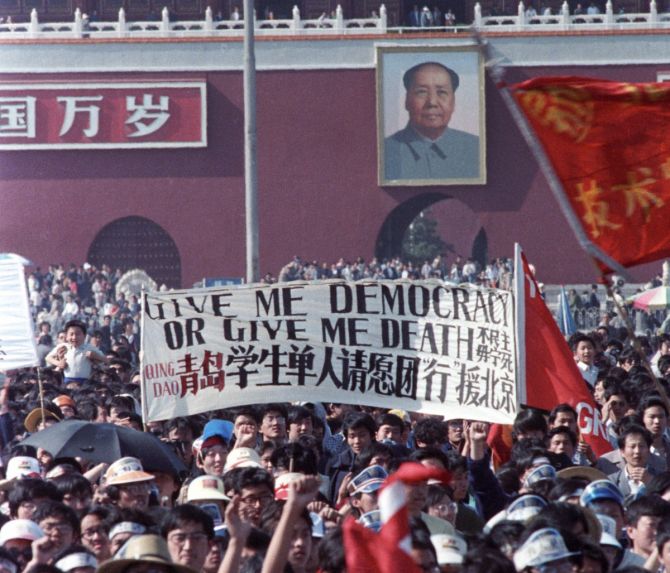
They gave Death
Why omit the Tiananmen massacre from the history of China's Communist party? asks Claude Arpi.
Here is the link...
Since the beginning of the year, China has started celebrating the 100 years of the Communist Party of China.
For the occasion, Chairman Xi, the new Mao, has decided to teach the history of Modern China to everyone in China; every citizen should “learn about a century of party history and write a new great legend [for the Party].”
An article in Xinhua states: “General Secretary Xi Jinping attaches great importance to the Party history study and summarizes the main content of Party history study into 16 words, namely, "learning history to be clear [about the role of the Party], learning history to increase credit [points], learning history to respect morality, and learning history to practice [Communism].”
The ‘credit points’ refer to the way the totalitarian regime is keeping a tab on its citizens, by crediting (or debiting) each and every Chinese for his/her actions; even the most seemingly insignificant deed is recorded into the Communist Party’s mega computers’ memory.
The News Agency adds: “…The new journey of a modern socialist country has started well.”
On March 1, 2021, Xi addressed the young cadres at the Central Party School in Beijing; he told them that they were the successors of the old comrades, “the glory of the party is in your hands”, and exhorted them to be the “faithful successor of the tradition and fine work-style of the Communist Party, constantly enhancing willpower, perseverance and self-control and making contributions in the new journey of comprehensively building a modern socialist country in the New Era!” And, of course, “loyalty to the party is the primary political quality of Communists,” he added.
The words of the new Great Helmsman sound good, but there is another side to it; there are black (or ‘bloodied’ red) holes in the official history.
One of the ‘red’ holes occurred 32 years ago, on Tiananmen Square.
If Beijing has forgotten, the world has not.
The Black Book of Communism
In 1997, French scholar Stéphane Courtois, along with other European academics, published Le Livre noir du communisme which was later translated in several languages under the title The Black Book of Communism: Crimes, Terror, Repression.
The Black Book sold tens of millions of copies; it is still considered by many as one of the most influential publications written about the history of Communism in the 20th century. The authors documented the history of political repression by Communist states, including genocides, extrajudicial executions, deportations, killing populations in labour camps as well as artificially-created famines.
In the first chapter, The Crimes of Communism, Stéphane Courtois quoting Plato’s Republic and Thomas More as Communist examples of ‘utopian philosophy’, Courtois explains, “We must make a distinction between the doctrine of communism and its practice. As a political philosophy, communism has existed for centuries, even millennia.”
Courtois gave figures, people killed by Communist governments amount to more than 94 million, including 65 million in the People’s Republic of China, 20 million in the Soviet Union, 2 million in Cambodia, 2 million in North Korea, 1.7 million in Ethiopia, 1.5 million in Afghanistan, 1 million in Vietnam.
In China alone, there is no doubt today that the Great Leap Forward resulted in 40 to 50 million deaths. According to Frank Dikötter in his masterly Mao’s Great Famine: The History of China’s Most Devastating Catastrophe, 45 million people died unnecessarily. Yang Jisheng in Tombstone: The Great Chinese Famine, 1958–1962 put the tally between 43 million and 46 million.
No candle vigil any more
In the past, Hong Kong used to commemorate the Tiananmen Square events, today, the former British colony have banned to do so.
A historical event is worth recalling.
Dr Zhisui Li, Mao's private physician recorded the death of Zhou Enlai, the Chinese Premier and Mao Zedong’s reactions to it in 1976, Dr Li wrote: 'Beginning in mid-March, knowing that the Qing Ming festival for honoring the dead would be celebrated on April 4, the citizens of Beijing began going to the Monument to the Revolutionary Heroes in Tiananmen Square to place mourning wreaths for Zhou. The movement was spontaneous, and the crowds grew larger by the day. The country had not witnessed such an outpouring of popular sentiment since before the Communists came to power in 1949.”
As April 4 approached, Dr Li visited Tiananmen clandestinely: 'The Square was filled with tens of thousands of people singing, making speeches, and reading poems. The mourning wreaths stretched from the Monument to the Revolutionary Heroes in the centre of the square all the way to Changan Avenue just in front of the Gate of Heavenly Peace. …It was impressive and moving.”
A similar event occurred in 1989, 13 years later.
Though Hu Yaobang had been sacked as the secretary general of the Chinese Communist Party in January 1987, he was still a member of the Politburo and entitled to attend important meetings. On April 9, 1989, after uttering some strong words on the Communist Party's failures, the respected Hu Yaobang had a stroke. A week later he passed away (similarly, the Panchen Lama had a ‘stroke’ when he mentioned the misdeeds of the Party in January 1989 in Shigatse, Tibet).
The death of Hu Yaobang was the beginning of the largest spontaneous student revolution since 1919.
During the following days and weeks, the students demanded freedom of speech and the press, democratic elections, greater transparency in government dealings.
The students believed that Hu Yaobang had been sacked though he had followed 'correct' policies. They demanded that the government “should affirm as correct Hu Yaobang's views on democracy and freedom.”
When The People's Daily termed the first spontaneous demonstrations as 'turmoil', the events took a new turn. For the students, the word 'turmoil' (‘dongluan’) had a strong meaning in Chinese reminiscent of the black days of the Cultural Revolution.
Zhao Ziyang was then the Party’s General Secretary; having the same conviction as Hu Yaobang, he thought that a possibility of political reform existed in Communist China. During the following weeks, he constantly tried to negotiate a compromise with the students. This could have changed the Middle Kingdom's fate.
We know what followed: during the night of June 3, Premier Li Peng ordered the tanks to roll out on the Square. Several thousand students lost their lives that night. The Party was saved and the fate of China was sealed (at least for the next few decades). One of the many ironies was that Li Peng was Zhou Enlai's adopted son.
In the meantime, the history of Modern Tibet is also rewritten; forgotten are the hundreds of thousands dead or the complete destruction of innumerable monasteries; on May 23, the Communist Party celebrated the 70th anniversary of the ‘Liberation of Tibet’, when the Dalai Lama’s representatives were forced under duress to sign that Tibet had ‘returned’ to the Motherland (China).
On the occasion, the local press in Lhasa reported: “Early in the morning, in the Potala Palace Square, the golden characters of the Tibet Peaceful Liberation Monument shined brightly. As evidenced by the monument, the peaceful liberation of Tibet 70 years ago not only shattered the delusional attempts of external forces to separate Tibet from China, safeguarded national sovereignty and territorial integrity, safeguarded the unity of the motherland and ethnic unity, and opened up the liberation of millions of serfs.” The Communist newspaper added: “This is a new day, and the sun shines all over the snowy plateau.”
The Xinhua article quoted earlier, concluded: “Looking back on the party’s history …our party has always adhered to the original aspiration and mission of seeking happiness for the Chinese people and rejuvenation for the Chinese nation, and it has never hesitated to advance toward this goal, thus winning the sincere and firm support of the people.”
If it was true, why omit the Great Leap Forward, the Cultural Revolution or the Tiananmen massacre from the history of the Party? It should at least have been analyzed to understand what went wrong; hiding a large portion of history does not give credibility to the Party.
Similarly, the Party is today hiding what happened in Wuhan.
It is time the world starts pressurizing Beijing to tell the truth.
Showing posts with label June 4. Show all posts
Showing posts with label June 4. Show all posts
Friday, June 4, 2021
Is Xi Scared of Tiananmen 1989?


Tuesday, June 1, 2021
When the Chinese Glasnost died again
 One the occasion of the 32th anniversary of the Tiananmen massacre, I re-post an article written in January 2005.
Two years ago, during the monthly briefing by senior Colonel Wu Qian, the spokesman of the Chinese Ministry of National Defence, a correspondent asked if the People's Liberation Army had any comment on the suppression of students 30 years ago.
Wu Qian replied: "I don't agree with the word 'suppression' in your question."
He added "Over the past 30 years, the process of our reform and development and our stability and achievements have already addressed your question."
Even this was deleted from the official transcript of the Press Conference...
It shows that China has not been nervous for a long time...
From Rediff.com, The Day Chinese Glasnost Died.
Did Zhao Ziyang die on January 8 or did he die on the morning of January 17? That is a million yuan question!
On the same day in 1976, another Chinese leader, its Prime Minister Zhou Enlai, passed away.
When Zhou died, the Great Proletarian Cultural Revolution had just ended. Modern China had gone through its 10 most tormented years.
During previous months, Mao had refused to provide treatment for his premier who had cancer; the Emperor wanted Zhou to die before him.
Even in Communist China, there is protocol!
In fact, the problem was that the premier was more popular than the Great Helmsman with the masses. Zhou's death was observed by Dr Zhisui Li, Mao's private physician who commented: 'What worried me most was the power struggle to follow.'
In Beijing, memories of the Cultural Revolution purges were still fresh in the populace's psyche. Though resentment was growing, nothing could be done openly as yet.
At that time, the Chinese New Year was approaching. When Mao decided to celebrate the event with firecrackers, the crowd outside Zhongnanhai (the residential enclave where Politburo members live) thought the Chairman rejoiced over his premier's death. Anger mounted, but the people of Beijing had to wait a few more weeks to express their respect for the deceased leader.
Dr Li wrote: 'Beginning in mid-March, knowing that the Qing Ming festival for honoring the dead would be celebrated on April 4, the citizens of Beijing began going to the Monument to the Revolutionary Heroes in Tiananmen Square to place mourning wreaths for Zhou. The movement was spontaneous, and the crowds grew larger by the day. The country had not witnessed such an outpouring of popular sentiment since before the Communists came to power in 1949.'
As April 4 approached, Dr Li visited Tiananmen clandestinely: 'The Square was filled with tens of thousands of people singing, making speeches, and reading poems. The mourning wreaths stretched from the Monument to the Revolutionary Heroes in the centre of the square all the way to Changan Avenue just in front of the Gate of Heavenly Peace, and thousands of banners were flapping in the breeze. It was impressive and moving.'
A similar event occurred 13 years later.
In 1989, though Hu Yaobang had been sacked as the secretary general of the Chinese Communist Party in January 1987, he was still a member of the Politburo and entitled to attend important meetings. On April 9, after uttering some strong words on the Communist Party's failures, the respected Hu Yaobang had a stroke. A week later he passed away.
Zhao Zhiang, then secretary general of the Chinese Communist Party, made the customary brief assessment of Hu's life: 'Comrade Hu was a loyal, tried and tested Communist fighter, a great proletarian revolutionary and politician, an outstanding political worker for the army.'
It was agreed that Hu would have a national funeral service with the norms of standing members of the Politburo. The plan was accepted by all the party's senior leaders including Deng Xiaoping. During that meeting, Zhao requested Qiao Shi, No 3 in the party and responsible for security, to 'keep a close watch on how Comrade Yaobang's death might impact society.' Qiao Shi is said to have replied: 'At the moment, society is in pretty good shape, Things are fairly stable.'
In the afternoon of April 17, 600 students of the Chinese University of Political Science and Law marched into Tiananmen Square with mourning banners and wreaths. They were 10,000 by the evening.
The next day, students and onlookers poured in from Beijing University and other places. Wreaths accumulated in front of the Monument to the Revolutionary Heroes.
The rest is history.
It was the beginning of the largest spontaneous student revolution since 1919.
During the following days and weeks, the students demanded freedom of speech and the press, democratic elections, greater transparency in government dealings.
The pretext for the explosion of the students' ire was the fact that Hu Yaobang had been sacked though he had followed 'correct' policies. They demanded that the government 'should affirm as correct Hu Yaobang's views on democracy and freedom.' When the People's Daily termed the first spontaneous demonstrations as 'turmoil', the events took a new turn. For the students, the word 'turmoil' (dongluan) had a strong meaning in Chinese reminiscent of the black days of the Cultural Revolution.
One man played a major role in the Tiananmen events -- Zhao Ziyang. Having the same conviction as Hu Yaobang, he thought that a possibility of political reform existed in Communist China. During the following weeks, he constantly tried to negotiate a compromise with the students. This could have changed the Middle Kingdom's fate.
One of his collaborators, Wu Guoguang, remembered in Time magazine: 'In the wrong place at the wrong time, Zhao Ziyang did the right thing. It was close to midnight on the night of May 19, 1989. China's leaders were finalising their plans to declare martial law and crush the Tiananmen Square democracy protests that had, in the preceding 48 hours, swelled to include more than a million demonstrators.
Zhao, then general secretary of the Chinese Communist Party, might have remained with the commissars inside Beijing's Great Hall of the People as they called in the troops. Instead, stooped with fatigue, tears in his eyes, he waded into the throngs of students and in the gathering darkness pleaded with them to abandon their vigil before it was too late.'
Three days earlier Zhau had received Mikhail Gorbachev, then general secretary of the Soviet Union Communist Party. Was Zhao trying to emulate his Soviet counterpart when he spoke to the students? The Chinese leader told Gorbachev, 'Some young people now had doubts about the superiority of socialism, that these doubts arose from genuine problems with the Party leadership and certain entrenched habits, and that the only way out for socialism was continued vigorous reforms.'
This view was certainly not shared by all in the standing committee of the Politburo. Just after Zhao had met Gorbachev, an important meeting was held, the verdict was split: two members were in favour of using force against the students, two were for a continuation of the dialogue and one, Qiao Shi, abstained.
The next day, the matter was referred to Deng Xiaoping. Zhao had told Gorbachev: 'Even though Deng Xiaoping had retired from his Party posts in 1987, the Party had recognised that his wisdom and experience were essential and that for the most important questions he would still be at the helm.'
Deng decided to use force. On May 20, the martial law order was signed by Prime Minister Li Peng. Two days later, Zhao Ziyang was sacked and Jiang Zemin was called from Shanghai to replace him.
During the night of June 3, Li Peng ordered the tanks to roll on the Square. Between 3,000 and 10000 students lost their lives that night. The Party was saved and the fate of China was sealed (at least for the next few decades). One of the many ironies was that Li Peng was Zhou Enlai's adopted son.
On October 17, 2004, Zhao celebrated his 75th birthday. The Human Rights in China group reported: 'In the past three days large groups of people have been gathering outside Zhao's Beijing home, requesting permission to see him. The groups, which range in size from a dozen to upwards of 100 people, seem to be made up largely of Zhao's former subordinates and his close friends and relatives.'
On the same day, a group of senior Chinese citizens and Zhao's supporters wrote to President Hu Jintao and Premier Wen Jiabao about Zhao's continuous detention: 'We strongly urge that you unconditionally and immediately release Mr Zhao Ziyang from house arrest, restore his freedom, and resume all his civil rights!
'No matter how the CPC (Chinese Communist Party and its government would now judge the 1989 political storm and whether Mr Zhao was right or wrong at that time, as a citizen of the People's Republic of China, his civil rights ought to be respected and protected. Without due legal procedure, his freedom and civil rights are not to be deprived. We believe that you share this common view with us, and with all those who respect the constitution and laws of China.'
On January 8, 2005, the media reported from Hong Kong that Zhao had died. This was denied by Chinese Foreign Ministry spokesman Kong Quan as totally untrue: 'Zhao Ziyang is an old man who is over 80. He fell ill, but after attentive treatment, his condition is currently stable,' he told reporters. However, one can doubt the veracity of this declaration (Zhao's daughter admitted he was in a coma).
Probably, like Yasser Arafat, the announcement of his death will be stage managed to ensure that all arrangements for his 'non-official' funeral are complete.
Already news from the BBC says, 'A thousand policemen are to be deployed every morning on Beijing's Tiananmen Square to escort visitors to the flag-raising ceremony. The new rules may be designed to prevent any dawn protests on the square, scene of a bloody pro-democracy crackdown in 1989.'
All this coincides with the publication of a Gallup report which concluded: 'The people of China may be far wealthier than they were a decade ago, but they are not very satisfied with their quality of life, a survey showed.'
In the meantime, the European Union prepares to lift the arms embargo imposed after the Tiananmen events.
This will be the third time Zhao died. Politically, he died at Tiananmen Square in May 1989; he probably died in a Beijing hospital earlier this month; and the principles he fought for will be buried for the sake of selling a few weapons more.
Wednesday, June 5, 2019
I would like to perform one Kalachakra initiation on Tiananmen

Eighteen years ago...
In 2001, I had an interview with the Dalai Lama in Dharamsala. It was published by Rediff.com.
Click here to read the interview.
March 27, 2001, Dharamsala: HP: The Little Lhasa in exile. For the past two weeks a colourful crowd of more than 10,000 devotees has followed the Dalai Lama's teachings on the Graded Path of Enlightenment. They have come from the Himalayan regions of Ladakh, Lahaul, Spiti or from the refugee settlements of South India and even from Tibet. A contingent of a few hundreds westerners have also joined in.
The day's Buddhist teachings are over and what better way to relax and recover from these intense days of concentration and prayers, but to attend the annual Tibetan opera festival at the Tibetan Institute of Performing Arts, a mile away from McLeod Ganj, the Tibetan village with a British name.
It is here that the Dalai Lama receives Claude Arpi, a couple of days before leaving for another hectic 12 day journey to the Chinese 'rebel' island of Taiwan. He also explains the dichotomy between the real Karmapa and his rival. A Rediff exclusive.
On the occasion of the Tiananmen Day, here is an extract of the interview:
Could you envisage a day when you will perform the Kalachakra puja in Tiananmen Square?
Oh, yes.
Do you think lakhs of Chinese would come to listen to Buddhist teachings?
Yes. In fact, after the events in Tiananmen Square (in 1989), I felt that one day in the future, I would like to perform one Kalachakra initiation on Tiananmen in order to purify the area and help the people who died. This desire or vision is still there with me.
When you read the recently released the Tiananmen Papers, you see the leadership living in constant fear. Is it why they do not want to handle the Tibetan case?
More than 15 years ago, I met an old French diplomat, a friend of mine, he told me the Chinese Communist leaders fear religion, they fear Buddhism.
There is some substance in this and, of course, with the public interest for Marxist ideology decreasing, and the interest for spirituality (including the Falun Gong) increasing, naturally, the fear increases. Though (religious) practice is prohibited, it is today spontaneously increasing (in spite of the ban), so it is obviously causing fear.
Some sources say the Chinese leadership has no confidence in you. Is it true?
Yes, they think I am a very cunning, a very clever man. And on top of that they believe I am colluding with the Western powers to 'split' China. (Laughs).
Subscribe to:
Posts (Atom)