My article Is Xi Scared of Tiananmen 1989? appeared in Rediff.com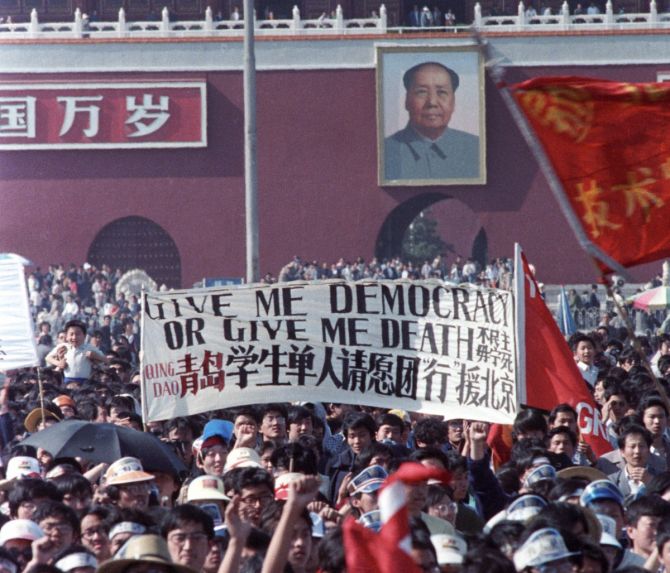
They gave Death
Why omit the Tiananmen massacre from the history of China's Communist party? asks Claude Arpi.
Here is the link...
Since the beginning of the year, China has started celebrating the 100 years of the Communist Party of China.
For the occasion, Chairman Xi, the new Mao, has decided to teach the history of Modern China to everyone in China; every citizen should “learn about a century of party history and write a new great legend [for the Party].”
An article in Xinhua states: “General Secretary Xi Jinping attaches great importance to the Party history study and summarizes the main content of Party history study into 16 words, namely, "learning history to be clear [about the role of the Party], learning history to increase credit [points], learning history to respect morality, and learning history to practice [Communism].”
The ‘credit points’ refer to the way the totalitarian regime is keeping a tab on its citizens, by crediting (or debiting) each and every Chinese for his/her actions; even the most seemingly insignificant deed is recorded into the Communist Party’s mega computers’ memory.
The News Agency adds: “…The new journey of a modern socialist country has started well.”
On March 1, 2021, Xi addressed the young cadres at the Central Party School in Beijing; he told them that they were the successors of the old comrades, “the glory of the party is in your hands”, and exhorted them to be the “faithful successor of the tradition and fine work-style of the Communist Party, constantly enhancing willpower, perseverance and self-control and making contributions in the new journey of comprehensively building a modern socialist country in the New Era!” And, of course, “loyalty to the party is the primary political quality of Communists,” he added.
The words of the new Great Helmsman sound good, but there is another side to it; there are black (or ‘bloodied’ red) holes in the official history.
One of the ‘red’ holes occurred 32 years ago, on Tiananmen Square.
If Beijing has forgotten, the world has not.
The Black Book of Communism
In 1997, French scholar Stéphane Courtois, along with other European academics, published Le Livre noir du communisme which was later translated in several languages under the title The Black Book of Communism: Crimes, Terror, Repression.
The Black Book sold tens of millions of copies; it is still considered by many as one of the most influential publications written about the history of Communism in the 20th century. The authors documented the history of political repression by Communist states, including genocides, extrajudicial executions, deportations, killing populations in labour camps as well as artificially-created famines.
In the first chapter, The Crimes of Communism, Stéphane Courtois quoting Plato’s Republic and Thomas More as Communist examples of ‘utopian philosophy’, Courtois explains, “We must make a distinction between the doctrine of communism and its practice. As a political philosophy, communism has existed for centuries, even millennia.”
Courtois gave figures, people killed by Communist governments amount to more than 94 million, including 65 million in the People’s Republic of China, 20 million in the Soviet Union, 2 million in Cambodia, 2 million in North Korea, 1.7 million in Ethiopia, 1.5 million in Afghanistan, 1 million in Vietnam.
In China alone, there is no doubt today that the Great Leap Forward resulted in 40 to 50 million deaths. According to Frank Dikötter in his masterly Mao’s Great Famine: The History of China’s Most Devastating Catastrophe, 45 million people died unnecessarily. Yang Jisheng in Tombstone: The Great Chinese Famine, 1958–1962 put the tally between 43 million and 46 million.
No candle vigil any more
In the past, Hong Kong used to commemorate the Tiananmen Square events, today, the former British colony have banned to do so.
A historical event is worth recalling.
Dr Zhisui Li, Mao's private physician recorded the death of Zhou Enlai, the Chinese Premier and Mao Zedong’s reactions to it in 1976, Dr Li wrote: 'Beginning in mid-March, knowing that the Qing Ming festival for honoring the dead would be celebrated on April 4, the citizens of Beijing began going to the Monument to the Revolutionary Heroes in Tiananmen Square to place mourning wreaths for Zhou. The movement was spontaneous, and the crowds grew larger by the day. The country had not witnessed such an outpouring of popular sentiment since before the Communists came to power in 1949.”
As April 4 approached, Dr Li visited Tiananmen clandestinely: 'The Square was filled with tens of thousands of people singing, making speeches, and reading poems. The mourning wreaths stretched from the Monument to the Revolutionary Heroes in the centre of the square all the way to Changan Avenue just in front of the Gate of Heavenly Peace. …It was impressive and moving.”
A similar event occurred in 1989, 13 years later.
Though Hu Yaobang had been sacked as the secretary general of the Chinese Communist Party in January 1987, he was still a member of the Politburo and entitled to attend important meetings. On April 9, 1989, after uttering some strong words on the Communist Party's failures, the respected Hu Yaobang had a stroke. A week later he passed away (similarly, the Panchen Lama had a ‘stroke’ when he mentioned the misdeeds of the Party in January 1989 in Shigatse, Tibet).
The death of Hu Yaobang was the beginning of the largest spontaneous student revolution since 1919.
During the following days and weeks, the students demanded freedom of speech and the press, democratic elections, greater transparency in government dealings.
The students believed that Hu Yaobang had been sacked though he had followed 'correct' policies. They demanded that the government “should affirm as correct Hu Yaobang's views on democracy and freedom.”
When The People's Daily termed the first spontaneous demonstrations as 'turmoil', the events took a new turn. For the students, the word 'turmoil' (‘dongluan’) had a strong meaning in Chinese reminiscent of the black days of the Cultural Revolution.
Zhao Ziyang was then the Party’s General Secretary; having the same conviction as Hu Yaobang, he thought that a possibility of political reform existed in Communist China. During the following weeks, he constantly tried to negotiate a compromise with the students. This could have changed the Middle Kingdom's fate.
We know what followed: during the night of June 3, Premier Li Peng ordered the tanks to roll out on the Square. Several thousand students lost their lives that night. The Party was saved and the fate of China was sealed (at least for the next few decades). One of the many ironies was that Li Peng was Zhou Enlai's adopted son.
In the meantime, the history of Modern Tibet is also rewritten; forgotten are the hundreds of thousands dead or the complete destruction of innumerable monasteries; on May 23, the Communist Party celebrated the 70th anniversary of the ‘Liberation of Tibet’, when the Dalai Lama’s representatives were forced under duress to sign that Tibet had ‘returned’ to the Motherland (China).
On the occasion, the local press in Lhasa reported: “Early in the morning, in the Potala Palace Square, the golden characters of the Tibet Peaceful Liberation Monument shined brightly. As evidenced by the monument, the peaceful liberation of Tibet 70 years ago not only shattered the delusional attempts of external forces to separate Tibet from China, safeguarded national sovereignty and territorial integrity, safeguarded the unity of the motherland and ethnic unity, and opened up the liberation of millions of serfs.” The Communist newspaper added: “This is a new day, and the sun shines all over the snowy plateau.”
The Xinhua article quoted earlier, concluded: “Looking back on the party’s history …our party has always adhered to the original aspiration and mission of seeking happiness for the Chinese people and rejuvenation for the Chinese nation, and it has never hesitated to advance toward this goal, thus winning the sincere and firm support of the people.”
If it was true, why omit the Great Leap Forward, the Cultural Revolution or the Tiananmen massacre from the history of the Party? It should at least have been analyzed to understand what went wrong; hiding a large portion of history does not give credibility to the Party.
Similarly, the Party is today hiding what happened in Wuhan.
It is time the world starts pressurizing Beijing to tell the truth.
Showing posts with label Zhao Ziyang. Show all posts
Showing posts with label Zhao Ziyang. Show all posts
Friday, June 4, 2021
Is Xi Scared of Tiananmen 1989?


Tuesday, June 1, 2021
When the Chinese Glasnost died again
 One the occasion of the 32th anniversary of the Tiananmen massacre, I re-post an article written in January 2005.
Two years ago, during the monthly briefing by senior Colonel Wu Qian, the spokesman of the Chinese Ministry of National Defence, a correspondent asked if the People's Liberation Army had any comment on the suppression of students 30 years ago.
Wu Qian replied: "I don't agree with the word 'suppression' in your question."
He added "Over the past 30 years, the process of our reform and development and our stability and achievements have already addressed your question."
Even this was deleted from the official transcript of the Press Conference...
It shows that China has not been nervous for a long time...
From Rediff.com, The Day Chinese Glasnost Died.
Did Zhao Ziyang die on January 8 or did he die on the morning of January 17? That is a million yuan question!
On the same day in 1976, another Chinese leader, its Prime Minister Zhou Enlai, passed away.
When Zhou died, the Great Proletarian Cultural Revolution had just ended. Modern China had gone through its 10 most tormented years.
During previous months, Mao had refused to provide treatment for his premier who had cancer; the Emperor wanted Zhou to die before him.
Even in Communist China, there is protocol!
In fact, the problem was that the premier was more popular than the Great Helmsman with the masses. Zhou's death was observed by Dr Zhisui Li, Mao's private physician who commented: 'What worried me most was the power struggle to follow.'
In Beijing, memories of the Cultural Revolution purges were still fresh in the populace's psyche. Though resentment was growing, nothing could be done openly as yet.
At that time, the Chinese New Year was approaching. When Mao decided to celebrate the event with firecrackers, the crowd outside Zhongnanhai (the residential enclave where Politburo members live) thought the Chairman rejoiced over his premier's death. Anger mounted, but the people of Beijing had to wait a few more weeks to express their respect for the deceased leader.
Dr Li wrote: 'Beginning in mid-March, knowing that the Qing Ming festival for honoring the dead would be celebrated on April 4, the citizens of Beijing began going to the Monument to the Revolutionary Heroes in Tiananmen Square to place mourning wreaths for Zhou. The movement was spontaneous, and the crowds grew larger by the day. The country had not witnessed such an outpouring of popular sentiment since before the Communists came to power in 1949.'
As April 4 approached, Dr Li visited Tiananmen clandestinely: 'The Square was filled with tens of thousands of people singing, making speeches, and reading poems. The mourning wreaths stretched from the Monument to the Revolutionary Heroes in the centre of the square all the way to Changan Avenue just in front of the Gate of Heavenly Peace, and thousands of banners were flapping in the breeze. It was impressive and moving.'
A similar event occurred 13 years later.
In 1989, though Hu Yaobang had been sacked as the secretary general of the Chinese Communist Party in January 1987, he was still a member of the Politburo and entitled to attend important meetings. On April 9, after uttering some strong words on the Communist Party's failures, the respected Hu Yaobang had a stroke. A week later he passed away.
Zhao Zhiang, then secretary general of the Chinese Communist Party, made the customary brief assessment of Hu's life: 'Comrade Hu was a loyal, tried and tested Communist fighter, a great proletarian revolutionary and politician, an outstanding political worker for the army.'
It was agreed that Hu would have a national funeral service with the norms of standing members of the Politburo. The plan was accepted by all the party's senior leaders including Deng Xiaoping. During that meeting, Zhao requested Qiao Shi, No 3 in the party and responsible for security, to 'keep a close watch on how Comrade Yaobang's death might impact society.' Qiao Shi is said to have replied: 'At the moment, society is in pretty good shape, Things are fairly stable.'
In the afternoon of April 17, 600 students of the Chinese University of Political Science and Law marched into Tiananmen Square with mourning banners and wreaths. They were 10,000 by the evening.
The next day, students and onlookers poured in from Beijing University and other places. Wreaths accumulated in front of the Monument to the Revolutionary Heroes.
The rest is history.
It was the beginning of the largest spontaneous student revolution since 1919.
During the following days and weeks, the students demanded freedom of speech and the press, democratic elections, greater transparency in government dealings.
The pretext for the explosion of the students' ire was the fact that Hu Yaobang had been sacked though he had followed 'correct' policies. They demanded that the government 'should affirm as correct Hu Yaobang's views on democracy and freedom.' When the People's Daily termed the first spontaneous demonstrations as 'turmoil', the events took a new turn. For the students, the word 'turmoil' (dongluan) had a strong meaning in Chinese reminiscent of the black days of the Cultural Revolution.
One man played a major role in the Tiananmen events -- Zhao Ziyang. Having the same conviction as Hu Yaobang, he thought that a possibility of political reform existed in Communist China. During the following weeks, he constantly tried to negotiate a compromise with the students. This could have changed the Middle Kingdom's fate.
One of his collaborators, Wu Guoguang, remembered in Time magazine: 'In the wrong place at the wrong time, Zhao Ziyang did the right thing. It was close to midnight on the night of May 19, 1989. China's leaders were finalising their plans to declare martial law and crush the Tiananmen Square democracy protests that had, in the preceding 48 hours, swelled to include more than a million demonstrators.
Zhao, then general secretary of the Chinese Communist Party, might have remained with the commissars inside Beijing's Great Hall of the People as they called in the troops. Instead, stooped with fatigue, tears in his eyes, he waded into the throngs of students and in the gathering darkness pleaded with them to abandon their vigil before it was too late.'
Three days earlier Zhau had received Mikhail Gorbachev, then general secretary of the Soviet Union Communist Party. Was Zhao trying to emulate his Soviet counterpart when he spoke to the students? The Chinese leader told Gorbachev, 'Some young people now had doubts about the superiority of socialism, that these doubts arose from genuine problems with the Party leadership and certain entrenched habits, and that the only way out for socialism was continued vigorous reforms.'
This view was certainly not shared by all in the standing committee of the Politburo. Just after Zhao had met Gorbachev, an important meeting was held, the verdict was split: two members were in favour of using force against the students, two were for a continuation of the dialogue and one, Qiao Shi, abstained.
The next day, the matter was referred to Deng Xiaoping. Zhao had told Gorbachev: 'Even though Deng Xiaoping had retired from his Party posts in 1987, the Party had recognised that his wisdom and experience were essential and that for the most important questions he would still be at the helm.'
Deng decided to use force. On May 20, the martial law order was signed by Prime Minister Li Peng. Two days later, Zhao Ziyang was sacked and Jiang Zemin was called from Shanghai to replace him.
During the night of June 3, Li Peng ordered the tanks to roll on the Square. Between 3,000 and 10000 students lost their lives that night. The Party was saved and the fate of China was sealed (at least for the next few decades). One of the many ironies was that Li Peng was Zhou Enlai's adopted son.
On October 17, 2004, Zhao celebrated his 75th birthday. The Human Rights in China group reported: 'In the past three days large groups of people have been gathering outside Zhao's Beijing home, requesting permission to see him. The groups, which range in size from a dozen to upwards of 100 people, seem to be made up largely of Zhao's former subordinates and his close friends and relatives.'
On the same day, a group of senior Chinese citizens and Zhao's supporters wrote to President Hu Jintao and Premier Wen Jiabao about Zhao's continuous detention: 'We strongly urge that you unconditionally and immediately release Mr Zhao Ziyang from house arrest, restore his freedom, and resume all his civil rights!
'No matter how the CPC (Chinese Communist Party and its government would now judge the 1989 political storm and whether Mr Zhao was right or wrong at that time, as a citizen of the People's Republic of China, his civil rights ought to be respected and protected. Without due legal procedure, his freedom and civil rights are not to be deprived. We believe that you share this common view with us, and with all those who respect the constitution and laws of China.'
On January 8, 2005, the media reported from Hong Kong that Zhao had died. This was denied by Chinese Foreign Ministry spokesman Kong Quan as totally untrue: 'Zhao Ziyang is an old man who is over 80. He fell ill, but after attentive treatment, his condition is currently stable,' he told reporters. However, one can doubt the veracity of this declaration (Zhao's daughter admitted he was in a coma).
Probably, like Yasser Arafat, the announcement of his death will be stage managed to ensure that all arrangements for his 'non-official' funeral are complete.
Already news from the BBC says, 'A thousand policemen are to be deployed every morning on Beijing's Tiananmen Square to escort visitors to the flag-raising ceremony. The new rules may be designed to prevent any dawn protests on the square, scene of a bloody pro-democracy crackdown in 1989.'
All this coincides with the publication of a Gallup report which concluded: 'The people of China may be far wealthier than they were a decade ago, but they are not very satisfied with their quality of life, a survey showed.'
In the meantime, the European Union prepares to lift the arms embargo imposed after the Tiananmen events.
This will be the third time Zhao died. Politically, he died at Tiananmen Square in May 1989; he probably died in a Beijing hospital earlier this month; and the principles he fought for will be buried for the sake of selling a few weapons more.
Tuesday, June 4, 2019
Tiananmen Square: 30 Years Later

Here is the link...
Thirty years after the massacre at Tiananmen Square, coerced collective amnesia envelops the Chinese nation about that horrific event.
Claude Arpi glances back at how the student uprising could have changed the Middle Kingdom forever had the Chinese Communist party not traveled on the route of martial law.
In 2005, I wrote a piece The Day Chinese Glasnost Died for Rediff.com.
Former Chinese Premier Zhao Ziyang had just passed away.
Can you believe that fourteen years later, the leadership in Beijing is still afraid of Zhao's ghost.
On January 17, 2013, The South China Morning Post had reported: "More than 100 mourners flocked to a traditional house in a quiet alleyway in Beijing yesterday morning to pay their respects at the home of the late Zhao Ziyang on the eighth anniversary of the ousted party chief's death," explaining “before his death, Zhao had been under house arrest at the courtyard home at No 6 Fuqiang Alley since opposing the use of military force against the Tiananmen Square demonstrators in 1989.”
Bao Tong, Zhao Ziyang’s secretary, who published the former Premier's memoirs, Prisoner of the State: The Secret Journal of Premier Zhao Ziyang, knew the implications of being close to Zhao: his home telephone was constantly tapped, he was followed everywhere he went and he was banned from approaching 'sensitive' events or places.
The situation in the Middle Kingdom has not improved, it has even worsened; while aiming at becoming the World Economic Power No 1, with a myriad of stealth jet planes, warships (soon three aircraft carriers), with the latest missiles and futuristic gadgets using Artificial Intelligence (AI) to monitor the life of the ‘masses’, China seems unshakable; but the ‘human’ intelligence and humanity symbolized by Zhao, has disappeared entirely from China, to be replaced by a authoritarian system (and even worse for places like Xinjiang).
Six years ago, Bao had explained why Zhao was not popular with the regime; China's former Premier simply treated people as human beings. Bao elaborated, “This doesn't sound very extraordinary …he was instrumental in protecting the autonomy of farming communities, because he saw farmers as people. He was instrumental in protecting the autonomy of enterprises, because he saw entrepreneurs and their workforce as people. He was instrumental in stopping the Party pronouncing on everything, because he didn't see the Party as a judge…”
Today, the Party is above everyone, monitoring and controlling everything.
What happened thirty years ago?
In January 1987, another great Chinese leader, Hu Yaobang was sacked as the Communist Party’s General Secretary; on April 9, 1989, still a member of the Politburo and entitled to attend important meetings, while uttering strong words and speaking of the Communist Party's failures, the respected Hu had a stroke. A week later, he passed away.
Zhao Zhiang, then secretary general of the Chinese Communist Party, made the customary brief assessment of Hu's life: “Comrade Hu was a loyal, tried and tested Communist fighter, a great proletarian revolutionary and politician, an outstanding political worker for the Army.”
It was agreed that Hu would have a national funeral service reserved for the Politburo’s Standing Committee members. But in the afternoon of April 17, 600 students of the Chinese University of Political Science and Law marched into Tiananmen Square with mourning banners and wreaths. They were 10,000 by the evening.
The next day, students and onlookers poured in from Beijing University and other places. Wreaths accumulated in front of the Monument to the Revolutionary Heroes.
The rest is history. It was the beginning of the largest spontaneous student revolution since 1919.
One man played a major role in the Tiananmen events - Zhao Ziyang. Having the same conviction as Hu Yaobang, he saw that the possibility of political reform existed in Communist China. During the following weeks, he constantly tried to negotiate a compromise with the students. This could have changed the Middle Kingdom's fate. It was not to be.
On May 20, the martial law order was signed by Prime Minister Li Peng. Two days later, Zhao Ziyang was sacked and Jiang Zemin was called from Shanghai to replace him.
During the night of June 3, Li Peng ordered the tanks to roll on the Square. Some 3,000 students are said to have lost their lives that night. The Party was saved and the fate of China was sealed (at least for the next few decades).
Thirty Years Later
Today, the momentous events on the Tiananmen Square have been erased from the public memory; nobody wants to remember the June 4 massacre. Cary Huang, a senior columnist with The South China Morning Post, wrote recently: “In 2019, China ushers in a year full of both festive jubilation and political trouble. Its communist leadership places enormous emphasis on the anniversaries of important historical events …China has a lot to celebrate in 2019 but it also has old wounds to heal.”
Huang noted that with its packed 2019 calendar of commemorative events, Beijing may ‘forget’ some of them, “many of which are politically charged or divisive. For a nation moving forward, it’s time to acknowledge the difficult past,” he argued.
It will not happen on June 4; already on March 28, Beijing selectively remembered the date as the 60th anniversary of Serfs Emancipation Day; but what was this emancipation?
March 28, 1959 marked a massacre of the Tibetan population in Lhasa and the Communist Party taking full control over the Tibetan capital; 18 days earlier, the Dalai Lama had fled the Roof of the World to take refuge in India. On March 28, the revered Lama was sacked as chairman of the Preparatory Committee for the Tibet Autonomous Region and was replaced by a (then) more pliant Panchen Lama.
While these events are forgotten, the May Fourth Movement which took place in 1919 in the Chinese capital has been celebrated with pomp; on that day, students started protesting against the nationalist Government’s weak response to the Treaty of Versailles, allowing Japan to control the territories surrendered by Germany in Shandong.
On the occasion, Xi Jinping affirmed that patriotism was the core spirit of the 1919 event. He added that the May Fourth Movement inspired the ambition and confidence of the Chinese people and the nation to realize national rejuvenation. “It was also a great enlightenment and new cultural movement of disseminating new thought, new culture and new knowledge,” Xi said. But, of course, the students of 1989, did not exist, though they also wanted a better China.
On May 27, The South China Morning Post published an article entitled Generation Amnesia explaining why China’s youth don’t talk about Tiananmen; it looked at how censorship, silence and time have created a gulf between the young people who witnessed the events and those who came after them.
The Hong Kong newspaper quotes several witnesses of the tragic events, including Zhang Shijun, a medic with the People’s Liberation Army’s 54th Army Group, one of the military units engaged in enforcing martial law in Beijing; Zhang preferred that his daughter remains unaware of what happened.
Andrew Nathan, who compiled the Tiananmen Papers says that the Communist Party imposed complete censorship of June 4 because even discussing the possibility of ‘errors and crimes’ would make the party’s will to power seem weak: “Controlling speech sends a message that the party will not allow any opposition, and this message of determination makes people afraid that if they talk about forbidden topics they will be punished,” he said.
The lofty concepts of freedom and liberty have entirely disappeared from today’s China; a Reuters article describes how China's robot censors work overtime for this purpose.
The news agency affirms: “Censors at Chinese internet companies say tools to detect and block content related to the 1989 crackdown have reached unprecedented levels of accuracy, aided by machine learning and voice and image recognition.”
Two employees at Beijing Bytedance Co Ltd, a ‘censoring’ firm, said that censorship of the Tiananmen crackdown, along with other highly sensitive issues including Taiwan and Tibet, is now largely automated: “Posts that allude to dates, images and names associated with the protests are automatically rejected.”
They explained that AI is much more accurate, than the human intelligence.
Reuters commented: “June 4 itself is marked by a cat-and-mouse game as people use more and more obscure references on social media sites, with obvious allusions blocked immediately …even the word ‘today’ has been scrubbed.”
A question remains, how long can liberty and freedom of thought be stifled.
Certainly not for ever.
Monday, March 31, 2014
Tibetan Flag and Phunwang

He was 91.
"Phuntso's son, Phunkham, told Reuters "He left this morning. Before his death, he was a Communist Party member. After his death, we have invited lamas to pray (for his soul) according to traditional Tibetan culture."
The Dalai Lama was probably immediately informed of the death of his former translator.
A couple of years ago, I wrote an article on an interesting story about the Tibetan flag. It is reproduced below:
Reuters recently published a fascinating piece of information. Phuntso Wangye, a veteran Tibetan Party leader would have written a series of three letters to President Hu Jintao. Wangye is not an ordinary Tibetan; in the forties, he was the first Tibetan Communist and in September 1951, he led the Chinese troops into Lhasa.
In his letter Phunwang told Hu that Beijing was mistaken to believe that the Tibetan issue will be solved with the death of the present Dalai Lama: "Any notion of delaying the problem until after the 14th Dalai Lama dies a natural death is not only naive, it is also unwise and especially tactically wrong."
On the contrary, he warned the Chinese leadership who read his letters that the Tibetan leader’s demise would only radicalize young Tibetan hardliners frustrated with his ‘middle way’ approach.
He reminded the Chinese President about his own objective to establish a harmonious society. If he strived for the return of hundreds of thousands of exiled Tibetans, he could turn ‘confrontation into harmony’.
Phunwang concluded: "wrong leftist policies continue on ethnic and religious issues, especially in Tibet… it should cease.”
This reminded me of a talk that I had some 10 years ago with Phuntso Tashi Taklha who was the Kusum Depon, in charge of the Dalai Lama’s security when the Tibetan leader visited China in 1954. Taklha told me: “At that time [in 1954] because the Chinese occupation of Tibet was not complete, the Chinese extended full courtesy and cooperation to the Dalai Lama. On some occasions Mao Zedong came himself to the Dalai Lama’s residence [in Beijing]. During one of the several discussions that the Dalai Lama and Mao Zedong had, they were talking on some subject, when Mao [suddenly] said: “Don’t you have a flag of your own, if you have one you can hoist it here”. Mao Zedong spoke like that. This I never told anybody before.”
I must admit that I did not immediately realize the importance of Mao’s point, but when I later read Phunwang’s biography, I understood better the incalculable implications of the Chairman’s statement.
It is worth quoting Phunwang: “One day, Mao unexpectedly came to visit the Dalai Lama at his residence… During their conversation, Mao suddenly said, "I heard that you have a national flag, do you? They do not want you to carry it, isn't that right?"
‘They’ were Zhang Jingwu, Zhang Guohua and Fan Ming, senior Chinese officials involved in Tibetan Affairs
Phunwang recalled: “Since Mao asked this with no warning that the topic was to be discussed, the Dalai Lama just replied, "We have an army flag." I thought that was a shrewd answer because it didn't say whether Tibet had a national flag. Mao perceived that the Dalai Lama was concerned by his question and immediately told him, "That is no problem. You may keep your national flag." Mao definitely said ‘national’ flag [tib. rgyal dar]. "In the future," he said, "we can also let Xinjiang have their own flag, and Inner Mongolia, too. Would it be okay to carry the national flag of the People's Republic of China in addition to that flag? Would that be all right?" The Dalai Lama nodded his head yes. This was the most important thing that Mao told the Dalai Lama, and I was amazed to hear it.
The Tibetan communist continued: “My mind was racing. I didn't know whether Mao had discussed this with other leaders in the Politburo or whether he mentioned it on his own. As I had always paid great attention to the Soviet Union's nationality model, I was excited because I took Mao's comment that Tibet could use its own flag to mean that China was contemplating adopting the Soviet Union's ‘Republic’ model, at least for these three large minority nationalities. That's why I thought it was something new and very important.”
This remark had a deep impact on Phuwang who one day of April 1958 was unexpectedly arrested; he was just informed that he needed to 'cleanse his thinking'. During the following 18 years, he was interrogated, tortured and jailed in the most atrocious conditions. He was finally rehabilitated at the end of the seventies.
After his rehabilitation, he continued to ponder on the isuues of nationalities within the People’s Republic of China. His personal belief was that the relationship between nationalities in a multiethnic state was supposed to be one of complete equality.
He thought: “from the Marxist standpoint, the struggle of minority nationalities against oppression by the majority nationality is correct and justified because there is no equality. In the absence of true equality, ‘splittism’ is a valid response for minority nationalities.” He had himself experienced for years of ‘Great Han Chauvinism’.
His contention was: “In socialist states, the majority nationality does not (or should not) oppress the minority nationalities. All should be equal, and there should be complete unity and cooperation among nationalities.”
This had a serious corollary for Tibet and other nationalities: the State had to guarantee the equality amongst nationalities (among other things, by not imposing Han language over ‘nationality language’ such Tibetan).
In the 80’s, when he elaborated on his theory, he again got into trouble. For several years, he was severely ‘criticized’ by leading members of the Party; Li Fatang, then Party Secretary in Tibet was one of them. Finally he managed to send a 25,000 character note to senior Party leaders such as Deng Xiaoping, Hu Yaobang, Zhao Ziyang and Li Weihan (who had signed the 17-Point Agreement with Tibet). While stressing that the outcome of a debate on the question of nationality would have a huge impact on future work in ‘minority nationality areas’ such Tibet, he told bluntly the leaders: “there had been no comparable debate in the party on nationality affairs.”
While many in the Party wanted to show him the door, Hu Yaobang and Deng Xiaoping instructed the officials not to remove him as a member of the Standing Committee of the National People's Congress. In a way, his stand was vindicated and in December 1982, he felt proud that the new Chinese Constitution stated: “Socialist relations of equality, unity, and mutual assistance have been established among the nationalities and will continue to be strengthened."
Slowly China became less rigid and in 1984, Zhao Ziyang told the Tibetan Party leaders: "Economic development is the work priority for the nation - including Tibet. Phunwang and the Panchen Lama are both our people and we are trying to win over the Dalai Lama. Therefore, it is wrong to make them objects of political attack."
Hu Yaobang, the Party boss agreed with Zhao: "Economic development is the priority of the whole nation… our country has had very hard times. If we do not pay attention to economic development in Tibet and improve the people's living conditions there, we will never achieve the kinds of political results we want."
He also said that it was wrong to single out three people (the Dalai Lama, the Panchen Lama and Phunwang) and make them targets of political struggle.
The debate started by Mao’s remark more than fifty years ago and reignited by Phunwang twenty years back, is still on. Will Hu Jintao and his colleagues get Phunwang’s point on the issue of nationalities or will the Great Han Chauvinism prevail once again? Perhaps the fate of the Dalai Lama’s ‘middle path’ approach and his representative’s dialogue with the United Front Department depends on which side the wind will blow in Beijing?
But it is still not advisable to go around the Bakhor with a Tibetan flag: Mao’s Thought has not percolated as yet in Tibet.
Sunday, February 3, 2013
Ghost of Zhao Ziyang still haunts China’s new leadership
 My article Ghost of Zhao Ziyang still haunts China’s new leadership is posted on niticentral.com.
Click here to read...
Sunday, January 20, 2013
The Day Chinese Glasnost died
Eight years ago, I wrote for Rediff.com, The Day Chinese Glasnost Died.Former Chinese Premier, Zhao Ziyang had just passed away.
Eight years later, the new leadership in Beijing is still afraid of Zhao's ghost; they tightly control whatever is happening around his former residence.
On January 17, The South China Morning Post reported: "More than 100 mourners flocked to a traditional house in a quiet alleyway in Beijing yesterday morning to pay their respects at the home of the late Zhao Ziyang on the eighth anniversary of the ousted party chief's death," adding "before his death, Zhao had been under house arrest at the courtyard home at No 6 Fuqiang Alley since opposing the use of military force against the Tiananmen Square demonstrators in 1989."
Though according to Zhao's daughter Wang Yannan, this year the Communist authorities did not try to stop Zhao's family from receiving mourners, nobody from the government visited Zhao's residence.
Microblog postings on Zhao were however dutifully removed from the Net.
Hu Jia, a two-time Nobel Peace Prize nominee explained to the Hong Kong daily that he had to sneak out from his apartment 6 am, in disguise, when security was laxer. As soon as the police noticed that he was not home, his mother was warned that he could be arrested again (Hu was jailed in 2008 and was released June 2011).
Hu Jia said: "People are talking about the changes since the new leadership took power, but I don't see much change based on my own experiences."
Bao Tong, a former secretary of Zhao Ziyang who helped published the former Premier's memoirs Prisoner of the State: The Secret Journal of Premier Zhao Ziyang, knows what it means to be close to Zhao.
His home telephone is constantly tapped and periodically cut off. Bao Tong is still followed everywhere he goes, and banned from 'sensitive' events or places. Even visits from his son, Bao Pu, who lives in Hong Kong need prior clearance from the Public Security Bureau.
On the occasion of Zhao's 8th death anniversary, Bao explained why Zhao is not popular with the regime. China's former Premier just treated people as 'human beings':
Zhao Ziyang had a particular characteristic: he treated people as human beings ... This doesn't sound very extraordinary ... but it's not a misunderstanding to understand him in this way, nor is it an exaggeration.Further, Zhao refused to believe that as the Premier of the State Council, he was superior to the masses. It cost him his job.
He was instrumental in protecting the autonomy of farming communities, because he saw farmers as people. He was instrumental in protecting the autonomy of enterprises, because he saw entrepreneurs and their workforce as people.
He was instrumental in stopping the Party pronouncing on everything, because he didn't see the Party as a judge.
He was also instrumental in stopping the Party from censoring books and newspapers, because he thought authors should be authors, and not the subject of constant inspection.
Perhaps it was his tendency to treat people as people that led so many people to appreciate Zhao Ziyang. Perhaps it is this very tendency that leads some people now to pretend that no such person ever existed.
Bao believes that to treat others as human being is an affront to the leaders' superiority:
Of course, in an ordinary citizen, such a quality isn't anything unusual. But the leadership at various levels seem to regard treating people like human beings as an affront to their own superiority. I'm not talking about a myth; I'm talking about our country's modern history.Will the new leadership bring a wind of glasnost on the Middle Kingdom like Zhao tried in the 1990s?
To put it in a more abstract manner, if the one who conducts the main theme tune decides that he wants to stake out his political territory, then people become a target to be silenced.
If hard reasoning tells one to go out and get rich, then people become the trees that money grows on, or the goose that lays the golden egg.
If a performance is meant to create a sensational effect, then people come in handy as extras and props. So you see, people don't often get treated as people.
To give a concrete example: Mao Zedong was number one, the leader in charge of everything. Because of this, no one else, not Liu Shaoqi, Peng Dehuai, nor Xi Chongjin could be treated as people. They were simply there to be led by Mao.
They had to surrender utterly to his will, and not the tiniest breach of his edicts was tolerated.
I believe some are trying; the battle is on.
 | ||
| Zhao speaking to the students on Tiananmen Square Wen Jiabao, the present Premier seen behind |
The Day Chinese Glasnost died
Rediff.comm
January 17, 2005
Did Zhao Ziyang die on January 8 or did he die on the morning of January 17? That is a million yuan question!
On the same day in 1976, another Chinese leader, its Prime Minister Zhou Enlai, passed away.
When Zhou died, the Great Proletarian Cultural Revolution had just ended. Modern China had gone through its 10 most tormented years.
During previous months, Mao had refused to provide treatment for his premier who had cancer; the Emperor wanted Zhou to die before him.
Even in Communist China, there is protocol!
In fact, the problem was that the premier was more popular than the Great Helmsman with the masses. Zhou's death was observed by Dr Zhisui Li, Mao's private physician who commented: 'What worried me most was the power struggle to follow.'
In Beijing, memories of the Cultural Revolution purges were still fresh in the populace's psyche. Though resentment was growing, nothing could be done openly as yet.
At that time, the Chinese New Year was approaching. When Mao decided to celebrate the event with firecrackers, the crowd outside Zhongnanhai (the residential enclave where Politburo members live) thought the Chairman rejoiced over his premier's death. Anger mounted, but the people of Beijing had to wait a few more weeks to express their respect for the deceased leader.
Dr Li wrote: 'Beginning in mid-March, knowing that the Qing Ming festival for honoring the dead would be celebrated on April 4, the citizens of Beijing began going to the Monument to the Revolutionary Heroes in Tiananmen Square to place mourning wreaths for Zhou. The movement was spontaneous, and the crowds grew larger by the day. The country had not witnessed such an outpouring of popular sentiment since before the Communists came to power in 1949.'
As April 4 approached, Dr Li visited Tiananmen clandestinely: 'The Square was filled with tens of thousands of people singing, making speeches, and reading poems. The mourning wreaths stretched from the Monument to the Revolutionary Heroes in the centre of the square all the way to Changan Avenue just in front of the Gate of Heavenly Peace, and thousands of banners were flapping in the breeze. It was impressive and moving.'
A similar event occurred 13 years later.
In 1989, though Hu Yaobang had been sacked as the secretary general of the Chinese Communist Party in January 1987, he was still a member of the Politburo and entitled to attend important meetings. On April 9, after uttering some strong words on the Communist Party's failures, the respected Hu Yaobang had a stroke. A week later he passed away.
Zhao Zhiang, then secretary general of the Chinese Communist Party, made the customary brief assessment of Hu's life: 'Comrade Hu was a loyal, tried and tested Communist fighter, a great proletarian revolutionary and politician, an outstanding political worker for the army.'
It was agreed that Hu would have a national funeral service with the norms of standing members of the Politburo. The plan was accepted by all the party's senior leaders including Deng Xiaoping. During that meeting, Zhao requested Qiao Shi, No 3 in the party and responsible for security, to 'keep a close watch on how Comrade Yaobang's death might impact society.' Qiao Shi is said to have replied: 'At the moment, society is in pretty good shape, Things are fairly stable.'
In the afternoon of April 17, 600 students of the Chinese University of Political Science and Law marched into Tiananmen Square with mourning banners and wreaths. They were 10,000 by the evening.
The next day, students and onlookers poured in from Beijing University and other places. Wreaths accumulated in front of the Monument to the Revolutionary Heroes.
The rest is history.
It was the beginning of the largest spontaneous student revolution since 1919.
During the following days and weeks, the students demanded freedom of speech and the press, democratic elections, greater transparency in government dealings.
The pretext for the explosion of the students' ire was the fact that Hu Yaobang had been sacked though he had followed 'correct' policies. They demanded that the government 'should affirm as correct Hu Yaobang's views on democracy and freedom.' When the People's Daily termed the first spontaneous demonstrations as 'turmoil', the events took a new turn. For the students, the word 'turmoil' (dongluan) had a strong meaning in Chinese reminiscent of the black days of the Cultural Revolution.
One man played a major role in the Tiananmen events -- Zhao Ziyang. Having the same conviction as Hu Yaobang, he thought that a possibility of political reform existed in Communist China. During the following weeks, he constantly tried to negotiate a compromise with the students. This could have changed the Middle Kingdom's fate.
One of his collaborators, Wu Guoguang, remembered in Time magazine: 'In the wrong place at the wrong time, Zhao Ziyang did the right thing. It was close to midnight on the night of May 19, 1989. China's leaders were finalising their plans to declare martial law and crush the Tiananmen Square democracy protests that had, in the preceding 48 hours, swelled to include more than a million demonstrators.
Zhao, then general secretary of the Chinese Communist Party, might have remained with the commissars inside Beijing's Great Hall of the People as they called in the troops. Instead, stooped with fatigue, tears in his eyes, he waded into the throngs of students and in the gathering darkness pleaded with them to abandon their vigil before it was too late.'
Three days earlier Zhau had received Mikhail Gorbachev, then general secretary of the Soviet Union Communist Party. Was Zhao trying to emulate his Soviet counterpart when he spoke to the students? The Chinese leader told Gorbachev, 'Some young people now had doubts about the superiority of socialism, that these doubts arose from genuine problems with the Party leadership and certain entrenched habits, and that the only way out for socialism was continued vigorous reforms.'
This view was certainly not shared by all in the standing committee of the Politburo. Just after Zhao had met Gorbachev, an important meeting was held, the verdict was split: two members were in favour of using force against the students, two were for a continuation of the dialogue and one, Qiao Shi, abstained.
The next day, the matter was referred to Deng Xiaoping. Zhao had told Gorbachev: 'Even though Deng Xiaoping had retired from his Party posts in 1987, the Party had recognised that his wisdom and experience were essential and that for the most important questions he would still be at the helm.'
Deng decided to use force. On May 20, the martial law order was signed by Prime Minister Li Peng. Two days later, Zhao Ziyang was sacked and Jiang Zemin was called from Shanghai to replace him.
During the night of June 3, Li Peng ordered the tanks to roll on the Square. Between 3,000 and 10000 students lost their lives that night. The Party was saved and the fate of China was sealed (at least for the next few decades). One of the many ironies was that Li Peng was Zhou Enlai's adopted son.
On October 17, 2004, Zhao celebrated his 75th birthday. The Human Rights in China group reported: 'In the past three days large groups of people have been gathering outside Zhao's Beijing home, requesting permission to see him. The groups, which range in size from a dozen to upwards of 100 people, seem to be made up largely of Zhao's former subordinates and his close friends and relatives.'
On the same day, a group of senior Chinese citizens and Zhao's supporters wrote to President Hu Jintao and Premier Wen Jiabao about Zhao's continuous detention: 'We strongly urge that you unconditionally and immediately release Mr Zhao Ziyang from house arrest, restore his freedom, and resume all his civil rights!
'No matter how the CPC (Chinese Communist Party and its government would now judge the 1989 political storm and whether Mr Zhao was right or wrong at that time, as a citizen of the People's Republic of China, his civil rights ought to be respected and protected. Without due legal procedure, his freedom and civil rights are not to be deprived. We believe that you share this common view with us, and with all those who respect the constitution and laws of China.'
On January 8, 2005, the media reported from Hong Kong that Zhao had died. This was denied by Chinese Foreign Ministry spokesman Kong Quan as totally untrue: 'Zhao Ziyang is an old man who is over 80. He fell ill, but after attentive treatment, his condition is currently stable,' he told reporters. However, one can doubt the veracity of this declaration (Zhao's daughter admitted he was in a coma).
Probably, like Yasser Arafat, the announcement of his death will be stage managed to ensure that all arrangements for his 'non-official' funeral are complete.
Already news from the BBC says, 'A thousand policemen are to be deployed every morning on Beijing's Tiananmen Square to escort visitors to the flag-raising ceremony. The new rules may be designed to prevent any dawn protests on the square, scene of a bloody pro-democracy crackdown in 1989.'
All this coincides with the publication of a Gallup report which concluded: 'The people of China may be far wealthier than they were a decade ago, but they are not very satisfied with their quality of life, a survey showed.'
In the meantime, the European Union prepares to lift the arms embargo imposed after the Tiananmen events.
This will be the third time Zhao died. Politically, he died at Tiananmen Square in May 1989; he probably died in a Beijing hospital earlier this month; and the principles he fought for will be buried for the sake of selling a few weapons more.
Subscribe to:
Posts (Atom)